
Requiem for a Dream
Darren Aronofsky’s second feature follows four Coney Island lives through a single brutal seasonal arc. Twenty-five years on, it remains one of the few American films of its era that refused the consolation of an ending.
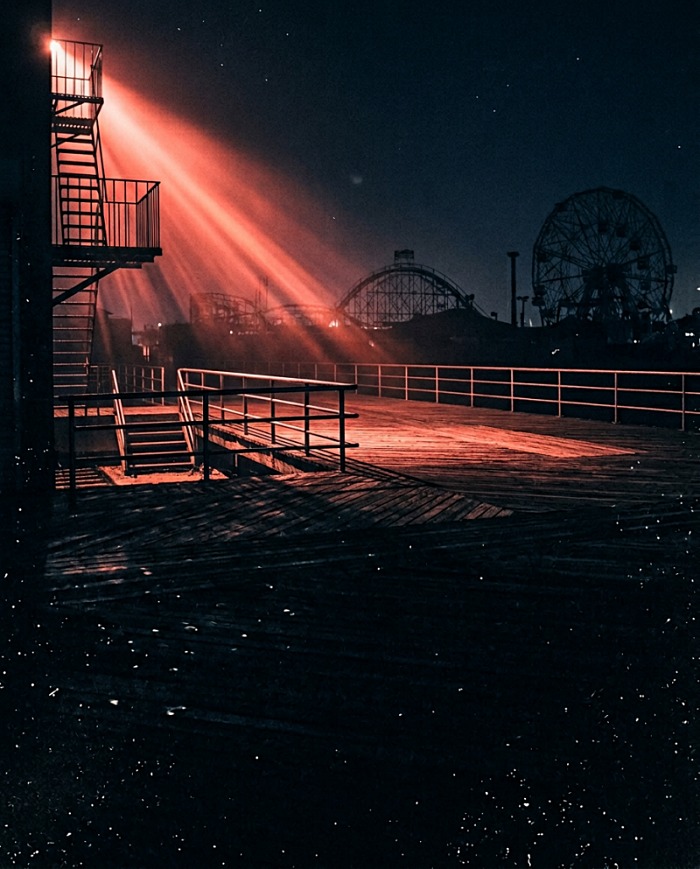 Reel A · Frame 001
Dir. Aronofsky
DP. Libatique
Score. Mansell
01
Reel A · Frame 001
Dir. Aronofsky
DP. Libatique
Score. Mansell
01
What it is, and what it does.
Adapted from Hubert Selby Jr.’s 1978 novel, Aronofsky’s film follows four people through a single Coney Island summer, autumn, and winter — a widowed mother, her son, her son’s girlfriend, and his closest friend. What begins as a film about dreams becomes, scene by carefully sequenced scene, a film about what happens when dreams become the only thing worth living for.
The film’s architecture is its argument. Four trajectories move forward in parallel, rhythms ticking in sync, each character reaching for a version of happiness that the camera patiently redefines as destruction. The pupils dilate. The refrigerator talks. The television audition never ends. A specific editorial grammar — more than two thousand cuts in a 102-minute film, against the typical six to seven hundred — turns the act of consumption into something that can be measured in frames.
It is not a film about drugs in the way other films are about drugs. It is a film about hunger, and about what happens to a body that cannot stop reaching for the thing that hollows it. The camera strapped to the chest — the Snorricam shot Aronofsky would later make famous — turns walking into vertigo. The split-screen collapses two lives into a single breathing surface. The score tightens like a belt.
Twenty-five years on, it remains one of the very few American films of its era that refused the consolation of an arc. It does not redeem. It does not resolve. It observes, and it asks you to observe with it.
“Every character in the film wants the same thing. Every character gets exactly that. That is what makes it a horror film.”
— On the Film’s Cruel SymmetryFour lives, one summer.
The film braids four stories — each reaching for a different dream, each finding the same shape at the bottom of it.
Sara Goldfarb
Ellen BurstynA widowed mother whose dream is a television appearance. Her performance anchors the film; her Oscar nomination is still among the most cited of its decade.
Harry Goldfarb
Jared LetoSara’s son. Plans a future with Marion, a small business, a way out. The plan does not survive contact with the plan.
Marion Silver
Jennifer ConnellyAn artist, a girlfriend, a daughter. Her thread is the one the film handles most carefully and punishes most completely.
Tyrone C. Love
Marlon WayansHarry’s closest friend. His relationship with his mother provides the film’s most openly tender moments — and the cruellest contrast.
A small piece of music that would not stay small.
Clint Mansell composed the film’s score, performed by the Kronos Quartet. The central motif — titled Lux Aeterna — has since become one of the most widely licensed and imitated pieces of orchestral music in post-2000 trailer history.
It has scored trailers for films it has no business being in. It has been re-orchestrated as Requiem for a Tower for The Lord of the Rings: The Two Towers. It has been remixed, re-scored, covered, and parodied. A simple rising six-note figure, written for a chamber quartet, has become the sound that commercial cinema reaches for when it wants to signal gravity.
The reason it is everywhere is also the reason the film’s final sequence is so devastating: it does not feel like music. It feels like the machinery of consequence, building.
From the journal
Writing about the film, and about the wider cinema it sits inside.
- 12 Best Red Filters for GoPro Diving (September 2026) Professional reviews
 I took my GoPro on a Caribbean dive trip expecting Instagram-worthy reef shots. What I got back was 47 minutes of green-blue soup. Sound familiar? That experience pushed … Read more
 - 8 Best Tart Pans with Removable Bottoms (September 2026) Professional reviews
 I’ve baked more tarts than I can count, and I’ll tell you the one thing that separates a bakery-worthy tart from a kitchen disaster: a good pan. After … Read more
 - 10 Best Leather Dog Collars (September 2026) Expert Reviews
 I spent the last 60 days walking three different dogs in ten different leather collars to figure out which ones actually hold up. After testing through rain, mud, … Read more
 - 10 Best Drones for Roof and Chimney Inspections (September 2026) Professional reviews
 Last spring, I watched a home inspector balance on a 24-foot extension ladder to photograph a chimney cap. One gust, one slip, and it would have been a … Read more
 - 12 Best Carhartt Jackets (September 2026) Professional reviews
 After testing 12 Carhartt jackets across worksites, commutes, and weekend chores, our team is convinced the brand still sets the bar for workwear in . We logged 400+ … Read more
 - 10 Best Gaming Desks With Shelves (September 2026) Professional reviews
 A gaming desk is a specialized computer desk designed for gaming setups, typically featuring cable management, monitor shelves, and enhanced stability for multiple monitors. After our team spent … Read more
 - 8 Best AEC Armored Car Model Kits (September 2026) Expert Reviews
 The AEC armored car model kit market is one of the most specialized corners of scale modeling, and after spending weeks building and researching these kits, I can … Read more
 - 10 Best AI-Powered Security Cams With Person Detection (September 2026) Professional reviews
 I tested ten of the most popular AI-powered security cameras with person detection across three months, and the difference between a smart camera and a dumb one comes … Read more
 - 12 Best Dog Playpens (September 2026) Expert Reviews & Top Picks
 Looking for the best dog playpens to keep your pup safe, contained, and happy? Our team spent six weeks testing 12 top-rated exercise pens across real homes, yards, … Read more
 - 10 Best Tripods for Macro Photography (September 2026) Expert Reviews
 If you’ve ever tried to shoot a beetle on a leaf at 2:1 magnification, you know the ugly truth. Handholding does not work. At macro distances, your subject … Read more
 - 8 Best Samsung 85 Inch TVs (September 2026) Professional reviews
 Shopping for the best Samsung 85 inch TVs in ? You have landed in the right place. After spending weeks testing sets side by side in our own … Read more
 - 8 Best Kids Ride On Motorcycles (September 2026) Professional reviews
 The day my son first revved a tiny electric throttle and shot down our driveway, I understood why parents hunt for the best kids ride on motorcycles. The … Read more
 - 12 Best Travel Lenses for Carry On Setups (September 2026) Reviewed
 Our team spent three months testing 12 lenses across Canon, Sony, Nikon, Tamron, and Sigma to find the best travel lenses for carry on setups in . I … Read more
 - 12 Best LEGO Creator Sets (September 2026) Tested and Reviewed
 I’ve spent the last three months building and rebuilding dozens of LEGO Creator sets with my team to find the absolute best LEGO Creator sets available right now. … Read more
 - 10 Best Speedlights for Nikon Mirrorless Cameras (September 2026) Professional reviews
 Finding the best speedlights for Nikon mirrorless cameras used to mean a simple choice between two or three OEM units, but in the market is far more interesting. … Read more
What it was, by the numbers.
Academy Award Nomination
Burstyn, Best Actress
Cuts in the Film
Against a typical 600–700
Minutes of Runtime
Four seasonal chapters
Years in the Canon
Still assigned, still studied
The novel came first.

The film’s source is Hubert Selby Jr.’s 1978 novel of the same title — the author’s third published work, following Last Exit to Brooklyn (1964) and The Room (1971). Selby wrote in long, run-on prose that fused interior monologue, street vernacular, and a rhythm adjacent to prayer — sentences that felt overheard rather than composed.
He collaborated on the film’s screenplay with Aronofsky, and has a brief on-screen cameo. He died in 2004.
His work remains difficult, uncompromising, and central to any serious account of twentieth-century American fiction about the body, the city, and the edges of the permissible.
 III
Reel C · Present Day
III
Reel C · Present Day
A website that decayed as you used it.
This domain — requiemforadream.com — was the official site for the film when it released in 2000, built by Hi-ReS!, a London digital agency. The brief was simple and uncomfortable: the site would decay as the visitor moved through it, shifting from white to grey to black before eventually ejecting the user entirely. A film about consumption, and a website that let itself be consumed.
It won two Webby Awards, a D&AD Pencil, and was later exhibited at the Barbican — part of the “Digital Archaeology” component of its 2014 “Digital Revolution” show. It is one of the few film marketing sites to be preserved as a work of design in its own right.
Flash is dead. The original site cannot run on a modern browser. But the name — we think — deserves to continue pointing at something with care in it. So it points here now. A journal of film, television, and cinema, run by people who remembered the original and are carrying it carefully.
About this journal
Edited and written by a small team who care more than is reasonable about the moving image. New dispatches weekly. The archive grows monthly. Everything else is in the writing.
Read our story