
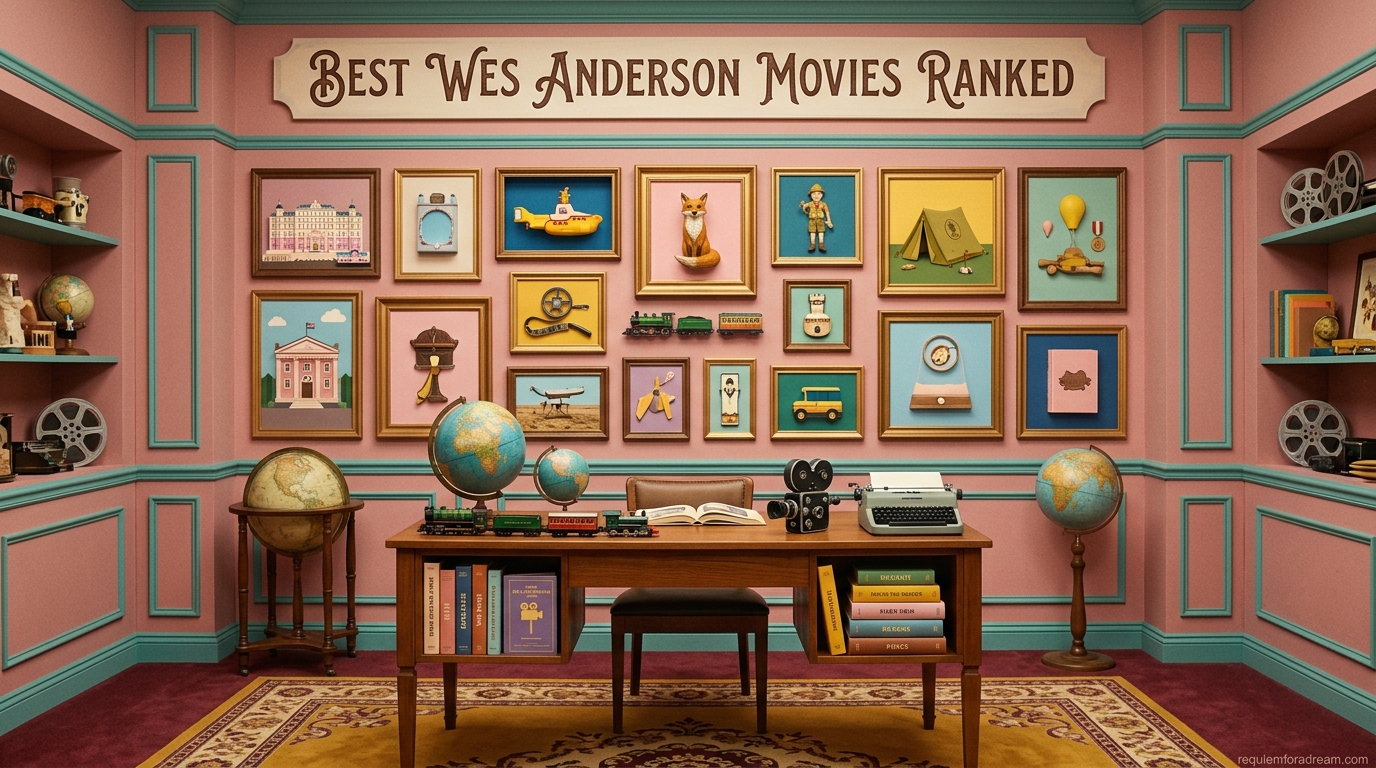
Wes Anderson is one of the most recognizable filmmakers working today, and ranking his movies has become something of a sport among film lovers. After watching all 13 of his feature films multiple times, I have put together this definitive ranking from worst to best. Whether you are a devoted fan or a first-time viewer wondering where to start, this guide covers every film in the Wes Anderson filmography with honest takes, critical context, and practical viewing advice.
The Royal Tenenbaums is widely considered Wes Anderson’s best movie, followed closely by Fantastic Mr. Fox and The Grand Budapest Hotel. These three films consistently top rankings from critics at Rolling Stone, Rotten Tomatoes, and The Hollywood Reporter. His newest film, The Phoenician Scheme (2025), adds another strong entry to an already impressive catalog that spans nearly three decades.
Anderson has built a career on creating ornate, handmade cinematic worlds filled with deadpan humor, pastel color palettes, and dysfunctional families searching for connection. His films reward repeat viewings — I discover new visual jokes and hidden details every time I revisit them. Let me walk you through every Wes Anderson movie ranked from worst to best, with context on why each one matters and where you can watch it.
Table of Contents
What Makes a Wes Anderson Film
Before diving into the rankings, it helps to understand the visual and storytelling language that defines a Wes Anderson movie. His style is so distinct that you can identify one of his films from a single frame.
Symmetrical framing is his signature. Anderson centers his subjects in the frame with architectural precision, creating compositions that feel like living dioramas. Every prop, piece of furniture, and costume is placed with intentionality that borders on obsession.
Color palettes define the emotional world of each film. The Grand Budapest Hotel glows in pinks and purples. Moonrise Kingdom is drenched in warm yellows and khaki greens. The Life Aquatic swims in blues and teals. These are not accidental — Anderson color-codes entire scenes to create specific moods.
Recurring cast members form a repertory company across his work. Bill Murray has appeared in nearly every Anderson film since Rushmore. Jason Schwartzman, Owen Wilson, Adrien Brody, and Tilda Swinton return film after film, creating a sense of continuity that makes his filmography feel like one sprawling story.
Deadpan humor and staccato dialogue delivery are hallmarks of his writing. Characters speak in flat, rapid-fire exchanges that somehow make absurd situations funnier. The comedy comes from the gap between the characters’ emotional intensity and their restrained delivery.
Pop soundtracks anchored by 1960s British Invasion tracks, folk songs, and classical pieces give his films an instantly recognizable sound. The Kinks, The Rolling Stones, and Alexandre Desplat scores provide the emotional backbone of many key scenes.
Best Wes Anderson Movies Ranked
Here is every Wes Anderson feature film ranked from worst to best. I based this ranking on a combination of critical consensus, cultural impact, personal viewing experience, and how well each film represents Anderson’s artistic vision. Every film on this list has merit — even the lowest-ranked entries are worth watching.
13. The Wonderful Story of Henry Sugar and Three More (2023)
In September 2023, Anderson released a collection of four short films on Netflix, all adapted from Roald Dahl stories. The centerpiece, The Wonderful Story of Henry Sugar, stars Benedict Cumberbatch as a wealthy man who learns a mystical gambling trick from a guru’s journal. The other three — The Rat Catcher, Poison, and The Swan — feature Ralph Fiennes, Dev Patel, and Rupert Friend respectively.
Anderson filmed these with a theatrical conceit: the actors perform on bare soundstages, narrating their own actions in real time, with minimal props and hand-painted backdrops. The effect is like watching a staged reading crossed with a magic trick. It is the most stripped-down Anderson has ever been, and the results are surprisingly powerful.
Henry Sugar won the Academy Award for Best Live Action Short Film — Anderson’s first Oscar. That alone earns it a place on this list. The 39-minute runtime means it does not have the narrative sprawl of his feature films, and some viewers may find the storytelling device gimmicky after the novelty wears off. But the Dahl adaptations represent Anderson at his most playful and literary, and the short format showcases his visual ingenuity within tight constraints. It ranks lowest on this list only because the twelve feature films above it offer fuller, more sustained experiences.
12. The Darjeeling Limited (2007)
Three estranged brothers — played by Owen Wilson, Adrien Brody, and Jason Schwartzman — reunite on a train journey across India after their father’s death. They are on a supposed spiritual quest, but mostly they are just trying to figure out how to be brothers again.
The Darjeeling Limited often lands at or near the bottom of Wes Anderson ranked lists, and I understand why. The pacing feels sluggish compared to his sharper work, and the narrative meanders without building the emotional momentum his best films achieve. Some critics have also noted uncomfortable elements in its portrayal of India.
That said, the film has its defenders. The visual design of the train interiors is gorgeous, and the brotherly chemistry between the three leads feels genuine. A short film called Hotel Chevalier, starring Schwartzman and Natalie Portman, serves as a prologue and is actually better than the main feature in some ways. The Darjeeling Limited has gained appreciation over time among fans who initially dismissed it. If you enjoy slow, contemplative character studies, this one might speak to you more than it did to most critics.
11. Bottle Rocket (1996)
Anderson’s debut feature introduces us to Anthony (Luke Wilson) and Dignan (Owen Wilson), two aimless friends in Texas who attempt a life of crime with spectacular ineptitude. The plot revolves around a bookstore heist, a landscaper named Bob, and a romance at a motel.
Bottle Rocket is the most divisive film in Anderson’s catalog. Some fans call it a cult classic that captures a raw, unpolished charm that his later, more ornate films lack. Others find it shapeless and slow, missing the visual precision that would become his trademark. Martin Scorsese named it one of his favorite films of the 1990s, which counts for something.
I find it fascinating as a historical document — you can see the seeds of Anderson’s style in the awkward staging and deadpan line readings, but the symmetrical framing and color-coded design are barely present yet. The writing, co-created with Owen Wilson, is surprisingly sharp in places. Bottle Rocket is essential viewing for completists, but I would not recommend it as anyone’s first Wes Anderson movie.
10. The Life Aquatic with Steve Zissou (2004)
Bill Murray stars as Steve Zissou, an eccentric oceanographer and documentary filmmaker who sets out to hunt down a jaguar shark that ate his best friend. Along for the ride are his estranged wife (Anjelica Huston), a journalist (Cate Blanchett), and a man who may be his son (Owen Wilson).
The Life Aquatic is the most polarizing Wes Anderson film. Critics and audiences were divided when it premiered, and it remains a love-it-or-hate-it experience. At the box office, it underperformed significantly. But over the years, it has developed a passionate cult following.
I have watched this film at least six times, and it has grown on me with each viewing. The production design is extraordinary — the cutaway cross-section of Zissou’s ship, the handcrafted sea creatures by Henry Selick, the Portuguese David Bowie covers performed by Seu Jorge. The film asks you to sit with its sadness and strangeness rather than racing toward a satisfying conclusion. That patience is rewarded if you give it a chance. The father-son dynamics between Murray and Wilson form the emotional core of something surprisingly tender.
9. Isle of Dogs (2018)
Set in a dystopian future Japan, Isle of Dogs follows a young boy named Atari who flies to Trash Island to find his beloved dog Spots. The corrupt Mayor Kobayashi has banished all dogs to the garbage dump, and Atari’s quest sparks a canine rebellion.
This is Anderson’s second stop-motion animated film, and the craftsmanship is stunning. Every frame is hand-sculpted and arranged with extraordinary care. The fur on the dogs moves visibly because real animal hair was used in the animation process. The voice cast is stacked: Bryan Cranston, Edward Norton, Bill Murray, Jeff Goldblum, Scarlett Johansson, and Tilda Swinton.
The political allegory landed Anderson in some controversy, with critics debating whether the film’s treatment of Japanese culture was respectful or reductive. Setting that conversation aside, Isle of Dogs is a visually extraordinary film with genuine emotional stakes. The bond between Atari and Chief, a stray dog who has forgotten how to trust, forms the heart of the story. It ranks lower on this list only because Anderson has made several films that achieve even more.
8. The French Dispatch (2021)
An anthology film structured around the final issue of an American literary magazine published in a fictional French city. The film presents three feature stories: an artist serving a prison sentence, a student revolutionary, and a kidnapped police commissioner’s child.
The French Dispatch is Anderson at his most stylistically extreme. The film shifts between color and black-and-white, changes aspect ratios, and packs every frame with more visual information than most directors put in an entire movie. The cast is enormous — nearly every working actor in Hollywood seems to appear.
Critics who loved it praised the sheer audacity of its design. Those who were less enthusiastic called it style over substance, arguing that the anthology structure prevents the emotional depth of his best work. I fall somewhere in between. Individual segments are brilliant — the prison art story featuring Benicio del Toro is genuinely moving. But as a complete film, The French Dispatch can feel exhausting, like eating a seven-course meal where every dish is dessert. It is a feast for the eyes that sometimes forgets to feed the heart.
7. Asteroid City (2023)
A television host introduces a play about a Junior Stargazer convention in a retro-futuristic desert town in 1955. Within that play, a recently widowed war photographer (Jason Schwartzman) and his children attend the event, where an alien encounter changes everything.
Asteroid City is a meta-fictional puzzle box — a play within a broadcast within a film. Anderson layers reality upon reality, asking questions about why we tell stories and whether art can genuinely console us in the face of grief. The desert setting gives him a new color palette to work with: dusty pinks, burnt oranges, and endless skies.
The film received mixed-to-positive reviews, with some critics calling it a minor work and others ranking it among his best. I find it deeply underrated. The scene where the alien simply hovers above the desert while everyone watches in silence is one of the most beautiful moments in Anderson’s entire career. Tom Hanks gives a restrained, touching performance as Schwartzman’s father-in-law. If Anderson’s earlier films are about dysfunctional families finding each other, Asteroid City is about learning to live with the family you have lost.
6. The Phoenician Scheme (2025)
Anderson’s newest feature follows a wealthy European family embroiled in business dealings, espionage, and generational conflict. The film continues his exploration of ornate worlds populated by eccentric characters navigating absurd situations.
The Phoenician Scheme earned strong reviews and became Anderson’s seventh consecutive Certified Fresh film on Rotten Tomatoes. Critics praised its blend of his established visual style with new thematic territory. The film feels looser and more playful than some of his recent work, with action sequences and spy-movie elements that add genuine tension to his typically controlled aesthetic.
It is too early in the film’s life to know exactly where it will settle in the Anderson canon. But based on early critical response and my own viewing, The Phoenician Scheme comfortably lands in the upper half of his filmography. It demonstrates that Anderson can evolve his style without abandoning what makes it distinctive.
5. Rushmore (1998)
Max Fischer (Jason Schwartzman) is a 15-year-old scholarship student at the elite Rushmore Academy who participates in every extracurricular activity possible while failing every class. He befriends a depressed industrialist (Bill Murray) and falls in love with a teacher (Olivia Williams), setting off a chain of events that forces everyone to grow up.
Rushmore is widely called Anderson’s breakthrough film, and for good reason. It established the template for his mature style: the deadpan humor, the pop soundtrack (this film introduced a generation to The Kinks), the bittersweet tone, and the production design that transforms everyday spaces into something magical. The opening sequence, where Max daydreams through a series of increasingly elaborate scenarios, is a perfect thesis statement for Anderson’s entire career.
Schwartzman delivers one of the great debut performances in American cinema. Murray, in his first collaboration with Anderson, reveals a depth of sadness that would define his work for the next two decades. The film is frequently cited as one of the best movies of the 1990s. It lands at number five on this list not because of any shortcoming, but because the four films above it are simply extraordinary.
4. Moonrise Kingdom (2012)
Two 12-year-olds — the introverted Suzy (Kara Hayward) and the orphaned Khaki Scout Sam (Jared Gilman) — run away together on a New England island in 1965. The adults in their lives, including Bruce Willis, Frances McDormand, Bill Murray, and Edward Norton, mount a search that becomes its own kind of chaos.
Moonrise Kingdom is Anderson’s sweetest film, and arguably his most emotionally direct. The young leads carry the movie with a sincerity that cuts through the stylized production design. When Sam and Suzy dance on the beach in their underwear to Francoise Hardy, it is pure cinema — tender, awkward, and completely believable despite the artifice surrounding it.
The film was a box office hit, earning over $68 million worldwide on a modest budget. It opened the Cannes Film Festival in 2012, a rare honor for an American director. The production design, featuring warm yellows, khaki uniforms, and the wild coastline of Rhode Island, creates an idealized summer that feels both nostalgic and immediate. Moonrise Kingdom proves that Anderson’s style, which some critics dismissed as cold or overly controlled, can deliver genuine warmth.
3. The Grand Budapest Hotel (2014)
A legendary concierge named Gustave H. (Ralph Fiennes) and his loyal lobby boy Zero (Tony Revolori) navigate a madcap adventure involving a stolen painting, a contested will, a fascist coup, and several murders in the fictional Eastern European republic of Zubrowka between the World Wars.
The Grand Budapest Hotel is Anderson’s most commercially successful film and the one that earned him the most Academy Award attention, picking up nine nominations and four wins for production design, costume design, makeup, and original score. It is also his most structurally ambitious work — a story within a story within a story, told across multiple time periods with different aspect ratios for each era.
Ralph Fiennes gives what might be the single best performance in any Anderson film. Gustave H. is by turns charming, vulgar, heroic, and heartbreakingly vulnerable. The scene where he recites poetry over the body of a dying aristocrat while bullets fly around him is one of the great comedic set pieces of modern cinema. Alexandre Desplat’s score is playful and melancholy in equal measure.
Many critics and fans consider this Anderson’s masterpiece. It nearly topped this list, and on a different day, it might. The reason it sits at number three is simply that the two films above it achieve something even rarer.
2. Fantastic Mr. Fox (2009)
Based on Roald Dahl’s children’s novel, Fantastic Mr. Fox follows a suave, suit-wearing fox (voiced by George Clooney) who promises his wife he will stop stealing chickens but cannot resist one last heist against three nasty farmers. The film features stop-motion animation that is rougher and more handmade than typical animated fare, which is exactly the point.
Fantastic Mr. Fox is pure Anderson at his best, translated into a medium that perfectly suits his aesthetic. Stop-motion animation allows him to control every single element of the frame in ways that live-action cannot match. The fur on the animal characters visibly shifts between frames because real fur was used — a happy accident that gives the film its distinctive, tactile quality.
The voice cast is exceptional. Clooney brings effortless charm to Mr. Fox, Meryl Streep plays his long-suffering wife, and Jason Schwartzman delivers a hilariously angsty performance as their insecure son Ash. Bill Murray plays a badger lawyer. The film’s central question — whether we can truly change our nature — gives the story a philosophical weight that elevates it beyond a children’s film.
Fantastic Mr. Fox is frequently cited by fans as their single favorite Anderson movie. On Letterboxd, Reddit, and film forums, it consistently ranks in the top three. It is the purest expression of his artistic vision, unburdened by the constraints of live-action filmmaking. The number two spot reflects a near-tie with the film above it, and depending on the day, this one could easily claim the top ranking.
1. The Royal Tenenbaums (2001) — The Best Wes Anderson Movie
After weighing critical consensus, cultural impact, personal experience, and the collective wisdom of thousands of fan rankings, The Royal Tenenbaums earns the top spot as the best Wes Anderson movie. It is the film where every element of his style — the ensemble cast, the symmetrical framing, the bittersweet tone, the pop soundtrack, the dysfunctional family dynamics — comes together in perfect balance.
Gene Hackman plays Royal Tenenbaums, the estranged patriarch of a family of former child prodigies who have all grown into deeply unhappy adults. When Royal learns his wife Etheline (Anjelica Huston) is about to remarry, he fakes a terminal illness to win his way back into the family home and the lives of his children. The ensemble cast — Hackman, Huston, Ben Stiller, Gwyneth Paltrow, Luke Wilson, Owen Wilson, Bill Murray, and Danny Glover — might be the greatest collection of talent Anderson has assembled in a single film.
What makes The Royal Tenenbaums extraordinary is its emotional depth. Beneath the stylized production design and deadpan comedy lies a genuinely moving story about a damaged family trying to forgive each other. Gene Hackman’s performance is a masterclass in playing a lovable jerk — Royal is selfish, dishonest, and manipulative, but Hackman makes you understand why his family cannot give up on him. The scene where he takes his grandsons dogfighting in the streets of New York is pure joy. The scene where Chas finally breaks down in the tent is pure heartbreak.
The film’s influence on popular culture is enormous. The visual aesthetic — the tracksuits, the fur coat, the wooden finger, theMargot’s eyeliner — has become a Halloween costume staple and a TikTok aesthetic. Wes Anderson’s style entered the mainstream cultural vocabulary largely because of this film. It appears at number one in rankings from Rolling Stone, The Hollywood Reporter, and Hulu.
No other Anderson film balances comedy and heartbreak with such precision. One moment you are laughing at an absurd situation, and the next you are blindsided by genuine emotional pain. That tonal range, anchored by Gene Hackman’s magnificent performance and a script co-written with Owen Wilson, represents Anderson’s artistry at its absolute peak. The Royal Tenenbaums has something no other film in his catalog quite achieves: it feels like the movie Anderson was born to make. Every theme he has explored before and since — absent fathers, gifted children who lose their way, the impossibility of going home again — finds its fullest expression here.
Where to Start: A Viewing Guide for New Fans
One of the most common questions on Reddit, Letterboxd, and film forums is: which Wes Anderson movie should I watch first? The answer depends on what kind of films you enjoy, but I have a clear recommendation.
Start with The Grand Budapest Hotel. It is his most accessible film, with a fast-paced plot, a charismatic lead performance from Ralph Fiennes, and visual splendor that immediately communicates what makes Anderson special. The humor is broad, the story is engaging, and the runtime is tight. If you love it, you will want to explore the rest of his catalog.
If you prefer coming-of-age stories, watch Moonrise Kingdom next. It is warm, funny, and emotionally grounded. If you want his most critically acclaimed work, go straight to The Royal Tenenbaums. If you love animation, Fantastic Mr. Fox is the perfect entry point.
Viewing order by mood:
Want to laugh? Start with The Grand Budapest Hotel or Rushmore. Want to cry? Watch The Royal Tenenbaums or Asteroid City. Want to be visually overwhelmed? The French Dispatch. Want cozy comfort viewing? Moonrise Kingdom. Want something weird and wonderful? The Life Aquatic with Steve Zissou.
I do not recommend watching the films chronologically on a first pass. Bottle Rocket and The Darjeeling Limited are better appreciated once you understand Anderson’s style from his stronger work. Save those for after you have fallen in love with his filmmaking. A good marathon order would be: The Grand Budapest Hotel, The Royal Tenenbaums, Moonrise Kingdom, Fantastic Mr. Fox, Rushmore, then fill in the rest based on your curiosity.
Wes Anderson’s Visual Style Evolution
Watching Anderson’s films in chronological order reveals a fascinating artistic journey. His visual style did not emerge fully formed — it evolved dramatically over three decades.
The early period (1996-1998) includes Bottle Rocket and Rushmore. These films are visually grounded and relatively restrained. The color palettes are muted, the compositions are loose compared to his later work, and the budgets were small. You can see Anderson experimenting with his aesthetic but not yet committing to the extreme precision that would define him. Rushmore shows the biggest jump — the opening montage alone demonstrates a director discovering his voice.
The middle period (2001-2007) encompasses The Royal Tenenbaums, The Life Aquatic, and The Darjeeling Limited. This is where the Anderson style crystallized. The Royal Tenenbaums introduces the storybook framing device and the elaborate, handcrafted production design. The Life Aquatic pushes further with the cutaway ship set and stop-motion sea creatures. By The Darjeeling Limited, the style is fully established: centered compositions, saturated colors, carefully chosen fonts, and a sense that every object in the frame has been curated.
The mature period (2009-present) begins with Fantastic Mr. Fox and continues through The Phoenician Scheme. This era is marked by increasing experimentation within his established style. He plays with aspect ratios in The Grand Budapest Hotel, shifting between 1.37:1, 1.85:1, and 2.39:1 to signal different time periods. He builds anthology structures in The French Dispatch. He layers meta-fictional narratives in Asteroid City. The stop-motion films allow him to control every frame with absolute precision. What began as a quirky indie sensibility has become one of the most recognizable visual languages in cinema history.
Recurring Cast Members Across the Filmography
One of the pleasures of watching all Wes Anderson movies is spotting the recurring actors. His repertory company creates a sense of continuity that makes the filmography feel connected.
Bill Murray has appeared in more Anderson films than any other actor, starting with Rushmore in 1998 and continuing through The Phoenician Scheme. His roles range from leading man (The Life Aquatic) to brief cameos (The Grand Budapest Hotel), but he always brings a specific melancholy that anchors the whimsy.
Jason Schwartzman debuted in Rushmore as a teenager and has grown up on screen across Anderson’s career. He co-wrote The Darjeeling Limited and has appeared in seven of the director’s films, often playing anxious, creative misfits.
Owen Wilson co-wrote Anderson’s first three films and has acted in many more. His contributions to the early scripts — particularly Bottle Rocket and The Royal Tenenbaums — helped shape the distinctive Anderson voice. Longtime fans consider his creative partnership with Anderson one of the most undervalued collaborations in American cinema.
Adrien Brody joined the ensemble with The Darjeeling Limited and has become increasingly central, earning some of his best roles in Anderson’s later films. Tilda Swinton, Jeff Goldblum, Willem Dafoe, and Edward Norton have all become reliable presences across multiple projects.
The familiarity of these faces across films creates a warm feeling when you watch them in sequence. It is like revisiting old friends who show up in different stories, always recognizable but always transformed. This repertory approach is rare in modern American cinema, and it gives Anderson’s body of work a cohesion that few directors achieve.
FAQs
What is considered to be the best Wes Anderson movie?
The Royal Tenenbaums (2001) is widely considered Wes Anderson’s best movie. It consistently ranks number one in critic lists from Rolling Stone, The Hollywood Reporter, and other major publications. The film’s blend of ensemble cast chemistry, emotional depth, and Anderson’s signature visual style represents his artistry at its peak. The Grand Budapest Hotel and Fantastic Mr. Fox are also frequent contenders for the top spot.
What is the most successful Wes Anderson movie?
The Grand Budapest Hotel (2014) is Anderson’s most commercially successful film, earning over $172 million worldwide at the box office. It also received nine Academy Award nominations, winning four — more Oscar recognition than any other Anderson film. The Royal Tenenbaums and Moonrise Kingdom were also significant box office successes relative to their budgets.
What does Tarantino think of Wes Anderson?
Quentin Tarantino has expressed admiration for Wes Anderson’s work. Tarantino named Bottle Rocket as one of his favorite films of the 1990s, praising its originality and the chemistry between Owen Wilson and Luke Wilson. The two directors represent very different approaches to filmmaking, but Tarantino has consistently acknowledged Anderson’s distinctive artistic vision.
What is Wes Anderson’s masterpiece?
Film critics generally point to The Royal Tenenbaums as Wes Anderson’s masterpiece, though The Grand Budapest Hotel runs a close second. The Royal Tenenbaums achieves a rare balance of comedy and emotional depth, anchored by Gene Hackman’s extraordinary performance as the flawed patriarch Royal Tenenbaum. Many critics consider it one of the best American films of the 2000s.
Which Wes Anderson movie should I watch first?
I recommend starting with The Grand Budapest Hotel. It is Anderson’s most accessible film, with a fast-moving plot, Ralph Fiennes’ charismatic lead performance, and stunning visuals that immediately showcase his style. Moonrise Kingdom is another excellent starting point if you prefer warmer, coming-of-age storytelling. Avoid starting with Bottle Rocket or The Darjeeling Limited, as those are better appreciated after you understand his aesthetic.
Are all Wes Anderson movies connected?
No, Wes Anderson movies are not narratively connected. Each film tells a standalone story with different characters and settings. However, they share recurring actors (Bill Murray, Jason Schwartzman, Owen Wilson), similar visual styles, and common themes like dysfunctional families, absent fathers, precocious children, and outsiders searching for belonging. These recurring elements create a sense of continuity across the filmography even though the stories themselves are independent.
Conclusion
Ranking the best Wes Anderson movies is ultimately a subjective exercise, but the consensus is clear: The Royal Tenenbaums, Fantastic Mr. Fox, and The Grand Budapest Hotel stand at the summit of his filmography. These three films represent the fullest expressions of his artistic vision, each in a different medium — live-action family drama, stop-motion animation, and period adventure.
What makes Anderson’s body of work remarkable is its consistency. Even his lowest-ranked films contain sequences, performances, and images that stay with you long after the credits roll. His influence on visual culture — from filmmaking to fashion to interior design — is undeniable. Directors like Taika Waititi, Greta Gerwig, and Noah Baumbach have all drawn inspiration from his distinctive approach to storytelling.
I hope this guide to the best Wes Anderson movies ranked helps you find your next favorite film or gives you a starting point for exploring one of American cinema’s most singular voices. Every film on this list deserves your time. Watch them in whatever order calls to you, and I suspect you will find, as I have, that Anderson’s movies improve with every revisit. His worlds are so densely detailed that you will always discover something new.