
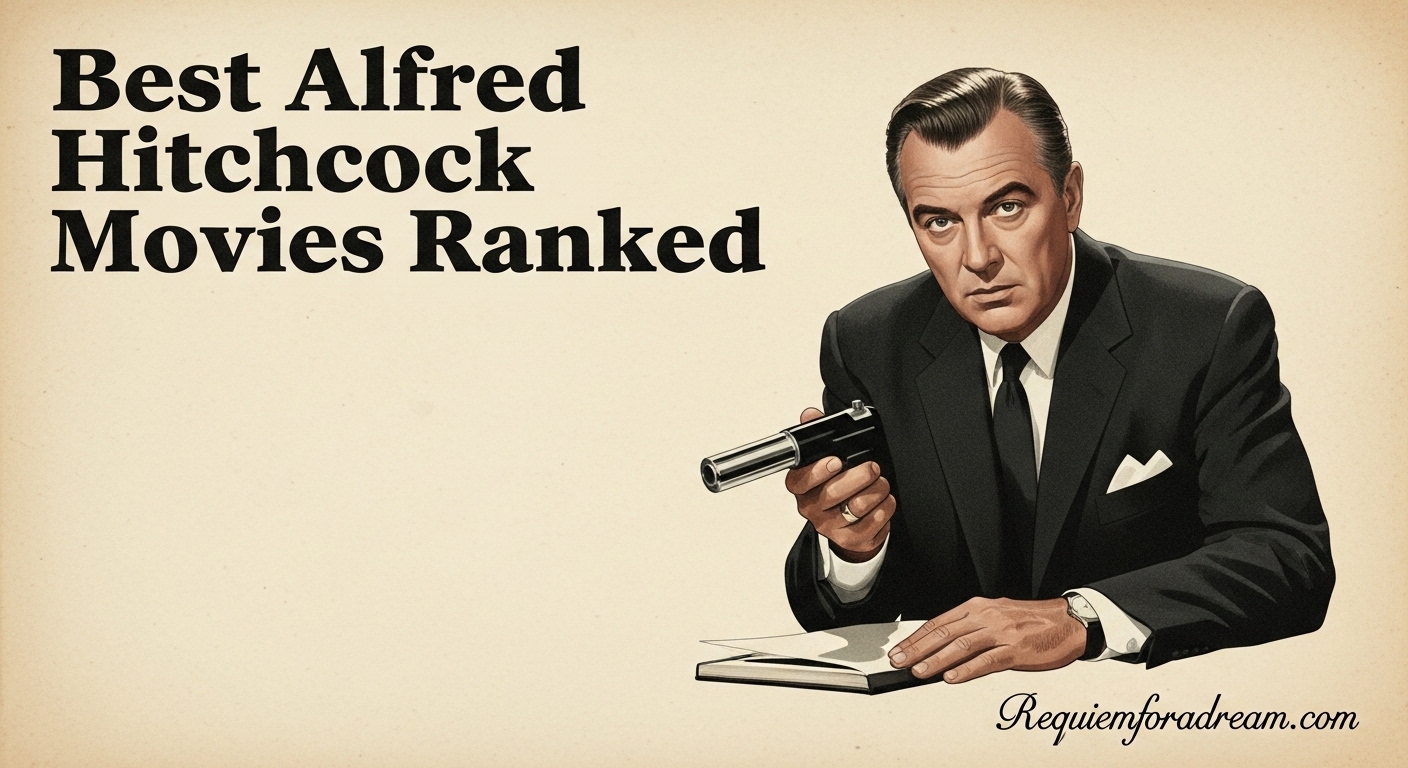
Few filmmakers have shaped cinema the way Alfred Hitchcock did. Over a career that spanned five decades and more than 50 feature films, the British-born director earned his reputation as the Master of Suspense through an unmatched ability to manipulate audience emotions. His techniques — the creeping camera, the sudden reveal, the tension that builds until you cannot breathe — remain the blueprint for thriller and horror filmmaking in 2026.
When Sight & Sound released its 2012 decennial poll of the greatest films ever made, one movie stood at the very top: Hitchcock’s Vertigo, dethroning Orson Welles’ Citizen Kane after fifty years. That moment confirmed what film critics had argued for decades — Hitchcock was not merely a popular entertainer but a serious artist whose work deserved the highest level of analysis and appreciation.
This ranking of the best Alfred Hitchcock movies ranked covers 13 essential films from his extraordinary catalog. I chose these based on four criteria: critical consensus across major publications and polls, cultural impact and lasting influence on filmmaking, technical innovation, and pure entertainment value. Whether you are a lifelong fan or someone who has never seen a single Hitchcock picture, this guide will help you understand why his work still dominates conversations about cinema in 2026.
Table of Contents
Quick Overview: 13 Essential Hitchcock Films
Here is the complete ranked list at a glance, perfect for readers who want the definitive answer fast:
- Vertigo (1958) — A retired detective’s obsessive pursuit of a mysterious woman becomes cinema’s most haunting study of desire and illusion
- Psycho (1960) — The shower scene that changed horror forever, with Bernard Herrmann’s shrieking strings and Anthony Perkins’ unsettling Norman Bates
- Rear Window (1954) — James Stewart spies on his neighbors from a wheelchair and stumbles onto what might be a murder
- North by Northwest (1959) — Cary Grant is chased across America by Cold War spies in the ultimate wrong-man thriller
- Notorious (1946) — Cary Grant and Ingrid Bergman navigate espionage and doomed love in post-war South America
- Strangers on a Train (1951) — Two men meet on a train and one proposes the perfect double-murder scheme
- The Birds (1963) — Nature itself turns hostile in this terrifying and ambiguous attack on a quiet coastal town
- Rebecca (1940) — Hitchcock’s first American film won Best Picture at the Academy Awards with its gothic tale of a haunted second wife
- To Catch a Thief (1955) — Cary Grant and Grace Kelly sparkle on the French Riviera in a glamorous cat-and-mouse caper
- Shadow of a Doubt (1943) — A young woman discovers her beloved uncle may be a serial killer in Hitchcock’s own favorite of his films
- Dial M for Murder (1954) — A retired tennis pro devises an elaborate plan to murder his wealthy wife
- The Lady Vanishes (1938) — An elderly passenger disappears on a European train, and only one woman remembers she existed
- Rope (1948) — Two friends commit murder and hide the body in plain sight during a dinner party, filmed in daring continuous takes
#13. Rope (1948)
Rope is one of the most audacious experiments in Hitchcock’s entire career. Inspired by the real-life Leopold and Loeb case, the film follows two young men who strangle a classmate, hide his body in a chest, and then host a dinner party — serving food right off the makeshift coffin. James Stewart plays their former teacher who begins to suspect something is terribly wrong.
The real star of Rope is not any actor but Hitchcock’s technical ambition. He attempted to make the film appear as one continuous shot, using ten-minute takes stitched together with hidden cuts. The camera glides through the apartment, circling the characters, building claustrophobia as the evening wears on and the noose of discovery tightens around the killers. The color cinematography by Joseph Valentine and William V. Skall is rich and deliberate — the sunset outside the window gradually darkening as the tension escalates.
Forum discussions frequently mention Rope as a fan favorite specifically because of its technical achievements. The conceit is bold, the performances are electric, and the moral questions it raises about intellectual arrogance feel strikingly modern. It is a compact 80-minute masterclass in how limitations can breed creativity.
#12. The Lady Vanishes (1938)
Before Hitchcock moved to Hollywood, he made some of his finest pictures in Britain, and The Lady Vanishes is the crown jewel of that period. A young woman named Iris boards a train in the fictional European country of Bandrika and befriends an elderly governess named Miss Froy. When Iris wakes from a nap, Miss Froy has vanished — and every other passenger claims the old woman never existed.
What makes this film so engaging is its balance of wit and suspense. The first act is genuinely funny, with two English cricket enthusiasts providing comic relief even as the central mystery deepens. Margaret Lockwood brings real urgency to Iris’s growing panic, and Dame May Whitty is perfectly cast as the vanished lady who may or may not be a figment of imagination.
The Lady Vanishes also carries a pointed political subtext. Released in 1938, the film’s fictional Bandrika and its complacent travelers who refuse to acknowledge a clear wrong mirror Europe’s reluctance to confront rising fascism. Hitchcock was making entertainment, but he was also making a point about willful blindness. This layered quality is exactly why the film holds up so well nearly 90 years later.
#11. Dial M for Murder (1954)
Dial M for Murder began as a stage play, and Hitchcock kept much of that theatrical intimacy intact. The story is almost entirely confined to a single London apartment where retired tennis professional Tony Wendice plots to murder his wealthy wife Margot when he discovers she has been having an affair with a crime novelist.
Grace Kelly plays Margot with a delicate composure that makes her eventual transformation from victim to accused even more powerful. Ray Milland as Tony is one of Hitchcock’s most charming villains — suave, calculating, and always three moves ahead of everyone in the room. The scene where Tony meticulously walks a blackmail target through the murder plan is a masterclass in exposition disguised as suspense.
Hitchcock originally shot Dial M for Murder in 3D, and you can still feel that spatial awareness in the blocking. Objects reach toward the camera, the apartment feels like a dollhouse we are peering into, and the famous scene where Margot reaches for a pair of scissors to defend herself was designed to make audiences flinch. Even viewed flat, the film crackles with Hitchcock’s precise control over every frame.
#10. Shadow of a Doubt (1943)
Hitchcock himself called Shadow of a Doubt his favorite among his own films, and once you understand why, the movie takes on a deeply personal dimension. The story centers on young Charlie Newton, a bored teenager in the idyllic small town of Santa Rosa, California, who is thrilled when her charismatic Uncle Charlie comes to visit. Gradually, she begins to suspect that her beloved uncle is the “Merry Widow Murderer” wanted by the police.
Joseph Cotten delivers one of the most unsettling performances in any Hitchcock film as Uncle Charlie. His warmth feels genuine, which makes his coldness all the more disturbing. Teresa Wright as young Charlie perfectly captures the devastation of discovering that evil can live inside someone you love and trust. The dinner table scene, where Uncle Charlie delivers his monologue about “fat, greedy women,” is chilling in its casual cruelty.
The genius of Shadow of a Doubt lies in what it says about the nature of evil. Hitchcock was not interested in monsters lurking in shadows. He was interested in how evil walks through the front door with a smile, sits down at the family table, and is welcomed. That idea — that darkness can live comfortably in ordinary places — became a foundational theme in his later work and influenced generations of filmmakers who followed.
#9. To Catch a Thief (1955)
If you want pure cinematic pleasure, To Catch a Thief delivers it in spades. Cary Grant plays John Robie, a retired cat burglar living on the French Riviera who is forced back into action when a copycat thief begins framing him for a new string of jewel heists. Grace Kelly plays Frances Stevens, the daughter of a wealthy American widow who becomes both Robie’s love interest and his most dangerous complication.
The film is gorgeous to look at. Oscar-winning cinematographer Robert Burks captured the Mediterranean coastline with a warmth and elegance that makes every frame feel like a vacation postcard. The costumes by Edith Head are impeccable, especially Kelly’s gold ballgown that seems to glow in the fireworks scene — one of the most seductive sequences Hitchcock ever filmed.
To Catch a Thief is lighter than most entries on this list. The stakes are lower, the tone is playful, and the suspense is more of a tickle than a grip. But that is precisely why it deserves its spot. It demonstrates that Hitchcock could entertain with charm and beauty as effectively as he could terrify with shadows and knives. Think of it as the palate cleanser in a Hitchcock marathon — the one you watch when you want to remember that cinema can be sheer joy.
#8. Rebecca (1940)
Rebecca holds a unique place in Hitchcock’s career: it was his first American film, it won the Academy Award for Best Picture (the only Hitchcock film to do so), and it established his working relationship with legendary producer David O. Selznick. Based on Daphne du Maurier’s novel, the film follows a shy young woman who marries the wealthy widower Maxim de Winter, only to find herself living in the shadow of his glamorous, deceased first wife, Rebecca.
Joan Fontaine delivers a heartbreaking performance as the second Mrs. de Winter, a woman whose confidence is systematically dismantled by the menacing housekeeper Mrs. Danvers, played with ice-cold perfection by Judith Anderson. Laurence Olivier is commanding as Maxim, a man haunted by guilt and secrets. The scene where Mrs. Danvers shows the new bride Rebecca’s bedroom, preserved exactly as it was when Rebecca was alive, is one of the most psychologically disturbing sequences Hitchcock ever created.
What sets Rebecca apart from other entries on this list is its gothic romanticism. There are no chase sequences, no murders shown on screen, and no espionage plots. The suspense is entirely psychological — the fear of not being good enough, the dread of an invisible rival, the terror of living in a house that belongs to someone else’s ghost. It is Hitchcock working in a register closer to horror-romance than pure thriller, and the result is haunting in an entirely different way than Psycho or The Birds.
#7. The Birds (1963)
The Birds is Hitchcock at his most unsettling because it refuses to explain itself. Flocks of birds begin attacking the residents of Bodega Bay, a quiet coastal town in Northern California. There is no virus, no environmental catastrophe, no scientific reason. The birds simply attack, again and again, with increasing ferocity. That refusal to provide a tidy explanation is exactly what makes the film so powerful.
Tippi Hedren makes her film debut as Melanie Daniels, a wealthy socialite who travels to Bodega Bay to deliver a pair of lovebirds to a man she has just met. The irony of lovebirds being the harbinger of a nightmare is pure Hitchcock. Rod Taylor is solid as Mitch Brenner, and Jessica Tandy delivers a moving performance as his clinging, fearful mother. But the real star is Hitchcock’s technical team, who used a combination of real birds, mechanical birds, and groundbreaking optical effects to create attack sequences that still look convincing in 2026.
The ambiguity of The Birds has fueled decades of interpretation. Some critics read it as a metaphor for nature’s revenge against human complacency. Others see it as a psychological projection of Melanie’s anxiety about entering a new family. Hitchcock himself never offered a definitive reading, and that open-ended quality is why the film continues to generate discussion in film communities and Reddit threads alike. It asks a question that no other Hitchcock film asks: what if the world simply turns against you, for no reason at all?
#6. Strangers on a Train (1951)
The premise of Strangers on a Train is one of the most elegant in all of thriller cinema: two strangers meet on a train, and one of them proposes a “criss-cross” murder scheme. Each man will kill someone the other wants dead, eliminating motive and creating the perfect alibis. Tennis star Guy Haines laughs it off — but Bruno Anthony is deadly serious.
Robert Walker as Bruno Anthony creates one of Hitchcock’s most memorable villains. Bruno is charming, erudite, and completely unhinged. He wears a flamboyant tie-pin lobster on his lapel, he talks about murder the way most people discuss the weather, and his menacing cheerfulness makes every scene he is in vibrate with danger. Farley Granger as Guy captures the mounting horror of an ordinary man trapped in an agreement he never actually made.
The film contains several of Hitchcock’s most celebrated sequences. The opening train tracks criss-crossing each other visually set up the dual murder concept. The tennis match where Bruno stares at Guy while every other head in the crowd follows the ball is a masterstroke of audience direction. And the out-of-control carousel climax — filmed with real stunt performers on a genuinely speeding merry-go-round — remains one of the most thrilling finales in any Hitchcock film.
The Top 5 Best Alfred Hitchcock Movies Ranked
These five films represent the absolute peak of Hitchcock’s artistry. Each one has a legitimate claim to being his greatest work, and together they form the foundation of his legacy as the most influential director in the history of suspense cinema.
#5. Notorious (1946)
Notorious is the most emotionally complex of all Hitchcock’s spy thrillers. Ingrid Bergman plays Alicia Huberman, the daughter of a convicted Nazi spy who is recruited by American intelligence to infiltrate a group of Nazis hiding in Brazil after World War II. Cary Grant plays Devlin, the agent who recruits her and then must watch — consumed by jealousy — as she seduces a Nazi leader to gather intelligence.
The relationship between Alicia and Devlin is what elevates Notorious above standard espionage fare. Grant and Bergman generate genuine heat together, but their romance is poisoned by duty, pride, and betrayal. Devlin cannot bring himself to tell Alicia how he feels, and Alicia cannot stop herself from going deeper into danger. It is a love story told through silences and glances, and it aches with an authenticity that pure thrillers rarely achieve.
The famous key scene is a masterwork of visual storytelling. Alicia holds a stolen key to the wine cellar where Nazi secrets are hidden, and Hitchcock films the moment she hands it to Devlin with the tension of a bomb defusal. The camera lingers on Bergman’s hand, then the key, then Grant’s face — no dialogue needed. Claude Rains as the Nazi leader who genuinely loves Alicia adds yet another layer of emotional complexity. He is not a cartoon villain but a man ensnared by his own feelings, and that nuance makes Notorious one of the richest films in the Hitchcock filmography.
#4. North by Northwest (1959)
If Hitchcock had made only one film, North by Northwest might be the one that best represents everything he was capable of. Cary Grant plays Roger Thornhill, a Manhattan advertising executive who is mistaken for a government agent named George Kaplan. What follows is a breathless cross-country chase involving Cold War spies, crop-dusting assassins, a seductive woman who may or may not be trustworthy, and a climactic battle on the faces of Mount Rushmore.
The crop duster sequence alone would secure North by Northwest a place on this list. Thornhill, lured to a barren Midwestern cornfield, waits for a man who never arrives. Instead, a crop duster plane appears in the distance and begins diving at him, strafing the field with bullets. It is the definitive wrong-man set piece — an ordinary person suddenly trapped in extraordinary danger, with nowhere to hide and no one to help. Hitchcock filmed it without music, letting the sound of the plane’s engine provide all the score the scene needs.
Ernest Lehman’s screenplay is sharp, funny, and constantly surprising. Grant’s effortless charm keeps the film grounded even as the plot escalates to absurd heights. Eva Marie Saint as Eve Kendall is one of the great Hitchcock heroines — intelligent, resourceful, and morally ambiguous in ways that keep the audience guessing. James Mason and Martin Landau provide memorable villainy, and Bernard Herrmann’s fandango-inspired score drives the action forward with infectious energy. North by Northwest is pure entertainment, executed at the highest possible level.
#3. Rear Window (1954)
Rear Window is the film that most directly addresses Hitchcock’s central obsession: the act of watching. James Stewart plays L.B. Jefferies, a photojournalist confined to a wheelchair in his Greenwich Village apartment with a broken leg. With nothing else to do, he begins observing his neighbors through his rear window — and slowly becomes convinced that one of them has murdered his wife.
The entire film unfolds from Jeff’s apartment, and Hitchcock transforms that single location into an entire world. The courtyard set, built at Paramount Studios, was one of the largest indoor sets ever constructed at the time, containing fully furnished apartments with working electricity and real gardens. We see only what Jeff sees, and we share his growing suspicion, his guilt about spying, and his inability to look away. It is a film about audience complicity — about how we are all voyeurs when we watch a movie.
Grace Kelly as Lisa Fremont gives what may be her finest screen performance. She is elegant, witty, and braver than any of the men around her — it is Lisa who eventually climbs into the suspected murderer’s apartment to search for evidence. Thelma Ritter as the nurse Stella provides earthy comic relief, and Raymond Burr as the menacing Lars Thorwald uses silence and stillness more effectively than most actors use dialogue. The final confrontation, when Thorwald realizes he is being watched and turns to face Jeff’s darkened window, is one of the most terrifying moments in any Hitchcock film precisely because it forces the watcher to become the watched.
#2. Psycho (1960)
No discussion of the best Alfred Hitchcock movies ranked would be complete without Psycho, the film that single-handedly rewrote the rules of horror cinema. Janet Leigh plays Marion Crane, a secretary who steals $40,000 from her employer and checks into the remote Bates Motel during a rainstorm. The proprietor, Norman Bates, seems shy and sweet — but his domineering mother has other ideas.
The shower scene is arguably the most analyzed sequence in film history. Forty-five seconds of screen time containing 78 camera setups and 52 cuts, all orchestrated to Bernard Herrmann’s all-strings score — a score Hitchcock originally did not want but later admitted doubled the scene’s effectiveness. What makes the sequence so devastating is not what it shows but what it implies. Hitchcock famously used quick cuts, chocolate syrup for blood, and clever editing to create the illusion of graphic violence without actually showing any penetration. Your brain fills in the gaps, and that is far more terrifying than anything explicit.
Psycho was a seismic cultural event. Hitchcock killed off his leading lady — a major movie star — barely a third of the way through the film. He forbade theaters from admitting latecomers. He printed posters warning audiences that no one would be seated after the film began. These marketing stunts worked because the film itself delivered on every promise. Anthony Perkins as Norman Bates created the archetype of the sympathetic monster — a boyish, nervous young man whose gentleness conceals something rotten. That duality, the idea that a smile can be a mask for madness, became a template that horror filmmakers are still following in 2026.
#1. Vertigo (1958)
Vertigo is the greatest Alfred Hitchcock film and one of the greatest films ever made, period. James Stewart plays Scottie Ferguson, a retired San Francisco detective whose fear of heights — the vertigo of the title — caused a colleague’s death. Hired by an old acquaintance to follow his wife Madeleine, Scottie becomes obsessed with this ethereal, mysterious woman who may be possessed by the spirit of a dead ancestor. When tragedy strikes, Scottie’s obsession curdles into something darker and more desperate.
The reasons Vertigo tops every ranking of Hitchcock’s work are numerous and well-documented. It is his most visually stunning film, with Robert Burks capturing San Francisco in dreamlike VistaVision — the Golden Gate Bridge shrouded in fog, the Mission Dolores bathed in red light, the sequoia forests where the ancient rings of time seem to mock human mortality. Bernard Herrmann composed what many consider the finest film score ever written, its swirling, obsessive motifs mirroring Scottie’s own spiraling fixation.
But the true genius of Vertigo is its emotional honesty. This is a film about the desire to control another person, to shape them into an ideal, to make a real woman conform to an imaginary image. Stewart’s performance grows darker and more uncomfortable as the film progresses — his Scottie is not a hero but a man destroyed by his own inability to accept reality. Kim Novak, in a dual role, conveys volumes through posture and silence, particularly in the extraordinary sequence where Scottie attempts to remake another woman in Madeleine’s image, specifying every detail of her appearance down to her hair color.
The 2012 Sight & Sound poll of 846 critics named Vertigo the greatest film ever made. Whether or not you agree with that ranking, the achievement is undeniable. Hitchcock took the thriller form — his thriller form — and infused it with such psychological depth, visual beauty, and emotional devastation that it transcends genre entirely. It is not just the best Hitchcock movie. It is one of the essential works of art in any medium.
What Makes a Hitchcock Film: His Signature Techniques
Understanding a few key concepts will deepen your appreciation of every film on this list. Hitchcock developed and refined these techniques throughout his career, and they became the building blocks of what critics now call “Hitchcockian” cinema.
The MacGuffin
The MacGuffin is the object, device, or secret that drives the plot forward but ultimately does not matter in itself. In North by Northwest, it is the government secrets the spies are after. In Notorious, it is the uranium hidden in the wine bottles. In Psycho, it is the stolen $40,000. Hitchcock used the MacGuffin as a narrative engine — something to set his characters in motion — while the real story was always about the characters and their emotional journeys. He liked to compare it to the “nothing” that two men discuss on a train: one asks what is in the package, the other says “a MacGuffin,” and the first asks what a MacGuffin is. “It’s a device for catching lions in the Scottish Highlands.” “But there are no lions in the Scottish Highlands.” “Well then, that’s no MacGuffin.”
The Wrong Man Plot
One of Hitchcock’s favorite narrative structures was the story of an innocent person mistaken for someone else and plunged into danger. North by Northwest is the purest example, but you can see variations in The Wrong Man (1956), Saboteur (1942), and The 39 Steps (1935). This premise works because it taps into a universal fear: being accused of something you did not do and being powerless to prove your innocence. Hitchcock himself was once locked in a jail cell by his father as a childhood punishment, and biographers have long connected that experience to the recurring theme of wrongful accusation in his work.
Voyeurism and Audience Complicity
Hitchcock understood that watching a film is an act of voyeurism — you are observing people who do not know you are there. Rear Window makes this explicit by having the protagonist literally spy on his neighbors, but the theme runs through nearly all his work. In Vertigo, Scottie follows Madeleine through San Francisco, watching her from a distance. In Psycho, Norman watches Marion through a peephole. By making his characters voyeurs, Hitchcock makes the audience confront its own role in the spectacle. We are not innocent bystanders. We are participants.
The Blonde Archetype and Bernard Herrmann
Hitchcock’s famous preference for blonde leading ladies — Grace Kelly, Tippi Hedren, Eva Marie Saint, Kim Novak, Janet Leigh — was not simply aesthetic. He often said that blondes made the best victims because their apparent innocence created a more shocking contrast when they were placed in danger. The “Hitchcock blonde” became an archetype of sophisticated beauty concealing hidden depths or secrets.
The other essential collaborator in Hitchcock’s peak period was composer Bernard Herrmann. Their partnership produced some of the most iconic scores in cinema history: the swirling obsession of Vertigo, the shrieking violins of Psycho, the driving fandango of North by Northwest. Herrmann understood that music could articulate emotions that dialogue and imagery could not reach. Their creative relationship ended bitterly during the production of Torn Curtain (1966), but the work they created together in the 1950s and early 1960s remains the gold standard for film scoring.
Where to Start: A Hitchcock Viewing Guide for Beginners
One of the most common questions in film forums is “Which Hitchcock movie should I watch first?” With over 50 films in his catalog, the choice can feel overwhelming. Here are some paths into his work based on what you already enjoy.
For First-Time Viewers: Start Here
If you have never seen a Hitchcock film, begin with North by Northwest or Rear Window. Both are accessible, fast-paced, and immediately entertaining. North by Northwest moves like a modern action film with wit and style, while Rear Window is a perfectly constructed mystery that keeps you guessing until the final frame. Either one will give you a clear sense of what makes Hitchcock special without demanding prior knowledge of film history.
For Horror Fans
Start with Psycho, then watch The Birds. These two films represent Hitchcock’s direct influence on the horror genre. Psycho invented the modern slasher template, and The Birds pioneered the concept of nature-run-amok. After those, try Shadow of a Doubt for a more psychological approach to terror — the horror of discovering evil in someone you love.
For Romance and Drama Fans
Notorious and Rebecca are your entry points. Both feature deeply felt love stories intertwined with suspense. Notorious is a spy romance with real emotional stakes, and Rebecca is a gothic love story with psychological dread. To Catch a Thief works if you prefer lighter, more glamorous romance.
The Ultimate Hitchcock Marathon
If you want to watch all 13 films on this list in a structured order, I recommend starting with his lighter, more accessible films and building toward the heavyweights:
- Week 1: To Catch a Thief and The Lady Vanishes — charm and wit
- Week 2: Dial M for Murder and Rope — contained thrillers
- Week 3: Strangers on a Train and Shadow of a Doubt — growing menace
- Week 4: Rebecca and Notorious — romantic suspense
- Week 5: The Birds and North by Northwest — large-scale thrills
- Week 6: Rear Window, Psycho, and Vertigo — the masterpieces
Most of these films are available to stream on platforms like Amazon Prime Video, the Criterion Channel, and occasionally Netflix or Max. Availability changes frequently, so check current listings in 2026 for the most up-to-date streaming information.
FAQ
What is the best Alfred Hitchcock movie?
The best Alfred Hitchcock movie is Vertigo (1958), which topped the prestigious Sight & Sound poll of the greatest films ever made in 2012. It stars James Stewart as a retired detective consumed by obsessive desire, with Kim Novak in a dual role and Bernard Herrmann’s legendary score. Rear Window, Psycho, and North by Northwest are also consistently ranked among his finest work.
Which Hitchcock film won Best Picture?
Rebecca (1940) is the only Alfred Hitchcock film to win the Academy Award for Best Picture. It was his first American film, produced by David O. Selznick, and starred Laurence Olivier and Joan Fontaine. Hitchcock himself never won a competitive Oscar for Best Director, despite five nominations.
How many Hitchcock films are there?
Alfred Hitchcock directed 53 feature films over a career spanning from 1925 (The Pleasure Garden) to 1976 (Family Plot). His output includes 9 silent films, 24 British sound films, and 20 American films. He also directed a number of television episodes for Alfred Hitchcock Presents.
What is a MacGuffin in Hitchcock movies?
A MacGuffin is a plot device that drives the characters into action but has little intrinsic meaning itself. Examples include the stolen money in Psycho, the government secrets in North by Northwest, and the uranium hidden in wine bottles in Notorious. Hitchcock used it to get the story moving while focusing on the characters’ psychological journeys.
Which Hitchcock movie should I watch first?
If you are new to Hitchcock, start with North by Northwest (1959) or Rear Window (1954). North by Northwest is a fast-paced, witty chase thriller that plays like a modern action film. Rear Window is a perfectly constructed mystery set in a single apartment. Both are immediately engaging and represent Hitchcock at the top of his form.
Did Alfred Hitchcock ever win an Oscar for Best Director?
No. Despite five Academy Award nominations for Best Director (for Rebecca, Lifeboat, Spellbound, Rear Window, and Psycho), Hitchcock never won a competitive Oscar for directing. He did receive the Irving G. Thalberg Memorial Award in 1968, an honorary Oscar recognizing his body of work. His brief acceptance speech was just two words: “Thank you.”
Why Hitchcock Endures
The best Alfred Hitchcock movies ranked on this list span from 1938 to 1963, yet every single one of them feels alive when you watch it today. That is not an accident. Hitchcock understood something fundamental about human psychology — that suspense is more powerful than shock, that what you imagine is always worse than what you see, and that the most frightening monsters are the ones who look perfectly ordinary.
His influence runs through the entire landscape of modern filmmaking. Brian De Palma built a career on Hitchcockian techniques. David Fincher’s psychological thrillers owe an obvious debt. Jordan Peele has cited Hitchcock as a primary inspiration for his horror films. The camera moves, the narrative misdirections, the careful control of audience information — these tools were sharpened to perfection by Hitchcock, and every working director in 2026 uses them.
Start wherever the list speaks to you. Watch Vertigo for its beauty and devastation. Watch Psycho for its genre-shattering boldness. Watch Rear Window for its flawless construction. Watch North by Northwest for pure pleasure. The Master of Suspense has been gone since 1980, but his films remain as thrilling, as unsettling, and as deeply human as the day they were released. That is the mark of genuine greatness — and it is why we are still ranking his movies decades later.