
Have you ever wondered what actually happens after you close your eyes and drift off? Sleep stages explained simply reveals that your brain is far from idle during those eight hours. Instead, you cycle through distinct phases that restore your body, consolidate memories, and even process emotions through vivid dreams. Understanding these stages can transform how you think about rest and help you wake up feeling genuinely refreshed.
Scientists have spent decades mapping what happens while we sleep, and the results are fascinating. Your brain produces different types of electrical waves throughout the night, your muscles alternate between relaxed and paralyzed states, and your eyes move rapidly during the most dream-filled phase. Each stage serves a specific purpose, and missing out on any of them can leave you groggy, unfocused, or even more susceptible to illness.
In this guide, I will break down sleep stages explained in plain English for curious minds who want to understand what happens when the lights go out. You will learn about the four distinct stages, how they cycle throughout the night, why each one matters, and practical tips for optimizing your sleep. By the end, you will understand your own sleep patterns better than most people ever do.
Table of Contents
What Are Sleep Stages and Why Should You Care?
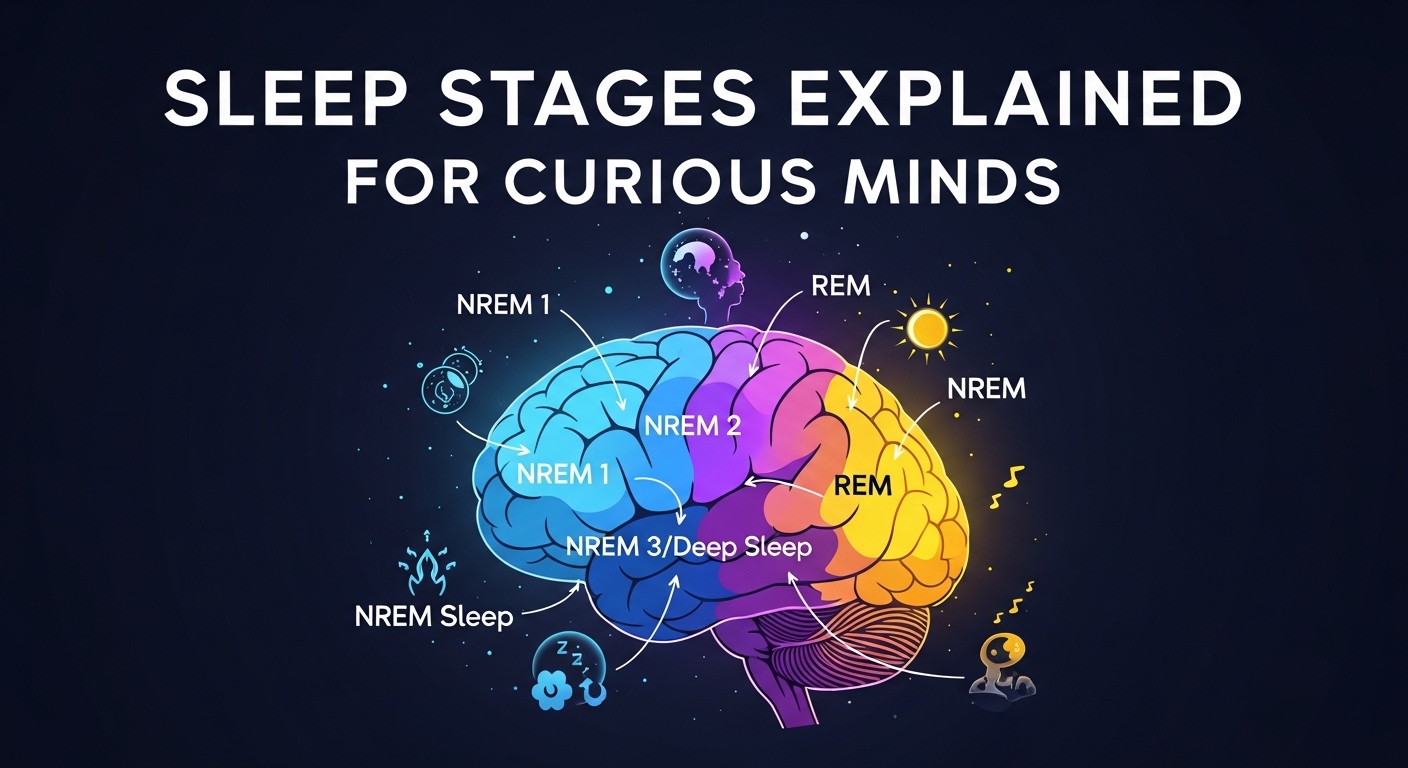
Sleep stages are distinct phases your brain and body cycle through during rest, each characterized by unique brain wave patterns, physiological changes, and specific functions. Researchers categorize sleep into two main types: non-rapid eye movement (NREM) sleep and rapid eye movement (REM) sleep. NREM includes three stages (N1, N2, and N3), while REM stands alone as the fourth stage.
The reason these stages matter goes far beyond academic curiosity. Deep sleep (N3) repairs tissues, strengthens your immune system, and releases growth hormone. REM sleep processes emotions, consolidates memories, and supports creative problem-solving. Light sleep stages (N1 and N2) serve as transitions and contribute to mental restoration. Skip any of these stages regularly, and you will notice the consequences in your energy levels, mood, and cognitive performance.
Your body moves through these stages in predictable cycles throughout the night. A complete cycle takes approximately 90 minutes, meaning you typically experience 4 to 6 cycles during a full night of sleep. The distribution changes as the night progresses, with more deep sleep early on and more REM sleep in the later hours. Understanding this architecture helps explain why timing matters when it comes to naps and why waking up at the wrong moment can leave you feeling terrible.
The Four Stages of Sleep: A Complete Breakdown
Here is what happens during each stage of a typical night’s sleep:
- Stage 1 (N1): Light sleep lasting 1 to 7 minutes, characterized by theta brain waves and the transition from wakefulness.
- Stage 2 (N2): Deeper light sleep lasting 10 to 25 minutes per cycle, making up about 45% of total sleep time with sleep spindles and K-complexes.
- Stage 3 (N3): Deep or slow-wave sleep lasting 20 to 40 minutes in early cycles, dominated by delta waves and responsible for physical restoration.
- Stage 4 (REM): Rapid eye movement sleep with brain activity similar to wakefulness, characterized by vivid dreams and muscle atonia.
Stage 1 (N1): The Gateway to Sleep
Stage 1, also called N1 or non-REM 1, is the transition between wakefulness and sleep. It typically lasts between one and seven minutes, though some people may pass through it more quickly. During this stage, your brain produces theta waves, which are slower than the beta waves of active wakefulness but faster than the deep sleep waves to come.
You have probably experienced N1 without realizing it. It is that drifting sensation where you are still somewhat aware of your surroundings but feel increasingly relaxed. Your muscles begin to unwind, your breathing slows, and your heart rate decreases slightly. Many people experience hypnic jerks during this stage, those sudden muscle contractions that make you feel like you are falling. Scientists believe these may be evolutionary remnants from when our ancestors slept in trees.
If you have ever caught yourself suddenly snapping awake with a jolt just as you were about to fall asleep, that was your brain transitioning through N1. This stage is very light, and you can be awakened easily. People who claim they barely sleep often spend more time in N1 than they realize, drifting in and out of awareness without progressing to deeper stages.
N1 serves an important function as the on-ramp to deeper sleep. Your body uses this brief window to begin shutting down unnecessary systems and preparing for restoration. While it only represents about 5% of total sleep time in healthy adults, it is essential for the transition into the more restorative stages that follow.
Stage 2 (N2): Deeper Light Sleep
Stage 2, or N2, represents the largest portion of your night, making up approximately 45% of total sleep time in adults. Each N2 period lasts roughly 10 to 25 minutes during the first cycles, though this can vary. While still considered light sleep, N2 is significantly deeper than N1 and harder to interrupt.
What makes N2 fascinating from a neurological perspective is the appearance of sleep spindles and K-complexes. Sleep spindles are brief bursts of brain activity that look like spindles on an EEG reading. They function as a protective mechanism, keeping you asleep when exposed to external stimuli. K-complexes are large wave patterns that appear in response to sounds or other disturbances, essentially helping your brain decide whether to stay asleep or wake up.
Beyond these interesting electrical patterns, N2 serves important cognitive functions. This is when your brain begins consolidating memories, moving information from short-term to long-term storage. Your body temperature drops and your heart rate continues to slow. Your muscles relax further, and eye movements cease. You are genuinely asleep at this point, though not yet in the deep restoration phase.
Many people spend more time in N2 than any other stage, and for good reason. It provides a balance of rest and accessibility, allowing your brain to process the day while remaining ready to wake if necessary. Older adults tend to spend even more time in N2 and less in deep sleep, which is part of why sleep often feels less refreshing with age.
Stage 3 (N3): Deep Sleep and Delta Waves
Stage 3, formerly divided into stages 3 and 4 before scientists combined them, represents deep sleep or slow-wave sleep. This is when your brain produces delta waves, the slowest and highest-amplitude brain waves observed during sleep. N3 typically lasts 20 to 40 minutes during the first cycles of the night and makes up about 15% to 20% of total sleep time in young adults.
This stage is physically restorative. Your blood pressure drops, your breathing slows further, and blood flow to your muscles increases. Your pituitary gland releases growth hormone, essential for tissue repair and development. Your immune system strengthens, preparing to fight off infections. If you have ever had someone tell you they need their beauty sleep, they are talking about N3, as this is when cellular repair and regeneration peak.
N3 is also the hardest stage to wake from. If someone rouses you from deep sleep, you will likely experience sleep inertia, that groggy disorientation that can last several minutes or even hours. This explains why napping too long can backfire, leaving you feeling worse than before. Your brain essentially needs time to climb back up through the stages to full wakefulness.
Stage 3 is deeper than REM sleep in terms of how difficult it is to wake someone and how disconnected they are from the environment. While REM involves intense brain activity, N3 represents the deepest level of unconsciousness in the sleep cycle. This is when sleepwalking and night terrors typically occur, as the brain is deeply asleep while parts of the motor system remain active.
REM Sleep: Where Dreams Come Alive
REM sleep, named for the rapid eye movements that characterize it, is when most vivid dreaming occurs. Your brain becomes highly active during REM, producing brain wave patterns similar to wakefulness. Despite this mental activity, your body enters a state of temporary paralysis called atonia, where most major muscle groups are essentially turned off to prevent you from acting out your dreams.
Each REM period grows longer throughout the night. The first REM phase may last only 10 minutes, but by the final cycles of the night, REM can extend to 60 minutes or more. Overall, REM makes up about 20% to 25% of total sleep time in healthy adults, though this percentage is much higher in infants who can spend up to 50% of their sleep in REM.
The functions of REM extend far beyond entertainment value from dreams. This stage is essential for emotional processing and memory consolidation, particularly for procedural memories and complex learning. REM helps your brain make connections between new information and existing knowledge, supporting creative problem-solving. It also appears to play a role in emotional regulation, helping you process difficult experiences without being overwhelmed by them.
If you have ever seen the film Inception, you have encountered a Hollywood interpretation of REM phenomena. The movie’s layered dream sequences play with the concept of dream time feeling longer than real time, which actually has some basis in research. While the film takes creative liberties, REM dreams do tend to be more vivid, story-like, and emotionally charged than the fragmented thoughts of other stages. Christopher Nolan reportedly drew from his own lucid dreaming experiences when crafting the screenplay.
How Sleep Cycles Work Throughout the Night
A typical sleep cycle progresses through stages N1, N2, N3, N2 again, and finally REM, taking approximately 90 minutes to complete. However, this duration varies between individuals and can range from 80 to 100 minutes. The cycle then repeats, with the composition changing as the night progresses.
Your first sleep cycle of the night contains the most deep sleep. You may spend 20 to 40 minutes in N3 during the first cycle, but by the fourth or fifth cycle, deep sleep may be minimal or absent entirely. Conversely, REM periods grow longer throughout the night. Early cycles might have brief 10-minute REM phases, while later cycles can feature hour-long REM periods. This explains why you are more likely to remember dreams if you wake up in the morning rather than the middle of the night.
Most adults complete 4 to 6 full cycles during a 7 to 9 hour sleep period. If you have ever wondered why the recommendation is 7 to 9 hours rather than a multiple of 90 minutes, it is because sleep cycles are not perfectly uniform. The first cycles tend to be longer and contain more deep sleep, while later cycles are shorter and REM-heavy. Waking naturally after 7.5 hours might cut off a final REM period, while 9 hours lets you complete that cycle.
This cycling architecture has practical implications for napping and wake-up timing. The popular advice to sleep in 90-minute increments works because it aims to wake you at the end of a cycle rather than in the middle of deep sleep. However, the variation between individuals means you may need to experiment to find your own optimal timing.
Why Each Sleep Stage Matters for Your Health
Missing any sleep stage has measurable consequences for your physical and mental health. Deep sleep deprivation impairs immune function, reduces growth hormone production, and leaves you physically exhausted even if you spent adequate time in bed. Athletes particularly notice the difference, as tissue repair and muscle recovery depend heavily on N3.
REM deprivation affects cognitive and emotional function. Without adequate REM, you may struggle with memory consolidation, creative problem-solving, and emotional regulation. Research suggests that REM deprivation can even impact your ability to read facial expressions and social cues. Chronic REM suppression, which can occur with alcohol use or certain medications, has been linked to increased anxiety and depression.
Light sleep stages matter too. While N1 and N2 might seem less glamorous than deep sleep and REM, they serve as essential transitions and contribute to overall restfulness. N2 in particular plays a role in memory consolidation and motor skill learning. People who frequently wake throughout the night and cannot maintain N2 long enough to reach deeper stages often report feeling unrefreshed despite technically sleeping for hours.
The distribution of stages also matters. While individual needs vary, adults generally need 15% to 20% deep sleep and 20% to 25% REM for optimal functioning. Wearable devices that track sleep stages can help you identify patterns, though consumer technology is not perfectly accurate. If you consistently feel unrested despite adequate time in bed, your sleep architecture may be the culprit.
What Affects Your Sleep Stages
Age dramatically changes sleep architecture. Newborns spend up to 50% of their sleep in REM, which supports rapid brain development. Teenagers actually need more sleep than adults but often experience delayed sleep phase, making early mornings difficult. Older adults typically see deep sleep decrease significantly, sometimes to just a few percent of total sleep time, which contributes to lighter, more fragmented sleep.
Alcohol has a particularly disruptive effect on sleep stages. While it may help you fall asleep faster, it suppresses REM sleep during the first half of the night and causes more frequent awakenings later. Your body metabolizes alcohol as a toxin, prioritizing that process over normal sleep cycling. This is why even a single drink before bed can leave you feeling groggy the next morning.
Caffeine consumed even six hours before bedtime can reduce deep sleep. Medications including antidepressants, blood pressure drugs, and sleep aids alter sleep architecture in various ways. Sleep disorders like sleep apnea repeatedly interrupt cycles, preventing progression to deep and REM stages. Shift work disrupts the natural timing of when different stages occur.
Wearable devices like Apple Watch and Fitbit claim to track sleep stages using heart rate variability and movement patterns. While these devices have improved significantly, they are not as accurate as polysomnography, the clinical gold standard that uses EEG to measure actual brain waves. Consumer trackers are reasonably good at detecting when you are awake versus asleep but less reliable at distinguishing between specific sleep stages.
Napping Strategy: Power Naps vs Full Cycles
Strategic napping requires understanding sleep stages. A 20-minute power nap keeps you in light sleep stages N1 and N2, providing refreshment without sleep inertia. You wake before entering deep sleep, avoiding the grogginess that comes from being pulled out of N3 prematurely. This duration is ideal for an afternoon energy boost.
A full 90-minute nap allows you to complete an entire sleep cycle including light sleep, deep sleep, and REM. This option provides more substantial restoration and is less likely to disrupt nighttime sleep if taken earlier in the day. However, waking from the deep sleep portion of a 90-minute nap can still cause temporary grogginess.
The danger zone for napping is the 30 to 60 minute range. This duration often puts you into deep sleep without allowing you to complete the cycle. Waking during N3 produces significant sleep inertia that can impair your performance for up to an hour. If you have ever taken a nap and felt worse afterward, you probably woke from deep sleep.
If you wake up in the middle of the night and cannot fall back asleep within 20 minutes, sleep experts generally recommend getting up briefly rather than lying awake. Your body may interpret the wakefulness as the start of a new day, but your sleep cycles will reset when you return to bed. You will not resume exactly where you left off, but you can still get valuable sleep in the remaining hours.
Sleep Stages in Movies and Pop Culture
Hollywood has long been fascinated by sleep and dreams, though films often take creative liberties with the science. Inception (2010) remains the most prominent example, depicting dreams within dreams with different time dilation at each level. While the film exaggerates the time distortion, REM dreams do sometimes feel subjectively longer than the minutes they actually occupy. The movie’s totem concept, while fictional, touches on the reality that lucid dreamers sometimes use reality checks.
The Matrix (1999) plays with the boundary between waking and dreaming, a concept rooted in the reality that REM brain activity closely resembles wakefulness. Neo’s awakening mirrors the transition from sleep to waking, though the film’s virtual reality premise obviously extends far beyond actual sleep science. The idea that we cannot distinguish dreams from reality has fascinated philosophers long before neuroscience identified the brain states involved.
Fight Club (1999) features a protagonist suffering from chronic insomnia, a condition that severely disrupts sleep architecture. The character’s dissociative states, while dramatized for the film, reflect real connections between sleep deprivation and altered consciousness. Chronic sleep loss can produce symptoms resembling intoxication or mental illness.
Horror films frequently exploit sleep paralysis, a phenomenon where you become conscious while REM atonia persists. You are essentially awake but temporarily unable to move, and the experience can include hallucinations. Films like The Nightmare (2015 documentary) explore these terrifying episodes, which occur when the brain transitions between REM and wakefulness imperfectly. Understanding the biology does not make the experience less frightening, but it does demystify what is happening.
Eternal Sunshine of the Spotless Mind (2004) imagines memory erasure during sleep, which touches on the real connection between REM sleep and memory consolidation. While we cannot selectively delete memories as depicted, the film captures something true about how sleep processes and stores experiences from our waking lives.
Tips for Healthier Sleep Cycles
Consistency is the foundation of healthy sleep architecture. Going to bed and waking at the same times every day, even on weekends, trains your body to cycle through stages predictably. Your circadian rhythm, controlled by your brain’s suprachiasmatic nucleus, works best with regular timing.
Limit alcohol within three hours of bedtime to preserve REM sleep. Avoid caffeine after early afternoon, as it has a half-life of five to six hours and can reduce deep sleep even when you no longer feel stimulated. Create a cool, dark, quiet bedroom environment to minimize awakenings that fragment your cycles.
Manage light exposure carefully. Bright light in the morning helps anchor your circadian rhythm, while blue light from screens in the evening suppresses melatonin and delays sleep onset. Consider using apps that filter blue light or wearing amber glasses if you must use devices before bed.
If you want to wake more refreshed, try timing your alarm to the end of a sleep cycle. Sleep cycle calculator apps can estimate when you should go to bed based on your wake time, aiming for complete cycles. While individual variation exists, these tools work better than arbitrary wake times that might catch you in deep sleep.
Frequently Asked Questions About Sleep Stages
What are the 5 stages of sleep?
Sleep is actually divided into 4 main stages, not 5. There are three NREM stages (N1, N2, and N3) and one REM stage. Older classification systems split N3 into two separate stages (3 and 4), which is where the confusion about 5 stages comes from. Modern sleep science combines these into a single deep sleep stage.
Is it better to have REM or deep sleep?
Both are essential for different reasons. Deep sleep (N3) provides physical restoration, immune support, and growth hormone release. REM supports mental health, memory consolidation, and emotional processing. You need both for optimal functioning. Chronic deprivation of either creates distinct problems.
Is stage 3 or REM sleep deeper?
Stage 3 (deep sleep or slow-wave sleep) is physically deeper. It is harder to wake someone from N3, and doing so causes significant sleep inertia. While REM involves intense brain activity, the body is actually easier to rouse from REM than from deep N3 sleep.
Is 2 hours of REM sleep good or bad?
Two hours of REM sleep is excellent for most adults. Healthy adults typically get 90 to 120 minutes of REM per night, representing 20% to 25% of total sleep time. Getting 2 hours of REM during a full night’s sleep suggests you are sleeping well and completing sufficient cycles.
How much of each stage of sleep should you get?
For healthy adults: Stage 1 (N1) should be 2% to 5% of sleep, Stage 2 (N2) about 45% to 55%, Stage 3 deep sleep 15% to 20%, and REM sleep 20% to 25%. These percentages vary by age and individual, but significant deviations may indicate sleep problems.
Does waking up in the middle of the night reset sleep cycle?
Waking up briefly does not completely reset your sleep cycles, but it does interrupt the current cycle. When you fall back asleep, you typically restart at Stage 1 (N1) and progress through the stages again. You may spend less time in deep sleep during the remaining hours of the night.
How many sleep cycles per night?
Most adults complete 4 to 6 sleep cycles per night. Each cycle lasts approximately 90 minutes, though this varies between 80 and 100 minutes per individual. A 7 to 9 hour sleep period typically allows for 5 complete cycles, which is considered optimal for most adults.
What stage of sleep should you wake up in?
Waking from Stage 1 (N1) or Stage 2 (N2) light sleep produces the least grogginess. Waking from REM can cause brief disorientation but is generally manageable. Avoid waking from Stage 3 deep sleep if possible, as this causes sleep inertia that can impair you for up to an hour.
Key Takeaways
Sleep stages explained for curious minds comes down to understanding that your night is not just one long unconscious period. You cycle through four distinct stages, each serving unique functions. Stage 1 transitions you into sleep. Stage 2 provides the bulk of your rest and begins memory processing. Stage 3 offers physical restoration and immune support. REM processes emotions and consolidates learning through vivid dreams.
These stages cycle every 90 minutes, with the composition changing throughout the night. You get more deep sleep early on and more REM toward morning. Missing any of these stages leaves you less than your best self, whether through physical exhaustion from lost deep sleep or mental fog from REM deprivation.
Understanding your sleep architecture empowers you to make better decisions about napping, alcohol consumption, and wake timing. You now know why 20-minute naps refresh while 40-minute naps can backfire. You understand why that nightcap hurts your sleep quality despite helping you fall asleep faster. And you can appreciate the science behind those vivid dreams that Hollywood loves to explore in films like Inception and The Matrix. Sleep well, and may your cycles be complete.