
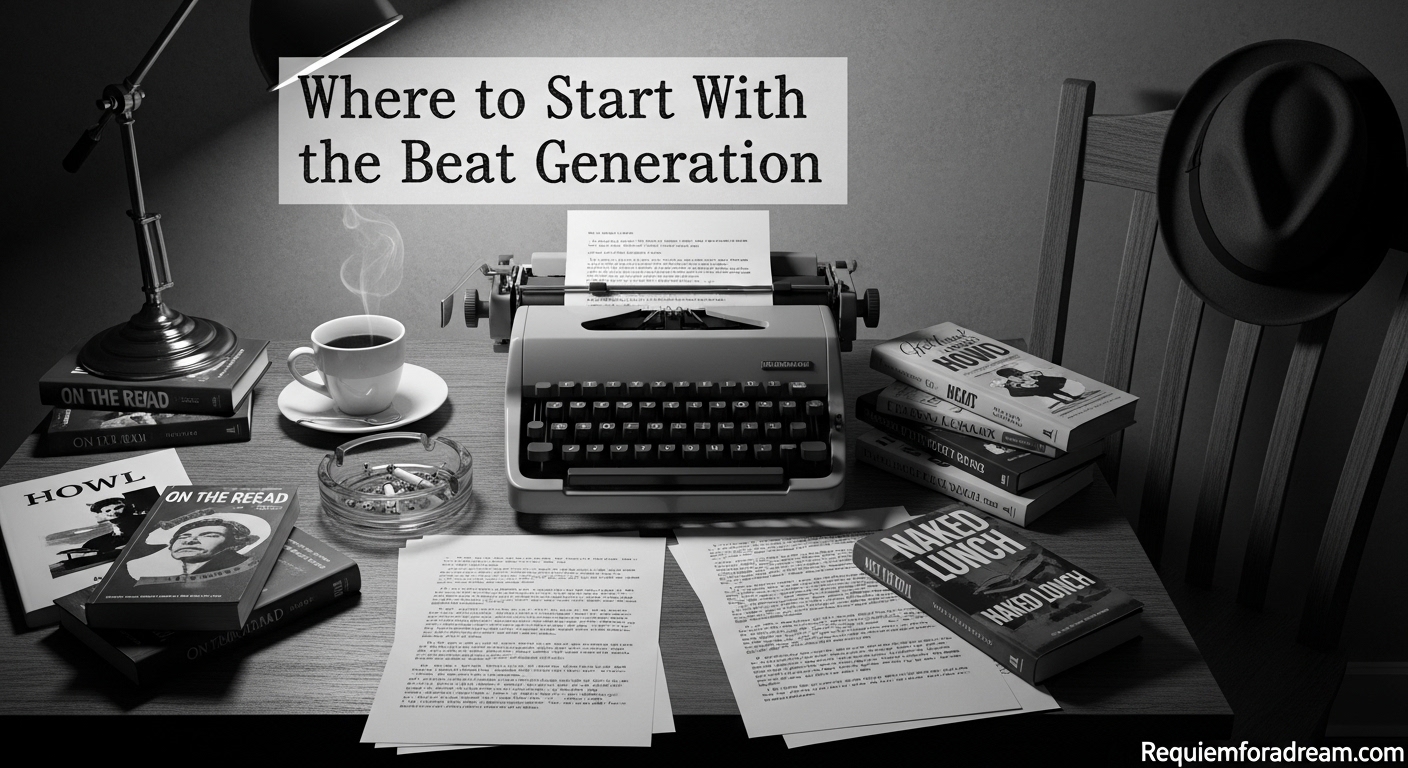
Where to start with the Beat Generation? I remember standing in a used bookstore fifteen years ago, staring at a shelf of vintage paperbacks with cracked spines and faded covers. The names looked familiar from college syllabi I had skipped: Kerouac, Ginsberg, Burroughs. But the books felt intimidating. Which one first? The thickest? The most famous? The one with the coolest cover?
I grabbed On the Road because everyone said it was the gateway. Some of it clicked immediately. Some of it frustrated me. That is the thing about the Beats. They are not a monolith. Jack Kerouac’s spontaneous prose highways feel completely different from Allen Ginsberg’s raw poetic howls or William Burroughs’ hallucinatory cut-up experiments.
This guide exists because I wish someone had handed me a map back then. We will look at the essential books, the authors who defined the movement, and most importantly, the right starting points based on what actually interests you. Whether you want road-trip wanderlust, spiritual seeking, or just to understand what the counterculture was rebelling against, there is a Beat book that fits. By the end, you will know exactly where to begin.
Table of Contents
What Was the Beat Generation?
The Beat Generation was a literary and cultural movement that emerged in the 1940s and peaked during the 1950s. It began at Columbia University in New York City, where a circle of students and friends—Kerouac, Ginsberg, Lucien Carr, and others—gathered around older mentors like William S. Burroughs. They shared a dissatisfaction with mainstream American values, materialism, and the cultural conformity that followed World War II.
The term “Beat” originally meant weary or defeated, but Kerouac expanded it to include “beatific”—a spiritual blessedness. The Beats were beat down by society but seeking transcendence through art, drugs, Eastern philosophy, sexual exploration, and constant movement. They wrote in coffee shops, traveled across America, and eventually converged on San Francisco’s North Beach neighborhood, where the movement found its public voice.
Where Did the Beat Generation Start?
The movement’s origins trace back to Morningside Heights in 1944. Ginsberg, Carr, Kerouac, and Burroughs formed a tight-knit group centered around Columbia’s campus and the nearby apartment of their friend Joan Vollmer Burroughs. After a series of personal tragedies and scandals, the original New York circle scattered. Kerouac took to the road. Ginsberg moved to San Francisco. The scene reformed in California, culminating in the famous Six Gallery reading on October 13, 1955, where Ginsberg debuted Howl and the Beat Generation became a national phenomenon.
What Did the Beat Generation Believe In?
The core philosophy centered on several key ideas. First, spontaneous creativity over polished craft. Kerouac typed On the Road on a single scroll of paper in three weeks. Ginsberg wrote Howl in one extended session. Second, spiritual seeking through Buddhism, Zen, and mystical Christianity. Third, personal freedom including sexual liberation and drug experimentation. Fourth, rejection of materialism and the corporate American dream. The Beats wanted authentic experience over comfortable security.
Beatniks vs. the Beat Generation
The word “beatnik” was a media invention that came later. San Francisco columnist Herb Caen coined it in 1958, combining “Beat” with the Russian satellite Sputnik. It suggested an “otherness” and soon became a caricature. Men in black turtlenecks, bongo drums, pseudo-intellectual jargon. The actual writers rejected the label. Kerouac hated it. The Beat Generation was about literature and genuine rebellion. Beatniks were a fashion trend. Understanding this distinction helps you approach the actual books without the stereotype baggage.
Essential Books: Your Starting Lineup
These eight books form the core Beat canon. I have organized them by accessibility, with difficulty ratings and the best audience for each. Start with what matches your interests and reading comfort level.
On the Road by Jack Kerouac (1957)
Accessibility: Easy | Best for: First-time readers, road trip lovers
This is still the most popular entry point, and for good reason. The novel follows Sal Paradise (Kerouac’s alter ego) and Dean Moriarty (based on Neal Cassady) as they crisscross America in search of “it.” The prose is breathless, exuberant, and intentionally unedited. Kerouac believed in spontaneous prose—writing without revision, capturing the flow of thought like jazz improvisation.
It works because the energy is infectious. Even when the characters make terrible decisions, their hunger for life pulls you along. The descriptions of 1940s America—the jazz clubs, the prairie highways, the Denver underground—create a vivid travelogue. Fair warning: some attitudes toward women and minorities have aged poorly. Read it as a document of its time, not a guide for living.
My recommendation? If you have ever felt restless, if you have ever wanted to just get in a car and drive until something happens, start here.
Howl and Other Poems by Allen Ginsberg (1956)
Accessibility: Easy to Medium | Best for: Poetry lovers, social rebels
Ginsberg’s Howl is the single most important poem of the Beat movement. It opens with the famous line: “I saw the best minds of my generation destroyed by madness.” The poem is a raw lament for friends driven insane by a conformist society, a celebration of the outcasts and the visionary, and an indictment of American materialism.
The language is explicit. Drugs, sex, homosexuality, mental institutions—it was shocking in 1956 and got Ginsberg arrested on obscenity charges. City Lights Books publisher Lawrence Ferlinghetti fought the case and won, establishing legal precedent for literary freedom. That history matters because it explains why the poem feels so urgent. These were not comfortable academics writing for other academics. They were risking jail for their art.
The collection also includes “Sunflower Sutra” and “A Supermarket in California,” which are more accessible and often anthologized. If you are new to poetry, read these shorter pieces first, then tackle Howl proper.
The Dharma Bums by Jack Kerouac (1958)
Accessibility: Easy | Best for: Spiritual seekers, nature lovers
Written shortly after On the Road, this novel is actually the better starting point for many readers. It chronicles Kerouac’s adventures with Gary Snyder (fictionalized as Japhy Ryder) as they backpack through the Sierra Nevada, discuss Zen Buddhism, and seek enlightenment in the mountains.
The prose is calmer than On the Road. The characters are gentler. Where Sal Paradise chased kicks, Ray Smith (Kerouac’s narrator here) wants peace. The famous mountain climbing sequence, the descriptions of meditation practice, and the genuine warmth between the characters make this a more welcoming introduction to Kerouac’s world. If you find On the Road too chaotic, try The Dharma Bums first.
Naked Lunch by William S. Burroughs (1959)
Accessibility: Difficult | Best for: Experimental literature fans, strong stomachs
Burroughs is the most challenging of the Big Three, and Naked Lunch is his most notorious work. The novel is a series of hallucinatory vignettes set in a surreal, dystopian landscape called Interzone. It abandons conventional narrative entirely. Scenes shift without warning. Characters morph into other characters. Reality dissolves into satirical horror.
The cut-up technique—where Burroughs literally cut pages into pieces and rearranged them—creates disorienting but occasionally brilliant effects. The book is funny in a dark, absurdist way. It is also deeply disturbing. Drug addiction, sexual violence, and bureaucratic nightmare fuel the imagery. Burroughs himself described it as “a frozen moment when everyone sees what is on the end of every fork.”
Do not start here unless you already enjoy experimental fiction. If you want to try Burroughs but need an easier entry, his later novels like Nova Express are slightly more structured, or his letters (the collection Letters to Allen Ginsberg) offer accessible insights into his thinking.
Kaddish and Other Poems by Allen Ginsberg (1961)
Accessibility: Medium | Best for: Readers drawn to emotional depth
The title poem is Ginsberg’s elegy for his mother, Naomi, who died in a mental institution after a lifetime of illness and paranoia. It is longer than Howl and structurally more complex, weaving Hebrew prayer, personal memory, and political rage into a moving portrait of grief and family trauma.
Kaddish requires more patience than Howl. The references to Jewish tradition and 1930s leftist politics can be obscure. But the emotional payoff is immense. When Ginsberg writes about his mother’s delusions, her fear of poison in the food, her institutionalization, the poem achieves a documentary realism that transcends the Beat label.
Read this after Howl if the Beat aesthetic clicks for you and you want to see Ginsberg’s range beyond the famous opening salvo.
Gasoline by Gregory Corso (1958)
Accessibility: Easy | Best for: Poetry newcomers, fans of wit
Corso was the youngest of the major Beats and often the funniest. His poems are shorter, more playful, and less politically charged than Ginsberg’s. “Marriage” imagines the domestic horrors of settling down. “The Whole Mess… Almost” lists everything he loves in rapid succession. His work offers a lighter, more accessible entry point into Beat poetry.
Corso lacked the academic background of Ginsberg or the mystical intensity of Kerouac. He grew up in foster homes and juvenile detention. That outsider perspective gives his work a freshness and irreverence that still reads well today. If Howl feels too heavy, try Gasoline first.
Big Sur by Jack Kerouac (1962)
Accessibility: Medium | Best for: Fans of On the Road seeking more depth
By the early 1960s, Kerouac was famous, alcoholic, and exhausted. Big Sur chronicles his attempt to escape fame by retreating to Lawrence Ferlinghetti’s cabin in the California wilderness. It is a darker, more honest book than On the Road. The wild energy has curdled into anxiety. The spiritual seeking has become desperate.
The famous “sea” passages—where Kerouac describes watching the waves crash against the rocks for hours—achieve a hypnotic beauty. But the book is ultimately tragic. The characters cannot outrun their demons. Nature offers no permanent peace. Read this after On the Road if you want to see the full arc of Kerouac’s talent and his struggles.
A Coney Island of the Mind by Lawrence Ferlinghetti (1958)
Accessibility: Easy | Best for: Casual poetry readers, art lovers
Ferlinghetti was the publisher who made the Beats possible through City Lights Books, but he was also a significant poet in his own right. This collection is his most popular work, selling over a million copies. The poems are short, imagistic, and accessible. They reference art, politics, and San Francisco culture with a lighter touch than Ginsberg’s cosmic pronouncements.
Ferlinghetti never achieved the revolutionary reputation of his authors, which makes him a safe entry point. You get the Beat sensibility—anti-establishment, jazz-influenced, visually oriented—without the intensity that can overwhelm newcomers. If you want to sample Beat poetry without committing to Howl’s epic scale, start here.
Choose Your Reading Path
Everyone asks the same question: which book first? The answer depends on what draws you to the Beats in the first place. Here are three tailored paths based on reader interests.
Path One: The Prose Lover
If you prefer novels and storytelling, start with The Dharma Bums. It is more structured than On the Road, with clearer character development and a gentler tone. The mountain-climbing sequences and meditation discussions give it shape. After that, read On the Road for the full Kerouac experience. Then try Big Sur to see the darker side. Save Naked Lunch for last—it requires the most adjustment if you are coming from conventional fiction.
Path Two: The Poetry Enthusiast
Start with A Coney Island of the Mind for accessible, imagistic poems that introduce the Beat sensibility without overwhelming you. Then move to Gasoline for Corso’s wit and shorter forms. Tackle Howl third—by then you will understand the context and appreciate its ambition. Finally, read Kaddish to see Ginsberg’s emotional range beyond the famous opening salvo.
Path Three: The Cultural Historian
If you want to understand the movement as history, start with Howl for the moment that made the Beats famous. Then read On the Road for the pre-fame wanderlust that defined their mythology. The Dharma Bums shows the spiritual dimension. Finally, seek out Joyce Johnson’s memoir Minor Characters for the crucial perspective of the women who were present but excluded from the official narrative.
The Women of the Beat Generation
Most Beat anthologies focus on the men. This is a historical failing we should correct. Women were present at the creation. They wrote, loved, suffered, and published. Their exclusion says more about 1950s sexism than their talent.
Joyce Johnson was Kerouac’s girlfriend during On the Road’s publication. Her memoir Minor Characters (1983) is essential reading. It describes the Greenwich Village scene from a woman’s perspective, the casual sexism of the male writers, and her own ambitions as a novelist overshadowed by her famous lover. Johnson is a sharp observer and a graceful prose stylist. Her novel Come and Join the Dance (1962) predated the women’s liberation movement but explored similar themes of female independence.
Diane di Prima published her first poetry collection in 1958 and founded the Poets Press to distribute Beat work. Her memoir Recollections of My Life as a Woman (2001) covers her relationships with LeRoi Jones (later Amiri Baraka), her children by different fathers, and her navigation of a male-dominated literary scene. Her poetry, collected in Pieces of a Song (1990), combines Beat spontaneity with feminist consciousness.
Lenore Kandel wrote The Love Book (1966), a small poetry collection that became the subject of an obscenity trial in San Francisco. Her work is more explicitly sexual than most Beat writing, exploring female desire without apology. She was married to photographer Charles Plymell and remained part of the North Beach scene throughout her life.
Joan Vollmer Burroughs, William’s common-law wife, never published during her lifetime but was arguably the most important female figure in the movement’s early days. Her apartment hosted the original Columbia circle. Her death in 1954—accidentally shot by Burroughs during a drunken game of William Tell in Mexico City—haunted the male Beats and influenced their work. She deserves remembrance as more than a tragic footnote.
Why Read the Beats in 2026?
The Beat Generation ended decades ago. Kerouac died in 1969, Ginsberg in 1997, Burroughs in 1997. The America they traveled no longer exists. So why read them now?
First, the prose influence is everywhere. Hunter S. Thompson’s gonzo journalism, the New Journalism of Tom Wolfe, the road-trip narratives of modern travel writers—all descend from Kerouac’s spontaneous method. The Beats proved that American literature could sound like spoken language, could capture the rhythms of jazz and the velocity of the highway.
Second, the spiritual seeking resonates in an age of wellness culture and mindfulness apps. The Dharma Bums predated the American Buddhist boom by decades. Gary Snyder, who appears in that novel, is still alive and writing. The Beats were among the first Western writers to take Eastern philosophy seriously, not as exotic decoration but as genuine practice.
Third, the political questions remain urgent. Howl’s indictment of American conformity, its defense of the mentally ill, its celebration of homosexuality at a time when it was criminalized—these arguments are still being fought. The Beats remind us that literature can be dangerous, that words can get you arrested, that art matters enough to risk everything for.
Finally, there is the pure pleasure of the language. When Kerouac describes Denver at dusk, when Ginsberg catalogues the angels and junkies, when Corso jokes about marriage—these passages deliver immediate aesthetic joy. You do not need a PhD to enjoy the Beats. You need curiosity and a tolerance for excess. The books are still alive. They wait on shelves for new readers to discover them.
Frequently Asked Questions
Where to start with the Beat Generation?
Start with either Jack Kerouac’s On the Road for prose lovers or Allen Ginsberg’s Howl for poetry readers. The Dharma Bums is an easier Kerouac entry point for spiritual seekers. Avoid William Burroughs’ Naked Lunch until you are comfortable with experimental literature.
What is the best Kerouac book to start with?
The Dharma Bums is the best starting point for most readers. It has calmer prose than On the Road, gentler characters, and accessible themes of Buddhism and nature. If you prefer high energy and road trip mythology, choose On the Road instead.
What are the most important Beat books?
The essential Beat canon includes On the Road and The Dharma Bums by Jack Kerouac, Howl and Kaddish by Allen Ginsberg, Naked Lunch by William S. Burroughs, and A Coney Island of the Mind by Lawrence Ferlinghetti. These six works define the movement’s style and themes.
What order to read Jack Kerouac books?
Start with The Dharma Bums for accessible prose and spiritual themes. Next read On the Road for his most famous work. Continue with Big Sur for a darker, more mature perspective. Save Desolation Angels and his later experimental works for after you understand his style.
Where did the Beat Generation start?
The Beat Generation began at Columbia University in New York City during the 1940s. The original circle included Jack Kerouac, Allen Ginsberg, Lucien Carr, and William S. Burroughs. The movement gained national prominence in San Francisco during the 1950s, particularly after the famous Six Gallery reading in October 1955 where Ginsberg debuted Howl.
What did the Beat Generation believe in?
The Beats believed in spontaneous creativity over polished craft, spiritual seeking through Buddhism and mystical traditions, personal freedom including sexual liberation, and rejection of American materialism and conformity. They valued authentic experience over comfortable security and saw literature as a means of transcendence.
What is the beatnik movement?
The term beatnik was coined by San Francisco columnist Herb Caen in 1958 as a media caricature combining Beat with Sputnik. It suggested an otherness and became associated with black turtlenecks, bongo drums, and pseudo-intellectual posturing. The actual Beat writers rejected the label. Beatniks were a fashion trend; the Beat Generation was a literary movement.
Conclusion
Where to start with the Beat Generation depends entirely on who you are and what you want from literature. There is no single right answer. If you want energy and wanderlust, pick up On the Road. If you want poetry that changed the law, read Howl. If you want something gentler, try The Dharma Bums.
Remember that the Beats were readers before they were writers. Kerouac devoured Thomas Wolfe and Marcel Proust. Ginsberg studied William Blake and Walt Whitman. Burroughs read Joseph Conrad and dystopian science fiction. They built their revolution from the books that moved them. You can do the same.
Start with one book. See if the voice speaks to you. The Beat Generation is not homework. It is an invitation. Accept it, and see where the road takes you in 2026.