
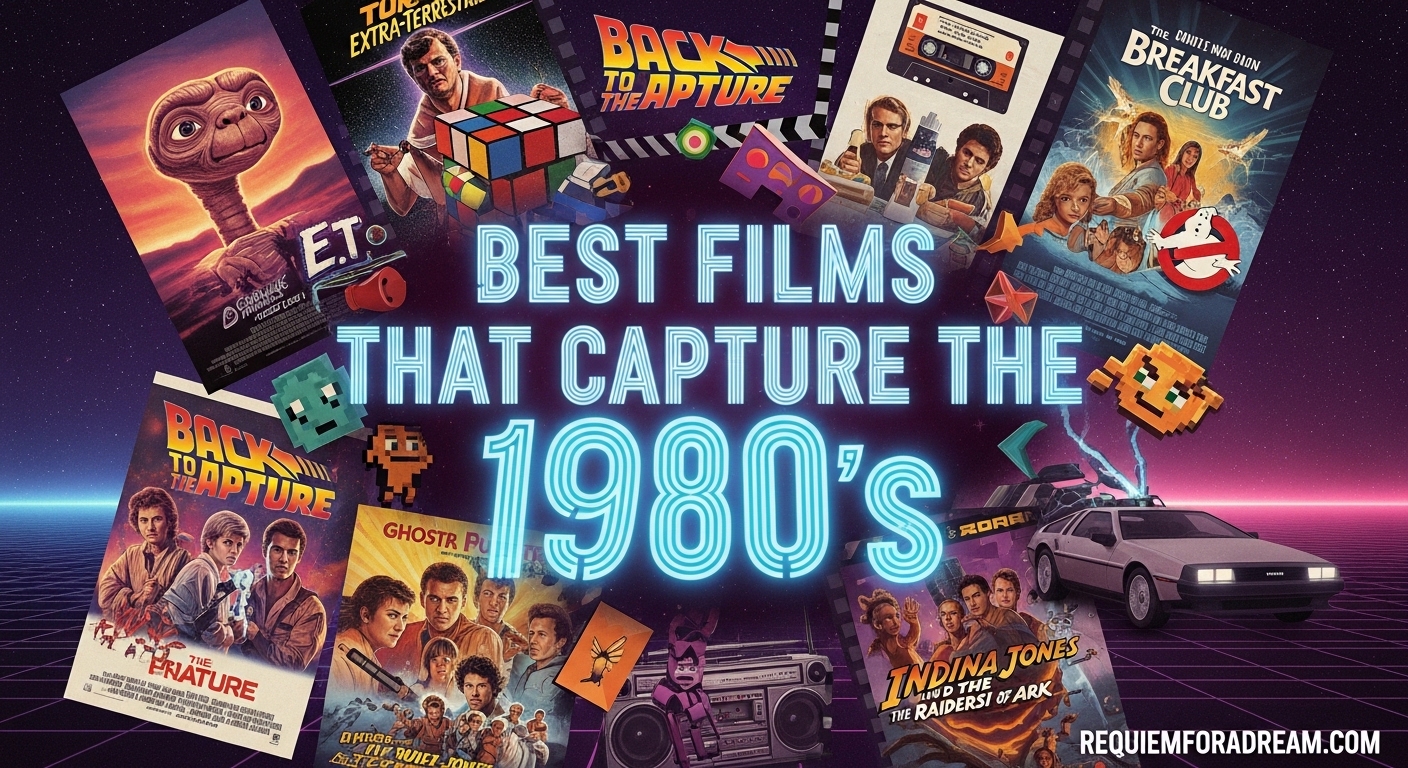
The 1980s was a decade unlike any other in cinema history. From neon-lit cityscapes to synthesizer-heavy soundtracks, from teen angst to blockbuster spectacle, the films of this era captured a unique cultural moment that continues to resonate with audiences today. But what makes a movie truly “capture” the 1980s? Is it the fashion, the music, the attitudes, or something more intangible—the very spirit of an era defined by excess, optimism, and transformation?
In this comprehensive guide, we explore twelve films that don’t merely take place in the 1980s—they embody it. These are the movies that defined the decade’s aesthetic, shaped its cultural conversations, and left an indelible mark on cinema history. Whether you’re a nostalgic Gen Xer reliving your youth or a curious newcomer discovering these classics for the first time, these films offer a portal into one of cinema’s most vibrant and influential decades.
Table of Contents
What Makes a Film Capture the 1980s?
Before diving into our selections, it’s worth considering what criteria elevate a film from “made in the 80s” to “capturing the 80s.” The films on this list share several characteristics:
- Visual Aesthetic: They embrace or define the decade’s visual language—whether through neon noir lighting, pastel colors, big hair, or distinctive fashion choices that immediately signal “1980s.”
- Cultural Impact: They influenced how we remember the decade, shaping everything from fashion trends to slang to collective memory.
- Thematic Resonance: They engage with themes central to the 1980s experience: Cold War anxieties, the rise of individualism, teen alienation, the dawn of the digital age, and the triumph of the underdog.
- Soundtrack Significance: They feature music that either defined or has become synonymous with the era’s sound.
The 12 Best Films That Capture the 1980s
1. Back to the Future (1985)
Director: Robert Zemeckis | Starring: Michael J. Fox, Christopher Lloyd
If any single film encapsulates the 1980s cinematic experience, it’s Back to the Future. This time-travel adventure works on multiple levels: as a thrilling sci-fi ride, a hilarious comedy, and perhaps most significantly, as a love letter to both the 1950s and the 1980s.
The film captures the 1980s through its optimistic spirit, its fascination with technology (the DeLorean time machine is essentially a character unto itself), and its soundtrack featuring Huey Lewis and the News. But it also captures something deeper—the 80s fascination with nostalgia itself, as Marty McFly visits the 1950s and finds his own parents as teenagers.
The visual aesthetic—from Marty’s puffy orange vest to the neon-lit 2015 sequences (which, in 1985, represented the far future)—has become iconic. The film’s success also epitomizes the blockbuster era that defined 1980s Hollywood, when high-concept premises, groundbreaking special effects, and mass appeal combined to create cultural phenomena.
2. The Breakfast Club (1985)
Director: John Hughes | Starring: Emilio Estevez, Judd Nelson, Molly Ringwald, Ally Sheedy, Anthony Michael Hall
No director captured the American teenager quite like John Hughes, and The Breakfast Club stands as his magnum opus. Set almost entirely in a high school library during Saturday detention, the film brings together five students from different social strata and watches as they slowly dismantle the barriers between them.
The film captures 1980s teen culture through its fashion (Molly Ringwald’s layered skirts and boots became a template for 80s style), its music (Simple Minds’ “Don’t You (Forget About Me)” became an anthem), and its honest exploration of adolescent anxiety. The characters—the jock, the princess, the criminal, the brain, and the basket case—became archetypes that still influence how we categorize high school social dynamics.
Beyond its cultural impact, The Breakfast Club captures the 1980s emphasis on individual expression and the search for authentic identity beneath social masks—concerns that defined the Me Generation.
3. Blade Runner (1982)
Director: Ridley Scott | Starring: Harrison Ford, Rutger Hauer, Sean Young
If Back to the Future represents the optimistic face of 1980s cinema, Blade Runner embodies its neon-drenched, noir-influenced alter ego. Ridley Scott’s adaptation of Philip K. Dick’s novel created a visual language—retroactively labeled “vaporwave”—that continues to influence design, fashion, and aesthetics today.
The film’s Los Angeles of 2019 (imagined from a 1982 perspective) is a rain-soaked metropolis of towering pyramids, flying cars, and ubiquitous neon signage. The production design, heavily influenced by French comic artist Moebius and futurist Syd Mead, created a dystopian future that felt simultaneously alien and familiar.
Vangelis’s synthesizer-heavy score perfectly complements the visual atmosphere, creating a soundscape that would influence decades of electronic music. The film’s themes—corporate power, environmental collapse, artificial intelligence, and what it means to be human—reflect anxieties that have only grown more relevant with time.
4. The Shining (1980)
Director: Stanley Kubrick | Starring: Jack Nicholson, Shelley Duvall, Danny Lloyd
Stanley Kubrick’s horror masterpiece opens the decade with a film that, while not explicitly “about” the 1980s, captured something essential about the era’s anxieties. The Overlook Hotel, isolated and magnificent, becomes a stage for the breakdown of the American family and the violence lurking beneath the surface of domestic tranquility.
The film’s visual style—with its steadicam shots through endless corridors, its geometric carpet patterns (which have become iconic design elements), and its cold, symmetrical compositions—created an aesthetic of dread that influenced horror cinema for decades. The use of Steadicam technology, then relatively new, gave the film a smooth, floating quality that made supernatural events feel unnervingly real.
Jack Nicholson’s performance as Jack Torrance, slowly descending from frustrated writer to axe-wielding maniac, captured the pressure-cooker atmosphere of the era. The film’s setting—an empty luxury hotel in the off-season—speaks to 1980s concerns about isolation, the failure of the American dream, and the monsters we become when cut off from society.
5. E.T. the Extra-Terrestrial (1982)
Director: Steven Spielberg | Starring: Henry Thomas, Drew Barrymore, Dee Wallace
Steven Spielberg’s tale of a boy and his alien companion captured the hearts of millions and defined the suburban childhood experience of the 1980s. E.T. works because it takes the wonder of Close Encounters of the Third Kind and scales it down to a child’s backyard, making the cosmic intimate.
The film captures 1980s suburban America—the split-level homes, the pizza deliveries, the Halloween trick-or-treating, the absent fathers (a recurring theme in 80s cinema reflecting rising divorce rates). It’s a world of cereal boxes and toy bicycles, of kids with freedom to roam unsupervised (a hallmark of pre-helicopter-parenting America).
John Williams’s soaring score, particularly the flying bicycle theme, became instantly iconic. The film’s blend of wonder and danger, its celebration of childhood imagination, and its message of compassion transcending species created a template for family entertainment that studios still attempt to replicate.
6. Ferris Bueller’s Day Off (1986)
Director: John Hughes | Starring: Matthew Broderick, Alan Ruck, Mia Sara
John Hughes appears twice on this list because his influence on 1980s teen cinema cannot be overstated. While The Breakfast Club explored teen angst and social stratification, Ferris Bueller’s Day Off celebrated the pure joy of being young and clever in a world that underestimates you.
Matthew Broderick’s Ferris is the ultimate 80s protagonist—charming, resourceful, tech-savvy (he hacks the school’s computer to reduce his absences), and effortlessly cool. The film’s love letter to Chicago—from the Art Institute to Wrigley Field to the Von Steuben Day Parade—showcases 1980s urban America at its most vibrant.
The film breaks the fourth wall in ways that feel fresh even today, with Ferris addressing the audience directly and commenting on his own story. This meta-textual playfulness became increasingly common in 1980s cinema as filmmakers embraced postmodern techniques. The message—life moves pretty fast, and if you don’t stop to look around once in a while, you could miss it—encapsulates the decade’s growing focus on individual experience over collective obligation.
7. The Goonies (1985)
Director: Richard Donner | Starring: Sean Astin, Josh Brolin, Corey Feldman, Kerri Green
Produced by Steven Spielberg and written by Chris Columbus, The Goonies captures the adventure-seeking spirit of 1980s childhood. A group of kids from the “Goon Docks” neighborhood of Astoria, Oregon, go on a treasure hunt to save their homes from foreclosure, encountering gangsters, booby traps, and a lovable monster named Sloth along the way.
The film embodies the “kids on an adventure” subgenre that flourished in the 1980s, when children in movies had agency, faced real danger, and solved problems without adult intervention. The 80s aesthetic is present in every frame—from Data’s homemade gadgets to Chunk’s truffle shuffle, from the Fratelli brothers’ criminal enterprise to One-Eyed Willie’s pirate ship.
The Goonies speaks to 1980s anxieties about economic precarity (the homes being foreclosed) while offering an escapist adventure that celebrates friendship, imagination, and the belief that kids can change the world. It remains a touchstone for 80s nostalgia, its fans still quoting lines and debating the locations of filming sites.
8. Top Gun (1986)
Director: Tony Scott | Starring: Tom Cruise, Kelly McGillis, Val Kilmer
If you want to understand 1980s Cold War optimism, look no further than Top Gun. Tony Scott’s aerial combat film turned Tom Cruise into a superstar and made naval aviation look like the coolest job on Earth. The film captures the era’s renewed military pride, its love affair with technology, and its unabashed embrace of American exceptionalism.
The visual aesthetic is pure 1980s: sunsets that look like they were designed by a lighting director, fighter jets gleaming like sports cars, and a color palette of blues, oranges, and whites that evokes Miami Vice (Tony Scott’s brother Ridley produced that show). The volleyball scene—set to “Playing with the Boys”—has become an iconic image of 80s beefcake cinema.
But it’s the soundtrack that truly cements Top Gun‘s 1980s credentials. Kenny Loggins’ “Danger Zone” and Berlin’s “Take My Breath Away” became instant classics, winning an Oscar for Best Original Song. The film’s success helped establish the formula of hit soundtracks boosting box office, a practice that defined 1980s Hollywood marketing.
9. Beetlejuice (1988)
Director: Tim Burton | Starring: Michael Keaton, Alec Baldwin, Geena Davis, Winona Ryder
Tim Burton’s sophomore feature established the visual and thematic sensibilities that would make him one of the defining directors of the late 1980s and beyond. Beetlejuice captures the decade’s growing appetite for the weird, the gothic, and the darkly comic—a reaction against the polished mainstream entertainment that had dominated the early 80s.
The film’s afterlife bureaucracy, with its waiting rooms and caseworkers, satirizes the era’s obsession with forms, rules, and institutional processes. The Deetzes, the yuppie family that moves into the haunted house, embody the decade’s materialism and pretension. And Lydia Deetz (Winona Ryder), with her black wardrobe and poetic melancholy, became a prototype for the disaffected youth who would define the alternative culture of the 1990s.
Michael Keaton’s performance as the bio-exorcist Beetlejuice is a masterclass in grotesque comedy, establishing the actor’s range beyond the clean-cut roles he’d previously played. The film’s handmade special effects, stop-motion animation, and production design create a tactile, imperfect world that feels distinctly pre-CGI—a hallmark of practical-effects 1980s filmmaking.
10. Fast Times at Ridgemont High (1982)
Director: Amy Heckerling | Starring: Sean Penn, Jennifer Jason Leigh, Judge Reinhold, Phoebe Cates
Based on Cameron Crowe’s undercover reporting at a California high school, Fast Times at Ridgemont High offers a more candid look at 1980s teen life than the polished fantasies of John Hughes. The film doesn’t shy away from sex, drugs, and the complexities of emerging adulthood, creating a time capsule of early 80s youth culture.
Sean Penn’s Jeff Spicoli became the definitive cinematic stoner, his surfer-dude patois and laid-back attitude offering both comedy and a genuine alternative to the era’s Reagan-era emphasis on ambition and success. The film’s mall culture—employees at pizza places and clothing stores, hanging out at the food court—captures the decade’s retail explosion and the emergence of the mall as teenage social hub.
The soundtrack reads like a who’s-who of early 80s rock: The Go-Go’s, Jackson Browne, Donna Summer, Jimmy Buffet, Tom Petty, and Fleetwood Mac. The film’s frank treatment of sexuality, its humor that ranges from slapstick to deadpan, and its ensemble structure influenced countless teen comedies that followed.
11. Say Anything… (1989)
Director: Cameron Crowe | Starring: John Cusack, Ione Skye
Closing out the decade, Say Anything… offers a more sensitive, introspective take on 1980s teen romance. Cameron Crowe’s directorial debut (after writing Fast Times) gives us Lloyd Dobler (John Cusack), an aimless optimist who falls for the class valedictorian Diane Court (Ione Skye).
The film captures the late-80s shift away from glossy blockbusters toward more character-driven stories. Lloyd Dobler, with his trench coat, his kickboxing aspirations, and his complete lack of career direction, embodies a generation questioning the materialism of the Reagan years. His romantic gesture—holding a boombox blasting Peter Gabriel’s “In Your Eyes” outside Diane’s window—became an iconic image of earnest, uncool romantic persistence.
The film also engages seriously with class issues (Diane’s father is investigated for fraud) and the anxiety of post-graduation limbo. It’s a movie about decent people trying to do the right thing, and in that sense, it captures the hopeful, uncertain spirit of 1989—a year that would see the Berlin Wall fall and the world change forever.
12. Heathers (1988)
Director: Michael Lehmann | Starring: Winona Ryder, Christian Slater, Shannen Doherty
As the 1980s drew to a close, Heathers arrived to brutally satirize everything the decade’s teen movies had built. This dark comedy about a high school where the popular clique (all named Heather) meets deadly justice at the hands of a rebellious student and her nihilistic boyfriend took the conventions of 80s cinema and twisted them into something dangerous and hilarious.
Winona Ryder’s Veronica Sawyer and Christian Slater’s J.D. channel the decade’s disaffected youth energy into something genuinely transgressive. The film’s Technicolor fashion—tweeds and blazers in primary colors—parodies preppy 80s style while making it look weirdly cool. The dialogue, full of invented slang and caustic wit, created a template for the stylized teen speech that would characterize 90s cinema.
Heathers captures the darkness beneath the gloss of 1980s America—the alienation, the pressure to conform, the violence simmering in suburban high schools. Its influence extends through films like Clueless, Mean Girls, and Euphoria, making it arguably the most forward-looking film on this list.
The Legacy of 1980s Cinema
These twelve films represent just a fraction of the 1980s cinematic output, but they capture essential truths about the decade. Whether through the lens of science fiction, horror, comedy, or romance, they explore themes that still resonate: the search for identity, the fear of technology, the celebration of youth, and the anxiety of a world in rapid transition.
The 1980s gave us the modern blockbuster, the teen movie as we know it, and the special effects-driven spectacle that dominates theaters today. But it also gave us intimate character studies, dark satires, and films that questioned the very values the decade seemed to celebrate. In their contradictions and variety, these movies capture something essential about the 1980s—a decade of excess and anxiety, of optimism and dread, of big hair and bigger ideas.
What film captures the 1980s for you? Is it one on this list, or something else entirely? The beauty of cinema is that each viewer brings their own experience to the screen, finding in these images not just a window to the past, but a mirror reflecting our own hopes, fears, and dreams.