
I still remember the first time I noticed a match cut. I was watching 2001: A Space Odyssey for the first time, completely mesmerized by that bone tumbling through the air. Then, in the blink of an eye, it transformed into a satellite floating in space.
That single transition said more than any dialogue ever could. It told the story of human evolution in one breathtaking moment. That’s the power of a match cut in film editing. This editing technique transforms simple scene transitions into storytelling powerhouses that can compress time, create thematic connections, and transport audiences through space without them even noticing.
In this guide, I’ll explain what is a match cut in film, why these transitions matter so much to filmmakers, and how you can use them in your own projects. Whether you’re a budding filmmaker, a video editor looking to refine your skills, or simply a film enthusiast who wants to understand what makes great editing tick, this article will give you everything you need to know about match cuts in 2026.
Table of Contents
What Is a Match Cut?
A match cut is a film editing technique that creates a seamless transition between two shots by matching visual elements, actions, or audio cues from the first shot to the second. Unlike standard cuts that simply move from one scene to another, match cuts use similarity in shape, movement, color, or sound to create a connection that feels organic and intentional.
The technique works by exploiting our brain’s natural tendency to find patterns and connections. When we see two images that share visual DNA, our minds bridge the gap automatically. This creates a smooth narrative flow that keeps viewers engaged while conveying meaning that dialogue or exposition simply cannot.
Think of it as visual poetry. Just as a poet might use rhyme to connect two seemingly unrelated ideas, a filmmaker uses matching elements to create relationships between scenes, characters, or moments in time. The result is a transition that doesn’t just move the story forward, it deepens it.
Why Match Cuts Matter in Film Editing
Match cuts matter because they solve one of filmmaking’s oldest challenges: how to move between scenes without jarring the audience or losing narrative momentum. Every time a film cuts from one location to another, from one time period to another, or from one emotional state to another, there’s a risk of breaking the spell that keeps viewers invested.
These transitions serve multiple storytelling functions. They can compress vast amounts of time into a single moment, connect disparate locations into a unified space, and create thematic links between characters who never meet. A well-executed match cut makes the audience feel smart because they recognize the connection. It turns passive viewing into active engagement.
From a practical standpoint, match cuts also help maintain pacing. Rather than using slow dissolves or elaborate transitional effects that can feel dated, a match cut keeps energy high while still providing visual information. Modern audiences, raised on quick-cut media from music videos to YouTube content, respond particularly well to this technique.
The psychological impact runs deeper than most viewers realize. When our brains process a match cut, we experience a moment of satisfaction, that “aha” feeling of recognizing a pattern. This positive emotional response keeps us locked into the story, eager to see what connections the filmmaker will reveal next.
Types of Match Cuts
Not all match cuts work the same way. Understanding the different types gives you more tools for your editing toolkit and helps you choose the right technique for each situation. The three main types of match cuts each serve different narrative purposes and create distinct effects.
Graphic Match Cuts
Graphic match cuts connect two shots through visual similarity in composition, shape, color, or form. The classic bone-to-satellite transition from 2001: A Space Odyssey is the most famous example, both objects share the same shape and trajectory against similar backgrounds.
These cuts work because our eyes naturally follow lines and shapes. When the composition of shot A matches shot B, the transition feels inevitable rather than arbitrary. Filmmakers use graphic matches to create visual metaphors, suggesting thematic connections between seemingly unrelated objects or scenes.
Color matching offers another powerful tool. A shot of red blood can cut to a red sunset, connecting violence with the end of a day or a life. A white wedding dress can cut to a white hospital sheet, linking joy with vulnerability. These color bridges speak directly to our emotions without a word of dialogue.
Shape matching operates similarly. A round clock face might cut to a round steering wheel, suggesting the passage of time and control. These geometric connections can be subtle or obvious, but they always serve to unify the visual world of the film.
Match on Action
Match on action cuts occur when a movement started in one shot continues into the next shot from a different angle or location. The action itself provides the bridge, making the cut invisible to most viewers. This technique is fundamental to continuity editing and appears in nearly every film you watch.
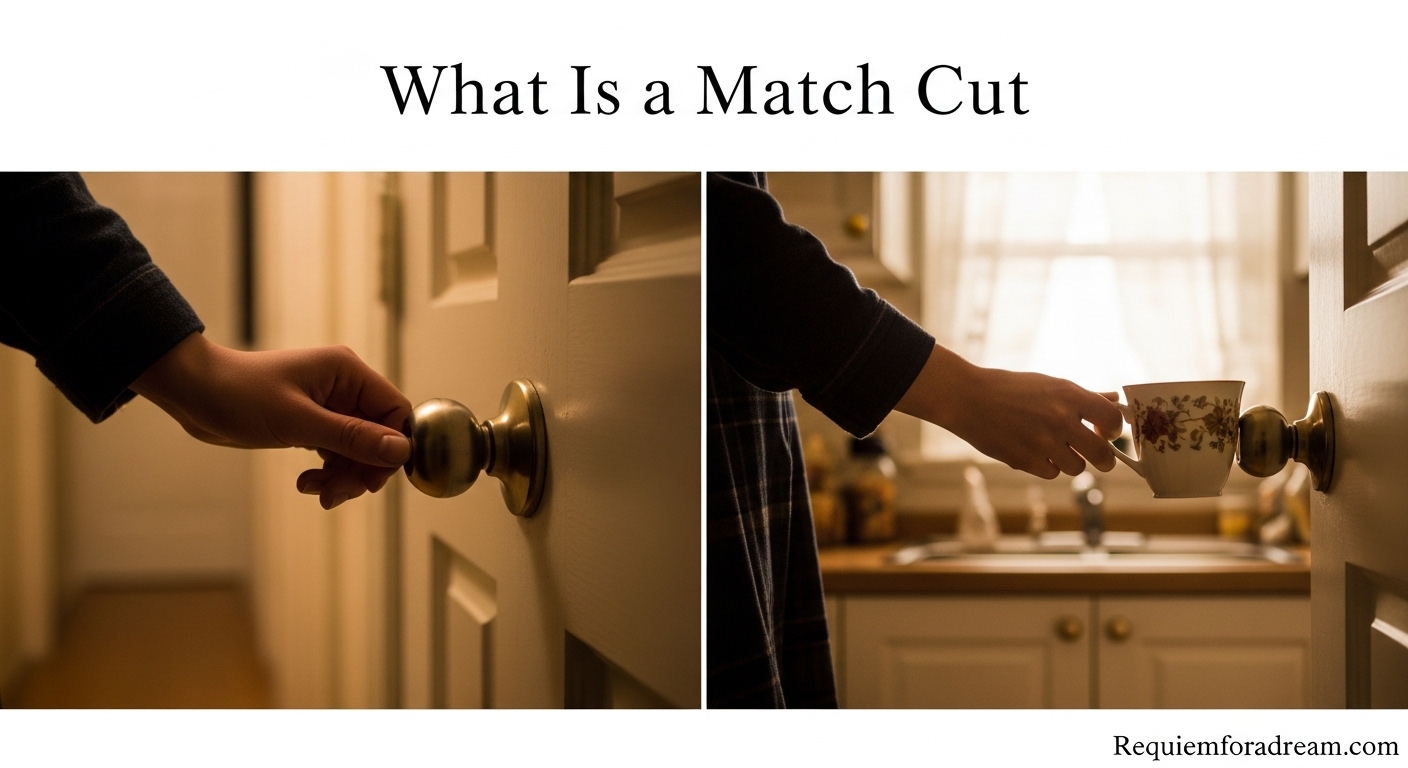
A character reaches for a doorknob in a wide shot, and the cut to a close-up shows the hand completing the same motion. The viewer’s eye follows the action, and the cut happens unnoticed beneath the movement. This is editing at its most invisible and effective.
The technique extends beyond simple movements. A character sitting down in one location can cut to them rising in another, suggesting the passage of time while maintaining visual continuity. A punch thrown in a boxing ring can cut to a door slamming, connecting violence with closure.
Professional editors pay careful attention to the “cutting point,” the exact frame where one shot ends and the next begins. Cut too early, and the action feels interrupted. Cut too late, and the movement feels repetitive. Finding the sweet spot takes practice but creates that seamless flow audiences expect from professional work.
Audio Match Cuts (Sound Bridges)
Audio match cuts, also called sound bridges, use matching sounds to connect two shots. The sound from one scene carries over into the next, or a similar sound in the new scene picks up where the previous one left off. This technique creates smooth transitions while adding layers of meaning.
The sound can be diegetic, meaning it exists within the world of the film, like a doorbell that rings in one house and continues into a different house in the next shot. Or it can be non-diegetic, like music that bridges scenes, carrying emotional tone across locations and time periods.
Edgar Wright’s films showcase masterful audio match cuts. In Scott Pilgrim vs. the World, phone rings, alarm clocks, and musical beats create a rhythmic editing style that feels energetic and modern. The sound doesn’t just connect scenes, it drives the entire film forward.
Sound bridges also work across different types of audio. Dialogue from one scene can begin over the image of the previous scene, a technique called an L-cut. Or dialogue can continue after we’ve cut to a new image, called a J-cut. Both techniques smooth transitions while adding narrative information.
Famous Match Cut Examples in Film History
The best way to understand match cuts is to see them in action. Throughout cinema history, certain films have elevated this technique to an art form, creating moments that film students still study decades later. These examples demonstrate the range and power of well-executed match cuts.
2001: A Space Odyssey (1968) contains the most famous match cut in film history. Stanley Kubrick’s transition from the bone thrown by an ape to the satellite orbiting Earth compresses millions of years of evolution into a single second. The cut works because both objects share the same shape, trajectory, and screen position. But its power comes from what it represents, the leap from primitive tools to space-age technology, from earthly violence to cosmic exploration.
Lawrence of Arabia (1962) features another legendary example. David Lean cuts from a blown-out match to the blazing desert sun using the same visual vocabulary. The flame’s shape and color match perfectly, but more importantly, the cut connects the intimate gesture of lighting a cigarette with the vast, unforgiving landscape that will test Lawrence’s spirit.
Edgar Wright has made match cuts a signature of his style. In Shaun of the Dead, he cuts from a vinyl record to a coffee mug, both spinning in the same direction, connecting nostalgia with mundane routine. In Baby Driver, nearly every cut is motivated by the soundtrack, creating a feature-length music video where gunshots, car doors, and screeching tires hit the beat with precision.
The Godfather (1972) uses match on action to powerful effect. The scene where Vito Corleone’s grandson mimics his facial expressions creates a subtle match cut that suggests family legacy and inherited traits. Coppola doesn’t need dialogue to show us how the past shapes the future.
Modern television has embraced the technique as well. Breaking Bad frequently used match cuts to show Walter White’s transformation from mild-mannered teacher to drug kingpin. One memorable cut transitions from a bloody scene to a red-sauced meal, connecting violence with domestic normalcy in a deeply disturbing way.
The Bear, a more recent series, uses rapid match cuts to convey the chaos and precision of professional kitchens. Knives chopping, pans flaming, and tickets printing all sync together to create a sense of controlled chaos that puts viewers right in the heat of the kitchen.
How to Use Match Cuts in Your Projects
Understanding match cuts intellectually is one thing. Actually using them in your own work requires planning, patience, and a willingness to experiment. Whether you’re shooting a short film, editing a YouTube video, or creating social media content, these techniques can elevate your work from amateur to professional.
Planning Match Cuts During Pre-Production
The most effective match cuts are planned before cameras roll. During your storyboarding phase, look for opportunities to connect scenes through visual elements. Ask yourself: what objects appear in multiple scenes? What movements repeat? What colors or shapes might create meaningful connections?
When writing your script, note potential match cuts in the action lines. For example: “Sarah turns the key. MATCH CUT TO: The same key turning in a different lock twenty years later.” This signals your intent to the editor and reminds you to capture the necessary footage during production.
Work with your production designer to create visual connections between sets. If you want to match cut from a modern city to an ancient village, consider using similar architectural elements in both locations. These visual echoes make the transition feel natural rather than forced.
For action matches, plan your camera angles carefully. You’ll need coverage that shows the same movement from different perspectives. Shoot the beginning of the action in your wide shot and the completion in your close-up, making sure the movement speed and direction match.
Executing Match Cuts in Post-Production
When you reach the editing room, start by identifying your best match cut opportunities. Look for shots with similar compositions, movements, or audio cues. Don’t force connections that aren’t there, the best match cuts feel inevitable, not clever.
In your editing software, use the blade or razor tool to find the exact frame where the match should occur. For action matches, cut on the frame where motion is most similar between shots. For graphic matches, align the matching elements precisely, paying attention to screen position and size.
If your footage doesn’t match perfectly, don’t abandon the cut. You can often adjust timing by extending or shortening individual frames. Color correction can help match shots that were filmed under different lighting conditions. Sometimes a slight zoom or position adjustment can align elements that were slightly off during filming.
Test your match cuts with fresh eyes. Show them to someone who hasn’t seen the edit and watch their reaction. If they notice the cut itself, it might not be working. If they simply follow the action without awareness of the transition, you’ve succeeded.
How to Write Match Cuts in a Screenplay
Formatting match cuts in screenplays follows industry conventions that signal your intent clearly. The standard format uses the transition “MATCH CUT TO:” between scenes to indicate a specific visual connection.
Here’s how it looks in practice:
INT. APARTMENT – DAY
Sarah drops a photograph. It flutters toward the floor.
MATCH CUT TO:
EXT. BEACH – DAY – TWENTY YEARS EARLIER
The same photograph drifts down onto sand.
Some writers prefer to include match cut notes within action lines without using the formal transition:
INT. KITCHEN – NIGHT
John turns on the faucet. Water gushes out (MATCH CUT: this water becomes rain in the next scene).
Either approach works, but consistency matters. Choose one format and stick with it throughout your script. Remember that match cuts are ultimately the director and editor’s domain. Your job as a writer is to suggest possibilities, not dictate every cut.
Read produced screenplays from directors known for creative editing to see how professionals handle these notations. Scripts for Edgar Wright films, Christopher Nolan films, and Stanley Kubrick films often contain valuable examples of how to communicate visual transitions on the page.
Common Mistakes to Avoid
Even experienced editors sometimes struggle with match cuts. After analyzing forum discussions and my own years of editing work, I’ve identified several recurring pitfalls that trip up beginners and professionals alike.
The most common mistake is confusing match cut with match on action. While related, these are distinct techniques. Match on action focuses on continuing movement between shots, while match cuts connect through visual or audio similarity. Understanding this distinction helps you choose the right tool for each situation and communicate clearly with collaborators.
Another frequent error is forcing matches that don’t serve the story. A clever transition that calls attention to itself but doesn’t advance the narrative or theme is just showing off. Every match cut should earn its place by adding meaning, not just style. If the connection feels arbitrary, audiences will notice and disconnect from your story.
Poor timing kills many otherwise good match cuts. Cutting too early leaves the audience hanging, while cutting too late makes the transition feel sluggish. The sweet spot usually comes at the peak of movement or the moment of maximum visual similarity. Practice and feedback help you develop an instinct for timing.
Many editors forget to plan match cuts during production and try to create them entirely in post. While some happy accidents happen in the editing room, the strongest match cuts come from intentional shooting. If you discover a potential match while editing, you might not have the right coverage to execute it properly.
Audio mismatches also plague amateur work. If you’re using a sound bridge, make sure the audio quality and levels match between scenes. A crisp phone ring in one scene that cuts to a muffled version in the next feels like a mistake rather than an intentional transition. Consistency in sound design maintains the illusion.
Match Cuts in Modern Filmmaking
While match cuts have been part of cinema since its earliest days, their application continues to evolve with new media formats and viewing habits. Understanding how these techniques work in contemporary contexts helps you stay current as a filmmaker.
Streaming television has embraced ambitious editing in ways that network TV rarely could. Without commercial breaks to interrupt pacing, shows like The Bear, Succession, and Euphoria use rapid match cuts to create distinctive visual styles. These transitions help differentiate streaming content from traditional television and match the visual language of theatrical films.
YouTube creators and social media filmmakers have democratized match cut techniques. Travel vloggers use graphic matches to transition between locations, connecting a door closing in one country with a door opening in another. Food creators match the motion of chopping different ingredients to create satisfying rhythmic sequences. These techniques, once reserved for Hollywood budgets, now appear in content shot on phones.
Documentary filmmakers use match cuts to solve unique challenges. When archival footage needs to connect with contemporary interviews, graphic matches bridge decades. A historical photograph of a factory can match cut to modern footage of the same location, showing change while maintaining continuity. These techniques help documentaries feel cinematic rather than merely informational.
Animation offers unlimited potential for match cuts since every frame can be precisely controlled. Pixar films frequently use match cuts to transition between emotional beats, with Up‘s famous montage containing several perfect examples. Independent animators use the same principles to create professional-looking work on smaller budgets.
Horror films use match cuts to disorient and disturb. A peaceful domestic scene that match cuts to violence creates jarring contrasts. David Lynch’s work demonstrates how match cuts can create dreamlike, uncanny atmospheres that leave viewers unsettled. The technique serves genre conventions while elevating artistic ambition.
Comedy benefits from match cuts through unexpected juxtaposition. The humor comes from recognizing the connection between two unrelated things. Edgar Wright’s comedies prove that match cuts can generate laughs as effectively as dialogue or performance. Timing is everything, a beat too early or late kills the joke.
Frequently Asked Questions
Why are match cuts so effective?
Match cuts work because they exploit our brain’s natural pattern recognition abilities. When we see visual or audio connections between shots, our minds bridge the gap automatically, creating seamless transitions that feel inevitable. This technique maintains narrative momentum, engages viewers actively, and can convey complex thematic connections without exposition or dialogue. The psychological satisfaction of recognizing patterns keeps audiences locked into the story.
What is the effect of a match cut?
Match cuts create several powerful effects: they compress time by connecting distant moments, establish thematic links between unrelated scenes, maintain visual continuity across location changes, and create visual metaphors that deepen meaning. They also keep energy high by avoiding slow dissolves, engage viewers through pattern recognition, and can evoke emotional responses through color, shape, and movement matching.
What are the three types of match cuts?
The three main types of match cuts are: 1) Graphic Match Cuts – connecting shots through visual similarity in shape, color, or composition, 2) Match on Action – continuing movement from one shot into the next from a different angle or location, and 3) Audio Match Cuts (Sound Bridges) – using matching sounds to connect scenes, either through continuous audio or similar sounds in successive shots.
What are some famous match cut examples?
The most famous match cut appears in 2001: A Space Odyssey, where a thrown bone transforms into an orbiting satellite. Lawrence of Arabia features a match cut from a blown match to the desert sun. Edgar Wright’s films, including Scott Pilgrim and Baby Driver, use extensive match cuts with sound bridges. The Godfather uses subtle match on action cuts, while modern shows like Breaking Bad and The Bear continue the tradition with innovative applications.
How to do match cut editing?
To create match cuts, first plan them during pre-production by identifying visual connections between scenes. During filming, capture matching coverage showing similar compositions or movements. In editing, align the matching elements precisely using your software’s blade or razor tool. Cut on frames where motion or visual elements align most closely. Adjust timing, color, and position as needed. Test with fresh eyes to ensure the transition feels natural rather than forced.
Conclusion
What is a match cut? It’s far more than just a transition technique. Match cuts represent one of cinema’s most elegant solutions to storytelling challenges. They compress time, create meaning, engage viewers, and elevate the art of film editing to something approaching poetry.
Whether you’re a filmmaker planning your next project, an editor refining your craft, or a viewer who wants to understand why certain films feel so satisfying, understanding match cuts opens up new ways of seeing. That bone becoming a satellite isn’t just a clever edit, it’s cinema speaking its own visual language.
As you watch films in 2026 and beyond, look for these connections. Notice when a movement continues across a cut, when a shape echoes from one scene to the next, when sound carries you through space and time. The more you notice, the more you’ll appreciate the invisible art that makes movies move.
Now grab your camera, open your editing software, or simply return to 2001: A Space Odyssey with fresh eyes. The match cut is waiting to transform how you tell stories.