
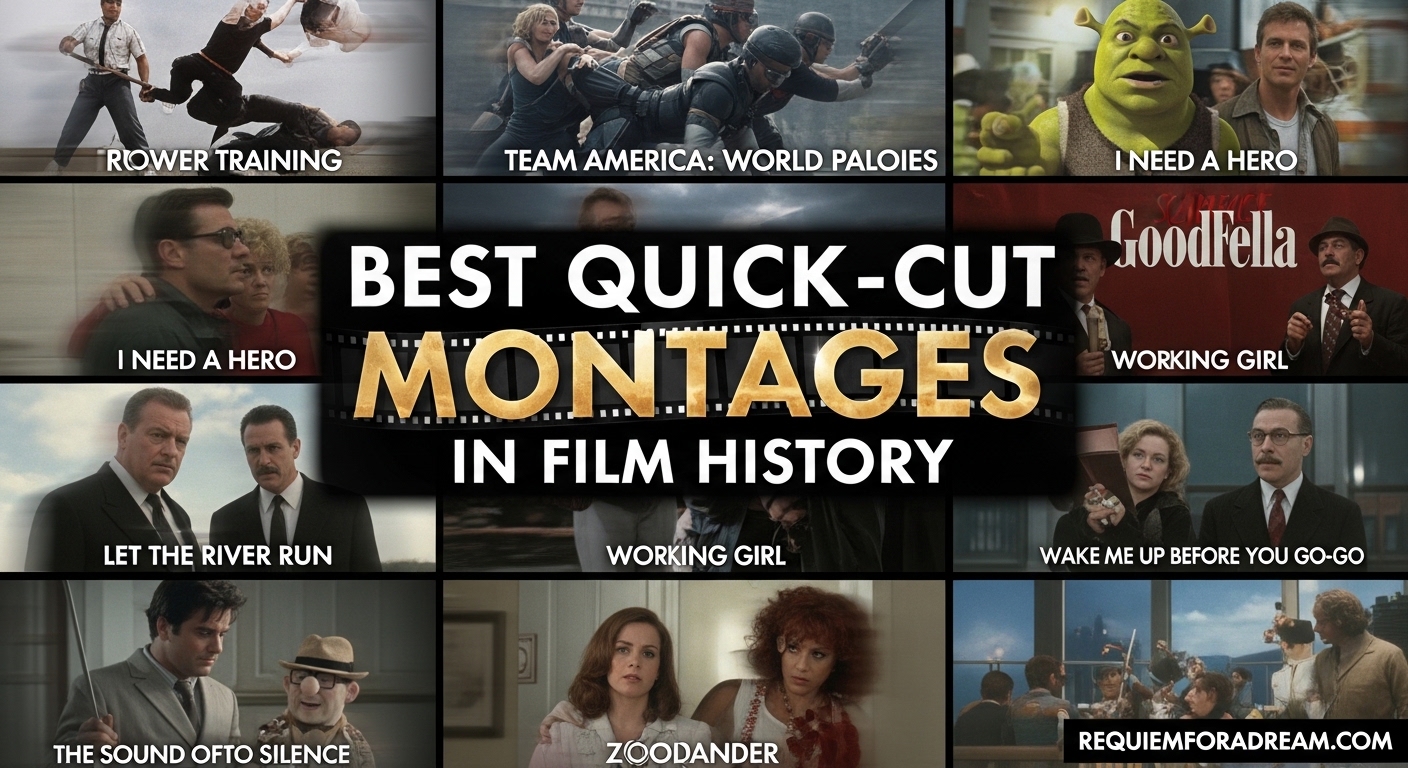
A quick-cut montage is a film editing technique that uses rapid succession of short shots to compress time, convey information efficiently, and create emotional impact through rhythmic visual storytelling. These sequences have become one of cinema’s most powerful tools, allowing directors to transform hours of narrative into seconds of visceral experience.
When we talk about quick cut montages film enthusiasts immediately recognize the signature styles of directors like Edgar Wright, Darren Aronofsky, and Sergei Eisenstein. Each has pushed the boundaries of how fast our eyes can process information while maintaining coherent storytelling. The best examples do not just accelerate time; they amplify emotion, create comedic timing, or build tension through precise editing rhythms.
In this guide, we have selected 12 of the most perfectly executed quick-cut montages from cinema history. These examples span from the silent film era to contemporary blockbusters, showcasing how this technique has evolved while remaining fundamentally rooted in the Soviet montage theory pioneered nearly a century ago. Whether you are a film student, an aspiring editor, or simply someone who appreciates the craft of visual storytelling, these sequences represent the pinnacle of what quick-cutting can achieve.
Table of Contents
12 Best Quick-Cut Montages in Film History
1. Up – ‘Married Life’ (2009)
Pixar’s opening sequence to Up remains one of the most emotionally devastating quick-cut montages ever committed to film. In just four minutes without a single line of dialogue, directors Pete Docter and Bob Peterson compress an entire lifetime of marriage between Carl and Ellie Fredricksen.
The sequence works through a series of increasingly rapid vignettes that establish the couple’s shared dreams, their quiet disappointments, and their enduring love. What makes the editing so effective is its restraint. Early shots linger for several seconds as young Carl and Ellie build their life together. As the montage progresses and they age, the cuts become slightly faster, mirroring how time seems to accelerate as we grow older.
The famous “adventure book” motif serves as a visual anchor throughout the sequence, giving viewers a stable reference point amid the rapid passage of years. When the montage reaches its heartbreaking conclusion with Ellie’s passing, the abrupt return to real-time pacing creates a visceral sense of loss. This is quick-cutting in service of pure emotion.
2. Rocky – Training Montage (1976)
No discussion of quick-cut montages film history can exist without mentioning the sequence that defined an entire subgenre. John G. Avildsen’s Rocky gave us the training montage that every subsequent sports film has tried to emulate.
Bill Conti’s ‘Gonna Fly Now’ provides the rhythmic backbone for the sequence’s accelerating pace. The editing begins with longer shots of Rocky struggling through basic exercises, his breath visible in the Philadelphia cold. As the music builds and the brass section swells, the cuts become increasingly rapid. Jump rope shots that initially lasted two seconds are eventually intercut with speed bag hits and stair runs in sub-one-second bursts.
The genius of this montage lies in its escalation structure. Each repetition of the musical theme corresponds to a tighter cutting pattern, creating a Pavlovian association between rapid editing and emotional triumph. When Rocky finally sprints up the steps of the Philadelphia Museum of Art, the brief return to longer takes makes his victory feel earned rather than inevitable.
3. The Godfather – Baptism Massacre (1972)
Francis Ford Coppola’s climactic sequence from The Godfather represents perhaps the most sophisticated use of cross-cutting in cinema history. The montage interweaves five simultaneous assassination orders with the baptism ceremony where Michael Corleone stands as godfather to his nephew.
Editor William Reynolds and Coppola employed a rigorous structural approach to the quick-cutting. Each murder sequence follows a precise pattern: establishing shot of the location, close-up of the victim, the violent act, and a reaction shot of the baptism. The cuts accelerate as the sequence progresses, creating mounting tension through sheer editorial velocity.
The parallel action serves as commentary on Michael’s moral transformation. As he recites the baptismal vows renouncing Satan, his orders are being carried out across the city. The juxtaposition is achieved entirely through editing rhythm, with the duration between shots shrinking from three seconds to under one second as the sequence reaches its violent crescendo.
4. Requiem for a Dream – Hip-Hop Montages (2000)
Given our site’s namesake, we would be remiss not to examine how Darren Aronofsky revolutionized quick-cut editing in Requiem for a Dream. Working with editor Jay Rabinowitz, Aronofsky developed what he termed “hip-hop montage” technique, named for its structural similarity to the sampling and rhythmic cutting of hip-hop music production.
The technique appears throughout the film but reaches its apex during the characters’ spiraling addiction sequences. Aronofsky employs extreme close-ups of drug preparation, dilated pupils, and television screens, cutting between them at rates approaching twenty-four shots per second. The rhythm syncopates with Clint Mansell’s electronic score, creating a visceral sense of biochemical urgency.
What distinguishes these montages from traditional quick-cutting is their psychological subjectivity. The rapid editing does not merely compress time; it simulates the altered perception of addicts experiencing chemical euphoria followed by crushing withdrawal. SnorriCam shots where the camera mounts to the actor create impossible backgrounds that shift while faces remain centered, contributing to the disorienting effect. This is quick-cutting as character psychology made visible.
5. Shaun of the Dead – The Plan (2004)
Edgar Wright’s collaboration with Simon Pegg produced some of the most innovative comedic quick-cutting in modern cinema. The “plan” sequence from Shaun of the Dead demonstrates how rapid editing can generate laughs through repetition and escalation.
The montage intercuts Shaun’s verbal explanation of the group’s zombie survival strategy with quick flashes of the actual execution. Each plan element triggers a sub-second visual gag showing how reality will inevitably diverge from intention. The cutting pattern follows Shaun’s speech rhythm precisely, with edits landing on specific syllables to create editorial punchlines.
Wright’s technique, developed through his background in television and music videos, relies on what editors call “graphic matches” between shots. The rapid cutting connects similar compositional elements across entirely different locations, creating visual continuity that emphasizes narrative discontinuity. When the group eventually executes their plan, the editing references earlier quick-cuts, rewarding attentive viewers with structural callbacks.
6. Goodfellas – ‘Layla’ Mob Murders (1990)
Martin Scorsese’s masterpiece contains several notable montages, but the ‘Layla’ sequence stands as his most formally accomplished exercise in quick-cutting. As Eric Clapton’s guitar introduces the second movement of Derek and the Dominos’ epic track, Scorsese and editor Thelma Schoonmaker intercut a series of methodical mob assassinations.
The brilliance of this montage lies in its counter-rhythmic approach. Rather than cutting rapidly to match the music’s energy, the editing maintains deliberately measured pacing that contrasts with Clapton’s soaring guitar. Each murder receives careful attention: establishing shots of mundane locations followed by clinical violence rendered through brief, precise cuts.
The quick-cutting appears not within individual murders but across the sequence as a whole. The montage accelerates through accumulation, with each subsequent killing receiving slightly less screen time than the last. By the sequence’s conclusion, shots last barely a second, creating a breathless survey of organized crime’s lethal reach.
7. Baby Driver – Opening Heist (2017)
Edgar Wright returned to peak form with Baby Driver, crafting an opening sequence that functions as pure quick-cut choreography. The prologue follows Baby through a bank robbery and escape, with every action precisely synchronized to The Jon Spencer Blues Explosion’s ‘Bellbottoms.’
The editorial approach here represents metric montage taken to its logical extreme. Every gunshot, car shift, and footstep lands on a specific musical beat. Editor Paul Machliss worked with Wright to create a cutting pattern where no shot exceeds the duration of a musical measure. The result is a sequence that feels like a music video while maintaining coherent spatial geography and narrative progression.
What separates this from traditional action editing is the temporal precision. Traditional quick-cutting in action sequences often disorients viewers to hide stunt limitations. Wright’s approach orients viewers through rhythmic consistency, allowing complex action to remain legible even at sub-second shot durations.
8. Battleship Potemkin – Odessa Steps (1925)
To understand quick cut montages film history, we must return to their theoretical origins in Soviet cinema. Sergei Eisenstein’s Odessa Steps sequence from Battleship Potemkin established the intellectual foundations that would influence every subsequent rapid-cutting technique.
Eisenstein developed what he called “metric montage,” cutting by exact frame counts regardless of action content. The Odessa Steps sequence alternates between soldiers marching in lockstep and fleeing civilians, with the editing rhythm determined by mathematical progression rather than narrative continuity. Shot durations decrease in precise ratios, creating acceleration through editorial mathematics.
The famous baby carriage sequence exemplifies this approach. Eisenstein intercuts three separate actions, the soldiers, the mother, and the baby in the carriage, using shot durations that decrease by half with each successive cut. The intellectual collision between images creates meaning that no single shot contains. This is the theoretical foundation upon which all contemporary quick-cutting stands.
9. Whiplash – ‘Caravan’ Climax (2014)
Damien Chazelle’s Whiplash culminates in a drumming sequence that transforms musical performance into visual quick-cutting. As Andrew Neiman plays an extended drum solo on ‘Caravan,’ editor Tom Cross intercuts between performance details, conductor Terence Fletcher’s reactions, and audience responses.
The editing rhythm derives entirely from the music’s accelerating tempo. As the drumming speeds up, the cutting follows suit, with shot durations eventually matching the rapid-fire snare hits. The technique creates kinesthetic empathy; viewers feel the physical exhaustion of the performance through the editorial strain of processing so many images.
Chazelle and Cross vary the cutting pattern strategically, introducing longer takes during brief musical rests before resuming rapid-fire cutting. This rhythmic variation prevents viewer fatigue while maximizing the impact of the quick-cut passages. By the sequence’s conclusion, editing and performance have become indistinguishable.
10. The Social Network – Creation Montage (2010)
David Fincher’s opening sequence establishes multiple timelines through quick-cutting that compresses years of litigation and hours of coding into parallel action. Editor Angus Wall intercuts the founding of Facebook with deposition testimony from the subsequent lawsuits.
The technique here employs what might be called “intellectual montage” in the Eisenstein tradition. Each cut between coding and testimony creates meaning through juxtaposition rather than simple time compression. Rapid intercutting between different coding sessions creates the impression of feverish, uninterrupted creative work.
Trent Reznor and Atticus Ross’s electronic score provides the rhythmic infrastructure, with the editing cutting precisely on musical downbeats during action sequences. The sequence demonstrates how contemporary filmmakers have absorbed and updated the lessons of Soviet montage theory for digital-age storytelling.
11. Scarface – Rise to Power (1983)
Brian De Palma’s cocaine empire montage represents 1980s excess rendered through editorial acceleration. As Tony Montana builds his criminal organization, editors Jerry Greenberg and David Rawlins intercut acquisition, distribution, and consumption into a breathless ascent.
Giorgio Moroder’s synthesizer score pulses beneath increasingly rapid visual information. The quick-cutting follows a structural logic of accumulation, with each successive shot of wealth and violence receiving briefer screen time. The montage accelerates until individual shots become subliminal flashes of money, drugs, and weapons.
De Palma’s technique references Eisenstein while updating it for MTV-era viewers accustomed to rapid image processing. The sequence influenced decades of subsequent crime film montages, establishing visual tropes that would be referenced and parodied for years to come.
12. The Breakfast Club – Getting to Know You (1985)
John Hughes’ detention classic contains a quieter but no less effective demonstration of quick-cutting’s emotional potential. The ‘getting to know you’ montage intercuts the five students revealing their personalities through dance, conversation, and confession.
Unlike the kinetic cutting of action sequences, Hughes and editor Dede Allen employ rapid intercutting to build emotional connections. Brief shots of each character’s reaction to others accumulate into a comprehensive understanding of group dynamics. The editing accelerates as the characters bond, with shot durations shrinking from several seconds to under one second by the montage’s conclusion.
Simple cuts without transitions or effects emphasize the technique’s foundational nature. This is quick-cutting as character study, demonstrating that rapid editing can serve intimate drama as effectively as action spectacle.
What Makes Quick-Cut Montages Effective
Understanding why quick-cut montages work requires examining several technical and psychological factors. These elements combine to create the distinctive emotional and narrative effects that define the technique.
Pacing and Rhythm
The fundamental principle of effective quick-cutting is controlled acceleration. The best montages begin with relatively long takes and progressively reduce shot duration. This creates a sense of mounting energy without overwhelming viewers immediately. Soviet montage theory called this “rhythmic montage,” where editing tempo creates emotional tempo.
Sound Design and Music
Music provides the structural backbone for most effective quick-cut montages. The relationship between cutting and soundtrack can follow several patterns. Metric montage cuts on specific musical beats. Tonal montage matches emotional content to musical mood. Over-tonal montage combines both approaches for maximum impact.
Visual Continuity
Rapid cutting risks disorienting viewers unless editors maintain visual coherence. Graphic matches, where similar compositional elements appear across successive shots, create continuity amid speed. Eye-line matches preserve spatial relationships even at sub-second durations. Color palettes and lighting consistency prevent visual jarring that would interrupt emotional engagement.
Emotional Impact
The psychological effect of quick-cutting operates through several mechanisms. Temporal compression creates urgency by implying that significant time passes in brief viewing periods. The mere exposure effect, where repeated brief exposure to images increases positive evaluation, operates powerfully in montage sequences. Kinetic empathy causes viewers to physically experience the rhythm of what they observe.
Frequently Asked Questions
What are the best movie montages of all time?
The most celebrated movie montages include Up’s Married Life sequence, Rocky’s training montage, The Godfather’s baptism massacre, Requiem for a Dream’s hip-hop montages, and Edgar Wright’s quick-cut comedies in Shaun of the Dead and Baby Driver. These sequences demonstrate how rapid editing can compress time, build emotion, and create memorable cinematic moments.
What is a quick cut montage in film?
A quick-cut montage is an editing technique using rapid succession of short shots to compress time, convey information efficiently, or create emotional impact. Shots often last less than one second, creating rhythmic visual storytelling that can communicate complex narratives in minimal screen time.
What makes a montage effective in movies?
Effective montages combine several elements: accelerating pace that builds energy, musical synchronization that provides emotional structure, visual continuity that prevents disorientation, and clear narrative purpose that justifies the time compression. The best montages serve character development or plot advancement rather than merely showing passage of time.
Who pioneered montage techniques in cinema?
Soviet filmmaker Sergei Eisenstein pioneered montage theory in the 1920s with films like Battleship Potemkin. His theories of metric, rhythmic, tonal, and intellectual montage established the foundation for all subsequent quick-cut editing. American filmmakers from the 1970s onward, including Francis Ford Coppola and Martin Scorsese, adapted these techniques for narrative cinema.
What is the purpose of a training montage?
Training montages compress weeks or months of physical preparation into minutes of screen time while building audience investment in the character’s success. Through accelerating quick-cuts synchronized to inspirational music, these sequences create emotional momentum that makes subsequent victories feel earned rather than inevitable.
The Enduring Art of the Quick-Cut Montage
From Sergei Eisenstein’s theoretical foundations to Edgar Wright’s comedic innovations, quick-cut montages remain one of cinema’s most versatile storytelling tools. The technique has evolved from intellectual experiment to mainstream convention, yet its fundamental power persists. When executed with precision, rapid editing creates emotional experiences that real-time footage cannot achieve.
The twelve sequences examined here represent different applications of quick cut montages film technique, each demonstrating how editorial rhythm shapes viewer psychology. Whether compressing a lifetime into four minutes or a training regimen into ninety seconds, these filmmakers have shown that what happens between shots can matter more than what appears within them.
As we continue through 2026, quick-cut editing shows no signs of disappearing from cinema. If anything, the technique has become more sophisticated, with filmmakers like Chazelle and Wright finding new applications for rapid cutting in genres Eisenstein never imagined. The quick-cut montage endures because it speaks to something fundamental about how we experience time, memory, and emotion.