
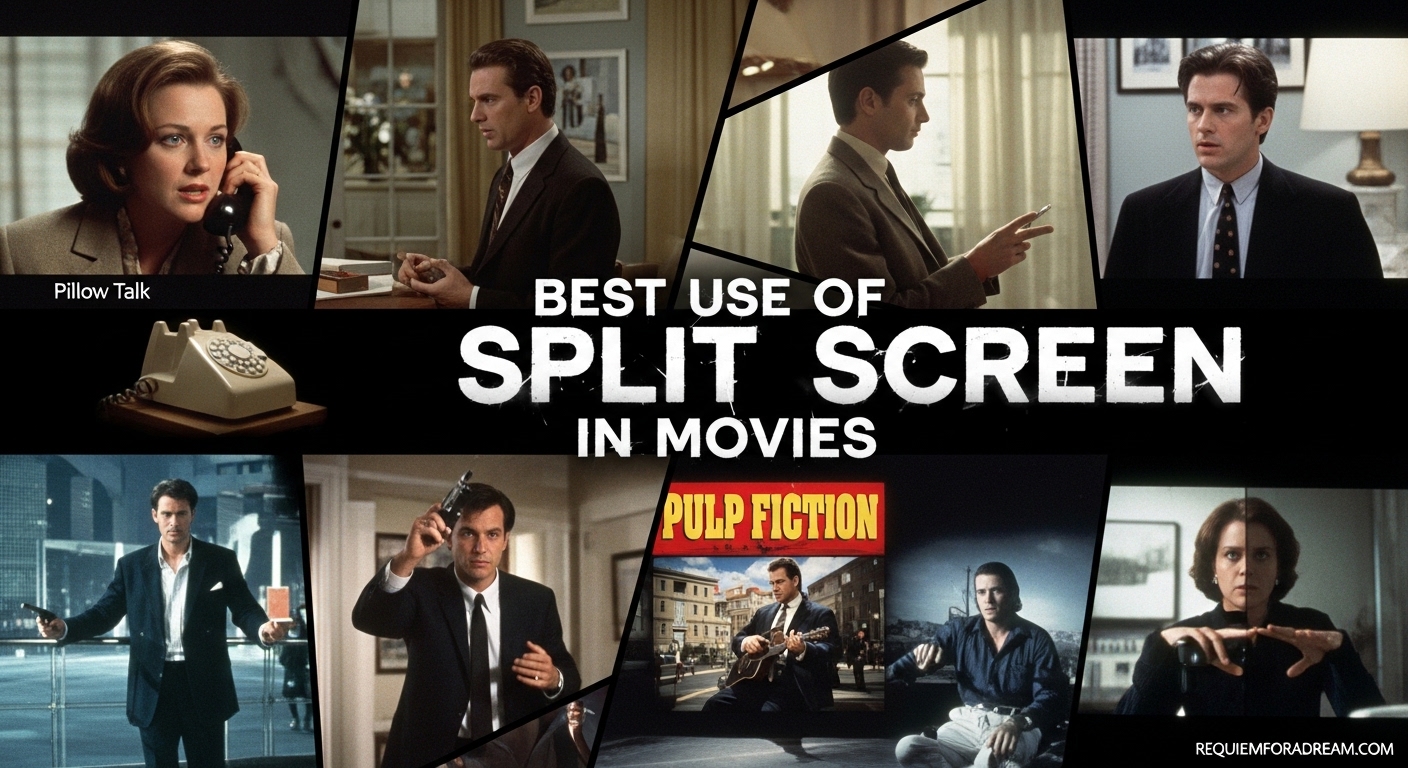
Split screen divides a single frame into multiple sections, allowing audiences to witness simultaneous action, contrasting emotions, or parallel storylines without a single cut. This technique transforms how we experience cinema by compressing time and space into one unified visual field.
What is the use of split screen in film? Directors employ this technique for several storytelling purposes:
- Showing phone conversations that create romantic intimacy across physical distance
- Displaying simultaneous action to build suspense or dramatic irony
- Contrasting expectations versus reality in the same moment
- Portraying twins or duplicates played by the same actor
- Creating emotional distance between characters who share the frame
I have spent years studying how directors manipulate our attention through frame composition. The best use of split screen in movies occurs when the technique serves the emotional truth of the scene rather than showcasing editorial cleverness. When Darren Aronofsky used split screen in Darren Aronofsky’s Requiem for a Dream, he was not being fancy. He was showing us two people who share a bed but exist in separate emotional prisons.
Table of Contents
What Is Split Screen Technique?
Split screen is a film editing technique that divides the frame into two or more distinct sections, each displaying different footage simultaneously. Unlike parallel editing, which cuts between separate locations, split screen keeps multiple perspectives visible at once.
The technical execution has evolved dramatically since cinema’s early days. In the analog era, filmmakers used optical printers to combine multiple film elements into a single composite image. This process required precise registration and multiple passes through the printer, making complex split screen effects expensive and time-consuming.
Digital compositing changed everything. Modern filmmakers can layer footage, adjust positioning, and blend images with pixel-perfect precision. This accessibility has democratized the technique, though it has also led to overuse in some contemporary productions where split screen becomes visual noise rather than narrative enhancement.
The Evolution From Analog to Digital
The earliest experiments with divided frames appeared in the late 1910s and 1920s. Abel Gance’s Napoleon (1927) used Polyvision, a three-camera, three-projector system that anticipated modern split screen by decades. This was not true split screen in the modern sense, but it established the conceptual framework.
What was the first movie to use split screen? While experimental films in the 1940s and 1950s toyed with divided frames, Pillow Talk (1959) established the commercial viability of the technique for mainstream audiences. This romantic comedy used split screen for telephone conversations, creating a visual language that would dominate the genre for decades.
The 1960s and 1970s saw avant-garde filmmakers embrace split screen as a political and aesthetic statement. Andy Warhol’s Chelsea Girls (1966) projected two 16mm films side by side, forcing viewers to choose where to direct their attention. This experimental tradition influenced mainstream directors who recognized the technique’s expressive potential.
Brian De Palma emerged as the technique’s greatest champion during the 1970s and 1980s. His background in experimental cinema combined with Hitchcockian suspense sensibilities produced some of the most innovative split screen applications in film history. Carrie, Dressed to Kill, and Blow Out all employed the technique with narrative precision.
The digital revolution of the 1990s and 2000s eliminated technical barriers while introducing new creative possibilities. Mike Figgis’s Timecode (2000) presented four simultaneous digital video feeds in real-time. Requiem for a Dream used digital compositing to create “invisible” split screens that audiences experienced emotionally without necessarily noticing the technique.
The 12 Best Split Screen Uses in Cinema History
1. Requiem for a Dream (2000) – Intimacy Across Distance
Darren Aronofsky’s harrowing addiction drama contains one of cinema’s most emotionally devastating split screen sequences. During an intimate scene between Harry Goldfarb and Marion Silver, Aronofsky divides the frame to show two lovers sharing a bed while occupying completely different emotional spaces.
The technique accomplishes something remarkable. We see both characters simultaneously, yet the split emphasizes their psychological separation. Harry faces one direction chasing his next fix while Marion faces the opposite, lost in her own deteriorating reality. The physical closeness makes their emotional distance more painful to witness.
Aronofsky employed digital compositing to create seamless divisions that feel natural rather than stylized. This invisible split screen approach prioritizes emotional impact over technical showmanship. The result is a sequence that makes viewers feel the characters’ isolation even as they share the same physical space.
2. 500 Days of Summer (2009) – Expectations vs Reality
Marc Webb’s romantic comedy contains the definitive example of using split screen to contrast expectation with reality. The famous dance sequence splits the frame into “Expectations” on the left and “Reality” on the right, showing protagonist Tom Hansen’s romantic fantasy alongside the disappointing truth.
The left side shows Tom’s idealized version: the party is perfect, Summer smiles at him with genuine affection, and everything aligns with his romantic narrative. The right side reveals crowded awkwardness, Summer’s distance, and the mundane truth of social gatherings. The split creates both comedy and genuine pathos.
This technique speaks directly to anyone who has ever constructed an elaborate fantasy about a situation before experiencing the mundane reality. By showing both versions simultaneously, Webb allows audiences to witness the collision between our internal narratives and external circumstances. The split screen becomes a visual metaphor for self-deception.
3. Annie Hall (1977) – The Therapy Session
Woody Allen’s masterpiece contains a split screen scene that perfectly illustrates the technique’s comedic potential. During the famous therapy session sequence, Alvy Singer and Annie Hall appear in split-screen, each speaking to their respective therapists about their relationship.
The comedy emerges from the contrast between their accounts. Alvy’s therapist prompts him to discuss his fears while Annie’s therapist asks about her satisfaction. The split allows Allen to show how differently two people can experience the same relationship, with Alvy’s paranoia contrasting against Annie’s growing independence.
Allen holds the split longer than necessary, milking the awkward comedy of simultaneous confession. The technique transforms what could be a simple dialogue scene into a visual statement about the gaps between partners in any intimate relationship. We laugh because we recognize our own tendencies to misunderstand each other.
4. Kill Bill: Vol. 1 (2003) – Hospital Suspense
Quentin Tarantino’s revenge epic pays homage to exploitation cinema through a split screen sequence that builds almost unbearable tension. When Elle Driver approaches the comatose Bride in the hospital, Tarantino divides the screen to show both characters’ perspectives simultaneously.
The left side shows Elle Driver in her nurse disguise, whistling a jaunty tune as she prepares to inject poison into the helpless Bride. The right side shows the comatose protagonist, vulnerable and unaware of the approaching death. The audience sees the threat while the victim cannot, creating classical dramatic irony.
Tarantino’s use of yellow and green color filtering on each side creates visual distinction while maintaining the film’s comic-book aesthetic. The sequence lasts only moments but demonstrates how split screen can compress time and heighten suspense without a single cut. We hold our breath because we see both hunter and prey in the same glance.
5. Timecode (2000) – Four Screens, One Take
Mike Figgis created the most audacious split screen experiment in cinema history with this real-time drama presented across four simultaneous digital video feeds. Each quadrant follows different characters through interconnected Los Angeles locations during the same ninety-minute period.
The film requires viewers to choose where to direct their attention, much like Warhol’s Chelsea Girls but with synchronized sound design that guides focus through audio cues. Important dialogue in one quadrant pulls your eye while action continues in the others. This creates an active viewing experience unlike conventional cinema.
Timecode represents split screen pushed to its logical extreme. Rather than a brief effect, the technique becomes the entire film’s structural foundation. While not commercially successful, it demonstrated digital cinema’s capacity for real-time experimentation and influenced subsequent filmmakers exploring simultaneous narrative perspectives.
6. Dressed to Kill (1980) – De Palma’s Mastery
Brian De Palma’s psychological thriller contains perhaps the most technically accomplished split screen sequence ever filmed. The museum chase scene divides the frame to show Angie Dickinson’s character navigating the Metropolitan Museum while an unseen stalker follows her movements.
De Palma uses the split to solve a narrative problem: showing both hunter and hunted without revealing the predator’s identity. We see Dickinson’s growing anxiety in one frame while anonymous men appear in the other, any of whom might be the threat. The technique transforms a simple walk through a museum into sustained suspense.
The director’s background in experimental cinema serves his Hitchcockian storytelling. De Palma understands that split screen is not merely a visual effect but a tool for manipulating audience knowledge and anxiety. By controlling what we see in each frame, he controls exactly how afraid we feel.
7. Pillow Talk (1959) – The Phone Call Tradition
Michael Gordon’s romantic comedy established the visual language for telephone conversations in cinema. Rock Hudson and Doris Day spend much of the film communicating by phone, with split screen allowing audiences to see both parties’ reactions simultaneously.
The technique solved a practical problem: keeping romantic leads separated while maintaining their chemistry. By showing both faces in the same frame, the split screen preserves the intimacy that would be lost in cutting between separate locations. We see Day’s expressions in response to Hudson’s lines, creating comedic timing impossible through editing alone.
This convention dominated romantic comedies for decades. From The Shop Around the Corner to When Harry Met Sally, the split screen phone call became a genre staple. Pillow Talk proved that the technique could serve both narrative and commercial purposes, establishing a template still referenced today.
8. Carrie (1976) – Prom Night Horror
Brian De Palma’s adaptation of Stephen King’s novel uses split screen to devastating effect during the prom night climax. As Carrie White unleashes her telekinetic powers on her tormentors, De Palma divides the frame to show multiple simultaneous reactions to the carnage.
The technique amplifies chaos by overwhelming the viewer with simultaneous information. We see the stage collapsing in one frame, fleeing students in another, and Carrie’s destruction in a third. The split screen mirrors the sensory overload of the massacre, placing audiences in the same disoriented state as the characters.
De Palma’s decision to use split screen here rather than rapid cutting maintains the scene’s spatial coherence while increasing intensity. We understand exactly where everyone is in relation to everyone else, making the violence more visceral and tragic. The technique transforms a horror sequence into operatic tragedy.
9. Scott Pilgrim vs The World (2010) – Comic Book Panels
Edgar Wright’s adaptation of Bryan Lee O’Malley’s graphic novel uses split screen to translate comic book panel layouts into cinematic language. The film constantly divides the frame to show multiple angles, reaction shots, and environmental details simultaneously.
Wright’s approach differs from traditional split screen applications. Rather than showing simultaneous action in different locations, he uses the technique to compress time and present information comic-style. Phone calls, flashbacks, and expository details appear in frame divisions that recall reading a graphic novel page.
The technique serves the film’s video-game and comic-book aesthetic while advancing narrative efficiently. We receive character information, emotional beats, and visual jokes through frame divisions that would require multiple cuts in conventional editing. Wright proves split screen can accelerate rather than merely display.
10. Chelsea Girls (1966) – Avant-Garde Experimentation
Andy Warhol’s experimental film projected two 16mm reels simultaneously on a single screen, creating a split screen effect through physical projection rather than optical or digital compositing. The sound from one reel played at any given time, forcing viewers to choose which half to prioritize.
This radical approach treated the audience as active participants rather than passive consumers. You cannot watch both halves equally, so your experience of the film becomes uniquely yours based on where you direct attention. Warhol transformed the theatrical space into a gallery where viewers curated their own experience.
Chelsea Girls influenced generations of experimental filmmakers who recognized split screen’s capacity to challenge traditional narrative consumption. The film remains a touchstone for understanding how screen division can become conceptual art rather than mere technique.
11. Conversations with Other Women (2005) – Intimate Dialogue
Hans Canosa’s romantic drama employs split screen throughout its entire runtime, following a former couple who reconnect at a wedding. The technique creates visual intimacy that mirrors the characters’ emotional reconnection across years of separation.
Canosa often places the dividing line between the characters, literally splitting them even as they share space and conversation. This visual metaphor reinforces their emotional barriers while the split screen paradoxically keeps them together in our field of vision. We cannot look at one without seeing the other.
The film demonstrates split screen’s capacity to sustain feature-length narratives rather than serve as brief effect. By committing fully to the technique, Canosa proves that frame division can become a storytelling language rather than a punctuation mark. The result is uniquely intimate cinema.
12. The Hulk (2003) – Comic Panel Transitions
Ang Lee’s ambitious comic book adaptation attempted to translate the visual grammar of Marvel comics directly to screen through split screen and panel-style transitions. Rather than conventional editing, Lee frequently divides the frame into comic-book panels that slide, wipe, and replace each other.
The technique was controversial upon release, with some audiences finding the approach distracting. However, Lee’s vision represented a genuine attempt to find cinematic equivalents for comic book storytelling. The split screens and wipes recall reading a page where multiple moments coexist in spatial relationship.
Time has been kind to Lee’s experiment. As comic book adaptations have become the dominant Hollywood genre, The Hulk stands out for its formal ambition. The split screen technique, while imperfectly executed, demonstrated that blockbuster filmmaking could embrace avant-garde visual strategies.
Directors Who Mastered Split Screen
Brian De Palma – The Undisputed King
No director has employed split screen more consistently or creatively than Brian De Palma. From his early experimental films through his Hitchcockian thrillers of the 1970s and 1980s, De Palma treated screen division as a fundamental element of his visual vocabulary.
Snake Eyes (1998) contains perhaps his most complex application, following Nicolas Cage through a boxing arena while simultaneously showing the assassination conspiracy unfolding in the same space. De Palma uses split screen to solve the impossible problem of showing simultaneous cause and effect without spatial confusion.
Sisters (1973) established his early mastery, using the technique for both suspense and psychological revelation. De Palma understands that split screen works best when it serves narrative functions that cannot be accomplished through conventional editing. His films reward close attention to how he manipulates the divided frame.
Darren Aronofsky – Emotional Intensity
While De Palma uses split screen for suspense, Aronofsky employs it for emotional devastation. Requiem for a Dream’s split screen sequences create intimacy through separation, a paradox that defines his approach to the technique.
Aronofsky’s split screens often feel invisible because they serve emotional truth rather than technical display. You experience the characters’ isolation without necessarily noticing the frame division that creates it. This represents the technique’s highest application: when audiences feel the effect without seeing the mechanism.
Edgar Wright – Comedic Timing
Wright uses split screen to accelerate comedy while delivering information. Scott Pilgrim vs The World compresses exposition, character beats, and visual gags into frame divisions that would require minutes of conventional screen time.
His technique recalls silent cinema’s visual efficiency while incorporating video game and comic book aesthetics. Wright proves split screen can serve contemporary genre filmmaking while maintaining artistic integrity. The technique becomes part of his signature style, instantly recognizable across his filmography.
Types of Split Screen Applications
Phone Conversations
The romantic comedy tradition established by Pillow Talk continues today, though less frequently. Split screen phone calls preserve the chemistry between separated leads while allowing reaction shots that cutting would make cumbersome. When Harry Met Sally uses this technique memorably during late-night conversations that build romantic tension.
Showing Twins and Duplicates
How do they film twins with one actor? Split screen is the primary technique. The Parent Trap established the template: film the actor performing one twin’s scenes, then repeat with the other twin’s scenes, then composite both halves of the frame. Modern digital techniques have made the effect seamless, but the principle remains unchanged.
More sophisticated applications create “invisible” split screens where the dividing line follows natural edges in the frame. Adaptation (2002) used this technique extensively for Nicolas Cage playing twin brothers, with the split sometimes occurring down a doorway or between characters to hide the seam from audience awareness.
Expectations vs Reality
500 Days of Summer perfected this application, but the technique appears across genres. Directors use split screen to show characters’ fantasies alongside harsh reality, creating both comedy and pathos. The technique externalizes internal psychology, making visible the gap between what we hope and what occurs.
Simultaneous Action
Suspense filmmakers use split screen to show hunter and hunted, perpetrator and victim, or cause and effect simultaneously. This creates dramatic irony where audiences know more than characters. Carrie’s prom night sequence exemplifies how simultaneous action builds tension through information overload.
Invisible Split Screen
Some films employ the technique without audiences realizing. When backgrounds need extension or crowds need multiplication, invisible splits combine multiple shots into unified frames. Adaptation and other films use this approach for same-actor twins, but the technique also appears in crowd scenes, landscape shots, and complex action sequences.
Frequently Asked Questions
What is the use of split screen in film?
Split screen divides the frame into multiple sections to show simultaneous action, create emotional contrast between characters, build suspense through dramatic irony, portray phone conversations with intimacy, and externalize internal psychology by showing expectations versus reality.
What was the first movie to use split screen?
While experimental films toyed with divided frames earlier, Pillow Talk (1959) established split screen as a commercial technique for mainstream cinema, particularly for romantic comedy phone conversations. Andy Warhol’s Chelsea Girls (1966) pioneered the avant-garde application with two simultaneous 16mm projections.
How do they film twins with one actor?
Filmmakers use split screen to composite two performances by the same actor into one frame. They film the actor performing as one twin, then repeat the process for the other twin, ensuring eyelines and timing match. Digital compositing seamlessly blends both halves. Invisible splits hide the dividing line along natural frame elements like doorways.
What is the split screen technique in film?
Split screen is an editing technique that combines multiple shots into a single frame, allowing audiences to see different locations, perspectives, or time periods simultaneously. Originally achieved through optical printing, modern split screen uses digital compositing for precise frame division and seamless integration.
Which director uses split screen the most?
Brian De Palma is cinema’s most prolific practitioner of split screen, employing the technique across his entire filmography from Sisters (1973) through Snake Eyes (1998). His Hitchcockian thrillers use frame division for suspense, while his experimental sensibilities push the technique’s expressive boundaries.
The Enduring Legacy of Split Screen in 2026
Split screen remains a vital cinematic technique despite the ease of conventional editing and digital effects. The best use of split screen in movies demonstrates that the technique serves storytelling functions no other method can accomplish. When Darren Aronofsky divides the frame to show lovers separated by their addictions, or when Brian De Palma splits the screen to build Hitchcockian suspense, they are using cinema’s unique capacity to manipulate space and time.
The technique has evolved from optical printer experiments through digital compositing’s precision. Contemporary filmmakers continue finding new applications, from Wes Anderson’s symmetrical compositions to television series like 24 that adapted split screen for real-time storytelling. The technique persists because it solves specific narrative problems: how to show simultaneous action, how to contrast internal and external reality, how to maintain intimacy across distance.
As audiences become more visually sophisticated, the challenge for filmmakers is using split screen with purpose rather than novelty. The examples explored here succeed because they serve emotional truth. Whether creating comedy in Annie Hall, horror in Carrie, or romantic devastation in 500 Days of Summer, these films prove that dividing the frame can bring cinematic elements together in profound and lasting ways.