
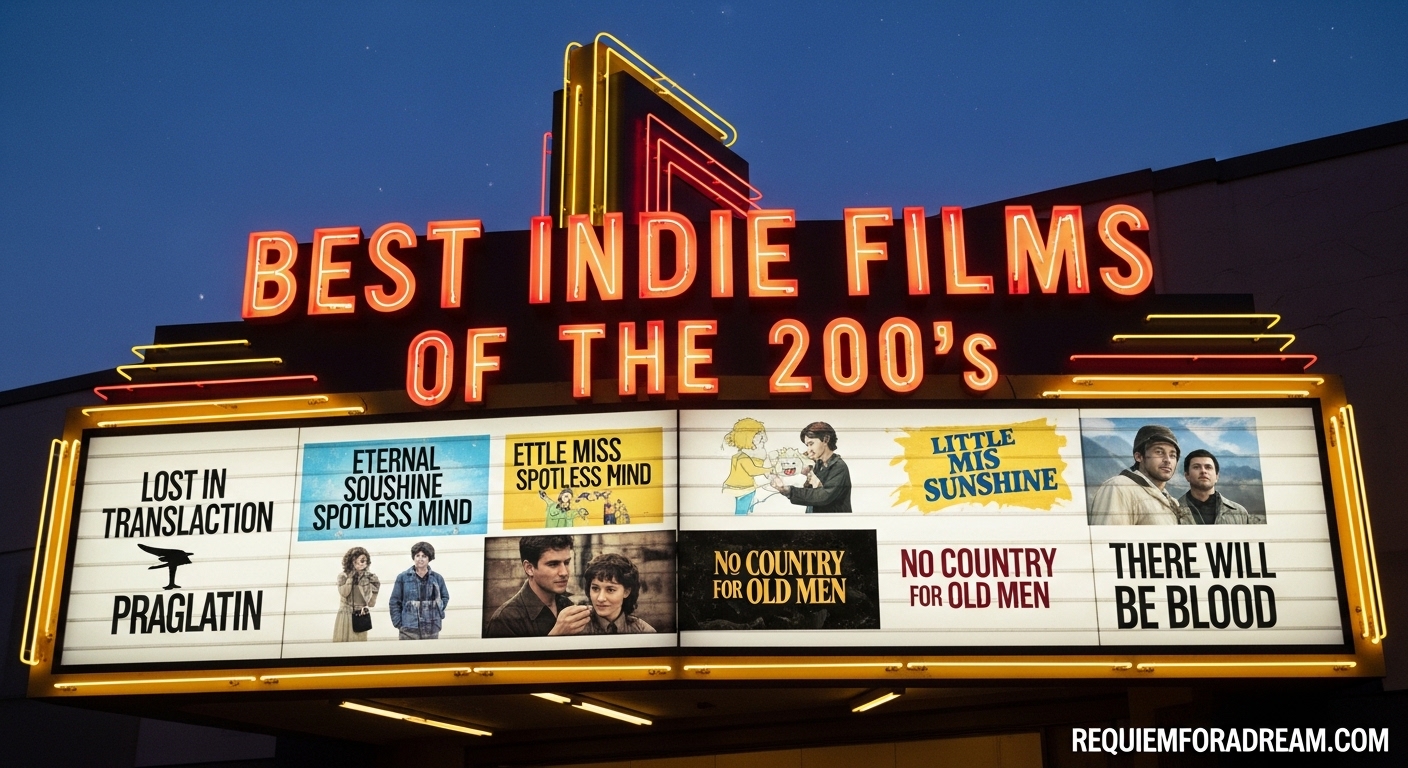
There is something magical about the Best Indie Films of the 2000s that still resonates with cinephiles today. This decade marked a golden era for independent cinema, when quirky coming-of-age stories, mind-bending narratives, and deeply personal visions found their way from Sundance screening rooms to mainstream audiences. The 2000s gave us films that felt like discoveries, movies that spoke to our alienation, our awkwardness, and our longing for connection in ways that studio blockbusters never could.
The term “indie movies” conjures a specific aesthetic from this period. Think muted color palettes, melancholic soundtracks packed with indie rock gems, and characters who spoke in witty, hyper-literate dialogue. The independent films of the 2000s bridged the gap between arthouse experimentation and accessible storytelling, creating a new language for American cinema that still influences filmmakers today.
What made 2000s cinema so special was the perfect storm of technological change and creative freedom. Digital filmmaking lowered barriers to entry, allowing visionaries with tiny budgets to craft works that rivaled studio productions in ambition if not scale. The rise of the internet helped these cult classics find their audiences through word-of-mouth, bypassing traditional marketing and creating the passionate fan bases that keep these films alive decades later.
Table of Contents
What Made the 2000s Indie Era Unique
The aughts era represented a transitional moment in film history. Sundance films evolved from niche curiosities into cultural touchstones, with studios creating specialty divisions specifically to acquire and distribute these low-budget films. This commercial validation paradoxically preserved the artistic freedom that made these movies special, as directors like Wes Anderson, Sofia Coppola, and Darren Aronofsky built careers on their distinctive visions.
The soundtracks deserve special mention as a defining feature of 2000s indie cinema. Garden State’s Shins-heavy playlist and Juno’s Kimya Dawson selections didn’t just accompany the films; they became cultural phenomena in their own right. Music supervisors like Alexandra Patsavas turned these arthouse films into discovery engines for indie rock, making the listening experience as essential as the viewing.
Thematically, these films explored alienation and connection with unprecedented directness. The manic pixie dream girl archetype emerged and was simultaneously celebrated and critiqued. Non-linear narratives became more accessible, with films like Eternal Sunshine and 500 Days of Summer playing with time and memory in ways that felt emotionally true rather than merely experimental. This was indie filmmaking at its most confident and culturally significant.
The Cult Classics That Defined the Era
Donnie Darko (2001) – Richard Kelly
Richard Kelly’s debut remains the quintessential 2000s cult classic, a film that turned a modest budget and a troubled theatrical release into two decades of obsessive analysis. Jake Gyllenhaal plays the troubled teen who receives apocalyptic warnings from a demonic rabbit named Frank, navigating high school while reality seems to unravel around him.
What elevates Donnie Darko beyond typical science fiction is its emotional core. The film captures that specific adolescent feeling of knowing something is fundamentally wrong with the world while everyone around you pretends everything is fine. Kelly wraps this universal anxiety in time travel mechanics and philosophical tangents that reward repeated viewing without sacrificing the story’s heart.
The film’s journey from box office disappointment to beloved midnight movie exemplifies how indie films of this era found their audiences. Its soundtrack, mixing 1980s hits with Michael Andrews’ haunting score, creates a temporal dissonance that mirrors Donnie’s fractured reality. Two decades later, new viewers still discover its secrets online, keeping the conversation alive.
Requiem for a Dream (2000) – Darren Aronofsky
Darren Aronofsky’s devastating addiction drama opens the decade with a gut punch that few films have matched. Ellen Burstyn, Jared Leto, Jennifer Connelly, and Marlon Wayans play four Brooklyn residents whose dreams curdle into nightmares as their various addictions consume them completely. Aronofsky’s rapid-fire editing and split-screen techniques create a visceral experience that mirrors the characters’ deteriorating mental states.
This is not an easy watch, and it was never meant to be. Aronofsky constructs what many consider the most effective anti-drug film ever made not through lecturing but through empathy, showing how addiction destroys not just bodies but aspirations, relationships, and dignity. Clint Mansell’s score, performed by the Kronos Quartet, has become iconic in its own right, that descending four-note motif now instantly recognizable as musical shorthand for dread.
For all its darkness, Requiem for a Dream exemplifies what independent cinema can achieve when freed from studio compromise. It is uncompromising, technically audacious, and emotionally devastating in ways that mainstream films rarely attempt. Burstyn’s performance as Sara Goldfarb remains one of the most harrowing depictions of psychological decline ever captured on film.
Napoleon Dynamite (2004) – Jared Hess
On the opposite end of the emotional spectrum sits Jared Hess’s bizarre comedy about an awkward Idaho teenager and his equally eccentric family. Jon Heder plays the titular Napoleon with a commitment to deadpan weirdness that launched a thousand quotable lines and Halloween costumes. The film’s ultra-low budget and unknown cast somehow amplified its authenticity.
What makes Napoleon Dynamite work is its complete absence of judgment toward its characters. The film finds humor in their oddness without mocking them, creating a strangely wholesome experience despite the protagonists’ social incompetence. The famous dance scene, performed to Jamiroquai’s “Canned Heat,” has been recreated at weddings and school events countless times, a testament to the film’s cultural penetration.
Released by Fox Searchlight after a successful Sundance debut, Napoleon Dynamite represents how 2000s indie films could cross over into mainstream success without losing their eccentric souls. It proved that audiences would embrace deeply weird content if it felt genuine, paving the way for future oddball comedies and establishing a template for the quirky underdog story.
Ghost World (2001) – Terry Zwigoff
Based on Daniel Clowes’ graphic novel, Terry Zwigoff’s Ghost World captures that liminal post-high school period when childhood friendships strain against adult responsibilities. Thora Birch and Scarlett Johansson play Enid and Rebecca, two cynical best friends navigating a summer of boredom, bad jobs, and uncertain futures in an unnamed American suburb.
Steve Buscemi’s performance as Seymour, the lonely record collector who becomes Enid’s unlikely friend, provides the film’s emotional weight. The relationship between these two misfits, separated by decades but united by their inability to connect with mainstream society, avoids both the obvious romance and simple friendship clichés. Instead, Zwigoff finds something more truthful about how we sometimes need people we cannot fully understand.
The film’s muted color palette and deadpan humor influenced countless indie movies that followed. Ghost World understands something essential about being young and smart in a world that doesn’t value either quality particularly highly. Its ending, ambiguous and slightly melancholic, trusts its audience to interpret meaning without heavy-handed explanation.
Coming-of-Age Masterpieces
Juno (2007) – Jason Reitman
Diablo Cody’s screenplay for Juno arrived with such a distinct voice that it immediately polarized audiences and critics alike. Ellen Page plays the pregnant teenager who decides to give her baby up for adoption to a seemingly perfect couple, navigating the complexities of this decision with a verbal wit that Cody made instantly recognizable. The film treats its subject with surprising maturity while maintaining the light touch that made it accessible to mainstream audiences.
What separates Juno from typical teen comedies is its refusal to judge its characters. The adoptive parents, played by Jennifer Garner and Jason Bateman, reveal hidden depths and flaws as the story progresses, while Juno herself grows beyond her initial defensive quippiness. Michael Cera’s Paulie remains one of the most realistic depictions of teenage awkwardness in cinema, his genuine sweetness cutting through the film’s more stylized elements.
The Kimya Dawson-heavy soundtrack became as famous as the dialogue, representing another example of how 2000s indie films used music to define their emotional landscapes. Juno won the Academy Award for Best Original Screenplay and earned Page a nomination, proving that independent sensibilities could achieve mainstream recognition without dilution.
Little Miss Sunshine (2006) – Jonathan Dayton and Valerie Faris
The Hoover family’s road trip to a children’s beauty pageant provides the framework for one of the decade’s most beloved ensemble comedies. Greg Kinnear, Toni Collette, Steve Carell, Paul Dano, Abigail Breslin, and Alan Arkin create a dysfunctional family unit that somehow feels completely real despite their exaggerated quirks. Each character carries their own burden of failure, making their collective journey toward the pageant both hilarious and deeply moving.
The screenplay by Michael Arndt understands that families are defined not by their harmony but by how they survive their conflicts. The iconic yellow Volkswagen bus becomes a character itself, its broken clutch forcing the family to push-start it at every stop, a perfect visual metaphor for their struggling but persistent relationships. When the family finally performs their act at the pageant, it represents a rejection of the competition’s superficial values in favor of genuine self-expression.
Alan Arkin won an Academy Award for his performance as the profane, heroin-using grandfather who provides the film’s most surprising wisdom. Little Miss Sunshine proved that comedies could tackle serious themes, depression, economic anxiety, and family dysfunction while remaining genuinely funny. Its success at Sundance and the Oscars cemented the viability of indie films as awards contenders.
The Royal Tenenbaums (2001) – Wes Anderson
Wes Anderson had already established his distinctive style with Bottle Rocket and Rushmore, but The Royal Tenenbaums represents the moment his aesthetic fully crystallized. Gene Hackman plays Royal, the estranged patriarch who worms his way back into the lives of his genius children by faking a terminal illness. The ensemble cast, including Gwyneth Paltrow, Ben Stiller, Luke Wilson, Owen Wilson, and Bill Murray, delivers performances perfectly calibrated to Anderson’s precise comic timing.
The film’s production design creates a New York that exists outside of time, filled with muted colors, specific fashions, and architectural details that feel simultaneously nostalgic and invented. Mark Mothersbaugh’s score and the carefully curated soundtrack of 1970s deep cuts create an audio environment as distinctive as the visual one. Every frame could hang in a gallery, yet the emotional content never gets lost in the style.
At its heart, The Royal Tenenbaums is about the stories families tell about themselves and how difficult it is to escape those narratives. The adult Tenenbaum children remain trapped by their childhood labels, genius, star tennis player, playwright, even as their actual lives prove far less exceptional. Anderson finds both humor and genuine sadness in this condition, creating a film that rewards viewers who embrace its specific wavelength.
Garden State (2004) – Zach Braff
Zach Braff’s directorial debut became a phenomenon that simultaneously defined and was eventually criticized as representative of 2000s indie film culture. Braff plays Andrew, a struggling actor who returns home to New Jersey for his mother’s funeral after years of estrangement from his family. Natalie Portman’s Sam, a pathologically lying epileptic with a pet hamster, becomes the catalyst for his emotional awakening.
The film’s influence on the twee aesthetic and manic pixie dream girl archetype has been well-documented, sometimes critically. But Garden State deserves credit for its genuine emotional sincerity and its killer soundtrack that introduced many viewers to The Shins, Iron and Wine, and Frou Frou. The scene in the rain, with Simon and Garfunkel’s “The Only Living Boy in New York” playing, remains an iconic moment of 2000s cinema.
Whether you find it profound or precious depends largely on your tolerance for its specific mood, but Garden State undeniably captured a moment in cultural history. It spoke to a generation of young adults feeling disconnected from their suburban roots and searching for meaning in unexpected places. The film won the Grammy for Best Compilation Soundtrack, recognizing how integral the music was to its impact.
Romance and Relationships
Eternal Sunshine of the Spotless Mind (2004) – Michel Gondry
Charlie Kaufman’s screenplay for Eternal Sunshine represents perhaps the most emotionally devastating exploration of memory and lost love in cinema history. Jim Carrey and Kate Winslet play Joel and Clementine, former lovers who have each undergone a medical procedure to erase their memories of the relationship. Most of the film takes place within Joel’s mind as he relives their time together in reverse, desperately trying to preserve the memories he paid to destroy.
Michel Gondry’s direction transforms Kaufman’s cerebral script into something viscerally felt through practical effects that make the dreamlike sequences feel tangible. Buildings collapse, faces blur, and settings dissolve as Joel’s memories are scrubbed away, each visual metaphor landing with emotional precision rather than cleverness for its own sake. Carrey’s restrained performance reveals depths that his comedic roles rarely accessed, while Winslet makes Clementine frustrating, magnetic, and ultimately sympathetic.
The film asks whether we would choose to remember painful love if forgetting were possible, and answers with a surprisingly hopeful affirmation. The circular narrative structure suggests that we might repeat our mistakes, but that the beauty of connection makes the inevitable pain worthwhile. It remains the defining cinematic statement on how love and memory intertwine.
Lost in Translation (2003) – Sofia Coppola
Sofia Coppola’s sophomore feature announced her as a major voice in American cinema, creating a mood piece that captures alienation and unexpected connection with rare subtlety. Bill Murray plays an aging actor filming a whiskey commercial in Tokyo who forms a bond with Scarlett Johansson’s young philosophy graduate, both of them adrift in their lives and in a city they cannot navigate. The age gap between them makes their relationship neither clearly romantic nor simply platonic, and the film’s genius lies in preserving this ambiguity.
The Tokyo setting functions as more than exotic backdrop; the city’s neon-lit streets and cultural disconnect amplify the characters’ isolation while providing moments of strange beauty. Coppola and cinematographer Lance Acord create images that feel like memories, soft-focused and warm-toned, evoking the specific melancholy of late-night hotel bars and sleepless jet lag. The soundtrack, mixing shoegaze, post-rock, and My Bloody Valentine, creates an audio environment as dreamy as the visuals.
The film’s final scene, with Murray’s whispered farewell to Johansson, has been analyzed and debated endlessly, and that mystery is precisely the point. Lost in Translation trusts its audience to fill in the emotional blanks, offering a mature perspective on connection that acknowledges some relationships cannot be categorized or continued but remain meaningful nonetheless. It won Coppola the Academy Award for Best Original Screenplay.
500 Days of Summer (2009) – Marc Webb
Marc Webb’s romantic comedy deconstructs the genre from within, using nonlinear storytelling to explore how we remember failed relationships. Joseph Gordon-Levitt plays Tom, a greeting card writer who falls for Zooey Deschanel’s Summer, a woman who explicitly tells him she does not believe in true love. The film jumps between days of their 500-day relationship, contrasting Tom’s expectations with reality in ways that feel both funny and genuinely painful.
The famous “Expectations vs. Reality” split-screen sequence represents the film’s formal inventiveness at its peak, showing Tom attending a party he has romanticized while the actual event plays out far more disappointingly beside it. Webb incorporates musical numbers, faux-documentary interviews, and even a parody of French New Wave cinema to keep the visual experience as fresh as the narrative structure. The result acknowledges the romantic comedy format while interrogating its assumptions about destiny and soul mates.
Perhaps most surprisingly, the film refuses to make Summer the villain of Tom’s heartbreak. She is honest about her limitations from the beginning; Tom simply chooses not to hear her. This maturity about relationship responsibility feels rare in the genre, as does the ending’s suggestion that Tom must grow beyond his romantic delusions to find actual happiness. Released near the decade’s end, it represents the culmination of 2000s indie cinema’s self-awareness.
Hidden Gems Worth Discovering
Hedwig and the Angry Inch (2001) – John Cameron Mitchell
John Cameron Mitchell adapts his off-Broadway musical into a gloriously punk cinematic experience that defies categorization. Mitchell plays Hedwig, a genderqueer rock singer touring chain restaurants with her band while telling the story of her botched gender reassignment surgery and search for her other half. The film combines glam rock performances, animated sequences, and direct address to the camera into something that feels completely original.
Beneath the outrageous humor and killer songs lies a genuinely moving exploration of identity, love, and wholeness. Hedwig’s journey from East Berlin to Kansas to New York becomes a mythological quest, complete with references to Plato’s Symposium and the Jewish concept of bashert. The music, written by Stephen Trask, spans genres from punk to power ballads, each song advancing both plot and emotional development.
The film developed a passionate cult following that has kept it alive through midnight screenings and stage revivals. It represents the kind of uncompromised vision that independent financing makes possible, telling a story that mainstream studios would never have touched in 2026. Its influence on subsequent LGBTQ+ cinema cannot be overstated.
Brick (2005) – Rian Johnson
Rian Johnson’s debut feature applies the conventions of 1940s hardboiled detective fiction to a contemporary California high school with remarkable success. Joseph Gordon-Levitt plays Brendan, a student investigating his ex-girlfriend’s murder by navigating the school’s criminal underworld of drug dealers and social climbers. The characters speak in rapid-fire slang that sounds like Dashiell Hammett by way of teen drama, and somehow it works completely.
The film’s formal rigor extends to every element, from Steve Yedlin’s cinematography that finds noir shadows in suburban daylight to Nathan Johnson’s score that channels Bernard Herrmann’s anxiety. The plot, involving a missing brick of heroin and a femme fatale named Kara, follows detective story beats with precision while maintaining genuine emotional stakes. Gordon-Levitt’s performance grounds the stylization in real grief and determination.
Brick announced Johnson as a filmmaker of serious technical skill and narrative ambition, leading to his subsequent success with Looper, The Last Jedi, and Knives Out. It remains one of the most inventive genre mashups in cinema, proof that indie films could reinvent classic formulas rather than simply rejecting them.
Primer (2004) – Shane Carruth
Shane Carruth’s time travel film was made for approximately seven thousand dollars, yet its ideas are more ambitious than most studio science fiction. Two engineers accidentally invent a time machine in their garage and gradually lose their grip on reality as they attempt to use it for financial gain. Carruth deliberately obscures the plot’s mechanics, demanding that viewers engage actively with the film’s logic and paradoxes.
What makes Primer remarkable is not its low budget but its intellectual density. The dialogue consists largely of technical jargon and half-explained concepts delivered in overlapping conversation that requires concentration to follow. Carruth, who wrote, directed, starred in, edited, and scored the film, refuses to dumb down his material for accessibility, trusting that interested viewers will revisit the film to untangle its mysteries.
The film won the Grand Jury Prize at Sundance and remains a touchstone for DIY filmmaking, proving that limited resources need not limit imagination. Its influence can be seen in subsequent time travel films like Looper and Tenet, both of which engage with temporal mechanics more seriously than typical Hollywood treatments. Primer represents indie filmmaking at its most uncompromising.
The Sounds of the Era: Why Music Mattered
If you remember the 2000s indie film scene, you probably remember the soundtracks as vividly as the stories. These films introduced generations to bands they had never heard on commercial radio, turning the viewing experience into a musical discovery session. The Shins, Arcade Fire, Death Cab for Cutie, and Sufjan Stevens all benefited from placement in indie movies that reached audiences who would become devoted fans.
This wasn’t mere background music. Directors like Zach Braff and Jason Reitman used songs as emotional punctuation, creating moments where image and audio fused into something greater than either element alone. The Garden State soundtrack became a platinum-selling album, proving that curation could be as artistically significant as composition. For many viewers, these soundtracks became the entry point into indie culture more broadly.
The music also helped define the temporal setting of these films, even when the stories weren’t explicitly about the aughts. The twee aesthetic had its audio equivalent in acoustic guitars, glockenspiels, and fragile vocals that suggested both innocence and melancholy. This sonic palette has become so associated with the era that hearing it now triggers instant nostalgia for those who came of age during the decade.
Why These Films Still Matter in 2026
The independent films of the 2000s created templates that still influence contemporary cinema. A24, the studio that has dominated prestige indie filmmaking in recent years, essentially commercialized the sensibilities that Fox Searchlight and other 2000s distributors pioneered. The current wave of coming-of-age stories, from Lady Bird to Eighth Grade, clearly descends from Juno and Little Miss Sunshine, balancing humor with genuine emotional insight.
Yet there is something specifically precious about the originals that makes them worth returning to. The 2000s indie films arrived before social media had transformed how we consume and discuss culture, before streaming made everything available simultaneously. Finding these films felt like discovering secrets, and sharing them with friends created bonds of taste and sensibility.
They also capture a particular pre-digital moment when alienation felt different than it does now. The characters in these films are lonely in ways that seem almost quaint today, disconnected by geography and circumstance rather than by the infinite scroll. Watching them now provides not just nostalgia for the films themselves but for a cultural moment when indie cinema represented a genuine alternative to mainstream entertainment rather than a content category on streaming platforms.
Frequently Asked Questions About 2000s Indie Cinema
What is the biggest indie film of all time?
While there are many contenders, My Big Fat Greek Wedding (2002) holds the record for highest grossing independent film with over $368 million worldwide on a $5 million budget. However, films like Pulp Fiction, The Blair Witch Project, and Paranormal Activity also achieved massive commercial success while maintaining indie credentials. The definition of ‘biggest’ depends on whether measuring box office, cultural impact, or critical reputation.
What defines an indie film?
An indie film typically refers to movies produced outside the major studio system, with budgets significantly lower than mainstream productions, and with creative control remaining with the filmmakers rather than studio executives. Key characteristics include artistic ambition over commercial appeal, distinctive directorial vision, festival premieres at events like Sundance or Cannes, and distribution through specialty divisions rather than major studio wide releases.
What were the biggest films of the 2000s?
The biggest 2000s indie films by cultural impact and critical recognition include Requiem for a Dream (2000), Donnie Darko (2001), Lost in Translation (2003), Eternal Sunshine of the Spotless Mind (2004), Juno (2007), and Little Miss Sunshine (2006). These films achieved mainstream recognition, awards consideration, and lasting influence while maintaining independent sensibilities. Napoleon Dynamite (2004) also deserves mention for its massive commercial success relative to its tiny budget.
Why are 2000s indie films important?
2000s indie films are important because they bridged the gap between arthouse experimentation and mainstream accessibility, creating a new language for American cinema. They launched the careers of directors like Wes Anderson, Sofia Coppola, and Darren Aronofsky while influencing the aesthetic of modern prestige television. The era established that character-driven stories with artistic merit could achieve commercial success, expanding what American audiences expected from cinema.
What makes 2000s indie films different from modern indie films?
2000s indie films emerged before streaming platforms transformed distribution, when discovery happened through word-of-mouth, festivals, and limited theatrical releases. The aesthetic was distinct, characterized by specific color palettes, indie rock soundtracks, and themes of alienation. Modern indie films, while influenced by this era, often have different distribution models through streaming and face different economic pressures. The 2000s also represented a specific cultural moment before social media dominated how we consume culture.
Conclusion: Your 2000s Indie Film Journey Begins
The Best Indie Films of the 2000s represent a singular moment in cinema history when artistic vision and mainstream accessibility found perfect balance. Whether you are discovering these films for the first time or revisiting old favorites, they offer something increasingly rare: stories that feel personal, directed by voices that could not be mistaken for anyone else’s, created with the freedom that comes from working outside studio constraints.
Start with whichever category speaks to your current mood. Need something mind-bending? Donnie Darko or Primer await. Looking for comfort? Little Miss Sunshine or Juno provide warmth without sentimentality. Want to feel all the feelings? Eternal Sunshine of the Spotless Mind and Lost in Translation deliver emotional experiences that only improve with repeat viewing. These films reward your attention with insights that linger long after the credits roll.
The 2000s indie movement proved that cinema could be both challenging and accessible, strange and relatable, heartbreaking and funny sometimes within the same scene. As we move further into 2026, these films only grow more valuable as artifacts of a particular creative moment and as timeless stories about being human. Your queue awaits.