
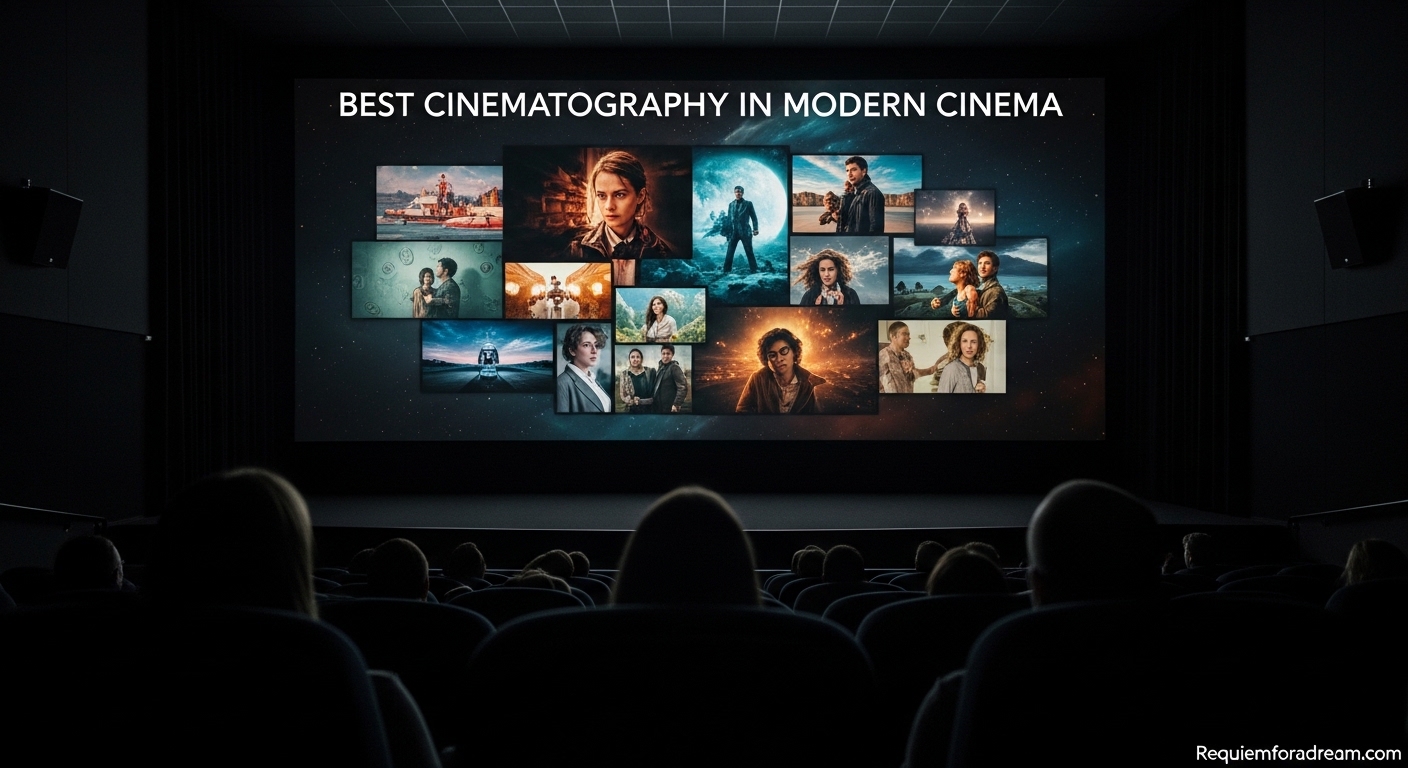
Some images stay with you long after the credits roll. Not because of clever dialogue or shocking plot twists, but because of how they looked. The amber glow of Los Angeles in 2049. The endless wheat fields whispering with spiritual meaning. The suffocating darkness of a lighthouse keeper’s descent into madness. These moments remind us that cinema is, above all, a visual medium.
I have spent years studying how great directors of photography craft images that serve story, emotion, and meaning. Modern cinema, which I define as films released from 2000 to 2026, has produced some of the most visually stunning and technically innovative work in the medium’s history. The shift from film to digital, the adoption of large format cameras, and the creative use of natural lighting have given cinematographers tools their predecessors could only dream of.
This guide examines the best cinematography in modern cinema, analyzing 20 films that represent the pinnacle of visual storytelling. These selections prioritize not just beauty, but meaning. Each film on this list uses its imagery to deepen our understanding of character, theme, and emotion.
Table of Contents
What Is Cinematography in Modern Cinema?
Cinematography is the art and craft of capturing moving images. It encompasses every visual decision made during production: camera placement, lens choice, lighting design, color palette, and movement. The director of photography, also called the cinematographer or DP, collaborates with the director to establish a film’s visual language.
Modern cinematography differs from earlier eras in several key ways. Digital cameras now dominate production, though many cinematographers still choose film for specific projects. Large format sensors and IMAX cameras have become more accessible, creating immersive, high-resolution images. Color grading in post-production allows for precise control over the final look. Yet the fundamental goal remains unchanged: to tell stories through pictures.
Great cinematography does more than make a film attractive. It guides our attention, establishes mood, reveals character psychology, and creates visual metaphors that deepen meaning. When Roger Deakins frames Ryan Gosling against the orange haze of a ruined Las Vegas in Blade Runner 2049, that image communicates isolation, decay, and beauty simultaneously. That is the power of the medium.
How We Selected These Films
Choosing the best cinematography in modern cinema requires more than personal preference. I evaluated each film based on four criteria: technical innovation, emotional impact, influence on subsequent films, and how effectively the imagery serves the story.
Technical innovation matters because cinematography is a craft that evolves through experimentation. Emmanuel Lubezki’s work on The Revenant pushed natural lighting to extremes. Hoyte van Hoytema’s photography for Oppenheimer demonstrated what large format black and white film could achieve. These advances open new possibilities for all filmmakers.
Emotional impact determines whether cinematography transcends mere competence to become art. A beautifully composed shot that means nothing is just decoration. The films on this list use their imagery to make us feel something specific: dread, wonder, intimacy, alienation.
The 20 Best Examples of Cinematography in Modern Cinema
Blade Runner 2049 (2017) – Cinematographer: Roger Deakins
Roger Deakins won his first Academy Award after thirteen nominations for this sequel, and it is easy to understand why. His work on Blade Runner 2049 creates a world that feels both vast and intimate, using color and contrast to distinguish between the sterile corporate environments of Los Angeles and the toxic wasteland of Las Vegas.
The film employs multiple aspect ratios, shifting between standard widescreen and IMAX-full frame sequences that expand vertically to fill the entire screen. Deakins shot primarily on the ARRI Alexa 65, a large format digital camera that captures remarkable detail and dynamic range. His use of practical lighting sources, from holographic advertisements to sodium vapor streetlights, grounds the science fiction in tactile reality.
The orange haze that permeates the Las Vegas sequences was achieved using a combination of atmospheric effects and precise color grading. Deakins has explained that he wanted these scenes to feel both beautiful and dangerous, like looking at a sunset during a wildfire. That tension between aesthetic pleasure and environmental warning perfectly mirrors the film’s themes.
What distinguishes this work is how every frame serves narrative purpose. When K walks through the ruins of a casino, the cavernous spaces dwarf him, visually reinforcing his status as a disposable replicant. When he finds the wooden horse in the furnace, the intimate close-up and warm light create a moment of profound human connection.
The Tree of Life (2011) – Cinematographer: Emmanuel Lubezki
Emmanuel Lubezki, known professionally as Chivo, created one of the most visually ambitious films of the century for Terrence Malick. The Tree of Life combines intimate family drama with cosmic creation imagery, requiring a cinematographic approach that could shift seamlessly between handheld naturalism and operatic spectacle.
Lubezki shot extensively using available light and wide-angle lenses close to the actors. This technique, which he refined throughout his collaborations with Malick, creates a sense of immediacy and immersion. The camera seems to exist within the same space as the characters, rather than observing from a distance.
The famous creation sequence, featuring imagery of galaxies forming, cells dividing, and dinosaurs walking the earth, used a combination of chemical reactions filmed in tanks, practical effects, and NASA footage. Lubezki and Malick worked with visual effects supervisors to ensure these sequences matched the film’s overall visual texture.
The film’s golden hour photography, particularly the scenes of children playing at sunset, demonstrates what natural light can achieve when cinematographers abandon the control of artificial lighting. These moments glow with a warmth that feels both nostalgic and universal.
Dune (2021) – Cinematographer: Greig Fraser
Greig Fraser approached Frank Herbert’s epic with a philosophy he called “dirty science fiction.” Rather than the pristine, antiseptic look common to the genre, he wanted Arrakis to feel lived-in, harsh, and physically demanding. This decision shapes every frame of the film.
Fraser mixed digital and film formats, shooting principal photography on the ARRI Alexa LF while using 35mm for select sequences requiring specific texture. The harsh desert environments of Jordan and Namibia provided natural lighting that no artificial source could replicate. Sandstorms during production became opportunities rather than obstacles, adding authentic atmosphere to scenes.
The film’s color palette deliberately restricts warm tones until Paul and Jessica reach the Fremen. Before that transition, the Harkonnen sequences are rendered in harsh black and white, while the Atreides home world features muted blues and grays. This restricted palette makes the warm oranges and reds of the desert feel earned and significant.
The sandworm emergence sequence represents modern blockbuster cinematography at its most ambitious. Fraser and director Denis Villeneuve planned these shots meticulously, using scale models and previsualization to ensure the final imagery would convey proper scale and awe.
1917 (2019) – Cinematographer: Roger Deakins
Deakins’ second appearance on this list demonstrates his remarkable range. Where Blade Runner 2049 embraced artifice, 1917 pursued authenticity. The film presents the illusion of a single continuous shot following two soldiers across World War I battlefields, requiring complex choreography between camera, actors, and effects.
The technical achievement cannot be overstated. Each “single take” sequence actually consisted of multiple long shots stitched together with invisible transitions. Deakins and his team rehearsed for months, using stand-ins to map camera movement through trenches, across no man’s land, and through destroyed villages.
The lighting evolved with the story’s timeline, beginning with overcast daylight and progressing through burning buildings, flares illuminating night battles, and finally sunrise. Deakins used everything from natural sun to practical torches to burning church interiors, always motivated by the scene’s reality.
The nighttime village sequence, lit entirely by flares that cast long, shifting shadows, creates some of the most haunting imagery in modern war films. The camera’s relentless forward movement never allows the audience or the characters a moment of rest, mirroring the soldiers’ psychological state.
The Revenant (2015) – Cinematographer: Emmanuel Lubezki
Lubezki’s third consecutive Academy Award winner represents perhaps the most extreme commitment to natural lighting in mainstream cinema. Director Alejandro Gonzalez Inarritu and Lubezki planned the entire film around available light, using fire, torches, and the sun as their only sources.
This approach created enormous production challenges. The team could only shoot during specific hours when the light matched their needs. Cloud cover, which changed constantly in the Canadian and Argentinian locations, could ruin an entire day’s work. Yet the results justify these difficulties.
The film’s opening battle sequence, shot in a single complex take through forests and along a riverbank, demonstrates what happens when you remove the safety net of artificial lighting. The camera dances between shafts of sunlight penetrating the tree canopy, creating exposure challenges that Lubezki embraced rather than corrected.
The famous bear attack and subsequent recovery sequences use firelight almost exclusively. Leonardo DiCaprio’s face, illuminated by the warm glow of his character’s campfire or the cold reflection of snow, carries the emotional weight of scenes with minimal dialogue. The limitations became artistic strengths.
Roma (2018) – Cinematographer: Alfonso Cuaron
Alfonso Cuaron served as his own cinematographer for this autobiographical masterpiece, creating a visual style that feels both deeply personal and universally accessible. Shot in black and white on the ARRI Alexa 65, Roma recreates Mexico City in the early 1970s with precise attention to period detail.
The camera moves slowly, often in long takes that observe the life of Cleo, an indigenous domestic worker, without judgment or intrusion. Cuaron’s compositions frequently place her within the geometry of the family home, emphasizing both her importance to the household and her marginal position within it.
The film’s most spectacular sequence, a riot on the street where Cleo shops for a crib, unfolds in a single extended shot that moves from the interior of a furniture store to the chaotic street outside. Cuaron and his team built a complete street set to control every element of this complex choreography.
Black and white photography serves the story’s themes of memory and class. By removing color, Cuaron creates a timeless quality that suggests these events belong to history while remaining emotionally immediate. The high contrast images, rich in detail from deep shadows to bright highlights, reward viewing on the largest screen available.
Mad Max: Fury Road (2015) – Cinematographer: John Seale
At age 70, John Seale came out of retirement to shoot what would become one of the most kinetic action films ever made. His work on Mad Max: Fury Road proves that clarity and chaos can coexist when cinematography serves story rather than spectacle alone.
Director George Miller insisted on practical effects and real vehicles rather than digital replacements. Seale’s camera operators, mounted on vehicles moving at high speeds through the Namibian desert, captured genuinely dangerous stunt work. The camera shakes, bounces, and swerves with the action, creating visceral excitement without sacrificing comprehension.
The color grading deserves special mention. The day-for-night “blue hour” sequences, achieved through heavy color manipulation rather than actual night shooting, create an otherworldly atmosphere distinct from the burning daylight chases. The orange and teal palette, so often misused in blockbusters, here feels organic to the desert environment.
Seale’s decision to keep the frame wide and deep, allowing audiences to see multiple vehicles and characters simultaneously, enables Miller’s editing style. Rapid cuts work because each shot contains enough information to orient the viewer. This is action cinematography that respects audience intelligence.
Moonlight (2016) – Cinematographer: James Laxton
James Laxton’s work on Barry Jenkins’ Moonlight demonstrates how cinematography can express interior emotional states through color and light. The film’s three chapters, following the protagonist Chiron through childhood, adolescence, and adulthood, each possess distinct visual palettes that reflect his evolving identity.
Laxton shot on the ARRI Alexa but pushed the digital image toward the texture of film, using specific lenses and post-processing to achieve warmth and grain. The Miami setting, usually depicted in bright tourism photography, here appears humid, neon-lit, and dreamlike.
The color blue recurs throughout the film, associated with the ocean and with Chiron’s emotional vulnerability. Laxton and Jenkins used different shades and saturations of blue to mark transitions between the character’s public facade and private truth. The swimming lesson scene, where young Chiron learns to float, bathes both characters in moonlit blue that feels protective and transcendent.
The final chapter’s visual restraint, with muted colors and still compositions, reflects the adult Chiron’s hardened exterior. When color finally erupts in the film’s conclusion, it carries the weight of suppressed emotion breaking through. This is cinematography as psychological portraiture.
The Assassination of Jesse James by the Coward Robert Ford (2007) – Cinematographer: Roger Deakins
Deakins’ third appearance on this list showcases his mastery of period authenticity and poetic imagery. His work on this western creates a dreamlike vision of the American frontier that feels both historically grounded and mythologically elevated.
The film’s distinctive look came from Deakins’ decision to use long lenses and shallow depth of field, unusual choices for the traditionally sharp-focused western genre. This approach isolates characters against blurred landscapes, suggesting the ways myth obscures reality. The famous train robbery sequence, lit by lanterns and moonlight, creates images that feel stolen from a daguerreotype.
Deakins experimented with vintage lenses and specific film stocks to achieve the muted, sepia-tinged color palette. He has noted that he wanted the film to feel like a memory of the old west rather than a documentary recreation. The results influenced countless subsequent period films.
The wheat field sequence, where Jesse James waits in tall grass for a train, demonstrates how landscape cinematography can create tension without action. Wind moves through the grain, light shifts across the horizon, and the frame becomes a canvas of natural beauty threatening to conceal violence.
Children of Men (2006) – Cinematographer: Emmanuel Lubezki
Lubezki’s second appearance on this list features some of the most technically ambitious long takes in cinema history. Working with director Alfonso Cuaron, he created sequences that immerse viewers in a near-future world where human infertility has pushed society toward collapse.
The car ambush sequence, apparently a single unbroken shot lasting nearly four minutes, required a specially rigged vehicle and months of preparation. The camera rotates around the interior, capturing each character’s reaction as the attack unfolds, then exits the vehicle to continue the action on foot. Digital effects removed the rig and stitched together multiple takes, but the illusion of continuous action creates unparalleled tension.
The film’s battle sequence, moving through a war zone in another extended take, demonstrates how cinematography can convey chaos while maintaining geographical clarity. Lubezki’s camera ducks, weaves, and runs alongside Clive Owen’s protagonist, never cutting away from the immediate danger.
Beyond the technical feats, the film’s gray, desaturated palette creates a plausible dystopia that avoids science fiction spectacle. This is a world that looks like ours, slightly worn and weathered, making the premise feel uncomfortably possible.
Interstellar (2014) – Cinematographer: Hoyte van Hoytema
Hoyte van Hoytema brought documentary realism to Christopher Nolan’s science fiction epic, grounding cosmic speculation in physical authenticity. His decision to shoot with IMAX film cameras for sequences on Earth and other planets created images of unprecedented scale and clarity.
The film mixed IMAX 70mm, standard 65mm, and 35mm film stocks depending on the scene’s requirements. Van Hoytema used IMAX for the vast landscapes of alien worlds and the infinite darkness of space, taking advantage of the format’s resolution to capture detail that rewards repeated viewing.
Practical effects dominated the production, with van Hoytema photographing real corn fields, actual glacier locations in Iceland, and full-scale spacecraft interiors. When visual effects appear, they blend seamlessly with photographed elements because the cinematography established a consistent visual language.
The tesseract sequence, representing a four-dimensional space where time becomes physical, required innovative lighting approaches to suggest impossible geometry. Van Hoytema and Nolan worked with practical light sources arranged in complex patterns, capturing reflections and refractions that feel both alien and comprehensible.
The Grand Budapest Hotel (2014) – Cinematographer: Robert Yeoman
Wes Anderson’s films possess a visual style so distinctive that audiences recognize his work within seconds. Robert Yeoman, who has shot nearly all of Anderson’s features, understands that this stylization serves deeper purposes than mere quirkiness.
The Grand Budapest Hotel uses three different aspect ratios to distinguish between time periods. The 1930s sequences unfold in the classic 1.37:1 Academy ratio, creating a boxy frame that evokes the period’s films. The 1960s material expands to 2.35:1 anamorphic widescreen, while the contemporary framing uses standard 1.85:1.
Yeoman’s compositions are meticulously symmetrical, often with the camera positioned directly centered on subjects rather than at offset angles. This formal rigidity suggests the ordered, hierarchical world of the old European hotel while creating opportunities for comedy through precise timing and blocking.
The color palette shifts with the narrative’s emotional temperature. Pastel pinks and purples dominate the hotel’s heyday, while Soviet-era grays and browns encroach as the story darkens. Miniature effects, shot in camera rather than created digitally, add handmade texture that suits the film’s nostalgic tone.
No Country for Old Men (2007) – Cinematographer: Roger Deakins
Deakins’ fourth entry demonstrates how restraint can be as powerful as spectacle. His work on the Coen Brothers’ western noir strips away artistic flourishes to create a stark, unflinching vision of moral decay along the Texas-Mexico border.
The film avoids obvious camera movement, preferring static compositions that observe action with detached calm. When the camera does move, typically in slow tracking shots that follow characters through landscapes, the motion carries weight precisely because of its rarity.
Natural light dominates, with Deakins taking advantage of the harsh Texas sun to create deep shadows and blown-out highlights. The famous coin toss scene in a remote gas station uses practical sources exclusively, with the fluorescent tubes overhead creating sickly green tones that contrast with the warm exterior glimpsed through windows.
Night sequences, particularly the motel confrontation and the car fire scene, demonstrate available light cinematography pushed to extremes. Deakins has explained that he wanted darkness to feel like a character in the film, something that obscures and threatens. The results influenced the look of countless subsequent crime films.
Gravity (2013) – Cinematographer: Emmanuel Lubezki
Lubezki’s third consecutive Oscar win came for a film that posed unprecedented challenges. Gravity takes place primarily in the weightless environment of Earth orbit, where traditional lighting and camera movement rules do not apply.
The film’s famous opening sequence, a seventeen-minute continuous shot that establishes the characters and their situation before disaster strikes, required innovations in both technology and technique. Lubekci and director Alfonso Cuaron developed a “light box” system, essentially a massive LED screen surrounding the actors, that could provide realistic lighting while displaying the Earth, sun, and stars that would reflect in the astronauts’ helmets and visors.
Cinematography and visual effects merged completely on this production. Lubezki planned every frame, but much of what appears on screen was created digitally. The distinction between photography and animation became meaningless because both served the same visual goal.
The film’s use of 3D, rare on this list, deserves mention. Lubezki and Cuaron designed shots specifically for stereoscopic presentation, using depth to convey the terrifying scale of space and the claustrophobic interiors of spacecraft. Objects float toward and away from the camera in ways that emphasize weightlessness.
The Lighthouse (2019) – Cinematographer: Jarin Blaschke
Jarin Blaschke shot Robert Eggers’ claustrophobic psychological horror in black and white using vintage lenses and a nearly square 1.19:1 aspect ratio. These technical choices immediately distinguish the film from contemporary releases and evoke the early cinema of the 1890s, when the story takes place.
The decision to shoot in harsh black and white served practical as well as aesthetic purposes. The remote Nova Scotia location offered limited resources for color correction or complex lighting. By embracing monochrome, Blaschke and Eggers turned constraints into artistic signatures.
The square frame, created by masking standard 35mm film, creates vertical compositions that emphasize the lighthouse tower’s dominance. Characters frequently appear trapped within the geometry of the structure, with beams, staircases, and walls pressing in from all sides.
Storm sequences, shot in actual harsh weather with actors being genuinely battered by wind and waves, achieve visceral impact that digital effects cannot replicate. The high contrast lighting, with deep blacks and bright whites separated by minimal gray tones, recalls expressionist cinema while serving the story’s descent into madness.
Dune: Part Two (2024) – Cinematographer: Greig Fraser
Greig Fraser returned to Arrakis for the second installment of Denis Villeneuve’s adaptation, expanding his visual vocabulary to encompass political intrigue on multiple worlds while maintaining the first film’s tactile quality. His work on Part Two confirms his status among the great science fiction cinematographers.
The sequel introduces new environments including the Imperial capital and the Harkonnen home world of Giedi Prime. Fraser photographed Giedi Prime in infrared, creating an eerie black and white world where the sun appears black and skin takes on translucent, otherworldly textures. This choice distinguishes the Harkonnen as genuinely alien without relying on digital manipulation.
The Fremen sequences on Arrakis embrace even harsher lighting conditions than the first film, with sand-saturated air diffusing sunlight into an omnipresent glow that obscures as much as it reveals. The famous sandworm riding sequence required innovative approaches to capture characters moving at high speed across desert landscapes.
Fraser continued his mixed format approach, using IMAX 15-perf 65mm for the largest scale sequences while returning to 35mm for intimate moments. The contrast between these formats, invisible to most viewers but felt subliminally, reinforces the story’s shifts between epic and personal scales.
The Green Knight (2021) – Cinematographer: Andrew Droz Palermo
Andrew Droz Palermo brought an indie film sensibility to David Lowery’s medieval fantasy, creating imagery that feels both timeless and contemporary. His work on The Green Knight prioritizes atmosphere and psychology over historical accuracy or fantasy spectacle.
The film was shot primarily on location in Ireland, taking advantage of the country’s dramatic landscapes and unpredictable weather. Palermo embraced the gloom, shooting in genuine fog, rain, and twilight rather than waiting for ideal conditions. This approach creates a world that feels haunted from the first frame.
Color plays a symbolic role throughout. The green that suffuses multiple scenes connects to the supernatural elements while suggesting nature’s indifference to human concerns. Gold and yellow appear at moments of temptation or moral failure. The final sequence’s shift toward warmer tones provides visual resolution that matches the narrative’s conclusion.
Palermo’s compositions frequently place Dev Patel’s Gawain within vast landscapes that diminish him, emphasizing the character’s isolation and insignificance against mythic forces. The camera movements, often slow and deliberate, create tension through restraint rather than action.
Sicario (2015) – Cinematographer: Roger Deakins
Deakins’ fifth appearance on this list showcases his versatility across genres. His work on Denis Villeneuve’s drug cartel thriller creates tension through shadows and silhouettes, using darkness as both literal reality and metaphorical weight.
The film’s famous border crossing sequence, shot at sunset with the characters moving through harsh sunlight into deepening shadow, demonstrates how natural light transitions can structure narrative. Deakins planned this sequence meticulously, knowing he had only minutes each day when the light matched his requirements.
Thermal and night vision sequences, representing surveillance technology, appear in monochrome green and white that contrasts with the film’s warmer daytime palette. These shifts in visual language mark transitions between different ways of seeing and knowing.
The tunnel climax, shot with minimal lighting and lots of darkness, required careful balance between revealing enough for comprehension and concealing enough for fear. Deakins has explained that he wanted audiences to feel the characters’ disorientation, unsure of what lurked beyond the reach of their flashlights.
Arrival (2016) – Cinematographer: Bradford Young
Bradford Young brought his distinctive approach to science fiction with Denis Villeneuve’s contemplative alien contact film. His work on Arrival prioritizes intimacy and emotional clarity over spectacle, making the extraterrestrial feel personal rather than distant.
Young shot the film with deep shadows and limited fill light, creating images where characters often appear partially obscured. This darkness serves the story’s themes of miscommunication and the unknown. When the aliens appear, they emerge from fog and shadow gradually, their forms never fully revealed.
The color palette restricts itself largely to blues, grays, and earth tones until the final revelation shifts toward warmer light. Young has spoken about wanting the film to feel like memory, with the haziness and selective illumination that characterizes recalled experience.
The spacecraft interiors, representing alien architecture that defies human spatial logic, use practical lighting sources within the set design rather than traditional movie lighting. This approach grounds the fantastic in physical reality, making the impossible feel tangible.
Life of Pi (2012) – Cinematographer: Claudio Miranda
Claudio Miranda won the Academy Award for his work on Ang Lee’s visually ambitious adaptation, which posed unique challenges in blending practical ocean photography with digital tiger and effects work. His cinematography had to sell the reality of a story that was, by design, potentially metaphorical.
The film’s ocean sequences were shot in an enormous wave tank in Taiwan, with Miranda lighting water and sky to match the story’s emotional beats. The famous phosphorescent whale sequence required innovative approaches to create bioluminescence effects that would interact properly with the live action.
Miranda used 3D cameras throughout, planning compositions that would take advantage of stereoscopic depth. The vast ocean spaces gain scale when viewers can perceive their true dimensions, while the cramped lifeboat creates claustrophobia through proximity.
The film’s color palette shifts from the warm tones of Pi’s Indian childhood to the cool blues of the Pacific, then toward spiritual whites and golds as the story approaches its conclusion. These transitions support the narrative’s movement from the concrete to the metaphysical.
Master Cinematographers Shaping Modern Cinema
Behind these films stand artists whose names have become synonymous with visual excellence. Understanding their approaches illuminates how cinematography functions as an interpretive art form.
Roger Deakins
With fifteen Oscar nominations and two wins, Deakins has established himself as perhaps the most respected cinematographer working today. His philosophy emphasizes serving story over showing off. He prepares extensively, creating detailed shot lists and lighting diagrams before production begins.
Deakins embraces both film and digital formats, choosing tools based on project requirements rather than nostalgia or trend. His website and podcast offer unprecedented transparency about his methods, educating a generation of aspiring cinematographers. His collaborations with the Coen Brothers, Sam Mendes, and Denis Villeneuve demonstrate his range across genres and scales.
Emmanuel Lubezki
Chivo’s three consecutive Academy Awards for Gravity, Birdman, and The Revenant reflect his innovative approach to natural light and continuous camera movement. His work with Terrence Malick and Alejandro Gonzalez Inarritu prioritizes improvisation and intuition within rigorous technical preparation.
Lubezki’s influence extends beyond his own films. His popularization of the “Chivo lighting” approach, using available light and wide lenses close to actors, has been widely adopted. His commitment to long takes has pushed the technical boundaries of what is possible in camera choreography.
Greig Fraser
Fraser represents the new generation of cinematographers comfortable with both blockbuster scale and independent intimacy. His work on Dune and its sequel demonstrates how large format digital cinematography can achieve texture and warmth previously associated with film.
Beyond science fiction, Fraser’s work on Lion and Zero Dark Thirty shows his range. He has spoken about the importance of previsualization and close collaboration with directors during development. His willingness to mix formats and embrace “imperfect” natural lighting has influenced contemporary cinematography significantly.
Hoyte van Hoytema
The Dutch cinematographer has become Christopher Nolan’s regular collaborator while maintaining diverse projects with directors like Spike Jonze and Tomas Alfredson. Van Hoytema favors large format film when possible, believing that IMAX and 65mm provide an immersive quality digital cannot replicate.
His work on Oppenheimer, shot in a combination of IMAX 65mm and 65mm black and white film, demonstrated that traditional photochemical processes remain viable for prestige productions. Van Hoytema’s compositions often emphasize architectural space and the human figure’s relationship to environment.
Key Trends in Modern Cinematography
These films reveal several developments that distinguish contemporary cinematography from earlier eras.
The Digital Revolution and Large Format Cameras
Digital cinema cameras have matured tremendously since their introduction. The ARRI Alexa series, Sony CineAlta, and RED cameras now offer dynamic range and color rendition that rivals or exceeds film in many conditions. Large format sensors, mimicking the look of 65mm film, have become more accessible, creating shallower depth of field and more immersive perspectives.
Yet film persists. Quentin Tarantino, Christopher Nolan, and other directors insist on photochemical processes for specific projects. Cinematographers increasingly choose formats based on creative requirements rather than defaulting to digital for cost savings.
Natural Lighting and Available Light
The Revenant represents an extreme example of a broader trend toward naturalism. Cinematographers increasingly use available sources, practical lights within scenes, and minimal artificial fill. This approach creates images that feel grounded and authentic, though it requires greater flexibility in scheduling and exposure.
LED technology has enabled new approaches to lighting. Flexible panels and programmable color temperature allow cinematographers to shape natural-looking light with greater control than traditional fixtures permitted.
Long Takes and Seamless Movement
Films like 1917, Birdman, and Gravity pursue the illusion of continuous action. While digital effects often stitch together multiple shots, the visual result maintains real-time pacing that cutting would interrupt. These sequences require extensive preparation and often innovative mechanical solutions.
The trend reflects audiences’ increasing sophistication. Viewers notice editing more than earlier generations did, and seamless movement creates immersion that frequent cutting disrupts.
Color as Emotional Language
Digital color grading, performed in post-production rather than during printing, allows precise control over final images. Cinematographers now plan for grading from pre-production, shooting with specific LUTs (Look-Up Tables) that approximate the intended final look.
Films like Moonlight and The Grand Budapest Hotel use color symbolically, restricting palettes to support narrative themes. This approach requires collaboration between cinematographer and colorist that was impossible in the photochemical era.
How to Analyze Cinematography When Watching Films
Appreciating cinematography requires no technical background. Anyone can learn to watch films with greater visual awareness by considering a few key questions.
First, notice where the camera sits in relation to the characters. Close proximity suggests intimacy or claustrophobia. Distance implies observation or isolation. Height matters too: low angles make subjects powerful, while high angles diminish them.
Second, pay attention to light sources within the scene. Does the lighting feel natural, coming from windows or lamps visible on screen? Or does it seem theatrical, with illumination that has no logical source? Neither approach is better, but understanding the choice illuminates the film’s intentions.
Third, observe color. Warm tones (oranges, yellows) typically suggest comfort, nostalgia, or danger depending on context. Cool tones (blues, greens) evoke distance, melancholy, or calm. Desaturation creates documentary realism or emotional emptiness.
Fourth, consider camera movement. Static frames feel stable, permanent, sometimes detached. Movement creates energy, urgency, or fluidity. The speed and direction of movement shape our emotional response.
Finally, think about composition. Symmetry suggests order, artificiality, or formality. Asymmetry feels natural, dynamic, or chaotic. The placement of characters within the frame tells us about their relationships and power dynamics.
Frequently Asked Questions About Cinematography
What movie has the best cinematography ever?
While subjective, many critics and filmmakers cite Lawrence of Arabia (1962), Blade Runner 2049 (2017), or The Tree of Life (2011) as having the best cinematography ever. Blade Runner 2049 earned Roger Deakins his first Oscar after thirteen nominations. The Tree of Life revolutionized natural light cinematography. Ultimately, the best cinematography depends on what you value: technical innovation, emotional impact, or historical influence.
What is the 30 rule in cinematography?
The 30-degree rule states that when cutting between two shots of the same subject, the camera position should change by at least 30 degrees relative to the subject. This prevents the shots from appearing too similar, which would create a jarring jump cut. The rule ensures that each shot provides a meaningfully different perspective while maintaining spatial continuity.
What are the 5 C’s of cinematography?
The 5 C’s of cinematography are: Camera angles, which establish perspective and psychological relationships. Continuity, which ensures smooth spatial and temporal flow between shots. Cutting, which determines when and where to transition between shots. Close-ups, which isolate details for emotional emphasis. And Composition, which arranges visual elements within the frame for meaning and beauty.
What are the 7 C’s of cinematography?
The 7 C’s expand the original five to include: Contrast, controlling the difference between light and dark areas. And Color, using hue and saturation for emotional and symbolic effect. Combined with Camera angles, Continuity, Cutting, Close-ups, and Composition, these seven principles provide a framework for understanding how cinematographers create meaning through visual choices.
How has cinematography changed in modern cinema?
Modern cinematography has shifted from film to digital cameras, though large format film persists for prestige productions. Digital intermediates allow precise color grading. LED lighting provides flexible, natural-looking illumination. IMAX and large format cameras have become more accessible. Natural lighting approaches have gained popularity. Long takes and seamless camera movement are more common. Color is increasingly used symbolically. These changes give cinematographers more control while demanding greater collaboration with visual effects artists.
The Enduring Power of Visual Storytelling
The twenty films examined here represent the best cinematography in modern cinema, but they also represent something larger: the continued vitality of visual storytelling in an era of overwhelming image saturation. When every phone captures video and every screen demands content, the deliberate, collaborative creation of meaningful images matters more than ever.
These cinematographers remind us that camera placement is a moral choice. Lighting design carries emotional weight. Color selection shapes meaning. The decisions made in the hours before dawn, as crews set up for a shot that will last seconds on screen, accumulate into experiences that stay with viewers for decades.
I encourage you to watch these films with fresh attention to their visual language. Notice how Deakins uses shadow to suggest moral uncertainty in No Country for Old Men. Observe how Lubezki’s natural light in The Revenant makes the landscape feel simultaneously beautiful and hostile. Consider how Fraser’s color restrictions in Dune create emotional anticipation.
The best cinematography in modern cinema does not merely decorate stories. It tells them. In the interplay of light and shadow, movement and stillness, color and absence, we find meanings that words cannot capture. That is the magic of the medium, alive and evolving in 2026.