
Some films just live rent-free in your head. You watch them once, and for weeks afterward, you’re second-guessing strangers on the subway, replaying that one scene, wondering what you’d have done. That’s the signature of a great psychological thriller. This list is my attempt to round up the absolute best the genre has produced, from the black-and-white bedrock that started it all to the modern masterpieces that keep redefining what “suspense” even means.
What Is a Psychological Thriller?
A psychological thriller is a film genre that builds suspense through the mental and emotional states of its characters rather than physical action. The best entries lean on paranoia, obsession, unreliable narrators, moral ambiguity, and slow-burn dread. Instead of jump scares or gore, they trap you inside a character’s head and make you question what’s real. Think Psycho, Silence of the Lambs, Gone Girl, Get Out.
If you’re in a rush, here’s the quick-glance shortlist before we dive in.
Quick-Glance: Top 10 Psychological Thrillers
| Rank | Film | Year | Director |
|---|---|---|---|
| 1 | The Silence of the Lambs | 1991 | Jonathan Demme |
| 2 | Psycho | 1960 | Alfred Hitchcock |
| 3 | Vertigo | 1958 | Alfred Hitchcock |
| 4 | Parasite | 2019 | Bong Joon-ho |
| 5 | Se7en | 1995 | David Fincher |
| 6 | Get Out | 2017 | Jordan Peele |
| 7 | Gone Girl | 2014 | David Fincher |
| 8 | Mulholland Drive | 2001 | David Lynch |
| 9 | Memento | 2000 | Christopher Nolan |
| 10 | Taxi Driver | 1976 | Martin Scorsese |
Alright. Let’s get into it.
How I Ranked These Films
A few quick words on criteria so you know what you’re reading. Every film on this list had to clear three bars:
- It has to be psychological first. Violence and horror elements are allowed, but the core engine must be a character’s mind, perception, or moral unraveling.
- It has to hold up. Not just “great for its time.” Great now.
- It has to stick. If you can forget it the next day, it doesn’t belong here.
I pulled from IMDb top-rated thrillers, Rotten Tomatoes Certified Fresh picks, Academy Award history, Sight & Sound critics polls, and my own obsessive rewatches. The order is rough best-to-weakest within loose tiers, but honestly, once you’re in the top 15, you could rearrange them ten different ways and all of them would be right.
The Genre-Defining Masterpieces
1. The Silence of the Lambs (1991)
The gold standard. Jodie Foster’s Clarice Starling walks into a cell to bargain with Anthony Hopkins’ Hannibal Lecter, and in 118 minutes, the movie teaches you everything you need to know about controlled dread. Based on the Thomas Harris novel, Jonathan Demme’s film is one of only three movies in history to sweep the “Big Five” Academy Awards — Best Picture, Director, Actor, Actress, and Adapted Screenplay. The other two are It Happened One Night (1934) and One Flew Over the Cuckoo’s Nest (1975). Hopkins is onscreen for roughly 16 minutes. That’s all he needed.
2. Psycho (1960)
This is where modern horror and the psychological thriller fully merged. Alfred Hitchcock convinced theaters not to admit anyone after the film started, which was a stunt at the time and is now standard. The shower scene still works. Norman Bates is still one of cinema’s most unsettling creations. Sixty-plus years later, Psycho is nerve-frying.
3. Vertigo (1958)
Widely considered Hitchcock’s masterpiece and, per Sight & Sound’s critics poll, one of the greatest films ever made. James Stewart plays an ex-cop with acrophobia pulled into a spiral of obsession and deception. Bernard Herrmann’s score does as much heavy lifting as the camera. A complete dissertation on romantic fixation disguised as a mystery.
4. Parasite (2019)
Bong Joon-ho’s Palme d’Or and Best Picture winner is a class-warfare fever dream that keeps shifting genres every 20 minutes. One minute it’s a caper comedy, then it’s a home-invasion thriller, then it’s something much darker. The first foreign-language film to win Best Picture at the Academy Awards.
5. Se7en (1995)
David Fincher’s rain-soaked serial-killer procedural pairs Brad Pitt and Morgan Freeman on the trail of a murderer staging kills around the seven deadly sins. The ending is one of the most talked-about in film history and genuinely still hurts to watch. Don’t let anyone spoil it.
6. Get Out (2017)
Jordan Peele’s directorial debut. A Black photographer visits his white girlfriend’s family estate, and the tension builds so slowly you almost don’t notice the walls closing in. Won the Oscar for Best Original Screenplay and kicked off an entire modern movement of socially conscious horror-adjacent cinema.
7. Gone Girl (2014)
Fincher again, this time adapting Gillian Flynn’s novel. Rosamund Pike’s performance as Amy Dunne is arguably the best depiction of sociopathy on screen this century. The “Cool Girl” monologue is the moment the movie goes from great to all-time. A masterclass in how marriage can be its own kind of horror.
8. Mulholland Drive (2001)
David Lynch’s most Lynchian film, which is saying something. Naomi Watts plays an aspiring actress who helps an amnesiac woman piece together her identity in Los Angeles. Don’t try to solve it on the first watch. Just let it wash over you. The Winkie’s diner scene is three minutes of the most effective horror filmmaking ever committed to celluloid.
9. Memento (2000)
Christopher Nolan’s breakthrough. Guy Pearce plays a man with anterograde amnesia hunting his wife’s killer using tattoos and Polaroids. The structure — alternating color scenes moving backwards and black-and-white scenes moving forwards — isn’t a gimmick. It’s the entire point. You finish the movie knowing less than you started with, and that’s the best kind of psychological thriller.
10. Taxi Driver (1976)
Martin Scorsese and Paul Schrader’s portrait of Travis Bickle, a Vietnam vet slowly combusting in 1970s New York, is on the National Film Registry for good reason. Robert De Niro’s performance codified the unstable-loner archetype for the next 50 years of cinema.
Hitchcock: The Master Class
You can’t write a list like this without giving Hitchcock his own section. He didn’t invent the genre, but he welded it together.
11. Rear Window (1954)
James Stewart is stuck in his apartment with a broken leg, watches his neighbors through a camera lens, and becomes convinced one of them is a murderer. Grace Kelly is luminous. The entire film plays out in essentially one room and it never once feels small.
12. Notorious (1946)
Cary Grant and Ingrid Bergman play bitter, toxic lovers tangled in a post-war spy operation in Brazil. Writers Guild of America selected Ben Hecht’s script as one of the finest ever written, and the wine-cellar set piece is a tutorial in how to extend a single moment into unbearable tension.
13. Strangers on a Train (1951)
Based on Patricia Highsmith’s novel. A chance encounter between a tennis player and a charming psychopath escalates into a murder pact that one party never agreed to. The carousel finale is pure Hitchcock.
14. Shadow of a Doubt (1943)
Hitchcock’s personal favorite of his own films. A young woman slowly realizes her beloved visiting uncle is a serial killer. Teresa Wright and Joseph Cotten anchor a small-town nightmare that holds its nerve for every minute of its runtime.
15. Rebecca (1940)
Hitchcock’s first Hollywood film. Won Best Picture at the 1941 Academy Awards. A romantic gothic thriller adapted from Daphne du Maurier’s novel, with Laurence Olivier and Joan Fontaine caught between a dead wife’s shadow and a controlling housekeeper. Still the best of the many Rebecca adaptations.
The Foundational Classics (Pre-1970)
16. Gaslight (1944)
George Cukor’s adaptation gave the English language the word “gaslighting.” Ingrid Bergman won her first Best Actress Oscar playing a wife being systematically manipulated into doubting her own sanity. If you want to see the ur-text of every modern psychological-abuse thriller, start here.
17. Diabolique (1955)
Henri-Georges Clouzot’s French-language shocker about two women who team up to murder an abusive headmaster, then lose the body. The ending is one of the most durable “gotcha” moments ever filmed. Robert Bloch, who wrote the novel Psycho, called it his all-time favorite horror film.
18. M (1931)
Fritz Lang’s German expressionist masterpiece predates the sound era by inches. Peter Lorre plays a child murderer being hunted by both police and the criminal underworld. The sequence where he whistles “In the Hall of the Mountain King” to signal his presence is one of the genre’s founding images.
19. Peeping Tom (1960)
Released the same year as Psycho and destroyed Michael Powell’s career because audiences weren’t ready for a film this confrontational about voyeurism and violence. A serial killer films his victims’ dying expressions. Retroactively recognized as one of the great psychological thrillers.
20. Repulsion (1965)
Roman Polanski’s first English-language film. Catherine Deneuve plays a woman left alone in a London flat for a weekend who slowly, terrifyingly loses her grip. Essentially a case study of psychosis rendered as cinema. Claustrophobic in a way no film before it had managed.
21. Persona (1966)
Ingmar Bergman’s experimental two-hander about an actress who stops speaking and the nurse tasked with her recovery. Identity blurs, faces merge, reality fragments. One of the most analyzed films in cinema history.
22. Rosemary’s Baby (1968)
Mia Farrow plays a pregnant woman who begins to suspect her neighbors and husband are cult members plotting something unspeakable for her child. The ambiguity of whether she’s paranoid or correct is the engine. Adapted from Ira Levin’s bestseller.
23. Cape Fear (1962)
Robert Mitchum’s ex-convict stalking Gregory Peck’s family is pure menace. Scorsese’s 1991 remake with De Niro is more graphic and flashier, but Mitchum’s creep factor in the original is scarier because it’s quieter.
24. Whatever Happened to Baby Jane? (1962)
Bette Davis and Joan Crawford playing aging, co-dependent Hollywood sisters in what has to be the most acidic camp psychological thriller ever made. The offscreen feud between the leads seeps into every frame.
25. The Third Man (1949)
Carol Reed’s post-war Vienna noir, frequently named the greatest British film ever made by the British Film Institute. Orson Welles’ Harry Lime only shows up in the last third of the movie, and it completely reframes everything that came before.
The 70s and 80s Gauntlet
26. The Conversation (1974)
Francis Ford Coppola between the first two Godfathers made this slow-burn about a paranoid surveillance expert (Gene Hackman) who becomes convinced his clients plan to murder the people he’s recording. Won the Palme d’Or at Cannes. As quiet and internal as a thriller can get.
27. Don’t Look Now (1973)
Nicolas Roeg’s adaptation of a Daphne du Maurier short story. Donald Sutherland and Julie Christie play grieving parents in Venice chasing a red-coated figure they believe is their dead daughter. The ending is one of the most devastating and talked-about in the genre.
28. The Shining (1980)
Stanley Kubrick’s adaptation of Stephen King’s novel. King famously hated it. Most of the rest of us disagree. Jack Nicholson’s descent at the Overlook Hotel is one of the genre’s foundational performances.
29. Blue Velvet (1986)
David Lynch unearths the rot beneath American suburbia. Kyle MacLachlan finds a severed ear in a field and tumbles into a nightmare starring Dennis Hopper as one of cinema’s most terrifying antagonists.
30. The Dead Zone (1983)
David Cronenberg directing a Stephen King adaptation. Christopher Walken plays a schoolteacher who wakes from a five-year coma with psychic visions. Unusually tender for both Cronenberg and the genre.
31. Blood Simple (1984)
The Coen Brothers’ debut. A Texas bar owner hires a private investigator to kill his cheating wife and her lover, and nothing goes the way anyone plans. Lean, pulpy, perfect.
32. Fatal Attraction (1987)
Glenn Close’s Alex Forrest is the patient zero of the “obsessive ex” archetype. Adrian Lyne’s erotic thriller was the highest-grossing film of 1987 and got seven Oscar nominations including Best Picture.
33. Manhunter (1986)
Michael Mann’s adaptation of Thomas Harris’s Red Dragon, featuring the first screen appearance of Hannibal Lecter (played by Brian Cox). Stylish, clinical, and ahead of its time. Fans of Silence of the Lambs who haven’t seen this owe it to themselves.
The 90s Golden Era
34. Misery (1990)
Kathy Bates won Best Actress — rare for a genre film — playing a “number one fan” who rescues an injured author (James Caan) and decides to keep him. Based on Stephen King’s novel. Still unbearably tense.
35. The Sixth Sense (1999)
M. Night Shyamalan’s breakout. Bruce Willis and Haley Joel Osment in a ghost story with one of cinema’s most famous twist endings. Six Oscar nominations including Best Picture. If you’ve somehow avoided the twist, get offline and watch it immediately.
36. Fight Club (1999)
Brad Pitt and Edward Norton in David Fincher’s adaptation of Chuck Palahniuk’s novel. A flop at release, now a cult monument. Read it as a critique of masculinity, not a how-to guide.
37. Eyes Wide Shut (1999)
Stanley Kubrick’s final film. Tom Cruise and Nicole Kidman, married in real life at the time, play a couple whose marriage fractures over a single confession. The masked party sequence is as unsettling as anything Kubrick ever shot.
38. Audition (1999)
Takashi Miike’s Japanese thriller pretends to be a quiet romance for about 60 minutes before turning into one of the most notorious final acts in genre history. Not for everyone. But if you can handle it, it’s unforgettable.
39. Jacob’s Ladder (1990)
Tim Robbins plays a Vietnam vet unstuck in his own reality. Influenced the Silent Hill video games, countless horror films, and The Sixth Sense. Don’t watch the 2019 remake.
40. Basic Instinct (1992)
Paul Verhoeven and Sharon Stone made erotic thrillers mainstream. Michael Douglas plays a detective investigating a bestselling novelist who may or may not be a murderer. The ice-pick opening is iconic for a reason.
The 2000s: New Blood
41. American Psycho (2000)
Mary Harron’s adaptation of Bret Easton Ellis’s novel, with Christian Bale as Patrick Bateman, a Wall Street yuppie whose serial-killer hobby may or may not be real. A satire of late-80s capitalism disguised as a thriller. Harron’s direction emphasizes the toxic-masculinity critique that got lost in a lot of the fanbase’s reading.
42. Oldboy (2003)
Park Chan-wook’s South Korean revenge epic. A man is imprisoned in a single room for 15 years with no explanation, then abruptly released and given five days to figure out why. The famous hallway fight scene is one take. The ending is a punch to the stomach. Skip the American remake entirely.
43. Zodiac (2007)
David Fincher’s obsessive police procedural about the hunt for the real Zodiac killer in 1970s San Francisco. The daylight basement scene is one of the most skin-crawling sequences in modern cinema. The BBC’s 2016 poll of 177 critics named it the 12th greatest film of the 21st century.
44. Shutter Island (2010)
Scorsese and DiCaprio. A U.S. Marshal investigating a disappearance at a remote psychiatric institution. Adapted from Dennis Lehane’s novel. The twist won’t surprise seasoned thriller fans, but the craft and atmosphere carry it anyway.
45. Black Swan (2010)
Darren Aronofsky’s ballet fever dream earned Natalie Portman a Best Actress Oscar. Obsession, perfectionism, and a body-horror streak. Heavily influenced by Satoshi Kon’s Perfect Blue (1997), which is itself a deserving entry on any comprehensive list.
46. The Others (2001)
Alejandro Amenábar’s ghost story starring Nicole Kidman as a mother in a post-WWII English country house with two photosensitive children. One of the great twist endings of the 2000s.
47. Donnie Darko (2001)
Richard Kelly’s sci-fi-adjacent cult classic. Jake Gyllenhaal plays a misfit teen visited by a demented giant rabbit named Frank. Works as a psychological study, a time-travel puzzle, or a grief drama depending on your angle.
48. Mystic River (2003)
Clint Eastwood’s adaptation of Dennis Lehane’s novel. Three childhood friends reunited by a crime in working-class Boston. Sean Penn and Tim Robbins both won Oscars. Devastating.
49. Caché (2005)
Michael Haneke’s French-language slow-burn about a bourgeois family receiving anonymous surveillance tapes. No music, no score, barely any conventional suspense machinery. Just dread. The ending is still debated.
50. A Tale of Two Sisters (2003)
Kim Jee-woon’s South Korean psychological horror. Two sisters return from a mental institution to a father and cruel stepmother. Works as a ghost story, a grief drama, and a psychological puzzle. Widely considered one of the best Korean films of the 2000s.
51. The Machinist (2004)
Christian Bale lost 62 pounds to play an industrial worker who hasn’t slept in a year and is questioning his own sanity. Brad Anderson’s direction keeps it lean and cold.
52. Collateral (2004)
Michael Mann’s neon-soaked LA thriller with Tom Cruise as a hired killer and Jamie Foxx as the cab driver he’s forced into service. Oscar nomination for Foxx.
Modern Masterpieces (2010s)
53. Prisoners (2013)
Denis Villeneuve’s child-abduction drama with Hugh Jackman and Jake Gyllenhaal. Two hours and 33 minutes that feel like a held breath. Roger Deakins shot it.
54. Nightcrawler (2014)
Jake Gyllenhaal as an LA stringer who films crime scenes for local news and discovers he’d rather make the news than cover it. A film about ambition as sociopathy.
55. Ex Machina (2014)
Alex Garland’s directorial debut. A programmer (Domhnall Gleeson) administers a Turing test to a robot (Alicia Vikander) and finds himself out of his depth fast. Won the Oscar for Best Visual Effects over heavy competition.
56. The Handmaiden (2016)
Park Chan-wook again. An elaborate con in Japanese-occupied Korea, told from multiple perspectives, each one reshuffling what you thought you knew. Gorgeous, erotic, twisty.
57. The Witch (2015)
Robert Eggers’ meticulously researched 1630s New England folk-horror. Anya Taylor-Joy’s breakthrough. Slow, deliberate, and uncompromising.
58. Hereditary (2018)
Ari Aster’s debut. Toni Collette’s performance is one of the most harrowing of the decade. The first 80 minutes are family drama. Then it goes somewhere else entirely.
59. We Need to Talk About Kevin (2011)
Lynne Ramsay’s adaptation of Lionel Shriver’s novel. Tilda Swinton plays the mother of a teen who commits a massacre. A film about parenthood and culpability that refuses to let you off the hook.
60. The Killing of a Sacred Deer (2017)
Yorgos Lanthimos’s clinical, emotionally flat nightmare. Colin Farrell plays a surgeon whose family is punished for a decision he made. Everyone speaks in the director’s signature monotone. It shouldn’t work. It does.
61. Nocturnal Animals (2016)
Tom Ford’s second feature. Amy Adams reads a manuscript written by her ex-husband, and the film splits into two parallel nightmares. Michael Shannon’s Oscar nomination is deserved.
62. Burning (2018)
Lee Chang-dong’s adaptation of a Haruki Murakami short story. Steven Yeun is magnetic as a wealthy charmer who may be a killer. Slow, gorgeous, ambiguous.
63. The Invisible Man (2020)
Leigh Whannell’s post-#MeToo update of the H.G. Wells story. Elisabeth Moss plays a domestic-abuse survivor convinced her “dead” ex has found a way back. A horror film that takes women’s testimony seriously.
64. Midsommar (2019)
Ari Aster’s Swedish cult nightmare in broad daylight. Florence Pugh’s breakup film about the worst vacation imaginable.
65. The Lighthouse (2019)
Robert Eggers’ black-and-white two-hander with Robert Pattinson and Willem Dafoe losing their minds at a remote 1890s lighthouse. Shot in the square Academy aspect ratio. Strange, drunk, brilliant.
66. You Were Never Really Here (2018)
Lynne Ramsay’s adaptation of Jonathan Ames’s novella. Joaquin Phoenix as a hitman who rescues trafficked girls. Violence is implied more than shown, which makes it hit harder.
67. Under the Shadow (2016)
Babak Anvari’s debut, set in 1980s Tehran during the Iran-Iraq War. A mother and daughter haunted by a djinn as missiles fall outside. Political and supernatural horror in one.
68. Personal Shopper (2017)
Olivier Assayas and Kristen Stewart. A celebrity’s personal assistant who believes she can contact the dead. A ghost story about grief and identity.
69. The Lost Daughter (2021)
Maggie Gyllenhaal’s directorial debut, from Elena Ferrante’s novel. Olivia Colman plays a woman on holiday who becomes disturbingly fixated on a young mother and daughter. Three Oscar nominations.
70. Promising Young Woman (2020)
Emerald Fennell’s neon-candy revenge thriller. Carey Mulligan plays a med-school dropout methodically dismantling men who assume women at bars are easy prey. Won Best Original Screenplay.
71. Joker (2019)
Todd Phillips and Joaquin Phoenix’s character study of Arthur Fleck. The first R-rated film to gross over a billion dollars. Debated to death, but the central performance is genuinely transformative.
72. Us (2019)
Jordan Peele’s follow-up to Get Out. Lupita Nyong’o’s dual performance is the year’s most overlooked. The film gets better on rewatch.
73. Inception (2010)
Christopher Nolan’s dream-heist blockbuster. More action-thriller than pure psychological thriller, but the identity and reality themes earn its place. Eight Oscar nominations.
Recent Additions (2020s)
74. The Menu (2022)
Mark Mylod’s satirical thriller with Ralph Fiennes as a celebrity chef and Anya Taylor-Joy as the unlikely interloper at his exclusive tasting menu. Equal parts dark comedy and slow-motion trap.
75. Fresh (2022)
Mimi Cave’s debut. Daisy Edgar-Jones meets Sebastian Stan on a dating app. I’ll say nothing more, because the 30-minute pre-title-card setup is the point.
76. The Platform (2019)
Galder Gaztelu-Urrutia’s Spanish-language allegory about a vertical prison with a food platform descending one floor at a time. Wealth, class, and human nature rendered as a game theory problem.
77. Relic (2020)
Natalie Erika James’s debut. A family reckoning with a grandmother’s dementia that metastasizes into something else. One of the most emotionally loaded horror-thrillers of recent years.
A Few More You Shouldn’t Miss
To round this out past 50, here are several more worth adding to your watchlist:
- Perfect Blue (1997) — Satoshi Kon’s anime about a pop star with a stalker. Directly inspired Black Swan.
- The Crying Game (1992) — Neil Jordan’s IRA-adjacent thriller with one of the all-time plot twists.
- The Cell (2000) — Tarsem Singh’s visual fever dream with Jennifer Lopez inside a serial killer’s mind.
- Donnie Darko — covered above but worth a second mention.
- Forgotten (2017) — a twisty Korean family thriller on Netflix that deserves wider attention.
- Berlin Syndrome (2017) — Cate Shortland’s abduction drama with Teresa Palmer.
- The Gift (2015) — Joel Edgerton’s directorial debut with Jason Bateman and Rebecca Hall.
- The Vanishing (1988) — the original Dutch version. Not the American remake. Never the American remake.
- Uncut Gems (2019) — the Safdie brothers and Adam Sandler. A film that is essentially a two-hour panic attack.
What Makes a Great Psychological Thriller? (Elements That Keep Showing Up)
If you watched any significant portion of the list above, you’d start noticing the same DNA in every entry. The Wikipedia entry on the genre catalogs the key devices, and they line up with what you see on screen:
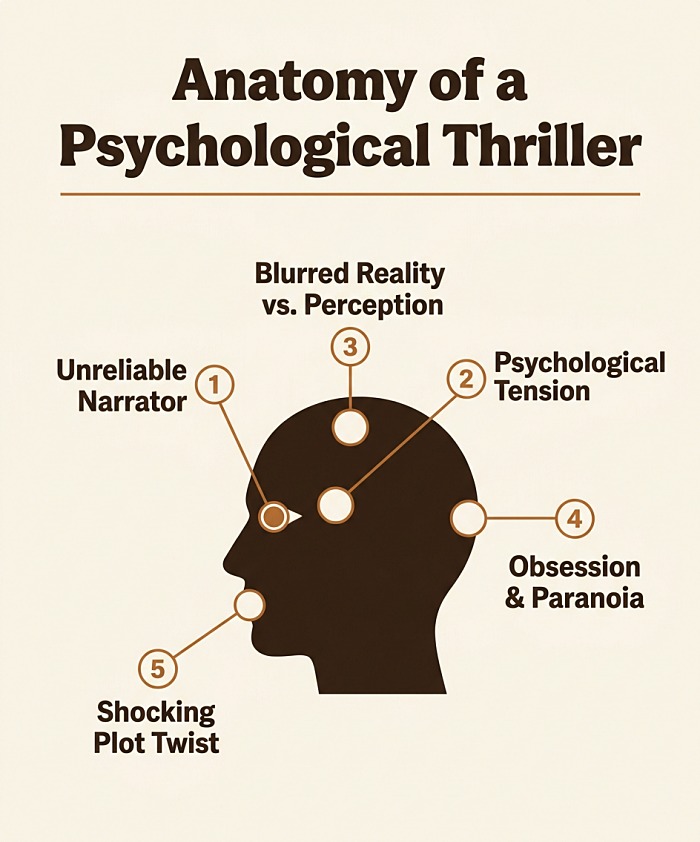
Unreliable narrators. Someone in the story, often the protagonist, is feeding you false or incomplete information, sometimes without realizing it. Memento, Shutter Island, Fight Club, Mulholland Drive all live here.
Moral ambiguity. No clean heroes. Nightcrawler, Taxi Driver, American Psycho. You’re complicit in a way straight horror rarely asks of you.
Obsession as engine. Love, revenge, work, fame — it doesn’t matter. The engine is that the character cannot stop. Black Swan, Vertigo, Perfect Blue.
Paranoia and blurred reality. Who’s real? Is this happening? Rosemary’s Baby, The Invisible Man, Repulsion. The fear comes from the possibility you can’t trust what you’re seeing.
Plot twists that recontextualize the whole film. The Sixth Sense, Psycho, The Crying Game, Oldboy. The good ones don’t just surprise you — they send you back to scene one with new eyes.
Psychological Thriller vs. Horror: What’s the Actual Difference?
People use these terms interchangeably all the time, and I get why, but they’re genuinely different things.
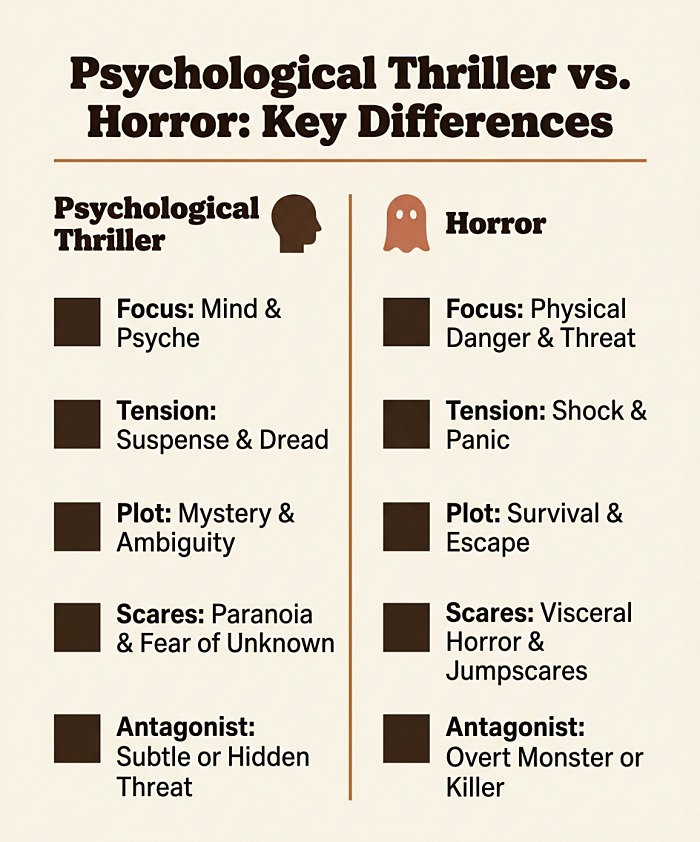
Horror wants to scare you. The threat is usually external, often supernatural, and the point is visceral: jump scares, monsters, gore, the sense that something is coming for you.
Psychological thriller wants to unsettle you. The threat is usually internal — a mind unraveling, a relationship rotting, a reality you can’t trust. Tension is built through ambiguity, not ambush.
A shorthand that works: if the scary thing is in the room with the character, it’s probably horror. If the scary thing is in the character’s head, it’s probably psychological thriller. The Conjuring is horror. Gone Girl is psychological thriller. Hereditary straddles both, which is why it’s one of the most discussed films of the past decade.
Underrated Picks You’ve Probably Missed
Every “best of” list pulls from the same 30 films. Here are a few that almost never crack the standard rotation but deserve to:
- The Machinist — Christian Bale at his most committed.
- Under the Shadow — Iranian psychological horror with political teeth.
- You Were Never Really Here — Ramsay and Phoenix operating at a frequency most thrillers can’t reach.
- Cache (Hidden) — Haneke’s surveillance nightmare.
- The Last Seduction — Linda Fiorentino in one of the great femme-fatale performances.
- Personal Shopper — Kristen Stewart proving, again, that she’s one of the best of her generation.
- Burning — Murakami via Lee Chang-dong. Slow, luminous, devastating.
Where to Stream Psychological Thrillers
Availability shifts constantly. As of September 2026, here’s a rough guide for US viewers:
| Streaming Platform | Typical Catalog Strength |
|---|---|
| Netflix | Original thrillers, Korean imports |
| Max | Classic Hollywood, HBO originals |
| Amazon Prime | Rental/purchase for nearly any title |
| Hulu | A24 catalog, newer releases |
| Criterion Channel | Classic and international arthouse |
| Shudder | Horror-adjacent and psychological horror |
For older classics, the Criterion Collection is the gold standard for restored editions. Many libraries now stream Criterion titles free via Kanopy.
How Psychological Thrillers Evolved: A Quick Timeline
- 1920s–40s: German expressionism (M), Hitchcock in Britain, Hollywood absorbs the form via Rebecca, Gaslight, Shadow of a Doubt
- 1950s–60s: Vertigo, Psycho, Rosemary’s Baby — Hitchcock era peaks, Roman Polanski arrives
- 1970s–80s: New Hollywood takes over. Taxi Driver, The Conversation, The Shining, Blue Velvet
- 1990s: Genre boom. Silence of the Lambs, Se7en, Fight Club, The Sixth Sense
- 2000s: International wave. Oldboy, Audition, Mulholland Drive, A Tale of Two Sisters
- 2010s: Elevated horror and prestige thrillers. Get Out, Gone Girl, Hereditary, Parasite
- 2020s: Genre fragmentation. The Invisible Man, Promising Young Woman, The Menu, Fresh
Frequently Asked Questions
What is the #1 best psychological thriller of all time?
Most critics and polls land on The Silence of the Lambs (1991) as the genre’s gold standard. It’s one of only three films to win all five major Academy Awards. Psycho (1960) and Vertigo (1958) consistently trail close behind in all-time rankings, with Vertigo often topping highbrow critics polls like Sight & Sound.
What’s the difference between a thriller and a psychological thriller?
A thriller relies on external stakes — chases, conspiracies, physical danger. A psychological thriller relies on internal stakes — paranoia, identity, moral crisis. Think of Mission: Impossible (thriller) versus Gone Girl (psychological thriller). Both are tense. Only one of them lives inside its characters’ heads.
Are psychological thrillers the same as horror films?
No. Horror is primarily about scaring you with external or supernatural threats. Psychological thrillers are about unsettling you with human minds, relationships, and perception. Many films blur the line — Hereditary, The Shining, Rosemary’s Baby — and that’s where the “psychological horror” subgenre sits.
What’s a good psychological thriller for beginners?
Start with one of these four: The Silence of the Lambs, Se7en, Get Out, or Gone Girl. All are accessible, expertly crafted, and representative of the genre’s core appeal without being so experimental that they’d lose a first-timer.
What psychological thrillers are based on true stories?
Zodiac (2007) is based on the real Zodiac killer case. The Conversation (1974) was inspired in part by real surveillance paranoia of the Watergate era. Compliance (2012, not on this list but worth knowing) dramatizes a real strip-search phone scam. Most psychological thrillers are fictional, but several draw on documented cases.
Which are the scariest psychological thrillers?
Hereditary, The Shining, Audition, The Babadook, and Rosemary’s Baby are the most consistently called “scariest.” They’re the films where the dread is real and sustained, not dependent on jump scares. Hereditary in particular has become the modern benchmark.
What are the best Korean psychological thrillers?
Parasite, Oldboy, The Handmaiden, A Tale of Two Sisters, Burning, and Forgotten are the essentials. Korean cinema has arguably been the strongest national output for psychological thrillers in the past 25 years, with directors like Park Chan-wook, Bong Joon-ho, and Lee Chang-dong leading the wave.
Is Inception a psychological thriller?
Partially. Inception is primarily a science-fiction action-thriller, but its dream-within-dream structure and identity themes put it in conversation with the genre. Purists argue it leans too far toward action; I’ve included it because the ambiguity of its ending and Cobb’s psychological journey do the work of a psychological thriller even if the surface doesn’t.
Why are psychological thrillers so popular?
Partly because they give us controlled exposure to fear and uncertainty. Partly because the best ones function as case studies — they let us watch obsession, paranoia, and moral collapse play out from a safe distance. Partly because they’re just extremely watchable.
What’s the best psychological thriller on Netflix right now?
Availability changes constantly, but Netflix’s library has historically featured Gerald’s Game, The Platform, Forgotten, Oldboy, and Hereditary at various points. Check the platform directly for September 2026 availability.
Pro Tips for Watching Psychological Thrillers
A few practical notes from someone who watches too many of these:
Watch them at night and alone. The genre is designed for undivided attention. Phones off. Lights down. Let it work on you.
Don’t rush to read reviews after. Half the experience is sitting with the ambiguity. The good ones change shape over 24 hours.
Rewatch the best ones. Mulholland Drive, Memento, and Parasite are entirely different experiences on a second viewing. You notice the scaffolding the second time.
Avoid the remakes. The American versions of Oldboy, The Vanishing, and Funny Games are lesser. The originals are on this list for a reason.
Trust the slow burns. The Conversation, Caché, Burning, and Personal Shopper reward patience. If you’re ten minutes in and nothing has “happened,” that’s on purpose.
The Final Word
If I had to hand someone a five-film starter pack to introduce them to what psychological thrillers can do at their best, it’d be The Silence of the Lambs, Mulholland Drive, Get Out, Parasite, and Hereditary. That’s your crash course in the classic procedural, the surreal identity puzzle, the socially pointed modern landmark, the genre-hopping masterpiece, and the elevated horror-adjacent nightmare. Everything else on this list expands from those five reference points.
Save this page. The genre keeps producing new entries — some of the films above are only a few years old, and I fully expect at least three or four releases from the next couple of years to crack this list eventually. The great psychological thriller never goes out of style. It just finds new ways to get under your skin.