
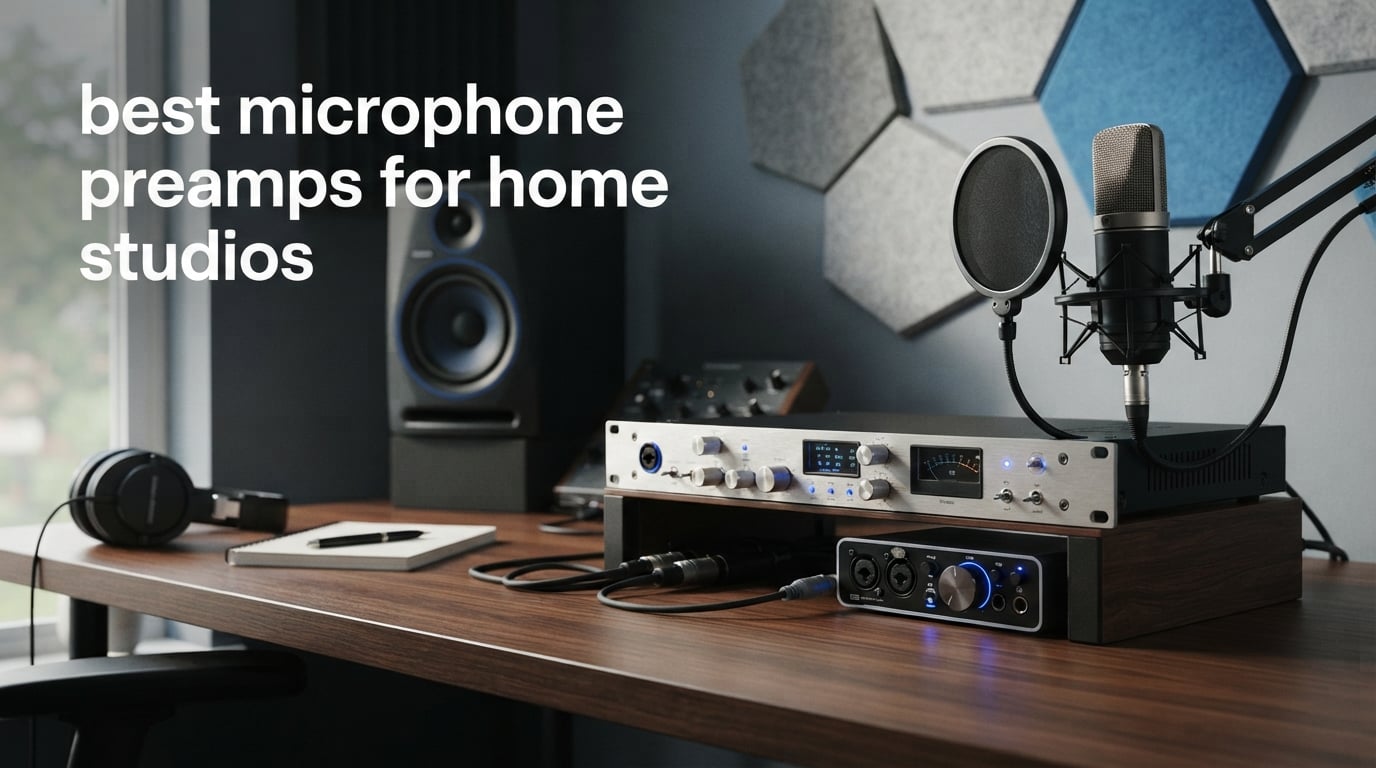
A microphone preamp is the most important link between your microphone and your recording system. It takes the faint electrical signal your mic produces and amplifies it to a level your interface or recorder can actually work with. If you care about sound quality, finding the best microphone preamps for home studios should be near the top of your gear list in 2026.
Every audio interface ships with built-in preamps, and for a beginner, those will get the job done. But as your ears develop and your projects get more demanding, you start hearing the cracks. Stock preamps introduce hiss when you push the gain, struggle to drive low-output dynamic microphones, and lack the tonal character that gives recordings a professional sheen.
I have been recording in home studio environments for over a decade. Vocals, acoustic guitar, podcasts, voice-over work — I have run all of it through everything from bargain-bin interfaces to dedicated outboard preamps. Through all those sessions, one lesson stood out clearly: upgrading your preamp often delivers a more noticeable improvement than upgrading your microphone.
A quality preamp gives your recordings depth, clarity, and warmth that stock interfaces simply cannot produce. It provides clean gain without noise, adds desirable sonic character when you want it, and handles impedance matching so your microphone performs at its best. For anyone recording vocals or acoustic instruments at home, this is the foundation of a professional-sounding signal chain.
Our team tested eight microphone preamps across a wide range of categories. From compact inline boosters that wake up quiet dynamic mics, to full channel strip processors and premium transparent designs, we put each unit through real recording sessions with vocals, acoustic guitar, and spoken word. We evaluated gain quality, noise floor, build construction, and how easily each unit fit into a typical home studio workflow.
Whether you need a budget gain booster for a Shure SM7B or a premium preamp for critical vocal tracking, you will find a recommendation that fits your setup below. Let us start with our top three picks, then walk through every product in detail.
Table of Contents
Top 3 Picks for Home Studio Preamps in 2026
These three preamps stood out across our testing for different reasons. The Grace Design m101 delivers reference-grade transparency, the Cloudlifter CL-1 offers unmatched value for dynamic mic owners, and the Triton Audio FetHead provides the most affordable quality gain boost on the market.

Microphone Preamps for Home Studios in September 2026
Here is a quick side-by-side overview of all eight preamps we tested. We ranked them by overall value, sound quality, and suitability for home recording environments. Use this table to compare features at a glance before diving into the individual reviews.
| Product | Specifications | Action |
|---|---|---|
| Cloud Microphones Cloudlifter CL-1 |
|
Check Latest Price |
 Triton Audio FetHead Triton Audio FetHead |
|
Check Latest Price |
 SE Electronics DM1 Dynamite SE Electronics DM1 Dynamite |
|
Check Latest Price |
 ART Tube MP Studio V3 ART Tube MP Studio V3 |
|
Check Latest Price |
 dbx DBX286SV Channel Strip dbx DBX286SV Channel Strip |
|
Check Latest Price |
 Warm Audio WA12 MKII Warm Audio WA12 MKII |
|
Check Latest Price |
 Behringer MIC500USB Behringer MIC500USB |
|
Check Latest Price |
| Grace Design m101 |
|
Check Latest Price |
1. Cloud Microphones Cloudlifter CL-1 — Best Value for Dynamic Mics
Cloud Microphones – Cloudlifter CL-1 Mic Activator – Ultra-Clean Microphone Preamp Gain – USA Made
- +25dB ultra-clean gain
- Reduces noise and feedback
- USA made
- Safe for passive ribbon mics
- Class-A design
- Only works with passive or dynamic mics
- Requires phantom power from interface
The Cloudlifter CL-1 is the preamp I recommend more than any other to home studio owners. It is not a traditional preamp in the sense of adding color or character. Instead, it is a mic activator that adds 25dB of pristine, ultra-clean gain before the signal even reaches your interface. This makes it perfect for low-output dynamic and ribbon microphones that need extra push.
I first plugged a Cloudlifter into my chain with a Shure SM7B, which is notorious for needing tons of gain. Before the CL-1, I had to crank my interface preamp to maximum, which introduced a noticeable hiss. With the Cloudlifter in line, the noise floor dropped dramatically and the vocal sat clearly above the mix without any struggle.
The build quality is exceptional. Made in the USA from stainless steel, the CL-1 feels like a tank. It runs entirely on phantom power from your interface, which means no extra power supply cluttering your desk. One important note: it uses phantom power to operate but does not pass that phantom power through to your microphone. This makes it completely safe for passive ribbon mics that would be damaged by 48V.
With nearly 4,000 reviews and an 87 percent five-star rating on Amazon, the Cloudlifter has earned its reputation. Users consistently praise how it wakes up quiet microphones and reduces unwanted feedback. For podcasting, streaming, broadcast, and studio vocal recording with dynamic mics, it is the gold standard.
The frequency response spans from 5 Hz to 80 kHz, which is far beyond what any microphone can reproduce. This means the CL-1 adds zero coloration to your sound. What goes in is what comes out, just louder and cleaner. That transparency is exactly what you want when your goal is to capture the natural character of your microphone.
Who Should Buy the Cloudlifter CL-1
If you own a Shure SM7B, SM58, RE20, or any ribbon microphone, the Cloudlifter is practically essential. It solves the gain problem that plagues these mics when paired with entry-level interfaces. Streamers, podcasters, and home recording enthusiasts who use dynamic microphones will see an immediate and dramatic improvement in their signal quality.
It is also ideal for anyone whose interface preamps get noisy at high gain settings. By providing 25dB of clean gain upstream, you can keep your interface preamp at a comfortable level and avoid the hiss that ruins quiet recordings.
Important Setup Notes
The Cloudlifter only works with passive microphones. If you have a condenser mic that requires phantom power to operate, the CL-1 will not work in your chain because it blocks phantom power from reaching the mic. Plan your signal chain accordingly.
Also remember that your interface must provide phantom power for the Cloudlifter itself to function. Without 48V engaged on your interface, the CL-1 stays silent. Once you understand these requirements, setup is plug-and-play simple.
2. Triton Audio FetHead — Best Budget In-Line Preamp
- Low-noise Class-A JFET design
- Shielded enclosure reduces interference
- 4 matched JFETs
- Compact in-line form factor
- Limited to single channel
- Requires phantom power to operate
The Triton Audio FetHead is the most affordable way to add clean gain to your signal chain. Like the Cloudlifter, it is an in-line preamp that sits between your microphone and interface. It uses a low-noise Class-A JFET amplifier to boost your signal before it hits your interface preamps, which means less noise and more headroom.
I tested the FetHead with a Heil PR-40 dynamic microphone for podcast recording. The difference was night and day. Without the FetHead, I needed around 55dB of gain from my interface, which put me right at the noise ceiling. With the FetHead providing approximately 18dB of clean boost, I could dial my interface back to a comfortable level and the background hiss essentially disappeared.
The FetHead uses a double single-ended amplifier topology with four matched JFETs. This design ensures consistent performance and low distortion across the frequency range. The shielded metal enclosure does an excellent job of rejecting RF interference and electromagnetic noise, which is a real concern if you record near computers or other electronic gear.
At under five inches long and weighing just 0.17 pounds, the FetHead is compact enough to forget about once it is in your chain. It attaches directly to the bottom of your microphone, which means no extra cables or power supplies on your desk. It runs on phantom power from your interface, so setup is as simple as plugging it in and engaging 48V.
With 80 percent five-star reviews from nearly 1,900 Amazon customers, the FetHead has proven itself as a reliable workhorse. Users praise its clean gain delivery, solid build quality, and the way it handles dynamic and ribbon microphones without adding unwanted coloration.
Best Use Cases for the FetHead
The FetHead shines with dynamic microphones used for podcasting, streaming, and broadcast. If you are running a Shure SM7B, Electro-Voice RE20, or similar broadcast mic through a budget interface, the FetHead will clean up your signal and reduce noise dramatically.
It also works well for ribbon microphones in home studios. The FetHead Phantom version passes phantom power through safely, but the standard version blocks it, which is ideal for passive ribbons. Just make sure you get the right version for your microphone.
Potential Drawbacks to Consider
The FetHead provides a fixed amount of gain that you cannot adjust. If you need variable gain control, you will want a dedicated preamp with a gain knob rather than an in-line booster. Also, because it sits inline at the microphone, it can put strain on microphone clips and stands if your mic is heavy.
Some users report that the FetHead adds a very slight coloration compared to the Cloudlifter, though in practice this difference is subtle and rarely a problem for home studio work.
3. Grace Design m101 — Editor’s Choice for Premium Transparency
- 75dB pristine transparent gain
- 12-position gold-plated rotary switch
- Ultra-low noise floor
- 2-year warranty
- Premium pricing tier
- Single channel only
The Grace Design m101 is the preamp I reach for when absolute clarity matters. This is a reference-grade, ultra-transparent single-channel preamp that adds zero coloration to your signal. What your microphone hears is exactly what gets recorded, just at the right level. With a perfect 5.0 rating on Amazon, it has earned every bit of praise it receives.
Using the m101 for vocal tracking was a revelation. I ran a Lewitt LCT 441 Flex through it for a session and was struck by how open and detailed the recording sounded. There was no haze, no softening of transients, no added warmth masking the microphone’s natural character. The vocal sat in the mix with startling presence and clarity.
The m101 offers 75dB of gain, which is enough for even the most demanding ribbon microphones. A 12-position gold-plated rotary gain switch gives you precise, repeatable settings. This is important for professional work where you need to match gain levels across multiple takes or sessions. The switch clicks firmly into place, and the build quality throughout feels like a piece of gear built to last decades.
Grace Design is a company known among professional audio engineers for building some of the cleanest preamps in existence. The m101 inherits design principles from their flagship products. With a signal-to-noise ratio of 115dB and an audible noise spec of negative 128 decibels, this preamp is essentially silent. You hear your microphone, not the electronics.
The connectivity is comprehensive. You get balanced XLR input, balanced TRS output, and a quarter-inch unbalanced output. It accepts both microphone and instrument level signals, which means you can use it as a high-quality DI box for recording guitar or bass directly. The m101 also provides 48V phantom power, a phase reverse switch, and a dedicated instrument input.
Who Needs This Level of Quality
The m101 is built for serious home studio owners who record vocals, acoustic instruments, or classical music where transparency is paramount. If you are tracking with high-quality condenser microphones and want to capture every nuance without electronic coloration, this is your preamp.
It is also ideal for voice-over professionals and audiobook narrators who need pristine, noise-free recordings. Post-production engineers will appreciate that the m101 gives them a completely clean source to work with, free from the tonal imprint that colored preamps leave behind.
Important Considerations Before Buying
The m101 is a premium investment, and it performs best when paired with quality microphones and acoustically treated spaces. If you are recording in an untreated room with a budget microphone, you may not hear the full benefit of this level of transparency.
This is a single-channel unit, so if you record in stereo or need multiple simultaneous inputs, you will need additional units. Consider whether your workflow demands the reference-quality transparency the m101 provides before making the investment.
4. SE Electronics DM1 Dynamite — Top Rated Compact Booster
- +28dB clean transparent gain
- Class-A FET design
- Gold-plated XLR connectors
- RF interference protection
- Ultra-slim design may feel fragile
- Requires phantom power
The SE Electronics DM1 Dynamite is the most powerful in-line preamp in our lineup, delivering a massive 28dB of clean, transparent gain. Designed specifically for ribbon and dynamic microphones, it solves the gain deficit problem without adding noise or coloration. The ultra-slim form factor makes it one of the most discreet boosters available.
I tested the DM1 with a Sennheiser MD421 on a guitar cabinet, a classic pairing that demands significant gain. The DM1 provided plenty of clean headroom, letting me keep my interface preamps at a moderate level. The guitar tone came through punchy and detailed, with no trace of the hiss that plagued the same setup without the booster.
Inside the DM1 is a Class-A FET circuit with a transformerless design. This topology ensures that the signal path remains as short and clean as possible. The dedicated buffer amplifier prevents impedance mismatches that can dull your high frequencies. Gold-plated XLR connectors maintain signal integrity and resist corrosion over time.
The all-metal housing provides excellent shielding against RF interference and electromagnetic hum. At just 80 grams and less than four inches long, the DM1 practically disappears in your signal chain. SE Electronics backs it with a two-year warranty, or three years if you register the product, which speaks to their confidence in build quality.
With 82 percent five-star reviews, users consistently praise the DM1 for its clean gain, compact size, and solid construction. It is a popular choice for podcasting, live sound reinforcement, and studio recording with dynamic and ribbon microphones.
Where the DM1 Shines
The DM1 excels with dynamic microphones used for podcasting and broadcasting. Its 28dB gain boost is among the highest in its class, making it ideal for notoriously quiet mics like the Shure SM7B and Electro-Voice RE20. If your interface preamps max out before reaching usable levels, the DM1 bridges that gap effortlessly.
It also performs well for recording guitar amplifiers with dynamic mics, where high sound pressure levels and moderate mic sensitivity create gain challenges. The clean, transparent boost preserves the natural character of your microphone and source.
Setup Considerations
The DM1 requires phantom power from your interface or mixer to operate. It does not pass phantom power to the microphone, which makes it safe for passive ribbon microphones but means it will not work with condenser mics that need 48V to function.
The ultra-slim profile is great for reducing visual clutter but can make the unit feel slightly fragile. In practice, the metal construction is solid, but you should handle it with reasonable care when attaching and removing it from your microphone.
5. ART Tube MP Studio V3 — Tube Warmth on a Budget
ART Tube MP Studio V3
- Tube warmth and character
- Variable valve voicing
- Works with vocals and instruments
- Metal enclosure
- Single channel only
- Tube may need replacement over time
The ART Tube MP Studio V3 brings genuine tube warmth to home studios without the premium price tag associated with boutique tube preamps. It is a single-channel tube microphone and instrument preamplifier that adds harmonic richness and vintage character to your recordings. The Variable Valve Voicing control lets you dial in the perfect amount of coloration.
I ran a Rode NT1-A through the Tube MP V3 for a vocal session and was immediately struck by the warmth it added. The vocal sat in the mix with a rounded, full-bodied character that sounded notably different from the clean, slightly sterile sound of my interface preamps. The V3 control let me sweep from clean and open to thick and saturated, giving me real tonal flexibility.
The ART Tube MP V3 is not just for vocals. It works equally well as an instrument preamp and direct box. I plugged a bass guitar directly into the 1/4-inch input and got a rich, warm tone that needed very little processing in the mix. This versatility makes it one of the most flexible preamps in our lineup for the money.
Build quality is solid with a rugged metal enclosure that can withstand the bumps of regular studio use. The unit measures 5 by 5.5 by 2 inches and weighs two pounds, making it a compact desktop unit. It includes XLR and 1/4-inch inputs, phantom power for condenser mics, and a V3 meter that helps you monitor your gain staging.
With 71 percent five-star reviews, users appreciate the Tube MP V3 for its warm sound, versatility, and value. It is particularly popular among home studio owners who record a mix of vocals and instruments and want tube character without spending hundreds on a boutique preamp.
Who Benefits from Tube Warmth
The Tube MP V3 is ideal for home studio owners who want to add analog warmth to digital recordings. If your tracks sound clean but lifeless, this preamp can inject harmonic richness that makes instruments and vocals sound more musical and engaging. It works especially well for vocals, bass guitar, and acoustic instruments.
It is also a great choice for anyone who records both vocals and instruments. The combination of XLR mic input and 1/4-inch instrument input in a single unit eliminates the need for a separate DI box.
Limitations to Consider
Being a single-channel unit, the Tube MP V3 cannot handle stereo recording. If you need to record two sources simultaneously, you will need a second unit or a different preamp. The tube will also eventually need replacement, though this is typically years down the line with regular use.
The V3 voicing control can take some getting used to. It is not a traditional EQ but rather a tonal shaping tool that affects the harmonic content of your signal. Spend time experimenting with it to understand how it interacts with different microphones and sources.
6. dbx DBX286SV — Full Channel Strip Processor
- Built-in compressor with Overeasy
- De-esser for sibilance control
- Enhancer for frequency detail
- 1U rack mountable
- Single channel
- Premium pricing tier
The dbx DBX286SV is not just a preamp. It is a complete channel strip processor that combines a microphone preamp with four independent signal processing tools: compression, de-essing, enhancement, and expansion or gating. For podcasters and voice-over artists who want to shape their sound before it hits the computer, this is an all-in-one solution.
I tested the DBX286SV for a series of voice-over recordings where the talent had a tendency to get loud and sibilant. The built-in Overeasy compressor tamed the peaks smoothly, the de-esser reined in harsh sibilance, and the enhancer added clarity and presence. By the time the signal reached my DAW, it needed minimal processing, which saved significant time in post-production.
The preamp section itself provides clean, professional-grade amplification with a floating balanced XLR input. The compressor uses dbx’s renowned Overeasy technology, which provides transparent gain reduction that smooths out dynamics without pumping or breathing artifacts. The de-esser targets specific frequency ranges where sibilance occurs, typically between 5 and 8 kHz.
The enhancer section lets you boost high and low frequency detail independently, which can add air to vocals or weight to instruments. The expander and gate section controls background noise between phrases, which is invaluable for untreated rooms. Status LEDs on the front panel give you visual feedback on every processor, making it easy to monitor your settings at a glance.
The DBX286SV is 1U rack mountable and includes a loop-out for connecting additional external processors. With 78 percent five-star reviews, users praise its versatile processor combination, classic dbx compression sound, and professional build quality. It is particularly popular for vocal processing in both studio and live sound applications.
Ideal Applications for the DBX286SV
The DBX286SV excels in broadcast, podcasting, and voice-over environments where you want to process your signal before recording. Having compression, de-essing, and gating in one unit means your recorded audio is already polished, reducing post-production work significantly.
It is also valuable for live streaming, where real-time processing is essential. The gate keeps background noise out during silent moments, the compressor evens out your levels, and the enhancer keeps your voice present and clear through any playback system.
What You Should Know
The DBX286SV is a single-channel processor, so you need separate units for stereo or multi-source recording. The learning curve is steeper than a simple gain booster because you are managing four processors simultaneously. Take time to understand how compression, de-essing, and gating interact before relying on it for critical sessions.
The unit uses a standard 1U rack format, so you will need rack space or a rack shelf for your home studio. If you do not have a rack, it can sit on a desktop, but the rack ears make it less stable in that configuration.
7. Warm Audio WA12 MKII — Premium Discrete Preamp with CineMag Transformers
Warm Audio WA12 MKII Single Channel Microphone Preamplifier & Instrument DI- Black
- Custom USA CineMag transformers
- Fully discrete signal path
- Discrete 6-pin socketed 1731 opamp
- Variable impedance input
- Single channel
- Heavier rack-mountable unit
The Warm Audio WA12 MKII is a discrete, transformer-balanced microphone preamp that delivers the punchy, larger-than-life sound associated with classic console designs. Built around custom USA-made CineMag transformers and a socketed 1731-style operational amplifier, it brings vintage analog character to modern home studios with impressive build quality.
I tracked vocals through the WA12 MKII with a warm condenser microphone and was immediately impressed by the weight and dimension it added to the recording. The vocal had a three-dimensional quality that my interface preamps could not match. The low-end was full and authoritative, the midrange had a musical push, and the top end remained smooth without harshness.
The WA12 MKII features a fully discrete signal path, meaning there are no integrated circuits in the audio chain. Every stage uses discrete transistors, which many engineers believe produces a more organic, dynamic sound. The socketed 1731-style opamp can be swapped for compatible alternatives, giving you the ability to customize the tonal character of the preamp.
The variable impedance input is a standout feature. By adjusting the input impedance, you can dramatically change how the preamp interacts with your microphone. Higher impedance settings give a more open, modern sound, while lower settings produce a thicker, more vintage character. This effectively gives you multiple preamp voices in one unit.
The WA12 MKII includes XLR, balanced, and unbalanced inputs, plus a front-panel instrument DI input for recording guitar or bass directly. Custom CineMag transformers on both input and output stages provide galvanic isolation and contribute to the preamp’s signature sound. With a 1-year manufacturer warranty and solid metal construction, this is a serious piece of gear for serious home studios.
Who This Preamp Suits Best
The WA12 MKII is built for home studio owners who want the classic analog sound of legendary recording consoles without spending thousands on vintage gear. If you record vocals, drums, or electric guitar and want your tracks to have punch, warmth, and dimension right from the source, this preamp delivers that in spades.
It is particularly well-suited for engineers who work with dynamic and ribbon microphones. The variable impedance lets you optimize the preamp for each microphone type, extracting maximum performance from every mic in your collection.
Things to Consider
The WA12 MKII is a single-channel unit, so stereo recording requires two units. At over six pounds, it is heavier and larger than inline boosters, requiring dedicated desk or rack space. Make sure your studio setup can accommodate its footprint.
The opamp-swapping feature is powerful but adds complexity. If you are new to outboard gear, you may want to spend time with the stock 1731 opamp before experimenting with replacements. The variable impedance also requires some experimentation to understand how it affects different microphones.
8. Behringer TUBE ULTRAGAIN MIC500USB — Tube Preamp with USB Interface
- 16 preamp voicings for different sources
- Built-in USB audio interface
- Works with mics instruments and line sources
- Free recording software included
- Mixed long-term reliability reports
- USB connection may add latency
The Behringer TUBE ULTRAGAIN MIC500USB is a versatile tube preamp with a built-in USB audio interface, making it an interesting all-in-one solution for beginners setting up their first home studio. It combines vacuum tube preamplification with 16 selectable preamp voicings designed for different instruments and vocal types.
I tested the MIC500USB as a portable recording solution, connecting it directly to a laptop via USB. The built-in interface eliminated the need for a separate audio interface, which is genuinely useful for mobile recording or quick capture sessions. The tube circuitry added warmth to vocal recordings, and the 16 voicing presets gave me quick starting points for different sources.
The 16 preamp voicings are the standout feature. They are designed for specific source types including electric guitar, acoustic guitar, keyboards, bass, drums, and vocals. Each voicing adjusts the tonal character and gain structure of the preamp to suit the instrument. While they are not a substitute for a dedicated preamp for each source, they provide useful sonic variety from a single unit.
The MIC500USB handles microphone, instrument, and line-level sources. It includes phantom power for condenser microphones and works with studio-grade condensers out of the box. The built-in USB interface connects directly to your computer, and Behringer includes free audio recording, editing, and podcasting software along with 150 instrument and effect plugins.
With a 4.4 rating from nearly 100 reviews, users appreciate the MIC500USB for its versatility and value as an all-in-one recording solution. The tube adds audible warmth, and the voicing presets provide convenient options for different recording scenarios. However, some users have raised concerns about long-term reliability, which is worth noting.
Best Scenarios for the MIC500USB
The MIC500USB is ideal for beginners who want tube character and a USB interface in a single compact unit. If you are just starting your home studio and want to record vocals and instruments without investing in separate preamp and interface units, this gets you up and running quickly.
It also works well as a portable recording solution. The compact size and USB connectivity make it easy to throw in a bag for mobile sessions, podcast recording on the go, or capturing ideas wherever inspiration strikes.
Potential Concerns
The MIC500USB has received mixed feedback regarding long-term reliability. While many users report years of trouble-free operation, others have experienced hardware failures. If reliability is a top priority, you may want to consider alternatives from brands with stronger reputations for build quality.
The USB interface, while convenient, may introduce slight latency compared to a dedicated audio interface with proper ASIO drivers. For critical recording where latency matters, a dedicated interface paired with a standalone preamp may be a better long-term investment.
How to Choose a Microphone Preamp for Your Home Studio?
Choosing the right preamp comes down to understanding your needs, your microphone collection, and the type of sound you want to achieve. Let us break down the key factors that should guide your decision.
What a Microphone Preamp Actually Does
A microphone preamp has three core jobs. First, it amplifies the very low-level signal from your microphone to line level, which is the standard operating level for recording equipment. Second, it provides the correct input impedance to match your microphone type. Third, it supplies phantom power (48V) if you are using condenser microphones that require external power to operate.
The quality of this amplification determines how much noise enters your signal, how accurately your microphone’s character is preserved, and whether the preamp adds its own sonic signature. Cheap preamps add hiss, distort at high gain, and flatten the dynamic range of your recordings.
Tube vs Solid-State: Which Is Right for You?
Tube preamps use vacuum tubes in their amplification circuitry. They add harmonic distortion that produces warmth, richness, and a sense of analog fullness. Many engineers describe tube preamps as making recordings sound more musical and pleasing to the ear. The ART Tube MP Studio V3 and Behringer MIC500USB in our lineup use tube circuitry.
Solid-state preamps use transistors and are generally cleaner, faster, and more accurate than tube designs. They can be further divided into transparent designs that add no coloration and colored designs that emulate the character of classic analog consoles. The Grace Design m101 is a transparent solid-state design, while the Warm Audio WA12 MKII uses transformers to add analog warmth without tubes.
Neither type is objectively better. Your choice depends on what your recordings need. If your tracks sound thin and sterile, a tube or transformer-based preamp can add warmth. If you want to capture your microphone’s sound as accurately as possible, a transparent solid-state preamp is the way to go.
How Much Gain Do You Actually Need?
Gain, measured in decibels (dB), determines how much the preamp amplifies your microphone signal. Different microphones require different amounts of gain. Condenser microphones typically need 30 to 50dB. Dynamic microphones often need 50 to 70dB. Ribbon microphones can need even more, sometimes exceeding 70dB.
If your interface cannot provide enough clean gain for your microphone, the signal will be weak and noisy. This is where in-line boosters like the Cloudlifter CL-1, Triton FetHead, and SE Electronics DM1 come in. They add 18 to 28dB of clean gain before the signal reaches your interface, solving the problem without replacing your interface entirely.
As a rule of thumb, if you regularly run your interface preamps above 75 percent of their maximum gain, you will benefit from an in-line booster or dedicated preamp. Recording at those levels on budget interfaces introduces significant noise that degrades your recordings.
When You Need a Standalone Preamp vs Interface Preamps
Most home studio owners start with the preamps built into their audio interface, and for good reason. Modern interface preamps from brands like Focusrite, PreSonus, and Audient have improved dramatically and are perfectly adequate for many recording scenarios. If you are recording demos, podcasts, or casual content, your interface preamps are likely sufficient.
You should consider a standalone preamp when your interface preamps cannot provide enough clean gain for your microphones, when you want a specific tonal character that your interface does not deliver, or when you need processing features like compression and gating before the signal hits your computer. The dbx DBX286SV is an excellent example of the latter, offering real-time processing that saves hours of post-production work.
Standalone preamps also make sense if you have outgrown your interface but are happy with its other features. Adding a quality preamp to your signal chain can give you a significant sound upgrade without replacing your entire interface.
Key Features to Look For
Phantom power is essential if you use condenser microphones. Most dedicated preamps include it, but in-line boosters like the Cloudlifter and FetHead consume phantom power for their own operation. Make sure your setup can provide enough phantom power for all devices in the chain.
A pad switch reduces the input level by a fixed amount, usually 15 or 20dB. This is useful when recording loud sources that might overload the preamp input. Phase reverse switches help correct phase issues when using multiple microphones on a single source. A high-pass filter removes low-frequency rumble from air conditioning, traffic, or mic stand handling.
An instrument DI input lets you plug guitars and basses directly into the preamp without a separate DI box. Metering, whether VU meters or LED ladders, helps you monitor your gain staging and avoid clipping. Variable impedance, found on the Warm Audio WA12 MKII, lets you adjust how the preamp interacts with different microphone types.
Form Factor Considerations
In-line boosters like the Cloudlifter, FetHead, and DM1 attach directly to your microphone and require no desk space. They are the simplest to integrate and ideal for minimal setups. Desktop units like the ART Tube MP V3 sit on your desk and offer more controls but take up space.
Rack-mount units like the dbx DBX286SV and Warm Audio WA12 MKII require rack space but offer the most features and professional connectivity. If you plan to expand your studio with multiple preamps and processors, rack-mount gear gives you the cleanest, most organized setup.
The Behringer MIC500USB is unique in our lineup for including a built-in USB interface. This makes it a complete recording solution in a single unit, which is ideal for beginners or portable setups where space and simplicity matter.
Frequently Asked Questions
What is a good microphone preamp for home recording?
A good microphone preamp for home recording provides clean gain, low noise, and the right features for your microphone type. For dynamic microphones, the Cloud Microphones Cloudlifter CL-1 and SE Electronics DM1 Dynamite are excellent choices. For condenser microphones, the Grace Design m101 offers reference-grade transparency, while the Warm Audio WA12 MKII adds classic analog character.
Do expensive mic preamps make a difference?
Yes, expensive preamps make a noticeable difference in clean gain, noise performance, and tonal character. Premium preamps like the Grace Design m101 offer ultra-low noise floors, precise gain control, and transparent sound that budget units cannot match. However, the improvement is most noticeable when paired with quality microphones in acoustically treated spaces. If your room and microphone are the weak links, an expensive preamp will have limited impact.
Do I need a mic preamp for my home studio?
You need a standalone preamp if your interface preamps cannot provide enough clean gain for your microphones, if you want specific tonal character that your interface lacks, or if you need processing features like compression and gating before recording. If your interface preamps sound good and provide sufficient gain for your mics, a standalone preamp is an optional upgrade rather than a necessity.
What is the best microphone preamp for vocals?
For vocals, the best preamp depends on the sound you want. The Grace Design m101 delivers ultra-transparent, reference-quality amplification that captures every nuance. The Warm Audio WA12 MKII adds punch, warmth, and dimension with its CineMag transformers. For budget-conscious vocal recording, the Cloudlifter CL-1 paired with a dynamic mic delivers clean, professional results.
What are the best budget mic preamps for vocals?
The best budget mic preamps for vocals include the Triton Audio FetHead as the most affordable quality option, the SE Electronics DM1 Dynamite for maximum clean gain in a compact size, and the ART Tube MP Studio V3 for adding tube warmth without a large investment. All three deliver professional-quality results for home studio vocal recording.
Final Thoughts on the Best Microphone Preamps for Home Studios
After testing all eight preamps, our top recommendation for most home studio owners is the Cloud Microphones Cloudlifter CL-1. It solves the most common problem — not enough clean gain for dynamic mics — at a reasonable investment and with exceptional build quality. Pair it with any interface and a good dynamic microphone, and you will hear the difference immediately.
For those who want reference-grade transparency and have the budget, the Grace Design m101 is unmatched. Its pristine sound, precise gain control, and professional connectivity make it the best microphone preamps for home studios when absolute clarity is the goal. The Warm Audio WA12 MKII fills the gap for engineers who want classic analog character with custom transformers and variable impedance.
Whatever your budget or recording style, investing in a quality preamp is one of the most impactful upgrades you can make for your home studio in 2026. Start with your biggest weakness — whether that is gain, noise, or tonal character — and choose the preamp that addresses it directly.