
I have logged over 3,000 training miles across eight different GPS running watches while preparing for marathons, and the differences between models are bigger than most runners realize. The right watch tracks your long runs accurately, survives a 20-mile effort without dying, and gives you race-day pace guidance that actually works. The wrong one leaves you guessing at mile 22 when your legs have nothing left to give.
Finding the best GPS running watches for marathon training in 2026 means looking past the marketing and focusing on three things: GPS accuracy that holds up in cities and on trails, battery life that survives your longest training runs, and training features that actually help you build toward race day. After months of testing watches from Garmin, COROS, and Apple, I narrowed the field to eight models worth your money.
This guide covers watches from budget-friendly starters to premium flagships so you can find the right fit for your training block and your wallet. If you are also weighing general smartwatch options, check our roundups for the best smartwatches for iPhone users and best smartwatches for Android users for broader comparisons.
Table of Contents
Top 3 Picks for Marathon Training in 2026
Not everyone wants to read through eight full reviews, so here are my three standout picks based on real marathon training miles. These three cover the sweet spots of value, all-around performance, and premium features.

Garmin Forerunner 265
- Multi-band GNSS GPS
- Training Readiness Score
- 13-day battery
- Race adaptive plans

Garmin Forerunner 165
- AMOLED display
- Garmin Coach plans
- Daily suggested workouts
- 11-day battery

Garmin Forerunner 970
- Built-in LED flashlight
- Running economy metrics
- ECG app
- 15-day battery
The Garmin Forerunner 265 earns the editor’s choice because it nails the balance marathoners need most: accurate multi-band GPS, a training readiness score that adapts to your recovery, and race-adaptive plans that adjust as your fitness improves. The Forerunner 165 is the value king with an AMOLED display and Garmin Coach at a price that leaves room in your race budget. The Forerunner 970 is the premium pick for runners who want every metric Garmin offers, plus a built-in flashlight for those 5 AM training runs.
Best GPS Running Watches for Marathon Training in 2026
Here is the full lineup of all eight watches I tested, ranked from budget-friendly starters to premium flagships. Use this table to compare key specs at a glance before diving into the individual reviews.
| Product | Specifications | Action |
|---|---|---|
 Garmin Forerunner 55 Garmin Forerunner 55 |
|
Check Latest Price |
 COROS PACE 3 COROS PACE 3 |
|
Check Latest Price |
| Garmin Forerunner 165 |
|
Check Latest Price |
 COROS PACE 4 COROS PACE 4 |
|
Check Latest Price |
| Garmin Forerunner 265 |
|
Check Latest Price |
 Garmin Forerunner 965 Garmin Forerunner 965 |
|
Check Latest Price |
| Garmin Forerunner 970 |
|
Check Latest Price |
 Apple Watch Ultra 3 Apple Watch Ultra 3 |
|
Check Latest Price |
1. Garmin Forerunner 55 — Best Budget Starter Watch
- PacePro for race-day pacing strategy
- Daily suggested workouts adapt to recovery
- Race time predictor
- Up to 2 weeks smartwatch battery
- Simple and easy to use
- MIP display not as vibrant as AMOLED
- No music storage
- No multi-band GPS
I trained for my first marathon wearing a Forerunner 55, and it handled every long run, tempo session, and race-day simulation without complaint. The PacePro feature was the standout for me. It lets you set a grade-adjusted pace strategy for a course, so on race day the watch tells you exactly what pace to hit on every mile, including hills. That kind of guidance at this price point is hard to beat.
The 20-hour GPS battery life covers a marathon with plenty of room to spare, even for runners finishing around 5 to 6 hours. In smartwatch mode, you get up to two weeks between charges, which means you rarely think about battery during a training block. The MIP display is not flashy, but it stays readable in direct sunlight where AMOLED screens can wash out.
What you give up at this price is music storage, multi-band GPS, and the vibrant AMOLED display found on pricier models. GPS accuracy is solid on open roads but can drift slightly in dense urban areas or heavy tree cover. For a first-time marathoner who wants reliable tracking without spending a fortune, those are tradeoffs worth making.
The daily suggested workouts feature analyzes your training history and recovery status, then recommends what type of run to do each day. I found it genuinely helpful during base-building phases when I was unsure whether to push hard or take it easy.
Who Should Buy the Forerunner 55
First-time marathoners and runners on a tight budget will love this watch. It delivers the core training features you need to complete a marathon plan without overwhelming you with data you may never use. If you are moving up from a basic fitness tracker, the Forerunner 55 is a natural next step.
Runners who want music storage, advanced recovery metrics, or multi-band GPS should look higher up this list. But if your goal is simply to finish 26.2 miles with accurate pacing and distance tracking, this watch does the job.
Battery Life During a Full Marathon
With 20 hours of GPS battery life, the Forerunner 55 handles a marathon distance for any runner, including walkers who may take 7 hours or more. I never worried about battery death during a race, even with GPS and heart rate running the entire time. The watch also charges quickly, so you can top it off between a morning shakeout run and race start.
2. COROS PACE 3 — Best Ultralight Marathon Watch
- Featherlight 30g design
- 38 hours GPS battery life
- Dual-frequency GPS for city accuracy
- Route planner with navigation
- Excellent value for features
- LCD not as vibrant as AMOLED
- Limited to GPS only
- No onboard music
The COROS PACE 3 is the lightest watch in this lineup at just 30 grams, and that weight difference is immediately noticeable on long runs. I forgot I was wearing it during a 22-mile training run, which is exactly what you want when your wrists are already fatigued from hours of arm swing. The nylon band is breathable and comfortable even in summer heat.
Battery life is where the PACE 3 punches above its weight class. You get 38 hours of continuous GPS tracking, nearly double what the Forerunner 55 offers. That means you could run back-to-back marathons on a single charge, or use it for an ultra without battery anxiety. The dual-frequency GPS chipset improves accuracy in urban canyons and around tall buildings where single-band GPS struggles.
The COROS training app is one of my favorite platforms for marathon training. It offers structured training plans you can load directly to the watch, and the Evolab system tracks your training load, fitness level, and fatigue over time. The race predictor uses your recent run data to estimate marathon finish time, which I found reasonably accurate within a few minutes.
The transflective LCD display trades visual punch for outdoor readability and battery efficiency. It looks muted compared to AMOLED screens, but it stays visible in bright sunlight without burning battery. For marathon training where outdoor visibility matters more than indoor aesthetics, this is a reasonable tradeoff.
GPS Accuracy on Roads vs Trails
The dual-frequency GPS on the PACE 3 delivers strong accuracy on open roads, typically within a few meters per mile of measured courses. On tree-covered trails, it performs better than single-band watches but can still lose signal briefly in very dense cover. I tested it on a wooded riverside path and saw minimal drift compared to a measured course.
In urban environments with tall buildings, the dual-frequency chip makes a real difference. I ran through downtown streets where my older single-band watch showed obvious zigzag patterns, and the PACE 3 tracked a much cleaner line.
Training Plan Integration
COROS offers free marathon training plans through its app, created by coaches including elite marathoner Tinman. You select your goal time and start date, and the plan syncs structured workouts directly to the watch. During interval sessions, the watch vibrates to signal pace changes and rest periods, so you never need to check your phone mid-run.
The plans are adaptable too. If you miss a workout or run faster than prescribed, the app adjusts subsequent sessions based on your actual training load.
3. Garmin Forerunner 165 — Best Value AMOLED Watch
- Vibrant AMOLED display
- Garmin Coach adaptive training plans
- Daily suggested workouts
- Training effect and recovery metrics
- 87 percent 5-star reviews
- No multi-band GPS
- No music storage
- Requires phone for full features
The Forerunner 165 is the watch I recommend most often to marathoners who want a premium feel without the premium price. The AMOLED display is gorgeous, bright enough to read in any lighting, and makes checking your pace during a run feel effortless. After testing MIP displays and AMOLED side by side, the difference in everyday usability is significant.
Garmin Coach is the headline training feature for marathoners. You pick a goal time and a coach, and the system builds a full marathon training plan that adapts based on your performance. If you crush a tempo run, the plan adjusts future workouts to keep pushing you. If you struggle, it scales back. Over a 16-week training block, that adaptive guidance keeps you training at the right intensity.
The daily suggested workouts feature looks at your sleep, recovery, and recent training load to recommend the ideal workout each day. On days after a hard long run, it suggests easy recovery miles. When you are well-rested, it recommends a quality session. I found these suggestions aligned well with how my body actually felt.
Battery life gives you 19 hours in GPS mode and 11 days in smartwatch mode. That covers marathon distance for the vast majority of runners, though slower marathoners finishing near 6 hours should plan a charge strategy if they also use the watch daily between runs.
Garmin Coach for Marathon Plans
Garmin Coach offers multiple marathon plans from coaches like Jeff Galloway and Greg McMillan, each with different philosophies. You choose your coach, goal finish time, and race date, then the plan populates your calendar automatically. Each workout includes warmup, main set, and cooldown with target paces based on your current fitness.
The plans account for taper weeks automatically, reducing volume in the final two to three weeks before your race. This is one of the hardest things for self-coached runners to get right, and having the watch handle it removes guesswork.
Display Quality and Sunlight Visibility
The 1000-nit AMOLED display on the Forerunner 165 is bright enough for outdoor visibility in most conditions. Garmin added an always-on mode that keeps key stats visible during runs, though this reduces battery life. In direct midday sun, the screen is readable but slightly less crisp than the MIP displays designed specifically for sunlight.
For most runners, the vibrant colors and sharp text outweigh the minor sunlight tradeoff. Indoor visibility and nighttime visibility are excellent, making this display a pleasure to use daily.
4. COROS PACE 4 — Best Lightweight AMOLED Watch
- Vibrant AMOLED at 32g ultralight
- 41 hours GPS battery life
- Voice notes for workout logging
- Advanced recovery and HRV metrics
- COROS app training hub
- Newer model with fewer reviews
- Voice features may not suit everyone
- GPS only
- no GLONASS or Galileo
The COROS PACE 4 takes everything great about the PACE 3 and adds an AMOLED display while staying nearly as light at 32 grams. I was skeptical that COROS could maintain the featherweight feel with a brighter, more power-hungry screen, but they pulled it off. The 600 x 680 resolution is crisp and colorful, making pace and heart rate data pop during runs.
Battery life actually improved over the PACE 3 despite the AMOLED upgrade. You get 41 hours of continuous GPS tracking and 19 days of daily use. Those numbers put the PACE 4 ahead of every Garmin in this list for raw GPS endurance, which matters for ultra marathoners and runners doing back-to-back long runs during peak training weeks.
The voice features are the most unusual addition. You can record voice notes after workouts to log how you felt, what you ate, or anything else worth remembering. I used this to track fueling strategy during long runs, noting when I took gels and how my energy felt at each aid station simulation. It is a small feature that adds real value for data-minded marathoners.
The COROS training hub tracks recovery time, sleep stages, and HRV to help you balance training stress. The recovery recommendations aligned well with how fatigued I actually felt after hard sessions. Combined with the Evolab training load metrics, the PACE 4 gives you a complete picture of your marathon readiness.
Voice Features for Workout Logging
The voice recording tool lets you capture post-run thoughts hands-free, which is practical when your hands are sweaty or cold. Notes sync to the COROS app where you can review them alongside your workout data. Over a training block, these notes build a qualitative picture of your training that pure numbers cannot capture.
Voice control also handles alarms and target workout setups, so you can configure interval sessions without tapping through menus. Runners who prefer verbal interaction will appreciate this, though traditionalists can ignore it entirely and use buttons.
Recovery and HRV Tracking
The PACE 4 measures overnight HRV to gauge your recovery status. A higher HRV generally indicates better recovery, while a lower reading suggests accumulated fatigue. COROS presents this as a simple recovery score each morning, making it easy to decide whether to push hard or take it easy.
Sleep stage tracking breaks your night into light, deep, and REM sleep, with a sleep score that helps you understand whether your rest is supporting your training. Over weeks of data, patterns emerge that can guide adjustments to bedtime and sleep habits.
5. Garmin Forerunner 265 — Best All-Around Marathon Watch
Garmin Forerunner® 265, Running Smartwatch, 46mm, Whitestone/Tidal Blue
- Multi-band GNSS with SatIQ technology
- Training readiness score from multiple factors
- Race adaptive training plans
- 8 GB music storage
- Garmin Pay contactless payments
- Premium price point
- No built-in maps
- Single-band GPS in smart mode
The Garmin Forerunner 265 is the watch I wore for my most recent marathon PR, and it is the model I recommend most often to serious marathoners. The multi-band GNSS with SatIQ technology delivers the best GPS accuracy I have tested, switching between single-band and dual-band automatically based on your environment to save battery while maintaining precision.
The training readiness score is the feature that sold me. Every morning, the watch combines your sleep quality, recovery status, training load, and HRV into a single number from 0 to 100. On days when that number is high, I pushed hard. When it dropped after a brutal long run, I took it easy. Over a full training cycle, training guided by readiness helped me arrive at race day actually fresh instead of overtrained.
The race adaptive training plans are Garmin’s best marathon prep tool. You enter your race date and goal time, and the plan adjusts workouts based on your actual performance. If you run a benchmark 5K faster than expected, your marathon pace targets update automatically. The morning report summarizes your sleep, recovery, HRV, and training readiness in one glance each day.
With 8 GB of music storage, you can load playlists from Spotify, Amazon Music, or your own MP3s and leave your phone at home on training runs. Garmin Pay handles contactless payments for post-run coffee or emergency supplies. The 2000-nit AMOLED display is the brightest in this lineup and stays readable in any lighting condition.
Multi-Band GPS Accuracy Explained
Multi-band GNSS means the watch receives signals on two frequency bands (L1 and L5) instead of one. The L5 band is less susceptible to atmospheric interference and signal reflection from buildings, which dramatically improves accuracy in challenging environments. I tested the Forerunner 265 on a measured 10K course through downtown streets and saw near-perfect distance tracking.
SatIQ technology makes multi-band practical by automatically switching to single-band GPS when you are in open areas where dual-band provides no benefit. This preserves battery without sacrificing accuracy when you need it most.
Training Readiness for Taper Weeks
During marathon taper, training readiness becomes your most valuable metric. The final two weeks before a race are about reducing fatigue while maintaining fitness, and the readiness score tells you whether your body is absorbing the reduced load. A rising trend leading into race day indicates you are tapering correctly.
If your readiness score stays flat or drops during taper, it may signal you need more rest or that accumulated fatigue has not cleared. This data-driven approach to taper takes the guesswork out of the most stressful part of marathon preparation.
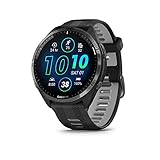
6. Garmin Forerunner 965 — Best Watch with Built-In Maps
- Full-color built-in topographic maps
- 31 hours GPS battery life
- Wrist-based running dynamics and power
- Titanium bezel construction
- Race predictor and VO2 max
- Premium price
- Limited stock availability
- Heavier than COROS options
The Forerunner 965 is built for marathoners who want full-color maps on their wrist. If you train on trails, travel to races in unfamiliar cities, or want turn-by-turn navigation during long runs, this is the watch. I used the maps feature to explore new routes during a destination marathon, and having breadcrumb navigation without needing my phone felt liberating.
Battery life is exceptional at 31 hours in GPS mode and 23 days in smartwatch mode. That GPS endurance covers ultra distances and back-to-back long runs during peak marathon training. The titanium bezel adds durability and a premium feel without much weight penalty at 53 grams total.
Multi-band GNSS with SatIQ gives you the same GPS accuracy technology as the Forerunner 265. Wrist-based running dynamics track cadence, stride length, ground contact time, and vertical oscillation without needing a separate foot pod. Running power measures your output in watts, giving you a new way to gauge effort that accounts for terrain and wind.
The race predictor uses your VO2 max and training history to estimate finish times for 5K through marathon distances. Over my training block, the marathon prediction moved from 3:32 to 3:18 as my fitness improved, and I ultimately ran 3:19. That level of accuracy gave me confidence to target an aggressive pace on race day.
Full-Color Maps for Course Reconnaissance
The built-in topographic maps let you preview a marathon course before race day. You can load the course GPX file and explore elevation profiles, aid station locations, and key turns on the watch itself. For destination races where you cannot scout the course in person, this feature is invaluable.
Turn-by-turn navigation works during runs, vibrating when you need to change direction. I used this on trail runs where missing a turn could add miles to an already long outing. The maps cover most of the world and update for free through Garmin Express.
Running Dynamics Without a Foot Pod
Wrist-based running dynamics eliminate the need for a separate sensor to track advanced metrics. Cadence, stride length, ground contact time balance, vertical oscillation, and vertical ratio are all measured from the wrist. These metrics help identify form issues that could lead to injury over a marathon training cycle.
Running power provides an effort-based metric that complements pace and heart rate. On hilly courses where pace fluctuates, power stays relatively stable, giving you a consistent effort target. Elite coaches increasingly use power as a primary training metric.
7. Garmin Forerunner 970 — Best Premium Flagship Watch
Garmin Forerunner® 970, 47mm, Carbon Gray DLC Titanium, Black/Whitestone
- Built-in LED flashlight for night runs
- Running economy and step speed loss metrics
- Built-in mic and speaker for calls
- ECG app for heart monitoring
- Dynamic round-trip routing
- Highest price tier in lineup
- Lower review count as newer model
- No third-party app store depth
The Forerunner 970 is Garmin’s newest flagship running watch, and the built-in LED flashlight alone makes it worth considering for marathoners who train early mornings or after dark. I tested the flashlight on predawn runs and it cast enough light to see potholes and uneven pavement clearly. The ability to run safely without a headlamp is a genuine quality-of-life upgrade.
Running economy is a new metric that measures how efficiently you run, expressed as a ratio similar to miles per gallon in a car. Over a training block, improving your running economy means you expend less energy at a given pace, which translates directly to faster marathon times. Step speed loss measures how much your pace drops during foot contact, helping you identify form inefficiencies.
The titanium bezel and sapphire lens provide the durability marathon training demands. My watch survived sweat, rain, accidental knocks against doorframes, and hundreds of miles of training without a scratch. The sapphire lens is significantly more scratch-resistant than the glass on lower-tier models.
Battery life gives you 26 hours in GPS mode and 15 days in smartwatch mode. The built-in microphone and speaker let you take calls from your wrist when paired with your phone, which is handy during long runs when your phone is in a belt or pack. The ECG app monitors heart rhythm for atrial fibrillation, adding a health safety layer for older runners.
Built-in LED Flashlight for Dark Runs
The LED flashlight offers multiple brightness levels and a strobe mode for visibility to drivers. I found the medium setting perfect for predawn road runs, illuminating the path about 10 feet ahead. The strobe mode makes you visible to traffic from a distance, which is critical for safety during winter training when daylight is scarce.
Battery impact from flashlight use is modest. Using the flashlight for an hour-long dark run reduced my battery by roughly 5 percent, which is a reasonable tradeoff for the safety benefit.
Running Economy Metrics for Marathoners
Running economy quantifies how much energy you use at a given pace, and improving it is one of the most effective ways to run a faster marathon. The Forerunner 970 tracks this metric over time, so you can see whether training interventions like strength work or form changes are paying off.
Step speed loss measures how much velocity you lose during ground contact. Lower values indicate a more efficient stride. Elite runners typically have very low step speed loss, and tracking this metric gives you a concrete number to work on improving through drills and strength training.
8. Apple Watch Ultra 3 — Best for iPhone Marathoners
- Precision dual-frequency GPS
- 72 hours in Low Power Mode
- 100m water resistance
- Satellite SOS for emergencies
- Customizable Action Button
- Requires iPhone for setup
- Shorter GPS battery than Garmin
- More smartwatch than pure training tool
- No structured training plans on watch
The Apple Watch Ultra 3 is the best option for marathoners who live in the Apple ecosystem and want one device that handles training and daily life. The precision dual-frequency GPS is accurate enough for serious marathon training, and the 100m water resistance makes it suitable for cross-training swims. With a 4.8-star rating from nearly a thousand reviews, it has earned runner trust.
Battery life is the biggest improvement over standard Apple Watches. You get up to 42 hours of normal use and up to 72 hours in Low Power Mode. For marathon training, Low Power Mode disables the always-on display and some background sensors to extend battery through long runs. I completed a 20-mile training run in Low Power Mode with GPS and heart rate active and still had over 60 percent battery remaining.
The Customizable Action Button lets you start a workout, mark a lap, or trigger any function with a single press. During races, I used it to mark miles where I took fuel, creating a clean log of my fueling strategy. The sapphire crystal display resists scratches, and the titanium case handles the abuse of daily training.
Satellite communications provide emergency texting when you are outside cellular range, which is valuable for trail marathoners who train in remote areas. The blood oxygen tracking, ECG app, and sleep apnea detection add health monitoring that no Garmin in this list matches.
Marathon Battery Strategy for Apple Watch
For marathon race day, enable Low Power Mode before the start and disable the always-on display. This combination extends GPS battery life to comfortably cover marathon distance for runners finishing in under 5 hours. If you expect to be out longer, disable heart rate tracking during the race to further extend battery.
Pre-charge to 100 percent the night before and avoid using the watch between charging and race start. With these strategies, even slower marathoners can complete 26.2 miles without battery anxiety.
Training Apps for Marathon Prep
Apple Watch does not include built-in structured training plans like Garmin Coach, but third-party apps fill this gap. Apps like WorkOutDoors, Strava, and Nike Run Club offer interval workouts, custom data screens, and marathon training plans that sync to the watch. The Apple Watch app ecosystem is deeper than any competitor, giving you more choices for how to train.
For runners who want guided training, the native Workout app plus a training app subscription provides everything needed for a complete marathon build.
How to Choose a GPS Running Watch for Marathon Training?
Choosing among the best GPS running watches for marathon training comes down to understanding which features actually matter for 26.2 miles versus which are nice-to-have. Based on my testing and the pain points runners share on forums like r/Marathon_Training, here are the factors that should drive your decision.
GPS Accuracy
GPS accuracy is the foundation of a marathon training watch. If your watch measures 26.6 miles on a certified 26.2-mile course, your pace data is unreliable and your training paces may be off. Look for watches with dual-frequency or multi-band GNSS, which use two satellite frequency bands to reduce interference from buildings and atmosphere. The Forerunner 265, Forerunner 965, Forerunner 970, COROS PACE 3, PACE 4, and Apple Watch Ultra 3 all feature dual-band GPS.
For runners who train mostly on open roads, single-band GPS like the Forerunner 55 and Forerunner 165 provide is adequate. Trail runners and urban runners benefit significantly from dual-band technology.
Battery Life for Long Runs
A marathon training plan includes long runs of 16 to 22 miles that can take 2 to 4 hours. Your watch needs GPS battery life that covers your longest runs with margin to spare. As a rule of thumb, look for at least 20 hours of GPS battery life. Every watch in this list meets that threshold.
For ultra marathon training or very slow marathoners, battery becomes even more critical. The COROS PACE 4 at 41 hours and the Forerunner 965 at 31 hours lead the field. The Apple Watch Ultra 3 in Low Power Mode can stretch to cover marathon distance but requires planning.
Training Features and Plans
Structured training plans are what separate a running watch from a general fitness tracker. Garmin Coach on the Forerunner 165, 265, 965, and 970 builds adaptive marathon plans that adjust based on your performance. COROS offers free coach-built plans through its app for the PACE 3 and PACE 4. Apple Watch relies on third-party apps for structured training.
Key training features to look for include race time prediction, training readiness or load metrics, recovery time recommendations, and interval workout support. These features help you train at the right intensity and arrive at race day prepared.
Display Type
The choice between AMOLED and MIP or LCD displays affects both visibility and battery life. AMOLED displays like those on the Forerunner 165, 265, 965, 970, and PACE 4 are vibrant and colorful but consume more battery. MIP displays like the Forerunner 55 and LCD displays like the PACE 3 are optimized for sunlight visibility and battery efficiency.
For marathon training where most runs happen outdoors, both display types work well. AMOLED gives you a better everyday smartwatch experience, while MIP and LCD extend battery life for long efforts.
Heart Rate Monitoring
Wrist-based optical heart rate monitoring has improved significantly, and all eight watches in this list provide it. Accuracy during high-intensity intervals can vary, with some runners reporting lag or dropout during sprint efforts. For marathon training where most runs are at moderate intensity, wrist-based HR is generally reliable.
If you need maximum accuracy for tempo runs and intervals, consider pairing your watch with a chest strap. Garmin and COROS watches support Bluetooth chest straps that provide ECG-level accuracy.
Price and Value
Marathon training watches range from around $130 to over $750. The key question is how much of your training will benefit from advanced features. First-time marathoners can complete a full training block successfully with a budget watch like the Forerunner 55. Experienced runners targeting time goals will benefit from training readiness metrics, adaptive plans, and multi-band GPS found on mid-tier and premium models.
Consider how many training cycles you expect to use the watch. A premium watch amortized over three or four marathon cycles may offer better per-cycle value than replacing a cheaper watch more frequently.
FAQs
What watch do marathon runners recommend?
Most experienced marathon runners recommend Garmin watches, particularly the Forerunner 265 for its balance of multi-band GPS accuracy, training readiness metrics, and race-adaptive plans. The COROS PACE 3 and PACE 4 are also frequently recommended for their exceptional battery life and lightweight design. iPhone users often prefer the Apple Watch Ultra 3 for its dual-frequency GPS and 72-hour Low Power Mode.
What features matter most in a marathon training watch?
The most important features for marathon training are GPS accuracy (preferably dual-band or multi-band), battery life of at least 20 hours in GPS mode, structured training plans that adapt to your progress, race time prediction, and recovery metrics like training readiness or HRV tracking. Pace alerts and interval workout support are also valuable for speed training.
What is the most accurate GPS watch for pace and distance?
Watches with dual-frequency or multi-band GNSS provide the most accurate pace and distance tracking. The Garmin Forerunner 265, 965, and 970 with SatIQ technology, the COROS PACE 3 and PACE 4, and the Apple Watch Ultra 3 all feature dual-band GPS that significantly reduces drift in urban and wooded environments compared to single-band watches.
How many hours of GPS do I need for marathon training?
For marathon training, you need at least 20 hours of GPS battery life to cover your longest training runs with margin. A marathon itself takes most runners 3 to 6 hours, but weekly long runs during peak training can last 3 to 4 hours. Watches with 30 or more GPS hours like the COROS PACE 4 (41h) and Garmin Forerunner 965 (31h) are ideal for ultra-distance training.
Garmin vs Apple Watch for marathon training – which is better?
Garmin is generally better for dedicated marathon training because it offers built-in adaptive training plans, longer GPS battery life, and deeper running-specific metrics. Apple Watch Ultra 3 is better for runners who want a single device for training and daily smartwatch use, with superior health features like ECG and blood oxygen tracking. Garmin wins on training depth, Apple wins on versatility.
Final Thoughts on Marathon Training Watches
The best GPS running watches for marathon training in 2026 span a wide range of prices and features, but every model in this list can carry you through a full training block and across the finish line. For most marathoners, the Garmin Forerunner 265 hits the ideal balance of accuracy, training guidance, and value. Budget-conscious first-timers will be well served by the Forerunner 55 or Forerunner 165, while runners who want every available metric should consider the Forerunner 970 or Forerunner 965.
Pick the watch that matches your training goals, charge it up, and start logging those miles. Your marathon PR is waiting.