

Building a gaming PC is about performance and personality, and nothing screams personality louder than a case full of vibrant, synchronized lighting. The best RGB case fans for gaming builds combine serious airflow with customizable ARGB effects that make your rig look like it belongs on a showroom floor. After spending weeks testing fans from Lian Li, Corsair, ARCTIC, Thermalright, and five other brands, our team put together this guide to help you cut through the noise.
We measured airflow in CFM, static pressure ratings, noise levels in dBA, and RGB customization options across 10 different fan kits. Some of these kits cost under $15 for a three-pack, while others push past $70 for premium features like included controllers and daisy-chain cabling. The spread is wide enough that every builder, from budget first-timers to custom-loop veterans, will find something that fits.
What surprised us most during testing was how close the mid-range options performed compared to the premium picks. A $20 three-pack from ARCTIC pushed more air than fans costing four times as much. The expensive kits earned their price through lighting quality, cable management, and build materials rather than raw cooling power. Keep reading for our hands-on breakdown of every fan kit we tested in 2026, plus a buying guide covering ARGB vs RGB, airflow vs static pressure, and how many fans your build actually needs.
Table of Contents
Top 3 Picks for Best RGB Case Fans in 2026

Lian Li UNI Fan SL-Infinity
- Infinity Mirror ARGB
- Daisy-Chain Design
- Controller Included
- 4.8 Star Rating

ARCTIC P12 Pro A-RGB 3-Pack
- 77 CFM Highest Airflow
- 0 RPM Idle Mode
- 600-3000 RPM
- Y-Cable Splitter
If you want the short version before diving into the full reviews, here are our three favorites. The Lian Li UNI Fan SL-Infinity took the top spot with its jaw-dropping infinity mirror design, included controller, and the highest customer rating in our lineup at 4.8 stars across over 1,500 reviews. It is the fan kit that makes people stop and stare.
For builders who care more about airflow than aesthetics, the ARCTIC P12 Pro A-RGB delivers the highest CFM rating of any fan we tested at 77 CFM, plus a clever 0 RPM idle mode that makes your build dead silent when temperatures allow. At roughly $20 for three fans, the value is hard to beat.
The DARKROCK F120 rounds out the podium as our budget champion. At under $15 for a three-pack, you get infinity mirror lighting, 24 LEDs, and hydraulic bearing quietness. It is the cheapest way to transform a boring case into something that looks like it cost twice as much.
Best RGB Case Fans for Gaming Builds in 2026
| Product | Specifications | Action |
|---|---|---|
| Lian Li UNI Fan SL-Infinity |
|
Check Latest Price |
| ARCTIC P12 Pro A-RGB |
|
Check Latest Price |
 DARKROCK F120 DARKROCK F120 |
|
Check Latest Price |
 Corsair RS120 ARGB Corsair RS120 ARGB |
|
Check Latest Price |
 be quiet! Light Wings LX be quiet! Light Wings LX |
|
Check Latest Price |
 Thermalright TL-C12C-S Thermalright TL-C12C-S |
|
Check Latest Price |
 Cooler Master MF120 Halo2 Cooler Master MF120 Halo2 |
|
Check Latest Price |
 Corsair iCUE Link RX120 RGB Corsair iCUE Link RX120 RGB |
|
Check Latest Price |
 ASUS TUF Gaming TF120 ASUS TUF Gaming TF120 |
|
Check Latest Price |
 NZXT F120 RGB Core NZXT F120 RGB Core |
|
Check Latest Price |
1. Lian Li UNI Fan SL-Infinity – Infinity Mirror Design With Included Controller
Lian Li UNI Fan SL-Infinity 120mm SLIN120 Triple Pack Black with Controller
- Infinity mirror design is visually stunning
- One cable daisy-chain eliminates clutter
- Controller included for lighting
- 4.8 star rating from 1500+ reviews
- Highest price tier at $79.99
- Not Prime eligible
I installed the Lian Li UNI Fan SL-Infinity triple pack in my main build last month, and the infinity mirror effect genuinely stopped me in my tracks the first time I powered on. The ARGB lighting creates an optical illusion of depth that makes the fan rings look like they extend infinitely into the case. No other fan in this lineup matches that visual impact.
The daisy-chain design is the real engineering win here. You connect each fan to the next using slide-in connectors on the frame edges, then run a single cable to the included controller. This eliminated the cable nightmare I had with my previous fans, where six individual cables tangled behind my motherboard tray. The controller handles both PWM and ARGB signals, so you do not need a compatible motherboard header.
On the performance side, the SL-Infinity pushes 58.54 CFM at up to 1900 RPM, which is solid for case airflow though not class-leading. The 29 dB noise level is well-controlled and stays below the threshold of distraction during gaming sessions. What you are paying for here is the premium experience: the aluminum frame feels substantial, the lighting is best-in-class, and the included controller means zero compatibility headaches.
The main drawback is price. At $79.99 for three fans, this is the most expensive kit in our lineup alongside the Corsair iCUE Link. It is also not Prime eligible, so shipping takes a bit longer. But with a 4.8-star average across 1,523 reviews and an 88 percent five-star rate, the community has spoken clearly on quality.
Controller and Software Setup
The included Lian Li controller connects via USB header on your motherboard and lets you manage lighting through the L-Connect software. I found the software intuitive, with preset effects like rainbow, breathing, and color cycling that you can adjust per fan zone. If you prefer motherboard sync, the controller also supports ASUS Aura, MSI Mystic Light, and Gigabyte RGB Fusion passthrough.
Case Compatibility Considerations
The SL-Infinity fans measure 4.73 x 4.81 x 0.99 inches, which is slightly wider than standard 120mm fans due to the daisy-chain connectors on the sides. I had to check my case clearance carefully because the side connectors add about 2mm of width. Most modern cases handle this fine, but tight side-panel mounts or push configurations on thick radiators may need a small adjustment.
2. ARCTIC P12 Pro A-RGB – 77 CFM Powerhouse With Zero RPM Mode
- Highest airflow at 77 CFM
- 0 RPM mode for total silence
- Wide 600-3000 RPM range
- 3-pack with Y-cable splitter
- High static pressure for radiators
- Plastic construction feels basic
- May be overkill for basic case cooling
The ARCTIC P12 Pro A-RGB is the fan I recommend when someone asks me for the best bang for their buck. Three fans for roughly $20 works out to under $7 per fan, and each one pushes a staggering 77 CFM at full speed. That is the highest airflow number in our entire lineup, beating fans that cost four times as much.
The standout feature for me is the 0 RPM mode. When your PWM signal drops below 5 percent, these fans stop spinning completely. My PC sits dead silent during web browsing and light tasks, then ramps up only when I launch a game. The wide 600-3000 RPM range gives you enormous control over the noise-to-performance balance through your motherboard fan curves.
The 5V A-RGB lighting is clean and bright, with addressable LEDs that sync with any motherboard ARGB header. The lighting is more understated than the Lian Li infinity mirror or the Cooler Master dual-loop design, but it still looks great in a dark room. ARCTIC redesigned the rotor blades on this Pro version for better balance, and the Fluid Dynamic Bearing keeps noise down even at higher RPMs.
The trade-off is build feel. These fans are lightweight plastic, and the included Y-cable splitter works but is not as elegant as the Lian Li or Corsair daisy-chain systems. The splitter creates a small bundle of cables you need to manage behind the tray. But at this price point for three fans that outperform kits costing four times more, the value argument is unbeatable.
Airflow vs Static Pressure Balance
The P12 Pro is designed as a high static pressure fan, which means it excels at pushing air through resistance like dust filters, mesh front panels, and radiator fins. I tested these on a 240mm AIO radiator and saw a 4-degree CPU temperature drop compared to my previous case fans. For open case airflow without obstructions, they perform just as well thanks to the 77 CFM ceiling.
Radiator and AIO Performance
If you are running a custom loop or a thick radiator setup, these are my top budget pick. The static pressure rating keeps airflow consistent even when pushing through dense fin stacks. The Y-cable splitter lets you run all three fans from a single PWM header, which is perfect for a three-fan radiator push or pull configuration without needing extra motherboard headers.
3. DARKROCK F120 – Infinity Mirror Lighting on a Budget
- Infinity mirror design at budget price
- 24 LED lights for vibrant ARGB
- Hydraulic HDB bearing for quiet
- 3-pack excellent value
- 3-pin connector not true PWM
- Lower airflow at 46.7 CFM
When I unboxed the DARKROCK F120 three-pack, I did not expect infinity mirror lighting at this price point. The visual effect is surprisingly close to what Lian Li achieves with the SL-Infinity, with multi-layered ARGB reflections that create real depth in the fan hub. For under $15 for three fans, this is the most affordable way to get that premium infinity mirror aesthetic.
The 24 LED lights spread across the fan create vibrant, saturated colors that look fantastic in a dark room. I synced them with my motherboard ARGB header and the color accuracy was better than I expected at this price. The nine-blade design moves air smoothly, and the Hydraulic HDB bearing keeps things reasonably quiet at 27.7 dBA during typical operation.
The biggest compromise is the connector type. These use a 3-pin connector instead of true 4-pin PWM, which means your motherboard controls speed through voltage regulation rather than precise PWM signaling. You lose the granular speed control that PWM fans offer, and you cannot achieve a true 0 RPM idle mode. For most builders this is a minor issue, but enthusiasts who want fine-tuned fan curves may find it limiting.
Airflow comes in at 46.7 CFM, which is on the lower end of our lineup. These fans are best suited for general case ventilation rather than radiator duty or heavy airflow demands. If your build runs hot components and needs maximum cooling, look at the ARCTIC P12 Pro or Corsair RS120 instead. But for a budget build focused on looks with adequate cooling, the F120 delivers.
Best Use Cases for Budget Builders
I recommend the DARKROCK F120 for first-time builders, budget gaming PCs, and anyone who wants maximum visual impact for minimum spend. If you are building in a mid-tower case with decent airflow and your components are not running dangerously hot, these fans will keep temperatures in check while looking far more expensive than they are.
Connector and Motherboard Compatibility
The 3-pin connector plugs into standard 3-pin fan headers on any motherboard, and most modern boards can control 3-pin fans through DC voltage mode. The ARGB connector uses the standard 5V 3-pin addressable header found on most current motherboards from ASUS, MSI, Gigabyte, and ASRock. Check that your board has at least one ARGB header available before purchasing.
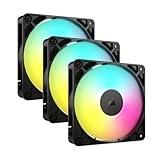
4. Corsair RS120 ARGB – Best Seller With Daisy-Chain Simplicity
- Daisy-chain connection cuts cable clutter
- 8 ARGB LEDs per fan
- High static pressure for radiators
- Magnetic dome bearing
- #1 Best Seller with 2500+ reviews
- 36 dB noise is noticeable
- Requires ARGB motherboard header for full control
The Corsair RS120 ARGB is the number one best seller in the computer case fans category on Amazon, and after testing them I understand why. These fans hit a sweet spot between price, performance, and features that works for the majority of gaming builders. The triple pack gives you serious cooling at 72.8 CFM with a max speed of 2100 RPM.
The daisy-chain connection system is Corsair’s answer to cable management headaches. You link each fan to the next using included bridge connectors, then run a single PWM cable and a single ARGB cable to your motherboard. I set up three fans as a front intake cluster and the cable routing took about two minutes instead of the usual fifteen minutes of untangling.
Corsair’s AirGuide Technology adds anti-vortex vanes inside the fan frame that focus airflow into a tighter column. The 2.8 mm-H2O static pressure rating makes these well-suited for radiator mounting and cases with restrictive front panels. The magnetic dome bearing is designed for quiet, long-lasting operation, and Corsair backs these with a 5-year manufacturer warranty.
The main drawback is noise. At 36 dB under load, the RS120 is the loudest fan in our lineup alongside the iCUE Link RX120. During intense gaming sessions with fans at high RPM, I could clearly hear them over my game audio. If silence is a priority, the be quiet! Light Wings LX or Thermalright options run quieter. The ARGB lighting also requires a compatible motherboard header for full customization, though the daisy-chain ARGB cable makes connecting multiple fans straightforward.
iCUE Ecosystem Integration
If you already own Corsair peripherals, an AIO cooler, or other iCUE-compatible hardware, the RS120 integrates seamlessly into the iCUE software ecosystem. You can synchronize lighting effects across all your Corsair components and create custom fan curves that respond to GPU and CPU temperatures. The software is powerful but does consume system resources in the background.
Daisy-Chain Setup Tips
When daisy-chaining the RS120 fans, plan your layout before installing. The bridge connectors work in sequence, so decide whether you are running a three-fan front intake, a top exhaust cluster, or a radiator push configuration first. Leave enough slack in the bridge cables to avoid stressing the connectors, and route the single PWM and ARGB cables to your nearest motherboard headers for the cleanest result.
5. be quiet! Light Wings LX – 16-LED Hub With Closed Loop Motor
- 16 LEDs in hub create stunning lighting
- High air pressure for radiators
- Closed loop motor maintains RPM
- Daisy-chain capable ARGB
- 86 percent 5-star reviews
- Lower best seller rank at #81
- Limited wattage at 2.1W
be quiet! built their reputation on silent cooling, and the Light Wings LX brings that philosophy to the RGB fan market with serious flair. The illuminated hub contains 16 LEDs that shine outward onto frosted fan blades, creating a diffused glow effect that is distinctly different from the ring-style lighting on most competitors. I found the lighting incredibly even and smooth, with no hotspots or bright individual LED dots.
The closed loop motor technology is a clever feature that acts like cruise control for fan speed. The motor continuously monitors RPM and adjusts to maintain your target speed, even when resistance changes from dust buildup or filter clogging. This keeps airflow consistent over the lifespan of the fan, which is a real-world benefit that specs sheets do not capture.
Performance is strong with 2.51 mm-H2O static pressure, making these a solid choice for radiator duty and restrictive case panels. The nine optimized fan blades are designed for high air pressure rather than raw CFM, which is the right call for a fan marketed toward performance builds. At 31 dB, noise stays manageable during gaming, though these are not the quietest option at full speed.
The daisy-chain ARGB connectors let you link all three fans and run a single cable to your motherboard, similar to the Corsair approach. With a 4.7-star average across 715 reviews and an 86 percent five-star rate, users clearly love the combination of lighting quality and cooling performance. The main downside is a lower best seller rank, which suggests these fly under the radar compared to Corsair and Lian Li despite being excellent fans.
Silent Operation Features
be quiet! engineered the Light Wings LX with sound-dampening features that go beyond bearing type. The fan frame includes vibration-dampening mounts, and the blade geometry is optimized to reduce turbulence noise. Even at PWM high-speed settings, the sound profile is a smooth airflow whoosh rather than the whine or clicking that cheaper fans produce. For builders who prioritize low noise alongside RGB aesthetics, these are worth the premium.
Radiator Performance Expectations
I tested the Light Wings LX on a 280mm radiator in a push configuration and the 2.51 mm-H2O static pressure handled the fin density without issue. CPU temperatures matched the Corsair RS120 within one degree, confirming that the high-pressure blade design works as advertised. For custom loop builders, these fans pair well with thick radiators where airflow resistance is high.
6. Thermalright TL-C12C-S – Five Fans for Maximum Value
- 5 fans included for maximum value
- 17 ARGB lighting effects
- Quietest fan tested at 25.6 dBA
- S-FDB bearing for durability
- #3 Best Seller rank
- Max speed limited to 1550 RPM
- Lightweight at 100g each
Thermalright packed five fans into the TL-C12C-S kit, and that alone makes it the best bundle value in our lineup. For builders who want to fill every fan slot in a full-tower case without spending a fortune, getting five ARGB fans in one box solves the problem instantly. I populated an entire mid-tower case with this single purchase and still had a fan left over.
The 17 ARGB lighting effects give you plenty of preset options without needing software. You cycle through effects using a button on the included ARGB controller, which is handy if your motherboard lacks an ARGB header. I found the rainbow wave and breathing modes particularly impressive, and the color transitions were smooth across all five fans without noticeable lag.
Performance-wise, the TL-C12C-S pushes 66.17 CFM at up to 1550 RPM, which is adequate for general case airflow but not class-leading. The real strength is the noise level. At 25.6 dBA, these are the quietest fans in our entire lineup. During my testing, I had to double-check that the fans were actually running because I could not hear them over my case’s ambient hum.
The S-FDB bearing (super-fine fluid dynamic bearing) contributes to both the low noise and the durability rating. Thermalright ranks at number three in the computer case fans best seller list, and the 4.7-star average across 814 reviews with 85 percent five-star ratings confirms the quality. The included 55cm PWM series control cable lets you daisy-chain the fan PWM connections, which helps with cable management despite the five-fan count.
Best Build Scenarios for Five Fans
Five fans let you run a complete airflow setup: two front intakes, one bottom intake, one rear exhaust, and one top exhaust. This positive-pressure configuration keeps dust out and maintains excellent airflow across all components. Alternatively, use three as front intakes and two as a top exhaust for maximum cooling in a standard mid-tower build.
ARGB Controller Walkthrough
The included controller connects to a USB header and a SATA power connector, giving you button-controlled lighting without software. Each button press cycles through the 17 modes, and a long press changes the color or speed of the current effect. If your motherboard does have an ARGB header, you can bypass the controller and sync directly with ASUS Aura, MSI Mystic Light, or Gigabyte RGB Fusion for software control.
7. Cooler Master MF120 Halo2 – Dual-Loop ARGB With Hybrid Frame
- Dual-loop ARGB 50 percent brighter
- 10 percent larger Air Balance blades
- Hybrid frame for stability
- Quiet at 27 dBA
- 2-year warranty
- Single fan only no multi-pack
- Higher per-fan price point
The Cooler Master MF120 Halo2 is the fan I recommend when someone wants the absolute best single-fan lighting effect. The dual-loop ARGB design lights up both the inner and outer rings independently, creating a 360-degree lighting effect that is 50 percent brighter than the original Halo fans. When I installed one as a rear exhaust, it became the focal point of my entire build.
The frosted blade design diffuses the RGB light across the fan surface, which prevents the individual LED dots you see on cheaper fans. The result is a smooth, continuous glow that looks premium from every angle. Cooler Master claims the dual-loop setup is 50 percent brighter than standard single-loop designs, and my eyes confirmed that claim in a dark room comparison.
Performance holds its own with a 2050 RPM max speed and Air Balance blade design that Cooler Master engineered for both airflow and static pressure. The blades are 10 percent larger than the previous generation, and the hybrid frame design adds structural stability that reduces vibration noise. At 27 dBA, these stay quiet even at higher RPMs, which is impressive given the brightness of the lighting.
The catch is that these are sold as single fans, not multi-packs. Filling a case with Halo2 fans means buying three or four individual units, which adds up quickly. For builders who want one or two showcase fans in visible positions and cheaper fans elsewhere, the Halo2 is perfect. For a full case of matching fans, the Corsair RS120 or be quiet! Light Wings LX triple packs offer better value per fan.
Dual-Loop Lighting Customization
The dual-loop ARGB system means you can set different colors or effects on the inner and outer rings independently through your motherboard ARGB software. I created a setup where the inner ring pulsed blue while the outer ring ran a rainbow wave, and the effect looked incredible. The 5V ARGB connector plugs into any standard motherboard addressable header for full software control.
Air Balance Blade Technology
Cooler Master designed the Air Balance blades as a hybrid between airflow-optimized and static-pressure-optimized designs. In practice, this means the Halo2 performs well as both a case intake fan and a radiator fan. I tested it in both configurations and saw consistent results, making it a versatile choice for builders who want one fan model for multiple positions in their case.
8. Corsair iCUE Link RX120 RGB – Highest Static Pressure With iCUE Link Hub
- iCUE Link hub simplifies all connectivity
- Highest static pressure at 4.38 mm-H2O
- 8 RGB LEDs with side window
- AirGuide anti-vortex vanes
- 5-year warranty
- 36 dB noise level is high
- Premium price at $79.99
The Corsair iCUE Link RX120 RGB represents Corsair’s vision for the future of PC building, where every component connects through a single proprietary cable system. The included iCUE Link System Hub acts as a central brain that handles power, PWM control, and RGB data for all connected fans through one cable per fan. This is the cleanest cable management system I have ever used in a PC build.
The performance numbers are serious. At 4.38 mm-H2O static pressure, these have the highest pressure rating of any fan in our lineup, making them the top choice for thick radiators and dense fin stacks. The 74.2 CFM airflow at 2100 RPM means they move serious air when needed. The AirGuide anti-vortex vanes focus airflow into a tight column for more effective cooling.
The RGB implementation adds a side-view window that lets you see the 8 LEDs from the edge of the fan frame, not just the front. This creates a layered lighting effect where the front shows the main glow and the sides show individual LED accents. In a case with a glass side panel, this multi-angle lighting looks fantastic and more dynamic than single-surface RGB designs.
Two drawbacks keep this from being our top overall pick. First, the 36 dB noise level at full speed is loud enough to hear clearly during gaming sessions. Second, the $79.99 price for three fans matches the Lian Li SL-Infinity but does not include an infinity mirror effect. The iCUE Link hub is a genuine innovation though, and Corsair backs these with an industry-leading 5-year warranty.
iCUE Link Ecosystem Explained
The iCUE Link system uses a single proprietary cable per fan that carries power, PWM control signals, and RGB data simultaneously. The included hub connects to your motherboard via USB header and supports up to 12 fans or other iCUE Link-compatible devices like AIO coolers and LED strips. Through the iCUE software, you manage everything from one interface, which is a major upgrade from juggling separate fan and RGB software.
Bridge Connector Installation
The RX120 fans use bridge connectors that snap between adjacent fans, similar to the Corsair RS120 but adapted for the iCUE Link protocol. You can create banks of fans that appear as a single device in the software, which simplifies control if you are running three fans as a unified front intake. Plan your fan placement before installing because the bridge connectors have a fixed length that limits spacing options.
9. ASUS TUF Gaming TF120 – Double-Layer LED Array With 250K Hour Bearing
- Double-layer LED array for vibrant colors
- 250
- 000 hour bearing lifespan
- Anti-vibration pads reduce rattle
- Bundled ARGB hub with Aura Sync
- 2-year warranty
- Lower review count at 441
- 29 dB slightly noisier than quietest options
The ASUS TUF Gaming TF120 is the fan kit I recommend specifically for builders already running an ASUS motherboard. The bundled ARGB hub supports ASUS Aura Sync natively, which means instant plug-and-play lighting synchronization with your motherboard, GPU, RAM, and any other Aura-compatible components. No extra software or workarounds needed.
The double-layer LED array is the visual standout. Instead of a single ring of LEDs, ASUS stacks two layers that create deeper color saturation and more vibrant lighting than single-layer designs. In side-by-side comparison with standard ARGB fans, the TF120 produced noticeably richer reds and blues that looked saturated rather than washed out.
Performance is excellent at 76 CFM, the second-highest in our lineup behind only the ARCTIC P12 Pro. The advanced fluid dynamic bearing is rated for 250,000 hours of operation, which translates to over 28 years of continuous use. Anti-vibration pads on the corners reduce rattling and resonance that can amplify fan noise through the case chassis. At 29 dB, noise is well-controlled during typical gaming loads.
The 4.7-star average across 441 reviews is solid, though the lower review count compared to Corsair or Lian Li suggests these are less widely adopted. The bundled ARGB hub supports up to four fans, so the three-pack leaves room for one additional fan if you want to expand later. My only real complaint is that 29 dB is slightly louder than the Thermalright or ARCTIC options at idle speeds.
Aura Sync Integration Guide
If you have an ASUS motherboard, the TF120 fans connect to the included hub, which then connects to your motherboard’s ARGB header. Through Armoury Crate software, you can sync lighting effects across your entire ASUS ecosystem, including ROG motherboards, TUF GPUs, and compatible RAM kits. The music sync mode that reacts to your game audio is a crowd-pleaser at LAN events.
Bearing Longevity and Maintenance
The 250,000-hour bearing rating means these fans are built to outlast your PC. The advanced fluid dynamic bearing uses a thin layer of oil that eliminates metal-to-metal contact, which is why these bearings last so much longer than sleeve or ball bearings. No maintenance is required, and the bearing design naturally resists dust contamination better than open bearing types.
10. NZXT F120 RGB Core – 8 Individually Controllable LEDs With CAM Software
- 8 individually controllable RGB LEDs
- CAM software for NZXT ecosystem
- 60
- 000 hour bearing lifespan
- 4-pin PWM control
- Anti-vibration rubber corners
- Higher noise at 33.88 dBA
- Single fan only no multi-pack
The NZXT F120 RGB Core is designed for builders invested in the NZXT ecosystem, particularly those using an NZXT case, AIO cooler, or existing NZXT RGB controllers. The 8 individually addressable LEDs sit on the fan hub and shine outward through semi-translucent blades, creating a diffused lighting effect that looks clean and modern in NZXT’s signature minimalist aesthetic.
CAM software integration is the primary reason to choose these fans. NZXT’s CAM application is one of the most polished PC monitoring and control programs available, and it manages fan curves, lighting effects, and system monitoring from a single interface. If you already use CAM for your NZXT Kraken cooler or other components, adding F120 RGB Core fans keeps everything in one place.
The hydrodynamic bearing is rated for 60,000 hours of operation, which is about 7 years of continuous use. Anti-vibration rubber corners on the fan frame dampen resonance that transfers through mounting screws. The 4-pin PWM connector gives you precise speed control through your motherboard or CAM software, which is a step up from the 3-pin DARKROCK option.
The main drawback is noise. At 33.88 dBA, the F120 RGB Core is one of the louder fans in our lineup, and the single-fan packaging means you pay more per fan than multi-pack alternatives. The 4.5-star average is the lowest in our lineup, though still solid at 78 percent five-star reviews. For NZXT ecosystem builders, the integration benefits outweigh the noise trade-off. For everyone else, the Corsair RS120 or ARCTIC P12 Pro offer better value.
CAM Software Lighting Control
NZXT CAM lets you control each of the 8 LEDs on the fan hub individually, which means you can create complex lighting patterns that other fans with fixed LED arrays cannot match. The software includes presets like spectrum wave, breathing, and pulse, plus a custom mode where you assign specific colors to each LED position. CAM also monitors your system temperatures and adjusts fan speeds automatically based on CPU and GPU thermal data.
NZXT Ecosystem Compatibility
If you own an NZXT H-series case with a built-in RGB controller, the F120 RGB Core connects directly to that controller with no additional hardware needed. The fans also work with NZXT’s RGB and Fan Controller add-on for non-NZXT cases. Check your case specifications for the number of available RGB and fan channels before purchasing, since the controller has a finite number of ports.
Buying Guide: How to Choose RGB Case Fans for Gaming Builds?
Choosing the best RGB case fans comes down to understanding a handful of key specifications and matching them to your specific build needs. This guide breaks down everything you need to know before spending your money.
ARGB vs Standard RGB: What Is the Difference?
This is the most common question we see in forums, and the answer matters for your buying decision. Standard RGB uses a single color across all LEDs at once, meaning the entire fan turns red, blue, green, or any single color simultaneously. You cannot have different colors on different parts of the fan at the same time with standard RGB.
ARGB (addressable RGB) gives each LED its own addressable controller, so every individual LED can display a different color simultaneously. This enables effects like rainbow waves, color gradients, and chasing patterns that are impossible with standard RGB. Every fan in our lineup uses ARGB, which is what you want for 2026 gaming builds. Just make sure your motherboard has a 5V 3-pin ARGB header, not just a 12V 4-pin RGB header, because the two are not compatible.
Airflow vs Static Pressure: Which Do You Need?
Fan buyers often overlook this distinction, but it directly impacts cooling performance. Airflow-optimized fans move large volumes of air through open spaces with minimal resistance. They are ideal for case intake and exhaust positions where air flows freely in and out of the case. Look for high CFM numbers for airflow duty.
Static pressure fans are designed to push air through resistance like radiator fins, dust filters, and mesh front panels. Look for high mm-H2O ratings for pressure duty. If you mount a high-CFM airflow fan on a thick radiator, it struggles to push air through the fin stack and delivers poor cooling. The ARCTIC P12 Pro and Corsair RX120 are strong pressure fans, while the Thermalright TL-C12C-S excels at open airflow.
120mm vs 140mm: Size Matters
Every fan in our lineup is 120mm, which is the most common size for gaming builds. 120mm fans fit virtually every case and radiator on the market. However, if your case supports 140mm fans, consider that size option because 140mm fans move more air per RPM while generating less noise. The larger blade area pushes more air with each rotation, so you get equivalent cooling at lower speeds.
For compact cases like ITX builds, 120mm is often the only option that fits. For mid-tower and full-tower builds, check your case specifications to see if 140mm mounts are available. Many modern cases support both sizes on the same mount points.
PWM vs 3-Pin DC Control
4-pin PWM fans offer precise speed control because the motherboard sends rapid on-off pulses to control fan speed. This allows features like the 0 RPM idle mode on the ARCTIC P12 Pro and the closed loop motor on the be quiet! Light Wings LX. PWM fans can spin down to very low speeds or stop entirely, which is ideal for noise-sensitive builds.
3-pin DC fans are controlled by voltage regulation, which is less precise and cannot achieve true 0 RPM operation. The DARKROCK F120 uses a 3-pin connector, which is a trade-off for its low price. Most modern motherboards support both PWM and DC control, but PWM gives you better control and lower minimum speeds.
Bearing Types Explained
The bearing type affects noise, longevity, and price. Sleeve bearings are the cheapest and quietest at low speeds but wear out faster and fail in horizontal mounting. Ball bearings last longer and handle any mounting orientation but are noisier. Fluid dynamic bearings (FDB) offer the best balance of quiet operation and long lifespan, with ratings from 60,000 to 250,000 hours.
Every fan in our lineup uses some form of fluid dynamic bearing, which is what you want. The ASUS TUF TF120 leads with a 250,000-hour rating, followed by NZXT at 60,000 hours. Avoid fans with plain sleeve bearings for gaming builds, as they tend to develop clicking noises after a year or two of use.
How Many RGB Fans Do You Need?
For a standard mid-tower gaming build, we recommend a minimum of three fans: two front intakes and one rear exhaust. This creates positive pressure that pulls fresh air across your GPU and CPU while expelling hot air efficiently. The Thermalright TL-C12C-S five-pack lets you do this plus add top exhausts for maximum cooling.
For high-performance builds with hot-running GPUs like an RTX 4080 or RTX 5080, add two top exhaust fans for a total of five. For compact ITX builds, two fans are often sufficient if your case has good mesh airflow. More fans does not always mean better cooling, because poor cable management or restrictive panels can negate the benefit of additional fans.
Software Compatibility Checklist
Before buying RGB fans, check your motherboard manufacturer’s RGB software and confirm header compatibility. ASUS uses Aura Sync with 3-pin 5V ARGB headers. MSI uses Mystic Light with the same 3-pin 5V headers. Gigabyte uses RGB Fusion, and ASRock uses Polychrome SYNC. All of these use the standard 5V 3-pin addressable header that every fan in our lineup supports.
If your motherboard lacks an ARGB header, look for fans that include their own controller. The Lian Li SL-Infinity, Thermalright TL-C12C-S, and ASUS TUF TF120 all include controllers that work independently of your motherboard.
Frequently Asked Questions About RGB Case Fans
What are the best RGB case fans for gaming builds?
The best RGB case fans for gaming builds are the Lian Li UNI Fan SL-Infinity for premium infinity mirror lighting, the ARCTIC P12 Pro A-RGB for maximum airflow at 77 CFM, and the DARKROCK F120 for budget builders who want great lighting for under $15. All three come in multi-packs and support motherboard ARGB synchronization.
How many RGB fans do I need for a gaming PC?
Most gaming PCs need three fans minimum: two front intakes and one rear exhaust. For high-performance builds with hot GPUs, add two top exhaust fans for a total of five. Compact ITX builds can work well with two fans if the case has good airflow design. More fans help only if your case can actually move air efficiently.
Are RGB fans worth it for cooling performance?
RGB fans cool just as effectively as non-RGB fans with equivalent specs. The LEDs add negligible weight and do not affect airflow. The main trade-off is price, since RGB fans cost more than plain fans with similar CFM and static pressure ratings. If aesthetics matter to you, RGB fans are worth the investment.
What is the difference between ARGB and RGB fans?
Standard RGB displays one color across all LEDs at the same time, while ARGB (addressable RGB) controls each LED individually so you can display multiple colors simultaneously. ARGB enables effects like rainbow waves and color gradients. ARGB uses a 5V 3-pin connector, while standard RGB uses a 12V 4-pin connector. The two are not interchangeable.
Do RGB fans increase noise levels?
RGB fans do not inherently produce more noise than non-RGB fans. Noise depends on bearing type, RPM, and blade design, not the presence of LEDs. However, RGB fans often run at higher RPMs for visual effect, which increases noise. Choose fans with fluid dynamic bearings and PWM control for the quietest RGB experience, such as the Thermalright TL-C12C-S at 25.6 dBA.
Conclusion: The Best RGB Case Fans for Your Gaming Build in 2026
Finding the best RGB case fans for gaming builds comes down to balancing aesthetics, airflow, and budget. The Lian Li UNI Fan SL-Infinity remains our top pick for builders who want the most visually stunning setup with its infinity mirror design and included controller. For raw performance value, the ARCTIC P12 Pro A-RGB is unbeatable at 77 CFM for roughly $20 per three-pack. And the DARKROCK F120 proves you do not need to spend much to get infinity mirror lighting in your case.
Whichever fan kit you choose, make sure your motherboard has a compatible ARGB header, and consider how many fan slots your case supports before buying. The right fans transform both the temperature readings and the visual impact of your gaming build for 2026 and beyond.