
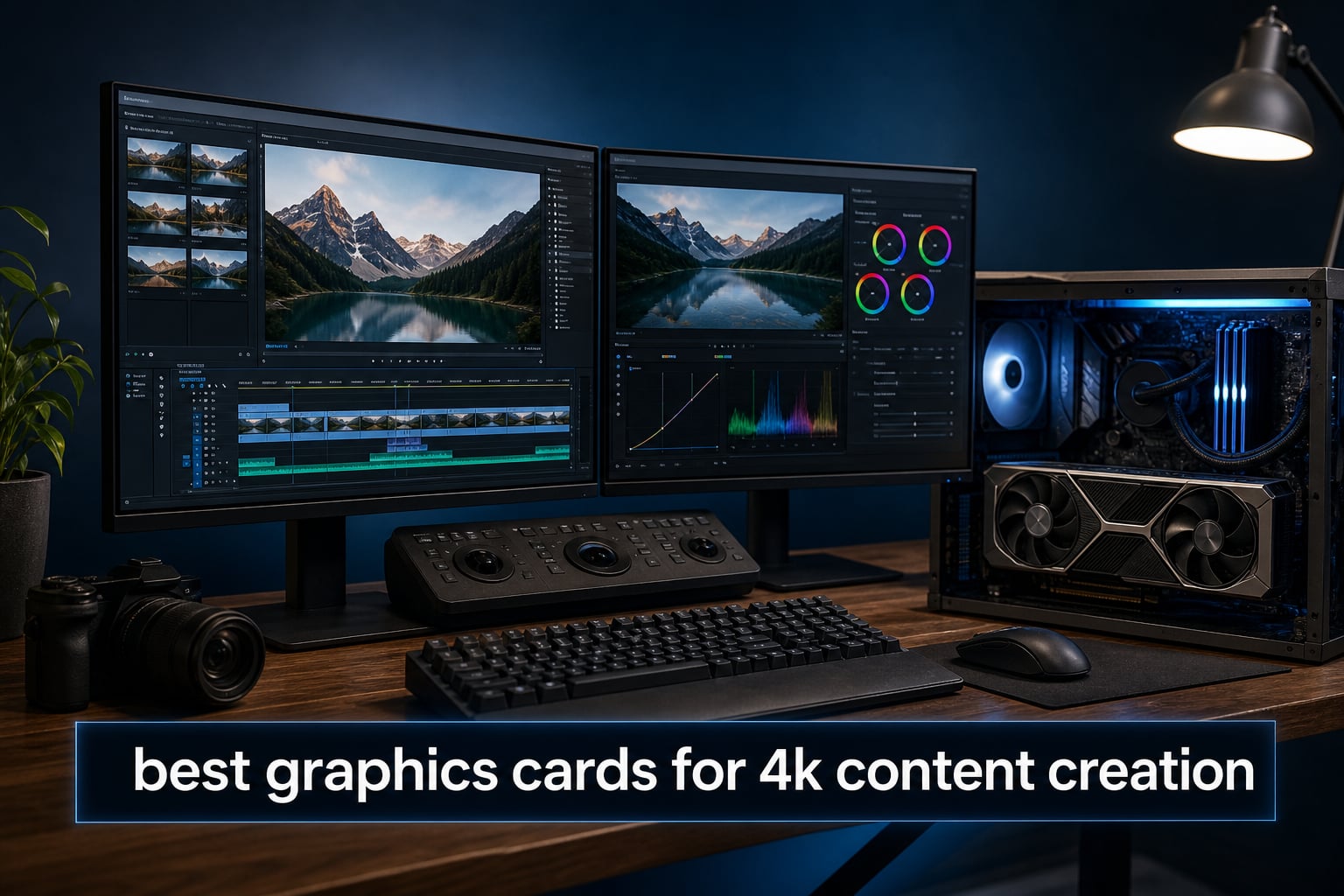
Finding the best graphics cards for 4k content creation is less about chasing one headline specification and more about matching memory capacity, cooling, outputs, and form factor to the footage you actually cut. For most serious 4K timelines, I would start with 16GB of dedicated graphics memory; 12GB can still make sense for simpler edits, while 16GB leaves more breathing room for effects, color work, and several high-resolution assets open at once.
The short answer is this: ASUS ProArt RTX 5080 is the strongest all-round pick here when a creator-focused 16GB NVIDIA card and USB Type-C output matter, ASUS Dual RTX 5060 Ti 16GB is the compact 16GB NVIDIA choice, and the XFX Mercury RX 9070 XT is a high-clocked 16GB AMD alternative. Those recommendations come from the listed product specifications and buyer feedback data, not from made-up export-time tests.
A GPU helps an editing workstation decode and encode supported video formats, draw effects, process color work, and accelerate some AI-assisted tools. It cannot fix an undersized system drive, inadequate RAM, a weak CPU, or a poorly organized project; forum discussions repeatedly make that point after creators run into stuttering 4K playback or crashes caused by full VRAM.
This guide compares ten current desktop cards with 12GB or 16GB of memory. I focus on what the product data can confirm: memory, dimensions when supplied, cooling approach, ports, warranty, ratings, and practical fit, then explain how those facts translate into a sensible GPU for 4K video editing, DaVinci Resolve, Premiere Pro, and motion-graphics work.
Table of Contents
Top 3 Picks for September 2026
Choose the ProArt RTX 5080 when you need a compact creator-oriented 16GB NVIDIA card with USB Type-C, choose the Dual RTX 5060 Ti when small-case fit and 16GB matter most, and choose the XFX RX 9070 XT when you want an AMD card with 16GB, a 3,100 MHz listed boost clock, and large triple-fan cooling. Every edit is different, so treat the cards below as workflow fits rather than a promise that any card will make every codec play in real time.
The best graphics cards for 4K content creation in 2026 cover every creator build
Use this overview to narrow the field before reading the individual notes. Memory is the first filter, but card length, slot thickness, cooling, warranty, and display connections can rule out an otherwise appealing card before it reaches your editing desk.
| Product | Specifications | Action |
|---|---|---|
 ASUS ProArt RTX 5080 16GB ASUS ProArt RTX 5080 16GB |
|
Check Latest Price |
 GIGABYTE RTX 5070 AERO OC 12G GIGABYTE RTX 5070 AERO OC 12G |
|
Check Latest Price |
 XFX Mercury RX 9070 XT XFX Mercury RX 9070 XT |
|
Check Latest Price |
 GIGABYTE RX 9060 XT Gaming OC 16G GIGABYTE RX 9060 XT Gaming OC 16G |
|
Check Latest Price |
 GIGABYTE RTX 5070 WINDFORCE SFF GIGABYTE RTX 5070 WINDFORCE SFF |
|
Check Latest Price |
 Sapphire Pulse RX 9070 XT Sapphire Pulse RX 9070 XT |
|
Check Latest Price |
 ASUS TUF RTX 5080 16GB ASUS TUF RTX 5080 16GB |
|
Check Latest Price |
 GIGABYTE RX 9070 XT Gaming OC GIGABYTE RX 9070 XT Gaming OC |
|
Check Latest Price |
 Sapphire Nitro+ RX 9070 XT Sapphire Nitro+ RX 9070 XT |
|
Check Latest Price |
 ASUS Dual RTX 5060 Ti 16GB ASUS Dual RTX 5060 Ti 16GB |
|
Check Latest Price |
The ASUS ProArt RTX 5080 is the best all-round creator-oriented pick
- 16GB GDDR7
- USB Type-C output
- 2.5-slot design
- Vapor chamber
- 3-year warranty
- Only 23 reviews
- 12 inch card length
ASUS builds this ProArt around the GeForce RTX 5080 with 16GB of GDDR7 memory, a listed 2,730 MHz OC-mode clock, and a 2.5-slot body. That combination makes it the card I would put first on a 4K creator shortlist when you want NVIDIA’s current Blackwell platform without moving to an oversized triple-slot-and-more enclosure.
The native port selection is unusually useful for a creator desk: one HDMI 2.1b, two DisplayPort 2.1b connections, and integrated USB Type-C. Its listed maximum resolution is 7,680 by 4,320, so it has the display-side credentials for high-resolution monitoring as well as editing.
The thermal design is not an afterthought. ASUS specifies three axial-tech fans, a MaxContact heatsink, and a vapor chamber, while the 3.1-pound listed weight is easier to plan around than much heavier cards in this group.
The 16GB memory and creator ports make this a sensible workstation choice
For 4K editors, 16GB is a comfortable capacity target when a project combines high-resolution media, GPU effects, color nodes, and graphics overlays. The integrated USB Type-C output is the differentiator here, since the other cards in this collection are generally listed with HDMI and DisplayPort only.
I also like that the card is explicitly described as SFF ready while keeping a 2.5-slot profile. Measure your case against its listed 12-inch length and 5-inch width before committing.
The limited feedback sample means buyers should read beyond the star score
The 4.9 rating is encouraging, but it is based on 23 listed reviews, so it is not a broad ownership sample. Treat it as a positive signal rather than proof of long-term behavior in every case or editing setup.
If you do not need USB Type-C or want a thicker cooler, the ASUS TUF RTX 5080 later in this guide offers the same 16GB capacity with a more substantial physical design. This ProArt is the cleaner fit when compact creator-focused connections are the priority.
The GIGABYTE RTX 5070 AERO OC suits NVIDIA editors with modest 4K timelines
- 12GB GDDR7
- PCIe 5.0
- WINDFORCE cooling
- three-year warranty
- 4.7 rating
- 12GB memory
- 12.75 inch length
The RTX 5070 AERO OC carries 12GB of GDDR7 on a 192-bit interface and a listed 2,600 MHz GPU clock. It is a reasonable NVIDIA option for editors whose work is mostly straightforward 4K cuts, light color work, and hardware-accelerated exports rather than dense composites that keep many effects and large assets resident.
GIGABYTE lists PCIe 5.0, a three-fan WINDFORCE cooling system, HDMI, and DisplayPort outputs. Its 4.7 rating across 385 listed reviews gives this card a much larger feedback base than the ProArt, although ratings cannot replace compatibility checks for your software and system.
The AERO body measures 12.75 inches long by 5.11 inches wide. That length is the practical detail I would verify first in a mid-tower or compact workstation, especially where front-mounted radiators take up clearance.
The 12GB capacity fits lighter 4K projects better than effects-heavy work
There is no single “4K project” requirement because codecs, bit depth, timeline resolution, effects, and background applications all change memory demand. Still, 12GB has less reserve than the 16GB cards here, so I would favor it for disciplined projects and proxy workflows over elaborate timelines.
Users asking whether an RTX 5070 is enough should weigh that capacity honestly. A faster platform does not make extra VRAM appear when an editor needs it.
The AERO cooling and full-size chassis call for a normal desktop build
Three fans and the WINDFORCE system indicate a card intended for a conventional case with a sensible airflow path. Keep intake and exhaust clear, because export and rendering sessions can hold a GPU under load longer than a short preview.
The card has a three-year manufacturer warranty. That is useful coverage context, but it does not remove the need to check physical clearance, power connections, and the ports your displays use.
The XFX Mercury RX 9070 XT is the high-clocked 16GB AMD alternative
- 16GB GDDR6
- 3100 MHz boost
- Magnetic Air triple fans
- RDNA 4
- three-year warranty
- 14.17 inch length
- Not Prime eligible
XFX lists this Mercury RX 9070 XT with 16GB of GDDR6, AMD RDNA 4 architecture, and a boost clock up to 3,100 MHz. It earns its place because it pairs the 16GB capacity that many 4K creators want with one of the more assertive cooling designs in this list.
The listing specifies MERC Magnetic Air triple-fan cooling, RGB lighting, HDMI and DisplayPort outputs, and a three-year manufacturer warranty. Its 4.8 rating comes from 75 listed reviews, which is promising but still a smaller set of owner reports than several other choices.
It is also physically substantial at 14.17 inches long and 6.3 inches wide, with a listed 2.33-kilogram weight. That is a card to plan a system around, not a safe assumption for a compact chassis.
The 16GB frame buffer gives AMD editors welcome project headroom
AMD or NVIDIA is not a simple winner for every editing application. First check the documented GPU acceleration and codec support in the version of Premiere Pro, DaVinci Resolve, or other editor you run, then choose the card whose memory capacity and fit meet your workload.
With 16GB, this XFX makes more sense than 12GB options when you expect to layer effects, grade 4K footage, or keep demanding timelines open. The listed 3,840 by 2,160 maximum display resolution also directly matches a 4K monitor target.
The large cooler requires case measurements before it becomes a recommendation
Magnetic Air triple-fan cooling may appeal to builders who want a serious thermal assembly, but the card’s 14.17-inch length is non-negotiable. Check GPU length allowance with front fans, radiators, cables, and any drive cages installed.
The source lists standard shipping rather than Prime eligibility. Availability details can change, so confirm the listing conditions when you are ready to buy.
The GIGABYTE RX 9060 XT Gaming OC makes 16GB practical in a shorter card
- 16GB GDDR6
- 11.06 inch length
- WINDFORCE cooling
- Hawk Fan
- three-year warranty
- Lower listed clock than RX 9070 XT
- No listed USB Type-C
GIGABYTE’s Radeon RX 9060 XT Gaming OC is a standout for builders who want 16GB of GDDR6 but do not have room for the longest RX 9070 XT cards. Its stated dimensions are 11.06 by 4.65 inches, and its listed weight is 1,100 grams, making physical planning less intimidating than with XFX’s larger Mercury model.
GIGABYTE specifies a 2,700 MHz GPU clock, PCIe x16 connection, WINDFORCE cooling, a Hawk Fan, server-grade thermal conductive gel, and RGB lighting. It has a 4.7 rating across 846 listed reviews, the largest feedback base among the AMD cards included here.
This is the 16GB AMD choice I would investigate first for a conventional build where case depth is limited. The product data does not list USB Type-C, so it is a more conventional HDMI-and-DisplayPort monitor setup.
The 16GB memory is the reason this card matters for 4K editing
GPU memory is the space available to the card for textures, frames, effects data, and other graphics tasks. When it is insufficient, an editing app can slow down, reduce preview quality, or become unstable; that is exactly the pain point creators flag when moving from lighter work into 4K footage.
For that reason, I would usually take a verified 16GB card over a 12GB alternative when the rest of the system and software support it. This RX 9060 XT offers that capacity in a listed 11.06-inch package.
The cooler suits a standard airflow path rather than an ultra-small enclosure
WINDFORCE cooling, the Hawk Fan, and thermal gel suggest GIGABYTE has put real attention into heat management. They do not make airflow optional: leave room around the card and avoid blocking case intakes with loose cables.
The card has a listed three-year manufacturer warranty. Confirm the space around the PCIe slot as well as the length measurement, since a cooling shroud can conflict with nearby components in some cases.
The GIGABYTE RTX 5070 WINDFORCE is the 12GB pick for small-form-factor NVIDIA builds
- SFF ready
- 12GB GDDR7
- PCIe 5.0
- WINDFORCE cooling
- three-year warranty
- 12GB memory
- No USB Type-C output listed
The RTX 5070 WINDFORCE OC SFF has the same fundamental 12GB GDDR7 and PCIe 5.0 credentials as the AERO RTX 5070, but GIGABYTE explicitly calls it NVIDIA SFF ready. At 11.1 inches long and 4.33 inches wide, it is the more natural RTX 5070 to consider when the workstation must fit a smaller case.
It uses a three-fan WINDFORCE cooling system and lists HDMI plus DisplayPort outputs. The 4.7 rating across 267 reviews provides a meaningful, though not huge, body of feedback.
Small form factor does not mean you can skip measurements. Check card length, height, slot thickness, cable bend room, and your case’s specified GPU clearance before building around it.
The SFF-ready label solves one fit question but not every fit question
An SFF-ready designation is useful because it signals a compact-build intent, yet cases vary widely around the PCIe area. A card listed at 11.1 inches long can still meet an obstacle from a front radiator, thick cables, or a side bracket.
I would map the whole installation path before ordering: slot location, power cable route, airflow direction, and monitor cable clearance. That preparation prevents the frustrating “it almost fits” outcome common in compact creator systems.
The 12GB capacity favors structured proxy and lighter-effect workflows
This card can be a good GPU for 4K video editing if your projects stay within its memory budget and your editor supports its acceleration paths. It is not the card I would choose solely for maximum headroom with dense 4K composites, because the 16GB models in this list provide more capacity.
Its Blackwell architecture and DLSS 4 are listed features, but editing decisions should begin with memory and application support rather than gaming features. For an SFF build needing 16GB, compare it directly with the smaller ASUS Dual RTX 5060 Ti.
The Sapphire Pulse RX 9070 XT is the straightforward 16GB multi-display AMD option
Sapphire 11348-03-20G Pulse AMD Radeon™ RX 9070 XT Gaming Graphics Card with 16GB GDDR6, AMD RDNA 4
- 16GB GDDR6
- 256-bit interface
- Four display outputs
- three fans
- 4.7 rating
- No dimensions supplied
- Not Prime eligible
Sapphire’s Pulse RX 9070 XT gives you 16GB of GDDR6 on a 256-bit interface with a listed 2,970 MHz GPU clock. It is a practical selection for an AMD-based editing build that needs monitor flexibility, as the product listing specifies two HDMI and two DisplayPort outputs.
Its three-fan cooling system and listed 1.86-kilogram weight put it in conventional full-size-card territory. The 4.7 rating is based on 265 reviews, with the source reporting 87% five-star ratings.
Unlike some competitors here, the supplied data does not provide physical dimensions. I would not order it for a tight case until the manufacturer’s current dimensional drawing confirms the fit.
The four listed display connections suit an editing desk with several screens
Multiple outputs can be useful when a workflow includes a main edit monitor, reference display, and client or playback screen. Port type still matters: check the inputs on each monitor and the cable standards you intend to use.
Two HDMI and two DisplayPort connections make the Pulse more flexible on paper than a card whose exact arrangement is not listed. They do not alter software support, but they can simplify a multi-screen desk.
The missing dimensions are the important specification to verify first
We know this card weighs 1.86 kilograms and has three fans, but weight does not tell you length, width, or thickness. Obtain those dimensions from Sapphire before treating it as a compact-build candidate.
Its two-year manufacturer warranty is shorter than the three-year coverage listed on several alternatives. That does not make it a poor card, but it belongs in the decision beside VRAM and output needs.
The ASUS TUF RTX 5080 is the durable full-size 16GB NVIDIA workstation option
- 16GB GDDR7
- Phase-change thermal pad
- Protective PCB coating
- Military-grade components
- three-year warranty
- 3.6-slot design
- 5 pound weight
The ASUS TUF RTX 5080 has the same 16GB GDDR7 capacity as the ProArt RTX 5080 but approaches cooling and physical construction differently. ASUS lists a 3.6-slot design with a massive fin array, axial-tech fans, a phase-change GPU thermal pad, protective PCB coating, and military-grade components.
That is a strong specification set for a workstation that will spend long stretches exporting or rendering, provided the case is built for it. The card is listed at 13.7 inches long, 5.7 inches wide, and 5 pounds, so it is a decidedly full-size component.
For displays, ASUS lists three native DisplayPort 2.1a connections and two native HDMI 2.1b connections, plus a 7,680 by 4,320 maximum resolution. Its 4.7 rating is based on 218 reviews in the supplied data.
The oversized thermal hardware suits creators with spacious, well-ventilated cases
A 3.6-slot cooler can help a GPU sustain demanding work, yet it occupies room that might otherwise support adjacent expansion cards or airflow. Before choosing it, check slot clearance as carefully as length and height.
The phase-change thermal pad and large fin array are hardware details worth having when thermal behavior is a priority. They are not a substitute for a case with sensible intake and exhaust.
The five display outputs support complex monitoring arrangements
Three DisplayPort and two HDMI outputs provide a generous set of physical connections for a multi-monitor edit setup. Verify the panel requirements and the software’s output behavior before assuming every connected display will be used the way you expect.
I would select this TUF over the ProArt when cooler mass and protective construction matter more than a slim 2.5-slot fit or USB Type-C. Both give 16GB of GDDR7, so the real split is build layout and port priorities.
The GIGABYTE RX 9070 XT Gaming OC is the widely reviewed 16GB AMD choice
- 16GB GDDR6
- 3060 MHz clock
- WINDFORCE cooling
- Hawk Fan
- three-year warranty
- 11.34 inch length
- DisplayPort-only output listed
This GIGABYTE RX 9070 XT Gaming OC combines 16GB of GDDR6 with a stated 3,060 MHz GPU clock and an 11.34-inch by 5.2-inch frame. It is an attractive middle ground for an AMD creator build: shorter than the XFX Mercury, with a more complete feedback sample of 430 listed reviews.
The cooling recipe is familiar from GIGABYTE’s other entry: WINDFORCE cooling, Hawk Fan technology, server-grade thermal conductive gel, and RGB lighting. It is also listed with a three-year manufacturer warranty.
The provided listing names DisplayPort as the video output interface. Since it does not list HDMI here, confirm the exact port configuration on the specific current product page if your monitor chain requires HDMI.
The 16GB capacity is a sound starting point for serious 4K timelines
For a 4K editing graphics card, memory capacity tends to be more useful than an isolated clock number when you are deciding between otherwise capable choices. A 16GB card gives room for applications that tap GPU acceleration during color correction, effects, compositing, and timeline playback.
This does not mean every 4K creator needs 16GB; a light edit with proxies may work well on less. It means this card is positioned for people who would rather leave fewer memory compromises in a desktop build.
The listed output detail needs a monitor-compatibility check before checkout
DisplayPort is an excellent connection for many editing monitors, but port adapters can complicate high-refresh or high-resolution display setups. Start with the monitors you already own and document which cable or connector each one needs.
At 1.78 kilograms, this is still a substantial component even though it is shorter than the Mercury. A bracket or proper support can be sensible in a long-term workstation build, subject to your case layout.
The Sapphire Nitro+ RX 9070 XT is the heavier 16GB AMD card for roomy cases
Sapphire 11348-01-20G Nitro+ AMD Radeon™ RX 9070 XT Gaming OC Graphics Card with 16GB GDDR6, AMD RDNA 4
- 16GB GDDR6
- 256-bit interface
- Four display outputs
- three fans
- Prime eligible
- 2.6 kilogram weight
- No dimensions supplied
The Sapphire Nitro+ RX 9070 XT is another 16GB GDDR6, 256-bit AMD option, with a listed 3,060 MHz GPU clock and three fans. Its 2.6-kilogram listed weight makes it the heaviest AMD card in this selection, a clear signal that the build needs room and solid card support.
Sapphire lists two HDMI and two DisplayPort outputs, which is a useful arrangement for mixed-monitor workstations. The source reports a 4.6 rating from 313 reviews, with 83% five-star ratings.
As with the Pulse, the supplied product data does not include card dimensions. Weight and fan count are not replacements for those measurements, so obtain the manufacturer’s diagram before putting it into a compact or tightly planned case.
The output mix is helpful for editors who combine HDMI and DisplayPort screens
A mixed port arrangement avoids forcing every display into the same connector type. That can be helpful when your edit station has an older HDMI reference monitor alongside a DisplayPort desktop display.
Connections are only one part of monitoring accuracy. The monitor itself, calibration, operating-system color management, and the application’s video-output setup determine whether an image is a reliable color reference.
The 2.6-kilogram weight makes physical support part of the build plan
A card this heavy should be installed in a case with a secure PCIe area and supported according to the manufacturer’s guidance. Do not treat a heavy card as interchangeable with a small dual-fan model just because both have 16GB.
The two-year manufacturer warranty is another point to compare with the three-year warranties attached to several GIGABYTE and ASUS entries. This Nitro+ is best for a spacious setup that values its 16GB capacity and versatile display outputs.
The ASUS Dual RTX 5060 Ti is the compact 16GB NVIDIA choice for 4K creators
- 16GB GDDR7
- SFF ready
- 9 inch length
- 0dB technology
- three-year warranty
- Dual-fan cooling
- No USB Type-C output listed
The ASUS Dual RTX 5060 Ti deserves close attention because it pairs 16GB of GDDR7 with a remarkably compact listed 9-inch by 4.7-inch body and a 0.66-kilogram weight. For a small workstation, it directly answers the question “is RTX 5060 good for 4K video editing?” with a qualified yes: the 16GB capacity makes it a credible option when your projects and software fit its performance class.
ASUS lists a 2,632 MHz OC-mode clock, Blackwell architecture, DLSS 4, 767 AI TOPS, SFF-ready status, axial-tech fans, and 0dB technology. The card’s 4.6 rating comes from 304 listed reviews, and its product data states a three-year warranty.
It offers three DisplayPort 2.1b connections and one HDMI 2.1b connection. There is no USB Type-C output listed, but the short length can make a far bigger difference for a creator working in a constrained case.
The 16GB memory and 9-inch body make this the strongest compact NVIDIA fit
Small-form-factor creators often have to choose between physical fit and memory capacity. This card is unusual within this list because it supplies 16GB while remaining much shorter than the RTX 5080, RX 9070 XT, and many triple-fan cards.
That does not turn it into a substitute for every heavier GPU. It means you can build a compact machine around a verified 16GB GPU instead of accepting 12GB simply to make the case dimensions work.
The dual-fan layout asks for deliberate case airflow on long exports
ASUS uses axial-tech fans and 0dB technology, and a short card can leave more internal room for airflow. Still, long encoding or rendering sessions create a different thermal situation from a brief edit preview, so watch case ventilation and temperatures after the build is complete.
For a larger case and a more demanding workflow, compare its compact advantage against the 16GB RTX 5080 options. For a smaller case, this ASUS Dual may be the most practical graphics card for video editing in the entire group.
The right 4K GPU starts with 16GB memory for demanding projects
For a direct rule of thumb, 8GB is the bare minimum for basic GPU-assisted 4K work, 12GB is more comfortable for straightforward projects, and 16GB is the recommended target in this collection for regular 4K editing, grading, effects, or several large assets. That is guidance, not a universal software requirement: footage codec, bit depth, timeline size, effect stack, and proxy use all affect real memory demand.
Do you need 24GB of VRAM for 4K? No, not for every 4K project. More memory can help with unusually complex compositions, 3D scenes, very large frame sizes, or working toward 8K, but the ten cards available for this guide show that 16GB is the sensible balance for most people building around serious 4K work.
The codec and editor determine how much acceleration you will actually see
H.264 and H.265 are common delivery and acquisition formats, but their behavior can vary by camera, bit depth, chroma sampling, and the version of your editing software. NVIDIA cards include NVIDIA’s hardware video engine ecosystem, while AMD cards provide their own hardware video capabilities; check your editor’s current documentation for the exact decode and encode support that applies to your footage.
AV1 matters more to creators than it once did, especially for modern online delivery workflows, but it should not be the only buying criterion. Verify whether you need hardware AV1 encoding, decoding, or both, then check the application and export preset you actually use.
ProRes is a different situation because the CPU, storage throughput, and application handling can carry a large share of the experience. A GPU remains useful for effects and color work, but a capable card does not remove the need for fast media storage and enough system RAM.
The CPU and GPU share the 4K editing workload rather than replacing each other
4K video editing is both CPU and GPU intensive. The CPU handles tasks such as application logic, many codecs, audio, and some effects, while the GPU speeds supported decoding, encoding, image processing, color work, and effects; a weak part in either role can become the bottleneck.
If your current system stutters on basic playback, first inspect the footage codec, drive speed, CPU load, RAM use, and whether GPU acceleration is enabled in the application. Replacing the GPU without checking those items is how an upgrade can disappoint despite impressive specifications.
Proxy workflows are still a professional answer, not a failure. Editing lower-bandwidth proxy files can make a project responsive while you reserve full-resolution media for final color and export, particularly when the source footage is demanding H.265 or long-GOP material.
The case, power connections, and display ports can disqualify a card before performance does
Start with the exact physical measurements. The ASUS Dual RTX 5060 Ti is listed at 9 inches long, the GIGABYTE RX 9060 XT at 11.06 inches, the ProArt RTX 5080 at 12 inches, the AERO RTX 5070 at 12.75 inches, the TUF RTX 5080 at 13.7 inches, and the XFX Mercury at 14.17 inches.
Then check slot thickness and cable room. The ProArt is listed as 2.5-slot, while the TUF is 3.6-slot, which can change whether you retain access to adjacent slots or adequate fresh air in the case.
Finally, map the monitors. The ProArt has USB Type-C alongside HDMI and DisplayPort, the two Sapphire RX 9070 XT cards list two HDMI and two DisplayPort outputs, and the ASUS Dual lists three DisplayPort plus one HDMI. A port arrangement is not a minor spec when you work across multiple screens.
The best card depends on the creator profile, not a generic benchmark chart
Choose the ASUS ProArt RTX 5080 for a creator-oriented 16GB NVIDIA build that benefits from USB Type-C and a 2.5-slot design. Choose the ASUS TUF RTX 5080 for a roomy case where its 3.6-slot thermal construction and five display outputs fit the plan.
Choose the ASUS Dual RTX 5060 Ti when a 9-inch SFF-ready 16GB NVIDIA card is the practical answer. On AMD, start with the GIGABYTE RX 9060 XT for a shorter 16GB option, the GIGABYTE RX 9070 XT for a higher-clocked 16GB option with a larger review base, or the Sapphire and XFX RX 9070 XT cards when their particular port and cooling layouts match the case.
Do not use a star rating as the sole decision maker. Review counts range from 23 to 846 in this group, and even a large number of positive reviews cannot verify that a card fits your chassis, power configuration, monitor connections, footage codec, and application version.
FAQs
What graphics card is recommended for 4K?
For serious 4K content creation, choose a dedicated GPU with at least 12GB of VRAM and prefer 16GB when projects include color grading, GPU effects, motion graphics, or several high-resolution assets. In this guide, the ASUS ProArt RTX 5080, ASUS Dual RTX 5060 Ti, and several RX 9070 XT options provide 16GB.
Which graphics card is best for content creation?
The ASUS ProArt RTX 5080 is the best overall fit in this group for creators who want 16GB of GDDR7, a listed 2.5-slot profile, a vapor chamber, and USB Type-C alongside HDMI and DisplayPort. The best fit can change if you need a shorter SFF card, AMD software support, or a specific monitor-port mix.
Is RTX 5060 good for 4K video editing?
The ASUS Dual RTX 5060 Ti 16GB can be a good choice for 4K video editing because it has 16GB of GDDR7 and a compact 9-inch SFF-ready design. It is most appropriate when your editor supports its acceleration and your projects do not demand the greater overall capability of larger RTX 5080 options.
Is 4K video editing CPU or GPU intensive?
It is both. The CPU, storage, RAM, codecs, and GPU all influence timeline playback and exports; the GPU accelerates supported decoding, encoding, effects, color work, and AI tasks, while the CPU remains important for many codecs and general application tasks. A balanced workstation is more useful than upgrading only one part blindly.
Do you need 24GB of VRAM for 4K?
No. 16GB is a strong recommendation for most demanding 4K editing workflows, while 12GB can suit simpler edits and proxy workflows. Consider 24GB or more only when your work involves very complex compositing, 3D scenes, exceptionally large projects, or a move toward 8K media.
Final Thoughts
My first pick is the ASUS ProArt RTX 5080 for its 16GB GDDR7 capacity, compact 2.5-slot form, vapor-chamber cooling, and USB Type-C output. For a small case, the 9-inch ASUS Dual RTX 5060 Ti makes a compelling 16GB NVIDIA alternative, while the GIGABYTE RX 9060 XT and RX 9070 XT cards give AMD-focused builders practical 16GB paths.
The best graphics cards for 4k content creation in 2026 are not interchangeable. Match the card to your real footage, editing software, case dimensions, airflow, power connections, monitor inputs, and how much GPU memory your projects genuinely consume before making the final call.