
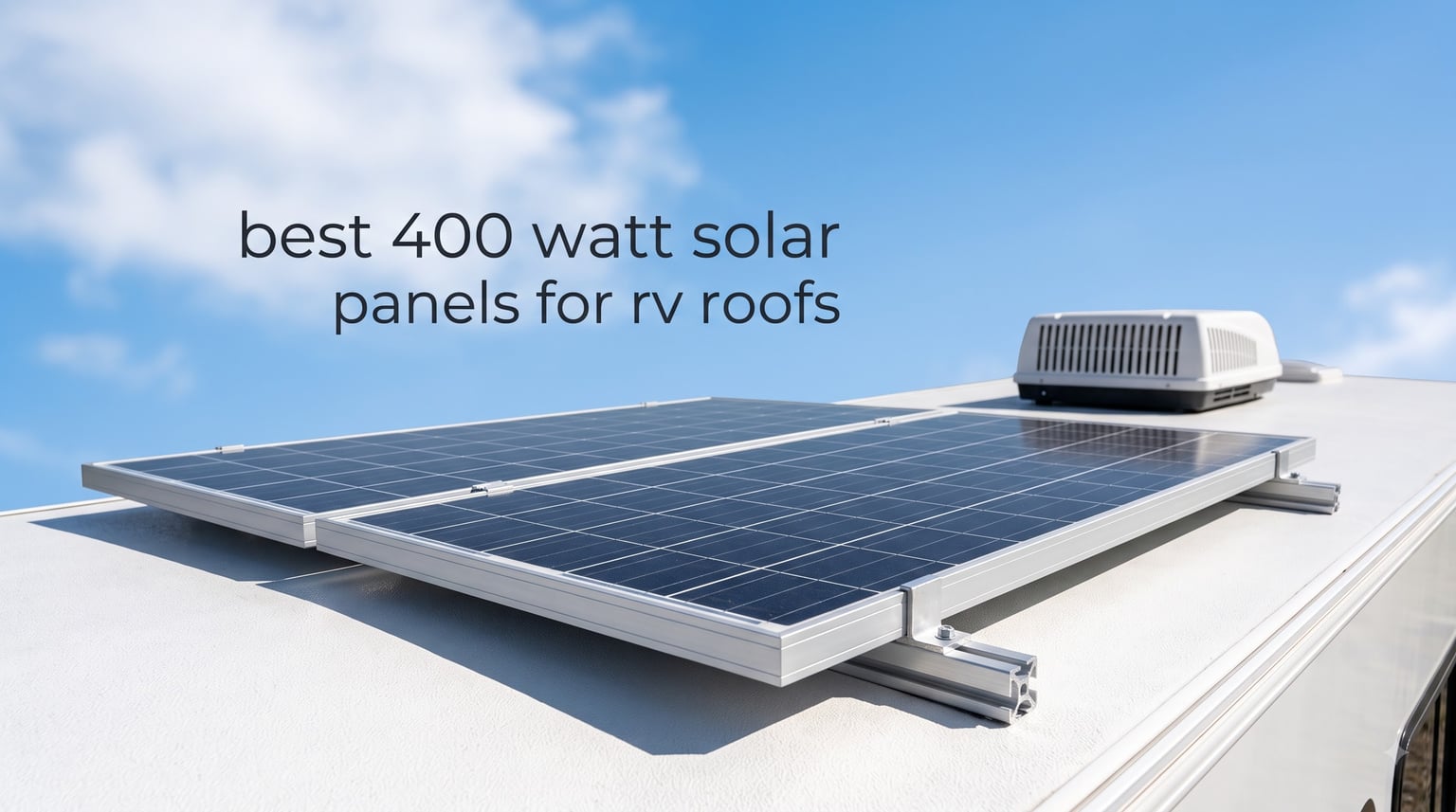
I have spent the last three camping seasons helping friends and family wire solar onto camper vans, travel trailers and one very stubborn fifth wheel. Almost every one of those builds landed on the same wattage: 400 watts. That is the sweet spot where an RV roof still has room to spare, the batteries finish charging on a decent sun day, and the generator stays in the storage bay. This guide covers the best 400 watt solar panels for RV roofs in 2026, drawn from the eight panels we would actually bolt to our own rigs.
Every pick here uses N-type or A+ monocrystalline cells, because that is where RV solar has moved. We tracked peak wattage against the nameplate rating, weighed each panel format against real roof geometry, and read hundreds of owner reports across the vandwelling and DIY solar forums. One pattern repeated everywhere: measured output matters more than brochure numbers, and that principle drove our ranking.
Set expectations before you buy. A 400 watt array on an RV roof typically delivers 240 to 320 watts at solar noon and 1,600 to 2,400 watt-hours per day in good conditions. That runs lights, a 12V fridge, fans, device charging and a coffee maker. It will not run an air conditioner, and nobody selling panels should tell you otherwise.
Table of Contents
Top 3 Picks for 400 Watts of RV Roof Solar in 2026
Out of eight panels, three earned the front of the battery bay. These are the ones I would put my own money behind, with badges matched to how people actually shop.

Callsun 400W N-Type Bifacial 2-Pack
- N-Type 16BB cells at 25% efficiency
- 420W+ real-world peaks
- Bifacial gain up to 30%

ECO-WORTHY 400W 4x100W N-Type Kit
- Four compact 100W panels
- 25% efficiency
- 449W reported output

Renogy 400W N-Type 16BB Pair
- 25% efficiency
- Fits 12V and 24V banks
- 25-year 80% output warranty
The Callsun pair takes the top spot because owners keep measuring above the rated number instead of below it, which is rare at any price. ECO-WORTHY wins on value since four small panels squeeze into roof shapes that laugh at big single panels. Renogy rounds out the podium with the strongest long-term warranty and a footprint sized for Class B vans.
Best 400 Watt Solar Panels for RV Roofs in 2026
Here is the full field, all eight panels ranked side by side. Pay attention to the format column, because two 200W panels, four 100W panels and one large single panel mount very differently on a curved roof.
| Product | Specifications | Action |
|---|---|---|
| Callsun 400W N-Type Bifacial 2-Pack |
|
Check Latest Price |
| Renogy 400W N-Type 16BB Pair |
|
Check Latest Price |
| ECO-WORTHY 400W 4x100W N-Type Kit |
|
Check Latest Price |
 JJN 425W Bifacial N-Type Panel JJN 425W Bifacial N-Type Panel |
|
Check Latest Price |
 DOKIO 400W Monocrystalline Panel DOKIO 400W Monocrystalline Panel |
|
Check Latest Price |
 Renogy 400W Bifacial N-Type Pair Renogy 400W Bifacial N-Type Pair |
|
Check Latest Price |
 AeternaSol 400W 18BB Bifacial Pair AeternaSol 400W 18BB Bifacial Pair |
|
Check Latest Price |
 AeternaSol 400W 25.2% N-Type Pair AeternaSol 400W 25.2% N-Type Pair |
|
Check Latest Price |
Five of these arrive as two 200W panels, the easiest format to carry up a ladder and arrange around roof vents. One ships as four 100W panels for odd-shaped roofs. Two come as a single large panel, which means fewer connections but a two-person lift.
1. Callsun 400W N-Type Bifacial 2-Pack – Best Real-World Output
- Owners measure 420W+ peaks above rated output
- Bifacial backsheet adds up to 30% more power
- Strong shade tolerance from dual-module design
- Light and compact for Class B vans
- 10-year support plus 25-year performance warranty
- Included cables run short for some roof layouts
- Shipping box can arrive dented
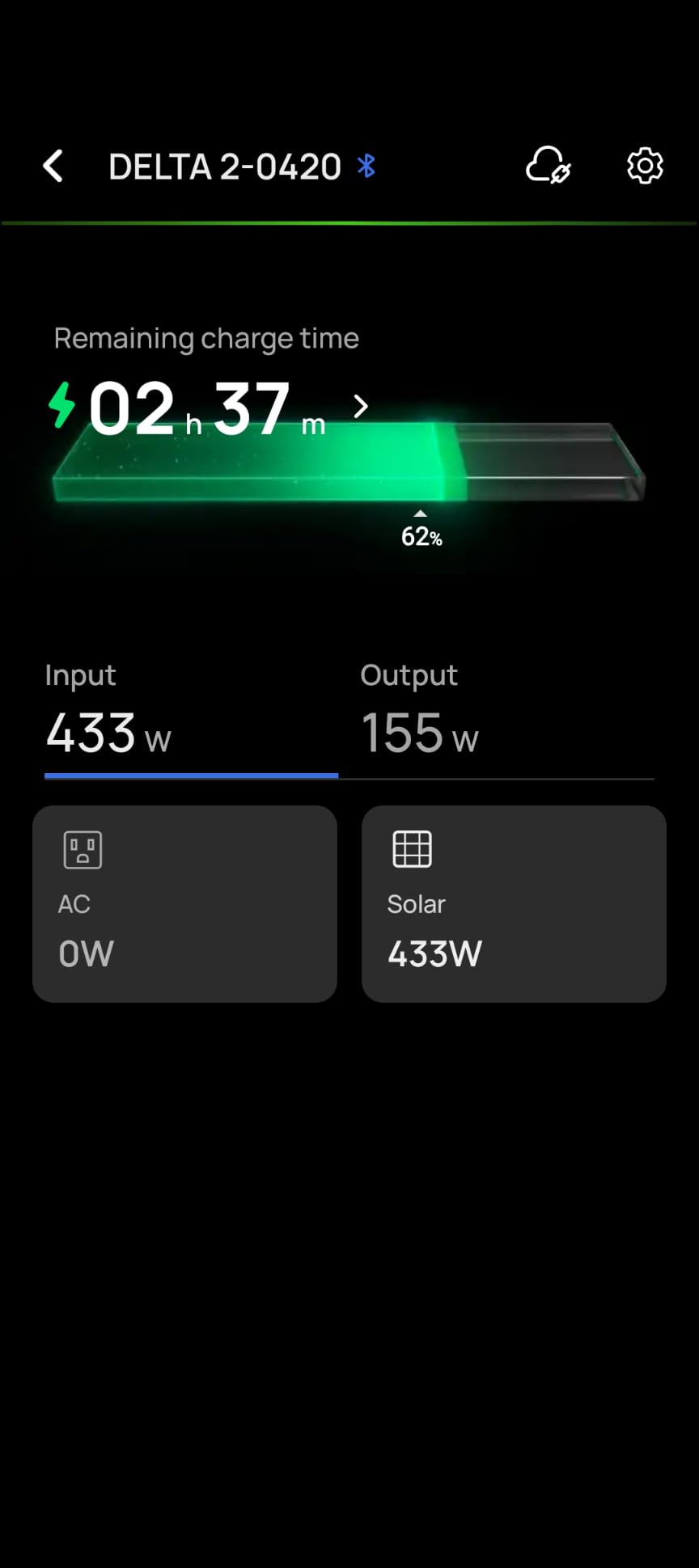
Out of every panel in this guide, the Callsun pair is the one I would bolt to my own van first. The reason is boring and important: it does what the label says. Across 218 reviews at a 4.8 average, owners keep posting clamp-meter readings north of 420 watts at peak, the opposite of the usual solar story where a 400 watt panel produces 270 watts and everyone shrugs.
The twin-panel format is also the friendliest for a first install. Two panels at 51.3 by 30.3 inches each are simple to carry up a ladder, simple to position around a fan or antenna, and simple to wire in parallel if your controller prefers lower voltage.
The bifacial backsheet is the first technical trick. The rear side captures light bouncing off a white RV roof membrane, and Callsun rates the gain at up to 30 percent. On a real fiberglass roof expect 10 to 15 percent, which is still free energy on hot afternoons.
The second trick is the dual-module parallel layout, where each panel runs as two independent halves. A shadow from the air conditioner shroud kills one half instead of the whole panel, quietly recovering watt-hours on a trailer where shade crawls across the roof all day.
The cells are N-type with 16 busbars at 25 percent efficiency, and the -0.3 percent per kelvin temperature coefficient beats most older P-type panels. That matters on a black rooftop in August, and it is a real part of why this set ranks first among the best 400 watt solar panels for RV roofs in actual summer conditions.
Charge controller sizing for this pair
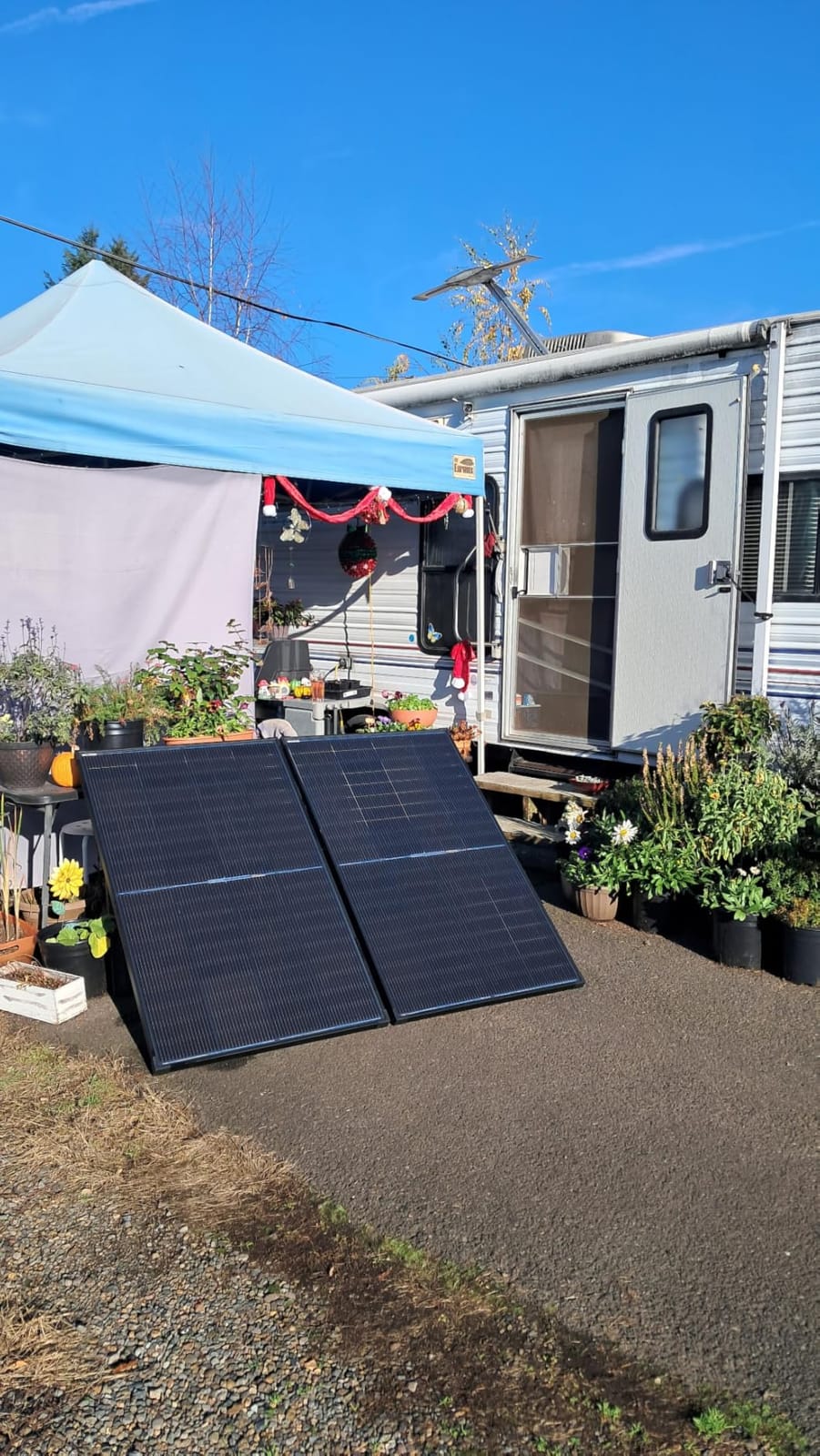
Each panel runs at roughly 27 volts open circuit, so two in series feed the controller about 55 volts. A 30 to 40 amp MPPT controller handles that comfortably on a 12 volt bank. Skip PWM here, because it would waste about a third of the harvest from these high-voltage panels.
Roof fit and weight check
Plan on about 22 square feet of clear roof for the pair plus walking room during installation. That fits most Class B and Class C roofs without crowding the vent or antenna zones, and the 23.8 pound listed weight keeps the whole job manageable for one person.
2. Renogy 400W N-Type 16BB Pair – Best for Class B Van Roofs
- Renogy build quality and support network
- Compact footprint sized for Class B vans
- Works with lithium
- AGM and deep-cycle banks
- Very low degradation at 0.4% annually after year one
- 25-year 80% output warranty
- Output drops in weak or hazy light
- Panels sit slightly taller than the previous generation
Renogy is the brand that shows up in every boondocking thread for a reason, and this N-Type pair is its most van-friendly 400 watt set yet. The headline is dimensional: 7.5 percent smaller and 11.7 percent lighter than the panels they replaced. On a Sprinter or Transit roof where every inch is spoken for, that shrink is the difference between fitting two panels and fitting one plus a vent.
The 16BB cell layout hits 25 percent efficiency, matching the best panels here. One owner detail I trust: a reviewer running twelve of these on a single roof reported the array sturdy through highway speeds and storms. That is far beyond 400 watts, but it tells you the frames and glass hold together, which is the failure mode that actually ends RV installs.
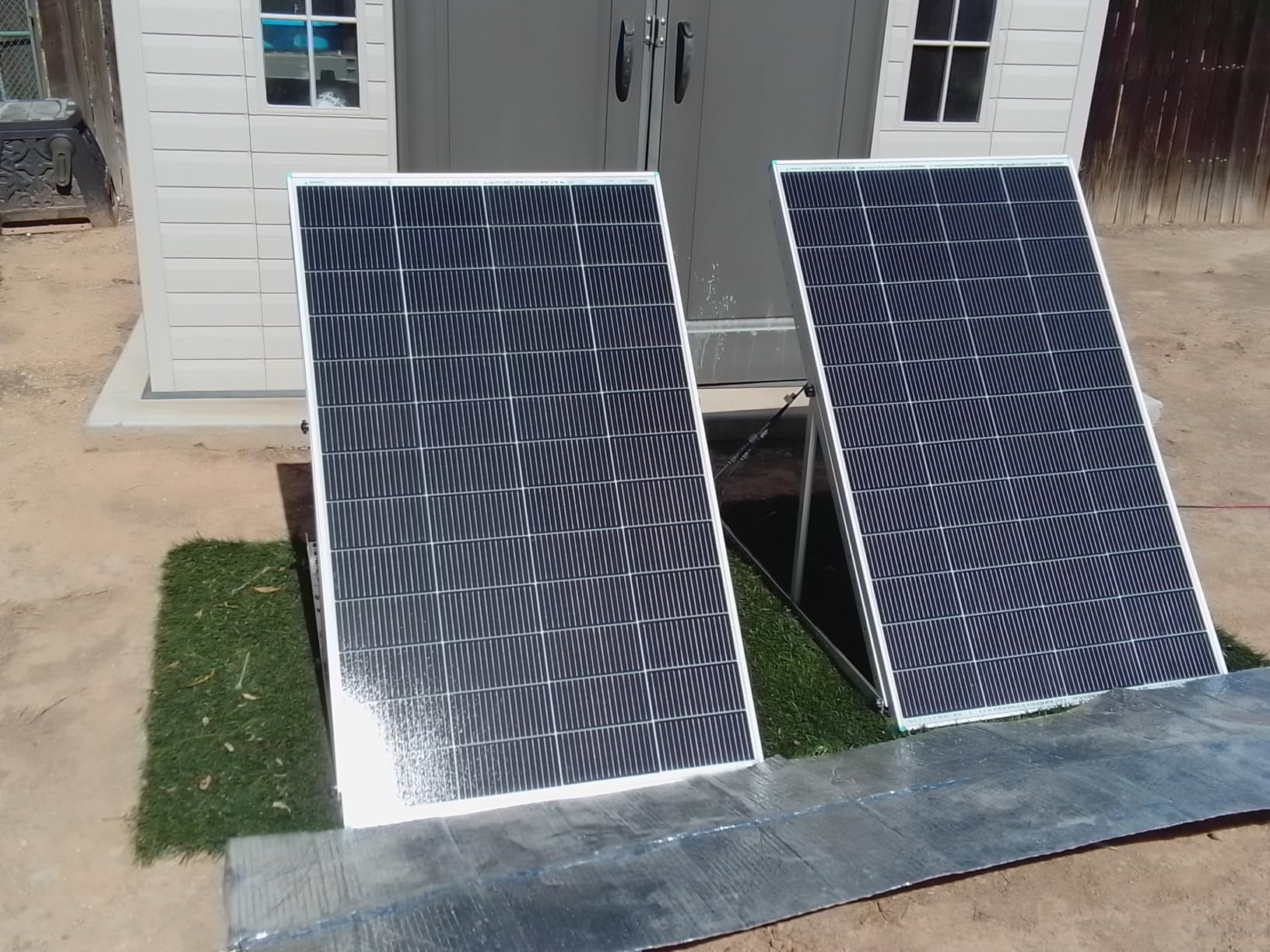
The degradation curve is where the premium money goes. These lose at most 1 percent of output in year one and 0.4 percent per year after, so they should still produce 80 percent of rated power in year 25. That promise is written into a transferable warranty from a company with a long support history.
Compatibility is equally broad, with support for 12 volt and 24 volt banks across lithium, AGM and flooded lead-acid. That flexibility matters if you plan to upgrade from 12V to 24V later without replacing the panels.
The honest weak point is gray-sky behavior. Several owners report softer-than-expected output on overcast mornings and low winter sun, so if you camp mostly in cloudy regions, the bifacial sets in this guide hold up better.
Fitting the pair on a Class B roof
Each panel measures 49.7 by 30.1 inches, so two side by side span about five feet of roof width. Mount them forward of the fan and behind the antenna, and confirm the 1.2 inch frame height clears any rack crossbars before you drill.
Wiring for 12V or 24V banks
In series the open-circuit voltage reaches about 75 volts, which suits many 30 amp MPPT controllers but exceeds cheap units. In parallel you stay near 37 volts and double the current, so size the roof-to-controller wire for roughly 14 amps and keep the run short.
3. ECO-WORTHY 400W N-Type 4-Pack – Best Budget RV Solar Kit
- Lowest cost per watt in this guide by a wide margin
- Four small panels fit around vents and curved sections
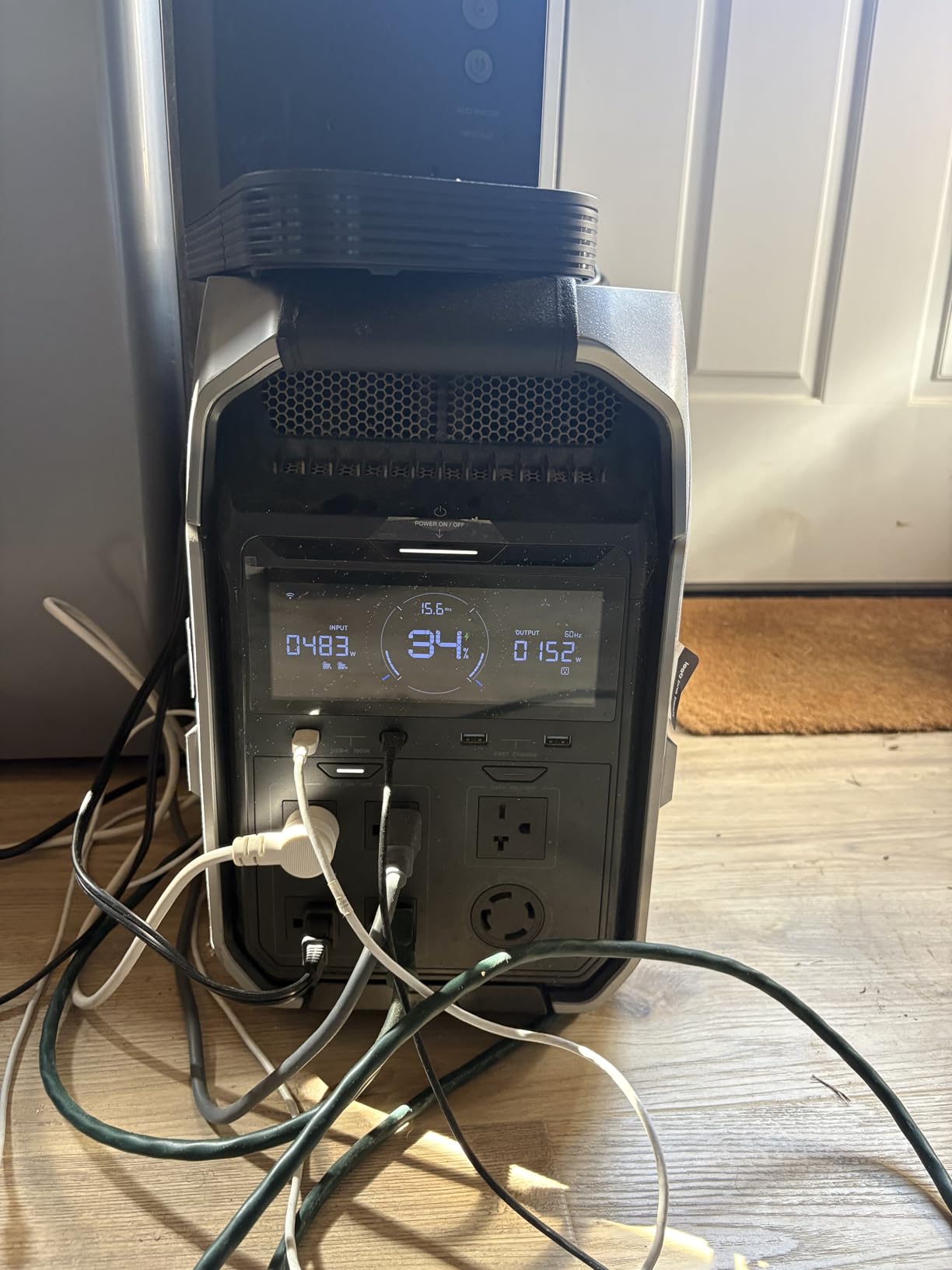
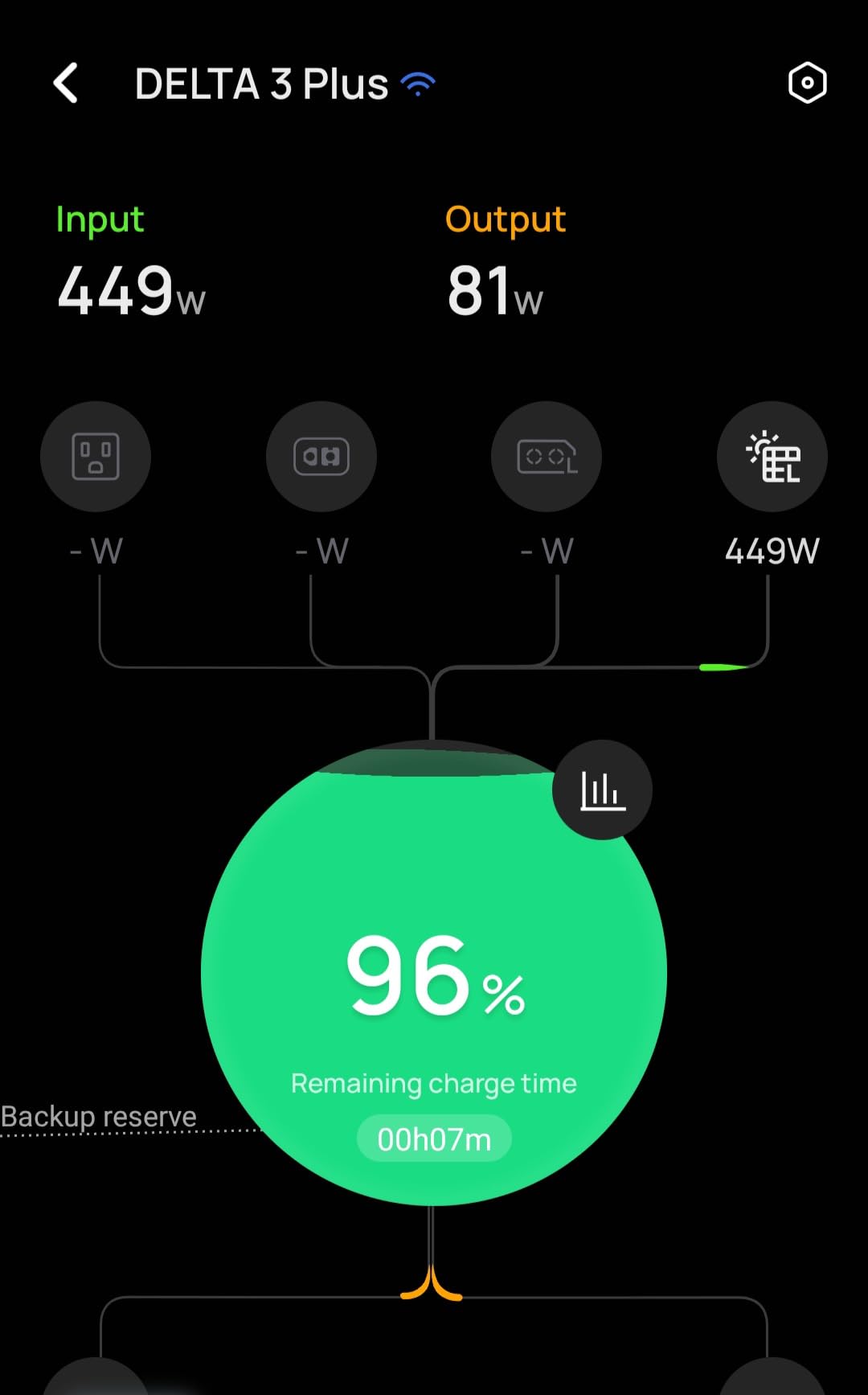
- Owner measured 449W from the full set
- Plug-and-play MC4 connections
- Good low-light performance
- Ships as two separate boxes that can arrive days apart
- Needs series-parallel wiring knowledge for best output
The ECO-WORTHY four-pack answers the most common RV roof problem: geometry. Big panels assume a big flat roof, but real rigs have a fan here, an antenna there and a curved corner that ruins everything. Four 100 watt panels at 35.6 by 23 inches each slot into leftover spaces like puzzle pieces, which is exactly how a friend’s Scamp trailer reached 400 watts with zero roof modifications.
The value is backed by the largest review base in this guide at 597 ratings and a 4.6 average. One owner documented 449 watts from a nominally 400 watt set in strong sun, and similar reports repeat through the review section. These are genuine N-Type 16BB cells at 25 percent efficiency, not last-generation stock in new packaging.
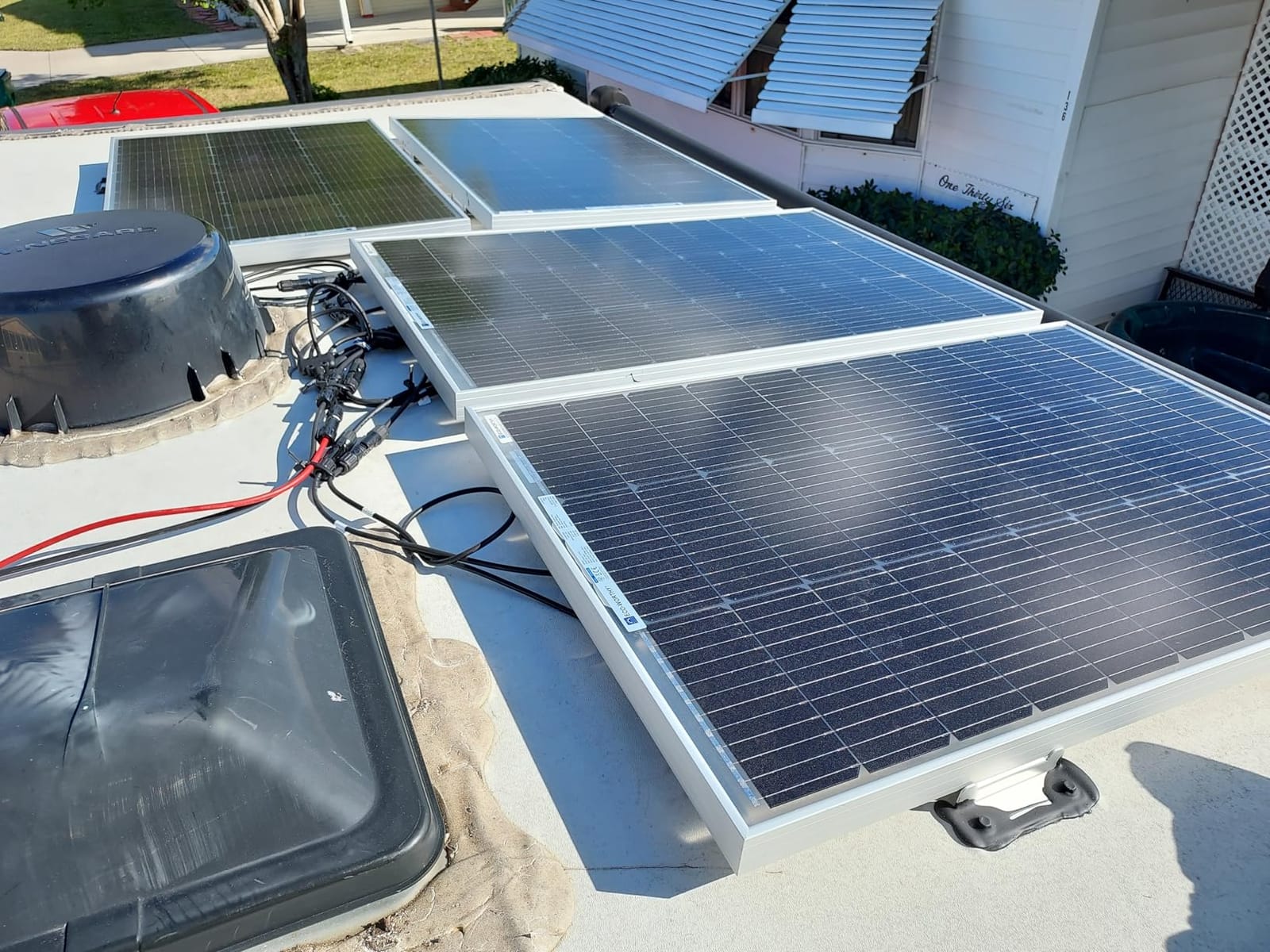
Installation favors first-timers. Each panel carries a 35 inch pre-installed cable with MC4 connectors, so panels snap together with no crimping on the roof. The 1.18 inch frame stays slim, which helps heat dissipate and keeps a low profile under tree branches.
Low-light behavior is better than the price suggests. Several owners specifically note usable harvest on overcast days, which is where cheap panels usually fall apart.
Know the trade before buying. You will place sixteen mounting feet instead of eight, and you should understand series versus parallel wiring to configure the array for your controller. If you want one box and one decision, this is not your kit.
Series versus parallel with four panels
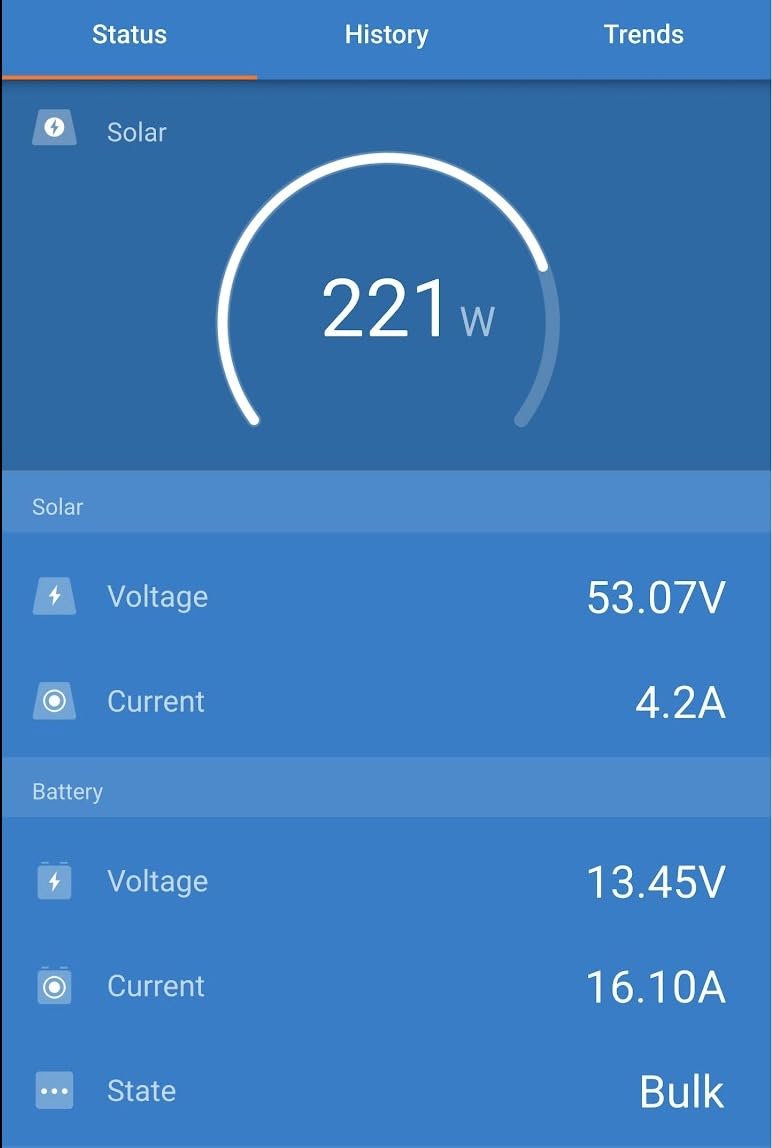
All four in series pushes open-circuit voltage near 100 volts, beyond many budget controllers. The standard approach is two series strings of two panels wired in parallel, giving roughly 50 volts and 20 amps, a comfortable match for a 30 amp MPPT unit.
What else you need to buy
This is panels only, so add Z-brackets or corner mounts, roof sealant, branch connectors for the parallel join, and a charge controller. Even with those added, the total lands well below most two-panel 400 watt kits.
4. JJN 425W Bifacial N-Type Panel – Best Warranty
- 30-year transferable output warranty
- longest in this guide
- UL 61730 safety certification
- Rated for 2400Pa wind and 5400Pa snow loads
- Black corrosion-resistant frame
- 425W from one panel means fewer connections
- 51.6 pounds makes it a two-person ladder job
- Panel only
- mounting hardware sold separately
JJN takes a different bet than everyone else here: one big panel instead of a pair. At 425 watts it gives you a little headroom over the 400 watt target, with bifacial N-Type construction and 16 busbars keeping efficiency at 25 percent. The transparent backsheet harvests reflected light off a light-colored roof, the same rear-side trick as the Callsun set.
The reason to choose this panel is the 30-year transferable warranty, five years longer than anything else in this guide. Transferable matters more than people realize, because if you sell the rig the coverage follows it and becomes a selling point. UL 61730 certification matters too, since it is a safety listing some campgrounds and insurers ask about.
Load ratings are genuinely overkill for a mobile roof, at 2400Pa wind and 5400Pa snow. Nothing on an RV will challenge those numbers, but panels live through hail and highway debris, and this frame is built for that abuse.
Owners at 471 reviews and a 4.5 average praise the build quality and weather sealing, with IP65 on the junction box and IP68 on the connectors. The recurring complaint is simply that hardware is not included, so brackets and sealant are a separate order.
Be realistic about the physical job. At 44.7 by 67.8 inches and 51.6 pounds, this is a full-size panel, and getting it up a ladder takes two people on a calm day. Once mounted it is superb, but installation day is real work.
Mounting a 51.6 pound panel solo
If you must go alone, rest the panel on a ladder rack or hoist it with a strap and pulley rather than carrying it. Never carry a panel this size flat in wind, because it acts like a sail at the top of a ladder.
Reading the 30-year transferable warranty
Long warranties promise a percentage of original output at set milestones, and transfers usually require notifying the manufacturer within a window after sale. Register the serial number the week you install it and keep the receipt.
5. DOKIO 400W Monocrystalline Panel – Best Single-Panel Simplicity
DOKIO 400W Solar Panel, 31V Monocrystalline, for 24V Off-Grid Systems
- One panel replaces four 100W units
- Fewer connections and fewer failure points
- 9.84 ft cable gives routing freedom
- Tempered glass and aluminum frame
- Good match for 24V systems and power stations
- Lowest rating in this guide at 4.1 stars
- Some owners report output below rated wattage
- Needs an MPPT controller to perform
- Large size makes handling awkward
DOKIO makes the case for the simplest possible install: one panel, two wires, done. Replacing four 100 watt panels with a single 400 watt unit turns sixteen mounting feet into eight and six MC4 connections into two. For anyone who has chased a bad crimp across a roof in the rain, that simplicity is worth real money.
The included 9.84 foot cable is a quiet advantage on taller rigs. Most panels give you three feet and force a splice on the roof, the least reliable place for a connection, while this one runs straight to an entry gland and down to the controller.
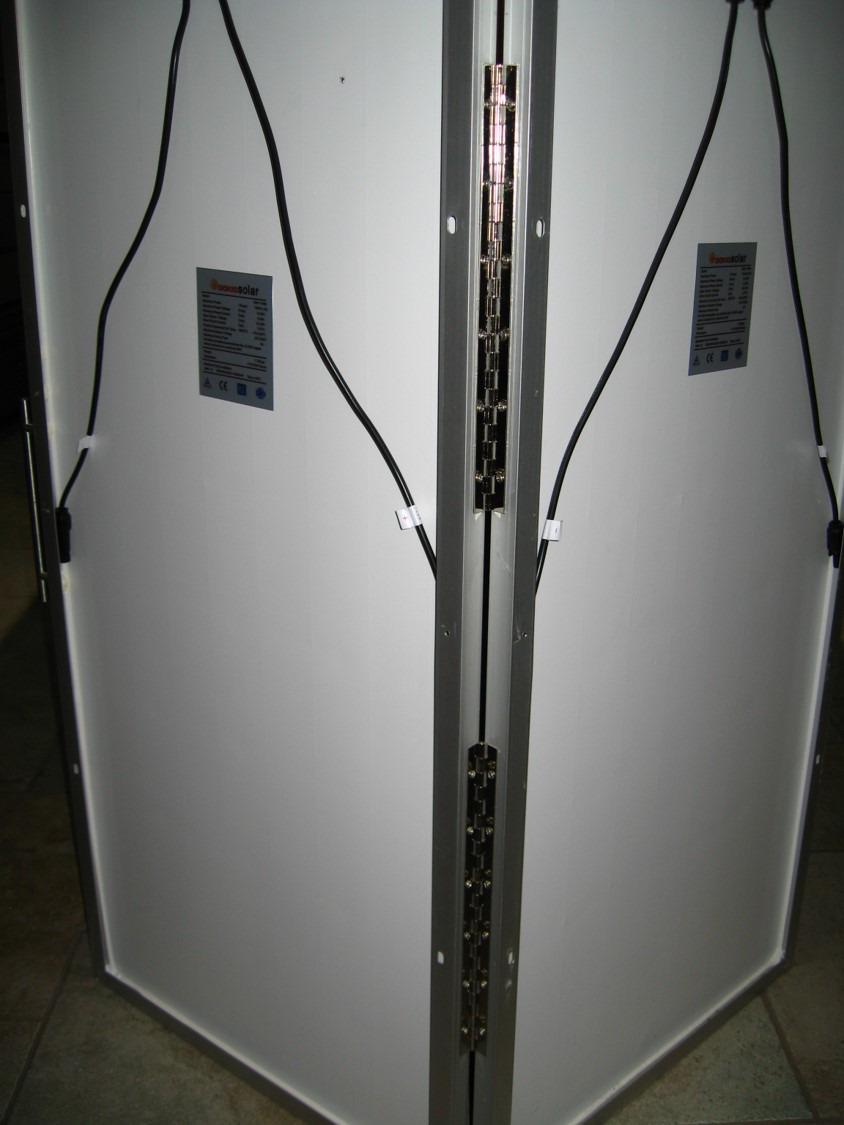
Now the honesty paragraph, because this panel carries the lowest rating in the guide at 4.1 stars across 488 reviews. Reports split between owners seeing 330 watts plus and owners measuring well under the rated number.
Reading the pattern, the unhappy reviews tend to involve PWM controllers or undersized wiring, both of which cripple a high-voltage panel. Treat the MPPT requirement as absolute, since this panel runs at 31 volts and a PWM controller on a 12 volt bank silently discards everything above battery voltage.
On the correct 24 volt off-grid system it was designed for, performance lands where it should, and the tempered glass plus aluminum frame have held up well for owners across varied climates. Pair it right and it is a bargain; pair it wrong and you will blame the panel.
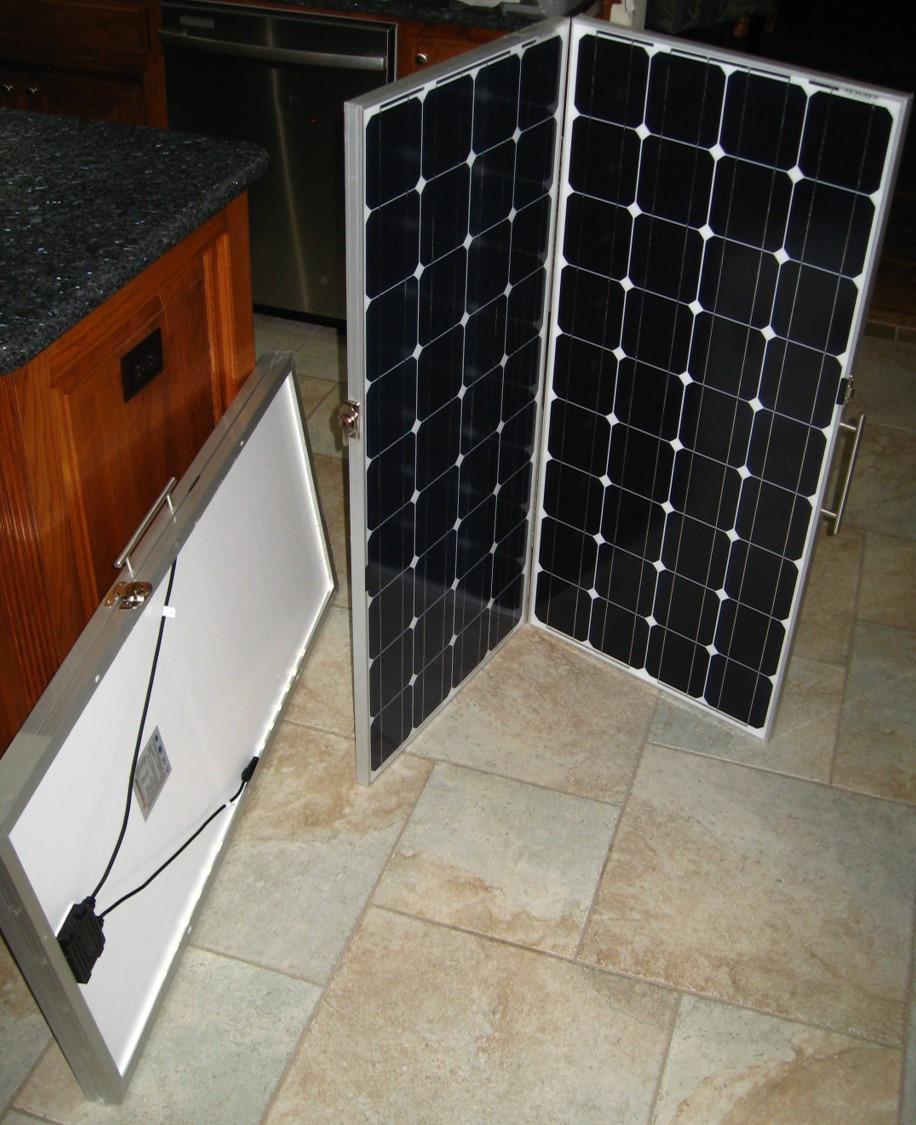
Controller requirements for the 31V output
Use an MPPT controller rated for at least 100 volts input. On a 24 volt bank this panel feeds a 20 amp class controller almost perfectly, while on 12 volts the output current doubles, so size wiring and fusing for the conversion.
Where a single big panel makes sense
Flat Class A roofs, cargo trailer conversions and campsites with a ground mount are natural homes for this format. Curved van roofs and vent-crowded trailers are not, because a 68 inch panel cannot bend or weave around obstacles.
6. Renogy 400W Bifacial N-Type Pair – Best for Partial Shade
Renogy Bifacial Solar Panel 400W N-Type, 16BB 25% High-Efficiency
- Dual-module parallel design resists shade losses
- Bifacial rear side adds up to 30% more energy
- Lightest 400W set in this guide
- Renogy brand support and 10-year product warranty
- 78% of reviews are five-star
- Some frames arrived with shipping damage
- Higher cost per watt than most rivals here
If your camping style involves trees, this is your set. Most rigs spend part of every day with one roof section shaded by a branch, a neighboring rig or their own air conditioner. Renogy’s dual-module parallel wiring splits each panel into two independent halves, so shading one half costs you half of one panel instead of the entire string.
The pair is also the lightest 400 watt setup here at a listed 22.7 pounds. Weight matters more than new installers expect, both on ladder day and for payload on vans already near their limit, and at 30.1 by 51.7 inches each these fit the same footprint class as the Callsun panels.
Owner sentiment runs strongly positive at 4.4 stars with 78 percent five-star ratings. The recurring praise is exactly what you would hope: good harvest in partial shade and a painless install.
The recurring complaint is shipping, with a few owners receiving tweaked frames from rough handling. Inspect both panels the day they arrive, because a bent corner can sometimes be straightened but glass stress cracks mean a return.
The other cost is literal, since these carry a higher price per watt than most rivals here. You are paying for the shade-tolerant wiring plus Renogy’s support line, and for forest campers that trade works out.
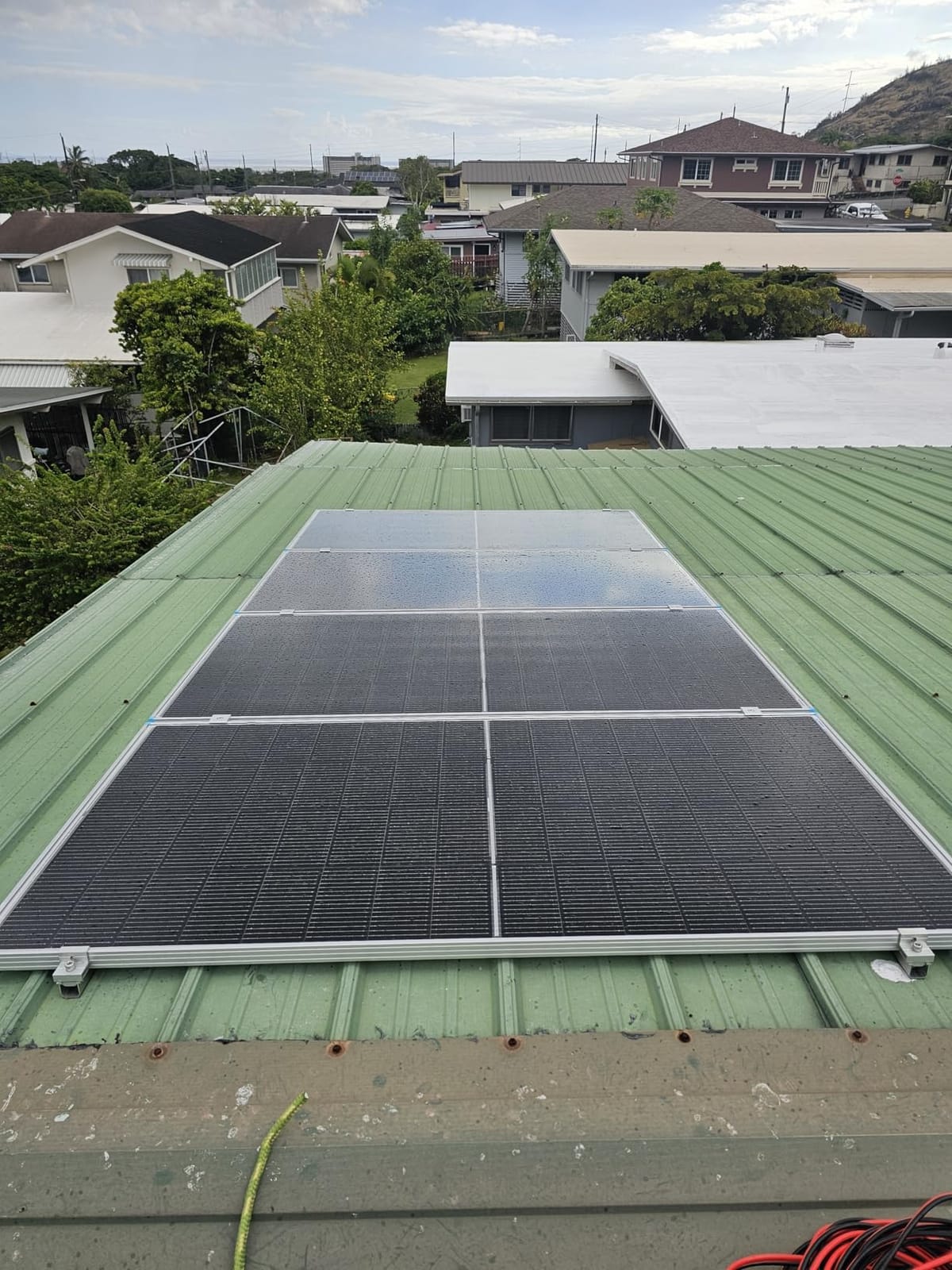
Getting real bifacial gain on an RV roof
Bifacial output depends on reflection beneath the panel, so mount with at least a two inch standoff and keep the roof membrane clean. A white or gray EPDM roof reflects far more than dark rubber, and a dirty roof can cut rear-side gain nearly to zero.
Shade performance at real campsites
With one panel half shaded, expect roughly 70 to 80 percent of unshaded output rather than the 50 percent a standard series-wired panel delivers. That difference is why shade-heavy campers keep recommending this exact design.
7. AeternaSol 400W 18BB Bifacial Pair – Best Budget Bifacial Upgrade
AeternaSol 400w Solar Panel,2pcs 200 Watt Bifacial Solar Panel,12V N-Type
- Lowest price in this entire guide
- 18 busbars with silver-containing full welding
- Reverse current blocking diodes protect each panel
- Quality 11 AWG oxygen-free copper wiring
- IP68 waterproof rating
- Only 13 reviews so far
- too new to judge longevity
- One-year warranty is the shortest here
AeternaSol is the newest name in this lineup, and this pair is the cheapest 400 watt kit in the guide. What caught my attention is that the low price does not come from old cell stock: you get A+ grade N-Type cells with 18 busbars, one more than the 16BB standard, plus silver-containing full welding on the joints for better conductivity.
The pair is remarkably light at a listed 19.6 pounds, with each panel a slender 26.4 inches wide. That narrow footprint genuinely helps on trailers where the roof narrows toward the front, and it makes ladder carries easy for one person.
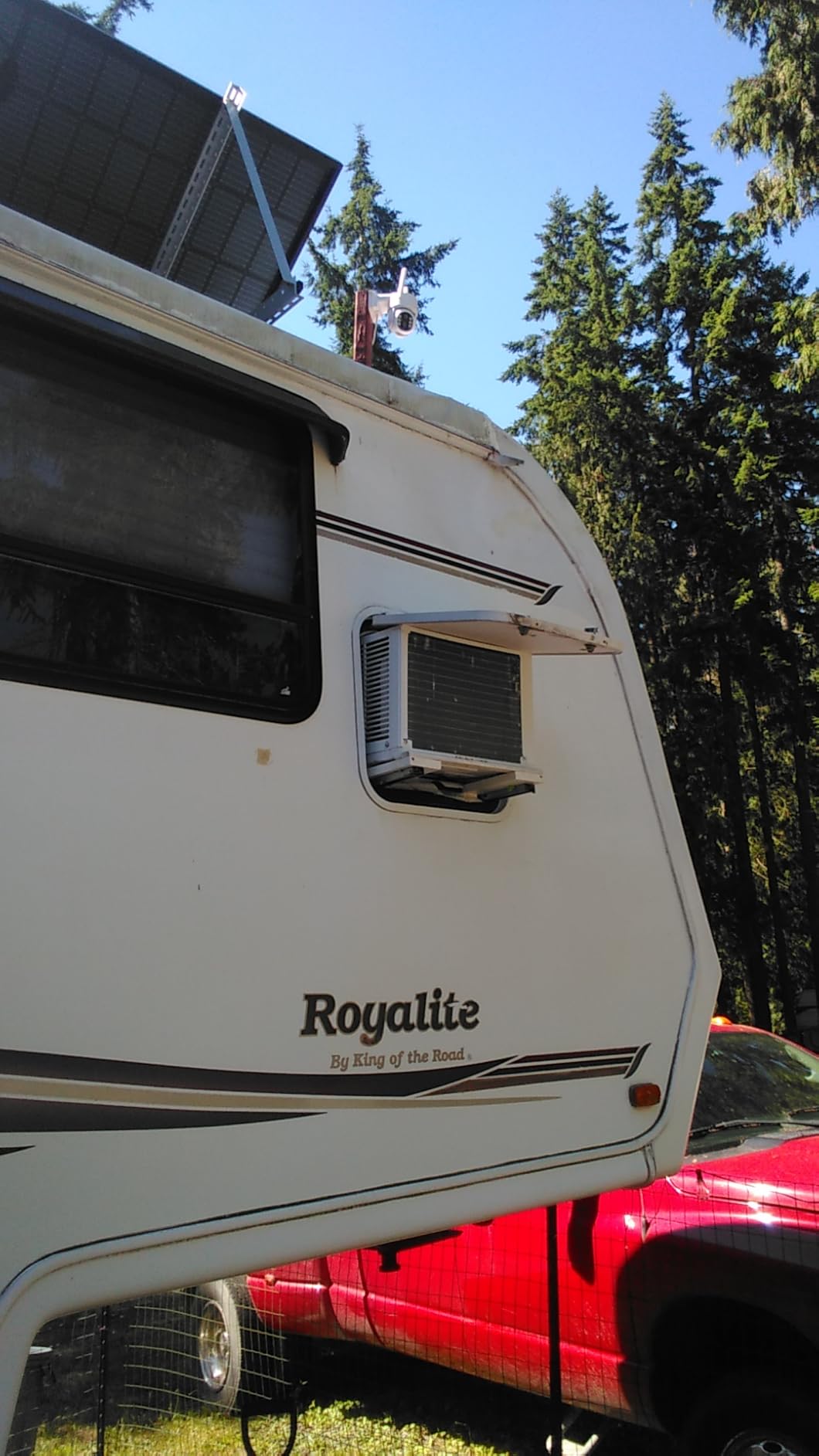
Early owners are happy, with 84 percent five-star ratings among the first 13 reviews. The feedback tracks closely with what buyers say about pricier bifacial sets: output close to spec, solid build, straightforward MC4 hookup.
The engineering details are better than the price implies. Reverse-current blocking diodes protect each panel at night, and the 11 AWG oxygen-free copper leads reduce voltage drop on longer roof runs.
Thirteen reviews is still thirteen reviews. I would not talk anyone out of this pair, because the early data is good and the cells are current, but if you want a decade of owner history before trusting a roof full of electronics, the Callsun or Renogy sets carry it.
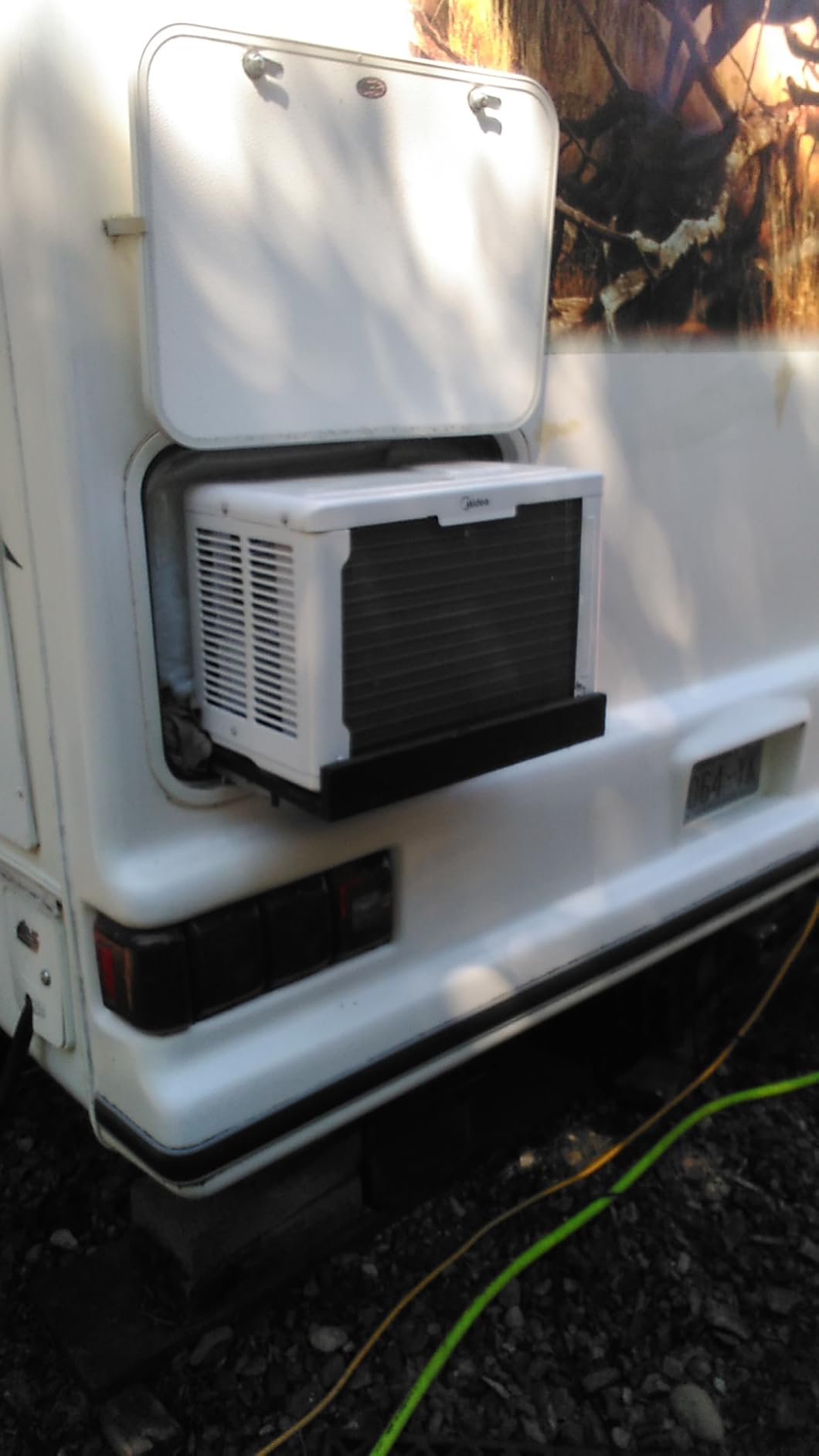
What a 13-review track record means
Small samples swing hard, since three unhappy buyers move the average far more than on a 500-review product. Read the newest reviews rather than the overall score, and buy the Prime-shipped listing so a return costs you nothing but time.
Warranty and support expectations
Coverage runs one year with 24/7 tech support, the shortest here. That is a fair trade for the price, but it makes the first months matter most, so meter-test both panels before mounting while an exchange is still easy.
8. AeternaSol 400W 25.2% N-Type Pair – Highest Efficiency Rating
400W Solar Panel, 12V 2Pcs 200 Watt Solar Panels, 25.2% High-Efficiency
- Highest efficiency in this guide at 25.2%
- Very low degradation at 0.4% annually after year one
- IP68 with potted electronics against vibration
- Bifacial design adds up to 15% more energy
- Joint-best rating here at 4.8 stars
- Does not include mounting hardware
- A few owners noted quality control inconsistencies
This is the pair for people who want the most electricity from the least roof. At 25.2 percent cell efficiency it edges out every other panel here, and it carries the joint-highest rating in this guide at 4.8 stars. When roof space is your binding constraint, that efficiency gap is not spec-sheet bragging, it is extra watt-hours from the same footprint.
The durability numbers deserve attention too. Degradation is rated at no more than 1 percent in year one and 0.4 percent per year after, matching the Renogy pair and beating most budget panels by a wide margin. The IP68 junction box uses potting compound to encapsulate the electronics, a detail that matters on a rig that vibrates down the interstate for hours.
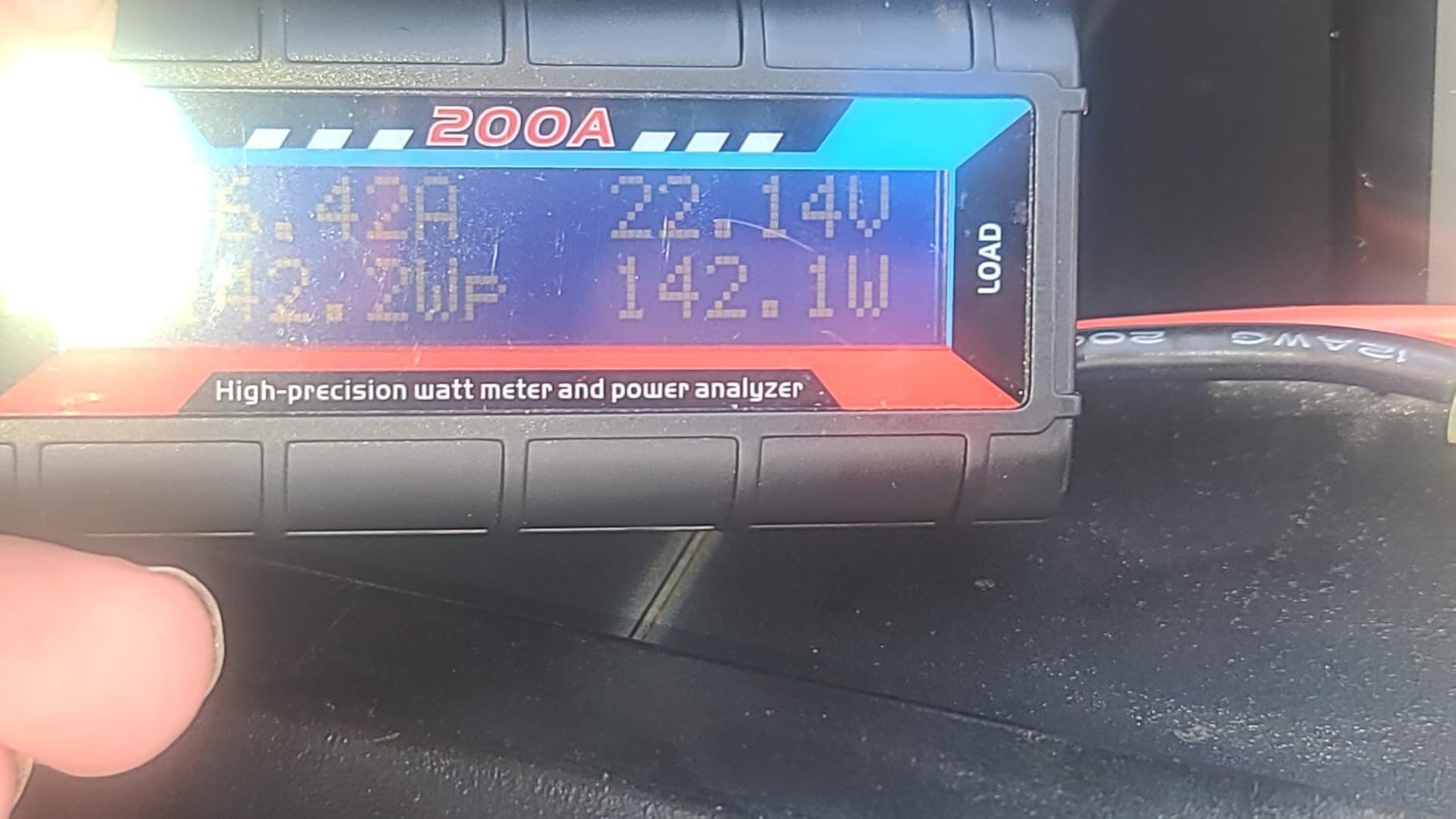
Owners report output close to or above rated wattage, the same encouraging pattern as the Callsun set. The 3.2mm tempered glass and anti-corrosion aluminum frame feel a tier above the price when you unbox them.
Bifacial gain here is rated at up to 15 percent from reflected light, more modest than the 30 percent claims elsewhere but consistent with what mobile roofs actually deliver.
Two cautions. Mounting hardware is not included, so budget for brackets and sealant, and with only 16 reviews a couple of owners flagged minor variation between panels. Meter-test both before they go on the roof.
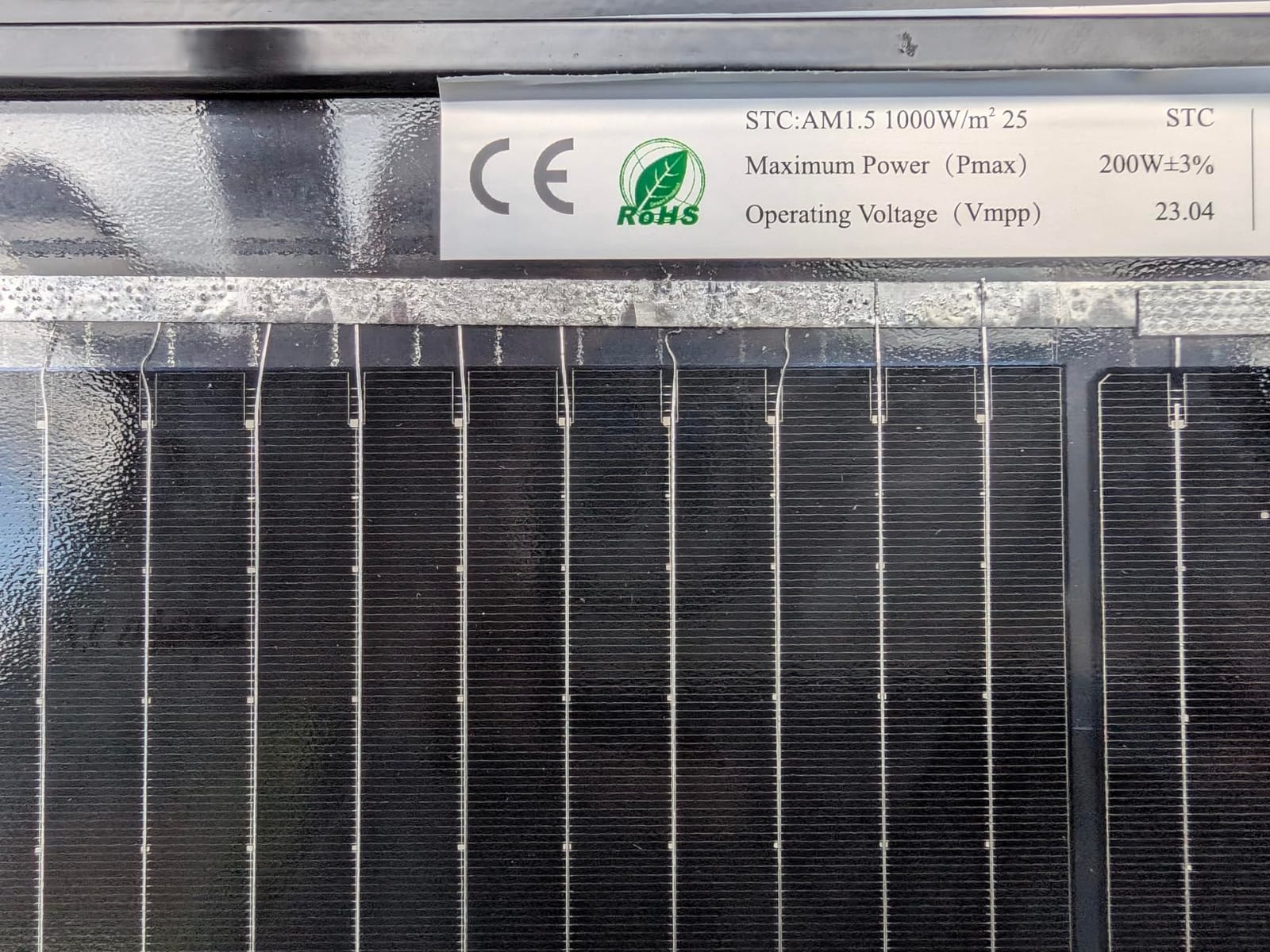
Where the extra efficiency actually helps
Efficiency matters most when roof area, not budget, is your limit. Moving from 23 to 25.2 percent frees roughly the output of a small portable panel from the same space, so if you still have empty roof after that, you did not need the upgrade.
Planning your mounting hardware
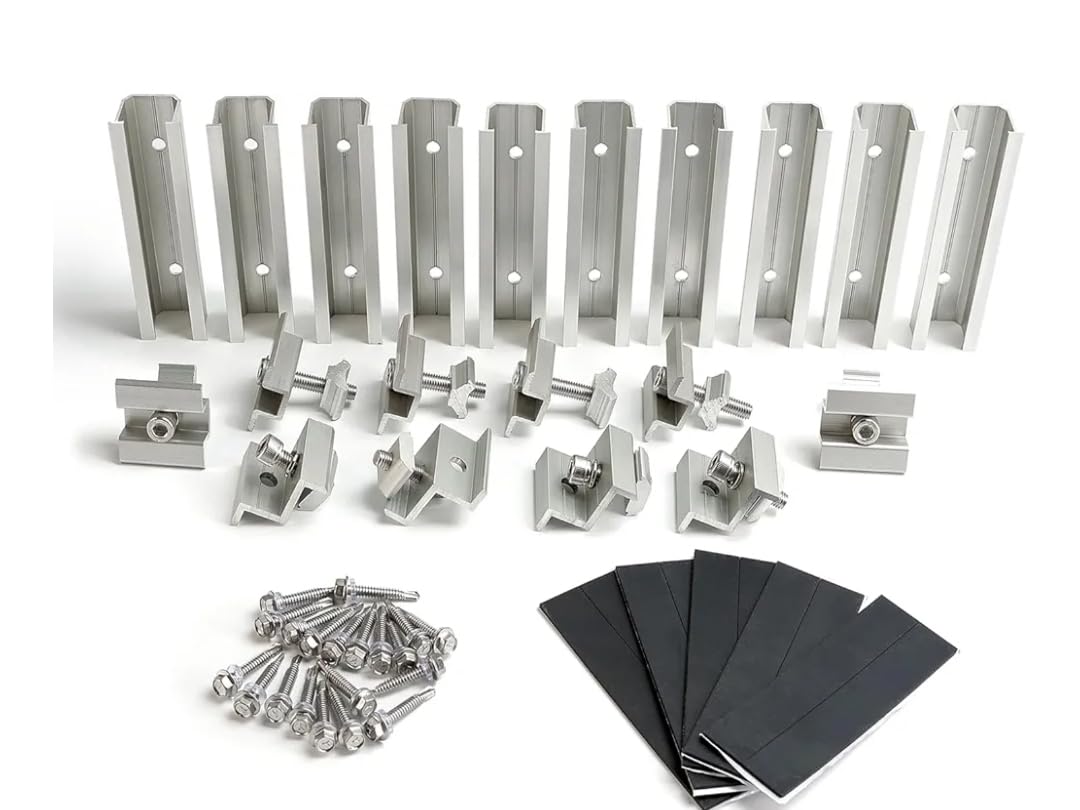
Pick up eight Z-brackets or two sets of corner and side mounts, stainless hardware, and butyl or dicor sealant for eight attachment points across the pair. Vibration-isolating mounts are worth the small added cost on rigs that see rough roads.
How to Choose 400 Watt Solar Panels for an RV Roof?
Choosing among these eight panels comes down to five decisions, and none of them involve the wattage printed on the box. Here is how I work through it with friends planning their first off-grid solar setup.
Real-world output versus rated wattage
The gap between rated and delivered watts is the biggest frustration in every forum thread. Panels are flashed at 77 degrees Fahrenheit under Standard Test Conditions, while your roof passes 140 degrees in summer, and every degree above that rating costs output. That is why owners routinely see a 400 watt array producing 270 watts at noon, and why the -0.3 percent per kelvin coefficient on N-Type cells matters more than any other spec on the page.
Plan around daily energy instead of peak watts. Most boondockers report 1,600 to 2,400 watt-hours per day from a well-mounted 400 watt array, which is 100 to 150 amp-hours into a 12 volt bank. Panels that owners measure at or above rating, like the Callsun and AeternaSol sets, close the gap between promise and delivery.
Roof space math for 400 watts
Two 200 watt panels cover about 22 square feet of roof, four 100 watt panels about 23, and a single large panel about 21. Add clearance for walking during installation plus spacing around vents and the antenna, and plan on 28 to 30 square feet of usable roof for a clean layout.
Measure the actual roof and mark where shade falls from the air conditioner before ordering. Broken-up roof space favors the four-panel ECO-WORTHY kit, while narrow van roofs suit the 26.4-inch-wide AeternaSol panels.
N-Type versus P-Type cells
Every panel in this guide uses N-type cells, and that is deliberate. N-Type silicon shows almost no light-induced degradation, holds a better temperature coefficient in heat, and resists the moisture-driven failures that shortened older P-type panel life. There is no good reason to buy P-type for a roof that lives outdoors year-round.
The difference compounds over years. A P-type panel can lose 2 to 3 percent of output in year one, while the Renogy and AeternaSol N-Type panels lose at most 1 percent, and the annual gap keeps widening from there. Busbar count helps too, since 16BB and 18BB layouts shorten the current path on each cell and cut resistive losses.
MPPT versus PWM controllers for 400 watts
At 400 watts, MPPT is not optional. A PWM controller connects the panel straight to the battery and wastes every volt above battery voltage, which on these high-voltage panels can be a third of your harvest, while MPPT tracks the maximum power point and converts the excess into extra charging current.
Sizing is simple arithmetic. Four hundred watts into a 12 volt bank produces about 33 amps at full output, so use a 40 amp MPPT controller; on a 24 volt bank that drops to roughly 17 amps and a 20 amp unit covers it. Always check the open-circuit voltage of your wiring plan against the controller input limit, because series strings add up fast.
Rigid versus flexible panels, and airflow
Every panel here is rigid, and that is a choice worth defending. Flexible panels lie against hot roofing membrane, cannot shed heat, and commonly lose output and lifespan to sustained heat, while rigid panels in an aluminum frame stand off the roof and cool themselves with airflow.
Standoff height is the cheapest performance upgrade in RV solar. A gap of two to three inches lets air flush heat away and can recover 5 to 10 percent of output on hot days compared to flush mounting, so never lay panels directly on rubber membrane. Flexible still makes sense under strict weight limits or on heavily curved surfaces, but rigid wins on watts per dollar over the system’s life.
Warranty and brand support
Warranty terms here range from one year to thirty. JJN leads at 30 years transferable, Renogy backs its N-Type pair for 25 years to 80 percent output, and the budget AeternaSol pair covers one year. Match the term to how long you will keep the rig, and remember a transferable warranty adds resale value.
Check what the warranty actually promises. Product warranties cover defects while performance warranties guarantee a percentage of output at set years, and the best panels publish both. A company with a real support line also matters more than the paper term when a junction box fails in year three.
Frequently Asked Questions
What is the best 400W solar panel for an RV?
The Callsun 400W N-Type bifacial pair is the best choice for most RV roofs, thanks to 25% efficient N-Type 16BB cells and owner-reported peaks above 420 watts. The two-panel format fits standard roofs, the dual-module design tolerates shade from vents and air conditioners, and it carries a 25-year performance warranty.
Is 400 watts of solar enough for an RV?
Yes, 400 watts covers the basics for most RV owners. A well-mounted 400W array produces roughly 1,600 to 2,400 watt-hours per day, or 100 to 150 amp-hours into a 12V battery bank. That runs LED lights, a 12V fridge, fans, device charging and a coffee maker, but it will not run an air conditioner, which needs several times more power.
What type of solar panels are most efficient for an RV roof?
N-Type monocrystalline panels are the most efficient choice for RV roofs, delivering 25% cell efficiency or better with 16 or 18 busbars. They degrade slower, lose less output in heat than P-type panels, and bifacial versions capture up to 30% extra energy from light reflected off a light-colored roof.
How long will it take a 400W solar panel to charge a 100Ah battery?
About 3 to 4 peak sun hours for lithium and 4 to 5 hours for lead-acid. A 400W array delivers roughly 240 to 320 real-world watts in good conditions, or around 20 to 25 charging amps, so a 100Ah lithium bank going from 20% to full needs about 80Ah restored. Lead-acid charges slower because current tapers during the absorption stage.
Final Verdict on 400 Watt RV Roof Solar
After comparing the best 400 watt solar panels for RV roofs in 2026, the Callsun N-Type bifacial pair stands out as the top overall pick for hitting its rated numbers in the real world. ECO-WORTHY wins on value with the most flexible roof-fitting format, and the Renogy N-Type pair is the safe premium choice with the strongest brand support and a 25-year output warranty.
Match the format to your roof before you match the brand to your budget: two panels for clean roofs, four panels for crowded ones, one big panel if you never want to think about it again. Add a 40 amp MPPT controller, mount with a two inch standoff gap, and meter-test everything before it goes on the roof.
Then spend your first night off-grid with the generator silent. That is the whole point, and it never gets old.