
Some movies entertain you. Others follow you home, sit at the foot of your bed, and refuse to leave. This list is about that second category.
The 25 most disturbing movies ever made are films that combine extreme content with real craft, pushing viewers past shock into something harder to shake. This ranked guide covers the most notorious entries in extreme cinema, from Pasolini’s Salò and Pascal Laugier’s Martyrs to modern nightmare-fuel like Hereditary and The House That Jack Built, with viewing tiers, content warnings, and context for each pick.
I’ve spent a long time in the weirder corners of cinema, and I’ve watched every film on this list (mostly so you can decide whether you want to). Some of these are genuine masterpieces. Some are self-indulgent trash that still haunt people decades later. A few are both at once. What they share is the ability to mess with you in a way a jump-scare slasher simply cannot.
Below you’ll find a complete quick-glance table, a difficulty tier system so you know what you’re walking into, the full ranked 25, and answers to the most common questions people search for about disturbing cinema.
Table of Contents
Quick-Glance Table: The 25 at a Glance
| Rank | Title | Year | Director | Country | Core Disturbance |
|---|---|---|---|---|---|
| 1 | Salò, or the 120 Days of Sodom | 1975 | Pier Paolo Pasolini | Italy | Systematic degradation |
| 2 | A Serbian Film | 2010 | Srđan Spasojević | Serbia | Exploitation allegory |
| 3 | Martyrs | 2008 | Pascal Laugier | France | Philosophical torture |
| 4 | Cannibal Holocaust | 1980 | Ruggero Deodato | Italy | Found footage / real animal deaths |
| 5 | Irreversible | 2002 | Gaspar Noé | France | Reverse-chronology assault |
| 6 | Antichrist | 2009 | Lars von Trier | Denmark | Grief and genital horror |
| 7 | The Human Centipede 2 | 2011 | Tom Six | Netherlands/UK | Nihilistic shock |
| 8 | Audition | 1999 | Takashi Miike | Japan | Slow-burn needle scene |
| 9 | Requiem for a Dream | 2000 | Darren Aronofsky | USA | Addiction spiral |
| 10 | The Exorcist | 1973 | William Friedkin | USA | Religious horror |
| 11 | A Clockwork Orange | 1971 | Stanley Kubrick | UK | Moral vertigo |
| 12 | Hereditary | 2018 | Ari Aster | USA | Family trauma |
| 13 | The House That Jack Built | 2018 | Lars von Trier | Denmark | Artful serial killing |
| 14 | Funny Games | 1997 | Michael Haneke | Austria | Fourth-wall cruelty |
| 15 | Threads | 1984 | Mick Jackson | UK | Nuclear dread |
| 16 | Men Behind the Sun | 1988 | T.F. Mou | Hong Kong | War-crime gore |
| 17 | I Spit on Your Grave | 1978 | Meir Zarchi | USA | Extended assault |
| 18 | The Last House on the Left | 1972 | Wes Craven | USA | Rape-revenge exploitation |
| 19 | Eraserhead | 1977 | David Lynch | USA | Oppressive atmosphere |
| 20 | Happiness | 1998 | Todd Solondz | USA | Humanizing the monster |
| 21 | The Act of Killing | 2012 | Joshua Oppenheimer | Denmark/UK | Real killers re-enacting |
| 22 | Oldboy | 2003 | Park Chan-wook | South Korea | Revenge reveal |
| 23 | I Saw the Devil | 2010 | Kim Jee-woon | South Korea | Revenge brutality |
| 24 | Inside | 2007 | Alexandre Bustillo & Julien Maury | France | Pregnancy slasher |
| 25 | Eden Lake | 2008 | James Watkins | UK | Feral-youth horror |
How I Selected These Movies
Every “disturbing movies” list is subjective. I used four criteria to keep this one honest:
- Actual impact. Does the film genuinely mess with viewers, not just gross them out?
- Notoriety. Has it been banned, censored, walked-out-on, or culturally infamous?
- Craft. Pure shock without skill ages badly. I weighed technique and intent.
- Breadth. I included gore-heavy shockers, slow psychological horror, documentaries, and art cinema so the list reflects the whole spectrum of “disturbing.”
Pure provocation for its own sake (think most of the Guinea Pig series) gets less weight than films where the disturbance is doing real dramatic or thematic work.
A Quick Viewer Difficulty Guide
Not every person reading this should start at #1. Disturbing cinema has tiers, and walking in without calibration is how you end up regretting a movie night for months.
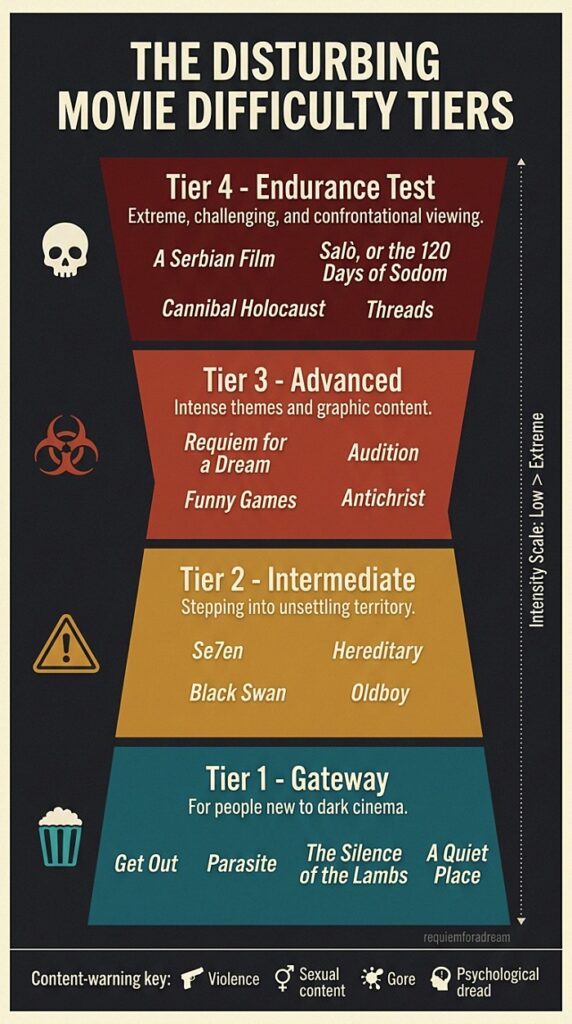
Tier 1: Gateway disturbing. Requiem for a Dream, Hereditary, The Exorcist, Oldboy. Intense, emotionally heavy, sometimes gory, but not transgressive in content.
Tier 2: Intermediate. A Clockwork Orange, Funny Games, Audition, The House That Jack Built, Eden Lake. You start to feel the line being crossed. Psychological weight builds.
Tier 3: Advanced. Martyrs, Irreversible, Antichrist, Inside, I Saw the Devil, Threads. Sustained brutality, heavier themes, longer aftertastes. These are where the word “disturbing” actually earns its job.
Tier 4: Endurance test. Salò, A Serbian Film, Cannibal Holocaust, The Human Centipede 2, Men Behind the Sun. You should know exactly what you’re signing up for. A lot of people watch these once, some people never finish, and some never should start.
A simple rule: if you’ve only ever seen mainstream horror, start in Tier 1 and see how you feel. Don’t start with Salò on a random Tuesday.
The 25 Most Disturbing Movies Ever Made
1. Salò, or the 120 Days of Sodom (1975)
The default answer to “what is the most disturbing movie ever made,” and for good reason. Pier Paolo Pasolini transplanted the Marquis de Sade’s novel into the dying days of fascist Italy, in which four powerful libertines imprison 18 teenagers and subject them to 120 days of systematic sexual, psychological, and scatological degradation. It was banned widely on release and only cleared for UK distribution in 2000. What makes Salò endure isn’t the shock content, which is genuinely extreme. It’s how coldly political the film is. Pasolini was murdered just weeks before its release, which gave the film a permanent, queasy aura.
Why it’s disturbing: The power dynamic is the horror. Everything unfolds with bureaucratic calm. Watch if you’re ready for: Art film intensity, not jump scares.
2. A Serbian Film (2010)
Srđan Spasojević’s A Serbian Film is the single most requested “test” movie in modern extreme cinema, and also the one I most often tell people to skip. A washed-up adult film star agrees to a mysterious art project and gets pulled into a snuff-film conspiracy. The scenes that pushed it into international infamy, which I won’t describe in detail, crossed lines most films won’t even approach. The director has insisted the film is a political allegory about Serbia’s post-war trauma. Whether that justifies it is the debate that has followed the film for over a decade.
Why it’s disturbing: The infamous “newborn” scene alone is a psychic injury. Watch if you’re ready for: Probably nothing can fully prepare you.
3. Martyrs (2008)
Pascal Laugier’s Martyrs is the crown jewel of the New French Extremity, and arguably the best film on this list. It starts as a rape-revenge story, pivots into home-invasion horror, and then spirals into something closer to metaphysical inquiry. The final act, in which a woman is methodically broken down in pursuit of a glimpse of what lies beyond death, is the most punishing sequence in serious genre cinema. Unlike most extreme films, Martyrs is genuinely about something. The brutality has a thesis.
Why it’s disturbing: The emotional exhaustion. By the end you’re not watching, you’re enduring. Watch if you’re ready for: Smart brutality with a philosophical payoff.
4. Cannibal Holocaust (1980)
Ruggero Deodato essentially invented found footage four decades before The Blair Witch Project, and the gimmick was so convincing that Italian courts briefly charged him with making a real snuff film. He had to produce his living actors in court to avoid murder charges. The film’s enduring problem isn’t the staged gore, it’s the unstaged gore. Real animals were killed on camera, and no amount of social commentary retroactively justifies it. Cannibal Holocaust remains banned in some countries as of 2026 and is one of the most notorious titles in exploitation history.
Why it’s disturbing: Real animal cruelty, presented as entertainment. Watch if you’re ready for: Deep ethical discomfort.
5. Irreversible (2002)
Gaspar Noé built Irreversible in reverse chronology, which means the film opens with its most brutal scenes and walks backwards toward a peaceful morning you know is about to be destroyed. A nine-minute assault in a Paris underpass is the scene most people remember, along with a fire-extinguisher murder that opens the film. Noé shot the whole thing on low-frequency infrasound designed to make audiences nauseous. It worked. Walkouts were extensive at Cannes.
Why it’s disturbing: Sustained scenes with almost no cuts give you nowhere to look away. Watch if you’re ready for:Extreme formal experimentation that earns its difficulty.
6. Antichrist (2009)
Lars von Trier’s Antichrist is a two-hander between Willem Dafoe and Charlotte Gainsbourg as a couple grieving the death of their young son. He’s a therapist, she’s inconsolable, and his attempts to treat her at a remote cabin collapse into violence, self-mutilation, and possibly the supernatural. The final act’s body-horror content is as extreme as anything ever put in a “serious” art film. Gainsbourg won Best Actress at Cannes for it, which says something about both the performance and the appetite of festival audiences.
Why it’s disturbing: It uses the vocabulary of prestige cinema to deliver gutter-level shocks. Watch if you’re ready for:Grief, genital horror, and von Trier being von Trier.
7. The Human Centipede 2: Full Sequence (2011)
Tom Six’s original Human Centipede was grotesque but watchable. The sequel is a willfully uglier, black-and-white meta-nightmare in which a disturbed fan of the first film tries to recreate it with 12 victims. Full Sequence was initially refused classification by the BBFC in the UK, an extremely rare outcome. The film is short on meaning, long on degradation, and earns its place here purely on the strength of how aggressively unpleasant it is.
Why it’s disturbing: It’s nihilism as a filmmaking philosophy. Watch if you’re ready for: Bleak, boring cruelty with no real payoff.
8. Audition (1999)
Takashi Miike’s Audition spends its first hour as a delicate, almost romantic drama about a widower who stages a fake movie audition to find a new wife. Then the last twenty minutes happen. The piano wire and needle sequence is one of the most infamous in modern horror, and it works because Miike earned the tonal whiplash through patient build-up. This is the most recommendable film in the top ten: genuinely great cinema that happens to include one of the most winced-at scenes ever filmed.
Why it’s disturbing: The contrast. You forget what genre you’re in until it’s too late. Watch if you’re ready for: Slow-burn Japanese horror with a payoff that earns its reputation.
9. Requiem for a Dream (2000)
Darren Aronofsky’s addiction drama isn’t “disturbing” in the exploitation sense, but ask anyone who’s seen it and they’ll tell you the final montage broke something in them. Four characters chase different versions of the American Dream through heroin, diet pills, and television, and all four endings land with crushing specificity. The infamous final sequence, intercut between all four leads, is scored by Clint Mansell’s now-iconic “Lux Aeterna.” This is as close as mainstream cinema gets to genuine cruelty.
Why it’s disturbing: You watch real human beings dissolve in real time. Watch if you’re ready for: Emotional demolition with a perfect score.
10. The Exorcist (1973)
William Friedkin’s The Exorcist has been softened by half a century of parody and reference, but the original release caused fainting, vomiting, and lines around the block. The central performance from Linda Blair, combined with Dick Smith’s makeup work and Mercedes McCambridge’s possessed-voice performance, still lands harder than most modern horror. It’s here because for millions of viewers, this was their first brush with genuinely disturbing cinema, and because the crucifix scene is still deeply transgressive.
Why it’s disturbing: Religious horror weaponized against a child. Watch if you’re ready for: Something more patient than modern horror will train you for.
11. A Clockwork Orange (1971)
Stanley Kubrick’s adaptation of Anthony Burgess’s novella is more morally disorienting than viscerally shocking. Alex is a violent teenage sociopath, and the film asks what happens when the state “cures” him through behavioral conditioning. The home-invasion sequence set to “Singin’ in the Rain” is the scene most remembered, but the Ludovico technique scenes in the second half are where the film gets truly claustrophobic. Kubrick personally withdrew the film from UK distribution in 1973 after threats and copycat crimes. It wasn’t officially a ban, and it returned after his death in 1999.
Why it’s disturbing: It makes you sympathize with a monster, then punishes you for it. Watch if you’re ready for:Style-soaked violence with a political sting.
12. Hereditary (2018)
Ari Aster’s feature debut is the contemporary horror film most often cited as genuinely traumatizing by viewers who otherwise have a high tolerance. The Graham family’s grief, the telephone-pole sequence, and Toni Collette’s entire performance combine into something that feels less like a horror movie and more like a nervous breakdown caught on film. The final twenty minutes pivot into occult horror, but it’s the middle section, the emotional fallout of a specific, unimaginable loss, that does the real damage.
Why it’s disturbing: It treats grief as a haunting. Both are true. Watch if you’re ready for: Slow, intense family horror that escalates without warning.
13. The House That Jack Built (2018)
Lars von Trier returns to this list with a two-and-a-half-hour provocation about a serial killer (Matt Dillon) walking a Virgil-like figure through his greatest hits while debating art, evil, and ego. Walkouts at Cannes were widely reported. The film is structured in five “incidents,” one of which involves a family hunting trip that is the most quoted reason viewers bail. Von Trier is explicitly daring you to keep watching, and daring the audience is the entire point.
Why it’s disturbing: The self-awareness. Jack is von Trier, and he knows you know. Watch if you’re ready for: Art-film cruelty with occasional dark humor.
14. Funny Games (1997)
Michael Haneke’s Austrian original and his shot-for-shot English-language 2007 remake are both on the table. Two polite young men knock on a lake-house door, borrow eggs, and then take a family hostage for a night of arbitrary, sadistic games. The trick is that the film repeatedly breaks the fourth wall, addressing the audience directly to accuse us of wanting the violence we paid to see. It is one of the few films on this list explicitly designed to punish its own viewer.
Why it’s disturbing: The film thinks you’re the problem, and it might be right. Watch if you’re ready for: Cold, clinical violence with a thesis.
15. Threads (1984)
Mick Jackson’s BBC television film about a nuclear strike on Sheffield is the most depressing movie on this list, and arguably the most realistic. There are no heroes, no rescues, and no hopeful ending. The film tracks Britain’s collapse from the first detonation through years of radiation sickness, a medieval second wave, and a final, silent scene of a disfigured baby being born into a broken world. Nothing matches it for sustained dread.
Why it’s disturbing: It’s a simulation, not a story. It feels like a documentary from a timeline that didn’t happen. Watch if you’re ready for: Something that will change how you read news headlines.
16. Men Behind the Sun (1988)
T.F. Mou’s Hong Kong production dramatizes the real atrocities of Japan’s Unit 731, which conducted biological warfare experiments on Chinese, Russian, and Korean prisoners during World War II. The film is a mix of staged extreme violence and allegedly real autopsy footage. The frozen-arm sequence, in which a prisoner’s limbs are immersed in ice water and then boiled before the skin is peeled off, is the scene that makes most viewers stop. The film is banned or heavily cut in multiple countries to this day.
Why it’s disturbing: It’s based on things that really happened, and it does not soften them. Watch if you’re ready for:Historical horror with no artistic distance.
17. I Spit on Your Grave (1978)
Meir Zarchi’s rape-revenge exploitation film was called, in famous Roger Ebert’s review archive, a “vile bag of garbage,” and it has been repeatedly cited as one of the most gratuitously ugly films in mainstream distribution. The extended opening assault is sustained past the point of any dramatic purpose. What follows is a revenge fantasy whose grisliness is meant to balance the attack but mostly just extends the same queasy atmosphere. Its place in the disturbing-movie canon is permanent, whether you think it deserves defense or not.
Why it’s disturbing: Unflinching length. The attack sequence refuses to end. Watch if you’re ready for: Old-school exploitation with no guardrails.
18. The Last House on the Left (1972)
Wes Craven’s feature debut, loosely based on Ingmar Bergman’s The Virgin Spring, is another rape-revenge shocker that trades gloss for ugliness. Its graphic scenes kept it out of UK cinemas and earned it a place on the infamous BBFC video nasties list during Britain’s 1980s censorship panic. The revenge sequence, in which the family of the victims turns on the killers, is the part Craven was really interested in, and it’s arguably uglier than anything that came before.
Why it’s disturbing: A young Wes Craven’s unfiltered style. Everyone looks broken. Watch if you’re ready for: Grimy early-70s filmmaking.
19. Eraserhead (1977)
David Lynch’s first feature isn’t bloody or violent in the conventional sense, and that’s exactly why it belongs here. Eraserhead is a five-year labor of anxiety about new fatherhood, rendered in rumbling, oppressive black and white. The deformed baby sequence, in particular the moment its swaddling is cut, is the jolt most viewers remember, but the real damage is the overall atmosphere. It’s a film you dream rather than watch.
Why it’s disturbing: Pure tonal dread. The feeling never lifts. Watch if you’re ready for: An experimental film that rewires how you process image and sound.
20. Happiness (1998)
Todd Solondz’s suburban ensemble black comedy is here because of what it refuses to flinch from. Bill Maplewood is a pediatrician, a father, and a pedophile, and Solondz refuses to caricature him. The film gives Bill moments of ordinary humanity, including a confession scene with his son that is as quietly horrifying as anything on this list. The disturbance isn’t in what’s shown, it’s in who’s allowed to be a person.
Why it’s disturbing: It humanizes people we’d rather reduce to monsters. Watch if you’re ready for: Uncomfortable empathy.
21. The Act of Killing (2012)
Joshua Oppenheimer’s documentary is the strangest film on this list. Oppenheimer asked the real perpetrators of Indonesia’s 1965 anti-communist massacres to re-enact their own killings in the style of the Hollywood movies they loved. They said yes. The result is an un-classifiable document of memory, denial, and cinema’s complicity in both. Anwar Congo, a cheerful elderly man who personally killed hundreds of people, slowly begins to realize during filming what he actually did. The final scene will not leave your head.
Why it’s disturbing: It’s real. Everyone on camera actually did what they say they did. Watch if you’re ready for: A documentary that interrogates its own form.
22. Oldboy (2003)
Park Chan-wook’s Oldboy is the most rewatchable film on this list, and the reveal in the third act is still one of the most genuinely upsetting twists in contemporary cinema. A man is imprisoned in a hotel room for 15 years without explanation, released, and given five days to figure out why. The single-take hammer corridor fight is the stylistic set piece, but the ending is the emotional wound. Spike Lee’s 2013 remake is not a substitute. The Korean original is one of the essential films of the century.
Why it’s disturbing: The reveal reframes every scene that came before. Watch if you’re ready for: A masterclass in revenge storytelling.
23. I Saw the Devil (2010)
Kim Jee-woon’s I Saw the Devil is a cat-and-mouse revenge thriller in which a secret agent hunts a serial killer, captures him, releases him, and hunts him again to draw out the torment. It’s essentially a philosophical question played out in blood: at what point does the pursuit of vengeance make you indistinguishable from the thing you’re chasing? The film gets more brutal as it goes, and the ending provides no comfort.
Why it’s disturbing: It argues that revenge is a trap, and shows you why. Watch if you’re ready for: Sustained, high-craft brutality from one of South Korea’s best genre directors.
24. Inside (2007)
Alexandre Bustillo and Julien Maury’s Inside is one of the purest distillations of the New French Extremity. A pregnant widow, days from giving birth, is stalked inside her own home on Christmas Eve by a woman (Béatrice Dalle) who wants to cut the baby out of her. That’s the entire plot. The escalation is relentless, the blood levels are operatic, and the final sequence is one of those scenes you only ever need to see once. It’s a film people respect more than they rewatch.
Why it’s disturbing: It is about the violation of a body most cinema protects. Watch if you’re ready for: High-volume blood and pure horror-film commitment.
25. Eden Lake (2008)
James Watkins’ Eden Lake is the most quietly upsetting film in the bottom half of this list. A young couple (Michael Fassbender and Kelly Reilly) go to a remote lake and are tormented, tortured, and hunted by a gang of teenage boys. The film’s real punch comes in the final minutes, when the origin of the kids’ behavior is revealed. It’s a British horror film about class, failure of community, and the impossibility of escape that doubles as one of the bleakest endings in the genre.
Why it’s disturbing: The ending removes any possibility of hope. Watch if you’re ready for: A short, sharp, realistic nightmare.
Extreme Cinema Movements: Where This Stuff Comes From
Most of the 25 above aren’t one-off anomalies. They belong to recognizable film movements that have shaped the vocabulary of disturbing cinema for half a century.
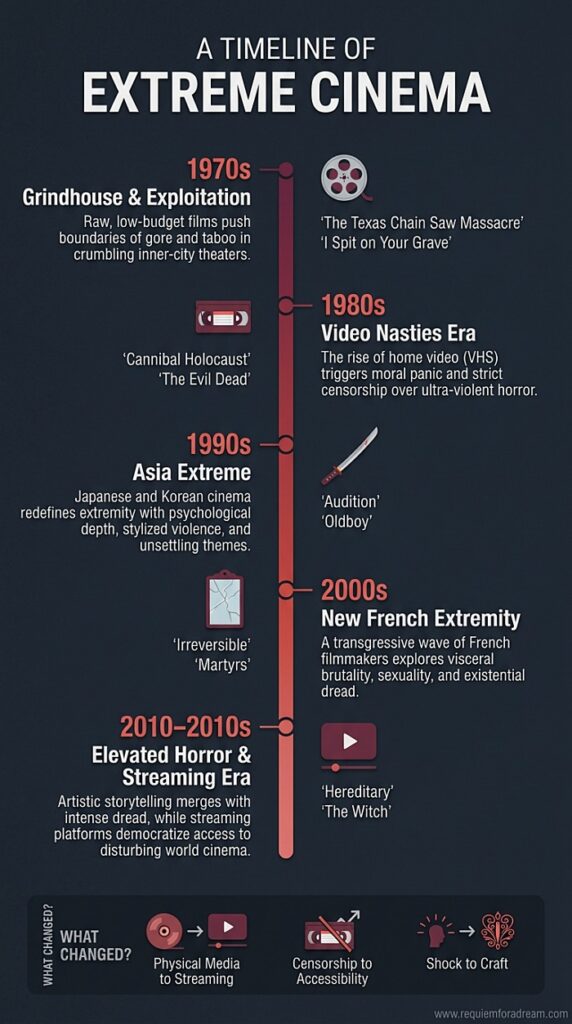
1970s Grindhouse and Exploitation
The US exploitation boom of the 1970s produced The Texas Chain Saw Massacre, The Last House on the Left, and I Spit on Your Grave. These were cheap, regional, often shot on 16mm, and frequently played in drive-ins. The 1970s also gave us Pasolini’s Salò in Europe and the Italian cannibal and zombie films that pushed gore further than anything in Hollywood.
The Video Nasties Era (1980s UK)
Britain’s 1984 Video Recordings Act created an official list of “video nasties,” titles prosecuted under the Obscene Publications Act. Many of this list’s 25 entries, including Cannibal Holocaust and The Last House on the Left, appeared on that list. According to the British Board of Film Classification, the era fundamentally reshaped how horror and extreme cinema was distributed in the UK for decades.
Asia Extreme (1990s–2000s)
The term “Asia Extreme” was popularized by UK distributor Tartan Films in the late 1990s, packaging films from Japan (Audition, Visitor Q), South Korea (Oldboy, I Saw the Devil), and Hong Kong for Western audiences. The throughline is a willingness to mix high craft with transgressive content, which made these films critical favorites and genre cornerstones.
The New French Extremity
According to Wikipedia’s detailed overview of the movement, the term was coined by critic James Quandt in a 2004 Artforum article about what he saw as a violent turn in French cinema in the late 1990s. Films associated with the movement include Irreversible, Inside, Martyrs, Antichrist (Danish director, but often lumped in), High Tension, and Raw. Most of them use genre tools to interrogate French social anxieties about class, gender, and the body.
Elevated Horror and the Streaming Era
From roughly 2014 onward, directors like Ari Aster, Robert Eggers, Jennifer Kent, and Jordan Peele started making horror films that played festivals and won awards. Sometimes dismissed as “elevated horror,” these films (Hereditary, The Witch, The Babadook, Midsommar) still earn their place in the disturbing canon because they trade cheap scares for sustained dread. Streaming has also made older extreme cinema more accessible than at any point in the past.
What Actually Makes a Movie Disturbing?
Gross-out content alone won’t get you there. A slasher film with buckets of blood usually plays like a roller coaster. A disturbing film plays like food poisoning.
The films on this list share some combination of:
- Intent and craft. The filmmaker knows exactly what they’re doing, and every shock is deliberate.
- Duration and proximity. Long takes, close framing, and no cutaway give you nowhere to look.
- Real-world weight. Fiction built on a true event, real footage, or a social reality you recognize hits harder than pure fantasy.
- Character identification. Violence against a person you care about is disturbing. Violence against anonymous victims is just gore.
- Refusal to resolve. Disturbing films rarely give you the relief of a clean ending.
The academic framing of horror often cites catharsis, but most of these films are specifically designed to prevent catharsis. That’s the difference.
Honorable Mentions
Narrowing to 25 meant cutting films that absolutely belong in the conversation. If you’ve seen most of the main list, consider:
- Visitor Q (2001). Takashi Miike’s micro-budget Japanese family-from-hell drama.
- Nekromantik (1987). German necrophilia drama, more sad than shocking once you adjust.
- Grave of the Fireflies (1988). The most devastating animated film ever made, full stop.
- Come and See (1985). Elem Klimov’s WWII horror film that is impossible to shake.
- The Girl Next Door (2007). Based on Jack Ketchum’s novel, based on a real 1965 Indiana case.
- Mother! (2017). Aronofsky’s allegorical freakout. Divisive but genuinely disorienting.
- The Texas Chain Saw Massacre (1974). The Tobe Hooper original, still the gold standard.
- Kill List (2011). Ben Wheatley’s hitman film that turns into something else entirely.
- An American Crime (2007). Dramatization of the Sylvia Likens case. Don’t watch casually.
- Grotesque (2009). Japanese “torture film” banned outright by the BBFC.
Should You Actually Watch These Movies?
Honest take: most people don’t need to, and that’s fine. Taste is not a measure of character, and forcing yourself through Salò to prove something to an internet forum is a waste of a weekend.
On the other hand, if you genuinely love cinema and you’ve never engaged with transgressive filmmaking, you’re missing a real conversation that includes some of the most important directors of the last 50 years: Pasolini, Kubrick, Lynch, Haneke, Park Chan-wook, Miike, Aronofsky, von Trier, Aster. Skipping the uncomfortable corners of cinema is skipping part of cinema.
The pragmatic approach:
- Read the content warnings first. Does the Dog Die and similar sites catalog most of the specific triggers.
- Watch during the day, with ambient light, with someone who has seen it.
- Don’t binge disturbing films. One every few weeks is plenty.
- If a film is affecting you past the next morning, stop.
- A movie being “important” does not mean you owe it your time.
FAQ: Your Most Searched Questions, Answered
What is considered the most disturbing movie ever made?
The most commonly cited answer is Salò, or the 120 Days of Sodom (1975) by Pier Paolo Pasolini, followed closely by A Serbian Film (2010), Cannibal Holocaust (1980), and Martyrs (2008). No single film is universally “the most” disturbing, because viewer response is personal, but those four titles dominate every serious list in 2026.
What is the most disturbing movie on Netflix right now?
Streaming libraries rotate, so check on August to confirm, but titles like Hereditary, Mother!, Requiem for a Dream, and The House That Jack Built have recently rotated through Netflix in various regions. For more reliably available extreme cinema, Shudder, Tubi, and the Criterion Channel tend to carry a deeper catalog.
Are any of these movies actually banned?
Several have been banned or heavily cut in various countries, past and present. Cannibal Holocaust was seized by Italian authorities on release. A Serbian Film is restricted or banned outright in multiple territories. Salò was effectively banned in the UK until 2000. The Human Centipede 2 was initially refused classification by the BBFC. Grotesque remains refused classification in the UK.
What’s the difference between “disturbing” and “scary”?
Scary is a momentary physical response: jump scares, loud sounds, adrenaline. Disturbing is a residual psychological response: the film sticks with you, invades your thinking, and changes how you feel about an idea, a person, or a possibility. The Conjuring is scary. Hereditary is disturbing. Many films are both, but “disturbing” lives in the days after the credits.
Is it okay to watch disturbing movies?
For most adults, yes. Fiction is a safe space to engage with dark material, and there’s legitimate psychological research suggesting horror and extreme cinema can serve as a controlled exposure to difficult emotions. That said, if you have trauma related to specific content (assault, child harm, suicide, extreme violence), screen carefully or skip entirely. No film is worth re-traumatizing yourself for.
Why do people like watching disturbing movies?
Common reasons include: curiosity, the challenge of “testing” yourself, an appreciation for boundary-pushing art, interest in what censorship excludes, a desire to feel strong emotion in a safe setting, and the sense of community with other cinephiles who engage with the same material. None of those reasons is pathological on its own.
What movie has the most walkouts at film festivals?
Several compete for the title, including Antichrist at Cannes 2009, Irreversible at Cannes 2002, The House That Jack Builtat Cannes 2018, and A Serbian Film at various festivals in 2010. Walkouts are a recurring press story for the extreme cinema circuit, to the point that they’ve become part of the marketing for certain films.
Are there disturbing movies that are actually good?
Most of this list, yes. Salò, Martyrs, Audition, Oldboy, Hereditary, The Act of Killing, Irreversible, Eraserhead, Funny Games, Threads, Come and See, and Requiem for a Dream are all serious works by major directors. Disturbing content and cinematic quality are not mutually exclusive. The worst films on this list are the ones that confuse shock for craft.
What movie should I start with if I want to get into disturbing cinema?
Start with Requiem for a Dream (2000), The Exorcist (1973), Oldboy (2003), or Hereditary (2018). All four are intense, all four are available on major streaming platforms most of the time, and all four are genuinely well-made films where the disturbance is doing real dramatic work. Once you know how those sit with you, you’ll have a better sense of whether to climb further up the difficulty tiers.
Are these movies legal?
All 25 films on this list are legal to own and watch in most countries, though a handful have been refused classification in specific territories (notably The Human Centipede 2 initially in the UK, Grotesque in the UK, A Serbian Film in several regions). When in doubt, check your country’s current classification status before purchase.
Final Thoughts
The best disturbing movies aren’t testing your tolerance, they’re testing your empathy. Hereditary isn’t great because it’s scary, it’s great because it makes grief feel geological. Martyrs isn’t great because it’s extreme, it’s great because it weaponizes that extremity into a genuine philosophical question. The Act of Killing isn’t disturbing because of its violence, it’s disturbing because of who’s remembering the violence.
If you’re new to this corner of cinema, go slow. Start with the emotional end of the spectrum, not the gore end. Watch with people who can talk you through it afterwards. Read about the film before or after to understand what the director was doing. And always, always respect your own limits. The people who watched everything on this list didn’t finish the list feeling better about humanity. They finished the list with a clearer sense of what movies are capable of, and what they themselves can handle.
Bookmark this page for reference, and feel free to come back in August when you’re ready for the next one on your tier.
Found this useful? Save it for your next dark movie night and share it with the cinephile in your life who’s been curious about extreme cinema but didn’t know where to start.