
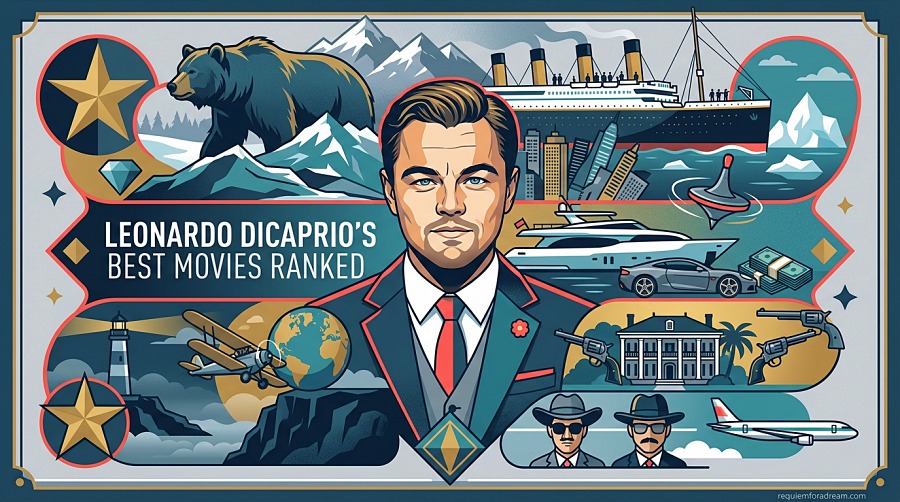
Few actors have shaped modern cinema the way Leonardo DiCaprio has. Over a career spanning more than three decades, he has delivered some of the most memorable performances in film history, working with legendary directors like Martin Scorsese, Christopher Nolan, and Quentin Tarantino along the way. From his breakout role as a teenager to his long-overdue Oscar win, DiCaprio has built a filmography that stands among the finest in Hollywood.
Our team spent weeks analyzing his entire body of work to bring you the best Leonardo DiCaprio movies ranked from top to bottom. We looked at critical consensus, cultural impact, performance quality, and overall rewatchability to build this definitive list. Whether you are a lifelong fan or just looking for your next movie night pick, this guide covers every essential film in his catalog.
DiCaprio has earned over $7 billion at the worldwide box office across his career. He has received multiple Academy Award nominations and has worked with some of the most respected directors in the industry. His ability to disappear into a character, whether playing a corrupt stockbroker, a fur trapper fighting for survival, or a dream thief, is what sets him apart from nearly every other actor working today.
This list covers his top 15 films, with detailed analysis of each performance. We also break down his director collaborations, his Oscar journey, and his impressive range across genres. By the end, you will have a clear picture of why Leonardo DiCaprio is considered one of the greatest actors of his generation.
One thing that makes ranking DiCaprio’s films so challenging is how consistently strong his choices have been. Even his lesser-discussed movies contain performances worth watching. That said, not all great performances come in equally great films, and we factored that into our final rankings.
We also considered how each film has aged. Some movies that felt monumental at release have lost a bit of their shine over time, while others have grown in stature. Cultural legacy matters when you are building a list of the best Leonardo DiCaprio movies ranked for 2026 audiences.
Table of Contents
How We Ranked Leonardo DiCaprio’s Movies
Before we get to the rankings, let us explain our methodology. Most competitor lists simply rely on Tomatometer scores or personal opinion. We wanted to be more transparent about how we arrived at our final order, so here are the four criteria we used.
Critical Consensus
We started with Rotten Tomatoes and IMDb scores as a baseline. These numbers give a general sense of how critics and audiences feel about each film. However, scores alone do not tell the full story. A movie like The Wolf of Wall Street has a slightly lower Tomatometer than some of his other films, but the performance and cultural impact are undeniable.
We also consulted Metacritic scores and polled user ratings on Letterboxd to get a broader picture of how each film is received across different platforms. A film that scores well with critics but not audiences, or vice versa, got a more nuanced evaluation rather than being ranked purely on one metric.
Cultural Impact and Legacy
Some films change the conversation around an actor or even around cinema itself. Titanic was a global phenomenon that made DiCaprio a household name. Inception became a reference point for complex storytelling in blockbuster filmmaking. These legacies matter in our ranking.
We looked at how each film has influenced other movies, how often it is referenced in popular culture, and whether it spawned lasting conversations. The internet memes about whether Jack could have fit on the door in Titanic, or whether the top was still spinning at the end of Inception, are signs that these films burrowed into the public consciousness in a way that goes beyond simple box office numbers.
Performance Quality
This is where DiCaprio’s range really shines. We evaluated each performance on its own merits, looking at emotional depth, physical transformation, and how well the actor disappeared into the role. His work in The Revenant required a completely different skill set than his work in Catch Me If You Can, and both are excellent in their own ways.
We paid special attention to specific scenes that demonstrate DiCaprio’s ability to convey complex emotions: the mirror scene in Once Upon a Time in Hollywood, the Quaalude sequence in The Wolf of Wall Street, and the bear attack in The Revenant are moments that define his career and separate him from his peers.
Rewatchability
A great film should hold up on repeat viewings. We considered how often we return to each movie and whether it still delivers the same impact on the fifth watch as it did on the first. Films like The Departed and Catch Me If You Can score high here because of their propulsive energy and sharp dialogue.
Rewatchability also means that the film rewards closer attention. The best DiCaprio movies contain layers of detail that you might miss on first viewing. Shutter Island, for instance, is an entirely different experience once you know the ending, and that replay value boosted its position on our list.
The Top 10 Leonardo DiCaprio Movies at a Glance
Here is our quick-reference list of the top 10 Leonardo DiCaprio movies. Each entry includes the film title, release year, and director. Scroll down for detailed analysis of every film on this list.
- 1. Once Upon a Time in Hollywood (2019) – Directed by Quentin Tarantino
- 2. The Departed (2006) – Directed by Martin Scorsese
- 3. The Wolf of Wall Street (2013) – Directed by Martin Scorsese
- 4. The Revenant (2015) – Directed by Alejandro G. Inarritu
- 5. Inception (2010) – Directed by Christopher Nolan
- 6. Catch Me If You Can (2002) – Directed by Steven Spielberg
- 7. Titanic (1997) – Directed by James Cameron
- 8. Django Unchained (2012) – Directed by Quentin Tarantino
- 9. Killers of the Flower Moon (2023) – Directed by Martin Scorsese
- 10. What’s Eating Gilbert Grape (1993) – Directed by Lasse Hallstrom
Notice how many different directors appear on this list. That variety is a testament to DiCaprio’s ability to adapt his style to match different filmmaking visions. Six of the top ten films come from just two directors, Scorsese and Tarantino, but the remaining four represent four entirely different creative voices.
Best Leonardo DiCaprio Movies Ranked in 2026: Honorable Mentions
Before we reach the top 10, these five films deserve recognition. They showcase different facets of DiCaprio’s talent and represent key moments in his career. Each one is worth your time and reveals something about the actor he was becoming or the star he had already become.
#15: The Basketball Diaries (1995)
Directed by Scott Kalvert, The Basketball Diaries remains one of the most intense performances of DiCaprio’s early career. He plays Jim Carroll, a high school basketball star who descends into heroin addiction on the streets of New York. The film is raw and unflinching, and DiCaprio throws himself into the role with a fearlessness that surprised many critics at the time.
What stands out watching this film now is how fully formed DiCaprio’s talent already was at just 21 years old. The withdrawal scenes are physically wrenching to watch. His ability to convey desperation and vulnerability without tipping into melodrama foreshadowed the kind of actor he would become. The supporting cast, including Lorraine Bracco and Mark Wahlberg, adds depth to the story.
While The Basketball Diaries was not a box office hit, it has developed a strong cult following over the years. It is a difficult watch at times, but it remains one of the most honest portrayals of addiction put on screen in the 1990s. For fans who only know DiCaprio from his blockbuster roles, this film is a revelation.
#14: Shutter Island (2010)
Martin Scorsese and DiCaprio teamed up for this psychological thriller about a U.S. Marshal investigating the disappearance of a patient at a remote psychiatric facility. The film’s twist ending became a major talking point upon release, but what makes Shutter Island worth rewatching is the layers of performance DiCaprio builds throughout.
He plays Teddy Daniels, a man haunted by trauma and guilt, and the way DiCaprio slowly reveals the fractures in Teddy’s psyche is masterful. Every scene takes on new meaning once you know the ending. The dream sequences with Michelle Williams are haunting, and the final conversation between Teddy and Dr. Sheehan, played by Ben Kingsley, carries a devastating weight.
The film earned strong reviews and performed well commercially, grossing nearly $300 million worldwide. It has aged better than many psychological thrillers from the same era because the emotional core holds up regardless of whether you know the twist. On rewatch, you notice how many visual clues Scorsese planted in plain sight, and DiCaprio’s performance becomes even more impressive when you realize how carefully he calibrated every moment.
#13: Gangs of New York (2002)
This was DiCaprio’s first collaboration with Martin Scorsese, and while it is not their strongest film together, it remains an important milestone. He plays Amsterdam Vallon, a young man seeking revenge against Bill the Butcher, played with terrifying intensity by Daniel Day-Lewis, in 1860s New York City.
The production design alone makes Gangs of New York worth watching. Scorsese recreated the Five Points neighborhood with obsessive detail, and the film captures a version of New York that most people never knew existed. DiCaprio holds his own against Day-Lewis, which is no small feat given that Day-Lewis delivers one of the most iconic villain performances in modern cinema.
The film received 10 Academy Award nominations, though it won none. It took decades to get made and cost over $100 million, but the result is a sweeping historical epic that deserves more recognition than it typically receives in discussions of Scorsese’s best work. Without Gangs of New York, the Scorsese-DiCaprio partnership that produced so many masterpieces might never have existed.
#12: Blood Diamond (2006)
Released the same year as The Departed, Blood Diamond shows a completely different side of DiCaprio. He plays Danny Archer, a Rhodesian smuggler operating in Sierra Leone during the 1999 civil war. The role requires him to balance moral ambiguity with genuine emotional growth, and he pulls it off convincingly.
Djimon Hounsou gives an equally powerful performance as Solomon Vandy, a fisherman separated from his family by rebel forces. The scenes between DiCaprio and Hounsou are the heart of the film. Their dynamic shifts from mutual distrust to genuine respect in a way that feels earned rather than forced.
DiCaprio received an Oscar nomination for Best Actor for this performance. The film also brought international attention to the issue of conflict diamonds, which demonstrates the real-world impact that well-made cinema can have. It remains one of his most socially conscious roles and proof that he was willing to use his star power to tell stories that matter.
#11: The Aviator (2004)
In The Aviator, DiCaprio portrays Howard Hughes during the most turbulent period of his life, from the late 1920s through the 1940s. This was his second film with Scorsese, and it represents a significant leap in their creative partnership. DiCaprio captures both Hughes’s brilliance as an aviator and filmmaker and his terrifying descent into obsessive-compulsive disorder.
The bathroom scene where Hughes refuses to leave because of his contamination fears is one of the most uncomfortable sequences DiCaprio has ever filmed. He makes you feel the walls closing in on this man who once seemed invincible. The film also features Cate Blanchett in an Oscar-winning turn as Katharine Hepburn, and their chemistry together is electric.
The Aviator earned 11 Academy Award nominations, including Best Picture and Best Actor for DiCaprio. It won five Oscars, though not for DiCaprio’s performance. Looking back, this film feels like a turning point where DiCaprio transitioned from young star to serious actor. It also set the template for the kind of complex, larger-than-life characters he would continue to seek out throughout his career.
Best Leonardo DiCaprio Movies: Top 10 Continued
#10: What’s Eating Gilbert Grape (1993)
This is the performance that announced DiCaprio as a genuine talent. He was just 19 years old when he played Arnie Grape, a boy with an intellectual disability, opposite Johnny Depp in the title role. What could have been a problematic or insensitive portrayal instead became one of the most empathetic performances of the decade.
DiCaprio spent time with children at residential care facilities to prepare for the role. That preparation shows in every scene. Arnie’s mannerisms, his way of climbing the town water tower, his excited shout of “Gilbert! Gilbert!” are all delivered with authenticity and warmth. The performance earned him his first Academy Award nomination for Best Supporting Actor.
Director Lasse Hallstrom has said that DiCaprio’s audition was so convincing that he initially thought the casting director had brought in an actual teenager with a developmental disability. That level of commitment to a role at such a young age is remarkable. Even now, watching the film, you forget you are watching an actor at work.
The film itself is a quiet, beautiful story about family, responsibility, and small-town life. Depp is excellent as the burdened older brother, and Juliette Lewis brings a gentle warmth to her role as the free-spirited Becky. But it is DiCaprio who steals every scene he is in and makes you believe completely in Arnie’s world.
#9: Killers of the Flower Moon (2023)
DiCaprio’s sixth collaboration with Martin Scorsese is also their most complex. In Killers of the Flower Moon, he plays Ernest Burkhart, a dim-witted World War I veteran who becomes complicit in the systematic murder of Osage Nation members for their oil wealth in 1920s Oklahoma. It is a deeply uncomfortable performance because DiCaprio makes you understand how an ordinary person could be drawn into such evil.
The film runs over three hours, but DiCaprio keeps you engaged throughout. His scenes with Lily Gladstone, who plays his Osage wife Mollie, are the emotional spine of the story. The quiet moments between them, a shared meal, a whispered conversation, carry more weight than the violent set pieces. When Ernest finally understands the full scope of what he has done, DiCaprio’s face tells the story without a single word of dialogue.
Killers of the Flower Moon received 10 Academy Award nominations, including Best Actor for DiCaprio. The film was praised for its unflinching look at a dark chapter of American history that many people knew nothing about. It is not an easy watch, but it is an essential one, and it shows that the Scorsese-DiCaprio partnership continues to produce challenging and important work.
#8: Django Unchained (2012)
Quentin Tarantino cast DiCaprio against type as Calvin Candie, a charming and brutal plantation owner in this pre-Civil War revenge western. The result is one of the most memorable villains in Tarantino’s filmography. DiCaprio had never played a villain before, and he leans into the role with visible relish.
The dinner table scene is the centerpiece of the performance. Candie discovers that Django, played by Jamie Foxx, and Dr. King Schultz, played by Christoph Waltz, have been deceiving him, and the shift from Southern charm to cold menace is chilling. According to reports from the set, DiCaprio actually cut his hand on a glass during this scene and stayed in character, rubbing his bleeding hand on Kerry Washington’s face. That moment made it into the final film.
Django Unchained was a commercial success, grossing over $425 million worldwide. It also won two Academy Awards, including Best Original Screenplay for Tarantino and Best Supporting Actor for Waltz. DiCaprio did not receive a nomination, which many critics considered a snub given how effectively he subverted his own screen persona.
The film is violent and provocative, but it also contains genuine moral weight. DiCaprio’s performance as Candie is a reminder that evil does not always look like a monster. Sometimes it wears a smile and serves you lemonade.
#7: Titanic (1997)
No list of the best Leonardo DiCaprio movies ranked would be complete without Titanic. James Cameron’s epic romance became the highest-grossing film of all time upon release, earning over $2.2 billion at the global box office. It made DiCaprio an international superstar and cemented his status as one of the biggest movie stars on the planet.
As Jack Dawson, a penniless artist who wins a ticket aboard the doomed ocean liner, DiCaprio brings an effortless charm and warmth to the role. His chemistry with Kate Winslet is the engine that drives the entire film. The drawing scene, the flying scene at the bow of the ship, and the final moments in the freezing water have become some of the most iconic images in cinema history.
Titanic won 11 Academy Awards, including Best Picture and Best Director. DiCaprio was surprisingly not nominated for Best Actor, a decision that remains controversial among fans. Some critics argue that the film’s massive popularity overshadowed the quality of his performance, but watching it now, his work holds up beautifully. He makes Jack feel like a real person rather than a romantic fantasy.
The film’s cultural impact cannot be overstated. It dominated the box office for months, inspired countless parodies and homages, and turned DiCaprio into the most famous actor of his generation. Even people who have never seen the movie know the line about making room on the door.
#6: Catch Me If You Can (2002)
Steven Spielberg directed this wildly entertaining cat-and-mouse story based on the real life of Frank Abagnale Jr., a con artist who successfully impersonated a pilot, a doctor, and a lawyer before his 19th birthday. DiCaprio brings a lightness and charisma to the role that makes you root for Frank even as he commits crime after crime.
The dynamic between DiCaprio and Tom Hanks, who plays FBI agent Carl Hanratty, is what elevates the film above a standard crime caper. Hanks brings a weary determination to the role, and the scenes where the two characters interact crackle with energy. The Christmas phone calls between them are surprisingly touching.
Catch Me If You Can is one of the most rewatchable films in DiCaprio’s catalog. Spielberg keeps the pace brisk, and the 1960s period detail is gorgeous. The opening credits sequence alone, with its Saul Bass-inspired animation and John Williams score, sets a stylish tone that the film maintains throughout.
The film grossed over $350 million worldwide and received positive reviews from critics. Many fans on Reddit and film forums consider it underrated compared to DiCaprio’s heavier dramatic roles. It showcases his comedic timing and charm in a way that few of his other films do, proving he could carry a lighter film without sacrificing substance. If you want a DiCaprio movie that the whole family can enjoy, this is the one to start with.
The 5 Best Leonardo DiCaprio Movies of All Time
#5: Inception (2010)
Christopher Nolan’s mind-bending heist film set inside the architecture of dreams features one of DiCaprio’s most emotionally layered performances. He plays Dom Cobb, a skilled extractor who steals secrets from the subconscious minds of his targets. The science-fiction premise is dazzling, but the emotional engine of the film is Cobb’s grief over the loss of his wife Mal, played with haunting intensity by Marion Cotillard.
What makes DiCaprio’s performance so effective is the restraint he shows throughout. Cobb is a man barely holding himself together, and DiCaprio communicates that fragility through small gestures and averted glances rather than big emotional outbursts. The scene where he finally confronts the projection of Mal in limbo is devastating because of the quiet way he lets go of her.
Inception was a massive commercial success, earning over $830 million worldwide. It won four Academy Awards and was nominated for eight total, including Best Picture. The film’s ending, with the spinning top, remains one of the most debated final shots in modern cinema. Whether Cobb is dreaming or awake, DiCaprio makes you believe that his character has finally found peace.
The supporting cast is outstanding, including Joseph Gordon-Levitt, Tom Hardy, Ellen Page, and Ken Watanabe. But DiCaprio is the anchor. Without his emotional commitment to the role, Inception could have been a cold exercise in visual spectacle. Instead, it is a deeply moving story about loss, guilt, and the lengths we go to hold on to the people we love.
#4: The Revenant (2015)
This is the film that finally won DiCaprio his Academy Award for Best Actor, and it is easy to see why. In The Revenant, he plays Hugh Glass, a fur trapper who is mauled by a grizzly bear and left for dead by his companions in the frozen wilderness of 1820s America. What follows is a grueling story of survival and revenge that pushes the actor to his physical limits.
DiCaprio has said that The Revenant was the most difficult shoot of his career. He slept in animal carcasses, ate raw bison liver, and waded through freezing rivers. That physical commitment translates directly to the screen. Every shiver, every labored breath, every agonized crawl across the snow feels real because it largely was.
The bear attack sequence is one of the most visceral scenes in modern cinema. Alejandro G. Inarritu filmed it in long, unbroken takes using natural light, and the result is an experience that feels disturbingly immediate. DiCaprio communicates Glass’s terror and pain through guttural sounds and desperate movements that are almost animalistic.
But The Revenant is more than a survival story. It is also about the bond between Glass and his son, and the injustice that drives him to keep going when any reasonable person would have given up. The scenes between DiCaprio and Forrest Goodluck, who plays his son Hawk, give the film its emotional weight and make Glass’s journey feel personal rather than merely physical.
The film won three Academy Awards including Best Director for Inarritu and Best Actor for DiCaprio. It also grossed over $530 million worldwide. For DiCaprio, it was the culmination of years of strong performances that had gone unrecognized by the Academy, and the standing ovation he received at the ceremony spoke volumes about how the industry viewed his body of work.
#3: The Wolf of Wall Street (2013)
Martin Scorsese’s wild, exuberant portrait of financial fraud Jordan Belfort features DiCaprio at his absolute most electric. This is a performance of pure kinetic energy. He races through scenes with a manic intensity that is simultaneously thrilling and repulsive, perfectly capturing the appeal and the horror of unchecked greed.
The Lemmon 714 Quaalude scene is one of the funniest sequences in Scorsese’s entire career. DiCaprio’s physical comedy is brilliant as he drags his paralyzed body across a country club floor and down a flight of stairs to save his friend Donnie, played by Jonah Hill, from choking. It is slapstick on a level that few dramatic actors could pull off convincingly.
But the darker scenes are just as powerful. The scene where Jordan hits his wife, played by Margot Robbie, and tries to kidnap his daughter while high on cocaine is genuinely disturbing. DiCaprio makes you understand how a charismatic person can justify the most monstrous behavior to himself. That is a far more unsettling type of villain than the ones who twirl mustaches.
The Wolf of Wall Street received five Academy Award nominations, including Best Picture, Best Director, and Best Actor for DiCaprio. It grossed over $390 million worldwide despite its three-hour runtime and polarizing content. The film divided audiences, with some critics arguing it glorified Belfort’s behavior and others praising its satirical approach. What is undeniable is the commitment and skill of DiCaprio’s performance.
#2: The Departed (2006)
Martin Scorsese’s Boston crime epic gives DiCaprio one of his most emotionally complex roles. He plays Billy Costigan, an undercover cop infiltrating the Irish mob run by Frank Costello, played with terrifying unpredictability by Jack Nicholson. Costigan is a man living on the edge of discovery at all times, and DiCaprio conveys that constant pressure in every scene.
What makes this performance stand out even among DiCaprio’s best work is the vulnerability he brings to the role. Costigan is not a cool, composed hero. He is scared, angry, and desperate to get out of his assignment alive. The scene where he sits with Madolyn, played by Vera Farmiga, and reveals his emotional scars is one of the most intimate moments in Scorsese’s filmography.
The film also features Matt Damon as Colin Sullivan, the mob’s mole inside the police department. The parallel structure between the two characters, one pretending to be a criminal, the other pretending to be a cop, gives the film a tense, symmetrical power. DiCaprio and Damon never share a scene until the climax, and when they finally confront each other on a rooftop, the payoff is immense.
The Departed won four Academy Awards, including Best Picture and Best Director for Scorsese. It was Scorsese’s first Oscar after decades of being overlooked, and DiCaprio’s performance is a major reason the film works as well as it does. The elevator scene and its aftermath remain some of the most shocking moments in modern American cinema. Fans on Reddit frequently cite The Departed as the single best DiCaprio performance, and it is easy to see why.
#1: Once Upon a Time in Hollywood (2019)
Our pick for the single best Leonardo DiCaprio movie is Quentin Tarantino’s love letter to 1969 Los Angeles. DiCaprio plays Rick Dalton, a fading Western television star struggling to remain relevant as the industry changes around him. It is a performance of extraordinary nuance that combines comedy, pathos, and genuine soulfulness in a way that no other DiCaprio role quite manages.
The trailer meltdown scene, where Rick forgets his lines and retreats to his trailer to scream at himself in the mirror, is one of the best individual scenes DiCaprio has ever filmed. It is funny and heartbreaking at the same time. You laugh at his self-pity and then immediately feel guilty for laughing because his pain is so real. That dual tone is incredibly difficult to achieve, and DiCaprio nails it.
His chemistry with Brad Pitt, who plays his stunt double and best friend Cliff Booth, is the beating heart of the film. Their relationship is lived-in and warm, built on years of shared history and mutual dependence. The scene where Rick tells Cliff that he might be over the hill, and Cliff responds with gentle encouragement, captures a kind of male friendship that is rarely portrayed with such tenderness on screen.
The film reimagines the Manson Family murders with a fictionalized, cathartic ending that sparked considerable debate. But beyond the controversy, Once Upon a Time in Hollywood is ultimately about the fear of obsolescence and the people who help us through it. DiCaprio’s Rick Dalton is a man terrified of becoming irrelevant, and watching him find a small measure of redemption is deeply moving.
DiCaprio received an Oscar nomination for Best Actor, his seventh nomination overall. The film also received nominations for Best Picture and Best Director. It grossed over $375 million worldwide and is widely considered one of Tarantino’s finest films. For our team, it represents the perfect combination of great material, a great director, and an actor at the absolute peak of his powers.
Leonardo DiCaprio’s Greatest Director Collaborations
One of the defining features of DiCaprio’s career has been his willingness to form deep creative partnerships with top directors. Rather than chasing paychecks, he has consistently sought out filmmakers who challenge him and push him into new territory. These collaborations have produced some of the finest films of the past 30 years.
Martin Scorsese: The Defining Partnership
The Scorsese-DiCaprio partnership is one of the most prolific actor-director collaborations in modern cinema. They have made six films together: Gangs of New York (2002), The Aviator (2004), The Departed (2006), Shutter Island (2010), The Wolf of Wall Street (2013), and Killers of the Flower Moon (2023). That is a remarkable run by any standard.
Scorsese has described DiCaprio as a creative partner rather than simply an actor for hire. They develop projects together, debate character motivations, and push each other toward more ambitious storytelling. The range of their work together is impressive, spanning historical epics, psychological thrillers, crime dramas, and dark comedies. No other director has drawn as many different performances out of DiCaprio.
Quentin Tarantino: The Subversive Duo
DiCaprio has made two films with Tarantino: Django Unchained (2012) and Once Upon a Time in Hollywood (2019). Both films cast DiCaprio against expectations. In Django, he plays a charismatic villain. In Hollywood, he plays a vulnerable, insecure actor. Both roles required him to step outside his comfort zone, and both resulted in some of his most celebrated work.
Tarantino has a unique ability to write dialogue that suits DiCaprio’s natural cadence. The speeches in both films feel tailor-made for his delivery. Their creative partnership has already produced two modern classics, and film fans are hopeful they will work together again.
Christopher Nolan and Others
Christopher Nolan directed DiCaprio in Inception (2010), a film that combined blockbuster spectacle with genuine emotional depth. Nolan’s methodical, puzzle-box approach to filmmaking brought out a more restrained side of DiCaprio’s acting. The result is one of the best science-fiction films of the 21st century.
Other notable director partnerships include Steven Spielberg on Catch Me If You Can, Alejandro G. Inarritu on The Revenant, Sam Mendes on Revolutionary Road, and Ridley Scott on Body of Lies. Each collaboration added a new dimension to DiCaprio’s filmography and demonstrated his ability to adapt to different filmmaking styles and creative visions. Spielberg in particular brought out a playful energy in DiCaprio that few other directors have matched.
Leonardo DiCaprio’s Oscar Journey and Awards
DiCaprio’s relationship with the Academy Awards has been one of the most discussed narratives in modern Hollywood. Despite delivering critically acclaimed performances for over two decades, he did not win an Oscar until 2016 for The Revenant. The long wait became a running joke in popular culture, with memes and social media campaigns devoted to the cause.
His nomination history tells the story of an actor who consistently delivered excellent work across a wide range of roles. His first nomination came in 1994 for What’s Eating Gilbert Grape, when he was just 19 years old. He was nominated again for The Aviator in 2005, Blood Diamond in 2007, The Wolf of Wall Street in 2014, The Revenant in 2016, and Once Upon a Time in Hollywood in 2020.
The 2016 win for The Revenant felt like the Academy finally catching up with what audiences and critics had known for years. DiCaprio’s acceptance speech focused on climate change and environmental issues, reflecting a passion that extends far beyond his acting career. He has used his platform to advocate for environmental causes consistently throughout his time in the spotlight.
Beyond the Oscars, DiCaprio has won Golden Globe Awards, Screen Actors Guild Awards, BAFTA Awards, and numerous critics’ prizes. He has been recognized by film festivals around the world and has received lifetime achievement awards from multiple organizations. His awards tally reflects not just individual performances but a body of work that is remarkable in its consistency and ambition.
Leonardo DiCaprio’s Range Across Genres
One of the most impressive things about DiCaprio’s filmography is the sheer variety of genres he has tackled. Many actors find a niche and stay there, but DiCaprio has deliberately sought out roles that challenge him in different ways. This genre diversity is one reason why ranking his films is so difficult and so rewarding.
Drama
Drama is the genre most associated with DiCaprio, and for good reason. Films like The Departed, The Revenant, and Killers of the Flower Moon represent some of the finest dramatic work in modern cinema. He has a rare ability to convey complex emotions through small gestures and subtle shifts in expression rather than broad theatrical displays.
Thriller and Crime
Shutter Island, Inception, and The Departed all fall into the thriller category, though each approaches suspense from a completely different angle. DiCaprio excels at playing characters who are hiding something or unraveling under pressure. The tension in his thriller performances comes not from external danger but from the internal conflicts that slowly consume his characters.
Comedy
The Wolf of Wall Street proved that DiCaprio is one of the best comedic actors working today. His physical comedy in the Quaalude scene and his manic energy throughout the film showed a side of his talent that had been largely hidden. Catch Me If You Can also features lighter comedic moments, and even Once Upon a Time in Hollywood has genuine laugh-out-loud scenes balanced against its more poignant moments.
Science Fiction
Inception stands as DiCaprio’s primary foray into science fiction, and it is a triumph. He brings genuine emotional stakes to a film that could easily have been a cold exercise in visual effects. The science-fiction elements serve the character’s emotional journey rather than the other way around.
Historical and Period Films
From Gangs of New York to Django Unchained to Killers of the Flower Moon, DiCaprio has shown a consistent interest in historical stories. He has played characters from the 1860s, the 1920s, the 1940s, and the 1960s, each time adapting his mannerisms and speech to feel authentic to the period. These roles demonstrate his commitment to research and his ability to immerse himself in a different era completely.
FAQs
What is considered Leonardo DiCaprio’s best movie?
While opinions vary, Once Upon a Time in Hollywood (2019) and The Departed (2006) are frequently cited as Leonardo DiCaprio’s best movies by critics and fans alike. The Departed won four Academy Awards including Best Picture, and Once Upon a Time in Hollywood earned DiCaprio his seventh Oscar nomination for his nuanced portrayal of fading TV star Rick Dalton.
What is DiCaprio’s most successful movie?
Titanic (1997) remains Leonardo DiCaprio’s most commercially successful movie, earning over $2.2 billion at the worldwide box office. It held the record for highest-grossing film of all time for 12 years. Inception (2010) is his second highest-grossing film with over $830 million worldwide.
How many Oscar nominations does Leonardo DiCaprio have?
Leonardo DiCaprio has received seven Academy Award nominations across his career. He won the Oscar for Best Actor for The Revenant (2015). His nominations span from 1994 (What’s Eating Gilbert Grape) to 2020 (Once Upon a Time in Hollywood), covering over 25 years of acclaimed performances.
Which Leonardo DiCaprio movie won an Oscar?
The Revenant (2015) is the film that earned Leonardo DiCaprio his Academy Award for Best Actor. He played fur trapper Hugh Glass, a role that required him to endure extreme physical conditions including sleeping in animal carcasses and eating raw bison liver. The film also won Oscars for Best Director (Alejandro G. Inarritu) and Best Cinematography (Emmanuel Lubezki).
How many movies has Leonardo DiCaprio made with Martin Scorsese?
Leonardo DiCaprio has made six feature films with director Martin Scorsese: Gangs of New York (2002), The Aviator (2004), The Departed (2006), Shutter Island (2010), The Wolf of Wall Street (2013), and Killers of the Flower Moon (2023). Their partnership is one of the most celebrated actor-director collaborations in modern cinema history.
Who got paid the most for Titanic?
Director James Cameron was the highest-paid individual associated with Titanic (1997), earning an estimated $75 million or more from his share of the film’s massive profits. Leonardo DiCaprio initially received a salary of $2.5 million for his role as Jack Dawson but earned significantly more through backend profit participation as the film broke box office records worldwide.
What is Leonardo DiCaprio’s highest rated movie on IMDb?
Inception (2010) holds the highest IMDb rating among Leonardo DiCaprio’s films with a score of 8.8 out of 10, placing it among the top 15 highest-rated films on the entire platform. The Departed (2006) and The Wolf of Wall Street (2013) also rank highly among his most-rated films on the site.
Final Thoughts on the Best Leonardo DiCaprio Movies Ranked
Ranking the best Leonardo DiCaprio movies is a challenging exercise because his filmography is remarkably consistent. From his heartbreaking work in What’s Eating Gilbert Grape to his scene-stealing performance in Once Upon a Time in Hollywood, he has delivered one memorable performance after another for over three decades.
Our top five, Once Upon a Time in Hollywood, The Departed, The Wolf of Wall Street, The Revenant, and Inception, represents what we believe to be the peak of his career so far. But honestly, any of these could be someone’s number one, and we would not argue. The strength of his collaborations with Scorsese, Tarantino, and Nolan has produced a body of work that few actors can match.
If you are working through this list, start with whichever genre appeals to you most. Want drama? Begin with The Departed. Prefer something lighter? Catch Me If You Can is a perfect entry point. Craving science fiction? Inception will blow your mind. However you approach it, you are in for some of the finest filmmaking of the past 30 years.