
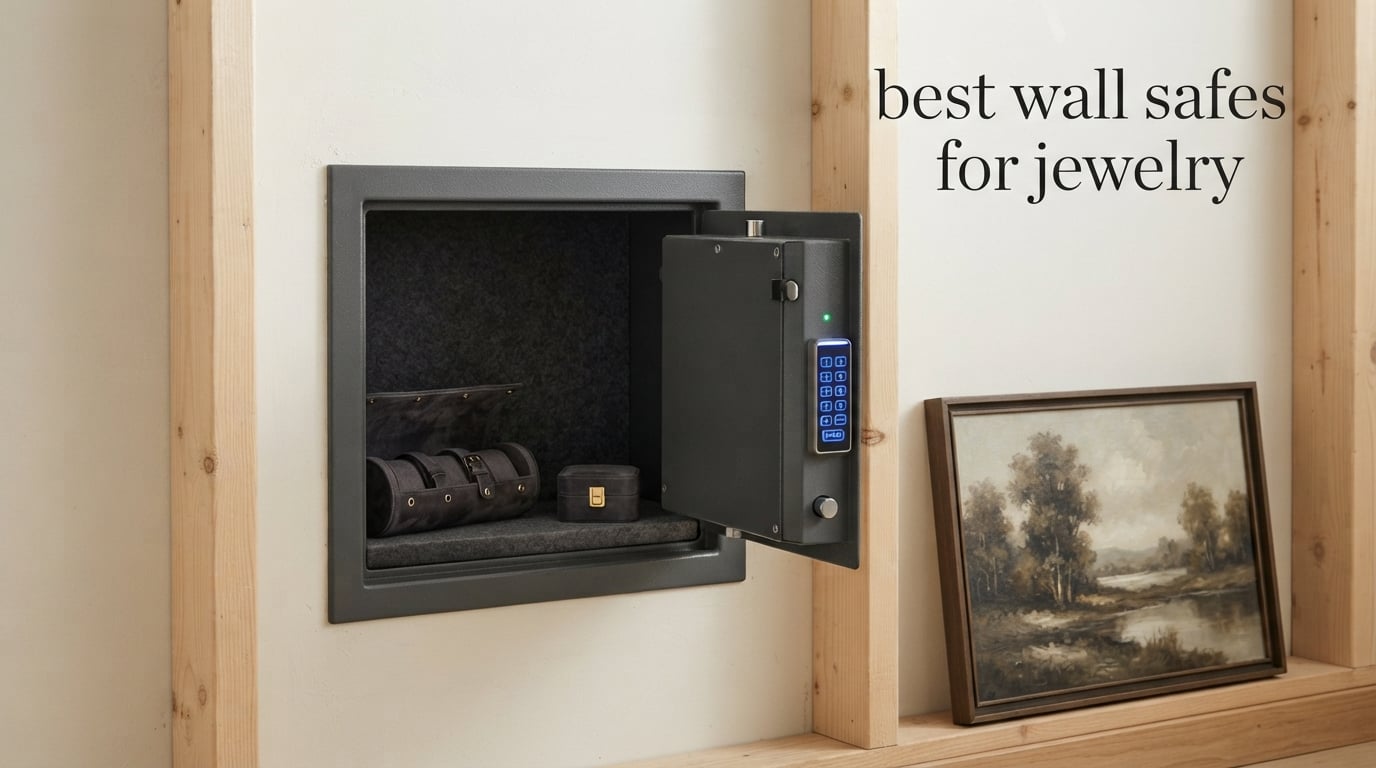
The best wall safes for jewelry are the Paragon In-Wall Safe with Keypad for most homes, the Viking Security VS-52BLX for fingerprint access and the heaviest steel on the list, and the Homak First Watch Between The Studs if you want a small collection behind a picture frame for very little money. We compared 12 in-wall safes, checking interior depth, lock style, actual steel thickness, and what owners say after living with them.
A wall safe is a steel box recessed into the cavity between your wall studs and finished flush with the drywall, so a mirror, a painting or a switch plate hides it completely. That concealment is the whole point. A dresser drawer full of jewelry hands it over the moment somebody opens the drawer, but a safe that nobody finds is a safe nobody has time to crack.
If you want a wider look at storage options first, our jewelry safe roundup covers freestanding cabinets and lock boxes, and our general wall safe guide goes deeper on the hardware side. What follows is specifically for rings, watches, chains and heirlooms, where the interior lining matters more than the lock.
Our criteria were simple: interior volume that fits a real jewelry collection, an interior surface that will not scratch a watch case or a diamond, a lock with a physical backup, a weight that makes removal a two-person job, and a body that fits a standard 16-inch on-center stud cavity. Fire claims got a hard look, because the word fireproof does not mean what sellers want it to mean. The r/Safes community raises the same point we do, and it deserves a full section below.
Table of Contents
Top 3 Best Wall Safe Picks for Jewelry in 2026
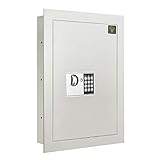
Paragon In-Wall Safe with Keypad
- 0.83 cubic feet
- LED touchpad with two passcodes
- Two manual override keys
- 39 lb steel body
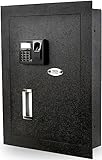
Viking Security VS-52BLX
- 500 DPI fingerprint reader
- Up to 32 fingerprints
- Motorized 20mm deadbolt
- Carpeted interior with LED
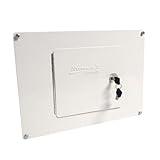
Homak First Watch Between The Studs
- 480 cubic inches
- Tubular mechanical lock
- Two keys included
- Black foam lining
Here is the same answer in the plain form most searchers want. Best for large collections: the Paragon In-Wall Safe. Features: 0.83 cubic feet, a wide front flange, and an LED touchpad. Why buy: it is the most reviewed in-wall safe in this group and the cavity fits standard studs with almost no fuss.
Best for fingerprint access: the Viking Security VS-52BLX. Features: a 500 DPI optical reader holding up to 32 fingerprints, a PIN fallback and a carpeted interior. Why buy: three independent ways in means a dead battery or a wet finger is not a lockout.
Best for a small collection: the Homak First Watch Between The Studs. Features: 480 cubic inches, a tubular mechanical lock and two keys. Why buy: no batteries, a piano-hinged steel door, and it disappears behind a framed picture in a closet.
All 12 Wall Safes for Jewelry Compared in 2026
| Product | Specifications | Action |
|---|---|---|
| Paragon In-Wall Safe with Keypad |
|
Check Latest Price |
| Homak First Watch Between The Studs |
|
Check Latest Price |
| Viking Security VS-52BLX |
|
Check Latest Price |
 Protex PWS-1814E Protex PWS-1814E |
|
Check Latest Price |
 Nebakne 25.6 Inch Tall Fireproof Wall Safe Nebakne 25.6 Inch Tall Fireproof Wall Safe |
|
Check Latest Price |
 V-Line Quick Vault V-Line Quick Vault |
|
Check Latest Price |
 Giantex Electronic Wall Safe Giantex Electronic Wall Safe |
|
Check Latest Price |
 Grimtron Electronic Wall Safe Grimtron Electronic Wall Safe |
|
Check Latest Price |
 Elder Welder Air Vent Hidden Wall Safe Elder Welder Air Vent Hidden Wall Safe |
|
Check Latest Price |
 Langger Biometric Wall Safe Langger Biometric Wall Safe |
|
Check Latest Price |
 XDeer Biometric Wall Safe XDeer Biometric Wall Safe |
|
Check Latest Price |
 KornerBatl Small Hidden In-Wall Safe KornerBatl Small Hidden In-Wall Safe |
|
Check Latest Price |
Two numbers matter more than the rest when you are shopping for jewelry: interior depth and interior height. A wide safe with a center lock box can have more advertised volume than a narrow safe with a flat door, and the usable space for a watch roll can still be disappointing.
Wall Safe vs. Jewelry Box vs. Fireproof Safe
Most people searching for the best safe for jewelry do not need an in-wall safe. A locking jewelry box inside a dresser solves the problem for a handful of pieces that were never worth insuring. A mirrored jewelry armoire does the same job with a lock and more storage, provided the armoire itself is somewhere a casual thief will not rip off its hinges.
Here is the honest split. A wall safe earns its place when the jewelry is genuinely valuable, when you want it off the dresser entirely, and when you are willing to cut an opening in a wall. A locking box is enough for a few hundred dollars of pieces you would not be upset to replace. A freestanding fireproof safe wins when your real fear is fire rather than theft, and you can accept an object sitting in the room where anyone can carry it out.
What a wall safe cannot do is protect against fire, and we will explain why in the fire section below. What it does better than anything else is disappear. That is a narrow advantage, but for heirlooms and high-value pieces it is the one that matters.
1. Paragon In-Wall Safe with Keypad – Best Overall Wall Safe for Jewelry
Paragon Safes In Wall Safe with Keypad and 2 Manual Override Keys, White
- Fits between standard 16 inch on-center studs with tight clearance
- Front flange hides small drywall cutting errors
- Ball-bearing door glide on a heavy steel body
- Two passcode profiles plus two override keys
- Room for watch rolls and document folders
- Center lock box eats a large slice of the middle shelf
- Keypad beeps on every keypress and cannot be disabled
- Included lag bolts are weak so bring your own fasteners
The Paragon is the safe I keep coming back to because it is the least fussy install and the most proven. The body is 16.25 inches wide against a roughly 14.5 inch clear cavity in standard 16-inch on-center framing, and the wide flange absorbs the small cutting mistakes every first-time installer makes. Once the drywall is patched, the flange is what makes the install look professional instead of homemade.
At 0.83 cubic feet with 16.25 inches of chamber width and 20.25 inches of chamber height, this is a genuine small-wardrobe safe for jewelry. It holds watch rolls, a ring roll, folded documents, a passport and a decent amount of folded cash without everything touching steel. The touchpad takes a master code and a guest code of 3 to 8 digits, which is the arrangement most households end up wanting: one code for the spouse, one you keep to yourself.
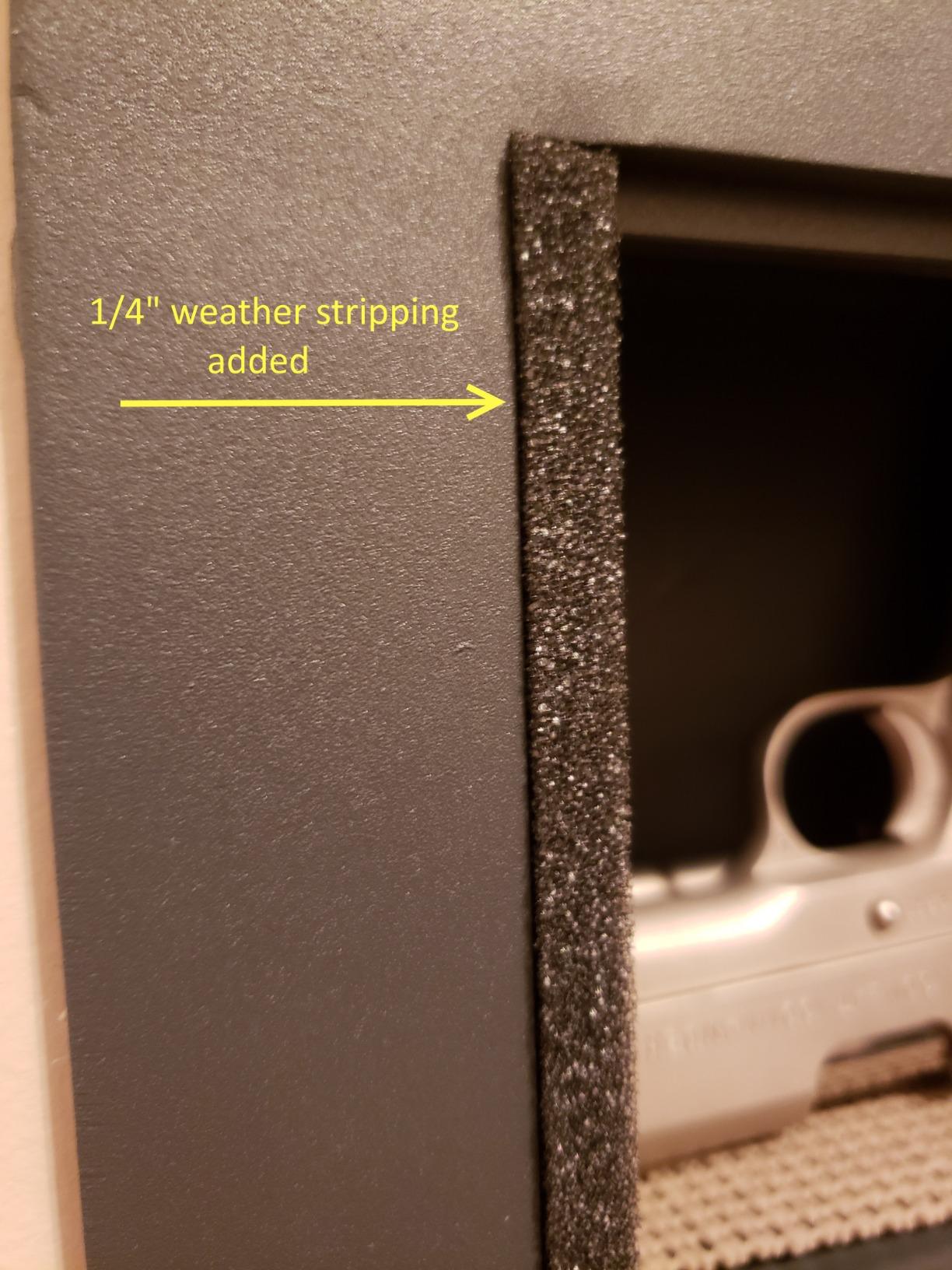
At 39 pounds this is a two-person lift, and the included lag bolts are the weak point in the box. Owners regularly report swapping them for better fasteners, and I would plan on doing the same. The battery pack is four AA cells, rated at roughly four to five months with one opening a day, so if you rotate codes or open daily, check them twice a year.
Two things annoy owners. The keypad beeps on every keypress and there is no setting to silence it, which matters if you open the safe at night. The center locking mechanism also claims a real slice of the middle shelf, so plan your shelf layout around a box in the center rather than fighting it.
How the Paragon handles a real jewelry collection
The interior is flat-sided with no shelf pins to snag a chain, so a rolled velvet watch roll or a ring box slides in without fuss. The chamber height leaves room for a full-length necklace pouch standing upright against the back wall. The one thing to plan around is the lock housing, which sits in the middle of the body and is the reason the top shelf reads smaller than the advertised 0.83 cubic feet suggests.
Where the Paragon falls short
It is not fire rated and it is not a burglary classification, so this is concealment and deterrence rather than certified resistance. Some owners report an electronic lock failing after a few months with no manufacturer contact available, so the two physical override keys should be treated as the primary access method rather than the backup. A small group of reviewers also point out there is no paper installation template in the box, so measure twice before you cut.
2. Homak First Watch Between The Studs – Best Budget Wall Safe for Small Collections
- Very low cost entry into concealed wall storage
- Full-length piano hinge on the door
- No batteries to fail
- Conceals behind artwork or in a closet
- Usable as a floor or closet safe too
- Thin steel door with no rim so it is easier to pry
- Very shallow interior for a few small items
- Included screws are weak so upgrade the fasteners
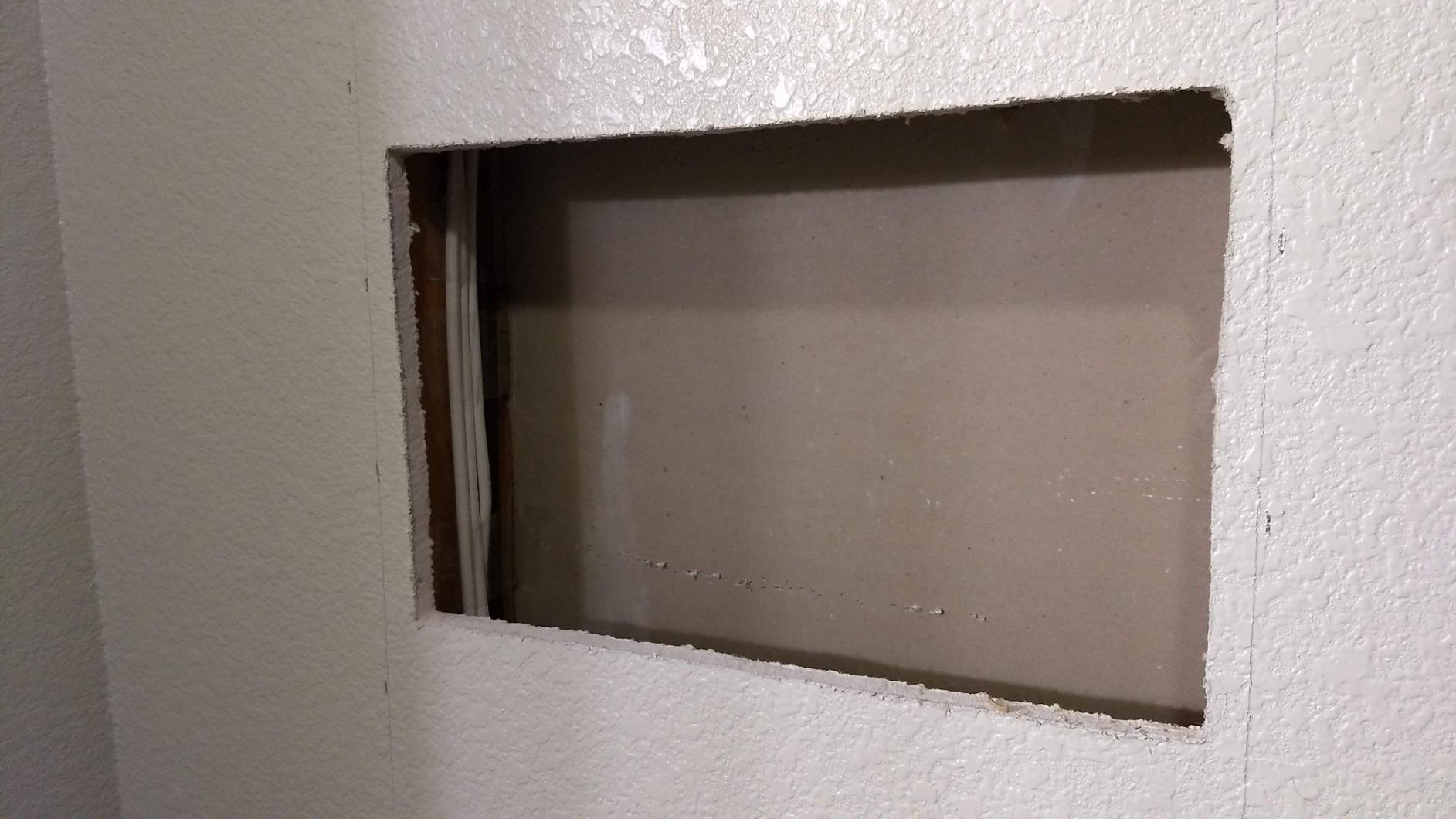
Do not read the low weight as a quality signal. The Homak is only four pounds because it uses thin steel over a shallow box, not because it is a badly made product. For what it is, a concealed box for a few rings, a couple of watches and some cards, it does the job cleanly and it installs in under an hour with a drywall saw and a stud finder.
The HMC tubular lock is a mechanical keyed system with two keys included. No batteries, no firmware, no lockout behaviour after too many wrong turns, and nothing that stops working in five years. For someone who stores a small, sentimental collection and wants it out of sight, that predictability is worth more than a fingerprint reader.
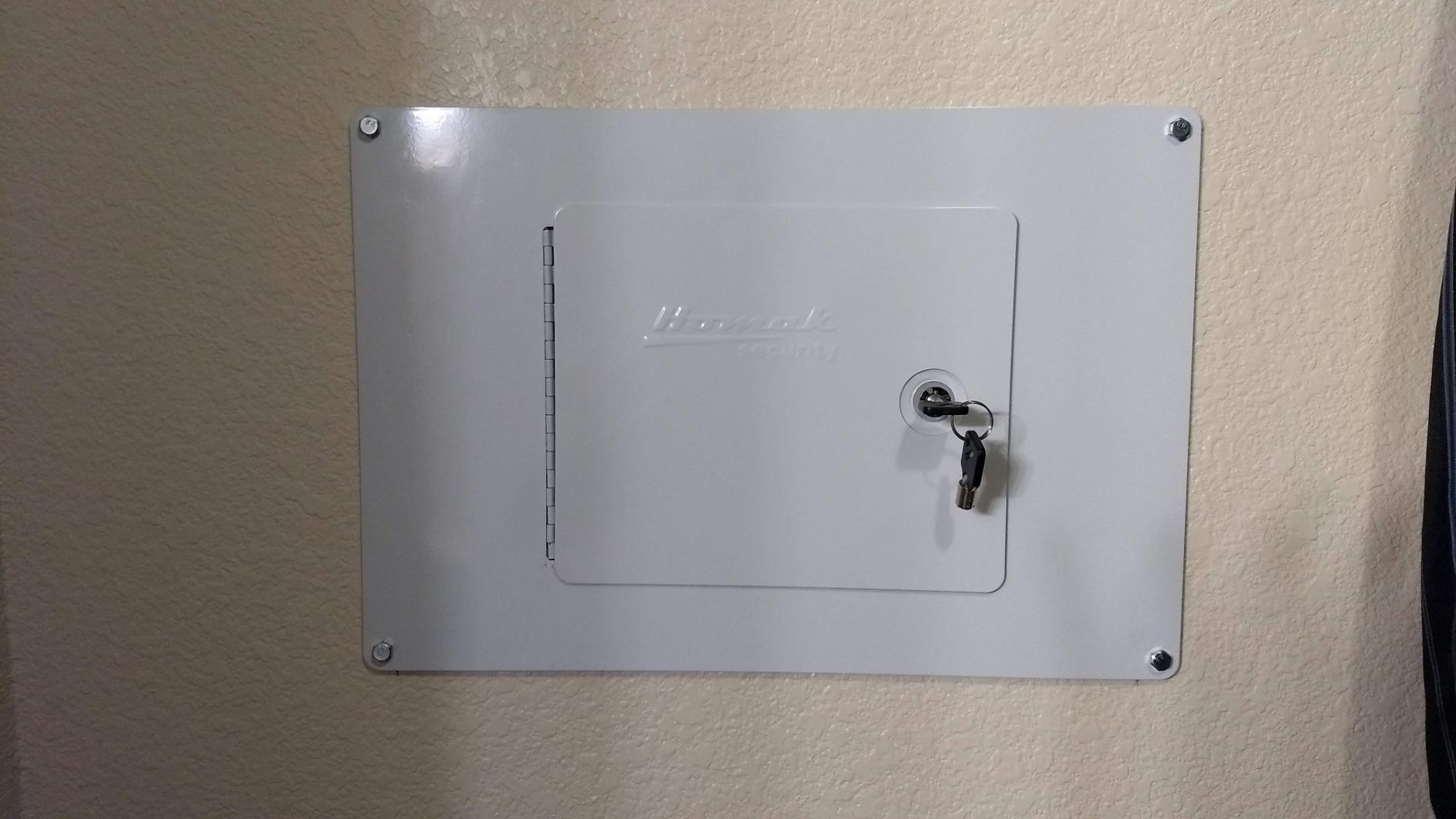
The black foam interior lining is the detail that keeps this on a jewelry list. Foam will not scratch a polished case back or leave a swirl mark on a gold band the way bare galvanized steel does. It is not velvet and it is not a fitted roll, so it will not keep a chain from tangling, but it protects surfaces and it costs nothing extra.
Owners are candid that this deters rather than defeats. The door has no rim or lip folded back around the opening, so a determined pry-bar attacker gets leverage on the flat steel. FineHomebuilding forum regulars make the same general point about the category, treating weight as a proxy for real resistance, and this is at the opposite end of that scale from the 39-pound bodies.
What fits inside the Homak
At 16 inches wide and 3 inches deep with 480 cubic inches, this is a shelf about the size of a paperback. Two watch rolls laid flat, a ring box, a card holder and a folded cash strap will all fit. A handbag, a camera body or a bulky safe deposit pouch will not. Sizing for a small collection is about footprint, not volume, and a wider shallow box usually beats a narrow deep one.
Who should skip this one
If your collection includes anything with a diamond certificate, a passport, or a family heirloom with a paper trail, move up a tier. The second inner door that stays behind the face panel if the outer panel is pried off is a nice touch, but the structural weakness is the door skin itself. Renters should also note that cutting drywall is a lease conversation, not a weekend project.
3. Viking Security VS-52BLX – Best Biometric Wall Safe for Jewelry
- Fast 500 DPI reader that works with worn prints
- Three independent access methods
- Two 20mm solid steel locking bolts
- Carpeted interior with LED and key hooks
- Owners report years of trouble-free use
- Oversized center lock box reduces usable middle space
- Shelves rest on thin easily bent metal tabs
- Large lock box needs 24 inch stud spacing framed in
- AA batteries need periodic replacement
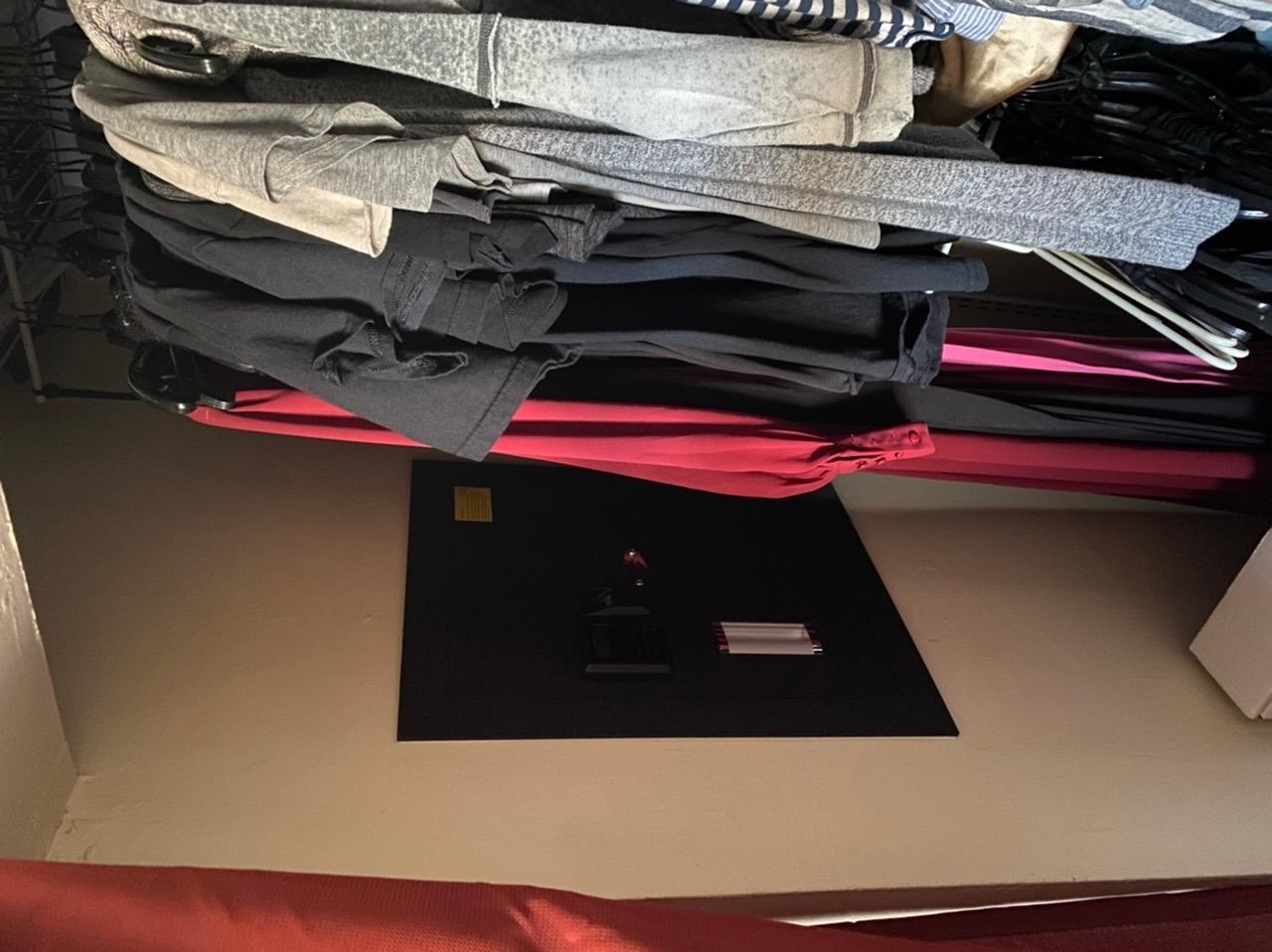
The VS-52BLX is the one I recommend when a household shares access. The 500 DPI optical sensor stores up to 32 fingerprints, which is enough for a spouse, adult children and a trusted sibling without turning your family into a security risk. The fingerprint memory survives battery removal, so swapping cells never locks anyone out.
Access is genuinely redundant. Fingerprint, a PIN code, and a four-prong cross key override all work, and there is a warning beep if you leave the door unlocked. The lock itself is a motorized 20mm deadbolt behind a 5mm door, which is a real step up from the tubular key locks at the entry tier.
Carpeted walls throughout, a built-in LED and key hooks at the top of the interior, plus three fully adjustable shelves. The carpeting is the single best feature for jewelry in this whole list, because it is a proper soft surface rather than foam. Chains sit on it without the metallic sound they pick up on bare steel, and the shelves let you build a dedicated watch shelf rather than a pile.
Install is the catch. The center lock box is bulky, and owners report needing 24-inch stud spacing framed in to clear it, which is real framing work rather than a simple cutout. If your wall is standard 16-inch centers, measure the lock box projection before you buy.
Why three access methods change the ownership experience
Electronic lockout is the most predictable failure mode in this category, and forum threads about it never really go away. This safe answers it three ways: batteries die and the PIN still works, the PIN is forgotten and the cross key opens it, the sensor fails in cold weather and the key does not care. A household with heirlooms that may sit untouched for years should weight redundancy heavily.
What to watch before cutting the opening
The shelves sit on thin metal tabs that reviewers say bend under load, so put nothing heavy on them. The interior LED is a genuine convenience in a dark closet. And at 39 pounds, plan on a second pair of hands, because a 20mm deadbolt and a steel body this size do not negotiate with a solo installer leaning on a ladder.
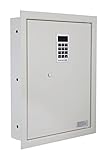
4. Protex PWS-1814E – Best Velvet-Lined Wall Safe for Fine Jewelry
- Dual live motorized 3/4 inch bolts resist prying
- Velvet lining and auto-opening door feel premium
- Multiple fail-safes including codes and physical keys
- Door sits only a quarter inch proud of the wall
- Interior LED lights the contents
- Instructions are sparse and the rough opening size is misleading
- Shelves are felt covered but feel flimsy
- Shallow interior limits you to documents and small pouches
- Some units need a battery contact adjustment out of the box
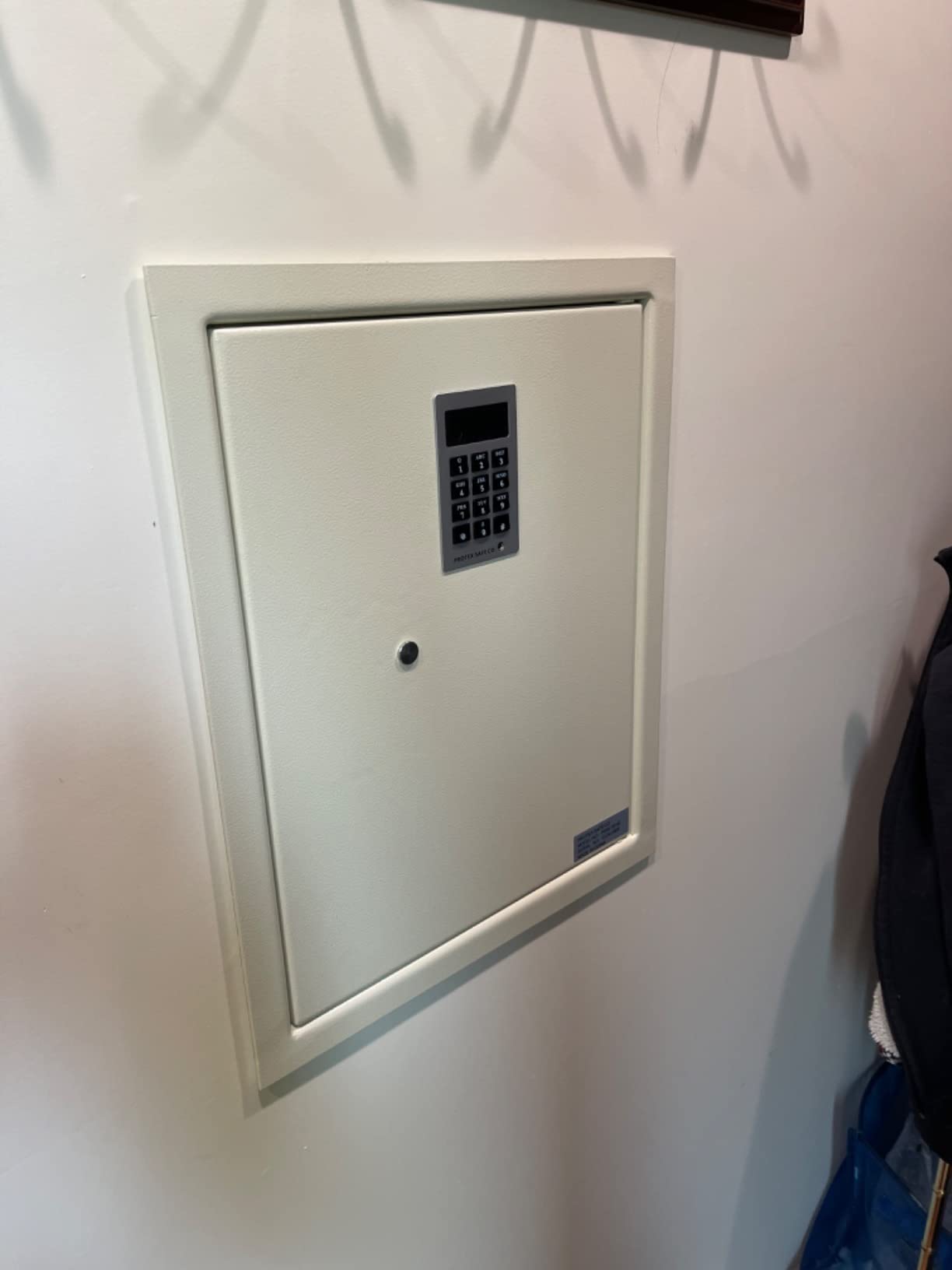
The Protex is the velvet-lining answer. Of the twelve safes here, only this one pairs a genuine velvet interior with a motorized door that swings itself open after you enter your code, which is a hotel safe experience rather than a hardware-store one. For fine jewelry the lining is the deciding factor, and velvet will not put a hairline scratch on a polished case or leave a mark on a gold chain.
Construction is heavier than the price suggests: heavy duty gauge steel, dual live chrome bolts measuring three quarters of an inch, and a door that sits barely a quarter to half inch proud of the drywall. That shallow projection matters in a hallway or closet where anyone can get close to the wall.
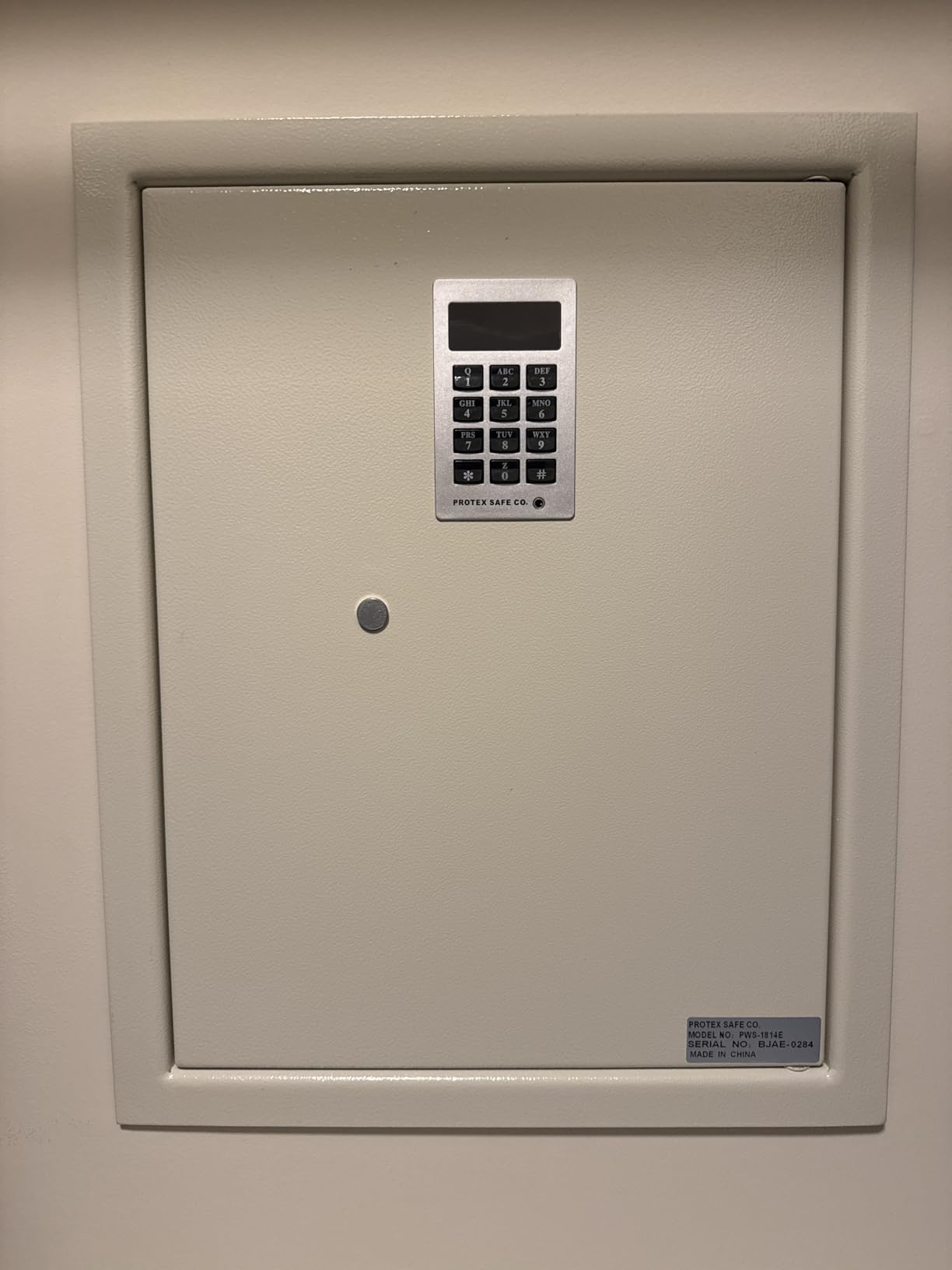
Fail-safes are stacked unusually well. There is a user code, a reprogrammable master code, an external battery backup compartment and physical override keys. The keypad display can be blanked after entry so the digits do not linger on screen, and dual live bolts mean both sides of the door are engaged rather than one latch at the edge.
The documentation is the weak point, and owners say so repeatedly. The stated rough opening size is misleading, so measure the actual body rather than trusting the listing. The interior LED is a real convenience for reaching a small pouch in the back corner without pulling everything out onto the floor.
Sizing for a small but valuable collection
At 0.44 cubic feet with a 3 inch exterior depth, this holds documents, a passport, a small pouch and a compact ring case. It will not hold a handbag or a box of coins. For a person whose jewelry is small in volume but high in sentimental value, the velvet and the shallow projection make it a better fit than a bigger safe with a bare steel floor.
Who will be disappointed
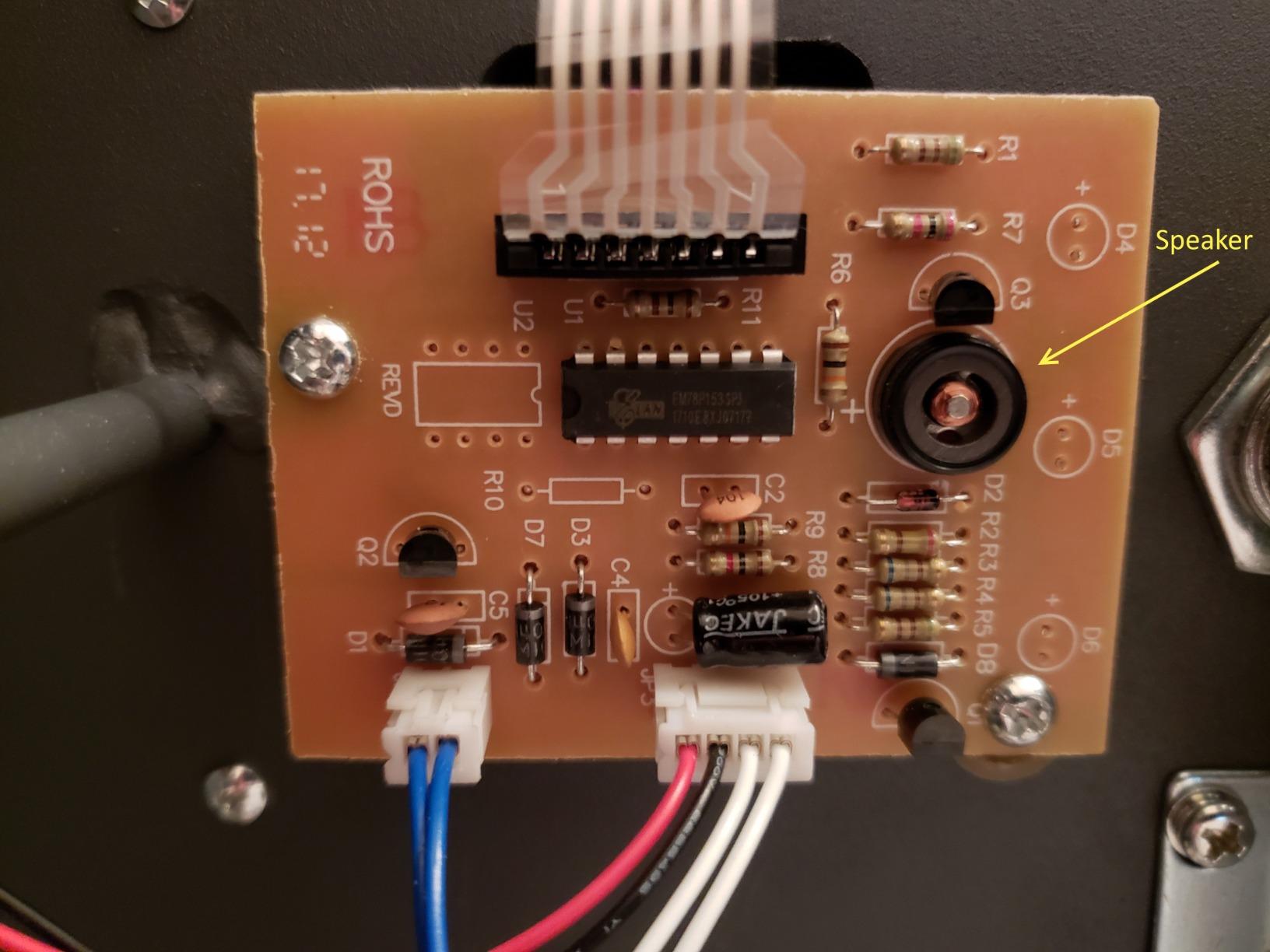
Anyone with a large collection, and anyone who moves. The shelves are felt covered and reviewers describe them as flimsy, so a heavy watch box will slide. Keypad beeps are moderately loud and silencing them means opening the unit and working on the speaker, so plan for a slightly noisy entry.
5. Nebakne 25.6 Inch Tall Fireproof Wall Safe – Best Tall Safe for Long Necklaces
25.6″ Tall Fireproof Wall Safe Between Studs 16″ Centers | Hidden Wall Safe
- Tall body gives unusually high usable interior height
- 4 cm thick steel door with solid bolts
- Code entry plus two emergency keys
- Hidden lower compartment adds a second layer
- Flush mount hides behind framed artwork
- Bolts and door weight make solo installation difficult
- 3.93 inch depth needs a larger cavity than most
- Smaller brand with a newer track record than the category leaders
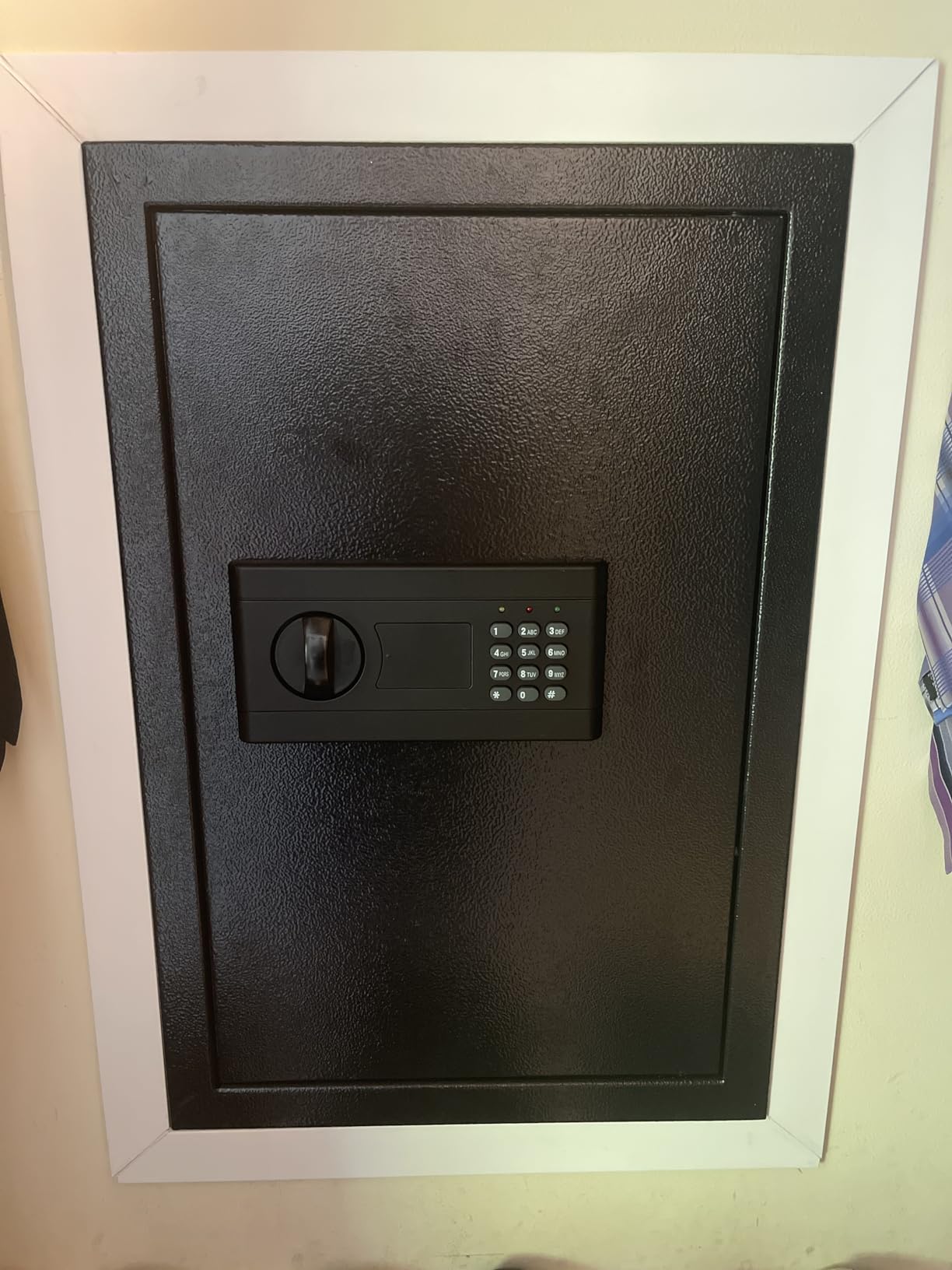
Height is the overlooked dimension in this category, and this safe is the tallest body in the group at 25.6 inches. If your collection includes long chains, graduated necklaces or a rolled bracelet set, vertical room is what stops you from crushing them into a coil. Most of the safes here are wide and short, which suits rings and watches and does nothing for necklaces.
The door is 4 cm of steel with an all-metal integrated panel, driven by two 2.2 cm solid steel locking bolts. Access is an electronic combination lock accepting 3 to 8 digit codes, with a knob and two emergency keys for backup. A removable interior shelf splits the tall cavity, and a hidden lower compartment gives you somewhere for the pieces you would rather not advertise.
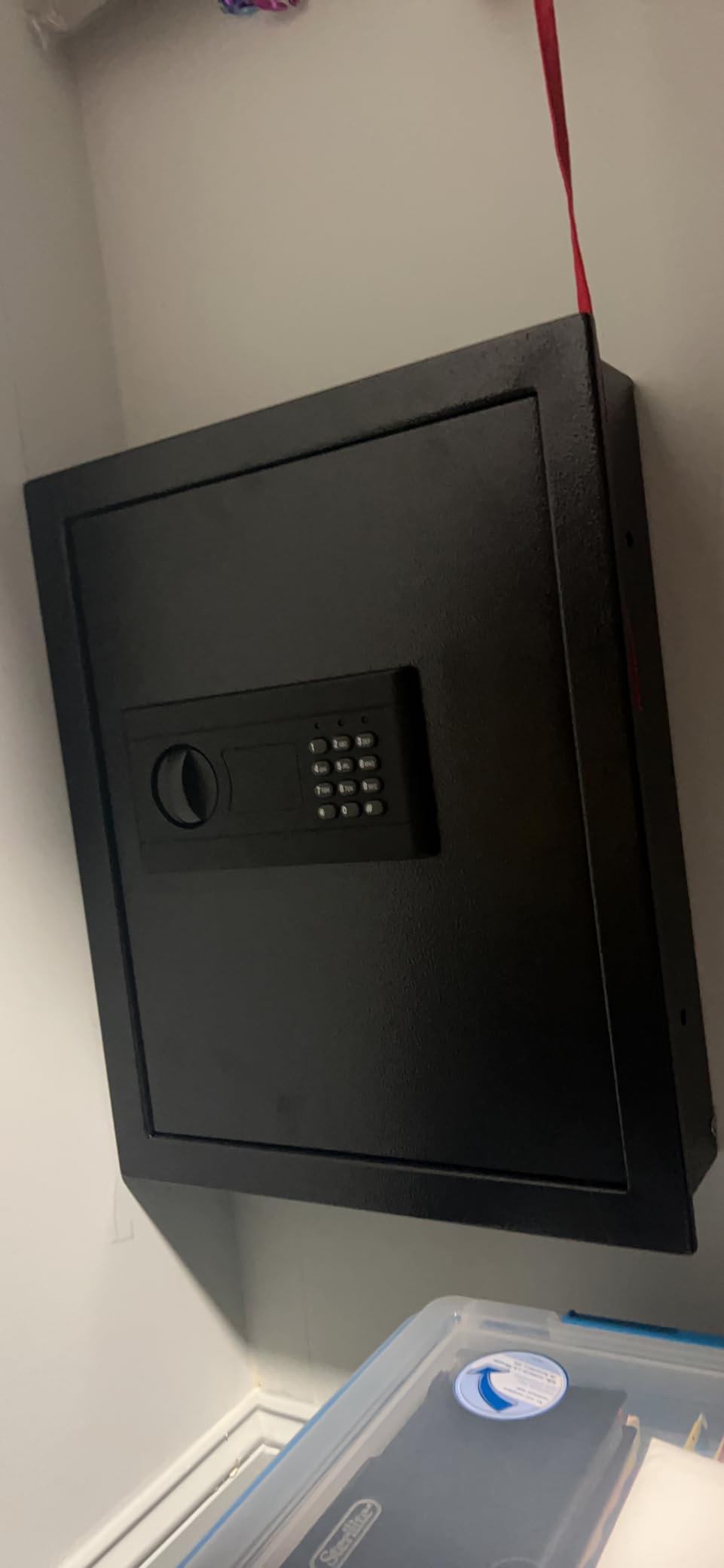
One word of caution about the listing title. It uses the word fireproof, and no certification accompanies that claim on the data we reviewed. Treat it as marketing language rather than a tested fire rating, and see the fire section further down for why a safe this thin cannot carry a genuine multi-hour rating.
Installation is the deciding factor. At 28.7 pounds with a thick door and two heavy bolts, owners report this is genuinely difficult to install alone. Budget for a second person, and confirm your wall cavity can accept a 3.93 inch depth before the drywall comes off.
Who this tall format suits
Anyone storing necklaces long enough that folding them causes tangles or kinks in a fine chain. It also works for a mixed collection of watches and jewelry where you want vertical separation rather than one deep box, since the removable shelf gives you two independent compartments instead of a single cavity.
Where it falls short
The 3.93 inch depth is deeper than most between-studs models, so it is a poor fit for a shallow partition wall or a cavity with old plumbing in the way. The brand is newer than the category leaders, so the volume of long-term owner feedback is thinner. And the hidden compartment is a secrecy feature, not a security feature, since anyone who opens the door can find it.
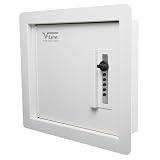
6. V-Line Quick Vault – Best Wall Safe with No Batteries or Keys
V-Line Quick Vault Locking Storage Safe for Guns and Valuables, Mechanical Lock, Steel, Ivory
- Push-button mechanical lock is fast and quiet
- No batteries or keys to manage
- 3/8 inch steel lock block and welded continuous hinge
- Felt-lined interior protects jewelry and watches
- Attached bezel lets a picture hang over the door
- Small interior volume at 0.35 cubic feet
- Buttons take practice to feel without looking
- Extra felt shelves must be bought separately
The V-Line is the reliability pick. A five-button mechanical push-button lock with 1081 possible combinations replaces every electronic weakness in this category: no batteries, no keypad to fail, no fingerprint sensor that sulks in cold weather, and no keys to lose. You press a sequence, the bolts retract, and it works the same way in ten years.
Construction is solid in the ways that count for prying. There is a 3/8 inch thick steel lock block, a pry-resistant clamshell door, and a continuous hinge welded on one end so the pin cannot be tapped out and the door pulled off its knuckles. That is a real attack-resistance detail that most units in this list do not have.
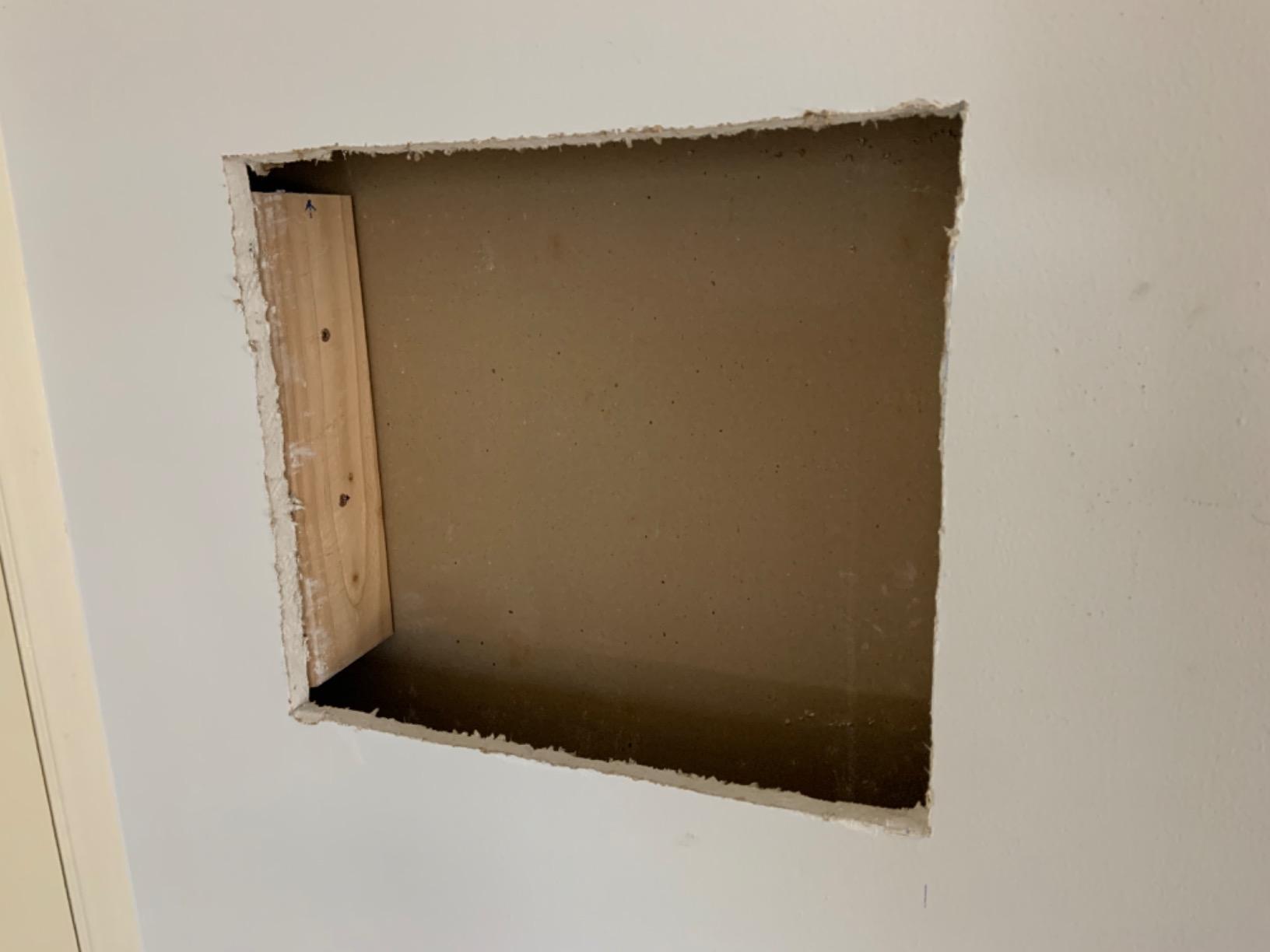
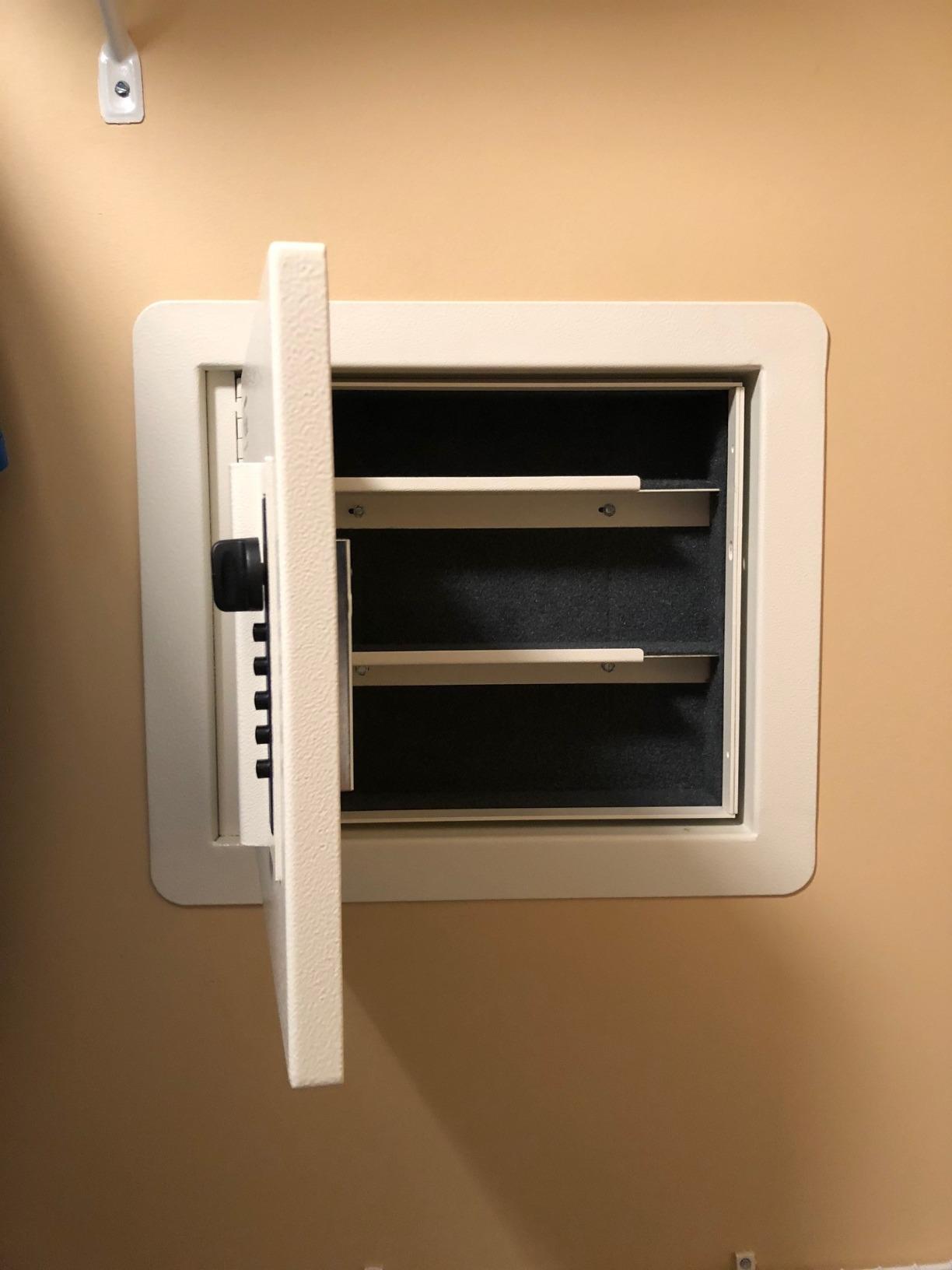
The felt lining covers the walls, the back and one adjustable shelf, and it does the jewelry job well. Felt will not scratch a watch crystal or dull a gold surface, and unlike foam it does not compress and shed over years. The attached bezel gives the finished install a clean edge, and it is shallow enough at 3.5 inches to hang a framed picture directly over the door.
The interior is the limitation. At 0.35 cubic feet with 14 inches of chamber width and 12 inches of chamber height, this is a watch and small-pouch safe, not a collection safe. Reviewers also note the buttons take practice to identify by touch, and additional felt shelves are sold separately.
When a mechanical lock beats a fingerprint reader
Three situations. A garage, basement or unheated closet where cold fingers cause sensor failures. A safe that will hold heirlooms for years without anyone checking the batteries. And any household with more than two people who need access, where issuing cards or keys is simpler than enrolling prints.
Limits worth knowing
Plan your layout around a single shelf and a low ceiling, and buy extra felt shelves if you need tiers. Push-button entry is fast once learned, but it is a sequence, so it is not the right choice for someone who opens the safe several times a day in a hurry. At 23 pounds it is manageable solo, which is a genuine plus for a solo installer.
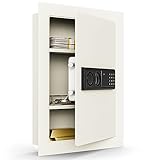
7. Giantex Electronic Wall Hidden Safe – Best Large Interior for the Money
Giantex Electronic Wall Hidden Safe Security Box, Built-In Wall Electronic Flat Security Safety Cabinet (White)
- Heavy steel body with real weight for the tier
- Easy fit between 16 inch on-center studs
- Straightforward keypad programming and reset
- Two ways in with code and key
- Interior fits jewelry and passports easily
- Keypad has a cheap rubber feel
- Center lock mechanism reduces usable middle space
- Battery compartment is inside so a dead cell means the key
- Not fire rated
- Key cover screw can strip
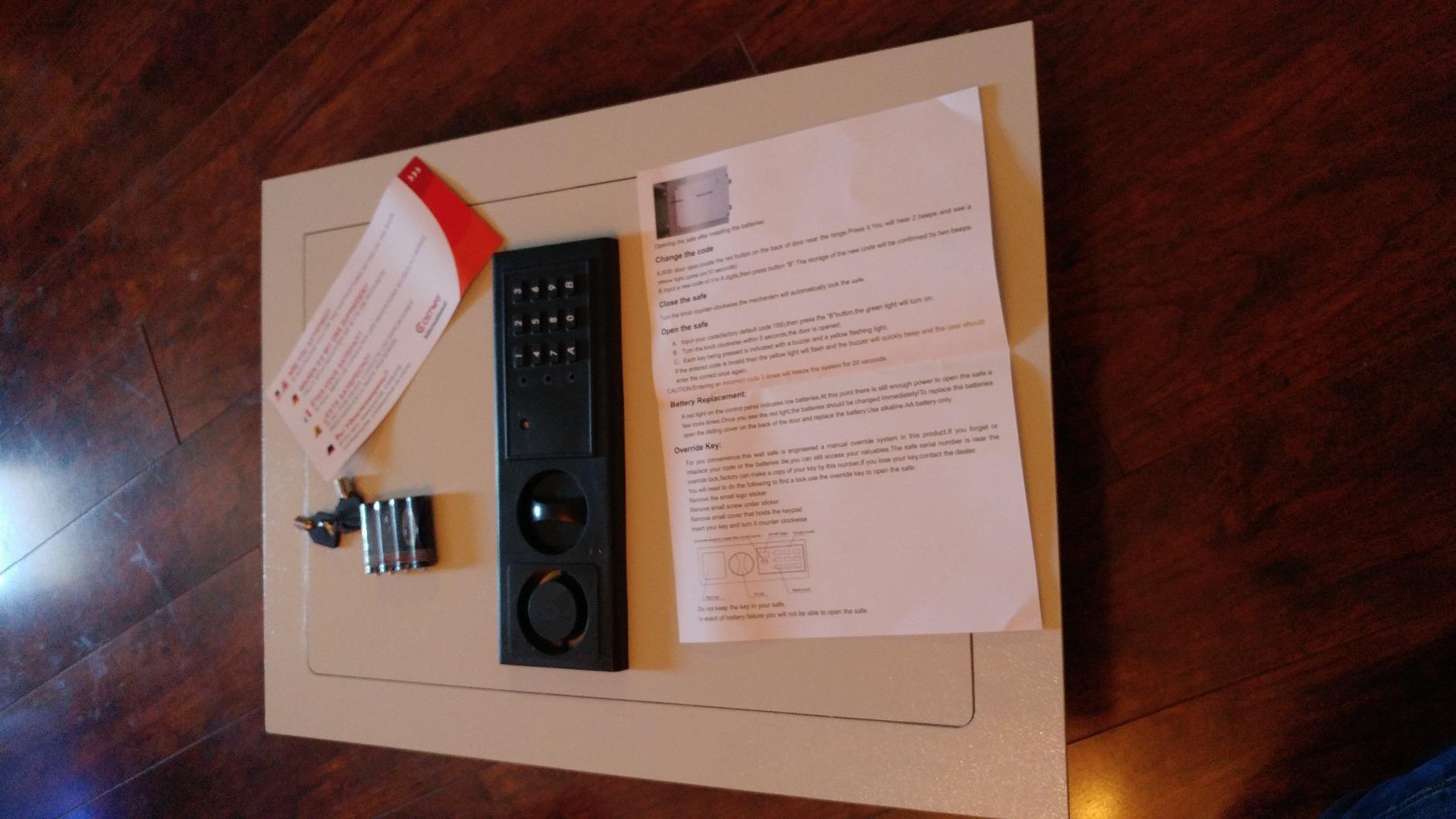
The Giantex is the volume-per-dollar answer. At 0.83 cubic feet of interior with inside dimensions of 19 by 13.8 by 3.75 inches, it matches the Paragon on volume while sitting lower in the range, and 31.6 pounds gives it enough heft to feel like steel rather than sheet metal. Owners repeatedly compare it favourably to safes costing several times more.
Access is an electronic combination code with a key override, and there is a lockout period after three incorrect attempts. The code programming and reset process is described as straightforward, which matters because a keypad you cannot reprogram is a safe you eventually cannot open.
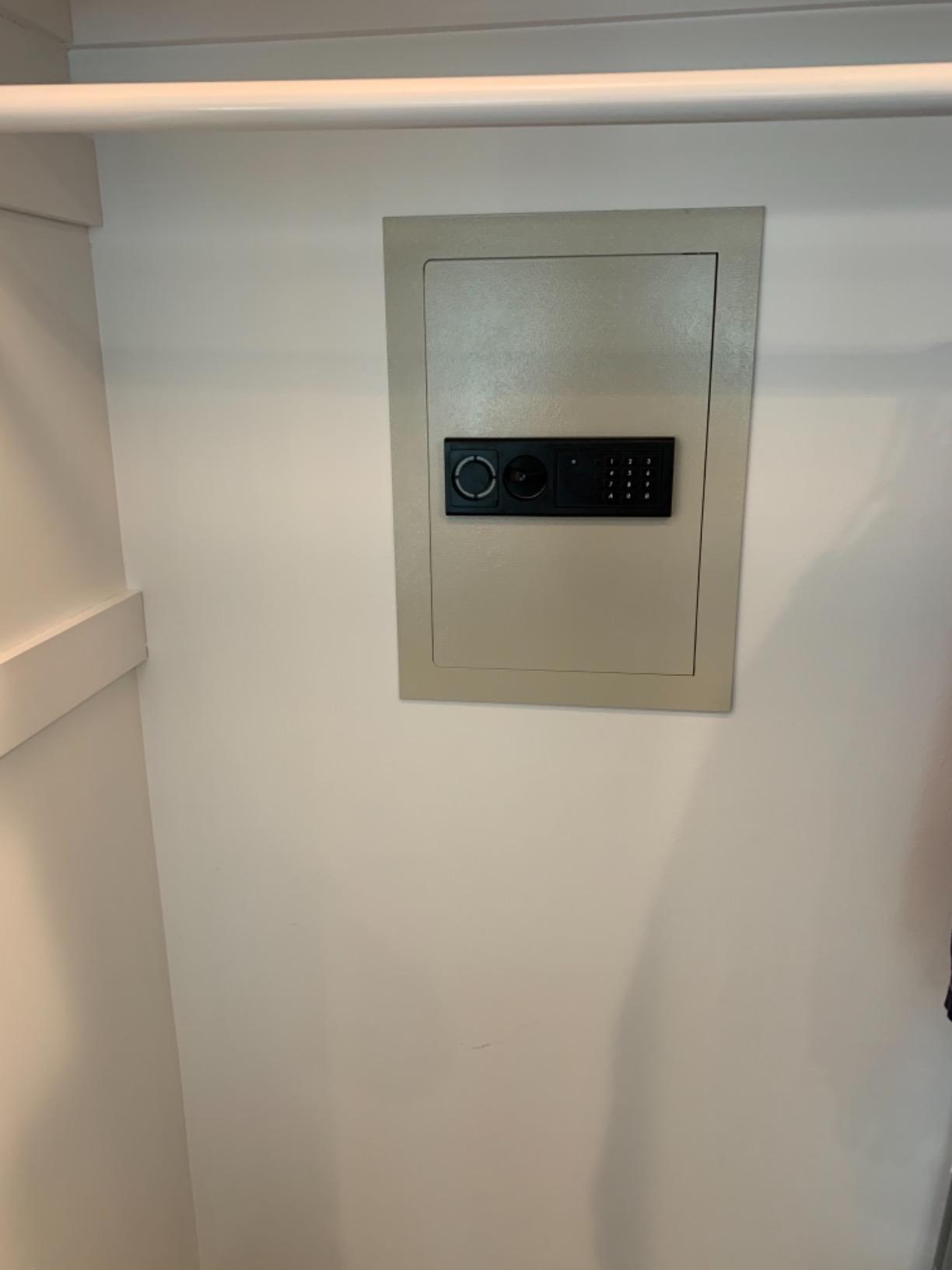
For jewelry specifically, the wide flat interior is the advantage. A 19 inch tall cavity takes a rolled bracelet set or a full-size ring case standing on end, and the width holds a watch roll alongside a small pouch without stacking. It is a good match for someone consolidating a dresser into one locked location.
The negatives are honest ones. The keypad has a cheap rubber feel, the center lock mechanism again reduces the usable middle, and the battery compartment sits inside the safe, so a dead cell means reaching for the key rather than a USB port. It is also not fire rated.
How it compares to the Paragon
Both hold 0.83 cubic feet. The Paragon gives you a wide front flange, two separate passcode profiles, a louder alarm escalation and the benefit of a very large review base. The Giantex gives you a slightly taller inside cavity and a key override instead of two keys. If the install is in a tight hallway where a proud flange would be obvious, the Giantex is the more forgiving body.
Who should move up instead
Anyone storing heirlooms that would be destroyed by handling, and anyone planning to add to the collection. The interior is bare steel with no lining, so put a felt or velvet liner mat inside before a watch goes anywhere near the walls. Also be aware the key cover screw is easy to strip, which can lock you out of the key override entirely.
8. Grimtron Electronic Wall Safe – Best Interior Layout for Necklaces and Watches
Grimtron Electronic Wall Safe Between 16″ & 24″ Studs with Shelves & Hooks
- Vertical interior not eaten up by a center lock box
- Silent Mode keeps keypad entry discreet
- Emergency USB port for dead batteries
- Two removable shelves plus adjustable hooks
- Spacer kit covers 16 inch and 24 inch stud centers
- Included screws and lag bolts are weak
- Not fireproof
- Pegboard pegs are fixed and must be unscrewed to move
- Fits loosely between true 16 inch centers
- Thin welded latch strap is a weak point
The Grimtron solves the problem that spoils most in-wall safes for jewelry: the center lock box. Its interior is a clean vertical run, so you get a full-height column instead of two short shelves split by a mechanism. With two removable shelves and adjustable hooks, you can build a watch tier, a necklace tier and a document tier without anything sharing a wall.
Silent Mode is the feature owners mention most in a house where other people sleep. The keypad still takes your code, it just does not beep, which removes the single most common complaint about electronic wall safes. There is also an emergency USB port for when the batteries die, plus two emergency keys as a second fallback.
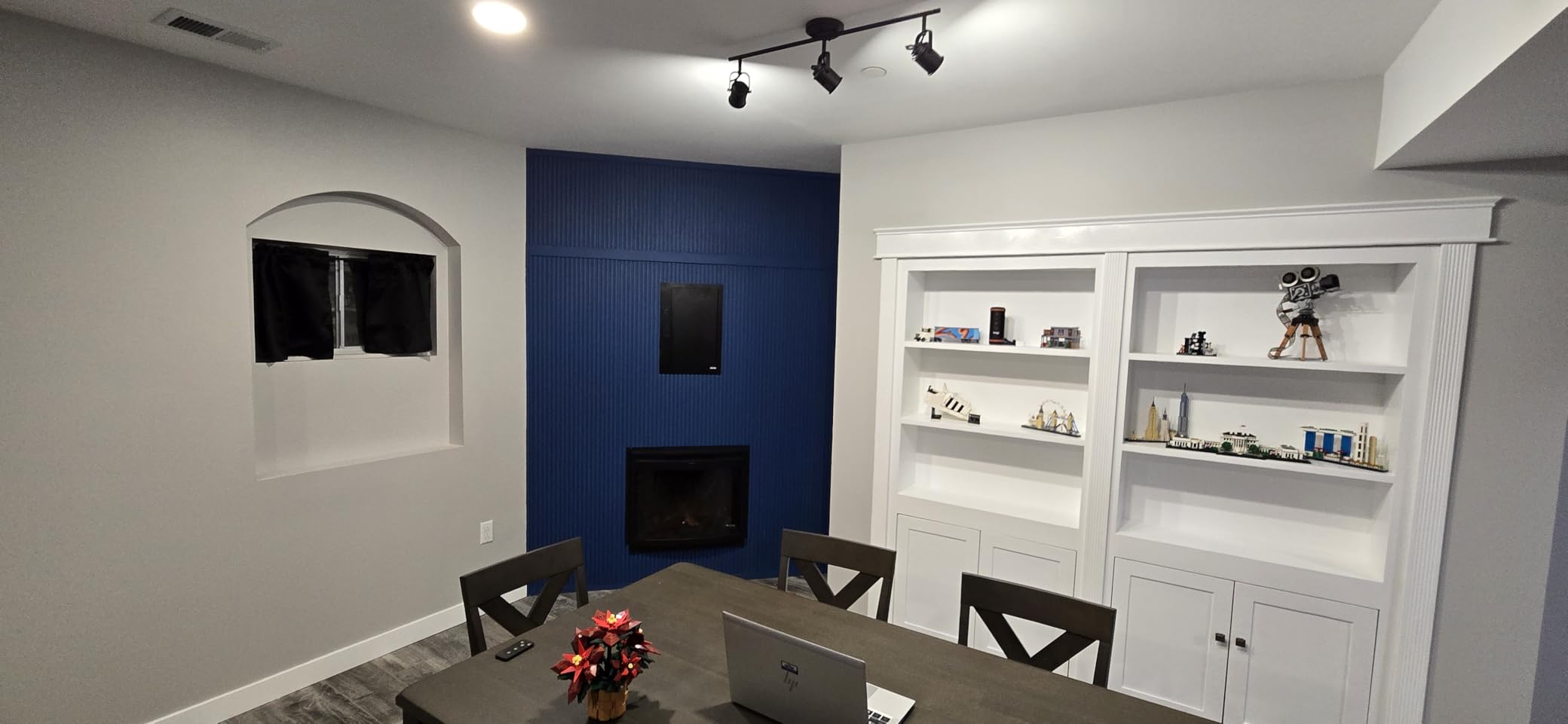
At 0.76 cubic feet with 13.78 inches of chamber width and 20.87 inches of chamber height, it is the best-proportioned interior in this group for chains and watches. The included shelf-and-hook kit is closer to a real jewelry organizer than the bare floors most competitors ship, and you can remove pieces of it to create open volume for bulkier items.
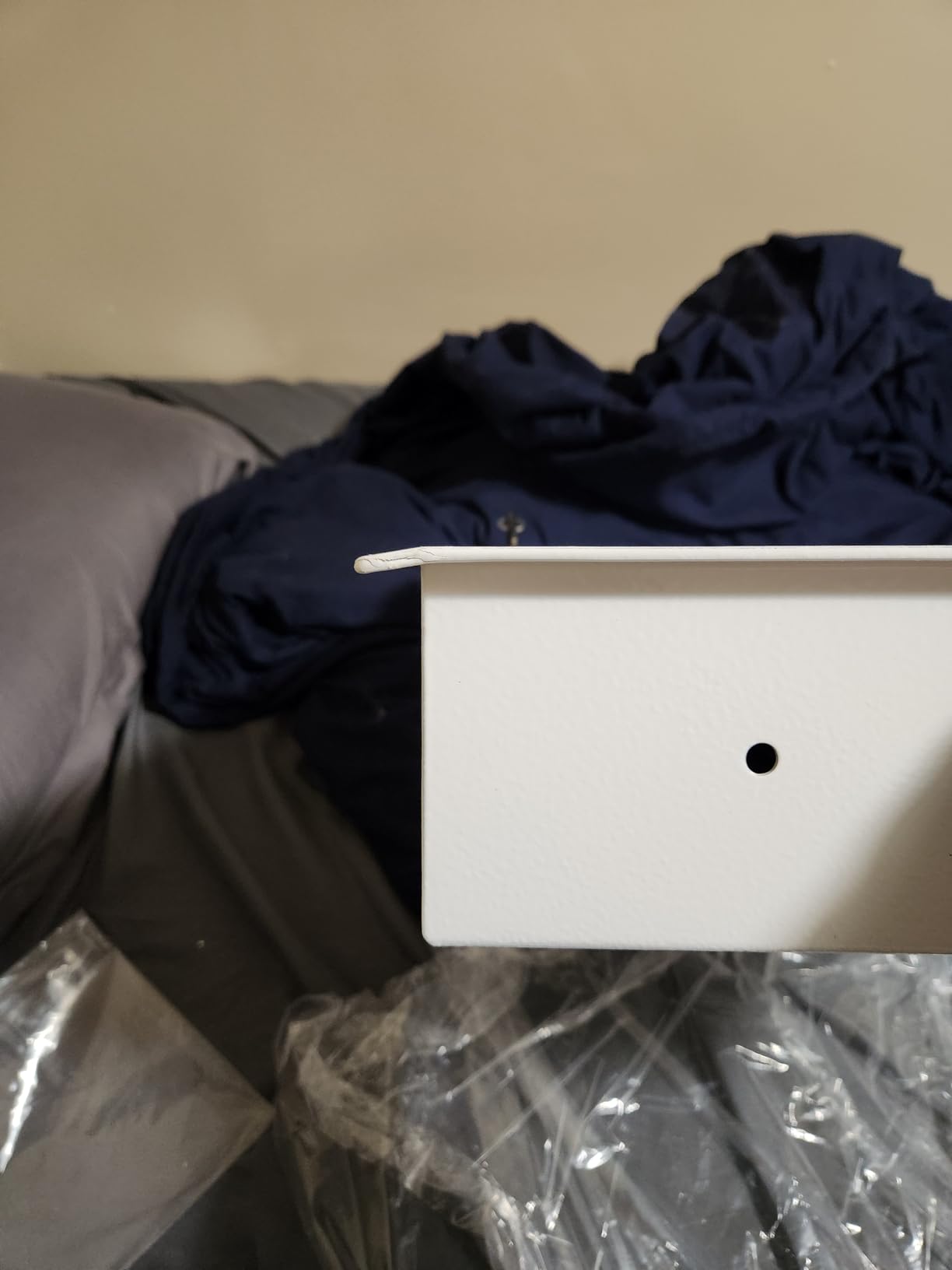
Bring your own screws. Owners report the included hardware stripping or bending, and several substitute heavier fasteners during install. The pegboard pegs are fixed in place, so plan your layout before you screw them in rather than rearranging later.
Why the vertical interior matters for necklaces
Chains tangle when they share a flat floor with other chains. A tall, divided interior lets you hang or stand each one separately, and the hooks let a pouch sit apart from a watch. If your jewelry is more than rings, this is the layout that will keep pieces from knocking against each other every time you open the door.
What to fix before and after install
Use the spacer kit if your studs are 24 inches on center, and check the fit between true 16 inch centers because owners report a small gap on each side. It is not fireproof. The thin welded steel latch strap is the structural weak point, so treat this as a concealment safe with a decent lock rather than a certified burglary container.
9. Elder Welder Hidden Wall Safe with Air Vent Cover – Best Disguised Wall Safe
Elder Welder® Hidden Wall Safe with Air Vent Cover, Combination Lock
- Conceals behind a realistic air vent cover
- Installs in about 20 minutes with the template
- Over 300 cubic inches in a low 3.1 inch profile
- Mechanical combination means no batteries
- Unmarked discreet packaging
- Shallow 3.1 inch interior depth limits what fits
- Combination must be reset after removing the safe
- Light body resists forced entry less than heavier safes
This is the only true disguise in the group. Where every other safe on this list is hidden behind something you hang yourself, the Elder Welder arrives with a genuine air vent cover, so the finished installation looks like an ordinary electrical vent plate. There is no picture to move, no frame to keep straight, and no visible seam to explain away.
That makes it a strong choice for hallways, utility rooms and rental-adjacent situations where a person walking past the wall all day would eventually wonder about the picture. The mechanical combination lock needs no batteries, and backup keys are included for the case where you forget the code.
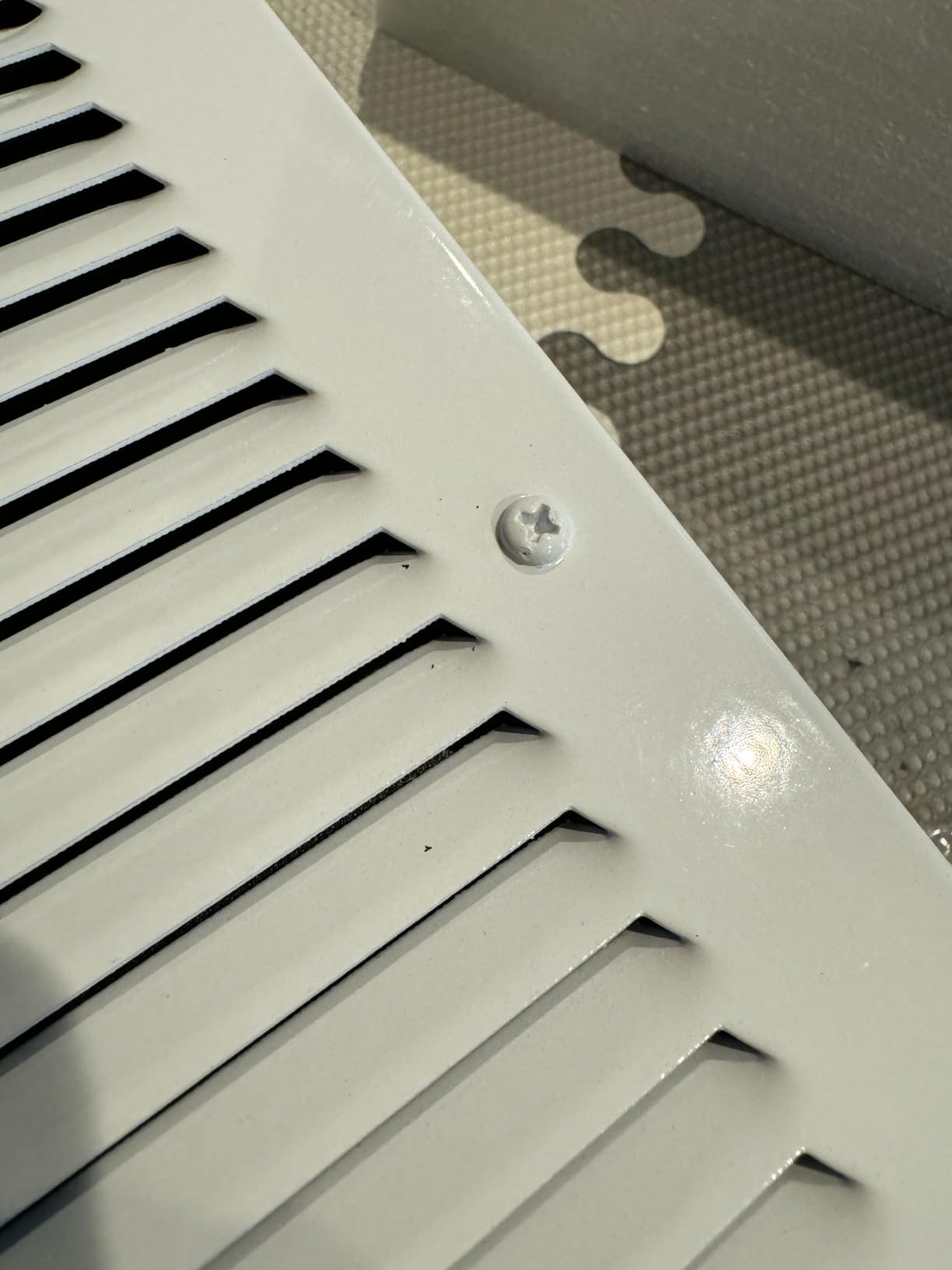
Install is the easiest here. A mounting template, stud-fixing screws, and both written and video instructions get this in place in about 20 minutes, and the body sits at only 3.14 inches deep. The packaging is unmarked, which matters if you would rather a delivery did not announce exactly what is on its way to your door.
Capacity is over 300 cubic inches in a 13.5 by 7.8 by 3.1 inch chamber, so it holds a small collection: rings, earrings, a couple of watches, a card holder. The depth rules out anything with a strap or a pouch, and the 2.8 kg steel body is light enough that a determined attacker could eventually get it out of the wall.
When a disguise beats concealment
Three cases. A wall where hanging art is impractical, such as a stair landing or a low wall. A household where anyone might notice a framed picture that never moves. And a secondary location where you want no visual trace at all, since a vent cover reads as part of the house rather than as storage.
Know the limitations before you set the code
The combination has to be re-set after the safe is removed from the wall, so record it somewhere you will find it. The shallow depth means velvet and felt liners may not fit, so put jewelry in pouches before it goes in. And a 2.8 kg body is deterrence, not resistance, which is a fair trade when the alternative is a box nobody ever finds.
10. Langger Biometric Wall Safe – Best for Shared Multi-User Access
Langger Biometric Wall Safe Between Studs, Hidden Fingerprint In‑wall Safe
- Biometric entry without fumbling for a code
- PIN code and two emergency keys as backup
- Two motorized deadbolt bars in a recessed panel
- Silent mode for discreet entry
- White finish blends into traditional trim
- Lock assembly takes a noticeable share of the interior
- Some units arrive with an over-tight deadbolt screw
- Spot weld quality criticized on some units
- Fingerprint reader needs clean dry fingers
- Instructions take careful re-reading
The Langger stores up to 100 fingerprints, far more than any other safe here, and that is the number that matters for heirlooms rather than watches. If your safe holds a grandparent engagement ring that your spouse, your adult children and a sibling may all need at some point, enrolling prints is cleaner than handing out keys or reciting PINs. Beep-off silent mode keeps entry quiet.
The door uses two motorized deadbolt locking bars set in a recessed panel in carbon steel, and mounting holes are pre-drilled with anchor bolts in the box. The white finish suits a closet or hallway with traditional trim, which is a small thing that makes a safe less noticeable.
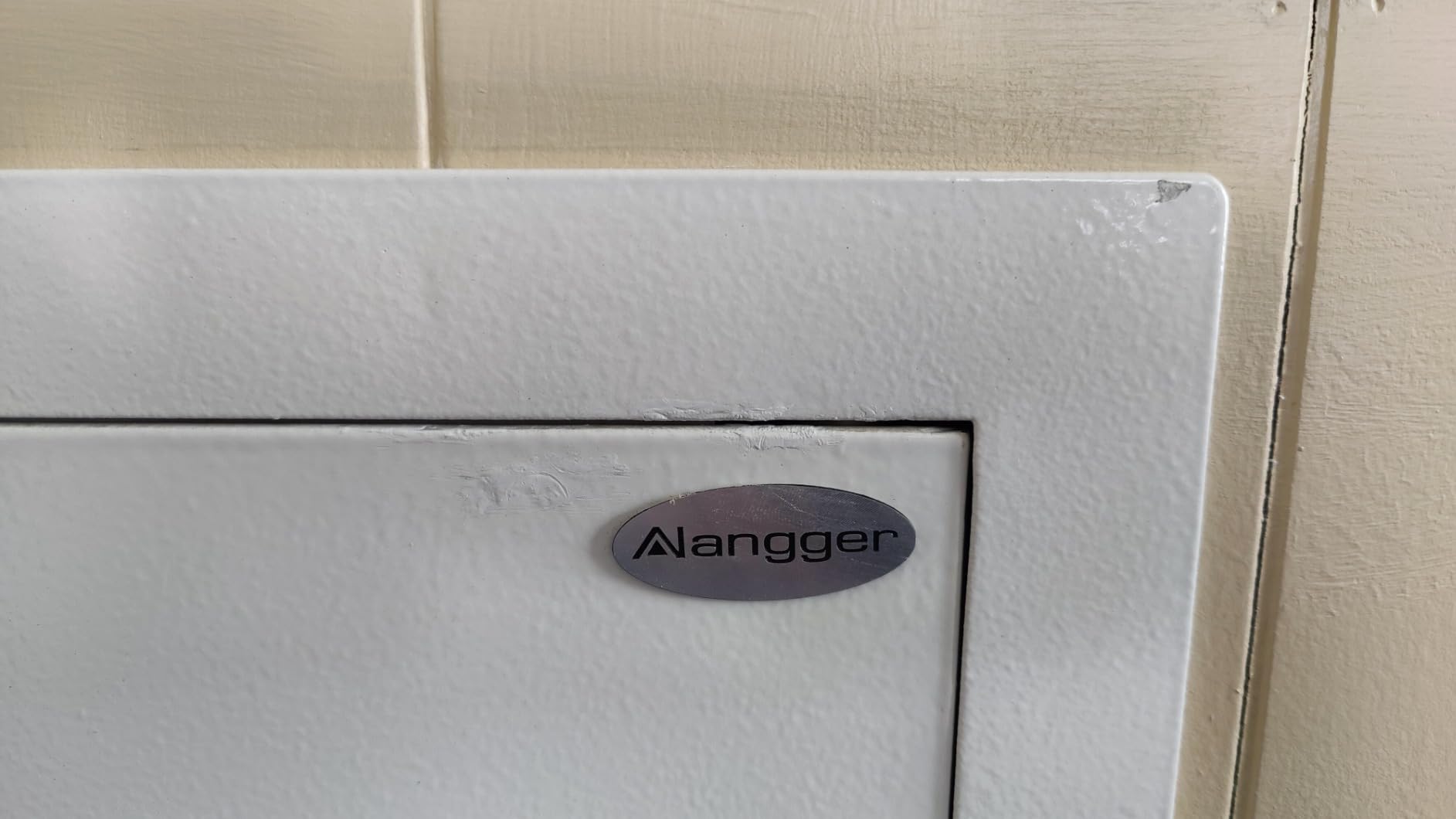
Several owners run these in new-home builds where the framing is still open, which is genuinely the easiest time to install any in-wall safe. The stated wall opening is 21 by 13.75 by 4 inches, and a shelf is included, so the cavity needs to be close to that or you will be patching a wider hole.
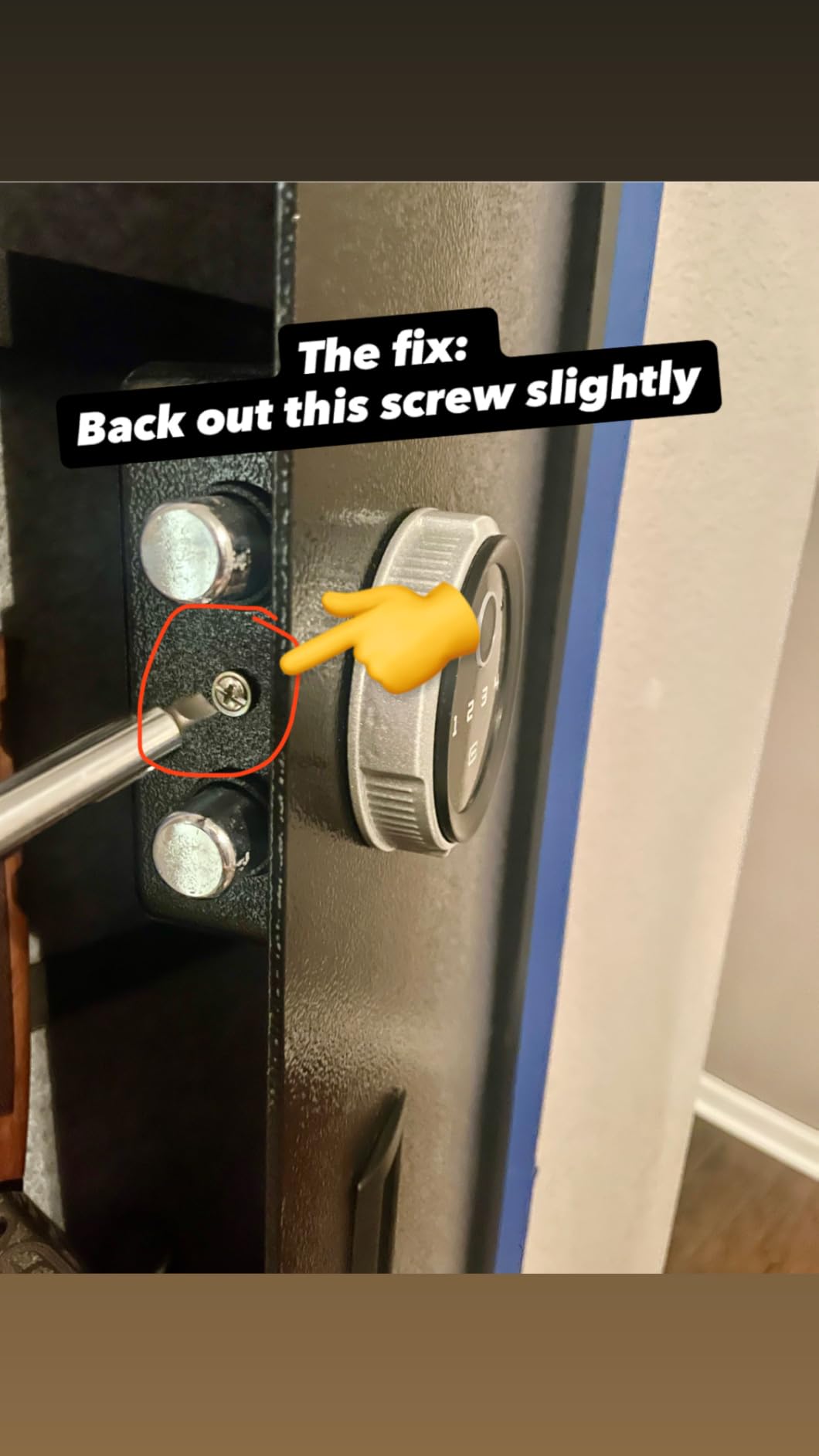
The recurring complaint is a manufacturing detail, not a design flaw: some units arrive with an over-tightened screw between the deadbolts that stops the bolts dropping. Check the bolts open and close before you drywall the wall in. Spot weld quality is also criticized on a small number of units.
How the 100-print capacity compares
The Viking stores 32 prints, the XDeer uses a smaller store again, and this stores 100. For a two-person household the extra capacity is irrelevant. For a family with adult children who may need access years from now, it removes the awkward conversation about handing over a key. Enrollment is also faster than it sounds, since you press a finger rather than remember a code.
Practical limits to plan around
The reader needs clean, dry fingers and a firm one to two second press, so it is not ideal for a garage or a room where hands are often cold or wet. The lock assembly claims a noticeable part of the interior, so map your shelf layout around it. And read the instructions properly the first time, since owners report the reader behaves differently than expected until it is set up properly.
11. XDeer Biometric Wall Safe – Best Adjustable Interior
XDeer Biometric Wall Safe Between 16″ Studs, Upgraded Hidden Safe
- Three access methods including fingerprint and key
- Removable shelves and hanging panel reconfigure easily
- Powder-coated finish resists scratches and corrosion
- Rounded edges are safer around children
- Flush install stays hidden behind artwork
- Fingerprint scanning needs clean dry fingers and a firm press
- Newer brand with a smaller volume of owner feedback
- Battery powered electronics need periodic replacement
The XDeer is the one to buy if your collection will change. The shelves and the hanging panel are both removable, and the panel has adjustable hook spacing, so you can strip the interior out completely for bulky items and rebuild it later for chains and watches. That flexibility is more useful over five years than any single well-fitted insert.
Three ways in: fingerprint, numeric keypad and two emergency keys, with automatic locking and an anti-pry design on the body. The matte powder-coated finish resists scratching, rust and corrosion, which matters in a humid closet or a basement wall where a bare steel box would bloom.
The rounded edges are worth noting if there are small children in the house. A square steel corner at knee height in a hallway is a minor but real hazard, and these are rounded. Six anchor bolts come in the box and the body is designed for 16-inch on-center stud spacing.
Be realistic about the fingerprint reader. It needs clean, dry fingers and a firm one to two second press, and the PIN and key paths exist precisely because of that. The brand is also newer than the category leaders, so there is a thinner base of long-term owner feedback to draw on.
Where the pegboard system earns its keep
The hanging panel with adjustable hooks is the piece that makes this a jewelry safe rather than a document box. Rings hang on hooks instead of sliding across a steel floor, a chain hangs rather than coils, and cards sit upright. Combine the panel with the removable shelves and you can run a dedicated jewelry tier that leaves documents on a separate level.
What to weigh against the alternatives
If you want the softest possible surface, the Protex velvet or the Viking carpet is better than a bare pegboard. If you want the deepest hanging capacity, the Nebakne tall body wins. Choose this one for reconfiguration and finish durability, and accept that the fingerprint convenience comes with a smaller service history.
12. KornerBatl Small Hidden In-Wall Safe – Best Compact Wall Safe for a Starter Collection
- Mechanical key lock with no batteries
- Heavier solid steel than comparable sheet metal safes
- Built-in pegboard with removable hooks
- Installs in under 30 minutes and sits flush
- Spacer kit extends to 24 inch stud centers
- Key only turns one way so orientation matters at install
- Bulky lock assembly reduces usable interior space
- Not fireproof
- Some units hinge right to left
- White finish may need repainting
The KornerBatl is the compact pick for a first wall safe. At 12.8 pounds with a double bar pry-resistant bolt in solid steel, it is noticeably heavier and more solidly built than the sheet-metal boxes at this tier, and several owners describe it as having the feel of a hotel room safe. That is exactly the right comparison for storing a small, consistent collection.
There is a built-in pegboard with removable hooks for jewelry, passports, cards and medication, and the interior dimensions of 13.29 by 10.14 by 3.87 inches give you usable room for a ring case and a watch roll side by side. A spacer kit extends the install to 24-inch stud centers.
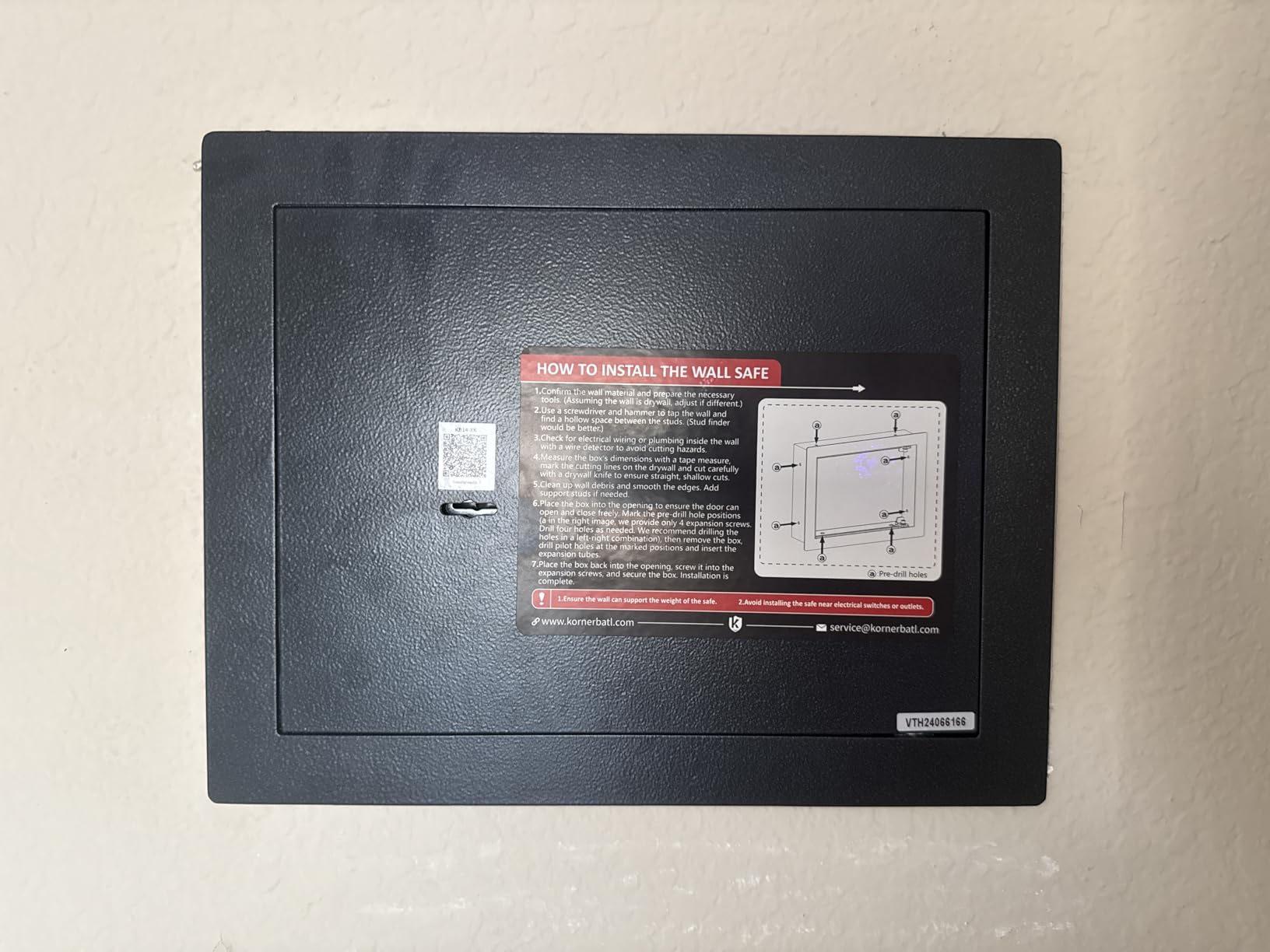
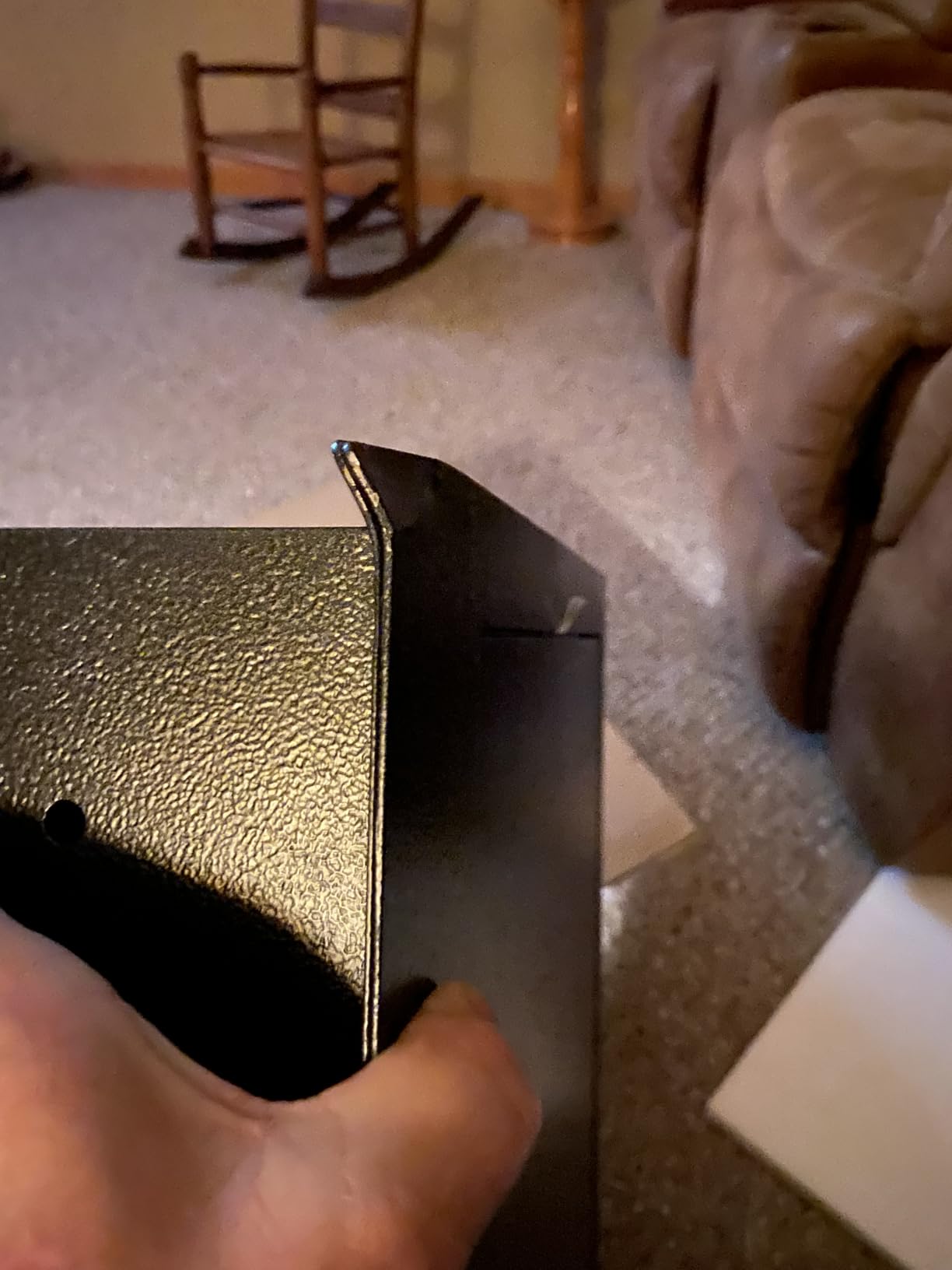
Two install details catch people out. The key only turns in one direction, so the orientation of the box has to be right before you fasten it to the studs, and some units hinge right to left, which is opposite the natural opening hand for most people. Mark the hinge side on the wall before you lift the box into the cavity.
The lock assembly is bulky and cuts into the usable interior for rigid items, so a flat ring box will fit where a watch box may not. The white finish sometimes needs repainting to blend with a particular wall, and this is not fireproof.
How much jewelry actually fits
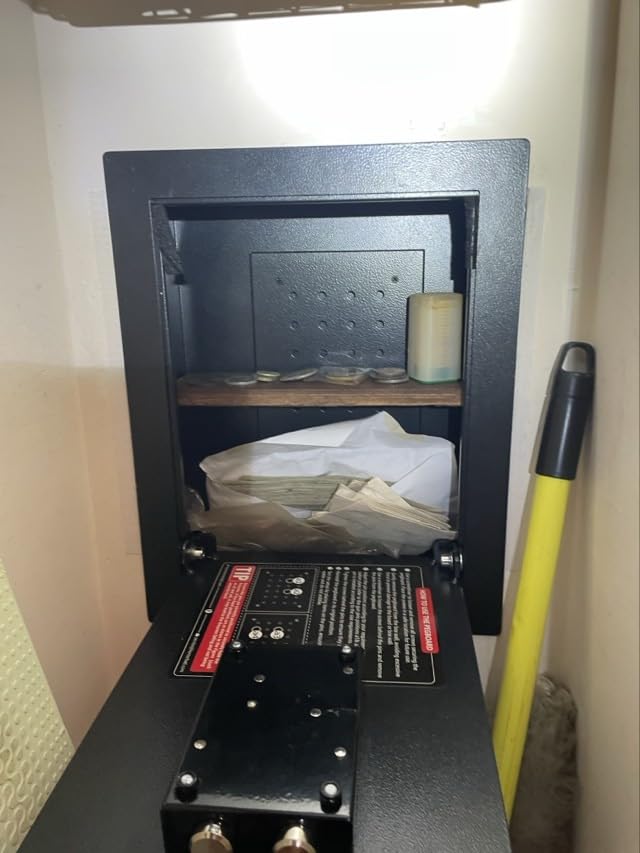
580 cubic inches sounds small until you map it to jewelry, which is mostly air. A ring roll, a watch roll, a set of earrings and a folded strap pouch fill less than half of it. This safe suits a starter collection or a secondary location, and it is the natural first step before a larger box in a different part of the house.
When to step up instead
If you own anything with an appraisal, skip the budget tier. A locking jewelry box in a dresser is cheaper and easier to move, and at this size the difference in security is marginal. The KornerBatl earns its place when you want something bolted into the wall that no visitor ever sees, and you value the pegboard organization over a stronger lock.
How to Choose a Wall Safe for Jewelry?
Three criteria decide almost everything: the interior lining, the lock type and the wall fit. If you get those three right, the rest is a preference between body weight and capacity. If you get one of them wrong, the safe will disappoint you within a year.
Jewelry-safe interiors beat steel every time
Steel destroys the value of fine jewelry slowly. A watch case back picks up hairline scratches that only show under a loupe, gold dulls against bare metal, and a diamond setting can chip if a box shifts in a moving vehicle of a door. Lining the interior is the single highest-value thing you can do for a jewelry collection.
Four surfaces appear in this category. Bare steel is the default and the worst option. Black foam, like the Homak, is the cheapest protection and works well. Felt, like the V-Line, compresses without shedding and covers the walls, back and a shelf. Carpet, like the Viking, is soft and quiet and the best general surface. Velvet, like the Protex, is the softest and the most premium, and it is the one we would pick for a diamond engagement ring.
Then there is organization hardware. Watch rolls, ring slots, necklace hooks and anti-tangle dividers matter more than most buyers expect, because tangles and scratches happen between openings, not because of the lock. The Grimtron and the XDeer ship adjustable panels and hooks; the Paragon and the Giantex do not, so plan to add a felt liner mat or a removable roll.
Lock types and their failure modes
Key-only locks such as the KornerBatl and the Homak never fail and never need batteries, but a lost key is a lost safe unless you have the spare. Mechanical push-button, like the V-Line, is fast and needs nothing at all, and you have to remember a sequence. Electronic keypads give you guest codes and an alarm after three wrong entries, and they need AA batteries checked twice a year.
Biometric readers, like the Viking, the Langger and the XDeer, are the fastest for daily use and the best for multi-user households. Their weak point is moisture, cold and dirty fingers, which is why every one of them here also carries a PIN and a key. Whatever lock you choose, insist on a physical override. A safe that needs batteries and has no key backup is a safe you will eventually break into with a pry bar.
Fire ratings versus fireproof marketing claims
Here is the honest answer, and it is the same tension raised on r/Safes: most fireproof safes have wall thicknesses approaching two inches, while a standard interior wall cavity is about 3.5 inches deep. A safe thin enough to sit flush between studs physically cannot carry a genuine multi-hour fire rating. When a wall safe listing uses the word fireproof without a certification number, treat it as marketing language.
Real ratings look different. UL Class 350 is a media protection standard aimed at documents and recorded media, not jewelry. A one-hour or two-hour rating at 1700 degrees Fahrenheit is a laboratory test on a specific safe construction, usually a thick-bodied unit, and you should expect to see a certification label rather than a photo of a flame. None of the twelve safes in this roundup carries a documented fire certification in the data we reviewed, and we would not treat any of them as fire protection for irreplaceable pieces.
So what should you do about fire? Keep appraisals and photographs of your jewelry elsewhere, and know that your insurance documentation matters more than the safe. If fire is your primary fear, you want a freestanding fireproof safe, and our floor safe roundup is the right place to start.
Security ratings you will see listed
Three classifications come up, and none of the twelve safes here is certified to any of them, so read them as context rather than as a spec. RSC, or Residential Security Container, is a UL listing meaning the safe resists prying and hand-tool attacks for a set period. B-rated refers to a solid steel door of at least a quarter inch over a body of at least an eighth inch. UL Class 350, as above, is a fire and media rating.
In practice, what separates the picks here is weight, steel thickness and bolt diameter. The 4 cm door and 2.2 cm bolts on the Nebakne, the 3/8 inch lock block and welded hinge on the V-Line, and the dual 3/4 inch live chrome bolts on the Protex are the meaningful differences. A thin sheet-metal door with a tubular key lock is a different category of object no matter what the listing says.
Wall fit and measuring your cavity
Standard US residential framing puts studs 16 inches on center, which leaves roughly 14.5 inches of clear cavity. Most safes in this list are 14 to 16.5 inches wide, so they fit with a small gap or a slight trim cut. Anything deeper than 4 inches, or any safe with a large center lock box, may need extra framing, and the Viking specifically needs 24-inch centers framed in to clear its lock housing.
Measure in this order. Find two studs with a stud finder and note the actual spacing rather than assuming 16 inches. Measure the cavity depth at several points, since old houses have plumbing and ducts that are not where the plans say. Check for wiring before you cut, and keep the cutout clear of electrical boxes. Then cut with a drywall saw and mount the body against the studs through the pre-drilled holes.
Exterior walls, plaster and lath, and walls shared with plumbing are all cases where an in-wall safe is a bad idea. If you have a basement or a garage, remember that moisture is a bigger threat to jewelry settings and leather than burglary in many homes, and a desiccant pack in the safe is cheap insurance.
Concealment and where burglars actually look
Concealment is a location decision as much as a hardware decision. A burglar in an unfamiliar house works from known patterns: the master bedroom, the dresser, the desk drawer, the wardrobe. That is why a safe in a closet wall or behind a bathroom mirror outperforms an identical safe sitting on a shelf in a study.
A ranked list, least searched first, is the useful version. A basement shelf nobody visits. Inside a wall safe behind an air vent. Inside a closet wall safe behind hanging clothes. Behind a full-length mirror in a hallway. Inside a hollowed-out book or under a floorboard. A master bedroom dresser drawer. A visible jewelry box on a vanity. Anything unlocked in a drawer, and anything in plain sight, goes last because it is where the search starts.
The broader strategy is dual location. Keep the everyday pieces somewhere obvious, because a safe that requires a crowbar and a drill every time you want your earrings is a safe you stop using. Put the heirlooms, the certificates and the appraisal paperwork in the wall safe, and consider a small second box in a different room for the pieces you actually wear.
What not to store in a wall safe
Cash is the big one. Currency in bulk inside a home is a legal problem in many jurisdictions, and a fire will largely destroy notes even in a well-insulated box. If you keep money at home, keep a modest amount and diversify it across locations.
Documents that would be destroyed by water rather than fire, such as a will or property deeds, belong in a fireproof and waterproof document safe or with a lawyer. Lithium batteries and any chemistry that degrades in heat should stay out. Leather, paper and fabric goods can be ruined by a fire long before steel gives up, so keep textiles and paperwork elsewhere. And a wall safe adds no insurance coverage on its own, so photograph and appraise what you store before it goes in.
Frequently Asked Questions
What is the best safe for storing jewelry?
It depends on the value and volume. For a small sentimental collection a locking jewelry box in a dresser is enough. For fine jewelry and heirlooms, the Paragon In-Wall Safe with Keypad is our top pick: 0.83 cubic feet of interior, two passcode profiles, two physical override keys and a 39 lb steel body that fits standard 16 inch on-center studs. For a fingerprint option, the Viking Security VS-52BLX holds up to 32 prints with a carpeted interior.
What is the best home safe for storing jewelry?
A home safe for jewelry should have a lined interior, a lock with a physical key backup and enough weight that removing it is a two-person job. The Paragon and the Viking both meet those tests. If your fear is theft rather than fire, an in-wall safe beats a freestanding one purely because nobody can find it. If your fear is fire, buy a freestanding fireproof safe instead, since no wall safe carries a real multi-hour rating.
Which brand of hidden wall safe is best?
For a disguised safe that looks like part of the house, the Elder Welder with a genuine air vent cover is the clear answer, and it installs in about 20 minutes with the included template. For hidden safes that sit behind artwork, Paragon, Viking and Grimtron are the strongest, all of which sit flush and take a framed picture over the door without a visible seam.
What are the best places to hide jewelry in my house to keep it safe?
Ranked least searched first: a basement shelf, inside a wall safe behind an air vent cover, a closet wall safe behind hanging clothes, behind a full-length hallway mirror, inside a hollowed book or under a floorboard. Least safe of all: a master bedroom dresser drawer, a jewelry box left out on a vanity, and anything unlocked in an open drawer, because that is where a burglar’s search starts.
Are wall safes actually fireproof?
Generally no, and the reason is geometry. A genuine one-hour or two-hour fire safe has walls approaching two inches thick, while a standard wall cavity is only about 3.5 inches deep. Any wall safe thin enough to sit flush between studs cannot carry a real multi-hour rating. Listings that use the word fireproof without a UL certification number are using it as marketing language, so treat fire as a separate concern and keep appraisals and photographs stored elsewhere.
Will cash burn in a fireproof safe?
Partly, and this surprises people. In a house fire the interior of a safe heats up far more than the outside of the safe suggests, and banknotes will char and disintegrate inside units that are rated for documents. If you want physical cash security, store modest amounts, split them across more than one location, and know that a gun safe is the standard product sold for that purpose rather than a document safe.
What is the best wall safe to mount between studs?
Anything up to 16 inches wide fits standard 16 inch on-center framing, so the Paragon, Giantex, XDeer, V-Line and Langger all install in a normal cavity. The Viking needs 24 inch stud spacing framed in to clear its larger lock housing, and the Grimtron ships a spacer kit for 24 inch centers. Measure your actual cavity depth and stud spacing before cutting, especially in older homes with plumbing in the wall.
The Best Wall Safe for Jewelry in 2026
The Paragon In-Wall Safe with Keypad is the best wall safe for jewelry in 2026 for almost every household. It has the largest proven install base, a wide flange that forgives a rough cut, two passcode profiles, two physical override keys and 0.83 cubic feet of interior that will hold watch rolls, pouches and documents without anything touching bare steel.
Pick the Viking Security VS-52BLX if fingerprint access and a carpeted interior matter more to you than a simple install, and the Homak First Watch Between The Studs if you are protecting a small sentimental collection and want zero batteries. For long necklaces choose the tall Nebakne body, for the softest interior choose the Protex, and for a safe that looks like a vent choose the Elder Welder.
Whatever you pick, measure your cavity before you buy, buy a felt liner mat, and photograph and appraise what goes inside. If your collection is worth more than a few hundred dollars, our depository safe guide is worth a look for the pieces you will genuinely never need at home.