
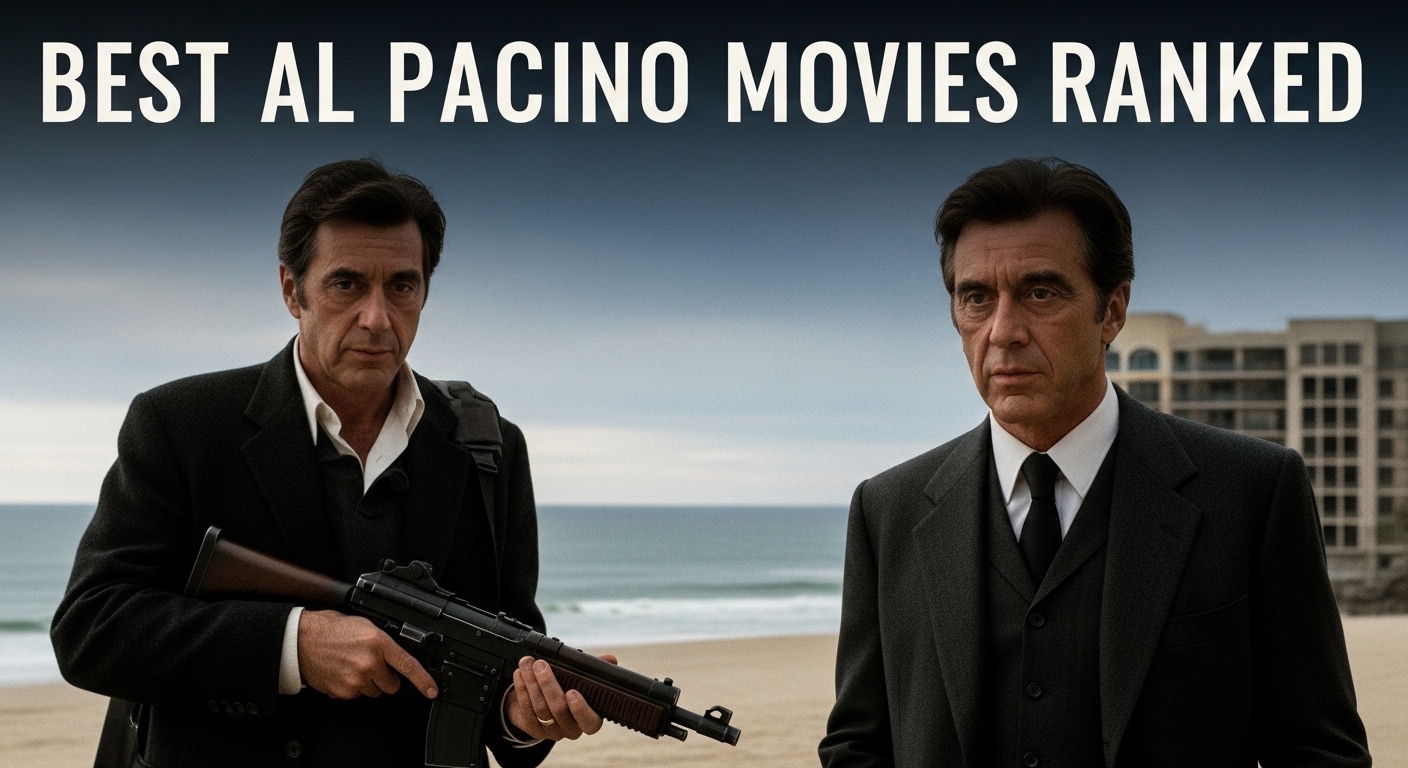
When we talk about the greatest actors in American cinema history, one name consistently rises to the top of every discussion. Al Pacino has spent more than five decades delivering performances that have shaped how we think about method acting, character study, and the very essence of on-screen presence. His filmography reads like a masterclass in dramatic craft, spanning genres from mob dramas to psychological thrillers, from intimate character studies to broad comedies. Ranking the best Al Pacino movies is no small task, but it’s one that reveals much about how we perceive cinematic greatness and why certain performances endure in our collective memory long after the credits roll.
The challenge with ranking Al Pacino movies lies in the sheer breadth of his career. He burst onto the scene in the early 1970s with a string of performances that redefined what film acting could be. By the time he delivered his iconic turn as Tony Montana in Scarface, he had already established himself as an actor willing to disappear into characters in ways that made audiences uncomfortable and exhilarated in equal measure. Today, in 2026, his career continues with surprising vitality, with recent appearances in films like House of Gucci proving that his talent remains undimmed. This ranking considers critical reception, cultural impact, and the enduring power of each performance, drawing on insights from both professional critics and the passionate film fans who continue to discuss his work in online communities.
Our methodology combines several factors to create a ranking that respects both artistic achievement and entertainment value. We have looked at Tomatometer scores and Metacritic ratings, examined the cultural footprint of each film, and incorporated perspectives from Reddit discussions where real viewers share their genuine reactions to Pacino’s work. The result is a ranking that acknowledges the undisputed masterpieces while also celebrating some unexpected choices that deserve more attention than they typically receive in mainstream lists.
Table of Contents
Quick Picks: Top 10 Al Pacino Movies
If you are looking for the quickest possible answer to which Al Pacino movies you should watch, here is our curated top 10 list. These represent the essential viewing for anyone wanting to understand why Pacino remains one of cinema’s most revered figures.
1. The Godfather (1972) – Francis Ford Coppola directs this timeless mafia saga that launched Pacino into the stratosphere as Michael Corleone.
2. The Godfather Part II (1974) – The sequel that matches and arguably surpasses the original, with Pacino delivering even more complexity as the younger Michael.
3. Heat (1995) – Michael Mann’s crime epic brings Pacino and Robert De Niro together for the first time on screen in a gripping cat-and-mouse story.
4. Scarface (1983) – Brian De Palma’s explosive take on the cocaine trade turned Tony Montana into a cultural phenomenon.
5. Dog Day Afternoon (1975) – Sidney Lumet directs this gripping true-story robbery that showcases Pacino’s ability to play desperate humanity.
6. The Insider (1999) – Michael Mann again, with Pacino as a tobacco industry whistleblower in this tense journalistic drama.
7. Serpico (1973) – Pacino gives one of his most understated performances as the honest cop who exposed police corruption.
8. Glengarry Glen Ross (1992) – David Mamet’s sharp dialogue becomes a weapon in Pacino’s hands as Ricky Roma, the smooth-talking salesmen.
9. Scent of a Woman (1992) – Pacino won his Academy Award for his tour de force performance as a blind colonel, delivering the famous “Hooch” speech.
10. Carlito’s Way (1993) – Brian De Palma directs this intimate character study of a ex-con trying to go straight in New York.
Best Al Pacino Movies Ranked: The Complete List
Now let us dive into the comprehensive ranking of Al Pacino’s finest performances. This section provides detailed analysis of each film, exploring why it earned its place in the ranking and what makes it significant in the context of his career and American cinema as a whole.
15. The Devil’s Advocate (1997)
Taylor Hackford’s supernatural thriller features Pacino at his most theatrical, playing John Milton, the charismatic head of a prestigious New York law firm who happens to be, quite literally, the devil. Pacino chews the scenery with obvious delight, delivering monologues about ambition and morality that elevate what could have been a generic horror film into something genuinely memorable. His performance is large, unapologetic, and increasingly unsettling as the film progresses. The role allowed Pacino to explore themes of temptation and corruption that run throughout much of his work, but here presented through an explicitly demonic lens. Working alongside Keanu Reeves, Pacino commands every scene he appears in, proving that even in lesser material, his presence transforms the experience. This film represents Pacino’s willingness to have fun with genre material while still delivering something memorable.
14. Sea of Love (1989)
Harold Becker directs this noir-tinged romantic thriller that paired Pacino with Ellen Barkin in a story about a detective investigating a serial killer. Pacino plays Frank Keller, a weathered cop still mourning his divorce, who falls for the prime suspect in his case. The film works because Pacino grounds the material in real emotional weight. His scenes with Barkin crackle with chemistry, while his solo moments reveal the loneliness that drives his character to make questionable decisions. The famous line “You see? You see? You see?” delivered to a suspect demonstrates his ability to convey menace through controlled intensity rather than explosive outbursts. Sea of Love deserves more recognition as one of Pacino’s more nuanced performances from the 1980s, a decade sometimes dismissed in discussions of his career.
13. Any Given Sunday (1999)
Oliver Stone’s football drama gave Pacino one of his most rousing roles as Tony D’Amato, the aging head coach fighting to maintain control of his team and his legacy. The film is chaotic and overwrought in true Stone fashion, but Pacino provides an anchor of weathered authority. His locker room speeches, particularly the “inch by inch” monologue, have become legendary examples of his ability to deliver inspirational rhetoric without irony. The role required Pacino to show both strength and vulnerability, playing a man watching his power slip away while still commanding respect. Any Given Sunday may not be remembered as a classic, but it contains some of Pacino’s most purely cinematic moments, shot with Stone’s characteristic energy and edited to emphasize the physicality of the sport.
12. Insomnia (2002)
Christopher Nolan’s American debut features Pacino as Will Dormer, a Los Angeles detective sent to a small Alaskan town to investigate a murder. The film explores themes of guilt and moral compromise that resonate throughout Pacino’s career, with his character haunted by both the case and his own past transgressions. Pacino delivers a restrained performance compared to his more explosive work, allowing vulnerability to show through his typically commanding presence. Robin Williams provides an unexpected counterpoint as the suspect, and the two actors create a tense psychological dynamic that drives the film forward. Insomnia often gets overlooked in discussions of Pacino’s best work, but it represents a sophisticated late-career achievement that proved he could adapt to new directorial approaches.
11. The Panic in Needle Park (1971)
Before The Godfather made him famous, Pacino delivered a raw, naturalistic performance in this low-budget New York drama about a heroin addict and his girlfriend. The film is notable for its unflinching depiction of drug addiction and the underground world of New York in the early 1970s. Pacino’s Bobby is not a romanticized character but rather a young man trapped in a cycle of dependency, and Pacino approaches the role with a documentary-style authenticity that was groundbreaking at the time. This performance caught the attention of Francis Ford Coppola, who would soon cast Pacino in The Godfather, recognizing the extraordinary depth he brought to even small roles. The Panic in Needle Park deserves recognition as the film that announced Pacino’s arrival as a serious dramatic actor.
10. Carlito’s Way (1993)
Brian De Palma’s follow-up to Scarface is a more restrained and ultimately more satisfying film. Pacino plays Carlito Brigante, a Puerto Rican ex-con who wants nothing more than to retire to a quiet life in the Caribbean with his girlfriend. De Palma creates a vivid portrait of 1970s New York, with the streets of the Bronx serving as almost a character in themselves. Pacino brings a tragic weight to Carlito, a man whose best intentions keep being undermined by the world he cannot escape. The film’s structure, moving between the present and flash-forwards showing Carlito’s ultimate fate, creates a sense of inevitable doom that Pacino embodies perfectly. The dance scene in the nightclub, shot in a single unbroken take, demonstrates his physical grace and the bittersweet nature of his character. Carlito’s Way proves that Pacino could play vulnerability as effectively as he played aggression.
9. Scent of a Woman (1992)
This film gave Pacino his only Academy Award win to date, and while many consider it sentimental, the performance itself is anything but soft. Pacino plays Lieutenant Colonel Frank Slade, a blind, retired Army officer planning to end his life over Thanksgiving weekend. When he is hired to accompany a young student (Chris O’Donnell) for the holiday, the two form an unlikely bond that transforms them both. Pacino’s performance builds toward the famous “Hooch” scene, a tour-de-force monologue about all the things he would do if he could see again. Yet the performance is more than just that speech. Throughout the film, Pacino reveals Frank’s pain, his pride, and ultimately his capacity for connection. The role demonstrated that Pacino could carry a film as a leading man while still supporting the younger actors around him.
8. Glengarry Glen Ross (1992)
David Mamet’s play about desperate real estate salesmen has never been bettered as a showcase for male ego and competitive aggression. Pacino plays Ricky Roma, the smooth-talking closer who manipulates clients with ease while looking down on his less successful colleagues. The role allowed Pacino to use his signature intensity in a more intellectual context, with Mamet’s dialogue serving as both weapon and musical composition. His scenes with Kevin Spacey’s Williamson crackle with tension, and the famous “Coffee’s for closers” line has become one of the most quoted moments in modern cinema. Watching Pacino work with such sharp material, it becomes clear why many consider this his most purely theatrical performance. The film proved that Pacino could dominate even in an ensemble cast, making every scene he appeared in feel like his.
7. Serpico (1973)
Sidney Lumet’s biographical drama tells the story of Frank Serpico, the New York police officer who exposed widespread corruption within the department and was subsequently ostracized and nearly killed for his honesty. What makes Pacino’s performance remarkable is its restraint. Serpico is not a heroic figure in the traditional sense. He is quiet, private, and ultimately isolated by his principles. Pacino captured the psychological toll of standing alone against an corrupt system, delivering a performance defined more by internal struggle than external action. The famous “shootout” scene, where Serpico is nearly killed by the officers he testified against, remains one of the most realistic and terrifying depictions of police violence in American film. Serpico represents Pacino’s ability to make heroism feel complicated and costly.
6. The Irishman (2019)
Martin Scorsese’s epic crime saga brought Pacino together with Robert De Niro and Joe Pesci for a film that serves as a meditation on aging, loyalty, and the weight of a life spent in violence. Pacino plays Frank Sheeran, a hitman for the Bufalino crime family whose conscience finally catches up with him in his final years. The film required Pacino to age across six decades, and he delivers a performance of quiet devastation. Where his earlier work was defined by explosive energy, The Irishman showcases Pacino at his most restrained, playing a man haunted by choices he made decades ago. The reunion with Scorsese was long overdue, and the director gave Pacino scenes that allowed him to explore regret and mortality with unprecedented depth. The Irishman proves that late-career Pacino can still deliver devastating work.
5. The Godfather Part III (1990)
The third installment of the Godfather saga receives more criticism than it deserves, though it cannot match the perfection of its predecessors. Pacino returns as Michael Corleone, now an aging patriarch trying to legitimize the family business while facing mortality and the sins of his past. The performance is elegiac, with Pacino capturing the weight of decades of moral compromise. His scenes with Andy Garcia’s Vincent Mancini, as Michael contemplates passing power to a new generation, carry genuine emotional power. The famous “Just when I thought I was out, they pull me back in” line resonates because Pacino makes us feel how trapped Michael truly remains. Part III may be imperfect, but Pacino’s commitment to the character never wavers, providing a fitting, if bittersweet, conclusion to the saga.
4. The Insider (1999)
Michael Mann’s fact-based thriller stars Pacino as Lowell Bergman, a 60 Minutes producer who fought CBS executives to air a story about tobacco industry wrongdoing. The film is a masterclass in tension building, with Pacino delivering a performance of quiet determination. Where other Pacino roles explode outward, Bergman is defined by his persistence, his willingness to risk his career for the truth. The chemistry between Pacino and Russell Crowe’s Jeffrey Wigand creates the emotional core of the film, with both actors delivering work of the highest order. The famous scene where Bergman confronts his bosses about their cowardice demonstrates Pacino’s ability to channel moral outrage without descending into melodrama. The Insider stands as one of the finest journalism films ever made, with Pacino at its moral center.
3. Dog Day Afternoon (1975)
Sidney Lumet’s masterpiece about a Brooklyn bank robbery gone wrong remains one of the most humane and funny crime films ever made. Pacino plays Sonny Wortzik, a Vietnam veteran who robs a bank to pay for his lover’s gender reassignment surgery. The performance is a delicate balancing act between comedy and tragedy, with Pacino making us sympathize with a man whose crime makes no rational sense. His scenes with the hostages, the police outside, and the gathered crowds demonstrate Pacino’s ability to create connection even in the most unusual circumstances. The famous “Attica!” chant has become iconic, but what makes it work is Pacino’s complete embodiment of a man who accidentally becomes a symbol. Dog Day Afternoon proves that great acting can transform what could have been a simple thriller into something profound.
2. The Godfather Part II (1974)
Many consider this the greatest sequel ever made, and much of that praise belongs to Pacino’s expanded role as the young Michael Corleone. The film traces Michael’s transformation from reluctant family man to ruthless mafia boss, with Pacino charting every step of the moral descent. Where the first film showed Michael making difficult choices, Part II shows him living with the consequences. The famous Senate hearing scene demonstrates Pacino’s ability to project menace through stillness, while his scenes with Talia Shire’s Connie reveal the emotional cost of his ruthlessness. The parallel editing between young Michael’s rise and older Michael’s fall creates a tragic resonance that Pacino carries with devastating authority. Part II represents Pacino at his most complex, showing us how good intentions can lead to evil through gradual steps.
1. The Godfather (1972)
The film that started it all remains Pacino’s defining achievement. As Michael Corleone, the youngest son of a mafia family who becomes its most ruthless leader, Pacino delivered a performance that changed cinema forever. What makes the role so remarkable is its restraint. In a film full of larger-than-life characters, Michael begins as the quiet one, the college student who wants no part of the family business. Pacino charts his transformation with such gradual precision that we feel every step as inevitable. The baptism scene, intercut with the murders he has ordered, represents the culmination of his journey, and Pacino delivers it with a combination of solemnity and cold calculation that never feels overwrought. Francis Ford Coppola’s direction and Gordon Willis’s cinematography create the perfect environment for Pacino to work, and the result is a performance that continues to influence actors and filmmakers more than fifty years later. The Godfather is not just the best Al Pacino movie; it is one of the greatest films ever made, and Pacino is at its heart.
Al Pacino’s Career by Era
Understanding Pacino’s career requires examining how his work evolved across different decades. Each era brought new challenges, new collaborations, and new dimensions to his already remarkable talent. Looking at his filmography through this historical lens reveals patterns that might be missed in a simple ranking.
The 1970s: The Golden Age
The 1970s represented Pacino’s breakthrough and establishment as one of cinema’s most important actors. Beginning with The Panic in Needle Park in 1971, he rapidly ascended through a series of landmark performances. The Godfather in 1972 announced a major new talent, though Marlon Brando initially dominated the film. By Serpico and Dog Day Afternoon in 1973 and 1975, Pacino had clearly taken center stage, delivering performances that rewrote the rules of what film acting could be. This era established his connection to directors like Sidney Lumet and his preference for intense character study over star turns. The 1970s Pacino was often restrained, letting emotion simmer beneath the surface rather than explode outward. This was also when he formed his legendary bond with Robert De Niro, a fellow student from the Actors Studio who would become his most frequent co-star.
The 1980s: The Transition
The 1980s brought both commercial success and critical reassessment for Pacino. Scarface in 1983 made him a box office star, with Tony Montana becoming a cultural icon despite the film’s mixed initial critical reception. The role was more explosive than his 1970s work, marking a shift toward larger-than-life characters that some felt represented a departure from his earlier subtlety. Other films from this era, including Sea of Love and Revolution, received mixed responses, leading some critics to suggest Pacino’s best work was behind him. Yet even during this period, Pacino continued to take risks, appearing in films that did not always pay off commercially or critically. The 1980s taught Pacino about the price of fame and the importance of choosing projects carefully, lessons that would serve him well in the decades ahead.
The 1990s: The Resurgence
The 1990s witnessed a remarkable creative rebirth for Pacino, beginning with Scent of a Woman in 1992. That Oscar-winning performance seemed to open a new chapter in his career, with Pacino delivering a series of strong performances in films like Glengarry Glen Ross, Carlito’s Way, and The Insider. This era was marked by successful reunions with directors like Brian De Palma and Michael Mann, both of whom had guided his career in the 1980s. The collaboration with Martin Scorsese finally happened with Casino, though Pacino’s brief appearance could not save that uneven film. The 1990s also saw Pacino begin to explore character work with greater depth, showing vulnerability and introspection that enriched his performances. By the end of the decade, Pacino had firmly reestablished himself as a major actor capable of carrying serious films.
The 2000s to Present: Late Career
The twenty-first century has brought continued work but mixed results for Pacino. Insomnia in 2002 showed he could adapt to new directorial approaches, with Christopher Nolan’s visual style challenging Pacino to work in unfamiliar ways. The Irishman in 2019 represented a high point, with Martin Scorsese finally directing Pacino in a film that did justice to his talent. Other recent work, including the Gigli and Jack and Jill films, has been widely panned, though Pacino himself seems unconcerned with critical opinion. More successful late-career efforts include The Devil’s Advocate, Any Given Sunday, and House of Gucci, where his theatrical gifts found appropriate homes. As Pacino has aged, his performances have taken on new dimensions, with mortality and regret becoming recurring themes that resonate given his own advanced age. He shows no signs of slowing down, and audiences continue to respond to his singular presence.
Al Pacino’s Acting Style: What Makes Him Great
Al Pacino’s approach to acting represents one of the most distinctive and influential methods in American cinema. Understanding his technique helps explain why his performances continue to resonate with audiences and why so many actors cite him as a major influence. His style evolved significantly over his career, moving from early restraint to later expressiveness, but certain elements remained constant throughout.
Pacino’s training at the Actors Studio under Lee Strasberg placed him firmly in the method acting tradition that drew from Stanislavski’s system. This approach emphasizes emotional truth, requiring actors to draw on personal memories and experiences to create authentic feeling on screen. Yet Pacino adapted these techniques in his own way, developing a intensity that was entirely his own. Where other method actors might seek complete transformation, Pacino brought an immediate presence that was unmistakably his, even as he disappeared into characters. His technique became about finding the universal in the specific, making audiences recognize themselves in his most extreme characters.
Signature elements of Pacino’s style include his distinctive voice, which could shift from a barely audible whisper to a thundering roar within a single scene. He mastered the art of the controlled outburst, building tension through restraint before releasing it in explosive moments. The famous “Hooch” speech in Scent of a Woman demonstrates this range perfectly, beginning quietly and building to an operatic crescendo. Another hallmark is his physical commitment, willingness to physically transform himself in ways that sometimes bordered on the extreme. For Scarface, he reportedly gained weight, changed his posture, and developed a new accent that made Tony Montana feel like someone we had never quite seen before.
Critics have sometimes noted a distinction between Pacino’s early restrained performances and his later more expressive work. The 1970s Pacino often kept emotion simmering beneath the surface, as in The Godfather where Michael’s rage is barely visible until the baptism scene. Later Pacino seemed more willing to let feelings explode outward, as in Scarface where Tony Montana’s anger is never hidden. This evolution reflected both changes in cinema itself and Pacino’s own growing confidence as an actor. By the 1990s, he could move seamlessly between restraint and expression, choosing whichever approach suited the character and scene. This flexibility explains why his late-career work continues to surprise and impress even as it diverges from his early style.
The influence of Pacino’s acting style on subsequent generations of actors cannot be overstated. Actors like Johnny Depp, Daniel Day-Lewis, and Leonardo DiCaprio have all cited Pacino as a major influence, adopting elements of his intensity and physical commitment. His willingness to take risks, to appear unsympathetic, to embrace darkness without judgment, opened doors for character actors across Hollywood. Pacino proved that leading men could be complicated, even ugly, and still capture audience loyalty. His legacy lives on in every actor who chooses truth over likability, intensity over safety.
Lesser-Known Al Pacino Films Worth Watching
While most fans know Pacino’s major hits, a wealth of lesser-known performances deserves more attention. These films may not have achieved blockbuster success, but they contain some of his most interesting and challenging work. For viewers who have exhausted the obvious choices, these hidden gems offer fresh perspectives on Pacino’s considerable talent.
Looking for Richard (1996)
This documentary about Pacino’s production of Richard III for the stage represents one of his most personal projects. Pacino appears both as himself and as a participant in discussions about Shakespeare’s play, creating a meditation on how classic literature remains relevant to modern audiences. The film reveals Pacino’s intellectual side, showing his engagement with performance theory and theatrical history. For fans who know only his film work, this documentary provides fascinating insight into how he approaches character and text. The production itself, featuring an ensemble cast including Alec Baldwin and Kevin Spacey, demonstrates Pacino’s collaborative nature and his desire to push beyond commercial cinema.
Scarecrow (1973)
Before either actor became famous, Pacino starred alongside Gene Hackman in this road movie about two drifters who form an unlikely friendship. Miloš Forman directs with his characteristic humanism, allowing both actors room to develop their characters over the course of the film’s meandering narrative. Pacino plays Lion, a sensitive ex-con whose vulnerability makes him endearing despite his rough exterior. The film failed commercially upon release but has since been recognized as an important early work that showcased Pacino’s ability to play gentler characters than the gangster roles for which he became famous.
Chinese Coffee (2000)
This little-seen indie drama features Pacino in a two-character film with Bernie Mac, based on Ira Lewis’s play about two struggling artists in Greenwich Village. The entire film consists of conversation between its two leads, making it essentially a filmed stage play. Pacino delivers his dialogue with the precision of a poet, finding music in what could have been ordinary speech. The film explores themes of artistic integrity and friendship that resonate throughout Pacino’s career. Though it received almost no theatrical distribution, Chinese Coffee demonstrates that Pacino’s talents extend beyond spectacle into more intimate, challenging work.
The Local Stigmatic (1990)
This obscure 1990 film stars Pacino and John C. Reilly as fans who become obsessed with a famous actress, with disturbing consequences. The film was never officially released due to legal disputes but has since become a cult item among Pacino collectors. The role allowed Pacino to explore obsession and violence in ways that mainstream films would not permit. Watching him disappear into this unsympathetic character demonstrates the range that made him famous, even in the most challenging material. Though difficult to find, The Local Stigmatic remains essential viewing for serious Pacino fans who want to understand the full scope of his work.
These lesser-known films remind us that Pacino’s career contains depths beyond the famous masterpieces. Each represents a risk or a choice that did not lead to commercial success, but that nonetheless contains valuable artistic achievements. For viewers willing to explore beyond the obvious classics, these hidden gems offer rich rewards and new insights into one of cinema’s greatest actors.
FAQ
Which Al Pacino film is considered his best?
The Godfather (1972) is widely considered Al Pacino’s best film. In it, he delivers a career-defining performance as Michael Corleone that changed cinema forever. The film regularly appears on lists of the greatest films ever made, and Pacino’s transformation of Michael from reluctant family member to ruthless mafia boss remains one of acting’s greatest achievements.
What are Al Pacino’s top 10 movies?
According to our ranking, Al Pacino’s top 10 movies are: The Godfather (1972), The Godfather Part II (1974), Heat (1995), Scarface (1983), Dog Day Afternoon (1975), The Insider (1999), Serpico (1973), Glengarry Glen Ross (1992), Scent of a Woman (1992), and Carlito’s Way (1993). These films represent his best work across different eras and genres.
Which Al Pacino movie has the highest rating?
The Godfather Part II currently holds the highest critical rating among Pacino’s films, with a 96% rating on Rotten Tomatoes. The Godfather is close behind at 97%, and both films consistently rank among the highest-rated films in cinema history. The Insider and Heat also score highly with critics.
What is considered Al Pacino’s best performance?
Most critics and film historians consider Al Pacino’s best performance to be his work in The Godfather and The Godfather Part II as Michael Corleone. However, his performances in Scarface, Heat, and The Insider also receive frequent mention as among his finest. For pure tour-de-force acting, many point to his Oscar-winning role in Scent of a Woman.
How many Oscar nominations does Al Pacino have?
Al Pacino has received nine Academy Award nominations throughout his career, winning once for Best Actor for Scent of a Woman in 1992. He has also received nominations for The Godfather, The Godfather Part II, Serpico, The Godfather Part III, Glengarry Glen Ross, and The Insider.
Is Scarface better than The Godfather?
This remains one of cinema’s great debates. The Godfather is generally considered the superior film by critics and is ranked higher on greatest films lists. However, Scarface has developed a passionate cult following and is more influential in popular culture. Both feature iconic Pacino performances, but The Godfather is typically considered his masterpiece while Scarface represents his most entertaining role.
What was Al Pacino’s first big movie?
The Godfather (1972) was Al Pacino’s breakout film, though he had previously appeared in The Panic in Needle Park (1971). His role as Michael Corleone in The Godfather transformed him from a respected stage actor into a major film star and is consistently cited as one of the greatest performances in cinema history.
Conclusion
Ranking the best Al Pacino movies ranked by quality and cultural impact reveals something essential about what makes cinema great. Across more than five decades, Pacino consistently chose challenging material, worked with visionary directors, and delivered performances that continue to influence actors and entertain audiences. Whether playing a reluctant mafia heir in The Godfather or an aging football coach in Any Given Sunday, he brought intensity and authenticity that elevated every project he touched.
For first-time viewers looking to explore Pacino’s work, start with The Godfather and The Godfather Part II as essential viewing that defines his legacy. From there, explore the crime thrillers like Heat and Serpico that showcase his range in the genre that made him famous. Scarface remains essential viewing for its cultural impact alone, while Glengarry Glen Ross demonstrates his ability to dominate ensemble casts. The Insider and The Irishman prove that his late-career work continues to reach heights that many actors never achieve at any point in their careers.
The best Al Pacino movies ranked list ultimately reflects both objective achievement and subjective taste. What everyone can agree on is that his career represents one of cinema’s greatest bodies of work, filled with performances that remind us why we fell in love with movies in the first place. As he continues to work in 2026, we can only wonder what new masterpieces this living legend might still deliver.