
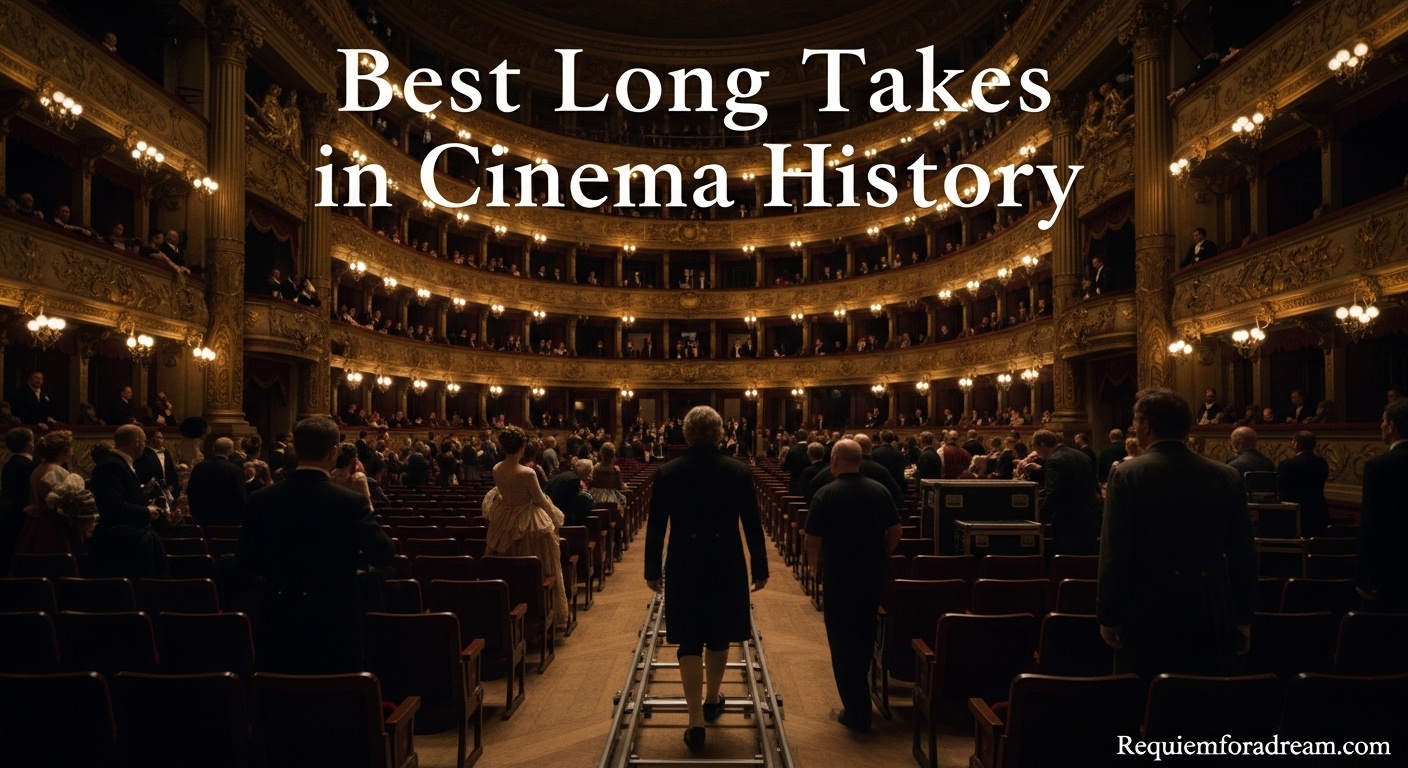
Some scenes in cinema history refuse to let you blink. The camera glides through corridors, weaves between actors, and pulls you into a world without a single cut to break the spell. These are the best long takes in cinema history—moments where technical precision meets pure storytelling magic.
When Orson Welles opened Touch of Evil with a continuous three-minute shot in 1958, he did not just create a memorable scene. He established the gold standard that filmmakers still chase nearly seven decades later. From Martin Scorsese’s Copacabana tracking shot in Goodfellas to Alfonso Cuarón’s impossible car ambush in Children of Men, these uninterrupted sequences demand our attention because they represent everything cinema can achieve when ambition meets craftsmanship.
Our team has studied hundreds of tracking shots, sequence shots, and plan-séquences to bring you the definitive guide to 2026. Whether you are a film student analyzing cinematography techniques or a movie lover who wants to understand how your favorite scenes were created, this guide covers the shots that changed cinema forever.
Table of Contents
What Is a Long Take?
A long take, also called a sequence shot or the French term plan-séquence, is an uninterrupted shot in a film that captures an entire scene without cutting. These shots can last anywhere from thirty seconds to several minutes—or in extreme cases, an entire feature film.
The distinction matters between a true long take and the appearance of one. Some films like Birdman and 1917 use hidden cuts disguised by camera movements, whip pans, or moments when the camera passes behind objects. These are still considered long takes in spirit, even if they are not technically single continuous shots. Others like Russian Ark achieved the impossible: a genuine 96-minute single take with no hidden edits whatsoever.
Directors choose long takes for many reasons. The technique creates immersive viewing experiences that trap viewers in real-time with characters. It showcases technical mastery that audiences can feel even if they do not understand the mechanics. Most importantly, long takes serve narrative purposes that editing cannot achieve—maintaining tension, establishing geography, or creating emotional continuity that would fracture with cuts.
Touch of Evil (1958) – The Opening Shot That Started It All
Orson Welles did not invent the long take, but he perfected it in the opening sequence of Touch of Evil. The shot begins with a close-up of a time bomb being planted in the trunk of a car. The camera then follows the vehicle through the streets of a Mexican border town for three uninterrupted minutes until the explosion that launches the plot.
What makes this shot revolutionary is not its length but its narrative sophistication. Welles establishes the entire geography of the border town, introduces multiple characters, and builds unbearable tension—all without a single cut. The audience knows the bomb is ticking while the characters do not, creating a Hitchcockian suspense that feels more intense because we cannot escape through an edit.
The technical execution required precise coordination between the camera operator, the car driver, and the actors. Welles reportedly needed several takes to get it right, though the exact number remains debated among film historians. The shot ends when the car explodes outside the border checkpoint, and only then does Welles give us our first cut—nearly four minutes into the film.
Welles himself considered this opening his finest technical achievement. It influenced every director who followed, establishing the long take as a legitimate artistic tool rather than a technical stunt.
Goodfellas (1990) – The Copacabana Scene
Martin Scorsese’s Copacabana tracking shot in Goodfellas has been studied, imitated, and celebrated for over three decades. The three-minute sequence follows Henry Hill and Karen as they enter the nightclub through a side entrance, winding through kitchens and corridors before emerging into the showroom where a table appears as if by magic.
The shot serves narrative function that no other technique could achieve. In a single continuous movement, Scorsese establishes Henry’s status and connections, shows the VIP treatment he receives, and demonstrates to Karen (and the audience) exactly what kind of world she is entering. The camera never leaves Henry’s perspective, making us complicit in his seductive lifestyle.
Cinematographer Michael Ballhaus operated the steadicam himself for this shot, moving backward through crowded spaces while maintaining perfect framing. The scene required eight takes over the course of a full day. The version in the film is actually a composite of two takes stitched together at the moment Henry hands money to a doorman—a hidden cut so seamless most viewers never notice.
What distinguishes this shot from technical showmanship is its emotional resonance. By the time Henry and Karen reach their table, we understand everything about his world without a word of exposition.
Children of Men (2006) – The Car Ambush and War Zone
Alfonso Cuarón’s Children of Men contains two long takes that redefined what digital cinematography could achieve. The car ambush scene follows Theo, Kee, and their protectors as they drive through a forest, engage in conversation, and are suddenly attacked by an angry mob. The camera rotates around the interior of the car, capturing every angle without cutting away from the chaos.
The shot lasts approximately four minutes and required unprecedented technical innovation. Cinematographer Emmanuel Lubezki developed a rig that allowed the camera to move 360 degrees inside the vehicle. Digital compositing removed visible equipment and stitched together multiple elements to create the illusion of an impossible continuous shot.
The war zone scene near the film’s climax is even more ambitious. Theo navigates through a devastated apartment building while a battle rages around him. The shot combines practical effects, digital augmentation, and precise choreography to create seven minutes of sustained tension. Lubezki won the Academy Award for this work, and the techniques developed here influenced every action film that followed.
What separates Cuarón’s long takes from earlier examples is how invisible the technique becomes. Unlike Welles or Scorsese, who wanted audiences to appreciate the craftsmanship, Cuarón uses long takes to prevent viewers from escaping the horror of his dystopian world.
Rope (1948) – Hitchcock’s Hidden Cuts Experiment
Alfred Hitchcock approached long takes with the systematic curiosity of a scientist. Rope was his experiment to see if he could make an entire feature film appear as one continuous shot. The story, based on the Leopold and Loeb murder case, follows two intellectuals who kill a classmate and host a dinner party with the body hidden in a trunk.
The film runs 80 minutes but actually contains ten shots, each lasting between four and ten minutes. The cuts are hidden when the camera passes behind furniture or actor’s backs, creating the illusion of continuity. Hitchcock was limited by 35mm film magazines that could only hold ten minutes of footage—hence the need for strategic cutting points.
James Stewart stars as the former professor who gradually realizes what his students have done. Hitchcock’s blocking required actors to hit precise marks while technicians moved walls and furniture to accommodate the camera’s path. The result is theatrical in the best sense—confined space, real-time tension, and the feeling that we cannot escape the moral horror unfolding before us.
Hitchcock later dismissed Rope as a failed experiment, but film scholars recognize its importance in proving that invisible editing could serve narrative rather than distract from it.
Russian Ark (2002) – The True Single Take
Alexander Sokurov’s Russian Ark represents the ultimate long take achievement: a 96-minute feature film shot in one continuous take without a single hidden cut. The film follows an unnamed narrator and a 19th-century French marquis as they wander through the Hermitage Museum in St. Petersburg, witnessing three centuries of Russian history unfold around them.
The production required extraordinary preparation. Sokurov had four attempts to get the shot right. The first two attempts failed due to technical problems. The third attempt was ruined when a camera operator stumbled. The fourth and final attempt—made with winter daylight fading—became the film.
Over 2,000 actors participated, each hitting precise marks in choreographed movements. The Steadicam operator German Arkhipov carried heavy equipment for the full 96 minutes, navigating through 33 rooms while capturing performances and maintaining composition. If anything had gone wrong in the final minutes, there would have been no film.
Russian Ark proves that digital video technology could achieve what film stock never could. The Sony HDW-F900 CineAlta HDCAM used digital memory rather than physical magazines, removing the time limitation that constrained Hitchcock decades earlier.
Birdman (2014) – The Illusion of One Shot
Alejandro González Iñárritu’s Birdman creates the impression of a single two-hour continuous shot following a washed-up actor attempting to revive his career on Broadway. The film won the Academy Award for Best Picture, and cinematographer Emmanuel Lubezki won his second consecutive Oscar for the technical achievement.
The actual production involved dozens of hidden cuts. Lubezki and his team used whip pans, passing behind actors, and moments of darkness to stitch together takes that lasted several minutes each. Digital compositing removed visible cuts and smoothed transitions so effectively that even experienced cinematographers struggle to identify the edit points.
Michael Keaton plays Riggan Thomson, a former superhero actor seeking artistic legitimacy. The continuous shot technique mirrors his character’s psychological unravelling—we cannot escape his perspective just as he cannot escape his own mind. The camera work becomes a visual metaphor for the suffocating pressure of performance.
Birdman demonstrates how digital technology has expanded the possibilities for long takes. What Hitchcock attempted with analog limitations, Iñárritu achieved with digital freedom.
1917 (2019) – The Modern War Epic
Sam Mendes’ 1917 tells the story of two soldiers tasked with crossing enemy territory to deliver a message that could save 1,600 lives. The film appears as one continuous shot following their journey through trenches, across no man’s land, and through devastated French countryside.
Roger Deakins won his second Academy Award for cinematography here, having previously won for Blade Runner 2049. The film actually contains hidden cuts approximately every eight to nine minutes, disguised by camera movements, passing objects, and moments of darkness. The longest single shot lasted about nine minutes.
The production required months of preparation and precise coordination between camera operators, actors, and hundreds of extras. Sets were built with removable sections to allow the camera to pass through spaces that would normally block movement. Timing had to be perfect—if an actor missed a mark by seconds, the entire take was ruined.
What distinguishes 1917 from other one-shot films is the scale. Previous attempts like Rope or Birdman took place in confined spaces. Mendes and Deakins moved their camera through open landscapes, underwater, and across burning villages while maintaining the illusion of continuous movement.
The Passenger (1975) – Antonioni’s Final Shot
Michelangelo Antonioni’s The Passenger ends with a seven-minute shot that film professors still analyze in cinematography courses. Jack Nicholson plays a journalist who has assumed a dead man’s identity. The final scene takes place in a hotel room overlooking a dusty Spanish plaza.
The camera begins inside the room with Nicholson’s character. Without cutting, it moves through the barred window and begins slowly circling the plaza, eventually returning to discover that the protagonist has been killed during our absence. We never see the violence—only its aftermath.
The technical challenge was unprecedented. Cinematographer Luciano Tovoli had to manage changing light conditions while the camera moved from interior to exterior. The shot required precise timing with the sun’s position. Windows had to be removed from the hotel facade to allow the camera’s passage, then replaced digitally in post-production.
Antonioni’s shot embodies the existential themes of his entire career. The camera’s movement suggests the indifference of the universe to individual human drama—we leave the protagonist, observe the larger world, and return to find him gone.
Atonement (2007) – The Dunkirk Scene
Joe Wright’s Atonement features a five-minute tracking shot on the beaches of Dunkirk that earned the film its only Oscar nomination for cinematography. The scene follows Robbie Turner through the evacuation of British soldiers from France in 1940, capturing the scale of military defeat and human desperation.
Over 1,000 extras participated in the shot, which was captured on the first day of filming. Steadicam operator Peter Cavaciuti moved through the beach, around obstacles, and past hundreds of performers while maintaining focus on James McAvoy’s character. The choreography required weeks of rehearsal to ensure that every extra hit their mark at the right moment.
The scene serves narrative function by establishing the chaos Robbie has entered while maintaining our emotional connection to his experience. Wright has said he wanted viewers to feel they were walking through history rather than watching it from a safe distance.
The shot ends with a haunting image: soldiers singing in a distant amusement park while waiting for evacuation, their voices carrying across the beach as the camera slowly retreats.
Boogie Nights (1997) – The Opening Scene
Paul Thomas Anderson opens Boogie Nights with a three-minute steadicam shot that introduces nearly every major character while establishing the 1970s San Fernando Valley pornography scene. The camera moves through a nightclub, gliding between dancers and partygoers before finally settling on Eddie Adams, the young dishwasher who will become Dirk Diggler.
The shot functions as a master class in narrative efficiency. Anderson gives us character relationships, social hierarchy, and period atmosphere without a single line of exposition. We understand this world before the story officially begins.
Cinematographer Robert Elswit worked with steadicam operator Andy Shuttleworth to create the fluid movement that would become Anderson’s signature style. The Rezidor hotel location provided the retro aesthetic while allowing enough space for complex camera choreography.
The opening shot announces that we are in the hands of a director who understands how visual language can accomplish what dialogue cannot.
Oldboy (2003) – The Hallway Fight
Park Chan-wook’s Oldboy contains a two-minute lateral tracking shot that changed how action sequences could be filmed. Oh Dae-su fights his way down a corridor against multiple attackers, the camera remaining fixed at his side as if we are watching a side-scrolling video game.
The shot required nineteen takes over three days. Actor Choi Min-sik performed his own stunts, and the physical exhaustion visible in his performance is genuine. Park wanted the fight to feel sloppy and desperate rather than choreographed and heroic.
The lateral perspective eliminates the spatial confusion of traditional action editing. We see every attacker, every connection, every moment of impact. The shot becomes exhausting to watch precisely because we cannot escape the violence through editing.
This sequence influenced a generation of action filmmakers, from The Raid to Netflix’s Daredevil series. It proved that long takes could serve visceral genre cinema as effectively as art house dramas.
International and Art House Gems
Beyond the famous Hollywood examples, world cinema offers extraordinary long takes that deserve wider recognition. Mikhail Kalatozov’s I Am Cuba (1964) features a funeral scene that begins on a rooftop, descends four stories down the outside of a building, moves through a crowd in the street, and ends underwater in a swimming pool—all without cutting.
Jean-Luc Godard’s Weekend (1967) includes a seven-minute tracking shot of a traffic jam that serves as biting social commentary. The camera moves past wrecked cars and arguing drivers, capturing the collapse of bourgeois society in real-time.
Andrei Tarkovsky’s The Sacrifice (1986) ends with a six-minute shot of a house burning while the camera circles the destruction. Tarkovsky required the crew to build a functional house, then burn it down in a single take. The shot failed on the first attempt. The version in the film is the second and final take.
Steve McQueen’s Hunger (2008) features a seventeen-minute conversation between Bobby Sands and a priest about the ethics of hunger striking. The shot never moves, never cuts, forcing us to witness the psychological intensity without escape.
Hou Hsiao-hsien’s Flowers of Shanghai (1998) uses extended takes to create meditative atmosphere in 1880s Shanghai brothels. Wong Kar-wai’s In the Mood for Love (2000) and Happy Together (1997) employ long takes to explore emotional distance between characters. Tsai Ming-liang’s entire career is built on long takes that challenge viewers to find meaning in stillness.
Zoya Akhtar’s Dil Dhadakne Do (2015) contains a seven-minute dinner scene on a cruise ship that moves between multiple conversations in true Bollywood fashion. Tony Jaa’s The Protector (2005) features a four-minute stairwell fight shot in a single continuous take that took eight attempts to complete.
Television’s Long Take Revolution
Television has embraced long takes with enthusiasm that rivals feature films. Cary Fukunaga’s True Detective Season 1 includes a six-minute shot following Matthew McConaughey’s character through a housing project raid. The sequence required precise coordination between camera operators, stunt performers, and hundreds of extras.
The Marvel Netflix series Daredevil became famous for its hallway fight scenes filmed in apparent single takes. Season one’s three-minute corridor fight established the show’s gritty aesthetic. Season three’s prison escape sequence lasts eleven minutes and represents the most ambitious television long take attempted at that time.
Christopher Storer’s The Bear features extended takes in its kitchen sequences that capture the chaos of professional cooking. These shots serve the same narrative function as the Copacabana scene—establishing professional hierarchy and expertise without exposition.
Television’s adoption of long takes reflects the medium’s cinematic evolution in the streaming era. Shows like Mr. Robot, Hannibal, and The Haunting of Hill House have all featured memorable uninterrupted sequences that would have been impossible in the network television era.
How They Do It: The Technical Breakdown
Creating a successful long take requires solving problems in three areas: equipment, planning, and execution. Understanding these elements helps explain why the best long takes in cinema history remain so impressive decades later.
Equipment for Long Takes
The steadicam revolutionized long takes when Garrett Brown invented it in the 1970s. This body-mounted stabilization system allows operators to move smoothly through spaces that would be impossible with traditional dollies. The Copacabana scene in Goodfellas and the opening of Boogie Nights both depend on steadicam technology.
Camera dollies on tracks provide smooth movement for planned paths. Cranes and jibs allow vertical movement and sweeping gestures. Modern gimbals and electronic stabilization have made smooth handheld movement accessible to productions of all budgets.
Digital cameras have removed the time limitations of film magazines. Where Hitchcock had to hide cuts every ten minutes due to film capacity, modern filmmakers can record for hours without stopping.
Planning and Blocking
Long takes require extensive pre-production. Every actor movement must be choreographed precisely. Camera paths must be mapped to avoid obstacles. Lighting must work for every position the camera will occupy.
Directors often use pre-visualization software to plan complex sequences. Storyboards become detailed maps of movement through space. Rehearsals can take weeks before filming begins.
Hidden Cuts and Digital Solutions
Many famous long takes actually contain invisible cuts. Whip pans—rapid camera movements between subjects—can hide edit points. Passing the camera behind an actor’s back or through darkness creates natural cutting opportunities. Digital compositing can stitch together separate takes or remove equipment from shots.
Birdman and 1917 represent the current state of the art in invisible editing. Software can match lighting conditions between takes, smooth camera movement across cuts, and remove visible crew members from reflections.
Frequently Asked Questions
What is the longest single take in movie history?
Russian Ark (2002) by Alexander Sokurov holds the record for the longest single take feature film at 96 minutes. For individual shots within edited films, several contenders exist including the opening of Touch of Evil (3 minutes), the Copacabana scene in Goodfellas (3 minutes), and the car ambush in Children of Men (4 minutes).
Is Birdman really one continuous shot?
No, Birdman is not a true single take. The film uses dozens of hidden cuts disguised by whip pans, camera movements behind actors, and moments of darkness. Cinematographer Emmanuel Lubezki stitched together takes that lasted several minutes each using digital compositing. The result creates the illusion of a two-hour continuous shot.
How did they film the car scene in Children of Men?
The car ambush scene used a specially rigged vehicle that allowed the camera to rotate 360 degrees inside. Digital compositing removed visible equipment and stitched together practical elements. The scene was not a true single take but rather carefully planned shots combined digitally to appear continuous. Cinematographer Emmanuel Lubezki developed new techniques for this sequence.
What equipment is used for long takes?
Steadicams provide body-mounted stabilization for smooth movement through spaces. Camera dollies on tracks offer controlled linear movement. Cranes and jibs enable vertical motion and sweeping gestures. Modern gimbals provide electronic stabilization. Digital cameras allow unlimited recording time compared to film magazines that limited earlier filmmakers to ten-minute maximums.
Why do directors use long takes?
Directors choose long takes to create immersive experiences that trap viewers in real-time with characters. The technique maintains narrative tension, establishes spatial geography, and showcases technical mastery. Some directors use long takes for thematic purposes—to suggest inevitability, psychological pressure, or the indifference of time to human drama.
What are the best long takes in TV shows?
Notable television long takes include the housing project raid in True Detective Season 1, the hallway fights in Daredevil (especially the eleven-minute prison escape in Season 3), and kitchen sequences in The Bear. These scenes demonstrate that television has adopted cinematic techniques as production budgets and audience expectations have increased.
Conclusion
The best long takes in cinema history do more than showcase technical skill. They create experiences that cut-free editing simply cannot achieve. When Orson Welles followed that car bomb through the border town in 1958, he demonstrated that the camera could be an instrument of narrative propulsion rather than mere recording device.
From Scorsese’s seductive Copacabana sequence to Cuarón’s dystopian car chases, from Sokurov’s museum-spanning single take to Iñárritu’s theatrical illusions, these scenes represent cinema at its most ambitious. They remind us that film remains a medium of physical reality—real actors, real spaces, real time—regardless of how much digital technology transforms production.
If you have never experienced these shots on a proper screen, seek them out. Watch them twice—once for the story, once for the technique. The best long takes in cinema history reward attention with revelations about what this medium can accomplish when vision meets craft. In 2026, these achievements remain as impressive as the day they were filmed.