
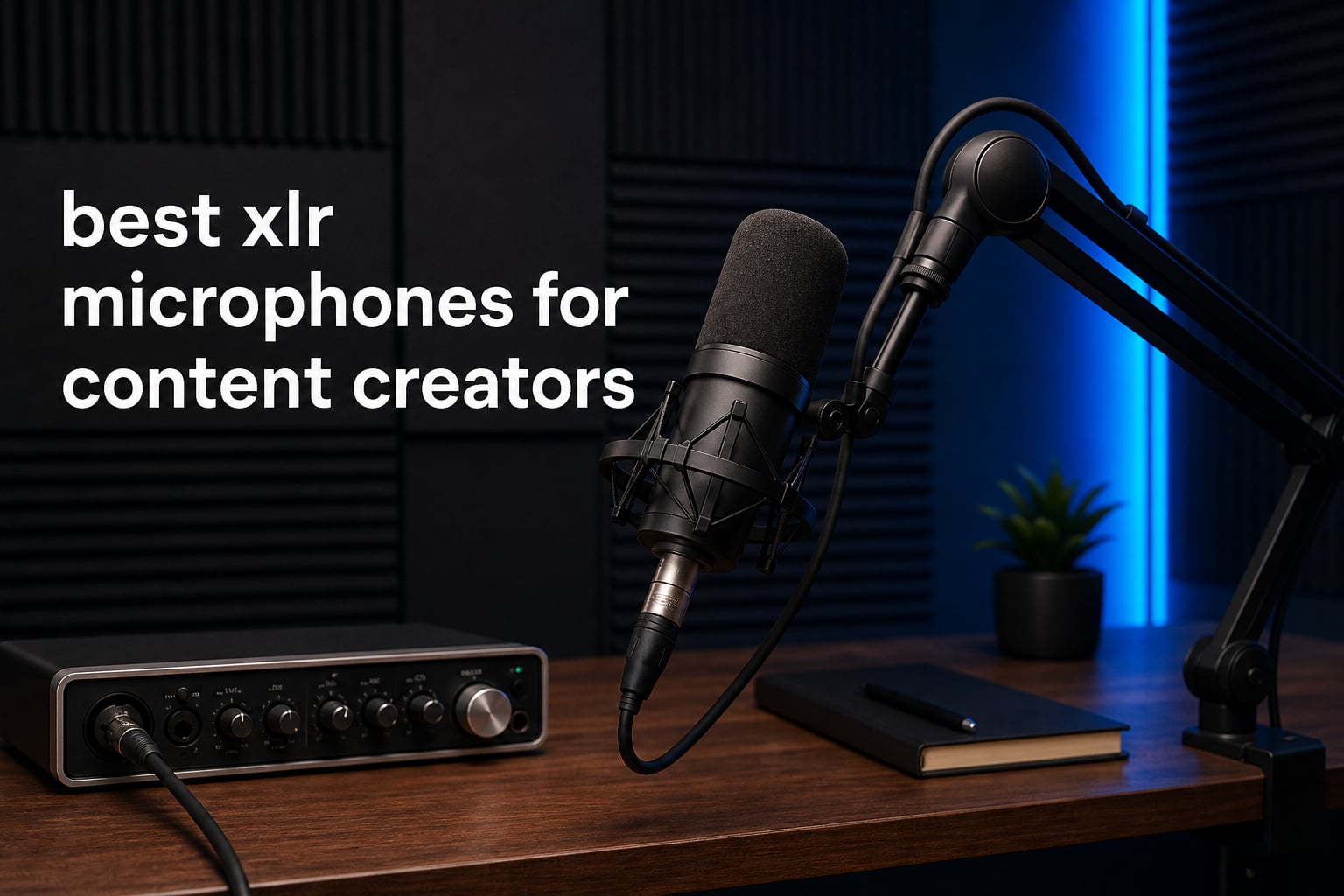
The best XLR microphones for content creators give you a balanced connection, useful upgrade options, and better control over your signal than a basic plug-in mic. Our leading pick is the Shure MV7+ because its dynamic capsule, USB-C and XLR outputs, Voice Isolation Technology, real-time denoiser, and Auto Level Mode serve a new streamer today and an interface-based creator setup later.
XLR is not magic on its own. It is a three-pin balanced connection that sends the microphone signal through an XLR cable to an audio interface or mixer, where you can set gain and monitor what you are recording; that balanced path helps reject electrical interference.
For a voice recorded beside a computer fan, in a shared room, or on a live stream, a close-talked dynamic microphone is usually the sensible first direction. For a quiet, controlled home studio where detail matters, a large-diaphragm condenser can capture more nuance; our dedicated guide to condenser microphones explores that category further.
We reviewed the available specifications, features, stated limitations, ratings, and review data for all 12 selections below. The result is a creator-first shortlist that explains the extra gear, room fit, and workflow behind each recommendation instead of treating every XLR microphone as interchangeable.
Table of Contents
Top 3 Picks for 2026
Choose the MV7+ for guided sound processing and a flexible connection, the PodMic USB for a rugged broadcast-style dynamic with direct monitoring, or the Q9x for a simple XLR-only dynamic path. Each one uses a cardioid-style focused pickup approach, which is useful when the creator speaks close to the microphone.
The best XLR microphones for content creators in 2026 are easier to compare here
This quick overview includes every microphone in this guide. Use it to narrow the field by connection type, microphone design, and the feature that best matches the way you publish.
| Product | Specifications | Action |
|---|---|---|
 Shure MV7+ Shure MV7+ |
|
Check Latest Price |
 RØDE NT1 5th Generation RØDE NT1 5th Generation |
|
Check Latest Price |
 Shure SM4 Shure SM4 |
|
Check Latest Price |
 RØDE NT1 Signature RØDE NT1 Signature |
|
Check Latest Price |
 MAONO PD400X MAONO PD400X |
|
Check Latest Price |
 Shure MV7i Shure MV7i |
|
Check Latest Price |
 Shure SM7dB Shure SM7dB |
|
Check Latest Price |
 AKG C104 AKG C104 |
|
Check Latest Price |
 RØDE PodMic USB RØDE PodMic USB |
|
Check Latest Price |
 Samson Q9x Samson Q9x |
|
Check Latest Price |
 Audio-Technica AT2020 Audio-Technica AT2020 |
|
Check Latest Price |
 AKG C114 AKG C114 |
|
Check Latest Price |
1. The Shure MV7+ is the strongest all-round creator microphone
- OBS certified
- Voice Isolation
- Real-time denoiser
- Auto Level
- USB-C and XLR
- XLR setup needs extra equipment
- Premium-positioned model
The MV7+ is a dynamic microphone built around flexibility rather than a one-way commitment to an interface. I would point a creator who records alone, streams live, and wants a clear next step toward an XLR rig here because it can connect by USB-C now or XLR when the rest of the setup changes.
Shure lists Voice Isolation Technology, built-in DSP, a real-time denoiser, Auto Level Mode, and a digital pop filter. Those are unusually practical tools for spoken-word recording, where distance from the mic and a sudden change in speaking volume can otherwise make a track feel uneven.
The MV7+ makes sense when you want guided control during live work
The LED touch panel doubles as a fast mute control and can show levels or pulse effects. OBS certification also makes this an especially credible fit for a creator who spends more time broadcasting or gaming than editing audio after the fact.
The MOTIV Mix app adds a route for adjusting sound and appearance, while the physical microphone retains XLR output for a future audio interface. That bridge answers a frequent forum concern: buying one microphone without closing off a more capable setup later.
The MV7+ needs an interface only when you choose the XLR path
USB-C is the simple connection for a computer-based desk setup. With XLR, plan on an interface or mixer and a balanced cable, so the microphone itself is only one part of the signal chain.
The listed 50 Hz frequency response and unidirectional pattern favor close, focused voice work. It is a polished choice for one person on camera, though creators who want a completely analog, minimal-control microphone may prefer the Q9x or SM7dB.
2. The RØDE NT1 5th Generation is the quiet-studio hybrid condenser
Rode NT1 5th Generation Condenser Microphone with SM6 Shockmount and Pop Filter,Silver
- 4 dBA self-noise
- USB-C and XLR
- Up to 192kHz
- SM6 mount included
- Pop filter included
- Condenser captures room sound
- Needs a controlled recording space
The NT1 5th Generation is for creators who want a large-diaphragm condenser sound but do not want to choose permanently between computer recording and an interface. Its dual USB-C and XLR connection is the important headline, and the stated 4 dBA self-noise makes it compelling for quiet voiceovers and detailed vocals.
RØDE also specifies high-resolution recording up to 192kHz through its Revolution Preamp and analog-to-digital conversion. The included SM6 shock mount and pop filter matter because they address two common desk-recording problems before you add separate accessories.
The NT1 works best in a calm room with a consistent mic position
A sensitive condenser can capture the pleasant detail in a close vocal, but it will not remove the character of a reflective room or a nearby appliance. I would reserve this microphone for a creator who can choose a quiet recording time, soften hard room surfaces, and keep the microphone steady in its shock mount.
Its gold-sputtered capsule is described as having a warm, silky character, with high SPL handling for sources beyond speech. That gives a YouTube creator a credible way to record narration one day and instruments or vocals another.
The NT1 gives you USB simplicity and an XLR expansion route
USB-C lets a creator record directly to a Mac or PC. XLR lets the same microphone join an interface or mixer workflow, which is helpful when adding multiple inputs or more hands-on gain control becomes important.
The metal body has nickel plating and a ceramic coating, and the product carries a one-year standard warranty that can extend to 10 years. Its strong 4.7 rating across 1,990 reviews adds useful market evidence, but room control remains the deciding factor.
3. The Shure SM4 is the focused XLR studio choice for camera work
- Dual-diaphragm capsule
- RF shielding
- 140 dB SPL
- Shock mount included
- Low-profile design
- Requires 48V phantom power
- XLR only
The Shure SM4 is an XLR-only condenser for a creator who already accepts the interface-and-cable workflow. Its one-inch brass dual-diaphragm capsule, uniform cardioid polar pattern, and stated 140 dB SPL handling put the emphasis on natural vocal detail and the ability to record loud sources without distortion.
Shure includes a detachable magnetic pop filter, shock mount, stand adapter, and carrying case in this kit. That is a sensible set of physical tools for a fixed home studio, especially when the microphone will sit in frame for talking-head work.
The SM4 is a strong fit when clean vocal detail is the priority
The product description calls out controlled low frequencies and smooth, detailed highs. It also says the large sweet spot reduces proximity effect, which can make close-miked delivery more consistent when a presenter moves a little while speaking.
Its integrated pop filter and woven mesh Faraday cage are meant to control plosives and unwanted noise, while RF interference shielding addresses possible interference from phones, laptops, and Wi-Fi routers. Those design choices are useful for a desk filled with creator gear.
The SM4 requires a true XLR recording chain before it can work
This condenser requires 48V phantom power, so an audio interface or mixer with phantom power is mandatory. It has no USB fallback, making it less convenient for a first-time creator who needs to plug straight into a computer.
The low-profile, camera-ready design will appeal to on-camera educators and streamers. Still, a noisy untreated space is better served by a close dynamic microphone such as the MV7+ or PD400X.
4. The RØDE NT1 Signature Series is the ready-to-rig XLR condenser kit
- HF6 one-inch capsule
- 4 dBA self-noise
- Shock mount included
- Pop filter included
- 10-year warranty
- Requires phantom-power interface
- XLR only
The NT1 Signature Series is a direct option for a creator who wants an XLR-only condenser package with the core mounting and cable pieces already included. Its HF6 one-inch true condenser capsule, cardioid pattern, and stated 4 dBA self-noise give it a clear home-studio identity.
The box includes a studio-grade shock mount, pop filter, and six-metre XLR cable. That removes some of the accessory uncertainty that regularly comes up when a beginner shifts from USB to an interface-based recording path.
The NT1 Signature rewards a quiet room and careful vocal recording
The low self-noise specification is valuable on quiet passages, and the smooth frequency response is designed for vocal recording, streaming, and podcasting. It also has high SPL handling, so a creator who records music alongside narration is not limited to soft spoken audio.
Because it is a cardioid condenser, aim it toward the speaker and keep the back of the microphone toward the strongest unwanted sound. A rug, curtains, books, or purpose-made treatment can reduce reflections that no microphone setting can fully erase.
The NT1 Signature needs phantom power and an interface from day one
There is no USB connection on this version. Your interface must supply phantom power, and the included XLR cable gives you the physical link between the mic and that interface.
RØDE lists a 10-year warranty with registration, a meaningful consideration for a microphone intended to remain in a studio for years. The available color options are a visual extra, but the room and interface are the parts that shape the actual recording experience.
5. The MAONO PD400X is the practical dynamic for an imperfect room
- USB and XLR
- Dynamic cardioid pickup
- Tap-to-mute
- Headphone monitoring
- Software controls
- Gooseneck form factor may limit placement
- Not a condenser studio mic
The MAONO PD400X speaks directly to the creator recording in a room that is not acoustically controlled. MAONO pairs a dynamic capsule with a cardioid polar pattern and explicitly describes it as rejecting unwanted background noise in imperfect rooms, which is why it deserves attention from streamers and gaming creators.
It can run as a plug-and-play USB microphone or through XLR to an audio interface, so there is no need to build a full analog chain on the first day. That hybrid route is a more measured answer than buying equipment before you know how often you will record.
The PD400X gives live creators direct controls where they need them
The three-in-one digital knob handles microphone gain, headphone volume, and monitor mix. A tap-to-mute control with an LED indicator and a built-in headphone jack make it easy to manage a live session without opening software menus.
Over USB, MAONO Link offers standard and advanced modes with EQ, limiter, compressor, gain, and monitor-mix adjustment. Those controls will help a newer creator learn what processing does, although clear placement and consistent delivery still come first.
The PD400X is best for speech rather than detailed room capture
A dynamic microphone is a practical choice for close-miked dialogue when fan noise, traffic, or other people are part of the environment. It is less aligned with the large-diaphragm condenser approach that a quiet music and voiceover studio may favor.
The listed frequency range is 40 Hz to 16 kHz, and the metal body supports frequent desk use. Use USB for a compact start, then move to XLR when you need an interface, mixer, or a longer-term multi-source setup.
6. The Shure MV7i is the smart choice for two-source creator sessions
- Built-in audio interface
- Dual-channel recording
- Voice Isolation
- Auto Level
- OBS certified
- Requires specified computer resources
- May exceed casual setup needs
The Shure MV7i is the unusual pick for a creator who needs more than one source in a compact recording workflow. Alongside USB-C output and XLR, it has an XLR and quarter-inch combo input and supports dual-channel recording, so it can bring another microphone or instrument into the session.
Like the MV7+, it is a dynamic microphone with Voice Isolation Technology, real-time noise reduction, Auto Level Mode, and OBS certification. I would consider it for an interviewer, musician, or livestreamer who regularly needs a second input but wants fewer boxes on the desk.
The MV7i works best when a second source is part of your regular format
Two channels are useful for a guest microphone, an instrument, or another line-level source. That is a more specific benefit than a general “better sound” claim: it changes what a solo creator can record without adding a separate interface.
The customizable LED touch panel provides voice-pulse effects and tap-to-mute control. Onboard processing provides a more managed route to consistent spoken audio when you cannot keep exact microphone distance during a fast recording session.
The MV7i asks more of the computer than a simple analog microphone
Shure lists minimum hardware requirements of 8 GB of RAM and 20 percent available disk space. That requirement matters because the useful smart features are part of a computer-centered production workflow, not a stand-alone XLR experience.
The 50 Hz to 16 kHz stated frequency range is appropriate for focused voice work. If you only record a single voice and do not need the combo input, the MV7+ delivers much of the same creator-friendly philosophy in a simpler format.
7. The Shure SM7dB is the premium dynamic with onboard gain
- Built-in preamp
- Selectable clean gain
- Cardioid pickup
- Shock isolation
- Rear EQ switches
- Requires 48V phantom power
- XLR only
The SM7dB is the route for creators drawn to the familiar SM7B-style dynamic cartridge but who do not want to add a separate gain booster. Its built-in preamp offers selectable +18 dB or +28 dB of clean gain, a concrete technical distinction that can simplify interface matching.
It remains an XLR-only dynamic microphone, with precision cardioid pickup, air-suspension shock isolation, electromagnetic shielding, and a detachable windscreen. The stated 50 Hz to 20 kHz range also covers a wide vocal recording range.
The SM7dB helps when your preamp gain is the weak link in the chain
Low-output dynamic microphones can make creators think their interface is broken when the gain is simply insufficient. The onboard preamp is designed to address that by adding gain at the microphone, without an extra inline device.
Rear-panel switches allow bass roll-off and mid-range presence boost. Those are focused controls for tailoring a vocal, not a replacement for basic source placement or gain staging.
The SM7dB still needs 48V phantom power even though it is dynamic
The microphone requires +48V phantom power to run its built-in preamp. Confirm that your interface or mixer can supply it, and use an XLR cable as the connection.
The all-metal construction and advanced shielding are suited to permanent creator rigs. Its design is more specialized than the hybrid USB/XLR microphones here, so it makes most sense when the XLR workflow is already settled.
8. The AKG C104 is the high-headroom condenser for loud sources
- 143 dB SPL
- Cardioid capture
- 80 dB signal-to-noise
- Large diaphragm
- Recycled metal body
- Requires phantom power
- Smaller review base
The AKG C104 is the C-series option for a creator whose work crosses spoken narration, streaming, and louder musical sources. Its large-diaphragm cardioid condenser design, stated 143 dB SPL handling, and 80 dB signal-to-noise ratio indicate a microphone made for clarity with substantial headroom.
AKG lists a transformerless FET circuit, nickel-sputtered diaphragm, and a body made from 100 percent recycled PIR metal. The sustainable materials are a distinct design point, while the important recording question remains whether your room is quiet enough for a condenser.
The C104 is right when your content includes loud instruments or performance
High SPL handling describes how much sound pressure a microphone can capture before distortion becomes a problem. At up to 143 dB as stated, the C104 has room for loud instruments as well as ordinary spoken-word creation.
The cardioid polar pattern focuses capture on what is in front of the microphone and reduces ambient sound from other directions. That focus is useful for a solo creator, though it cannot turn a very reflective room into a treated studio.
The C104 needs phantom power and a stable recording environment
This is an XLR condenser, so it requires phantom power from compatible recording equipment. Its approximately 30 dB audible-noise specification should also be considered alongside the room’s existing noise floor.
With 41 reviews, it has a much smaller review base than the established RØDE and Shure options on this list. That does not erase its listed capabilities, but it is a fair reason to give extra weight to your intended use and recording conditions.
9. The RØDE PodMic USB is the durable hybrid broadcast microphone
- USB-C and XLR
- APHEX processing
- Zero-latency monitoring
- Internal shock mount
- Dual pop filters
- Reported audible noise specification
- USB power needed outside XLR
The PodMic USB is a broadcast-focused dynamic microphone with two very practical connection paths: USB-C for direct recording and XLR for an interface or mixer. It also includes an internal shock mount, an internal pop filter, an external pop filter, and a headphone port, which makes it a useful all-in-one physical package for a desk creator.
RØDE adds internal DSP with APHEX Aural Exciter and Big Bottom processing through the RØDE Central app. That makes the microphone a sensible candidate for a streamer or podcaster who wants to monitor directly and test processing without building a complex rack of gear.
The PodMic USB makes monitoring and plosive control straightforward
The integrated headphone port provides zero-latency monitoring and its own volume control. Hearing your voice without a delay helps with pacing and makes it easier to notice a noisy environment before recording a long take.
Both internal and external pop filtering target the bursts of air from sounds such as “p” and “b.” The internal shock mount also helps limit vibration from a desk, boom arm, or accidental handling.
The PodMic USB is a close-talked choice for streaming and podcast work
Its dynamic design and unidirectional pickup suit a creator who can speak close to the microphone. The XLR route is there for a dedicated interface, while USB-C keeps the starting setup compact.
RØDE lists a 20 Hz to 20 kHz range and compatibility with macOS, Windows, iOS, and Android. Its 4.3 rating from 1,246 reviews is solid evidence of broad interest, but a creator needing a very low-noise studio condenser should look toward the NT1 models instead.
10. The Samson Q9x is the straightforward XLR broadcast dynamic
- Broadcast dynamic
- Cardioid pattern
- Wide flat response
- Mid-presence boost
- Two-year warranty
- XLR only
- Needs external preamp or interface
The Samson Q9x is the cleanest recommendation when you want a conventional XLR broadcast dynamic without USB controls, companion software, or an onboard interface. Its purpose is clear: connect it to a standard preamp, interface, or mixer and record a focused vocal through its cardioid pickup pattern.
Samson describes a wide, flat frequency response and a mid-presence boost for vocal clarity. That combination fits spoken podcasts, live streams, and voice recordings where intelligibility matters more than a deliberately glossy processed sound.
The Q9x suits creators who already own a compatible XLR input
There is no USB output here, so an interface or mixer is not optional. In return, the signal path is simple and familiar: microphone, XLR cable, preamp, recording device or computer.
The cardioid pattern minimizes pickup from behind the microphone, giving it a useful degree of focus in a typical desk setup. Close placement and pointing the microphone away from the strongest room noise will help the dynamic capsule do its job.
The Q9x is the sensible choice when simple broadcast voicing is enough
The aluminum construction and two-year manufacturer warranty support routine streaming and recording use. Its 4.3 rating from 639 reviews gives it more review history than several newer models in this guide.
Do not choose it if you need direct headphone monitoring, app-based EQ, or laptop-only recording without an interface. The PD400X and PodMic USB carry those hybrid conveniences; the Q9x keeps the emphasis on the analog XLR chain.
11. The Audio-Technica AT2020 bundle is the starter home-studio condenser package
- Cardioid pattern
- High SPL handling
- Wide dynamic range
- Mic arm included
- 20 ft XLR cable
- Condenser room sensitivity
- 20 dB SPL stated noise level
This AT2020 package is a practical home-studio starting point because it groups the microphone with a boom arm, pop filter, 20-foot XLR cable, and cleaning cloth. It is still a true XLR condenser microphone that expects a compatible audio interface, but the bundle closes several accessory gaps in one move.
Audio-Technica specifies a custom engineered low-mass diaphragm, extended frequency response, high SPL handling, wide dynamic range, and a cardioid polar pattern. Those are solid characteristics for a creator planning recorded narration, vocals, tutorials, or project-studio work.
The AT2020 bundle works when you need the physical desk setup as well as a mic
A microphone arm can help position the capsule close to the speaker without filling the video frame with a stand. The pop filter and supplied cable also make it easier to start with appropriate placement rather than holding the microphone or improvising a connection.
Its cardioid pattern reduces pickup from the sides and rear, improving isolation of the intended source. That is helpful, but it does not remove keyboard clatter in front of the microphone or room reflections entering the front of the capsule.
The AT2020 bundle needs an interface and a quieter space than a dynamic mic
It connects through XLR to an audio interface, which is listed as its compatible device. As a condenser, it should be part of a workflow with appropriate phantom power from that interface.
The product details list 20 dB audible noise. For a close, clean narration track, listen to the room first and use the supplied arm to keep a consistent distance; creators in noisy rooms may get an easier result with a dynamic alternative.
12. The AKG C114 is the flexible multi-pattern condenser for varied sessions
- Three polar patterns
- 145 dB SPL
- Large diaphragm
- Shock mount included
- Recycled metal body
- 30 dB stated noise floor
- Smaller review base
The AKG C114 earns its place by offering cardioid, omnidirectional, and figure-eight polar patterns in one large-diaphragm XLR condenser. That makes it the flexibility pick for a creator who records solo narration most of the time but also wants to explore interviews, two-person recordings, instruments, or room sound.
Its edge-terminated, gold-sputtered capsule is described as inspired by classic C12 and C414 designs, while the listed maximum SPL reaches 145 dB. The included H84 shock mount adds a useful mounting foundation for a more serious home studio.
The C114 changes its pickup approach to suit different recording jobs
Cardioid is the natural choice for a single speaker placed in front of the microphone. Omnidirectional captures from around the capsule, while figure-eight captures from the front and rear; those additional patterns open up recording options that a fixed-cardioid mic cannot offer.
Pattern flexibility needs thoughtful placement, not less planning. In particular, omni and figure-eight modes can bring more of the room into a recording, so they are most useful when the acoustic space is intentionally part of the sound.
The C114 belongs in a studio that will use more than one polar pattern
The C114 is an XLR condenser and needs compatible powered recording equipment. Its 82 dB signal-to-noise ratio, 30 dB audible-noise specification, and high headroom are meaningful technical details for creators comparing it with the fixed-pattern C104.
It has 19 reviews, so its rating represents a smaller data set than the more established models above. Pick it for the functional value of multiple polar patterns, not just because it is a large-diaphragm condenser.
The right XLR microphone depends first on your room and connection plan
The best microphone is the one that matches the sound around you and the way you record. Start by deciding whether you need noise rejection, detailed room-sensitive capture, a direct USB connection, or a fully interface-based workflow.
A dynamic microphone is the safer answer for noisy or untreated rooms
Dynamic microphones such as the Shure MV7+, MAONO PD400X, Shure SM7dB, RØDE PodMic USB, and Samson Q9x are well suited to close speech. Their focused cardioid or unidirectional pickup can reduce the amount of background sound that reaches the recording when compared with a sensitive large-diaphragm condenser used at a distance.
That does not mean a dynamic microphone deletes all noise. Turn the microphone so its least-sensitive area faces the noise source when possible, bring your mouth reasonably close, lower fan noise, and keep the gain at a sensible level.
A condenser microphone is the better answer for a controlled studio and detail
The RØDE NT1 models, Shure SM4, AKG C104, Audio-Technica AT2020, and AKG C114 are condensers designed for detailed vocal and studio capture. They are a good fit when the room is quiet and you want a microphone that can also take on music, voiceovers, or instruments.
Before choosing a condenser, make a short test recording with the room exactly as you use it. Listen on headphones for computer fans, HVAC sound, keyboard noise, reflections from bare walls, and traffic; soft furnishings and intentional treatment often improve this more than changing microphones.
An audio interface and cable are the basic requirements for an XLR-only microphone
An XLR microphone needs a three-pin balanced XLR cable and an audio interface or mixer with a microphone preamp. The interface converts the analog signal for your computer and gives you a gain control, while the balanced connection helps reduce electrical interference along the cable.
Many XLR condenser microphones need 48V phantom power, including the SM4; the NT1 Signature also requires an interface with phantom power. The SM7dB is a dynamic microphone, but its onboard preamp also requires 48V phantom power. Check the mic and interface instructions before switching phantom power on.
Do not select a random cable solely by appearance. A guide to quality XLR cables can help you match cable length and connector quality to a desk, boom arm, or studio layout.
A USB/XLR hybrid microphone is the smoothest upgrade route for many creators
Hybrid models including the MV7+, NT1 5th Generation, PD400X, MV7i, and PodMic USB can connect directly to a computer and later join an XLR setup. This is an especially useful route if you are making your first podcast or stream while deciding whether a mixer, more inputs, or hardware monitoring will become necessary.
Creators comparing direct-connect options can also read our roundup of USB microphone alternatives. USB is not automatically inferior; an XLR path earns its extra complexity through equipment flexibility, gain control, multi-mic expansion, and a balanced analog connection.
A cardioid polar pattern is the best default for one person talking to camera
Cardioid microphones favor sound from the front and reduce capture from the sides and rear. Every selection here lists a unidirectional or cardioid-focused pickup, which makes this group naturally suited to a solo podcaster, streamer, teacher, or YouTuber speaking in front of the mic.
The AKG C114 is the exception in flexibility: its cardioid, omni, and figure-eight patterns support broader recording scenarios. Pick the pattern to match the people and sound sources in the room rather than expecting a pattern setting to repair poor placement.
A staged upgrade prevents unnecessary gear from complicating your early recordings
A simple path is a hybrid dynamic microphone and USB connection first, then an interface and XLR cable after your posting schedule is established. A quiet-room creator can begin with a hybrid condenser such as the NT1 5th Generation, while a fully XLR studio can start with the accessory-complete NT1 Signature or AT2020 bundle.
If podcasting is your main format, compare this creator-first list with our collection of XLR microphones for podcasters. The core advice is the same: spend your attention on room sound, positioning, and compatible gear before adding complicated processing.
FAQs
What is the best mic for content creators?
The Shure MV7+ is the best all-round mic for content creators in this guide because it combines a dynamic capsule, USB-C and XLR outputs, Voice Isolation Technology, real-time denoising, Auto Level Mode, and OBS certification. It works as a direct computer mic and can move into an interface-based XLR setup later.
What is the most popular XLR mic?
The Shure SM7B is frequently described in creator discussions as a classic, but the SM7dB reviewed here uses the same dynamic cartridge with a built-in selectable +18 dB or +28 dB preamp. Among the products in this guide, the RØDE NT1 Signature has the largest listed review count at 2,314.
Do streamers use XLR mics?
Yes. Streamers use XLR microphones when they want an interface or mixer, hands-on gain control, expandable inputs, and a balanced connection. Hybrid models such as the Shure MV7+, MAONO PD400X, and RØDE PodMic USB also let a streamer begin with USB and add XLR later.
What mic do all the influencers use?
There is no single microphone used by every influencer. The Shure SM7B-style sound is a common reference point, while creators also choose hybrid dynamics such as the MV7+ and studio condensers such as the RØDE NT1 based on room noise, recording format, and interface needs.
Does XLR give better mic quality?
XLR does not automatically make the microphone capsule sound better. It provides a balanced analog connection to an audio interface or mixer, which can reject electrical interference and gives access to preamp gain, monitoring, and more equipment choices. The biggest sound differences still come from the microphone type, room, placement, voice, and recording technique.
Conclusion
Choose the MV7+ when you want a dynamic microphone with USB-C, XLR, guided processing, and direct streaming features. Choose the NT1 5th Generation for a quiet studio that wants detailed condenser capture, or the PodMic USB and PD400X for a more approachable hybrid dynamic path in a less-than-perfect room.
The best xlr microphones for content creators are the ones you can place correctly, connect confidently, and keep using as your channel grows. If you are shopping for the person behind that channel as well as their recording chain, our guide to gifts for YouTubers has more creator-focused ideas.