
A sunroom breaks most TVs. Not the electronics, mostly, but the picture. A panel that looks stunning in a dim media room turns into a pale grey rectangle the moment afternoon sun hits a wall of glass, and window reflections stack a second, brighter image on top of the one you are trying to watch.
That is why the best tvs for sunrooms are not simply the most expensive sets on the market. They are the ones that combine high measured brightness with an anti-reflective or matte-style coating, and they come in two very different forms. The first is a high-brightness indoor Mini-LED or QLED that stays protected inside the room. The second is a weatherproof IP56 outdoor panel that can be mounted near the openings and left there through rain, snow and temperature swings.
We spent weeks going through owner feedback across ten of the strongest candidates in both families, weighing the brightness figures, the reflection handling, the panel technology and the practical details like mounting weight and cable routing. Every set below is scored on the same criteria, and every specification comes from the manufacturer listing rather than from a marketing roundup. If your sunroom doubles as an office most of the week, you will also want to think about temperature control before you buy, and our window air conditioner guide for sunrooms covers that side of the room.
Our short version: buy brightness and anti-reflection first, picture quality second, and smart platform last. The rest of this guide explains why, and which specific models deliver it.
Table of Contents
Top 3 Best Sunroom TVs in 2026

Samsung 75 inch QN90F Neo QLED
- Glare Free anti-reflection coating
- 2000-nit class peak brightness
- Motion Xcelerator 165Hz with VRR
- Object Tracking Sound+ with Dolby Atmos

TCL 65 inch QM6K Mini LED QLED
- Full array local dimming with Halo Control
- 144Hz native refresh with Motion Rate 480
- Dolby Vision and HDR10+
- Onkyo 2.1 audio with built-in subwoofer

LG 65 inch OLED evo C4
- Self-lit OLED pixels with perfect blacks
- a9 AI Processor Gen7 upscaling
- 144Hz with 0.1ms response
- Five years of webOS updates
All 10 Sunroom TVs Compared in 2026
| Product | Specifications | Action |
|---|---|---|
| Samsung 75 inch Neo QLED QN90F |
|
Check Latest Price |
| TCL 65 inch QM6K Mini LED QLED |
|
Check Latest Price |
| LG 65 inch OLED evo C4 |
|
Check Latest Price |
 Sony 65 inch BRAVIA 9 Mini LED Sony 65 inch BRAVIA 9 Mini LED |
|
Check Latest Price |
 LG 65 inch OLED evo AI G5 LG 65 inch OLED evo AI G5 |
|
Check Latest Price |
 Sony 65 inch BRAVIA XR8B OLED Sony 65 inch BRAVIA XR8B OLED |
|
Check Latest Price |
 TCL 65 inch QM7L SQD Mini LED TCL 65 inch QM7L SQD Mini LED |
|
Check Latest Price |
 Sony 65 inch BRAVIA 7 Mini LED Sony 65 inch BRAVIA 7 Mini LED |
|
Check Latest Price |
 SYLVOX 65 inch IP56 Outdoor TV SYLVOX 65 inch IP56 Outdoor TV |
|
Check Latest Price |
 SYLVOX 43 inch IP56 Outdoor TV SYLVOX 43 inch IP56 Outdoor TV |
|
Check Latest Price |
Why a Sunroom TV Is a Different Buying Decision
Three things separate a sunroom from a living room, and only one of them is brightness. The other two are reflections and climate, and they change which set you should buy more than any picture feature will.
Ambient light is the first. A typical indoor panel in the 200 to 500 nit range is calibrated for a dark room, so in a sunroom it simply cannot out-shine the daylight washing across it. Colour washes out first, then contrast disappears. That is why every set on this list starts at 700 nits and most of them go well past 1000.
Reflections are the second, and they are a property of the screen surface rather than the panel. A glossy panel acts like a mirror when it is dark and a weak mirror when it is on. In a room with a glazed wall opposite the screen, you are effectively watching two images at once. Anti-reflective coatings attack this directly, and they vary enormously in how well they work, which is why we have a dedicated section on them below.
Climate is the third. A three-season porch room is not the same as a four-season sunroom. Heat rises to the ceiling where the screen usually is, humidity works into seams, and a panel that is not rated for it degrades. This matters more than most buyers expect: a TV chosen purely for brightness will still lose you a year or two of early life in an unconditioned room. Our space heater guide for sunrooms touches on keeping the room stable through the cold months, which protects the electronics as much as it protects you.
One more practical point before the panel talk. Sound in a sunroom is genuinely difficult. Glass, tile and concrete walls absorb nothing and scatter everything, so dialogue loses definition and the room feels louder than it is. Built-in 2.0 audio will not cut it; we flag which sets here ship a real surround system so you can decide whether to add a soundbar.
Mini-LED vs OLED vs QLED for Sunrooms
For sunrooms, brightness wins and OLED wins on the things brightness is not measured on. Here is the honest split.
Mini-LED is the strongest all-round answer for a glazed room. Backlight-based brightness is genuinely high, and full array local dimming gives you dark scenes that look dark even with daylight in the room. The cost is size: these panels are physically deep and heavy, and a 75-inch Mini-LED needs a mount rated for well over 80 pounds. Every Mini-LED option in this roundup is a 65-inch panel or larger for exactly that reason.
QLED is the same bright, backlight-led idea with quantum dot colour added. It is the most forgiving technology in daylight because it has no emissive black level to fight against, and it is also the most common in outdoor-rated sets. The trade is local dimming precision: a standard QLED with edge or basic backlight will not match a good Mini-LED in a dark movie scene, but it will look perfectly fine on sports and news in a bright room.
OLED produces perfect blacks, near-instant response and the best gaming and cinema picture of any panel type here, which is why it remains the choice for evening viewing in a sunroom. Its weakness in daylight is twofold. Every OLED here is rated at 1000 nits peak, and a glossy OLED surface mirrors window light almost as well as a mirror. A matte-coated OLED improves on the second problem but gives up some of the first, because anti-reflection treatments typically cost peak brightness. If your sunroom is primarily an evening room, OLED is the right answer. If it is a daytime room, it is not.
On local dimming specifically, do not count zones by marketing number alone. Zone counts in the thousands, like the 2100-plus figure on the TCL QM7L, translate into finer control of halos around bright on-screen objects. That matters in a sunroom because you will often be watching daytime content with subtitles, which is the exact situation where blooming around white text on a dark background becomes obvious.
Anti-Reflective Coatings Explained for Glass-Heavy Rooms
The four surface treatments you will meet in this roundup work on the same principle and differ in degree. Knowing which one a set has tells you more about how it will behave in your room than the peak brightness number does.
Glare Free on the Samsung QN90F and X-Anti Reflection on the Sony BRAVIA 9 are the two purpose-built treatments here. These are engineered nano-texture layers that scatter incoming light rather than reflecting it back at you, which is the closest a flat panel gets to a matte screen without the full brightness penalty. Owners with floor-to-ceiling glass report that reflections stop being a problem on both.
Discomfort Glare Free on the LG G5 is a different, narrower claim. It is UL-verified against a discomfort standard measuring reflected luminance, which is a real and useful certification for rooms where a reflection lands right in the middle of the picture. It addresses what you see when the set is on more than what you see when it is off.
HVA 2.0 Pro on the TCL QM7L is described as a high-contrast anti-reflective panel, and the 3000-nit backlight underneath it means there is a lot of light to spare even with the coating. Owners still report picking up window and lamp reflections, so treat it as a partial solution rather than a complete one.
Everything else here is glossy. The Sony XR8B, the BRAVIA 7 and the two SYLVOX outdoor panels all mirror the room, and the owners of the XR8B are explicit that its glossy screen is the main thing holding it back for a sun-facing space. In a glazed room, a glossy screen in a dark bezel is a mirror you switch on for eight hours a day. That is the single biggest reason we would not put the XR8B at the top of this list despite it having the highest owner rating in the group.
1. Samsung 75-Inch Neo QLED QN90F: the Glare Free flagship for glass-walled rooms
- Anti-reflective Glare Free coating is built for window-heavy rooms
- 2000 nit class brightness handles daylight viewing
- Object Tracking Sound+ Dolby Atmos removes the need for a soundbar
- Motion Xcelerator 165Hz with VRR for console gaming
- 87.5 pounds needs a mount rated for heavy panels
- Only one slim non-backlit remote in the box
- Included stand leaves the panel slightly wobble-prone
This is the set we keep coming back to for the most common sunroom layout: a big glazed wall opposite a seating area, with the screen mounted on a solid interior wall. Glare Free is the reason. It is not a marketing label with nothing behind it, because the owners who bought it for exactly this situation report that window reflections stopped being an issue, with the picture staying clear even with lamps on in the room.
Brightness is the second reason. A 2000-nit class panel with Mini LED backlighting under Neo Quantum HDR+ has real headroom, which means the picture does not flatten when the sun moves across the floor. Community discussion on r/hometheater about Samsung’s high-end Neo QLEDs consistently lands on the same conclusion: they are the ones people actually keep in bright living spaces.
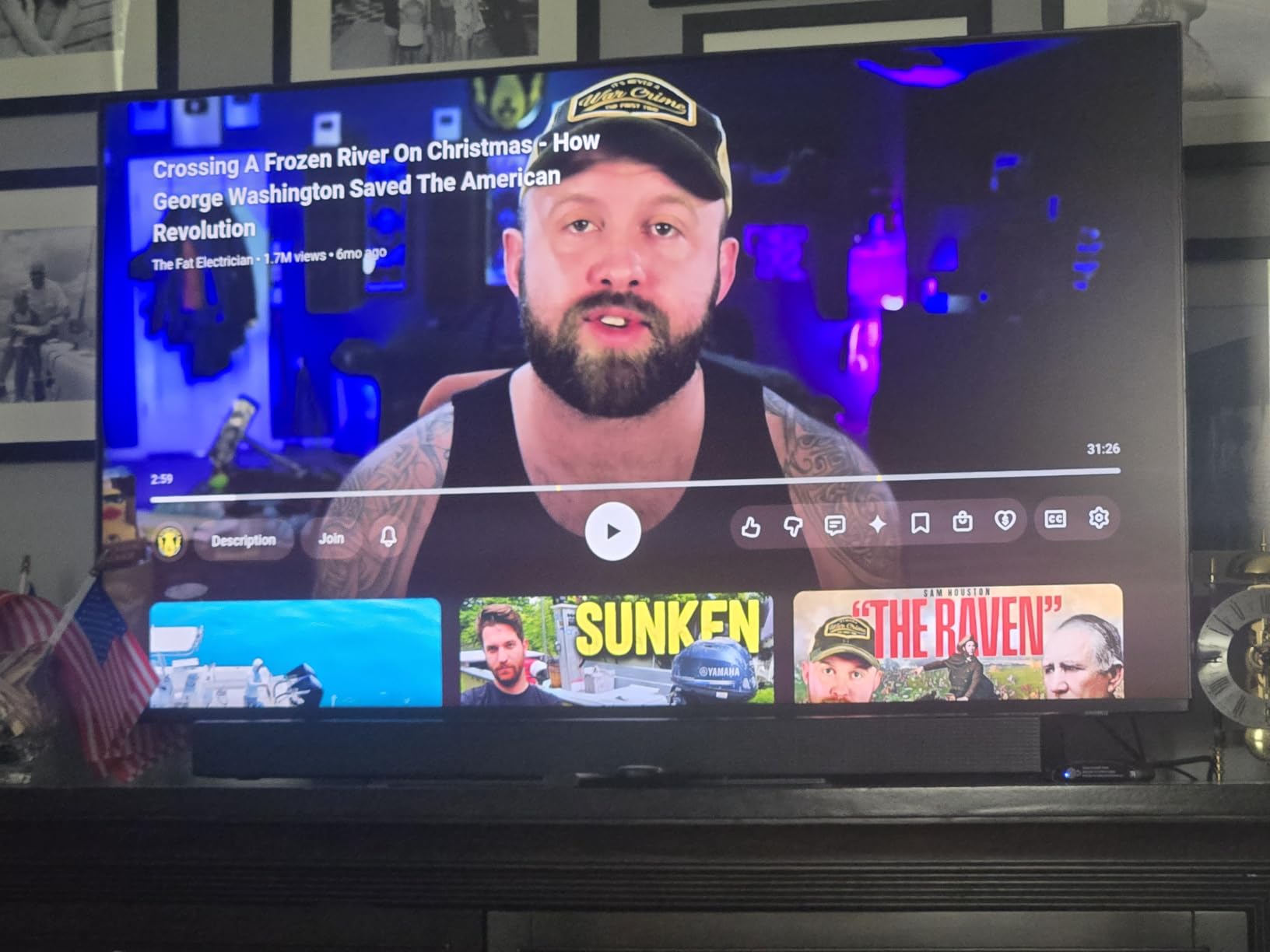
The 165Hz Motion Xcelerator with variable refresh rate is genuinely useful if the sunroom doubles as a gaming space, and 75 inches fills a 10 to 12 foot viewing distance without feeling small. At 87.5 pounds this is a two-person wall mount, and you should confirm your studs and mount rating before the box arrives. The VESA pattern is 400 x 400 mm.
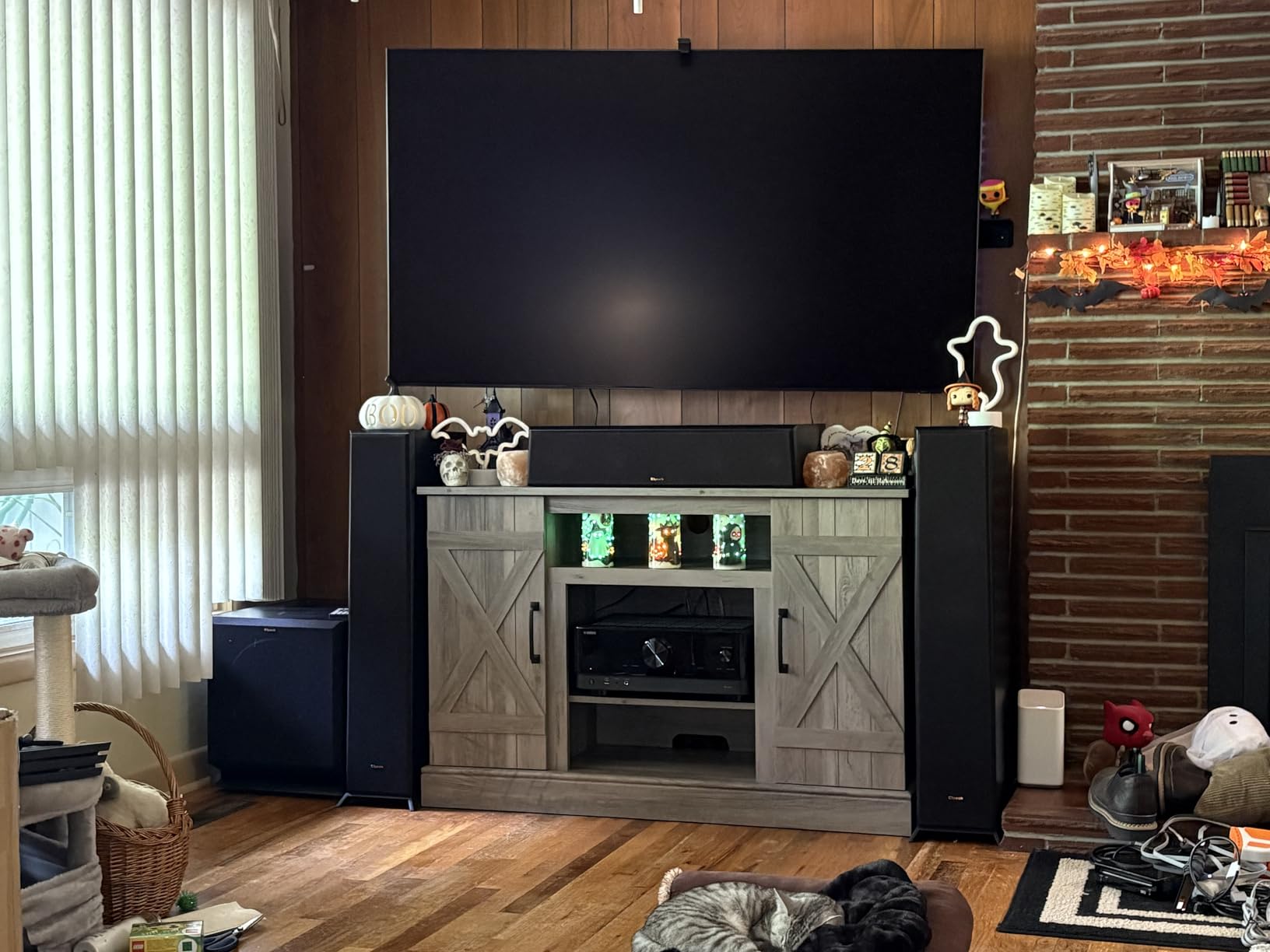
Object Tracking Sound+ with Dolby Atmos is the feature that quietly matters most in a sunroom. The 4.2.2 channel array is the only surround system on this list, which matters in a glass-and-hard-surface room where a soundbar is the thing you would otherwise have to add. Members on r/hometheater who upgraded from older Neo QLED sets call out the upscaling from the NQ4 AI Gen3 processor, which runs 128 neural networks to clean up lower-resolution sources.
What to check before you buy the QN90F
Weight and mounting first. At 87.5 pounds this is not a casual wall mount job, and the panel depth of 11.9 inches means you need real clearance from the wall behind. Make sure your cable run is planned before the mount goes up, because fishing HDMI through a finished wall afterwards is a project in itself.
Then check the AI upscaling settings honestly. Owners report that the processor struggles with genuinely old, very low-bitrate video and can make it look more pixelated rather than less. If you plan to watch a lot of archived content, turn the enhancement off for those sources.
Who the QN90F suits and who it does not
It suits a daytime sunroom with a real seating distance of 10 feet or more, and it suits anyone who does not want to add a soundbar. It also suits households that plan to keep the TV for a while, since Mini-LED panels do not carry the same static-image concerns as OLED.
It does not suit a small sunroom. If your viewing distance is under about 8 feet, 75 inches is too much screen and a 65-inch Mini-LED will look better and be far easier to mount. It also does not suit anyone unwilling to deal with a non-backlit single remote, which is the one accessory criticism that comes up repeatedly.
2. TCL 65-Inch QM6K Mini LED QLED: the brightness-to-cost winner
- Mini LED local dimming gives deep blacks for the money
- 144Hz native refresh handles fast sports and gaming
- Supports Dolby Vision HDR10+ HDR10 and HLG
- Onkyo 2.1 audio with a built-in subwoofer beats typical budget sets
- Brightness is below premium Mini LED sets in very bright rooms
- Google TV home screen is ad-heavy without a third-party launcher
- Onkyo speakers are decent but a soundbar is better for movies
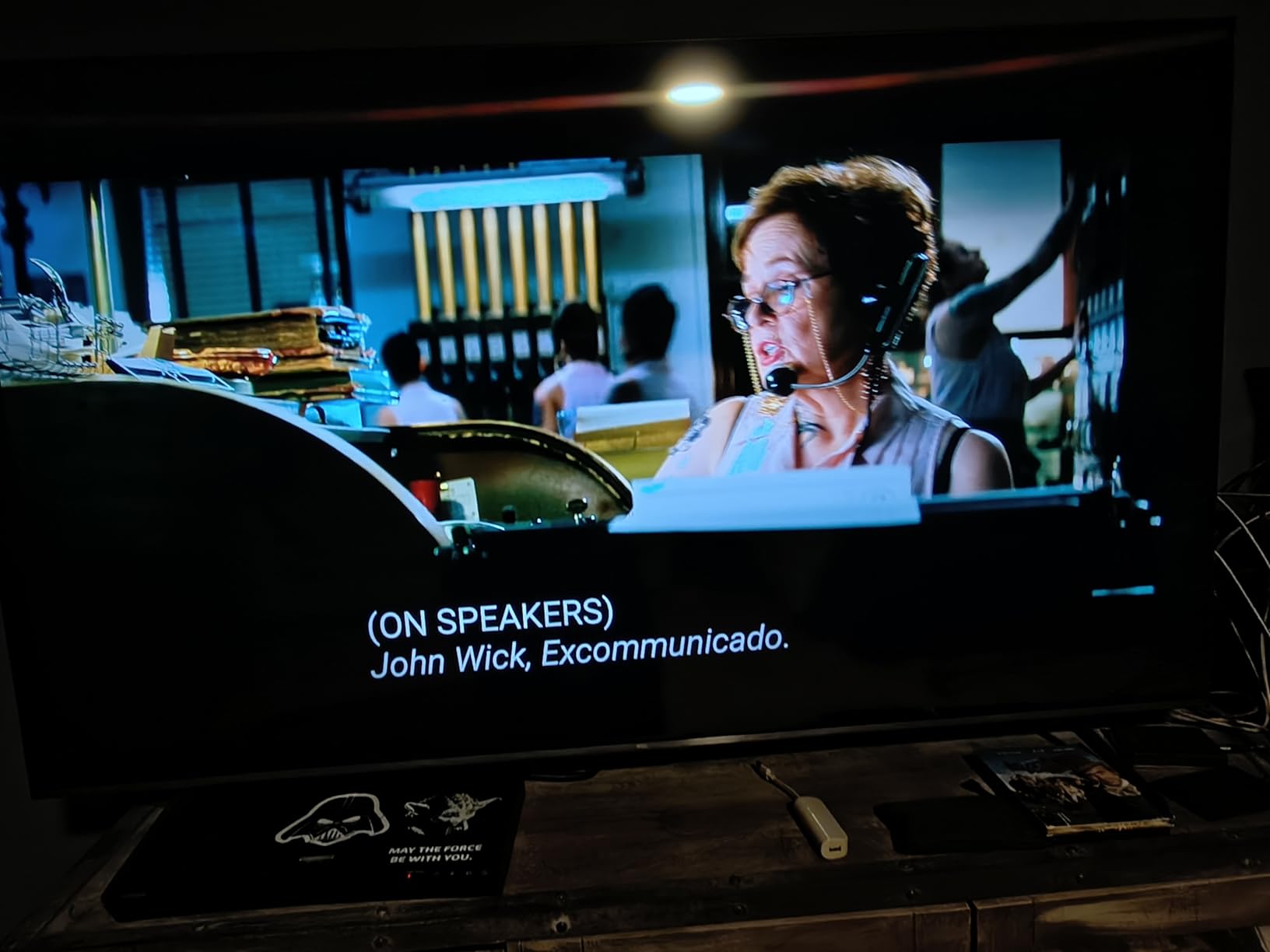
With 1944 owner reviews behind it, the QM6K is the most thoroughly tested set in this roundup, and the pattern across those reviews is remarkably consistent. Owners call it a standout value, single out deep blacks and strong motion handling, and one specifically reports it handling a brightly lit room next to massive glass sliding doors without reflections becoming a real issue.
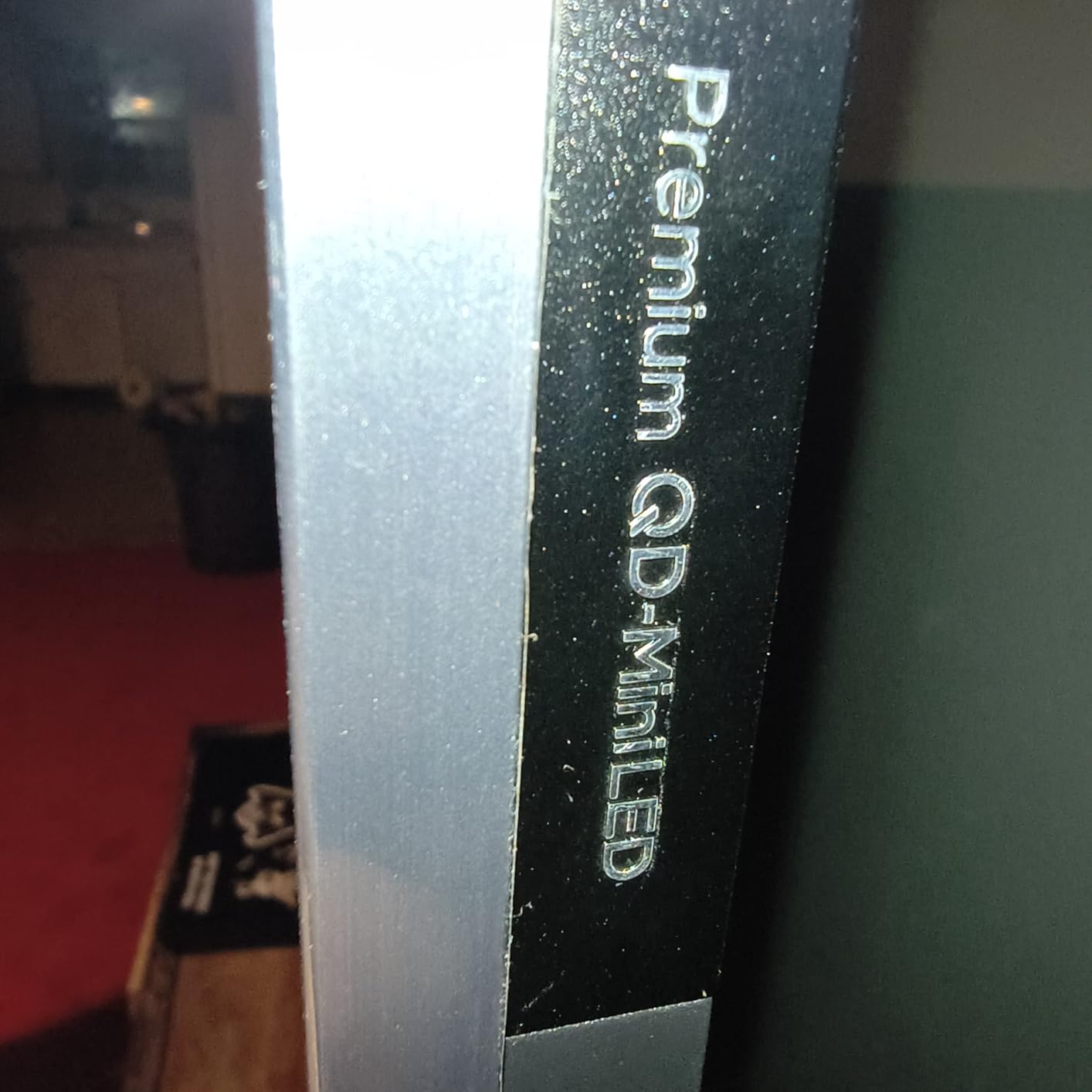
The panel is QD-Mini LED: quantum dot colour layered onto a Mini LED backlight with full array local dimming, managed by TCL’s Halo Control system to suppress halos. At 144Hz native with Motion Rate 480 and up to 288Hz VRR, it handles PS5 and PC gaming far better than the price suggests. All four major HDR formats are supported, including Dolby Vision and HDR10+.
Sound deserves a mention because TCL included a 2.2 channel Onkyo system with a genuine built-in subwoofer. It will not fill a sunroom the way the Samsung’s 4.2.2 array does, but it is a real step above the thin two-speaker strips on most sets in this class, and reviewers repeatedly say the built-in sound exceeded expectations for the money.
The honest limitation is brightness. Owners are clear that this set does not reach the daylight punch of the premium Mini-LED flagships, and in a truly bright room you will want dimmable blinds alongside it. Our advice for the best tvs for sunrooms is to treat the QM6K as the pick for a bright but shaded room, or as a room where you are also installing motorized shades.
What to check before you buy the QM6K
Measure the wall. At 37.8 pounds it is manageable for two people, and the 300 x 300 mm VESA pattern is standard, so any mainstream full-motion mount will work. The flip side of a wall mount here is that you lose the 2.2 channel separation, so think about whether the Onkyo speakers are actually reaching you.
Look at your room lighting before you finalise. The picture dims noticeably less than others here, but it does not disappear in direct sun, and pairing it with a bright room means you should also look at how it handles a Google account requirement, since app installs need one.
Who the QM6K suits and who it does not
It suits a 3-season sunroom that gets plenty of light but is not in direct afternoon sun, and it suits anyone who wants Mini-LED contrast and gaming features without flagship spending. Given the review volume, you are buying into a very well understood product rather than taking a gamble.
It does not suit an unshaded room facing west or south-west, where the premium Mini-LED models pull clearly ahead. It also does not suit anyone who refuses to deal with the Google TV interface, which owners commonly describe as heavily advertised and in need of a third-party launcher.
3. LG 65-Inch OLED evo C4: the best evening movie panel in a glass room
- Perfect blacks and wide viewing angles from self-lit pixels
- 144Hz and 0.1ms response with G-Sync and FreeSync Premium
- a9 AI Processor Gen7 upscaling cleans up lower-resolution content
- Five years of webOS software updates
- 1000 nits peak is modest for very bright glass-walled rooms
- webOS is described as clunky by some owners
- Pixel cleaning routine prompts are intrusive for some users
There is a specific kind of sunroom where the C4 is the correct answer and the other nine are not. If your glazing faces north or east, or if your primary viewing is in the evening, this OLED delivers a picture nothing else on the list matches. Reviewers are unanimous about deep inky blacks that hold from any angle, which is exactly the weakness of every backlit set in a sunroom.
The a9 AI Processor Gen7 is the practical hero here. Owners repeatedly praise the AI upscaling for rescuing older content, and the combination with Filmmaker Mode and Dolby Vision means you can get an accurate picture without a calibrator. For gaming, 144Hz, 0.1ms response and four HDMI 2.1 ports with both G-Sync and FreeSync Premium make this one of the fastest panels in the group.
On r/hometheater, owners of the C-series OLEDs consistently raise one size-related point that matters for sunrooms: 55-inch and larger panels handle reflections noticeably better than the 42-inch models, because there is simply more screen area relative to the reflecting window. At 65 inches you are at the size where that advantage starts to pay off, which is a good reason not to go smaller if you are mounting in a bright room.
Many owners pair it with an external streaming device or soundbar. The reasoning is straightforward: webOS is described by some as clunky and missing certain TV provider apps, and the onboard 2.2 channel audio is passable rather than cinematic. If you are building out the room properly, our OLED buying guide is worth a look at how the range compares before you settle.
What to check before you buy the C4
Test it at the time you actually watch. OLED panels are rated at 1000 nits peak, and in a room flooded with afternoon light that will not be enough. Sit in the seat, at the hour you care about, with the blinds in the position you will really use. If you can, do this in a showroom with comparable daylight.
Decide how you feel about OLED panel maintenance. The automatic pixel cleaning routine runs on a timer and several owners find the notifications intrusive, particularly if the set is off for long stretches. It is a non-issue if the TV is used daily, and an annoyance if it is not.
Who the C4 suits and who it does not
It suits an evening-first sunroom, a mixed-use room where the TV is on after dark, and anyone who wants the best film and gaming picture available. It also suits households that will use the TV daily, which keeps the pixel maintenance cycle healthy.
It does not suit a room with unshaded south or west glazing and daytime viewing as the priority. A 1000-nit ceiling simply is not the answer there, no matter how good the blacks are. It also does not suit someone who wants the built-in speakers to carry a film night.
4. Sony 65-Inch BRAVIA 9 Mini LED: the anti-reflection specialist
Sony 65 Inch BRAVIA 9 Mini LED QLED 4K HDR Smart Google TV (K-65XR90)
- X-Anti Reflection suppresses glare from windows and lamps
- X-Wide Angle keeps picture strong from off-centre seats
- XR Backlight Master Drive delivers deep Mini LED blacks
- Sony Pictures Core includes 4K UHD movie credits
- Highest cost in this roundup with only 2.0 speakers
- 76.7 pounds on a 65-inch panel needs a sturdy mount
- Only 65
- 75 and 85 inch sizes are offered
Sony built this one around a single problem: light coming back at you. X-Anti Reflection is a dedicated coating layer rather than a generic treatment, and X-Wide Angle handles the other half of the sunroom problem, which is that nobody sits perfectly square to a 65-inch screen. Owners who compared it directly to the OLED models rate the brightness and anti-glare performance as the decisive advantages of the Mini-LED.
Underneath, XR Backlight Master Drive is Sony’s brightest 4K implementation, and XR Triluminos Pro produces the colour. That combination is what the r/hometheater crowd consistently recommends for bright rooms when the budget allows: not the OLED for blacks, but the Mini-LED for light. The picture engine also includes Studio Calibrated modes, IMAX Enhanced, DTS:X and the full set of PS5 features including Auto HDR Tone Mapping.
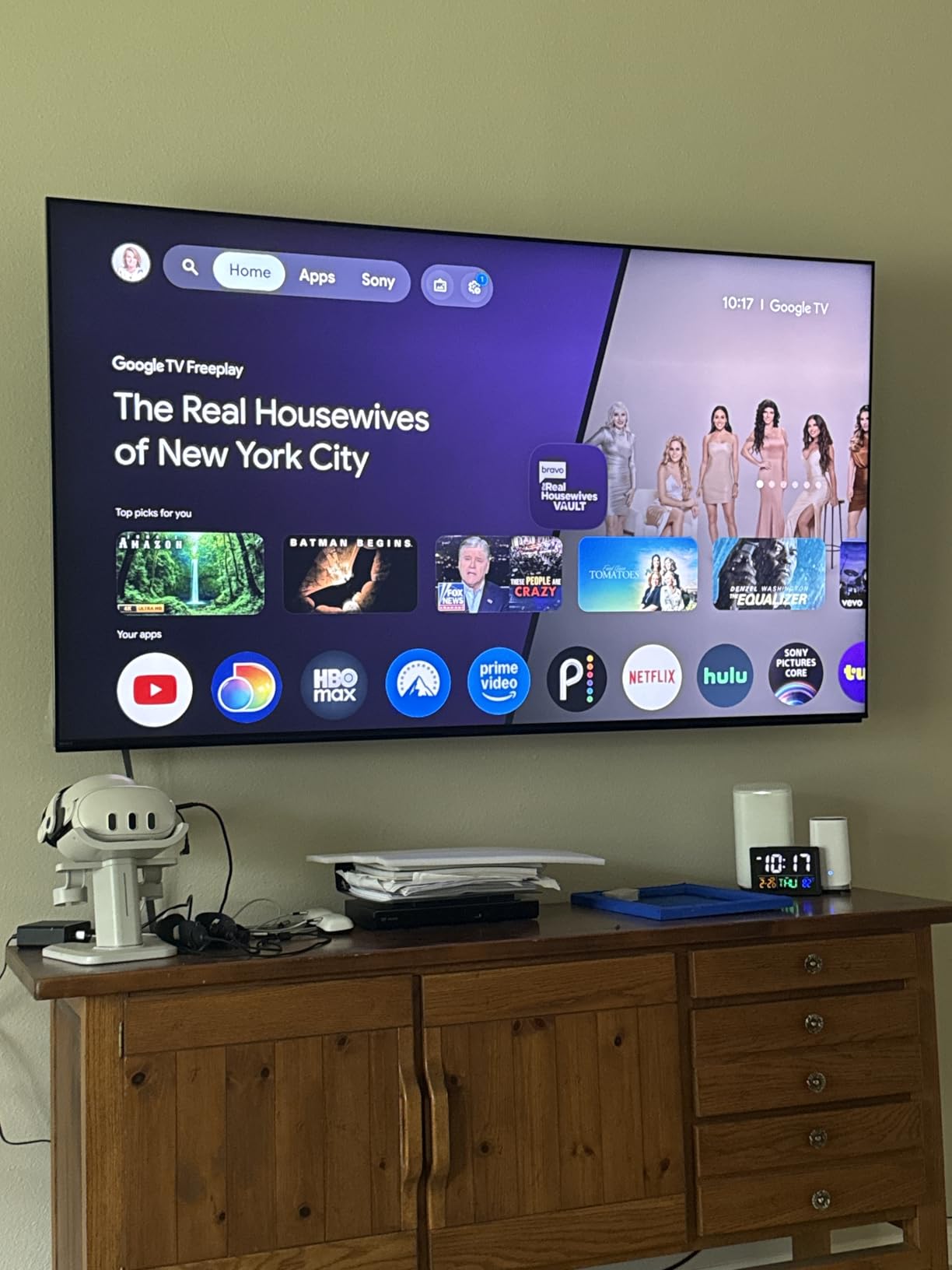
Two practical notes. First, the chassis is deep at 13.38 inches and heavy at 76.7 pounds for a 65-inch set, so plan the wall cavity and the mount accordingly. Second, the review sample is smaller at 210 owners, so you are buying on the strength of the engineering and the panel rather than a huge volume of long-term reports.
The bundled Sony Pictures Core app with 4K UHD movie credits is a genuine quiet bonus, particularly for a sunroom that doubles as a guest room, since it gives you something to play without an extra subscription. Our sunroom seating guide covers the layout side of making that space comfortable for longer sessions.
What to check before you buy the BRAVIA 9
Audio, plainly. This is the most expensive set here and it ships with 2.0 Acoustic Multi-Audio speakers. In a sunroom with hard surfaces you will be adding a soundbar, and if that is part of the plan, budget for it. The reflection handling, not the sound, is what justifies the spend.
Refresh rate too. At 120Hz it is behind the 144Hz TCL and 165Hz Samsung, which matters if you are a console gamer. For sports and film there is no meaningful difference, so decide which you are before you decide between these two.
Who the BRAVIA 9 suits and who it does not
It suits a sunroom with serious glazing, off-centre seating, and a household that prioritises a glare-free daytime picture over console gaming. It is the one we would put in a room where the TV is genuinely central to daily life.
It does not suit a tight budget, and it does not suit a small sunroom, since it is only offered at 65 inches and up. If money is the constraint, the TCL QM6K delivers most of the same benefit for considerably less.
5. LG 65-Inch OLED evo AI G5: the certified bright-room OLED
LG 65-Inch OLED evo AI 4K G5 Series Smart TV (OLED65G5WUA, 2025)
- UL-verified Discomfort Glare Free with UGR under 22
- Brightness Booster Max and alpha 11 AI Processor Gen2
- Perfect black and 100 percent color volume
- 4.2 channel Dolby Atmos fills a sunroom without a soundbar
- 1000 nit ceiling limits it against Mini LED in direct sun
- Refresh rate capped at 120Hz rather than 144Hz
- Most expensive indoor set in this roundup
The G5 is the OLED to consider if you have convinced yourself OLED is not for daylight. It carries a UL-verified Discomfort Glare Free rating, meaning it has been measured against a standard for reflected luminance rather than simply being described as reflection-resistant. Owners treat that certification as the reason the set works in their bright rooms, and it is a fair position.
The alpha 11 AI Processor Gen2 adds AI Super Upscaling and AI Director Processing, and Brightness Booster Max pushes highlights harder than the C-series. Colour is genuinely full: over 8.3 million self-lit pixels with perfect black and 100 percent color volume, which in a sunroom means saturated daylight content does not look pastel the way it does on lower-end sets.

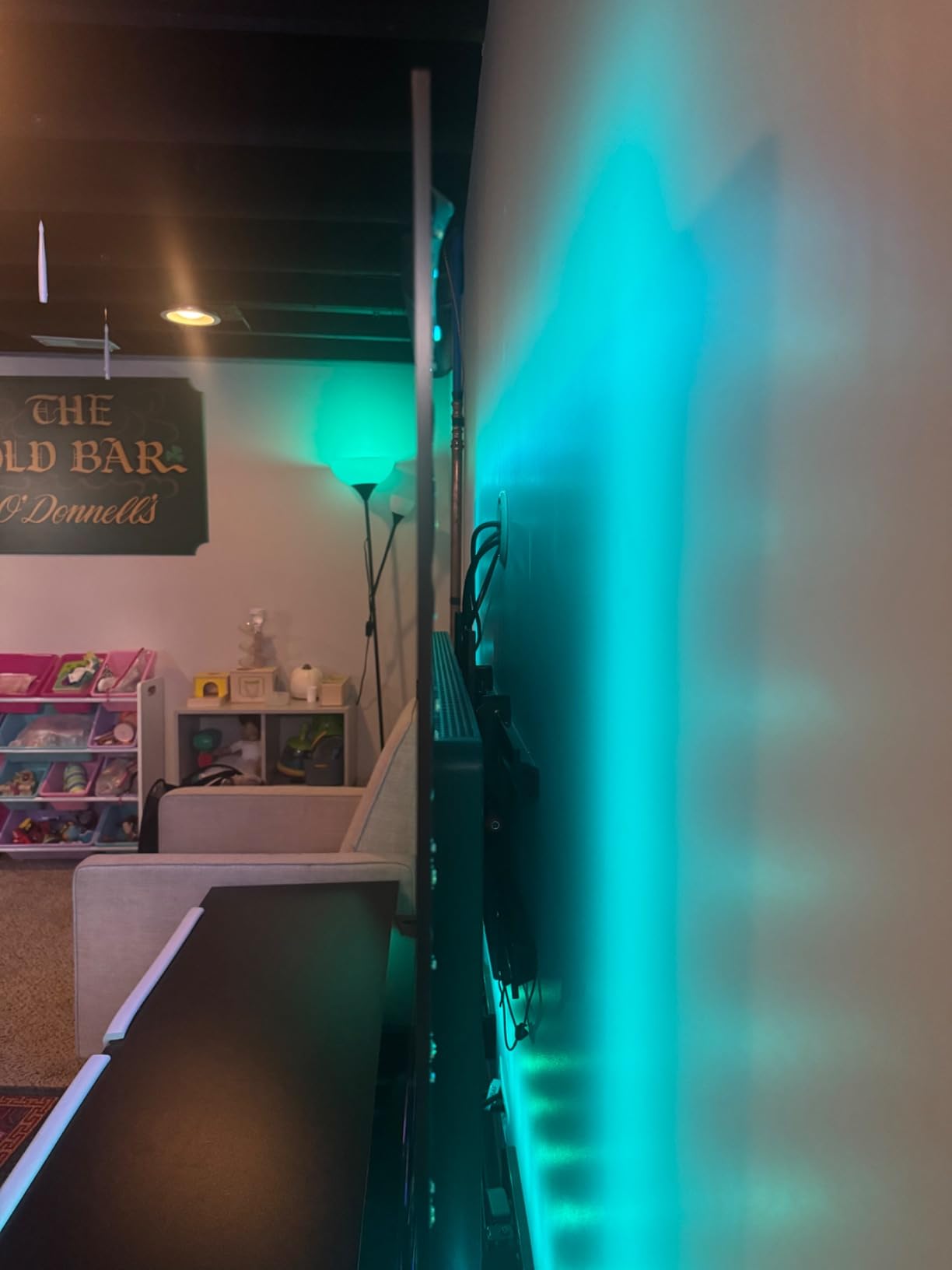
Where the G5 genuinely separates itself is audio. A 4.2 channel Dolby Atmos system with WOW Orchestra is the second most capable onboard array on this list, and owners in glass-walled rooms say it fills the space without a soundbar. One Wall Design also means a mounted panel sits almost flush to the wall, which matters in a narrow sunroom where a thick bezel would eat space.
Accept two compromises. The brightness ceiling is 1000 nits, the same as the C4, so this is still a 1200-plus-nit problem set for direct sun. And the refresh rate is capped at 120Hz, behind both the C4 and the TCL Mini-LEDs, which you will notice on fast competitive gaming.

What to check before you buy the G5
Cost versus benefit, honestly. This is the most expensive indoor set in the group, and you are paying a large part of that for the glare certification and the 4.2 channel audio rather than for raw brightness. If your sunroom is truly unshaded, a Mini-LED will serve the picture better even though it will not sound as good out of the box.
Check your streaming habits against webOS. LG commits to five years of software updates, which is genuinely long, but owners still pair these sets with external devices when the built-in platform is not their preference.
Who the G5 suits and who it does not
It suits a sunroom that is bright but not directly sunstruck, an audience that watches a lot of film and sport, and anyone who refuses to add a separate sound system. The glare certification is the reason it belongs on a shortlist at all.
It does not suit a full-sun exposed position, a competitive gamer who needs 144Hz or more, or anyone who wants the lowest spend. If brightness is the binding constraint, this is the wrong OLED.
6. Sony 65-Inch BRAVIA XR8B OLED: the best picture, the worst glare
- Best-in-class black contrast and colour clarity
- XR Clear Image upscales lower-resolution content cleanly
- Studio Calibrated Modes for Netflix and Prime Video
- Acoustic Surface Audio+ creates a wide soundstage
- Glossy screen reflects window light and suits direct sun poorly
- Small slippery remote is widely criticised
- AI upscaling and motion smoothing can degrade the image if left on
The XR8B has the highest owner rating in this entire roundup, and the reason is straightforward: nothing else here produces a picture of this quality. Owners describe it as stunning, with exceptional blacks, vivid colour and class-leading upscaling. On a dark evening screen, it is the best set on the list by a distance.
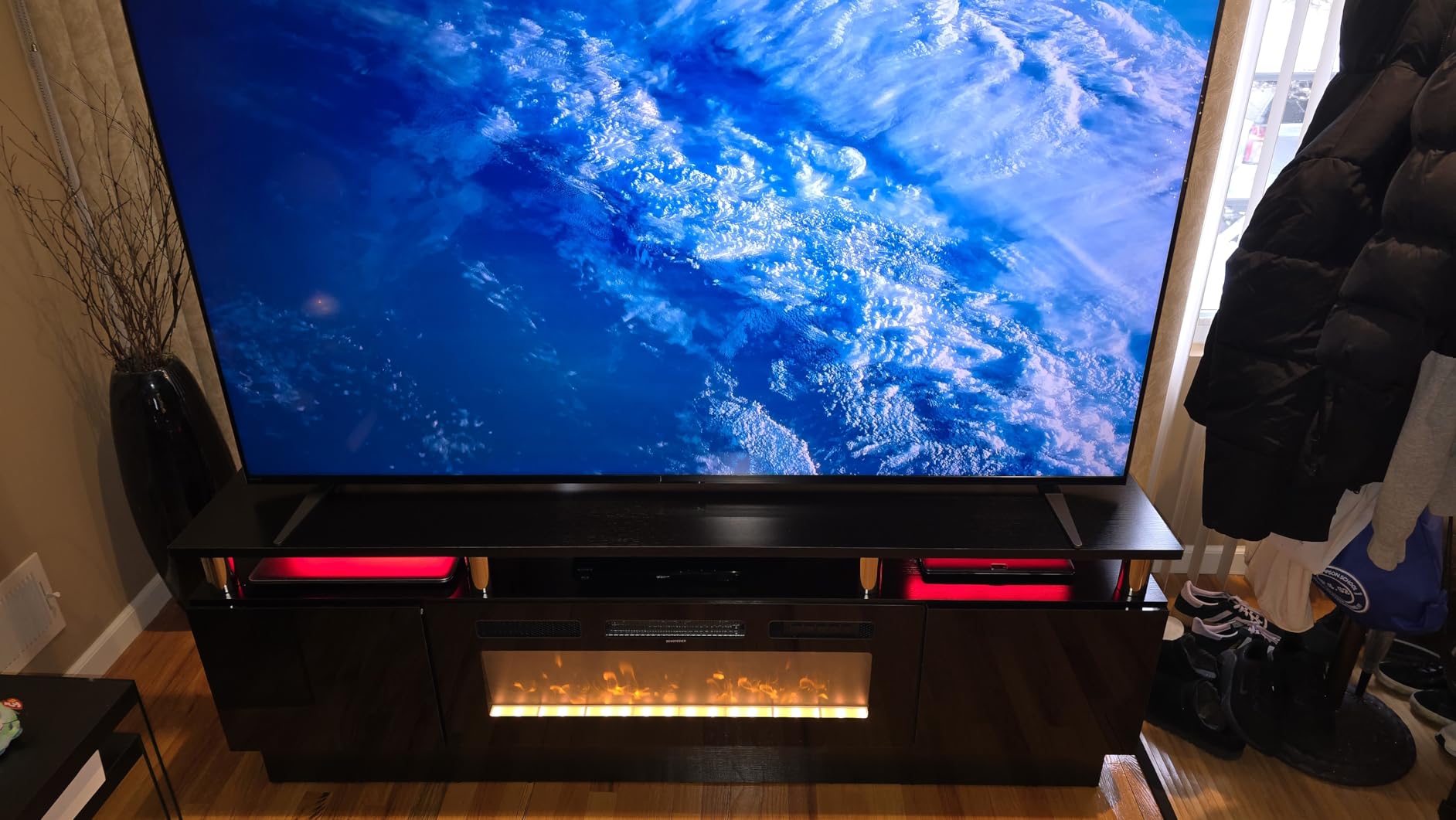
It is also, and this is the catch, the worst fit for a sunroom. The screen is glossy. When the set is off, it is a mirror in a wall of glass, and even when on, a glossy OLED in a bright room gives you a competing reflected image. The review data is explicit on this point, and it is why a 4.6 rating did not earn it the top spot here.
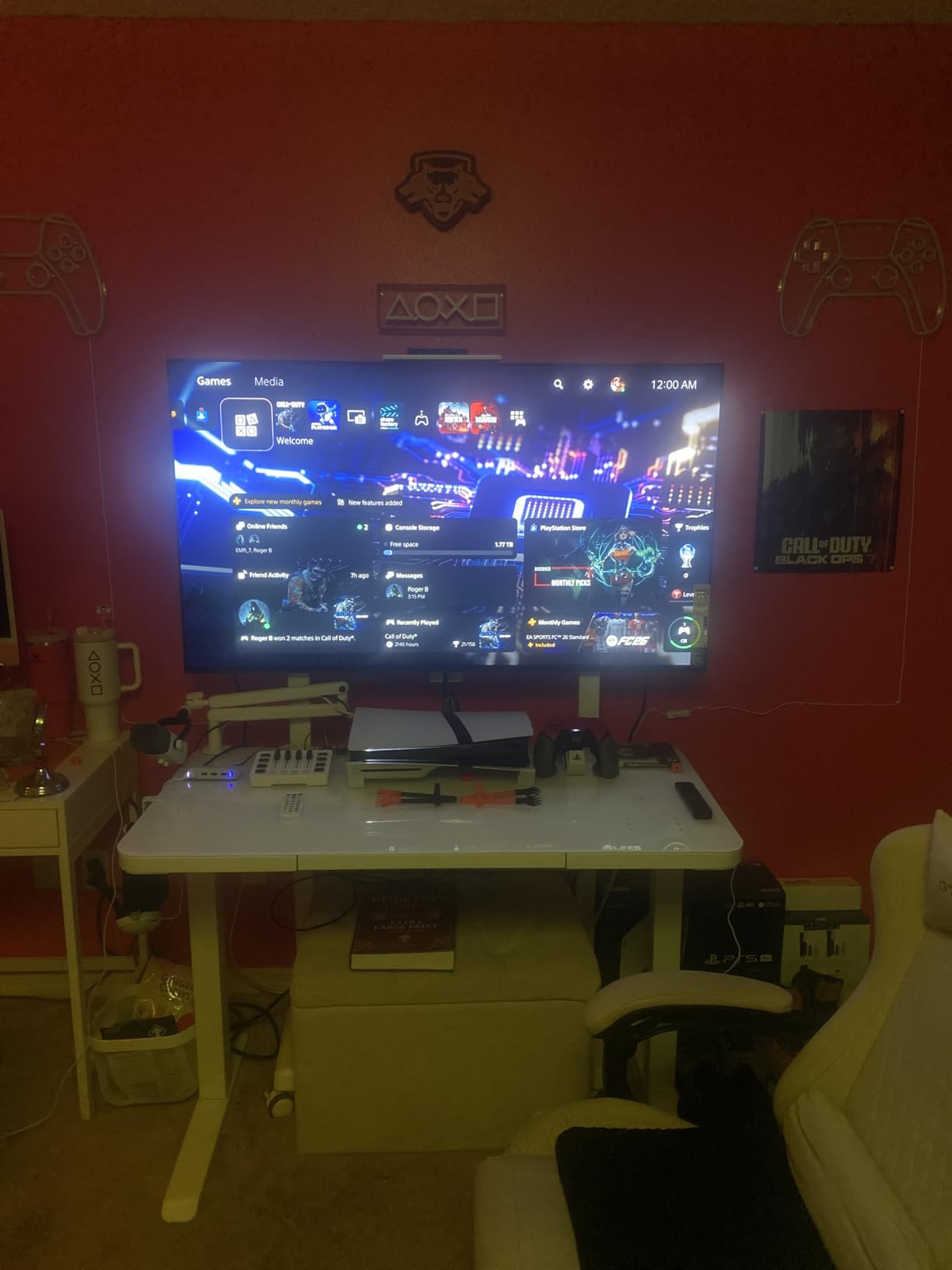
Where it does shine is integration. Studio Calibrated modes for Netflix and Prime Video, IMAX Enhanced, DTS:X and the PS5 feature set including Auto HDR Tone Mapping and Auto Genre Picture Mode make this the most complete picture platform available. Acoustic Surface Audio+ also produces a wider soundstage than the panel count suggests, though it is still 2.0 and a soundbar still improves film sound.
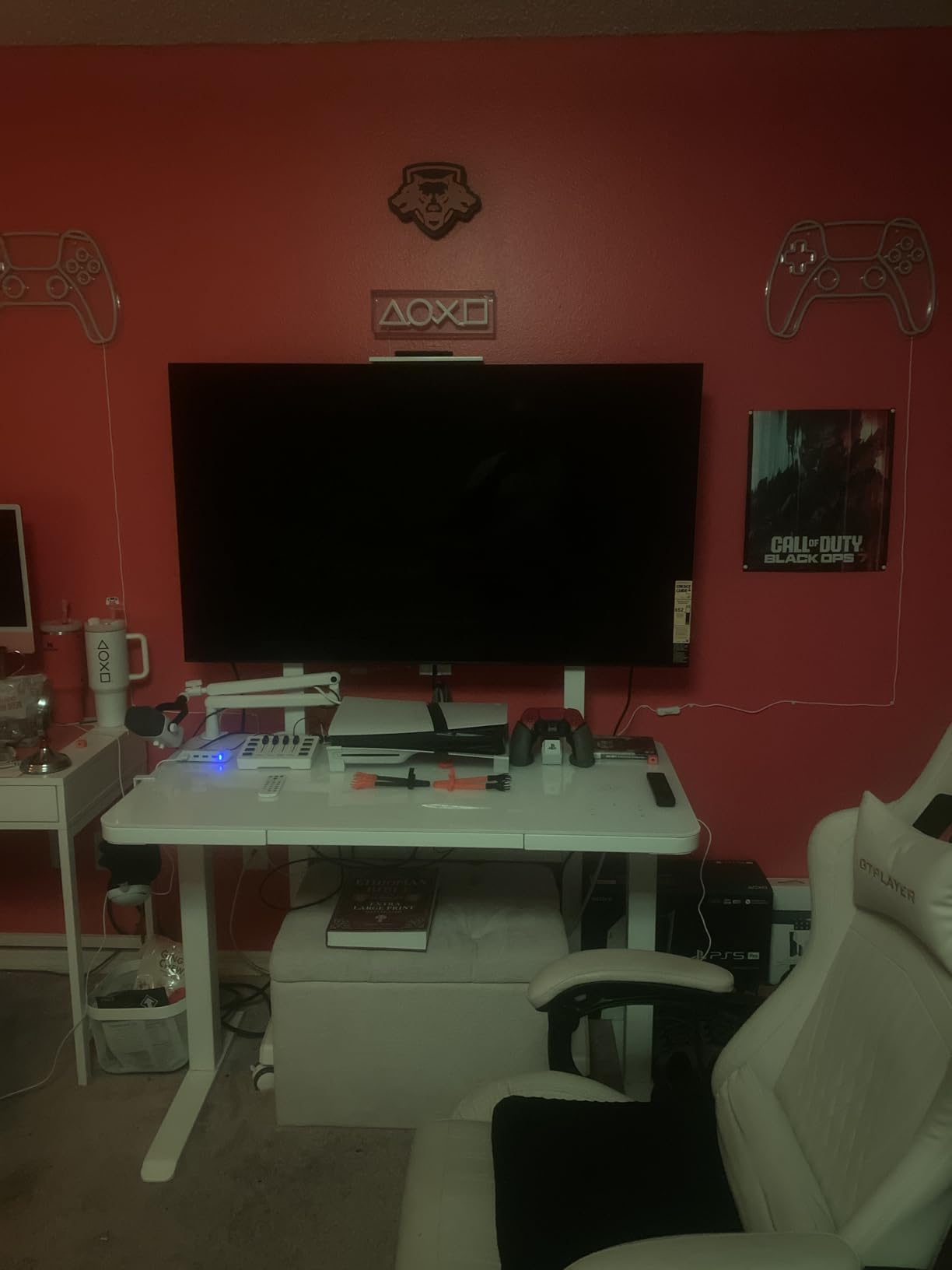
One operating note from owners: the remote is small, slippery and frequently criticised. And be careful with the AI upscaling and motion smoothing settings, which reviewers warn can actively degrade the image if you leave them on for everything.
What to check before you buy the XR8B
The position of the screen relative to your windows. A glossy panel can work if the screen faces away from the glazing and no window reflects into it, which is a solvable layout problem. It cannot work if you intend to mount it opposite a floor-to-ceiling window. Look at the room at your viewing time, not at a showroom wall.
Size, too. Owners on r/hometheater note that smaller OLEDs handle reflections worse than larger ones, so if you do choose this, 65 inches is the floor rather than the ceiling.
Who the XR8B suits and who it does not
It suits a PS5 household with a sunroom that is shaded or evening-oriented, and anyone who places picture quality first and will solve the reflection problem with layout or motorized shades. It also suits a PS5 owner specifically, since the automatic tone mapping is the most complete implementation available.
It does not suit a sunroom with reflected daylight in the picture. Nothing about the software or the settings fixes a mirror. If that describes your room, step up to a Mini-LED with a proper anti-reflective coating instead.
7. TCL 65-Inch QM7L SQD Mini LED: the brightest panel here, glossiness aside
- 3000 nit peak brightness is the highest figure in this roundup
- 2100+ local dimming zones deliver OLED-competitive blacks
- HVA 2.0 Pro high-contrast anti-reflective panel
- Bang and Olufsen tuned audio is a standout at this level
- Screen is fairly glossy and picks up window and lamp reflections
- Only HDR10 is listed with no Dolby Vision
- Remote lacks full feature coverage and needs a second controller
The QM7L is the raw brightness answer in this roundup. A 3000-nit class peak brightness figure is higher than anything else here, and owners who bought it specifically for a bright sunroom report that the panel delivers on the claim, with blacks that rival OLED and highlights aggressive enough to make you squint. If your sunroom gets genuine direct sun, this is the set that fights back hardest.
Dimming is the other headline. Up to 2100-plus discrete local dimming zones in the LD2100 Precise Dimming Series is a genuinely fine-grained backlight array, and it is why the blacks hold up next to an OLED despite being a lit LCD. The 144Hz refresh with Game Accelerator 288 VRR and AMD FreeSync Premium Pro makes it competitive for gaming too.

Audio is unusually good here as well. Bang and Olufsen tuning with optional wireless subwoofer and satellite speakers means the 2.0 baseline can be expanded without replacing the whole system, which is a real advantage in a sunroom where the acoustic problem is hard.
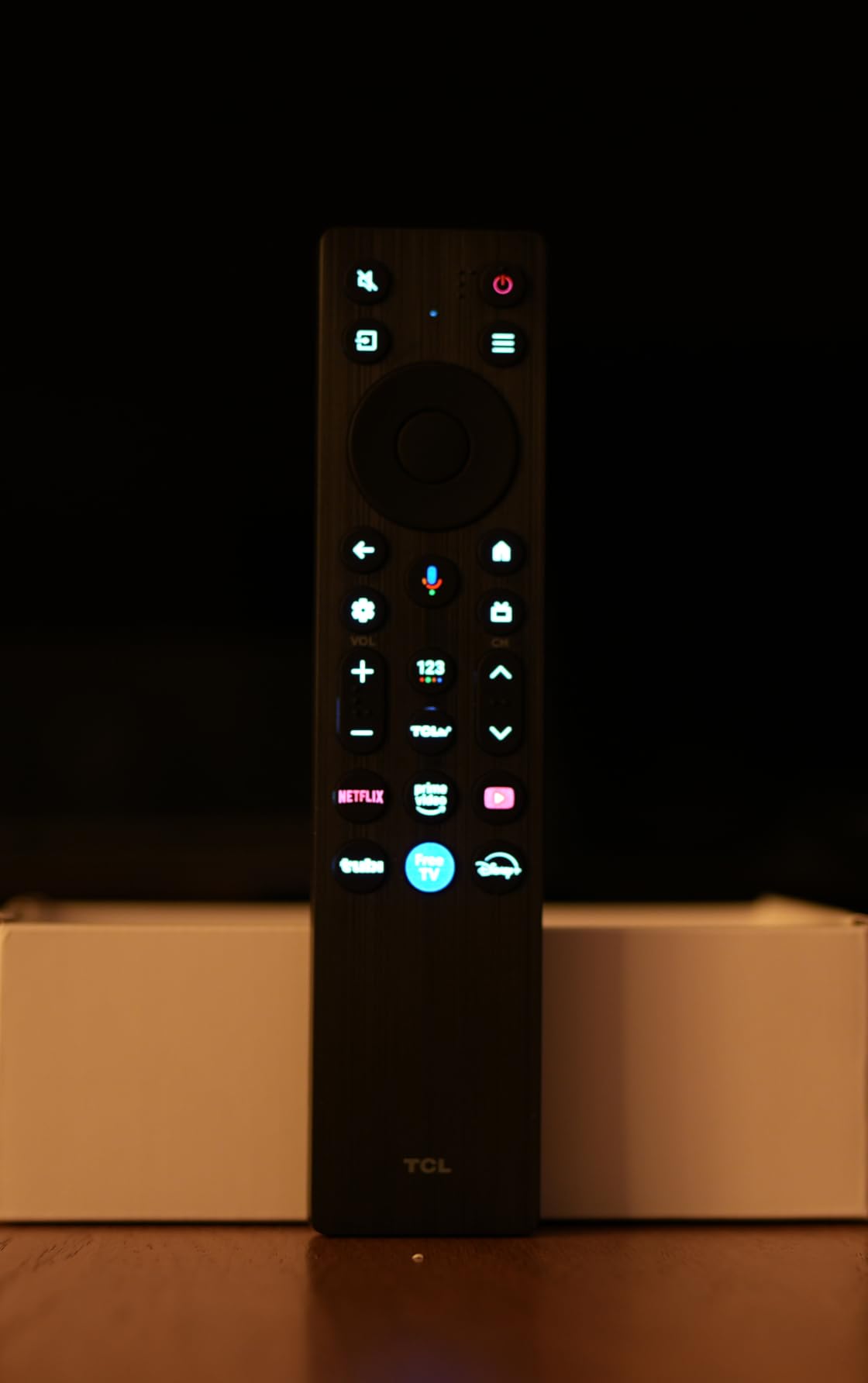
Now the caveats, and the first is significant. The panel is glossy. Owners with windows or lamps behind them notice reflections, which is the direct trade for the extra brightness. The HVA 2.0 Pro anti-reflective panel helps but does not eliminate it, so this is a brightness-first answer, not a glare-first one. Dolby Vision is also not listed, only HDR10, which is a real loss for a set at this level.
What to check before you buy the QM7L
Gloss in your specific room, honestly and early. Take a photo of your sunroom from the seat with a camera at the height of where the screen will hang, and look at what the glass does. If a window lands in that frame, the reflections will be visible on this panel more than on the Samsung or the Sony.
Also check the 14.5 inch chassis depth. This is a deep panel for a 65-inch, and it will not sit flush to a wall without a mount with real clearance. The review sample is also the thinnest here at 100 owners, so treat the long-term reliability picture as less certain than for the TCL QM6K.
Who the QM7L suits and who it does not
It suits a sunroom that receives direct sunlight and where you want the brightest possible picture, and it suits a gamer who wants high refresh and fine local dimming in one panel. The Bang and Olufsen audio reduces the need to plan a separate sound solution immediately.
It does not suit a room where reflection control matters more than brightness, and it does not suit someone who needs Dolby Vision, since only HDR10 is specified. If glare is the dominant concern in your room, the anti-reflective Mini-LEDs are the better targets.
8. Sony 65-Inch BRAVIA 7 Mini LED: Mini LED value with no anti-reflection
Sony 65 Inch BRAVIA 7 Mini LED QLED 4K HDR Smart Google TV (K-65XR70)
- Mini LED with XR Backlight Master Drive gives high brightness and deep blacks
- XR Clear Image upscales 480i and 720p content convincingly
- ATSC 3.0 tuner receives a large number of over-the-air channels
- Studio Calibrated Modes and IMAX Enhanced for accurate out-of-box picture
- Screen is not anti-reflective and reflects lamps and windows
- Viewing angle narrows off-centre and degrades the image
- Small non-backlit remote made from recycled plastic
The BRAVIA 7 is the interesting middle option in Sony’s line, and its specific strength is upscaling. XR Clear Image and the XR Processor handle 480i and 720p sources convincingly, which owners consistently single out. If your sunroom TV is going to be fed by an antenna, a cable box or an older streaming service rather than 4K sources, that matters more than any other spec on this list.
The picture engine is the same family as the flagship. XR Backlight Master Drive, XR Triluminos Pro colour, Dolby Vision, Dolby Atmos, IMAX Enhanced and DTS:X are all present, along with Studio Calibrated Modes and the full PS5 feature set. The ATSC 3.0 tuner is a real advantage for anyone planning to cut cable in a sunroom, since owners report it locks onto a large number of over-the-air channels reliably.
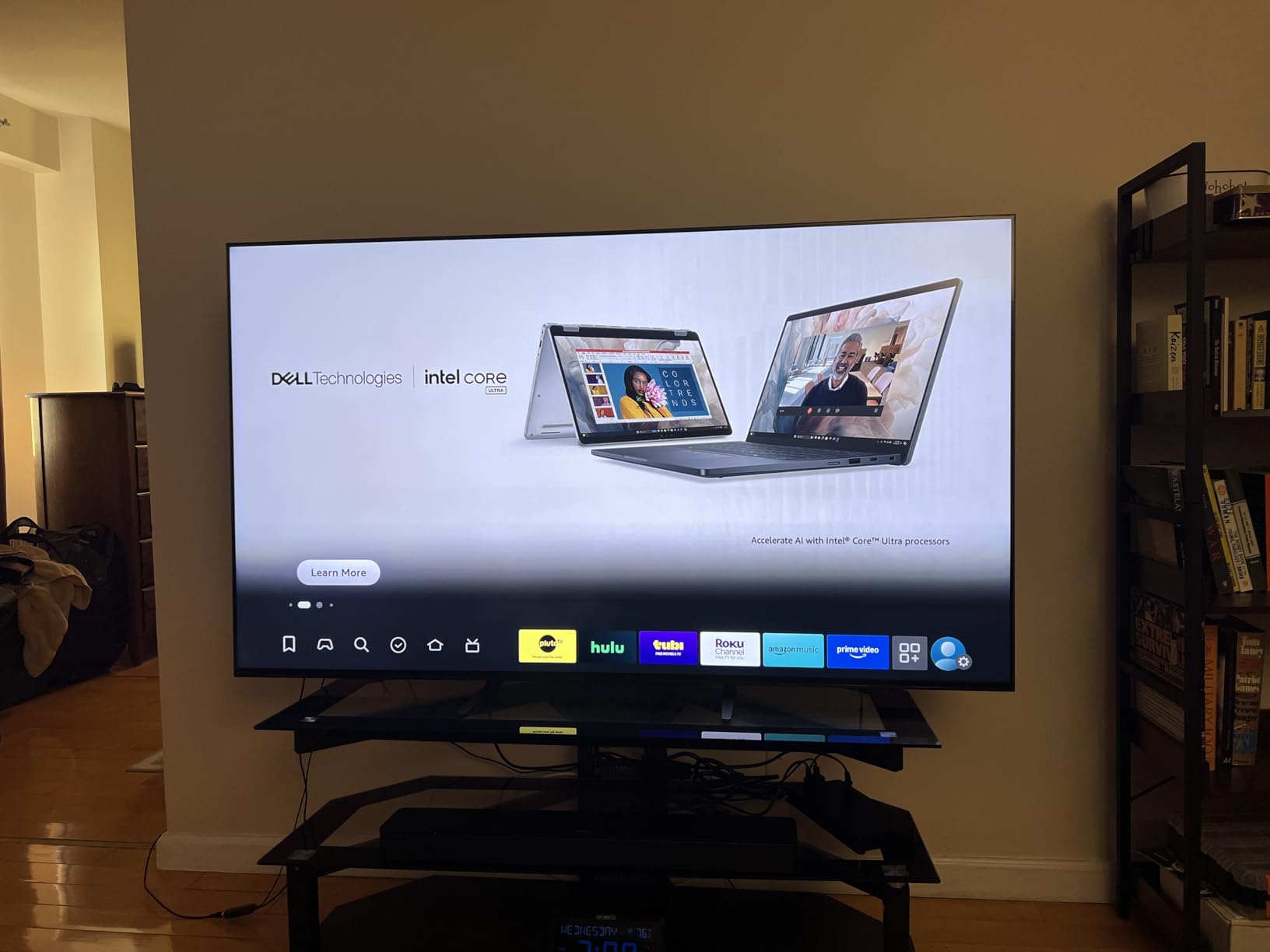
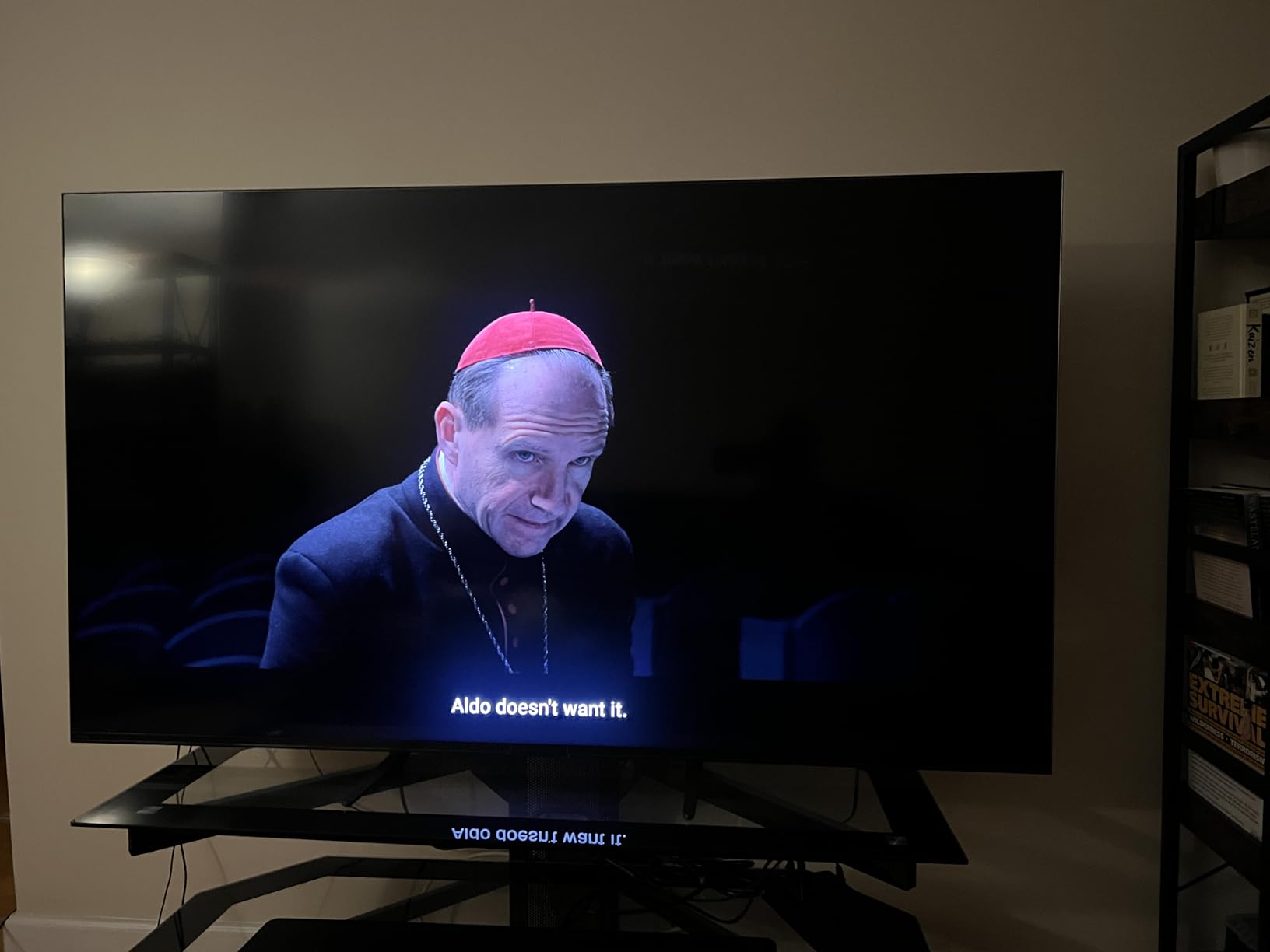
What it does not have is the anti-reflection layer. The BRAVIA 9 fixes exactly this with X-Anti Reflection, and without it the 7 reflects lamps and windows in a bright room. Viewing angle also narrows off-centre, so side seats get a visibly worse image. Both are the reasons this set carries the lowest owner rating in the roundup despite respectable hardware.
Two smaller items to know. The included remote is small, not backlit and made from recycled plastic, which owners dislike. And the Google TV settings menu is deep and layered enough that reviewers call it overwhelming for first-time users, so expect to spend a little time finding the picture controls.
What to check before you buy the BRAVIA 7
Source material and viewing position, together. This set is genuinely well suited to an antenna-fed sunroom TV on a wall that does not reflect windows, viewed mostly from the centre seats. It is poorly suited to an off-centre arrangement in a bright, glass-walled space, and no setting fixes that.
Mounting is the other item. At 62.4 pounds and 13.63 inches deep, a 65-inch set here needs a serious mount and real wall clearance, so confirm the structure before you commit.
Who the BRAVIA 7 suits and who it does not
It suits a sunroom with mixed or legacy content sources, an antenna user who values the ATSC 3.0 tuner, and a household that wants Sony picture processing without flagship spending. It also suits a room where the screen is on a wall with no reflected windows.
It does not suit a sunroom with heavy reflections, a wide seating arrangement, or anyone who cares about the included remote. If reflections are the main problem, the two step-up Sony models exist for a reason.
9. SYLVOX 65-Inch IP56 Outdoor TV: full metal weatherproofing for a covered room
SYLVOX Outdoor TV, 65 inch Smart Waterproof Outdoor TV, 4K UHD Weatherproof
- IP56 waterproof full-metal casing built to stay mounted outdoors year-round
- 1000 nit brightness suits partial sun and full shade positions
- 5.1.2 channel Dolby Atmos beats typical outdoor TV audio
- Works across a wide temperature range in real conditions
- 60Hz refresh rate with no gaming features
- Heavy at 60.2 pounds and needs solid mounting hardware
- One owner reported a reboot-loop hardware failure around 14 months
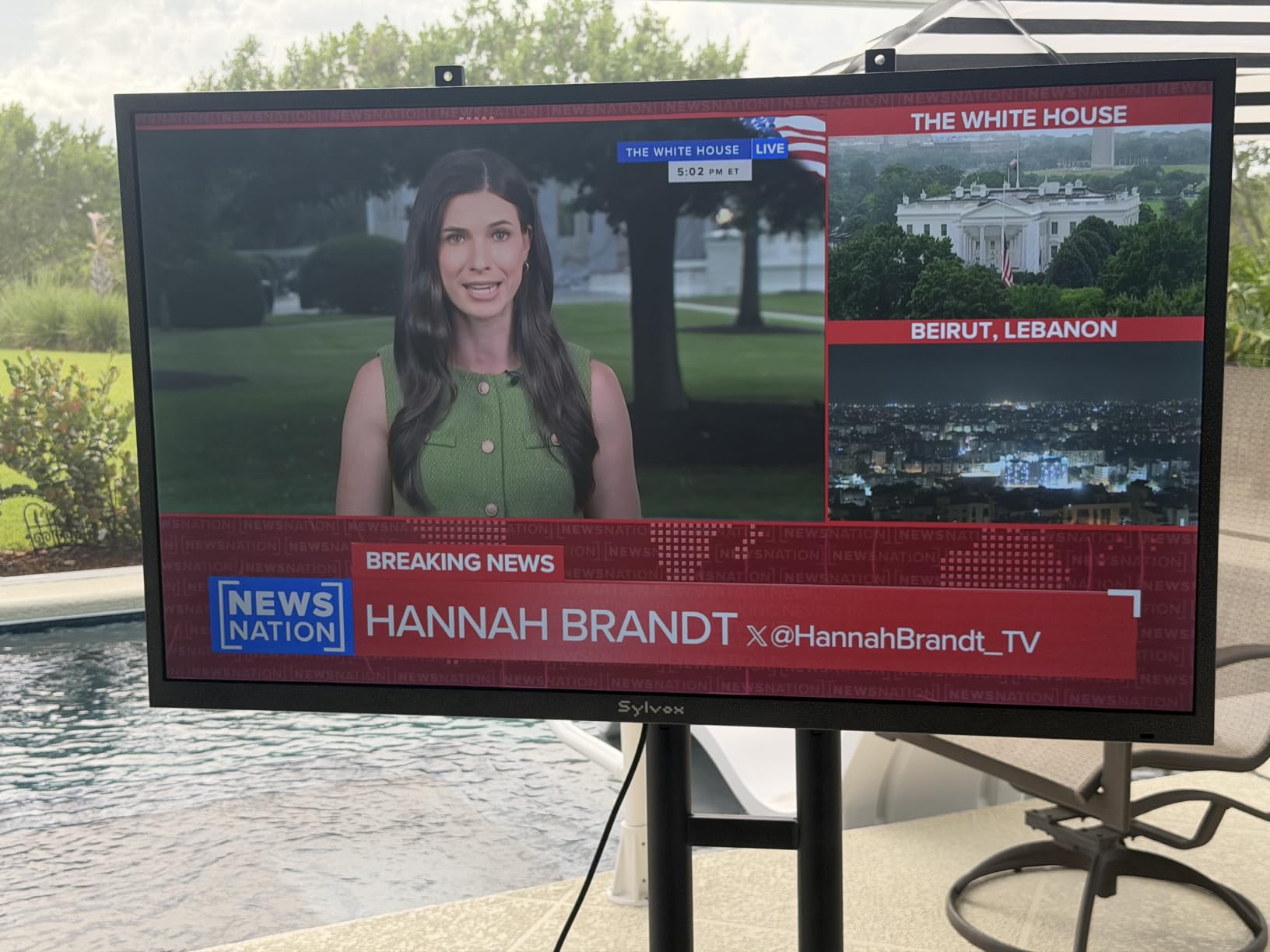
This is where the other half of the sunroom question comes in. If your room is a covered patio, a screened porch or an unconditioned space where you want the television permanently mounted near the opening, an indoor panel is the wrong purchase regardless of how good it is. This 65-inch set has an IP56 waterproof full-metal casing designed to be mounted outside and stay there.
Owner reports are convincing on durability. The large majority leave this set mounted outdoors year-round and describe it performing in rain, snow and deep cold, with one owner running it from 10C down to minus 30C without issue. Support is singled out for fast, professional replies and remote replacements, which matters when the product is physically somewhere you cannot easily reach.
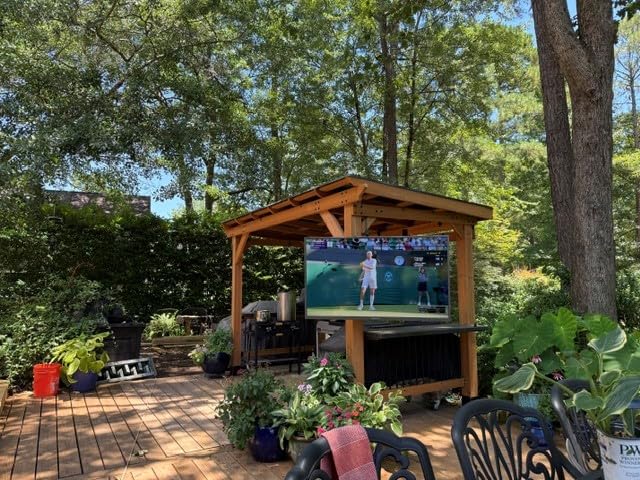
Brightness is 1000 nits, which the manufacturer and the owners both position at partial sun and full shade rather than full sun. That is an honest and correct positioning. If your screen position is under permanent cover, this is plenty. If you want to watch through open direct sun, no 1000-nit outdoor panel is the right answer and you should be managing the sun angle with the mount instead.
Audio is the unexpected strength. A 5.1.2 channel built-in Dolby Atmos system is the most capable onboard array in the whole roundup, and that matters outdoors where ambient noise is competing with every word. Connectivity includes HDMI, optical, USB and Ethernet, and it mounts on a wall, stand, gazebo ceiling or poolside.
What to check before you buy the SYLVOX 65
Two things: the 60Hz refresh rate, which rules it out for gaming entirely, and the weight at 60.2 pounds, which demands a mount rated well above the panel. Also plan the power and signal run before installation, because running cable to an exterior wall position is the most common reason outdoor installations go wrong.
Then read the warranty position honestly. There is a detailed owner report of a freezing, reboot-loop hardware fault within the first 14 months and a replacement policy the owner considered inadequate. It is isolated rather than common, but on a panel installed somewhere inconvenient it is worth factoring into your decision.
Who the 65-inch SYLVOX suits and who it does not
It suits a covered patio, screened porch or three-season sunroom where the panel will stay outside through the year, and it suits households that want one television serving both the indoors and the outdoors without moving anything.
It does not suit a full direct sun position, a gamer, or anyone installing into a room where the wiring is not already in place. For a fully conditioned four-season room, an indoor Mini-LED remains the better picture by a wide margin.
10. SYLVOX 43-Inch IP56 Outdoor TV: the compact weatherproof option
SYLVOX 43 Inch Outdoor TV, Weatherproof Google TV, IP56 Waterproof TVs
- IP56 waterproof chassis with anti-scratch body for exposed outdoor use
- Operates from -22F to 122F so it suits four-season rooms
- Dual waterproof speakers are clear and loud enough for outdoor listening
- Lighter and easier to wall mount than larger outdoor sets
- 700 nits is bright enough for partial sun only
- 60Hz refresh rate with no VRR or gaming support
- No optical audio out listed so external sound options are limited
The 43-inch SYLVOX solves a specific problem: a sunroom, patio kitchen or covered balcony where a 65-inch outdoor panel is simply too large or too heavy. At 32.5 pounds with a 400 x 300 mm VESA pattern, it is a much easier installation, and owners treat it as a purpose-built patio panel rather than a compromise.
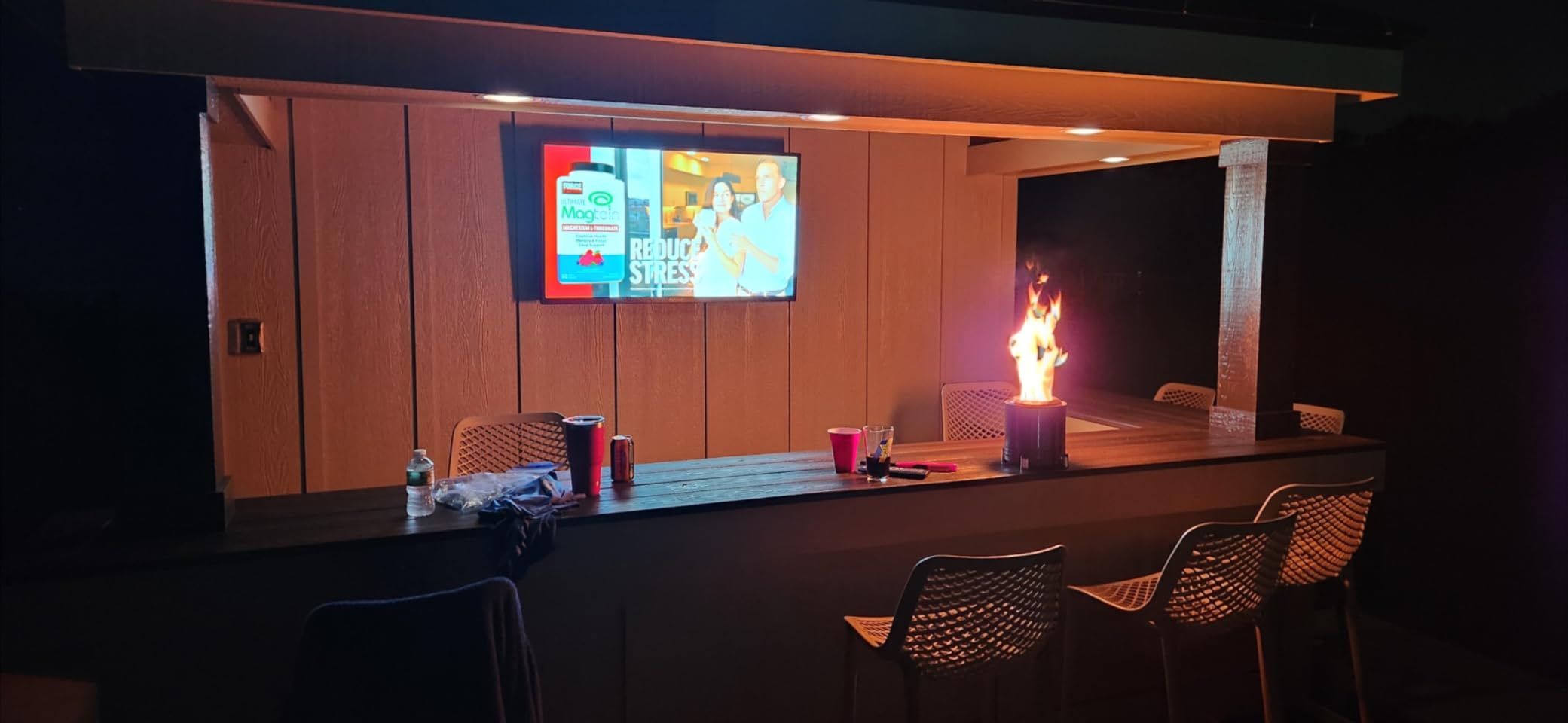
The weatherproofing is genuinely the point. An IP56 waterproof body with mist resistance, sunproof design and an anti-scratch finish, plus an IP66 waterproof remote in the box, and a rated operating range from minus 22F to 122F. That range is what makes it a four-season option rather than a summer-only one, and owners describe leaving it mounted through the seasons without concern.
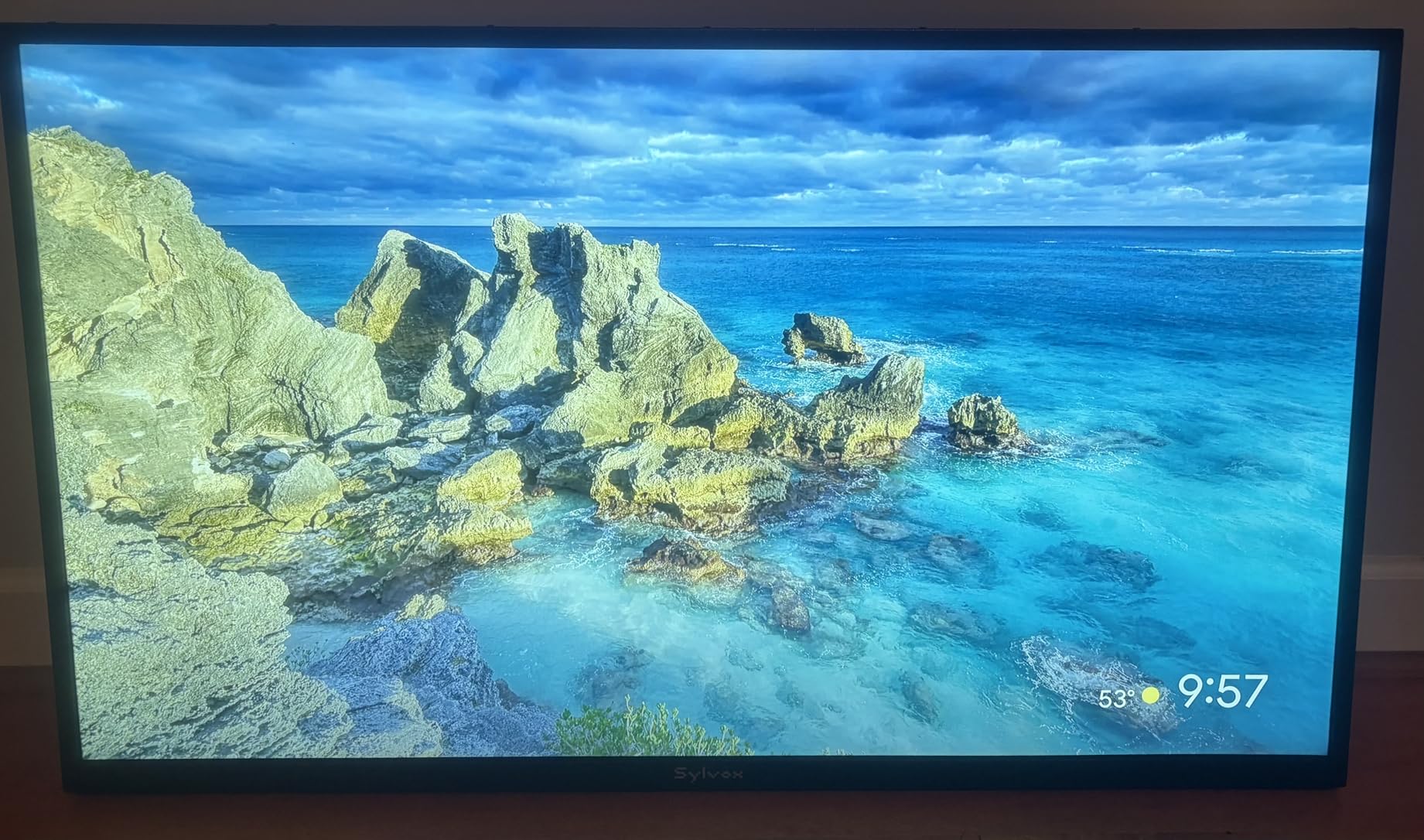
The 700-nit brightness is the limit that defines it. Owners are clear that this is a partial-sun and shaded-position panel, not a full-sun one, and that is the correct expectation to set. The dual 10W waterproof outdoor speakers are clear and powerful for the money, which is a real consideration when there is no wall to mount a soundbar on.
Setup is reported as simple, and the Google TV platform supports app downloads and Wi-Fi, plus Miracast screen mirroring. It will not double as a gaming display at 60Hz with no VRR, so treat it as a lifestyle and news screen rather than a media system.
What to check before you buy the SYLVOX 43
Sun exposure on the mounting position. Walk outside at the hour you will be watching and check what lands on the screen. If a wall or a tree blocks direct light, 700 nits is genuinely fine. If open sky does not, look at one of the brighter indoor Mini-LEDs with motorized shades instead.
Also confirm your audio plan. There is no optical audio out listed, so external sound is limited to the built-in speakers or Bluetooth. In a small space the built-ins are probably enough; in a larger covered room, that limitation will show.
Who the 43-inch SYLVOX suits and who it does not
It suits a covered balcony, patio kitchen, poolside area or small sunroom where a 65-inch outdoor set is impractical, and it suits anyone who wants a permanent outdoor screen on a straightforward installation. The temperature rating makes it a four-season choice rather than a seasonal one.
It does not suit a main living-room television, since 700 nits and 60Hz will not satisfy a serious viewing room, and it does not suit a fully unshaded position. Judge it as a purpose-built outdoor panel and it does its job well.
Sunroom Installation Checklist Nobody Covers
Almost every competitor guide stops at the picture specs. In practice, where and how you mount the panel matters as much as which panel you pick, because glare is a function of angle as much as of coating. Members on r/homebuilding and r/HomeImprovement raise the same point repeatedly: a fixed mount locks in whatever reflection you happened to have that afternoon.
Use a full-motion mount. A tilting or swiveling arm is the cheapest glare reduction available. Being able to angle the screen away from a window during the afternoon and back into a comfortable position in the evening solves problems that no coating fully fixes. This is the single highest-return change most sunroom owners can make.
Plan the cable run before the mount. Outdoor-rated HDMI in a conduit run, a weatherproof junction box, and a circuit with headroom for sustained high-brightness operation. If the set is going outside, the wiring design is the part that has to be right, and it is the part that is hardest to fix afterwards.
Watch the seasonal sun angle. A southwest-facing room in midsummer throws light far higher into the space than it does in winter. Ask the mount for enough vertical adjustment that the screen can be angled down in summer and level in winter. Owners who have lived with this a full year report it as the difference between a usable and an unusable summer.
Consider motorized shades seriously. This is the forum consensus, and it is the advice we would give first. Many owners end up with a high-brightness indoor TV plus automated shades rather than an expensive outdoor set, because shades control both glare and heat load and they work in every season. If you are planning a full fit-out, our sunroom rug guide covers the softer side of making the space livable once the technical decisions are done.
Think about the power draw. Running a panel at high brightness for eight hours a day is a sustained load, and a four-season room running a climate system alongside it is worth planning for on a dedicated circuit. It is also a reason not to oversize the screen: a smaller panel at the same viewing distance is easier on the bill and on the room.
How to Choose a TV for Your Sunroom
Work through these in order and the decision makes itself. Start with the sun, not the screen.
How much brightness do you need? Under 700 nits covers a shaded room with no direct light. Between 700 and 1000 nits handles partial sun and covered positions. Above 1000 nits, you are dealing with real daylight, and you should be looking at the anti-reflective Mini-LEDs on this list. Above 2000 nits is for the hardest positions, and it is where the reflections become the limiting factor rather than the brightness.
Indoor or outdoor-rated? A four-season conditioned sunroom with glass doors that close should have an indoor panel, because you will get a better picture for the money. A covered patio, a screened porch or an unconditioned three-season room should have an IP56 outdoor set, because no brightness figure compensates for humidity and temperature damage. Ask whether the room can be closed up, and the answer usually decides it.
Which panel? Mini-LED for daytime and sport in a bright room. OLED for evening film and gaming, or for a shaded room that doubles as a cinema. QLED if you want bright, robust, relatively affordable performance and the picture detail is not the priority.
How big? For a 10 to 12 foot viewing distance, which is the most common sunroom seating layout, 65 to 75 inches is the right range. Under 8 feet, stay at 65 or smaller. Keep in mind that 43 inches is the maximum most outdoor-rated models reach, so an outdoor set constrains your size choice by design.
What about the coating? This is the section to read twice if your room has a glazed wall opposite the screen. X-Anti Reflection and Glare Free are the two treatments that materially change outcomes. A certified Discomfort Glare Free rating is a useful, narrower guarantee. A glossy panel in a glass-walled room is a compromise you will live with every day.
Audio and platform. In a sunroom, built-in 2.0 audio will not carry a film. If you do not want to run a separate soundbar, look at the Samsung QN90F with 4.2.2 channel audio, the LG G5 at 4.2 channels, or the SYLVOX 65 with 5.1.2 Dolby Atmos. For the platform, webOS commits to five years of updates on the LG sets, while Google TV is the common denominator across the rest and the platform most people find easiest to get around.
Warranty and support. A one-year manufacturer warranty is standard across this entire list, with no outdoor-specific extension. That makes support quality the real differentiator for weatherproof sets, and the SYLVOX reviews are unusually positive on support responsiveness. For indoor panels in humid rooms, a four-season space is the thing to protect, since humidity is what indoor warranties are written to exclude.
Frequently Asked Questions
Is QLED or OLED better for sunlight?
Mini-LED and QLED are the better choice for a sunroom, because they are backlit and reach far higher peak brightness than OLED. Every OLED in our roundup is rated at 1000 nits, which is not enough to out-shine direct daylight. OLED still wins on blacks, contrast and viewing angle, so it remains the right pick for evening viewing or a shaded room.
Which TV screen is best in sunlight?
A Mini-LED with a purpose-built anti-reflective coating is the best screen in sunlight. The Samsung QN90F uses a Glare Free layer and the Sony BRAVIA 9 uses X-Anti Reflection, and owners with floor-to-ceiling glass report reflections stop being a problem on both. A matte or semi-matte surface handles glare better than a glossy one but usually costs peak brightness.
What are the best TVs for full sun use?
For direct sun you need high peak brightness plus glare control. The TCL QM7L leads this roundup on brightness at a 3000-nit class figure, the Samsung QN90F pairs 2000-nit class brightness with a Glare Free coating, and the Sony BRAVIA 9 adds the most effective anti-reflection treatment available. Position the screen on a full-motion mount so you can angle away from the sun.
Can you use a regular indoor TV in a sunroom?
Yes, if the room is conditioned, enclosed with closable glass doors, and free of direct sun on the screen. A standard indoor set will out-perform an outdoor-rated panel on picture quality in those conditions. In a covered patio, screened porch or unconditioned three-season room, choose an IP56 outdoor TV instead, because humidity and temperature swings damage indoor panels regardless of brightness.
How many nits do I need for a sunroom TV?
Around 700 nits covers a shaded room with no direct light, 700 to 1000 nits handles partial sun and covered positions, and you want more than 1000 nits for genuine daylight viewing. Above 2000 nits is for the hardest positions. Remember that anti-reflective coatings reduce peak brightness, so a coated 1000-nit panel can outperform an uncoated 1500-nit one in a glass-walled room.
Is an anti-glare screen worth it in a sunroom?
In a room with glazing opposite the screen, yes, because reflection competes with the picture and no brightness setting fixes it. The trade is that anti-reflective coatings typically lower peak brightness and can reduce contrast slightly. A full-motion mount helps as much as any coating, so it is worth doing both rather than choosing between them.
Final Verdict for Bright Rooms in 2026
The Samsung 75-inch Neo QLED QN90F is our pick for the best tvs for sunrooms, because a purpose-built anti-reflective coating and 2000-nit class brightness is the combination that solves daylight viewing and window glare at the same time, and the 4.2.2 channel audio removes the need to plan a separate sound system. The Sony BRAVIA 9 takes the crown for the most glare-resistant picture, the TCL QM6K is the value pick for a bright but shaded room, and the two SYLVOX outdoor panels are the correct answer when the screen lives outside.
Whatever you choose, mount it on a full-motion arm, plan the cable run first, and buy the brightness your sun position actually requires rather than the most you can afford. That last decision is the one that determines whether you are happy with the set in year three.