
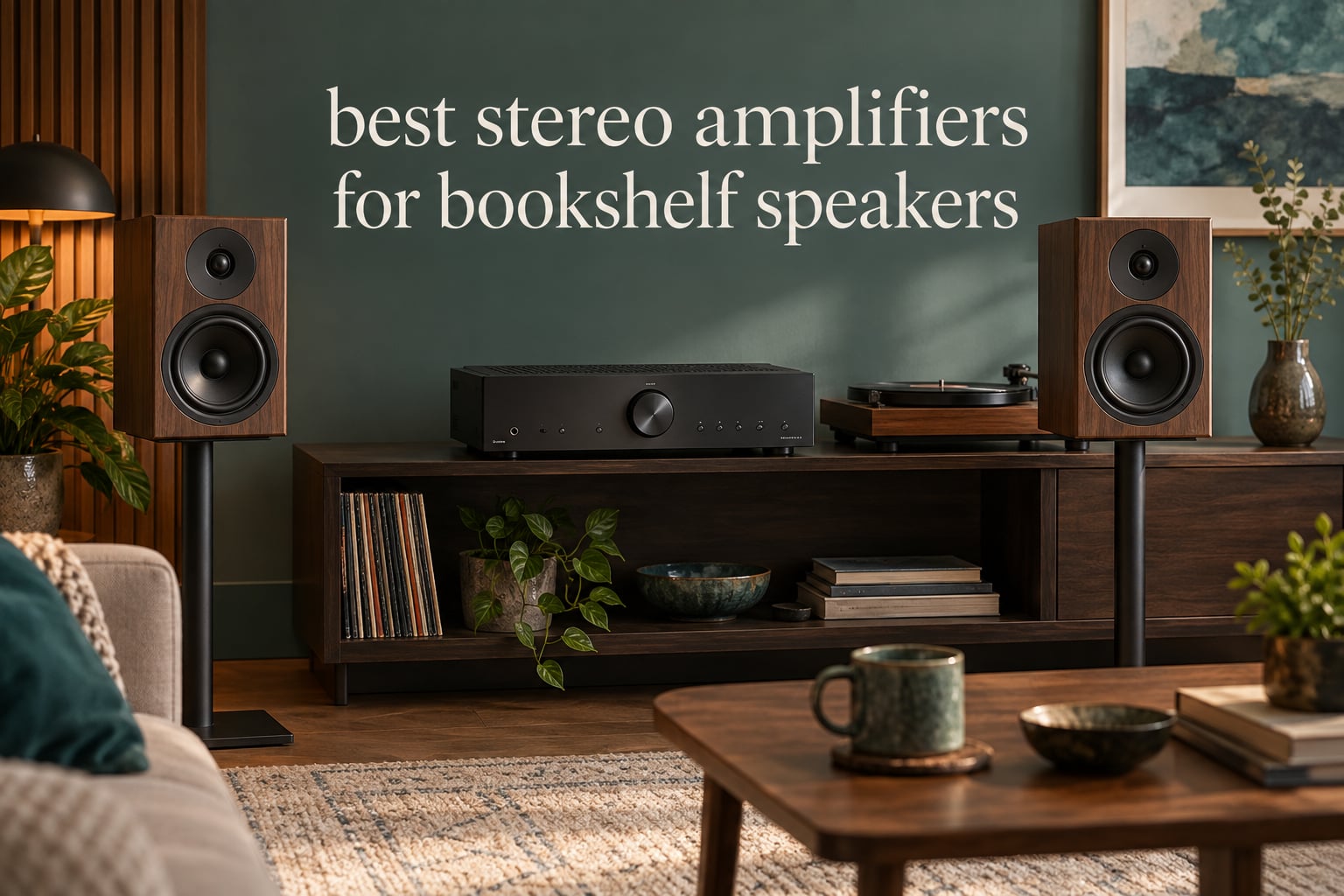
Most people buying the best stereo amplifiers for bookshelf speakers make one big mistake: they hunt for the biggest wattage number they can find. Bookshelf speakers are small, efficient and easy to drive, so a huge amplifier does not make them sound better. It just costs more money and sits there generating heat.
The amplifiers that actually work well with bookshelf speakers are modest, high-current boxes with enough real headroom for musical peaks. We went through 12 of them and matched each one to the kind of speaker, room and source it genuinely suits.
Before we get into the list, one definition worth having early. Passive bookshelf speakers have no amplifier inside, so they need an external amplifier or receiver to drive them. Active bookshelf speakers have the amplification built into the cabinet, so you connect a source directly and no external amplifier is required. Most of the speakers people ask us about are passive.
We covered powered bookshelf models separately in our powered bookshelf speaker guide, and the entry-level passive picks in our entry-level bookshelf speaker roundup. If you have not settled on speakers yet, keep reading, because the buying guide further down explains how to buy in the right order.
Table of Contents
Top 3 Picks for the Best Stereo Amplifiers for Bookshelf Speakers (September 2026)

All 12 Amplifiers at a Glance in 2026
| Product | Specifications | Action |
|---|---|---|
| WiiM Amp Pro |
|
Check Latest Price |
 Sony STRDH190 Sony STRDH190 |
|
Check Latest Price |
 Denon PMA-600NE Denon PMA-600NE |
|
Check Latest Price |
 Marantz PM6007 Marantz PM6007 |
|
Check Latest Price |
 Yamaha A-S301 Yamaha A-S301 |
|
Check Latest Price |
 Onkyo TX-8470 Onkyo TX-8470 |
|
Check Latest Price |
 AIYIMA A80 AIYIMA A80 |
|
Check Latest Price |
 Fosi Audio BT20A Fosi Audio BT20A |
|
Check Latest Price |
 Fosi Audio TB10D Fosi Audio TB10D |
|
Check Latest Price |
 Micca OriGain Micca OriGain |
|
Check Latest Price |
 AIYIMA A07 AIYIMA A07 |
|
Check Latest Price |
 Fosi Audio BT10A Fosi Audio BT10A |
|
Check Latest Price |
Do Bookshelf Speakers Need an Amplifier?
Only if they are passive. A passive bookshelf speaker has no amplification built into the cabinet, so it needs a stereo amplifier or receiver to supply the voltage and current that moves the cone. An active bookshelf speaker has a small amplifier inside each cabinet, so you connect a source directly and no external amplifier is required.
That distinction is the first thing to check, because it saves people from buying hardware they do not need. If your speakers have binding posts and bare speaker wire, they are passive. If they have a mains lead, a volume knob and a small line input, they are active. Our powered bookshelf speaker roundup covers the active side in detail.
There is one more case worth knowing: some small speakers ship with a passive crossover network and no amplifier, while others add a jumper arrangement to switch between active and passive. Check the back panel and the manual before assuming.
How We Picked These Amplifiers
Wattage marketing is noisy, so we filtered on things that survive measurement and listening. Every product below was checked against six criteria, and we dropped amplifiers that failed on power claims alone.
Real clean power, not headline power. We ignored peak and maximum-output figures where continuous power was not stated, because a 300W peak number can mean 50W of clean RMS.
Impedance floor and current delivery. The amplifier should drive 4 ohm loads, and ideally 6 ohm, without running into its own protection.
Inputs matched to a real source. A phono stage matters only if you own a turntable, and a DAC matters only if you have a digital source.
Volume control quality. A stepped or laggy remote drew more complaints than tone in the owner feedback we read.
Thermal behaviour. A unit that its own protection shuts down at normal levels is a poor match for a main system.
Warranty and support. Three-year coverage on a Denon and a two-year Onkyo backstop sit very differently against a small desktop box, even when the audio quality is close.
Owner feedback carried heavy weight too. Repeated patterns about relay clicks, thin default bass or app instability told us more than any specification sheet.
1. WiiM Amp Pro: The Streaming Amp With Real Headroom
- Rock-solid Wi-Fi 6 and Bluetooth 5.3 streaming
- 60W at 8 ohms and 120W at 4 ohms gives real headroom
- HDMI ARC makes it a one-cable TV amplifier
- WiiM Home app with room correction and EQ
- Works with Alexa and Google with a voice remote
- Not compatible with AirPlay
- No USB input only network and Bluetooth
- Needs a powered subwoofer for deeper bass
This is the most network-focused product in the roundup, and owners routinely use it to replace an AV receiver for two-channel music, pairing it with bookshelf speakers and a subwoofer over HDMI ARC.
Sixty watts per channel into 8 ohms and 120W into 4 ohms gives genuine headroom for bookshelf speakers. Reviewers single out the combination of stable wireless performance, real power per channel and a capable app with room correction and EQ as the reason it scores so highly.
Many describe it as outperforming separates that cost several times more. On the Audio Science Review forum, users favour a WiiM Amp Pro paired with used bookshelf speakers for the music-plus-television case, which is exactly what this is built to do.
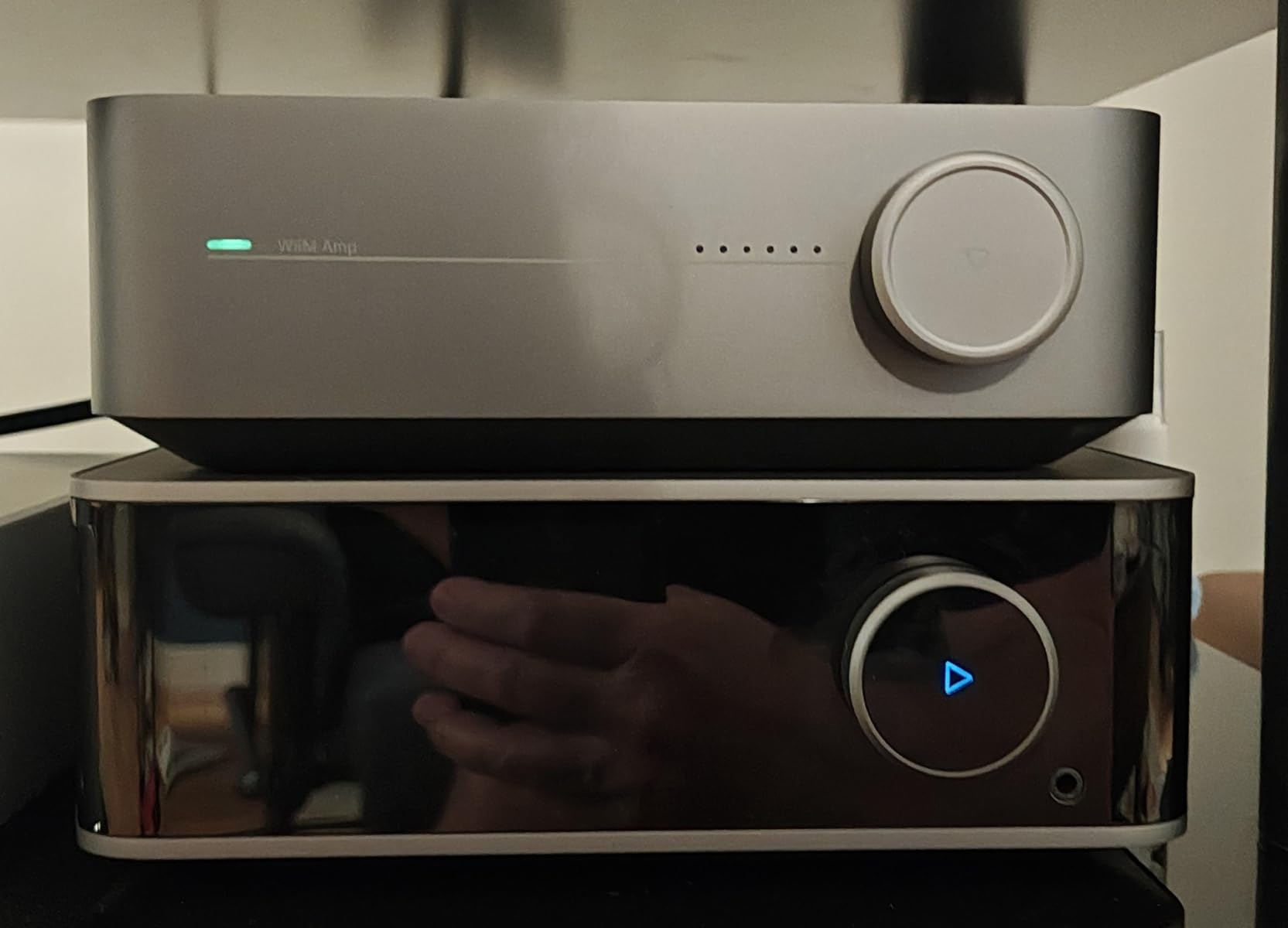
The WiiM Home app adds room correction, independent EQ per channel, favorites, alarms and multiroom grouping. It works with Alexa and Google Assistant, and a voice remote is in the box.
It streams up to 24-bit/192 kHz with gapless playback over Wi-Fi 6 and Bluetooth 5.3 with two antennas, and PFFB technology keeps load behavior predictable. The thermal design keeps it cool.
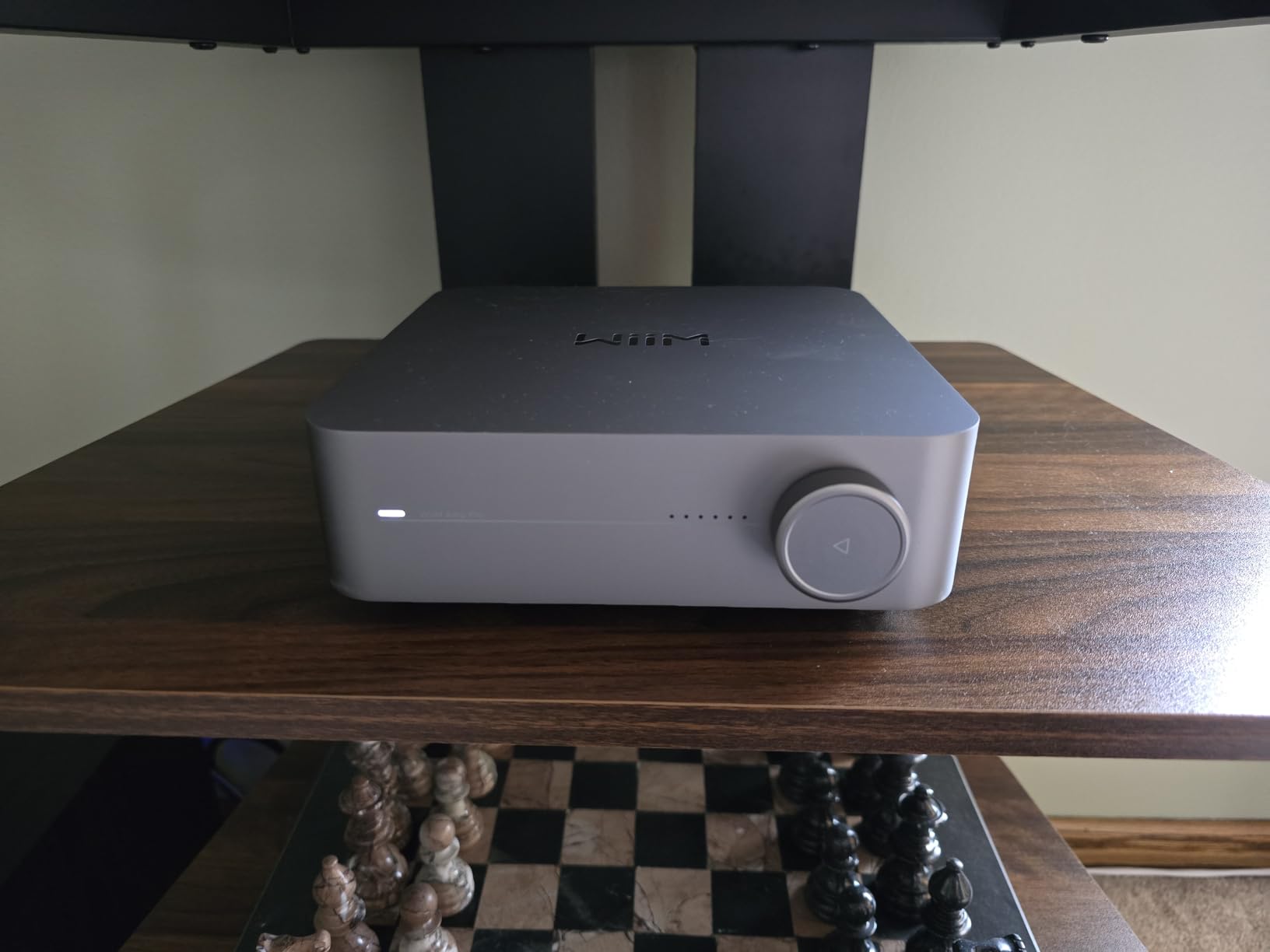
Best for music and television in one box
The HDMI ARC input turns it into a one-cable television amplifier, and the subwoofer output gives you a straightforward 2.1 path. If your plans include adding a subwoofer or a second zone, multiroom support with Amazon Echo, Google Home and other WiiM devices is a real advantage.
Our bookshelf speakers for home theater guide covers the speaker side of that setup.
Watch out for the AirPlay gap
It is not compatible with AirPlay and cannot act as an AirPlay receiver, which rules it out for anyone in an Apple household streaming from an iPhone or Mac.
There is also no USB input, only network streaming and Bluetooth, so hi-res files need a network player. Deeper bass requires an external powered subwoofer, since the output is line level.
2. Sony STRDH190: The Best Value Per Watt Here
Sony STRDH190 2-ch Home Stereo Receiver with Phono Inputs & Bluetooth Black
- Clean undistorted 100W x 2 with A and B switching
- Phono stage strong enough to skip an external preamp
- Reliable Bluetooth with strong range
- Four stereo RCA inputs plus record output
- Low 5.25 inch profile fits AV cabinets
- No optical or HDMI input
- Default bass is thin and treble boost goes harsh
- Vinyl is clean but not warm
- Small awkward speaker-wire clips
- Loud selector clunk on power-on
With more than ten thousand reviews, this receiver punches well above what it costs. Owners frequently compare it favourably to units costing several times more, especially on power, input count and phono performance.
For bookshelf speakers, 100W per channel into 8 ohms across a 6 to 16 ohm impedance range is a lot of headroom for speakers that rarely need more than 30W.
It also drives two pairs of speakers independently with A/B switching, which makes it a genuinely useful centre of a multi-room audio setup.
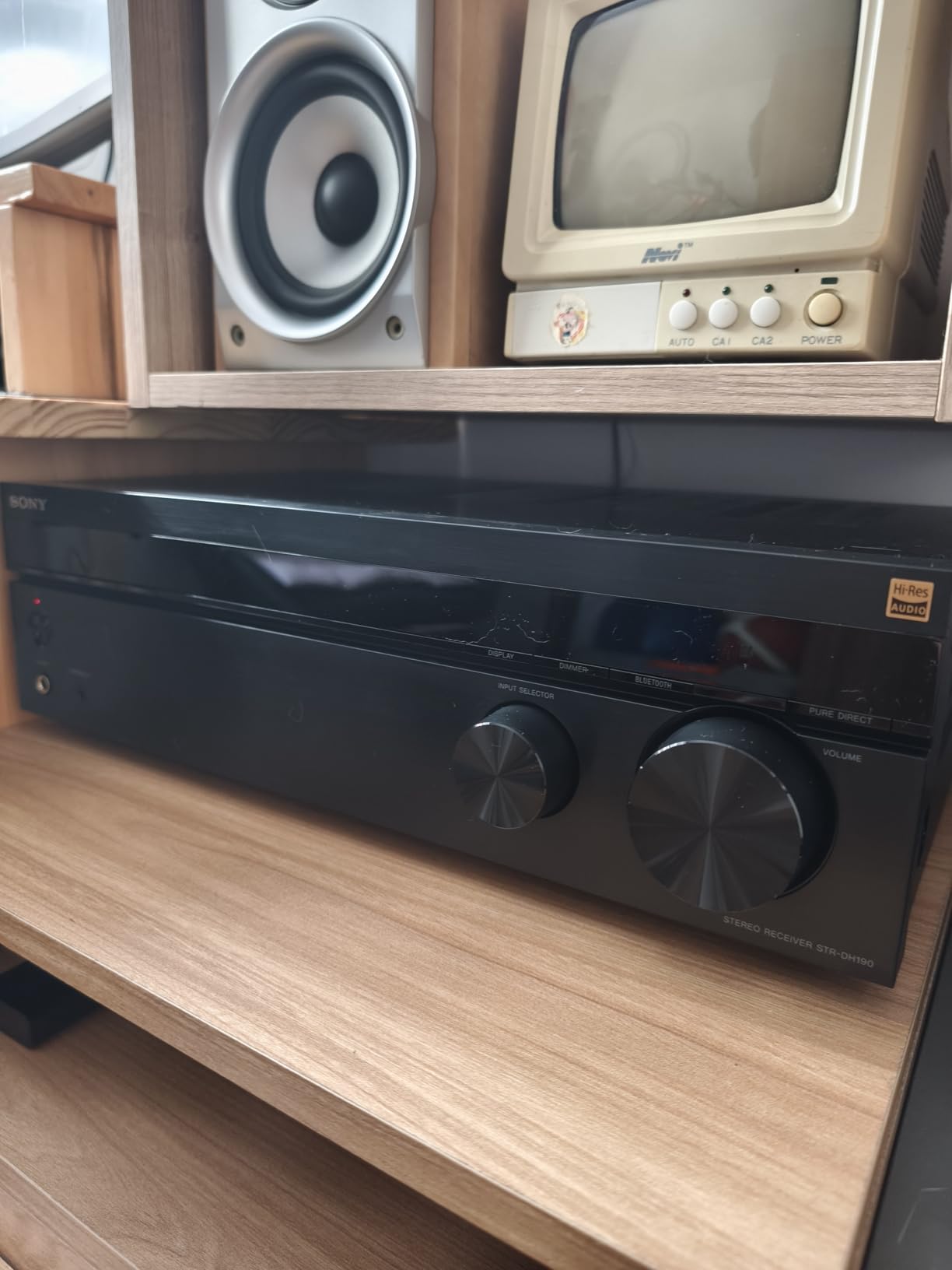
The phono stage is strong enough that no external preamp is needed, and Bluetooth pairing is quick with strong range. There is a full-size quarter-inch headphone jack and a front 3.5mm portable input for a phone.
The 5.25-inch chassis height is the practical win here: it fits the conventional AV cabinet where taller amplifiers will not.
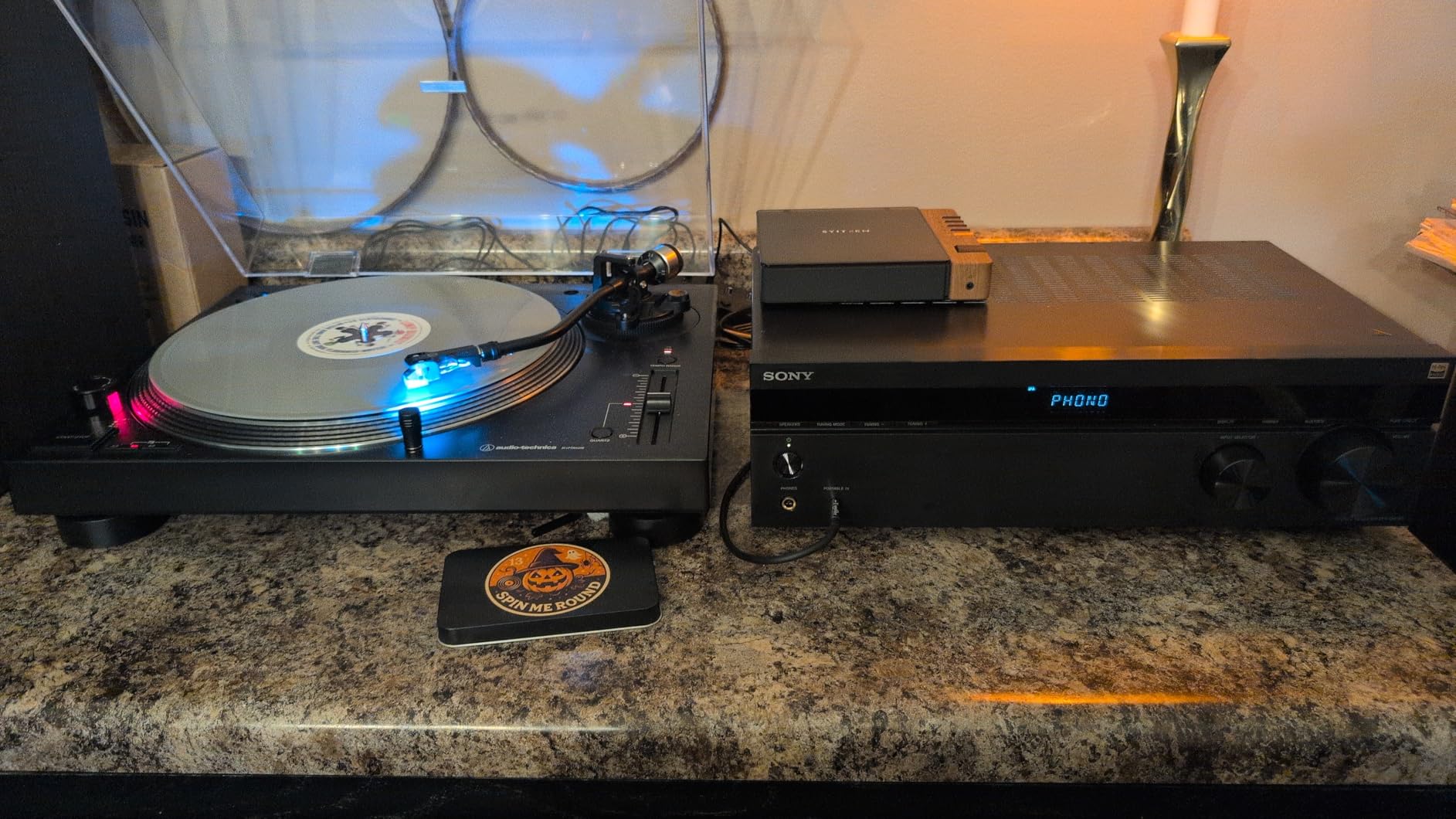
Best for maximum power and inputs on a modest budget
If your priority is the most watts and the most RCA inputs for the money, nothing else here competes. The 100W figure is quoted at 1kHz rather than full bandwidth, which is the honest caveat on that number.
It is also the natural choice if you already own a similar older Sony receiver and just want speaker wire and better sound, since the layout will feel familiar.
Watch out for the tone controls and missing digital inputs
Default bass is thin and needs boosting, and the treble boost goes harsh if you push it. Expect to spend a few minutes on tone settings rather than living with the out-of-box balance.
There is no optical or HDMI input, so any digital source needs an external adapter. The speaker-wire clips are small and awkward, the input selector makes a loud clunk on power-on, and radio presets cannot be deleted, which annoys people more than it sounds like it should.
3. Denon PMA-600NE: The Analog-First All-Rounder
Denon PMA-600NE Bluetooth Stereo Amplifier, 2 Channel Amplifier Home Audio
- Warm tube-like tone with airy treble
- Analog Mode bypasses the digital circuits
- Phono plus built-in DAC and subwoofer output
- Runs barely warm after hours
- Drives high-impedance headphones
- Dim recessed input labels
- Relays are loud and clunky when switching
- Laggy stepped remote volume
- Remote lacks bass and treble controls
This is the amplifier we keep coming back to for analog-first systems. Owners consistently describe a step up in clarity and spaciousness compared with vintage and mid-range units, and the phono stage, DAC and subwoofer output cover most needs in one box.
What impressed us most is Analog Mode. It disengages the digital circuitry so the signal path is undivided, which matters more to some listeners than any amount of measured power.
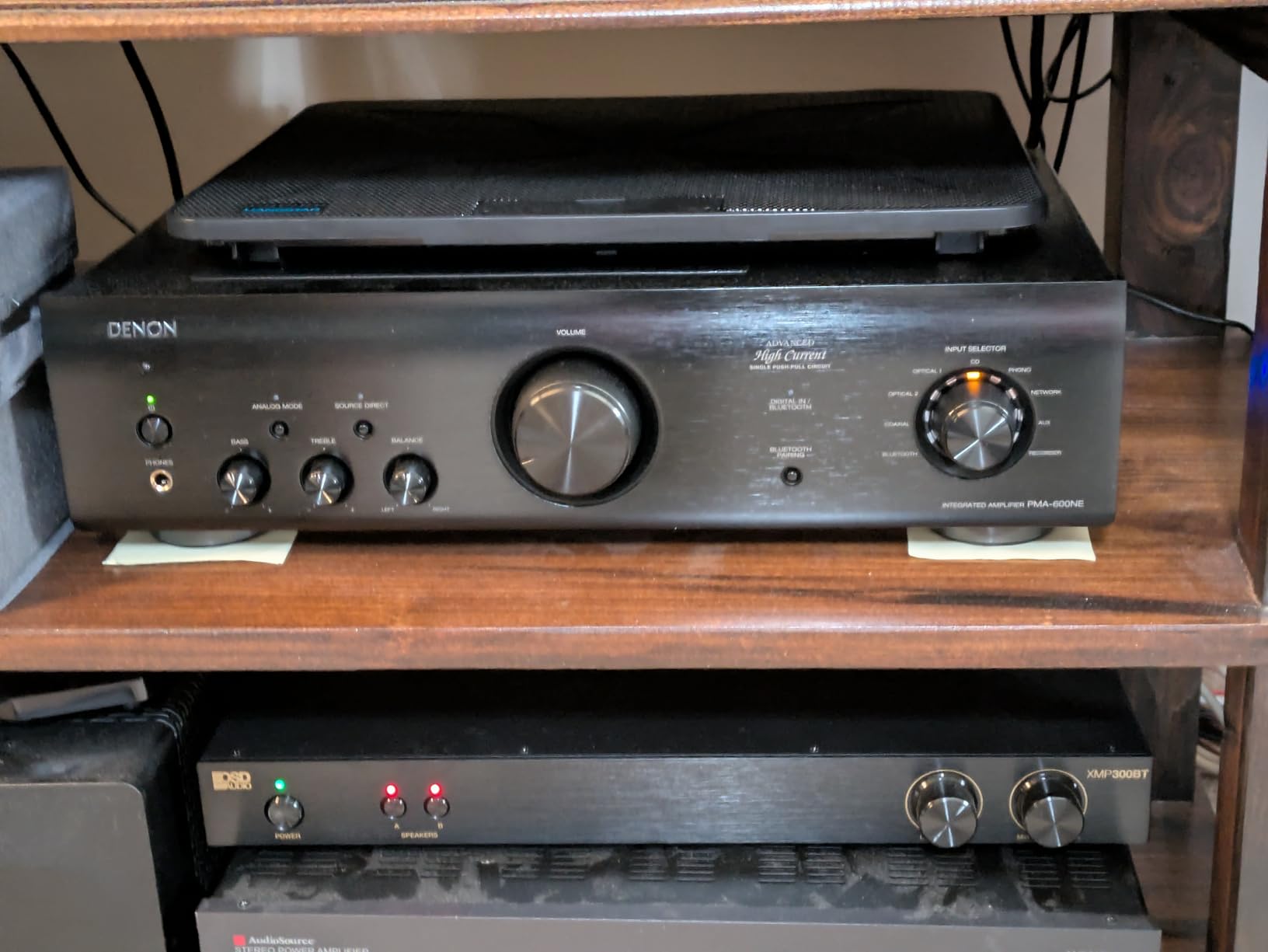
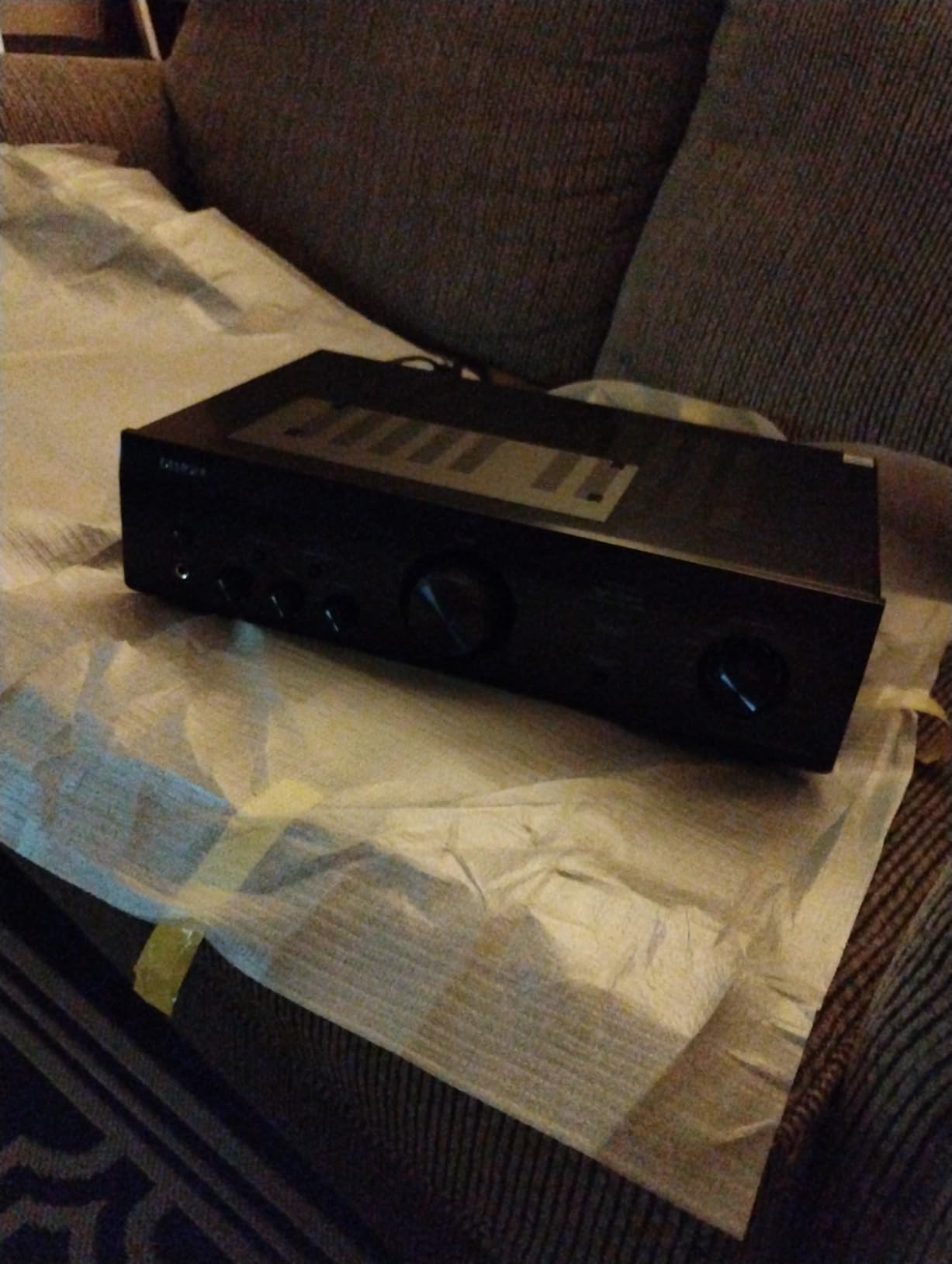
The 70W rating is at 4 ohms, which is exactly the impedance many modern bookshelf speakers present. The chassis is slim enough for a conventional AV cabinet, and at 18 lb it moves easily between rooms when you rearrange.
It also runs cool. After hours of use the case stays barely warm, a good sign that the power supply is not being asked to do more than it was designed for.
Best for a first serious system with a turntable
It covers the whole chain in one enclosure: a phono preamp for a moving magnet cartridge, optical and coaxial digital inputs, Bluetooth, and a subwoofer output with its own level control. You can add a turntable and a sub later without changing amplifier.
Forum regulars on r/BudgetAudiophile repeatedly name Denon as a mainstream safe choice, and the PMA-600NE is the model that advice tends to point at.
Watch out for the small annoyances
The input selector LEDs are dim and recessed, so reading them from a couch is frustrating. The internal relays are loud and clunky, with a noticeable delay when you change inputs.
The remote is the weakest part. Volume adjustment is laggy and stepped too coarsely, and there are no bass, treble, balance or Pure Direct buttons on it. Some listeners also find the low end lean without a subwoofer, which is normal for a speaker-first system at low volume.
4. Marantz PM6007: Warmth Over Neutrality
Marantz PM6007 Amplifier, Integrated Amplifier with Digital Connectivity, Analog Coaxial and Optical Inputs, 2X 45 Watt, DAC, D/A Conversion for Digital Input – Silver/Gold
- Warm crisp Marantz character
- Shielded D/A converter for digital sources
- Gold-plated inputs and copper screws
- HDAM SA3 modules cut distortion
- FET-equipped MM phono stage
- Some units ship with a European two-pin plug
- No HDMI ARC or wireless connectivity
- Only one digital filter option
If you like a warmer, more engaging sound with a strong sense of presence, this is the one. Owners describe it as a natural successor to the classic Marantz receivers, and that description holds up.
The HDAM SA3 output modules widen dynamic range and cut distortion, which is the part of the design that affects what you hear rather than how the spec sheet reads.
Build quality is where Marantz spends its money: gold-plated inputs, copper screws and steel feet. At 7 kg it feels like a small piece of hi-fi furniture.
Best for a dedicated listening room
The MM phono stage uses a FET input stage, and vinyl listeners on forums regularly praise the Marantz PM series for a usable phono stage at a sane price. It will not replace a good external preamp, but you do not need one to start.
There are five analog inputs plus one coaxial and two optical digital inputs, so a television and a streamer both fit without adapters.
Watch out for the plug and the 45W figure
The single most repeated complaint, and the reason several one-star reviews exist, is the European two-pin plug configuration on certain units shipped to the US. That forces a step-down transformer. Check the plug on the listing carefully before ordering and message the seller if it is unclear.
At 45W per channel into 8 ohms this is the least powerful mainstream amplifier here. That is genuinely fine for typical bookshelf speakers in a normal room, but it is the one to skip if you own low-sensitivity floorstanders.
5. Yamaha A-S301: The Neutral, No-Surprises Choice
Yamaha Audio A-S301BL Natural Sound Integrated Stereo Amplifier (Black)
- Natural Sound tuning is neutral and musical
- Digital coaxial and optical inputs
- Built-in phono stage
- Speaker A/B plus A plus B switching
- Well-regarded build quality
- Only one optical digital input
- No Bluetooth or Wi-Fi streaming
- Bulky and heavy for the feature set
This amplifier has sat in the entry two-channel category for years, and the reason is that it does not try to be clever. Natural Sound tuning gives a neutral, musical presentation that does not editorialize.
It has a long-standing owner base that treats it as the default first step into serious hi-fi, which is why the same units keep changing hands with no modification at all.
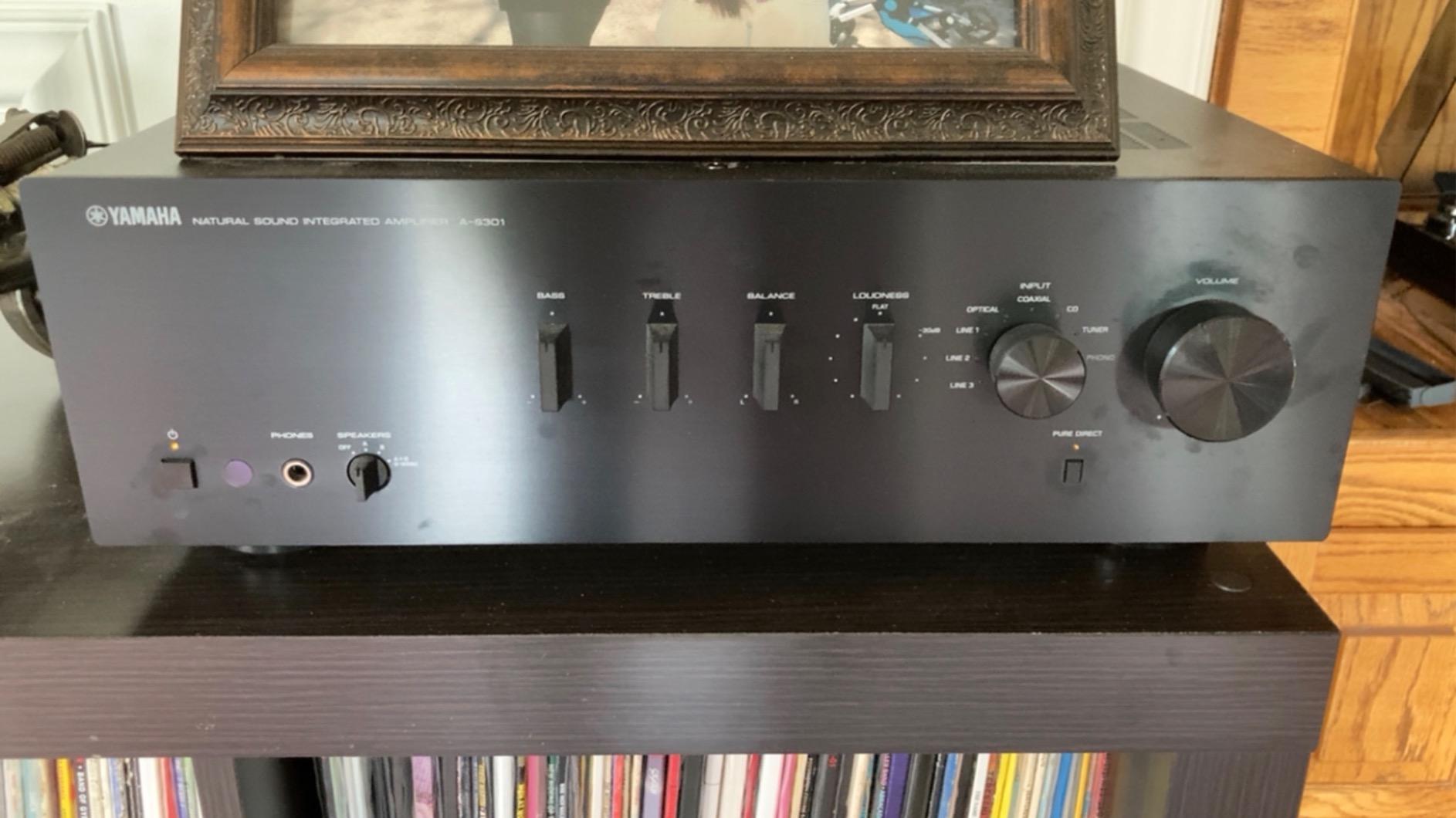
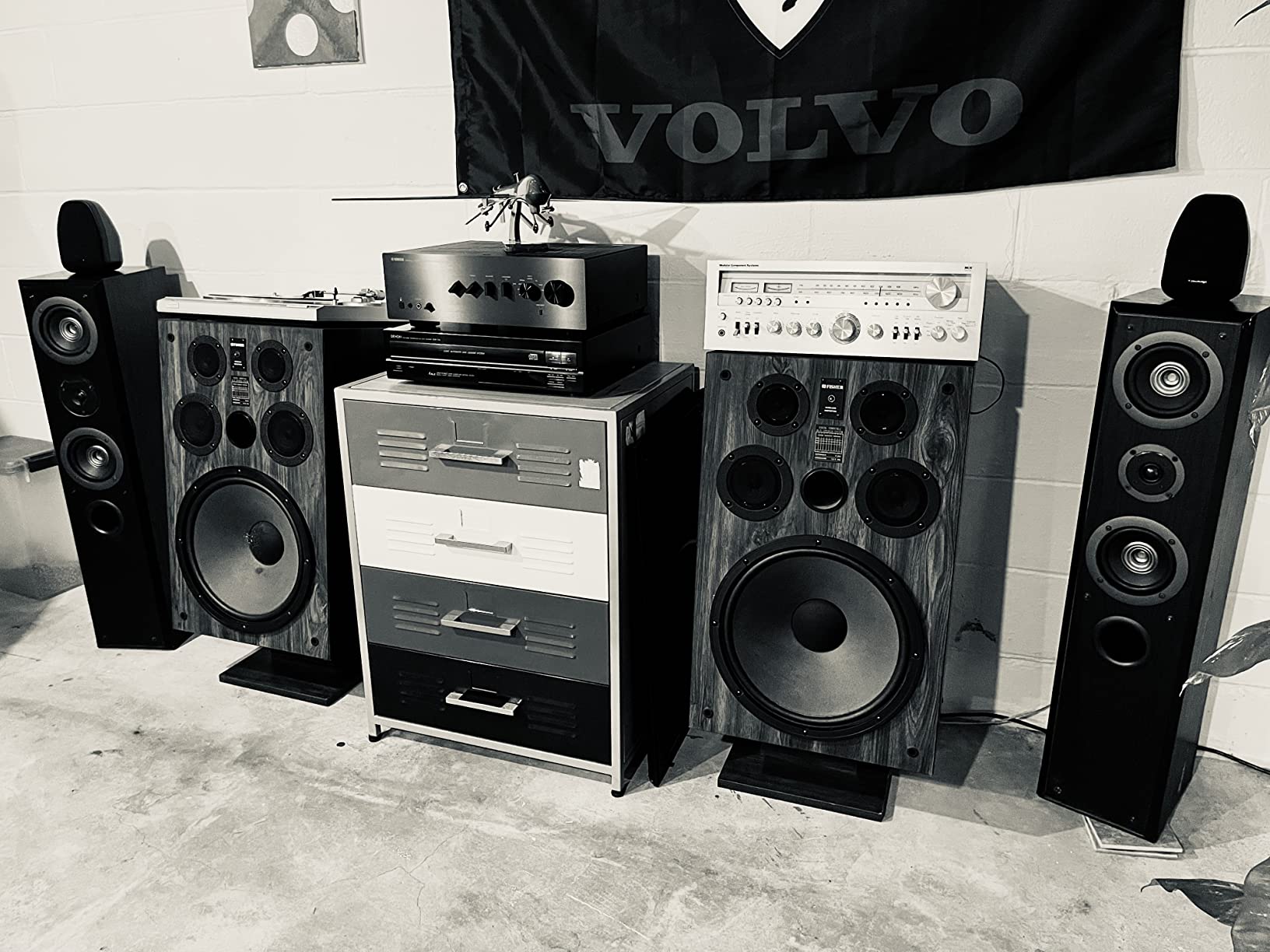
For speakers, the useful part is Speakers A, B and A plus B switching. You can run a pair of bookshelf speakers in the main room and a second pair in an office or a patio without buying a second amplifier.
The subwoofer output is pre-out level rather than a bass management system, so there is no adjustable crossover. On a music-first system with a capable bookshelf pair, that is usually not a problem.
Best for a two-pair home setup
Few amplifiers at this level run two pairs with independent switching. This one does, and that alone can replace a whole second amplifier in a multi-room home. Our bookshelf speaker picks for the home assume a layout where that matters.
Watch out for the age of the design
There is one optical digital input, so connecting a television and a game console optically requires an adapter. There is no Bluetooth or Wi-Fi streaming at all, which is the most common reason people move to a newer model.
It is also 19.8 lb and physically bulky for what it offers, so plan the shelf space before buying. The upside is that the weight is honest: a real transformer and real capacitors, and build quality is a genuine strength.
6. Onkyo TX-8470: Network Streaming With a Real Phono Board
Onkyo TX-8470 2 Channel Stereo Receiver with Wi-Fi, Bluetooth, Phono, Hi-Res Audio and Roon Ready
- Expansive soundstage with strong microdetail
- Excellent integrated DAC for a two-channel unit
- Isolated MM and MC phono board
- Wi-Fi with Roon Tidal and Deezer
- HDMI and Dirac Full Band correction
- Control app repeatedly loses connection
- No automatic power-on with a signal
- No continuous folder playback from USB
- Remote is very large with small buttons
- No bass management for a subwoofer
This is a network stereo receiver built for music rather than a home theatre hub, and audiophile-leaning owners widely endorse the sound. The Class G design and internal DAC are competitive with far more expensive separates.
It is one of the few units here with a full streaming platform built in: Roon, Tidal and Deezer alongside Wi-Fi and Bluetooth, plus HDMI and Dirac Full Band room correction. Apple and Google voice assistants are supported.
Best for streaming first, vinyl second
That combination is rare at this level. The isolated MM and MC phono board with discrete op-amp circuitry means you can keep a turntable in the chain without giving up network streaming.
For anyone moving away from an AV receiver, this is the shape of device that handles music properly while still taking a television over HDMI.
Watch out for the software, honestly
The rating is held back almost entirely by usability. The Onkyo control app is reported to drop Wi-Fi and receiver connections repeatedly, requiring repeat setup, and the remote is very large with small buttons and a fiddly menu.
There is also no automatic power-on when an input signal is present, no continuous folder playback from a USB drive, and no bass management controls to integrate a subwoofer. Power delivery draws mixed feedback, with some listeners feeling it runs short of headroom on a large multi-speaker setup.
7. AIYIMA A80: A Serious DAC Hiding in a Tiny Chassis
AIYIMA A80 Bluetooth Stereo DAC Amplifier TPA3255,PFFB & Digital VU Meter
- ESS DAC gives clean detailed sound and wide stage
- Very low noise floor
- TRS balanced plus USB-C optical coaxial RCA and Bluetooth
- Digital VU meter and spectrum display modes
- Bass and treble controls plus a remote
- PFFB feedback for tighter load behavior
- Runs noticeably warm with the display on
- No automatic power-on with a signal
- Subwoofer connection needs a 3.5mm adapter
- Vu meters barely move at normal levels
- No IR profile for common streaming sticks
This is consistently described as a major step up from entry-level Class D amplifiers, and many owners report it replacing a much larger AV receiver for music. The ESS ES9038Q2M DAC is the headline: THD as low as 0.006 percent with 109dB SINAD, supporting DSD256 and PCM up to 32-bit/768kHz.
Input coverage is the best on this list: TRS balanced, RCA, optical, coaxial, USB-C and Bluetooth, plus a 3.5mm and RCA pre-out and a 12V trigger input.
PFFB post-filter feedback and Rubycon and WIMA capacitors are there to tighten load behavior, and the noise floor is low enough that owners describe it as quieter than older Pioneer and Sony receivers.
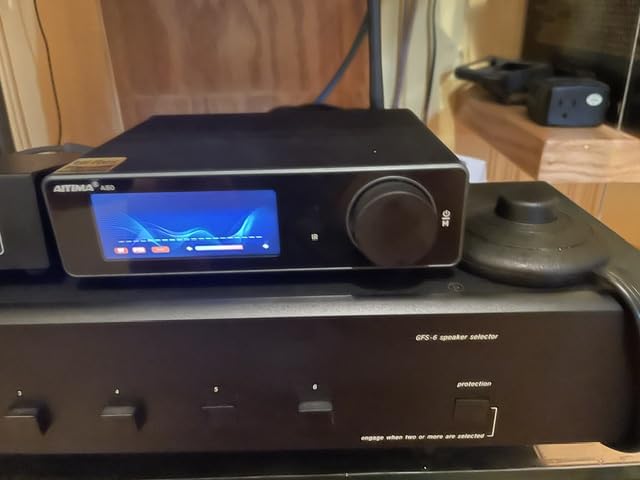
The digital VU meter and spectrum analyzer with multiple modes is a deliberate design choice. Some owners love it and others find it gimmicky, because the meters are poorly calibrated and barely move at normal listening levels.
Because it accepts balanced input, a desktop DAC or a studio interface can feed it directly, which is unusual at this size.
Best for digital-first listeners with a good source
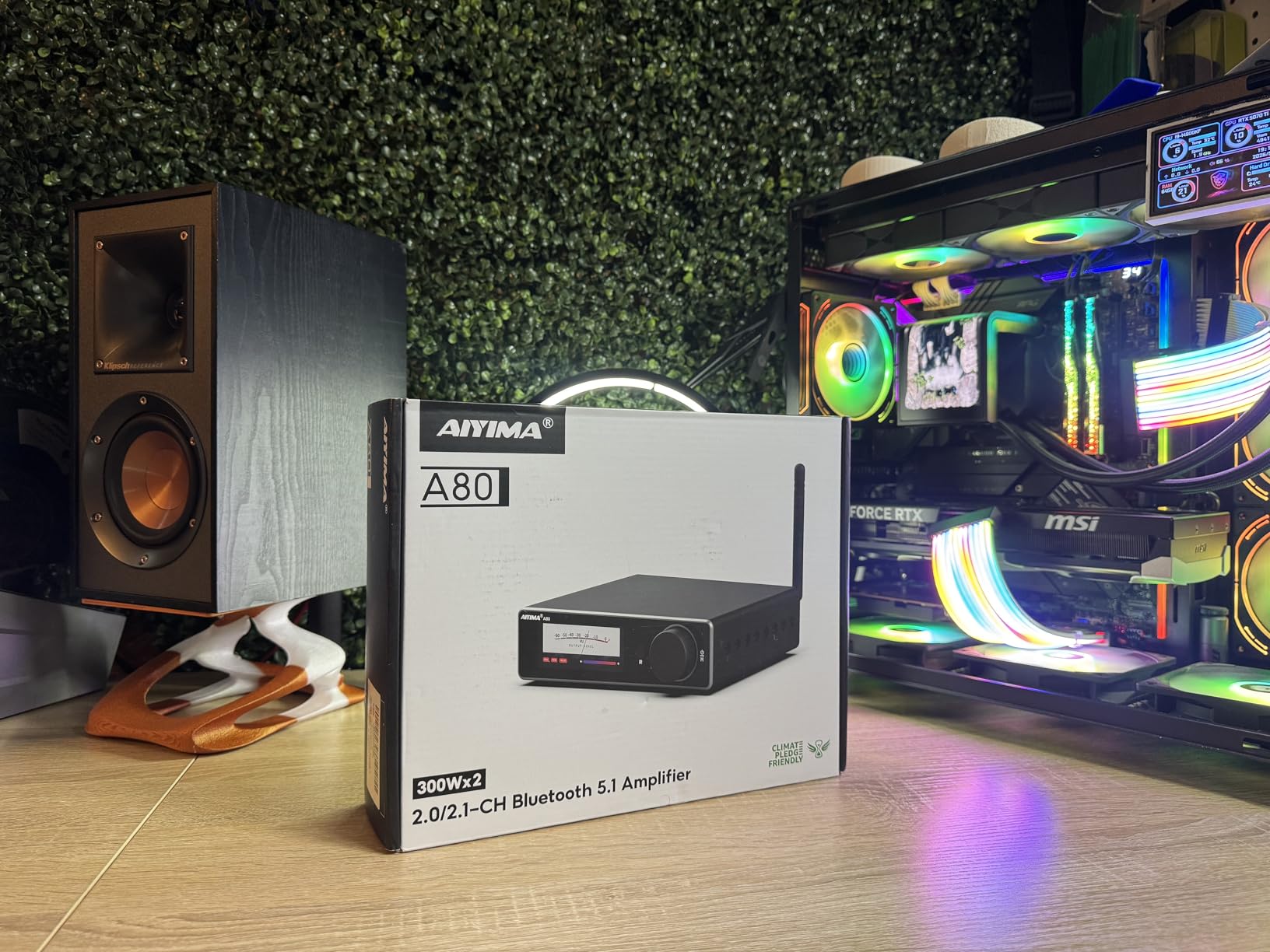
It is the only compact unit here that covers balanced, digital and wireless inputs in one chassis, so it can replace a DAC, an amplifier and a streamer box at once. A 48V supply is included, which is what the headline 300W x 2 figure needs before it can be approached honestly.
Watch out for the heat and the auto-on
It runs noticeably warm, especially with the display on, so give it airflow in a closed cabinet. There is no automatic power-on when a signal is present, which frustrates people integrating it with a television or a streaming stick.
Subwoofer connection requires a 3.5mm adapter rather than a dedicated RCA pre-out, menu navigation lacks a back button, and the display cannot be turned off completely. There is no IR profile for common streaming sticks either, so a translator is needed for full integration.
8. Fosi Audio BT20A: The Community Favourite
Fosi Audio BT20A Bluetooth Stereo Amplifier, 2 Channel Home Audio Component Amplifiers for Passive Speakers, Mini Class D Amp Receiver 200W for Indoor/Outdoor/Garage/Ceiling/Bookshelf Speaker
- Rock-solid Bluetooth pairing with stable range
- Punchy clean output for its size
- Simple setup with no network configuration
- Compact minimal all-black design
- Bass and treble controls plus RCA for wired sources
- Tone is bassy and can distort in the midrange when pushed
- No digital inputs sub out headphone jack or remote
- Requires an external power supply
With nearly ten thousand reviews, this is one of the most proven budget amplifiers you can buy, and it is the single most repeated recommendation across the audio forums we read when people ask what to drive bookshelf speakers with.
Owners routinely report that it replaces far more expensive receivers for bookshelf, in-ceiling and outdoor speakers. Bluetooth reliability is singled out as better than comparable low-cost alternatives.
The 100W x 2 figure is a maximum output into 4 ohm, not a continuous rating. That matters, so read the buying guide before treating it as a main-system amplifier.
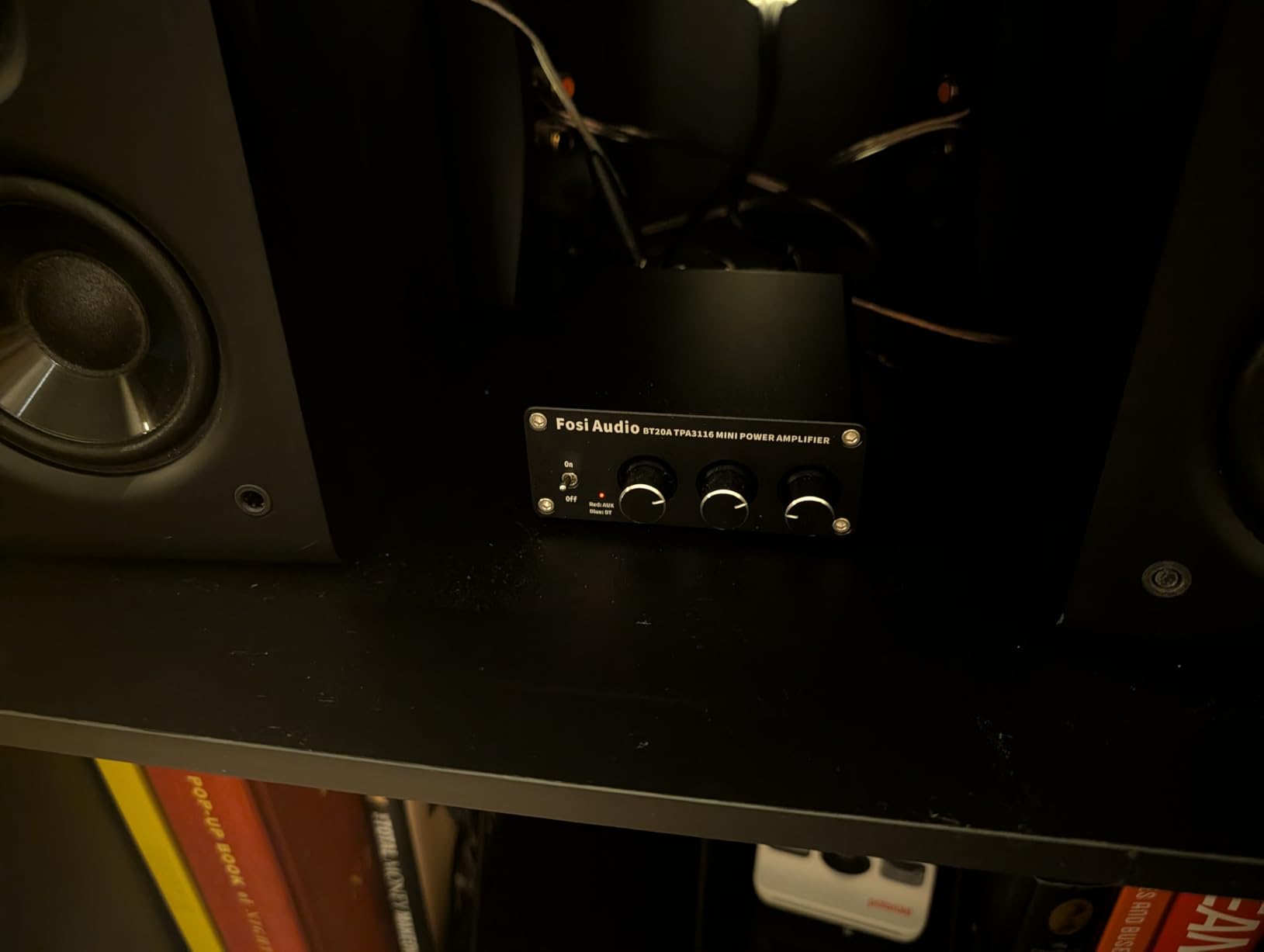
Setup is deliberately minimal: a one-touch power switch, Bluetooth and 3.5mm or RCA inputs, and front-panel bass and treble controls. There is no network configuration, no app and nothing to sign into.
That is the whole appeal. It works the moment you plug it in, which is why it turns up in so many first-system and secondary-zone builds.
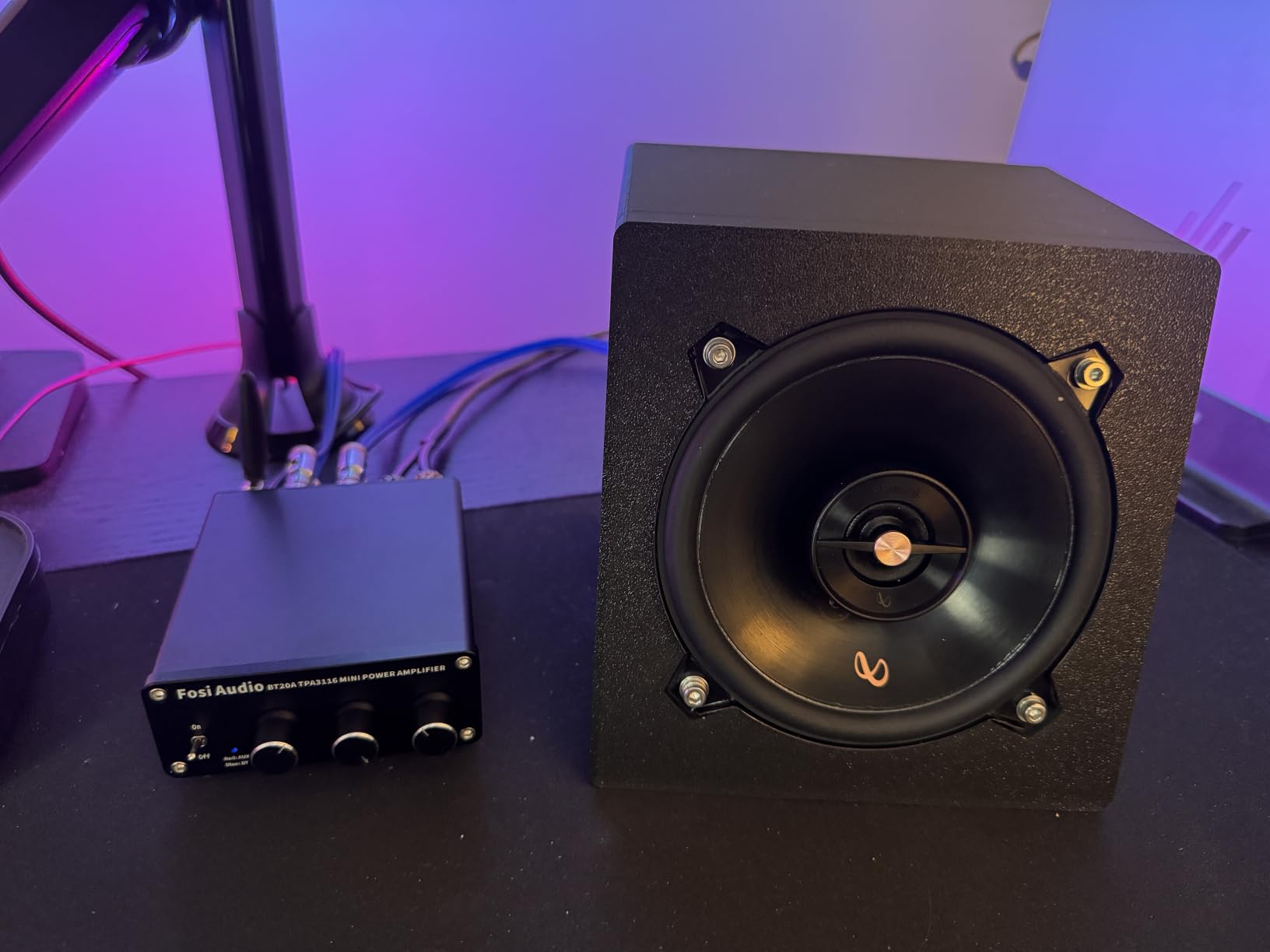
Best for patio speakers, a bedroom pair or a second zone
It suits outdoor and in-ceiling work, where a unit that tolerates being switched on and off constantly is worth more than a feature list. Fosi Audio customer service also reportedly replaced a defective unit promptly.
Keep the tone controls near neutral when pairing it with another amplifier in the same room, otherwise the two will not match.
Watch out for the tone character
The default voicing is on the bassy side and it can distort in the midrange when pushed hard. That is a tuning choice rather than a fault, but on a pair of small bookshelves in a reflective room it is easy to end up with a muddy centre.
There is no digital input, subwoofer output, headphone jack or remote control, and it needs an external power supply. For streaming plus television audio plus a subwoofer, look at the WiiM Amp Pro instead.
9. Fosi Audio TB10D: The Audiophile-Angled Amp in This Trio
- About 50W per channel into 8 ohms cleanly
- Runs cool and draws very little standby power
- Bass and treble controls adjust tone smoothly
- Differential Class D outputs drive down to 2 ohms
- Compact enough to build a full streaming stack
- Advertised 600W is a peak figure only
- No Bluetooth digital inputs sub out or headphone
- No relay input trigger for auto power-on
- Bass and treble knob positions are reversed
This is the audiophile-leaning member of the range, and reviewers consistently praise the sound quality and thermal behaviour for the money. They treat it as a pure analog power amplifier best paired with a separate streamer such as a WiiM unit.
Real output is around 50W per channel into 8 ohms with clean, full, non-fatiguing sound. It runs cool and draws very little standby power, which makes it fine to leave on continuously.
The differential Class D outputs can drive speakers down to 2 ohms, giving you far more flexibility than the compact size suggests.
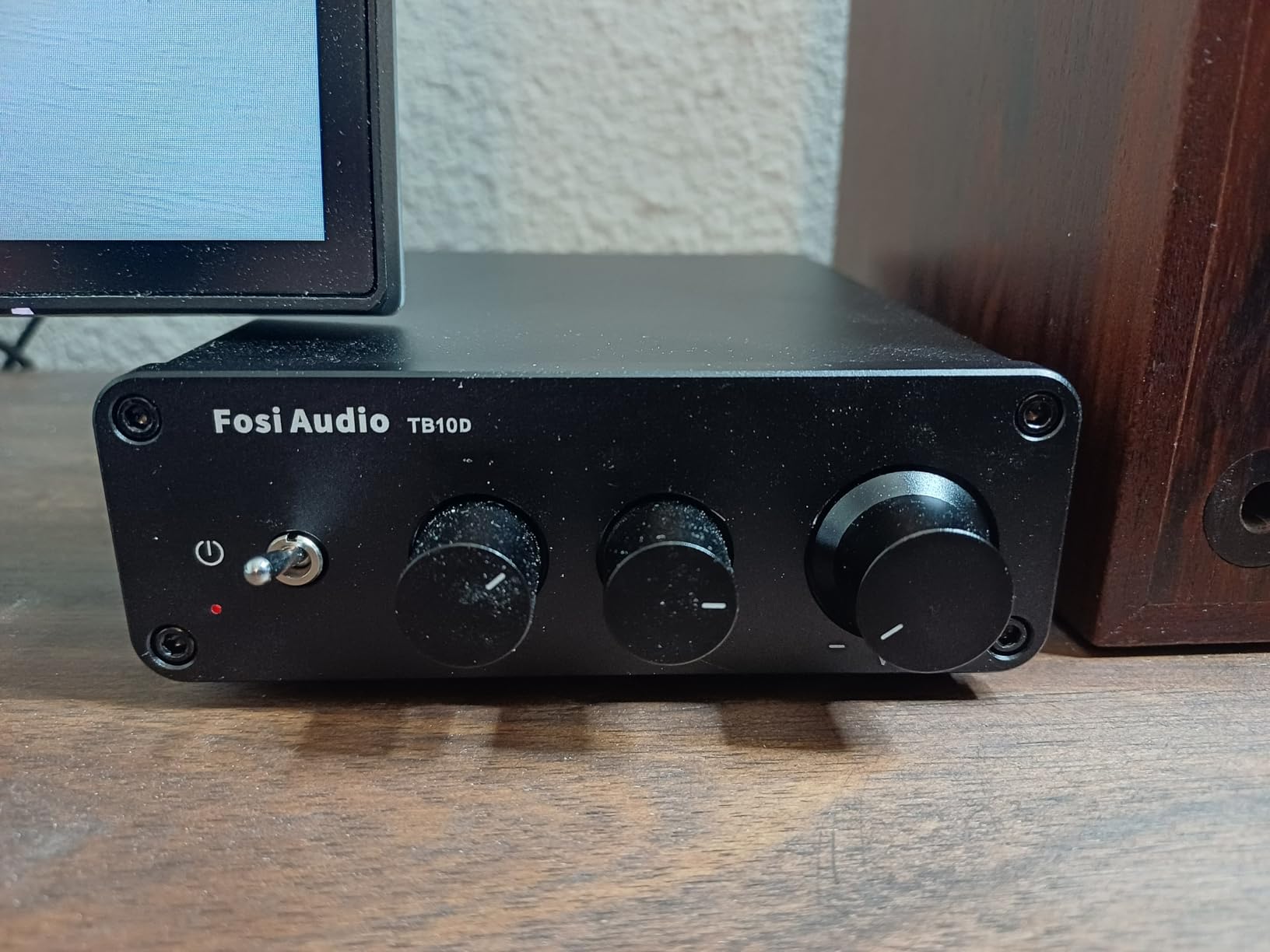
The central discussion in reviews is the honest gap between the advertised wattage and the roughly 50W per channel of clean RMS output. A detailed reviewer notes that thermal protection cuts in during sustained high-power testing, so treat the peak figure as a ceiling rather than a rating.
RCA input and passive speaker output terminals keep the signal path simple, and it works with a bass shaker, a turntable preamp, a PC or a television source.
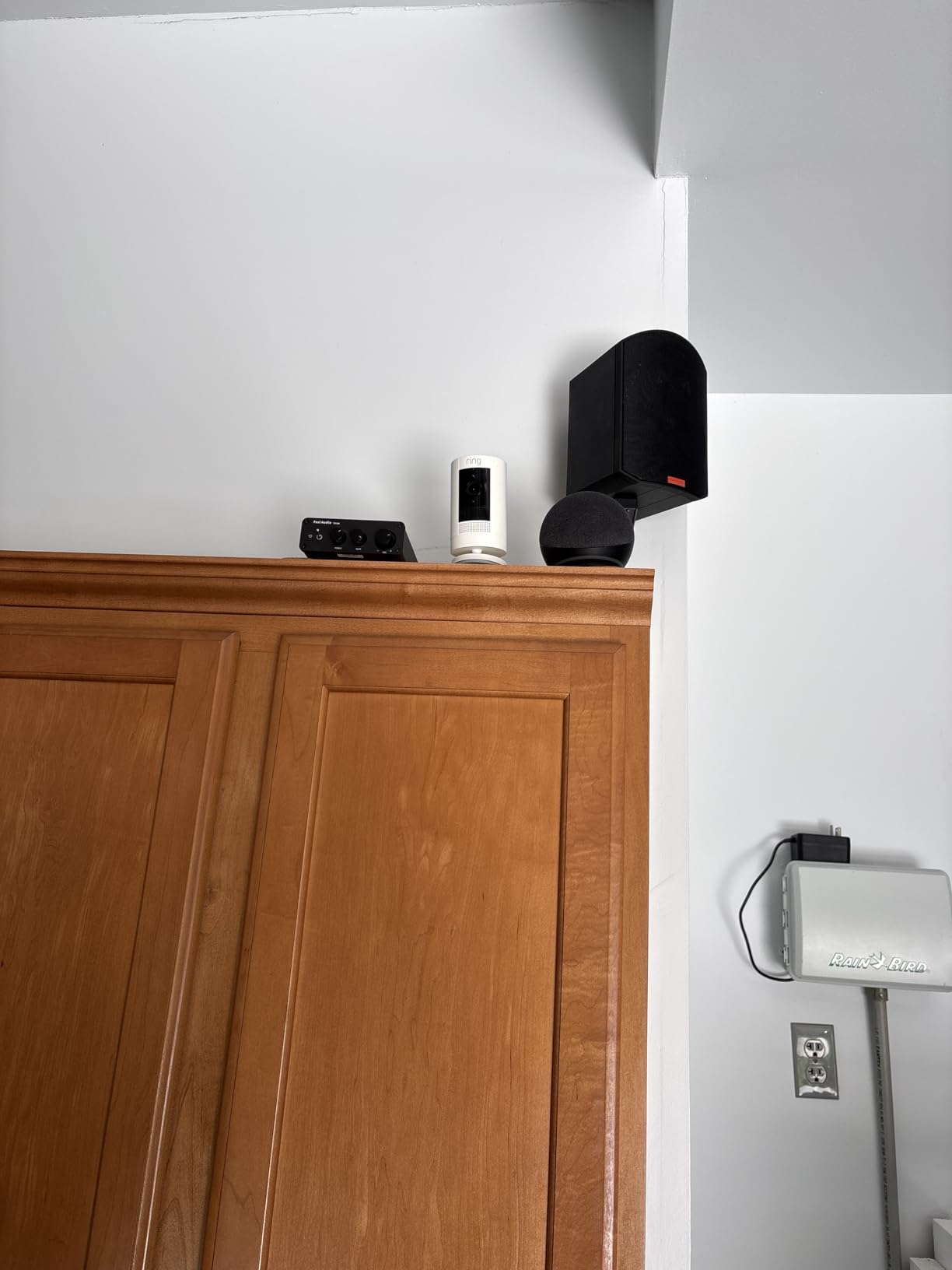
Best for a streamer-plus-amp stack in a small footprint
Because it has no Bluetooth and no digital inputs, it wants a source box to do the streaming. Pair it with a network streamer and you get a complete system that fits in a shoebox, which is a real answer for apartment listening.
It is also the version to pick if you intend to add a subwoofer later through a separate preamp rather than through the amplifier itself.
Watch out for the wattage claim and the reversed knobs
The advertised 600W is a peak figure, and thermal protection trips at high sustained levels. Read it as 50W per channel of clean power and the amplifier makes sense.
There is no Bluetooth, digital input, subwoofer output, headphone jack or remote, and no relay input trigger for automatic power-on, so a streamer without a 12V trigger will not switch it on by itself. The bass and treble knob positions are also reversed relative to most other amplifiers, which trips up new owners every time.
10. Micca OriGain: USB Audio and a Sub Pre-Out in a Tiny Box
Micca OriGain Compact Stereo Integrated Amplifier and DAC, 50W x 2, 96kHz/24-Bit, USB and Optical S/PDIF (Black)
- USB input auto-negotiates as plug-and-play in Windows
- Quiet operation with no hiss at normal levels
- Subwoofer pre-out is rare at this size
- Solid metal enclosure with a substantial volume knob
- Handles analog USB and optical sources
- Large external power brick bigger than the amp
- Optical input clicks on track changes
- Only 30W x 2 into 8 ohms
- No Bluetooth headphone output or remote
- Reports of loose terminals and digital input failures
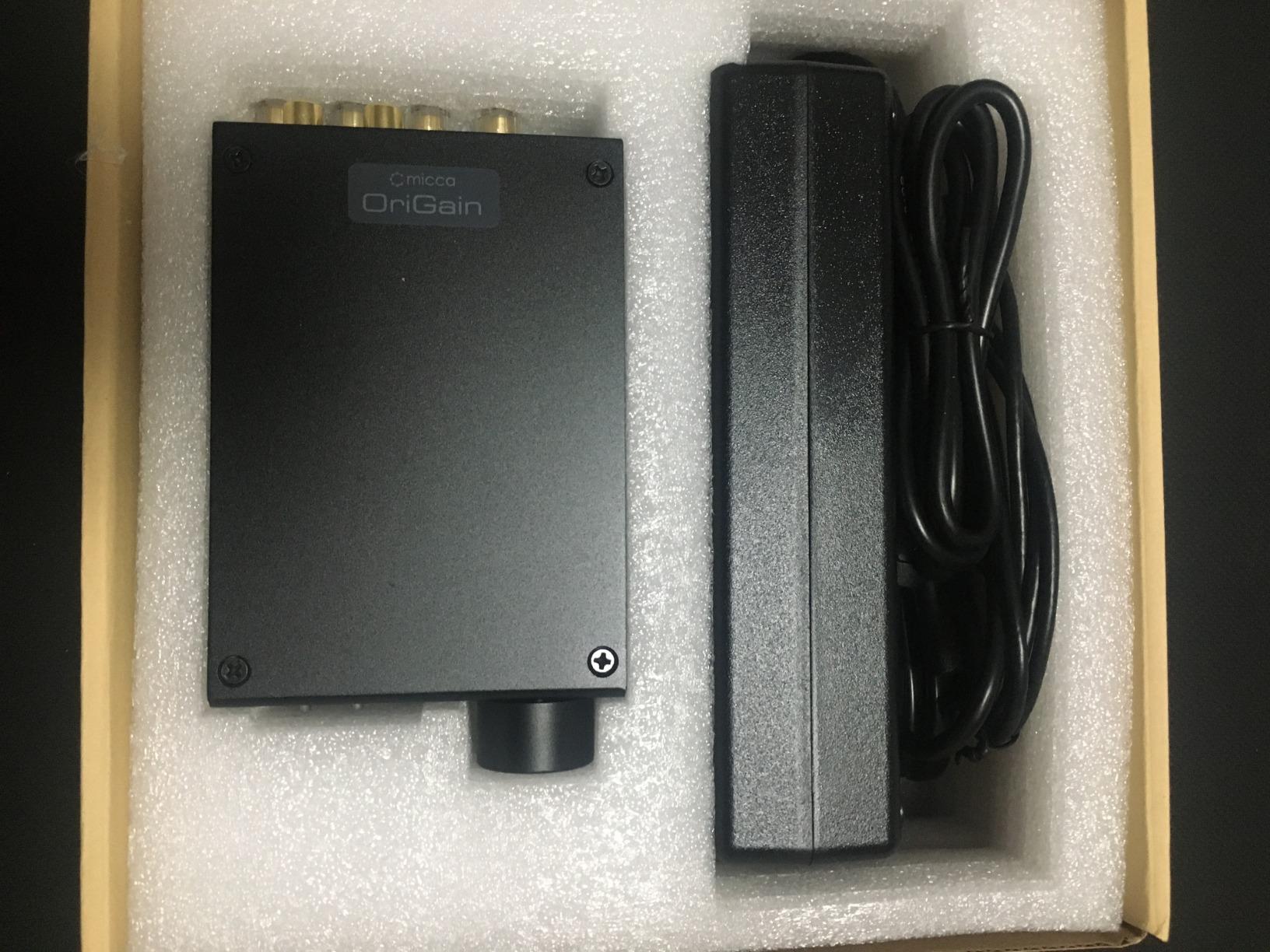
This is the amplifier for a desk or a small listening room where every centimetre of shelf space counts. At 5.63 by 3.23 by 1.26 inches and 2 lb, it disappears.
The USB input auto-negotiates as a plug-and-play playback device in Windows, which removes the biggest pain point of cheap USB audio. There is genuinely no hiss at normal listening levels, which is more than several competitors manage.
Inside it is a Texas Instruments TPA3116D2 Class D amplifier, a Wolfson WM8740 DAC and a C-Media CM6510B USB interface, with 50W x 2 into 4 ohm and 30W x 2 into 8 ohm under 0.5 percent THD.
The 3.5mm pre-out for a subwoofer is the feature that surprises people. It is rare on a unit this size, and it lets you build a 2.1 desktop system instead of straining small speakers for low bass.
Best for a computer or a very small room
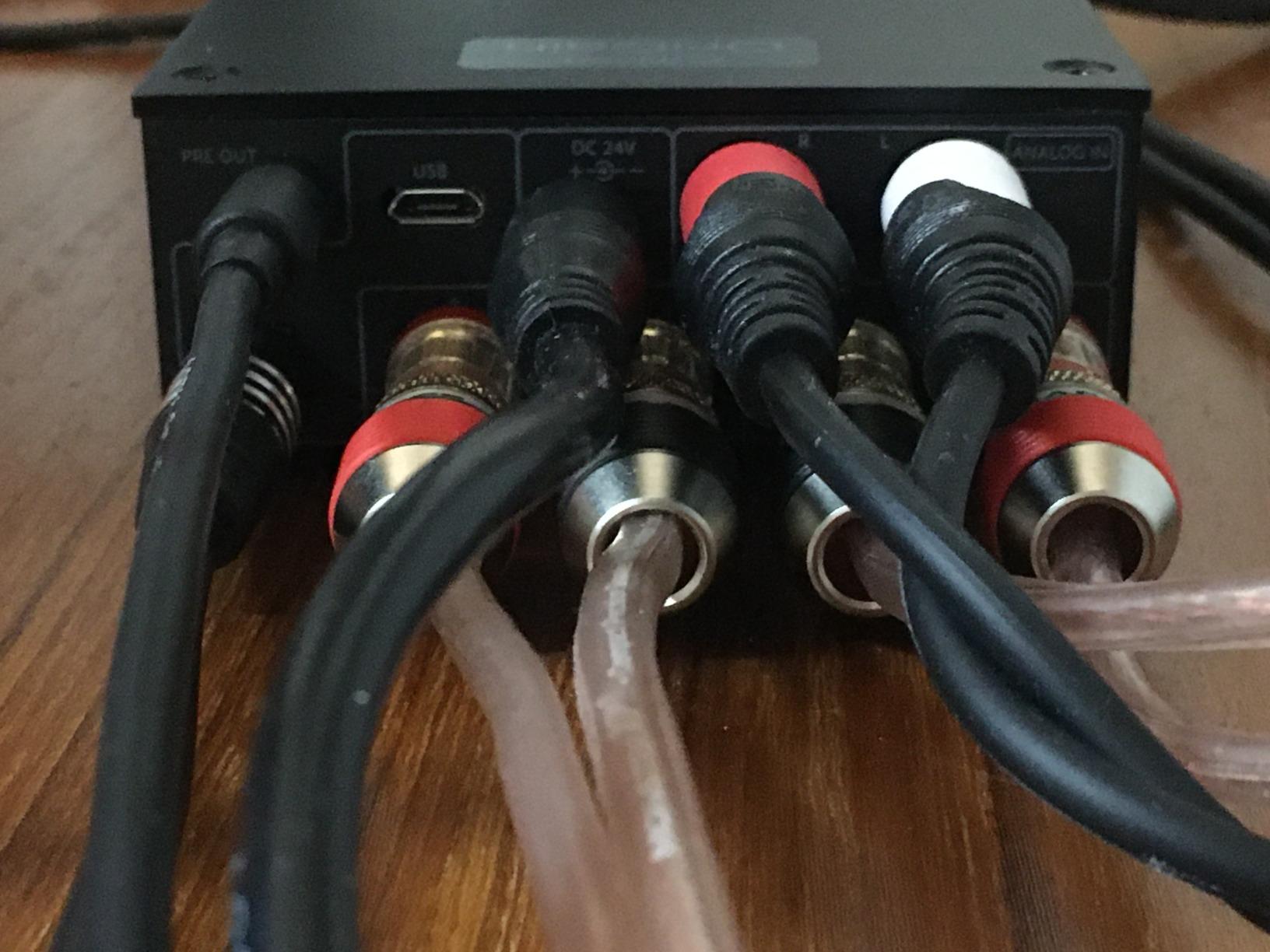
With 5-way binding posts that accept banana plugs, a solid metal case and a smooth volume knob, it feels more substantial than the specification sheet suggests. Our bookshelf speaker stand guide covers getting the placement right once the amp is sorted.
Watch out for the power supply and the optical input
The external power brick is larger than the amplifier itself, which defeats part of the compactness. The optical input can produce clicks and pops when changing tracks unless your source is set to PCM output.
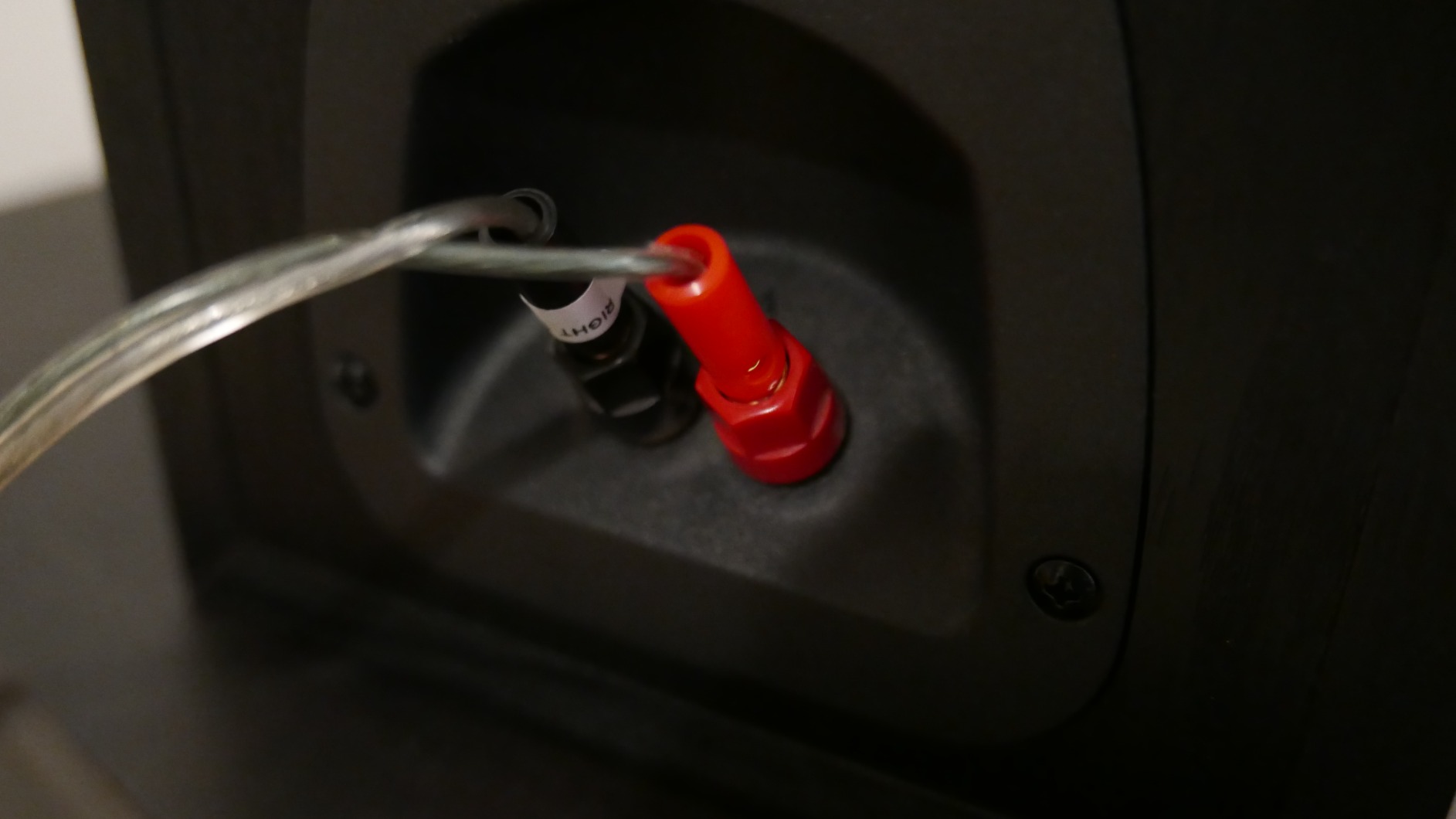
At 30W x 2 into 8 ohms it limits larger or less efficient speakers, and there is no Bluetooth, headphone output or remote. Several reviewers also report quality slips such as reversed or loose speaker terminals, and one describes the unit eventually failing after years of use, so check your wiring at first power-up.
11. AIYIMA A07: The Amp You Can Upgrade After Buying
AIYIMA A07 Premium TPA3255 Power Stereo Amplifier with AUX Pre-Out 300W*2
- Clean uncolored sound with strong channel separation
- Very quiet with no audible hiss or hum
- Socketed NE5532 op-amps can be swapped
- 3.5mm pre-out doubles as a subwoofer feed
- Metal housing and good thermal regulation
- 300W x 2 needs a 48V supply to be real
- No tone controls and no digital or optical input
- No Bluetooth headphone out or remote
- Some units reported a channel failing after long storage
This has the most technically literate user base of any product in the roundup. Measurement-based reviews confirm strong noise and distortion figures, and the sound is described as clean and uncolored with above-average signal-to-noise and channel separation.
The star feature is the socketed NE5532 op-amps. A popular thread among owners is rolling them for parts such as the OP275GPZ and reporting meaningful gains in soundstage, resolution and vocal clarity.
It is also very quiet, with no audible hiss or hum, and the 3.5mm pre-out doubles as a subwoofer or second-amp feed.
Japanese ELNA and WIMA filter capacitors sit in the signal path, and the metal housing plus an internal cooling system keep temperatures stable on a closed shelf.
From the included 32V supply it delivers clean 50 to 60W RMS per channel, which sits squarely in bookshelf speaker territory and is more than enough for most rooms.
Best for tinkerers who like changing parts
Nothing else here lets you alter the amplifier’s core voice after purchase, and for listeners who enjoy that process it turns a cheap box into a hobby. It drives 2 to 8 ohm passive bookshelf speakers comfortably.
Because there are no tone controls at all, the sound is entirely dependent on the source, so pair it with something clean.
Watch out for the power supply caveat
The 300W x 2 claim depends entirely on upgrading the supplied power supply to a 48V unit. Out of the box the included adapter limits output to about 120W total, so the headline number does not apply on day one.
There are no tone controls, only volume, and no digital or optical input, no Bluetooth, no headphone output and no remote. A small number of owners also report a channel failing after long storage, so test both channels soon after delivery.
12. Fosi Audio BT10A: The Smallest Useful Amp Here
Fosi Audio BT10A Bluetooth 5.0 Stereo Audio Amplifier Receiver 2 Channel Class D Mini Hi-Fi Integrated Amp for Home Passive Speakers 50W x 2 TPA3116
- Bluetooth 5.0 with stable range to about 50 feet
- Texas Instruments TPA3116 chip with full fault protection
- Bass and treble controls on the front panel
- Drives most bookshelf and desktop speakers easily
- Dead silent when nothing is playing
- No digital optical or RCA-only input options
- No subwoofer out headphone jack or remote
- Modest 50W x 2 limits larger speakers
This is the smallest and least expensive of the three Fosi models here, and it is used almost entirely as a secondary or desktop amplifier for bookshelves and small rooms.
Reviewers value the stable Bluetooth 5.0 connection, the inclusion of tone controls at this level, and the dead-silent noise floor when nothing is playing. That silence matters more than people expect at low listening volumes.
Short-circuit, thermal, overvoltage, undervoltage and DC protection circuitry is built in, which is reassuring for a unit that lives on a shelf for years.
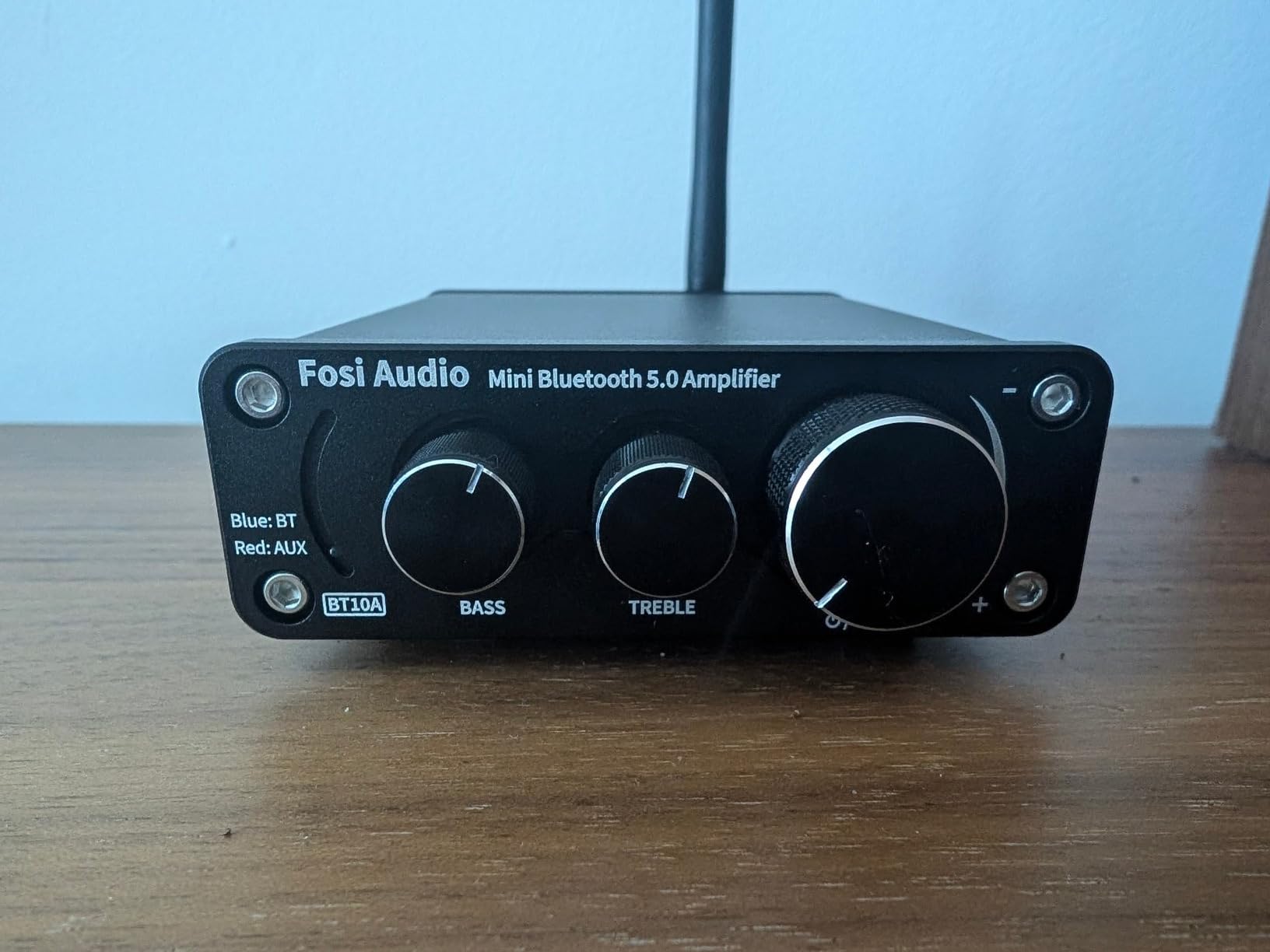
The 50W x 2 output comes from the same Texas Instruments TPA3116 chip used in larger models. Bluetooth 5.0 holds a stable connection up to about 50 feet, which covers a bedroom or office comfortably.
A power supply and user manual are included, so the only other thing you need is speaker wire.
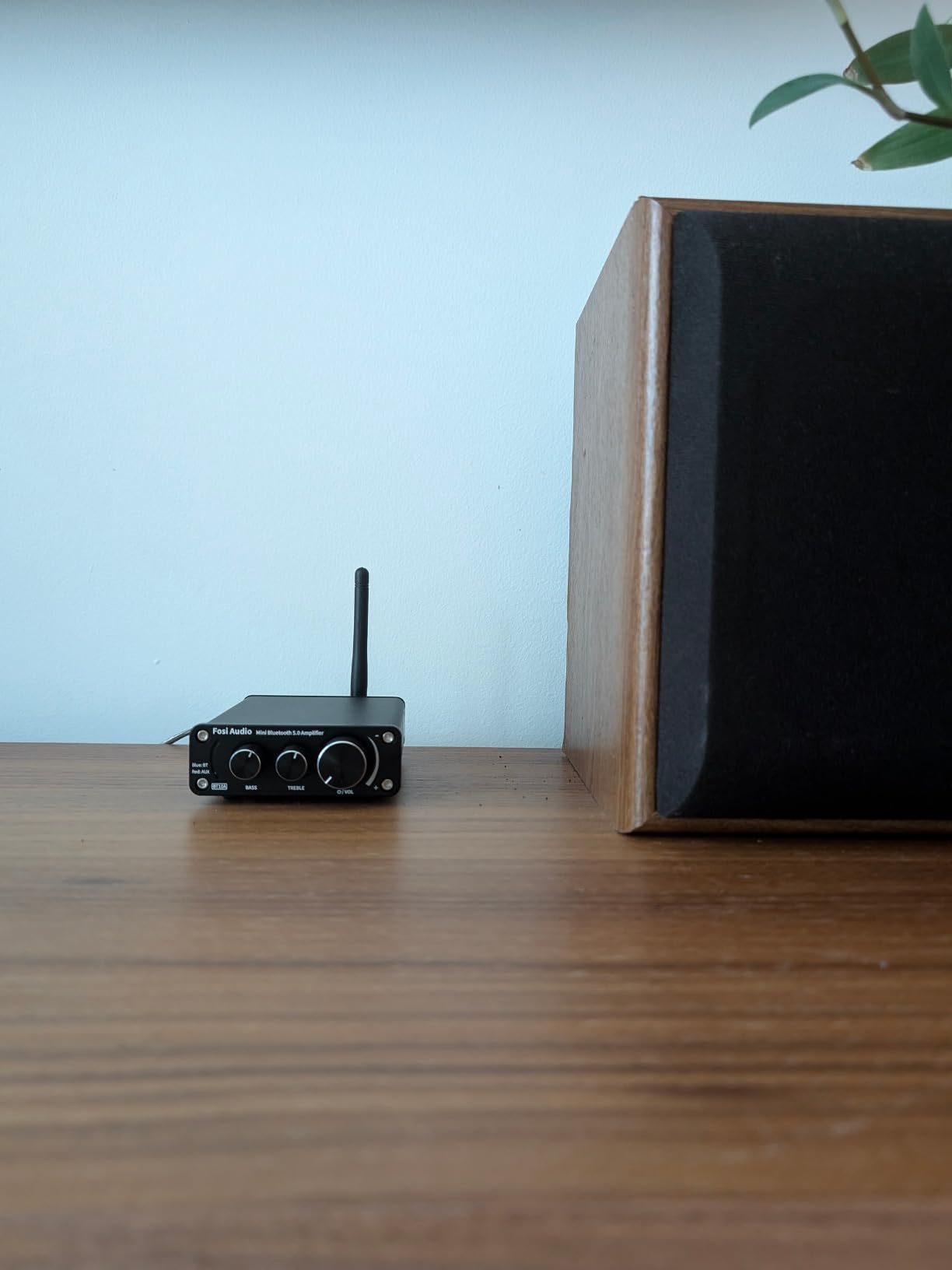
Best for a bedroom, an office or a very small speaker pair
It works mainly as an entry point or zone amplifier rather than a main system. If your bookshelf speakers are efficient and your listening distance is short, that is exactly the case it fits.
It is also a sensible first amplifier for a teenager who wants their own system in a shared house, because it is small, cheap and hard to break.
Watch out for the connectivity
Beyond Bluetooth and 3.5mm AUX there is nothing: no optical, no coaxial, no subwoofer output, no headphone jack and no remote. A laptop or a phone is the only source it really wants.
The 50W x 2 output limits larger or less efficient speakers, so do not pair it with low-sensitivity floorstanders and expect them to fill a large room.
How to Match an Amplifier to Bookshelf Speakers?
Matching is mostly about impedance, sensitivity and your sources, not wattage. Work through these five steps in order and you cannot go far wrong.
Step 1: Check the speaker impedance and the amplifier’s minimum load
Most bookshelf speakers are rated 6 or 8 ohm nominal, and some dip to 4 ohm or lower across the frequency range where the bass reflex port operates. Read the speaker manual, not just the box, and look for a minimum impedance figure rather than a nominal one.
Then check the minimum load on the amplifier. Many mainstream amplifiers specify 4 to 16 ohm or 6 to 16 ohm, which is what you want. The danger is an amp that accepts 8 ohm only, driven hard with a 4 ohm speaker, because it will run hot and either distort or shut down.
Step 2: Work out how much power you actually need
Bookshelf speakers are efficient. A pair rated at 85 to 88 dB sensitivity in a normal room at a two-metre listening distance usually needs something like 20 to 50W per channel for everyday listening, and 80 to 100W only if you listen loudly or in a large room.
Forums repeatedly warn the other way too: matching amplifier wattage to speaker wattage ratings is a mistake, because a speaker rating is a maximum, not a requirement. The real risk to avoid is underpowering, which clips on musical peaks.
What the 83 percent rule means and why most people ignore it
The 83 percent rule is a design guideline that keeps an amplifier operating at roughly 83 percent of its rated load so the output stays in a linear region. It comes up constantly in forums and almost never in editorial buying guides.
For buying purposes it is more useful as a matching exercise than a formula. Keep the amplifier’s rated load close to the speaker’s nominal impedance, and if the speaker is less efficient than about 85 dB, step up to an amplifier with more current delivery rather than more nominal watts.
Step 3: Match the inputs to your source
A phono stage only matters if you own a turntable with a moving magnet cartridge, and a built-in DAC only matters if you have a digital source rather than an analog one. Paying for a DAC you will not use is a common mistake, and so is discovering you need a phono stage you did not buy.
Paying for HDMI and surround processing you will never use is the other classic waste, and that is the core argument for an integrated amplifier over an AV receiver when you only care about music.
Step 4: Class A/AB versus Class D, and why it rarely matters
Class A/AB designs bias the output transistors into Class A at low levels for linearity, run warm and are typically larger. Class D switches the output constantly at a high frequency, is far more efficient, runs cool and can be tiny and inexpensive.
The audible differences at sane volumes are small enough that most listeners cannot hear them in a blind test. What does matter is build quality, power supply design, and whether the amplifier can supply the current your speakers need. That is why the small Class D units here drive real speakers competently, and why the larger A/AB units do not need enormous power to sound good.
Step 5: Integrated amplifier versus AV receiver
An AV receiver is a video processor with amplifiers attached. If you only care about music, you are paying for decoding, HDMI switching and a large chassis you will never use in a two-channel setup. An integrated amplifier does one job and usually does it better for the money.
The exception is if you genuinely want a home theatre system later, in which case a receiver with HDMI and surround decoding saves you a second purchase. A few amplifiers here have HDMI ARC, which covers the television half of that without the processing circuitry.
Popular bookshelf pairings and the amplifiers we would use
For efficient mainstream models in the 85 to 88 dB range, almost anything on this list works, and the choice comes down to sources. For low-sensitivity models in the 84 to 86 dB band, choose an amplifier with more real current delivery rather than a bigger headline number.
Pair the small Class D units with compact speakers in a small room, and pair the Sony STRDH190, the Denon PMA-600NE or the WiiM Amp Pro with anything harder to drive. If you are still choosing speakers, our entry-level bookshelf roundup is the sensible starting point.
Frequently Asked Questions
What is the best amp for bookshelf speakers?
The WiiM Amp Pro is the best all-round choice because it combines 60W per channel of real power with Wi-Fi streaming, HDMI ARC and a subwoofer output in one small box. For a vinyl-first system, the Denon PMA-600NE is the better match, with a phono stage, a built-in DAC and an Analog Mode.
Do bookshelf speakers need an amplifier?
Only passive bookshelf speakers need an amplifier. Passive models have no amplification in the cabinet and require a stereo amplifier or receiver. Active speakers have a small amplifier built into each cabinet, so you connect a source directly and no external amplifier is required.
Can I use an 8 ohm amplifier for 4 ohm speakers?
Only if the amplifier is rated for a 4 ohm load. Running a 4 ohm speaker into an amp rated for 8 ohm only will overheat the output stage, cause distortion and can trigger protection shutdowns. Check the minimum load on the back panel rather than the nominal rating on the front.
How much wattage should my amplifier have to match my speakers?
For efficient bookshelf speakers measuring 85 to 88 dB sensitivity, 20 to 50W per channel is enough for normal listening in a typical room. Speaker wattage ratings are maximums, not requirements, so matching amp power to them is a common mistake. Step up to 80 to 100W only for low-sensitivity speakers or loud listening in a large room.
What is the 83 percent rule for speakers?
The 83 percent rule is a design guideline that keeps an amplifier operating at roughly 83 percent of its rated load so the output stays in a linear region. For buyers it is a matching exercise: keep the amplifier rated load close to the speaker nominal impedance, and choose more current delivery rather than more nominal watts.
Is a Class D amplifier as good as Class AB?
At sane listening volumes the difference is small enough that most listeners cannot hear it reliably. Class D runs far more efficiently and cooler, which allows smaller and cheaper chassis. Class A and A/B designs bias the output for linearity and run warm. Build quality and current delivery matter more than the class label.
Which Amplifier Would We Buy?
The WiiM Amp Pro wins this roundup. It supplies 60W per channel of real, high-current power without running hot, and it covers streaming, television audio and a future subwoofer in one box that costs less shelf space than a traditional integrated amplifier.
Our alternatives depend on your sources. The Denon PMA-600NE is the pick for a vinyl-first system, and the Sony STRDH190 is the pick for raw power and input count on a modest budget. The Fosi BT20A remains the community favourite for a second zone or an outdoor pair.
Whatever you choose, buy to the speaker rather than to the wattage figure. The best stereo amplifiers for bookshelf speakers in 2026 are the modest ones that leave headroom for musical peaks without wasting money on power you will never use.