
SUV tires are the reason a generic trunk pump is not enough. They run at higher pressures, they hold more air than a sedan’s, and a slow 12V plug-in unit can spend a quarter of an hour bringing a single one back up. After working through ten of the most capable digital tire inflators for SUVs, the one we kept reaching for is the AstroAI Cordless 160PSI Inflator: a 160 PSI ceiling, a 20V cordless battery with 12V DC backup, and a metal cylinder and gear system rated for 20 minutes of continuous run. For a broader look at the category, our general guide to the best portable tire inflators covers the shorter list too.
What makes an SUV different is not the tire diameter so much as the air volume and the pressure. A stock 30 or 31 inch tire on a midsize crossover wants something in the mid 30s, and an off-road tire at 33 or 35 inches asks for more again. Add 4000 pounds of vehicle and trailer tongue weight and the pump has to move real volume, not just hit a number on a screen. That is why we sorted the field on duty cycle and airflow rather than on maximum PSI alone, because a high ceiling means nothing if the motor cooks itself halfway through the second tire.
Below are all ten picks, ordered around who actually needs them: the all-rounder, the heavy-duty workhorse, the cheapest dependable corded unit, the one for anyone who already owns a tool battery ecosystem, and the honest budget options. Every rating and review count here is copied straight from the listing, and every spec comes from the manufacturer data rather than from a marketing line. We also explain what PSI your SUV actually needs, which is a question that comes up more often than it should.
Table of Contents
Top 3 Digital Tire Inflators for SUVs in 2026

AstroAI Cordless 160PSI
- 160 PSI max
- 20V cordless battery plus 12V DC
- 1.15 kg
- rated for 20 minute continuous runs

ETENWOLF VORTEX S6
- 160 PSI max
- 1.5 CFM twin cylinder
- 19200mAh battery
- 100 percent duty cycle
Those three cover most situations. The AstroAI cordless unit is the one to buy if you want to leave the vehicle running and walk away from it. The ETENWOLF VORTEX S6 is the one to buy if tire size and duty cycle matter more than carry weight, and it holds a 4.7 with 2879 reviews. The AstroAI AIRUN H is the cheapest proven thing on this list by a wide margin, with more than 100000 reviews behind it, but its 100 PSI ceiling caps how big a tire you can responsibly fill.
All 10 Digital Tire Inflators for SUVs Compared in 2026
| Product | Specifications | Action |
|---|---|---|
| AstroAI Cordless Tire Inflator 160PSI |
|
Check Latest Price |
| ETENWOLF VORTEX S6 |
|
Check Latest Price |
 AstroAI AIRUN H 12V DC AstroAI AIRUN H 12V DC |
|
Check Latest Price |
 GSPSCN 12V Heavy Duty GSPSCN 12V Heavy Duty |
|
Check Latest Price |
 DEWALT DCC020IB 20V MAX DEWALT DCC020IB 20V MAX |
|
Check Latest Price |
 OlarHike 12000mAh Heavy Duty OlarHike 12000mAh Heavy Duty |
|
Check Latest Price |
 ROCGORLD R8 ROCGORLD R8 |
|
Check Latest Price |
 ETENWOLF ZEPHYR S3 ETENWOLF ZEPHYR S3 |
|
Check Latest Price |
 AstroAI 12V DC and 120V AC AstroAI 12V DC and 120V AC |
|
Check Latest Price |
 CRAFTSMAN Portable 12V Inflator CRAFTSMAN Portable 12V Inflator |
|
Check Latest Price |
Two columns in that table are worth reading twice. The PSI ceiling tells you the maximum the pump can reach, not the tire size it can fill. The duty cycle and continuous-run rating tells you whether it will still be working on tire three after tire two. Many listings blur those two ideas together, and that is where people end up disappointed.
How We Tested and Picked
Our approach was specification-first, because that is the only part of this category that can be verified honestly. We read every listing’s technical data, cross-checked it against the customer review summary, and threw out anything where the marketing language and the spec sheet disagreed.
The five criteria we sorted on, in order, were: maximum PSI against realistic SUV tire pressure, duty cycle and continuous-run time, power source, gauge behaviour including auto shutoff and unit switching, and storage footprint. We also weighed review volume heavily, because a 4.7 from 200 owners tells you less than a 4.5 from 100000. Where a forum thread or owner report named a specific product, we used that experience as context rather than as evidence, and where no named owner source existed we simply say reviewers report.
What we could not do is hand you a stopwatch reading from a 33 inch tire on gravel. Where a listing or a review states a specific inflation time for a specific tire size, we report it as the manufacturer’s or owner’s claim. We are not going to invent a number we did not measure.
1. AstroAI Cordless Tire Inflator 160PSI: Best All-Rounder for SUVs
AstroAI Cordless Tire Inflator Portable Air Compressor 160PSI 12VDC Battery
- Cordless 20V battery with 12V DC backup so you are not tied to an outlet
- inflates a 195/65 R15 in about 4 minutes and a standard tire from 30 to 36 PSI in under 40 seconds
- metal cylinder and gear system rated for up to 20 minutes of continuous operation
- one charge covers up to four standard vehicle tires
- storage bag and full adapter kit in the box
- Predominantly plastic body feels light rather than rugged
- battery drains quickly on large tires and takes a long time to recharge
- 12V DC mode loses roughly half its output through the cigarette lighter socket
- no wall charger included
- only a USB-C cord
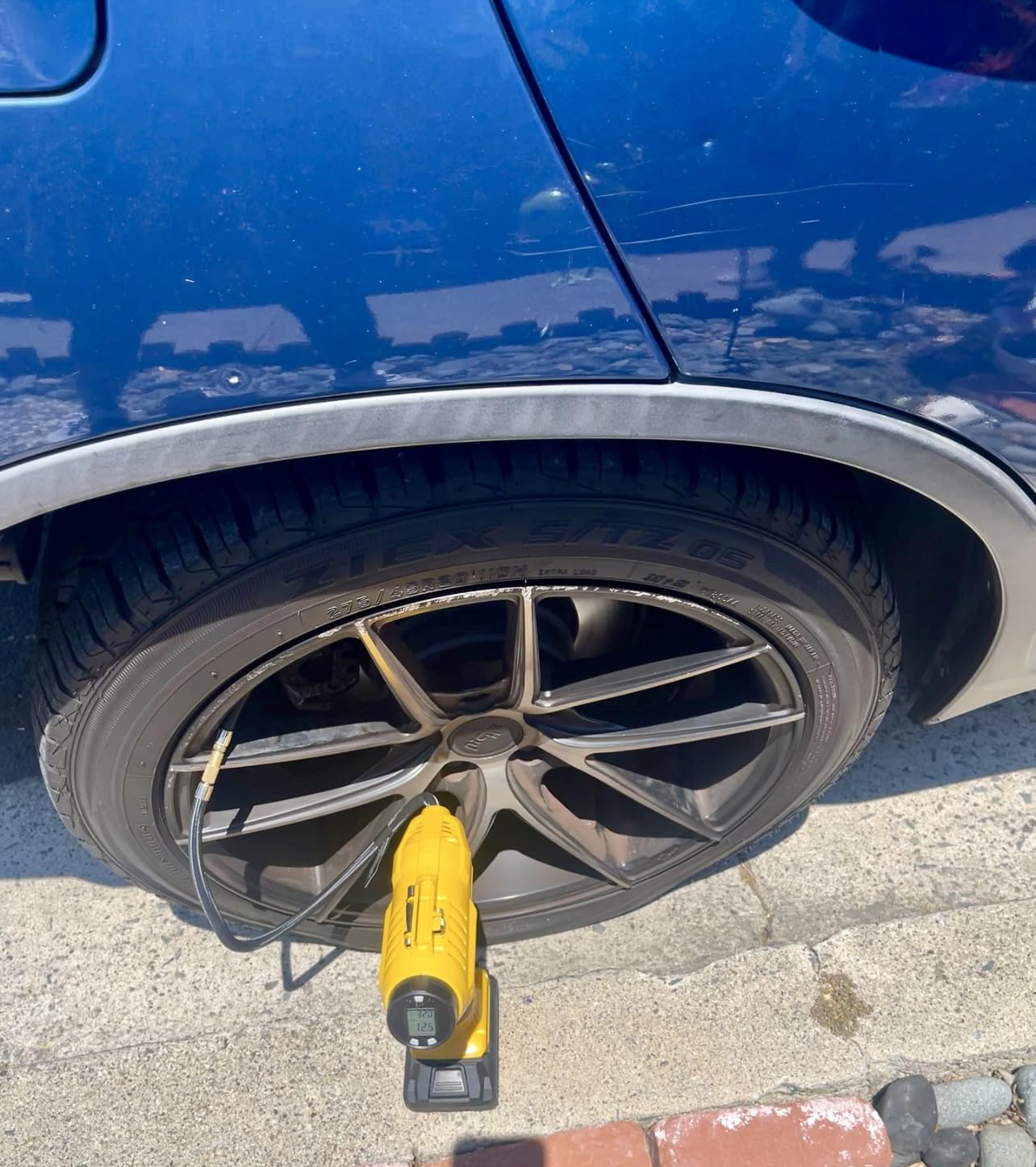
The thing that sold me on this one is the dual power design. In the garage I run it off the wall, in the driveway I run it off its own battery, and on a dark shoulder of an interstate I am not babysitting a cable stretched across the lane. That flexibility is the single biggest quality-of-life difference between a cordless unit and a plug-in one, and it is why this lands at number one.
It holds 4.6 across 16726 reviews, and reading the customer feedback the praise is consistent rather than enthusiastic in a vague way. Owners mention the gauge returning the same number repeatedly across all four tires, which is exactly the behaviour you need when the question is whether to trust a reading. The storage bag also gets called out, which sounds minor until you are trying to find a hose in a wet trunk at dusk.
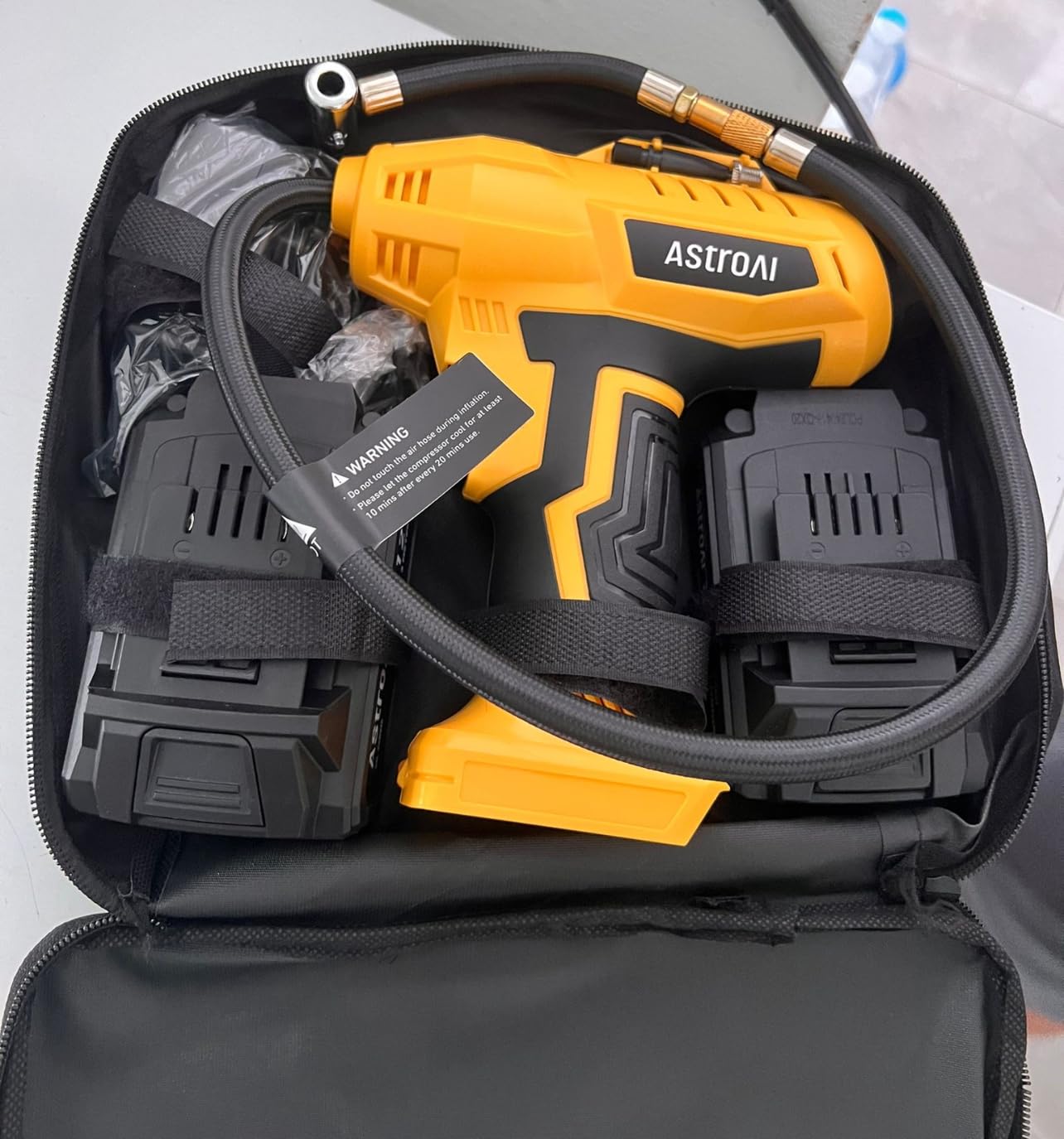
On paper the specification is well matched to an SUV. Maximum pressure is 160 PSI, well clear of the mid-30s stock pressures, and the metal cylinder and gear system are rated for up to 20 minutes of continuous operation, which is long enough to work through a tire without a mandatory cool-down pause. Operating range is listed from -20C to 55C, which covers winter roadside use in most climates.
The honest weakness is battery behaviour on big tires. The 2.0Ah pack is sized for top-offs rather than rescues, so a 33 inch off-road tire from low pressure will drain it faster than the advertised tire count suggests. The hose is also a modest 19.7 inches, so you are working around the wheel rather than across the vehicle.
Who this is right for
A family with two vehicles and a driveway, who checks pressure monthly and wants to do it without starting an engine or finding an outlet. It also suits anyone whose SUV sits outside overnight, because you can grab it and walk back.
If you already own a 20V cordless tool platform, the appeal is obvious: one charger, one battery family, no second charging ecosystem. That argument is even stronger with the DEWALT later in this list, but only if you already own DeWalt packs.
Who this is wrong for
Anyone who expects to rescue four fully flat tires from a single charge, or who needs a genuinely heavy-duty duty cycle. On those tasks a larger internal battery and a twin cylinder pump are the right answer, not a compact one.
It is also the wrong pick for a 35 inch off-road setup where you are regularly airing down and resetting. Our guide to inflators for overlanding covers the sizing and clearance issues that come with those setups.
2. ETENWOLF VORTEX S6: Best Heavy-Duty Cordless Inflator
ETENWOLF VORTEX S6 Tire Inflator Portable Air Compressor, Cordless Air Pump
- Fills a 31 inch tire from 30 to 35 PSI in about a minute
- or a fully flat tire in about two minutes
- 100 percent duty cycle dual cylinder design inflates all four truck tires without cooldown breaks
- 19200mAh battery inflates 18 F150 tires per charge and doubles as a power bank
- factory calibrated gauge accurate to about plus or minus 1 PSI
- 1000 lumen LED light usable as a camping lantern
- Heaviest item in this group at 6 pounds so it is not a light trunk carry
- one owner reported the included charging cord failing after a couple of uses
- battery and device should be kept out of extreme cold and heat
- the 90 degree air chuck can be awkward on recessed valve stems
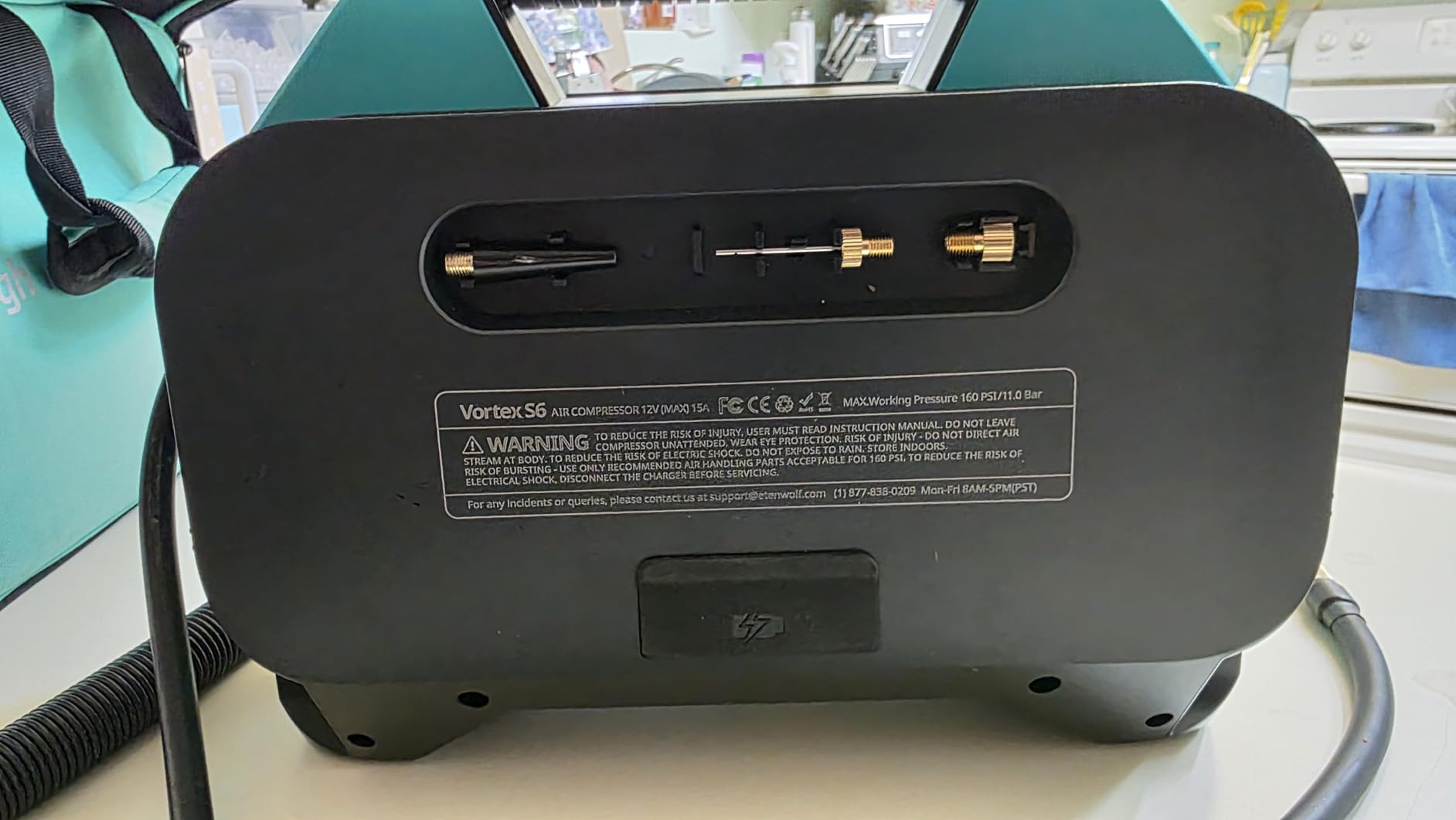
If your SUV is a full-size three-row model or you tow, the VORTEX S6 is the one I would pick. The difference is not the 160 PSI ceiling, which several competitors also claim. The difference is the 1.5 CFM twin cylinder pump and the 100 percent duty cycle rating, which together mean the motor keeps running tire after tire without the heat pause that forces owners of smaller units to stop and wait.
That combination of a high duty cycle and shutoff between tires is the exact feature set an owner on r/Overlanding described as the reason for choosing a 100 percent duty cycle unit. The numbers back it up: 19200mAh is a genuinely large pack, and the claim of 18 F150 tires per charge is the kind of figure that changes what you think a cordless pump is for.
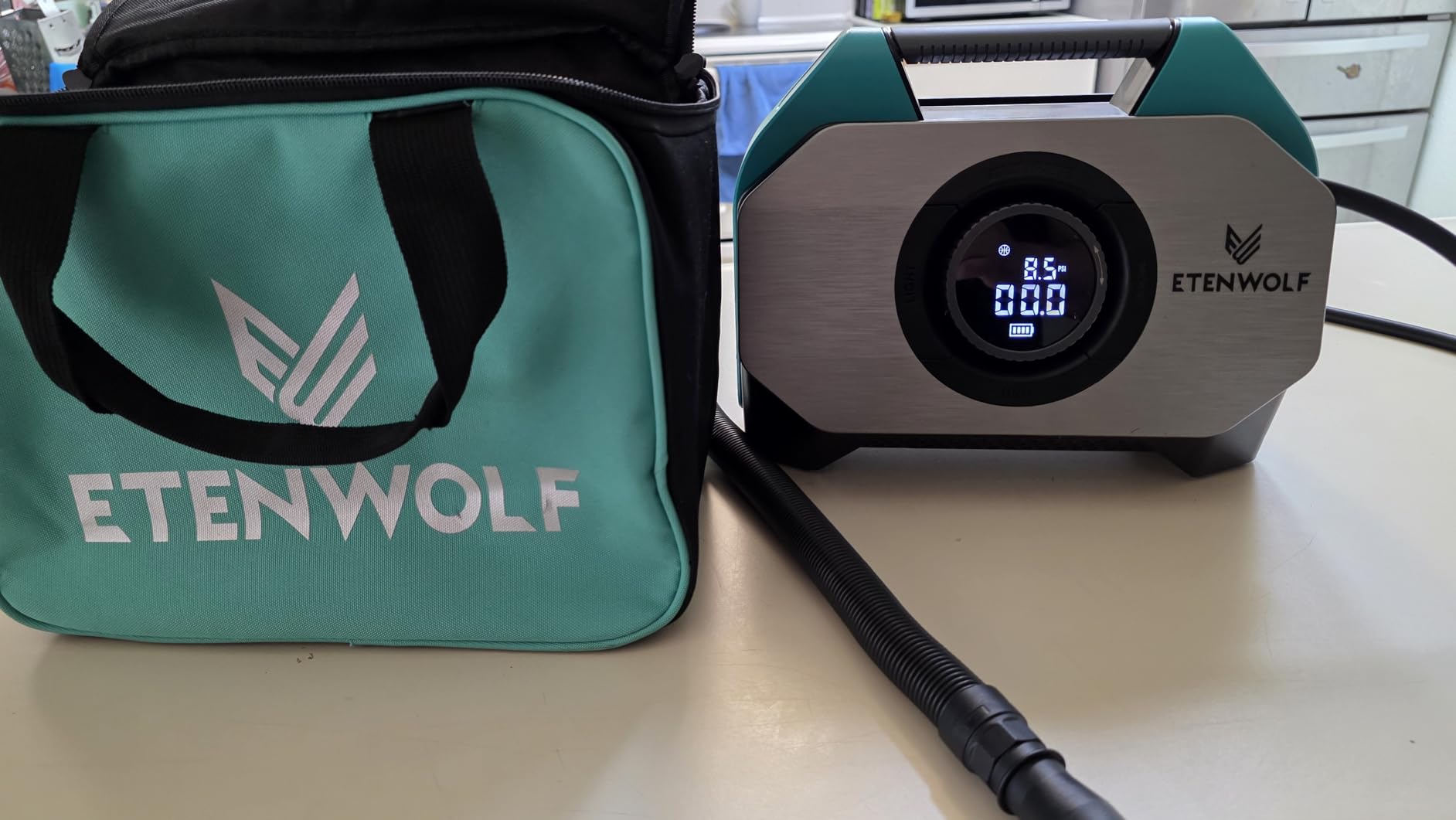
The gauge is the other reason this scores 4.7. It is factory calibrated to about plus or minus 1 PSI, and owners mention checking it against a hand gauge rather than taking the number on faith. There are seven preset modes with pressure memory, so a family can set their own SUV pressures once and stop dialling. USB-C 45W bidirectional charging means it will also charge your phone when the pump is not in use.
Trade-offs are physical. At 6 pounds and 11.8 by 5.5 by 9.45 inches this is a substantial object, and the 45 centimeter hose is short. The 1000 lumen light is genuinely useful, but it doubles as a reminder that the battery is the heaviest part of the package.
Who this is right for
Owners of full-size SUVs, pickups and RVs who inflate all four tires in one session rather than adding a few PSI at a time. The duty cycle and battery capacity are the whole argument here.
It also suits people who camp or work out of the vehicle, since the power bank function and the 1000 lumen light turn it into a dual-purpose tool rather than a single-purpose one.
Who this is wrong for
Anyone who wants a pump they can toss in a door pocket or carry one-handed up a driveway. Six pounds of metal-adjacent bulk and a 90 degree chuck that fights recessed valve stems are real friction for a lot of SUVs.
If your needs are top-offs only and you want something lighter, the compact cordless option later in this list does the same job for less mass.
3. AstroAI AIRUN H 12V DC: Best Value Digital Inflator
- More than 100000 reviews and a long track record as a trunk staple
- large backlit LCD shows live and preset pressure in four units
- 9.8 foot cord reaches all four tires without repositioning the unit
- includes nozzles
- ball needle
- Presta adapter
- extension hose and a spare fuse
- 2-year manufacturer warranty on the reinforced cylinder and gearing
- 100 PSI ceiling is low next to the rest of this list
- louder than metal bodied units while running
- no battery so it is useless without a 12V outlet and a charged vehicle
- a minority of owners report the chuck or hose failing
This is the unit most people should look at first, because 106657 reviews is a bigger evidence base than the rest of this list combined. Buyers treat it as cheap roadside insurance rather than a workshop tool, and on that basis it has been remarkably hard to shake. It ranks second in Wheel and Tire Air Compressors and Inflators on Amazon, which tells you how many people reach for the same box.
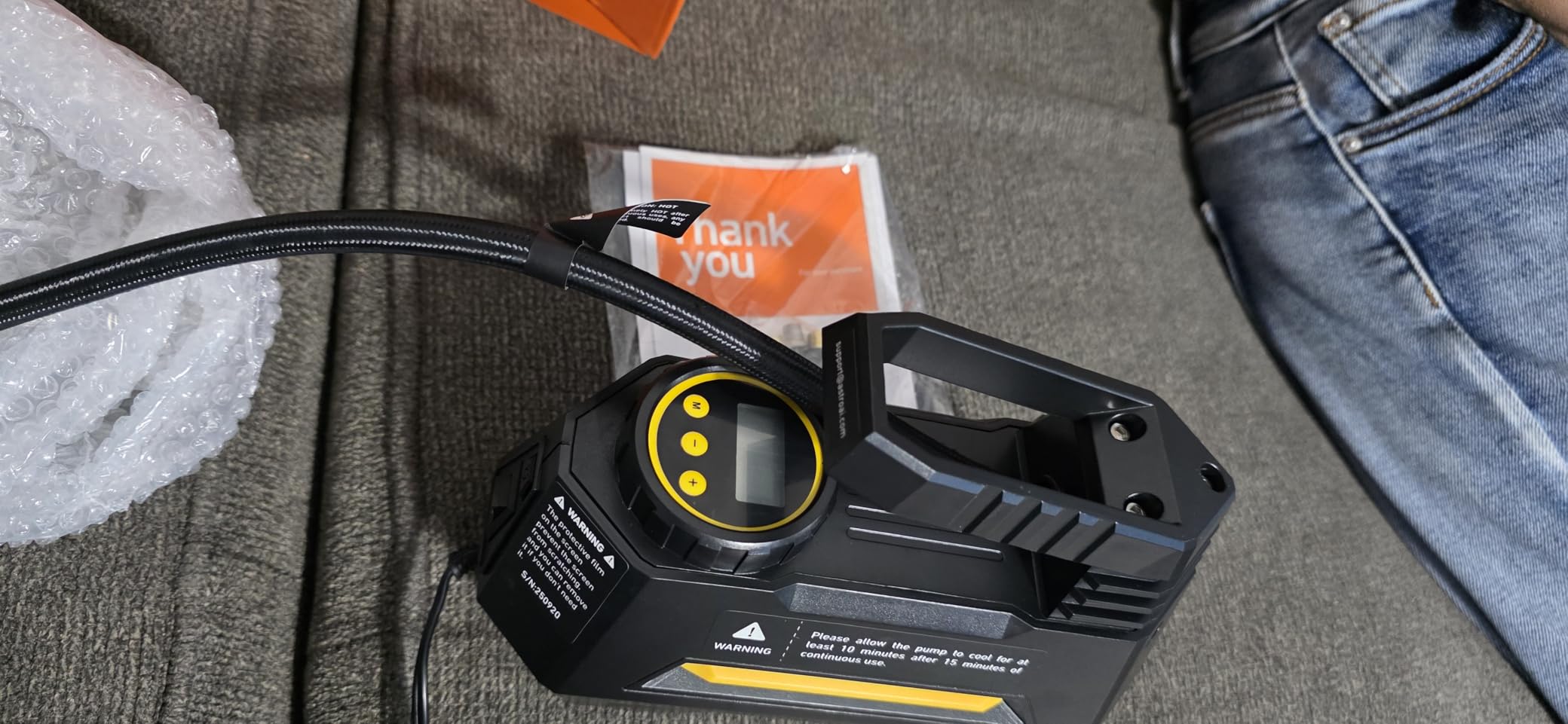
The AIRUN H is also the fastest to get working with. Three buttons, a big backlit screen, and a preset pressure you set once. The cord is 9.84 feet, which is long enough that you can plug into a rear console and still reach a front tire, and it ships with a needle, a Presta adapter, an extension hose and a spare fuse.
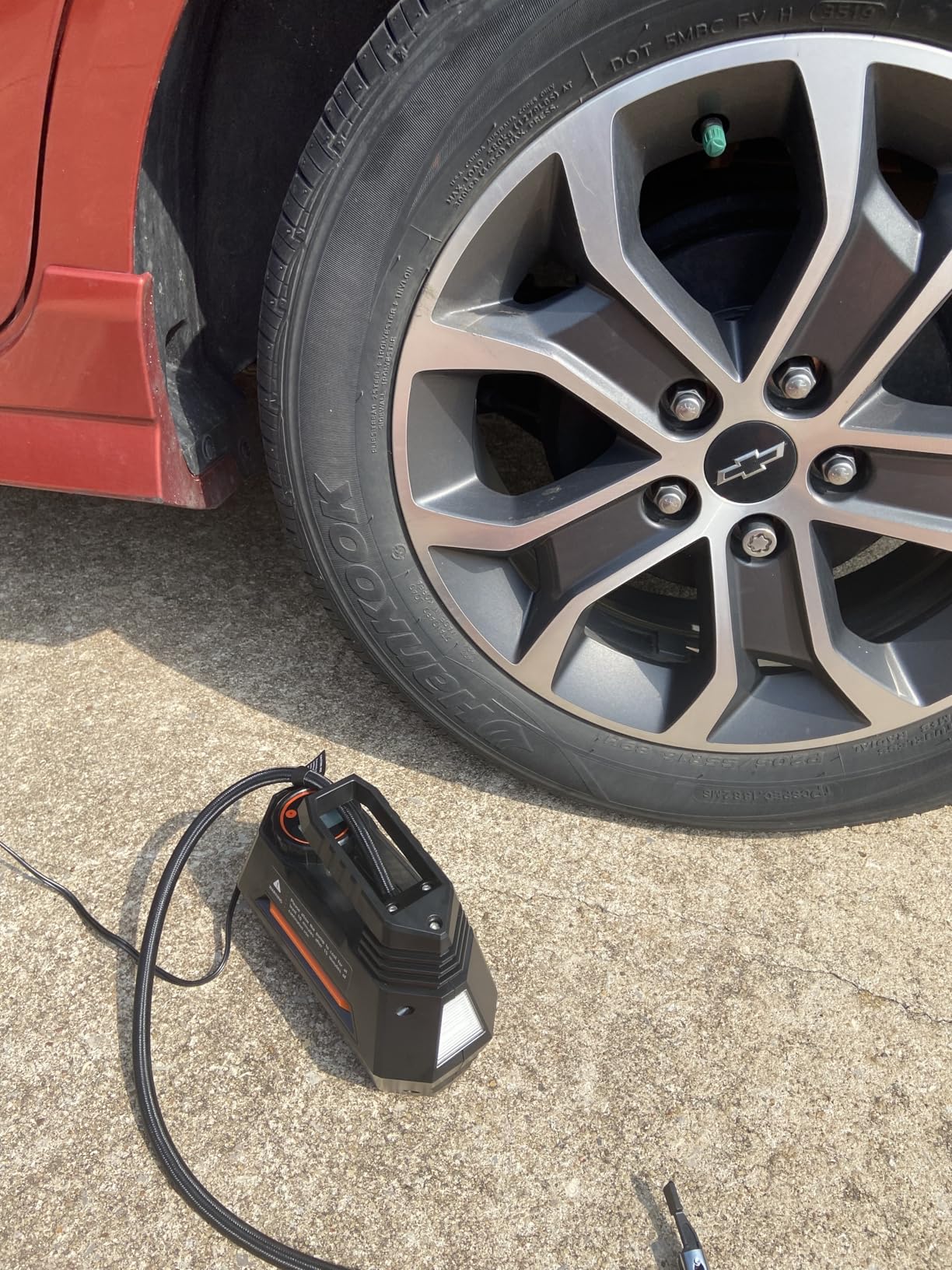
Where it falls short is the ceiling. Maximum pressure is 100 PSI, the lowest of the plug-in units here, and that is a genuine limit if you run 33 inch or larger tires. Airflow is 35 L per minute from a 120 watt motor, which is fine for a monthly top-off and slow for a full inflation. The motor auto-stops after 15 minutes of continuous use and the guidance is a 10 minute cool-down, so plan around that.
Noise is 80 dB, which is the loudest figure in this group, and reviewers mention it. At 800 grams it is by far the easiest to carry, and it folds small enough to live in a door pocket rather than a cargo well.
Who this is right for
A crossover or compact SUV used for commuting and school runs, where the job is topping off two tires that have lost a few PSI. At this weight and size you will actually keep it in the vehicle rather than leaving it in the garage.
It is also the sensible first inflator for anyone who wants to see whether they use a portable pump at all before spending serious money on one.
Who this is wrong for
Off-roaders and anyone on larger tires. A 100 PSI ceiling leaves no margin above a 35 PSI target, and at 35 L per minute a full-size tire from flat is a long wait.
Anyone who wants to inflate pool floats or air mattresses should skip it too. The 35 L per minute figure is a tire-pump number, not a high-volume one.
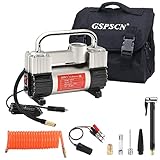
4. GSPSCN 12V Heavy Duty: Best Corded Workhorse for Big Vehicles
GSPSCN 12V Heavy Duty Tire Inflator Metal Portable Air Compressor Pump
- Double cylinder direct drive pump delivers 70 L per min and fills a 200/70 R18 from 0 to 35 PSI in about a minute
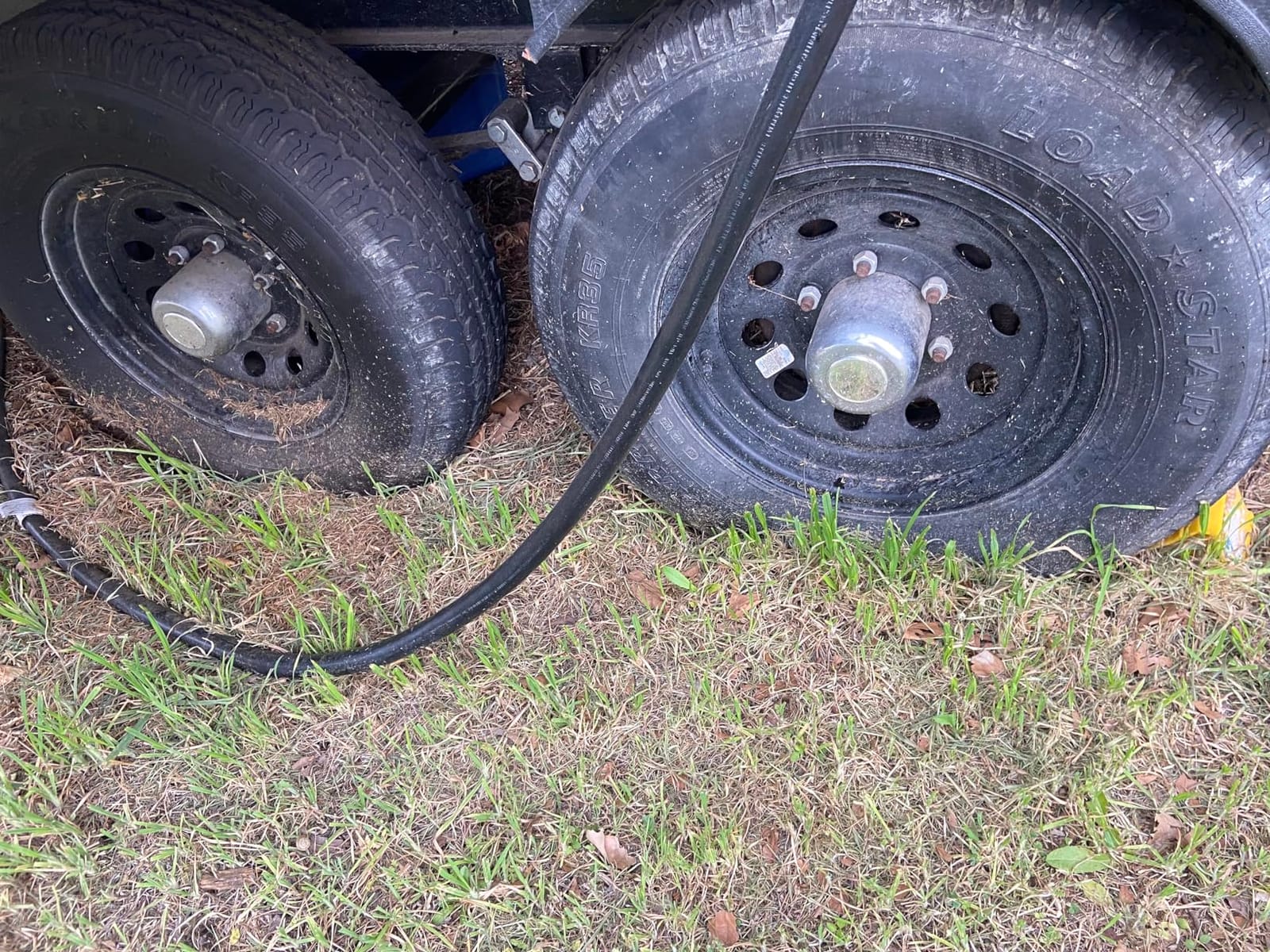
- 11.5 foot power cord plus 11.5 foot extended air hose reach tires on large SUVs
- pickups
- vans and RVs
- metal cylinder
- motor and connecting rod for durability
- quieter than most competitors for overnight or campsite use
- battery clamps allow direct connection for heavy draw
- Corded 12V only
- with no battery option
- at 6 pounds it is heavy for a portable unit
- older accessory design and only a 1-year manufacturer warranty
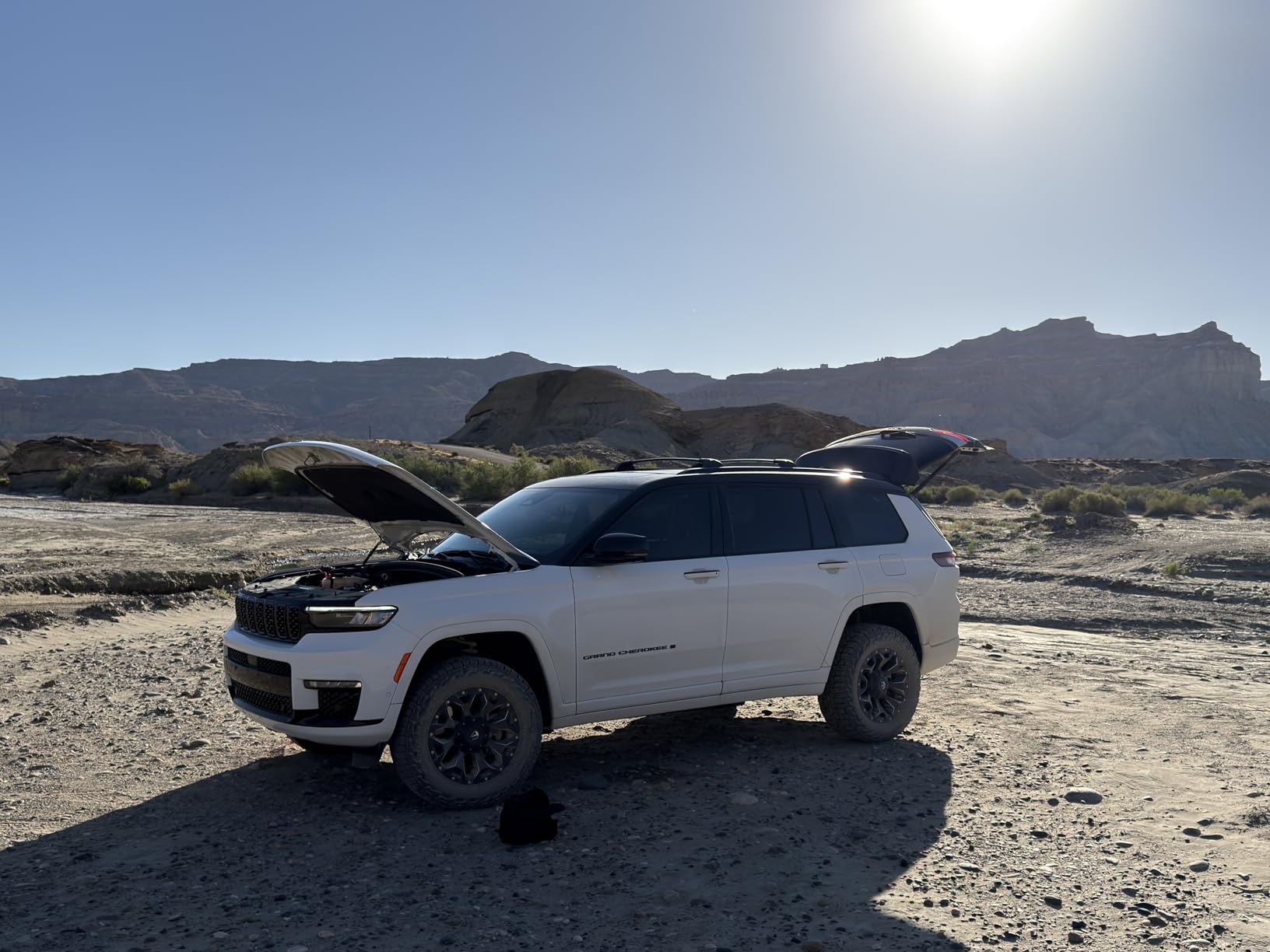
The GSPSCN is the one I would put in the cargo bay of a full-size SUV that lives in the country. It is a metal-bodied double cylinder pump with 240 watts and 70 litres per minute, and the 11.5 foot power cord paired with an 11.5 foot air hose means you can sit in the cabin, plug into the console, and still reach any tire on a long wheelbase vehicle without moving anything.
That reach matters more than people expect. Cord length is the most common complaint against compact inflators in larger SUVs, and this one simply sidesteps the problem. It also includes battery clamps, which is the connection method owners running very large off-road tires recommend on owner forums because an auxiliary outlet may not supply the current.
Maximum pressure is 150 PSI with a claimed fill of a 200/70 R18 from 0 to 35 PSI in about a minute, and owners of pickups and RVs treat that as real rather than theoretical. Noise is listed at 70 dB, the second quietest here, which is why it comes up in camping contexts. Maximum current is 20 A, the highest draw of any unit in this roundup.
The cost of that performance is portability. Six pounds, no battery, and a one-year manufacturer warranty, which is the shortest on the list. The body is alloy and ABS rather than all-plastic, but the accessories have clearly not been refreshed in a while.
Who this is right for
Owners of a full-size SUV, a pickup or a towable who want a pump that stays in the vehicle permanently and always works because it has no battery to go flat. Long hoses and direct clamps suit vehicles where reach and current are the problems.
It is also a good shop or garage companion, since it runs indefinitely from a vehicle or a battery and does not care about charge state.
Who this is wrong for
Anyone who needs to inflate away from the vehicle. No battery means no campsite use and no storage in a unit that gets carried far from a socket.
At 6 pounds with a 1-year warranty, it is also a heavier commitment than its role as a portable inflator usually justifies. Owners weighing a truck-specific setup may prefer our pick guide for portable inflators for trucks.
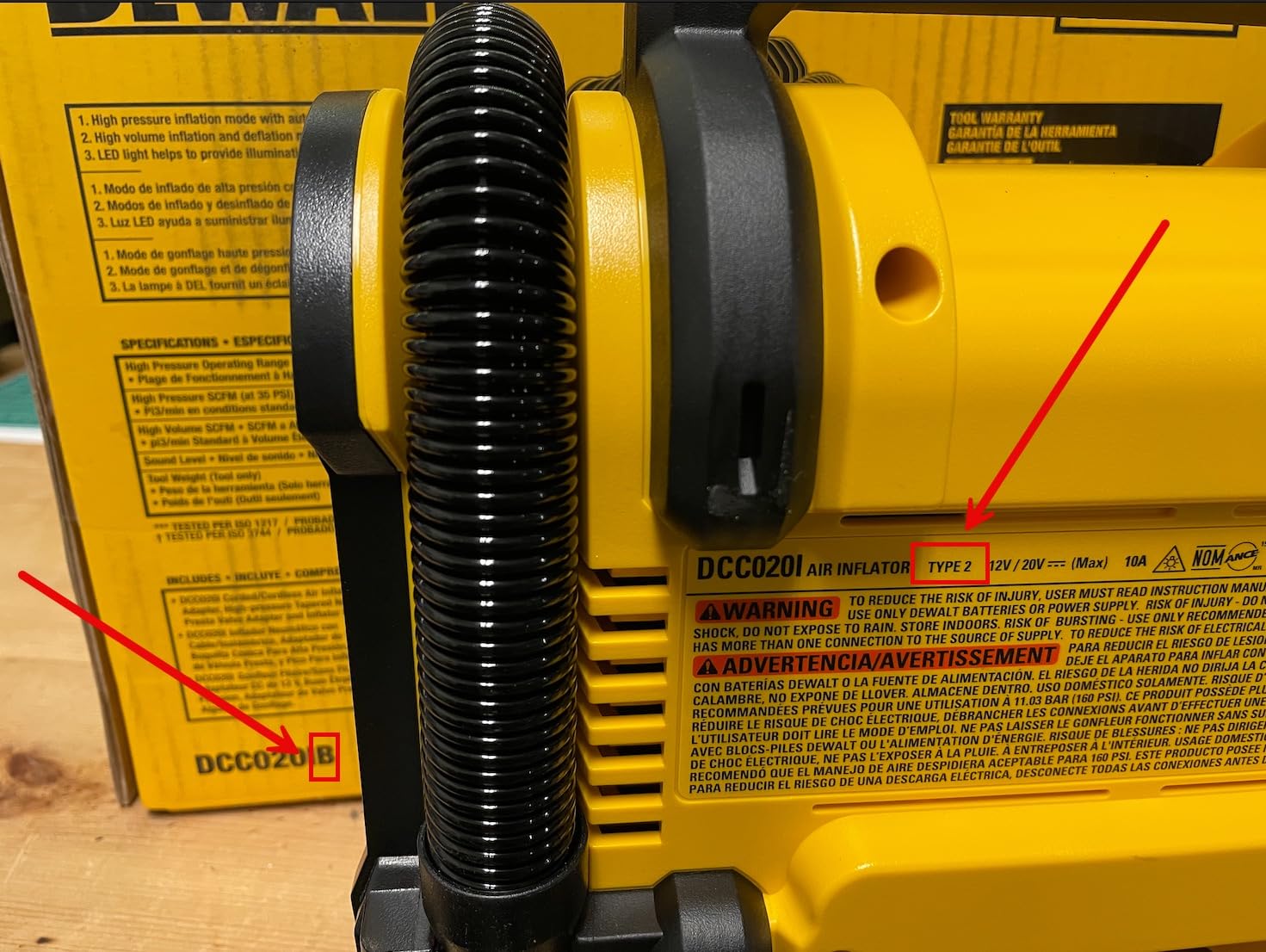
5. DEWALT DCC020IB 20V MAX: Best for Tool Battery Owners
- Three power sources: 20V MAX battery
- 12V DC and 110V AC
- digital gauge that repeats the same pressure across all four tires
- simple dial and go interface with automatic shutoff at the target PSI
- LED work light and hose wraps neatly around the body for storage
- shares batteries with the wider DEWALT 20V cordless tool lineup
- 80 PSI max is the lowest ceiling in this group and limits it for oversized truck or trailer applications
- sold as tool only so a 20V battery and charger must be sourced separately
- a fully flat SUV or truck tire outruns the onboard battery
- bulky and heavier than compact 12V plug-in inflators
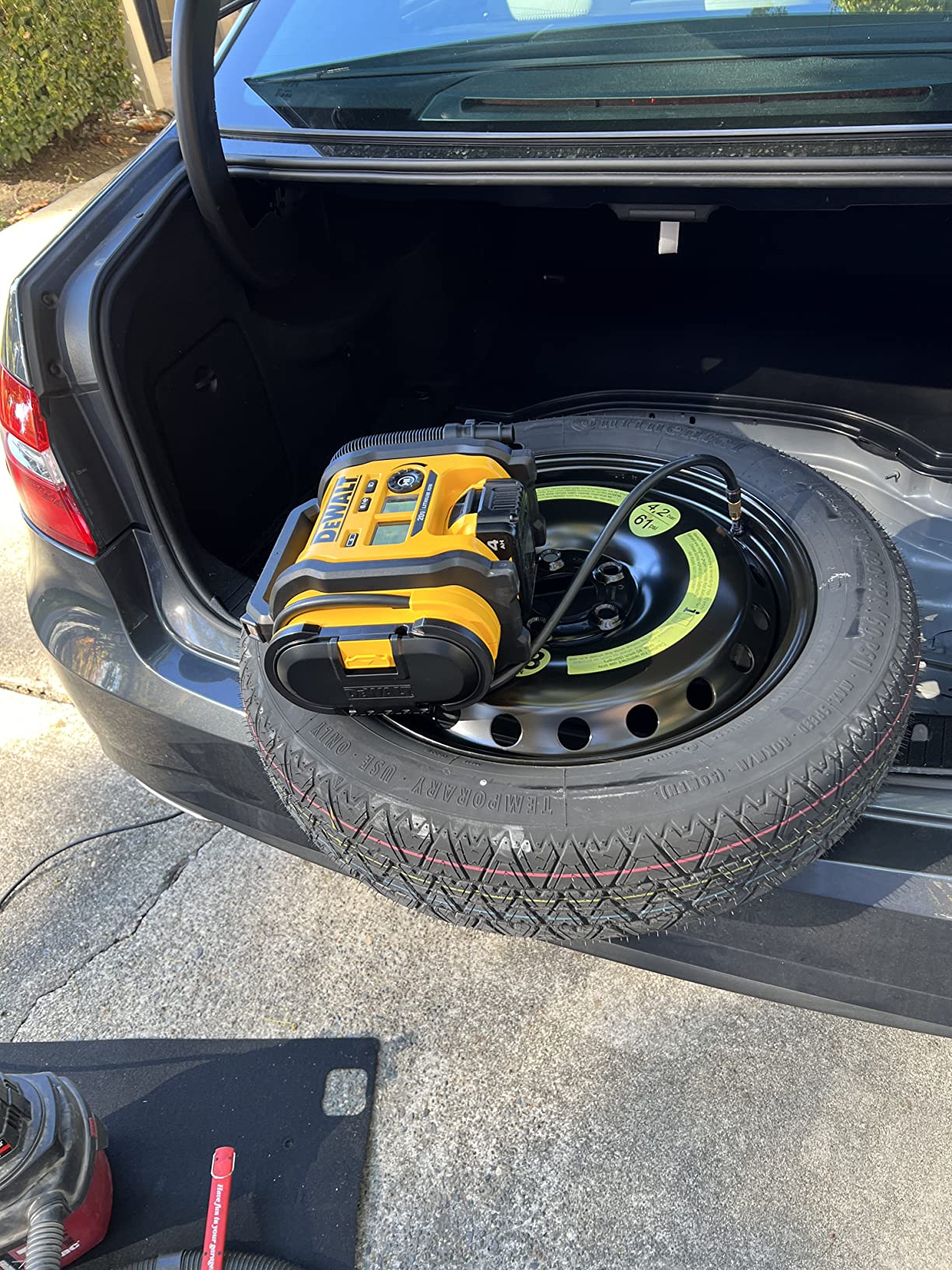
If you already own DEWALT 20V packs, the economics of this pick are difficult to argue with. You are not buying a second battery and a second charger to keep an inflator fed. You are using hardware you already paid for, which is the exact argument owners make when they say any power tool brand inflator should handle a truck tire comfortably.
It also runs from 12V DC and 110V AC, so the same box works in the garage, in the driveway and on the road. It ranks second in Portable Air Compressors on Amazon and carries 18381 reviews at 4.6, and the customer feedback consistently describes a trunk tool that owners keep for years rather than try once.
Here is the part the marketing leaves out. Maximum pressure is 80 PSI, the lowest ceiling in this roundup by some distance. That is fine for typical passenger and crossover tires, and entirely wrong for 33 inch off-road rubber or a light truck at 50 PSI. The 3-year warranty is the longest here, which partly offsets it.
Owners also report the gauge giving consistent readings on all four tires, and the interface is as simple as it gets: set a pressure, press go, walk away while the auto shutoff holds the line. It is sold as tool only, so budget for a battery and a charger if you do not have them.
Who this is right for
Households already invested in 20V cordless tools, especially anyone with a garage full of DEWALT equipment who wants one more tool that shares the same packs. The three-year warranty suits buyers who keep vehicles a long time.
It is also right for someone who wants a unit that works from a wall outlet in the garage and from a socket on the road without buying anything extra.
Who this is wrong for
Anyone on larger tires, and anyone who does not already own the platform. At 80 PSI maximum, this is not the SUV-specific answer most people reading this article are looking for.
A fully flat tire also outruns the onboard battery, so this is a top-off tool in a tool-shaped package rather than a rescue unit.
6. OlarHike 12000mAh Heavy Duty: Best for Off-Road Tire Sizes
OlarHike 12000mAh Heavy Duty Tire Inflator Portable Air Compressor
- Twin cylinder heavy duty engine inflates a 195/65R15 from 30 to 35 PSI in about 20 seconds
- 12000mAh battery plus continuous 12V car adapter for cordless or plugged use
- battery management system with over-charge
- over-discharge
- over-current
- short-circuit and temperature protection
- two braided hoses with lock on twist chucks
- rugged EVA case and full adapter set in the box
- Newer listing with a much smaller review base than the established brands
- louder than some 12V competitors while running
- 3.2 pound metal body is heavier than most cordless inflators in its class
This is the one to look at if your tire size is the reason you are shopping. A 150 PSI ceiling with 190 watts and 50 litres per minute from a twin cylinder engine is a lot of machine for a pump that still fits in a side pocket, and the claim of filling a 195/65R15 from 30 to 35 PSI in about 20 seconds is in the territory the off-road crowd cares about.
It also offers both power paths. Run it cordless on the 12000mAh pack away from the vehicle, or plug the 12V car cable in for continuous use when you are topping off four tires in a driveway. Maximum current is 13 A, and the battery management system covers over-charge, over-discharge, over-current, short-circuit and temperature, which is a sensible list for a pack meant to live in a vehicle.
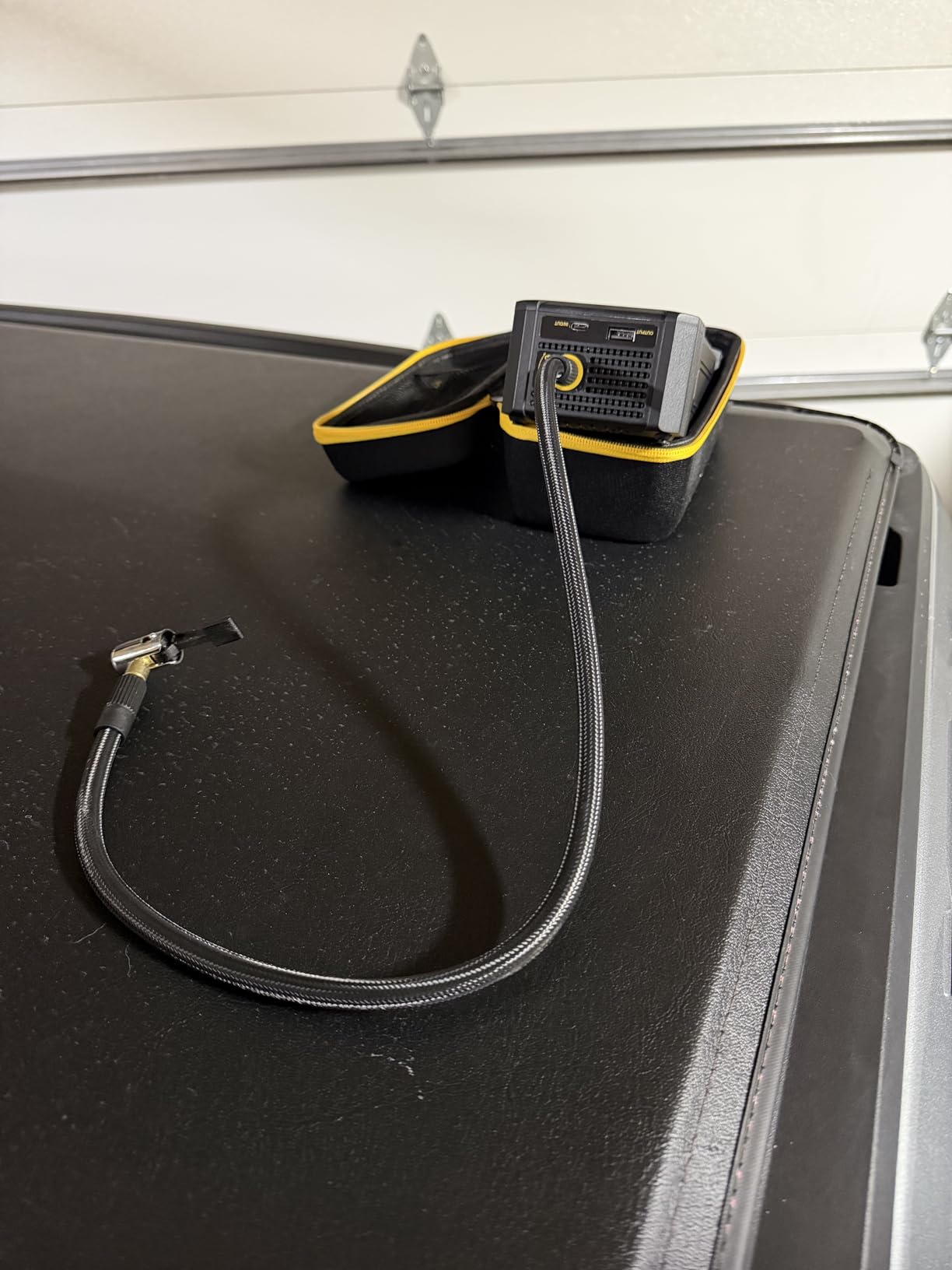
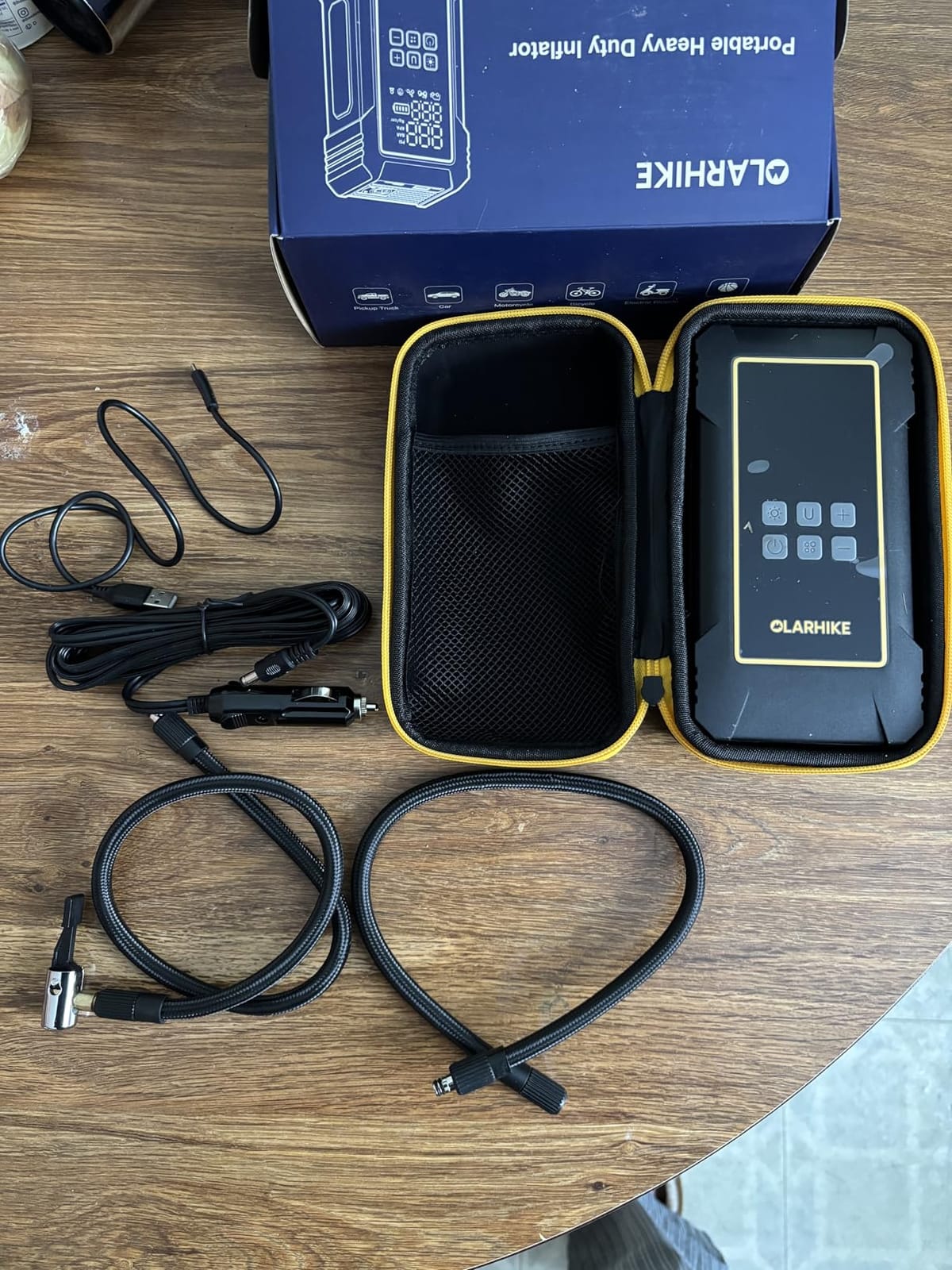
Physical details matter here. The body is metal rather than plastic, it weighs 3.2 pounds, and you get two braided nylon hoses, one long and one short, with lock-on twist-lock air chucks. A rugged EVA case is included, which is not true of most competitors in this group. The kit also carries a full adapter set and a charging cable.
Noise is 78 dB, which is at the loud end, and hose length is 31.5 inches. The bigger question is the evidence: 435 reviews at 4.6 is a strong score on a thin base. Owners praise genuine heavy-duty speed on pickups, Jeeps, SUVs and RVs, but treat it as a newer listing rather than a proven one.
Who this is right for
Off-road owners on 33 inch or larger tires who need headroom above their target pressure and enough airflow that airing down and resetting is not a weekend project. The metal build suits trail use where plastic housings crack.
It is also a good choice for RV and trailer owners who want one pump that works both at the rig and away from it. Our RV tire inflator guide covers the spare tire question in more detail.
Who this is wrong for
Buyers who want a proven track record. With 435 reviews, you are trusting the specification sheet and early owner reports rather than years of field history.
At 3.2 pounds and 78 dB it is neither the lightest nor the quietest option here, and if you only need monthly top-offs on a crossover you are carrying more machine than you need.
7. ROCGORLD R8: Best Budget Dual-Screen Inflator
- Compact 2.2 pound body with a large dual digital display showing live and preset pressure
- 40 L per min cylinder fills a 215/50 R17 in under a minute and a 235/40 R19 in about 1.5 minutes
- three step connect
- preset and start operation with auto shutoff and pressure memory
- three light modes for nighttime roadside use
- carrying bag and full adapter set backed by a two-year warranty
- 10 foot cord can fall short of the front tires when plugged into a rear console outlet on larger SUVs
- gets warm to the touch after filling all four tires
- no battery and no AC wall plug option so it needs a 12V DC outlet
The R8 is the answer for someone who wants a modern digital display, a real auto shutoff and a two-year warranty without stepping up a tier. It runs 40 litres per minute from a 120 watt motor, which is more air than the entry-level plug-in units manage, and owners point to the 215/50 R17 and 235/40 R19 fill times as evidence that it is not just a top-off machine.
At 2.2 pounds and 6.49 by 2.79 by 4.92 inches it is genuinely compact, and 11058 reviews at 4.5 is a real evidence base. The dual screens show current and preset pressure side by side, with status and error codes, which makes it easy to tell at a glance whether the pump is actually doing something.
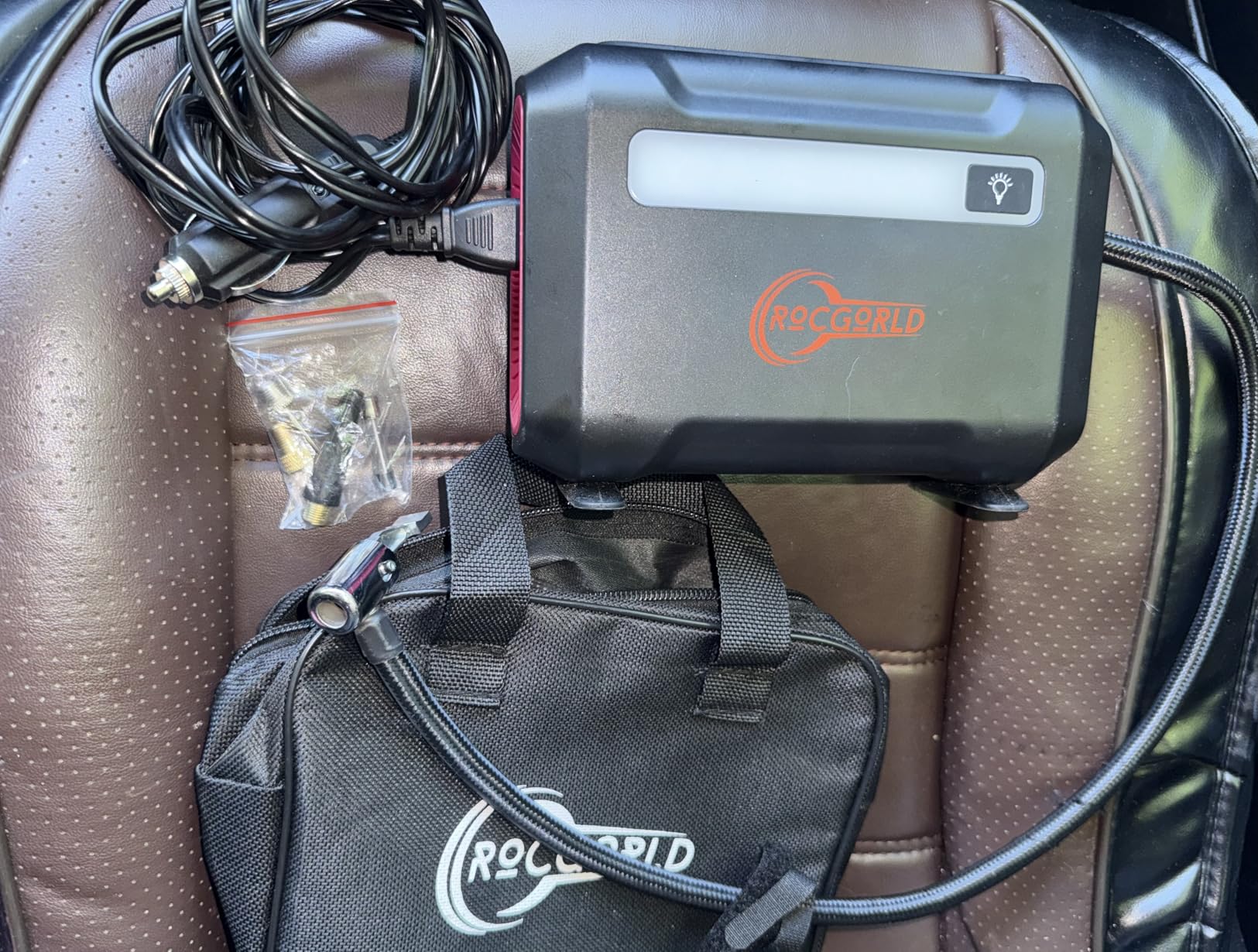
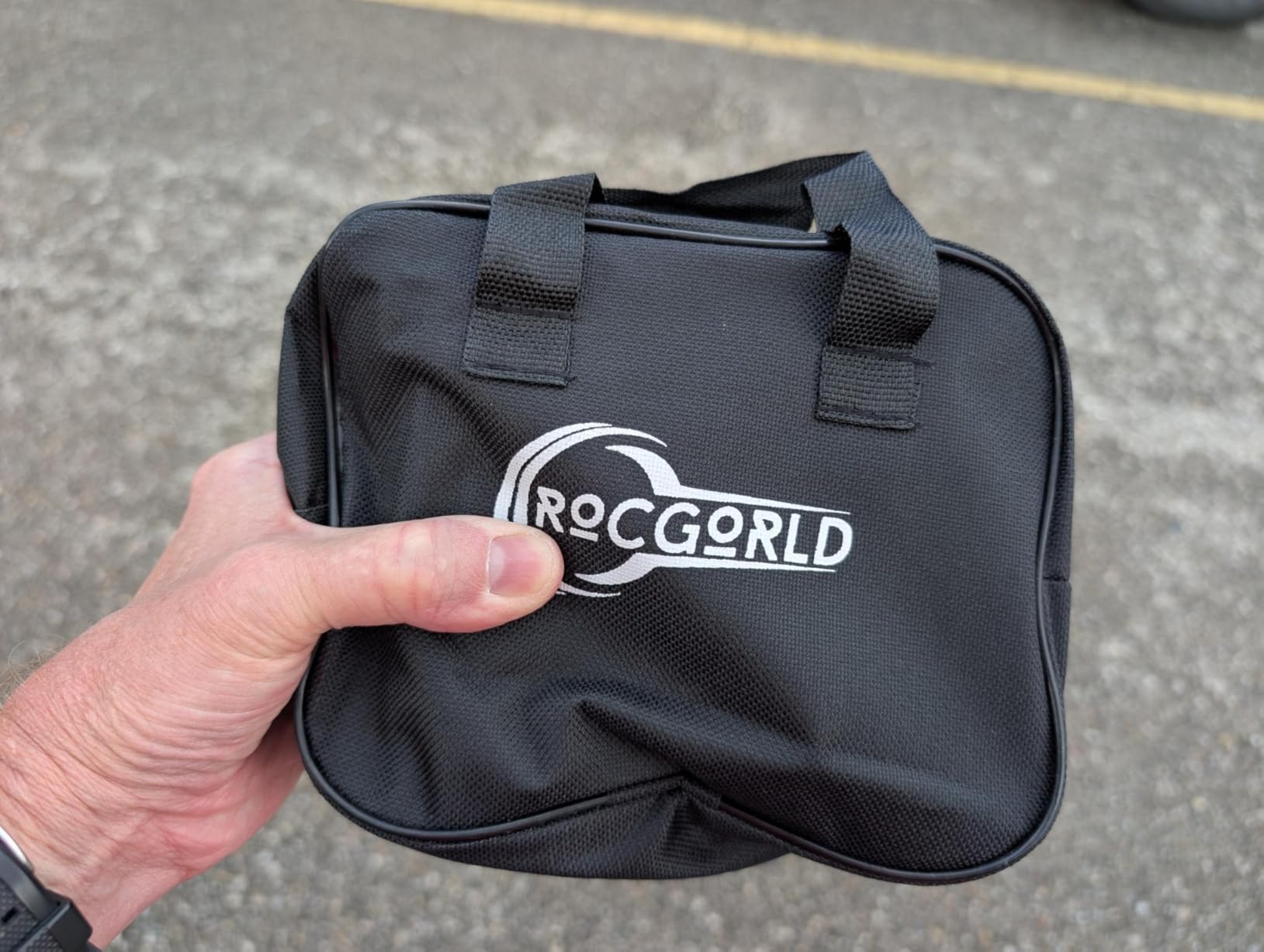
Specs worth noting: 150 PSI maximum, 10 A maximum current, 69 dB noise, a 10 foot power cord and a 2 foot hose, plus pressure memory so your SUV setting survives being unplugged. Three light modes cover roadside work at night, and the box includes a carrying bag, a Schrader to Presta valve, a needle valve, an extension nozzle, a fuse and a manual.
The most common complaint is not performance, it is reach. A 10 foot cord plugged into a rear console outlet on a three-row SUV may not reach the front passenger tire, which is the same limitation people report with other compact units. Several owners also note it gets warm after a full set of four tires.
Who this is right for
A daily-driver crossover or compact SUV kept in town, where the cord reach from the front seats is fine and the priority is a readable display, quick top-offs and a two-year warranty at a modest outlay.
It also works well for anyone inflating bikes, balls and other small items, since the needle and Presta adapters are in the box.
Who this is wrong for
Owners of long-wheelbase vehicles who plan to plug into a rear outlet. Measure before you buy, or you will end up moving the unit around.
Anyone inflating a fully flat tire from zero on a regular basis will find 120 watts slow for the job, and there is no battery or wall plug option if you need to work away from the vehicle.
8. ETENWOLF ZEPHYR S3: Best Compact Cordless Inflator
- Fills a 26.3 inch tire from 30 to 35 PSI in about a minute with plus or minus 1 PSI accuracy
- 100 percent duty cycle dual cylinder design inflates all four tires without cooldown pauses
- long hose
- rubber base and a small body that stores easily in a trunk
- four preset modes with pressure memory
- 300 lumen LED work light
- 7800mAh battery drains fast
- taking one tire from 11 to 38 PSI from four bars to one
- not intended to raise four fully flat tires from zero in one charge
- slow on a completely dead flat car tire
- instructions advise against storing it in the vehicle in summer heat
The S3 is the compact cordless answer. It shares the 100 percent duty cycle twin cylinder architecture of the larger ETENWOLF above, holds a 4.7 with 85 percent five-star reviews, and at 1.47 kg it is light enough to keep in a small SUV’s cargo area permanently. Gauge accuracy is stated at plus or minus 1 PSI, which is at the better end of what we saw.
Owners describe it as accurate, quiet for the class and well suited to seasonal top-offs and emergency air. Four preset modes with pressure memory means a two-car household can keep both pressures stored. The long hose and rubber base are practical touches that stop it walking across a wet tailgate.
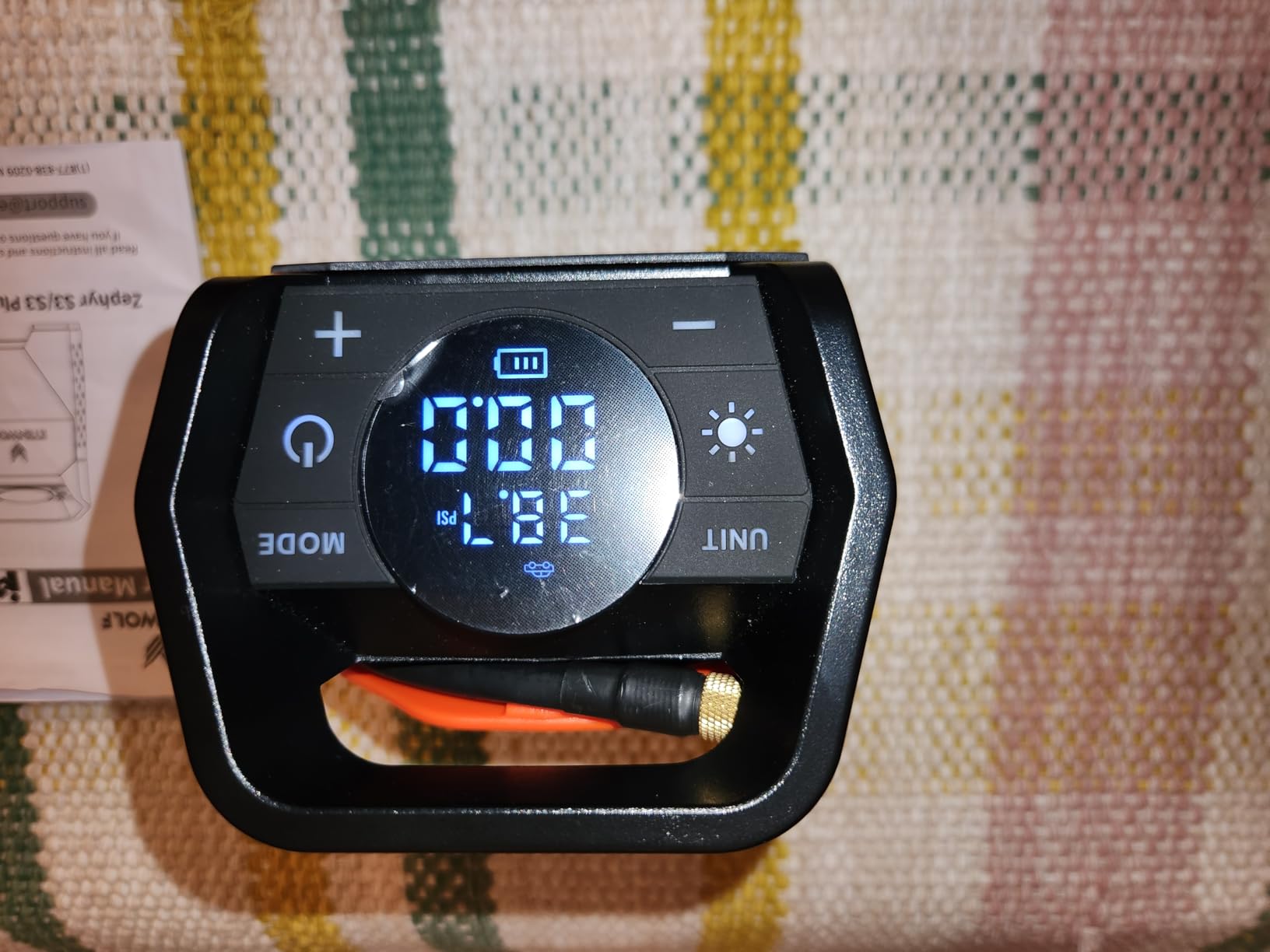
Where the compactness costs you is capacity. The 7800mAh battery is the constraint, and reviewers are specific about it: one tire from 11 to 38 PSI can take the pack from four bars to one. Manufacturer figures of up to 16 tires per charge assume modest top-offs, not a full set from flat. Airflow is 1.25 CFM, or 35 L per minute, and noise is listed at 78 dB.
The included kit is sensible for light use: air chuck, pressure hose, Presta adapter, inflation needle, a high-pressure tapered nozzle and a USB A to C cable. The instruction sheet advises against storing the unit in a vehicle over summer, which is a real limitation for anyone planning to leave one in a car in a hot climate.
Who this is right for
Drivers who want cordless convenience without carrying six pounds of pump, and who mostly top off rather than rescue. The 300 lumen light makes it useful for a night check in a parking garage, and pressure memory suits households with more than one vehicle.
It is also a reasonable first cordless unit, since it uses a standard USB-C cable rather than a proprietary charger.
Who this is wrong for
Anyone inflating 33 inch off-road tires or fully flat spares. The battery will not hold up, and the airflow is modest for that volume of rubber.
If you leave vehicles parked outdoors in summer heat, the manufacturer’s own storage advice argues against it, which is an unusual amount of honesty to find in this category.
9. AstroAI 12V DC and 120V AC Dual Power: Best Inflator for Home and Car Use
AstroAI Tire Inflator Portable Air Compressor, 12V DC/120V AC Dual Power
- Only unit here that runs on both 12V DC and 120V AC
- usable at home in the garage or in the vehicle
- large volume mode reaches 350 L per min for air mattresses and other low pressure items
- high pressure mode pumps to 150 PSI and refills 30 to 36 PSI in about a minute
- dual metal motors and metal cylinder with heat dissipation for 15 minute continuous runs
- power cut memory restores the last preset pressure
- Lowest rated unit in this group at 4.3 with a 10 percent one-star share
- not compatible with heavy duty trucks
- needs a 10 minute cool down after each 15 minute run and several owners report overheating on large tires
- LCD viewing angle is poor when the unit sits on the ground
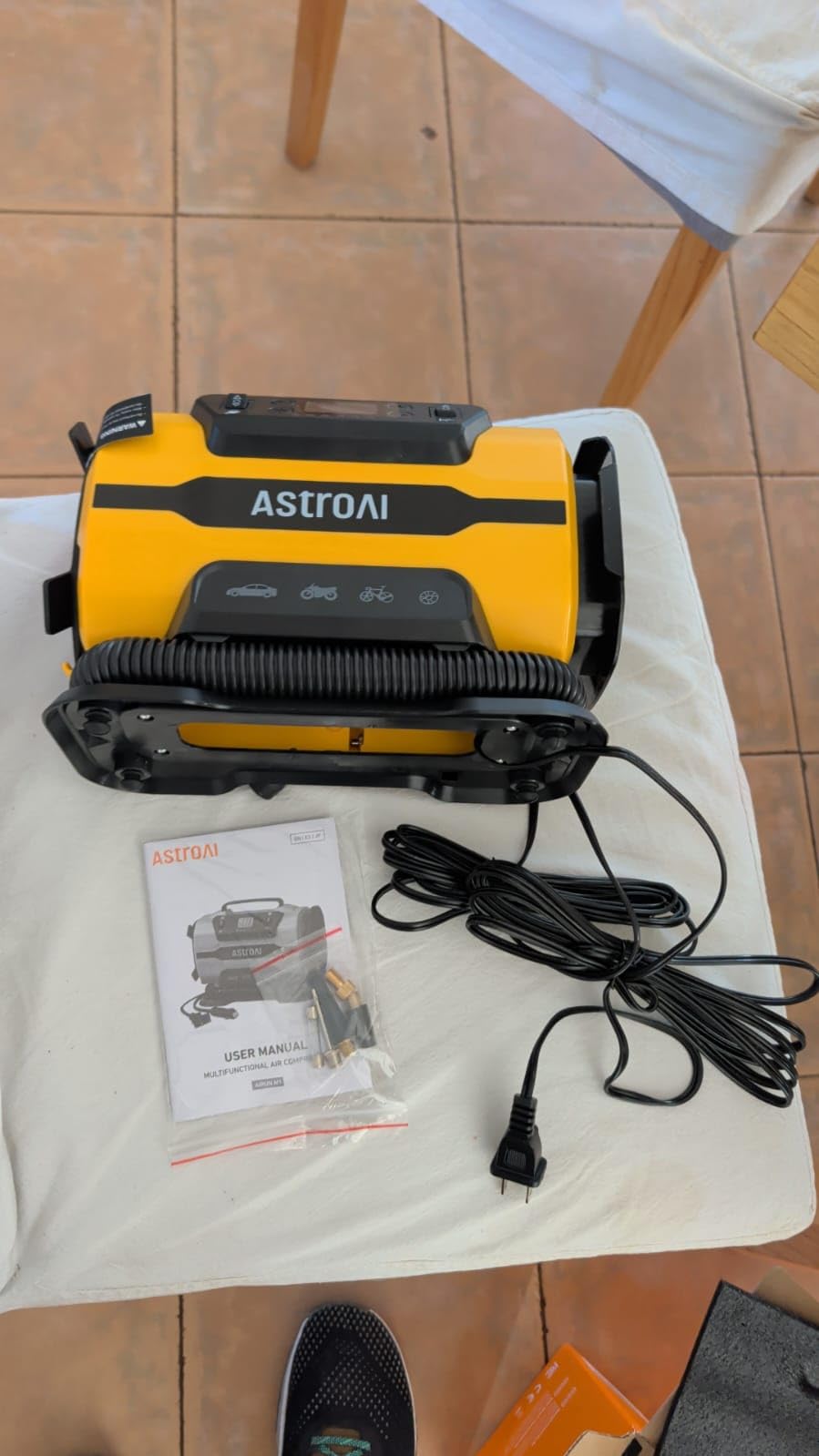
The reason this one is here is the dual power supply. It is the only unit in the roundup that runs from 12V DC and 120V AC, so the same pump pre-inflates a tire in the garage and then stays in the car for roadside work. For someone who already owns a wall compressor but wants a portable unit, that removes the single most common complaint about 12V-only inflators.
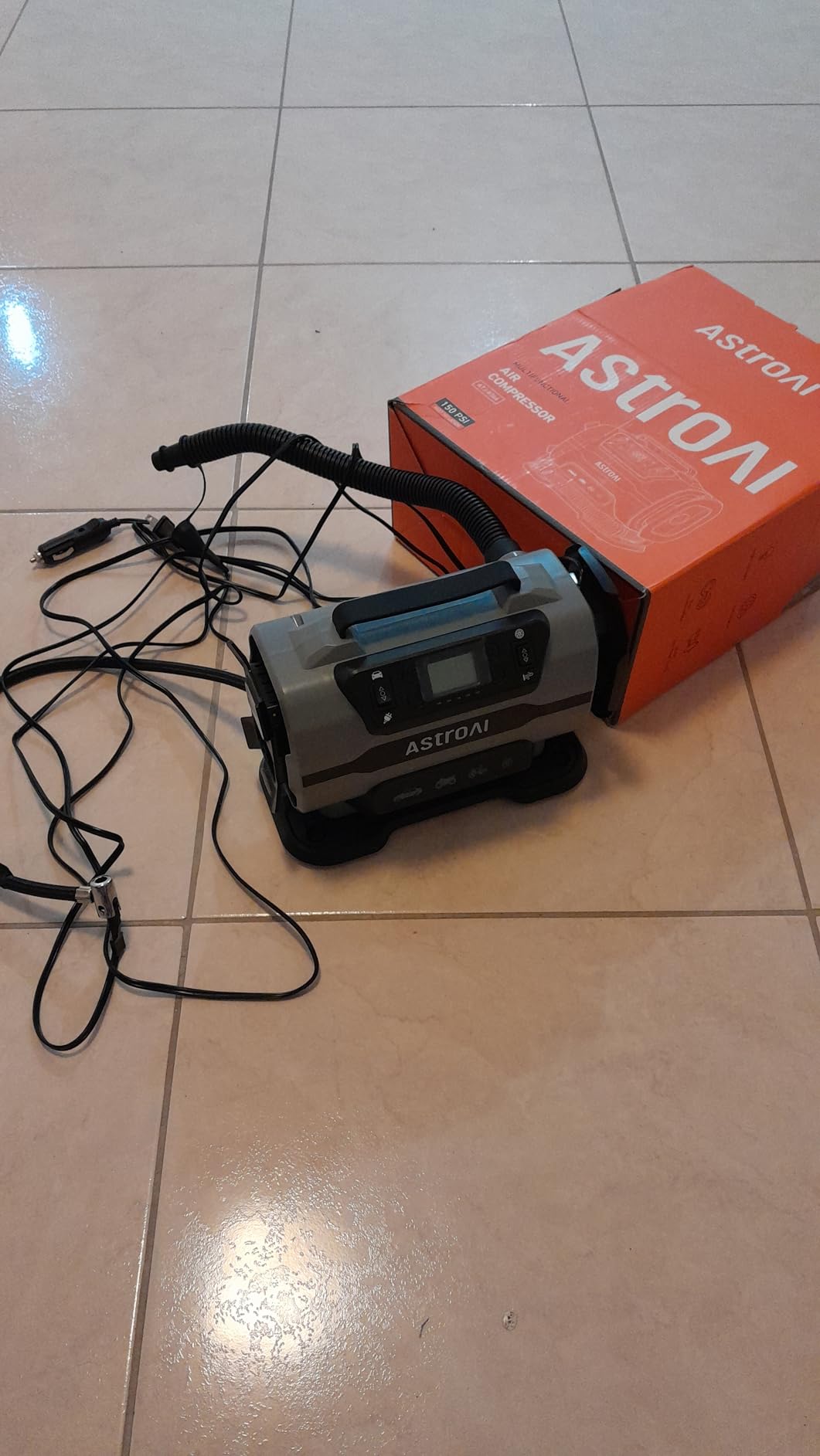
It is also a two-purpose machine. High pressure mode handles tires to 150 PSI, and large volume mode reaches 350 L per minute for air mattresses and similar items, which is a capability no other unit here claims at that level. The build is metal motors and a metal cylinder with OmniVent dissipation, plus an LED light, four display units and power-cut memory.
We rate this one last among the ten for a reason. It holds 4.3 with 6614 reviews, the lowest rating here, and about 10 percent of reviews are one star. Owners repeatedly describe heat build-up on sustained or high pressure use, and one report mentions a melted 12V lighter cord, which is a failure mode worth taking seriously before you park it next to a plastic console.
It is also listed as not compatible with heavy duty trucks, and the LCD viewing angle is poor when the unit sits flat on the ground, which is exactly how you use it on gravel. At 1.96 kg with a 27.48 inch hose it is not small, and the 15 minute run limit followed by a 10 minute cool-down is a real constraint on four-tire sessions.
Who this is right for
Homeowners with a garage who want one device for air mattresses in the house and tires in the driveway, without a separate high-volume attachment. The AC option is genuinely convenient for pre-inflation before a trip.
It also works for sedan and midsize SUV use where the pressure target sits comfortably inside its range.
Who this is wrong for
Owners of pickups, tow vehicles or anything on large tires, since it is explicitly not rated for heavy duty trucks and owners report overheating on big rubber. Given the heat complaints, it is also not the unit to leave in a vehicle in summer.
At 4.3 it is the weakest-rated product we included, and we would only pick it for the AC capability rather than for its tire performance.
10. CRAFTSMAN Portable 12V Inflator: Best for Small Trunks and Simple Operation
CRAFTSMAN Portable 12V Tire Inflator with Digital Gauge & Auto Shut-Off
- Small footprint with a listed weight of 1.13 kg
- fills a 195/65 R15 from 30 to 36 PSI in under a minute at up to 150 PSI
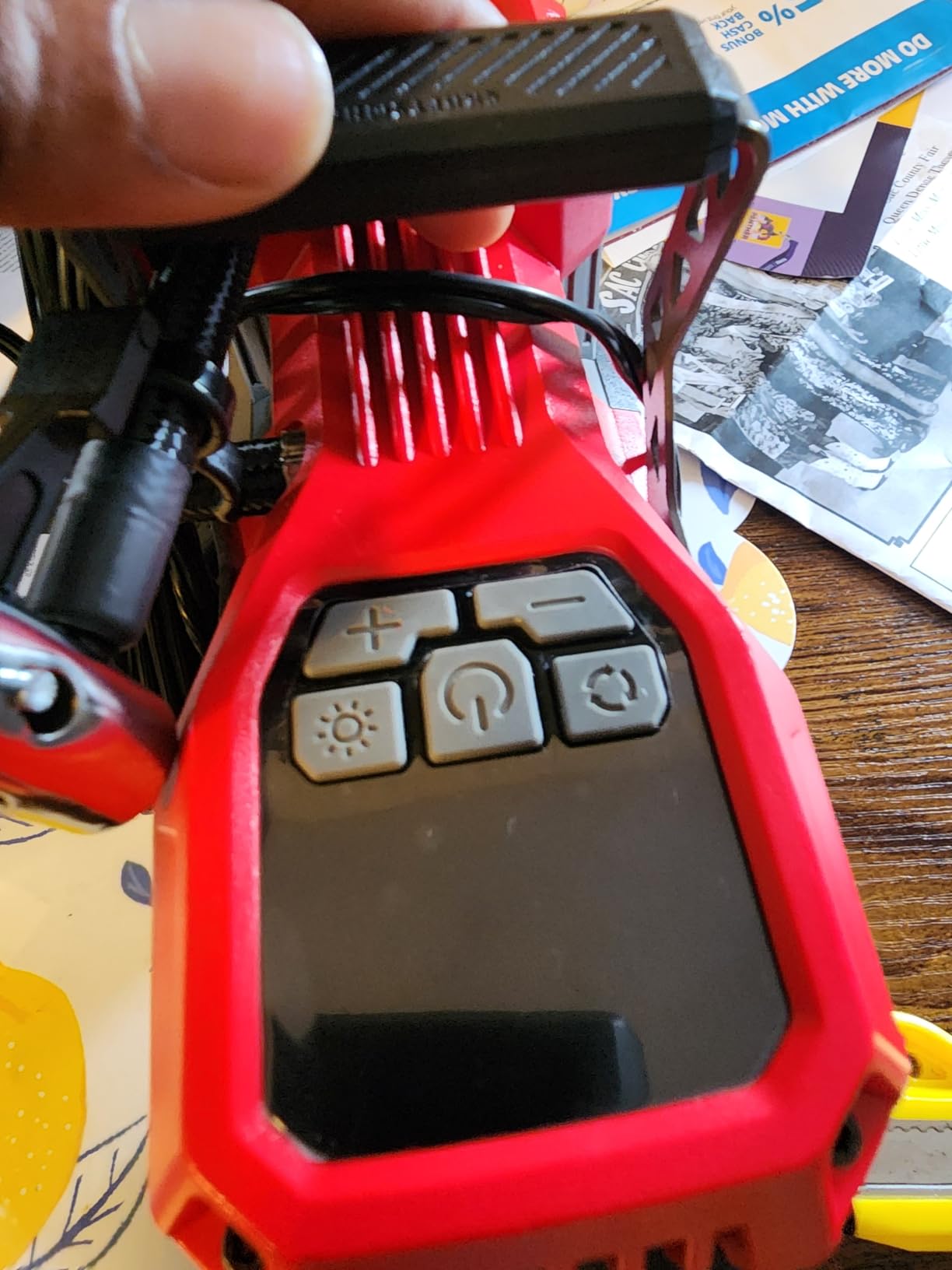
- simple auto shut-off with PSI
- BAR and kg/cm2 presets
- 10 foot 12V plug cord plus 2.17 foot hose with built-in cord storage and a carry bag
- three mode LED light and an LCD showing current and target pressure
- praised by older users as one of the easiest units to operate
- Slower than larger units at inflating a tire from completely flat
- 2.17 foot air hose is short compared with most competitors
- no battery option
- 12V DC power only
- newer listing with a smaller review base
The CRAFTSMAN is the least complicated unit in the roundup, and that is its argument. Set a pressure in PSI, BAR or kg per square centimetre, press start, and the motor stops on its own. Older users in particular call out how straightforward the interface is, which matters more than any spec when the person using it is your partner or a roadside stranger.
It carries 4.6 across 284 reviews. That is a small base compared with the others, so treat it as a newer listing rather than a proven one, but the stated performance is credible: a 195/65 R15 from 30 to 36 PSI in under a minute, up to 150 PSI maximum, with a 10 foot cord and a 2.17 foot hose.
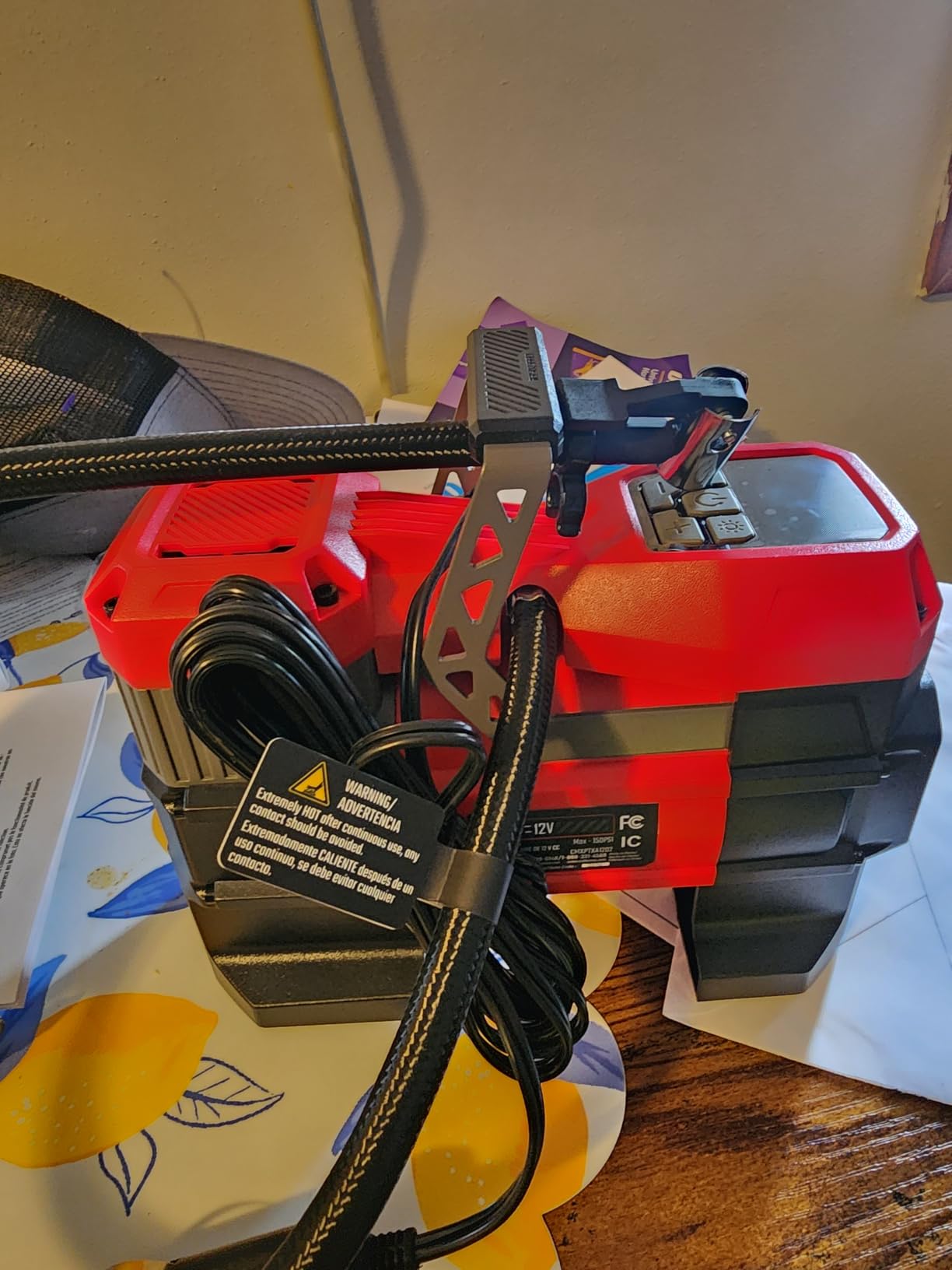
Physical numbers: 1.13 kg, a 2.17 foot hose, and noise listed at 78 dB. The box includes a carry bag, a Presta valve adapter, an inflatable adapter, a ball needle, an extra fuse and a manual. The hose is short, which is the main thing to understand before buying, since you will be working right at the wheel rather than reaching across a vehicle.
The main limitation is the one that matters for a low-pressure tire. Reviewers consistently say it is slower than larger units when a tire is completely flat, which is a different job from adding a few PSI. If your use is monthly top-offs, that is fine. If your use is rescuing a tire after a highway blowout, look at a unit with more airflow.
Who this is right for
Someone with a small crossover who wants a pump simple enough that anyone in the household can use it, and light enough to keep within reach rather than buried in the cargo well. The three-mode LED is useful for a pre-trip check in the dark.
It is also a sensible second unit for a household where one person handles pressure checks on a small vehicle.
Who this is wrong for
Anyone running larger tires or regularly recovering a flat. The 2.17 foot hose and the slow flat-tire recovery are the two reasons it sits at the bottom of this list rather than higher.
It is cord-only as well, so it does nothing for a campsite or a trailer far from a vehicle.
What PSI Do SUV Tires Actually Need?
Start on the driver’s door jamb, not the tire sidewall. The sidewall number is the tire’s maximum cold pressure rating, and setting your SUV to it is one of the most common ways people end up with an over-inflated, poorly handling vehicle. The door sticker is the factory cold inflation pressure for the tire and trim combination the vehicle actually shipped with.
Cold means the vehicle has been parked for at least three hours or driven less than a mile. Driving heats the air inside the tire and raises the displayed reading, which is why a check after a highway run can read several PSI high and tempt you to bleed air. Check before you drive, or add roughly 3 to 5 PSI to the door-sticker figure if you have no choice.
Sizes vary too. A crossover on 30 or 31 inch tires typically sits in the low to mid 30s. Many midsize and full-size SUVs on factory equipment run 35 to 38 PSI, and adding 33 inch or 35 inch off-road tires to the same vehicle means you need the door-sticker figure for that larger tire, and a pump with headroom above it. If a pump tops out at 100 PSI you have no margin at all, which is exactly why the entry-level unit in this roundup is not a good match for an off-road build.
Cold weather deserves its own note. Pressure falls as temperature drops, commonly about 1 PSI for every 10 degrees Fahrenheit, so a tire set correctly in September can read 4 or 5 PSI low in January. That is also why a tire monitoring system tends to light up on a cold morning. Top off to the door-sticker number when the tires are cold, and the warning usually clears on its own after a short drive, since the sensors reset as pressure rises.
How to Choose a Digital Tire Inflator for SUVs?
Get the PSI ceiling right first, and interpret it correctly. A ceiling of 150 or 160 PSI is not a tire size, it is a maximum the pump can reach. What matters is whether the ceiling sits comfortably above the pressure your tires need plus a margin. For stock tires in the mid 30s, anything from 100 PSI upward works. For 33 inch off-road rubber, 150 PSI is the sensible floor.
Then read the duty cycle, which is where most listings go quiet. A 100 percent duty cycle unit is designed to run continuously with a cooling system to match. A 50 percent duty cycle unit, or one that auto-stops after 15 minutes, is telling you to pause. If you plan to fill four tires in one session, that distinction saves you half an hour of waiting.
Airflow in litres per minute tells you how much of your evening it will take. Units here range from 35 L per minute for top-off duty up to 70 L per minute for a double cylinder corded pump, and the manufacturer or owner claims attached to specific tire sizes are the best guide. Treat a claim of a 31 inch tire from 30 to 35 PSI in about a minute as a top-off figure, since filling from flat takes several times longer.
Accuracy comes down to auto shutoff and unit switching. A digital gauge that lets you set a target in PSI, BAR, kPa or kg per square centimetre and stops itself is the reason these products exist. The factory-calibrated figure of about plus or minus 1 PSI quoted by ETENWOLF is a concrete example of a stated tolerance; where a listing gives none, ask yourself how you would know the reading was wrong.
Power source is the decision that costs owners the most. A 12V DC plug-in unit is unlimited in runtime but limited by the auxiliary outlet, and a 30-year-old socket has been reported straining to fill SUV tires. Cordless gives you freedom and no lead to trip over, at the cost of battery capacity. Direct battery clamps avoid the outlet entirely and are the method recommended on owner forums for very large tires. A tool battery platform costs nothing extra only if you already own the packs.
Storage footprint is the last filter, and it decides whether the pump gets used. A 800 gram unit in a door pocket will be used monthly. A six-pound unit in a garage will be used twice a year. Match the weight to how often you expect to top off, and check that the cord and hose reach from wherever you plan to plug in, especially on three-row vehicles.
What to avoid is straightforward: units marketed as truck and SUV capable that quote a maximum PSI but never mention duty cycle, digital gauges with no stated accuracy and no auto shutoff, cordless packs with small capacity sold for large tires, and anything that claims compatibility without a 12V current figure. The forum consensus we came across is that undersized auxiliary outlets, over-inflation from unreliable shutoff, and heat-limited duty cycles cause most of the disappointment in this category.
Corded vs Cordless vs Tool Battery for SUV Tires
Corded 12V units win on runtime and lose on freedom. They never run out, they generally draw the most current, and the longer cord plus extended hose models can reach any tire on a long wheelbase vehicle. Their weakness is the auxiliary outlet itself, which on older vehicles may not deliver the current a double cylinder pump wants. A shorter plug-in hose and a small motor, however, means a unit that is genuinely annoying to carry.
Cordless units invert the trade. You get a 12V or 20V internal battery, a long reach, and no lead across a dark road. You give up runtime on big tires, and the small packs drain fast on high volume work, as the compact cordless review above shows clearly. Cordless makes the most sense when you check pressure away from a vehicle and when your tires need small top-offs rather than full fills.
Tool battery platforms are the cheapest option only in a specific case: when you already own the packs. Owners describe power tool brand inflators as the safe default, and the arithmetic is simple, since the battery and charger are sunk costs. If you do not own the platform, the premium reviews in this category are buying a second charging ecosystem for one tool, which is hard to justify unless you plan to buy more of that brand’s gear.
Direct battery clamps sit outside the three categories but matter for large tires. Connecting straight to a vehicle battery bypasses the auxiliary outlet entirely and is the endorsed approach on owner forums for very large off-road rubber, where a compromised socket can brown out mid-inflation.
Digital vs Analog Gauges: Which Is More Accurate?
Digital wins on the two things that matter in the field: repeatability and shutoff. A digital gauge reading 34.8 PSI four times in a row tells you something consistent, and a preset target that switches the motor off is the only reliable protection against over-inflation. Owners of the units in this roundup consistently describe the gauge giving the same number across all four tires, which is the behaviour you want.
Analog dials have one genuine advantage: no battery and no electronics to fail on a cold night in a parking lot. A pencil gauge is also free. But a small analog dial is harder to read accurately, offers no shutoff, and gives no way to know you hit your target rather than overshot it by a few PSI. For a vehicle as heavy as an SUV, where tire pressure affects handling and braking, we would use digital every time.
The practical accuracy question is less about the screen and more about where the pressure is measured and how the sensor behaves at low and high ends. The better-specified units in this roundup state a tolerance of about plus or minus 1 PSI and describe factory calibration against a hand gauge. Where a listing offers no tolerance figure at all, that silence is the answer.
Frequently Asked Questions
What is the best tire inflator for an SUV?
The AstroAI Cordless Tire Inflator 160PSI is our top pick for most SUVs. It has a 160 PSI ceiling, a 20V cordless battery with 12V DC backup, and a metal cylinder and gear system rated for 20 minutes of continuous operation. Owners top off all four tires from one charge. For heavier vehicles, the ETENWOLF VORTEX S6 offers a 100 percent duty cycle twin cylinder pump and a 19200mAh battery.
What is the most accurate tire inflator?
Accuracy comes from a stated tolerance plus a reliable auto shutoff, not from the screen size. The ETENWOLF VORTEX S6 and ZEPHYR S3 both state factory calibration to about plus or minus 1 PSI, verified against a hand gauge. Digital units that repeat the same reading across all four tires give you the repeatability that matters more than the decimal place.
What is the most reliable portable tire inflator?
Reliability usually tracks duty cycle, thermal design and warranty length. The ETENWOLF VORTEX S6 runs a 100 percent duty cycle twin cylinder with a dedicated cooling system, carries a two-year warranty and holds 4.7 across 2879 reviews. The DEWALT DCC020IB carries the longest warranty here at three years, but its 80 PSI ceiling limits it to smaller tires.
Are digital tire inflators better than analog ones?
For anything involving an SUV, yes. A digital gauge can hold a preset target in PSI, BAR, kPa or kg per square centimetre and switch the motor off when it arrives, which is the only dependable guard against over-inflation. An analog dial needs no battery, which helps on a cold night, but it offers no shutoff and a coarser reading. We would use digital for tires and keep a pencil gauge as backup.
How long does a portable inflator take on a full SUV tire?
It depends on airflow and how much air is missing. The corded double cylinder GSPSCN moves 70 L per minute and is claimed to fill a 200/70 R18 from 0 to 35 PSI in about a minute, while the ETENWOLF VORTEX S6 is claimed to fill a 31 inch tire from 30 to 35 PSI in about a minute. Adding a few PSI takes seconds. Filling a completely flat tire takes several times longer.
Do I need a 150 PSI or 200 PSI inflator for my SUV?
You need headroom above your tire’s target pressure, not a round number. Stock crossover and full-size SUV tires usually sit between 33 and 40 PSI, so a 150 or 160 PSI ceiling is plenty. If you run 33 inch or 35 inch off-road tires, 150 PSI is the sensible floor and higher gives margin. A 100 PSI ceiling leaves too little room, and an 80 PSI ceiling is not an SUV tool.
Final Verdict
If you take one recommendation from this roundup, take the AstroAI Cordless Tire Inflator 160PSI. It hits the specs an SUV actually needs, a 160 PSI ceiling, cordless freedom with 12V DC backup, and a 20 minute continuous run rating, at 4.6 across 16726 reviews. It is the pick we would put in the cargo area and actually use every month.
Buy the ETENWOLF VORTEX S6 instead if your tires are large, you tow, or you fill all four in one sitting and the duty cycle matters more than carry weight. Buy the AstroAI AIRUN H if you want proven and inexpensive and your tires are ordinary. Use the guide to choose the best portable tire inflators alongside this list if you also need a unit for a sedan, a bike or a trailer, and check your door-jamb pressure before you set any target on any of them in 2026.