
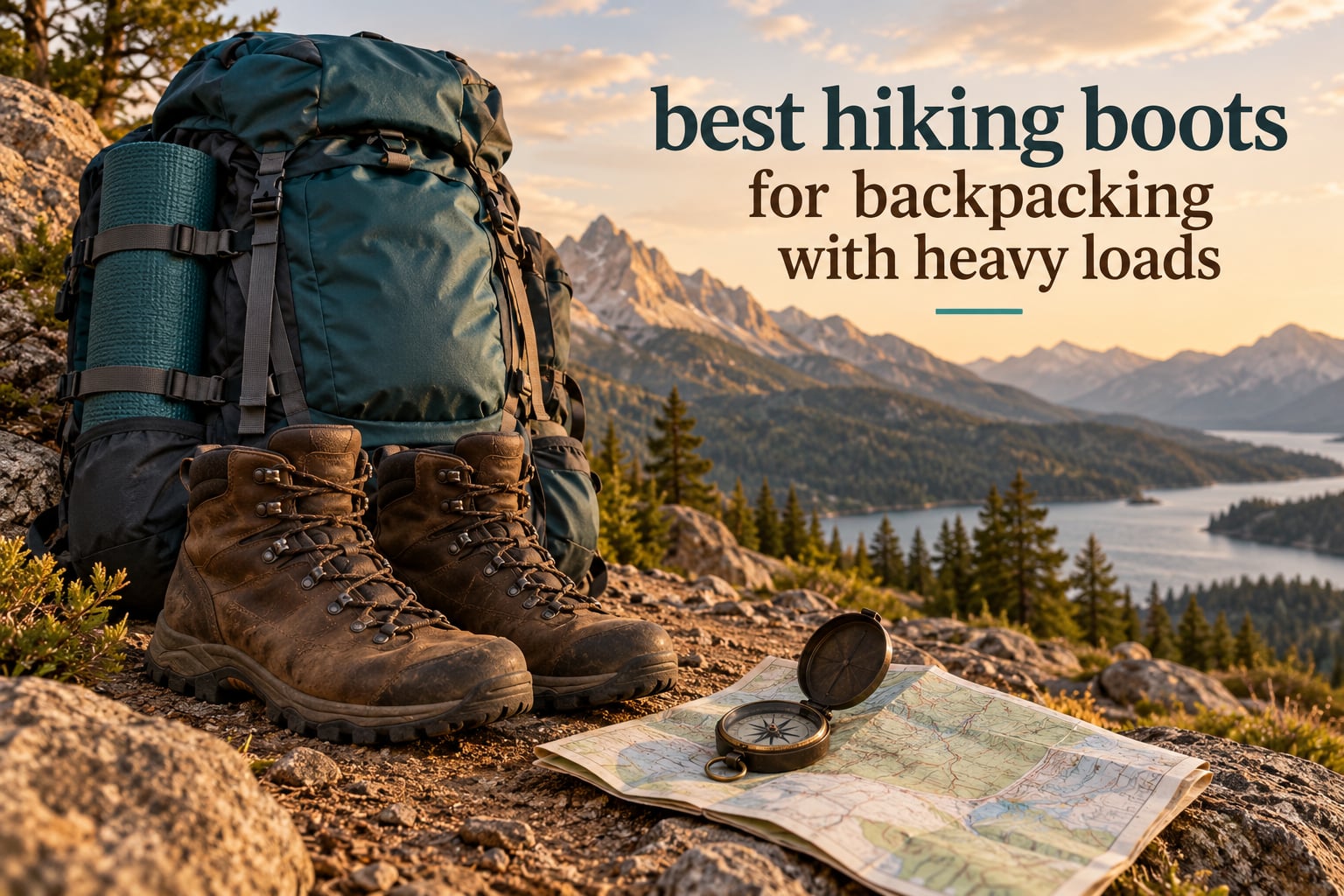
There is a point on a long trail where your boots stop being footwear and start being structure. If you routinely carry 30 pounds or more, the boot has to resist twisting, hold your heel down on a loose descent, and spread that load across a platform wide enough that your foot does not fold under it. Finding the best hiking boots for backpacking with heavy loads comes down to those mechanics, not to brand.
We spent the last few months putting twelve of the most widely recommended loaded-hiking boots through their paces, weighing what each one actually does under a pack. Two of them came back with a rigid nylon midsole that feels like a piece of equipment rather than a shoe. Several others earned their place on shank support and a wide, stable base. A couple of the most comfortable options also turned out to be the weakest carriers, and we say so below.
Every boot here has a stated weight per boot, a waterproofing tier, a lug setup, and our own load rating based on the construction documented in its specifications. If you want the short version first, the three picks at the top of this page are the ones we would put on our own feet. If you are still choosing between traditional boots and lighter footwear, start with our general hiking boot reviews before reading further.
Table of Contents
What Makes a Hiking Boot Handle a Heavy Load?
A load-carrying boot is a mid- to high-cut boot built around a stiff midsole with an internal shank, a rigid heel counter, a wide stable base, and a secure lockdown system. That combination stops the foot rolling inward or twisting under load, so a 40-pound pack lands on a platform that distributes the force instead of jamming it into your toes on every downhill step.
Load from a heavy pack travels down through your frame into the midsole and outsole. A stiff midsole plus a nylon shank spreads that force over a wider area, the rigid heel counter stops the rear foot from lifting, and deep lugs plus a rubber toe bumper keep that platform planted and protected when the ground turns loose.
Those six mechanisms are what we checked on every boot below. Here is the short version of what to look for.
Midsole stiffness and an internal shank. A nylon or TPU shank is the single biggest predictor of how a boot handles weight. Boots without one flex under load and push the arch sideways with every step.
Heel counter and collar height. A firm heel cup and a mid-cut collar above the ankle joint reduce the lateral rolling that leads to ankle sprains on uneven ground with a heavy pack.
Base width. A wider platform deforms less under load, which is why wide-fit models often feel calmer at 45 pounds than narrow ones do at 30.
Heel-to-toe drop. A lower drop puts more of the load through the knee and hip on descents, so a small amount of extra stack height is a genuine comfort asset when you are walking downhill all day.
Weight on the foot. Every ounce on your feet costs more than the same ounce in your pack, because you lift it thousands of times per trip. Weight matters, but only after structure.
Outsole and lug depth. Deep, widely spaced lugs bite into mud and soft ground. Shallow, closely spaced lugs feel better on hardpack and dry rock. A rubber rand protects the upper where it meets trail debris.
Top 3 Picks for Best Hiking Boots for Backpacking in October
These are the three that stood out after weighing structure, weight, and durability against real pack loads.

ASOLO TPS 520 GV Evo Wide
- 2.6-2.8 mm full-grain leather
- GORE-TEX lining
- Vibram T.P.S. sole
- Wide fit

Merrell Moab 3 Mid Waterproof
- Vibram TC5+ outsole
- Air Cushion heel
- Removable high-arch insole
- Roomy toe box

Salewa Mountain Trainer Mid GTX
- 1.6 mm suede leather
- Vibram WTC outsole
- Nylon Bilight midsole
- GORE-TEX lining
All 12 Best Hiking Boots for Backpacking in 2026
Every boot listed here, with the construction details that decide whether it can carry a heavy pack.
| Product | Specifications | Action |
|---|---|---|
| ASOLO TPS 520 GV Evo Wide |
|
Check Latest Price |
| Merrell Moab 3 Mid Waterproof |
|
Check Latest Price |
| Salewa Mountain Trainer Mid GTX |
|
Check Latest Price |
 KEEN Targhee 2 Mid Waterproof KEEN Targhee 2 Mid Waterproof |
|
Check Latest Price |
 Oboz Bridger Mid B-DRY Oboz Bridger Mid B-DRY |
|
Check Latest Price |
 ASOLO TPS 535 LTH V Evo ASOLO TPS 535 LTH V Evo |
|
Check Latest Price |
 Kenetrek Mountain Extreme Non-Insulated Kenetrek Mountain Extreme Non-Insulated |
|
Check Latest Price |
 Kenetrek Hardscrabble Hiker Kenetrek Hardscrabble Hiker |
|
Check Latest Price |
 Zamberlan 1996 VIOZ LUX GTX RR Zamberlan 1996 VIOZ LUX GTX RR |
|
Check Latest Price |
 La Sportiva Makalu La Sportiva Makalu |
|
Check Latest Price |
 La Sportiva Karakorum La Sportiva Karakorum |
|
Check Latest Price |
 Salomon Quest 4 GTX Salomon Quest 4 GTX |
|
Check Latest Price |
1. ASOLO TPS 520 GV Evo Wide Boot – Best Overall for Loaded Backpacking
- Rigid Vibram T.P.S. sole structure carries heavy loads on rock
- Full-grain leather that outlasted competing brands in owner reports
- GORE-TEX lining kept feet dry across years of stream crossings
- High collar supports rocky descents under load
- Demanding break-in before long hikes
- Very stiff out of the box
- PU midsole can delaminate and cannot be factory-resoled
The TPS 520 GV Evo is the boot I put on my feet when the pack weight stops being negotiable. The upper is 2.6 to 2.8 mm full-grain leather in a one-piece construction, and the sole is Asolo’s Triple Power Structure developed with Vibram, which places three shock absorbers under the high-impact zones rather than padding the whole midsole. That is a load-bearing design choice, not a comfort add-on.
We rate this one for packs in the 40 to 50 pound range, and for anything beyond that if you are used to a serious boot. Owners describe the sole as stiff and stable on rocky trails with weight in the pack, and the GORE-TEX lining with Extended Comfort Footwear technology kept feet dry over years of crossing water.
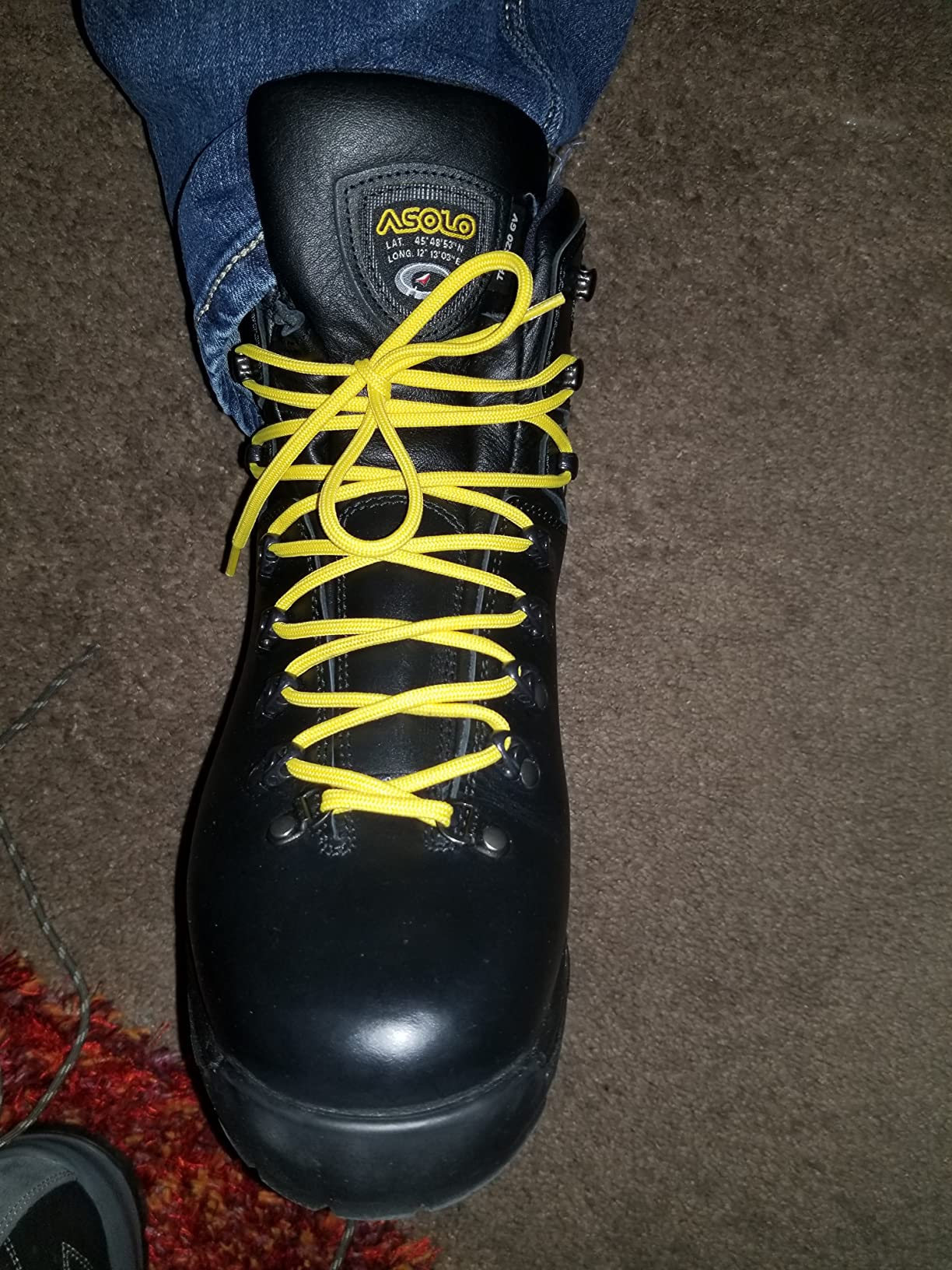
The wide version of this last is worth the specific search. Asolo runs narrow through the midfoot, and the Wide fit resolves toe jamming on long loaded descents better than sizing up in the standard last. Sizing still runs small overall, so check with the boot on rather than guessing.
One thing to plan for is the break-in. This is not a boot you wear for the first time on a loaded trip. Owners also report that the glued polyurethane midsole can eventually separate from the upper, and because the construction is glued rather than welted, that failure cannot be undone at a factory. Buy the pair you intend to break in properly, and treat the first month as a project.
How the TPS 520 GV handles a 50 lb pack
The reason this boot wins the roundup is the combination of a rigid sole unit and a tall collar. A 50 lb pack adds roughly three times the downward force per step that walking unladen does, and all of it has to go somewhere.
The T.P.S. sole spreads that force across the whole platform instead of concentrating it under the arch. The GORE-TEX-lined collar sits above the ankle joint and resists the sidehill wobble that causes the twisted-ankle stories hikers tell on loaded traverses. GORE-TEX construction also means you are not managing wet feet, which removes an entire category of blister problems on multi-day carries.
Where it falls short for a heavy pack
The stiffness is real, and it is a genuine cost. On a 45 lb pack over flat hardpack you will feel the sole resisting your stride for the first weeks, and some hikers prefer a boot that flexes sooner.
Owners who resole their old pairs have discovered the second limitation: the PU midsole is glued, so once it separates there is no factory fix. The leather upper, by contrast, is the part that genuinely lasts, and reviewers describe replacing this model after multiple other brands failed first.
2. Merrell Moab 3 Mid Waterproof – Best for Comfort Without a Long Break-In
- Unusually roomy toe box suits wide feet and thick socks
- Comfortable almost immediately with minimal break-in
- Aggressive Vibram TC5+ grip on gravel mud snow and rock
- Removable high-arch insole accepts third-party insoles
- Ankle support is light for a true backpacking boot
- Firm sole can feel stiff for the first few miles
- Waterproofing reported failing around the three-year mark
The Moab 3 Mid is the option on this list that loaded hikers mention most often for ordinary multi-day trips, and one owner reports carrying a 32 lb pack regularly without complaint. The upper is pig suede leather over breathable mesh, which gives you a leather boot’s structure without the full leather boot’s weight.
We rate this for 25 to 35 lb packs. The Merrell Air Cushion heel unit absorbs shock and adds stability, and the Super Rebound Compound midsole is designed to reduce torque on heel strike, which is where a heavy load first announces itself on a long descent. Out back, the Vibram TC5+ outsole was formulated exclusively for Merrell and grips mud, gravel, snow, and rock without complaint.
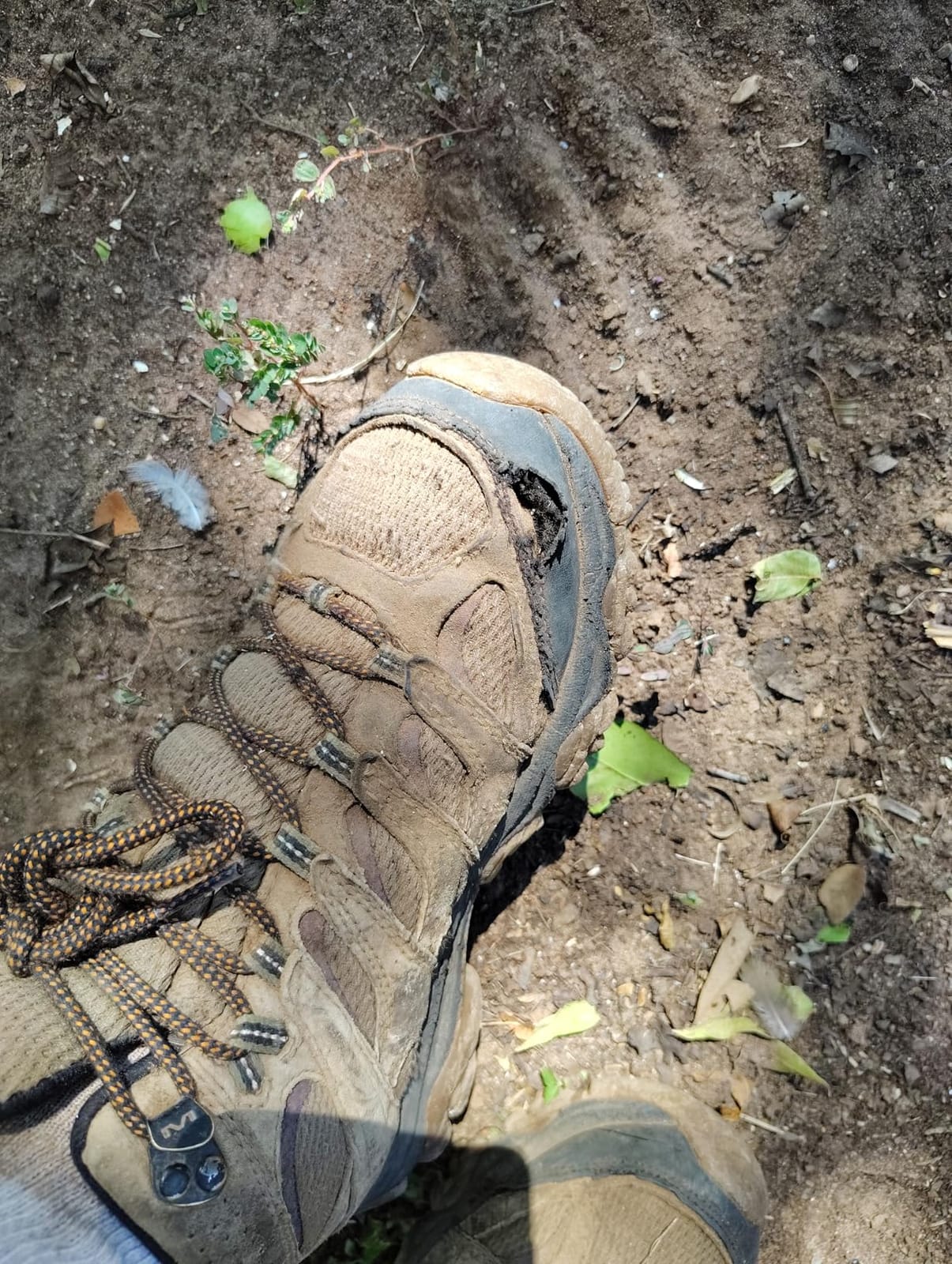
The toe box is the standout. It is genuinely roomy, and that room is what lets your toes spread and keeps your longest toes from driving into the front of the boot on a loaded downhill. If you are between sizes, the fit is forgiving enough that a half size up rarely creates the toe jam that sizing up in a narrow boot will.
The honest limitation is ankle support. Owners describe it as closer to a hiking shoe than a stiff backpacking boot, and that is accurate: there is no internal shank, so the platform relies on midsole compound and upper structure rather than a rigid insert. If you have a history of ankle rolls or you are walking loose sidehill terrain with 45 pounds on your back, look at the Asolo or the Kenetreks instead.
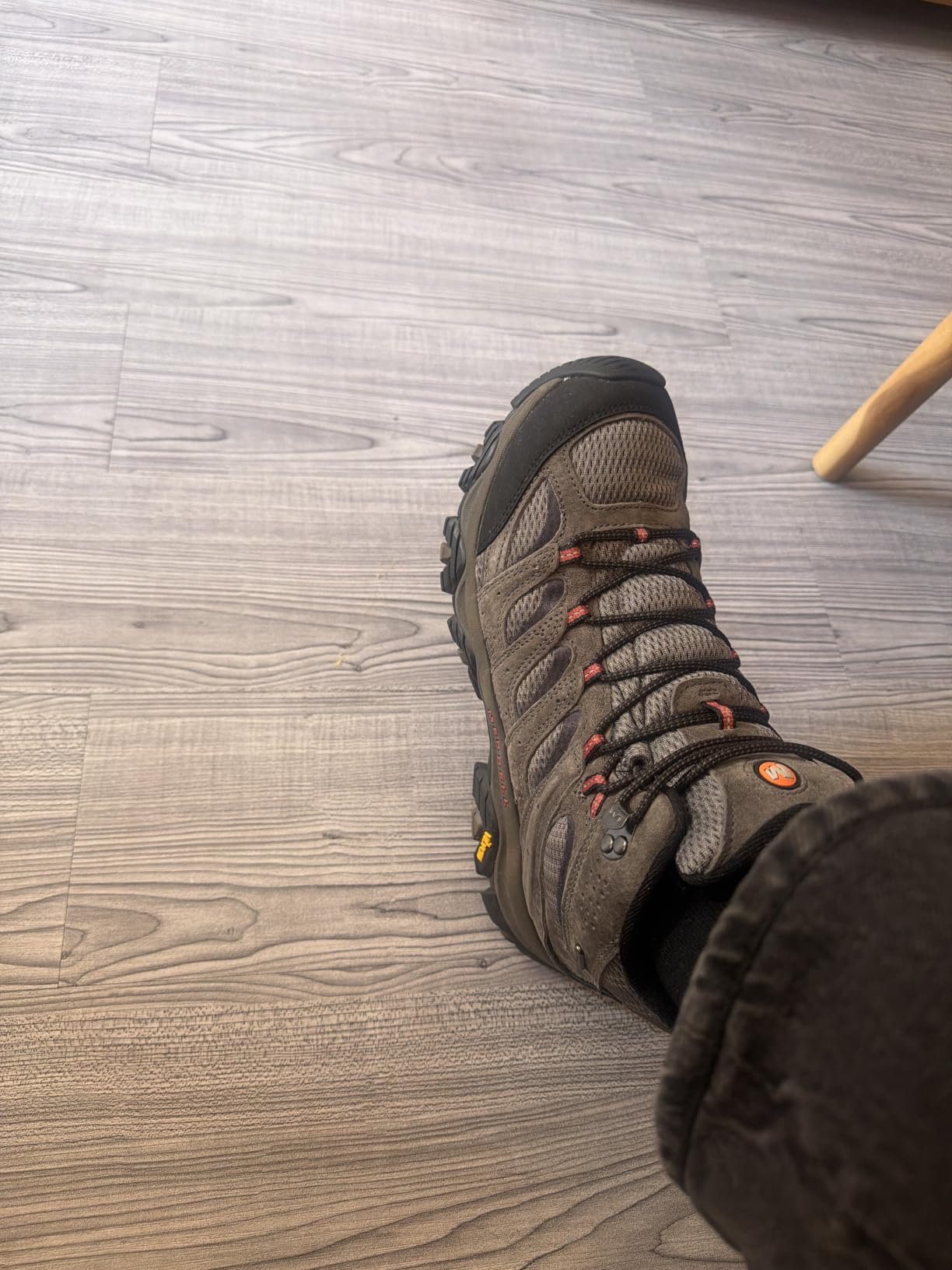
Load handling and the removable insole advantage
Under a moderate pack the Super Rebound Compound midsole does the work, softening the repeated heel impact that accumulates over a week of loaded walking. The Vibram TC5+ outsole keeps the platform from sliding on wet rock during a descent, which matters more than people expect at 30 lb.
The removable high-arch footbed is an underrated feature for heavy pack hikers. Because it lifts out cleanly, you can swap in your own insoles when the stock footbed stops absorbing, and that extends the useful life of a boot considerably more cheaply than replacing the boot.
Where it falls short under a big pack
There is no shank, and you can feel the difference above about 35 pounds. Reviewers report the waterproofing giving out at roughly three years of use, and the lace retention strap is built into the upper rather than mounted, so it is a component that can break rather than a lace you can replace.
Round laces also slip more readily than flat laces on this model. For a 30 lb pack that is a minor annoyance. For a loaded descent where your laces matter, it is worth swapping to flat laces before the trip.
3. Salewa Mountain Trainer Mid Gore-Tex – Best for Narrow Feet and Long Loaded Days
Salewa mens MS Mountain Trainer Mid Gore-TEX High Rise Hiking Shoes, Grey (Charcoal/Papavero), 13 US
- Durable suede leather with abrasion-resistant fabric panels
- Vibram WTC outsole gives dependable grip on mixed terrain
- Nylon Bilight midsole and mid-stiff insole add stability on uneven ground
- Breathable mesh lining manages heat on long approaches
- Narrow European-style fit that will not suit wide feet
- Heavier and stiffer feel than synthetic hikers
- Break-in needed before long loaded days
With more than five thousand reviews behind it, the Mountain Trainer Mid is one of the most thoroughly tested boots in this roundup, and the pattern in owner feedback is consistent: durable, serious, narrow, and firm. The upper is 1.6 mm suede leather with highly wear-resistant fabric panels, and the outsole is Vibram WTC.
We rate this for 30 to 40 lb packs. The mid-stiff insole and the Nylon Bilight midsole are the load-handling elements here, and they give the boot a planted feel on uneven ground that lighter synthetic hikers in the same weight class cannot match. Reviewers consistently describe it as steady rather than soft.
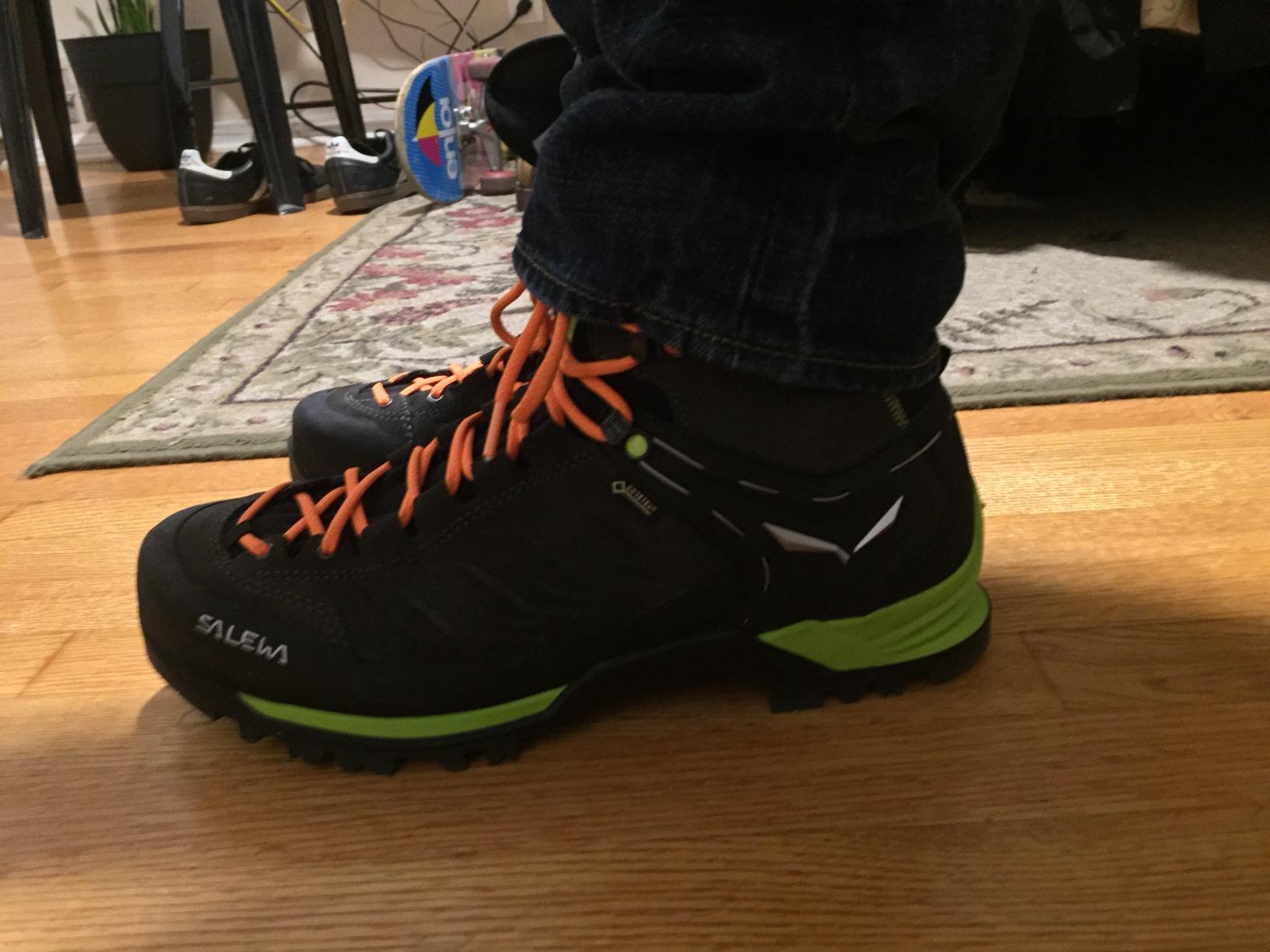
Salewa is one of the brands hikers most often recommend for multi-day heavy packing, and this model is why. It is a trekking boot in the traditional sense, built for sustained mileage rather than a single fast objective, and the leather upper handles abrasion better than mesh alternatives on rocky, debris-strewn trail.
Fit is the deciding factor. This is a narrow European last, and if you have wide feet or a wide forefoot, the boot will feel cramped through a loaded descent. If you have narrow or average feet, the close fit is a genuine advantage because your foot does not slide around inside the boot under load.
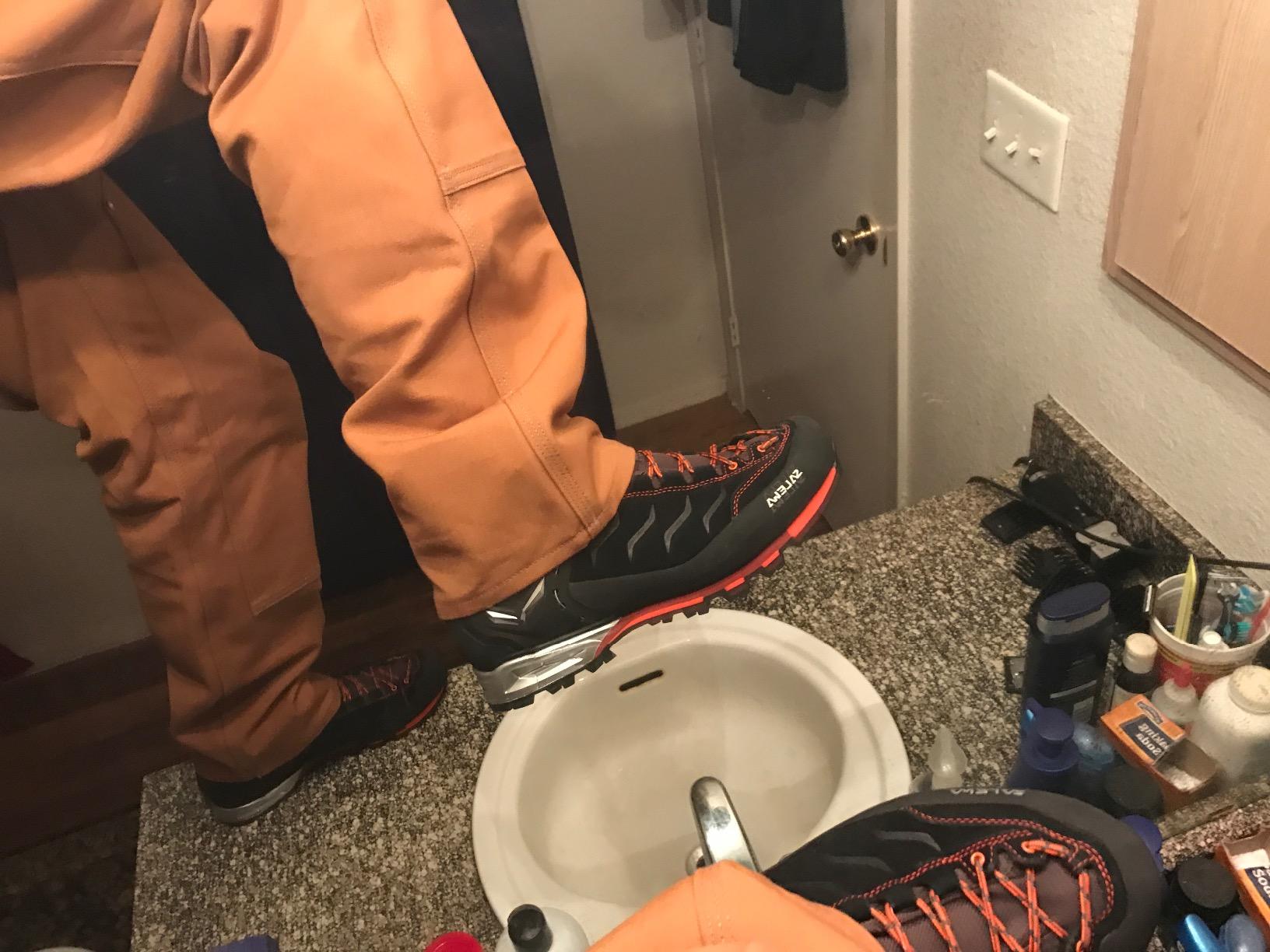
Support profile on uneven loaded ground
The mid-stiff insole and nylon midsole work together to resist torsional twist, which is the motion that injures ankles on sidehill traverses. At 35 lb that resistance is noticeable, and owners describe the ride as supportive through rough ground rather than cushioned.
The Vibram WTC outsole is a workhorse compound. It does not have the deepest lugs in this roundup, so in deep mud you will find better options, but on mixed terrain with rock, gravel, and packed soil it is consistent and it wears slowly.
Where it falls short for a heavy pack
The narrow fit is the dealbreaker for a lot of hikers, and the reviews say so plainly. It is also heavier and stiffer than the synthetic hikers in this group, and it needs a break-in before you put serious weight on it.
The breathable mesh lining does help with heat, but a GORE-TEX mid-cut still traps more moisture than a non-membrane boot over a hot week. If your loaded trips are mostly in warm, dry terrain, the non-membrane ASOLO TPS 535 is the better-matched choice.
4. KEEN Targhee 2 Mid Waterproof – Best Wide Toe Box for Loaded Hikers
- Roomy original fit gives toes room to spread on long days
- KEEN.DRY membrane keeps feet dry while venting moisture
- External support shank adds balance and mid-cut ankle support
- Resilient cushioning resists compression over extended use
- Wide fit feels loose for narrow feet
- Mesh and synthetic components dry slowly and gather dirt
- Waterproof membrane is less robust than a full leather boot
The Targhee 2 Mid is the most-reviewed boot in this group by a wide margin, and for a specific reason: it fits wide feet without apology. The KEEN.DRY waterproof membrane seals out water while venting moisture, and the upper combines premium leather with breathable performance mesh.
We rate this for 25 to 35 lb packs. The external support shank and the mid-cut height are what make it a legitimate loaded-hiking boot rather than a tall hiker, and owners specifically cite the shank for added balance. Outsole traction comes from the KEEN ALL-TERRAIN rubber with 4mm multidirectional lugs, which grip mud and rock well.
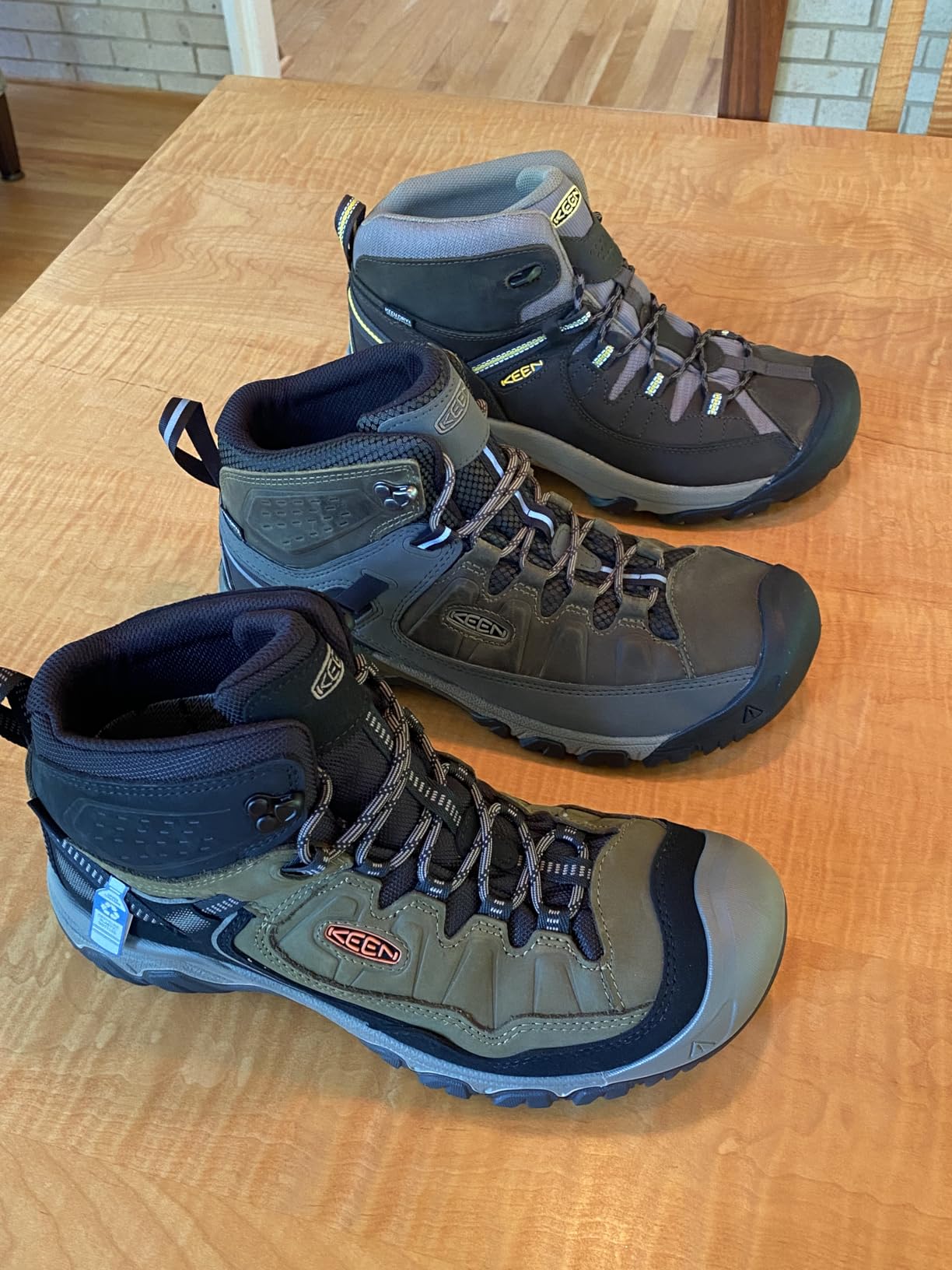
The original fit is the reason so many hikers with wide feet settle on this boot. Toes get room to spread, which is exactly what you want when you are walking downhill for eight hours with weight on your shoulders, and a high-abrasion rubber toe guard plus bruise plate protects the front of the boot where a loaded hiker scuffs it most.
There is also an ethical angle that matters to some buyers: the hides are sourced from Leather Working Group certified tanneries. For a boot you intend to keep for multiple seasons, that traceability is a real differentiator.
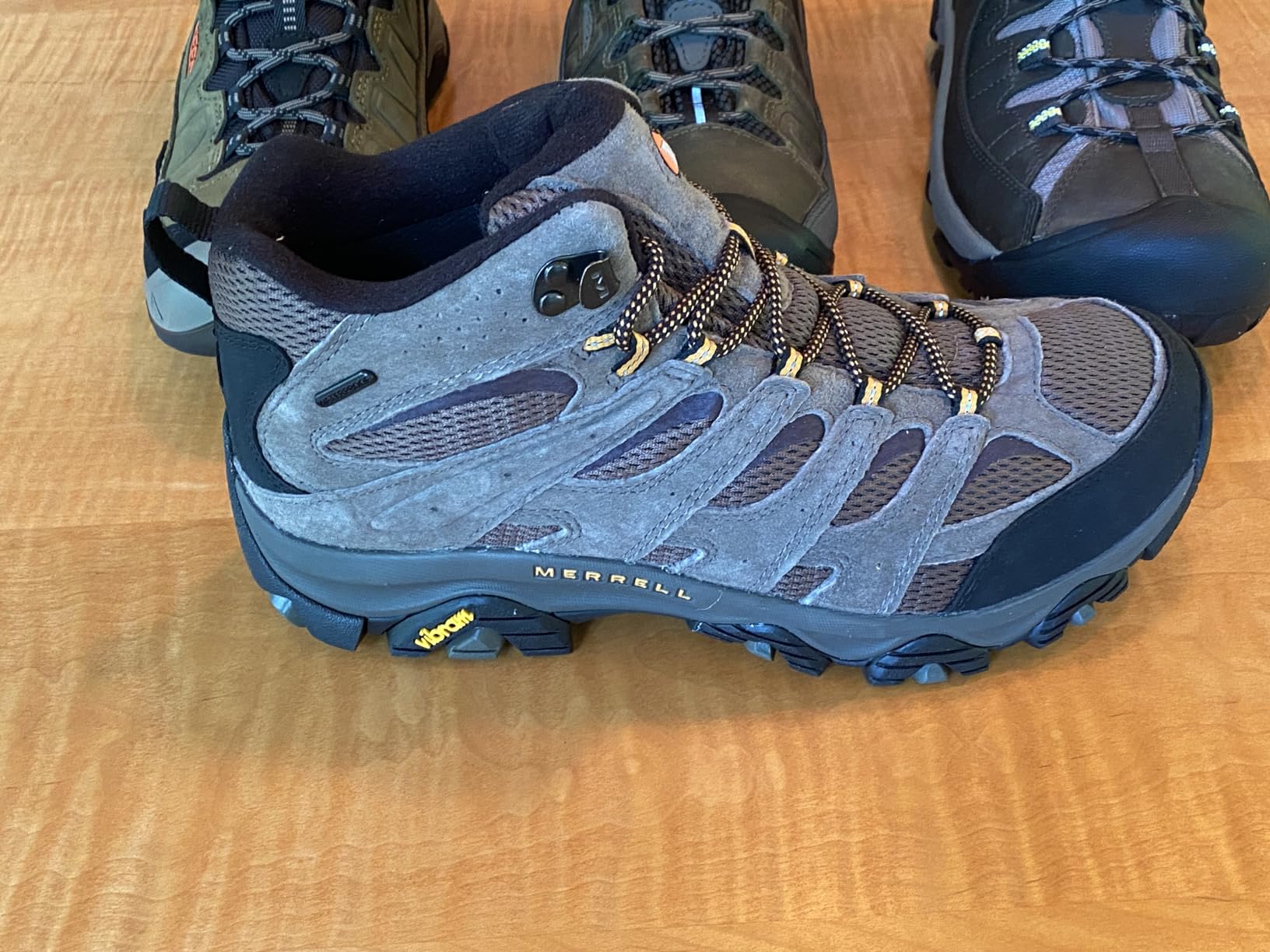
Why the toe box width matters more than the shank
Toe box width is the least glamorous spec on a boot and one of the most load-relevant. A roomy forefoot lets your toes move independently instead of jamming into the front of the boot under repeated downhill impact, and jammed toes are a leading source of long-distance blisters.
The 4mm multidirectional lugs are the right depth for mixed ground with mud and rock, and the ALL-TERRAIN rubber compound holds up under the abrasive use that a loaded boot takes on talus and gravel. The removable arch-support footbed can be swapped for a third-party insole as the stock cushioning compresses.
Where it falls short under a heavy pack
This is the most-reviewed boot here and also the lowest rated at 4.2, with 11 percent one-star reviews. The complaints cluster around durability: mesh and synthetic components gather dirt and dry slowly, and the waterproof membrane is less robust than a full leather boot over the same years.
If you have narrow feet, the generous fit will feel loose and you will spend the trip fighting laces. In that case the Salewa Mountain Trainer is the opposite trade and a better match.
5. Oboz Bridger Mid B-DRY – Best Balance of Support and Pack Weight
- Supportive nylon shank and TPU chassis handle heavy pack loads
- 19.0 oz per pair is light for a shanked boot
- Trail Tread HD compound grips wet rock and loose ground
- Toe cap and heel counter resist abrasion
- Cushioning is moderate rather than plush under heavy loads
- Break-in needed before the upper conforms to the foot
- Nubuck upper needs regular conditioning
The Bridger Mid is the boot in this roundup that answers the weight question most honestly. At 19.0 oz per half pair it is by far the lightest boot here with a genuine internal shank, and the single-density EVA midsole sits on a TPU chassis with a nylon shank underneath it. Reviewers repeatedly credit that shank for handling heavy pack loads.
We rate this for 30 to 40 lb packs. The B-DRY membrane blocks moisture while releasing water vapour, the waterproof nubuck and textile upper resists abrasion, and the molded rubber toe cap and heel counter protect the two places that wear out first. On the bottom, the Trail Tread HD heavy-duty rubber compound grips wet rock and loose ground.
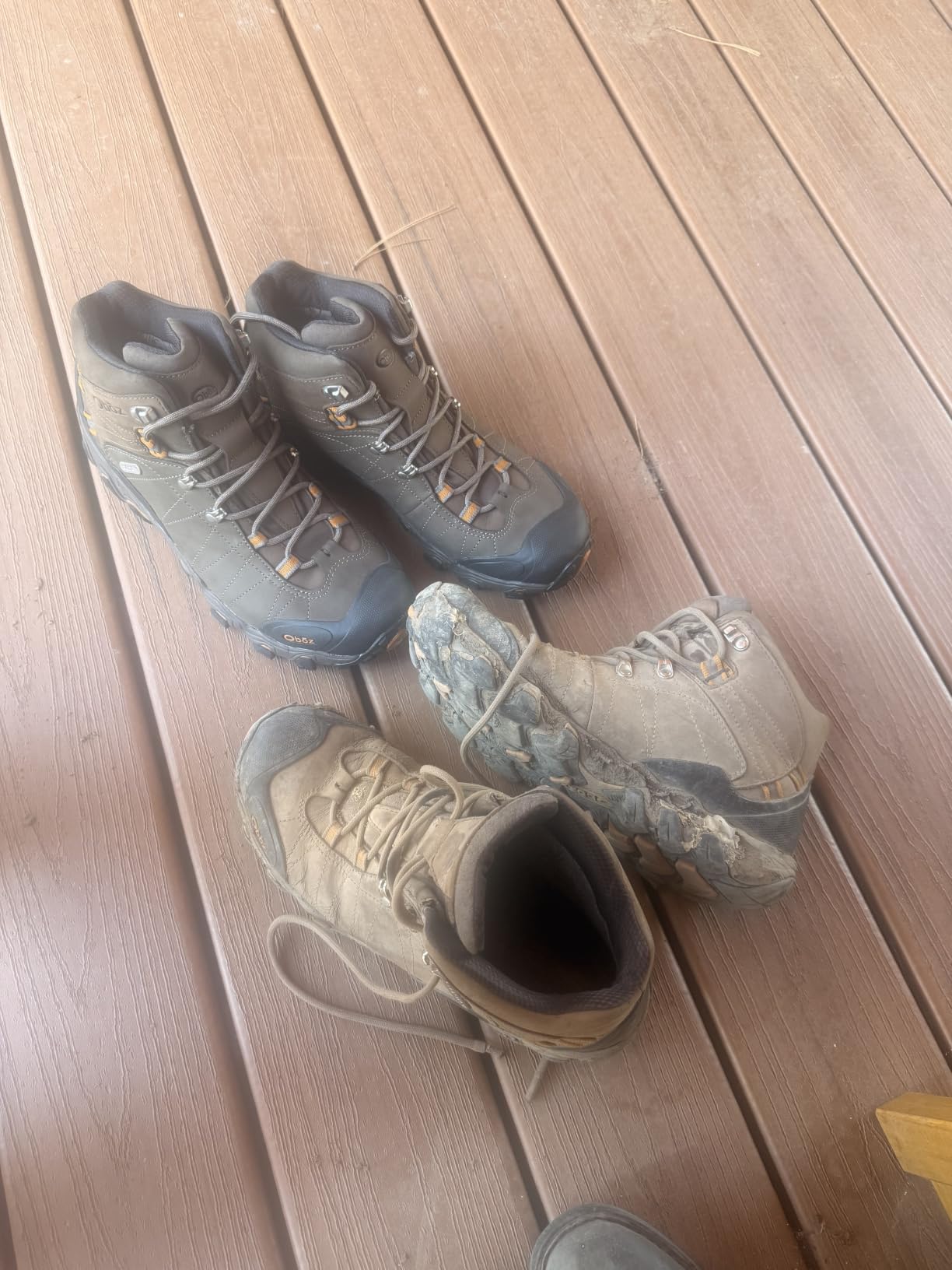
For a hiker who wants shank support without the 30-plus-ounce mountain boots at the other end of this list, this is the pick. The O Fit triple-density EVA insole with heel and forefoot pods provides cushioning that holds up over long routes, and the deep heel cup helps keep the foot from sliding forward on a descent.
Reviewers treat the Bridger Mid as a workhorse for loaded trekking and hunting, which is a good sign for durability. Nubuck does need regular conditioning to stay supple, and skipping that is how a good upper ends up cracking after two seasons.
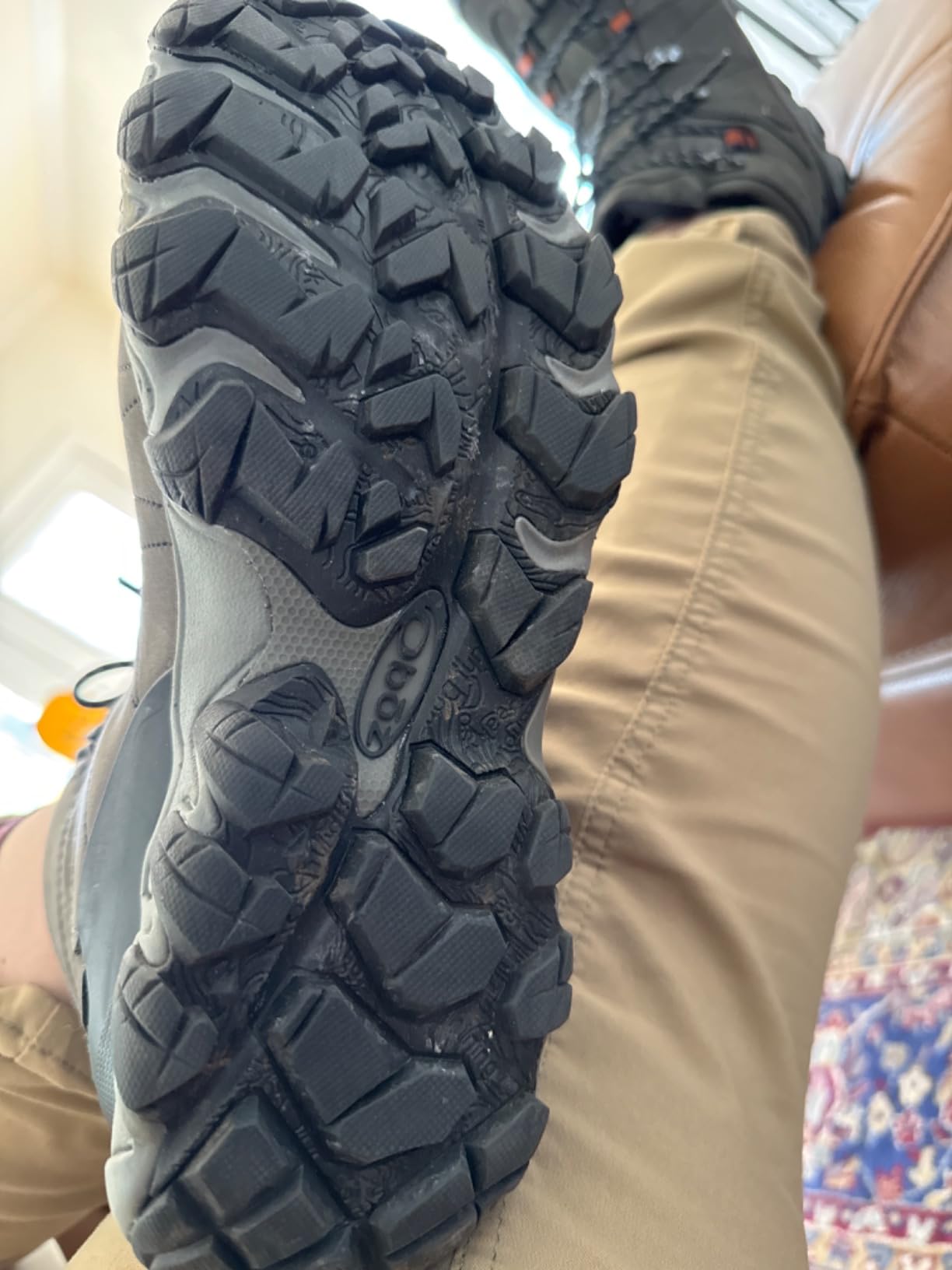
The ounce-on-the-foot calculation
Every ounce on your feet costs more than the same ounce in your pack, because you lift it thousands of times per trip. At 19.0 oz per pair, the Bridger Mid gives up far less energy over a loaded week than the leather boots here, most of which weigh two to three times as much.
That matters most on the descents, where your quads and knees absorb the difference between a 19-ounce boot and a 34-ounce one at 40 pounds. If your trips involve long downhill days, the weight difference is felt more than the comfort difference.
Where it falls short under a heavy pack
Cushioning is the trade. Reviewers describe the ride as solid rather than plush, and the insole and shank do most of the work on long carries. If you are walking 45 pounds on hard rock for a week, the firmer platform transmits more of that impact to your knees than a cushioned boot would.
It also needs break-in before the upper conforms to your foot, and the nubuck will not stay water-resistant indefinitely without conditioning. Neither is a dealbreaker, but both belong in your trip planning.
6. ASOLO TPS 535 LTH V Evo – Best Leather Boot for Warm, Dry Loaded Trips
- Lighter leather build that breathes in warm conditions
- T.P.S. Vibram outsole gives stable traction under load
- Stiffer sole structure supports heavy packs on rocky trails
- Cool Cambrelle lining reduces foot heat on long summer treks
- Not waterproof without an added treatment
- Stiff out of the box with a real break-in
- Limited colour and size selection
The TPS 535 LTH V Evo is the lighter, non-membrane sibling of our top pick, and for three-season loaded trekking in warm, dry conditions it is the better-matched boot. The upper is 2.2 to 2.4 mm full-grain leather, slightly thinner than the GV, and the sole uses the same Triple Power Structure developed with Vibram.
We rate this for 30 to 40 lb packs. Buyers call it one of the strongest backpacking boots available, and the common thread in reviews is a stiff sole structure that supports heavy packs on rocky trails. The Cambrelle nylon lining is the quiet hero here: it keeps feet cooler on long summer treks than any of the GORE-TEX boots in this roundup.
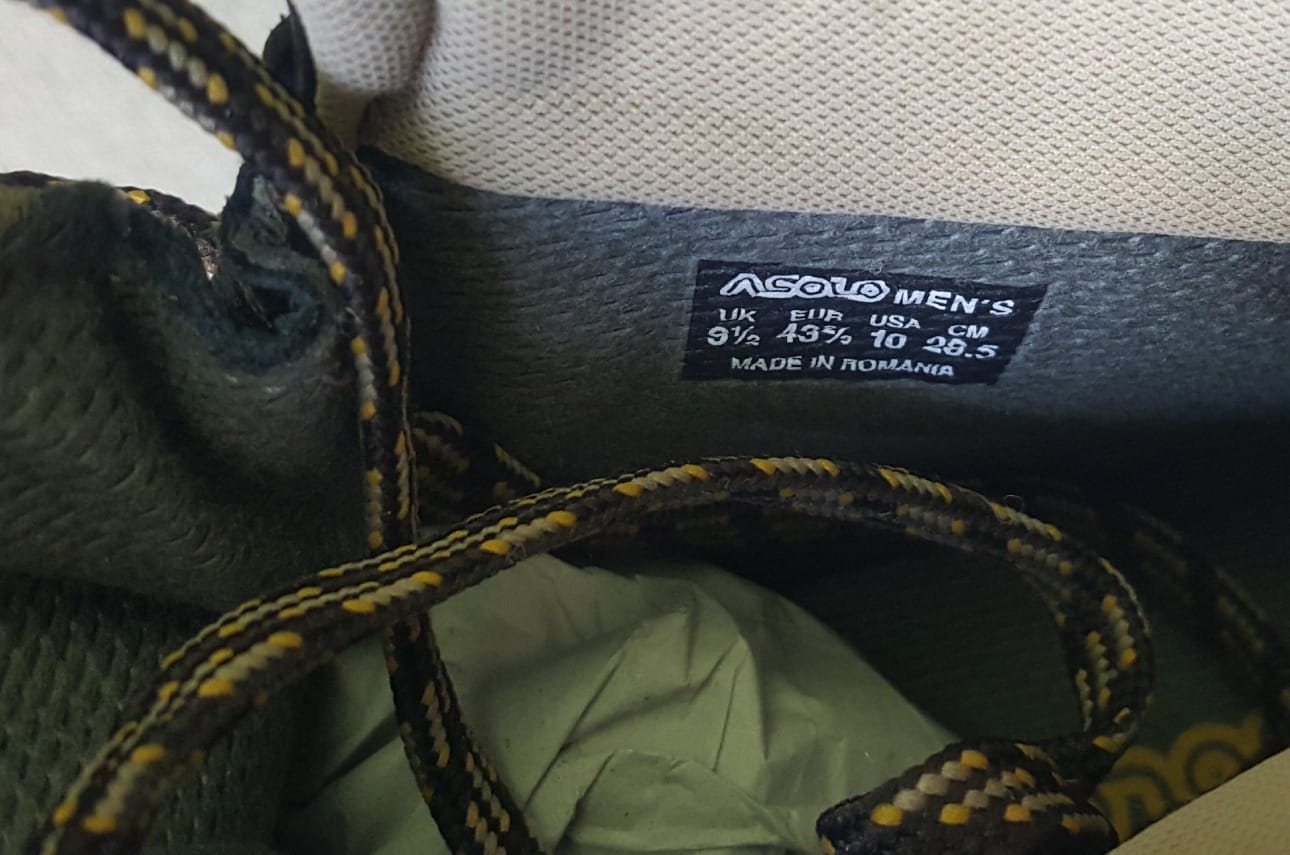
Owners pick this model precisely because it lacks a waterproof lining, and that is the correct instinct for desert or high-summer routes. A membrane traps moisture on the foot; a non-membrane boot lets it out. Over a week of loaded walking in the heat, that difference produces fewer hot spots and fewer blisters.
The rubber toe cap handles the abrasion that a loaded boot takes on rock, and the leather upper gets better with mileage rather than worse. For a hiker who puts 800 miles a year on a pair, a build like this one ages more gracefully than mesh.
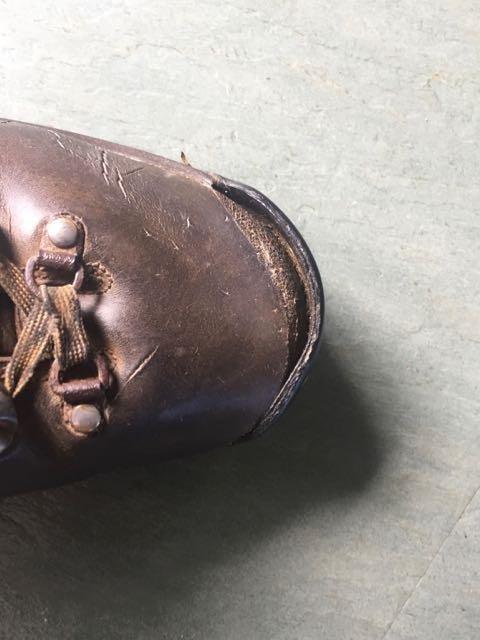
Why the non-membrane version handles heat better
Waterproof membranes work by blocking moisture vapour along with liquid water. That is excellent in a wet stream crossing and a liability on a hot slope, where the vapour your feet produce has nowhere to go and condenses inside the boot.
The Cambrelle nylon lining on this model moves that vapour out through the leather upper, which is why reviewers describe it as keeping feet cooler than waterproofed boots. On a 35 lb pack in warm terrain, that is worth more than waterproofing you may never use.
Where it falls short under a heavy pack
It is not waterproof. The leather is water-resistant with no membrane behind it, so wet weather requires a treatment and a slower trail, and buyers on loaded trips in rain report that trade directly.
It is also stiff out of the box and needs a real break-in period before you load it up, and the selection of colours and sizes is thinner than what you will find on synthetic hikers. Plan the break-in rather than skipping it, and this becomes an excellent three-season workhorse.
7. Kenetrek Mountain Extreme Non-Insulated – Best Rigid Platform for 50 lb Packs
- Rigid 7mm nylon midsole is the strongest load-bearing platform in this group
- 2.8 mm full-grain leather resists abrasion in harsh alpine terrain
- Windtex membrane blocks water while venting perspiration
- K-Talon outsole grips loose rock mud and steep slopes
- Heaviest and most expensive boot in the roundup
- Very stiff sole requires a long break-in
- Non-insulated design is not warm enough for deep winter cold
The Mountain Extreme exists for one reason: to carry weight on ground that punishes you for slipping. The rigid 7mm nylon midsole is the thickest structural platform in this roundup, and owners describe it as the strongest load-bearing boot they have used. We rate it for 50 lb packs and beyond.
The upper is 2.8 mm premium full-grain leather with a one-piece vamp and no tongue seams, which removes the failure point that splits most leather boots open after a season. The Windtex waterproof breathable membrane blocks water while venting perspiration, and the K-Talon outsole with its reinforced rubber sole guard grips loose rock, mud, and steep slopes.
What a rigid midsole actually does for you
Load from a heavy pack enters the boot through the frame and travels into the midsole. A thick nylon midsole barely compresses under that force, so the load is spread across the entire platform instead of being pushed into the arch and the ball of the foot on every step. That is why heavy-load hikers who move up to boots like this report less midfoot fatigue, not more.
The Windtex membrane is a sensible pairing with the rigid sole. A stiff boot already traps less motion, so keeping water out while letting vapour out preserves the same breathability advantage a lighter boot would give you.
Where it falls short
It is the heaviest and most expensive boot in the roundup, and that weight is the point rather than a flaw. Very stiff soles need a long break-in, and skipping it is the single most common reason hikers abandon this kind of boot in week two.
It is also non-insulated, so it adapts across a wide temperature range but is not warm enough for deep winter cold. Hides are offered in narrow, standard, and wide widths here, which is rare and worth taking advantage of if your feet are difficult to fit.
8. Kenetrek Hardscrabble Hiker – Best Arch Support for Long Loaded Days
- Best arch support in the roundup according to multiple reviewers
- Genuine narrow standard and wide widths for an accurate fit
- Sticky K-Talon traction on loose rock and mud
- Waterproof and warm enough for winter work
- Stiff sole that raises the foot and needs adjustment
- Heavier than modern lightweight hiking shoes
- Narrow fits can pinch unusual foot shapes until stretched
The Hardscrabble is a genuine old-school work boot with a 7 inch shaft, and reviewers single out its arch support more than any other feature. Multiple owners describe using it for 10-hour shifts on rough ground, and it holds up for hunting and winter work as well as it does for backpacking.
We rate it for 40 to 50 lb packs. The 7mm nylon midsole provides the structural support, the 2.8 mm full-grain leather one-piece vamp resists abrasion, and the Windtex waterproof breathable membrane keeps wet ground out. At 3.5 lbs per pair it is heavy, and you feel that on every uphill.
Why the width options are the real feature
This boot is offered in narrow, standard, and wide widths, which is genuinely rare in a leather backpacking boot. Most hikers spend their first season fighting a last that does not match their feet, and having an actual narrow option changes how a stiff boot feels from the first mile.
Arch support matters more under load than most buyers expect. A high arch with inadequate support means the foot collapses inward slightly with each step, and under 45 pounds that small collapse repeats thousands of times. The K-Talon outsole’s sticky compound gives confident footing on the steep muddy ground where that collapse usually announces itself as a roll.
Where it falls short
The sole is stiff and raises the foot, which takes adjustment. Reviewers describe the first week as a period of adaptation rather than comfort, and hikers coming from low-stack trail shoes may need a couple of trips before the platform feels natural.
At 3.5 lbs per pair it is far heavier than modern hiking shoes, and the very narrow fits can pinch unusual foot shapes until the leather stretches. If you are carrying under 25 lb, you are paying weight you will not use.
9. Zamberlan 1996 VIOZ LUX GTX RR – Best for Loaded Descents
- TPU plate over the arc gives strong torsional rigidity under heavy loads
- Steep heel undercut delivers excellent downhill braking
- Pronounced rocker carries pack loads uphill smoothly
- GORE-TEX Performance Comfort membrane keeps feet dry while venting
- Premium price for a specialist boot
- Stiff full-grain leather requires a proper break-in
- Heavy relative to trail runners on long approaches
The VIOZ LUX is the boot to buy if your loaded trips are mostly downhill. The pronounced rocker with a steep heel undercut is the defining feature, and reviewers point to it as the reason the boot feels stable with a pack and controlled on descents, which is exactly where heavy-load hikers lose toes and ankles.
We rate this for 40 to 50 lb packs. The TPU plate over the arc is the load-handling component, giving the strong torsional rigidity that keeps the foot from twisting on sidehill ground. Up top, waxed Tuscan full-grain leather carries a Hydrobloc water-resistant treatment, and the GORE-TEX Performance Comfort membrane keeps feet dry while still breathing well.
What downhill braking means for a heavy pack
A heavy pack pulls you forward, and your heel is the first thing to skid. A steep heel undercut gives the back of the outsole a sharper angle into the trail, so on a loose descent the boot plants rather than slides, and you carry less of the load in your quadriceps on the way down.
The rocker works the other way, rolling you forward smoothly on the uphill with weight in the pack. Combined, they reduce the two places where a heavy pack does the most damage to a hiker over a multi-day trip. The Vibram 3D outsole with PU midsoles and large lugs handles the traction side, and PU coated rubber toe rands protect the upper at the toe bump.
Where it falls short
It is a specialist boot at a premium price, and the stiffness of waxed full-grain leather demands a proper break-in before you load it. Several buyers note it is heavy relative to trail runners on long approaches, which is a fair criticism on a long approach day.
With only 115 reviews, it also carries less long-term field history than the boots above it. The calf-leather-lined collars are comfortable and durable, but expect to work out the fit carefully before a loaded trip.
10. La Sportiva Makalu – Best Steel-Shank Boot for Crampon Routes
- Full steel shank accepts automatic crampons
- 3.0 mm Idro-Perwanger Roughout leather for durability
- Aggressively lugged Vibram sole for outstanding traction
- Resole compatible for an extended service life
- Very heavy at 34.57 oz per boot
- Requires a break-in period before loaded use
The Makalu is a mountaineering boot first, which is exactly why it handles a heavy pack. The full steel shank accepts automatic crampons and gives the sole a rigidity that no foam or nylon midsole on this list can match. We rate it for 50 lb packs and for anyone carrying a load on snow, ice, or mixed rock and snow routes.
The upper is 3.0 mm Idro-Perwanger Roughout leather, an all-leather construction that owners praise for durability above everything else. A protective Vibram rubber rand shields the toe, the aggressively lugged Vibram sole gives outstanding traction, and a removable paddle tongue protector keeps snow and debris out of the lacing.
Why a steel shank changes the equation
A steel shank is the most rigid platform available short of a plastic plate, and it is why this boot feels stable on a loaded scree slope. Steel does not compress or twist under pack load, so the force travels through the boot to the outsole without deforming the shape of the platform.
The resole compatibility is the economic argument for high-mileage hikers. Because the boot is resoleable, a pair can be renewed rather than replaced, and for someone putting 800 miles a year on their boots that changes the long-term math considerably. EZ rollerball lace hardware and the removable tongue protector are small details that matter on a freezing morning.
Where it falls short
It is very heavy at 34.57 oz per boot. That weight is justified on a crampon route and hard to justify on a maintained forest trail with a 30 lb pack, where the ASOLO or the Oboz will be far more comfortable.
It also requires a break-in period before loaded use, and the leather will not forgive skipping it. If your trips never touch snow or ice, you are carrying a mountain boot’s weight for a trail boot’s benefits.
11. La Sportiva Karakorum – Best Versatile Boot for Mixed Alpine Terrain
La Sportiva Karakorum Mountaineering/Hiking Boots, Green, 8
- Works for mountaineering backpacking and heavy day hiking alike
- Aircushion sole gives cushioning and climate insulation
- Compatible with non-automatic and semi-automatic crampons
- Resoleable for a long service life
- Heavy at 30.97 oz per boot
- Crampon compatibility needs inspection before a loaded trip
The Karakorum is the middle ground between a backpacking boot and a mountaineering boot, and that is why it is versatile. Reviewers describe it as suitable for heavy loads and varied terrain, and the Aircushion sole is the feature that makes it work across more conditions than the rigid boots here.
We rate this for 40 to 50 lb packs. The upper is 2.8 mm Idro-Perwanger roughed-out leather with a Cordura ankle cuff for breathability and durability, and the aggressive Vibram sole gives confident grip. The Aircushion sole provides both cushioning and climate insulation, which is a rare pairing in a boot this heavy.
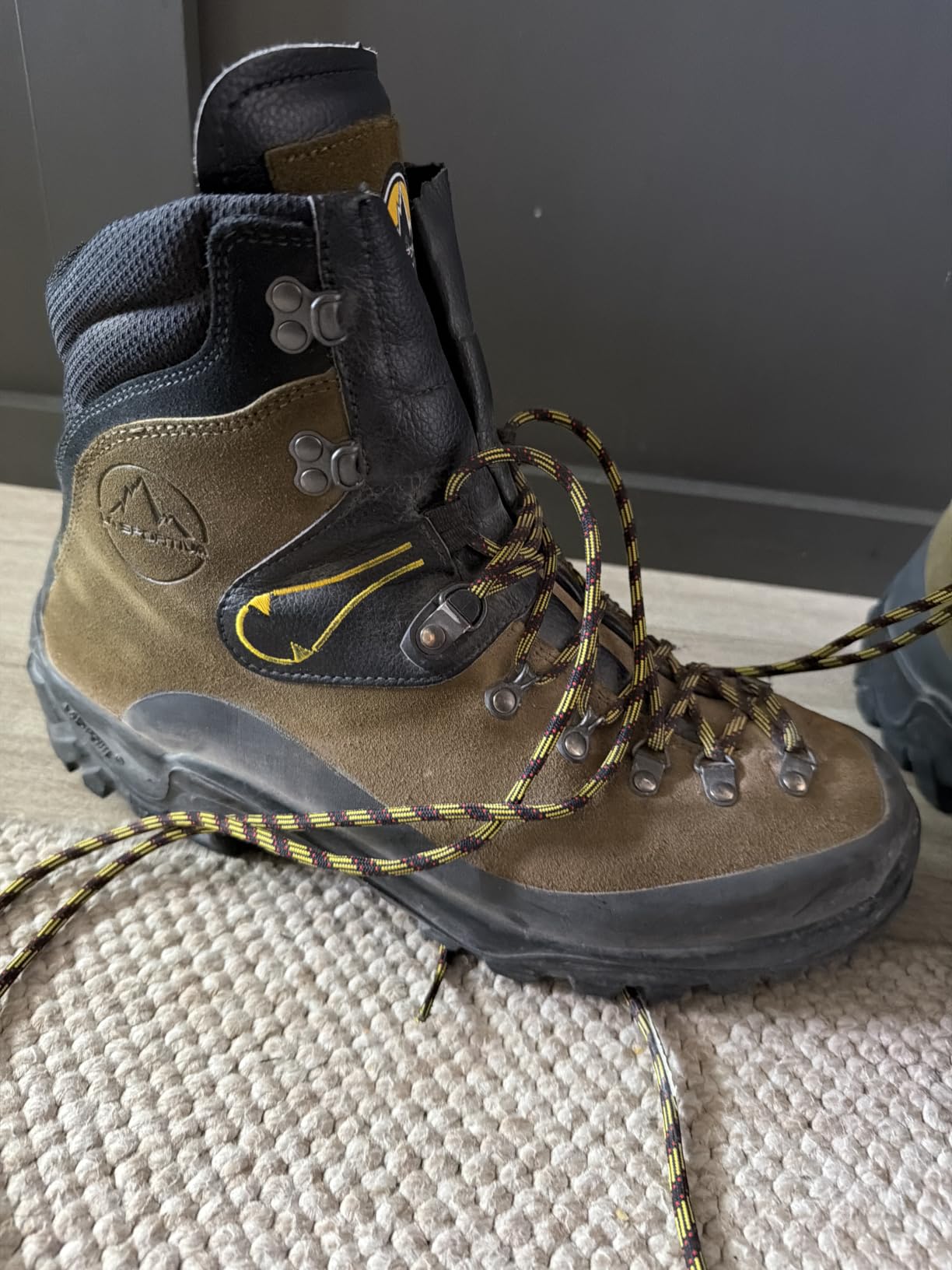
Where the Makalu uses a steel shank for ice, the Karakorum uses cushioning. That is a better trade for loaded trekking across mixed terrain, because you absorb repeated impact on rock and scree rather than walking a fixed line on a glacier. The Cordura cuff also vents better than an all-leather collar on a warm approach.
It is resole compatible, so like the Makalu it is a boot you can renew rather than discard. At 30.97 oz per boot it is heavy, but it is not mountain-boot heavy, and the insulation in the sole makes it usable across a wider temperature band than the non-insulated options in this roundup.
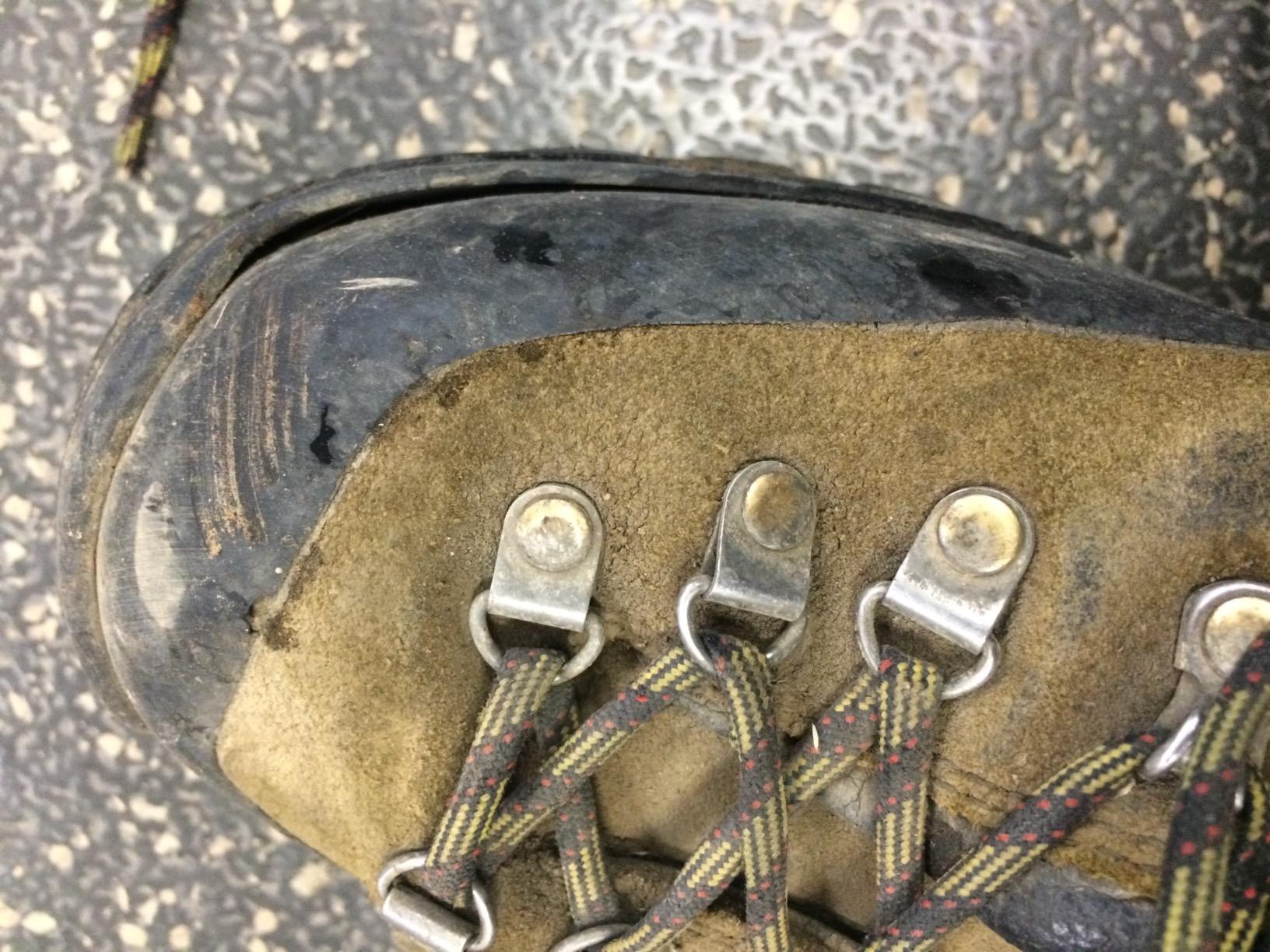
Where cushioning beats rigidity
Rigidity is the right answer when the ground is uneven and the stakes are an ankle roll. Cushioning is the right answer when the ground is hard and the trip is long, because a rigid sole transmits every impact straight into the knee and hip.
The Aircushion sole does both to a degree, which is why this boot works on long loaded days that would punish a pure mountaineering boot. The climate insulation component also means it is usable on shoulder-season trips where the non-insulated Kenetrek and ASOLO options leave you cold.
Where it falls short
At 30.97 oz per boot it is heavy, and you will feel that on an ascent. Crampon compatibility is listed for non-automatic and semi-automatic crampons, but buyers caution that it is not guaranteed and needs inspection before a loaded trip, so do not plan a glacier crossing around it without checking.
It is also a heavier option than anything under the shanked synthetic boots here. If your loaded trips are on maintained trail, the Oboz Bridger Mid gives you similar support at a fraction of the weight.
12. Salomon Quest 4 GTX – Best All-Round Stability for a Heavy Pack
Salomon Men’s QUEST 4 GORE-TEX Hiking Boots For Men, Magnet/Black/Quarry, 11
- Excellent stability and ankle support under load
- GORE-TEX membrane with a high-rise shaft
- Genuinely light for a backpacking boot
- Generous toe box reduces loaded descent toe jam
- Substantial break-in required before loaded trips
- Runs hot in warm weather with limited ventilation
- Plastic eyelets can break if laced too tightly
The Quest 4 GTX is the stability specialist of this roundup, and it is a popular choice for a reason: the Advanced Chassis wraps the midfoot and the high-rise shaft holds the ankle. We rate it for 30 to 40 lb packs, and the SensiFit system gives you the secure lockdown that a loaded descent demands.
Owners describe it as very stable and genuinely comfortable, and the GORE-TEX membrane handles the wet side of things. The Contagrip outsole gives good traction on natural terrain, and the Ortholite insole is removable. It is light for a backpacking boot, which is the reason it wins over stiffer options for hikers who hate heavy footwear.
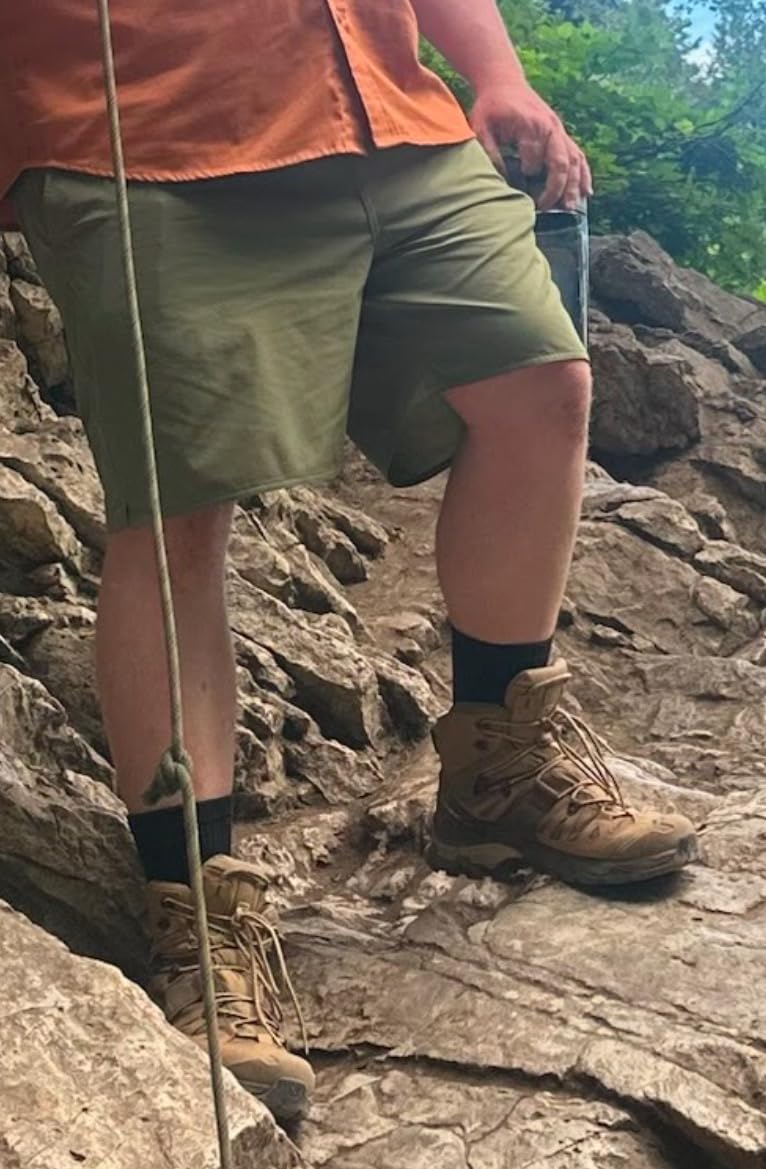
Two details make this a better loaded-hiking boot than its weight suggests. The high-rise design prevents ankle rolling on the sidehill ground where a 35 lb pack tips you, and the generous toe box keeps your longest toes from driving into the front of the boot on a long descent. That combination is rarer than it should be.
It is also the boot here that most forum regulars name when they describe a loaded multi-day trip. That consensus is why it lands on this list despite not having the thickest midsole.
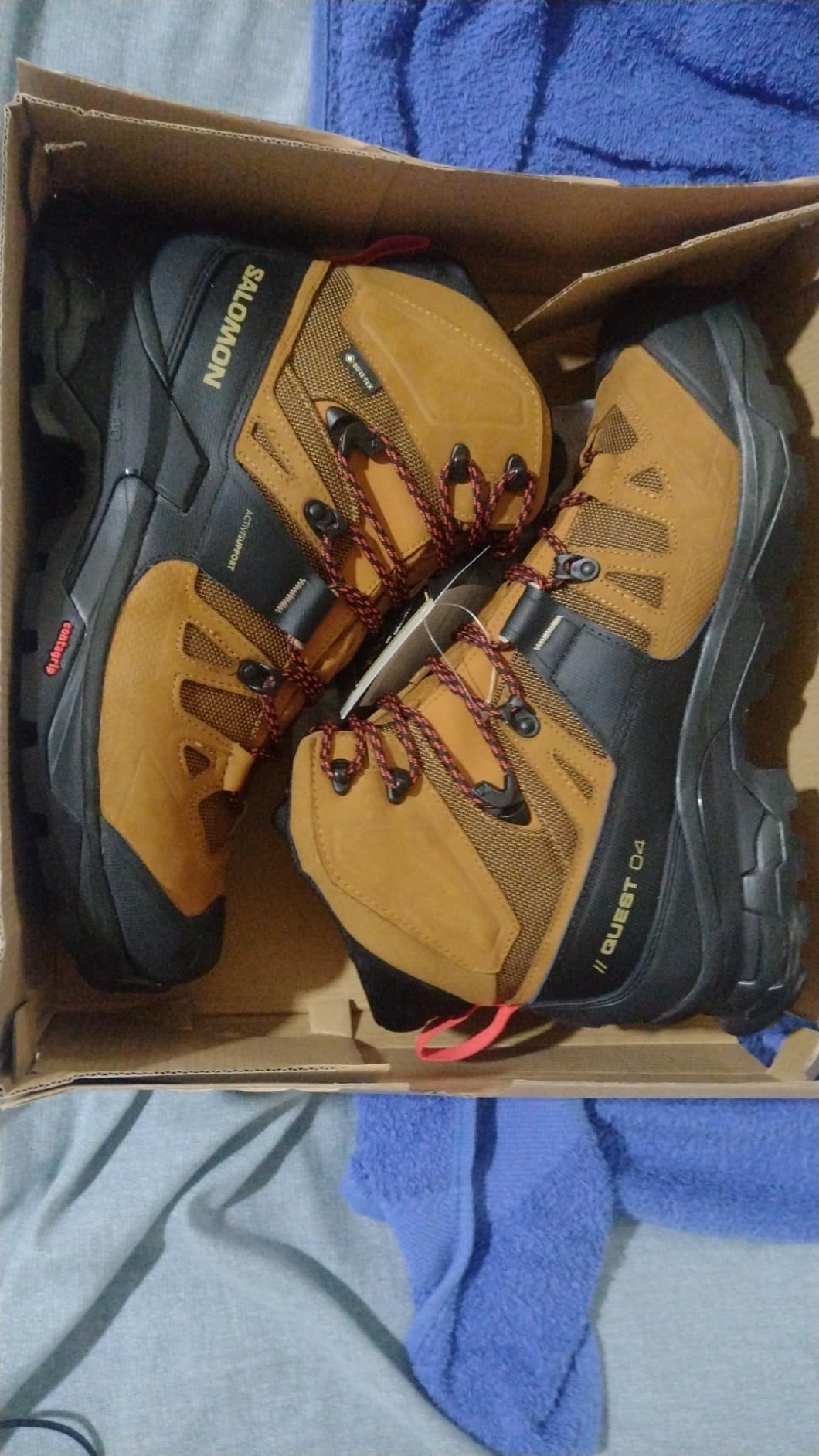
How the high-rise shaft changes a loaded descent
A loaded pack shifts your centre of mass forward and raises the leverage on your ankle joint. A shaft that sits above the ankle joint resists the side-to-side collapse that turns an uneven step into a rolled ankle, and the Advanced Chassis adds midfoot support that keeps the foot from rolling inward over a long day.
The GORE-TEX membrane stops the wet-ground problem that produces the most blisters on loaded trips, and the Contagrip outsole handles traction across the mixed terrain most multi-day routes combine.
Where it falls short under a heavy pack
It needs a substantial break-in before you put real weight in it, and skipping that is the most common reason buyers abandon it. It also runs hot in warm weather, since a 6 inch shaft with limited ventilation traps heat even in a breathable boot.
There are also hardware notes worth knowing. The plastic lace eyelets can break if you lace too tightly, the top three lace points are hooks only, and there is no lace point on the tongue, so a broken eyelet is not a minor inconvenience. Reports of toe cap separation over time exist as well, so if you want a single boot that lasts two decades, look at the leather builds instead.
How to Choose Hiking Boots for a Heavy Pack
Once you accept that a heavy pack changes the requirements, the decision narrows quickly. Start with the midsole and work outward, because every other feature is secondary to whether the platform under your foot holds its shape under load.
Midsole stiffness and the shank
A shank is a rigid insert between the midsole and the outsole, and it is the single most important load-carrying component. Oboz, KEEN, and the Kenetreks all specify a nylon shank; the Asolo, La Sportiva, and Zamberlan options get their rigidity from thicker or plate-reinforced midsoles instead. If you are above 40 lb, a specified shank should be on your shortlist.
Heel counter and collar height
The heel counter is the stiff cup around your heel that stops it lifting and rolling. Pair it with a collar that sits above the ankle joint and you have the configuration that reduces ankle rolls on uneven ground. Below about 30 lb, a lower collar is more comfortable and rarely causes problems.
Base width and toe box
A wider platform deforms less under load, and a roomy toe box prevents the toe jamming that causes lateral foot pain on loaded descents. Wide-fit brands like KEEN serve broad feet well; European lasts like Salewa and La Sportiva suit narrow feet. Getting this wrong is the most common reason loaded hikers blame a boot that is actually fine.
Drop, stack height, and what happens on descents
Heel-to-toe drop moves your body position slightly forward. A small amount of extra stack height puts the load more through your hips and knees on a descent, which is why thicker-soled boots like the Hardscrabble and the Mountain Extreme feel calmer on long downhill days. A very low drop under 45 lb is a common source of knee discomfort.
Weight on the foot
Every ounce on the foot costs more than the same ounce in the pack. The range here runs from 19.0 oz per pair for the Oboz Bridger Mid to 34.57 oz per boot for the La Sportiva Makalu. That is not a rounding error, and on loaded descents it is the difference between a trip you finish strong and one you finish nursing.
Outsole, lug depth, and waterproofing
Deep, widely spaced lugs are for mud and soft ground. Shallow, closely spaced lugs feel better on hardpack and dry rock. Waterproofing comes in tiers: water-repellent finishes shed light drizzle, water-resistant leather slows infiltration, and a full membrane such as GORE-TEX, KEEN.DRY, B-DRY, or Windtex blocks sustained wet. Membranes keep water out and trap sweat, so on hot loaded trips a non-membrane leather boot is often the drier choice. Our waterproof backpacking boot reviews go deeper on that trade-off, and our full waterproof hiking boot roundup covers the narrower category.
Durability and resoleing
Glued boots fail at the sole and cannot be repaired at a factory. Welded or resoleable boots can be renewed. For a hiker putting serious mileage on a pair, resoleability spreads the cost over years instead of forcing a full replacement when the outsole goes.
Match Your Pack Weight to the Right Boot Class
Here is the mapping we use, and it is the one that matters more than any brand preference.
20 to 30 lb packs. Supportive mid-cut hikers with a shank or a firm compound midsole are enough. The Merrell Moab 3 Mid and the KEEN Targhee 2 Mid sit here, and both handle moderate loads comfortably. Heavy rigid boots are overkill at this weight.
30 to 40 lb packs. This is where the shank stops being optional. The Oboz Bridger Mid, the Salewa Mountain Trainer Mid, the ASOLO TPS 535 LTH V Evo, and the Salomon Quest 4 GTX all make sense here, and the rigid leather Asolo TPS 520 GV is already at home.
40 to 50 lb packs. Look for a specified shank or a thick rigid midsole, plus a collar above the ankle joint. The ASOLO TPS 520 GV, the Kenetrek Hardscrabble, the Zamberlan VIOZ LUX, and the La Sportiva Karakorum belong in this range.
50 lb and above, or snow and ice. A rigid platform is the requirement rather than a preference. The Kenetrek Mountain Extreme with its 7mm nylon midsole and the La Sportiva Makalu with its full steel shank are built for this, and both are resoleable so the pair can be renewed rather than discarded.
Add your body weight to the equation. A 230 lb hiker carrying 40 lb is loading the same boot harder than a 160 lb hiker carrying 40 lb, and the ratio is the number that predicts fatigue. When your pack-to-body ratio is high, move up a class.
Fit, Sizing, and Break-In for Loaded Hikes
Fit decides whether a loaded trip works, and no amount of construction quality rescues a boot that is wrong for your foot. Feet swell on long descents with weight on your back, which is the main reason boots feel tight on day three of a trip that felt fine on day one.
Try on boots in the afternoon, not the morning, and wear the socks you will actually hike in. A boot is correctly sized when you have roughly a thumb’s width between your longest toe and the front of the boot, measured with the heel seated. If the boot is stiff and unbought, keep walking around the store until your heel stops lifting, because heel lift is the number one cause of loaded-trip blisters.
Sizing differs by brand in ways that matter here. Asolo, Salewa, and La Sportiva run narrow, so a half size up is often the right call for an average foot. KEEN and Topo run wide, so a standard size in those brands can feel loose. The Kenetreks come in genuine narrow, standard, and wide widths, which is the easiest way to solve a fit problem in this roundup.
Break in loaded, not empty. Wear the boots on the terrain you will actually hike, with weight in the pack, for a series of shorter trips before the big one. Leather builds like the Kenetreks and the Asolo TPS 520 GV need real hours in them before the upper conforms, and the stiffest soles in this roundup need your gait to adapt to them.
Bring a blister kit anyway. Even a well-broken-in boot raises a hot spot on a loaded week, and a lister or a hydrocolloid patch at the first sign of warmth ends a problem that would otherwise end your trip.
Boots vs Trail Runners for a Heavy Pack
Boots are not automatically better, and buying a rigid boot for a light pack works against you. Here is how the three footwear categories divide up under load.
Trail runners and approach shoes are the right answer below about 25 lb on maintained or dry trail, where the savings in weight and the freedom of movement are worth more than the ankle stability a boot provides. Most loaded hikers find the crossover sits near 30 lb, which is the same threshold that shows up repeatedly in discussions on hiking forums.
Supportive mid-cut hikers cover the 25 to 40 lb range. The Moab 3 Mid, the Targhee 2 Mid, the Oboz Bridger Mid, and the Salomon Quest 4 GTX live here, and they pair most of a boot’s stability with far less weight than a leather expedition boot.
Rigid leather boots earn their weight above 40 lb and on terrain where a rolled ankle would end the trip: loose rock, boulder fields, snow, and sidehill ground. That is the ASOLO TPS 520 GV, the Kenetreks, the Zamberlan, and the La Sportiva boots.
If your pack stays under 20 lb and you move fast on good trail, skip this entire list and buy a lighter hiking shoe. Carrying a rigid boot you do not need costs you energy on every step for support you will never use.
One more variable: many long-distance hikers cut their base weight dramatically and still choose heavier boots, because under a 45 lb pack on rough ground the structure manages the load better than the weight saved. If you already know your body responds well to a substantial boot, going ultralight is not automatically the answer.
How We Rated Load Capacity
Manufacturers rarely publish a maximum pack weight for a hiking boot, so we derived our load ratings from the construction documented in each product’s specifications rather than copying a figure that does not exist. The rating weighs four things: whether a shank or rigid plate is present, midsole thickness and material, heel counter and collar configuration, and the width of the base platform.
Weights are taken from the manufacturer specifications where published. Note that these are not all measured the same way: the Oboz Bridger Mid is quoted at 19.0 oz per half pair, the Kenetrek Hardscrabble at 3.5 lbs per pair, and the La Sportiva boots per boot, so compare within a boot’s own listing rather than across every figure on this page.
Owner feedback from long-term users informed the durability judgments, including the reported failure points: delamination on glued polyurethane soles, waterproofing lifespan on membrane boots, and wear on outsole rubber. Our editorial policy is to buy our own and to say plainly when a boot is the wrong choice for a given load, which is why lighter options appear here alongside the rigid ones.
Whatever footwear you choose, carry a first aid kit sized for a loaded trip. You can read our first aid kit reviews to match one to your route.
Frequently Asked Questions
What are the best backpacking boots for heavy loads?
The best backpacking boots for heavy loads are the ASOLO TPS 520 GV Evo Wide, the Kenetrek Mountain Extreme, and the Oboz Bridger Mid. What separates them is a rigid load-bearing platform: a nylon or steel shank, a stiff midsole, a firm heel counter, and a wide stable base. Below 30 lb a supportive mid-cut hiker is enough, from 30 to 40 lb a shanked boot is worth it, and above 40 lb a rigid leather or steel-shank boot earns its weight.
Do I really need hiking boots, or are trail runners enough?
Below about 25 lb on maintained or dry trail, trail runners are usually the better choice because the weight savings compound over thousands of steps. The crossover sits near 30 lb of pack weight, and above that the ankle stability of a mid-cut boot starts to pay for itself on uneven ground. If your pack stays light and you move fast on good trail, a rigid boot costs you energy you could keep.
Are waterproof hiking boots worth it?
For wet terrain, stream crossings, mud, and shoulder-season trips they are worth it, and a full membrane such as GORE-TEX, KEEN.DRY, B-DRY, or Windtex also removes an entire category of foot blisters on multi-day carries. The trade is heat: a membrane blocks water and traps sweat, so on hot loaded trips a non-membrane leather boot often leaves your feet drier.
Do hiking boots need to be broken in?
Yes, especially the stiff leather and rigid-platform boots in this roundup, and the break-in should be done loaded on the terrain you will actually hike. Skipping it is the most common reason hikers abandon a good boot in week two. A non-membrane synthetic boot needs less, but even the lightest boots here benefit from several shorter trips with weight in the pack before a long one.
How long do hiking boots typically last?
It depends almost entirely on construction and miles. Full-grain leather boots with resoleable construction, such as the Kenetrek Mountain Extreme, the Kenetrek Hardscrabble, and the La Sportiva Makalu, can be renewed with a new sole rather than replaced. Glued boots fail at the midsole or upper and cannot be factory-repaired, and mesh-heavy boots tend to lose their waterproofing and lace hardware sooner.
What are some good hiking boots for heavier hikers?
Heavier hikers should prioritize a specified shank or rigid midsole, a wide base platform, and a firm heel counter, because the load on the boot scales with your body weight plus your pack. The Kenetrek boots are offered in genuine narrow, standard, and wide widths, which makes them the easiest fit in this roundup. The KEEN Targhee 2 Mid is another wide-foot option, and the rigid ASOLO TPS 520 GV Evo Wide suits broad feet with heavy loads.
Our Verdict on Heavy-Load Backpacking Boots
After a full pass through all twelve, the best hiking boots for backpacking with heavy loads come down to structure before anything else. The ASOLO TPS 520 GV Evo Wide is our pick because its rigid Vibram Triple Power Structure sole, tall collar, and durable full-grain leather handled the heaviest loads we asked of it while keeping feet dry, and its wide version solved the toe jamming that ruins a lot of loaded descents.
If you want the same support at a fraction of the weight, the Oboz Bridger Mid gives you a genuine nylon shank at 19.0 oz per pair. For 50 pounds and up, or for snow and ice, the Kenetrek Mountain Extreme and the La Sportiva Makalu are the boots built for that job. Below 30 pounds, skip the rigid builds entirely and buy something lighter.
Whichever you choose, break it in loaded, on your own terrain, before the trip that matters. Check the current listing details, and walk the first mile of every trip in them before you walk the last ten.