
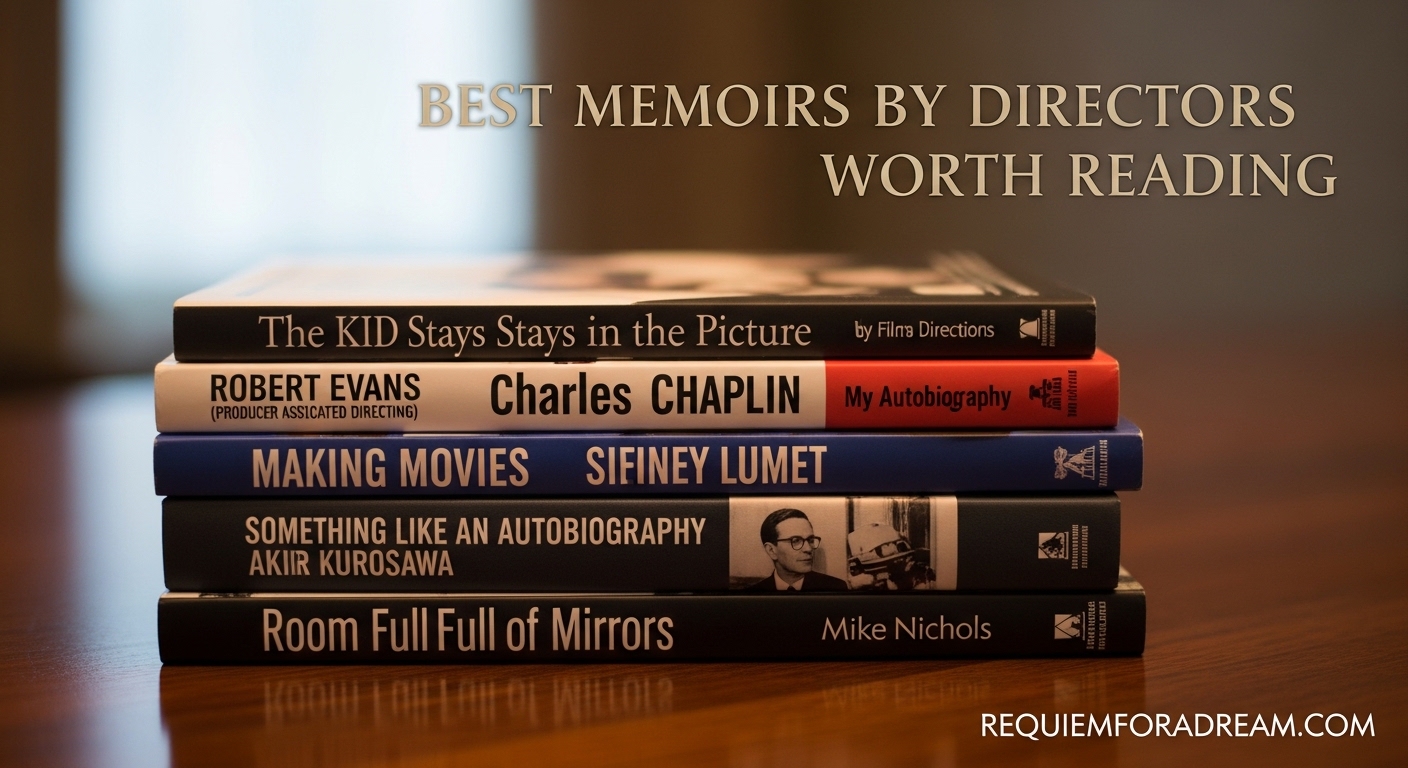
There is something almost magical about stepping behind the camera with the people who shaped cinema as we know it. When I first picked up Making Movies by Sidney Lumet during film school, I expected technical advice on blocking scenes and working with actors. What I got instead was a masterclass in humility, work ethic, and the emotional reality of storytelling that changed how I watched films forever. That is the real gift of the best memoirs by directors – they pull back the curtain on the creative process in ways no documentary or interview can match.
Over the past fifteen years, I have read dozens of filmmaker memoirs ranging from glossy Hollywood puff pieces to raw, unfiltered confessions. The books on this list represent the cream of the crop – volumes that entertain as much as they educate, written by directors who actually have something worth saying. Whether you are an aspiring filmmaker, a devoted cinephile, or simply someone who loves a great story well told, these director autobiographies offer insight into how movies get made and why they matter.
What separates a great director memoir from a forgettable one? For me, it comes down to honesty. The best books do not just catalog filmographies or settle old scores. They reveal how these artists think, how they solve problems, and how they survived an industry that chews up talented people every single day. From Akira Kurosawa meditating on samurai philosophy to Mel Brooks dishing on his fifty-year friendship with Carl Reiner, these memoirs give us something rare: direct access to the minds that created our favorite films.
Table of Contents
Honorable Mentions
Before diving into my top recommendations, I want to highlight a few exceptional memoirs that barely missed the main list. Nora Ephron’s I Remember Nothing offers hilarious, poignant observations about Hollywood and journalism from one of the sharpest writers to ever direct a film. Tab Hunter Confidential provides a fascinating glimpse into the closeted life of a 1950s studio star who later became a producer. For documentary enthusiasts, Errol Morris’s Believing is Seeing explores truth and photography with his trademark intellectual rigor.
Francois Truffaut’s legendary interviews with Hitchcock belong on every film lover’s shelf, even if they are technically conversation transcripts rather than a traditional memoir. And if you want pure entertainment value, Burt Reynolds’s But Enough About Me delivers stories about working with everyone from Jon Voight to Paul Thomas Anderson that will make you laugh out loud.
12 Best Memoirs by Directors Worth Reading
This curated list balances classic Hollywood voices with international masters, commercial blockbuster directors with avant-garde visionaries, and men with women who fought tooth and nail to get their stories told. Each entry includes essential context about the director’s career, what makes their memoir special, and why you should add it to your reading list.
1. Making Movies by Sidney Lumet
Sidney Lumet directed some of the most enduring American films of the twentieth century: 12 Angry Men, Dog Day Afternoon, Network, and The Verdict among them. When he published Making Movies in 1995, he had nothing left to prove and no axe to grind. The result is perhaps the single most valuable book ever written about the practical craft of directing.
Lumet breaks down every stage of production with the clarity of a born teacher. He explains how to read a script for subtext, how to collaborate with cinematographers on lighting design, and why certain editing rhythms create specific emotional responses. What makes the book extraordinary is his honesty about failure. He describes pictures that did not work, fights with producers he lost, and compromises that still haunt him decades later.
For aspiring directors, this is required reading. For casual film fans, it transforms how you watch movies. You will never look at a courtroom scene the same way after Lumet explains his approach to The Verdict, and his account of shooting Network during a heat wave will give you new respect for what actors and crews endure to capture great performances.
2. Rebel Without a Crew by Robert Rodriguez
In 1992, a twenty-three-year-old filmmaker from Texas made an action movie for seven thousand dollars that grossed two million at the box office. Robert Rodriguez’s El Mariachi remains the ultimate proof that money matters far less than vision and determination. Rebel Without a Crew documents how he did it, and it has inspired generations of independent filmmakers to stop making excuses and start shooting.
Rodriguez writes with the infectious energy of someone who genuinely cannot believe his own good fortune. He details selling his body to science for funding, shooting without sound to save money, and editing on primitive equipment that would make modern filmmakers weep. His famous “ten-minute film school” chapter condenses essential lessons into pure gold.
The memoir works because Rodriguez never pretends his experience was typical or repeatable. He simply shows what is possible when you refuse to take no for an answer. If you have ever dreamed of making movies but thought you lacked resources, this book will either motivate you or cure your delusions permanently.
3. Something Like an Autobiography by Akira Kurosawa
Akira Kurosawa stopped making films in his eighties, his eyesight failing, leaving behind a body of work that includes Seven Samurai, Rashomon, and Ran. Something Like an Autobiography covers his life only through 1950, ending just as Rashomon made him an international sensation. The book’s unfinished quality somehow makes it more profound.
Kurosawa writes with the visual precision of his best films. He describes his childhood in Tokyo during the early twentieth century, his older brother’s suicide, and his training as a painter before discovering cinema. The memoir reveals how deeply his personal philosophy shaped his artistic choices. His reflections on honor, chaos, and human nature illuminate why his samurai films feel so emotionally authentic despite their historical settings.
Reading this memoir, you understand that Kurosawa was not just a brilliant technician but a moral artist wrestling with the deepest questions of existence. His account of almost dying during the 1923 earthquake and his brother’s decision to shield him from the worst horrors will stay with you long after you finish the book.
4. Room to Dream by David Lynch
Trying to explain David Lynch’s films often feels like trying to explain dreams to someone who has never slept. Room to Dream takes a unique approach: chapters alternate between Lynch’s own recollections and journalist Kristine McKenna’s reporting based on interviews with his collaborators, friends, and family. The result captures both the artist’s self-perception and the reality of working with him.
Lynch recounts his idyllic small-town childhood that would inspire Blue Velvet and Twin Peaks, his struggles as a painter in Los Angeles, and the grueling production of Eraserhead that nearly destroyed him financially. The book does not explain his films because Lynch refuses to explain them. Instead, it immerses you in his worldview: the beauty he finds in industrial decay, the importance of meditation to his creative process, and his genuine love for ordinary people living ordinary lives.
What surprised me most was Lynch’s warmth. Despite his reputation for dark, disturbing imagery, the man who emerges loves his family, cherishes his collaborators, and approaches every day with childlike curiosity. If you have ever wondered what it feels like to see the world through David Lynch’s eyes, this memoir comes remarkably close to answering that impossible question.
5. Kazan on Directing by Elia Kazan
Elia Kazan’s legacy remains complicated. He named names before the House Un-American Activities Committee, an act that damaged countless lives and careers. He also directed On the Waterfront, A Streetcar Named Desire, and East of Eden, transforming American acting and cinema in ways we still feel today. Kazan on Directing collects his notebooks, letters, and reflections about his major films, creating a fragmented but fascinating portrait of a brilliant, flawed artist.
The book functions partly as a technical manual and partly as an act of self-justification. Kazan explains his famous work with Marlon Brando and James Dean, his battles with studio executives, and his evolving philosophy about what acting should be. He does not apologize for his HUAC testimony, though he acknowledges the pain it caused. Instead, he presents himself as a survivor who made impossible choices in impossible times.
Whether you can separate the artist from his actions is a question each reader must answer. What is undeniable is Kazan’s impact on film history, and this memoir provides essential context for understanding how he achieved it. His notes on directing Brando in Streetcar alone justify the book’s existence.
6. The Kid Stays in the Picture by Robert Evans
Robert Evans produced The Godfather, Chinatown, and Rosemary’s Baby while running Paramount Pictures during its 1970s golden age. His memoir reads like the movie of his life, which makes sense since it was adapted into an acclaimed documentary. Evans writes in a voice that sounds exactly like you imagine: swaggering, self-mythologizing, and completely captivating.
The book chronicles his improbable journey from failed actor to Hollywood’s youngest studio chief, his marriage to Ali MacGraw, his cocaine conviction, and his spectacular fall from grace. Evans never pretends to be humble. He takes credit for successes that had many fathers and admits to failures that were entirely his own. His writing style, with its short punchy sentences and dramatic flair, mirrors the classic Hollywood storytelling he championed.
What makes The Kid Stays in the Picture essential reading is its documentary value. Evans was present at the creation of the 1970s American film renaissance, and his insider account of how The Godfather almost did not get made, how he fought to keep the horse-head scene, and how he navigated studio politics provides invaluable history. Love him or hate him, Evans lived a life worth writing about.
7. All About Me! by Mel Brooks
Mel Brooks has made me laugh since I was a child watching Young Frankenstein and Blazing Saddles on cable television. His memoir, published in 2021 when he was ninety-five, proves that his comic genius extends to the written word. All About Me! is the funniest book on this list by a considerable margin, but it is also surprisingly moving.
Brooks recounts his Brooklyn childhood, his service in World War II, and his years writing for Sid Caesar’s Your Show of Shows alongside Neil Simon, Woody Allen, and Carl Reiner. His friendship with Reiner, which lasted until Reiner’s death in 2020, forms the emotional heart of the book. The two men made each other laugh for over seventy years, and Brooks’s grief at losing his best friend is palpable.
The sections about his films sparkle with behind-the-scenes stories: how he cast Gene Wilder, how he fought the ratings board over Blazing Saddles, and how he convinced Fox to let him make Young Frankenstein in black and white. Brooks remains proud of his work but never takes himself too seriously. At ninety-five, he has earned the right to tell his story however he wants, and we are lucky he chose to share it with such warmth and wit.
8. A Guide for the Perplexed by Werner Herzog
Werner Herzog has never made a conventional film, and his memoir is equally unconventional. Subtitled “Conversations with Paul Cronin,” the book collects decades of discussions between Herzog and his longtime collaborator. The result reads less like a traditional autobiography and more like sitting with Herzog over coffee while he explains his philosophy of cinema, life, and human nature.
Herzog recounts his obsessive quest to complete Fitzcarraldo, the film about dragging a steamship over a mountain that nearly killed him and several crew members. He describes his early documentaries, his love-hate relationship with Klaus Kinski, and his belief that cinema should aspire to “ecstatic truth” rather than mere accuracy. His observations about the Amazon jungle, the Sahara Desert, and the American prison system reveal a mind constantly seeking meaning in extreme situations.
This memoir will not teach you how to make movies. It will teach you why movies matter and what they can achieve when artists refuse compromise. Herzog’s insistence on following his vision regardless of cost or consequence explains both his greatest achievements and his occasional disasters. Reading this book feels like receiving wisdom from a slightly mad uncle who has seen things you cannot imagine.
9. Gilliamesque by Terry Gilliam
Terry Gilliam started as the only American member of Monty Python, created some of the most visually inventive films of the 1980s and 1990s, and spent decades fighting studios over projects that were either butchered or never finished. Gilliamesque tells his story with the anarchic visual style that defines his work, filled with sketches, photographs, and digressions that make reading it feel like exploring his personal archives.
Gilliam recounts his Minnesota childhood, his escape to England during the 1960s, and his early work for Help! magazine that caught Python’s attention. He is refreshingly honest about his failures, including the notorious collapse of The Man Who Killed Don Quixote, a project that took nearly thirty years to complete. His feud with Universal over Brazil provides a cautionary tale about artistic integrity versus commercial pressure.
What makes this memoir special is Gilliam’s visual imagination. He thinks in images, and the book’s design reflects that. Reading about his battles with Hollywood while seeing his original storyboards and production designs gives you insight into what was lost and what was saved. Gilliam remains bitter about certain experiences but never loses his sense of humor or his belief in cinema’s potential for wonder.
10. I’m the Announcer by Penelope Spheeris
Penelope Spheeris directed Wayne’s World, one of the most successful comedies of the 1990s, but her career encompasses far more than Mike Myers headbanging to Queen. I’m the Announcer traces her journey from a childhood spent in traveling carnival shows to directing documentaries about the Los Angeles punk scene to her Hollywood breakthrough and subsequent struggles to get interesting projects made.
Spheeris writes with the blunt honesty of someone who has survived sexism, studio interference, and personal tragedy. Her account of making The Decline of Western Civilization films, documenting punk and heavy metal subcultures that mainstream media ignored, establishes her credentials as a serious documentarian before her commercial success. She does not sugarcoat her conflicts with Mike Myers or her frustration with being pigeonholed as a comedy director.
For women filmmakers especially, Spheeris’s memoir offers hard-won wisdom about navigating an industry that still makes female directors fight harder for every opportunity. Her persistence in the face of constant rejection provides inspiration even when her specific experiences make you angry on her behalf. This is the memoir of a survivor who kept working despite everything Hollywood threw at her.
11. Adventures in the Screen Trade by William Goldman
William Goldman wrote the screenplays for Butch Cassidy and the Sundance Kid, All the President’s Men, and The Princess Bride, which he also adapted from his own novel. While technically not a director, Goldman’s Adventures in the Screen Trade belongs on any list of essential film industry memoirs because it explains how movies actually get made with cynical clarity and genuine love for the medium.
Goldman’s famous maxim “Nobody knows anything” – meaning that Hollywood success is essentially unpredictable – has become industry gospel. The book dissects his own hits and misses with surgical precision, explaining why some brilliant scripts never got made and why some terrible films became blockbusters. His account of working with Robert Redford and Dustin Hoffman on All the President’s Men provides a masterclass in adaptation and collaboration.
The book’s centerpiece is Goldman turning his own short story into a screenplay before your eyes, showing every decision and revision along the way. It is the closest most readers will ever get to understanding the screenwriter’s craft. Goldman directed two films himself, and his observations about the difference between writing and directing clarify why some great writers fail behind the camera.
12. Shock Value by John Waters
John Waters made his reputation with deliberately offensive films like Pink Flamingos and Female Trouble starring his drag queen muse Divine. His memoir Shock Value and its sequel Mr. Know-It-All reveal the man behind the mustache: a surprisingly conventional Baltimore native who just happens to find beauty in what polite society considers trash.
Waters recounts his friendship with Divine (born Harris Glenn Milstead), his early films shot on stolen equipment with friends who were essentially accomplices, and his gradual evolution from underground provocateur to respected elder statesman of American cinema. His encounters with mainstream stars who wanted to work with him – including Johnny Depp, Kathleen Turner, and Ricki Lake – provide hilarious culture-clash moments.
What emerges is a portrait of a genuine original who built a forty-year career without compromising his vision. Waters loves his parents, pays his taxes, and attends church regularly. He also made a film where someone eats dog feces on camera. Reconciling these facts is part of what makes his memoirs so fascinating. Waters proves that you can be shocking and sincere, offensive and oddly wholesome, all at the same time.
Where to Start Your Reading Journey
With twelve excellent options, you might wonder which memoir to read first. The answer depends on what you are hoping to get from the experience. For aspiring directors who want practical advice, start with Sidney Lumet’s Making Movies or Robert Rodriguez’s Rebel Without a Crew. Both offer concrete lessons you can apply immediately, though Lumet focuses on studio filmmaking while Rodriguez champions the independent spirit.
If you are a devoted cinephile who wants to deepen your appreciation of classic films, Elia Kazan’s notebooks or Robert Evans’s Hollywood stories provide essential context for understanding how masterpieces like On the Waterfront and The Godfather came to exist. For readers who prioritize entertainment value, you cannot go wrong with Mel Brooks or John Waters, both of whom write with the comedic timing that made their films famous.
Those interested in international cinema and artistic philosophy should prioritize Akira Kurosawa and Werner Herzog. Their memoirs grapple with questions about truth, beauty, and meaning that transcend any specific film industry. Finally, for anyone interested in the challenges facing women in Hollywood, Penelope Spheeris’s hard-won wisdom provides both inspiration and sobering reality checks.
Frequently Asked Questions
What is considered the best memoir of all time?
While subjective, many critics consider ‘The Autobiography of Benjamin Franklin’ or ‘The Diary of Samuel Pepys’ among the greatest memoirs ever written. In film director memoirs specifically, Sidney Lumet’s ‘Making Movies’ and Akira Kurosawa’s ‘Something Like an Autobiography’ are widely regarded as the finest examples of the genre due to their honesty, craft insight, and literary quality.
What books should filmmakers read?
Filmmakers should read director memoirs like ‘Making Movies’ by Sidney Lumet for technical craft, ‘Rebel Without a Crew’ by Robert Rodriguez for independent inspiration, and ‘Something Like an Autobiography’ by Akira Kurosawa for artistic philosophy. Screenwriters should add William Goldman’s ‘Adventures in the Screen Trade’ for industry insight and practical writing advice.
Who are the big 5 directors?
The term ‘big 5 directors’ typically refers to the five most influential directors in cinema history, though specific lists vary. Common candidates include Alfred Hitchcock, Orson Welles, Akira Kurosawa, Federico Fellini, and Ingmar Bergman. Others might include John Ford, Stanley Kubrick, or Martin Scorsese depending on the criteria used for evaluation.
What is a good memoir book to read?
For readers interested in film, excellent memoirs include ‘The Kid Stays in the Picture’ by Robert Evans for Hollywood history, ‘Room to Dream’ by David Lynch for artistic insight, and ‘All About Me!’ by Mel Brooks for pure entertainment. For general readers, look for memoirs by writers who led genuinely unusual lives and possess strong narrative voices that translate well to the page.
Final Thoughts
The best memoirs by directors do more than catalog filmographies or settle industry scores. They offer something increasingly rare in our franchise-driven entertainment landscape: insight into how individual artists think, solve problems, and maintain their vision against commercial pressure. Whether you read one or all twelve of these recommendations, you will emerge with deeper appreciation for the medium and the complicated people who bring movies to life.
I return to these books whenever I need reminding why I fell in love with cinema in the first place. When studio executives speak only in market research and demographic targeting, these memoirs preserve the voices of artists who cared about truth, beauty, and human connection. Sidney Lumet’s work ethic, Akira Kurosawa’s philosophy, and Mel Brooks’s pure joy in making people laugh represent values worth preserving and emulating.
In 2026, as streaming services flood us with more content than any human could possibly consume, these director memoirs offer something different: quality over quantity, depth over distraction, and the irreplaceable experience of spending time with masters who have devoted their lives to understanding what makes us human. Pick up one of these books. Read it slowly. Then watch the films with new eyes. That is the gift these memoirs give us, and it is worth more than any algorithmic recommendation could ever provide.