
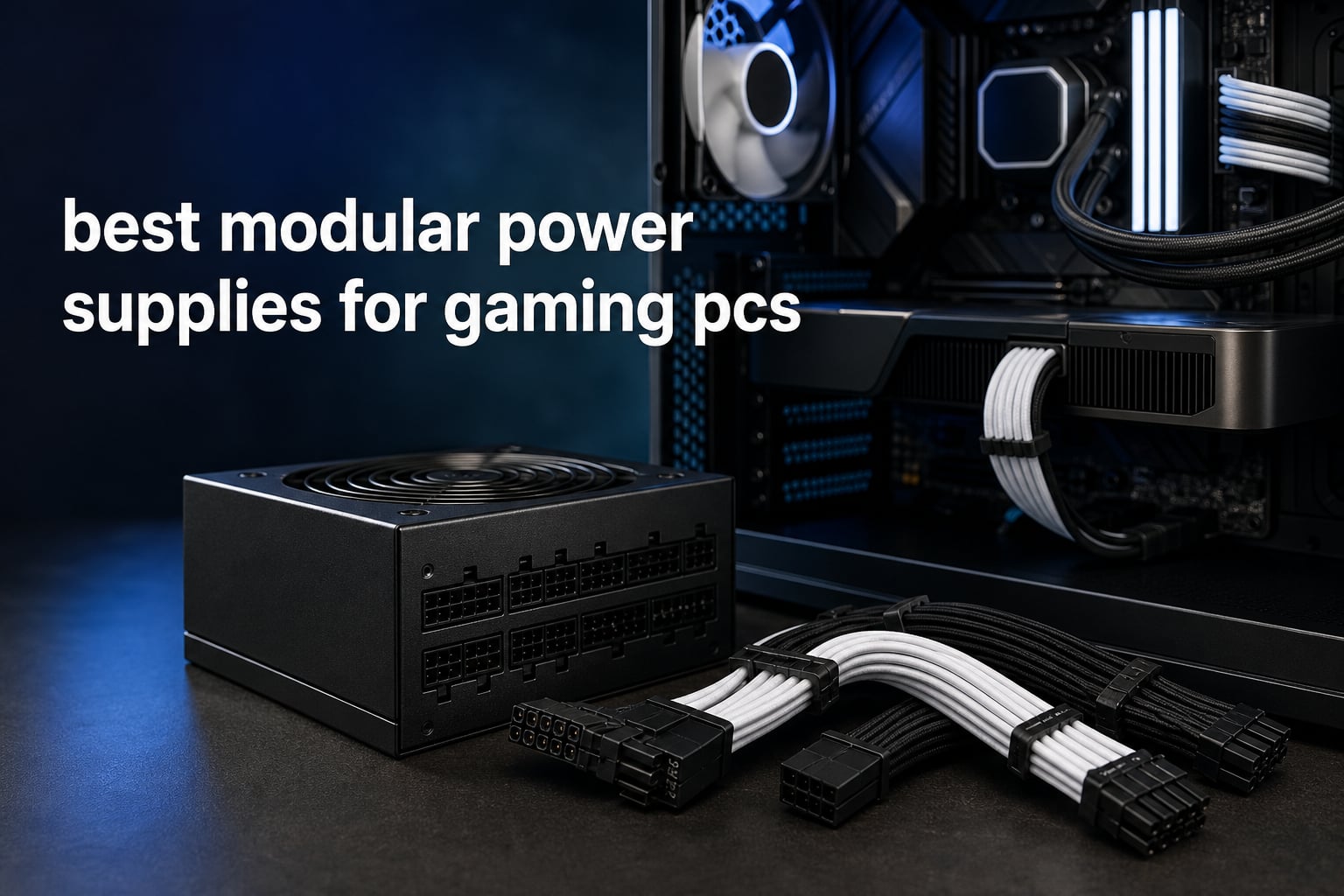
The best modular power supplies for gaming PCs do more than turn wall power into power your parts can use. They give a build only the cables it needs, make later upgrades less awkward, and can include a native 12V-2×6 lead for a current graphics card.
For this guide, we compared all eight available fully modular units by their listed wattage, current ATX and PCIe support, efficiency claims, cooling features, warranty terms, ratings, and review volume. I also gave extra weight to the questions builders repeatedly raise: whether 850W is enough, how to seat a 12V-2×6 cable safely, and whether a quiet fan mode is meaningful in an actual gaming PC.
A modular PSU is a power supply with detachable cables, so you connect the motherboard, CPU, GPU, SATA, and peripheral leads that your system actually requires. That cleaner cable route can help airflow and makes troubleshooting or a component swap easier, but it does not make a weak unit strong; wattage, connector support, protection circuitry, and long-term support still matter.
Table of Contents
Top 3 Picks for 2026
The Corsair RM850e is the broadest recommendation here because it combines 850W, fully modular cabling, ATX 3.1 and PCIe 5.1 support, a supplied 12V-2×6 cable, and a 7-year manufacturer warranty. The MONTECH Century II raises the available power to 1050W with a 10-year warranty and Cybenetics Platinum efficiency certification, while MSI’s MAG A850GL gives many builders an 850W ATX 3.1 option with a dual-color native GPU connector.
Those picks are not interchangeable. A quiet white showcase build may favor NZXT or Lian Li, a demanding 1000W system may suit Corsair HX1000i or be quiet!, and ASUS has a distinct durability-focused feature set.
These modular PSUs cover gaming PCs in 2026
The list contains 850W, 1000W, and 1050W ATX models; there is no SFX power supply among the eight. Every selection is fully modular, while current-standard choices have ATX 3.1 and PCIe 5.1 support or, in the ASUS unit’s case, ATX 3.0 support with a 16-pin PCIe lead.
Use this overview to narrow the field, then read the matching review for the connector, cooling, warranty, and build-fit details that matter to you.
| Product | Specifications | Action |
|---|---|---|
 Lian Li EDGE1000W Lian Li EDGE1000W |
|
Check Latest Price |
 Corsair RM850e Corsair RM850e |
|
Check Latest Price |
 ASUS TUF Gaming 1000W ASUS TUF Gaming 1000W |
|
Check Latest Price |
 NZXT C850 Gold NZXT C850 Gold |
|
Check Latest Price |
 be quiet! Pure Power 13 M be quiet! Pure Power 13 M |
|
Check Latest Price |
 Corsair HX1000i Corsair HX1000i |
|
Check Latest Price |
 MONTECH Century II MONTECH Century II |
|
Check Latest Price |
 MSI MAG A850GL MSI MAG A850GL |
|
Check Latest Price |
1. The Lian Li EDGE1000W is the white 1000W pick with a built-in hub
- ATX 3.1 and PCIe 5.1 support
- Native 12V-2x6 cable
- USB and fan hub
- Magnetic dust filter
- 10-year warranty
- Relatively small review pool
- Hub feature may not suit every case
Lian Li’s EDGE1000W stands apart because its listed USB and fan hub supports four devices and up to eight downstream connections. For a white RGB build with several fans or USB accessories, that integration can reduce the number of small controllers competing for space behind the motherboard tray.
The unit supplies 1000W in a standard ATX form factor and lists ATX 3.1 plus PCIe 5.1 compliance. It also includes a 12V-2×6 connector for NVIDIA GeForce RTX 40 and 50 series cards, so a compatible card can use its native lead rather than an adapter.
Its Cybenetics Gold efficiency claim and low-noise positioning are welcome on paper, as is the removable magnetic dust-filter mesh. The 4.8 rating is excellent, but it comes from 165 reviews, so I would treat the review consensus as promising rather than as broad as that for the larger-volume Corsair and MSI options.
The 10-year warranty is one of the strongest ownership signals in this group. Its 7.17 by 3.39 by 5.91 inch listed dimensions also deserve a case-clearance check before installation, especially if the lower shroud has a tight cable chamber.
This PSU suits a white build that needs more than basic power delivery
Choose this one when the white finish, 1000W output, current connector support, and hub functionality all solve real parts of your build. A system with numerous case fans, front-panel devices, or a clean-display goal has more reason to consider it than a simple build with only a few cables.
The 12V-2×6 cable makes it a sensible candidate for a high-end GPU configuration. Leave enough room to route that cable without a sharp bend next to the connector.
This PSU is less compelling when a hub would sit unused
A builder who already owns a fan and USB controller may receive little practical benefit from the integrated hub. In that case, compare its 1000W output and warranty against the other high-capacity models rather than selecting it for an extra feature that duplicates existing hardware.
The smaller pool of buyer feedback is another reason to check current compatibility notes for your exact case and components. The listed rating is strong, but review count gives useful context.
2. The Corsair RM850e is the balanced 850W choice for most gaming PCs
CORSAIR RM850e (2025) ATX 3.1 PCIe 5.1 Ready 850W Power Supply – Black
- Fully modular cables
- ATX 3.1 and PCIe 5.1
- 105C-rated capacitors
- Quiet 120mm fan
- Modern Standby
- Some reports of coil whine
- Seven-year warranty is shorter than some rivals
The RM850e is the easy starting point for a mainstream-to-high-end gaming build because 850W is a useful middle capacity and the feature list is current. It is fully modular, carries ATX 3.1 and PCIe 5.1 compliance, and includes a 12V-2×6 cable for a modern GPU.
Corsair specifies 105°C-rated capacitors, Modern Standby compatibility, and a 120mm rifle-bearing fan with a calculated fan curve. Those are concrete design choices that support steady operation and lower noise, although fan sound can still vary with case airflow, ambient temperature, and load.
This model has a 4.7 rating from 828 reviews, one of the more established feedback pools in this list. Buyers commonly praise quiet operation, modular cable management, and reliable delivery, while the reported coil-whine experiences mean a silent-room builder should keep expectations realistic.
At 5.91 by 5.51 by 3.35 inches and 3.4 pounds, it is a relatively compact ATX option by the supplied figures. That makes cable routing easier in many normal mid-tower layouts, but always confirm the case’s PSU length allowance and bottom shroud space.
This 850W capacity fits a powerful single-GPU gaming build
For many gaming PCs, 850W is a practical target when paired with a single current GPU and a strong desktop CPU. The PSU is rated to handle GPU transient power excursions of up to two times, as specified for its ATX 3.1 certification.
It is a sound fit for builders who want a native current-generation GPU cable but do not require the headroom of a 1000W or 1050W unit. Start from the GPU maker’s PSU guidance, add the CPU and the rest of the system, then leave reasonable headroom instead of matching the figure exactly.
This PSU needs a noise check for an extremely quiet room build
Some users report coil whine under load, and that sound can depend on the interaction between a particular PSU, GPU, electrical supply, and frame rate. It is not the same as fan noise, so a fan curve alone cannot predict it.
The seven-year manufacturer warranty is solid, though several alternatives here list 10 years. If long warranty coverage outranks compact dimensions, compare the NZXT, Lian Li, MONTECH, ASUS, and MSI entries closely.
3. The ASUS TUF Gaming 1000W favors a rugged 1000W build
- Military-grade components
- Protective PCB coating
- Dual ball bearing fan
- 16-pin PCIe cable
- 10-year warranty
- ATX 3.0 rather than ATX 3.1
- Older standard than newer options
ASUS aims the TUF Gaming 1000W at builders who put durability features high on the list. Its capacitors and chokes are described as passing the brand’s military-grade certification testing, and the PCB has a protective coating intended to guard against moisture, dust, and extreme temperatures.
The 120mm Axial-tech fan uses dual ball bearings, which ASUS says can last up to twice as long as sleeve-bearing designs. The unit is fully modular, has 80 Plus Gold certification and Japanese capacitors, and is backed by a 10-year warranty.
It is ATX 3.0 compatible rather than ATX 3.1, but the bundled 16-pin PCIe cable can deliver up to 600W to a PCIe Gen 5.0 graphics card according to the listing. That makes it usable for a compatible high-power GPU, while newer ATX 3.1 models offer the later specification.
A 4.7 rating across 466 reviews gives this model meaningful buyer feedback. Its 5.46-pound listed weight is also higher than several units here, which is not a flaw by itself but makes a supported, secure case mount sensible.
This PSU fits builders who prioritize physical protection and 1000W headroom
The coated PCB and dual-ball-bearing fan are the core reasons to consider this ASUS over a plainer 1000W supply. They speak directly to a build that runs in a dustier room or one intended for extended use with substantial GPU demand.
Its 1000W output gives more capacity than the 850W models for a system with a power-hungry graphics card, CPU, storage, cooling, and added peripherals. Headroom does not create performance by itself, but it can keep the planned load well below the label’s ceiling.
This PSU is not the first choice when ATX 3.1 is non-negotiable
If you specifically want an ATX 3.1 power supply, pick one of the listed Corsair RM850e, NZXT, be quiet!, Corsair HX1000i, MONTECH, MSI, or Lian Li units instead. The TUF’s ATX 3.0 support and 16-pin cable are still relevant, but they are not the later standard.
Builders who want a semi-passive fan stop at low load should also compare the NZXT, be quiet!, Corsair HX1000i, and MONTECH entries. ASUS highlights the bearing design rather than a zero-RPM mode in the supplied information.
4. The NZXT C850 Gold is the quiet white 850W option
- ATX 3.1 with 12V-2x6
- Zero Fan Mode
- 135mm FDB fan
- Japanese capacitors
- 10-year warranty
- Some higher-load noise reports
- Listed dimensions need case check
The NZXT C850 Gold has a particularly clear identity: white finish, 850W output, fully modular cables, and low-load silent operation. Its ATX 3.1 compliance and native 12V-2×6 connector make it ready for a current compatible graphics card, with the listing describing up to 600W for an RTX 40 series GPU.
NZXT lists 80 Plus Gold, Cybenetics Gold, and Cybenetics A- noise-level certification. The 135mm fluid-dynamic-bearing fan enters Zero Fan Mode below 50% load, so desktop use, browsing, and lighter game sessions may run without fan noise from the PSU.
The model uses 100% premium Japanese capacitors and has a 10-year manufacturer warranty. Its 4.7 rating from 418 reviews is encouraging, with user feedback especially positive about the fan-stop behavior, though some users expected less noise when the system moved into heavier loads.
This is a strong white alternative when Lian Li’s hub and 1000W capacity are unnecessary. The supplied 6.3 by 5.91 by 3.39 inch dimensions remain important in a compact chassis because the connector side needs space for graceful cable bends.
This PSU suits a quiet white gaming PC with an 850W target
Pick the NZXT when the case exposes the PSU or has a coordinated white theme, but the decision should still rest on the 850W capacity and current standards first. The white finish is an added build benefit, not a reason to settle for inadequate power.
Its A- Cybenetics noise claim adds useful context that 80 Plus does not provide. Efficiency labels describe conversion efficiency; a noise rating speaks to acoustics under a defined test approach.
This PSU needs airflow planning at sustained heavy load
Zero Fan Mode applies below 50% load, not during every gaming session. A heavily loaded PC will ask the 135mm fan to work, so case intake and exhaust still have a direct effect on the sound you hear.
Some owner reports mention higher sound than expected at higher loads. That does not erase the formal noise and efficiency certifications, but it is useful context for a system built for near-silent all-day rendering or long high-load play.
5. The be quiet! Pure Power 13 M gives 1000W with semi-passive cooling
- Up to 94.4 percent efficiency
- Native 12V-2x6
- Single 12V rail
- Semi-passive fan
- LLC topology
- One-year manufacturer warranty
- Heavier than many alternatives
The Pure Power 13 M combines 1000W capacity with ATX 3.1, PCIe 5.1 GPU support, fully modular cables, and a native 12V-2×6 connector. It is a practical option for a high-draw gaming system when quiet idle behavior matters as much as connector compatibility.
be quiet! specifies up to 94.4% efficiency under its 80 Plus Gold certification and uses an LLC topology for voltage regulation and efficiency. The single 12V rail is designed to handle power excursions up to twice the rated power, a relevant point for GPUs with short, sharp changes in draw.
The 120mm fan is semi-passive, meaning it stays off at low load and starts only when cooling is needed. That approach makes sense for a PC that spends time at the desktop between games, though sustained gaming and heavy compute loads will involve fan operation.
Its 4.7 rating comes from 234 reviews and the product is ranked sixth in the listed category data. The major limitation is simple: the supplied details list a 1-year manufacturer warranty, which is much shorter than the 7- and 10-year coverage on most competitors here.
This PSU is for a 1000W system that needs current GPU support and quiet idle time
Use this be quiet! model for a build where 850W looks restrictive after adding a high-end GPU, CPU, fans, drives, and planned upgrades. The native 12V-2×6 connector avoids relying on an adapter when the GPU supports that connection.
The fully modular cable set is also helpful in a full tower or a clean tempered-glass system. Route only the leads required and keep unused cables in the box, not packed under the PSU shroud.
This PSU loses ground when warranty length is a deciding factor
A one-year manufacturer warranty is the clear trade-off against the product’s otherwise current feature set. Builders who use warranty duration as a proxy for expected support will likely feel more comfortable with the 10-year options from Lian Li, ASUS, NZXT, Corsair HX1000i, MONTECH, or MSI.
The listed 3.14-kilogram weight is another small consideration for a compact build. Check the case mount and allow room for the modular plugs rather than treating the ATX label as a complete fit guide.
6. The Corsair HX1000i is the 1000W Platinum option with software monitoring
- 80 Plus Platinum efficiency
- ATX 3.1 and PCIe 5.1
- 140mm FDB fan
- Zero RPM mode
- iCUE compatible
- Premium-positioned model
- No listed warranty detail in core specifications
The Corsair HX1000i is the pick for a builder who wants 1000W, 80 Plus Platinum efficiency, ATX 3.1, PCIe 5.1 support, and iCUE compatibility in one fully modular supply. The higher efficiency certification is its clearest technical separator from the Gold-rated models around it.
A 140mm fluid-dynamic-bearing fan and Zero RPM Fan Mode target lower audible output at light loads. The bigger fan may move air at lower speed when it does run, but actual system noise still depends on the GPU, CPU cooler, case fans, and the load placed on every component.
iCUE compatibility is useful for builders already using Corsair’s software ecosystem and who want a PSU that participates in that setup. It should not become the sole reason to buy a PSU; capacity, required cables, case fit, and warranty coverage are the foundation.
This unit has a 4.6 rating from 328 reviews. The supplied review information describes a 10-year manufacturer warranty, while the technical specification block does not list it, so confirm current warranty language at checkout rather than relying on a single field.
This PSU fits a feature-heavy 1000W build with efficiency as a priority
Choose the HX1000i when a high-end gaming or workstation-style system calls for 1000W and you want the listed Platinum efficiency tier. Less power lost during conversion can also mean less heat inside the unit under comparable load.
It is also a relevant choice for someone who already uses iCUE and values that management connection. Fully modular cabling helps keep the physical build as organized as the software side.
This PSU is excessive for a modest GPU and CPU combination
Not every gaming PC benefits from moving straight to 1000W Platinum. A system whose calculated needs sit comfortably below an 850W unit’s capacity may be better served by the RM850e, NZXT C850 Gold, or MSI MAG A850GL.
Confirm its 7.09 by 5.91 by 3.39 inch listed dimensions against the case before you commit. A long unit can turn an easy modular-cable setup into a cramped one if the drive cage or shroud is close behind it.
7. The MONTECH Century II gives 1050W and dual efficiency credentials
- 1050W capacity
- ATX 3.1 and PCIe 5.1
- Cybenetics Platinum
- Japanese capacitors
- Full protection suite
- Not Prime eligible
- Smaller review base than MSI
The MONTECH Century II provides the highest listed capacity in this group at 1050W, along with ATX 3.1, PCIe 5.1 readiness, a 12V-2×6 cable, and fully modular cabling. That combination gives a builder generous room for a high-end GPU, processor, and future component additions.
Its certifications are notable: 80 Plus Gold plus Cybenetics Platinum efficiency. These labels are not interchangeable, since they come from different programs and testing approaches, but together they give more information than an 80 Plus label alone.
The unit also lists 100% Japanese capacitors, a 135mm fluid-dynamic-bearing silent fan with Zero RPM Mode, and 10-year warranty coverage. Its protection list includes OCP, OVP, UVP, SCP, OTP, and OPP, covering over-current, over-voltage, under-voltage, short-circuit, over-temperature, and over-power situations.
It has a 4.6 rating from 197 reviews, so the feedback pool is smaller than MSI’s but still useful. For a builder comparing feature lists, the combination of 1050W, 12V-2×6 support, fan-stop behavior, and a decade of coverage is unusually complete.
This 1050W PSU gives extra margin for a high-draw gaming PC
This is the right capacity class when a proposed build contains a high-power graphics card and CPU, plus many fans, storage devices, or add-in hardware. It also leaves room for a future graphics-card change without immediately forcing a PSU replacement.
The native 12V-2×6 cable should be inserted fully and checked again after routing. Use the included PSU cable only with this PSU; modular cables are not universal across brands or even across every model family.
This PSU is less proven by volume than the MSI and Corsair alternatives
The Century II’s 197-review count is far below the 5.8k-plus feedback shown for the MSI MAG A850GL and below the RM850e’s 828 reviews. That does not negate its listed specifications or 4.6 rating, but it is reasonable to factor review volume into a close decision.
It is also not listed as Prime eligible in the available data. Availability and service terms can change, so check the listing details that apply in your location.
8. The MSI MAG A850GL is the widely reviewed 850W ATX 3.1 option
- ATX 3.1 and PCIe 5.1
- Native dual-color 12V-2x6
- Fully modular
- 80 Plus Gold
- 10-year warranty
- Larger listed dimensions
- Rating is lower than several picks
The MSI MAG A850GL is a fully modular 850W option with ATX 3.1, PCIe 5.1 readiness, 80 Plus Gold certification, and a 10-year limited warranty. Its defining cable detail is the native dual-color 12V-2×6 connector, which gives a visual cue that can help a builder identify whether the plug is seated correctly.
It is the most extensively reviewed product in this roundup, with a 4.5 rating from 5.8k-plus reviews and a listed number-one best-seller position in its category. That review volume makes it a sensible choice for shoppers who want a large base of user feedback alongside current connector standards.
The unit has a 120mm fan and is fully modular, so unused leads do not have to live inside the case. Its listed dimensions are 12 by 8.75 by 4.92 inches, which appear larger than several peers; verify the actual product and packaging dimensions with the case clearance before installation.
Although the rating is lower than the 4.6 and 4.7 models here, it is still supported by a very large review count. The best modular power supplies for gaming PCs are not selected by star score alone: the needed capacity, cable type, support duration, and physical fit matter just as much.
This PSU fits builders who want a visible 12V-2×6 seating cue
The dual-color cable is a practical safety-oriented feature because it can make incomplete insertion easier to spot during assembly. Still, treat the color as a check, not as a substitute for pushing the connector fully home and confirming the latch engagement.
Its 850W capacity and ATX 3.1 support make it appropriate for many current gaming systems. The 10-year limited warranty adds reassurance for a part that may stay in the PC through several other upgrades.
This PSU requires a careful clearance check in compact ATX cases
The supplied dimensions are larger than those listed for several competing ATX models, so a short PSU chamber, hard-drive cage, or thick cable bundle can matter. Measure from the rear mounting plane to the nearest obstruction and reserve more room for the connector-side cables.
There is no SFX version in this selection, and this is not a mini-ITX PSU by form factor. Small-form-factor builders should search specifically for an SFX or SFX-L unit rather than attempting to force an ATX PSU into a case not designed for it.
Choose a modular PSU by wattage, connector, efficiency, and fit
Start with your actual parts list, especially the GPU and CPU, rather than choosing a wattage number from the PSU label alone. Add the GPU maker’s PSU recommendation to the expected processor draw, motherboard, memory, drives, pumps, fans, USB devices, and a margin for transient spikes and future upgrades.
A 750W unit is not automatically overkill, but headroom depends on the parts
A 750W power supply can be plenty for a moderate gaming PC, and it can also be too close to the limit for a high-draw GPU and CPU combination. The right answer comes from the component guidance and expected simultaneous load, not from a single capacity rule repeated across every build.
In this eight-product list, 850W is the entry capacity. That level is a common place to begin for a strong single-GPU system, while 1000W or 1050W makes more sense when the planned GPU, processor, overclocking, storage, and cooling stack push total demand higher or an upgrade is already planned.
A fully modular design keeps only needed cables in the case
Fully modular power supplies let you attach every cable individually, which is especially handy in a case with a tight back panel or an open display layout. Semi-modular supplies leave a few leads permanently attached, while non-modular units attach every lead whether the build needs it or not.
Modularity is worth it for most custom gaming builds because it simplifies cable management and replacement of a damaged cable from the correct manufacturer kit. Never reuse a modular cable from another PSU just because the connector appears to fit; the pinout at the PSU end can differ and damage components.
An ATX 3.1 unit with a native 12V-2×6 cable is the cleanest choice for a compatible new GPU
ATX 3.1 builds on the recent PSU standard and the listed models pair it with PCIe 5.1 readiness. For a compatible graphics card, a native 12V-2×6 cable reduces the need for a multi-connector adapter and gives the cable path a simpler layout.
The ASUS TUF Gaming 1000W is the exception in this roundup: it lists ATX 3.0 support and a bundled 16-pin PCIe cable rated up to 600W. It remains a capable option, but builders who specifically require ATX 3.1 have seven direct choices above.
A 12V-2×6 connector is safe when it is fully seated and not sharply bent
Reports of connector melting have made builders understandably cautious. The practical steps are straightforward: power off the PC, use the supplied native cable where available, push the plug fully into the GPU until it is seated, avoid sideways stress, and leave room before the first sharp bend.
Do not route the cable so tightly against a side panel that the panel pulls it sideways. After the first install and after moving the PC, inspect the plug again; if it appears loose, is discolored, or the system behaves oddly, stop using it and seek support from the component maker.
80 Plus describes efficiency while Cybenetics can add efficiency and noise context
An 80 Plus certification describes how efficiently a PSU converts AC input to the DC power your components use at defined loads. Gold, Platinum, and Titanium are higher efficiency tiers, but a certification alone does not tell the whole story about fan acoustics, cable layout, warranty, or case compatibility.
Cybenetics is a separate certification program that can report efficiency and noise results. In this group, NZXT lists Cybenetics Gold efficiency and A- noise level, the Lian Li is listed as Cybenetics Gold, and the MONTECH lists Cybenetics Platinum efficiency alongside 80 Plus Gold.
A quiet PSU depends on fan behavior as well as the rest of the system
Look for a zero-RPM or semi-passive mode if low-load silence matters. NZXT’s fan stops below 50% load, be quiet! uses semi-passive cooling, and the Corsair HX1000i and MONTECH list Zero RPM modes; Corsair RM850e instead emphasizes a 120mm fan curve.
Fan sound is only one noise source. A graphics card, CPU cooler, radiator fans, hard drives, and coil whine can dominate what you hear, so a quiet power supply should be part of a complete acoustic plan rather than a promised silent PC.
A long warranty and a new unit are better bets for long-term ownership
Forum discussions consistently warn against used PSUs because internal wear and prior operating conditions are hard to verify. Capacitors age with heat and time, and a supply that looks clean from the outside can still have unknown history.
Several products here list 10-year coverage, while the RM850e lists seven years and the Pure Power 13 M lists one year in the provided data. Warranty duration is not an electrical test result, but it is a meaningful part of comparing support for a component that often stays in a system for seven to ten years.
An SFX case needs an SFX or SFX-L PSU rather than any ATX model in this roundup
Every product above is an ATX form-factor PSU. That means this selection does not include a mini-ITX PSU option, even though compact builds are often better served by a fully modular SFX power supply.
Measure the case manual before ordering. A smaller case may also restrict cable length, the bend radius of a GPU power lead, and airflow around the PSU, so form factor is more than a simple width-and-height match.
FAQs
What is the best power supply for a gaming PC?
The best power supply for a gaming PC is a reputable unit with enough continuous wattage for the GPU, CPU, and peripherals, the right native GPU cable, and a form factor that fits the case. From this list, the Corsair RM850e is the balanced 850W choice for many current gaming builds, while 1000W or 1050W choices suit systems that need more headroom.
Is it worth buying a modular PSU?
Yes, a modular PSU is usually worth choosing for a custom gaming PC because it lets you install only the cables the build needs. That simplifies cable management, helps keep the case less crowded, and makes later component changes easier. Only use cables made for the exact PSU model or approved by its manufacturer.
Is a 750W power supply overkill?
A 750W PSU is not automatically overkill. It can be appropriate for many gaming PCs, but the correct size depends on the GPU, CPU, cooling, drives, and upgrade plans. Check the GPU maker’s guidance, account for the whole system, and leave sensible headroom for transient loads rather than sizing to the bare minimum.
How big of a power supply do you need for a gaming PC?
Choose a PSU by adding the expected GPU and CPU demand to the motherboard, memory, storage, cooling, and peripherals, then leave headroom. An 850W unit is a common starting point for a strong single-GPU gaming build, while 1000W or 1050W can suit higher-draw parts and planned upgrades. Confirm that the unit fits the case and has the needed cables.
Conclusion
The Corsair RM850e is the broad recommendation for a current 850W gaming PC, while the MONTECH Century II offers 1050W, Cybenetics Platinum efficiency, a native 12V-2×6 cable, and a 10-year warranty. For white builds, start with the NZXT C850 Gold or Lian Li EDGE1000W; for a durability-led 1000W choice, consider the ASUS TUF Gaming unit.
Pick from the best modular power supplies for gaming PCs by verifying wattage, case clearance, the exact GPU cable, cooling approach, and warranty before you install. In 2026, a fully seated native 12V-2×6 cable and a sensible amount of capacity headroom are more useful than buying the largest number on the label.