
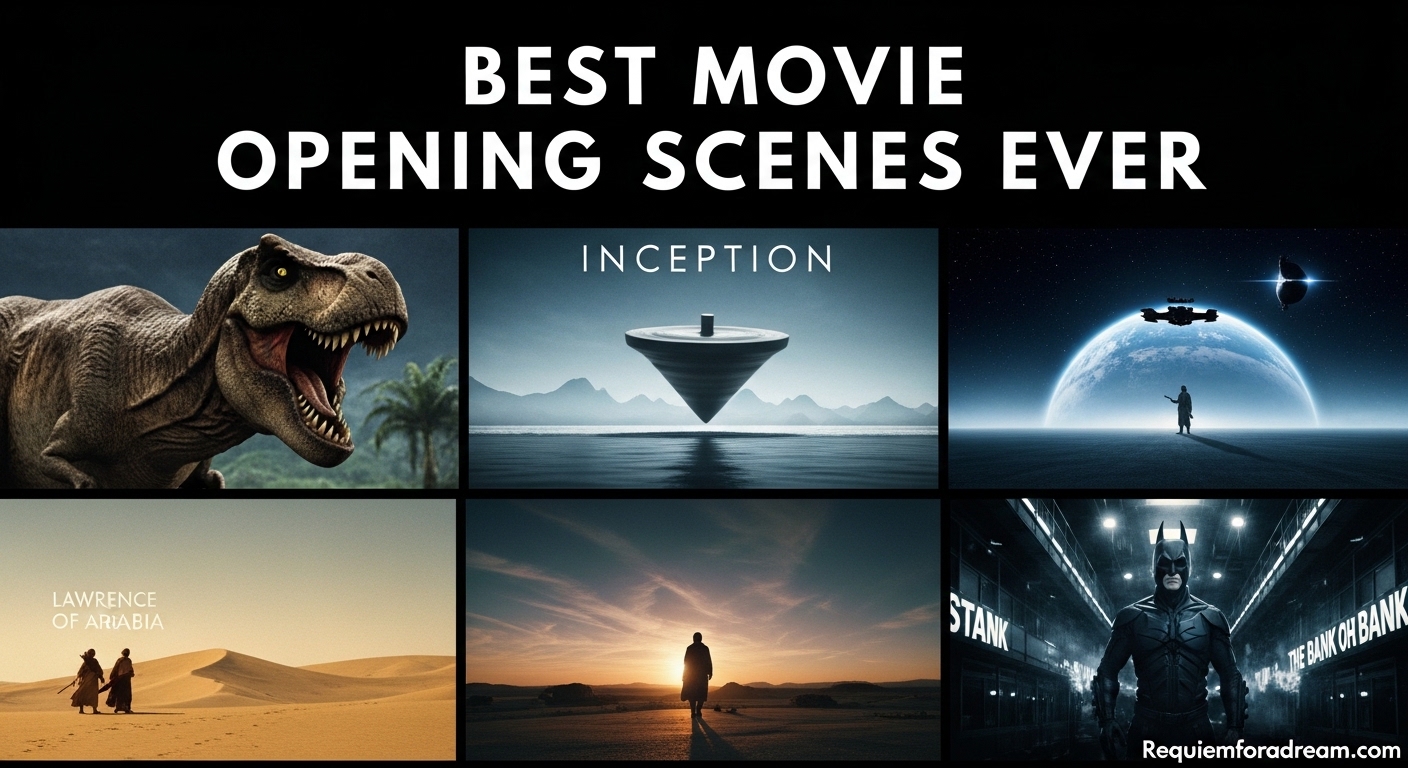
Think about your favorite film for a moment. Chances are, you can remember exactly where you were when its first frame hit the screen. That is not an accident. In psychology, researchers call it the serial position effect: people remember what comes first and what comes last, while everything in the middle tends to fade into a blur. Filmmakers have understood this instinctively for over a century. The best movie opening scenes ever made are not just entertaining. They are masterclasses in grabbing your attention, setting a tone, and making a promise to the audience that the next two hours will be worth every second of your time.
Our team has spent months comparing opening sequences across every major genre, from westerns to horror, from animated classics to war epics. We analyzed cinematography, sound design, dialogue, pacing, and that hard-to-define quality we call the grab factor. We read through hundreds of Reddit threads on r/movies and r/Letterboxd. We studied how critics at StudioBinder, Collider, and GQ ranked their own favorites. The result is this ranked list of the 15 most unforgettable movie opening scenes in cinema history.
Whether you are a film student studying storytelling technique, a screenwriter looking for inspiration, or a movie buff looking for your next great rewatch, these are the openings that defined generations of filmmaking. Let us count them down from great to legendary.
Table of Contents
The Three Best Movie Opening Scenes – Quick Picks
Before we get into the full breakdown, here are the three openings that earned our highest marks across every criterion we measured. These are the scenes that film communities on Reddit, Letterboxd, and professional critics alike consistently place at the very top of their lists.
1. Inglourious Basterds (2009) – Quentin Tarantino’s farmhouse interrogation scene is widely regarded as the greatest opening in cinema history. The tension builds through dialogue alone over 20 relentless minutes, and Christoph Waltz’s introduction as Hans Landa is nothing short of iconic. This scene won Waltz an Academy Award and remains the consensus number one pick across virtually every major ranking.
2. Once Upon a Time in the West (1968) – Sergio Leone’s nearly wordless opening at a remote railway station is a masterclass in visual storytelling and sound design. Every creak, drip, and fly buzz builds dread without a single meaningful line of dialogue. Collider ranks it as their number one opening of all time.
3. The Godfather (1972) – “I believe in America.” Francis Ford Coppola opens with one of the most quoted lines in film history, pulling the audience into the Corleone family’s moral universe through a single, devastating monologue delivered in near-darkness.
How We Ranked the Best Movie Opening Scenes Ever
Ranking art is inherently subjective, but our team used three consistent criteria to evaluate each opening scene. These metrics gave us a structured framework for comparing openings across wildly different genres, eras, and filmmaking styles.
Grab Factor: How effectively does the scene seize the audience’s attention within the first 60 seconds? A great opening does not wait for you to get comfortable. It pulls you in immediately through spectacle, tension, curiosity, humor, or shock. We measured this by asking a simple question: would you keep watching if this were the only thing you knew about the film?
Memorability: Does the scene stick with you long after the credits roll? The most iconic movie opening scenes become cultural touchstones. People quote them, parody them, and reference them decades later. If an opening scene has entered the broader cultural lexicon, it scores high in this category. We cross-referenced Reddit discussions, Letterboxd reviews, and YouTube analysis video counts to gauge lasting impact.
Story Setup: Does the opening do the hard narrative work of establishing tone, character, and world without dumping exposition? The finest openings teach you how to watch the film. They set rules, introduce stakes, and hint at major themes without spelling everything out in obvious ways. A perfect story setup feels invisible to the viewer in the moment but becomes obvious on rewatch.
We also weighted genre diversity in our final rankings. An explosive action sequence and a quiet dialogue scene can both be perfect openings if they accomplish their goals. A horror opening that terrifies and a western opening that mesmerizes deserve equal recognition when they execute their craft at the highest level. Our list intentionally spans horror, animation, sci-fi, crime, war, western, and superhero genres to reflect the full breadth of what great filmmaking can achieve.
The 15 Best Movie Opening Scenes Ever Ranked
Here is our definitive countdown of cinema’s greatest opening sequences, ranked from outstanding to all-time legendary. Each entry includes the specific filmmaking elements that make it great, along with community reactions and behind-the-scenes insights where available.
15. Scream (1996) – The Horror Opening That Rewrote the Rules
Wes Craven opens Scream with one of the most nerve-shredding sequences in horror history. Drew Barrymore’s Casey Becker receives a seemingly innocent phone call from a stranger that slowly escalates into a fight for survival. The scene works because it subverts every single expectation the audience brings to a horror film. Barrymore was the movie’s biggest star at the time, featured prominently on all the promotional materials. Audiences assumed she was safe. Craven proved them devastatingly wrong within the first 15 minutes.
The genius of this opening lies in its simplicity. A phone, a front porch, some popcorn, and mounting dread. Craven uses sound design masterfully throughout: the ringing telephone becomes a weapon of anxiety, each ring tightening the screws. The scene also directly references horror movie tropes through the killer’s quiz questions about Friday the 13th and Halloween, making the audience complicit in the genre’s conventions. It is a horror opening that comments on horror itself while still delivering genuine, stomach-dropping terror.
Reddit’s r/movies community consistently ranks this as one of the most effective horror openings ever filmed. It proved that a horror film could be terrifying and intellectually smart at the same time. The scene also set a new standard for how to kill off a major star early to establish that no one in the film is safe.
14. The Lion King (1994) – Animation’s Crowning Achievement
“Nants ingonyama bagithi Baba.” The opening Zulu chant of “Circle of Life” is enough to give anyone chills, regardless of age or background. Disney’s The Lion King begins with a sunrise over the African savanna, and in under three minutes, it accomplishes something remarkable: it makes you feel the weight of an entire ecosystem coming to life. Every animal in the kingdom is traveling to the same destination, and the reason is not revealed until the final seconds of the sequence.
The sequence is a technical marvel of hand-drawn animation combined with early CGI techniques that were groundbreaking for 1994. Animals gather at Pride Rock in a grand procession that functions as both world-building and emotional preparation. We do not meet Simba yet. We do not meet any characters at all. We meet the world they will inherit. That creative choice is what makes this opening brilliant. It earns the audience’s emotional investment before asking them to care about any individual character.
Composer Hans Zimmer and lyricist Elton John created a score that functions as a standalone piece of art. The opening song tells you everything about the film’s themes of legacy, nature, and responsibility before a single word of dialogue is spoken. It is arguably the best animated film opening ever made, and it demonstrated that animated films could achieve the same emotional grandeur as live-action cinema.
13. Jurassic Park (1993) – Dinosaurs Before You See Dinosaurs
Steven Spielberg is a master of showing without showing, and the opening of Jurassic Park is one of his finest demonstrations of that principle. The film gives us zero dinosaurs for several minutes, and it is terrifying anyway. A crew transfers a Velociraptor in a rain-soaked thunderstorm, and something goes horribly wrong. We see only glimpses: a powerful claw raking through a metal cage, a muzzle straining against the grip of multiple handlers, workers panicking and shouting. The unseen threat is more frightening than any creature effects could ever be.
This opening does everything right from a storytelling perspective. It establishes the danger of these animals before we even understand what they are or where they came from. It introduces the central theme of human hubris in believing nature can be controlled, contained, and commodified. And it does so with almost no dialogue, relying on cinematography, rapid editing, and sound design to create visceral, heart-pounding tension.
Spielberg reportedly shot this sequence quickly and intentionally kept it tight. The restraint is the entire point. By the time we finally see a dinosaur on screen later in the film during the legendary Brachiosaurus reveal, we have already been trained to fear what these creatures can do. That is brilliant narrative economy: establish the threat first, then reveal the wonder.
12. Drive (2011) – Neon Silence and Sudden Violence
Nicolas Winding Refn’s Drive opens with Ryan Gosling’s unnamed driver navigating the streets of Los Angeles at night, listening to a police scanner, calmly evading pursuit after a heist gone wrong. The sequence is a masterclass in atmosphere and mood. Refn uses the electronic score by Cliff Martinez to create a hypnotic, almost dreamlike quality before puncturing it with brief bursts of real-world danger and urgency.
What makes this opening so memorable is how much it tells us about the central character without any exposition whatsoever. The driver is precise, calm under extreme pressure, and thoroughly professional. He does not panic when he hears sirens approaching. He thinks three steps ahead. The way he hides the getaway car in a parking structure, calmly blends into a crowd exiting a sports arena, and simply vanishes into the night reveals a complete personality through action alone. No backstory needed. No voice-over required.
Refn’s opening sets the exact tone for the entire film that follows: quiet, meditative beauty interrupted by sudden, shocking violence. It promises the audience an experience that is more art film than action thriller, and the rest of the film delivers on that promise completely. The GQ ranking of best movie opening scenes placed Drive in the top five for good reason: it creates an unforgettable mood in under ten minutes.
11. Goodfellas (1990) – “As Far Back as I Can Remember, I Always Wanted to Be a Gangster”
Martin Scorsese opens Goodfellas with a flash-forward that grabs you instantly. Three men in a car stop on a dark road to open the trunk, and we witness a brutal stabbing before the title card even appears on screen. The violence is sudden and matter-of-fact. Then Scorsese freezes the frame on Ray Liotta’s face, and a voice-over begins: “As far back as I can remember, I always wanted to be a gangster.” The camera then cuts to a sweeping, celebrated tracking shot through the Copacabana nightclub that has been studied in film schools around the world.
This opening is a filmmaking clinic in how to introduce a character’s worldview without ever breaking the story’s momentum. Henry Hill does not just tell us he wanted to be a gangster. Scorsese shows us exactly why: the glamour, the power, the respect, the sense of belonging to something bigger than yourself. The Copa tracking shot is one of the most famous single takes in cinema history, and it works so well because it places the audience directly inside Henry’s seductive fantasy of gangster life.
The juxtaposition of the trunk murder with the nightclub entrance is completely intentional. Scorsese wants you seduced by the lifestyle before you are forced to confront its violence. He wants you complicit in Henry’s choices before you understand their consequences. Forum discussions on r/Letterboxd frequently cite the “Maybe I should’ve just gotten the rice” line as a fan-favorite detail that perfectly grounds the scene in dark humor and authenticity.
10. A Clockwork Orange (1971) – Uncomfortable From Frame One
Stanley Kubrick opens A Clockwork Orange with a slow zoom out from a close-up of Malcolm McDowell’s Alex DeLarge, staring directly into the camera with one exaggerated eyelash, a bowler hat, and a chilling, almost theatrical grin. The camera pulls back steadily to reveal the Korova Milkbar, a surreal space filled with sexually suggestive white sculptures and teenage gang members drinking drug-laced milk. Nothing about this image is welcoming, and that is precisely the point.
The opening image is one of the most recognizable in all of cinema. Kubrick’s use of Wendy Carlos’s electronic Moog synthesizer adaptation of Henry Purcell’s “Music for the Funeral of Queen Mary” creates an unsettling contrast between classical grandeur and futuristic depravity. The music tells you everything about this world before a single character speaks: it is corrupted, oddly beautiful, and deeply, deeply wrong.
What makes this opening scene great is how efficiently it establishes tone and aesthetic. In under three minutes, you understand the film’s entire visual language, its moral ambiguity, and its absolute willingness to make you uncomfortable. Both StudioBinder and Collider rank this opening in their top tens, and it appears on virtually every “greatest opening scenes” list ever compiled across every platform we studied.
9. Apocalypse Now (1979) – The Sound of Helicopters and Burning Trees
Francis Ford Coppola’s Apocalypse Now begins with an image that sears itself into your memory: a shot of Vietnamese jungle canopy in flames while military helicopters cross the frame in slow motion. The Doors’ “The End” plays on the soundtrack as Martin Sheen’s Captain Willard lies upside down in a Saigon hotel room, a ceiling fan spinning above him, visually and sonically blending into the helicopter rotors that haunt his mind.
This opening is a hallucinatory collapse of past and present, reality and memory, internal trauma and external destruction. The jungle burning on screen is not a scene from the war Willard will eventually enter. It is the war already burning inside his head before the mission even begins. Coppola uses the dissolve technique to merge Sheen’s destroyed, whiskey-soaked hotel room with the Vietnamese landscape, establishing immediately that this film will not separate the personal from the political or the psychological from the physical.
The sound design is truly extraordinary. Jim Morrison’s haunting vocals, the persistent helicopter blades, the jungle ambience, and the dead hotel room silence all layer on top of each other to create a sonic landscape of psychological breakdown. It is an opening that works on pure sensation before it works on story. That sensory-first approach is what makes it endure as one of cinema’s best opening sequences and a landmark of New Hollywood filmmaking.
8. The Dark Knight (2008) – The Bank Heist That Introduced a Legend
Christopher Nolan’s The Dark Knight opens with a meticulously orchestrated bank robbery in broad daylight on the streets of Gotham City. Masked thieves execute a precision heist, systematically eliminating each other as the job progresses through a series of calculated betrayals. The scene builds with the mechanical precision of a Swiss watch, each double-cross revealing another layer of a grander plan.
The brilliance of this opening is that the Joker has designed the entire heist so that every accomplice kills the next one in line, neatly reducing his payout obligations. By the time the last surviving robber removes his mask to reveal Heath Ledger’s painted face, the audience understands they are watching a villain who thinks ten steps ahead of everyone else in the room. The mask removal is one of the most celebrated character introductions in modern cinema, and it works because the entire preceding sequence has been building to that single, electrifying reveal.
Nolan shot the sequence with IMAX cameras, giving it a physical scale and immediacy that feels genuinely cinematic in a way few superhero films achieve. The opening functions as a standalone short film while perfectly establishing the chaos-driven philosophy of the antagonist. Reddit threads on r/movies consistently cite this bank heist as one of the best movie opening scenes of the 21st century and a high-water mark for superhero filmmaking.
7. Jaws (1975) – What You Cannot See Will Hurt You
John Williams’s two-note theme is all you need. Steven Spielberg’s Jaws opens with a nighttime beach party that transitions to a young woman named Chrissie swimming alone in the dark ocean. What follows is cinema’s most famous off-screen attack. We never see the shark. We hear the music building, we see the girl pulled beneath the surface, thrashing, screaming, and then silence. Our imagination fills in the rest, and what we imagine is always worse than anything a special effects team could create.
This opening defined the concept of the “unseen threat” in film, and its influence echoes through every horror and thriller made since. Spielberg famously struggled with the mechanical shark on set, nicknamed “Bruce” by the crew, which malfunctioned constantly throughout production. That technical failure became his single greatest creative decision. By not being able to show the creature, he was forced to suggest it through music, movement, and implication. He forced the audience to project their own deepest fears onto that dark, empty water.
The opening also establishes the film’s central theme of innocence destroyed by forces beyond comprehension. The beach party is carefree and youthful. The swimmer is confident and alive. The brutal contrast between the warmth and laughter of the party and the cold, crushing darkness of the ocean creates a tension that carries through the entire film. Collider ranks this opening in their top ten, and it remains one of the most parodied, referenced, and analyzed sequences in movie history.
6. Raiders of the Lost Ark (1981) – The Greatest Adventure Introduction
Harrison Ford’s Indiana Jones does not get a traditional character introduction. There is no backstory, no establishing narration, no title card explaining who he is. Instead, Steven Spielberg drops us directly into the middle of a jungle trek through a dense South American rainforest. We see Indy from behind first. We see his silhouette against the trees. We see his whip before we see his face. When he finally turns around, the audience already knows exactly who this man is: a capable, resourceful, determined adventurer carrying secrets.
The temple sequence that follows is essentially a miniature adventure film contained within the film itself. Poisoned darts, collapsing floors, a massive boulder chase, a rival archaeologist, a narrow escape via seaplane, and a moment of dark comedy involving a snake that pays off later in the story. Spielberg packs more pure storytelling and characterization into this opening sequence than most adventure films manage in their entire runtime.
This opening is a perennial favorite in community discussions across every platform we studied. Reddit users on r/movies consistently call it the greatest adventure film opening of all time, and Letterboxd logs show it as one of the most rewatched openings in cinema. The sequence works because it is both entirely self-contained and a perfect setup for the character and the story. You learn everything you need to know about Indiana Jones in twelve minutes: he is clever, he is relentless, he is afraid of snakes, and he is not above making a hasty exit when the situation demands it.
5. Saving Private Ryan (1998) – War Without Glory
Steven Spielberg opens Saving Private Ryan with an elderly man walking slowly through the Normandy American Cemetery, collapsing to his knees before a specific grave while his family watches helplessly behind him. Then the film cuts abruptly to June 6, 1944, and the audience is thrust directly into the D-Day invasion at Omaha Beach. For the next 24 minutes, Spielberg delivers one of the most visceral, unflinching, and emotionally devastating depictions of combat ever committed to film.
The opening uses handheld cameras, desaturated color, and unsynchronized sound design to place the viewer directly inside the chaos and terror of the landing. Soldiers vomit on the approach craft from fear and seasickness. Bullets punch through men before they even reach the sand. The camera dips below the water’s surface, muffling the sound of gunfire and screaming, creating a brief, surreal moment of peace before the violence resumes with crushing force. Spielberg reportedly told his cinematographer Janusz Kaminski to make it look like “newsreel footage from the 1940s,” stripping away the polish and glamour that typically characterized war films.
What makes this opening scene truly legendary is not just its technical achievement but its emotional honesty. There is no swelling hero music. There is no triumphant charge up the beach. There is only confusion, terror, desperation, and survival instinct. GQ ranked this the number one movie opening scene of all time, and military veterans have reportedly said it is the closest a fictional film has ever come to capturing the actual reality of combat. That is perhaps the highest compliment an opening scene can receive.
4. Trainspotting (1996) – “Choose Life”
Danny Boyle’s Trainspotting opens with two men running flat-out down an Edinburgh street while Ewan McGregor’s Mark Renton delivers the “Choose Life” monologue over the driving pulse of Iggy Pop’s “Lust for Life.” The sequence is kinetic, darkly funny, and deeply subversive in equal measure. Renton lists all the conventional markers of a successful life in modern society: a job, a career, a family, good health, dental insurance, a washing machine, a compact disc player. Then he rejects every single one of them with a grin and a sprint.
The opening works because it places you directly inside Renton’s worldview before you have any time to judge it. The “Choose Life” monologue has become one of the most quoted movie intros in history, referenced endlessly in pop culture and academic film criticism alike. Boyle’s direction is relentless in its energy: quick cuts, dynamic camera movement, and a soundtrack choice that takes anti-heroin sentiment and somehow transforms it into an irresistible adrenaline rush. It is a film about the devastating reality of addiction that opens with the kinetic energy of a music video.
The cultural impact of this opening cannot be overstated. Forum users on Reddit and Facebook consistently cite the “Choose Life” speech as a defining cultural moment of 1990s cinema, a perfect crystallization of youthful rebellion and generational disillusionment. StudioBinder places it in their top 25 opening scenes, but we believe it firmly deserves a higher position for its lasting influence on filmmaking style, its cultural resonance, and its perfect, seamless fusion of image, sound, and text into something greater than the sum of its parts.
3. The Godfather (1972) – “I Believe in America”
Francis Ford Coppola’s The Godfather begins in near-total darkness. The screen fades in slowly from black to reveal the face of an undertaker named Amerigo Bonasera, speaking directly to the camera in a desperate, trembling voice. “I believe in America,” he says, and what follows is a monologue about justice, loyalty, dignity, and the complete failure of the American dream to protect those who believed in it most. The camera slowly pulls back to reveal Don Vito Corleone sitting behind a desk in shadow, gently stroking a cat in his lap.
This opening is a masterclass in cinematic restraint and power. Coppola keeps the camera tight on Bonasera’s face for an uncomfortably long time, forcing the audience to absorb every desperate word of his plea. The darkness surrounding him feels almost physical. When we finally see Marlon Brando’s Vito Corleone emerge from the shadows, the reveal carries enormous, almost mythic weight. We understand without being told explicitly that this is a man who commands rooms, demands respect, and dispenses a very particular brand of justice. The cat in Brando’s lap, by the way, was reportedly a stray the actor found on set and simply refused to put down during filming.
The scene establishes the entire moral universe of the film in under five minutes of screen time. The formal legal system has failed this man entirely. The promise of America has betrayed him. Only the Corleone family offers what he considers real justice, but that justice comes with invisible strings attached that will tighten over the course of the story. It is one of the most iconic movie opening scenes ever shot, and it appears in the top five of virtually every major ranking we studied during our research.
2. Once Upon a Time in the West (1968) – The Sound of Silence
Sergio Leone’s Once Upon a Time in the West opens with three gunmen waiting patiently at a remote, sun-baked railway station in the middle of nowhere. For nearly fifteen minutes of screen time, almost no meaningful dialogue is spoken. The entire scene is built from ambient sound and carefully staged stillness: a windmill creaking rhythmically in the wind, a telegraph key clicking out an urgent message nobody reads, water dripping and echoing inside a wooden barrel, a fly buzzing lazily against a windowpane. Every sound is magnified, deliberate, and loaded with tension.
Leone understood something that most directors still struggle to grasp: silence can be louder, more dramatic, and more powerful than any explosion or action sequence. The three gunmen, played by veteran Western actors including Woody Strode and Jack Elam, communicate pure menace through posture, eye movement, and absolute stillness. They do not need to speak because their bodies tell the entire story. When a train finally arrives and Charles Bronson’s character known only as Harmonica steps onto the platform, his wordless confrontation with the gunmen is resolved in a matter of seconds. The tension that Leone carefully built for a quarter of an hour releases in a single, devastating gunshot.
This opening is consistently ranked as one of the greatest film opening scenes of all time across every single platform we analyzed during our research. Reddit users praise its extraordinary patience and confidence. Collider places it at number one on their list. StudioBinder ranks it third. The sound design alone would make this scene legendary in film history. Combined with Leone’s operatic visual framing and Ennio Morricone’s haunting, unforgettable score, it creates an experience that defines what cinema can accomplish with minimal dialogue and maximum craft. It is the gold standard for visual storytelling.
1. Inglourious Basterds (2009) – The Farmhouse Interrogation
Our number one pick is Quentin Tarantino’s opening to Inglourious Basterds, and it earns this position through an extraordinary combination of dialogue mastery, sustained tension over 20 minutes, and one of the greatest character introductions in the entire history of cinema. The scene takes place on a quiet dairy farm in occupied France during World War II. SS Colonel Hans Landa, played by Christoph Waltz in a career-defining performance, arrives to politely interrogate a French farmer he suspects of hiding a Jewish family beneath his floorboards.
What makes this opening truly extraordinary is how Tarantino builds unbearable dread through politeness and charm. Landa is articulate, cultured, and meticulous in his manners. He asks for a glass of fresh milk. He compliments the farmer’s daughters. He speaks fluent French with impeccable grace, then switches seamlessly to English at a calculated moment, then switches back again. Every gesture, every smile, every linguistic transition is calculated to disarm and control. The audience knows something terrible is coming from the very first frame, but Tarantino makes you wait for it through twenty agonizing minutes of increasingly uncomfortable, increasingly personal conversation.
Christoph Waltz’s performance in this scene won him the Academy Award for Best Supporting Actor, and watching it, the reasons are immediately clear. Landa’s gentle smile never wavers, not once, even as the scene’s true, horrifying purpose is gradually revealed to the farmer and the audience. The farmer eventually breaks down completely under the unbearable pressure of Landa’s warmth and patience, and what follows is one of the most emotionally devastating sequences in modern cinema. The scene works so perfectly because Tarantino fundamentally trusts his audience to sit with discomfort. He does not rush toward the payoff. He lets the tension build slowly, methodically, until it becomes genuinely unbearable.
This opening appears at number one on StudioBinder’s definitive ranking and number two on both Collider’s and GQ’s best-of lists. Reddit threads on r/movies frequently and overwhelmingly cite it as the consensus greatest opening scene of all time. It earns a perfect mark across all three of our ranking criteria: the grab factor is immediate and sustained, the memorability is permanent, and the story setup introduces the film’s central themes of deception, power, survival, and the terrifying gap between civilized manners and monstrous intent.
How Opening Scenes Have Evolved Over Film History
The best movie opening scenes ever made did not emerge from a creative vacuum. They evolved alongside filmmaking technology, shifting audience expectations, and broader cultural movements. Understanding that evolution helps explain why certain openings hit harder than others and why the craft of the opening scene continues to advance with each new generation of filmmakers.
In the silent era, openings relied almost entirely on visual spectacle and physical performance. Directors like D.W. Griffith and Charlie Chaplin used exaggerated gestures, expressive faces, and title cards to establish mood because they literally had no other tools at their disposal. When synchronized sound arrived in the late 1920s with The Jazz Singer, everything changed overnight. Suddenly, directors could use music, spoken dialogue, and ambient noise to create atmosphere before the first image even appeared on screen.
The Golden Age of Hollywood in the 1930s through the 1950s standardized the elaborate opening credits sequence. Films from this era typically began with orchestral overtures and scrolling text cards listing the cast and crew. The actual story did not begin until the credits finished rolling, sometimes several minutes into the runtime. Directors like Orson Welles with Citizen Kane in 1941 began actively challenging this convention, using the opening shot itself as a storytelling tool rather than treating it as a perfunctory introduction the audience had to endure before the real film started.
The New Hollywood revolution of the 1970s shattered every remaining convention about how a movie should begin. Young directors like Martin Scorsese, Francis Ford Coppola, and Steven Spielberg treated the opening scene as a bold creative statement, not a contractual obligation. The Godfather, Jaws, and Apocalypse Now all opened in ways that announced their directors as artists with fiercely distinct visions and a determination to grab audiences by the throat from the very first frame. This era established the modern expectation that a film’s first minutes should be its most compelling and its most carefully crafted.
Today, the trend has shifted dramatically toward spectacle-driven cold opens that function as standalone entertainments. Blockbusters like The Dark Knight, Skyfall, and the Mission: Impossible franchise begin with massive action set pieces designed to thrill audiences before any significant exposition takes place. At the same time, directors like Quentin Tarantino, Paul Thomas Anderson, and Bong Joon-ho continue proving that dialogue and slowly building tension can be just as gripping, and often more memorable, than explosions and chase sequences. The best modern openings blend both approaches, understanding that the fundamental craft of grabbing an audience’s attention is timeless even as the specific tools and technologies continue to evolve.
What Makes a Great Opening Scene – The Filmmaker’s Toolkit
Behind every unforgettable opening scene is a carefully considered set of technical choices. Directors and their crews use specific, deliberate tools to seize the audience’s attention and set the emotional terms of the film within its first minutes. Here are the key techniques that separate a good opening from a truly legendary one.
Sound Design and Score: More than any other single element, sound determines how an opening scene feels to the viewer. Think of John Williams’s two-note Jaws theme, the soaring Zulu chant in The Lion King, or the oppressive dead silence in Once Upon a Time in the West. Composers and sound designers create the emotional architecture of the first scene. A well-placed musical cue tells the audience whether to feel dread, excitement, nostalgia, or creeping unease before any character ever speaks a word of dialogue.
Cinematography Techniques: The long take through the Copa in Goodfellas, the slow zoom out in A Clockwork Orange, the handheld documentary chaos of Saving Private Ryan. Each of these techniques creates a fundamentally different relationship between the viewer and the screen. Tracking shots create deep immersion. Extreme close-ups create uncomfortable intimacy. Sweeping wide shots create epic scale. The best directors choose their opening shot the way a painter chooses a canvas size: that single decision determines everything that follows.
Dialogue and Voice-Over Narration: Tarantino’s farmhouse opening in Inglourious Basterds proves conclusively that dialogue alone can carry twenty minutes of screen time and keep an audience completely riveted. Voice-over narration, when used effectively in films like Trainspotting and Apocalypse Now, creates immediate, intimate access to a character’s inner world. The key to both approaches is economy. Great opening dialogue reveals character, advances the plot, and builds tension simultaneously without ever feeling like exposition.
Visual World-Building: Sometimes the most powerful openings say nothing at all with words. Leone’s railway station, Kubrick’s surreal milkbar, Spielberg’s rain-drenched raptor paddock. These scenes build entire worlds through production design, lighting choices, and careful visual composition. They teach the audience how to read the film’s visual language before the main story begins in earnest. The world itself becomes the first character the audience meets.
FAQ
What is the greatest film opening of all time?
Based on our analysis and broad community consensus, the greatest film opening of all time is the farmhouse interrogation scene from Inglourious Basterds (2009). Directed by Quentin Tarantino, this 20-minute scene combines masterful dialogue, sustained tension, and Christoph Waltz’s Oscar-winning introduction as Hans Landa. It ranks number one across most major rankings and is the most frequently cited answer in Reddit and Letterboxd community discussions about the best movie opening scenes ever.
What makes a great opening scene?
A great opening scene succeeds across three dimensions: grab factor (it seizes attention immediately within the first 60 seconds), memorability (it stays with the viewer long after the film ends and often enters the cultural lexicon), and story setup (it establishes tone, character, and stakes without dumping heavy exposition). The best openings use sound design, cinematography, dialogue, or visual world-building to accomplish these goals within the first few minutes of the film.
Which movies have the best opening scenes?
The films most consistently ranked as having the best opening scenes include Inglourious Basterds, Once Upon a Time in the West, The Godfather, Saving Private Ryan, Trainspotting, Raiders of the Lost Ark, Jaws, The Dark Knight, A Clockwork Orange, and Apocalypse Now. These films span a wide range of genres from westerns and war dramas to horror and superhero films, demonstrating that a great opening is not limited by genre.
What is a cold open in film?
A cold open is a scene that begins before the opening credits or title card appear on screen. It drops the audience directly into the action, dialogue, or story without any introductory text, voice-over explanation, or formal setup. Films like The Dark Knight and Scream use cold opens to grab attention immediately, creating engagement and investment before the audience even knows the official title of the film they are watching.
Why do some movie openings feel better than the rest of the film?
Some directors pour disproportionate creative energy and preparation into their opening scenes, making them more compelling than the film that follows. This happens because openings are often storyboarded, rehearsed, and shot more intensively than other scenes, or because a strong concept works better as a short, concentrated sequence than as a feature-length narrative. Reddit discussions frequently mention films like Lord of War, 28 Weeks Later, and Watchmen as examples of openings that outshine the rest of their respective films.
Conclusion – Why the Best Movie Opening Scenes Ever Matter
The best movie opening scenes ever made share one essential quality regardless of genre, era, or budget: they refuse to waste a single second of the audience’s time. Whether it is Sergio Leone stretching silence into a symphony of unbearable tension, Quentin Tarantino weaponizing politeness and charm into pure dread, or Steven Spielberg making you deeply afraid of water you cannot even see, these openings respect the audience’s attention and reward it generously.
Our ranking spans six decades of cinema, from 1968 to 2009, and covers westerns, war films, crime dramas, horror, animation, and superhero action. That range tells you something important about the art form. A great opening scene is not bound by budget, technology, or genre. It is bound only by the ambition, creativity, and craft of the filmmakers behind it.
If you take one thing away from this list of the best movie opening scenes ever, let it be this: the next time a film’s first scene grabs you by the collar and refuses to let go, pay close attention to what it is doing and exactly how it is doing it. The technique behind these openings is the same technique that powers every great story ever told. The best movie opening scenes ever created do not just start films. They start conversations that last for decades, inspire generations of new filmmakers, and remind us why we fell in love with cinema in the first place.