
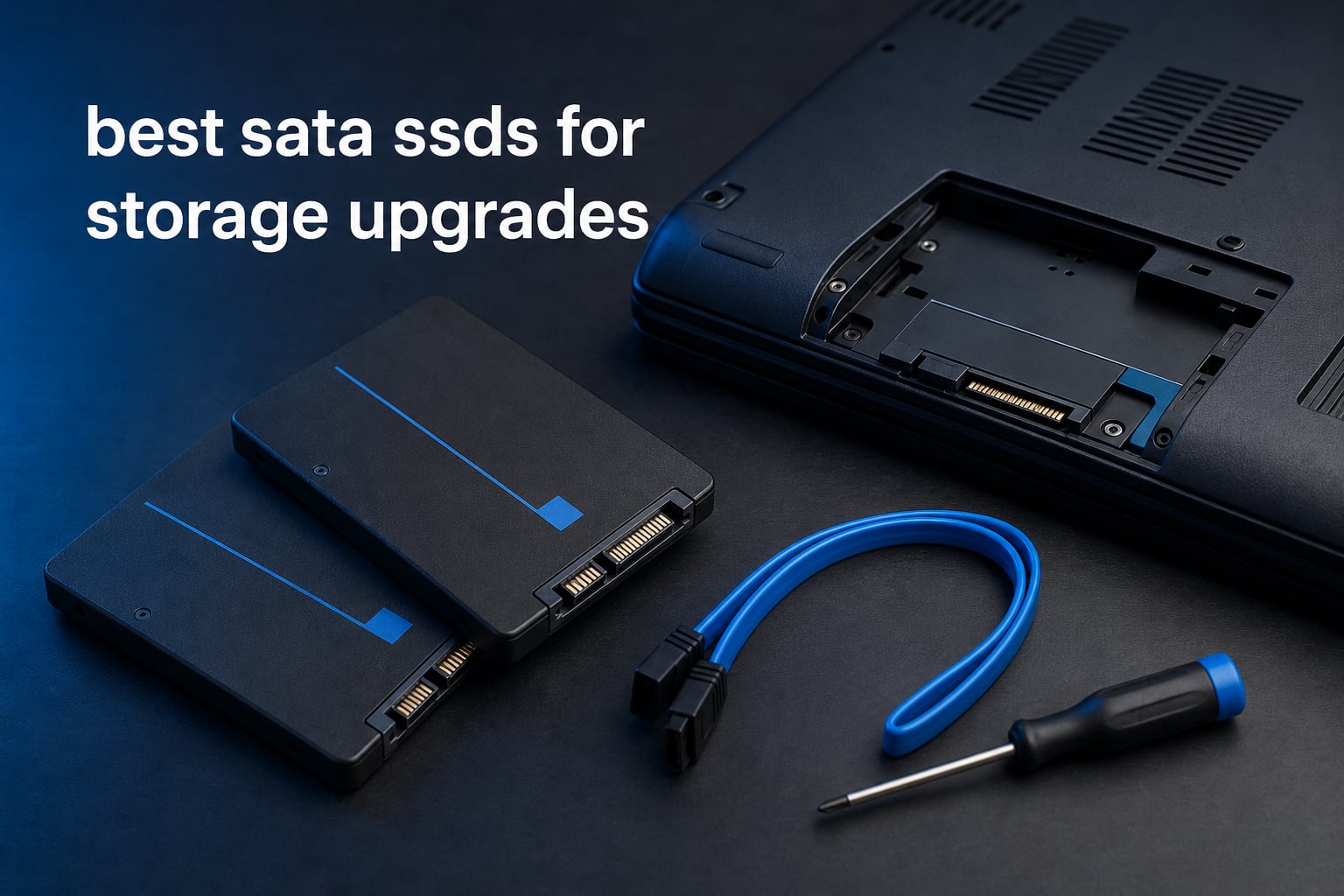
A SATA SSD is still one of the most satisfying upgrades you can make when a laptop or desktop has a slow hard drive or an open 2.5-inch bay. The best SATA SSDs for storage upgrades turn a familiar SATA III connection into much faster booting, app loading, and file access, with real-world sequential reads typically topping out around 560 MB/s.
The Samsung 870 EVO 1TB is my overall recommendation because its listed 560/530 MB/s speeds, 600 TBW rating, five-year limited warranty, encryption support, and management software cover the needs of most people. Kingston A400 is the simpler 480GB route for an older slim notebook, while the Samsung 870 QVO and WD Blue SA510 make more sense when capacity is the priority.
SATA is not the fastest interface now, but it is far from obsolete when your system lacks an M.2 slot, that slot is already occupied, or you are replacing a 2.5-inch hard drive. If you are upgrading a compact editing workstation, our guide to the best mini PCs for video editing can help you check which storage bays and slots a small system actually has.
I ranked these six drives by stated capacity, interface speed, warranty, endurance where supplied, form factor, compatibility, and the limits called out in product feedback. The list does not treat every SATA drive as interchangeable: a 1TB TLC-oriented work drive and a 2TB QLC-oriented media drive can both be right choices, just for different jobs.
Table of Contents
Top 3 Picks for September 2026
Pick the 870 EVO for a main drive that balances speed and stated endurance, the Crucial BX500 for a straightforward 1TB everyday upgrade, and the 870 QVO when you want more space in one 2.5-inch SATA bay. All three use the standard SATA III connection, so confirming physical fit and cable access matters more than chasing a small difference in advertised peak speed.
These six best SATA SSDs make the quick comparison clear in 2026
SATA III has a practical ceiling, which is why the 500 MB/s to 560 MB/s figures below should be read as a class of performance rather than a race with NVMe. Capacity, warranty, NAND type where stated, and your workload should break the tie after you verify that the system accepts a 2.5-inch SATA drive.
| Product | Specifications | Action |
|---|---|---|
 Samsung 870 EVO 1TB Samsung 870 EVO 1TB |
|
Check Latest Price |
 Kingston A400 480GB Kingston A400 480GB |
|
Check Latest Price |
| Samsung 870 QVO 2TB |
|
Check Latest Price |
 Crucial BX500 1TB Crucial BX500 1TB |
|
Check Latest Price |
 PNY CS900 500GB PNY CS900 500GB |
|
Check Latest Price |
 WD Blue SA510 2TB WD Blue SA510 2TB |
|
Check Latest Price |
1. Samsung 870 EVO is the best SATA SSD for balanced storage upgrades
- 560/530 MB/s speeds
- 600 TBW endurance
- 5-year warranty
- Magician software
- AES-256 encryption
- Premium positioning
- only 1TB in this listing
The 1TB Samsung 870 EVO takes the first spot because its published specifications answer the major concerns in one drive. It reaches up to 560 MB/s read and 530 MB/s write, carries a stated 600 TBW endurance figure, and includes a five-year limited warranty.
That combination is useful for a laptop SSD upgrade where the drive will hold the operating system, apps, games, and regular documents. Samsung lists compatibility with laptops, Macs, and PCs, while its 2.5-inch shape keeps this a conventional replacement for an older SATA hard drive.
I also like that Samsung includes Magician software for updates and drive-health monitoring rather than leaving a less experienced owner to find a third-party tool. The listed AES 256-bit encryption and TCG/Opal support are meaningful details for users whose device or workplace can use encrypted storage.
The feedback record is substantial: this listing shows a 4.8 rating across more than 45k reviews, with 89% marked five-star. Forum conversations still show hesitation around Samsung SSD failure stories associated with other product lines, so I would take the sensible route with any brand: keep a current backup and monitor S.M.A.R.T. health rather than treating a warranty as a backup plan.
The 870 EVO fits an operating-system drive and active project storage
The 1TB capacity is a comfortable starting point for a boot drive that also holds common applications and a moderate game library. Its stated 600 TBW rating gives it a stronger documented endurance case than a drive selected only for maximum space.
For a creator, it is a sensible SATA III internal SSD for current projects after an M.2 boot slot is unavailable or already filled. Its sequential figures are already at the practical top of the SATA interface, so a faster SATA label would not materially change the connection limit.
The 870 EVO needs a 2.5-inch bay and a SATA connection
This is not an M.2 stick, so a desktop needs a SATA data cable to the motherboard and a SATA power lead from the power supply. Most laptops that ship with a 2.5-inch hard disk accept this form factor, but check the tray, connector position, and 7mm clearance before ordering.
Choose a different capacity if your media library alone is larger than 1TB or if you only need a small secondary storage SSD. The 870 EVO is a strong all-rounder, not a substitute for an NVMe drive where your motherboard supports one and sustained high-speed transfers are the main goal.
2. Kingston A400 is the best straightforward 480GB hard-drive replacement
Kingston 480GB A400 SATA 3 2.5″ Internal SSD SA400S37/480G – HDD Replacement for Increase Performance
- 7mm slim form factor
- Acronis cloning
- shock resistant
- 500 MB/s read
- large review base
- 450 MB/s write speed
- 480GB fills quickly
The Kingston A400 is the uncomplicated answer when a computer needs to stop feeling like it is waiting on a mechanical disk. Kingston lists up to 500 MB/s reads and 450 MB/s writes, which is a major change from hard-drive behavior even though it trails the fastest SATA models on paper.
Its 2.5-inch, 7mm body is the detail I would prioritize for a thin notebook that previously used a 7mm hard drive. Kingston explicitly describes it as fitting a wider array of systems and as appropriate for thin and light notebooks with limited space.
The A400 also includes Acronis cloning software, a welcome practical feature if you plan to copy an existing Windows installation instead of starting again. Its stated shock and vibration resistance is another meaningful improvement over a spinning drive in a machine that travels.
There is a very large feedback pool behind this option: the listing reports a 4.8 rating from more than 205k reviews, with 86% five-star. That volume does not make it immune to failure, but it gives more context than a lightly reviewed listing; regular backups remain non-negotiable for irreplaceable files.
The A400 fits older laptops and basic desktop refreshes
Choose the A400 when 480GB is enough for the operating system, essential programs, and a focused set of files. It is particularly convincing for an old laptop whose original hard drive is the obvious bottleneck and whose user wants a familiar 2.5-inch SATA installation.
Its SATA Rev. 3.0 interface is backward compatible with SATA Rev. 2.0, which helps with aging hardware. That does not make an old system faster than its port allows, but it avoids a needless interface mismatch.
The A400 requires realistic capacity planning before migration
A 480GB SSD has less usable formatted space than its label suggests, so check how much data is currently on the source disk before cloning. Leave room for the operating system, temporary files, updates, and future growth rather than filling the drive on day one.
The listed 450 MB/s write speed is moderate beside the 870 EVO or QVO. For long, frequent writing of large video files, I would move toward the 1TB EVO or use a higher-capacity drive as the working location.
3. Samsung 870 QVO is the best SATA SSD for large secondary storage
- 2TB capacity
- 560/530 MB/s speeds
- options up to 8TB
- Magician software
- older SATA support
- QLC NAND trade-off
- 3-year warranty
The Samsung 870 QVO is my high-capacity pick because this version puts 2TB into a standard 2.5-inch SATA drive while still listing up to 560 MB/s reads and 530 MB/s writes. That is practical for a gaming library, photo collection, media archive, or a desktop that has only SATA bays free.
Samsung identifies the QVO as a second-generation QLC SSD and offers the family in capacities up to 8TB. QLC stores more data per cell than TLC, so I see this model as capacity-first storage rather than automatically assigning it the same role as a more endurance-focused 1TB work drive.
The product details note improved random access and sustained performance over the earlier QVO, plus a refined ECC algorithm. Samsung also lists backward compatibility with 3 Gb/s and 1.5 Gb/s SATA interfaces, a helpful point for a desktop that has survived several hardware generations.
The 2TB listing has a 4.8 rating from more than 20k reviews, with 88% five-star. It has a three-year limited warranty, so I would weigh that against the EVO’s five-year term if the drive will receive constant writes rather than primarily reading a game and media library.
The 870 QVO fits game libraries, media collections, and roomy desktops
For a gaming storage upgrade, capacity often matters more than a narrow gap in SATA benchmark numbers. Games installed on a SATA SSD load much more quickly than from a hard drive, while game performance after loading depends much more on the rest of the PC.
This is also a sensible secondary storage SSD beside an existing NVMe boot drive. That arrangement mirrors a common forum solution: use NVMe for the operating system and active work, then reserve a big SATA drive for files that need space more than maximum transfer speed.
The 870 QVO calls for a workload-aware endurance decision
QLC NAND is not a flaw, but it is a reason to match the drive to the job. A mostly read-heavy library of games, finished video, photos, and backups is different from a scratch disk that receives repeated large writes all day.
Samsung quotes up to 2,880 TBW for the 8TB model, not this 2TB listing, so I would not transfer that figure to the drive here. Read the endurance figure attached to the exact capacity you choose, and keep two copies of data that cannot be recreated.
4. Crucial BX500 is the best everyday 1TB SATA storage upgrade
Crucial BX500 1TB 3D NAND SATA 2.5-Inch Internal SSD, up to 540MB/s – CT1000BX500SSD1, Solid State Drive
- 1TB capacity
- 540 MB/s read
- Micron 3D NAND
- low energy use
- Data Recovery Service
- Write speed not stated
- 3-year warranty
The Crucial BX500 earns its place as a plain-language 1TB upgrade for everyday computers. Crucial lists up to 540 MB/s reads, Micron 3D NAND technology, and a 2.5-inch 7mm form factor compatible with desktops and laptops that accept that drive size.
Its claim of being 300% faster than a typical hard drive tells the right story for this class of product: the main gain comes from replacing spinning storage, not from attempting to beat an NVMe drive. Booting, opening programs, and loading ordinary files should feel far more responsive than they do on an HDD.
The BX500 is also listed as 45 times more energy efficient than a typical hard drive. In a laptop, lower storage power use can be a useful side benefit, although total battery life still depends heavily on the display, processor, battery condition, and how the machine is used.
The listing has a 4.7 rating across more than 33k reviews, with 85% five-star. Community discussions commonly distinguish the BX500 from Crucial’s MX500 line, so I would describe this as a capable everyday drive rather than make unsupported assumptions about its behavior under heavy sustained write workloads.
The BX500 fits a balanced laptop or desktop capacity refresh
One terabyte gives breathing room that 480GB and 500GB drives can lack after you migrate a full operating system, applications, family photos, and a few modern games. It is a practical capacity for an office PC, school laptop, or home desktop that needs to become usable again.
Micron 3D NAND and Crucial’s listed Data Recovery Service availability add useful context for buyers researching the brand. Data recovery is not the same thing as a backup, so important material still belongs in at least one separate location.
The BX500 needs a simple clone-or-clean-install plan
Before replacing a hard drive, clean out temporary files and measure the data you plan to move. If the source drive carries more data than fits on the BX500, copy archives to an external disk first or do a clean operating-system installation.
Crucial lists a three-year limited warranty for this drive. That is reasonable information to compare, but the correct decision also depends on capacity, fit, stated performance, and whether the drive is for light daily tasks or a heavy production workload.
5. PNY CS900 is the best compact SATA II-compatible boot-drive upgrade
- 550 MB/s read
- 500 MB/s write
- low power use
- SATA II compatibility
- 3D NAND
- 500GB capacity
- smaller review base
The PNY CS900 is a useful 500GB option for older hardware because PNY lists backward compatibility with SATA II at 3 Gb/s. Its advertised ceiling of up to 550 MB/s read and 500 MB/s write is above what a SATA II port can deliver, but it will still bring the low-latency feel and durability advantages of flash storage to that machine.
For a SATA III system, the listed 500 MB/s write speed is close enough to the class norm to make the more important question capacity. Five hundred gigabytes suits a boot drive, essential applications, and a curated collection, but it can be limiting if you store large games or media locally.
PNY also calls out 3D NAND and ultra-low power consumption. These details make the drive a reasonable candidate for a laptop where the existing disk is slow, noisy, or starting to show its age.
This listing reports a 4.7 rating from more than 6k reviews, with 85% five-star. That is a smaller feedback base than the Kingston, Crucial, or Samsung entries here, so I would be especially disciplined about testing the clone, retaining the old disk until the move is complete, and keeping backups afterward.
The CS900 fits SATA II systems and small operating-system partitions
Older PCs can make excellent web, office, music, and media machines once the hard disk is replaced. The SATA II compatibility note makes the CS900 relevant where a newer drive’s top SATA III transfer figure cannot be reached but solid-state responsiveness still matters.
It also works for a desktop or laptop that has a dedicated 500GB role: operating system, productivity apps, and a set of frequently used files. A separate larger drive can hold archives that do not need SSD access speeds.
The CS900 needs headroom for updates and larger files
Do not plan a 500GB boot volume as if all 500GB were available. Formatted capacity is lower, and Windows updates, restore points, caches, and applications grow over time.
PNY lists a three-year warranty and the product feedback notes limited capacity options. Pick the 1TB BX500 or 2TB options in this guide instead if you already know your storage use will exceed a compact boot-drive role.
6. WD Blue SA510 is the best 2TB SATA SSD with a five-year warranty
- 2TB capacity
- 560/520 MB/s speeds
- 5-year warranty
- 7mm form factor
- laptop and desktop fit
- 4.4 customer rating
- 10% one-star reviews
The WD Blue SA510 is the other compelling 2TB choice, combining a stated 560 MB/s read speed, 520 MB/s write speed, and five-year limited warranty. That warranty length makes it easier to compare with the 870 EVO, while its 2TB capacity makes its use case closer to the 870 QVO.
Western Digital lists the familiar 2.5-inch, 7mm physical format and support for laptops, desktops, and PCs. In practical terms, that means it can replace a 2.5-inch hard drive, occupy a desktop SATA bay, or supply a second SSD volume if your boot drive is already handled.
The listed 2TB capacity is useful when a 1TB drive would force immediate compromises over games, raw footage, photo catalogs, or local backups. I would still keep the actual backup on another device or service; one internal drive is storage, not redundancy.
There is an important trade-off in the feedback: the listing reports a 4.4 rating across nearly 12k reviews, with 78% five-star and 10% one-star. The five-year warranty is valuable, but that lower rating means prospective buyers should read current feedback for their capacity and purchase from a source with a straightforward return process.
The WD Blue SA510 fits spacious laptop and desktop upgrades
Use this drive where 2TB is genuinely useful and you value a longer stated warranty. It is a good match for a desktop game library, a laptop with one 2.5-inch bay, or a secondary drive that holds work files after they leave the active project stage.
Its 560/520 MB/s specifications are near the SATA III limit. In a SATA-only computer, that is the class of speed to expect from a well-specified 2.5-inch drive, not a reason to search for a much higher advertised number.
The WD Blue SA510 calls for extra review and backup diligence
The 10% one-star share in the provided listing data stands out beside the other products here. It does not prove the outcome of a particular unit, but it is a fair reason to set up drive-health monitoring, test the installation promptly, and protect important files from the start.
As with the other 2.5-inch SATA options, confirm that the bay supports a 7mm drive and that the machine has the needed SATA data and power connections. A 2TB upgrade avoids capacity pressure only if the computer can physically host it.
A good SATA SSD choice starts with fit, capacity, and workload
Start by checking what is inside the computer, not by selecting a drive from a speed figure alone. A 2.5-inch SATA SSD needs a SATA data connection and power in most desktops; a laptop may use a combined connector and a drive caddy, while some thin models have no 2.5-inch bay at all.
The 7mm height listed for the Kingston A400, Crucial BX500, and WD Blue SA510 is common for laptop drives. A thicker caddy or spacer may be needed in some older systems, and an M.2-only laptop needs an M.2 SSD instead of any drive in this roundup.
A capacity decision is simple when you map the files you keep locally
Choose roughly 480GB or 500GB for an operating-system drive with basic applications and intentionally limited local files. It is the right level when an external drive or cloud service handles larger archives.
Choose 1TB for a broadly useful laptop or desktop upgrade with games, photos, applications, and room for updates. The Samsung 870 EVO and Crucial BX500 fit this middle ground, although the EVO supplies more stated endurance data and a longer warranty.
Choose 2TB when your computer keeps a large game library, video assets, photo catalogs, or many years of local records. The Samsung 870 QVO emphasizes capacity with QLC storage, while the WD Blue SA510 pairs 2TB with a five-year limited warranty.
SATA remains the right answer when NVMe is unavailable or already assigned
An NVMe SSD uses the M.2 or PCIe connection and can be much faster than SATA in sequential transfers. If a system has an available compatible M.2 slot and you routinely edit huge files or move large datasets, NVMe deserves consideration.
A SATA SSD remains the sensible route for a hard-drive replacement, an occupied M.2 slot, a desktop with extra SATA ports, or a machine limited to SATA. Many users pair an NVMe boot drive with a SATA secondary storage SSD because the two roles work well together.
Endurance and warranty matter most when writes are frequent
TBW means terabytes written: it is the amount of data a manufacturer rates a drive to accept over its warranty period. The Samsung 870 EVO listing states up to 600 TBW, while the QVO family statement of up to 2,880 TBW applies to its 8TB model, not automatically to every capacity.
A longer warranty does not remove the need for backups, but it is useful evidence in a comparison. The 870 EVO and WD Blue SA510 list five-year limited warranties; the Kingston A400, Crucial BX500, PNY CS900, and Samsung 870 QVO list three-year terms in the supplied product data.
A clean migration avoids most first-day upgrade mistakes
Back up the source drive before cloning it, then confirm the used space will fit on the new SSD. If it will not, remove unneeded downloads and move archival material elsewhere before you begin.
After installing, check that the firmware and operating system recognize the SSD, enable TRIM where the operating system supports it, and use S.M.A.R.T. monitoring to watch drive health. Keep the old hard disk untouched until the new installation has booted and your files have been checked.
A SATA SSD can speed gaming loads without changing frame rates
A solid state drive SATA upgrade shortens loading and asset-streaming waits compared with a hard drive. It normally does not raise frame rate in the same way a graphics-card or processor change can, so set expectations around faster access rather than extra visual performance.
For video and NAS planning, SATA SSDs can also serve as fast local project or cache storage, but the broader array design matters. See our best NAS drives for video editing guide when the goal is shared storage or a dedicated editing archive rather than a single-computer upgrade.
FAQs
What is the best SATA SSD to buy at the moment?
The Samsung 870 EVO 1TB is the best overall choice in this group because it combines stated 560/530 MB/s SATA-limit speeds, 600 TBW endurance, a five-year limited warranty, encryption support, and management software. Choose the Samsung 870 QVO or WD Blue SA510 instead when 2TB capacity is more important.
Which 2.5 SATA SSD would you recommend?
For most laptop and desktop upgrades, choose the 2.5-inch Samsung 870 EVO 1TB. The Kingston A400 is a compact 7mm 480GB option for a simple HDD replacement, and the Crucial BX500 provides a 1TB everyday alternative.
Are SATA SSDs just not worth it anymore?
SATA SSDs are worth it when replacing a 2.5-inch hard drive, adding storage to a desktop with spare SATA ports, or working with an older system without an available M.2 slot. NVMe is faster, but SATA remains a major upgrade from an HDD and typically reaches up to about 560 MB/s reads.
What is a good SATA SSD for gaming?
The Samsung 870 QVO 2TB is a good gaming-storage option when you need room for many installs, while the Samsung 870 EVO 1TB is better suited to a balanced main drive. A SATA SSD improves load times over a hard drive, though it does not normally increase frame rates.
What is the best SATA SSD for a budget upgrade?
The Crucial BX500 1TB is the strongest everyday budget-focused choice in this list because it provides 1TB, up to 540 MB/s reads, 3D NAND, and a 7mm 2.5-inch fit. The Kingston A400 and PNY CS900 are good smaller-capacity choices when a 480GB or 500GB drive is sufficient.
Conclusion
Choose the Samsung 870 EVO 1TB when you want the most balanced SATA package: top-end interface speeds, a stated 600 TBW rating, software, encryption, and a five-year limited warranty. Choose the Crucial BX500 for a straightforward 1TB everyday upgrade, the Kingston A400 or PNY CS900 for smaller older-system roles, and either 2TB model when capacity is the central need.
Before selecting from these best SATA SSDs for storage upgrades, confirm the 2.5-inch bay, 7mm clearance, SATA connection, and the space your files will need a year from now. Back up first, then make the upgrade that matches the computer you own rather than the benchmark you wish it had.