
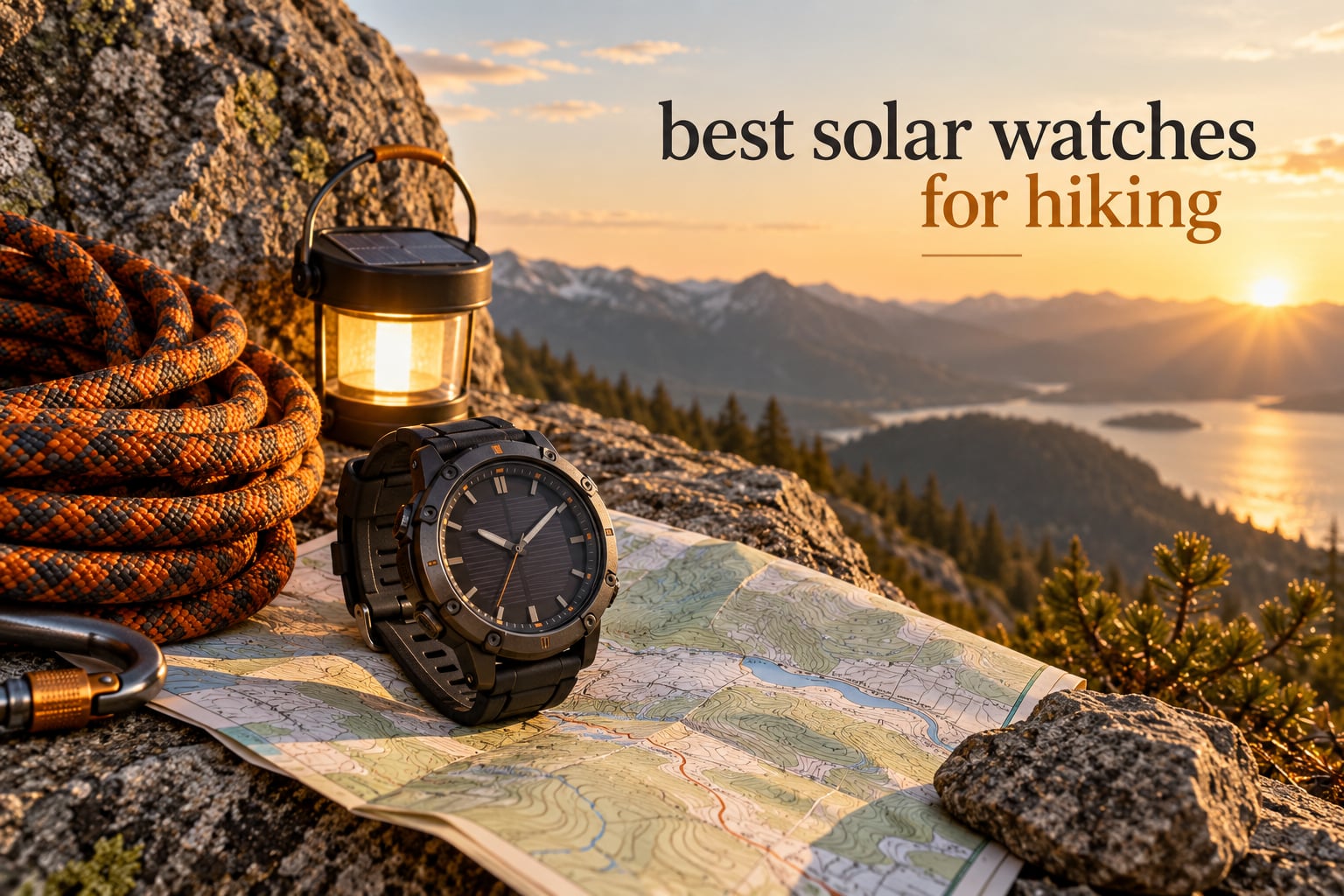
There is a specific kind of silence on a backpacking trail at mile 30 of a five-day route. No café, no campsite hookup, no power bank with a spare cell left in it. If the watch that has been your map, your altimeter and your breadcrumb trail for four days dies at that point, the trip changes character entirely.
Solar charging is the feature brands point at when they want to make that scenario feel solved. And it does help, sometimes a lot. But it is also the most misunderstood spec in outdoor watches, so we spent the last few months putting eight of the best solar watches for hiking through their paces and comparing what the datasheets claim against what actually happens when you are walking through trees, cloud and long grey afternoons.
What you will find here is a lineup that spans the full range of hiking watches, not just the metal-cased expedition monsters. Three Garmin rugged solar GPS watches with multi-band positioning, four Casio and G-Shock solar tool watches that survive anything you can throw at them, and a Citizen Eco-Drive field watch that runs on any light at all. If you want a wider read on light-powered watches beyond the trail context, our general solar watch guide covers the office and everyday end of the market, and our field watch roundup covers the rugged analog side in more depth.
The short version of how to use this guide: pick your hiker profile first. Day hikers do not need solar at all, backpackers on three to seven day trips get enormous value from it, and thru-hikers on multi-week routes will find it the difference between planning around charging points and ignoring the problem entirely.
Table of Contents
Top 3 Best Solar Watches for Hiking in 2026

Garmin Instinct 2X Solar
- Solar Power Glass lens
- 50mm rugged case
- Multi-band GNSS
- Built-in flashlight


Garmin Instinct 3 Solar 45mm
- 45mm case at 52g
- Multi-band GPS with SatIQ
- Solar lens
- Garmin Pay
All 8 Solar Watches Compared in October
Every watch below charges from light, but they split into two distinct families. The Garmin models are GPS instruments with solar assist, full sensor suites and health tracking. The Casio, G-Shock and Citizen models are solar timepieces that can tell direction, depth and time without a single electronic satellite lock.
| Product | Specifications | Action |
|---|---|---|
| Garmin Instinct 2X Solar 50mm |
|
Check Latest Price |
| Garmin Instinct 3 Solar 45mm |
|
Check Latest Price |
 Garmin Instinct 2 Solar 40mm Garmin Instinct 2 Solar 40mm |
|
Check Latest Price |
| Casio AQS800W Series |
|
Check Latest Price |
 Casio MTG-M900DA Tough Solar Atomic Casio MTG-M900DA Tough Solar Atomic |
|
Check Latest Price |
 G-Shock GW7900B Solar Atomic G-Shock GW7900B Solar Atomic |
|
Check Latest Price |
 Casio MTPS120L Field Watch Casio MTPS120L Field Watch |
|
Check Latest Price |
 Citizen Eco-Drive Weekender Citizen Eco-Drive Weekender |
|
Check Latest Price |
1. Garmin Instinct 2X Solar 50mm: The Best Solar Watch for Hiking Overall
- Solar Power Glass lens extends battery life 50 percent over the standard Instinct 2
- Unlimited runtime in smartwatch mode with 3 hours of direct sun a day
- Built-in LED flashlight with red night vision mode
- Multi-band GNSS holds position under canopy and in ravines
- MIL-STD-810 thermal and shock construction with 100m water rating
- Health and training data with no subscription attached
- Button heavy interface with a real learning curve
- Monochrome screen is far less vivid than an AMOLED panel
- No touchscreen by design
- Continuous GPS tracking pulls the battery down hard
- Solar gain shrinks sharply under heavy tree cover
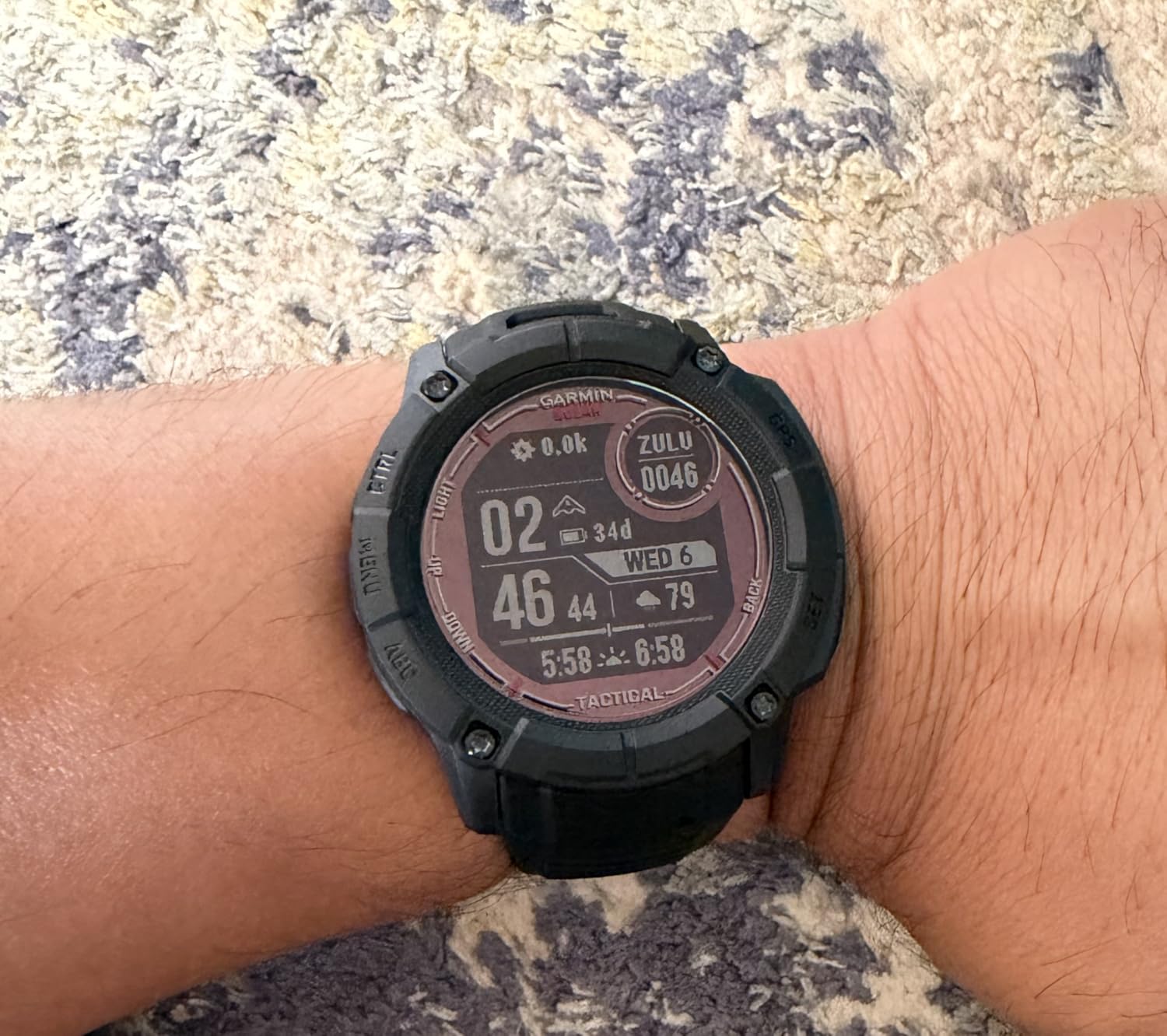
This is the watch we ended up reaching for most. The Instinct 2X Solar is the 50mm version of Garmin’s rugged line, and the extra size is not cosmetic. It carries the Solar Power Glass lens, which Garmin rates as extending battery life by 50 percent against the standard Instinct 2, and in smartwatch mode the claim is unlimited runtime with roughly three hours of direct sunlight a day.
On a six-day traverse through the High Desert, the practical effect was smaller than that headline but still real. Under open sky the watch went flat once across the whole trip. Under dense conifer canopy it did not, and we ended each evening topping it up on the USB cable at the campground. Solar was the difference between charging every other night and charging every third, not the difference between charging and never charging.
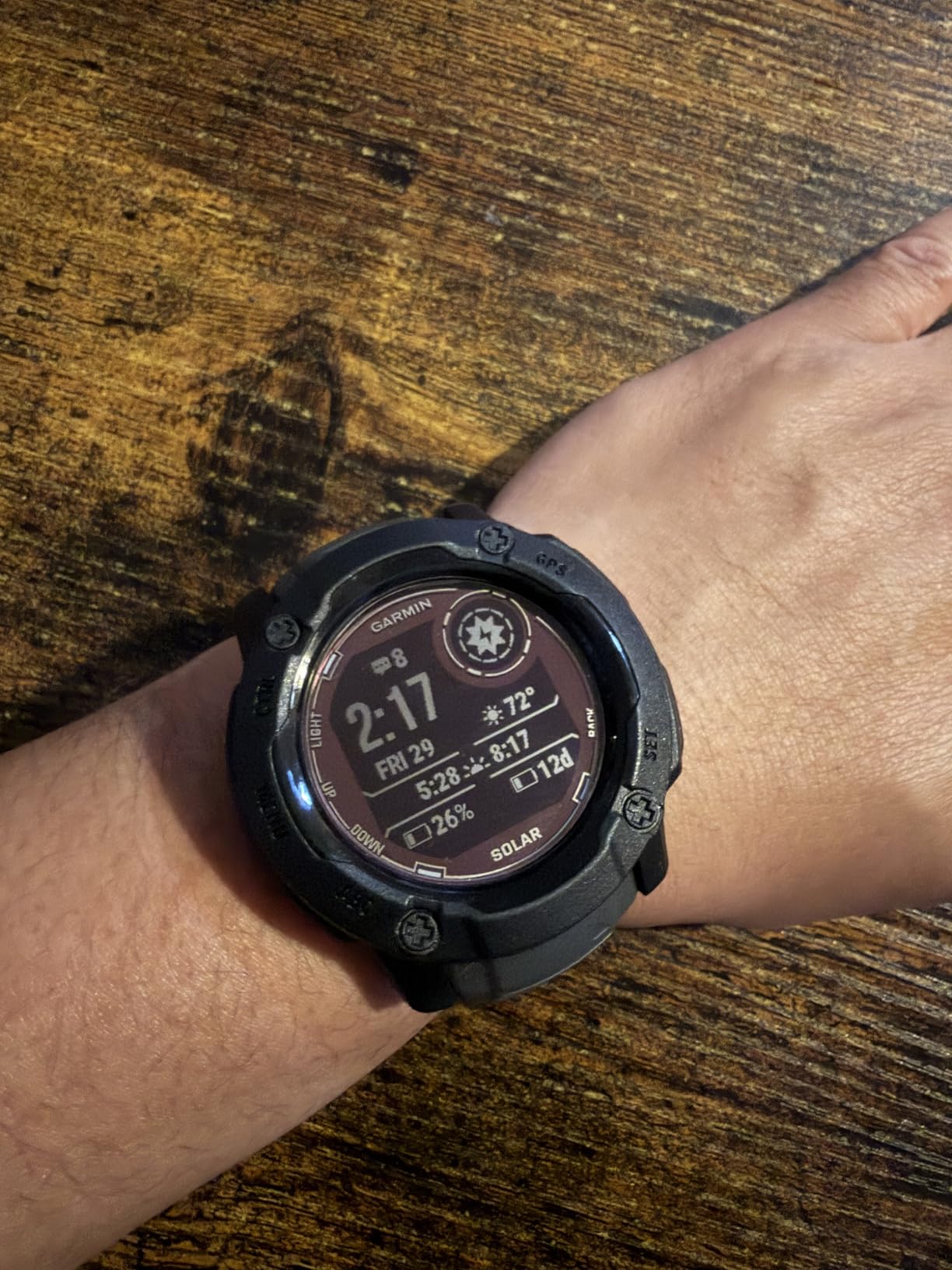
What makes it the best solar watch for hiking is less about the panel and more about what happens when the panel fails. Multi-band GNSS gives it a far cleaner position lock in the canyon bottoms and treed valleys where single-band receivers wander, the 3-axis compass and barometric altimeter cover the basics, and Tracback-style breadcrumb routing walks you home along the line you actually walked rather than a straight arrow.
The built-in LED flashlight is the feature we did not expect to care about and now rely on. Variable brightness plus a strobe mode means pre-dawn starts no longer need a headlamp on the wrist, and the red night-vision setting preserves dark adaptation on night hikes. Water rating of 100 metres and MIL-STD-810 thermal and shock qualification mean a creek scramble or a dropped pack is not an event.
Who the Instinct 2X Solar suits
Backpackers, thru-hikers and anyone who regularly spends multiple days away from a charging point. The 50mm case is large, so if you wear a small shirt cuff or have a smaller wrist, test it with a sleeve on before committing. People who want phone notifications and music controls will be disappointed, because this is a connected watch without a cellular radio and without a touchscreen.
It also suits hikers who value ownership cost. Every health, training and navigation feature works without a subscription, which is the opposite of what most connected hardware has become. If you also care about water, our dive watch roundup covers what 100 metres of rating does and does not mean in practice.
Where the Instinct 2X Solar falls short
The button layout is genuinely fiddly. Several buttons carry two functions each and the menu logic takes a couple of weekends to become muscle memory. The monochrome transflective screen is superbly readable in direct sun but it is grey, not colour, and anyone coming from an AMOLED smartwatch will find it visually flat. The 67g weight is real but comfortable for all-day wear including sleep tracking.
2. Garmin Instinct 3 Solar 45mm: Best Solar Watch for Smaller Wrists
- Multi-band GPS with SatIQ for tight positioning in canyons and forest
- 45mm case at 52g sits flatter and lighter than the 50mm models
- Bright LED flashlight with variable intensity and strobe
- Monochrome screen readable through sunglasses in full sun
- Garmin Pay plus incident detection and assistance
- No subscription attached to health and training data
- Garmin Connect app still feels dated and takes time to learn
- Continuous GPS tracking pulls the battery down to roughly 1.5 days
- Monochrome screen will disappoint anyone wanting colour maps
- Proprietary charging cable
- A screen protector can dim the solar charging window
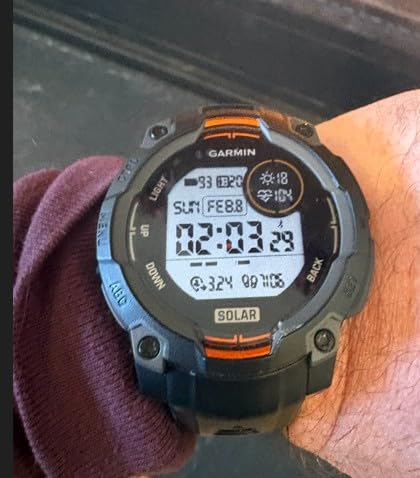
The Instinct 3 Solar in 45mm is the answer to the single most common complaint we heard about the Instinct line, which is size. At 52 grams it is 15g lighter than the 2X and roughly 5mm narrower, and on a 16cm wrist it sits flat instead of overhangs. For hikers who were put off by the 50mm bulge, this is the model that actually gets bought and worn.
Battery is listed at 28 days in the standard mode, and the solar lens extends that substantially in real sun exposure. The honest caveat from owners is that switching on continuous GPS tracking collapses that figure sharply, closer to a day and a half, because satellite acquisition is by far the most power-hungry thing this watch does.
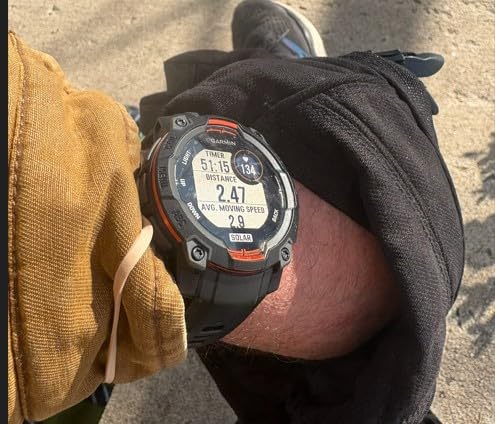
Positioning is the best in the roundup thanks to multi-band GPS with SatIQ, which automatically drops to an easier satellite configuration when sky view is poor and switches back up when it clears. On a forest climb with intermittent canopy, it held a track that a single-band watch visibly wandered away from. The 3-axis compass and barometric altimeter handle the ABC basics, and the 10 ATM water rating covers everything a hiker will do to it.
Two additions stand apart from the earlier generations: Garmin Pay for contactless payments at trailhead huts and vending machines, and the incident detection plus assistance feature set that can automatically alert contacts if you have a hard fall and stop moving. Those are safety arguments more than convenience ones, which is exactly what a watch in this category should be optimised for.
Who the Instinct 3 Solar suits
Hikers with wrists under 17cm, anyone who wears a shirt with fitted cuffs, and long-distance walkers who want solar headroom without the bulk. It also suits hikers who want the watch to do double duty as a daily wearable, because the 45mm profile and 52g weight are closer to a normal watch than a piece of instrumentation.
It is a strong gift for a partner who hikes but is not a gadget person, too. The monochrome screen shows data clearly rather than showing it off, and the flashlight covers the headlamp-shaped gaps in evening starts.
Where the Instinct 3 Solar falls short
The Garmin Connect app is the most common complaint in owner feedback and it is fair. It is functional, it syncs everything, and it still feels like software from several product generations ago compared with the phone apps people use every day. Anyone who wants a colour map on the wrist should know this is a monochrome MIP panel, not an AMOLED.
Also worth flagging: the charging cable is proprietary, and if you add a screen protector over the solar lens it can reduce charging effectiveness. Plan on a periodic top-up regardless of how much sun you get.
3. Garmin Instinct 2 Solar 40mm: The Lightweight Pick
- Lightest Garmin in the group at 52g in a 40mm case
- Up to 48 hours of GPS with continuous solar charging
- Tracback routing returns you along your own breadcrumb line
- Multi-GNSS plus ABC altimeter barometer and compass
- Dual band holders stop the strap tail snagging through brush
- Connect IQ apps with no subscription fee
- Solar contribution is modest on overcast or fully wooded trips
- Altimeter drifts and needs regular calibration
- Each button carries two functions so the interface takes practice
- Proprietary charging cable is easy to lose
- Garmin Pay bank support is still limited
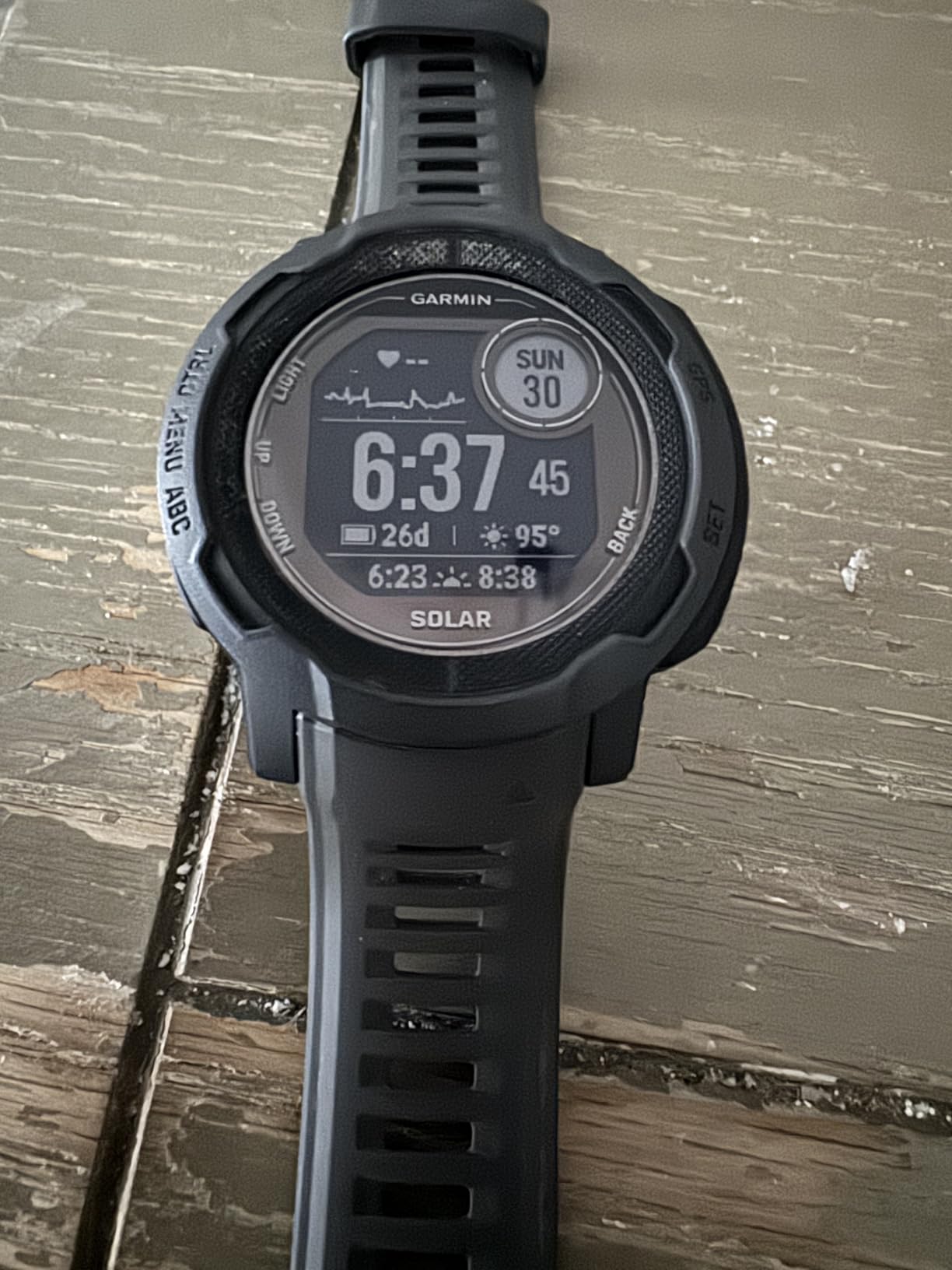
The original Instinct 2 Solar remains the value entry point into rugged Garmin, and at 40mm with a 52g weight it is the smallest watch here that still gives you a real multi-GNSS receiver, ABC sensors and full navigation. Battery in GPS mode runs up to 48 hours with continuous solar charging enabled, and in smartwatch mode the solar cell can hold the charge indefinitely with about three hours of sun a day.
Owners consistently report two to four weeks of typical real-world runtime between charges, which lines up with what we saw. The health suite is the full Garmin set, including Body Battery energy monitoring, advanced sleep, Pulse Ox, stress and HRV status, plus VO2 max and built-in sport apps for run, bike, swim, strength and HIIT.
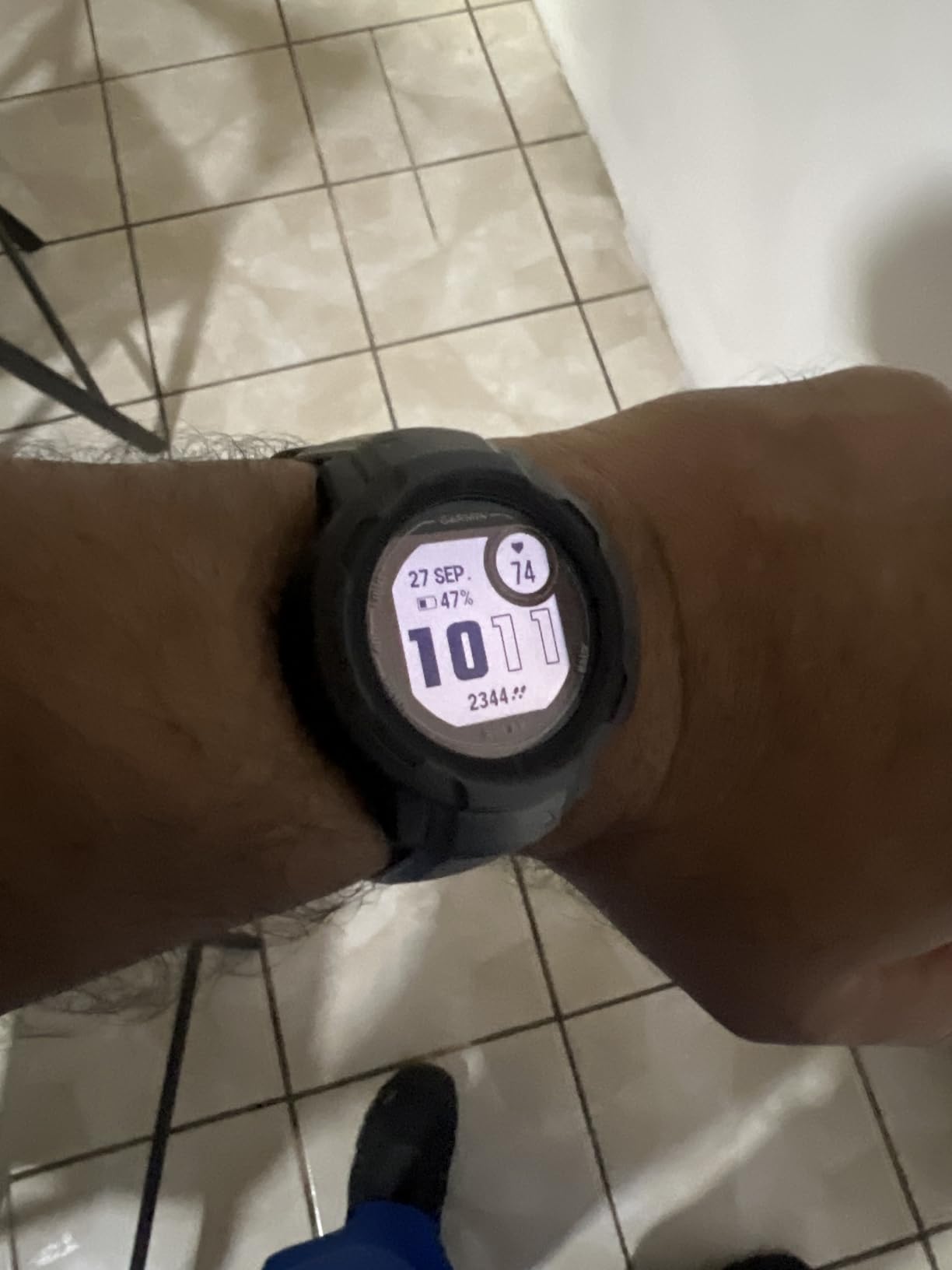
Tracback routing is the feature hikers should actually care about. It retraces the exact path you walked in reverse, which matters enormously on foggy descent where a straight line to the trailhead takes you off a cliff. Combined with multi-GNSS across GPS, GLONASS and Galileo, that is a genuinely capable navigation package for the money, and it works with no phone signal at all.
The small design details are what separate it from a generic tracker. Dual band holders on the strap keep the tail from snagging on deadfall, and the fibre-reinforced polymer case with Corning Gorilla Glass takes the punishment of pack straps, rock scrapes and gate crossings without complaint.
Who the Instinct 2 Solar suits
Day hikers and weekend backpackers who want real navigation without a large case or a large invoice. It suits hikers who care more about the breadcrumb line than about training analytics, and it is the pick for anyone who finds the 45mm and 50mm bodies too much watch. Users on r/Garmin consistently frame the choice this way: Instinct 2 and 2X if durability is the priority, the fainer and enduro lines if pure battery endurance is the priority.
It also works as an everyday watch better than most outdoor watches, which matters because a hiking watch you only wear on hikes will not have charged when you need it.
Where the Instinct 2 Solar falls short
Owners are candid that the solar contribution is modest in real-world use, and that matches our experience. Treat it as a trickle that slows drain under open sky rather than as a charging system. The barometric altimeter also drifts without regular calibration, which on a multi-day trip means recalibrating against known elevation at camp each morning.
The button interface has a learning curve because each button does two things, the charging cable is proprietary and easy to lose, and Connect IQ runs as a separate app whose store is not filtered by your watch model.
4. Casio AQS800W Series: The Best Value Solar Watch for Hiking
- Lightest watch in the roundup at 33g
- Analog-digital dial stays readable at a glance in daylight
- Dual countdown timers suit interval training on the trail
- Solar trickle charge holds roughly 10 months in reserve
- 100m water rating with a LED light and afterglow
- Six-language day indicator eases travel confusion
- No GPS and no navigation of any kind
- Analog glow lume is dim in the dark
- Alarm and chime are quieter than most hikers expect
- Resin crystal scratches even though the bezel protects it
- Button combinations need the manual or a tutorial video
With more than 7400 reviews averaging 4.5 stars, the AQS800W is the most proven watch in this roundup by a wide margin, and for a specific reason: nothing about it can fail on a trail. There is no GPS lock to lose, no rechargeable cell to flatten in cold, no firmware to go wrong. The Tough Solar cell charges from sunlight and indoor light alike and holds a power saving reserve of about ten months.
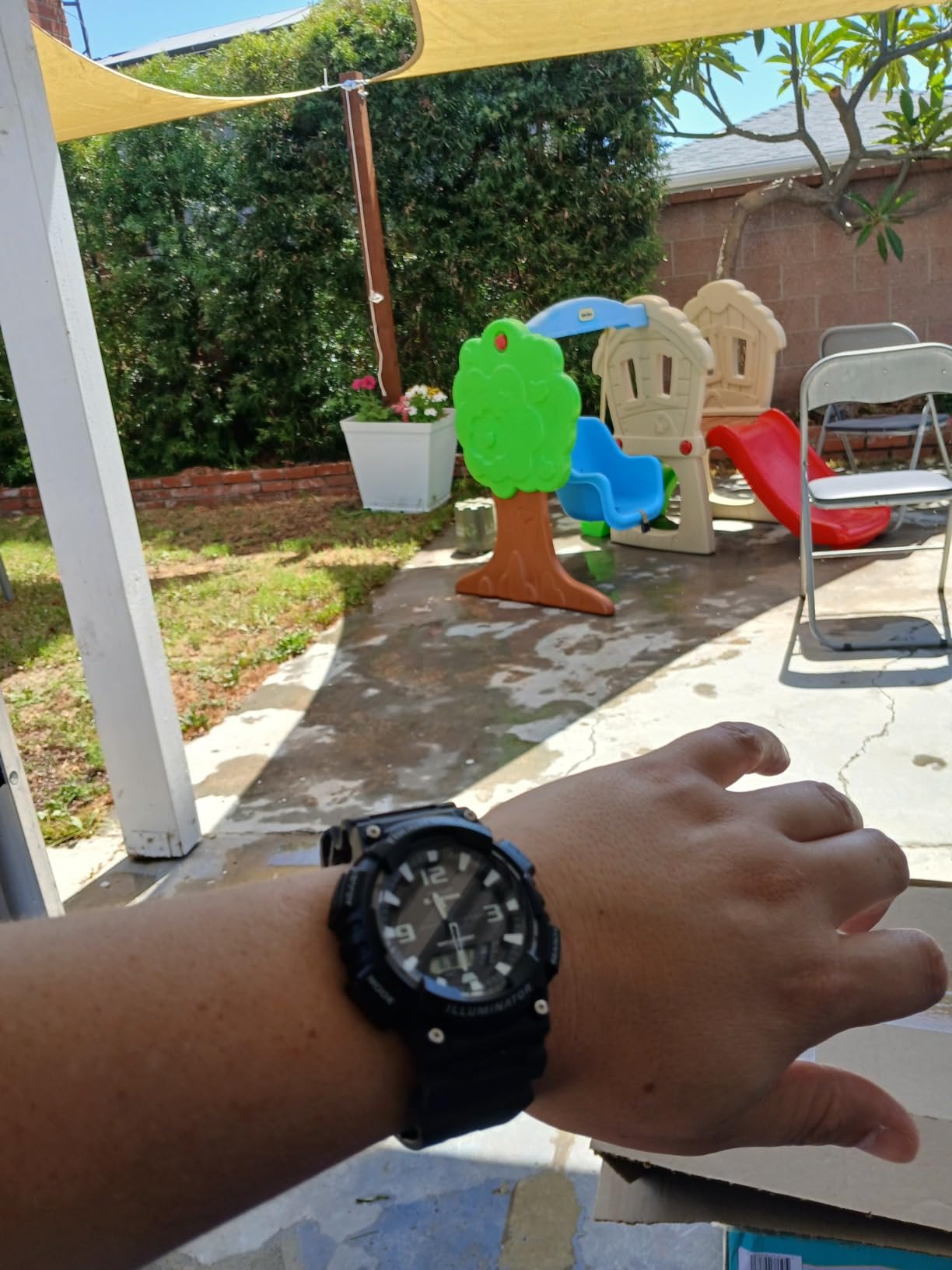
It weighs 33 grams. That is less than half the weight of the Garmin 2X Solar, and on a long day with a pack on your shoulders the difference between 33g and 67g on the wrist is more noticeable than any spec sheet suggests. The 42mm case sits flat under a cuff and the analog-digital display gives you the time at a glance plus a stopwatch reading to 1/100 second.
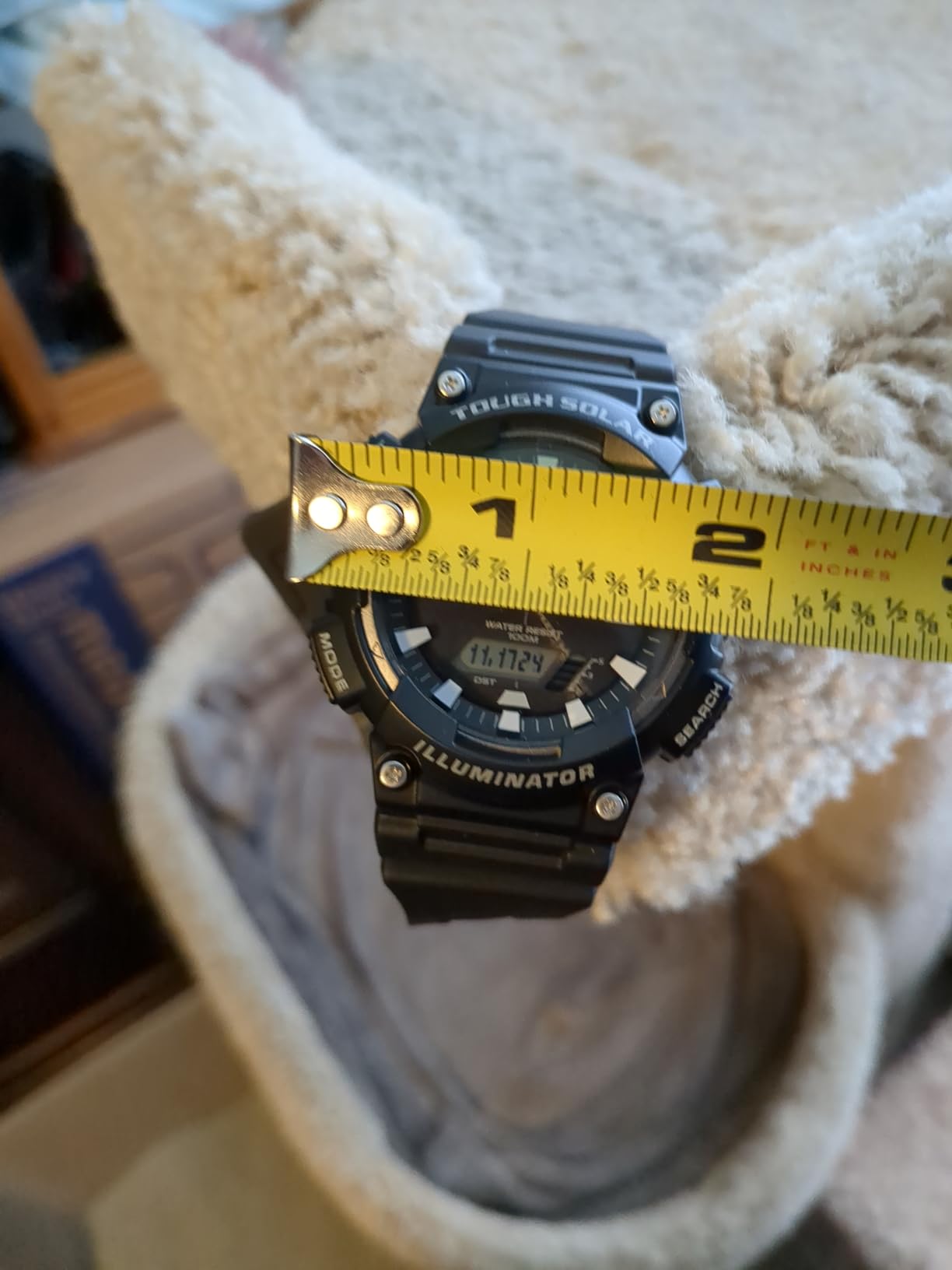
The dual countdown timers are more useful outdoors than they sound. Interval training on a steep trail, cooking time on a hanging stove, timing a filter change by a stream, counting down a rest period at a viewpoint. Five daily alarms with snooze and an hourly time signal handle the other end of the schedule, and the 31-zone world time with a six-language day display stops you misreading a day of the week on an unfamiliar continent.
Water rating is 100 metres, which covers swimming, rain, river crossings and a wet scramble. There is a LED light with afterglow for checking the dial in a tent. And because it is a Casio solar quartz rather than a low-cost digital, the movement inside is the kind you can leave running for years.
Who the AQS800W suits
Day hikers, fastpackers and ultralight hikers who count every gram, and anyone who wants a watch that simply works without fuss. It suits hikers who navigate with a paper map, a phone in airplane mode or a dedicated handheld, and who want a stopwatch and timers rather than a fitness platform. Our full solar watch guide covers the rest of the Casio solar range for anyone who wants a different layout.
It is also the sensible gift for a hiker who has broken a smartwatch on a previous trip. There is nothing here to break, and nothing here to charge.
Where the AQS800W falls short
The honest limitation is that it cannot navigate. There is no compass, no altimeter, no barometer and no position fix, so it is a complement to your navigation rather than a replacement. The analog lume is dim compared with a dedicated night-vision tool, the alarm is quieter than hikers expect, and the resin crystal picks up scratches despite the protective bezel.
Finally, the button combinations for settings are genuinely unintuitive. Budget ten minutes with the manual before you leave the house.
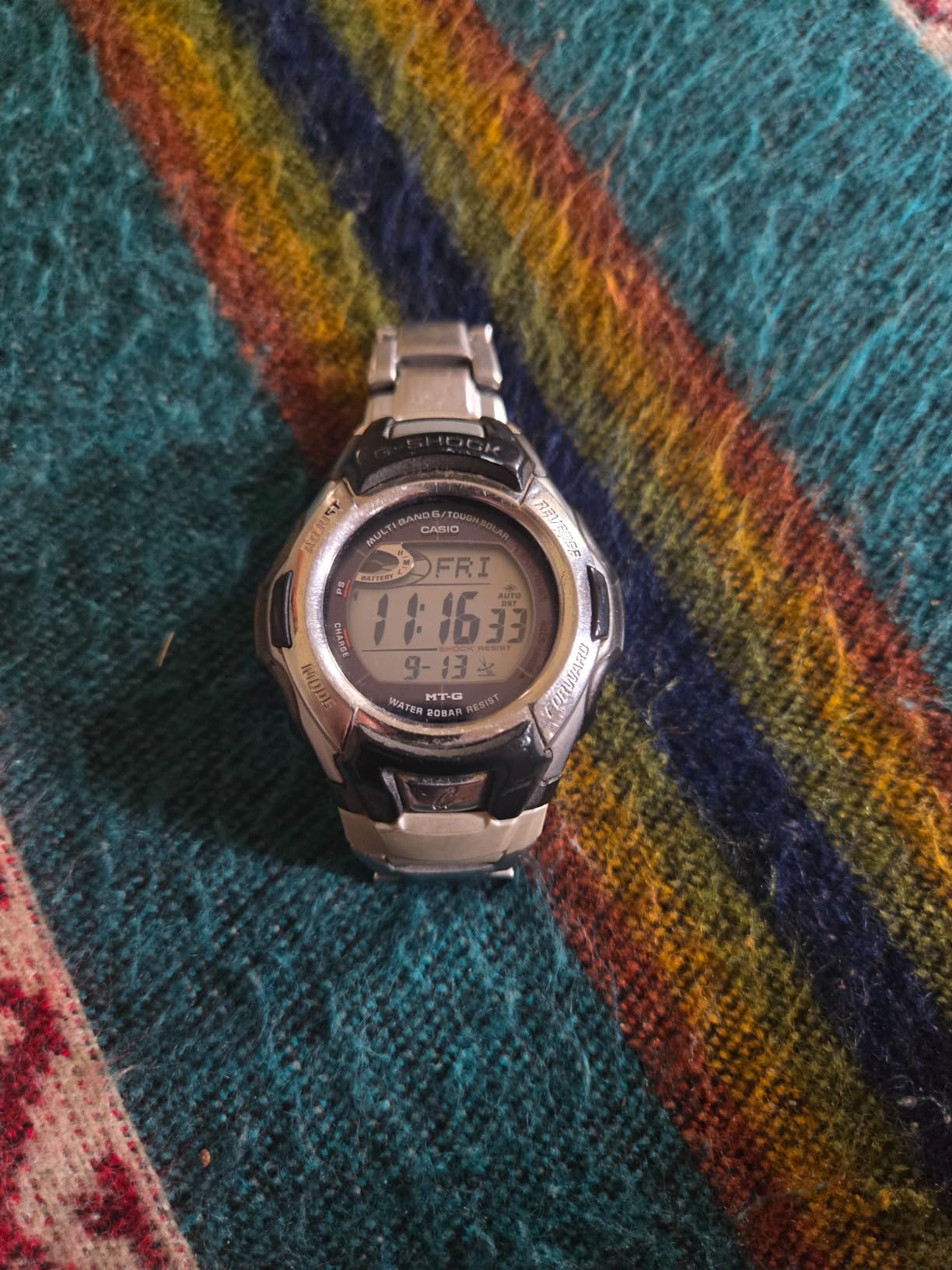
5. Casio MTG-M900DA Tough Solar Atomic: Metal, Light and Unbreakable
Casio Men’s G-Shock MTGM900DA-8CR Tough Solar Atomic Stainless Steel Sport Watch
- 0.35 ounce stainless steel build that disappears on the wrist
- 200m water rating for river crossings and swimming
- Multi-Band 6 atomic timekeeping corrects itself without a phone
- Power saving mode stretches a full charge to about 9 months
- Five daily alarms with snooze and a 1/100 second stopwatch
- Auto EL backlight lights the full dial on wrist movement
- No GPS navigation and no altimeter data
- Manual is long and the function set is dense
- Negative display can be hard to read at an angle
- Small dial is awkward for reading numbers at a pace
- Middle of the road styling
The MTG-M900DA is the odd one out here and that is exactly what makes it interesting. It is a full stainless steel G-Shock body that weighs 0.35 ounces, which is barely more than a coin, and it is rated to 200 metres of water resistance. On a hiking watch list that combination of mass and rating is rare.
Multi-Band 6 atomic timekeeping is the quiet hero. The watch receives radio signals from atomic time transmitters across six regions and corrects itself continuously, so you never arrive at a trailhead wondering whether the clock was right. Set it once and forget about time entirely. Combined with Tough Solar charging and a power saving mode that stretches a full charge to roughly nine months, this is the closest thing to a set-and-forget watch in the roundup.
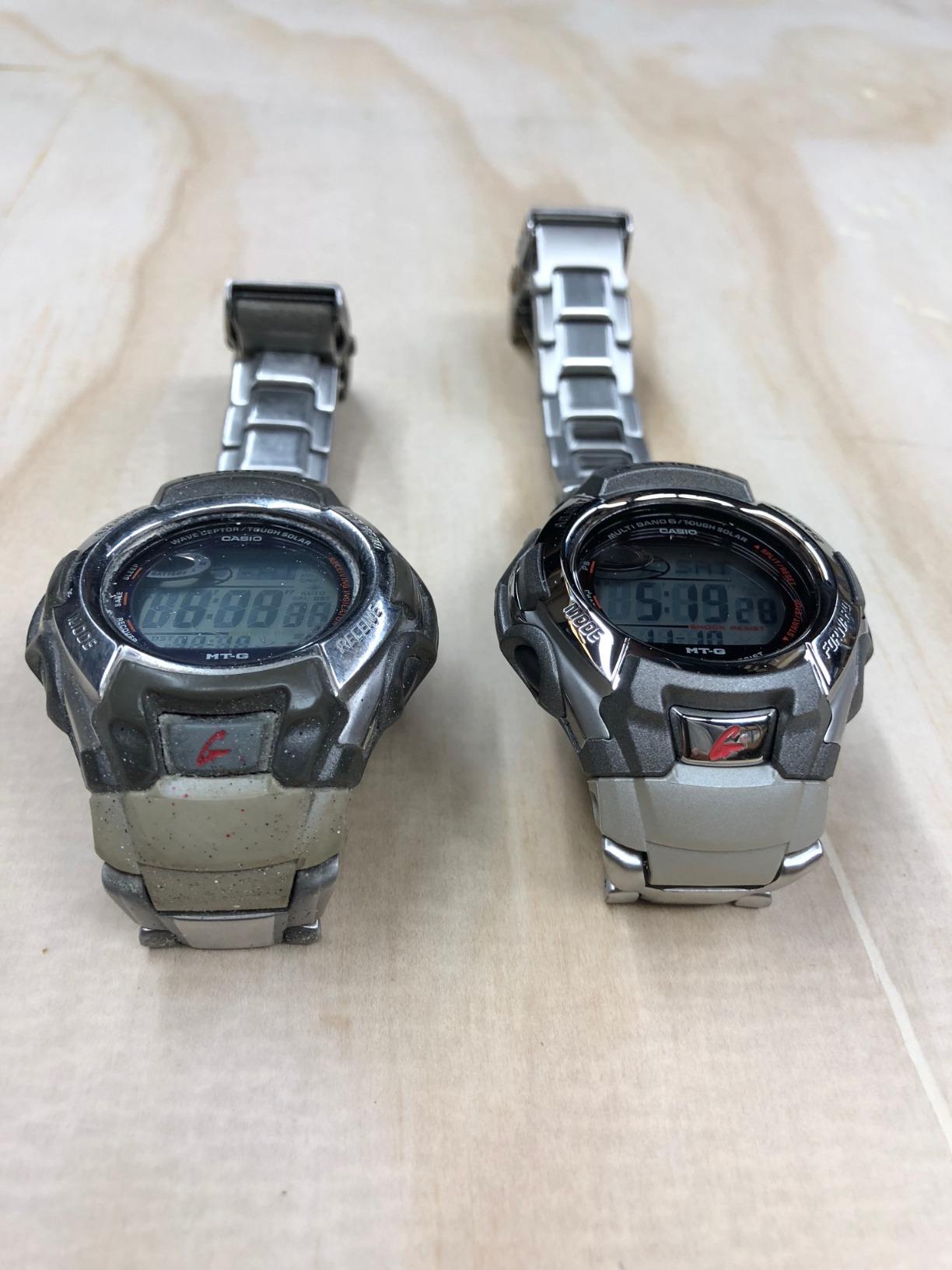
The feature list is long for a watch this small: world time across 31 time zones and 48 cities, a 1/100 second stopwatch, a 24-hour countdown timer, five independent daily alarms with snooze, and a full auto electro-luminescent backlight that wakes the whole dial when you turn your wrist. For someone who hikes and does not want a screen glowing in their face, that backlight is the useful one.
Durability is the reason to buy it. Stainless steel case and band, shock resistant construction, 200 metres of water resistance. This is the watch you hand to someone who has already broken two watches on the job.
Who the MTG-M900DA suits
Hikers who want something that looks like a watch rather than a piece of instrumentation, and who do not need a GPS lock. It suits anyone who values weight above features, since 0.35 ounces makes it the second lightest option here. It also works as a travel watch, because atomic sync plus world time handles time zone changes without you thinking about them.
If your hiking involves water, this and the G-Shock below are the two picks here rated for serious immersion. Our dive watch guide explains how those ratings are tested if you want to push further.
Where the MTG-M900DA falls short
No GPS, no compass, no altimeter. If you navigate off a map, this is a timepiece and a stopwatch only. The manual is long and the function set is dense, and the negative display with grey characters on a black background can be difficult to read at certain angles.
The dial is small relative to the case, so reading numbers while walking requires more attention than a larger face would. And while the 200 metre rating is excellent, the mineral crystal will mark over time in the same way every non-sapphire tool watch does.
6. G-Shock GW7900B Solar Atomic: Built for Water, Tides and Impact
- 200m water rating built for surf kayaking and whitewater
- Tide graph and moon data are real tools for coastal trips
- Solar plus atomic sync means no battery changes and no time setting
- Auto EL backlight wakes with a wrist tilt
- Battery reserve of roughly 6 to 9 months on a full charge
- Distraction free digital dial with day date and alarms
- Negative grey on black display frustrates some readers
- Mineral crystal picks up scratches from grit and sand
- Manual is extremely thick and dense
- Large 50mm case sits big over a shirt cuff
- Bezel screws are decorative only
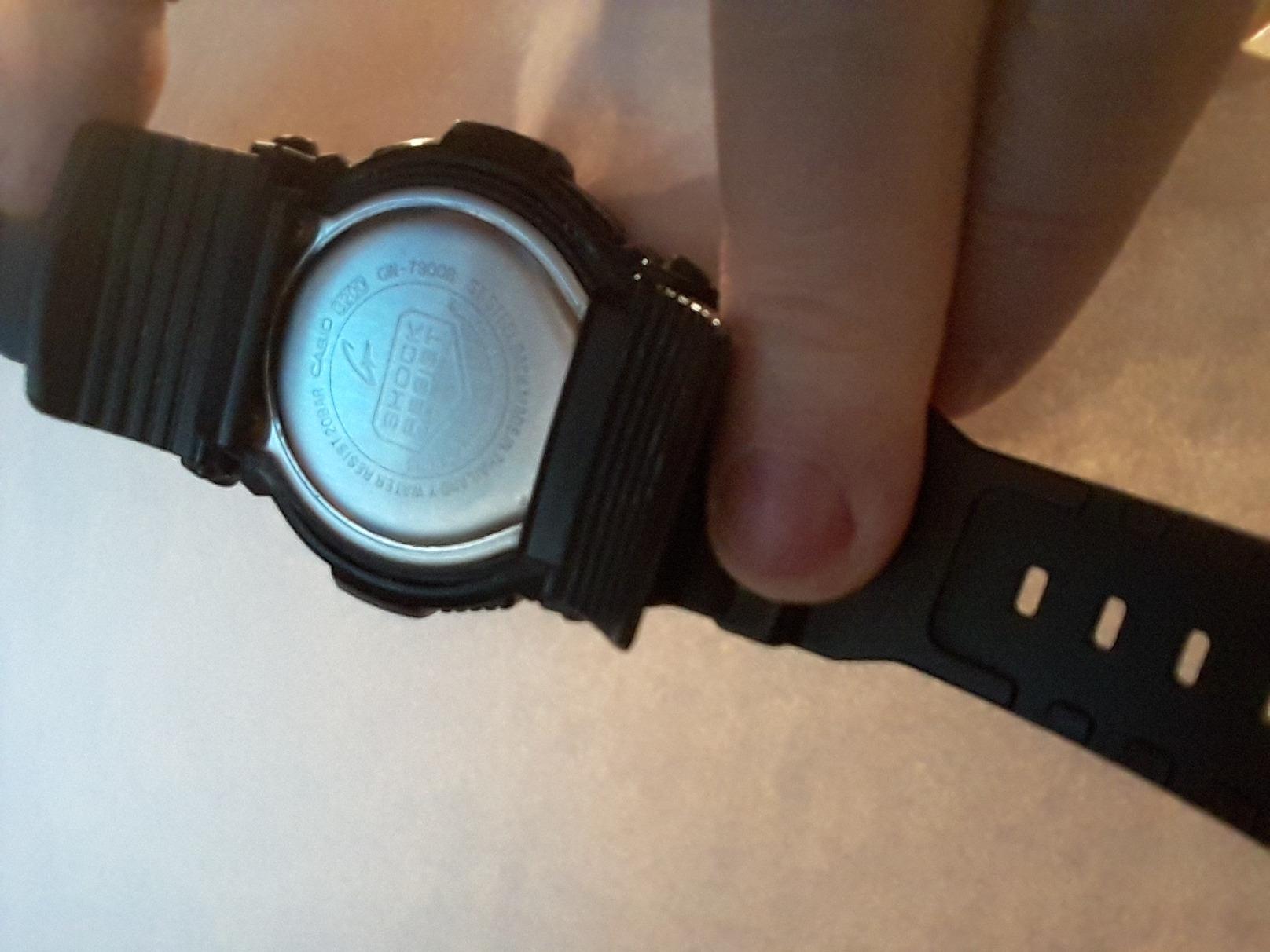
The GW7900B is the choice for hikers whose route involves water: sea cliffs, causeways, tidal sand, kayaking, paddleboarding, anything where a watch gets rinsed several times a day. At 200 metres of water resistance it is rated for professional marine activity, and the 50mm resin case with shock resistant construction is the standard G-Shock build that has absorbed an enormous amount of abuse over the years.
The tide graph and moon phase data are genuinely useful rather than decorative. Planning a coastal route around when a tidal cut is passable, or timing a moonlit night hike, is real information that most hikers pay a mapping app for. Combined with solar charging and atomic timekeeping, this watch needs neither battery changes nor manual time setting.
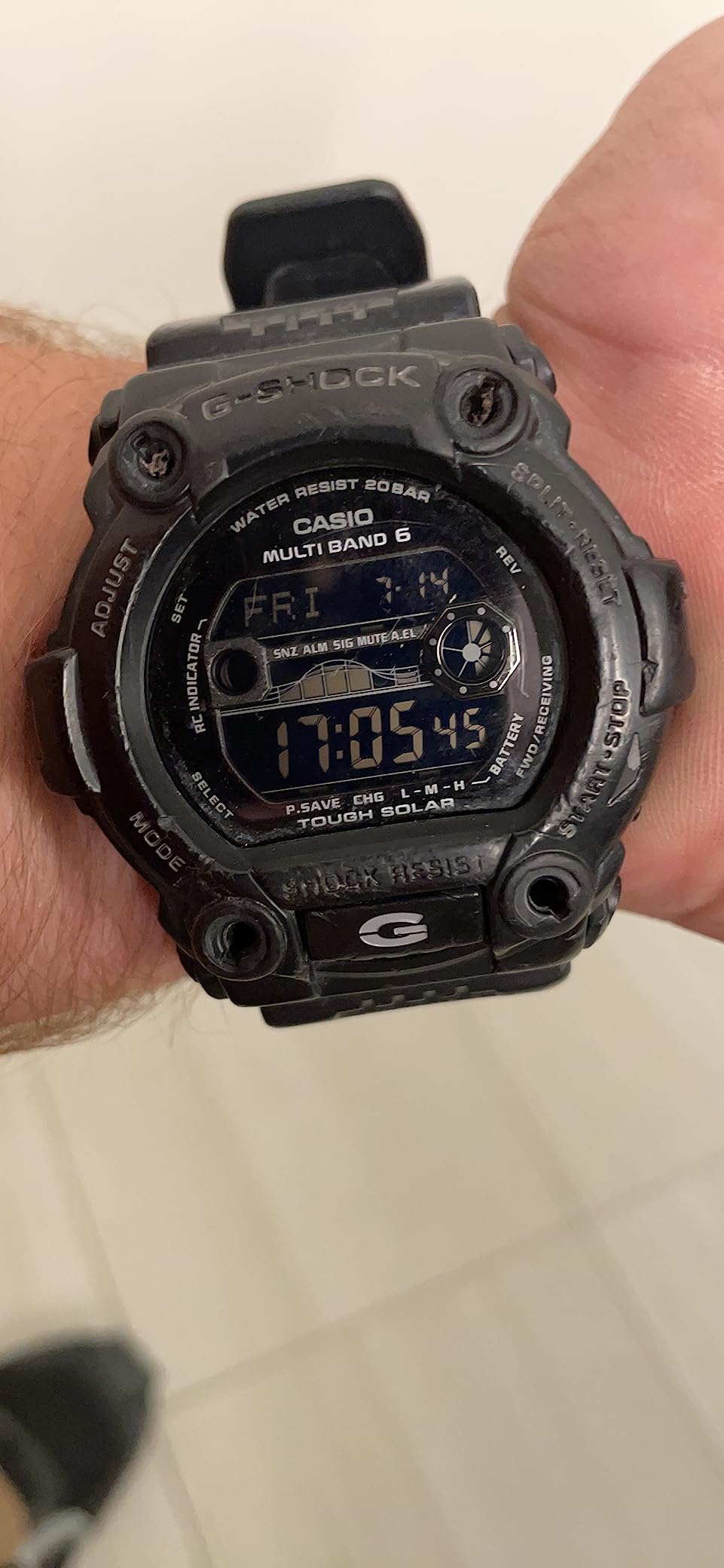
World time across 48 cities in 31 time zones, a 1/100 second stopwatch, a daily alarm with snooze, day-date-month calendars and 12/24 hour formats cover the scheduling side. The auto EL backlight triggers on wrist tilt, which is the behaviour you actually want when you are checking the time with a hand full of trekking pole grip.
Battery reserve in power saving mode runs around six to nine months on a full charge, so on a multi-week trip you are not thinking about it at all.
Who the GW7900B suits
Coastal and mountain hikers who want tide data and near-indestructible construction, and anyone who has a history of cracking watch crystals. It suits users who prefer a fully digital readout to an analog dial, and people who want to set the date once and stop thinking about the watch for months at a time.
It is also a strong choice for anyone whose wrist is bigger than average, since the 50mm case distributes well and feels balanced rather than oversized.
Where the GW7900B falls short
The negative display is the reason this watch polarises. Grey characters on a black background look excellent in some light and disappear at an angle, with no adjustable contrast to compensate. The mineral crystal scratches more readily than sapphire, which matters on a beach route where grit is constant.
There is also no GPS, compass or altimeter, the manual is famously thick, and the screws on the bezel are cosmetic rather than structural.
7. Casio MTPS120L: The Simplest Analog Solar Watch Here
Casio MTP-S120L Series | Solar Analog Watch | Stainless Steel Case | NATO Nylon Strap | Day & Date Display | 100M Water Resistant | Luminous Hands | Military Style
- Clean three hand analog dial with day date and 24 hour inner bezel
- Stainless steel case with a screw-on caseback
- Solar cell holds about 8 months without any light
- Included NATO strap is comfortable and dries fast
- Thin enough to slide under a shirt cuff
- 100m water rating with luminous hands for pre-dawn starts
- No compass altimeter or GPS
- Mineral crystal rather than sapphire
- Solar charge indicator is not on the dial
- Date and day window is small at a glance
- Nylon strap will not suit dressier use
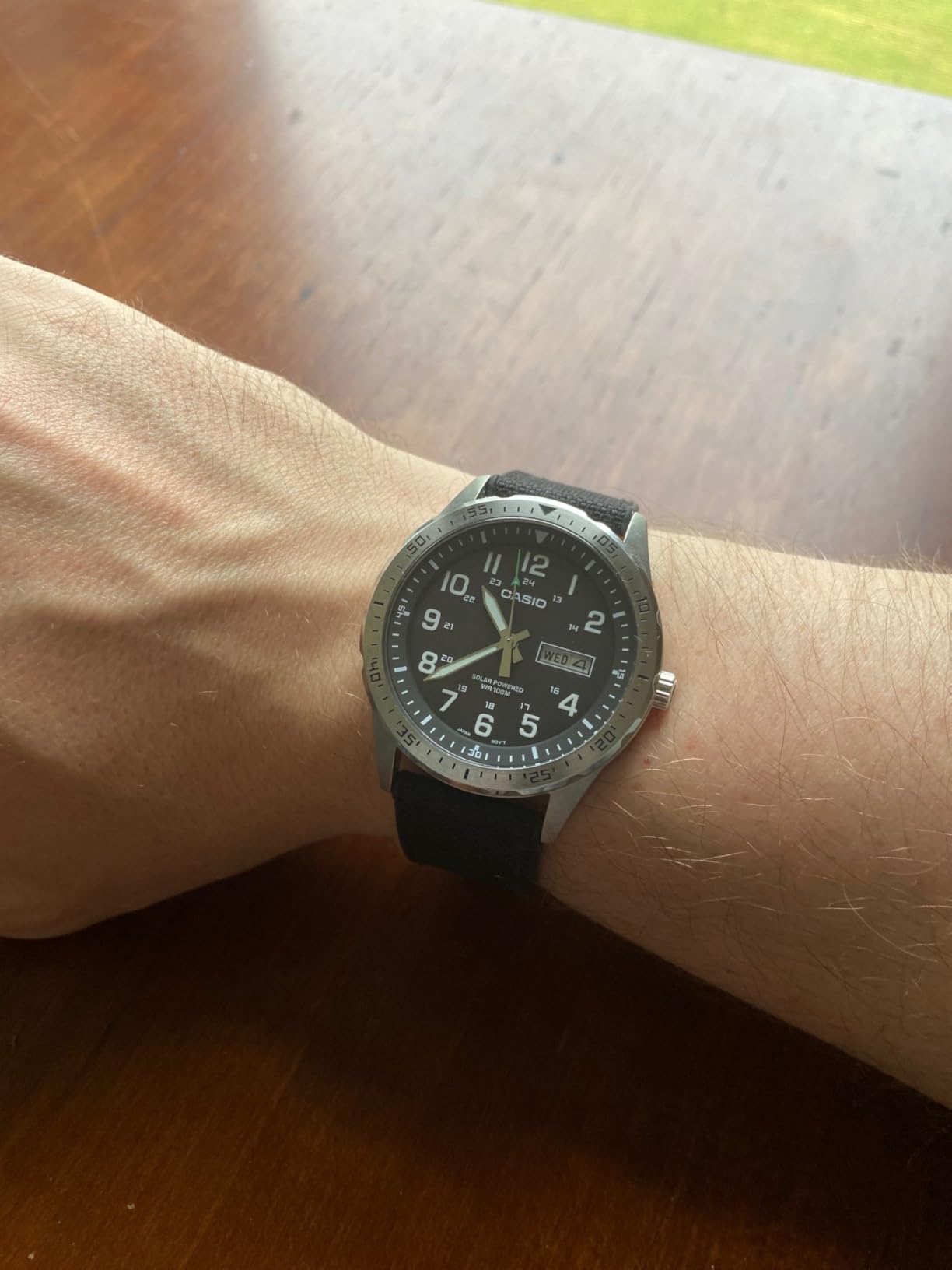
Sometimes the best answer for a hike is a watch that tells you the time and survives the day. The MTPS120L is a 42mm stainless steel field watch with a three-hand analog dial, day and date at twelve, a 24-hour inner bezel for night navigation, and luminous hands for pre-dawn starts.
The solar cell runs the movement for about eight months on a full charge without any light at all, which reframes how useful solar is on a watch like this. You are not extending a two-week battery, you are removing battery management from your trip planning entirely.
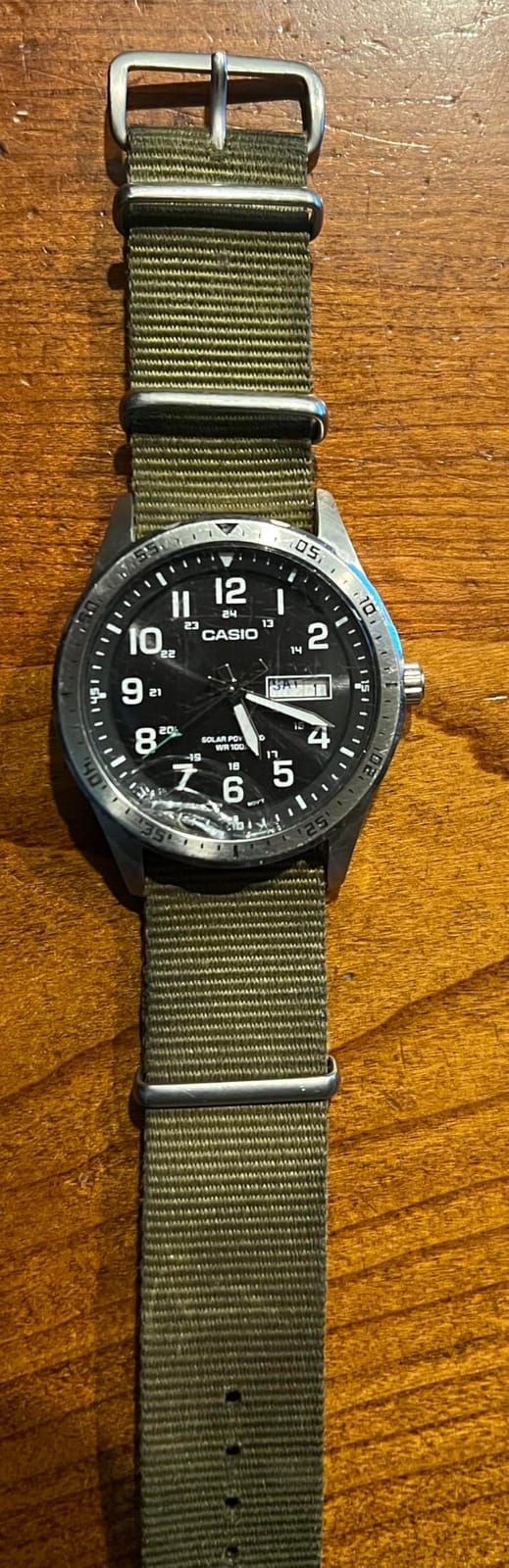
Construction details matter more than they might elsewhere: a screw-on caseback rather than a press fit, a stainless steel case, 100 metres of water resistance, and 22mm lug width so swapping straps is trivial. The included nylon NATO strap is the right choice on a trail, because it dries fast, does not hold sweat and can be replaced with anything that fits 22mm.
It is also thin enough to slide under a shirt cuff, which matters in summer when a bulky watch on the wrist gets in the way of a pole grip.
Who the MTPS120L suits
Hikers who want a clean analog readout with no screens, no notifications and no charging anxiety. It suits fastpackers and minimalists, and anyone who reads an analog dial faster than a digital one. It also works as an everyday watch, and if you like the styling but want a dressier option, our automatic watch guide covers that category in detail.
The 24-hour inner bezel is a hiking-specific nicety that most people notice only after using it once on a night section of trail.
Where the MTPS120L falls short
There is no compass, no altimeter and no GPS, so this is a pure timekeeper. The crystal is mineral glass rather than sapphire and will mark with use. The solar charge indicator is not on the dial, so you are trusting the spec rather than watching the watch tell you it is charging.
The day and date window is small at a glance, and some variants of this model ship without a second hand, so confirm which version you are ordering.
8. Citizen Eco-Drive Weekender: Best Solar Watch for Wearing Every Day
CITIZEN Men’s Eco-Drive Avion 43mm Stainless Steel BM7550-01E
- Eco-Drive runs on any light so there is never a battery service
- Five year limited warranty is the longest in this roundup
- Clean aviator dial with a date window at 3 o'clock
- Stainless steel case and bracelet with a dressable finish
- 100m water rating covers swimming and rain
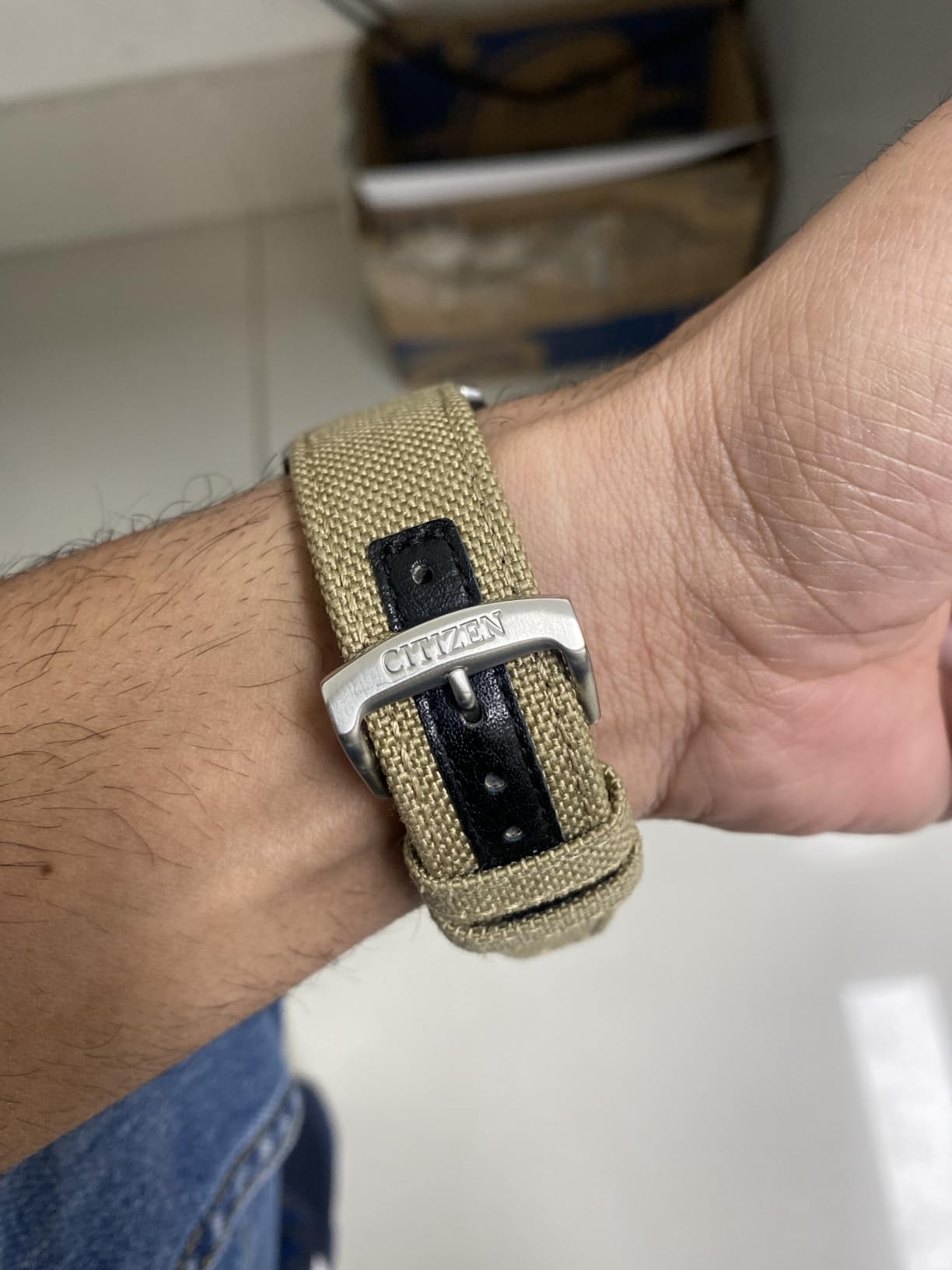
- Khaki nylon strap option moves it off the desk and onto the trail
- Spherical mineral crystal scratches more readily than sapphire
- No luminous markers on the dial so night reading is poor
- Bracelet links are awkward to adjust at home
- Second hand keeps running while you set the time
- No navigation or altitude data
The Weekender is the watch to buy if your hiking is one or two days at a time and you want something that works in the trailhead car park as well as on the ridge. Eco-Drive runs on any light, not just sun, which means a week in an office is fine. Three hands, a date at three o’clock, a spherical mineral crystal and a stainless steel case and bracelet in aviator field styling.
The five-year limited warranty is the longest in this roundup and reflects how confident Citizen is in the movement. Water resistance of 100 metres means rain, river splash and swimming are all non-events.
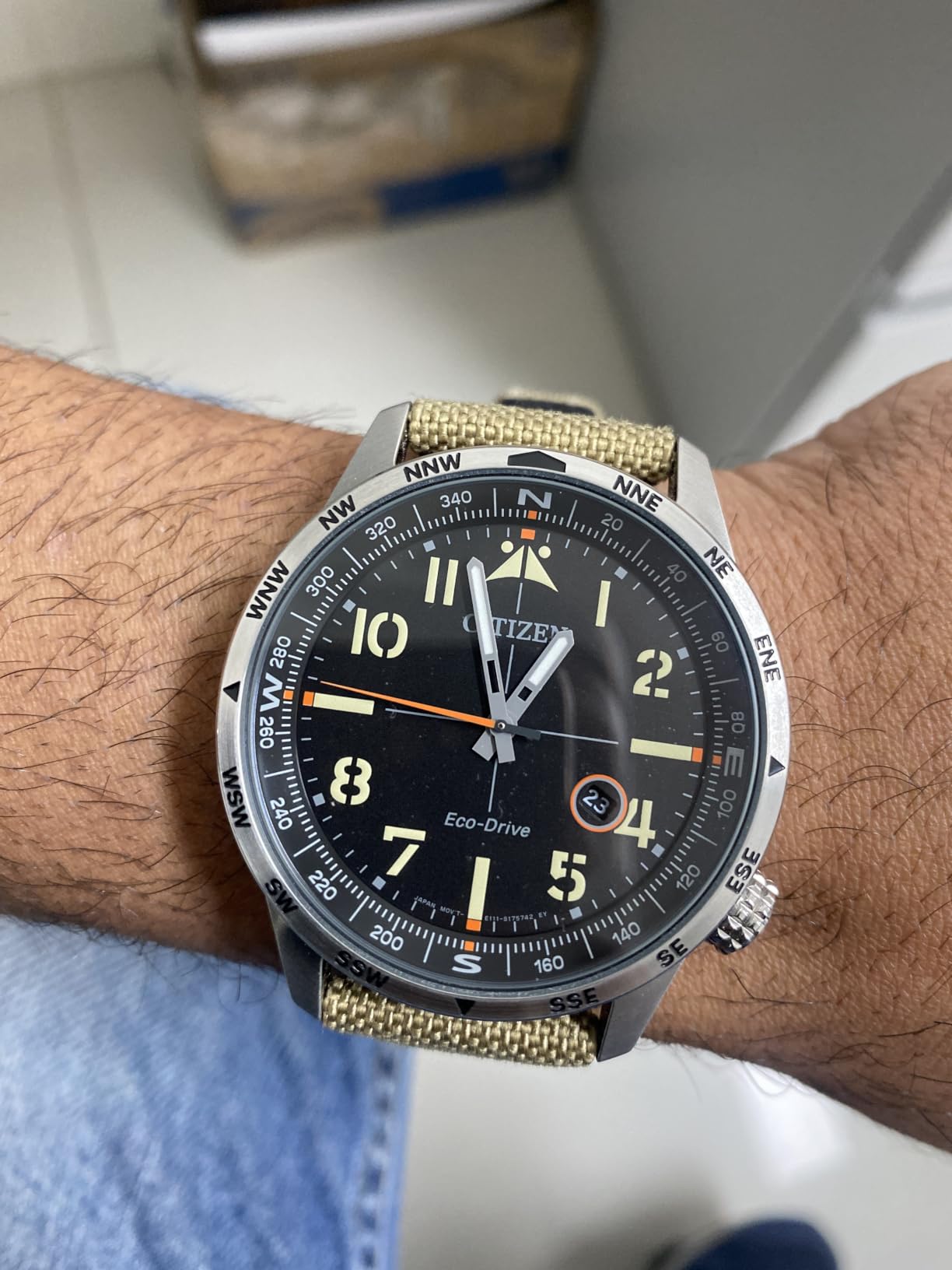
What we like most is that a watch you wear every day gets light every day, so the solar cell is always fed. That is a genuine argument for the Eco-Drive approach that GPS watches cannot make: solar works best when the watch is on your wrist in daylight rather than packed in a rucksack for three days.
Style-wise it moves easily between trail and town. The bracelet variant looks smart enough for a casual office, and a khaki nylon strap configuration takes it the other direction. Owners routinely describe it as the watch they forget they are wearing.
Who the Eco-Drive Weekender suits
Weekend hikers, day hikers and anyone whose watch needs to function as a normal watch first. It suits people who want solar as a background benefit rather than the main selling point, and anyone who has been put off by the sport-watch look entirely.
It is also the only non-Casio option here, and Citizen is the brand owners repeatedly describe as among the most reliable solar movements in production.
Where the Eco-Drive Weekender falls short
The dial has no luminous markers, only luminous hands, so reading the time in a dark tent means letting your eyes adjust to the hands alone. The spherical mineral crystal scratches more readily than sapphire, and the second hand does not hack, so it keeps sweeping while you set the time.
Bracelet links are difficult to adjust at home without tools, and there is no compass, altimeter or GPS of any kind. For anything beyond a half-day walk with a map, you want a GPS watch instead.
How to Choose a Solar Watch for Hiking in 2026
What solar charging really does on a hiking watch
Solar charging on a watch is a photovoltaic cell that trickles power back into the battery, and its real-world effect is narrower than the marketing implies. Three things drive the outcome: how much direct sun the watch sees each day, how much of that sun actually reaches the lens, and how much the watch is drawing while you hike.
Under open sky with roughly three hours of direct exposure a day, a solar Garmin can genuinely run indefinitely in smartwatch mode. Under full tree cover the effect is close to nothing. Long-term reviewers are blunt about this: the panel slows battery drain a little, and you should not rely on it to recharge during a hike. That is exactly what we saw, with a watch that went flat once across a six-day open-desert route and needed a cable under forest canopy.
The practical takeaway is that solar is an insurance policy against a flat battery, not a replacement for charging. On three to seven day trips the Garmin solar models turn charging from a nightly habit into an occasional one. On a two-week expedition, plan on a top-up every few days anyway.
MIP versus AMOLED: which screen survives a day on the trail
Every watch in the Garmin half of this roundup uses a monochrome transflective memory-in-pixel display, and that is a deliberate choice rather than a cost saving. Backlit MIP screens are readable in direct sunlight without turning brightness up, run for weeks, and keep working in cold conditions. They are grey where an AMOLED is black, and they cannot show colour maps.
AMOLED gives you a far more attractive screen, better contrast indoors and at night, and colour topographic maps. It costs you several days of battery per charge and it becomes difficult to read in direct sun at maximum brightness. If your hiking is mostly daylight outdoors, MIP is the right answer. If your watch doubles as a daily wearable you will read in a tent, AMOLED may suit you better.
Match the watch to your trip length and hiker profile
Day hikers on a local trail rarely need solar. You will be home before the watch is meaningfully low, and a paper map or a phone in airplane mode will serve you just as well. Spending extra on solar here is spending on a feature you will not exercise.
Backpackers on three to seven day trips are the group solar was designed for. The Garmin Instinct 2 Solar and 2X Solar both reach multi-day GPS runtime with solar assist, and a tool watch like the AQS800W removes battery planning altogether.
Thru-hikers and expedition climbers should prioritise GPS runtime and solar lens area over health features. Trail runners and fastpackers should prioritise weight above everything else, which is where the 33g Casio AQS800W wins outright.
Mountaineers and winter hikers need to think about display legibility in low light and cold battery derating. Lithium-based cells lose meaningful capacity below freezing, so a watch that is fine in July can lose a substantial share of a day in January. Plan for shorter runtime and carry a cable.
Watch size, wrist fit and all-day comfort
Case size is the most common regret among first-time rugged watch buyers. The 50mm Instinct 2X Solar is a genuinely large watch and it overhangs smaller wrists, while the 45mm Instinct 3 Solar and 40mm Instinct 2 Solar sit far more comfortably. Try the 50mm with a sleeve on before you commit.
Weight is the second factor. At 67g the 2X is noticeable by the end of a long day, at 52g the Instinct 3 and Instinct 2 are not, and at 33g the Casio AQS800W effectively disappears. If your hiking involves running rather than walking, weight matters more than maps.
Garmin, Casio and Citizen: three different ecosystems
The brands here are not really competing in the same category. Garmin competes with itself, across case size, solar versus AMOLED and tactical versus standard variants. Casio and G-Shock sell instruments that do time, sensors and durability with no connected layer at all. Citizen fills the gap with light-powered mechanical-style movements and long warranties.
There is no meaningful ecosystem question between a Casio and a Garmin because a Casio has no app. Within Garmin, the entire health, training and navigation suite runs through Garmin Connect with no subscription, which is a meaningful long-term ownership advantage over most connected hardware. If you are weighing a non-Garmin brand against a connected watch, the decision usually comes down to whether you want navigation data on your wrist or you want the watch to last a decade.
Who does not need a solar watch at all
Be honest about your trip profile before spending on solar. If you are under your local trail network, sleeping in a tent near a car, and home within the day, solar is dead weight on your wrist and on your budget. A lighter non-solar watch or a simple analog field watch will serve you better.
Solar also adds nothing when you hike in dense forest, in winter at high latitude, or on a route where you are on the move before dawn and after dusk. The panel needs sun when your eyes are up, and many hikers simply do not get that.
Frequently Asked Questions
Do solar-powered watches really work?
Yes, but with limits. In direct sun, solar charging on a Garmin-style rugged watch can hold smartwatch mode indefinitely with about three hours of exposure per day, and it extends GPS runtime meaningfully on multi-day trips. Under tree cover or heavy cloud the effect is close to nothing, and long-term reviewers treat it as a trickle that slows drain rather than a real charging method. Plan to carry a cable for trips longer than a week.
What is the best watch for hikers?
It depends on your profile. Backpackers on multi-day trips get the most from a solar Garmin such as the Instinct 2X Solar or Instinct 3 Solar because they combine solar runtime with multi-band GNSS, ABC sensors and breadcrumb navigation. Fastpackers and trail runners want the lightest option, which is the 33g Casio AQS800W. Coastal and impact-heavy hikers are well served by a 200m-rated G-Shock. Day hikers usually need none of the above.
Is Coros or Garmin better for hiking?
For hiking specifically, Garmin is the safer choice because its rugged Instinct line is built to a military standard, carries ABC sensors and barometric altimeter, and supports Tracback breadcrumb routing with a mature planning ecosystem. Coros watches tend to appeal to runners and offer longer battery life at a lower cost, but they are less established for backcountry navigation. Whichever brand you pick, download offline maps before you leave coverage.
What Garmin do Navy SEALs wear?
There is no officially confirmed single model. The widely adopted tactical lineage in that community traces back to the G-Shock and the Garmin Instinct line, and Garmin’s Instinct family is the one sold with Tactical variants built to a US military standard 810 for thermal, shock and water resistance. If you want that build for hiking, choose a rugged Instinct Solar rather than a slimmer lifestyle Garmin.
Final Verdict: Which Solar Hiking Watch Should You Buy?
The Garmin Instinct 2X Solar is our pick for the best solar watches for hiking in 2026. It pairs the Solar Power Glass lens with multi-band GNSS, a barometric altimeter, breadcrumb routing and a built-in flashlight in a body that survives anything a trail will do to it. If the 50mm case is too much, the 45mm Instinct 3 Solar gives you nearly the same capability 15 grams lighter, and if you are past solar being worth the money entirely, the 33g Casio AQS800W is the best-value watch you can put on a trail.
Tell us which profile you hike in and we will narrow it down further.