
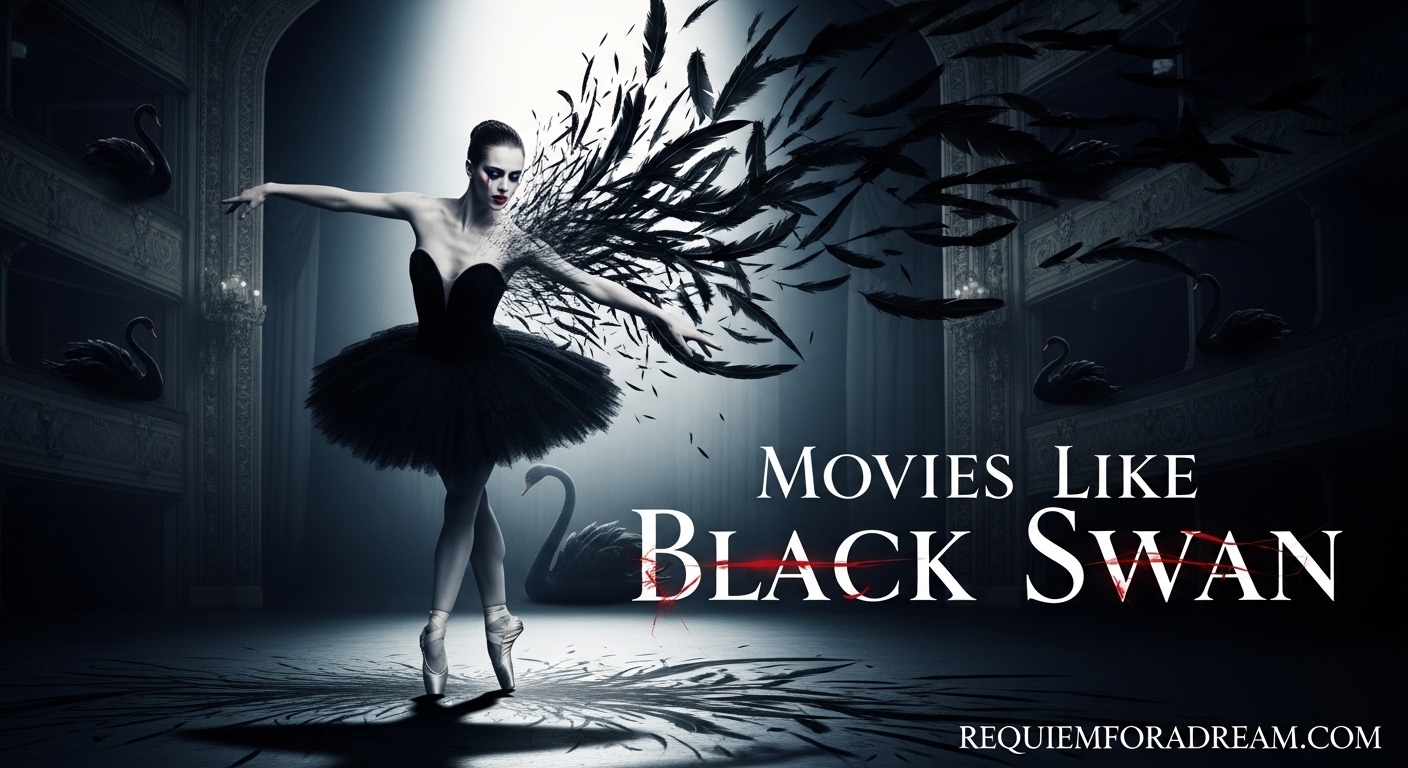
There is a specific kind of feeling that hits you after watching Black Swan for the first time. You sit in the dark, credits rolling, unsure whether you just witnessed a beautiful tragedy or a horror film disguised as art. That disorientation is exactly why so many of us go searching for movies like Black Swan — we want to feel that again, that unsettling mix of awe and dread that lingers for days.
Black Swan, directed by Darren Aronofsky in 2010, follows Nina Sayers, a ballerina whose pursuit of perfection in Swan Lake slowly fractures her sense of self. What begins as a demanding role becomes a full psychological collapse — hallucinations, self-harm, doppelgangers, and a final performance that blurs the line between triumph and destruction. It is a film about what happens when ambition eats you alive.
Since this site is named after one of Aronofsky’s most devastating films, we have a particular appreciation for cinema that pushes into uncomfortable territory. Over the past several months, our team has watched and rewatched dozens of psychological thrillers to build this list — not just the obvious picks, but films that genuinely share Black Swan’s DNA. We paid attention to the themes that matter: identity fragmentation, obsession with perfection, unreliable narration, and that slow, terrifying descent into madness.
This guide covers 14 films organized by the specific thematic threads that connect them to Black Swan. Whether you are drawn to the artistic obsession, the body horror, the fractured identity, or simply the experience of a film that refuses to leave your head, you will find your next watch here.
Table of Contents
What Makes Black Swan So Haunting
Before we get to the recommendations, it helps to understand exactly what makes Black Swan work so well — because the best films on this list share these same mechanisms.
At its core, Black Swan is a character study of Nina Sayers, a woman whose entire identity is wrapped up in being the perfect dancer. Her mother treats her like a child. Her artistic director demands she access a darkness she has spent her life suppressing. And her rival — or is it her mirror? — embodies everything Nina wishes she could be. The film never fully clarifies where reality ends and Nina’s delusions begin, which is what makes it so disturbing.
Nina’s psychological condition has been widely debated. Most clinical readings suggest she experiences a combination of psychotic disorder, obsessive-compulsive personality traits, and possibly borderline personality disorder. Her hallucinations grow more elaborate as the pressure mounts. Her self-harm escalates. And the mirrors — there are mirrors everywhere in this film, reflecting versions of Nina she cannot recognize.
Visually, Aronofsky borrows heavily from the tradition of psychological horror cinema. The subjective camera work places us inside Nina’s perspective so completely that we stop trusting what we see. The body horror elements — peeling skin, bleeding cuticles, feathers emerging from beneath flesh — are not gratuitous. They externalize Nina’s internal disintegration. Her body is quite literally rebelling against the person she is trying to become.
And then there is the duality. The White Swan and the Black Swan. Innocence and sensuality. Control and chaos. Nina cannot perform the Black Swan because she has spent her entire life performing the White Swan. The film suggests that true artistic expression requires embracing your darkness — and that the cost of doing so might be your sanity.
Every film on this list touches at least one of these elements. The best ones touch several.
Movies Like Black Swan: The Essential Watchlist
We have organized these 14 films into four thematic categories based on what they share with Black Swan. Some films could appear in multiple categories, but we placed each where its strongest connection lies.
The Aronofsky Connection
If you want to understand Black Swan, you need to understand Darren Aronofsky’s broader body of work. His films share recurring obsessions: the limits of the human body, the cost of ambition, and characters who push themselves past the point of no return.
1. Requiem for a Dream (2000)
Requiem for a Dream is the most obvious companion to Black Swan, and not just because they share a director. Both films follow protagonists whose obsessive pursuit of a dream — drugs in one case, artistic perfection in the other — leads to a devastating psychological and physical collapse. Both films use the same accelerating editing style that makes you feel like you are losing control alongside the characters.
Requiem is arguably more punishing to watch. It follows four characters in Brooklyn whose lives unravel through addiction, and it does not offer the artistic beauty that makes Black Swan’s darkness feel transcendent. This is pure, unfiltered descent. Ellen Burstyn’s performance as Sara Goldfarb, a widow addicted to diet pills and the fantasy of appearing on television, earned an Academy Award nomination and remains one of the most harrowing portrayals of psychological deterioration ever filmed.
The connection to Black Swan is structural as much as thematic. Aronofsky uses split screens, time-lapse sequences, and an aggressive soundtrack by Clint Mansell to create a sensory experience that mirrors addiction’s escalating grip. If Black Swan is about what happens when you chase perfection, Requiem for a Dream is about what happens when you chase escape. Available on Max and for rental on most platforms.
2. Pi (1998)
Aronofsky’s debut film is a black-and-white fever dream about a mathematician named Max who becomes obsessed with finding a hidden numerical pattern in the stock market. His apartment becomes a shrine to his obsession — computers covering every surface, a brain pulsing on his desk, migraines that blur the line between genius and breakdown.
Pi shares Black Swan’s interest in the cost of obsession and the way pursuing an impossible goal can fragment your sense of self. Max, like Nina, cannot stop even as his pursuit visibly destroys him. The film is rawer and more experimental than Black Swan, shot in grainy 16mm with a claustrophobic aspect ratio that makes you feel trapped inside Max’s deteriorating mind.
At only 84 minutes, Pi is a concentrated dose of the same themes Aronofsky would refine in Black Swan. It also features Clint Mansell’s first collaboration with the director, establishing the musical partnership that would define both films. Available on Paramount+ and for rental on most platforms.
3. The Wrestler (2008)
The Wrestler completes a loose Aronofsky trilogy with Black Swan and Requiem — three films about performers who sacrifice their bodies for their art. Mickey Rourke plays Randy “The Ram” Robinson, an aging professional wrestler who cannot walk away from the ring even as his body breaks down and his heart threatens to give out.
Where Black Swan explores destruction through the lens of artistic perfection, The Wrestler explores it through physical decline and the identity crisis of a performer who has nothing outside his craft. Randy, like Nina, is defined entirely by what he does. Without the performance, he does not know who he is. The film asks the same devastating question: is a moment of transcendence worth destroying yourself for?
The connection is personal for this site. The Wrestler, Black Swan, and Requiem for a Dream form Aronofsky’s unofficial trilogy of self-destruction through performance and pursuit. Available on Max and for rental on most platforms.
Obsession and Artistic Destruction
Black Swan is ultimately about what happens when artistic ambition crosses the line into obsession. These four films explore the same dangerous territory — characters who cannot stop pursuing greatness, even when it destroys them.
4. Whiplash (2014)
Whiplash is the film most frequently recommended alongside Black Swan on Reddit and film forums, and for good reason. Both films follow young performers pushed to their psychological breaking point by the pursuit of excellence. Where Black Swan’s pressure comes from within, Whiplash’s comes from without — specifically from Terence Fletcher, a music instructor whose teaching methods amount to psychological warfare.
Miles Teller plays Andrew Neiman, a jazz drummer at a prestigious conservatory who practices until his hands bleed. The film is structured almost like a thriller, with escalating tension that mirrors Black Swan’s claustrophobic intensity. J.K. Simmons won an Academy Award for his terrifying performance as Fletcher, a man who believes the only way to push a student toward greatness is through fear and abuse.
The parallel to Black Swan is striking: both films ask whether suffering is a necessary ingredient in creating great art, and both leave you unsettled about the answer. Whiplash is available on Netflix and for rental on most platforms.
5. The Prestige (2006)
Christopher Nolan’s The Prestige follows two rival magicians in Victorian London whose obsessive competition drives them to increasingly extreme sacrifices. Like Black Swan, it is a film about performance, duality, and the terrifying lengths people will go to in order to be the best.
The film’s structure mirrors its themes — it is itself a magic trick, with misdirection and reveals that make you question everything you have seen. Christian Bale plays a magician whose commitment to his craft involves a secret that slowly destroys him from within, much like Nina’s transformation. Hugh Jackman plays his rival, a man whose obsession with outperforming Bale’s character consumes his identity entirely.
The Prestige also shares Black Swan’s fascination with doubles and sacrifice. Both films use the language of performance to explore questions about the self — who you are versus who you pretend to be, and what happens when those versions collide. Available on Max and for rental on most platforms.
6. Birdman (2014)
Alejandro Gonzalez Inarritu’s Birdman follows Riggan Thomson, a washed-up actor famous for playing a superhero, as he attempts to revive his career by directing and starring in a Broadway play. Like Black Swan, it is a film about the intersection of performance and identity — Riggan cannot separate himself from the character he once played, and his grip on reality loosens as opening night approaches.
The film is shot to appear as one continuous take, creating the same suffocating, inescapable feeling that Black Swan achieves through its tight, close-up-heavy cinematography. You are trapped inside Riggan’s experience the same way you are trapped inside Nina’s. Michael Keaton gives a performance that blurs the line between acting and autobiography, playing a man haunted by the ghost of his more famous persona.
Birdman is lighter in tone than Black Swan — it is frequently funny, sometimes absurdly so — but its underlying themes are just as dark. It asks what happens when your art becomes indistinguishable from your mental illness, and whether there is a difference between the two. Available on Max and for rental on most platforms.
7. Nightcrawler (2014)
Nightcrawler takes the obsession-with-performance theme in a different direction. Jake Gyllenhaal plays Lou Bloom, a driven sociopath who discovers the world of Los Angeles crime journalism, where freelance cameramen race to film accidents, crimes, and violence for morning news broadcasts. Lou is not pursuing artistic perfection like Nina — he is pursuing success, defined entirely by ratings and money.
But the psychological mechanism is the same. Lou, like Nina, abandons every other aspect of his humanity in pursuit of a single goal. He loses weight. He stops sleeping. He begins staging crime scenes to get better footage. The film never shows us what Lou was like before this obsession took hold — he arrives fully formed as a predator, which makes him all the more unsettling.
Nightcrawler connects to Black Swan through its portrait of ambition unmoored from morality. Both characters would destroy anything — including themselves — to achieve their version of perfection. Available on Netflix and for rental on most platforms.
Identity Fragmentation and Madness
Black Swan’s most disturbing quality is how thoroughly it destabilizes your sense of what is real. These four films share that unreliable narrator tradition, placing you inside minds that may or may not be trustworthy.
8. Fight Club (1999)
Fight Club consistently ranks as the number one recommendation on Reddit threads about movies like Black Swan, and the connection is immediately clear. Both films center on protagonists whose identities fracture under pressure, creating alter egos that embody everything they have suppressed. In Fight Club, the Narrator’s insomnia and alienation birth Tyler Durden — a charismatic, violent, uninhibited version of himself.
David Fincher’s film adapts Chuck Palahniuk’s novel into a visceral critique of consumer culture and masculinity, but at its psychological core, it is about the same thing as Black Swan: what happens when you cannot integrate the different parts of yourself. The Narrator’s apartment, filled with IKEA furniture catalog perfection, is his version of Nina’s pristine bedroom — a mask of control over a chaotic interior.
The famous twist reframes everything that came before, and like Black Swan, it rewards rewatching because knowing the truth changes every scene. Both films make you question whether the protagonist’s destruction was inevitable or chosen. Available on Hulu and for rental on most platforms.
9. Memento (2000)
Christopher Nolan’s breakthrough film follows Leonard Shelby, a man with short-term memory loss who uses tattoos and Polaroid photos to hunt for his wife’s killer. The film plays in reverse chronological order, so you experience Leonard’s confusion in real time — you never know more than he does, and like Black Swan, you gradually realize that what you have been watching may not be what actually happened.
Memento shares Black Swan’s preoccupation with unreliable perception. Leonard constructs a narrative from fragments, filling in gaps with assumptions that may or may not be accurate. His certainty is inversely proportional to his reliability — the more confident he seems, the less you should trust him. Nina operates the same way. Her conviction that Lily is sabotaging her feels real because we see it through her eyes, but the film gives us enough distance to suspect otherwise.
Both films use their narrative structures to trap the viewer inside a compromised mind. You cannot watch passively — you have to actively piece together what is real, and the exercise changes how you understand the story. Available on Max and for rental on most platforms.
10. The Machinist (2004)
The Machinist stars Christian Bale as Trevor Reznik, a factory worker who has not slept in a year and is slowly losing his grip on reality. Bale lost 62 pounds for the role, and his gaunt, skeletal frame mirrors Nina’s physical deterioration in Black Swan — both characters are literally wasting away as their psychological conditions worsen.
Trevor, like Nina, begins seeing people who may not exist. Post-it notes appear in his apartment that he does not remember writing. A coworker warns him about a man no one else can see. The film uses the language of noir — shadows, rain-slicked streets, industrial landscapes — to create a world that feels one degree removed from reality, the same way Black Swan’s ballet world feels both beautiful and deeply wrong.
The Machinist is more conventional in its mystery structure than Black Swan, but it matches Black Swan’s intensity in showing how guilt and denial can corrode a person’s ability to distinguish reality from delusion. Available on Paramount+ and for rental on most platforms.
11. Mulholland Drive (2001)
David Lynch’s Mulholland Drive is perhaps the most formally challenging film on this list, but it shares Black Swan’s central concern with identity and the terrifying gap between who you are and who you wish you were. Naomi Watts plays Betty, an aspiring actress who arrives in Hollywood full of optimism, only to descend into jealousy, despair, and a fractured sense of self that the film expresses through a surrealist, dreamlike narrative.
The film explicitly connects artistic ambition with psychological destruction. Betty’s desire for success in Hollywood and her relationship with a woman named Rita drive the narrative into increasingly unstable territory, until the film itself seems to fall apart — identities swap, timelines collapse, and a terrifying figure behind a diner becomes an indelible image of dread.
Mulholland Drive and Black Swan both use their settings — Hollywood and ballet — as microcosms of a broader culture that rewards self-erasure in the name of art. Both films suggest that the pursuit of a creative dream can become indistinguishable from a nightmare. Available on Paramount+ and for rental on most platforms.
Body Horror and Transformation
Black Swan’s most visceral scenes involve Nina’s body betraying her — skin peeling, bones cracking, something inhuman emerging from beneath her flesh. These four films share that territory where psychological horror becomes physical.
12. Perfect Blue (1997)
Satoshi Kon’s animated thriller is the single most important influence on Black Swan that most Western audiences have never seen. The parallels are remarkable: a young female performer transitioning from one career to another, a stalker, an alter ego that seems to exist independently, mirrors that reflect a different person, and a gradual loss of the ability to distinguish reality from fantasy.
Perfect Blue follows Mima Kirigoe, a pop idol who transitions into acting, only to find herself haunted by a ghostly version of her former self. That version — chirpy, innocent, and furious at Mima for abandoning their shared identity — appears in mirrors, on television screens, and eventually in the room with her, making the same accusations that Nina’s doppelganger makes in Black Swan.
Aronofsky has acknowledged Perfect Blue’s influence, even purchasing the rights to remake it at one point. The scenes where Mima’s apartment becomes a site of disorientation — objects moved, time lost, a version of herself watching from the corner — are echoed almost beat for beat in Black Swan. If you want to understand where Black Swan’s visual language came from, start here. Available on Crunchyroll and for rental on most platforms.
13. Suspiria (2018)
Luca Guadagnino’s reimagining of Dario Argento’s 1977 horror classic is set in a prestigious dance academy in Berlin — and yes, the parallels to Black Swan’s ballet company are immediate and intentional. Dakota Johnson plays Susie Bannion, an American dancer who joins the academy and gradually discovers that the institution is run by a coven of witches.
Like Black Swan, Suspiria uses dance as a vehicle for bodily transformation. The performance sequences are physically intense — one early dance scene shows a dancer on the other side of the room contorting and breaking in real time as Susie moves, as though her movements are controlling the other woman’s body. It is body horror as choreography, the same way Black Swan uses ballet as a framework for Nina’s metamorphosis.
Suspiria is longer and more ambitious than Black Swan, weaving in Cold War politics and feminist themes alongside its horror elements. But the core experience is familiar: a young woman enters an institution that promises artistic transcendence and delivers something far more sinister. Available on Amazon Prime Video and for rental on most platforms.
14. Mother! (2017)
Aronofsky’s own Mother! takes the themes of Black Swan and amplifies them to an almost unbearable degree. Jennifer Lawrence plays a woman whose quiet life in a remote house with her poet husband is progressively destroyed by uninvited guests, expanding into an allegory that encompasses creation, destruction, environmental collapse, and the consuming nature of love.
The connection to Black Swan is direct — same director, same interest in a female protagonist whose body and identity are consumed by forces beyond her control. Where Black Swan uses ballet as its framework, Mother! uses domestic space. Where Nina’s home becomes a site of hallucination, the title character’s home literally becomes something else entirely as the film spirals toward its brutal climax.
Mother! is the most polarizing film on this list. Critics and audiences were deeply divided upon its release, with some calling it a masterpiece and others calling it unwatchable. If you found Black Swan’s intensity appealing, Mother! pushes further in the same direction. If Black Swan’s intensity was already at your limit, approach with caution. Available on Paramount+ and for rental on most platforms.
Why These Films Get Under Your Skin: A Psychological Analysis
There is a reason these films stay with you long after the credits roll, and it is not just because they are well made. Psychological thrillers about obsession, identity, and madness tap into some of our deepest cognitive and emotional mechanisms.
The concept of catharsis — first described by Aristotle in the context of Greek tragedy — helps explain why we seek out films that disturb us. By watching a character experience extreme psychological distress, we process our own anxieties about perfectionism, identity, and ambition in a controlled setting. The film ends. You leave the theater. The destruction stays on screen. But the emotional processing continues.
These films also exploit a cognitive vulnerability: our tendency to trust our own perceptions. When a film places us inside an unreliable narrator’s experience — whether it is Nina seeing her doppelganger, Leonard constructing false memories in Memento, or the Narrator unknowingly interacting with his alter ego in Fight Club — it forces us to question our own reliability as observers. We have been complicit in a deception, and that complicity is uncomfortable in a way that lingers.
The body horror elements serve a specific psychological function. When Nina’s skin peels or her bones crack, the film is externalizing an internal process — making visible the psychological disintegration that would otherwise remain invisible. This is a technique with deep roots in horror cinema, from Cronenberg’s body horror films to Japanese psychological horror. The body becomes a text on which the mind’s suffering is written.
Perhaps most importantly, these films all feature characters who are pursuing something genuinely admirable — artistic excellence, professional success, creative expression. The horror does not come from external threats but from the characters’ own ambitions. This is what makes them so unsettling: they suggest that the line between dedication and destruction is thinner than we would like to believe.
How to Pick Your Next Film Based on What You Loved About Black Swan
With 14 films on this list, the choice can be overwhelming. Here is a quick guide based on what specifically resonated with you about Black Swan.
If you were captivated by the dance and performance angle, start with Suspiria for another dance-focused descent into darkness, or Whiplash for a different art form with the same intensity. Perfect Blue is essential viewing if you want to see the animated film that directly influenced Black Swan’s visual language.
If the psychological unraveling and unreliable narration got under your skin, Fight Club and Memento are your best bets. Mulholland Drive takes the unreliable narrator concept furthest into surrealist territory, while The Machinest offers a more grounded but equally disorienting experience.
If the body horror and physical transformation scenes haunted you, Perfect Blue and Suspiria share that territory most directly. Mother! pushes the body horror into allegorical extremes, while Requiem for a Dream applies a similar physical-deterioration aesthetic to addiction rather than transformation.
If you want more of Aronofsky’s specific directing style — that tight, suffocating, following-camera technique that makes you feel trapped inside the protagonist’s experience — watch Requiem for a Dream and Pi first, then The Wrestler for a more emotionally grounded take on the same themes.
And if you want something genuinely different but thematically connected — a film that takes the same ingredients in an unexpected direction — try Birdman for dark comedy mixed with psychological collapse, or Nightcrawler for a portrait of ambition so extreme it becomes its own kind of horror.
Frequently Asked Questions About Movies Like Black Swan
What are movies like Black Swan?
The best movies like Black Swan include Fight Club, Whiplash, Requiem for a Dream, Perfect Blue, Memento, The Machinist, Mulholland Drive, Suspiria, The Prestige, Pi, Nightcrawler, Birdman, Split, and Mother!. These films share Black Swan’s themes of obsession, identity fragmentation, unreliable narration, and psychological deterioration, often combined with intense visual storytelling and body horror elements.
What mental illness did Nina have in Black Swan?
While the film never provides a clinical diagnosis, most psychological analyses suggest Nina Sayers experiences symptoms consistent with psychotic disorder, obsessive-compulsive personality traits, and possibly borderline personality disorder. Her hallucinations, self-harm, dissociative episodes, and inability to distinguish reality from delusion point to a severe psychotic break triggered by the extreme pressure of performing the dual lead in Swan Lake.
Is Perfect Blue or Black Swan better?
This is debated among film fans. Perfect Blue (1997) is the earlier film and a direct influence on Black Swan — Aronofsky even purchased remake rights at one point. Perfect Blue is tighter at 81 minutes and its animated format allows for surreal imagery that live-action struggles to match. Black Swan has higher production values, a more developed visual style, and broader cultural recognition. Both are exceptional. If you appreciate animation and want to see the blueprint, watch Perfect Blue first. If you want a more accessible entry point, start with Black Swan.
What should I watch after Black Swan?
Start with Requiem for a Dream if you want more of Aronofsky’s directing style, Whiplash if you loved the artistic obsession angle, or Perfect Blue if you want to see the film that directly influenced Black Swan. For something lighter but still thematically rich, try Birdman. For something darker, try Mother! or Suspiria.
Why is Black Swan considered a psychological thriller?
Black Swan is classified as a psychological thriller because it builds tension through the protagonist’s deteriorating mental state rather than through external threats. The film uses unreliable narration — we see the world through Nina’s compromised perspective — combined with hallucinations, paranoia, and identity fragmentation to create suspense. Unlike conventional thrillers where danger comes from outside, Black Swan’s horror comes from within Nina’s own mind.
Final Thoughts on Finding Your Next Obsession
Finding movies like Black Swan is not just about matching plot elements or genre labels. It is about finding films that create the same specific experience — that unsettling, lingering sense of having witnessed something beautiful and terrible at the same time. The 14 films on this list all achieve that in different ways, whether through the lens of artistic obsession, fractured identity, body horror, or the simple, terrifying spectacle of watching a character lose their grip on reality.
Black Swan endures because it treats its audience with respect. It does not explain itself. It does not offer comfort. It trusts that the experience of disorientation is itself the point — that sitting in uncertainty, unsure of what you just saw, is a valuable artistic experience. The films we have gathered here share that trust in their audiences.
Start wherever the themes that haunted you most lead you. And if you have already seen everything on this list, the search itself is part of the experience. There are always more films waiting in the dark corners of psychological cinema, ready to get under your skin and stay there.