
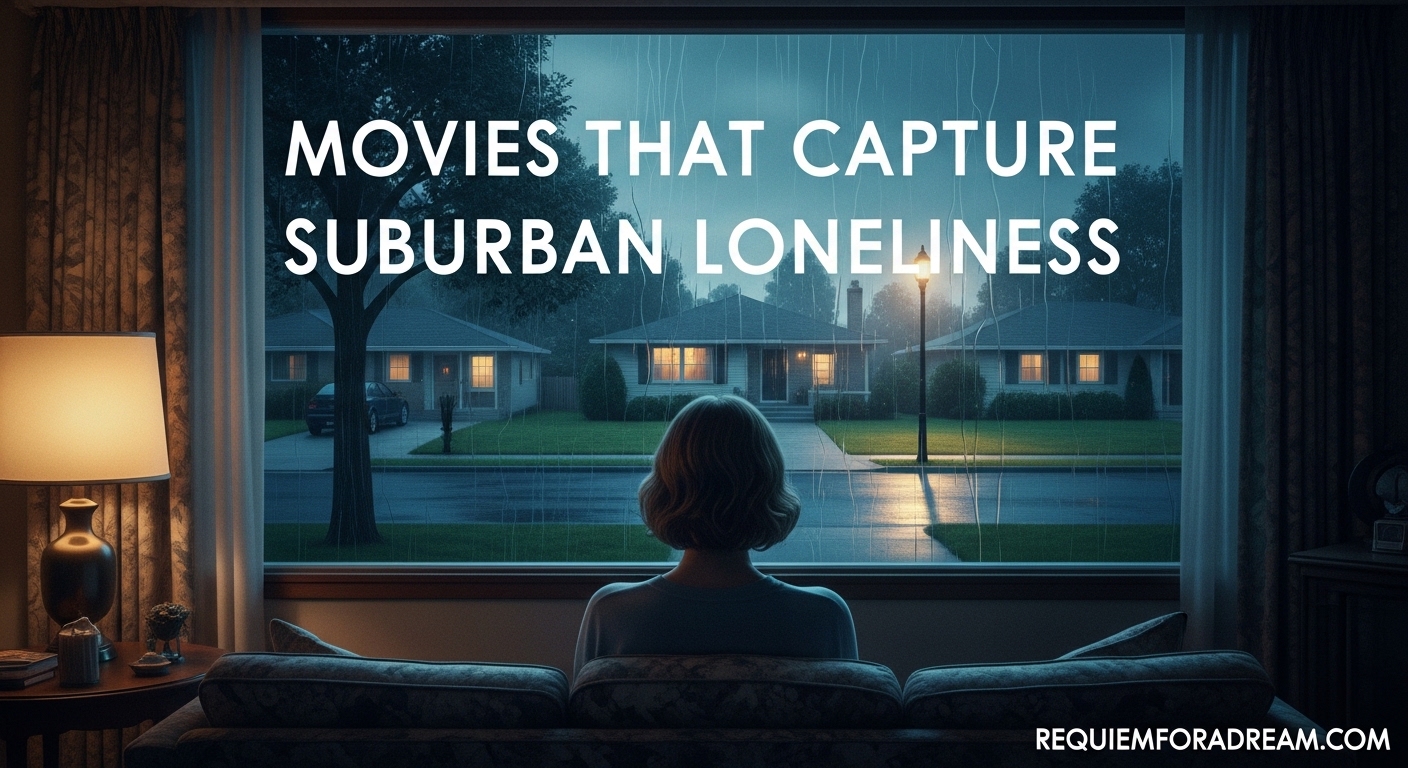
There is a particular ache that settles into the bones of suburban life. It arrives quietly, often disguised by the morning ritual of retrieving the newspaper from the driveway or the evening procession of garage doors closing in mechanical unison. This is suburban loneliness, a distinct species of isolation that differs from the anonymity of crowded cities or the physical remoteness of rural existence. Movies that capture suburban loneliness reveal the emotional emptiness that thrives in these manufactured communities, where identical homes and manicured lawns create a facade of perfection that masks profound disconnection.
I have spent years watching and analyzing films about suburban isolation. The best movies that capture suburban loneliness do not simply show unhappy people in pleasant neighborhoods. They expose the architecture of alienation built into the suburban dream itself, the way conformity becomes a cage, and how the pursuit of the American Dream often leaves its achievers feeling strangely hollow. These films validate an experience that many viewers recognize but struggle to name.
This collection of 12 films spans four decades of cinema, from the Lynchian nightmares of the 1980s to the existential horror of recent years. Each movie offers a unique perspective on the melancholy that seeps through the walls of cookie-cutter houses. These are not merely films about unhappy suburbs. They are precise examinations of what happens when the promise of community collides with the reality of isolation.
Table of Contents
What Is Suburban Loneliness in Cinema?
Suburban loneliness in cinema refers to the specific portrayal of emotional isolation experienced by characters living in seemingly ideal suburban communities. Unlike urban loneliness, which often stems from anonymity in crowds, or rural loneliness, which derives from physical distance, suburban loneliness emerges from a particular paradox. It is the loneliness of being surrounded by people yet feeling completely unseen. It is the isolation that grows in the gap between the expectation of community and the reality of neighborly estrangement.
Filmmakers capture this sensation through distinctive visual and narrative techniques. The contrast between pristine exteriors and troubled interiors appears repeatedly, with pastel-colored homes masking domestic turmoil. Wide shots of empty streets and identical houses emphasize the homogenized nature of suburban sprawl. Characters often appear trapped within frames, whether looking out windows or confined to fenced backyards. The visual language speaks to a deeper psychological truth about the suburbs as spaces designed for display rather than authentic connection.
The emotional texture of suburban loneliness films differs from general stories about isolation. These movies explore themes of conformity versus individuality, the performance of happiness, the quiet desperation of routine, and the yearning for something more meaningful than material comfort. They examine how the physical design of suburban spaces, with their emphasis on privacy and separation, can inadvertently foster disconnection. The loneliness depicted is often unacknowledged by the characters themselves, who may not recognize their own alienation until some crisis forces confrontation with their emptiness.
12 Films That Capture the Isolation of Suburban Life
The following films represent the most insightful cinematic explorations of suburban loneliness available in 2026. Each entry includes streaming information so you can watch these powerful portrayals of isolation tonight. These movies span genres from dark comedy to psychological thriller, but all share a commitment to revealing the emotional truth beneath the suburban facade.
1. American Beauty (1999) – Sam Mendes
Starring: Kevin Spacey, Annette Bening, Thora Birch, Wes Bentley | Available on: Paramount+, Amazon Prime Video
American Beauty remains the definitive film about suburban malaise more than twenty-five years after its release. Lester Burnham’s voiceover opens with the haunting admission that he will be dead within a year, establishing immediately that this is not a story about suburban happiness but about suburban disintegration. The film dissects the emotional bankruptcy of a middle-class family living in a nameless suburb that could be anywhere in America.
The loneliness in American Beauty manifests differently for each character. Lester experiences midlife crisis as a desperate attempt to feel something, anything, after years of numbing conformity. His wife Carolyn performs happiness with manic intensity while dying inside. Their daughter Jane feels invisible to parents who are too absorbed in their own crises to notice her. The film suggests that suburban life requires a constant performance that eventually exhausts the performers, leaving them disconnected from their authentic selves and from each other.
Sam Mendes and cinematographer Conrad Hall create visual poetry from the mundane details of suburban existence. The famous plastic bag scene, where Ricky Fitts films a bag dancing in the wind, captures the film’s philosophy that beauty and meaning can be found in unexpected places if one pays attention. Yet most characters are too trapped in their routines to notice such moments. The red rose petals that recur throughout the film symbolize both the manufactured beauty of suburban life and the blood that pulses beneath its surface.
2. The Virgin Suicides (1999) – Sofia Coppola
Starring: Kirsten Dunst, James Woods, Kathleen Turner, Josh Hartnett | Available on: Hulu, Amazon Prime Video
Sofia Coppola’s debut feature adapts Jeffrey Eugenides’ novel into a dreamlike meditation on female isolation within suburban confinement. The Lisbon sisters exist as beautiful mysteries to the neighborhood boys who narrate the film, but the story reveals the crushing loneliness of young women trapped by parental overprotection and suburban expectation. Set in 1970s Michigan, the film captures a specific era of suburban development while exploring timeless themes of isolation.
The loneliness depicted here is particular to the suburban teenage experience. The girls are physically surrounded by family and watched by neighbors yet emotionally imprisoned. Their home becomes a fortress of isolation, with strict parents enforcing a separation from the world that breeds despair. The suburban setting, with its emphasis on appearance and respectability, enables this confinement. Neighbors notice the girls’ strangeness but maintain the suburban code of non-interference, allowing the tragedy to unfold unchecked.
Coppola’s visual style, all soft focus and golden light, creates a nostalgic haze that mirrors the narrators’ romanticized memories. Yet beneath this beauty lies genuine horror. The film suggests that suburban communities can watch suffering unfold across manicured lawns and do nothing, maintaining the facade of normalcy even as darkness consumes a family. The final image of the girls as remembered fragments, never fully understood, speaks to the ultimate loneliness of being reduced to symbols by those who observe but never truly see.
3. Revolutionary Road (2008) – Sam Mendes
Starring: Leonardo DiCaprio, Kate Winslet, Michael Shannon, Kathy Bates | Available on: Paramount+, Amazon Prime Video
Sam Mendes returns to suburban themes with this devastating adaptation of Richard Yates’ novel, exploring marital loneliness in 1950s Connecticut. Frank and April Wheeler begin the film believing themselves superior to the suburban conformity surrounding them, yet they have fully internalized the suburban dream they claim to reject. Their tragedy lies in realizing too late that the loneliness of suburban life cannot be escaped simply by moving to Paris, as they plan, because they carry their emptiness within themselves.
The film exposes how suburban architecture facilitates emotional distance. Frank commutes to the city while April remains trapped in their identical home, the physical separation mirroring their growing emotional estrangement. Their conversations become battlegrounds where loneliness expresses itself as anger and resentment. The suburb itself becomes a character, with its repetitive houses and social rituals creating a pressure cooker environment where disappointment ferments into despair.
Michael Shannon delivers a searing performance as John Givings, a mentally ill man whose inability to perform social niceties allows him to speak truths that others suppress. His character represents what happens when suburban repression cracks, the honest emotions that leak through the facade. The film’s conclusion offers no comfort, suggesting that suburban loneliness, when unaddressed, destroys not just marriages but lives. It stands as one of the most unflinching portraits of how the suburban dream became a nightmare of isolation for a generation.
4. Blue Velvet (1986) – David Lynch
Starring: Kyle MacLachlan, Isabella Rossellini, Dennis Hopper, Laura Dern | Available on: Criterion Channel, Amazon Prime Video
David Lynch’s masterpiece opens with iconic shots of suburban normalcy, white picket fences and manicured lawns presented with an unsettling gloss that suggests something hidden beneath. The discovery of a severed ear in a field near Jeffrey Beaumont’s home initiates a descent into the darkness that suburban life conceals. Blue Velvet does not simply contrast innocence with corruption. It suggests that the extreme repression required to maintain suburban appearances inevitably generates pathological behavior.
The loneliness in Blue Velvet manifests as sexual and psychological dysfunction. Dorothy Vallens exists in a prison of masochistic dependency, trapped by her relationship with the psychopathic Frank Booth. Frank himself embodies suburban rage turned monstrous, his violent outbursts representing all the emotions that proper suburbanites must suppress. The film suggests that the quiet streets and friendly neighbors serve as cover for profound individual suffering that goes unnoticed because everyone is too busy maintaining their own facade.
Lynch’s visual approach, blending 1950s aesthetic nostalgia with nightmarish violence, captures the schizophrenic nature of suburban existence. The severed ear that triggers the plot can be read as a metaphor for the deafness of suburban communities to the suffering occurring around them. Jeffrey’s journey from innocent observer to unwilling participant in this darkness mirrors the audience’s confrontation with suburban reality. The film suggests that beneath every manicured lawn lies a similar darkness, unseen but always present.
5. Edward Scissorhands (1990) – Tim Burton
Starring: Johnny Depp, Winona Ryder, Dianne Wiest, Anthony Michael Hall | Available on: Disney+, Amazon Prime Video
Tim Burton’s suburban fairy tale uses the perspective of an outsider to expose the conformist nature of suburban communities. Edward, created by an inventor who died before completing him, possesses scissors for hands and an innocence that contrasts sharply with the artificiality of the suburban neighborhood where he is taken in. The film’s color palette, with its pastel houses and manicured lawns, establishes a visual language of suburban conformity against which Edward’s Gothic appearance appears both threatening and authentic.
The loneliness here operates on multiple levels. Edward is literally unable to touch others without causing harm, a physical manifestation of the emotional barriers that separate suburban neighbors. The suburbanites initially embrace him as a novelty but quickly turn on him when he fails to conform to their expectations. Their loneliness emerges from the hollowness of their pursuits, the constant consumption and gossip that fill their days without providing genuine connection. The film suggests that suburban communities are designed to exclude difference, maintaining a sterile homogeneity that crushes authentic individuality.
Burton, who grew up in suburban Burbank, California, brings personal experience to the film’s critique. The cookie-cutter houses that dominate the landscape represent not community but isolation, each family enclosed in its own box, separated from neighbors by fences and social pretense. Edward’s final retreat to the abandoned mansion on the hill, looking down on the suburb that rejected him, offers a poignant image of exile. The film suggests that authentic connection is impossible in environments designed for display and conformity.
6. The Ice Storm (1997) – Ang Lee
Starring: Kevin Kline, Joan Allen, Sigourney Weaver, Tobey Maguire | Available on: Criterion Channel, Amazon Prime Video
Set during Thanksgiving weekend in 1973, Ang Lee’s adaptation of Rick Moody’s novel captures a specific moment of suburban history when traditional family structures were beginning to crumble. The Hood and Carver families inhabit the same Connecticut suburb, their children friends, their parents engaged in partner swapping that no one acknowledges openly. The ice storm of the title serves as both literal weather event and metaphor for the emotional freeze that has settled over these families.
The loneliness depicted here is familial and generational. Parents and children occupy the same houses but live in separate worlds, unable to communicate across the generational divide. The adults seek connection through sexual experimentation but find only further emptiness. The teenagers, experimenting with their own emerging sexuality, discover that physical intimacy does not prevent emotional isolation. The film suggests that suburban life, with its emphasis on material comfort and social appearances, has severed the bonds that once held families together.
Lee’s careful direction creates a period piece that feels both historically specific and timeless. The 1970s setting, with its waterbeds and key parties, establishes a society in transition, the old certainties dissolving without new structures to replace them. The climactic ice storm, which literally brings the narrative to a frozen halt, suggests that the emotional coldness of suburban existence can become deadly. The film concludes with an image of permanent isolation, one character trapped in grief that the suburban environment offers no resources to process.
7. Safe (1995) – Todd Haynes
Starring: Julianne Moore, Peter Friedman, Xander Berkeley, Susan Norman | Available on: Criterion Channel, Amazon Prime Video
Todd Haynes’ psychological drama presents suburban loneliness through the lens of environmental illness, using physical sickness as metaphor for spiritual malaise. Carol White lives in a pristine San Fernando Valley home, married, mother to a stepson, surrounded by the material comforts that define successful suburban life. Yet she is slowly dying, not from any identifiable disease, but from the accumulated toxicity of her environment. Her multiple chemical sensitivity becomes the physical expression of suburban isolation.
The film examines how suburban spaces, designed for comfort and convenience, can become toxic to the human spirit. Carol’s home is filled with chemical cleaners, synthetic materials, and air-conditioned isolation. Her days are consumed by meaningless consumption and shallow social interactions that leave her fundamentally alone. When conventional medicine fails to diagnose her condition, she retreats to a desert commune that offers its own form of isolation. The film suggests that there is no escape from suburban loneliness, only different varieties of isolation.
Julianne Moore’s performance captures the dissociation of suburban existence, her face increasingly blank as Carol loses connection with her own life. The film’s static compositions and symmetrical framing emphasize the rigid structures of suburban living. Haynes refuses easy answers, leaving viewers uncertain whether Carol’s illness is physical, psychological, or environmental. This ambiguity reflects the mysterious nature of suburban loneliness itself, a condition that persists even when all material needs are met.
8. Columbus (2017) – Kogonada
Starring: John Cho, Haley Lu Richardson, Parker Posey, Rory Culkin | Available on: Hulu, Amazon Prime Video
Kogonada’s directorial debut offers a contemplative, modern take on suburban isolation through the unlikely connection between two strangers in Columbus, Indiana. Casey lives in this small Midwestern city, famous for its modernist architecture, working at a library and caring for her recovering addict mother. Jin arrives from Korea to care for his estranged father, a renowned architect who has fallen into a coma. Their friendship develops through conversations about buildings, but the film is really about loneliness and the architecture that contains it.
The suburban loneliness depicted here is quieter and more contemporary than in earlier films. Casey feels trapped by her responsibilities, her potential on hold while she supports her mother. Jin carries the loneliness of cultural dislocation and paternal estrangement. Their connection forms in the spaces between buildings, the empty streets and modernist structures that define Columbus. The film suggests that suburban isolation can be interrupted by unexpected encounters, though not necessarily resolved.
Kogonada’s background in video essays shows in the film’s careful attention to architectural space. Each building becomes a meditation on how physical environments shape emotional experience. The modernist structures of Columbus, with their clean lines and contemplative spaces, offer a different suburban aesthetic than the cookie-cutter developments of earlier films. Yet the loneliness remains similar, the isolation of individuals in communities designed for automobile transport and private life. The film concludes with an acceptance of loneliness as a condition of modern existence.
9. Vivarium (2019) – Lorcan Finnegan
Starring: Jesse Eisenberg, Imogen Poots, Jonathan Aris, Senan Jennings | Available on: AMC+, Amazon Prime Video
This recent horror film literalizes suburban entrapment in a surreal nightmare that speaks to genuine anxieties about home ownership and community. Tom and Gemma, a young couple looking to buy their first home, find themselves trapped in an endless suburban development where every house is identical and escape is impossible. The film’s title refers to an enclosed environment for keeping animals, and the metaphor is clear. Suburban life is a trap from which there is no exit.
The loneliness in Vivarium is existential and married. Tom and Gemma begin as a loving couple but the environment slowly destroys their relationship. Their forced care for a mysterious child, who grows at an accelerated rate into something inhuman, represents the obligations that consume suburban parents. The development itself, with its empty streets and identical homes stretching to a false horizon, creates a claustrophobic isolation more extreme than any physical prison. The film suggests that suburban conformity is literally dehumanizing.
As a contemporary entry in the suburban loneliness canon, Vivarium reflects anxieties particular to the late 2010s. The housing market, the pressure to start families, the fear of being trapped in unfulfilling routines all find expression in its nightmare logic. The film’s visual style, with its artificial colors and uncanny repetition, creates a sense of wrongness that permeates every frame. It stands as one of the most direct cinematic statements about suburban isolation, using horror genre conventions to literalize metaphors that other films handle more subtly.
10. Little Children (2006) – Todd Field
Starring: Kate Winslet, Patrick Wilson, Jennifer Connelly, Jackie Earle Haley | Available on: Paramount+, Amazon Prime Video
Todd Field’s adaptation of Tom Perrotta’s novel examines adult loneliness in the routine of suburban parenthood. Sarah Pierce, a stay-at-home mother, and Brad Adamson, a stay-at-home father, meet at the local playground and begin an affair that offers escape from the numbing repetition of their daily lives. The film juxtaposes their slow-burn connection with the community’s obsession with a convicted sex offender who has moved into the neighborhood, using this parallel to explore how suburban surveillance culture masks profound isolation.
The loneliness depicted here is specific to the early 2000s suburban experience, particularly for parents who have put their own lives on hold to raise children. Sarah feels intellectually starved by motherhood, her graduate school ambitions abandoned. Brad feels emasculated by his wife’s career success and his own repeated failure to pass the bar exam. Their connection forms not from profound compatibility but from shared desperation, two lonely people seeking warmth in a cold environment. The film suggests that suburban routine, with its scheduled activities and social obligations, can be as isolating as physical solitude.
Field’s direction creates an atmosphere of mounting dread that emerges from the mundane details of suburban life. The playground gatherings, the pool visits, the book club meetings all become spaces where loneliness persists despite social contact. The voiceover narration, which adopts the tone of a literary novel, adds distance that emphasizes the characters’ isolation from their own experiences. The film concludes with characters retreating into their assigned roles, the brief connection they formed insufficient to overcome the structural loneliness of suburban existence.
11. Suburbia (1996) – Richard Linklater
Starring: Jayce Bartok, Amie Carey, Nicky Katt, Giovanni Ribisi | Available on: Amazon Prime Video
Richard Linklater’s adaptation of Eric Bogosian’s play brings theatrical intensity to the examination of youth aimlessness in suburban sprawl. A group of disaffected young people hang out behind a convenience store in a nameless suburban town, their days and nights consumed by boredom, substance abuse, and petty conflict. The film captures a specific type of suburban loneliness experienced by those who have not yet found their place in the adult world but no longer fit in the adolescent spaces they have outgrown.
The loneliness here is generational and economic. These young adults have no clear future, no meaningful work, no sense of purpose within the suburban landscape. Their parents are either absent or ineffective, the suburban homes providing shelter without guidance. The convenience store parking lot becomes their shared space of exile, a nowhere place that reflects their nowhere lives. The film suggests that suburban sprawl, with its lack of meaningful community centers and its emphasis on private property, creates a vacuum where young people drift without direction.
Linklater’s dialogue-heavy approach, characteristic of his early work, allows the characters to express their alienation directly. They talk about their loneliness, their anger, their sense that life should mean something more than what suburban existence offers. The film’s theatrical origins show in its focused intensity, the limited locations creating a sense of claustrophobia that mirrors the characters’ trapped circumstances. It stands as a raw expression of suburban disaffection from the 1990s, a time when economic uncertainty first began to crack the promise of suburban security.
12. The Squid and the Whale (2005) – Noah Baumbach
Starring: Jeff Daniels, Laura Linney, Jesse Eisenberg, Owen Kline | Available on: Netflix, Amazon Prime Video
Noah Baumbach’s semi-autobiographical film examines divorce and family dissolution in the Brooklyn suburbs of the 1980s. The Berkman family is splitting apart, with parents Bernard and Joan dividing their children Walt and Frank between their respective homes. The film captures the loneliness that descends on children caught in parental conflict, the isolation of a family that was once whole becoming separate and hostile parts. It is a precise, painful examination of how suburban family life can fracture.
The loneliness depicted here is parental and filial. Bernard, an intellectual snob, deals with his failed literary ambitions by dominating his sons. Joan, seeking freedom after years of marriage, explores new relationships that confuse and wound her children. Walt and Frank navigate their parents’ separation with varying degrees of denial and acting out, their suburban homes becoming spaces of emotional danger rather than safety. The film suggests that suburban families, with their emphasis on appearances and achievement, often lack the resilience to survive crisis.
Baumbach’s script brings uncomfortable humor to painful situations, the comedy emerging from characters’ inability to recognize their own loneliness. The film’s title refers to a museum diorama that becomes a metaphor for the children’s perspective on their parents’ battles, as monstrous and incomprehensible as a giant squid attacking a whale. The Brooklyn setting, more urban than the typical suburban landscape but sharing its emphasis on property and status, demonstrates that suburban loneliness can exist even in cities. It is one of the most honest films about how family separation creates new forms of isolation.
Common Themes Across These Films
Examining these twelve films reveals recurring patterns that define the cinematic language of suburban loneliness. The visual contrast between pristine exteriors and troubled interiors appears in nearly every entry, from the blood-red roses against white picket fences in American Beauty to the identical pastel homes hiding monstrous secrets in Vivarium. This visual motif speaks to the fundamental paradox of suburban existence, the gap between appearance and reality that creates space for loneliness to grow.
The theme of conformity versus individuality emerges repeatedly. Characters who attempt to break free from suburban norms, like the Lisbon sisters in The Virgin Suicides or Edward in Edward Scissorhands, face punishment or exile. Those who maintain the facade, like Carolyn Burnham in American Beauty or Carol White in Safe, find themselves dying slowly from repression. The films suggest that suburban communities are designed to enforce homogeneity, crushing authentic expression and leaving residents isolated within their own performances of normalcy.
Another common thread involves the failure of the American Dream. The families in these films have achieved the material success that suburbia promises, yet they find no satisfaction in their accomplishments. Revolutionary Road explicitly addresses this disillusionment, with the Wheelers recognizing that their suburban home represents the death of their youthful ambitions. The Ice Storm shows how the pursuit of material comfort in the 1970s led to moral bankruptcy. These films collectively argue that the dream sold to generations of Americans was always hollow, designed to produce consumers rather than fulfilled human beings.
The role of architecture in creating isolation deserves attention. Films like Columbus explicitly examine how buildings shape emotional experience, but all these movies pay careful attention to suburban spaces. The wide streets that prevent neighborly interaction, the fences that enforce privacy, the garages that allow residents to enter and exit without being seen all contribute to isolation. Even natural elements become part of this architectural system, with manicured lawns requiring constant maintenance that keeps residents isolated in their own yards. The suburban landscape is designed for automobiles and private property, not for community.
Where to Watch These Films
| Film | Year | Primary Streaming Platforms |
|---|---|---|
| American Beauty | 1999 | Paramount+, Amazon Prime |
| The Virgin Suicides | 1999 | Hulu, Amazon Prime |
| Revolutionary Road | 2008 | Paramount+, Amazon Prime |
| Blue Velvet | 1986 | Criterion Channel, Amazon Prime |
| Edward Scissorhands | 1990 | Disney+, Amazon Prime |
| The Ice Storm | 1997 | Criterion Channel, Amazon Prime |
| Safe | 1995 | Criterion Channel, Amazon Prime |
| Columbus | 2017 | Hulu, Amazon Prime |
| Vivarium | 2019 | AMC+, Amazon Prime |
| Little Children | 2006 | Paramount+, Amazon Prime |
| Suburbia | 1996 | Amazon Prime |
| The Squid and the Whale | 2005 | Netflix, Amazon Prime |
Streaming availability changes frequently, and these films may move between platforms or become temporarily unavailable. I recommend checking JustWatch.com for the most current information on where these films can be streamed, rented, or purchased in your region. Many are also available through local library systems via Kanopy or Hoopla, excellent resources for accessing independent and classic cinema without subscription costs.
For viewers new to the suburban loneliness genre, I suggest starting with American Beauty or The Virgin Suicides, both accessible entry points that establish the visual and thematic vocabulary these films share. Those interested in contemporary takes should begin with Columbus or Vivarium, while viewers seeking historical perspectives might prefer The Ice Storm or Revolutionary Road. Each film offers a distinct angle on suburban isolation, and watching several reveals the depth and variety of this cinematic tradition.
Frequently Asked Questions
What movies to watch when you feel lonely?
When experiencing loneliness, films that validate rather than exploit that feeling can provide genuine comfort. Columbus (2017) offers a gentle meditation on connection between isolated individuals. The Squid and the Whale (2005) reminds viewers that loneliness is a shared human experience. Edward Scissorhands (1990) suggests that outsiders can find understanding. These films acknowledge loneliness without romanticizing it, offering recognition rather than false solutions. Avoid films that suggest loneliness can be easily fixed through romance or simple lifestyle changes, as these can increase feelings of inadequacy.
What defines suburban loneliness in film?
Suburban loneliness in cinema is defined by the paradox of isolation within community. Unlike urban loneliness, which stems from anonymity in crowds, suburban loneliness emerges from the gap between the promise of neighborhood connection and the reality of private, enclosed lives. Visually, these films contrast pristine suburban exteriors with troubled interiors, using identical houses, manicured lawns, and white picket fences as symbols of conformity that masks emotional emptiness. Thematically, they explore how suburban architecture and social expectations create isolation even among families and neighbors.
What are the best modern films about suburban isolation?
The best modern films about suburban isolation include Columbus (2017), which offers a contemplative examination of loneliness through architecture and unexpected friendship, and Vivarium (2019), which uses horror conventions to literalize suburban entrapment. The Squid and the Whale (2005), though set in the past, provides a timeless examination of family dissolution. Little Children (2006) captures the loneliness of routine suburban parenthood. These films bring contemporary concerns to the suburban loneliness tradition, reflecting anxieties about housing, parenting, and modern disconnection.
How is suburban loneliness different from urban isolation?
Suburban loneliness differs from urban isolation in its specific combination of physical proximity and emotional distance. Urban isolation typically involves anonymity among crowds, while suburban loneliness occurs among people who know each other’s names but remain fundamentally unknown. The suburban environment, with its emphasis on private property, automobile transport, and social performance, creates a unique isolation where neighbors are physically close but emotionally distant. Urban loneliness can sometimes be escaped through community spaces, but suburban loneliness is often structural, built into the design of the environment itself.
Why do suburbs make people feel lonely?
Suburbs can produce loneliness through several structural factors. The emphasis on single-family homes creates physical separation between residents. Automobile-dependent design eliminates spontaneous social contact. The pressure to maintain appearances discourages authentic emotional expression. Zoning laws separate residential areas from commercial and community spaces, reducing opportunities for gathering. Additionally, the suburban promise of happiness through material achievement often leaves residents feeling hollow when possessions fail to provide fulfillment. These environmental and social factors combine to create the specific loneliness that suburban films capture.
The Quiet Truth Beneath the Picket Fence
These twelve films collectively expose the loneliness that suburban architecture and culture often produce. They reveal how the pursuit of the American Dream, with its promise of community and contentment, can instead generate isolation and alienation. Movies that capture suburban loneliness serve an important cultural function, validating experiences that many viewers feel but struggle to articulate. They name a condition that the suburbs themselves deny, insisting that behind every manicured lawn and freshly painted facade, real human beings struggle with disconnection.
The films span decades and styles, yet they share a consistent critique. Whether through the surreal nightmares of David Lynch, the careful period detail of Ang Lee, or the contemporary horror of Lorcan Finnegan, each director recognizes that suburban spaces are designed for privacy rather than community. The loneliness depicted is not an individual failure but a structural feature of suburban life. Understanding this distinction matters because it shifts the blame from lonely individuals to the environments that produce their isolation.
I encourage you to watch these films not as depressing portraits of suburban failure but as honest examinations of a common human experience. Loneliness is not a defect to be hidden but a condition to be acknowledged and addressed. These films offer that acknowledgment, creating space for viewers to recognize their own experiences and perhaps find connection through shared understanding. The suburbs may be lonely places, but watching these films reminds us that we are not alone in feeling that way.
What films about suburban loneliness have resonated with your experience? Which movies would you add to this list? I welcome your recommendations and reflections in the comments below.