
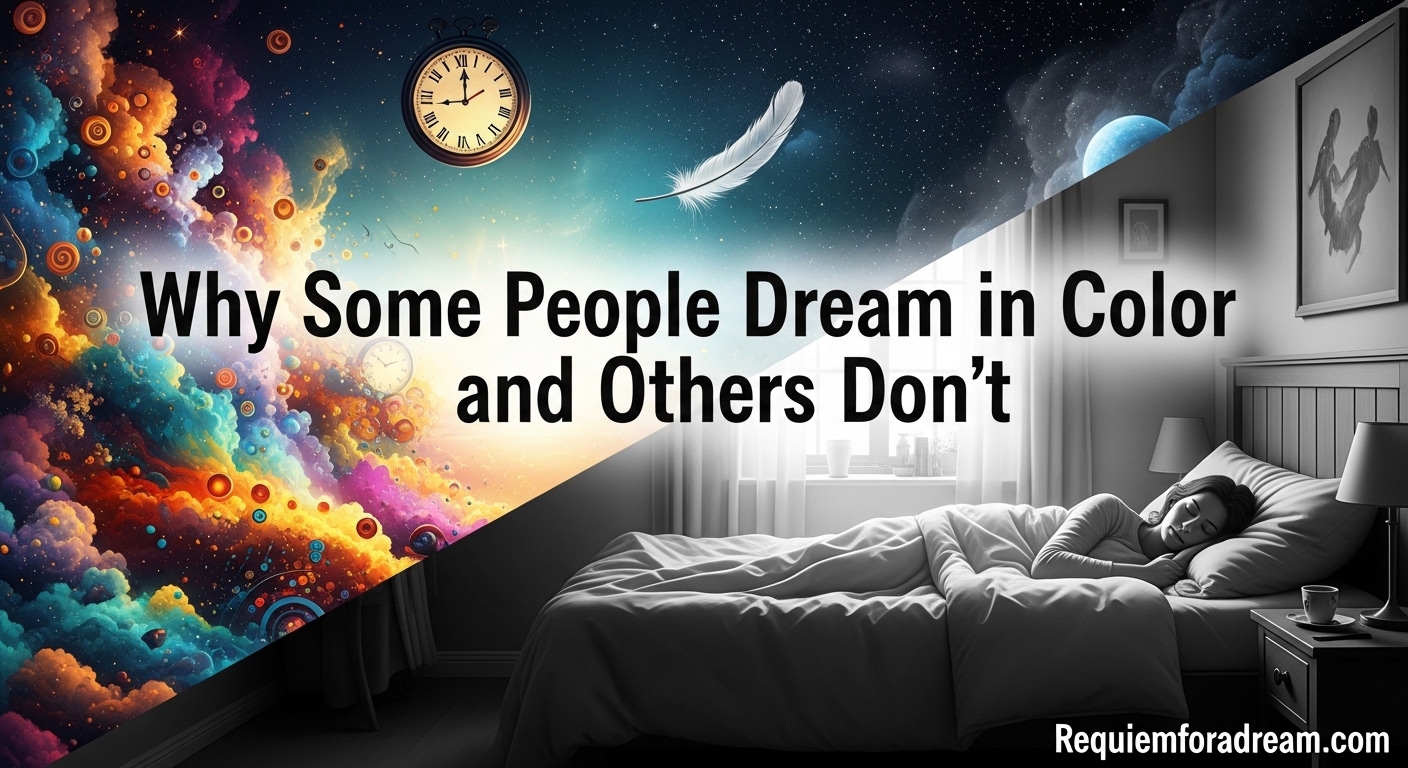
Have you ever stopped to consider whether your dreams appear in vibrant color or muted shades of gray? The question of why some people dream in color and others don’t has fascinated scientists and dreamers alike for decades. I remember the first time I asked my grandparents about their dreams and was surprised to learn they often experienced them in black and white, while my own dreams have always been filled with color.
Research suggests that roughly 70% to 80% of people today report dreaming in color. Yet this was not always the case. In the 1940s, studies revealed that approximately 75% of Americans dreamed almost exclusively in black and white. So what changed? And why do some people still experience grayscale dreams while others enjoy full-color dreamscapes?
In this article, we will explore the fascinating science behind dream colors. From the impact of childhood television habits to the inner workings of your brain during REM sleep, we will uncover what determines whether you are a color dreamer or a black-and-white dreamer.
Table of Contents
What Percentage of People Dream in Color
Modern research consistently shows that the majority of people dream in color. A landmark study conducted in the early 2000s found that about 70% to 80% of participants reported experiencing dreams in full color. This represents a dramatic shift from earlier decades.
Before color television became widespread in the 1960s, most people reported dreams in black and white. A 1942 study by Calvin Hall revealed that approximately 75% of Americans rarely or never saw color in their dreams. Today, that number has flipped completely.
Interestingly, about 12% of the population still reports dreaming primarily in black and white. These individuals are typically older adults who grew up during the era of monochrome television and photography. The percentage of people who never dream in color has been steadily declining as newer generations, raised on color media, reach adulthood.
Some researchers also note that a small percentage of people experience mixed dreams, occasionally seeing certain elements in color while the rest remains in grayscale. This suggests that dream color perception exists on a spectrum rather than as a simple binary.
The Color TV Theory: How Media Shapes Our Dreams
The most compelling explanation for the generational divide in dream colors involves the media we consume during our formative years. This theory, proposed by researchers Eric Schwitzgebel and Michael Schredl, suggests that exposure to black-and-white versus color television fundamentally shapes how our brains construct dream imagery.
Think about it: during the 1940s and 1950s, most households owned black-and-white televisions. Children growing up during this era watched their favorite shows, news broadcasts, and movies entirely devoid of color. Their visual world consisted of shades of gray, and this limitation appears to have carried over into their dream lives.
When color television became mainstream in the 1960s, a gradual shift occurred. People who grew up watching color TV began reporting more colorful dreams. The correlation is striking: countries that adopted color television earlier also showed earlier shifts toward color dreaming in their populations.
Philosopher Eric Schwitzgebel from the University of California, Riverside, has extensively studied this phenomenon. He notes that our dreams often mimic the visual style of media we consume. Just as films influence our dream narratives and imagery, the color palette of our waking visual experiences seems to bleed into our sleeping minds.
However, some scientists debate whether media exposure actually changes how we dream or simply affects how we remember and report our dreams. This brings us to another crucial factor: memory.
Age and Generational Differences in Dream Colors
Age plays a significant role in determining whether you dream in color. A study published in 2008 found that people aged 25 and younger almost never report dreaming in black and white. Conversely, older adults, particularly those over 55, are significantly more likely to experience grayscale dreams.
This pattern aligns perfectly with the media exposure timeline. Older generations spent their childhood years watching black-and-white television, while younger generations have never known a world without color screens. The shift is so pronounced that researchers can often predict someone’s age based on their dream color reports.
The generational divide becomes even more apparent when examining specific age groups. Among those over 70 who grew up before color television, approximately 25% still report primarily black-and-white dreams. For those aged 40 to 60, the number drops to around 5%. And for people under 30, black-and-white dreaming is practically unheard of.
This does not necessarily mean that younger people experience more vivid dreams. Rather, their visual frame of reference has always included color, making it the default mode for their dreaming minds. The brain constructs dreams using the visual vocabulary it has learned throughout life.
The Science Behind Dream Colors
To understand why we dream in color or black and white, we need to look at what happens in our brains during sleep. Dreams primarily occur during REM (Rapid Eye Movement) sleep, a phase characterized by intense brain activity that closely resembles wakefulness.
During REM sleep, your visual cortex, the part of the brain responsible for processing visual information, remains highly active. Neuroscientists like Kimberly Fenn from Michigan State University explain that the same brain regions light up when you visualize something while awake also activate during vivid dreams. This suggests that the machinery for color perception exists during sleep, but how it gets used depends on individual factors.
The hippocampus and amygdala also play crucial roles in dream formation. The hippocampus helps consolidate memories, including visual memories, while the amygdala processes emotional content. Dreams often combine these elements, drawing from stored visual experiences and emotional states.
Interestingly, the brain does not simply replay daytime experiences during dreams. Instead, it constructs novel scenarios using familiar elements. If your stored visual memories predominantly feature color, your dreams will likely follow suit. If you grew up with limited color exposure, your brain’s visual library may default to grayscale.
Some researchers have also explored connections between dreaming and aphantasia, the condition where people cannot form mental images while awake. While not directly related to color perception, this line of inquiry suggests that individual differences in visual processing can significantly impact dream experiences.
REM Sleep and Visual Processing
During REM sleep, your eyes move rapidly beneath closed eyelids, scanning the dreamscape much like they would scan a real scene. Studies using electroencephalograms (EEGs) show that the visual cortex processes these dream images with surprising fidelity to waking perception.
The intensity of REM sleep varies throughout the night. Early REM periods tend to be shorter and may feature less vivid imagery. Later REM periods, particularly those occurring in the early morning hours, often produce the most memorable and visually rich dreams. This explains why you are more likely to recall colorful dreams when you wake naturally versus being jarred awake by an alarm.
Do Blind People Dream in Color
The experience of dreaming varies significantly for people with visual impairments. Understanding how blind individuals dream provides valuable insights into the nature of dream colors and sensory experience during sleep.
People who are born completely blind do not experience visual dreams at all. Without visual memories to draw upon, their dreams consist entirely of sound, touch, smell, taste, and emotional content. They might dream of conversations, textures, or movements, but not colors or images.
However, people who lose their sight later in life often continue to dream visually, including in color, for years or even decades after losing their vision. Their brains retain the visual memories accumulated during sighted years and continue using them in dreams. Over time, these visual dreams may gradually fade as visual memories become less accessible.
Partially sighted individuals report dreams that reflect their waking visual experience. If someone sees the world in limited color due to their condition, their dreams typically match this perception. This further supports the theory that dreams draw directly from our stored sensory experiences.
Beyond vision, dreams can incorporate all senses. Most people experience sound in dreams regularly. Smell and taste appear less frequently but can make dreams feel particularly vivid and realistic when they do occur. Touch sensations, including pain and pleasure, also feature in many people’s dream experiences.
Memory vs Reality: Do We Remember Dream Colors Accurately
One of the most challenging aspects of studying dream colors involves separating actual dream experience from memory of that experience. When you wake up and try to recall a dream, are you remembering what you actually saw, or are you reconstructing the memory based on expectations?
Schwitzgebel proposes the concept of “indeterminate” dream imagery. He suggests that some dreams may not be explicitly colored or colorless during the experience itself. Instead, we assign colors retroactively when trying to remember or describe the dream. If asked whether you saw red in a dream, you might say yes simply because the object you dreamed about is typically red, even if the dream itself contained no specific color information.
This phenomenon complicates research on dream colors. Studies rely on self-reports collected after waking, which introduces potential bias. Someone who expects dreams to be in color may unconsciously colorize their memories, while someone who grew up with black-and-white media might default to grayscale descriptions.
Memory consolidation during sleep also plays a role. The hippocampus processes dream content for long-term storage, and this process may filter or alter certain details. Color information, being less essential than narrative or emotional content, might be discarded more readily during consolidation.
Despite these challenges, the consistent patterns observed across large studies suggest that genuine differences exist in how people experience dream colors. The generational and media exposure correlations are too strong to dismiss entirely as memory artifacts.
How to Better Remember Your Dreams
Whether you dream in color or black and white, improving your dream recall can help you better understand your own dreaming patterns. Here are practical strategies that sleep researchers recommend:
Keep a dream journal. Place a notebook or recording device beside your bed and record dreams immediately upon waking. Even fragmentary memories fade quickly, so capture them while fresh. Over time, this practice trains your brain to prioritize dream memory.
Wake up naturally. Alarm clocks interrupt sleep cycles and often jolt you out of REM sleep, making dream recall more difficult. When possible, allow yourself to wake without an alarm, especially during periods when you want to remember dreams.
Stay still upon waking. Movement and immediate engagement with your environment can erase dream memories. Lie still for a minute or two after waking, allowing dream content to surface before getting out of bed.
Focus on details. When recalling a dream, start with specific sensory details rather than the overall narrative. Ask yourself what colors, sounds, textures, or smells you experienced. This focused attention can unlock more complete memories.
Practice mindfulness. Regular meditation and mindfulness practices enhance overall awareness, which can translate to better dream recall. Being more attentive during waking hours seems to correlate with better memory for dream experiences.
Frequently Asked Questions
Why do some people not dream in color?
Some people do not dream in color primarily due to generational and media exposure factors. Older adults who grew up watching black-and-white television are more likely to dream in grayscale. Additionally, individual differences in memory, visual processing, and dream recall can affect whether color information is retained or reported from dreams.
Does dreaming in color mean anything?
From a scientific perspective, dreaming in color versus black and white does not carry specific psychological meaning. However, the colors that appear in dreams may reflect emotional states, with vibrant colors sometimes correlating with more emotionally intense dreams. The presence or absence of color is more related to media exposure during childhood and generational factors than to personality or mental state.
Can dreams raise cortisol levels?
Yes, dreams can affect cortisol levels. Stressful or anxiety-inducing dreams, particularly nightmares, can trigger the body’s stress response and elevate cortisol upon waking. Studies show that sleep quality and dream content influence morning cortisol levels. Poor sleep with disturbing dreams may result in higher cortisol compared to restful sleep with pleasant dream content.
What is the rarest dream to have?
While subjective, some of the rarest reported dream types include lucid dreams (where you know you are dreaming and can control the narrative), recurring dreams with identical details over many years, dreams featuring specific scents or tastes (most dreams lack strong smell or taste elements), and dreams in which you experience pain or other intense physical sensations.
Conclusion
Understanding why some people dream in color and others don’t reveals fascinating insights about how our brains process visual information and how early experiences shape our subconscious minds. The evidence strongly suggests that exposure to color media during childhood plays a significant role, with generations raised on black-and-white television more likely to experience grayscale dreams.
However, the full picture remains complex. Individual differences in memory, brain function, and dream recall all contribute to how we experience and report our dreams. Whether your dreams unfold like Technicolor movies or classic noir films, what matters most is the rich inner world that dreaming provides.
As we move further into the digital age in 2026, where color screens dominate every aspect of visual media, black-and-white dreaming may become increasingly rare. Future generations might view monochrome dreams as a curious artifact of the past, much like the television sets that once shaped their grandparents’ sleeping minds.