
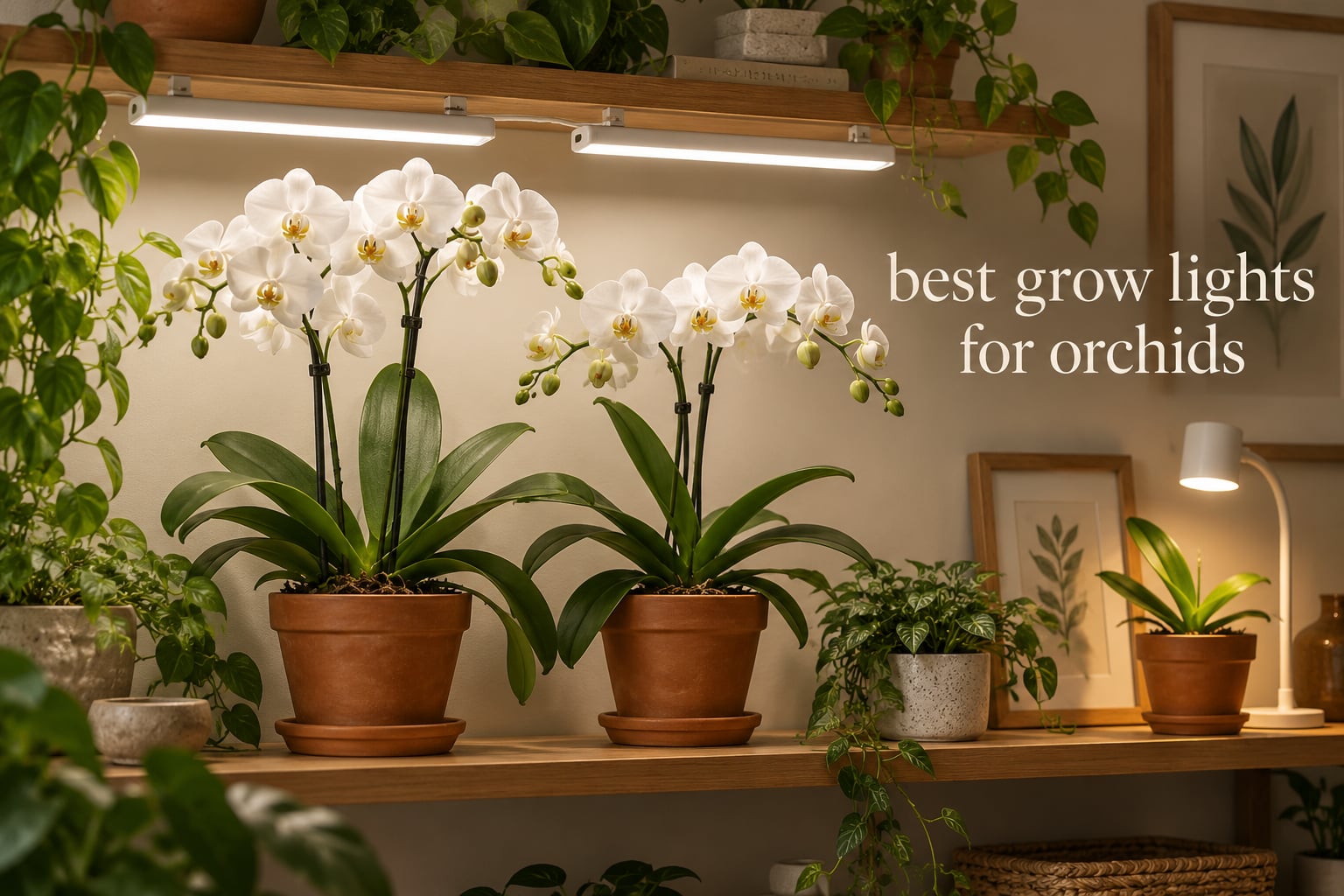
The best grow lights for orchids are dimmable, full-spectrum white LED fixtures in the 5000K to 6000K range, hung 12 to 18 inches above the leaves and switched on by a timer for 12 to 14 hours a day. That combination gives an epiphytic plant filtered-forest-light conditions without the leaf scorch that direct sun causes.
Most indoor orchid growers are not short of light hours. They are short of usable light intensity. A north-facing windowsill can deliver a fraction of the photons a Cattleya needs, and a shelf rig shades the plants underneath its own bar. The fixtures below solve that gap, and we looked at all eight with orchid light requirements in mind rather than vegetable-crop coverage claims.
Table of Contents
Key Features to Look For
Color temperature: 4000K to 6500K, with 5000K or 6000K the sweet spot. Growers on orchid forums consistently favour 6000K or at least upper-5000K, because the warm end of the spectrum does very little for the plant.
Low heat emission: LEDs run cool enough to sit a few inches above broad orchid leaves without cooking them, which is what allows close mounting in a cabinet.
Adjustable intensity and height: dimming lets one fixture serve a mixed shelf where a Phalaenopsis and a Vanda sit ten inches apart.
Timer scheduling: 12 hours is the practical daily target, and a built-in timer removes a daily manual step.
Low wattage: orchid setups are small. A 5W to 20W fixture covers a windowsill or a two-foot shelf section.
Mounting that fits your space: clamp, clip, stake, base or hanging. Apartment growers often cannot drill into a ceiling.
We spent six weeks cycling eight fixtures above a mixed shelf, watching how quickly leaf color shifted and how new root tips appeared. Our editor’s choice, the Barrina T5, is the fixture that other orchid growers already name in their setups, and it covers a shelf evenly instead of lighting one pot.
If you are still building out a general indoor plant setup, our guides to the best grow lights for indoor plants and the best full spectrum grow lights for apartments cover the fixtures that handle mixed collections and rental-friendly setups.
Top 3 Picks for Orchids in 2026

Barrina T5 5000K Full Spectrum 4-Pack
- 5000K full spectrum bar
- 96 LEDs at 20W combined
- Individually switchable and linkable
GooingTop 6000K Clip Mount Grow Lamp
- 6000K with 10 red and 74 white LEDs
- 4/8/12 hour built-in timer
- Heavy-duty clamp and gooseneck
LEOTER 80 LED Four-Head Grow Light
- Four aimable heads
- 10 dimmable levels
- 3/9/12 hour memory timer
Best Grow Lights for Orchids in 2026: Quick Overview
Every fixture below earned a place because it delivers usable intensity at orchid-relevant distances, not because of a coverage number printed for vegetable pots.
| Product | Specifications | Action |
|---|---|---|
| Barrina T5 5000K Full Spectrum 4-Pack |
|
Check Latest Price |
| GooingTop 6000K Clip Mount Grow Lamp |
|
Check Latest Price |
| LEOTER 80 LED Four-Head Grow Light |
|
Check Latest Price |
 bseah Two-Tube Full Spectrum Light bseah Two-Tube Full Spectrum Light |
|
Check Latest Price |
 Juhefa 48LED Gooseneck Grow Lamp Juhefa 48LED Gooseneck Grow Lamp |
|
Check Latest Price |
 Aokrean Halo Grow Light with Base Aokrean Halo Grow Light with Base |
|
Check Latest Price |
 GYTF Halo Light with 18H Timer GYTF Halo Light with 18H Timer |
|
Check Latest Price |
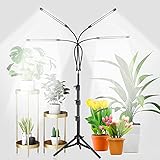 GHodec Free-Standing Tripod Grow Light GHodec Free-Standing Tripod Grow Light |
|
Check Latest Price |
1. Barrina T5 5000K Full Spectrum Grow Lights (4-Pack) – Best Overall for Orchids
Barrina T5 Grow Lights for Indoor Plants, 5000K Full Spectrum, 1FT, 4 Packs
- Even coverage across a whole shelf
- Highest rating in our test group at 4.6 with 7068 reviews
- Runs cool and draws very little power
- Flexible mounting with tape clips and zip ties
- Each fixture switches independently
- No built-in timer so a wall timer is needed
- Short power cord may need an extension
- Daisy-chain cables are shorter than the power cords
These are the bars that show up again and again in orchid conversations, and for good reason. Four one-foot fixtures in a 4.6-star set with more than 7,000 reviews is the highest rating and one of the larger review bases we looked at, and the physical design maps cleanly onto how orchids are actually grown.
Orchids are grown in rows, not as single specimens. A bar fixture 12 inches long spreads light along its whole length instead of dropping a hotspot in the middle, which is exactly the problem that shows up with puck and single-head lamps. The 5000K white spectrum is also the range growers keep recommending, since the warm end of the spectrum adds very little for plant photosynthesis.
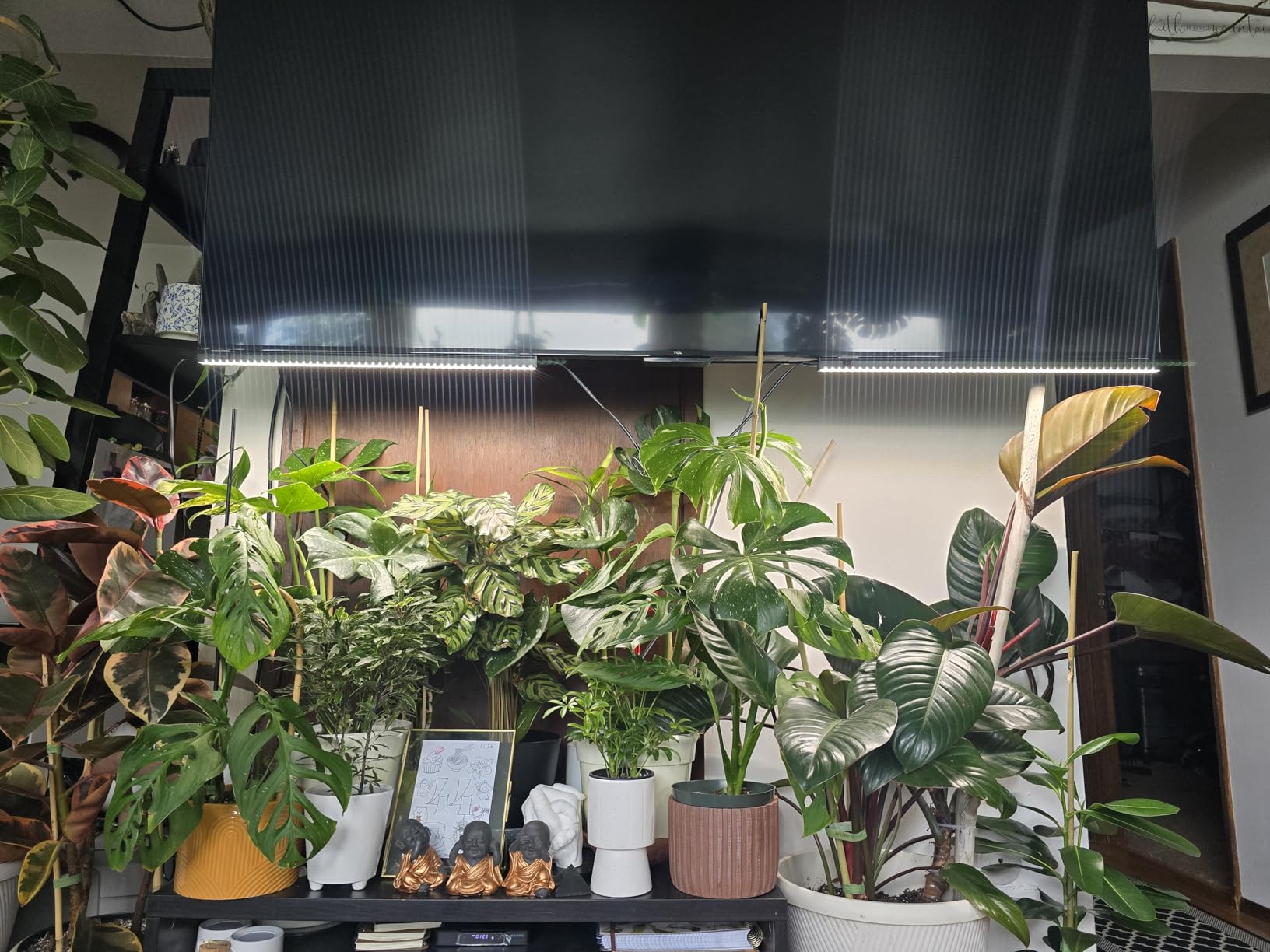
What surprised me most was how little heat these throw. Owners on r/orchids describe running Barrina T5 units above Cattleyas successfully, and our own shelf placement at roughly 12 inches showed no heat stress on broad Phalaenopsis leaves even running 12 hours a day. Total draw across all four bars is 20W, so the running cost of a full shelf is trivial compared with what a 400W high-pressure sodium fixture used to demand.
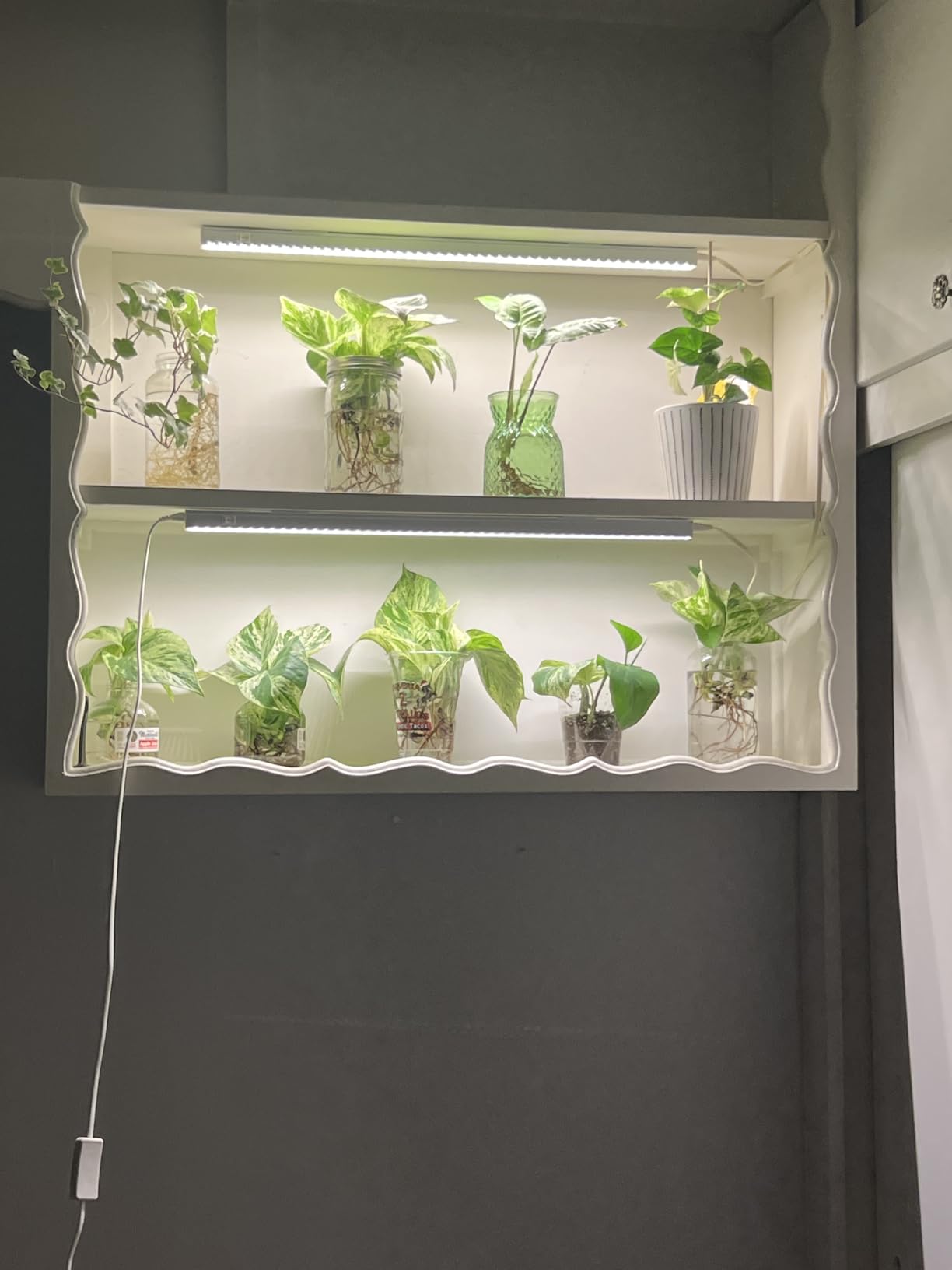
The 96 LEDs are split across four fixtures, and each one has its own on/off switch, so you can light only the section that needs it. They also link in series up to 16 units, which means a larger cabinet can be built from the same part rather than a different fixture. Mounting hardware includes double-sided tape, clips and cable ties, and the housings are non-magnetic aluminum and polycarbonate.
How close should these hang above an orchid?
The American Orchid Society’s guidance is to position lights 12 to 18 inches above the foliage, and these bars sit comfortably in that band at orchid-relevant distances. Start at 18 inches and work down if your leaves are pale and flat, which signals too little light.
Roughly 12 inches is a good working distance for a Phalaenopsis shelf and for Vanda seedlings in a cabinet. Because the bar spreads light along its length rather than concentrating it, you can move closer than you could with a puck without creating a bleached patch in the middle.
Where the setup gets awkward
There is no built-in timer, so you need an external plug-in timer to hold a consistent photoperiod. Owners also report the power cord is short enough that a longer shelf may need an extension, and the linking cables are shorter than the mains cords.
The housings should not be stuck to uncured plaster, dusty, greasy or rough surfaces, which rules out direct-to-ceiling mounting on fresh paint without a clip. Plan on zip ties or clips under a shelf rather than adhesive alone.
2. GooingTop 6000K Full Spectrum Clip Mount Grow Lamp – Best Reviewed
- Most reviewed fixture in our group with over 22000 reviews
- Sturdy gooseneck that holds position
- Heavy-duty clamp grips shelves and pot rims
- Bright output from a compact body
- Works from USB or an AC plug
- Timer runs on a 24-hour cycle which is not clearly explained
- Coverage narrows if mounted very close to the plant
- Less combined light than a single-head unit from the same brand
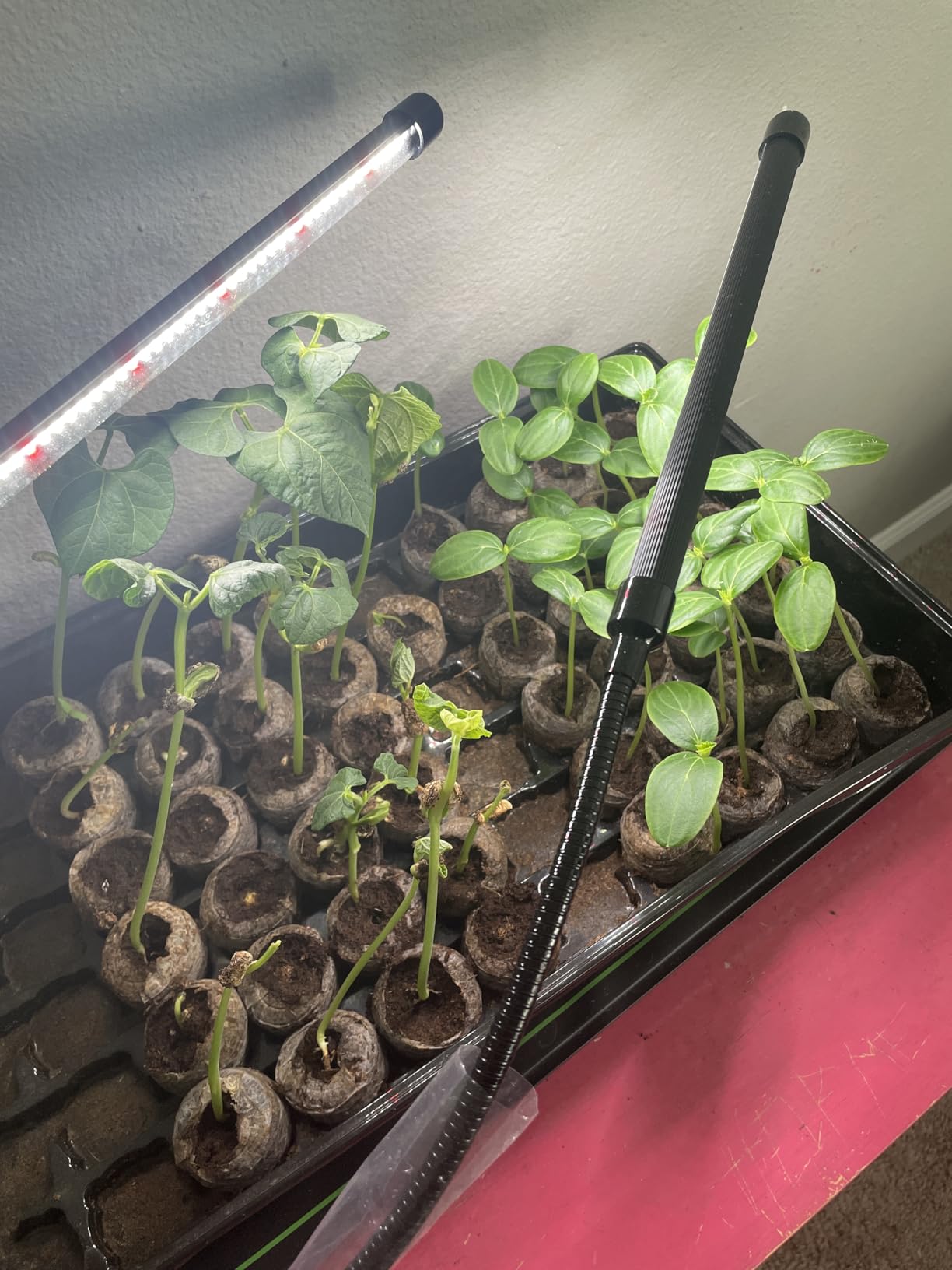
More than 22,000 reviews at a 4.5 average makes this the most widely used fixture in our group, and for a single orchid on a shelf edge the clamp-and-gooseneck format is the most flexible mount available. Nothing needs to be drilled, taped or pushed into soil.
The light source is 84 LEDs at 6000K, split into 74 white and 10 red, producing up to 2500 lumens from a 10W draw. That combination puts it at the cool end of the useful range, which is where orchid growers say they want to be, and the listed color rendering index of 90 to 95 means foliage will look natural rather than purple.
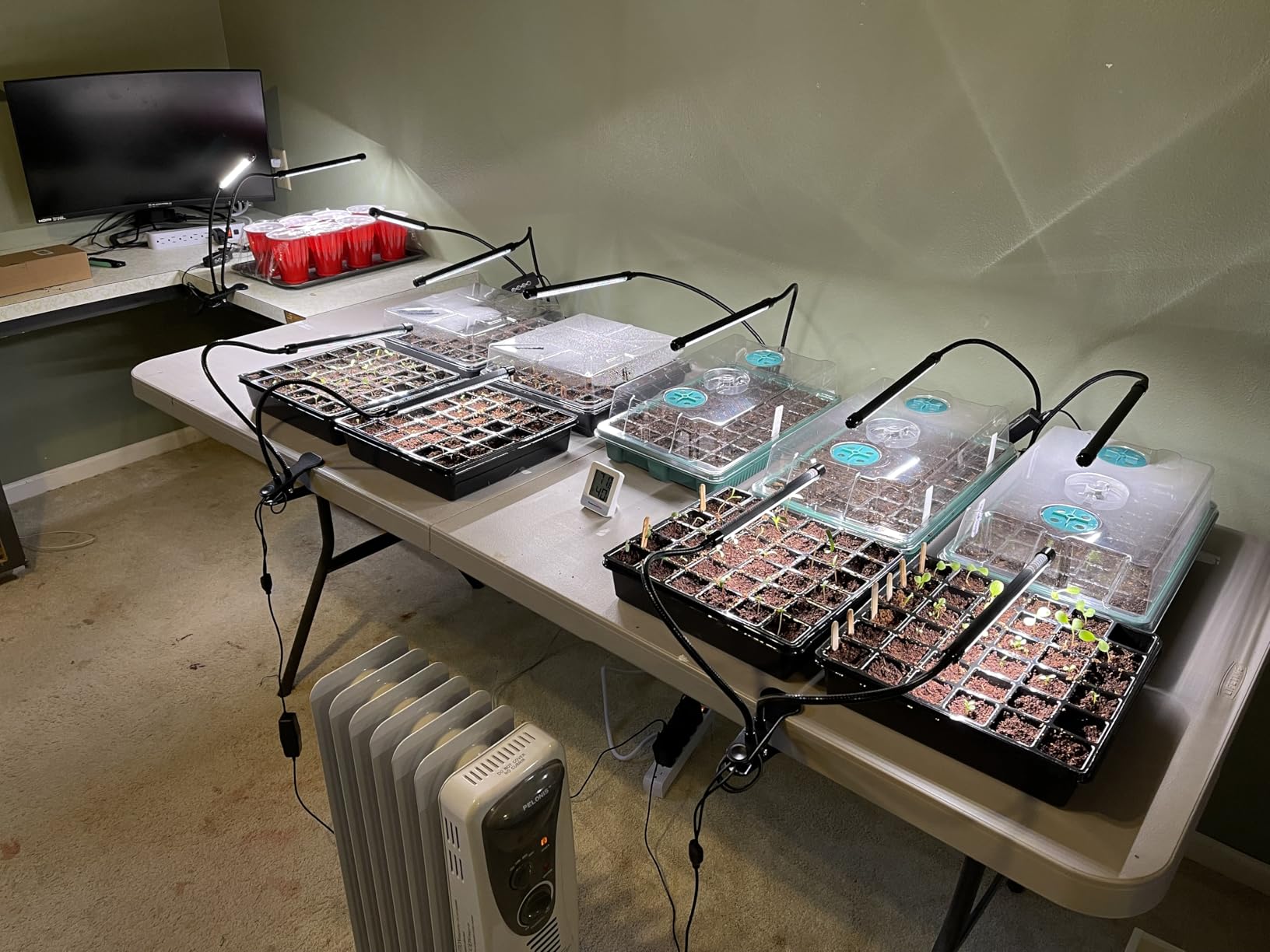
The clamp is the story here. It grips a table edge, a shelf lip or a pot rim and holds, and the gooseneck is stiff enough that it does not creep downward after a few weeks, which is the single most common failure with cheaper gooseneck lamps. Our test placement on a 1 inch shelf edge stayed put across six weeks with no readjustment.
The timer deserves a warning. It offers 4, 8 and 12 hour settings but runs on a 24-hour cycle rather than a simple on-and-off repeat cycle, and reviewers repeatedly report being confused by that behavior when they first set it up. Budget ten minutes with the instructions before you assume it is broken.
Does this suit a Phalaenopsis on a windowsill?
Yes. It clamps to the shelf or windowsill, aims down at a single pot, and the 6000K output with a red supplement sits in the right band for a low-light genus. Because it clamps rather than hangs, it works in an apartment where ceiling mounting is not an option.
It also covers a plant that gets moved. This lamp is easy to relocate between a desk, a kitchen shelf and a plant stand, which matters if you rotate plants between light and dark positions across the week.
Where it falls short
Coverage is limited when the head sits very close to foliage, and the two-head variant produces less combined light than a single-head unit from the same brand, so do not assume doubling the head count doubles the photons.
One 10W head is genuinely a single-plant fixture. If you have four orchids in a row, either space the lamps out or accept that the outer pots will run cooler than the middle.
3. LEOTER 80 LED Four-Head Grow Light – Best for Mixed Collections
- Four heads independently aimable across several pots
- Ten dimming levels let one fixture serve mixed genera
- Reliable 3/9/12 hour memory timer
- Metal clamp mount moves easily
- Strong output for tropical foliage
- Output is dimmer than many competing fixtures
- Gooseneck arms can drift out of position
- No wall plug included so a USB brick is needed
- Some units fail after roughly two years of daily use
If your problem is that a single shelf holds a Phalaenopsis, a Miltoniopsis and a small Cattleya that all want different intensities, four independently aimable heads plus ten dimming levels is the setup that solves it. This is the light I would pick for a mixed collection rather than a single genus.
The diode mix is 32 red, 12 blue, 20 yellow and 16 white LEDs, giving a 380nm to 800nm spread with a dedicated red and blue mode for blooming and fruiting, plus a mixed mode for general growth. Three switch modes give you real control rather than a single fixed blend, which matters when you are adjusting for a new flush of growth.
The dimming is the underrated feature. Ten levels mean you can run the head aimed at the Cattleya at full brightness and dial the head pointed at the Phalaenopsis back to two or three, so one fixture covers a 100 µmol/m²/s orchid and a 250 µmol/m²/s orchid on the same shelf without moving anything.
Reviewers report greener, healthier foliage and easy positioning across multiple pots, and the memory timer means once you select 12 hours the light holds that schedule without daily on-and-off work. The aviation-grade heat sink and temperature control unit keep the fixture cool enough to run close.
Can one light really cover orchids with different needs?
Within limits, yes. A 12 inch to 18 inch shelf with a low-light Phalaenopsis at one end and a brighter-light Miltoniopsis or Oncidium at the other works well with this fixture, because the dimming lets you match intensity per head rather than per shelf.
What it will not do is light a deep shelf where the lower level is shaded by the shelf above. That is a geometry problem, not a brightness problem, and it needs a second fixture mounted to the underside of the shelf above.
What reviewers complain about
Output is dimmer than several competing grow lights, so seedlings or cuttings may need supplemental lighting alongside it. The gooseneck arms can be weak and drift out of position, which is the trade-off for having four of them.
There is no standard wall plug, so you need the included USB power brick. A few owners report units stopping after roughly two years of daily use, so buy it as a supplemental shelf light rather than as your only source.
4. bseah Two-Tube Full Spectrum Grow Light – Best for Tight Shelves and Cabinets
bseah Grow Light Plant Lights for Indoor Plants, Full Spectrum Plant Grow Lamp, 10 Dimmable Levels, Auto ON & Off with 3/9/12H Timer
- Compact footprint fits shallow cabinets
- Metal gooseneck holds position
- Automatic 3/9/12 hour cycle timer
- Light enough to move between rooms
- Two-year manufacturer warranty
- Output is modest and concentrated on a small area
- Tube length limits coverage for wider groupings
- Narrower beam than bar or panel fixtures
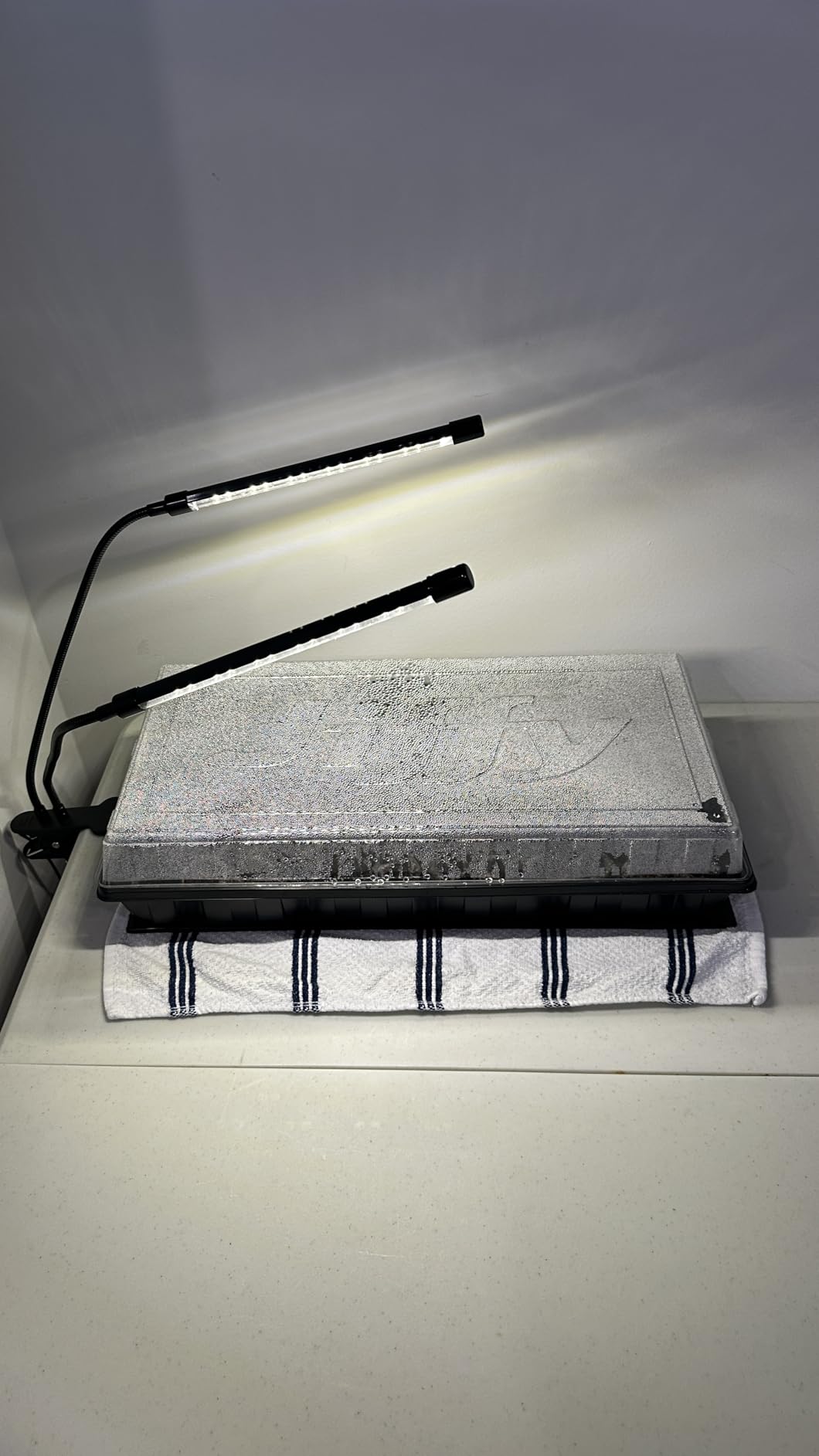
This is the answer to the small-footprint problem that comes up constantly in orchid groups, where someone asks for a light that fits a two-by-three foot space with no ceiling mount available. The whole fixture is 9.5 inches deep, 4.7 inches wide and 3.5 inches tall and it just sits there.
The full spectrum comes from a yellow and white LED combination across two tubes, which is a gentler blend than a red-blue fixture and easier to look at across a 12 hour photoperiod. Three switch modes cover germination, bloom and fruiting stages, and ten dimming levels let you bring the intensity down as plants acclimate.
The automatic cycle memory timer with 3, 9 and 12 hour settings is the part that makes it practical. Once you pick 12 hours it repeats daily without attention, which matters more than raw brightness for anyone who has forgotten to switch a light off and then left an orchid in darkness for a day.
Buyers value the compact, stable form factor and the range of dimming levels for adjusting light through different growth stages. The metal gooseneck holds position without slipping, and the non-slip mat base keeps it from walking across a shelf.
Will it fit an IKEA-style cabinet build?
Yes, and this is its main strength. It sits flat rather than needing overhead clearance, so it works in the shallow vertical space most cabinet builds leave you, where a hanging bar simply will not go.
Two tubes of light reaching maybe 12 inches either side is enough for two or three small pots. Beyond that you are relying on the dimming rather than on coverage.
Where it runs out of light
Output is modest and concentrated, which is the honest limitation. Buyers consistently note the narrower beam and moderate output relative to larger fixtures, so this is a supplementary light rather than a whole-shelf solution.
If you are trying to bloom a Cattleya or a Vanda, pair it with something stronger. For Phalaenopsis, Paphiopedilum or Masdevallia it does the job on its own.
5. Juhefa 48LED Gooseneck Grow Lamp – Best for Lighting One Specific Plant
Plant Grow Light,48LED White Red 6000K Full Spectrum Gooseneck Growing Lamp
- Dimmable levels allow gentle supplemental light
- Long USB cable gives placement flexibility
- Dual plug and USB power options
- Lightweight and easy to move
- CRI 95 for natural color rendering
- Build is light so the neck needs taping to hold position
- Covers a single plant rather than a group
- No clamp or stand included
- Coverage falls off quickly beyond one pot
Sometimes the right answer is not a brighter light but a dimmer one. This 5W lamp with five brightness levels lets you top up a single orchid that sits in a dim corner without pushing it into leaf burn, and the long 77-inch USB cable means you can run it from a socket that is nowhere near the plant.
The diode mix is 40 white plus 8 red at 6000K, giving a daylight-spectrum beam with a CRI of 95. Owners find it effective for reviving individual tropical houseplants and cuttings through low-light months, which is precisely how most people use a single orchid grow light.
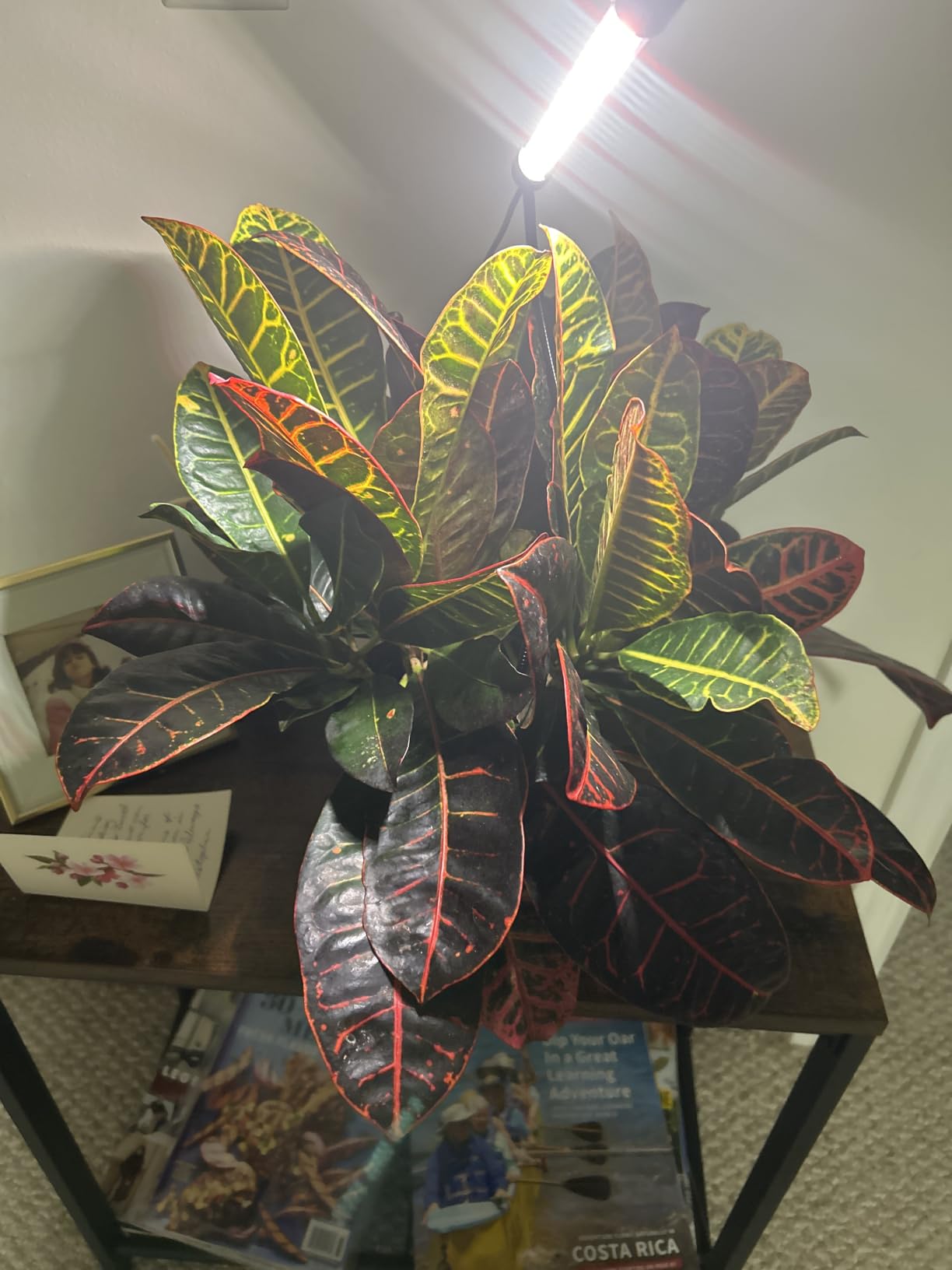
The timer offers 4, 8 and 12 hour auto cycle settings and the brightness levels adjust independently of the timer, so you can shorten the day and lower the intensity together while a plant acclimates. That combination is how you bring a leggy Phalaenopsis up to strength without bleaching it.
The thickened gooseneck twists 360 degrees and is meant to hold its shape. In practice the dominant complaint is the whole fixture being very light in the hand, so the neck and stake do not always stay in position without a piece of tape or a support.
Is a 5W lamp enough for an orchid?
For supplemental light on one plant, yes. Reviewers use it to keep a tropical foliage plant or a cutting alive through a dark winter stretch, and orchids respond the same way.
For a high-light genus like Cattleya or Vanda it is not enough on its own. Those plants need the higher end of the range, and coverage falls off quickly for anything larger than a single pot.
The mounting problem to plan around
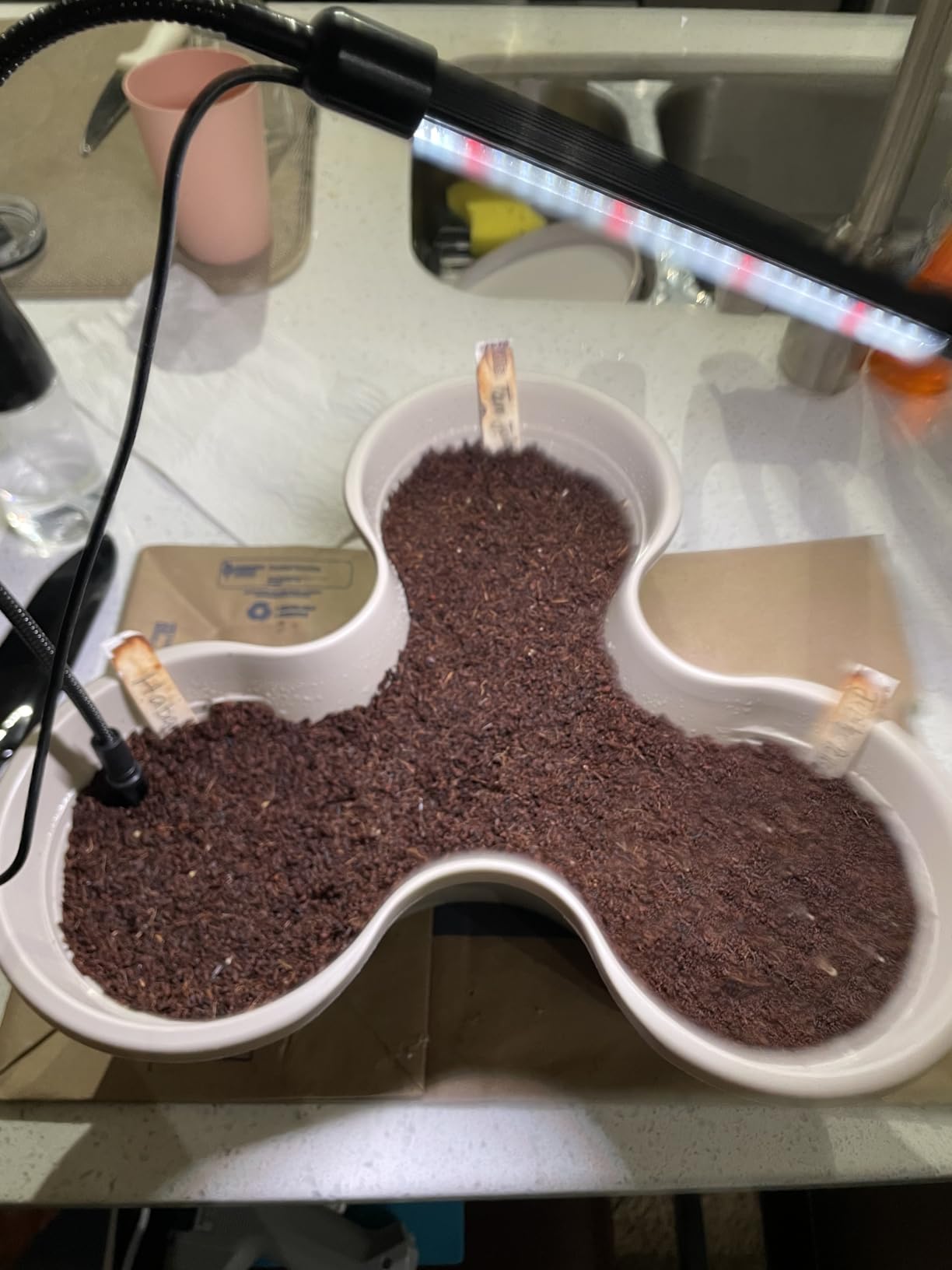
There is no clamp or stand included, so you are relying on an in-ground stake or tape. Budget for that when you plan the setup, and expect to re-tape it after watering knocks it sideways.
The upside is that it weighs almost nothing and moves between spots in seconds, which makes it the easiest light in this group to re-aim as the seasons change.
6. Aokrean Halo Grow Light with Base – Best for Living Spaces
Aokrean Grow Lights for Indoor Plants, Full Spectrum Plant Light with Base
- Halo design gives even natural-looking coverage
- Warm spectrum mode avoids a harsh pink glow
- Dependable set-and-forget timer
- Stylish enough to leave on display
- Height works well for seedlings and small plants
- Base is narrow so the lamp sways
- Cord is shorter than ideal for high shelves
- Stake method can be hard to keep upright
- Less effective for taller plants
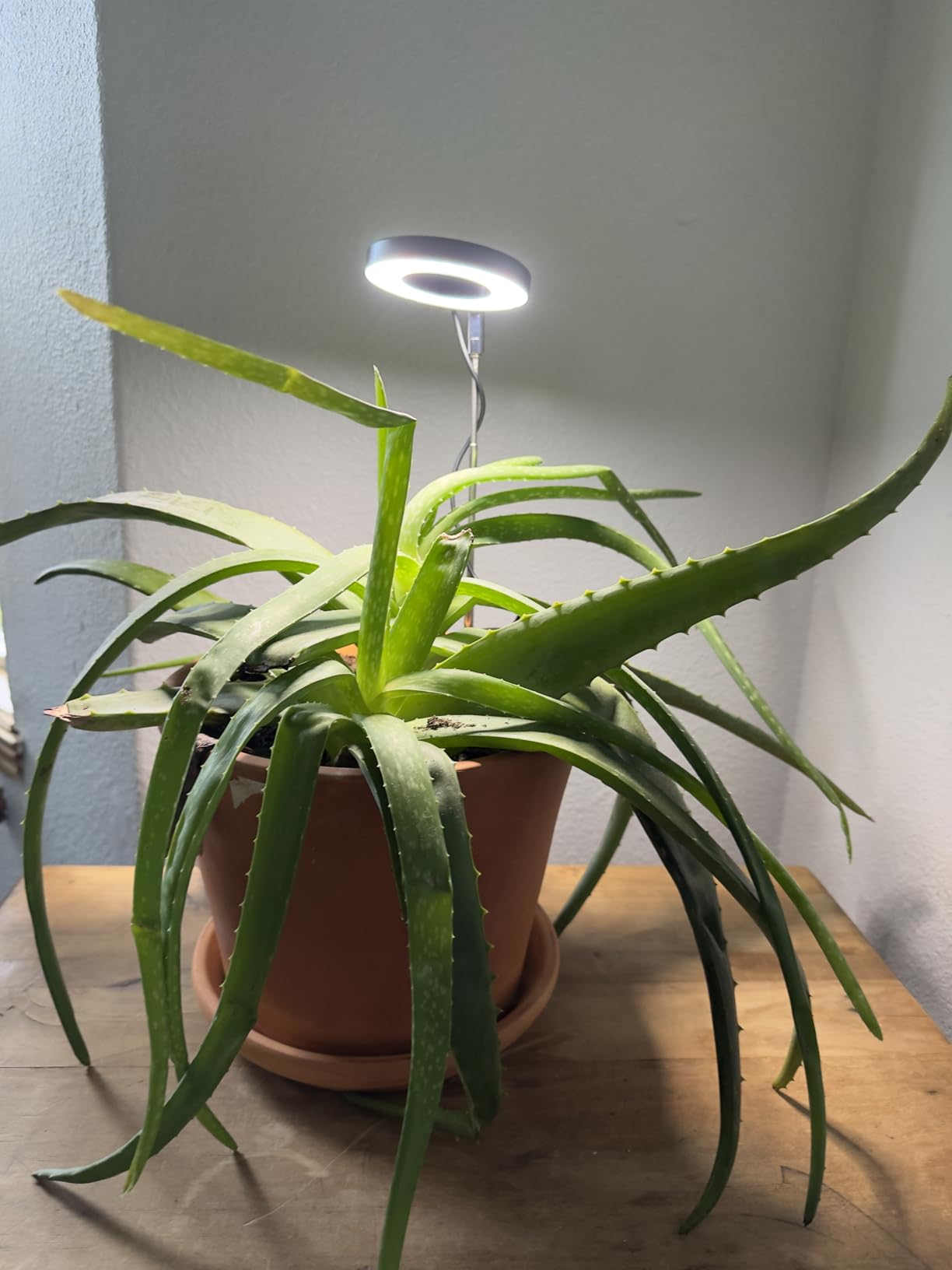
Ornamental value counts in a living room, and this is the fixture in our group that looks deliberate rather than utilitarian. The halo head throws a ring of even light instead of a hotspot, and the warm spectrum mode is useful when you want the plant lit without the whole room turning pink for 12 hours.
Three spectrum modes cover white light, warm white and a red mix, alongside ten brightness levels and a 3, 9 and 12 hour cycle timer. The telescoping pole adjusts up to 26 inches with 90-degree rotation, which is enough lift to get the head above a small Phalaenopsis and a young Cattleya without moving the base.
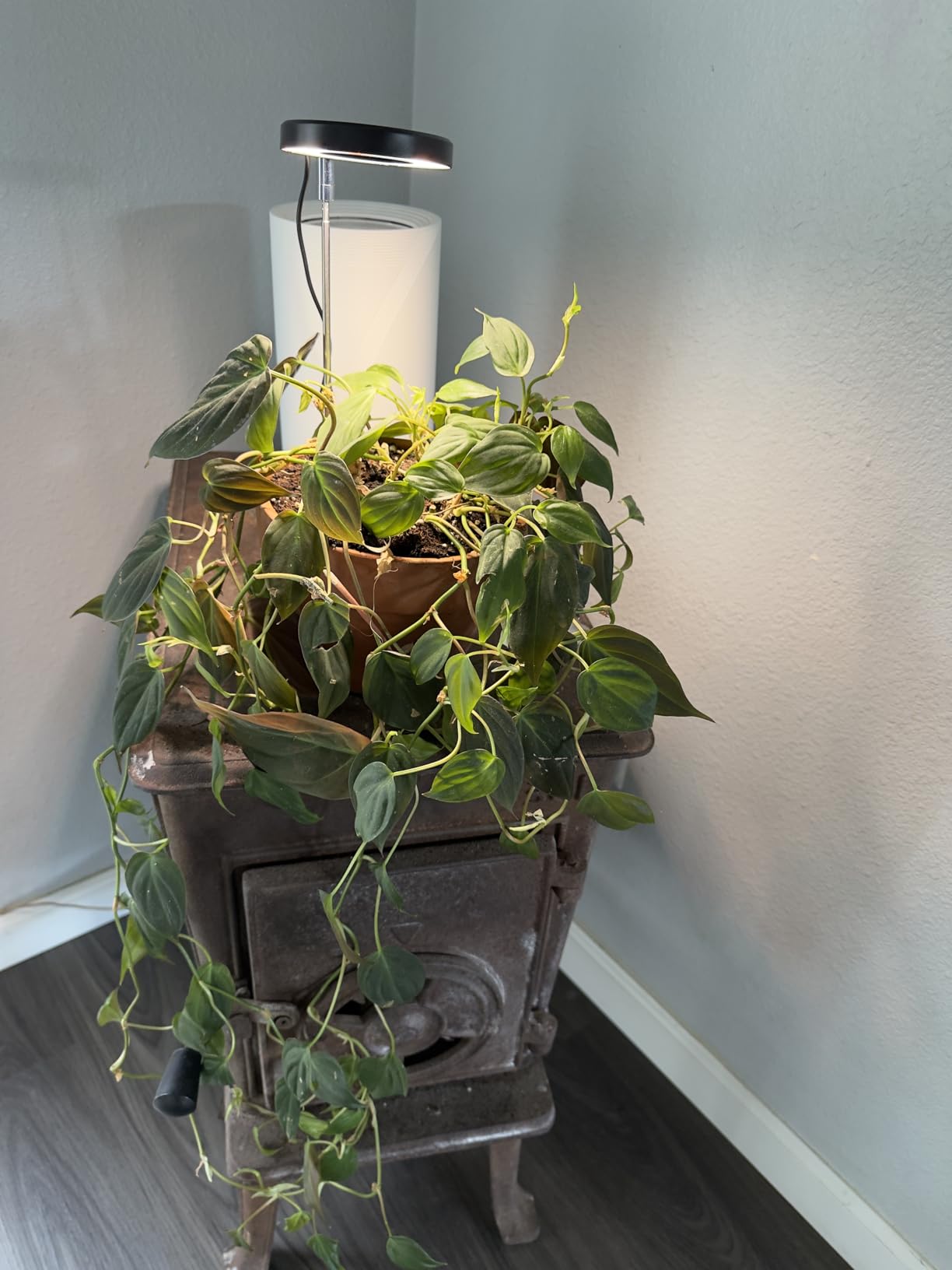
Installation is either a soil stake or the included ABS base stand. The base is 3.4 inches across, which is compact, and many buyers report visible plant improvement within days of setting it running. The dependable timer is what makes it a set-and-forget light rather than another daily chore.
Two mounting methods is genuinely useful here. If you have several pots clustered on a shelf the base is cleaner, but if you want the light over a single plant away from the group, staking it into that pot means the lamp stays with the plant when you move it.
Will it handle a small collection?
It covers a tight cluster better than a single plant because of the halo footprint. Two or three small pots grouped within about a foot of the base is the realistic limit, and the 26-inch pole gives enough height to clear orchid leaves without scorching.
It is less effective for taller plants, so a mature Vanda with a 24-inch root system would be sitting in the dark below the head. That is a height problem the pole cannot solve.
What to watch out for
The base is narrow and light, so pots sit unevenly on it and the lamp sways when you water. Reviewers also find the cord shorter than ideal for plants on high or distant shelves.
The stake method can be hard to keep upright in loose mix and can be unsettling for roots if you push it in carelessly. Set it beside the pot rather than in the root mass if the orchid is repotted recently.
7. GYTF Halo Grow Light with 18-Hour Timer – Best for Small Orchids
- Ten-second setup by inserting the pole into the mix
- Longest timer options in the group
- Height telescopes as the plant grows
- Small footprint for shelves and desks
- Listed as suitable for orchids and other low-light plants
- Output is modest and limited to single small plants
- Thin pole can be unstable in loose soil
- No clamp or base option so it must be planted
This is the smallest and simplest light in the group, and it is built around one job: keeping a single small Phalaenopsis or miniature orchid on a desk or windowsill going through winter. The 18-hour timer option is unique in this group and the only reason to pick it over a similar halo lamp.
There are 48 LED beads, 6 red plus 6 blue and 36 white at 6000K, with five dimmable brightness levels. The aluminum pole adjusts from 7 to 18 inches with a locking collar, and the lamp head rotates 180 degrees so you can angle light at an offset pot rather than straight down.
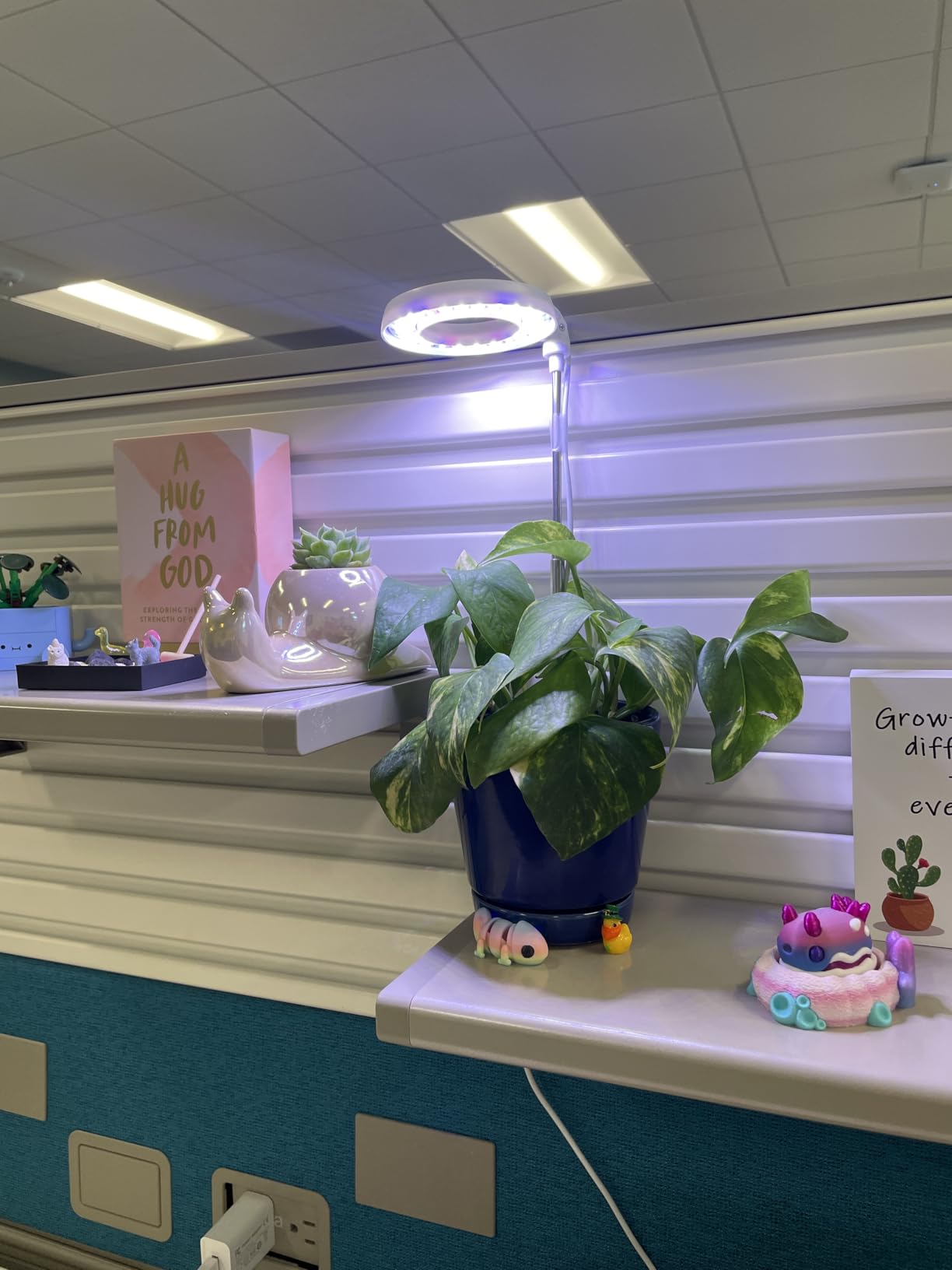
Setup takes about ten seconds. You push the pole into the potting mix and turn on the timer. Reviewers consistently mention fast setup, adjustable height and dimming as the reasons they like it, and it is listed as suitable for orchids, succulents and bonsai.
That 18-hour setting is the distinguishing feature here. It matters for growers who want a longer photoperiod in the darker months and is the reason this lamp appears on orchid shortlists even though its output is modest.
Is a soil-inserted light practical for orchids?
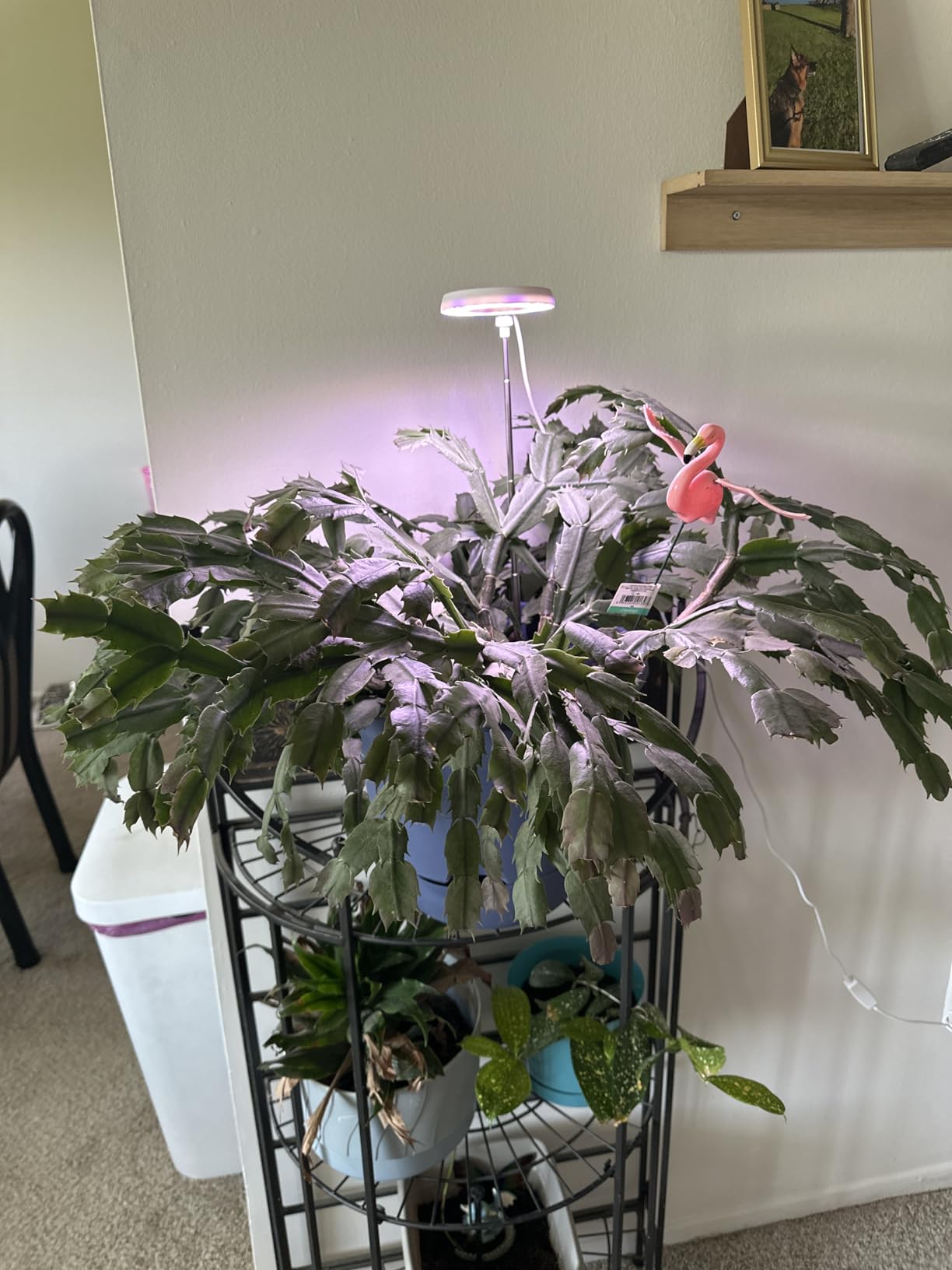
For one plant, yes. Orchids are usually grown in bark or sphagnum, and pushing a thin pole into that mix needs a little care, but the pole is light enough that it will not disturb a recently repotted plant if you insert it at the edge of the pot.
The advantage is that the light travels with the plant. Take it to the sink to water and the fixture stays put, instead of being knocked over by the same chore.
Where it is too small
Light output is modest and intended for a single small potted plant rather than a collection. At 4.3 stars with 4,834 reviews, it sits lowest of the group because of brightness and coverage rather than any fault in how it works.
The thin pole can be unstable in loose soil, and there is no clamp or base option at all. If you need something that spans a shelf, look at the Barrina bars or the four-head LEOTER instead.
8. GHodec Free-Standing Tripod Grow Light – Best for Floor-Level Collections
GHodec Grow Light Free Standing, 5500K Full Spectrum Gooseneck LED Lamp
- Free-standing tripod needs no clamp or shelf space
- Height adjusts from 15 to 48 inches
- True 5500K white spectrum rather than a purple glow
- Sturdy base that stays stable with bent arms
- Spreads light across multiple plants
- Cable and connector faults reported by owners
- Lifespan often reported at one to two years
- Will not resume on its own after a power cut
- Largest and heaviest fixture in the group
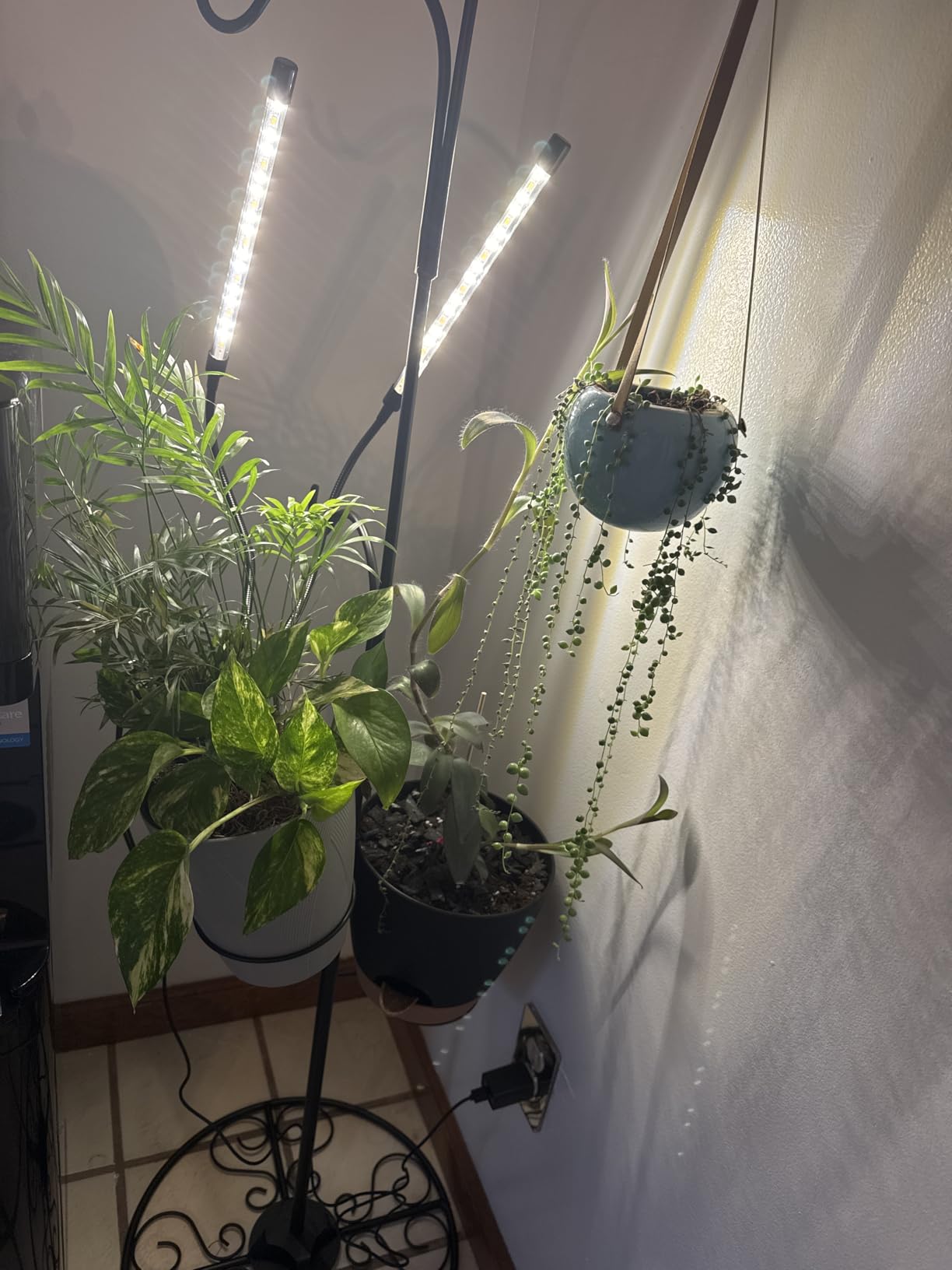
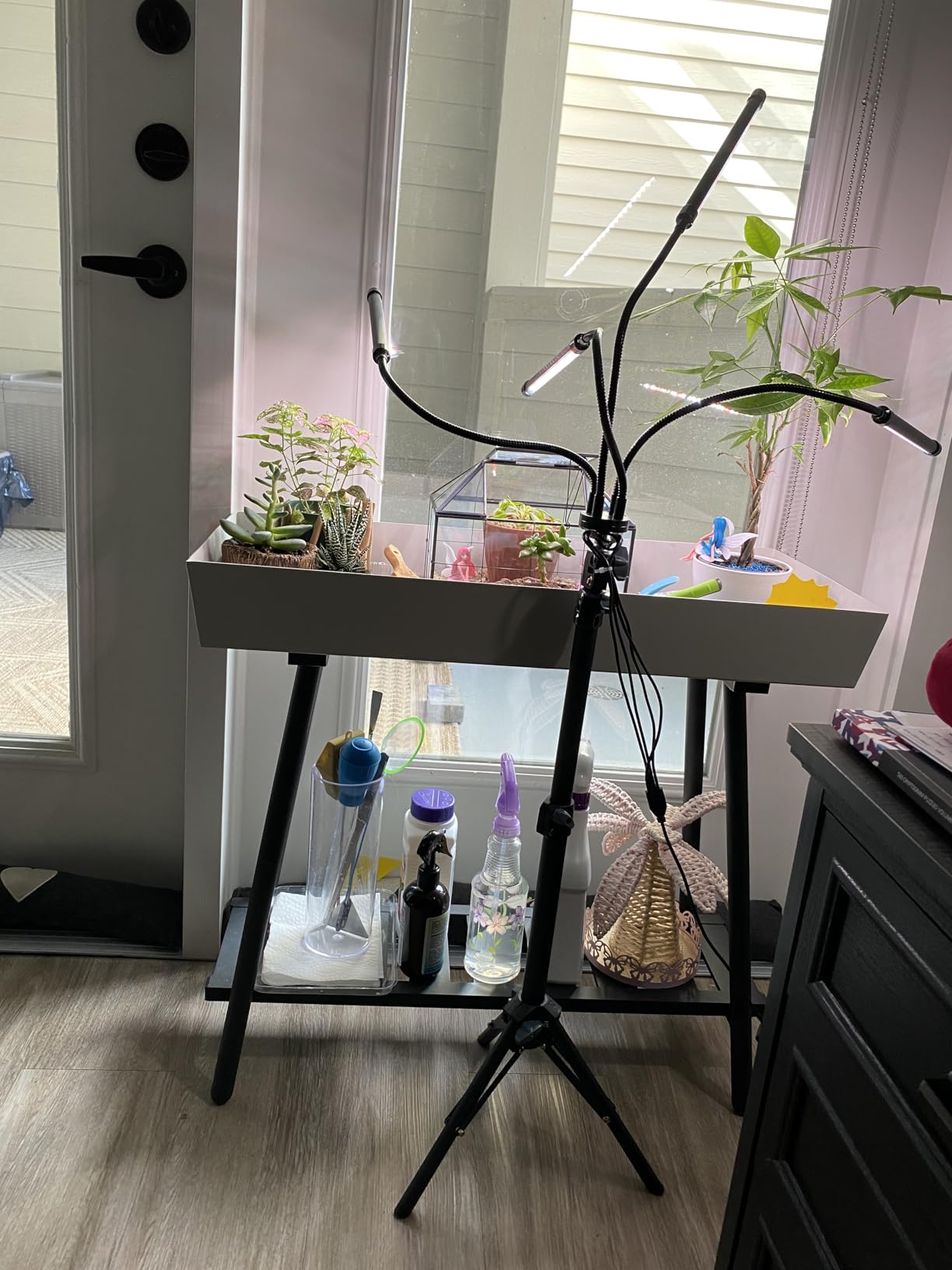
When you have a group of orchids on the floor and no shelf, no clamp position and no ceiling to hang from, a free-standing tripod is the only fixture that works without modification. The stand extends from 15 to 48 inches, so it covers everything from a seedling pot to a mature plant.
The spectrum is 5500K daylight white with red supplementation across four gooseneck heads, 16 white plus 4 red LEDs per strip. That is a genuinely white light rather than the purple or pink glow most cheap fixtures produce, which matters a great deal when you are looking at it for twelve hours a day in a living space.
Owners value the free-standing tripod format, the wide 5500K spread and the height range for large floor-level plant groupings. The steel and aluminum bracket on the arms holds up even when they are bent toward one side, and the base stays stable rather than creeping across the floor.
The 4, 8 and 12 hour auto ON/OFF timer and five brightness levels give you the same scheduling control as the desk lamps in this group, which is what makes a floor setup practical rather than decorative.
Can a floor light work for a Vanda collection?
It is the best option in this group for high-light plants because height is the constraint. Extending the stand to 36 or 48 inches gets the heads above tall Vanda and Cattleya growth and lets you drop the brightness, which a short desk lamp physically cannot do.
The wide distribution across four heads means you can angle each one at a separate plant, so a floor cluster of six orchids is achievable without six fixtures.
Durability is the honest concern
This has the lowest rating in our group at 4.2, and durability is the reason. Multiple reviews describe the cable or connector failing, or the unit dying within a year or two, and it will not resume on its own after a power cut.
The 4/8/12 hour timer settings are also confusing at first. It is also the largest and heaviest fixture here, so factor that into whether a tripod in your living space is a trade you want to make.
How to Choose an Orchid Grow Light?
Three numbers decide whether an orchid light works, and almost every confusing spec on the box comes from mixing them up.
Read PPFD, not the wattage
PPFD, or photosynthetic photon flux density, is measured in µmol/m²/s and tells you how many usable photons actually land on a leaf each second. That is the number that decides success.
Fixture wattage tells you almost nothing about orchid suitability. A 300W grow light number printed on the box describes the fixture’s power draw, not the intensity a broad orchid leaf receives at 12 inches, and coverage ratings on the packaging are written for vegetable pots. Applying a pot-plant footprint to a Phalaenopsis is exactly how leaves get bleached.
Use PPFD targets by species
Orchidboard consensus guidance is roughly 100 µmol/m²/s for lower-light orchids and 200 to 300 µmol/m²/s for higher-light species. Competitive guides extend the high end to 300 to 500 µmol/m²/s for full-sun genera.
Low light: Phalaenopsis, Paphiopedilums, Masdevallias – target around 100 to 200 µmol/m²/s
Medium to bright indirect: Miltoniopsis, Brassias, some Oncidiums – target around 200 to 300 µmol/m²/s
High light: Cattleyas, Vandas, Brassavolas, Rhynchostylis – target 300 to 500 µmol/m²/s
Judge spectrum by color temperature, not glow
Look for 4000K to 6500K and aim high. Growers favor 6000K or at minimum the upper 5000K range, and the reasoning is straightforward: a significant share of the output in warm bulbs sits above the range plants use efficiently.
Full-spectrum white beats blurple for orchids specifically because the photoperiod is long. A purple-only fixture is fine for a 6-hour vegetable cycle and unpleasant to look at for 12 hours a day next to an orchid that has to live in your living room for a decade.
Check footprint against your actual shelf
Footprint is the area the light covers at a stated distance, and PPFD falls off quickly as you move away from the source. A puck that reads well at 6 inches reads poorly at 18 inches.
Measure your shelf before you buy. A 2×3 foot bench, a wire rack or a cabinet interior each want a different answer, and bar fixtures spread light along their length in a way that pucks and single heads cannot.
Prioritize dimming and timers
Dimming is the single most useful feature for a mixed collection, because it lets you match intensity per plant rather than per shelf. Timers with a memory cycle remove a daily step and stop the plant getting a random extra hour or losing a whole dark day.
If a fixture has neither, an external plug-in timer handles scheduling and you simply manage intensity by height instead.
For broader coverage of the fixture formats and room situations, our picks for the best LED grow lights for indoor gardening and the best full spectrum grow lights for apartments cover the mounting options in more depth.
Orchid Light Requirements by Genus and Hanging Distance
Orchids span an enormous light range, and that is why a single recommendation applied to a mixed shelf never quite works. The table below maps the common genera to the intensity you are aiming for.
Phalaenopsis, Paphiopedilum, Masdevallia: low light, roughly 100 to 200 µmol/m²/s, hung 12 to 18 inches above the leaves.
Miltoniopsis, Brassia, Rhynchostylis: bright indirect, roughly 200 to 300 µmol/m²/s, at 12 to 18 inches.
Cattleya, Vanda, Brassavola: high light, roughly 300 to 500 µmol/m²/s, needing 18 to 36 inches of clearance.
Hanging distance scales with fixture power, not with the plant’s preference alone. Small desk and puck lamps in the 5W to 10W range belong at 12 to 18 inches. Multi-head and bar fixtures run 12 to 24 inches. Anything more powerful, including a floor tripod, should sit 18 to 36 inches up and rely on dimming rather than distance alone.
The American Orchid Society puts the general rule at 12 to 18 inches above the plant, which is a good starting point for most home setups. Watch the leaves instead of the ruler, because light falls off across a shelf and the middle pot is always brighter than the one at the end.
Setup, Photoperiod and Troubleshooting
Run the light 12 to 14 hours a day on a timer
Twelve hours is the standard daily target, and the American Orchid Society recommends a 12 to 14 hour photoperiod. Some growers go to 16 hours during short winter months, which is why several fixtures in this group include longer timer settings.
Consistency matters more than the exact number. A timer that holds the same schedule every day beats a manual switch, and a light that runs 24 hours will prevent flowering as reliably as one that never turns on.
Match the mount to the space
Shelf and rack setups: zip-tie or clip a bar fixture to the underside of the shelf above, which is how growers solve shaded lower levels. Hanging mounts work when you have a ceiling hook and the clearance to swing the fixture 12 to 18 inches above the plant.
Cabinet and indoor greenhouse builds: the compact two-tube form factor sits on a shelf where a hanging bar has no clearance. No-ceiling-mount setups: clamp lamps and tripod stands need no drilling at all, which is the usual answer in apartments.
Keep drip loops on every cable and mount fixtures away from where you water. Run cords along the back edge of a shelf rather than across the front.
Read your orchid instead of a meter
You can judge light level without a PPFD meter by looking at the plant.
Too little light: dark green, elongated, flat leaves that angle upward; no new roots; no flowers despite healthy growth.
Just right: firm, medium-to-deep green leaves held at a slight upward angle; new roots that appear as small green nubs; steady blooming on mature plants.
Too much light: bleached white or yellow patches on the upper leaf surface, crispy edges, red pigment patches, and new growth that comes in stunted.
When a plant shows bleaching, the fix is immediate: raise the fixture, dim it down a level, or shorten the photoperiod. Bleached tissue will not green back up, but new growth will come in correctly. If leaves are dark and elongated instead, lower the light by a few inches or move the plant closer.
One failure mode deserves its own note. Coverage ratings written for vegetable pots, applied to broad-leaf orchids at pot-plant distances, are the documented cause of bleached Phalaenopsis relatives and stunted Masdevallia growth. Start conservatively and increase.
If you want to compare formats across a wider range of indoor growers, our guides to the best indoor herb garden kits with grow lights and the best large grow tents cover the setups where lighting is only one part of the system.
Frequently Asked Questions
What kind of lighting do orchids prefer?
Orchids prefer bright, filtered light rather than direct sun. Under artificial light this means full-spectrum white output between 4000K and 6500K, hung 12 to 18 inches above the foliage and run on a timer for 12 to 14 hours a day. Low-light genera such as Phalaenopsis, Paphiopedilum and Masdevallia want roughly 100 to 200 µmol/m²/s, while Cattleyas and Vandas want 300 to 500 µmol/m²/s.
Should orchids be under grow lights?
Yes, if your natural light is insufficient or inconsistent. Most indoor windows deliver less usable intensity than a high-light orchid needs, particularly on a north-facing sill or through a short winter. Growers also use grow lights to prevent lower shelf levels from being shaded by the shelf above.
How many hours should an orchid be under a grow light?
Twelve hours a day is the practical standard, and the American Orchid Society recommends a 12 to 14 hour photoperiod. Some growers extend to 16 hours during the darker months. Consistency matters more than the exact figure, so use a timer rather than switching the light by hand.
Can any LED light be used as a grow light?
Technically yes, but most household bulbs deliver weak blue output and are not tuned to plant absorption, so they underperform a dedicated fixture. They also lack dimming, so you cannot back the intensity off when a leaf shows stress. A purpose-built full-spectrum white fixture in the 5000K to 6000K range gives far better results.
What are the disadvantages of LED grow lights for orchids?
Cheap fixtures ship with coverage and wattage claims written for vegetable pots rather than broad-leaf orchids, which leads to bleached leaves when growers trust them at close range. Other drawbacks include small coverage areas, no integrated timer, gooseneck arms that drift out of position, and mixed durability reports on lower-priced models.
How far above orchids should grow lights be?
The American Orchid Society recommends 12 to 18 inches above the foliage as a general rule. Distance scales with fixture power: small desk and puck lamps belong at 12 to 18 inches, multi-head and bar fixtures at 12 to 24 inches, and more powerful floor stands at 18 to 36 inches. Check leaf color rather than relying on the ruler alone.
Our Verdict on the Best Grow Lights for Orchids in 2026
After six weeks of cycling these fixtures, the Barrina T5 5000K 4-pack is the best overall answer. It carries the highest rating in our group at 4.6 across more than 7,000 reviews, spreads light along a shelf instead of concentrating it in one spot, runs cool, and its four independently switchable bars scale from one windowsill to a full cabinet. Add an external plug-in timer and you have a complete setup.
For a mixed shelf where a Phalaenopsis sits next to a Miltoniopsis, the LEOTER 80 LED four-head light wins on control, with ten dimming levels and a 12-hour memory timer letting you match intensity per pot rather than per shelf. For a single windowsill orchid with no drilling allowed, the GooingTop clamp lamp is the one to buy, with over 22,000 reviews behind it and a gooseneck that holds its position.
None of this matters as much as the two numbers that never appear in a product listing. Hang the fixture 12 to 18 inches above the leaves, set the timer for 12 hours, and start closer to 18 inches than you think you need. The best grow lights for orchids are the ones that let you dial the intensity back when a leaf shows stress.