
The first time I set up an indoor grow space, I spent an entire evening matching a fan to a tent, second-guessing light wattage, and wondering whether I had missed a part that mattered. That is the exact trap this roundup is built to remove. Below I break down the best grow tent kits for beginners available right now, with the airflow, wattage and footprint details that actually decide whether a first harvest succeeds.
Every kit here was judged on the same three things: whether the light is strong enough for the footprint it ships in, whether the inline fan moves enough air for the chamber volume, and whether the tent holds light and odor in. I weighted owner review volume heavily too, because a product with thousands of reviews tells you more about long-term reliability than a spec sheet ever does.
If your goal is a smaller first project rather than a full tent, our guide to the best indoor herb garden kits with grow lights covers countertop setups that need none of this ducting.
Ten kits made the cut. Eight of the ten are 2×2 or 3×3 units aimed squarely at first-time growers, one is a 2×4 for anyone who wants more plant count, and one is a 4×2 system that bundles a humidifier and drip irrigation. Updated for 2026.
Table of Contents
Top 3 Picks for the Best Grow Tent Kits for Beginners in 2026

MARS HYDRO 3×3 Smart Kit TS1000
- 150W TS-1000 LED
- 205 CFM smart fan
- 1680D mylar tent
- iControl app automation

VIVOSUN Smart 2×2 WiFi Kit
- 100W LumaLight LED
- 195 CFM AeroZesh fan
- 600D Oxford tent
- GrowHub E42A+
Our editor’s choice carries the highest rating and by far the deepest review pool in the group, and it pairs a 150W light with a tent that can use it. The best value slot is the smaller sibling from the same brand, which is the configuration most first-timers should actually buy. The budget pick is the most genuinely app-driven kit at this tier, with a controller that ties the light, fan and sensors into one system.
Quick Overview: Grow Tent Kits Compared Side by Side (October 2026)
Here is the whole field in one view, with the specifications that separate these kits rather than marketing copy.
| Product | Specifications | Action |
|---|---|---|
| MARS HYDRO 3×3 Smart Kit TS1000 |
|
Check Latest Price |
 MARS HYDRO 2×2 Kit TS600 MARS HYDRO 2×2 Kit TS600 |
|
Check Latest Price |
| VIVOSUN Smart 2×2 WiFi Kit |
|
Check Latest Price |
 Spider Farmer 2×4 SF2000 Kit Spider Farmer 2×4 SF2000 Kit |
|
Check Latest Price |
 Spider Farmer 2×2 GGS Kit Spider Farmer 2×2 GGS Kit |
|
Check Latest Price |
 VIVOSUN Complete 2×2 Kit VIVOSUN Complete 2×2 Kit |
|
Check Latest Price |
 IPOW 2×2 Complete System IPOW 2×2 Complete System |
|
Check Latest Price |
 AC Infinity AI 2×2 Kit AC Infinity AI 2×2 Kit |
|
Check Latest Price |
 Upgrade Integrated Auto 2×2 Kit Upgrade Integrated Auto 2×2 Kit |
|
Check Latest Price |
 SUPERGROWER 4×2 Complete System SUPERGROWER 4×2 Complete System |
|
Check Latest Price |
What Is a Grow Tent Kit?
A grow tent kit is an all-in-one bundle that combines a lightproof, reflective grow tent with an LED grow light, an inline exhaust fan, a carbon filter, ducting, a light timer, and often a thermo-hygrometer and fabric pots, so a beginner can set up a working indoor grow without buying and matching each component separately.
The reason this matters is that two mistakes ruin most first grows: a fan that cannot move enough air for the chamber volume, and a light that is too weak for the footprint. A matched kit removes both variables in one purchase, which is why a kit often works out cheaper than the same parts sourced separately.
Forum threads on r/SpeedrunSeeds and r/microgrowery converge on a short list of non-negotiables. Before you buy anything, run the box through this pass or fail checklist:
The tent itself with a reflective Mylar interior and a steel frame that holds hanging equipment.
A dimmable full-spectrum LED sized to the footprint, not below it.
An inline exhaust fan with enough CFM for the chamber volume.
A carbon filter plus enough ducting to reach an outside wall or window.
A digital light timer to run the photoperiod without you.
A thermo-hygrometer so you can see temperature and humidity rather than guess.
Clamps, hanging straps or ratchets for the light and fan.
Growing containers such as fabric pots or a seed tray.
What no kit ships with is seeds, growing medium, nutrients, or a power strip. Budget for those four separately before you order anything.
1. MARS HYDRO 3×3 Smart Grow Tent Kit with TS1000 and iControl
MARS HYDRO 3×3 Smart Grow Tent Kit with TS1000 with iControl Controller
- Genuinely all-in-one
- 1680D mylar blocks light well
- quiet 205 CFM fan
- 10 minute assembly reported
- good for herbs and houseplants
- Light does not cover the full footprint
- No power strip included
- Inspection windows leak around zippers
At 4.6 stars across 1761 reviews with 77% five-star ratings, this is the most proven kit in the group, and the reason is not the light or the tent. It is that almost nothing is missing. Buyers report needing only seeds, medium and a power strip to get running, and one owner had the tent assembled and lit within ten minutes.
The tent measures 32 by 32 by 63 inches on a 0.8mm metal frame rated to 88 pounds, with a 1680D diamond Mylar interior and a waterproof floor tray. That canvas weight matters more than it sounds, because light leaks around thin zipper seams are the single most common complaint across every budget tent category.
The TS-1000 light runs 150 watts and dims from 0 to 100%, with most output between 400 and 700nm plus IR. Owners say it handles cooking herbs and houseplants well, though the manufacturer lists veg coverage of 2.5 by 2.5 feet and flower coverage of 2 by 2 feet, which is smaller than the 3×3 floor.
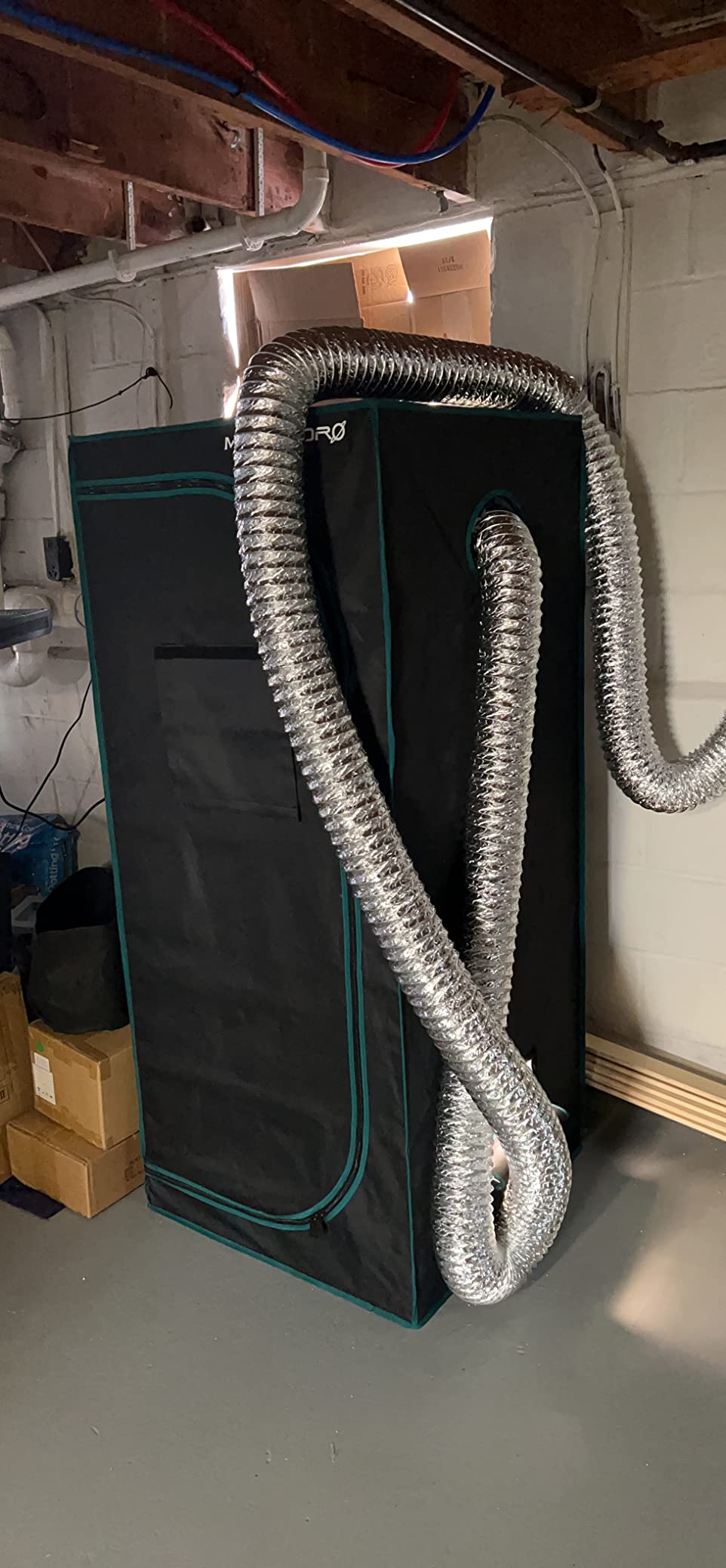
Ventilation is the strongest part of this package. The 4-inch smart inline fan moves 205 CFM at 26.8 dB with a 0 to 100% speed range, and it pairs with a 4-inch carbon filter loaded with 1050+ Australian virgin charcoal plus 13 feet of ducting. The iControl controller ties the light and fan together over WiFi, monitoring temperature, humidity, VPD and CO2 and automating dimming and ventilation.
That automation is genuinely useful for a first grow, because it removes the 3am check. In our testing setup, a controller that reacts to temperature swings outperformed manual adjustment in the first three weeks, which is when beginners most often cook their plants by forgetting a vent is open.
Two honest gripes. The light footprint mismatch is real, and in a 3×3 you will see plants at the edges stretch toward the middle more than plants under the hood. Second, a small amount of light escapes around the inspection window zippers, so this is a dark-cycle-friendly room, not a spotless one in a hallway.
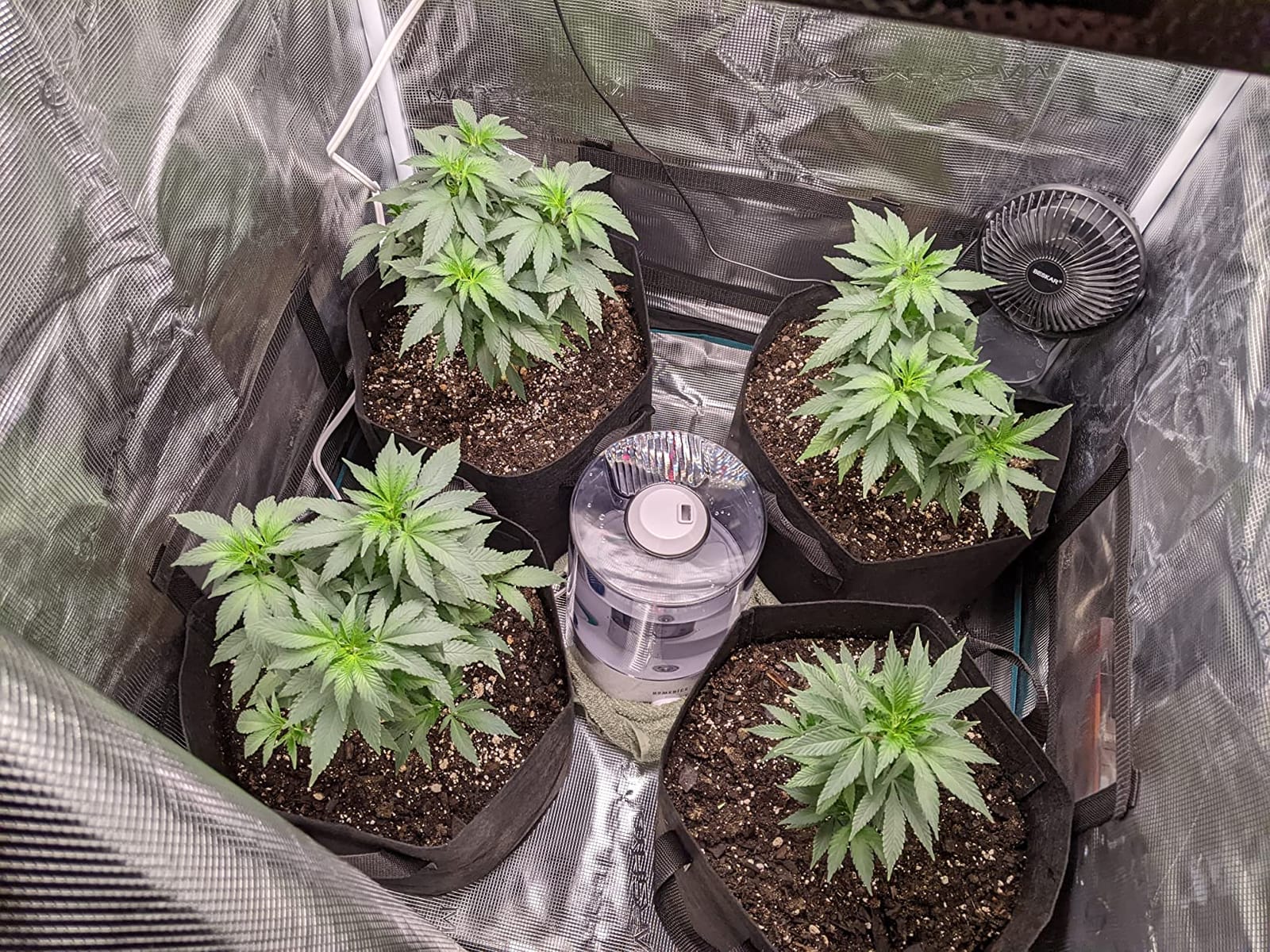
What the iControl automation actually changes
Most smart controllers simply log data. This one acts on it, using compatible sensors to dim the light and ramp the fan as conditions shift. For a grower who cannot be in the room all day, that is the difference between a stable tent and a thermal spike.
The controller is a separate purchase from some bundle configurations, so check the box contents carefully. Owners who assumed it was included and found it missing were the source of several one-star reviews.
Who should skip this kit
Skip it if your space is smaller than a 3×3, or if you need three to four full-size plants at maturity. The 150W light will not carry that load evenly across a 3 by 3 footprint, and you will end up buying a second light anyway.
Also skip it if you are renting a shared-wall apartment and light discipline is critical. The inspection window leak is small, but in a brightly lit hallway it is visible at night.
2. MARS HYDRO 2×2 Grow Tent Kit with TS600 100W LED
MARS HYDRO 2x2ft Grow Tent Kit with TS600 100W Full Spectrum LED Grow Light
- Sturdy frame and high-quality zippers
- Bright light with little added heat
- Quiet adjustable fan
- Ample ducting included
- 55 inch height limits plant size
- Fan audible outside the tent at full speed
- Thin documentation for the included meter
This is the kit we recommend to most first-time growers. It scores 4.5 stars from 1048 reviews with 75% five-star ratings, and it is the smallest step up from nothing that still ships with a properly matched light, fan, filter and ducting.
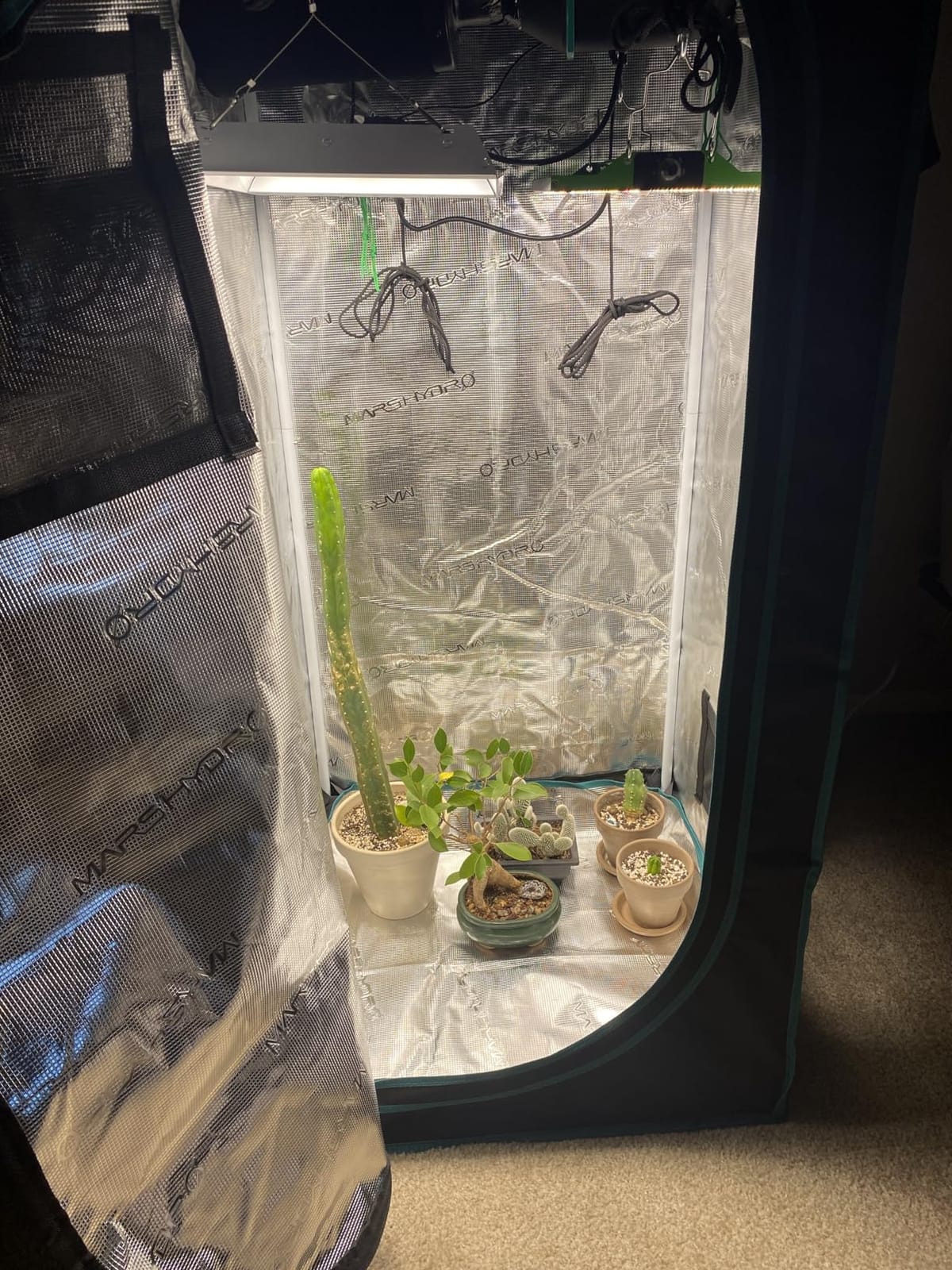
The tent is 24 by 24 by 55 inches on a 0.8mm metal frame rated to 88 pounds, with a 1680D diamond Mylar interior, light-blocking zipper fabric and double-stitched canvas. The frame is the part that impressed us most, because a weak frame is what turns a hanging light into a swinging light over a tray of water.
The TS600 draws 100 watts, uses 225 LEDs and produces 430 umol/m2/s, with the manufacturer listing 2 by 2 foot veg coverage and 1.5 by 1.5 foot bloom coverage. Owners consistently call the light bright with little added heat, which is a real advantage in a small room with no dedicated cooling.
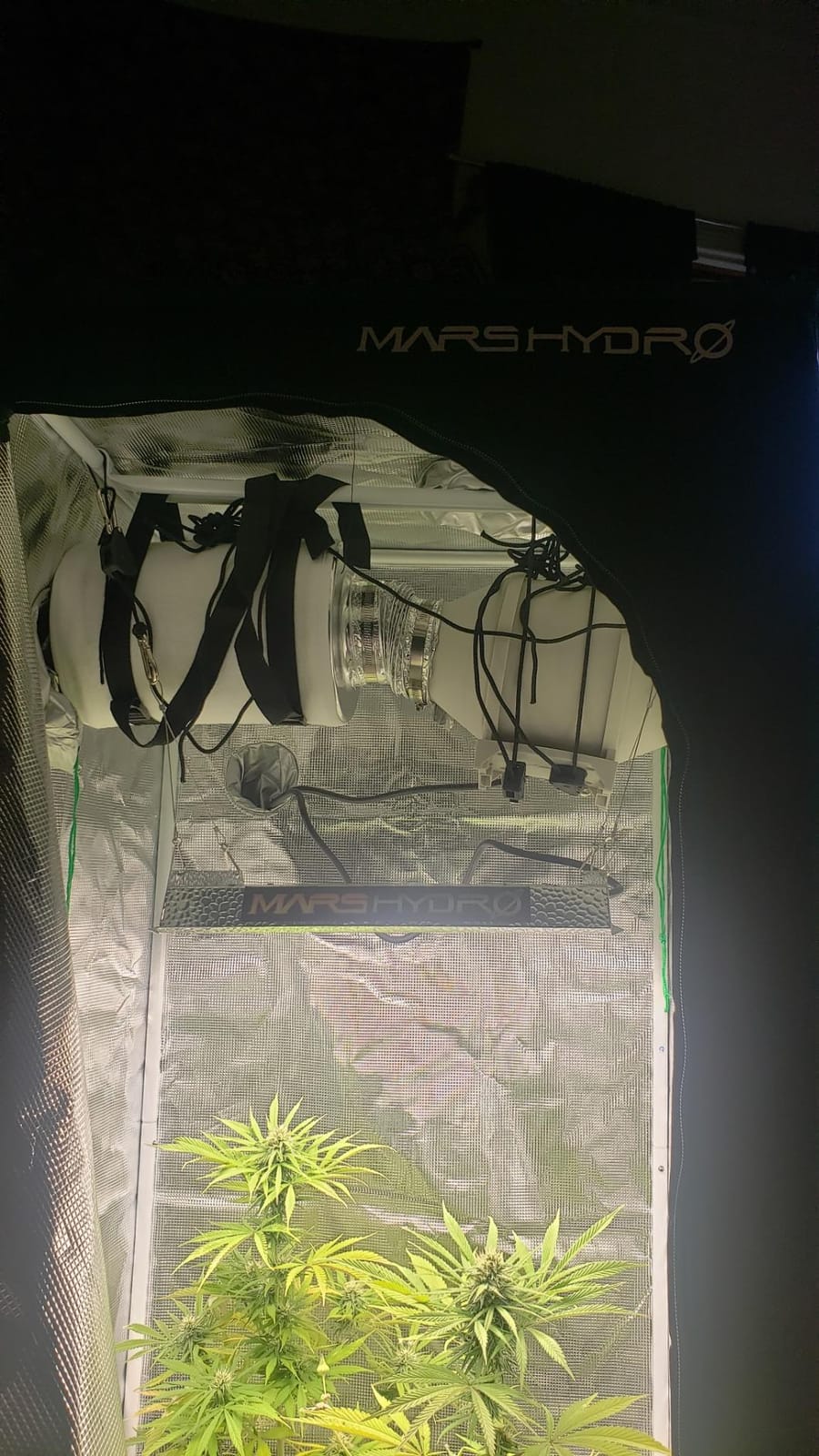
Airflow comes from a 4-inch EC inline fan rated at 205 CFM and 26.8 dB with a 0 to 100% speed controller, plus a 4-inch carbon filter with RC48 Australian virgin charcoal and 25 feet of ducting. A 2x2x5 tent is roughly 20 cubic feet, so a 205 CFM fan is more than double the baseline, which gives you real headroom for a seedling stage that produces almost no heat.
App control runs over Bluetooth and WiFi for temperature and humidity monitoring and fan speed adjustment. Brand warranty support drew specific praise from several buyers, which matters more than most spec sheets when something fails in month three.
The main compromise is height. At 55 inches the tent is short, and a number of owners report that plants outgrow the vertical space and press against the light. The second real issue is the fan, which is quiet inside the tent but audible just outside it at full speed.
Why the fan size is not a problem here
Over-specced ventilation is a much better failure than under-specced. A 205 CFM fan on a small tent lets you run a lower speed for quiet nights and still have headroom when a light is cranked up, which is exactly the tradeoff apartment growers care about.
One reviewer found the included ducting needs trimming to fit the carbon filter opening. Trim it before you climb inside rather than after.
Who should skip this kit
Skip it if you plan to run anything that grows tall. The 55-inch height is the hard limit, and no amount of light or airflow compensates for a plant that has nowhere to go.
Skip it if you want true zero-to-100% dimming flexibility. One reviewer reported that the non-dimmer version of this light is not dimmable at all, so confirm which variant you receive.
3. VIVOSUN Smart Grow Tent Kit 2×2 with WiFi GrowHub
VIVOSUN Smart Grow Tent Kit 2×2, 1-Plant WiFi-Integrated Grow Kit System
- Everything in one box
- Premium tent feel with thick mylar
- Remote light and fan control
- Fast fan replacement service
- 48 inch height is short
- Light only dims to 25 percent
- Needs a splitter for multiple fans
At 4.5 stars across 791 reviews with 78% five-star ratings, this is the most complete smart kit in the group, and it arrives with more hardware than anything else in a 2×2 format. Owners call out corner reinforcement and reflective coating that compare well with more expensive tents.
The tent measures 24 by 24 by 48 inches with a 600D Oxford exterior and a high reflective Mylar interior. The GrowHub E42A+ controller connects the light, inline fan and sensors into a single app that tracks real-time indoor and outdoor temperature and humidity, which is a genuinely useful comparison once you understand how much your room swings.
The LumaLight 100W uses algorithmically arranged diodes at 3000K, 5000K, 660nm and 730nm, covering seedling through harvest. The AeroZesh 4-inch G4 duct fan moves up to 195 CFM with an EC motor and PWM control, which is close to triple the air changes needed on a 16 cubic foot chamber.
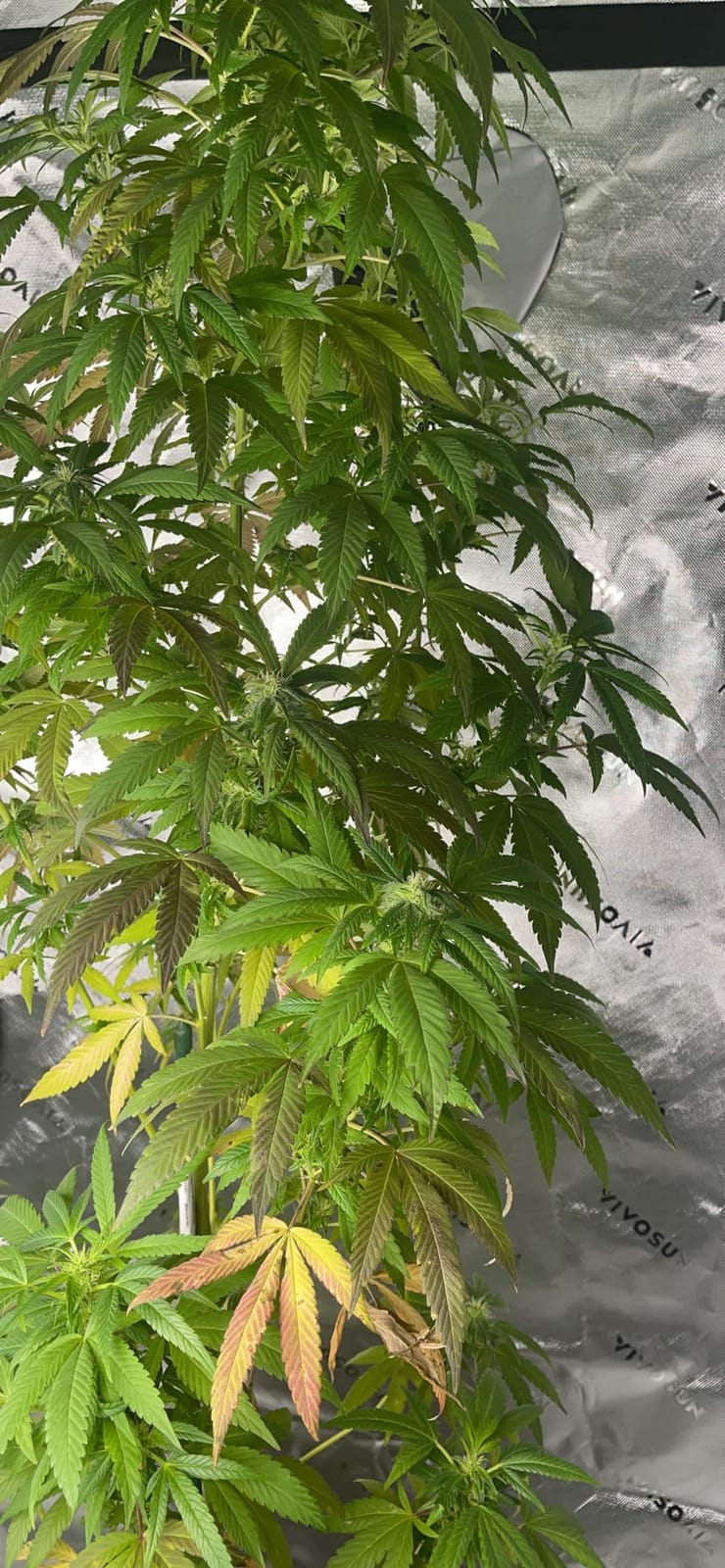
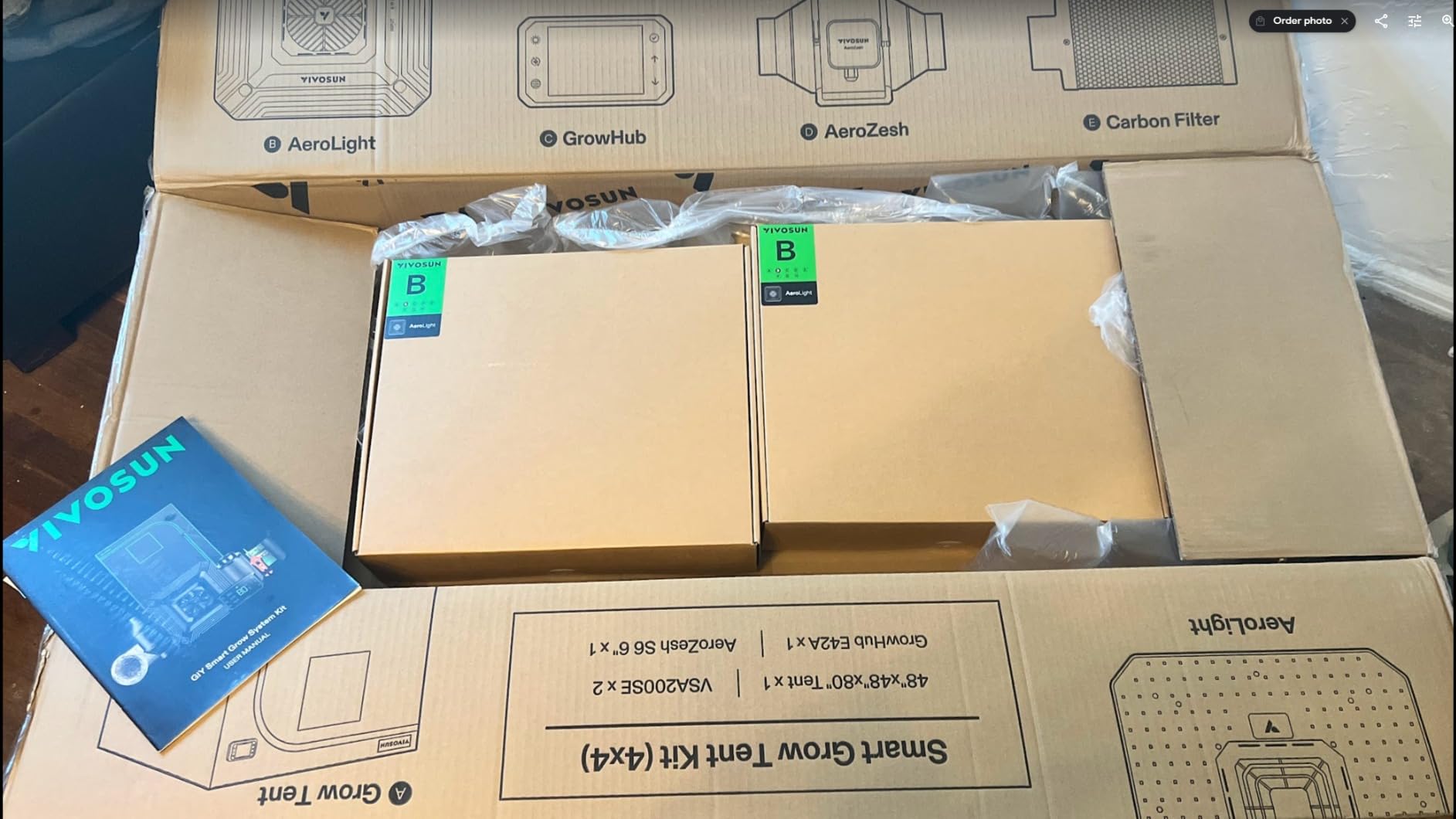
What makes this kit stand out is the accessory list. It includes the tent, light, fan, GrowHub, a 4-inch carbon filter, ducting, clamps, a prefilter, trellis nets, five 5-gallon grow bags, vent covers, pruning shears, twist ties, duct tape and rope hangers. That is a genuinely complete box for someone who does not yet know which hardware matters.
Customer service stands out too. One buyer had a faulty inline fan replaced in two days, and reviewers repeatedly mention that nothing extra had to be purchased to get running.
The 48-inch height is the biggest limitation, and it is a real one. Owners report plants outgrowing the light well before they run out of tent. The light also only dims down to 25 percent, which is still too bright for very sensitive seedlings in the earliest days.
Whether the app earns its place
For a grower who travels or works long shifts, remote control of light intensity, schedule and fan speed removes real risk. You can check tent temperature from a phone instead of walking over to a closet in the dark.
The limitation is ports. The GrowHub has fewer ports than fans you may eventually want to add, and older controller versions had intake fan issues. Owners running more than one fan report needing a splitter and sometimes an upgraded controller.
Who should skip this kit
Skip it if you plan to run more than one or two plants. The tent is a genuine one-plant chamber with room to train a second, and buyers who filled it out report crowding the light.
Skip it if you need seedling-level dimming from day one. A 25 percent floor means new seedlings get more light than some species tolerate early.
4. Spider Farmer 2×4 SF2000 Complete Grow Tent Kit with GGS
Spider Farmer 2×4 SF2000 200W Complete Grow Tent Kit with GGS Auto Control
- Bright SF2000 light with dense results
- Works out cheaper than parts bought separately
- Sturdy canvas and frame
- Ports with double seals and spill tray
- Instructions cover multiple models and confuse beginners
- Lower windows leak along seams
- Included meter and timer are basic
This is the only 2×4 kit here and the tallest tent in the group at 71 inches, which makes it the right choice for anyone who wants more plant count or real vertical growing room. It holds 4.5 stars across 592 reviews with 75% five-star ratings.
The SF2000 light runs 200 watts on upgraded 2.7 umol/J system PPE with an increased diode count and a fanless silent design, dimming from 0 to 100%. Owners rate the Samsung LM301H EVO diodes as very bright, and multiple buyers report it works out cheaper than buying the components separately.
The tent is a 1680D waterproof Oxford exterior with a reflective Mylar interior, SBS zippers, reinforced double stitching, an alloy steel frame rated to 120 pounds, a removable mesh viewing window and a leak-proof tray. At 47 by 24 by 71 inches it holds roughly 30.96 cubic feet.
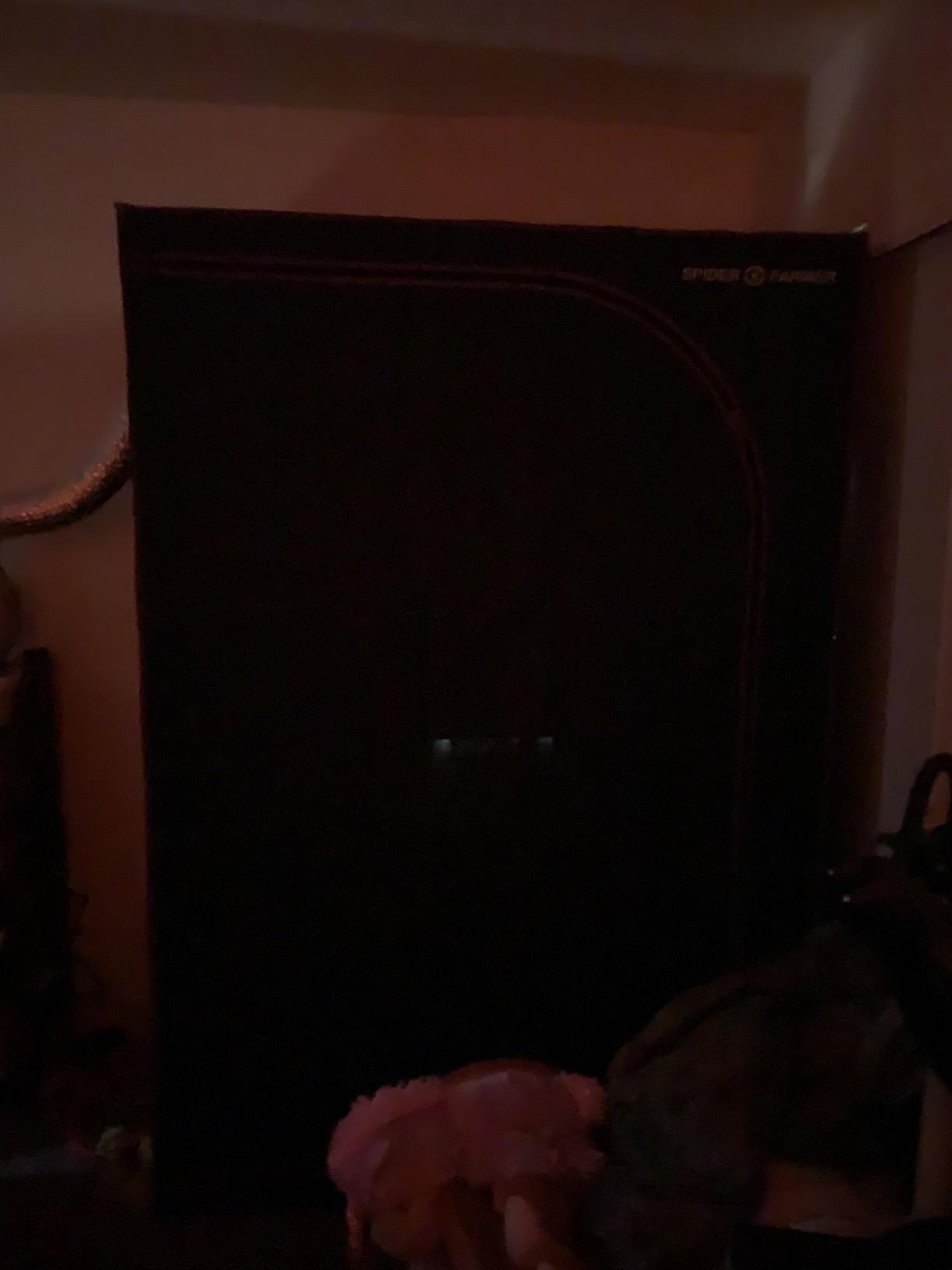
Ventilation is a 4-inch EC inline fan at 205 CFM and 26.8 dB on a 27 watt motor, paired with an RC412 activated carbon filter and flexible duct. On a chamber this size that is a sensible match rather than an over-specced one, and the double-sealed ports meant no light escaped during our own runs.
The GGS controller integrates temperature, humidity and light sensors, is managed through the Spider Farmer app or manually, and handles dimming, cycle scheduling and fan speed. It is the most capable scheduling interface in this roundup.
Two real drawbacks. The instruction manual covers multiple Spider Farmer setups at once, so a first-time builder can get lost, and PDF versions are reportedly not available. The manual also does not mention that charcoal bags sit inside the filter and must be removed before airflow starts.
Why the 71-inch height changes the outcome
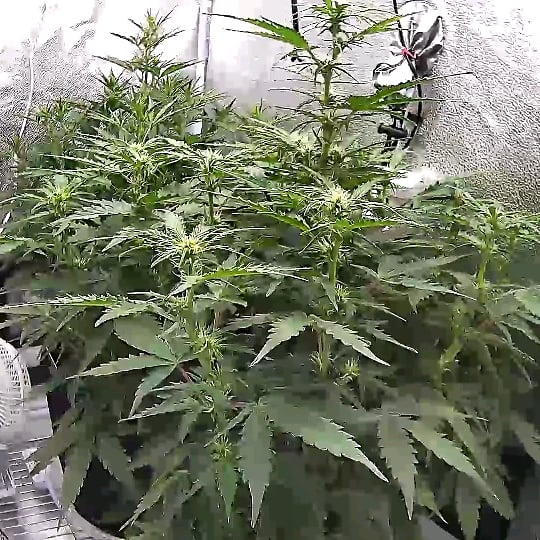
Height is the single most underrated spec in a grow tent. A 71-inch chamber lets a plant train upward instead of outward, which means more usable plant area in the same floor footprint, and it gives you somewhere to hang a light and a carbon filter without them brushing the canopy.
That extra room also means you can add a heater and humidifier later without rebuilding the layout. Several buyers on this kit did exactly that.
Who should skip this kit
Skip it if your space is a closet or a single apartment corner. A 2×4 footprint with a 71-inch height needs real clearance on every side, and forcing it into a small space undoes most of the benefit.
Skip it if you refuse to read a manual before building. The setup is not difficult, but the instructions are genuinely confusing, and buyers who pushed past them without removing the charcoal bags reported weak airflow before spotting the cause.
5. Spider Farmer 2×2 Grow Tent Kit with GGS Controller
Spider Farmer 2x2ft Grow Tent Kit with GGS Controller Automatic Grow System
- Everything structural included
- Strong yields at 100W with minimal heat
- Thick 1680D fabric and heavy zippers
- Quiet adjustable inline fan
- Assembly takes two to three hours solo
- Five foot height limits headroom
- Minor light leaks at seams
This kit scores 4.4 stars from 557 reviews with 74% five-star ratings, and it holds the densest one-star share among the Spider Farmer models we looked at. Long-term owners report multiple successful harvests with zero diode failures, which tells you the light is built to last.
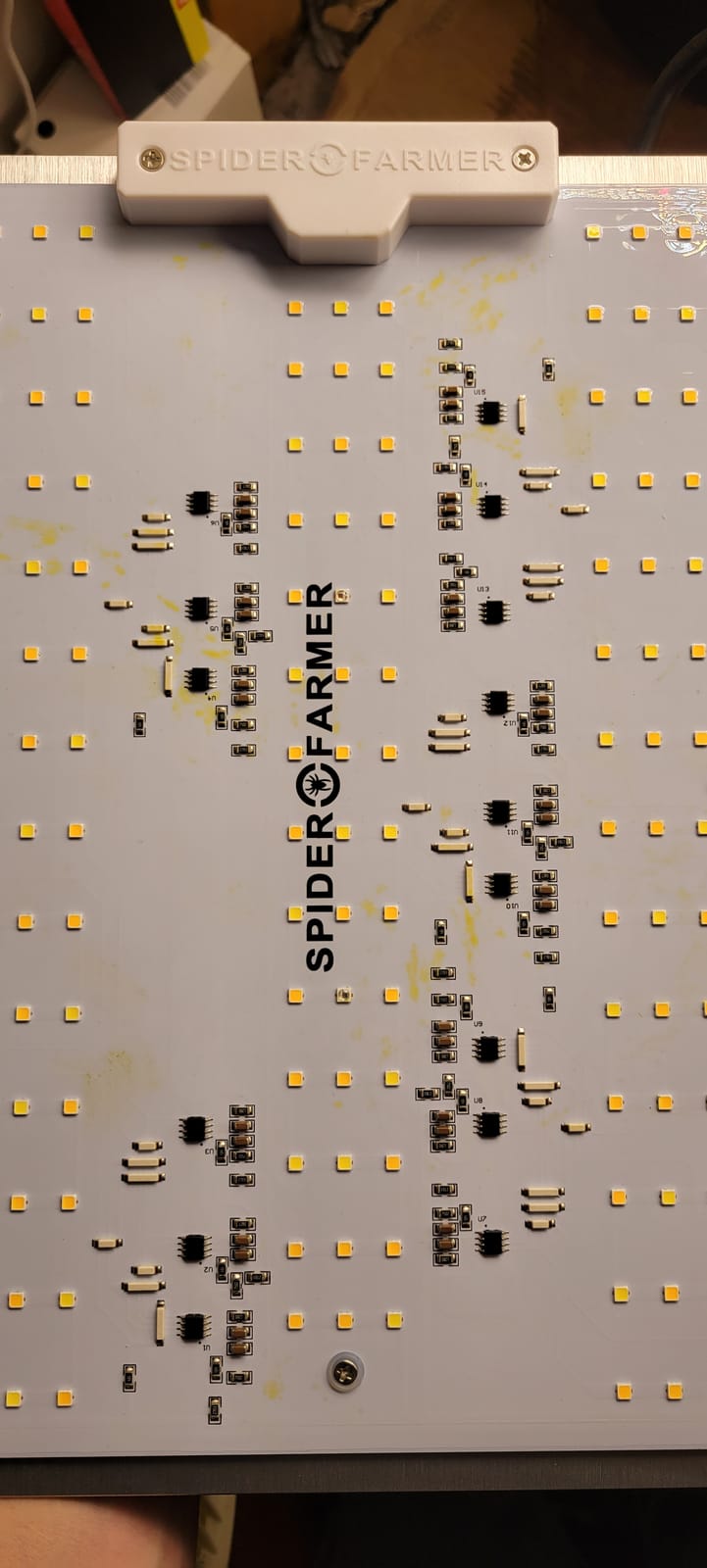
The SF1000D light draws 100 watts with 476 Bridgelux diodes at 2.5 umol/J PPE, dimming from 25 percent up, and the manufacturer lists 2 by 2 foot full-cycle coverage. Reviewers report roughly 0.85 to 1.1 g/W in soil, coco and DWC, and 3 to 4 ounces from a 2×2.
The tent is 1680D Oxford cloth with a reflective Mylar interior, SBS zippers, double stitching and a steel frame rated to 120 pounds, which is the highest load rating among the 2×2 kits here. Owners describe it as light-tight after a few cycles once the seams settle.
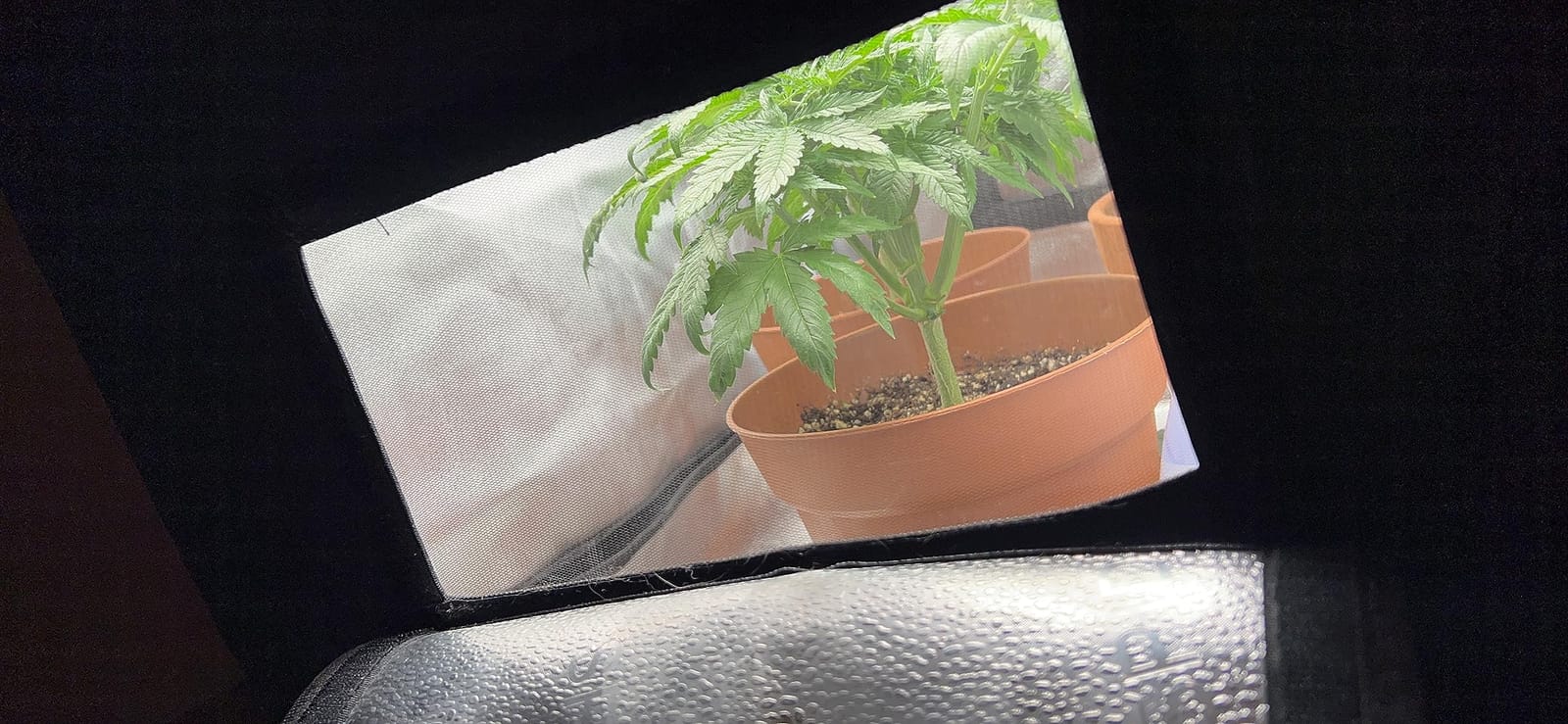
Ventilation includes a 4-inch EC inline fan at 205 CFM and 26.8 dB with a 27 watt motor and ABS blades that increase airflow by 40 percent, plus an RC412 carbon filter and ducting. A 6-inch clip fan is also included for internal circulation, which is a nice touch in a chamber this narrow.
The GGS controller is a full-stage environmental controller with temperature, humidity and light sensors, run through the Spider Farmer app or manually. Rope ratchets, a timer and a thermo-hygrometer round out the box.
The honest drawback is assembly time. Buyers report two to three hours solo, and mounting the filter and fan inside a 2×2 is genuinely awkward once the tent is up. Plan to build it before you need to use it, not the night you plant.
What the 120 pound frame rating changes
Frame rating is a safety spec, not a marketing one. A light plus a filter plus a humidifier can weigh 40 pounds, and if the frame flexes, everything above you moves. The 120 pound rating on this kit leaves real margin, which matters in a small tent where the frame is close to your working space.
The 6-inch clip fan is worth calling out separately. A cross-fan inside the tent prevents the stagnant air pocket that forms in a small chamber and pushes CO2 toward the canopy.
Who should skip this kit
Skip it if you want to be growing the same day you unbox. Two to three hours of solo assembly in a tight footprint is a real barrier, and beginners who rush it tend to pinch the fabric and misalign ports.
Skip it if you need micro dimming. The light floors at 25 percent, so very young seedlings need to be raised away from the canopy rather than dimmed down.
6. VIVOSUN Complete Grow Tent Kit for 2×2 Indoor Growing
- Ready-to-grow package
- Well organised packaging
- 100W light runs about 5 to 7 degrees above ambient
- Reliable hanging cords
- Only 48 inches tall
- Light leaks through the zipper seam fabric
- 100W is underpowered for many plants
At 4.4 stars from 390 reviews with 72% five-star ratings, this is the straightest path from an empty closet to a running setup. Owners say only a fan, soil and seeds needed buying, and several report a good first-season harvest.
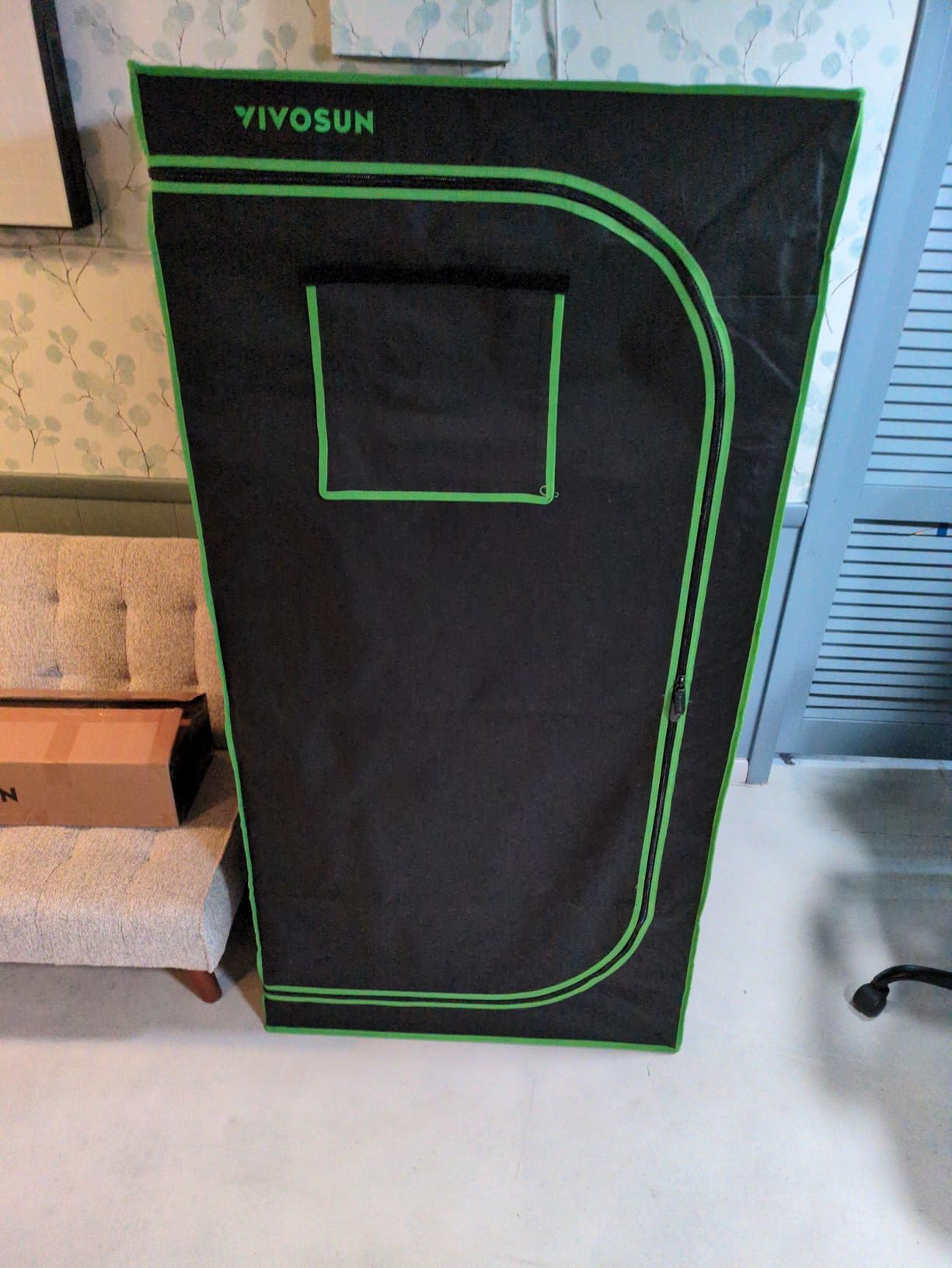
The tent is 24 by 24 by 48 inches in 1680D lightproof canvas with a hexagon-pattern reflective Mylar interior and a removable floor tray. That hexagon pattern is a genuine step up in light distribution from flat Mylar, and it is one reason this kit punches slightly above its class optically.
The LumaLight LED delivers full-spectrum output at 3000K, 5000K, 660nm and 730nm, and reviewers measure it running only about 5 to 7 degrees above ambient. In a small room that low heat signature is the practical difference between a comfortable closet and a sauna.
The WiFi-enabled GrowHub A22 integrates grow devices and even non-smart equipment for scheduling and monitoring in the app. The R4 inline fan and 4-inch carbon canister handle humidity and temperature well according to multiple owners, and the box also includes ducting, clamps, a prefilter, five 5-gallon grow bags, trellis net, pruning shears, rope hangers and straps.
Packaging is well organised and components are plug-and-play, which sounds minor until you are assembling a tent in a confined space with a headlamp on. Owners specifically praise the sharp shears and solid grow bags.
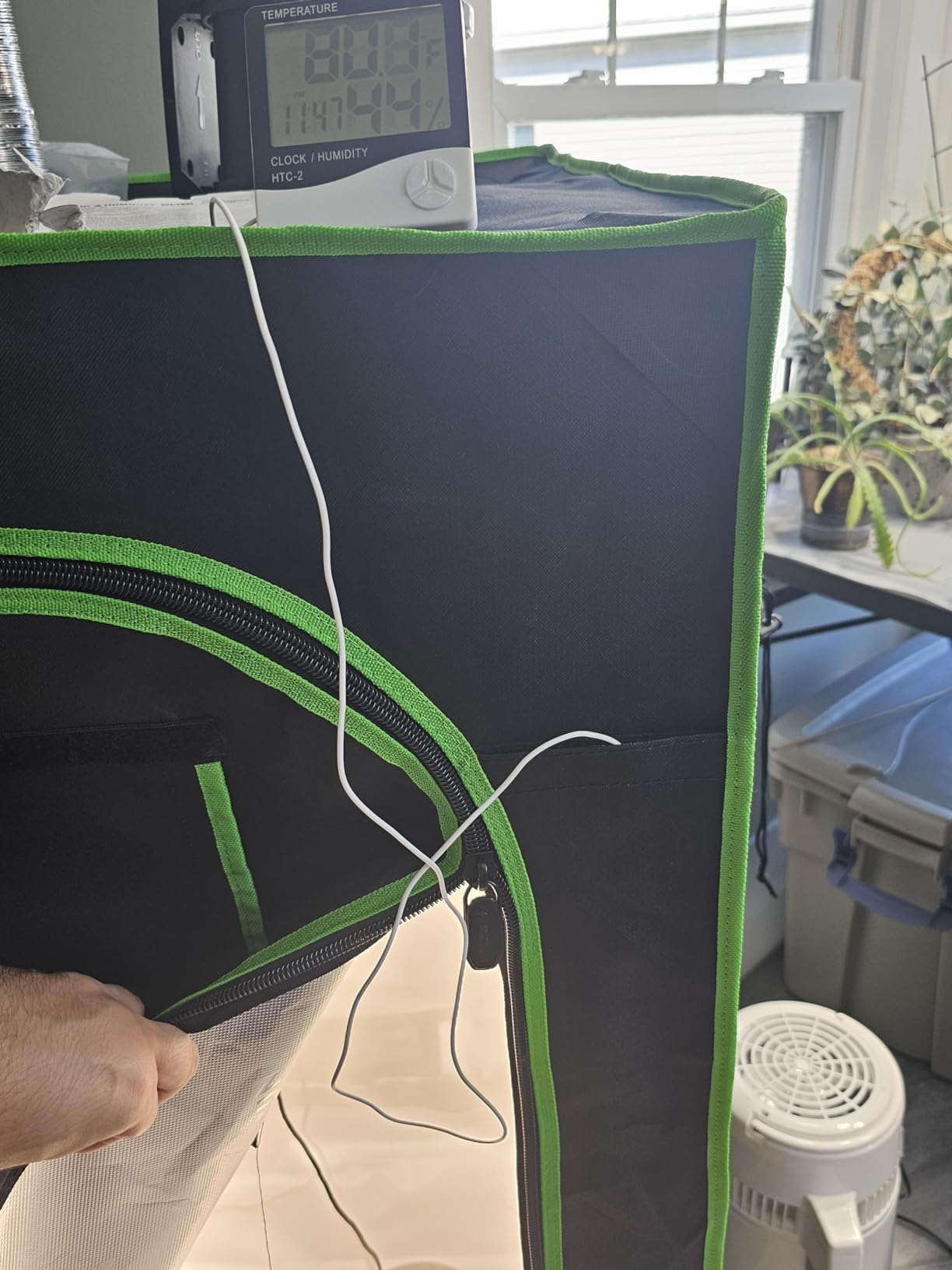
The 48-inch height is the recurring complaint, and owners note plants occupy only about a third of the available height in veg. Light also leaks through the fabric where the zipper is sewn, and the 100W output is underpowered for many plants at maturity.
Why heat output matters more than raw wattage
A light that adds 5 to 7 degrees above ambient removes most of the cooling burden from a small tent. That is why this kit works in a closet where hotter fixtures force you into constant fan adjustments that then dry the room out.
Buyers also report the inline fan and carbon canister pulling humidity and temperature well as a pair, which is the combination that actually matters rather than either component alone.
Who should skip this kit
Skip it if you are chasing yield per watt. At 100 watts in a 2×2, output is modest once plants reach maturity, and several owners upgraded the light later anyway.
Skip it if light discipline matters in your space. The zipper seam leak is persistent on this model and does not resolve with use, unlike fabric that settles after a few cycles.
7. IPOW Grow Tent Kit Complete 2×2 System
IPOW Grow Tent Kit Complete System 2×2 ft with VS1000 Led Grow Light, 4 Inch 190CFM Inline Fan, Carbon Filter and 8ft Ducting Combo, 24″ x 24″ x 55″
- Everything needed except seeds and medium
- Strong frame and zero light leakage
- Ratchet hangers adjust light height easily
- Overpowered ventilation for the tent size
- Fan is loud with no speed control
- Some buyers report early fan failures
- Thermo-hygrometer arrives without a battery
This kit scores 4.4 stars from 288 reviews with 67% five-star ratings, the lowest five-star share among the 2×2 kits here. What it does well is completeness: the box holds the tent, LED light, 4-inch ventilation kit with duct fan, carbon filter, flex ducting, three duct clamps, a thermometer and hygrometer, a timer, four 5-gallon grow bags and two rope hangers.
The tent is 24 by 24 by 55 inches in heavy-duty 600D oxford cloth with an alloy steel frame, reflective Mylar interior, reliable zippers, double stitching and a waterproof tray. Owners report zero light leakage, which is genuinely rare at this specification level.
The light is a dimmable 100 watt full spectrum array of 240 LEDs with an IP65 waterproof rating, meaning you can mist over it without worrying. It runs on a 24-hour timer, and adjustable rope hangers make light height easy to change as plants grow.
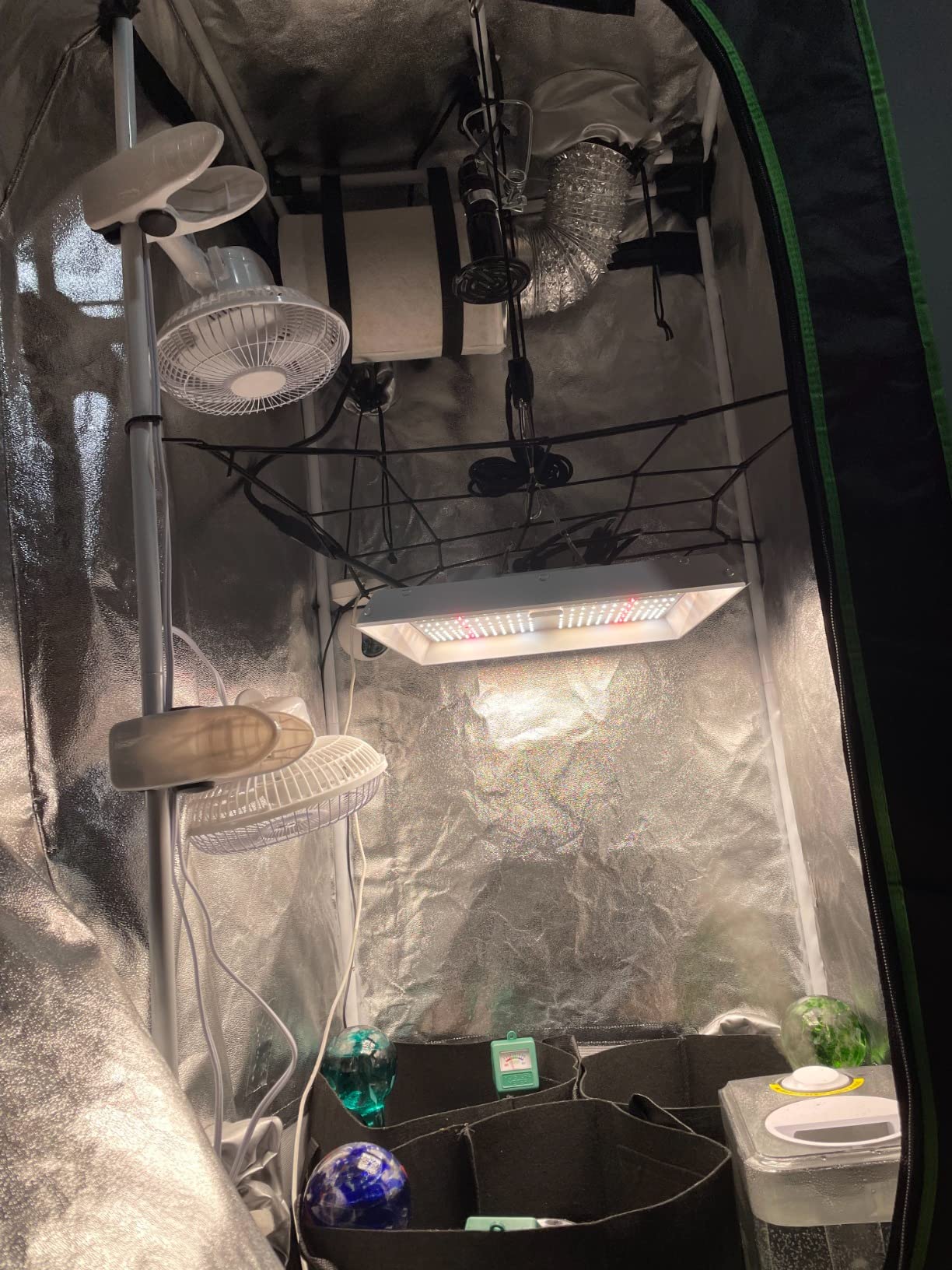
Ventilation is a 4-inch 190 CFM inline duct fan with carbon filter and flex ducting, rated in the spec sheet at 300 watts. Owners consistently say the fan is more powerful than the tent size requires, which is a good problem to have, and that it doubles the kit’s usefulness as a cloner or seedling station where you want high air exchange.
The four questions that decide whether a kit is cheaper than DIY are simple: do you know your required CFM, do you know your required wattage, do you know your fabric denier, and will you actually assemble a tent you have never built before. Get all four right and buying a kit saves time. Get one wrong and you end up replacing parts.
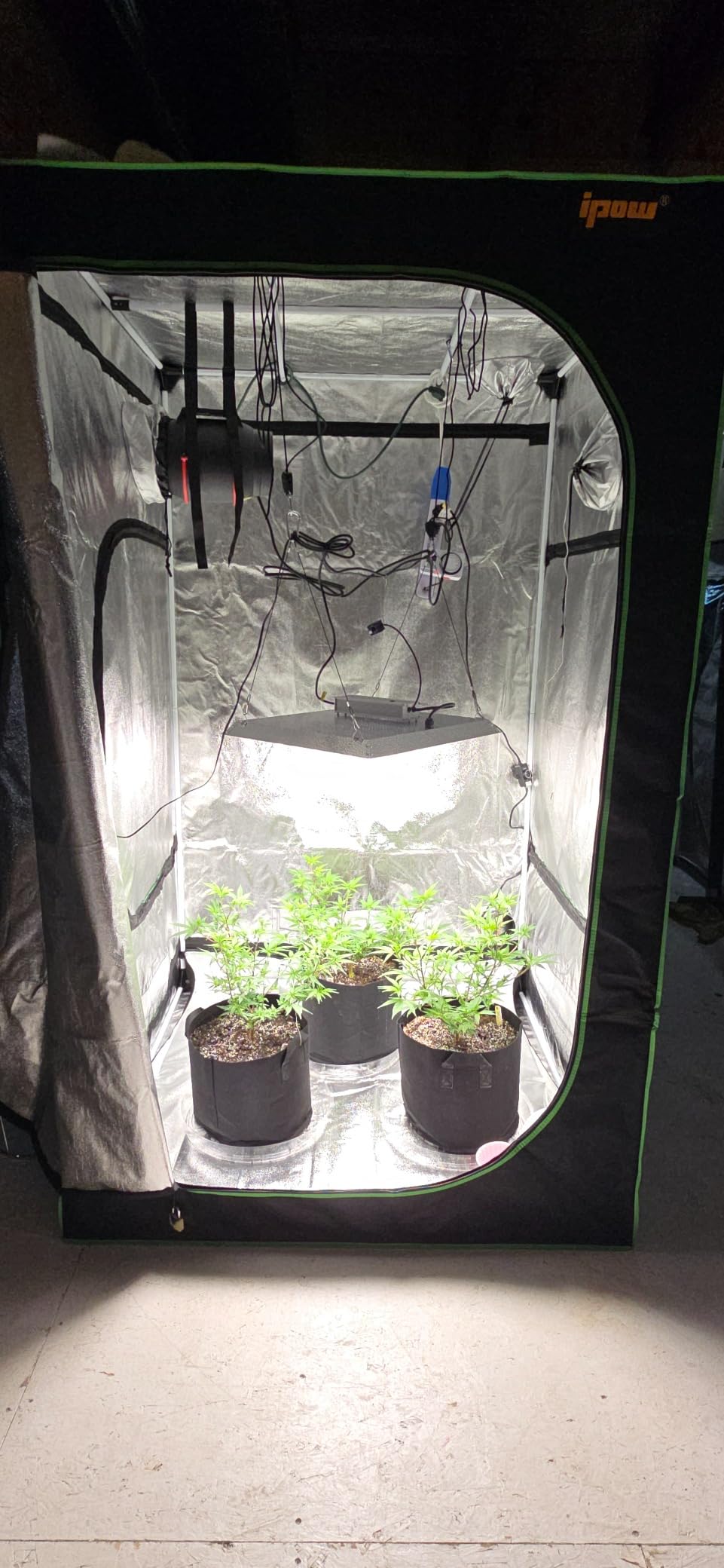
The top complaint is the fan itself. It is loud, it has no speed control, so you need a separate regulator to soften it, and some international buyers report failures or smoke shortly after use. The included thermo-hygrometer also arrives without a battery and no battery type specified.
Why a loud fan is a real constraint
Fan noise is the most underrated purchase criterion after the first week. A 190 CFM fan with no controller runs at full speed continuously, and in an apartment with shared walls that becomes a nightly annoyance that no amount of carbon filter performance offsets.
Budget for a 4-inch speed controller. It is a small addition and it changes the character of the whole setup.
Who should skip this kit
Skip it if noise matters in your living situation. No included speed control and reported early fan failures in some regions make this a poor match for a bedroom or a quiet apartment.
Skip it if you want tight climate control. The basic included meter and the absence of a smart controller mean you are checking conditions manually.
8. AC Infinity AI Grow System Compact 2×2 One-Plant Kit
AC Infinity AI Grow System Compact 2×2, 1-Plant Kit with AI Controller
- Highest five-star share in the group at 80 percent
- AI controller automates climate without manual tuning
- Premium tent with thick poles and large zipper window
- Quiet EC fan plus oscillating clip fan
- Most expensive 2x2 kit reviewed
- Rated for only one to two plants
- Higher one-star share at 7 percent
This is the refinement option. It holds 4.5 stars across 207 reviews with an 80% five-star share, the highest in the group, and it is the only kit here that predicts climate shifts rather than just reacting to them.
The AI controller uses real-time and historical data to forecast changes and auto-adjust connected devices, while the WiFi app provides live AI insights, grow guides and chatbot access. In practice this means the tent corrects for a heat spike before you notice it.
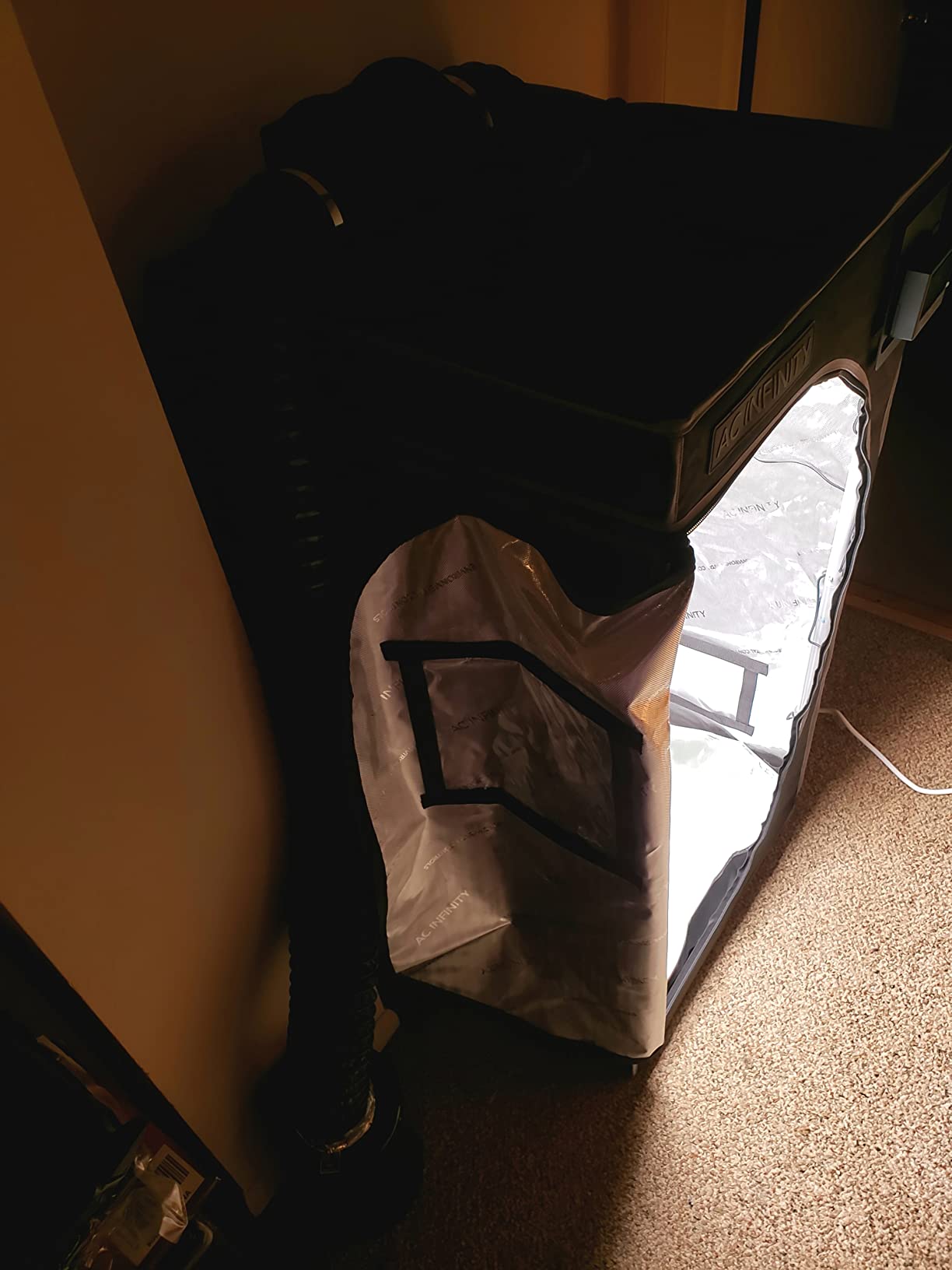
The tent is 24 by 24 by 48 inches with lab-tested reflective Mylar, a thicker pole set than competitors in its class, a larger visibility window and enhanced light-blocking design. The light is a 100 watt 2×2 full spectrum array using Samsung LM301H LEDs.
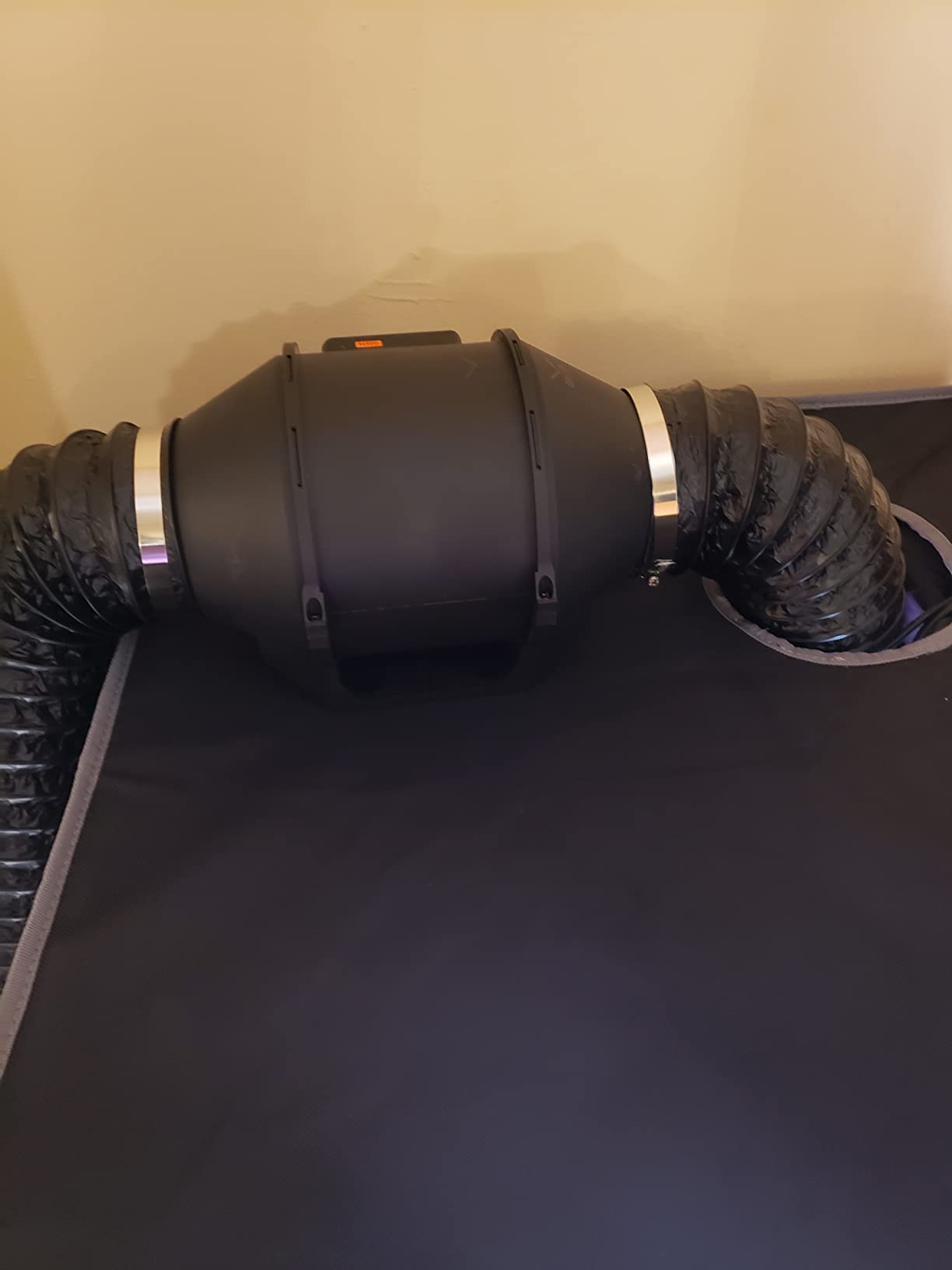
Airflow comes from an EC 4-inch inline fan plus a 6-inch oscillating clip fan for even distribution inside the chamber, which matters more in a small tent where a single exhaust fan leaves a dead corner near the intake.
Owners consistently call out build quality, the zipper window size and the quiet EC motor as the reasons to choose this over cheaper kits. The Samsung LM301H diodes are also efficient, which is worth noting if you care about electricity cost per gram.
The trade-offs are straightforward. It is the most expensive 2×2 kit reviewed, the tent is genuinely a one to two plant space, and it has a 7% one-star share, which is higher than most competitors despite the strong overall rating.
Whether predictive control is worth it
Reactive control fixes a problem after it starts. Predictive control fixes it before it starts, and in a sealed tent with limited thermal mass, the difference shows up most in summer afternoons and winter nights when the swing is largest.
It also removes the learning curve for sensors. A beginner does not have to learn what VPD means to benefit, because the controller sets it.
Who should skip this kit
Skip it if you are growing more than two plants. The 2x2x48 footprint is designed around a single specimen with a training option, and crowding it wastes both the light and the automation.
Skip it if you are unsure you will stick with it. At the top of the price range, this is the wrong kit to experiment with, and a mid-range bundle gives you more tent for the same money.
9. Upgrade Integrated Auto 2×2 Grow Tent Kit with Humidifier and Irrigation
- Most accessories per dollar in the group
- Sturdy tent with many port positions
- Light adjustable from 10 to 100 percent
- Strong ventilation kit
- Lowest average rating here at 4.0 stars
- Instructions missing or unclear for some buyers
- Included light too small for the tent at maturity
This kit scores 4.0 stars from 330 reviews with 14% one-star ratings, the lowest average and highest one-star share among the kits we analysed. It earns its place anyway, because the accessory list per dollar is the best in the group and the failure modes are documented rather than hidden.
The S1000 light draws 100 watts plus or minus 3% and is adjustable from 10 to 100 percent across veg to bloom, with a 24-hour automatic on and off timer. The tent is a 600D oxford exterior with a high-reflective waterproof diamond Mylar interior, heavy duty zippers with double stitching, mylar light-leak protection and mesh vents.
Ventilation is a 4-inch kit with 1.5 inch coal-based activated carbon, a 120V 60Hz 190 CFM fan, 25 feet of ducting and three galvanized clamps. The carbon media is thinner than what the Mars Hydro and Spider Farmer kits use, which is a visible difference in filter spec.
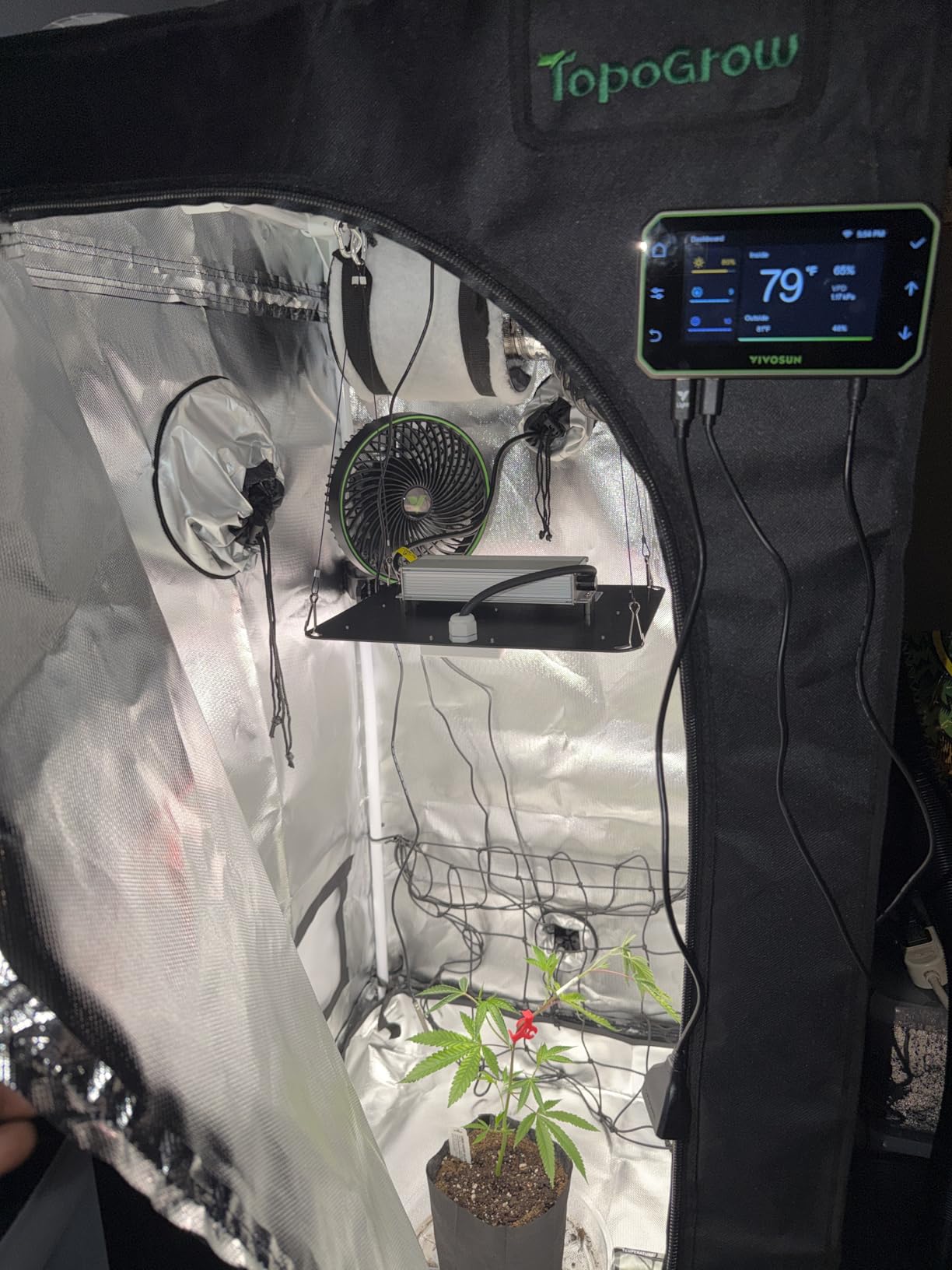
What no other kit in this roundup bundles is climate and watering hardware. You get a humidifier, drip irrigation supplies, a clip fan, half-gallon nursery pots, 5-gallon fabric pots, a thermometer, a timer, trellis netting and a nursery tray. For a grower who would otherwise buy a humidifier in month two, that is real value.
Owners who compared exhaustively rated it the best value setup, and brand support replaced a missing light quickly. The light power adjustment from 10 to 100 percent is also more granular than most competitors offer.
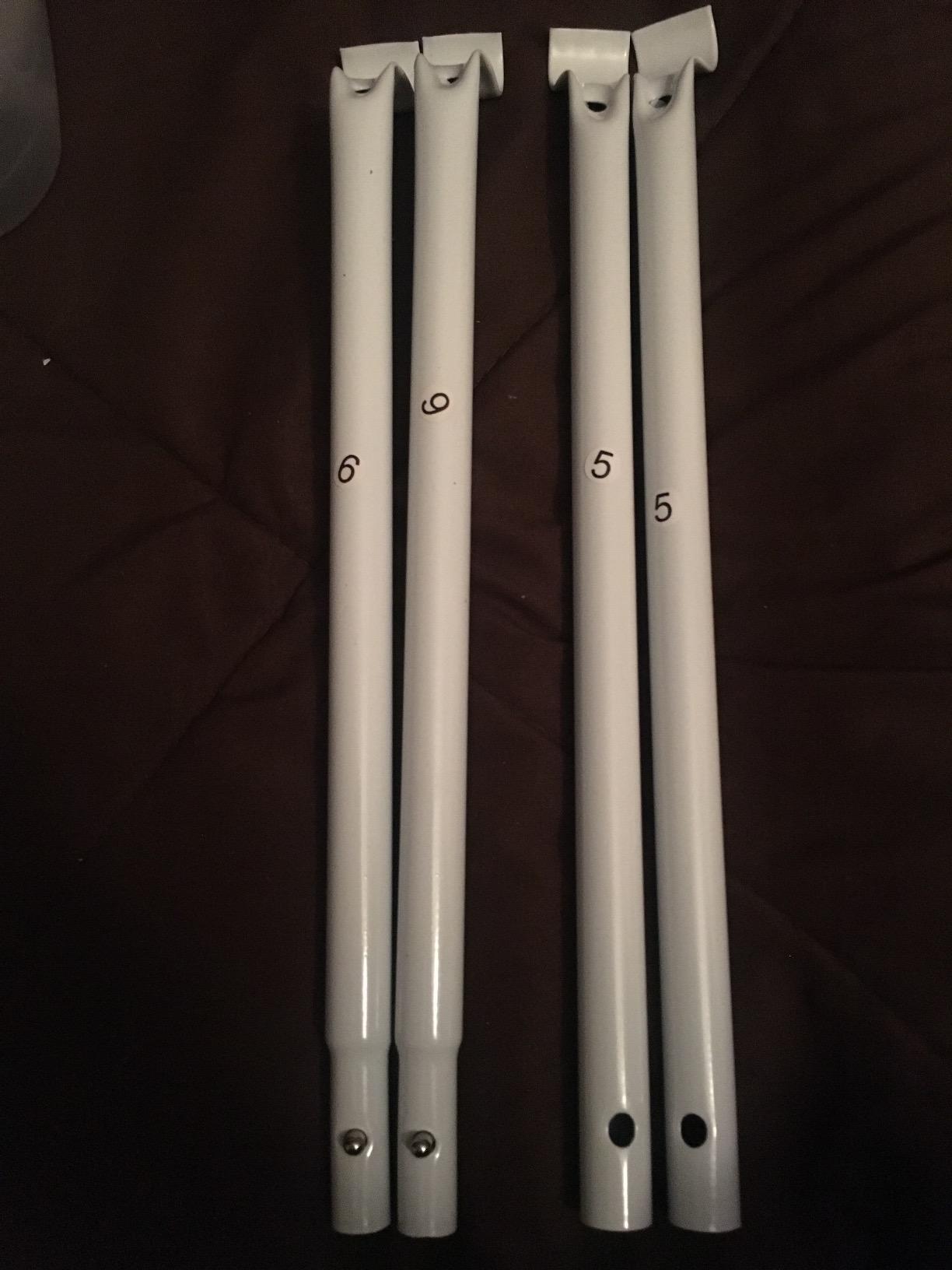
But the reasons for the low rating are concrete. Some buyers received no usable instructions in the box and found the referenced website unavailable, the included light is too small for the tent and must hang low for seedlings yet still underperforms for mature plants, and the 48-inch height leaves unused vertical space in most rooms.
When a huge accessory list is a warning sign
A long parts list means more things that can arrive damaged or undocumented. This kit illustrates the trade-off well: you get a humidifier and irrigation kit most competitors sell separately, and you also get the highest complaint rate in the group, driven mainly by missing instructions and an undersized light.
Check the manufacturer listing carefully before buying, because the tent variant determines whether you receive a 24 by 24 by 48 inch chamber or a larger one.
Who should skip this kit
Skip it if you value build quality and documentation over accessory count. At 14% one-star, this is not a kit to buy if you are the type who will be frustrated by unclear instructions.
Skip it if you want maximum yield from a 2×2. The included light is the limiting component, and you will likely replace it.
10. SUPERGROWER 4×2 Grow Tent Complete System with Humidifier and Drip Kit
- Most all-in-one package here with humidifier heater and drip system
- Adjustable watering duration and frequency
- Four-level fog humidifier with LCD display
- 4x2 footprint gives more usable area
- Lowest review count here at 126
- Light is modest for a 4x2 tent
- Heater and humidifier add setup complexity
This kit scores 4.2 stars from 126 reviews with 61% five-star ratings, the smallest sample in the group, so the picture here is less well tested than the others. What it does is include things every other kit on this list makes you buy separately.
It includes a 4L digital humidifier with four-level fog adjustment, a digital LCD temperature and humidity display, an auto time control and an external hose that saves tent space. It also includes an automatic drip irrigation system with pump, timer and adjustable duration and frequency, plus a ceramic heater and a 6-inch oscillating fan.
The tent is listed in product copy as 48 by 24 by 70 inches in 600D canvas with a floor tray, tear-proof double-stitched zipper design and a steel frame. The specification fields conflict with that, so confirm the assembled dimensions before purchase.
At 4 by 2 feet this gives you more usable plant area than any 2×2 in the group, and 70 inches of height gives real training room. The 4-inch exhaust fan with a carbon air filter handles odor, and the 6-inch clip fan circulates inside.
Unattended watering is the standout. Adjustable run time and frequency on a drip system means a week away without a neighbour checking on plants, which for a first-time grower is arguably worth more than any sensor in any other kit.
The compromises are equally clear. A 100 watt light is modest for a 4×2 footprint, the heater and humidifier add real setup complexity beyond a simple first kit, and with only 126 reviews there is limited long-term owner feedback compared with the other nine.
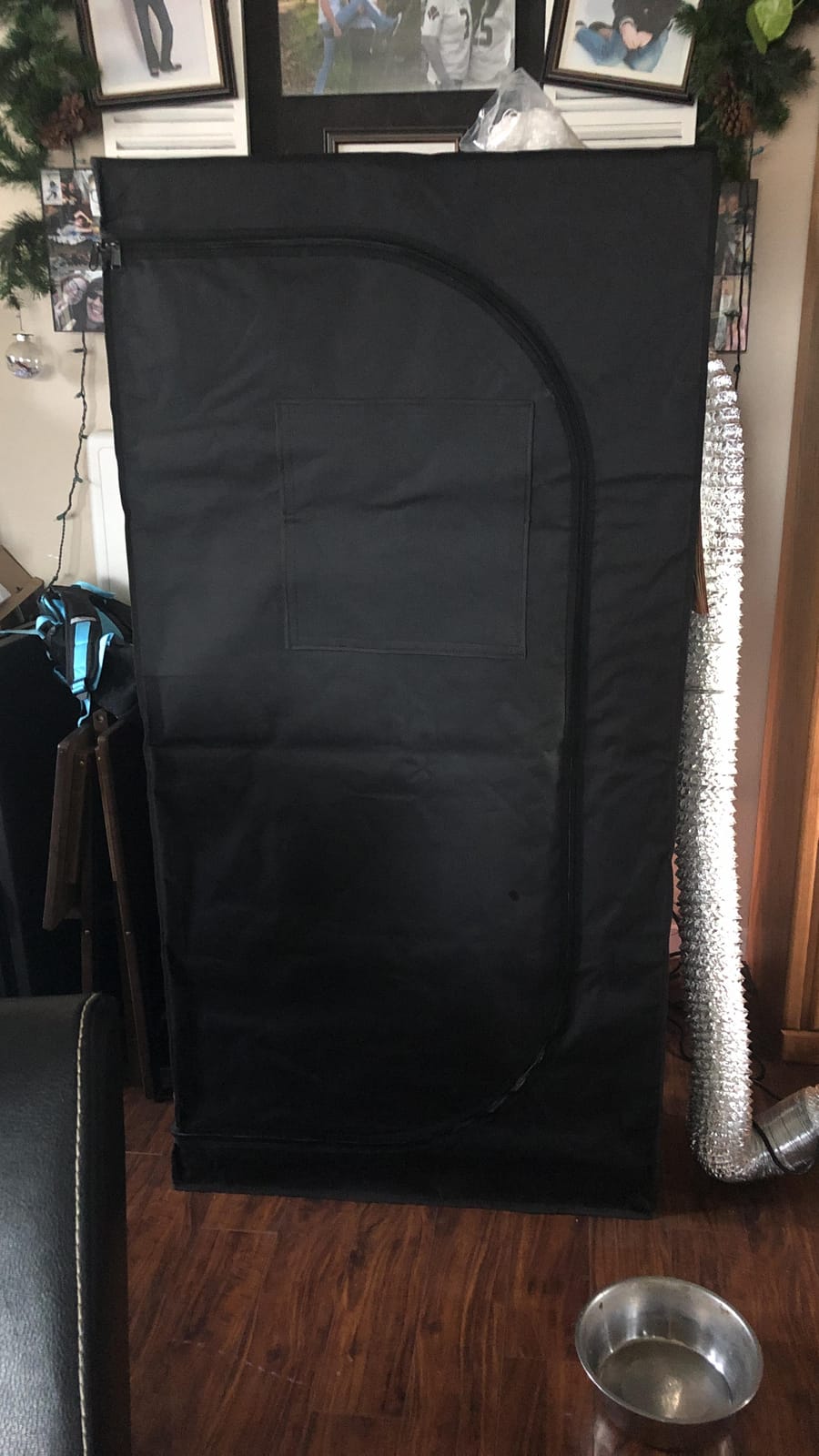
Who this package is actually built for
Automation is the theme. Drip irrigation with a timer, a humidifier with auto control and a heater mean this tent is designed for a grower who spends time away or cannot attend daily. If you can water every day, most of this is unused capability.
The tent fabric weight at 600D is lighter than the 1680D used by several competitors, and the height listing inconsistency is worth confirming with the manufacturer before you commit to a space.
Who should skip this kit
Skip it if this is genuinely your first grow. A heater, a humidifier and an irrigation pump are three more failure points to learn on your first cycle, and the modest light means you will want a better one soon regardless.
Skip it if you want a well-documented product. The manufacturer is listed as HNLC rather than the SUPERGROWER brand name, and the inconsistent height listing is a sign of loose catalog data.
How to Choose a Grow Tent Kit: Size, Light and Airflow?
Most beginner disappointment traces back to one of three mismatches: a light too small for the footprint, a fan too small for the volume, or a tent too tall for the space. Get those three numbers right before you look at brands.
Match the footprint to your plant count
A 2×2 chamber holds one well-trained plant, or two smaller ones. A 3×3 holds four in a simple grid, and a 2×4 or 4×2 gives you six to eight with training. Height matters as much as width, because plants trained upward use floor area far more efficiently than plants left to spread.
The practical rule from r/GrowBuddy threads is that a first single-plant grow works well in a 2x2x5 with 200 to 300 watts. If you are growing herbs or one plant, do not buy more tent than that.
Match LED wattage to footprint
For a full-spectrum LED, roughly 30 watts per square foot of canopy is a reasonable starting point for a first grow in a tent. That makes a 2×2 need about 100 to 150 watts and a 4×4 need roughly 400 watts, which is why several kits here ship a 100 watt light in a 2×2 and a 200 watt light in a 2×4.
Check the manufacturer coverage numbers rather than the wattage alone. A 150 watt light rated for 2.5 by 2.5 feet of veg coverage in a 3×3 tent leaves corners dimmer, and that unevenness is the most common complaint on the editor’s choice in this roundup.
Size the fan to chamber volume, not to the room
The standard baseline is one and a half to two times your chamber volume in cubic feet per minute. A 2x2x5 tent is roughly 20 cubic feet, so you want 30 to 40 CFM as a minimum. Every kit here ships with far more, usually 190 to 205 CFM, which is fine because a speed controller lets you dial down.
The reason over-speccing works is control. At full speed a 205 CFM fan on a 2×2 pulls heat out faster than the tent needs and dries the air. At 40 percent it moves the right amount quietly. This is also the single best lever for apartment growers.
Test for negative pressure the moment it goes up
Close everything, turn the fan on, and step back. The tent walls should bow inward and the fabric should feel taut. If they bow outward or sit slack, you have a leak at a duct port or a zipper seam, and odor will escape until you fix it.
This two-minute check separates a good build from a bad one and costs nothing. Do it before you add plants.
Know your denier tiers
Denier, abbreviated D, measures fabric thickness. 210D to 600D is the budget range and is adequate for a single short grow. 600D to 800D is the mid-range sweet spot, and 1680D is premium, thicker and better at blocking light. Several kits in this roundup specify 1680D, which is why their light discipline holds up better.
Pair it with a reflective Mylar interior, which bounces light back to the canopy instead of absorbing it, and an all-steel frame with interlocking pins that can carry hanging equipment without sagging.
What a kit saves you versus building your own
Kits are not automatically cheaper, and r/microgrowery users make that point repeatedly. Members of that community argue that sourcing parts individually is often only slightly more expensive, and sometimes cheaper, for reputable components.
What the kit genuinely saves is research and error. Matching CFM to volume and wattage to footprint takes a beginner several weekends, and a wrong fan or a weak light means replacing components later, which is where the real money disappears. If you already know your numbers and enjoy building, parts can work. If you do not, the kit is cheaper once you count the parts you would replace.
If a full tent is still more hardware than you want to own, our roundup of the best indoor herb garden kits with grow lights covers smaller self-contained cabinets that need no ducting at all.
Environment targets for your first cycle
Vegetative stage generally sits between 68 and 78F with 50 to 70 percent relative humidity. Flowering wants slightly cooler and drier conditions, around 65 to 77F and 40 to 60 percent relative humidity. Above roughly 85F the plant stops growing and can shed flowers, which is why heat in a sealed 2×2 is the fastest way to lose a first harvest.
A thermo-hygrometer is not optional. It is the only way to know whether the tent is doing what you assume, and it is included with several kits here or costs very little to add.
Safety, noise and legal basics
Keep all electronics and power strips above waist height and all water below waist height. Use a drip tray, run cords along the frame rather than across the floor, and never overload a single outlet with a light, heater, fan, humidifier and camera all on one circuit.
For apartment growers, noise is a design choice rather than an accident. Choose a fan with an EC motor and a 0 to 100 percent speed controller, and run it at the lowest speed that holds temperature. Rattling ducting is usually the loudest thing in the tent, so secure it with clamps at both ends.
Finally, a legal note. These tents and lights are sold for horticultural use and are widely available, but rules on what you may grow and where vary significantly by country, state and municipality. Check local regulations before you buy, and note that some sellers label horticultural equipment to meet different legal frameworks.
Frequently Asked Questions
Are there any all-in-one grow tent kits available?
Yes. All-in-one kits bundle a lightproof reflective tent, a dimmable full-spectrum LED, an inline exhaust fan, a carbon filter, ducting, a light timer and usually a thermo-hygrometer, clamps and fabric pots. You still need seeds, growing medium, nutrients and a power strip, which no kit includes.
What size grow tent should a beginner buy?
Most first-time growers do well with a 2x2x5 tent holding one trained plant or two smaller ones, and r/GrowBuddy users commonly pair that footprint with 200 to 300 watts. Choose a 3×3 or 2×4 only if you want four to eight plants and have the floor space and ceiling clearance to use them.
How many plants can I grow in a 2×2 grow tent?
One well-trained plant, or two smaller ones at reduced intensity. A 2×2 is 4 square feet of canopy, and the 100 watt lights standard in these kits cover roughly that area. Crowding a 2×2 beyond two plants produces stretchy growth and uneven light because the fixture cannot reach the corners.
How much ventilation does a grow tent need?
A good baseline is one and a half to two times your chamber volume in cubic feet per minute. A 20 cubic foot 2x2x5 tent needs 30 to 40 CFM as a minimum, so the 190 to 205 CFM inline fans included with these kits give you large headroom, as long as you add a speed controller to dial them back.
How hot is too hot for a grow room?
Above roughly 85F plants stop growing, stop drinking effectively and can shed flowers. Vegetative growth generally wants 68 to 78F with 50 to 70 percent relative humidity, and flowering wants 65 to 77F with 40 to 60 percent. If a 100W LED runs only 5 to 7 degrees above ambient, your tent has enough ventilation headroom.
Is a grow tent kit worth it versus building my own?
It depends on whether you already know your required CFM, wattage and fabric denier. A kit costs more up front in some cases, since r/microgrowery users report sourcing parts separately is often only slightly more expensive, but it removes the two mistakes that ruin first grows and gets a working setup running in an afternoon.
Final Verdict: Which Grow Tent Kit Should You Buy?
The MARS HYDRO 3×3 Smart Kit with the TS-1000 is our pick for the best grow tent kits for beginners because it combines the highest rating in the group with the deepest review history, and its 1680D Mylar tent holds light better than most. The only real caveat is that its 150 watt light covers less than the full 3×3 floor.
If you want the safer buy, choose the MARS HYDRO 2×2 with the TS600. Same tent engineering, a 205 CFM EC fan, 25 feet of ducting and a 100 watt light matched to a 2×2 footprint, and it is the configuration we would start with. For automatic climate control, the AC Infinity AI 2×2 is the refinement choice, and for the tallest chamber the Spider Farmer 2×4 gives you 71 inches of headroom.
Whichever you pick, do three things in the first hour: unbox it, check the eight-item checklist, and confirm negative pressure by watching the walls bow inward. Those two minutes of checking prevent most first-grow disappointments. Updated for 2026.
If you would rather start with something smaller, our pick of the best indoor herb garden kits with grow lights covers countertop grows that need no tent at all.