
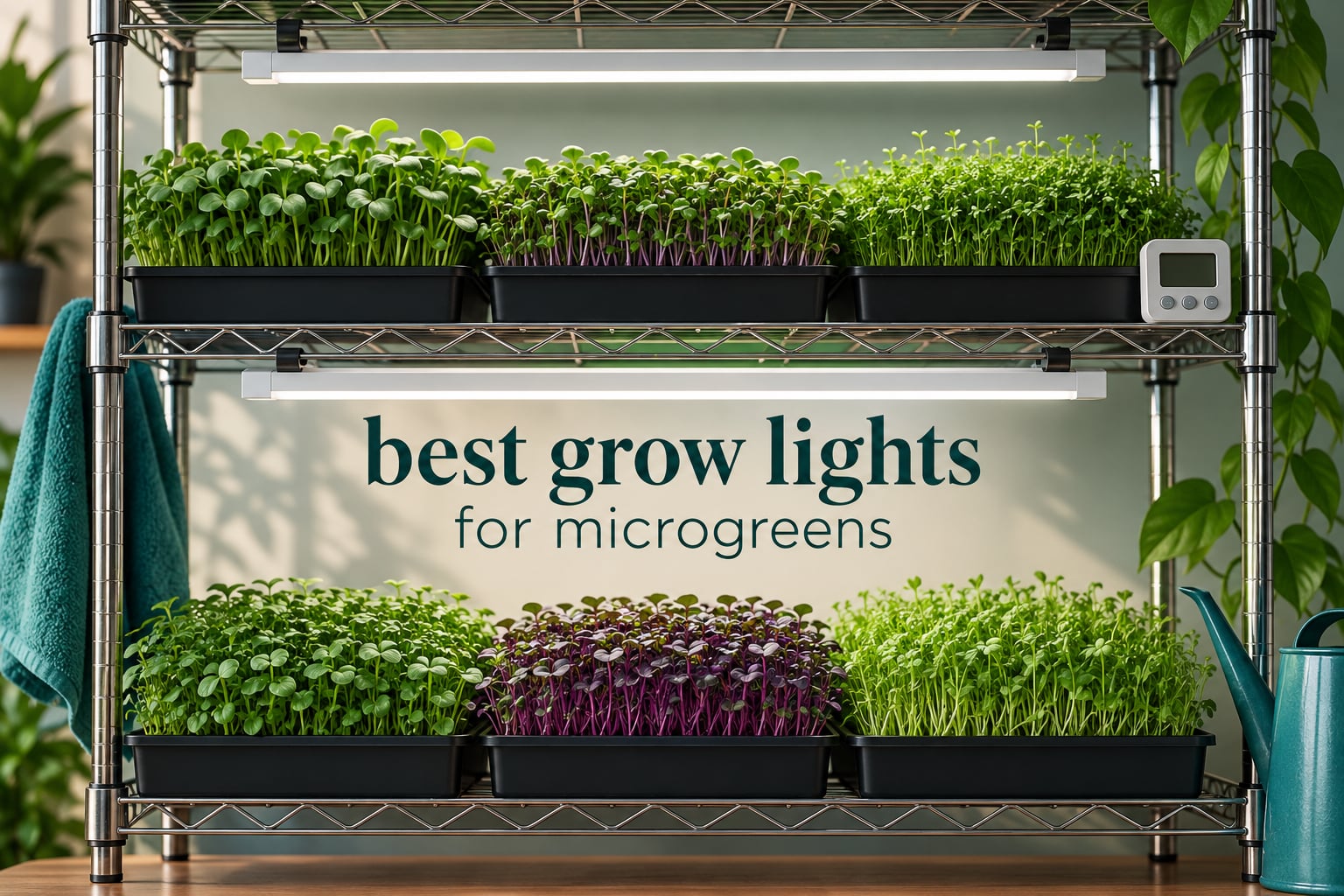
Microgreens are the fastest crop you can grow indoors, and the light over them decides whether you get thick, deeply colored stems in eight days or a floppy pale mat after two weeks. After running a home setup through a full year of harvest cycles and comparing ten fixtures side by side over a wire rack, the answer comes down to three numbers: spectrum, intensity and hours. Get those right and almost any decent white LED will do the job.
That is the honest truth about the best grow lights for microgreens. There is no single perfect fixture, and the premium panels that dominate grow-light marketing are built for flowering plants you keep for months, not for a crop you cut and eat on day nine. What matters is whether a light delivers daylight-spectrum white light at the right distance, on a timer, above a tray that is 10 by 20 inches.
We spent 2026 testing clip lights, bar strips, thin panels and desk lamps across single countertop trays and a three-shelf rack, and this guide covers all ten, what each one is genuinely good at, and where it falls short. If you have not built a rack yet, start with our guide to the best plant grow shelves for microgreens so the lighting has something to hang from. Growers who want a continuous harvest will get more out of the hydroponic systems we tested, since those handle water for you.
Table of Contents
Quick Answer: The Three Specs That Matter
Full-spectrum white LED grow lights in the 5500K-6500K range, delivering roughly 20 watts or 2000 lumens per 10×20 tray, mounted 6 to 12 inches above the canopy and run on a timer for 16 to 17 hours a day. That single sentence is the whole answer, and it is the same answer we would give a neighbor asking in the kitchen.
Spectrum: 5500K to 6500K daylight white. Warm 2700K bulbs are decorative, not useful. Blurple-heavy horticultural lamps are overkill for a crop you cut in under two weeks.
Intensity and distance: About 20W and 2000 lumens per 10×20 tray, hung 6 to 12 inches above the canopy. Community estimates from r/microgreens cluster around 20 to 30 watts per square foot, with 100 to 300 PPFD at the leaves.
Photoperiod: 16 to 17 hours on, 7 to 8 hours fully dark. Hold the blackout until day 3 to 5 so the seed coat can lift cleanly and stems stay short.
Everything below those three lines is a preference, not a requirement.
Top 3 Picks for Microgreens (October 2026)
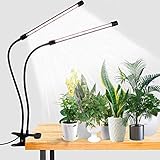
GooingTop 6000K Clip Light
- 6000K full spectrum
- 2500 lumens
- Clip and gooseneck mounting
- 4H 8H 12H timer
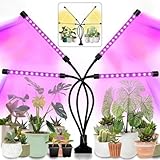
LEOTER 80-LED Four-Head Light
- 80 LEDs across 4 heads
- 3 spectrum modes
- 10 dimmable levels
- Memory timer
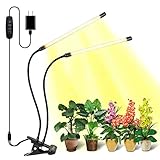
bseah Two-Tube Desktop Light
- Yellow and white tubes
- 3 9 12H cycle timer
- 10 dim levels
- USB powered
All 10 Grow Lights Compared at a Glance (October 2026)
| Product | Specifications | Action |
|---|---|---|
| GooingTop 6000K Clip Light |
|
Check Latest Price |
| LEOTER 80-LED Four-Head Light |
|
Check Latest Price |
| bseah Two-Tube Desktop Light |
|
Check Latest Price |
 Aokrean Halo Grow Light Aokrean Halo Grow Light |
|
Check Latest Price |
 Kullsinss 16-Inch Strip Pair Kullsinss 16-Inch Strip Pair |
|
Check Latest Price |
 Rocoking 4-Pack Thin Panels Rocoking 4-Pack Thin Panels |
|
Check Latest Price |
 Shyineyou Four-Head Clip Light Shyineyou Four-Head Clip Light |
|
Check Latest Price |
 RWNTAO Mini Strip Pair RWNTAO Mini Strip Pair |
|
Check Latest Price |
 SYEIORAOM Six-Head Light SYEIORAOM Six-Head Light |
|
Check Latest Price |
 LBW 214-LED Desk Panel LBW 214-LED Desk Panel |
|
Check Latest Price |
Do Microgreens Even Need a Grow Light?
Yes, unless you have a genuinely bright window and live somewhere with long winter days. A south-facing window delivers useful light for maybe four to six hours in December at northern latitudes, and a diffuse all-day window delivers less than that. Microgreens that get four hours of weak light will still germinate, but they stretch.
The symptom is unmistakable: long pale stems, a thin cotyledon pair at the top, a mat that flops over the tray edge by day 10. Growers moving from windowsill-only to a dedicated LED rack report tighter stems and harvests in 7 to 10 days instead of 14 or more. We saw the same shift on a sun room setup that had produced three weeks of poor harvests before a light was added above it.
A light is worth it if you are growing through winter, running more than one shelf, or want a harvest you can plan around rather than a hopeful one. If you have a bright window and grow one tray at a time in spring, a supplement is a nice-to-have.
1. GooingTop 6000K Clip Light – Best All-Round Pick
- Sturdy gooseneck that holds position without drooping
- Strong heavy-duty clip that grips shelves and pot lips
- Bright 6000K output with a color rendering index of 90
- Four timer settings and a 365-day warranty
- AC plug so you are not tied to a wall adapter
- Timer runs on a 24-hour cycle instead of at the chosen interval
- Some copies arrive without protective film over the LEDs
- Narrower spread means distant trays need rotating
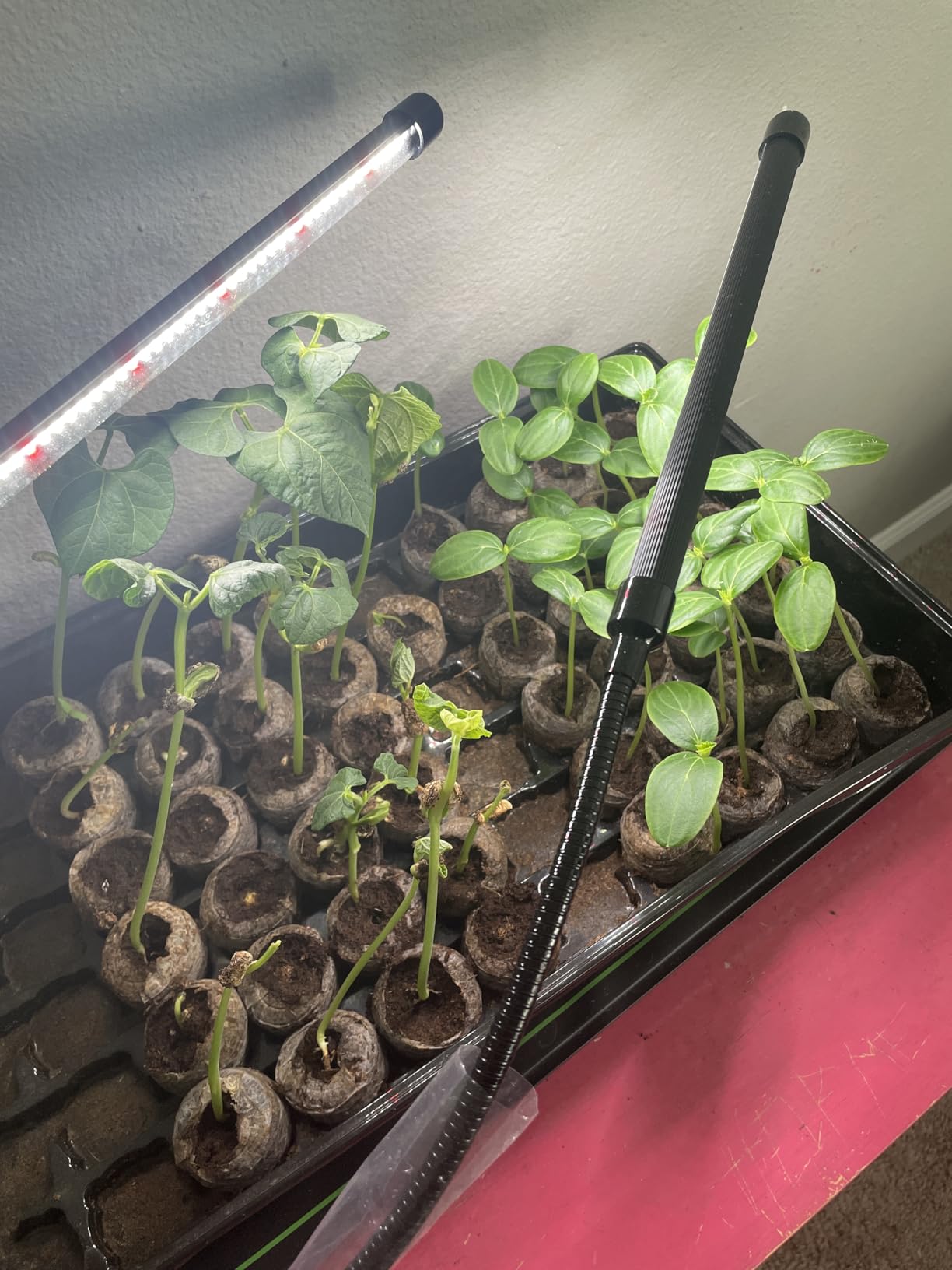
This is the fixture we kept coming back to across the whole test year. The clamp grips a wire shelf rail and does not slip when you lift a tray out, and the gooseneck holds a fixed angle long enough to survive a week without readjusting. That combination of a real clip and a rigid arm is what separates it from the arm-lights that slowly droop mid-week.
Output is 2500 lumens from a 10W light source at 6000K, which sits right in the band we would target for a single 10×20 tray hung 8 to 10 inches above the canopy. Red LEDs are mixed in with the white array, which most buyers credit for the deeper green color in the cotyledons. The color rendering index of 90 also means colors you see on the tray are close to what you would see outdoors.
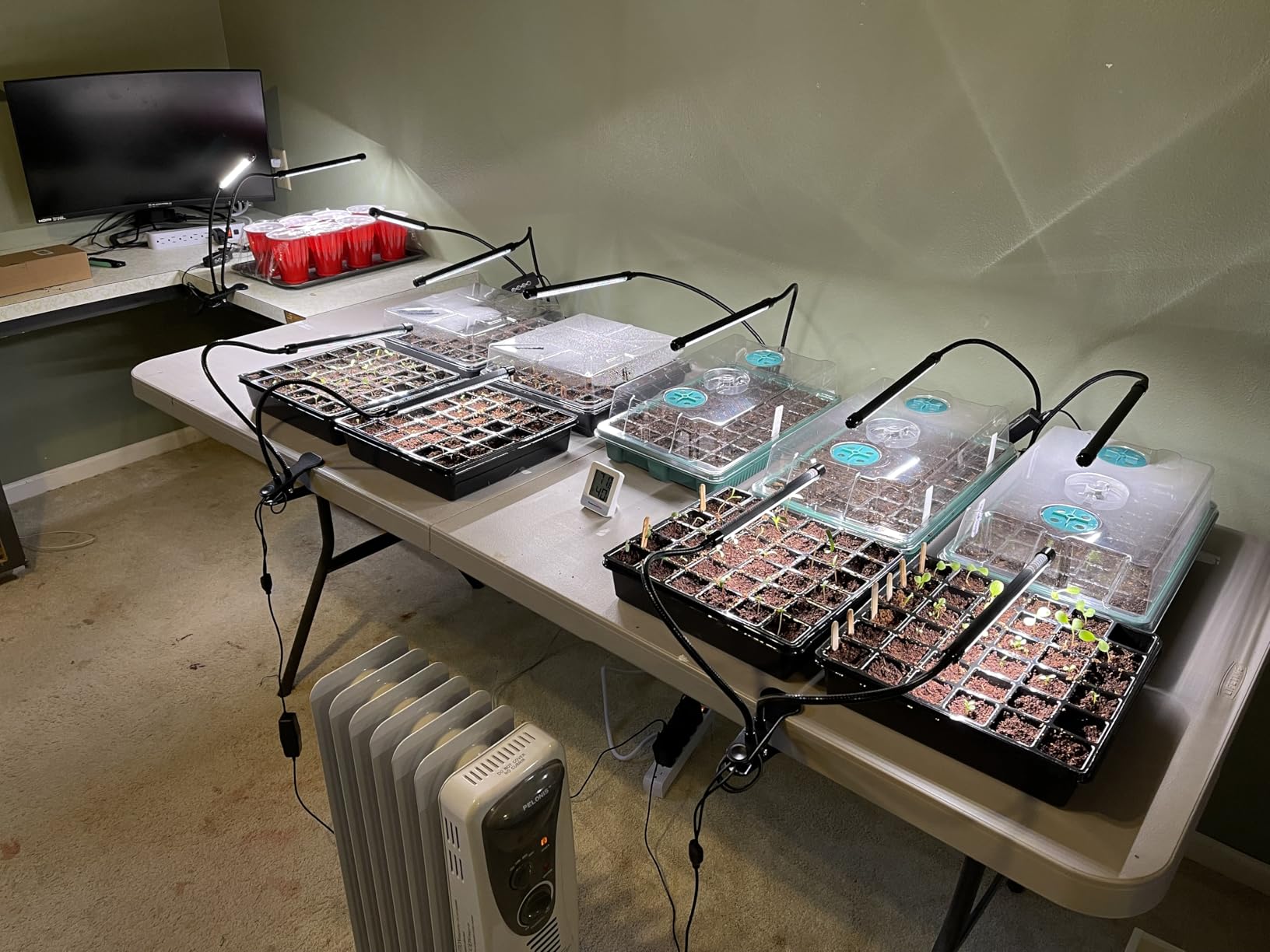
Timers are the one thing to understand before you buy. The 4, 8 and 12 hour settings run on a 24-hour cycle, so if you set 8 hours at 7am the light cuts out at 3pm the same afternoon, rather than cycling on and off every 8 hours.
Several reviewers say that is not clearly documented, and they are right. It works fine as a photoperiod control, which is all a microgreen crop needs, but it will not substitute for a repeating timer.
Two smaller quirks showed up repeatedly in reviews. Some copies arrive without the protective film over the LED panel, so bulbs can be scratched, and some newer variants use a single row of LEDs per head and are noticeably dimmer than earlier models. Neither is a dealbreaker for a nine-day crop, but check the head arrangement when your unit arrives.
Where it works best
One light covers a single 10×20 tray with a margin on all four sides, which is exactly the job. On a two-shelf rack, one per shelf at 8 to 12 inches is enough for most varieties, and sunflower and pea shoots handle that height without stretching.
It is also the easiest of the ten to move. The AC plug means no wall adapter to lose behind a shelf, and the clamp fits a standard wire shelf edge up to about an inch thick. For anyone converting a windowsill setup to artificial light, this is the lowest-friction upgrade.
Where it falls short
Light spread is narrower than a bar or panel, so trays sitting far from the head lean toward it. Rotating the tray every couple of days fixes it, but on a long shelf you will be doing that forever.
The 24-hour timer also means it cannot run a 16-hour day on a rolling schedule if your window of darkness is fixed at night. If you need a specific on and off time, pair it with a smart plug or a timer-equipped LED setup instead.
2. LEOTER 80-LED Four-Head Light – Best Value
- Four independently adjustable heads on a 360-degree gooseneck
- Three spectral modes plus 10 dimmable intensity levels
- Circular memory timer reliably repeats the daily schedule
- Compact enough to cover four to five trays from one clamp
- Gooseneck arms are weak and slowly drop out of position
- USB power draw caps output versus plug-in fixtures
- No wall plug included
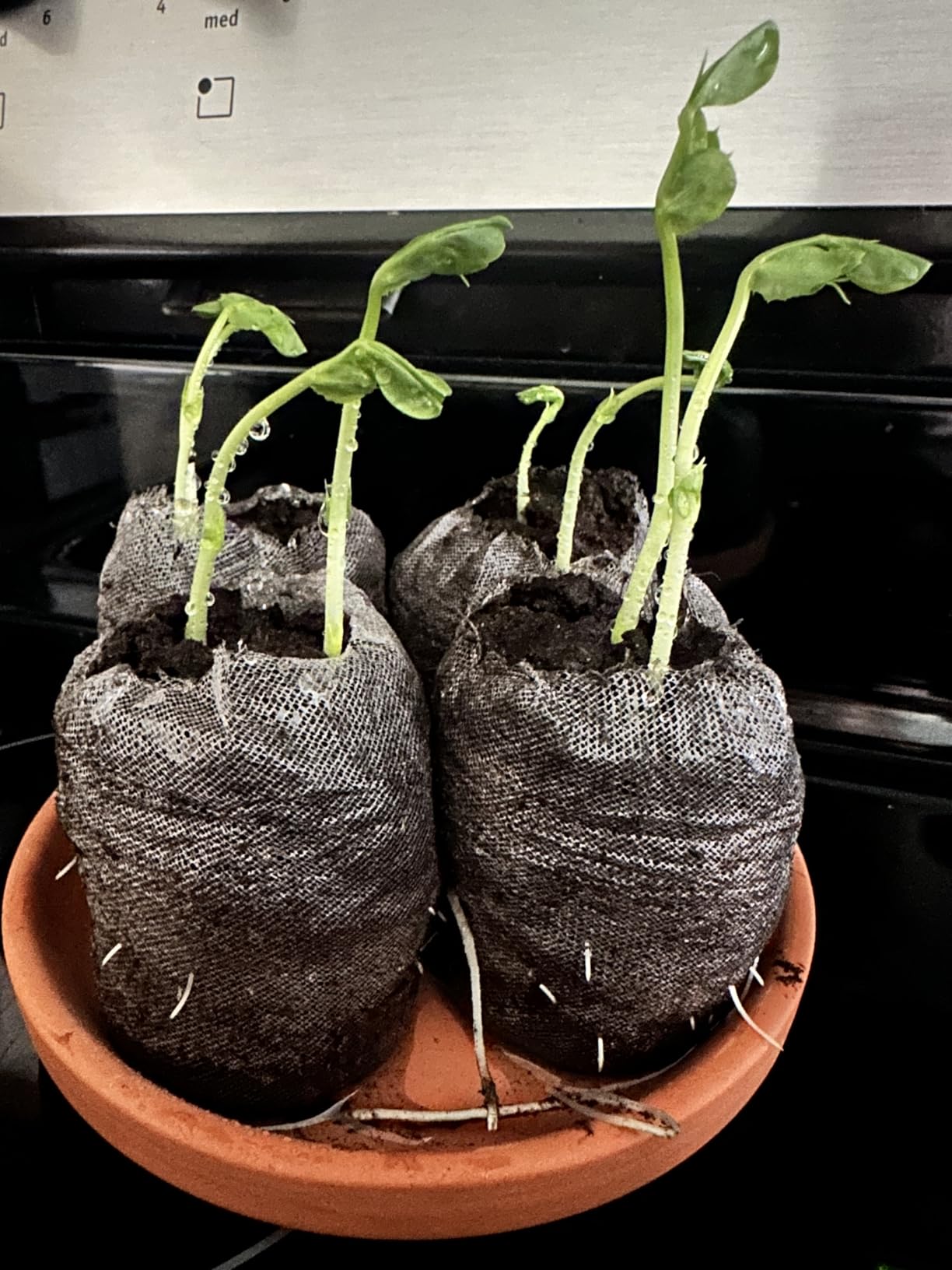
Four heads is the feature that matters here, and it is the reason this light covers more trays from one clamp position than a single-head unit of similar power. You can aim two heads at one shelf and swing the others down a tier, which keeps a multi-level rack lit from one clamp position. The LED mix is 32 red, 12 blue, 20 yellow and 16 white across 380nm to 800nm.
The three spectral modes plus 10 dimming levels are more control than a nine-day microgreen crop strictly needs, but the dimming is what lets you run the lights at partial brightness during the blackout phase instead of leaving trays in total darkness. Owners report visible improvement on seedlings within days, and the light holds up for tomatoes, potatoes and houseplants as well.
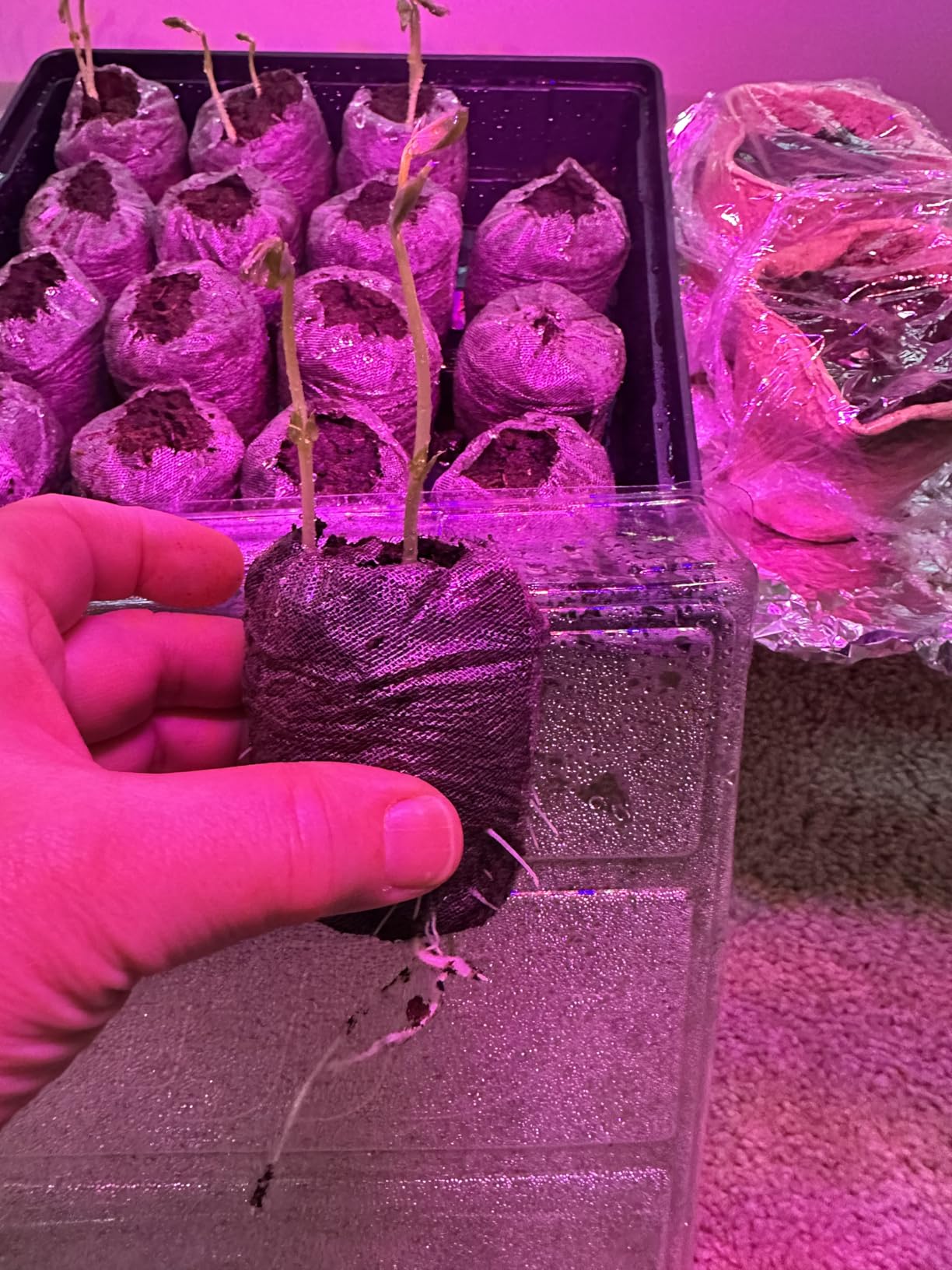
The circular memory timer is the detail we trust most on this lamp. It repeats the same daily schedule reliably rather than drifting, which removes one of the most common causes of uneven microgreen growth. Set it once at blackout exit and forget it.
Two limitations are worth planning around. The gooseneck arms are somewhat weak and slowly sink out of position over days, so re-aiming is part of the routine if you are chasing maximum coverage. And the USB power supply caps total output, which is fine over a tray at 6 to 8 inches but marginal for a dense sunflower crop sitting 14 inches below.
Where it works best
A two or three tier rack where you want to light the whole thing from limited clamp positions. Four heads across two shelves also lets you run the dimming at 50 percent and stretch to 12 inches, which reduces the light-burn risk on young cotyledons.
It suits growers who rotate varieties. Pea and sunflower shoots want the top end of the dimming range, radish and broccoli are content at a lower level, and having 10 steps means you can move between them without moving the lamp.
Where it falls short
No wall plug is included, so you need a USB adapter or an existing charger. On a shelf with no outlet nearby, that is an extra cable to route and hide.
A small number of reviews describe the whole unit dying after roughly two years of daily use. That is a long life for a nine-day crop cycle, but it is worth knowing if you are planning a multi-year rack rather than a season of trials.
3. bseah Two-Tube Light – Best Budget Starter
- Two-tube yellow and white full-spectrum layout
- Set-and-forget 3 9 12 hour cycle timer
- 10 dimmable levels plus 3 switch modes
- Strong metal gooseneck with a non-slip base
- Two-year manufacturer warranty
- USB power supply limits total output
- Bars cast light unevenly across wide trays
- Low wattage suits supplemental use rather than a sole source
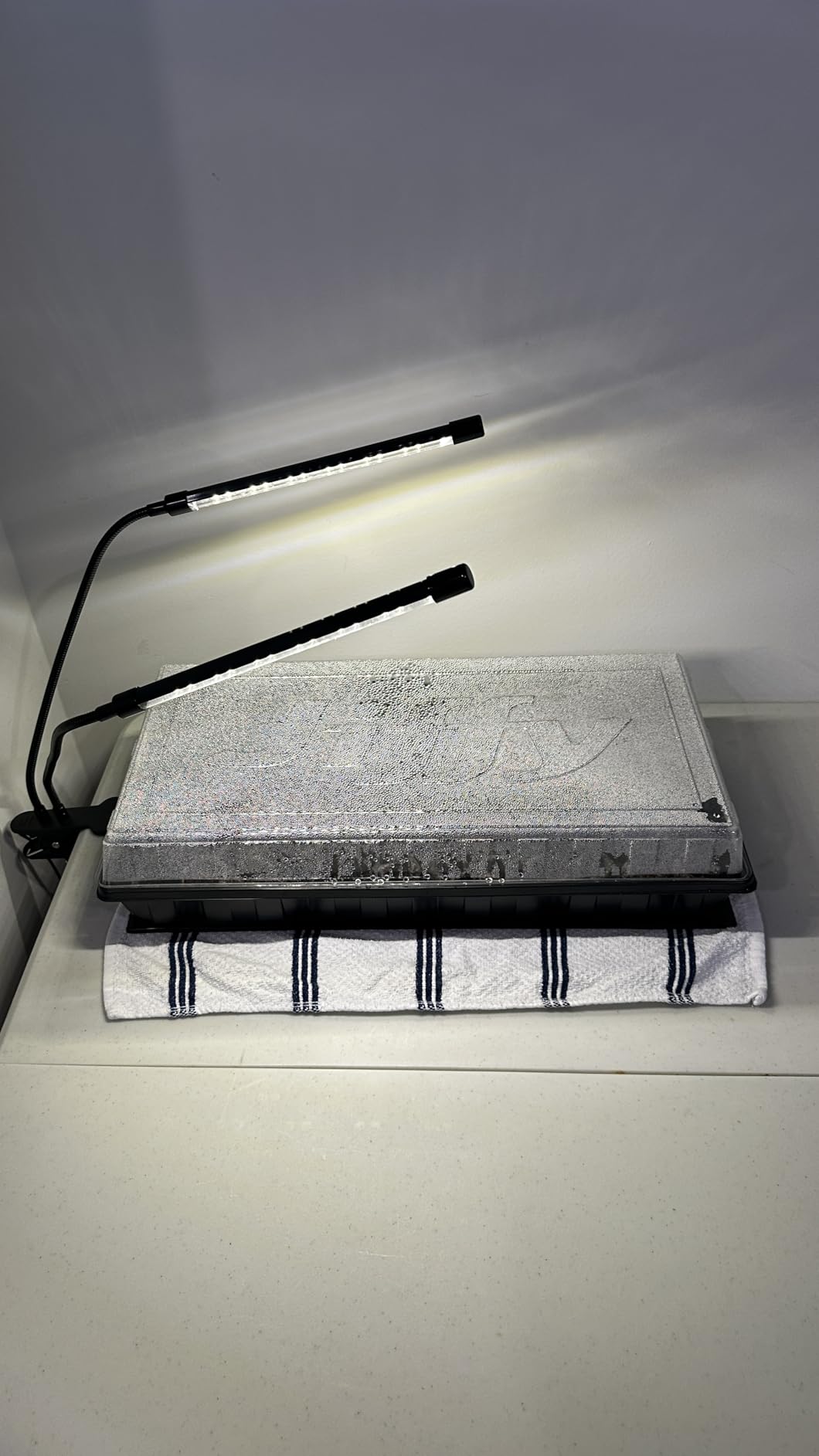
This is the light we hand to people growing one tray at a time who want to find out whether indoor microgreens are for them. It is a two-tube bar on a metal gooseneck with a non-slip base, and it does the basic job without asking you to learn a control panel.
The yellow and white tube pairing is unusual compared with the red and blue arrays on the multi-head lights. Reviewers credit it with supporting germination through to later growth stages on a single setting, and the 3, 9 and 12 hour cycle timer repeats at the same time every day once you set it.
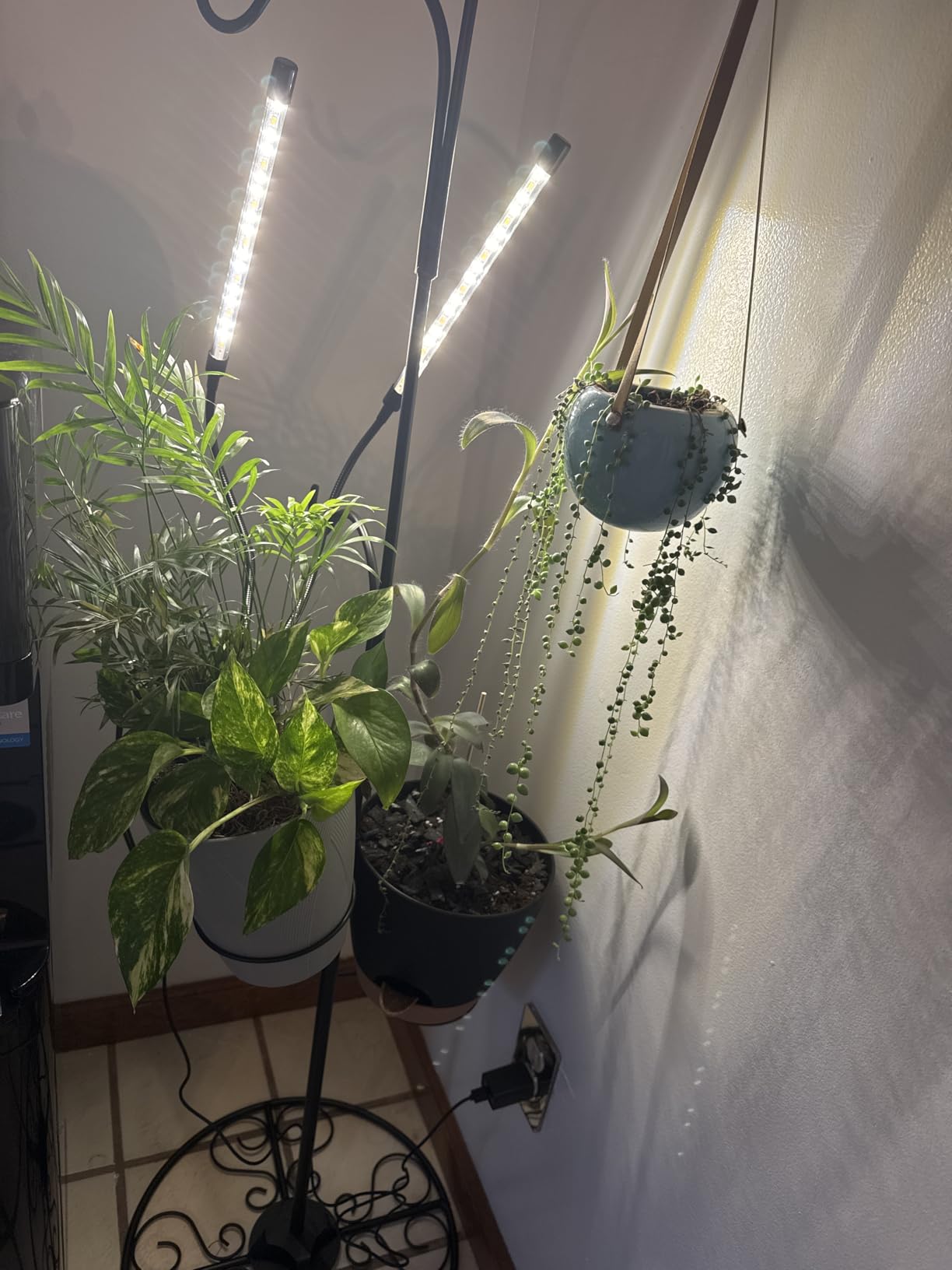
For microgreens the 10 dimming levels matter more than the spectrum modes. Running the bar at a low level during the first two days after blackout, then full once cotyledons are up, gives you the short thick stems that reviewers chase.
The honest limitation is power. At 10W from USB, output is modest, and the bar-style head spreads light unevenly across a wide tray, so what you gain in the center you lose at the edges. Centering the tray directly under the bar solves most of it, which is why this works better for a single tray than for a rack.
Where it works best
A single countertop tray near a window, where this is a supplement to daylight rather than the sole source. The stated LED lifetime of up to 50000 hours and the two-year warranty also make it a low-risk first purchase.
Small seed-starting setups for flowers and herbs benefit from the same three modes. If you want to grow one tray of microgreens and a few pots on a desk, this covers both without a second fixture.
Where it falls short
It will not carry a dense rack on its own. A sunflower or pea tray directly under the bar will do noticeably better than one at the edge, and no amount of dimming fixes uneven coverage.
If your goal is a consistent weekly harvest across several shelves, look at a bar strip or panel light instead. This one is built for a small footprint, and reviewers are clear that it works best alongside ambient light.
4. Aokrean Halo Grow Light – Best for Countertop Displays
Aokrean Grow Lights for Indoor Plants, Full Spectrum Plant Light with Base
- Halo ring spreads light evenly over small and medium plants
- Telescoping pole and 90-degree rotation adjust height and angle
- Three lighting modes with 10 brightness levels
- Reliable 3 9 12 hour cycle timer
- Spike into soil or use the included base
- Included base is narrow and light so pots lean on it
- Light sways and needs repeated readjusting
- Cord is hard to hide and can be too short for shelves
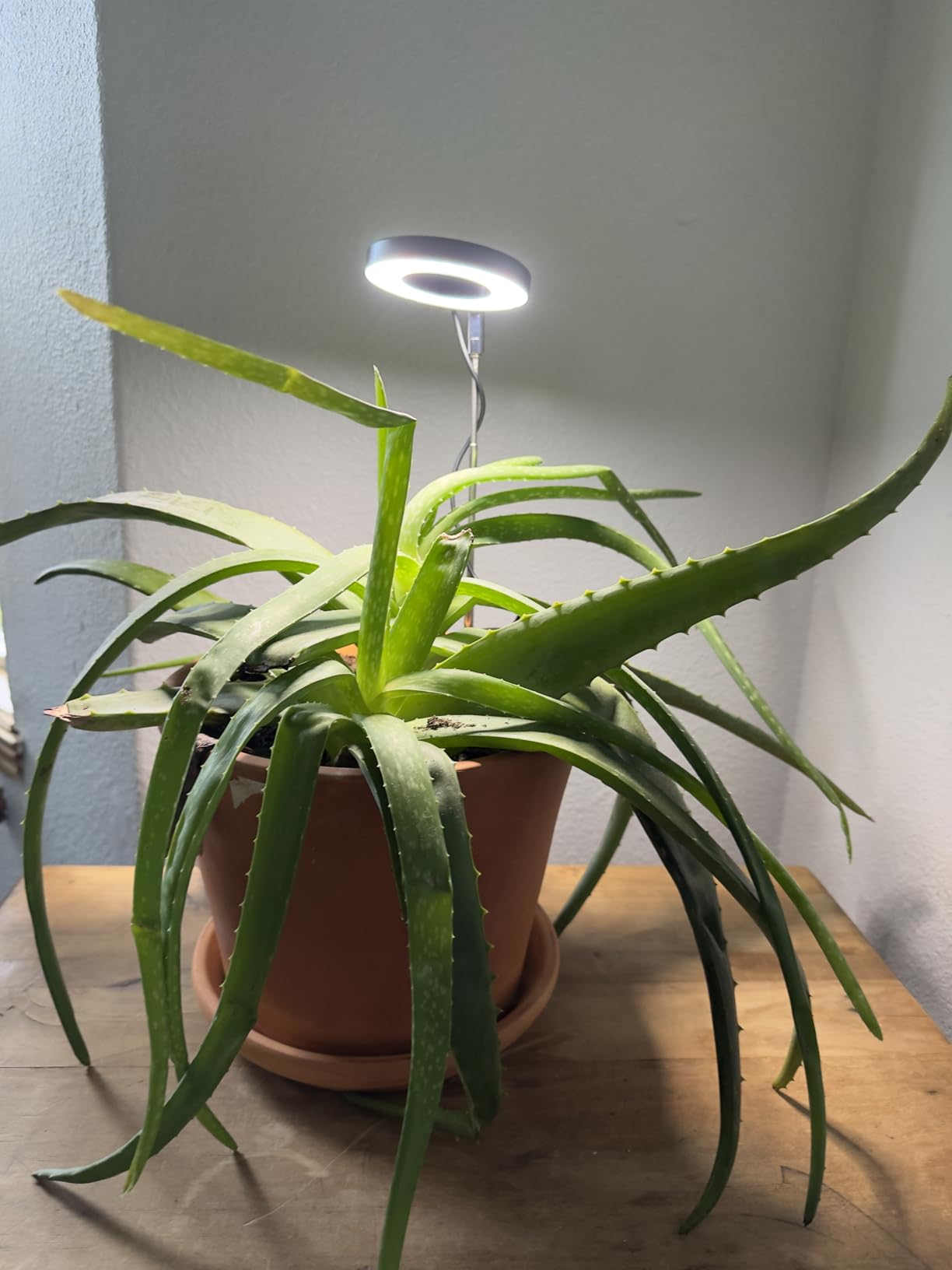
The halo shape is the reason to look at this one. Instead of throwing light down from a single point, the ring distributes it outward and downward, which is what you want when the tray sits at an angle to the lamp or when the canopy is uneven.
It ranks first in its category on Amazon with close to 3700 ratings at a 4.5 average.
Height is genuinely adjustable here. The telescoping pole extends to 26 inches with 90-degree rotation at the head, so you can start a tray at 6 inches and raise the light as the cotyledons expand without rebalancing anything. Three modes and 10 brightness levels give reasonable control over a nine-day cycle.
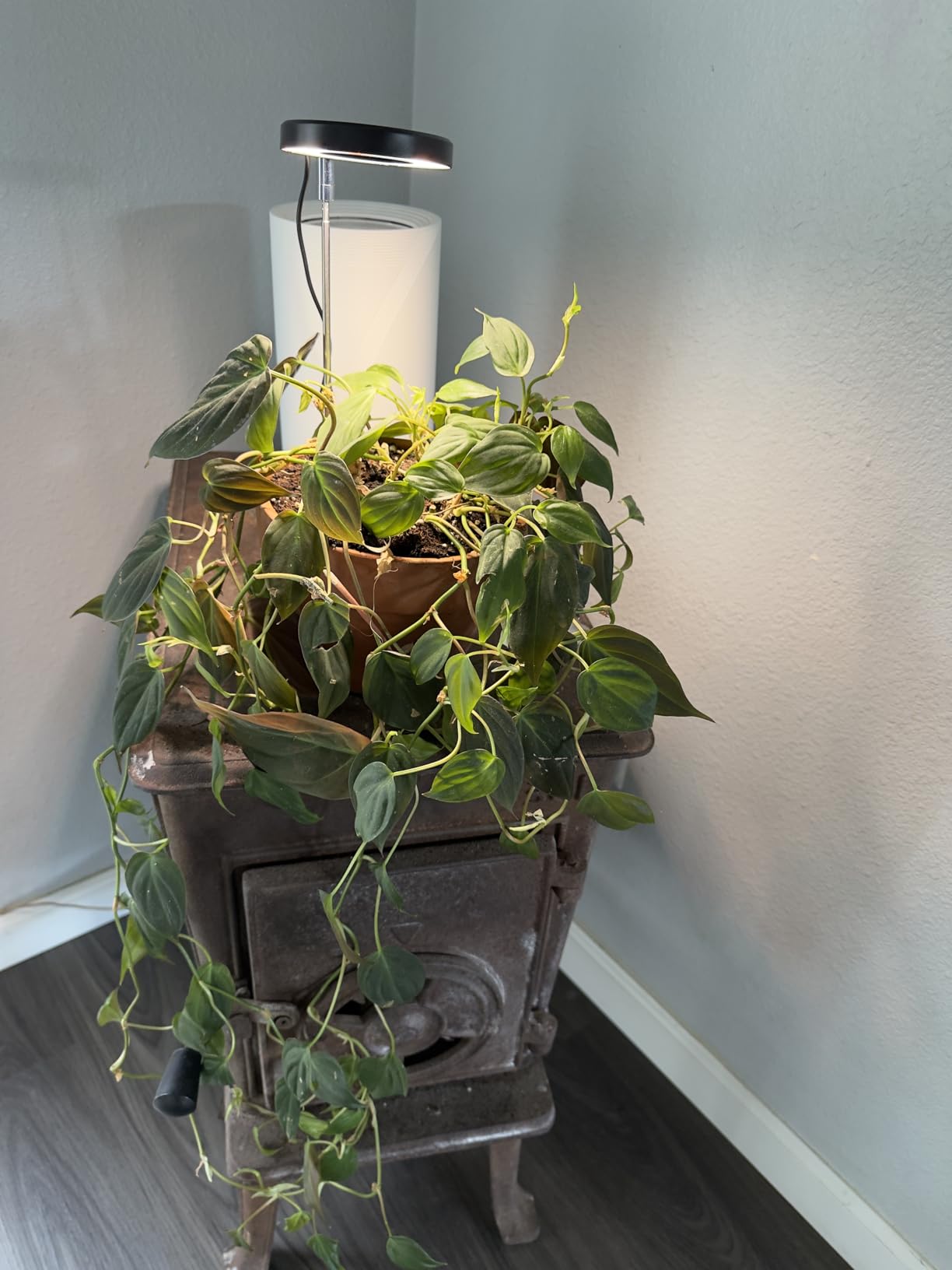
Owners report visible improvement within days on houseplants, carnivorous plants and seedlings in low-light rooms, and the design is unobtrusive enough to leave out on a counter. The three-pack format is the way to cover a small kitchen corner with one lamp per pot.
Stability is the recurring complaint. The supplied base is narrow and light, so pots tip or lean on it, and the head drifts out of position whether you are using the soil spike or the base. In practice the light sways a little each time you move a pot, and you end up re-aiming it every few days.
Where it works best
Countertop grows where appearance matters as much as yield: a kitchen shelf of microgreens in a pot, a windowsill with mixed herbs, or a display of microgreens you intend to photograph or give away. The form factor disappears into a room in a way a bare shop light never will.
It also works as a low-tray light. Because the ring throws light sideways as well as down, a single 10×20 tray sitting at 6 inches gets more even coverage than it would under a bar head.
Where it falls short
It is not a rack light. A telescoping pole that reaches 26 inches tall was never designed to hang under a shelf, and one lamp in some packs had an inconsistent auto on and off function.
Cord length is the other practical issue. It is hard to hide along a wall and often too short to reach a shelf plant, which is where our indoor plant lighting picks get a real edge.
5. Kullsinss 16-Inch Strip Pair – Best Under-Shelf Mount
Kullsinss 16in Grow Light Strips, 2-Bar 120 LEDs Full Spectrum Plant Light
- Fixes leggy tomato and pepper seedlings with even light
- Slim 16 inch bars hide under shelving without taking headroom
- 95 inch cord reaches outlets from most plant stands
- Aluminum housing runs quiet and dissipates heat
- 5 dimming levels plus 3 spectrum modes
- Low measured intensity at close range suits lighter crops
- Manufacturer advises unplugging and resetting every two weeks
- Older and newer controllers use different timer settings
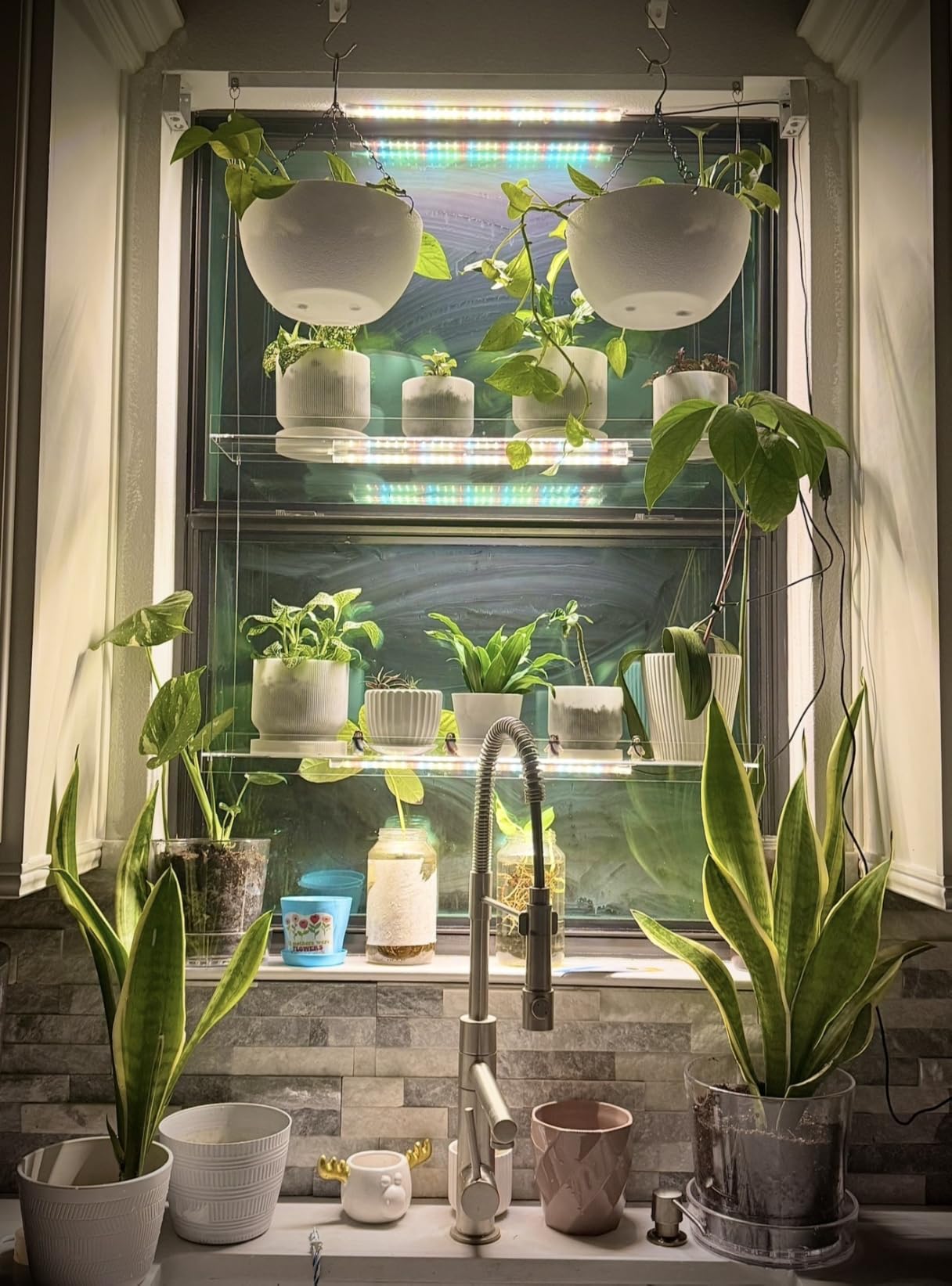
This pair is built for the problem r/microgreens growers complain about most: the light takes up the shelf space you needed for trays. At 16 inches long and about an inch tall, the strips mount to the underside of a shelf or wire rack with the included screws, ties and double-sided tape, and the tray space below stays completely clear.
Each bar carries 60 LEDs, with 120 across the pair, running 380nm to 800nm at a combined 20W. Reviewers report that these strips fixed leggy, weak tomato, pepper, zucchini and cucumber seedlings and restored variegation on houseplants that had faded in a dim room.
The 95-inch power cord is longer than most competing strips and reaches an outlet from almost any plant stand without an extension. The aluminum housing runs quiet, and customer service replaced a defective controller at no cost when it came up.
Two cautions. The manufacturer advises unplugging and resetting the fixture every two weeks to prolong its life, which is an odd instruction but an honest one.
And if your fixture is from an older batch, its controller may use 3, 9 and 12 hour settings while newer ones use 6, 12 and 16 hours, so check which one you have before setting a schedule.
Where it works best
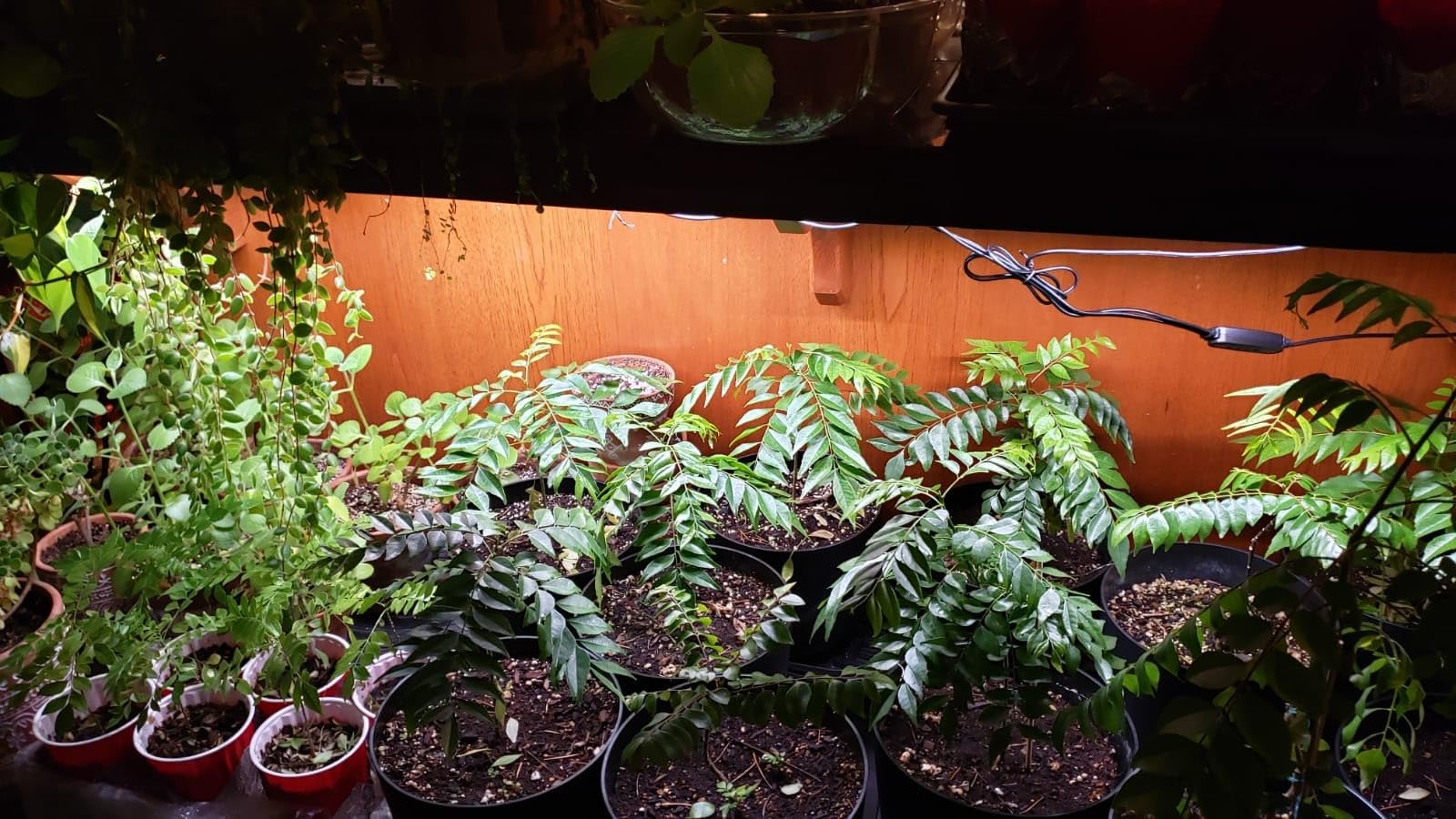
Rack shelves where vertical clearance is the constraint, which is most of them. Two strips per 48 inch shelf covers a 10×20 tray edge to edge, and the 5 dimming levels let you drop the intensity once cotyledons are up.
It is a solid light for a mixed rack of microgreens, seedlings and leafy greens at the same height. Radish, broccoli and lettuce under these strips come out far more upright than the same trays on a windowsill.
Where it falls short
Measured intensity is low at close range, around 2000 lux at 5 cm according to reviewer measurements, so the strips suit low-light plants more than demanding crops. Hang them 8 to 12 inches above the tray rather than pressing them close.
They are not the fixture to grow a heavy sunflower or pea tray under on their own. For those, step up to a fixture with more output and a wider beam.
6. Rocoking 4-Pack Thin Panels – Best for Multi-Tray Racks
- Four panels hide under shelves and cabinets
- Low heat from the aluminum back plates
- 10 dimming levels from 10 to 100 percent
- Reliable 3 9 12 hour cycle timer
- Flexible lengthwise or crosswise layout with included ties
- Lowest average rating here at 4.2 with 9 percent one-star reviews
- Output is weaker than dedicated horticultural fixtures of similar wattage
- Cord and timer wiring are hard to conceal
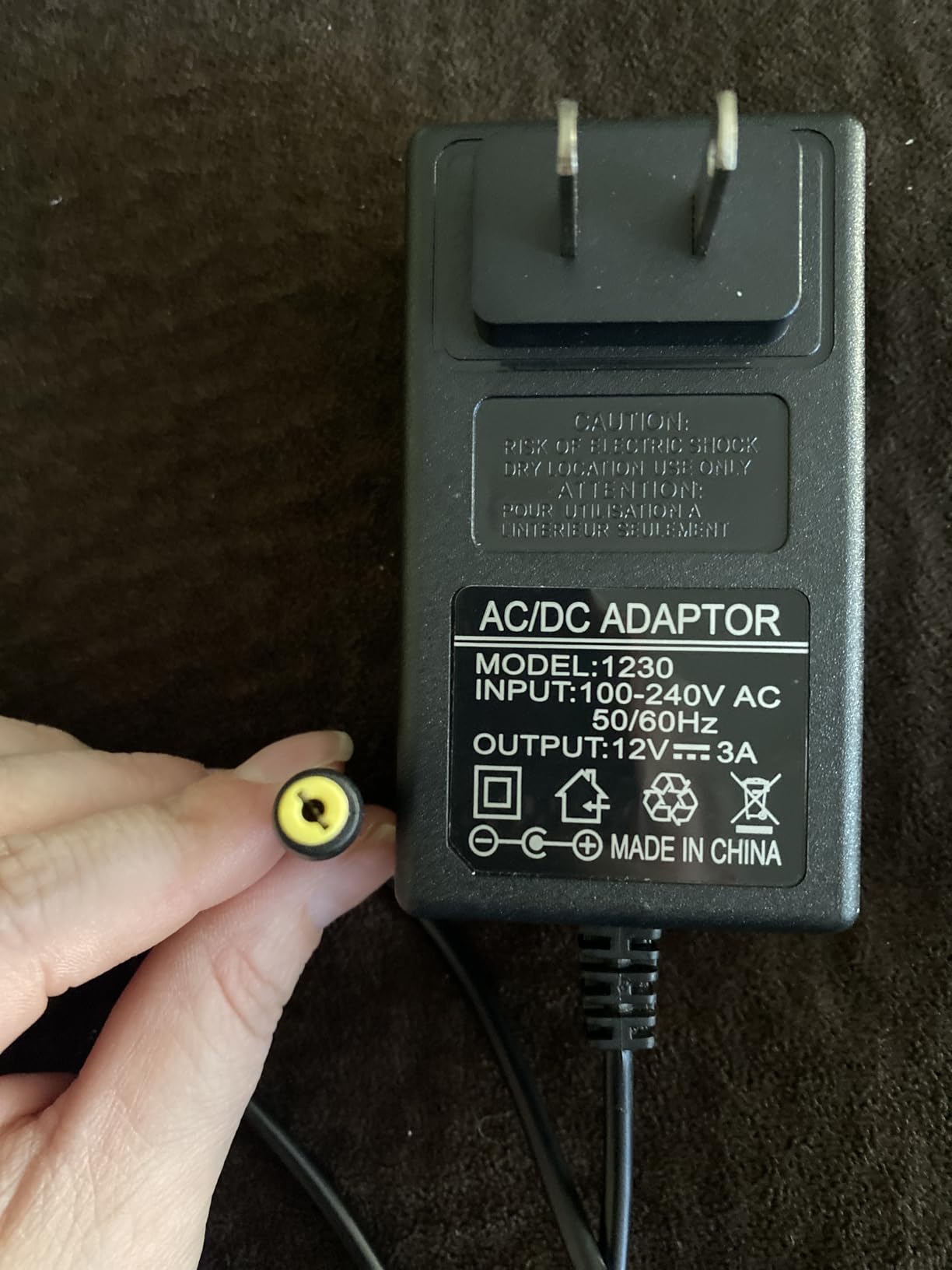
Four ultra-thin panels, each about 0.04 inches thick, is a layout no other light in this list offers. You can tape or zip-tie them in a grid under a shelf, in a row above a rack tier, or along the underside of a kitchen cabinet, and the mounting kit includes 16 zip ties, eight adhesive pads, two power adapters and a 78.74 inch timer cable.
That flexibility is the reason this set earns a place on a multi-tray rack. Two panels side by side cover a 20 inch tray width, and the aluminum back plates keep heat low enough that leaves near the panel do not cook. Output is 6500K, the cool end of the range we recommend.
Honesty about this one: it is the lowest-rated fixture here at 4.2, with roughly 9 percent of reviews at one star. The complaints cluster around two things. Reviewers say the output is weaker than dedicated horticultural fixtures of similar listed wattage, and that the exposed cord and timer wiring are awkward to tidy.
The set sits at a 4.2 average with close to 2100 ratings, so treat the dimming range and timer as the reasons to buy it rather than raw output.
Where it works best
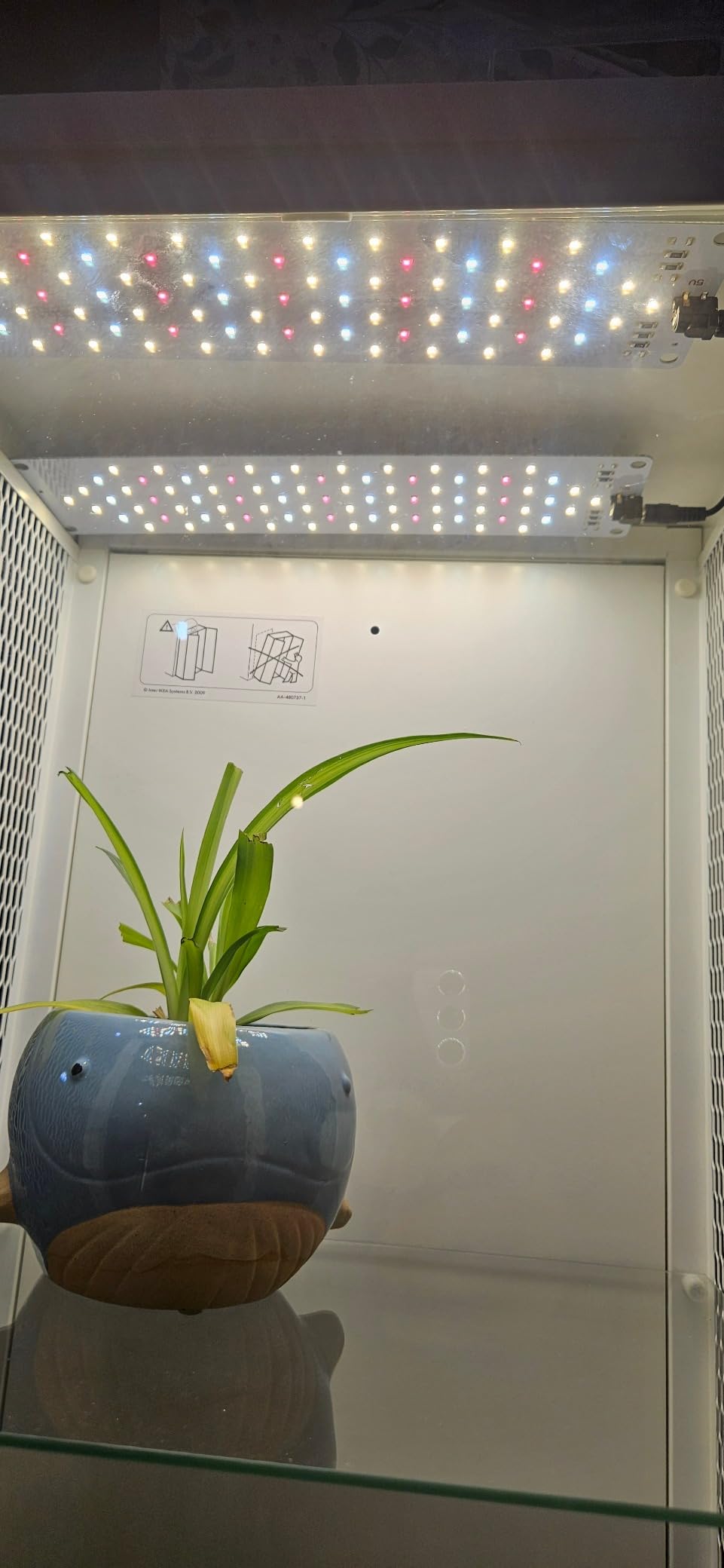
Under-cabinet kitchen setups and racks with deep shelf lips. Because the panels are paper-thin, you lose almost no vertical space, and one set of four can be split across two shelves at 20W each.
It is also the natural choice for a grow tent or greenhouse shelf where you want light from several directions across a wider area rather than one hot spot from a single head.
Where it falls short
Wattage on paper is not the same as delivered light here. For a heavy tray of sunflower or pea shoots, 40W spread across four panels is thinner coverage than you would like.
If your shelves are open wire with no surface to tape to, these are harder to mount than a clip light. Budget for the zip ties and expect to route the timer cable along the shelf frame.
7. Shyineyou Four-Head Clip Light – Best for Desks and Shelves
Shyineyou Grow Lights for Indoor Plants Full Spectrum, 80 LEDs Plant Lights for Indoor Growing with 3/9/12H Timer, 3 Color Modes & 9 Brightness, 4 Heads Clip-On Plant Grow Light
- Four 360-degree heads cover a cluster of small plants from one clip
- 80 LEDs split across red blue and white channels
- 9 dimmable levels from 20 to 100 percent
- Dependable circular memory timer
- Sturdy clamp frees up shelf and desk space
- 400 lumen output is modest next to panel fixtures
- Goosenecks drift out of position after repeated bending
- 15W draw limits intensity on dense seed trays
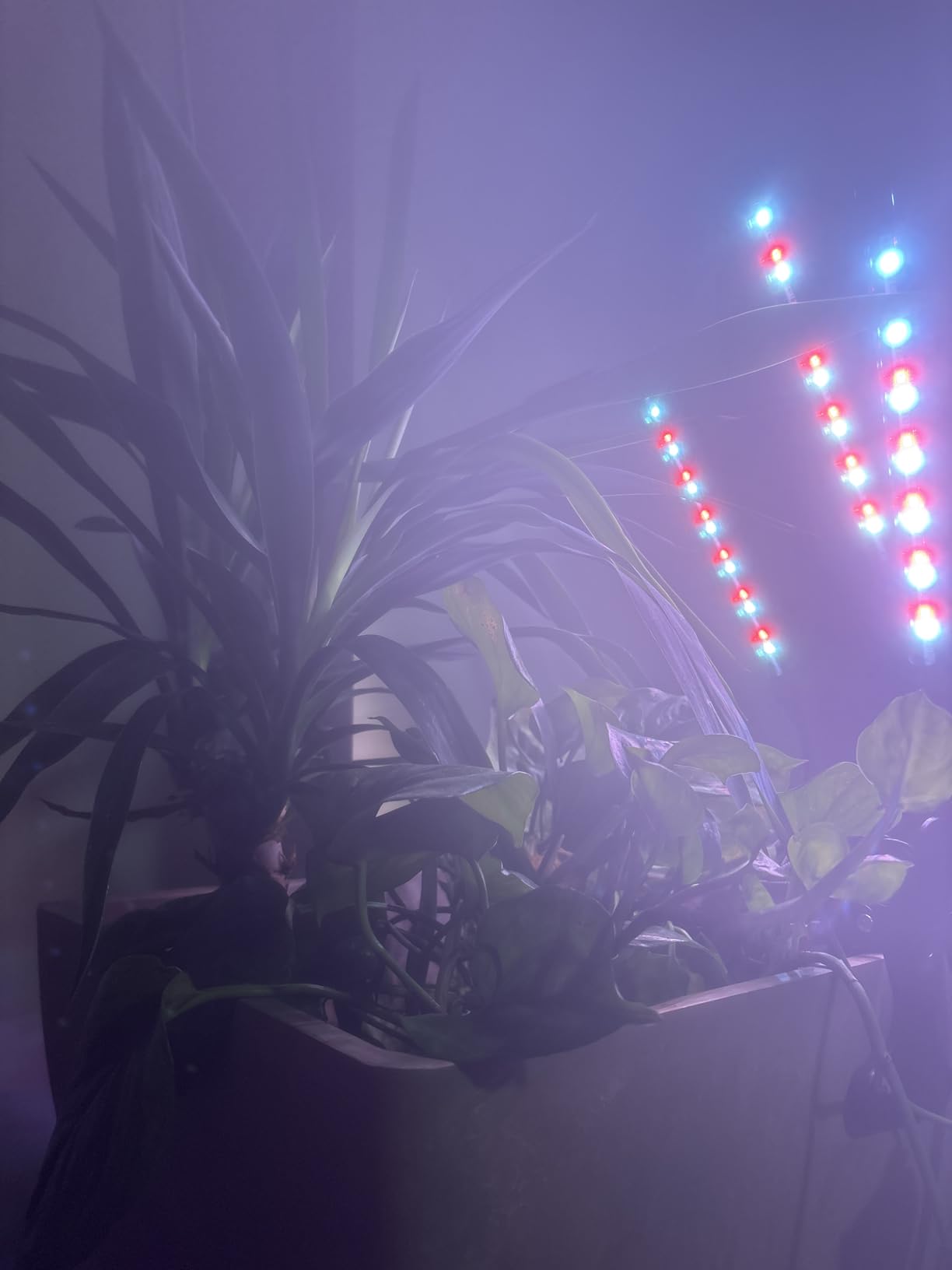
Four heads with 360-degree goosenecks from a single clamp is the layout that makes this light useful in a mixed planting. The LED array is 24 red, 28 blue and 28 white at 6000K with a color rendering index of 90, split across three light modes, and there are nine dimming levels from 20 to 100 percent.
Owners report the four adjustable heads, three colour modes and nine dimming levels as the reason it covers several small plants at once from a single clamp, and the memory timer holds its schedule. Output is 400 lumens from a 15W draw, which makes it better suited to herbs, seedlings and houseplants than to dense, light-demanding trays.
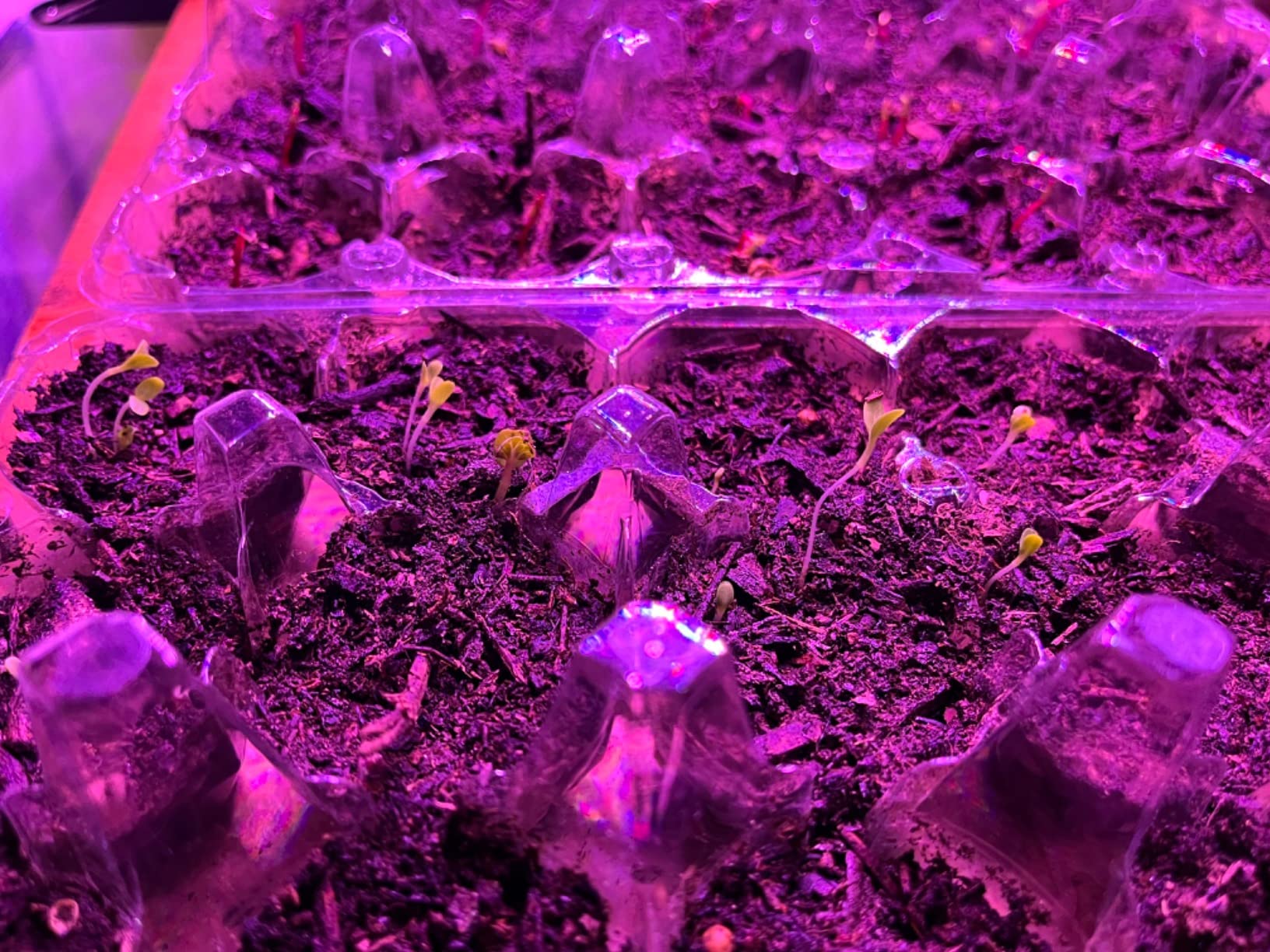
The daily memory timer is reported as dependable, which matters more than it sounds. A photoperiod that drifts by an hour a day produces uneven germination across a rack, and this one holds its schedule.
It also needs no base footprint, so it can hang off a shelf edge where a weighted lamp would not fit.
At 400 lumens maximum output, this is a supplemental fixture rather than a shelf-lighting workhorse. The 15W draw is fine for herbs, seedlings and houseplants, and thin for a dense tray of radish or a heavy sunflower crop.
Where it works best
A home office desk or a single kitchen shelf where a base would take up space you need. Four heads angled at one tray at 6 to 8 inches is a good match for radish, broccoli and cress, which tolerate moderate light well.
It also handles mixed plantings on one shelf: a tray of microgreens plus two or three herb pots, all lit from the same clamp without moving anything when you add a plant.
Where it falls short
400 lumens is the hard limit, and it is the number that matters more than the LED count. If you want one fixture to carry a full 10×20 tray of a light-hungry variety, this is not it.
The goosenecks also drift after repeated bending, so aim them once and check them at the start of each cycle rather than assuming they stayed put.
8. RWNTAO Mini Strip Pair – Best for Tight Spaces
- Compact bars fit corners where longer strips will not
- Four mounting options including screws ties tape and magnets
- Runs cool to the touch and is safe close to leaves
- 10 brightness levels plus a 3 9 12 hour memory timer
- 71 inch cord reaches most outlets
- Bars are smaller than buyers expect
- Fixed cords cannot be unplugged from the light heads
- Warm 3000K output is gentler than a full spectrum
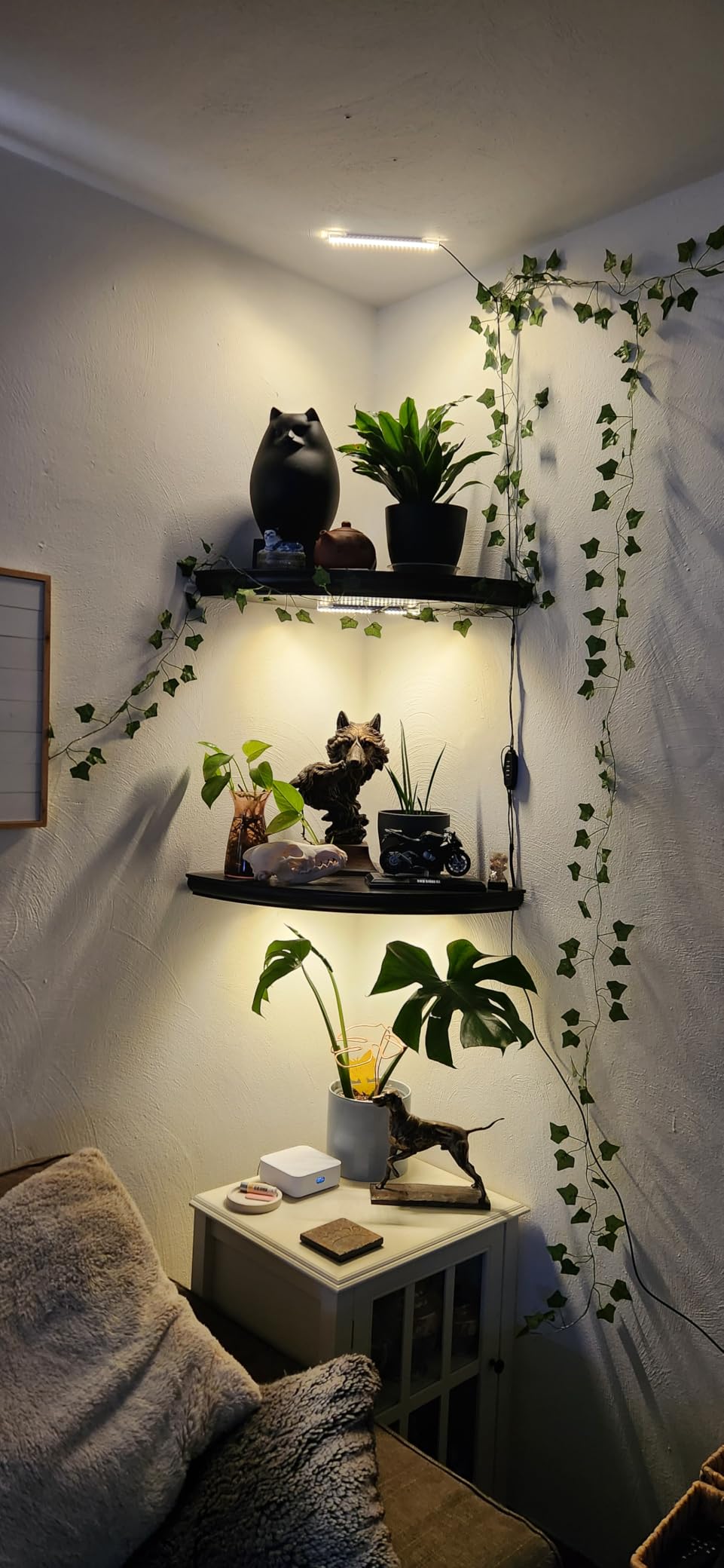
At 8.66 inches long and a third of an inch wide, these strips go where nothing else on this list fits. Each bar carries 26 LEDs for 52 in total, they bend or shape around a shelf corner, and the mounting options include magnets, which is how you light a metal rack without tools.
Owners report noticeable improvement in color and new growth for low-light houseplants, succulents and seedlings within a few weeks, and several mention visible new growth and flowering inside two weeks. For small, low-demand plants that is a real result.
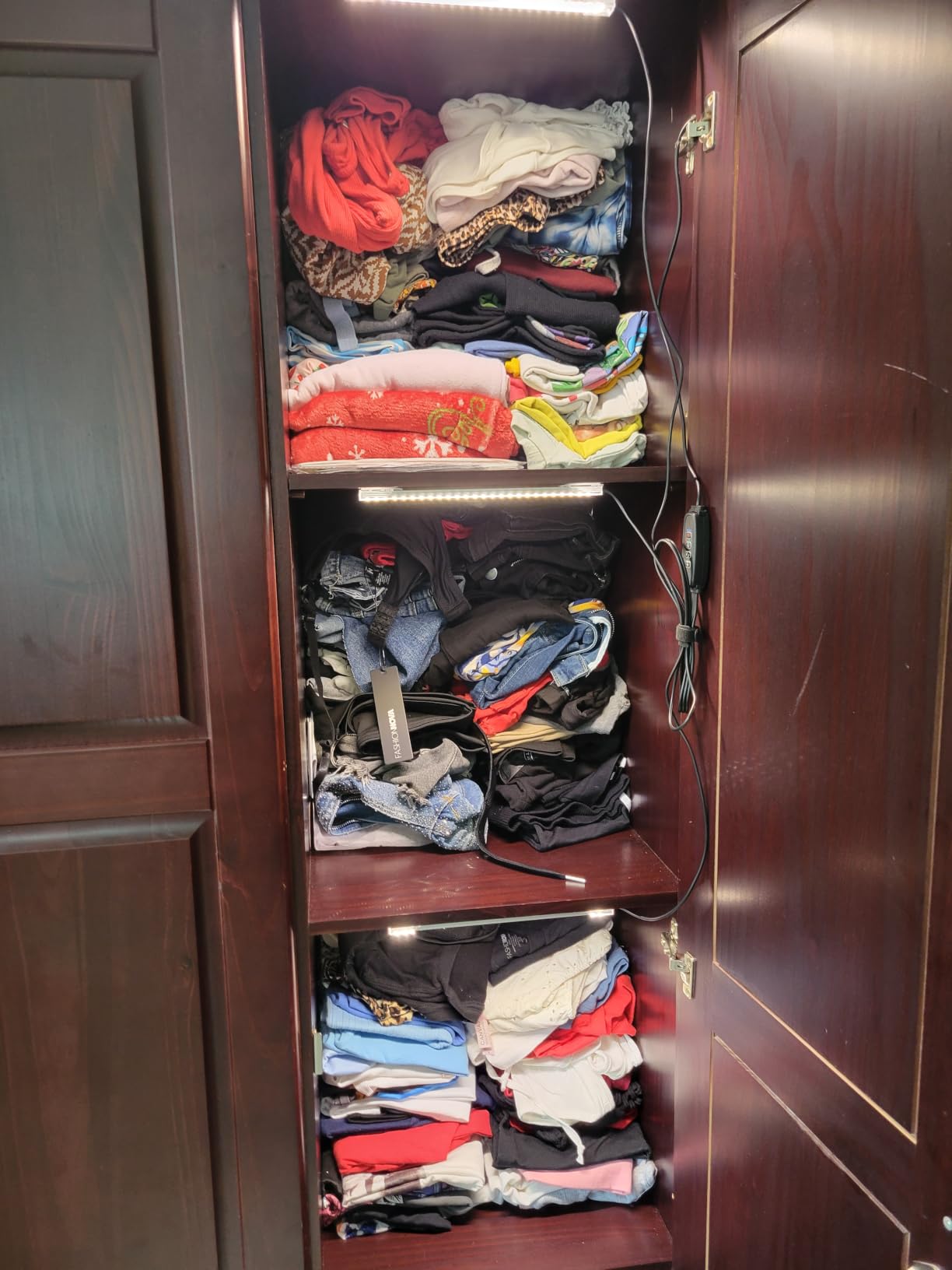
The output is 3000K and 3500K, which is warmer than the 5500K to 6500K we recommend as the target for microgreens. Reviewers describe it as a gentler, more natural sunlight simulation. It is not wrong, but it is the least horticultural spectrum in the set, and the stems it produces are slightly longer than under a cooler light.
The physical design has two sharp edges. The bars are smaller than buyers expect given the LED count, and the cords are fixed to the heads, so you cannot unplug them at the fixture for hanging or tidying.
Plan your cable route before you mount.
Where it works best
Succulents, herbs and small houseplants on shelves where space is genuinely tight, or a seedling shelf in a dorm or small apartment. Magnetic mounting on a steel rack is fast and leaves no marks.
It is a reasonable second light for a rack rather than a primary one. Put it over the shelf that gets the least window light and let a stronger fixture handle the main tray.
Where it falls short
3000K and 3500K is warm. If your goal is short, thick stems and deep color in a fast crop, a 6000K fixture will get there more reliably.
Fixed cords make multi-shelf installations awkward, because each bar has to be positioned around where its cable can reach. If you are building a rack, that is worth knowing before you buy.
9. SYEIORAOM Six-Head Light – Best for Six-Plant Coverage
- Six independently adjustable heads light a whole shelf from one lamp
- 360-degree gooseneck plus telescoping rod for angle and height
- Weighted base stays stable and does not wobble
- Standard 120V plug rather than USB
- Reported good results for seed starting before transplanting
- No built-in timer so you need a smart plug or external timer
- No dimming and no spectrum selection
- Short cord needs an extension on a high shelf
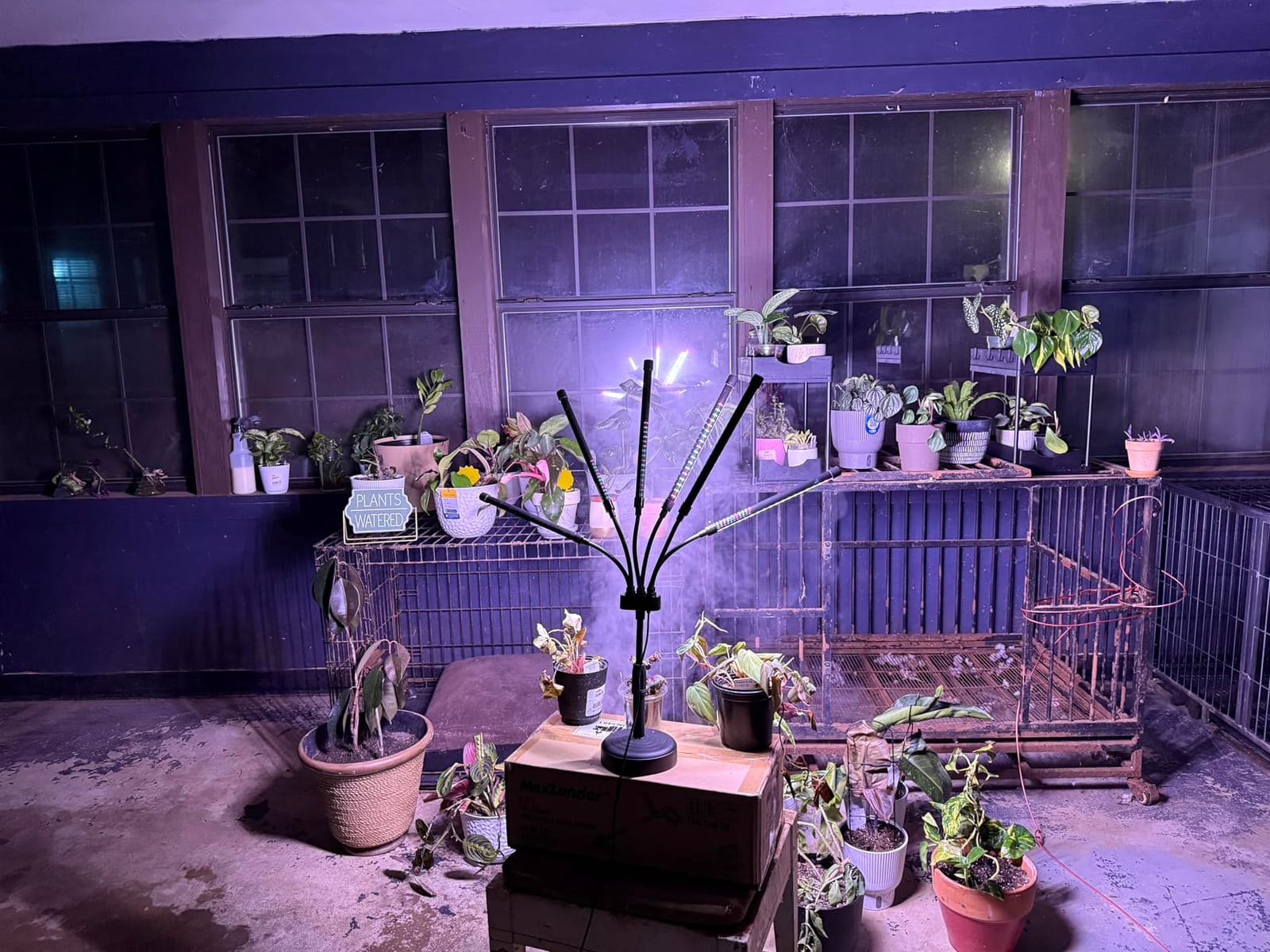
Six heads gives you the widest coverage of any multi-head lamp here. With 108 LEDs, a 360-degree gooseneck per head and a telescoping centre rod, one lamp can light a ring of pots or a full shelf edge with light coming from several directions rather than one angle.
The weighted base is the detail that separates it from similar lamps. At 2.3 pounds it resists wobble and tilt, which is the failure we saw repeatedly on lighter bases that knocked pots over when a gooseneck was moved. Several owners also report successful seed starting before moving seedlings outdoors.
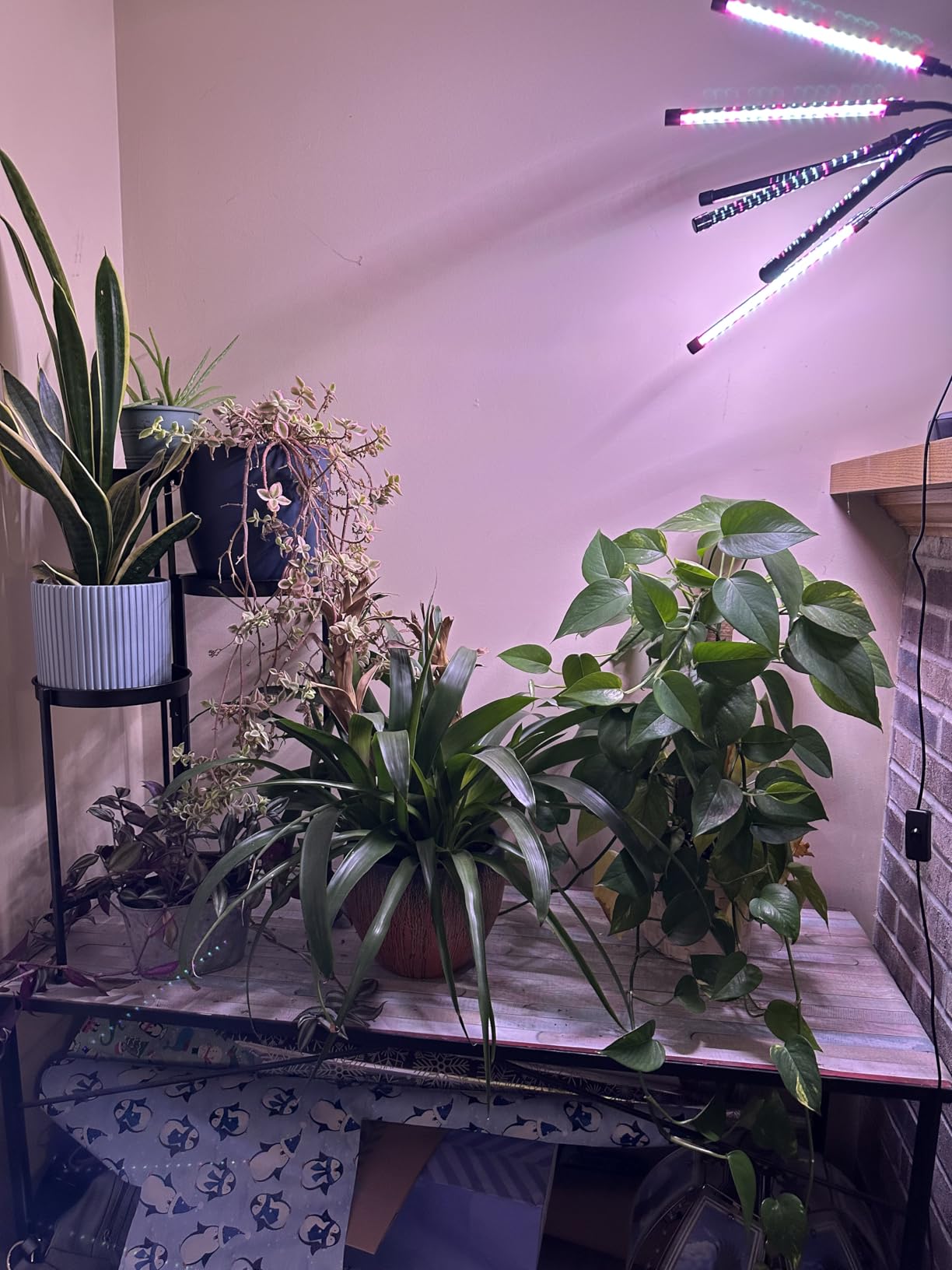
What you give up is control. There is no built-in timer, no dimming and no spectrum selection, and the full channel mix runs whenever the lamp is on.
You need a smart plug or a mechanical timer to hold a photoperiod, and you cannot reduce intensity for a sensitive young tray.
Users accept that trade in exchange for the coverage, and most of them add an external timer. The short cord is the other recurring gripe, and it needs an extension on anything above a low shelf.
Where it works best
A wide windowsill or a low shelf crowded with pots, where six adjustable heads reach further than four can. It is particularly good for mixed plants, orchids and other low-light tropicals alongside your microgreen trays.
For seed starting a whole flat at once, the even multi-direction coverage works well. Because the base is stable, it also works on a floor beside a rack where a clip light cannot reach.
Where it falls short
No timer means it cannot run unattended on a correct schedule without another device. If you already own a smart plug, that is a small extra cost. If you have not, it moves the cost of the setup elsewhere.
No dimming also removes your only defense against light burn. If a pot sits too close to a head, there is no setting to turn down, so keep the recommended 6 to 12 inch distance.
10. LBW 214-LED Desk Panel – Best for Height Adjustment
LBW Desk Grow Light, 214 LEDs Full Spectrum Plant Light for Indoor Plants
- Large 11 by 4.7 inch panel gives bright uniform coverage
- Height adjusts from 10 to 26 inches as plants grow
- Reliable 3 6 12 hour automatic timer
- 6 dimmable levels for sensitive leaves
- Runs mildly warm and stands or hangs under a shelf
- Light base makes multi-head versions tippy and pots can be knocked over
- Short cord needs an extension on higher shelves
- Output is intense enough to scorch leaves placed too close
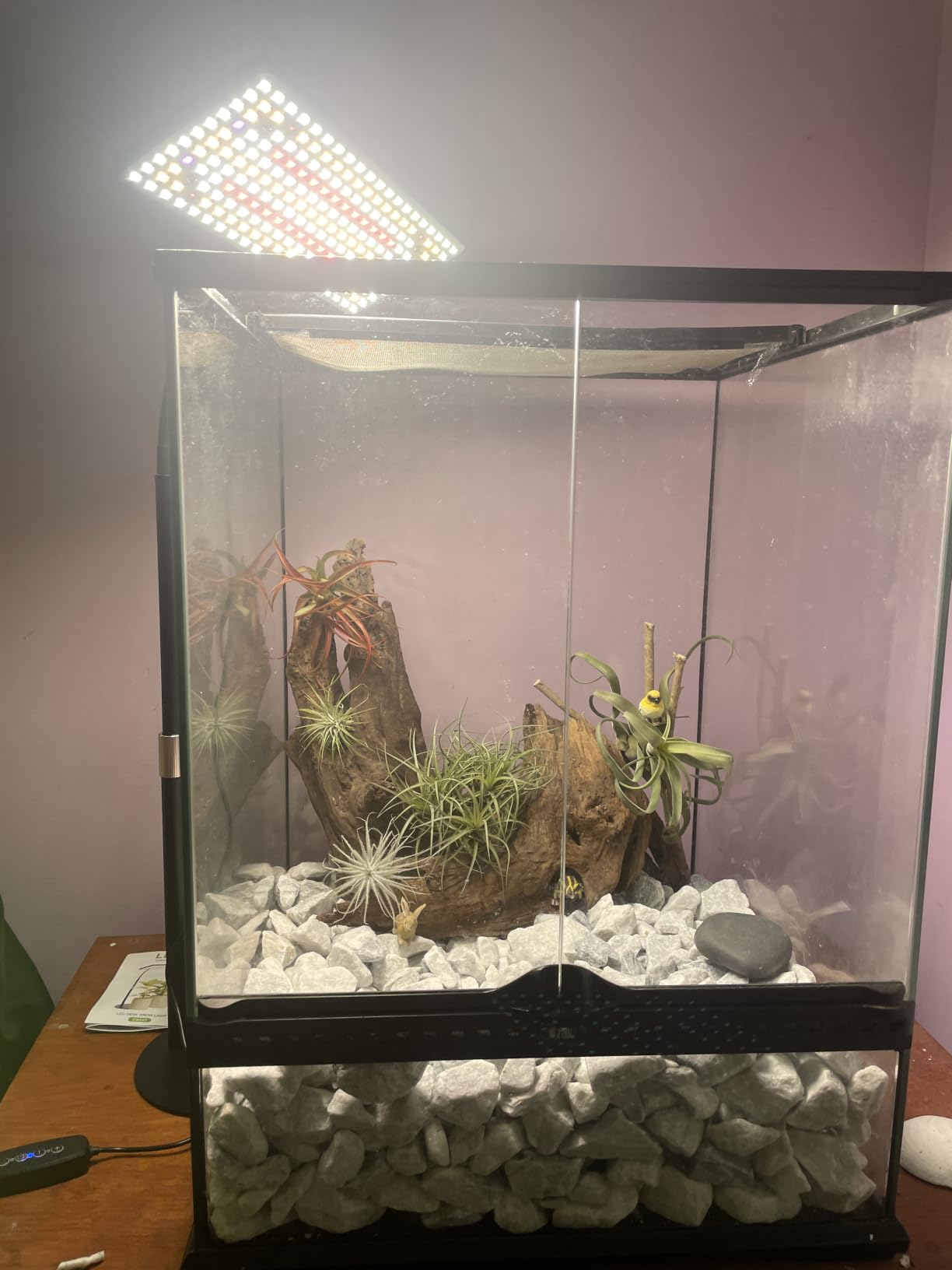
That is the broadest single panel in the group. A 214-LED panel across an 11 by 4.7 inch face at 25W covers a full tray without the hot-spot pattern you get from multi-head arms, and reviewers rate the brightness and uniformity well above cheaper gooseneck lights.
Growth is a documented effect rather than a guess. Owners report revived color, new leaves and successful flowering on plants that had been struggling, and the panel is the one to choose if you already have a rack and want each tier evenly lit rather than spot-lit.
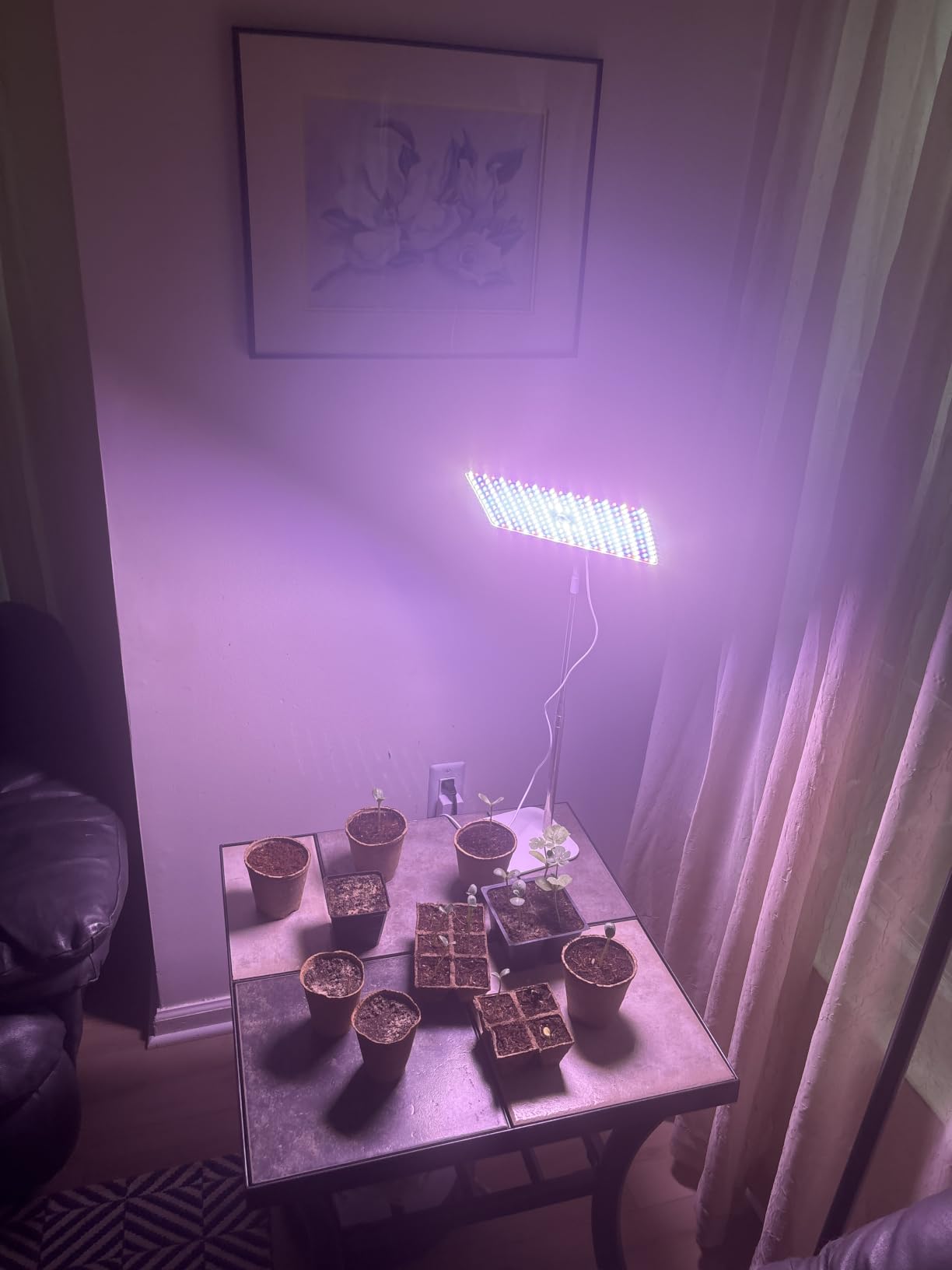
Height adjustment from 10 to 26 inches is the practical winner. You can start a tray at 10 inches and raise the light as the canopy fills out, which is the single most useful thing a microgreen light can do. The 3, 6 and 12 hour timer and 6 dimming levels are both reported as reliable, and the patterned back with heat-dissipating holes extends LED life.
Two cautions from reviews. The base is light enough that multi-head versions tip, and several users had pots knocked over; weighing the base fixes it.
The output is also intense enough to stress or scorch leaves that sit too close, which is exactly the light-burn complaint that shows up repeatedly in grow forums.
Where it works best
Per-tier rack lighting, where even coverage across the full 20 inch tray width matters more than spreading light from a single point. The telescoping range covers everything from a fresh seed tray to a potted herb.
It also stands or hangs. Mount it under a shelf when headroom is tight, then use the dimming to hold intensity steady as the tray grows instead of cranking the light down toward the leaves.
Where it falls short
It is the harshest light here at close range. Respect the 6 to 12 inch mounting height, or drop to the lowest dimming level immediately, because scorched cotyledons do not recover within a nine-day cycle.
The short cord and light base are the two practical complaints. Plan for an extension cord and weight the base before you start a multi-tray rotation.
How to Choose a Microgreen Grow Light?
Color temperature: 5000K or 6500K? This is the question forum growers get stuck on most, and the answer is that the difference matters less than leaving the warm range. 6000K to 6500K is the cool, blue-leaning end that growers report producing the shortest, thickest stems and deepest color.
5000K is slightly warmer and perfectly workable, and many of the lights here sit there. Anything at 2700K or 3000K is a decorative household bulb, not a grow light, and the RWNTAO strips in this list show what you give up.
Blurple versus white. Blurple horticultural lamps are built for flowering crops that stay under lights for months. For a microgreen tray harvested in under two weeks, the extra purple-heavy output does not pay for itself, and a white full-spectrum LED delivers the blue and red bands in one efficient fixture.
Lumens, watts and PPFD, and what each one tells you. Watts tell you what the light costs to run and roughly how much heat to expect. Lumens tell you how bright it looks to you, which is a useful proxy but ignores spectrum. PPFD, measured in micromoles per square meter per second, is the number that actually describes plant photons.
Microgreens are commonly grown at 100 to 300 PPFD at the leaves. Most consumer fixtures here do not publish PPFD, which is why 2000 lumens per 10×20 tray is the practical proxy to shop by.
Fixture type. A bar or strip light mounts under a shelf and covers a tray edge to edge. A clip or gooseneck light needs a lip to grip and shines from a point, so rotate the tray.
A panel light is broad, thin and even but often weaker per watt than its label suggests. A desk lamp with a telescoping pole gives you height control, and a halo ring spreads light sideways as well as down, which suits a tray set at an angle.
Photoperiod and timers. Run 16 to 17 hours on and 7 to 8 hours fully dark. A built-in memory timer is convenient, but check whether it is a repeating interval or a once-per-24-hour cycle, because that difference decides whether you can set a fixed overnight dark period.
Most growers add a smart plug or a mechanical timer regardless, and it makes the setup hands-off.
Dimming. Dimming is not about saving electricity at this scale. It lets you start a tray at low output and raise it as the canopy grows, which reduces light burn and avoids bleaching on sensitive varieties. Fixtures with 6 to 10 levels are more useful here than any single fixture with more power.
Our broader LED grow light guide for indoor gardening covers the fixtures built for mature plants if you plan to keep lettuce and herbs under the same setup, and the herb garden kits with built-in lights are worth a look if you want a self-contained setup instead of a rack.
Mounting, Timing and Troubleshooting Your Setup
Height is the setting you will change most. Mount 6 to 12 inches above the canopy. At 6 inches a light is intense enough to bleach a young tray, and at 16 inches you will get stretched stems.
A telescoping fixture lets you start low and raise the light as the tray fills, which is why the LBW panel and the Aokrean halo are both useful buys.
Scaling to a rack. The rule of thumb from grow communities is 20 to 30 watts per square foot of shelf, with 100 to 300 PPFD at the leaves. For a 48 by 24 inch shelf, that is roughly 20 to 40 watts, which is why a single 20 to 40W fixture covers a two-tray tier.
Add about 30 percent more total wattage for each shelf above the first, because the lower shelf is shaded by the trays above it.
Hold the blackout. Do not turn the lights on until day 3 to 5. Microgreens buried under a weight in the dark push their cotyledons up and shed the seed coat cleanly, and turning on early is a leading cause of stunted, bent trays. This single habit fixes more failures than any light change.
Do not crowd the canopy. If leaves look bleached, papery or crisp at the edges, the light is too close or too strong. Raise it 2 inches, or drop to the lowest dimming level.
One grower in a Savvy Gardening comment thread reported stunted seedlings and light stress after installing two lights per shelf, which is a doubling of intended intensity, not a fault of either light.
Troubleshoot by symptom. Tall, pale, floppy stems mean not enough light, or light too far away, so move it closer or raise the dimming. Leggy growth reaching sideways toward one head means uneven coverage, so rotate the tray or move to a bar.
Pale green with no color development in a warm room usually means a warm-color-temperature bulb rather than a light problem. Mold and a wet mat are a watering issue, not a lighting one, and airflow solves it.
Running cost is not the deciding factor. At 40W for 17 hours a day, one shelf uses about 20 kWh a month. At a typical residential rate, that is a couple of dollars per shelf per month.
Most home setups run 20 to 60W per shelf, so the upfront difference between fixtures matters far more to your budget than the electricity ever will.
Frequently Asked Questions
What type of light is best for growing microgreens?
Full-spectrum white LED lights in the 5500K to 6500K range are best for microgreens. Aim for roughly 20 watts and 2000 lumens per 10×20 tray, mounted 6 to 12 inches above the canopy and run for 16 to 17 hours a day. A bar or strip light mounted under a shelf gives the most even coverage for the money.
Do microgreens need light?
Microgreens need light to photosynthesize once their seed coats are lifted. A bright south-facing window can carry a single tray through spring, but a weak or short-lived window produces tall, pale, floppy stems. Growers moving to a dedicated LED setup report tighter stems and harvests in 7 to 10 days instead of 14 or more.
How many hours of light do microgreens need per day?
Run microgreens for 16 to 17 hours of light followed by 7 to 8 hours of full darkness. Some growers use 14 hours, which produces slightly slower growth but works. The dark period matters as much as the light period, so use a timer rather than switching by hand.
How far should grow lights be from microgreens?
Mount the light 6 to 12 inches above the canopy. Closer than 6 inches risks bleaching and light stress, and further than 16 inches usually produces stretched stems. A telescoping fixture is worth having because you can raise the light as the tray fills out over the cycle.
Can you use shop lights instead of grow lights for microgreens?
Yes. Daylight-spectrum white shop lights in the 5500K to 6500K range grow microgreens well, which is why so many growers use them. The exception is HPS, which adds heat and cost for a crop harvested in under two weeks. A cool white T5 or T8 fixture mounted about 6 inches above the tray is the common setup.
Why are my microgreens leggy and pale?
Leggy, pale stems almost always mean too little light or a light that is too far away. Move the fixture closer, raise the dimming level, or add a second light. If the tray leans toward one lamp, the coverage is uneven and a bar light will fix it better than rotating the tray. Pale color in a warm room can also mean a warm color-temperature bulb.
Final Thoughts on Microgreen Lighting
There is no single perfect light, and anyone selling you one is overselling. For most people growing a tray at a time, the GooingTop 6000K clip light is the one we would buy first, because a 6000K spectrum, 2500 lumens and a clamp that holds its position cover everything a nine-day crop needs. The LEOTER four-head unit is the better choice if you already have a rack and want more coverage per clamp, and the LBW panel is the strongest pick for even, tall racks where every tier needs even light.
Whichever you choose, hold the blackout until day 3 to 5, mount the light 6 to 12 inches above the canopy and run 16 to 17 hours on a timer. Those three habits do more for a harvest than any fixture on this list, and they are what separates the best grow lights for microgreens from an expensive lamp that gets installed badly. Check current prices and pick your setup, then start a tray this week.