
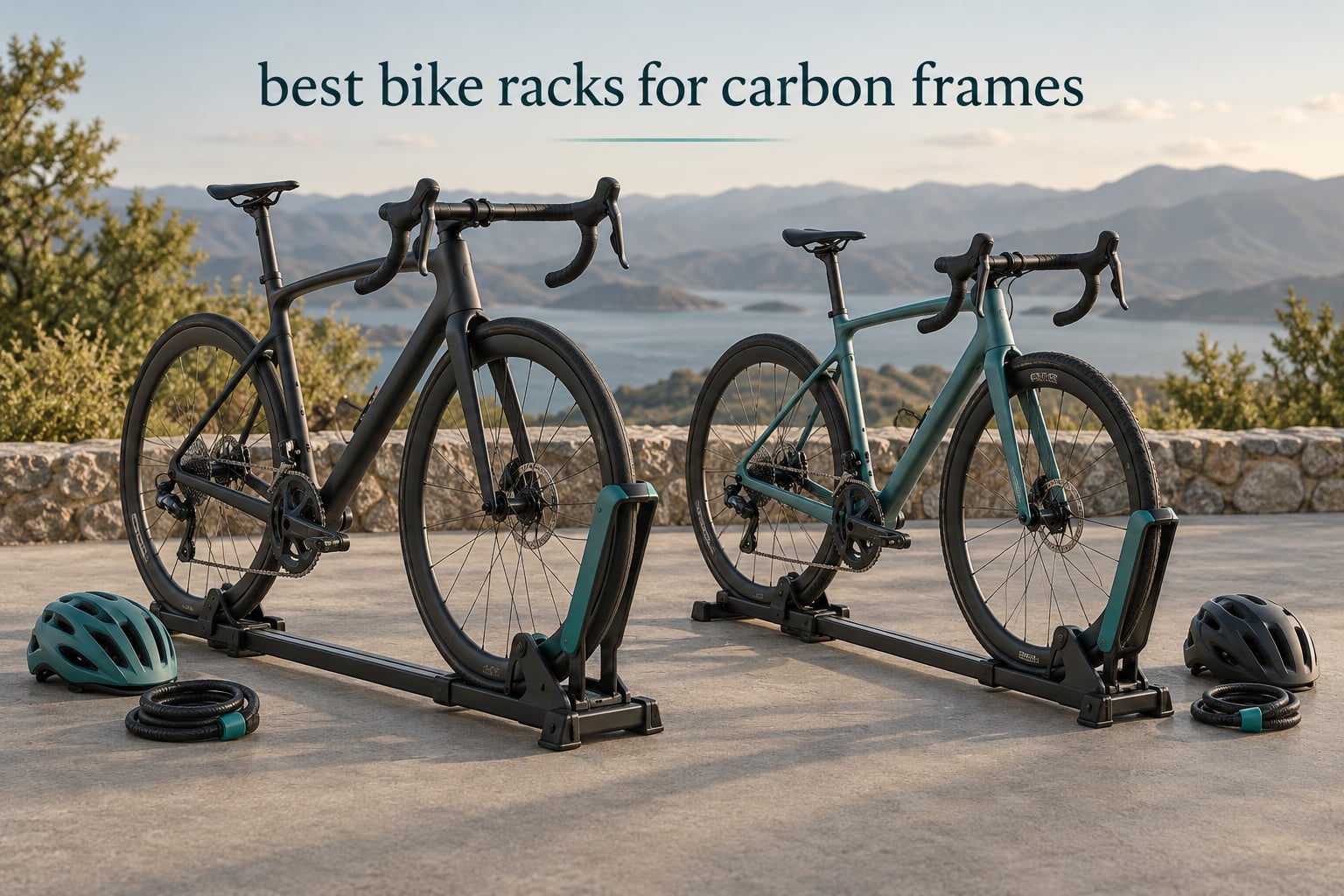
Short answer: yes, you can put a carbon frame bike on a bike rack, but only on a wheel-mounted platform rack. A tray rack grips the front and rear wheels and leaves the carbon frame completely untouched, which is the only mounting approach most riders and mechanics treat as safe. Hanging racks, roof racks with frame clamps, and trunk racks all press on the frame itself.
That single rule decides everything on this list. Every one of the eight racks below holds a bike by its wheels and nothing else, so there is no clamp, no strap, and no foam sleeve between your paint and a load path. We also tracked the details that trip people up: wheelbase limits on long road bikes, receiver size mismatches, per-bike weight ratings, and the racks that look harmless until a four-bike load starts knocking frames together at highway speed.
We spent weeks comparing specifications, owner reviews, and the recurring questions on cycling forums, where owners of expensive carbon bikes tend to be very specific about what touched their frame. If you want the short version, jump to the hitch bike rack guide for mounting basics, or read the verdict in the bike rack roundup if you have not settled on a mounting style yet.
Table of Contents
Top 3 Picks for Carbon Frames in 2026

Kuat Sherpa 2.0 Compact
- Zero frame contact
- Aluminum 32 lb build
- 40 lb per bike
- Foot-assisted pivot

Kuat NV 2.0 1.25 inch
- 60 lb per tray
- Zero frame contact
- Trail Doc repair stand
- Foot and hand pivot

Swagman Quad 2+2
- 2 or 4 bike capacity
- 45 lb per bike
- 20-50 inch wheelbase
- Locking ratchet hooks
Best Bike Racks for Carbon Frames in 2026
| Product | Specifications | Action |
|---|---|---|
| Kuat Sherpa 2.0 Compact |
|
Check Latest Price |
| Swagman Quad 2+2 |
|
Check Latest Price |
| Kuat NV 2.0 1.25 inch |
|
Check Latest Price |
 Thule T2 Pro XT XTR Thule T2 Pro XT XTR |
|
Check Latest Price |
 Hollywood Racks Destination 4 Hollywood Racks Destination 4 |
|
Check Latest Price |
 Yakima HoldUp 2-Bike Yakima HoldUp 2-Bike |
|
Check Latest Price |
 RockyMounts Monorail RockyMounts Monorail |
|
Check Latest Price |
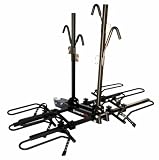 Swagman XTC4 Swagman XTC4 |
|
Check Latest Price |
1. Kuat Sherpa 2.0 Compact – Our Best Bike Rack for Carbon Frames
- Holds bikes by their tires with no frame contact
- Lightweight aluminum build at 32 pounds
- Foot-assisted pivot gives trunk access with bikes loaded
- Adjustable ratchet arm tightens one-handed
- Includes an external cable lock
- Two bikes only with no add-on path in this listing
- 40 lb per tray is low for heavy e-bikes
- Wheels under 24 inch need a separate adapter
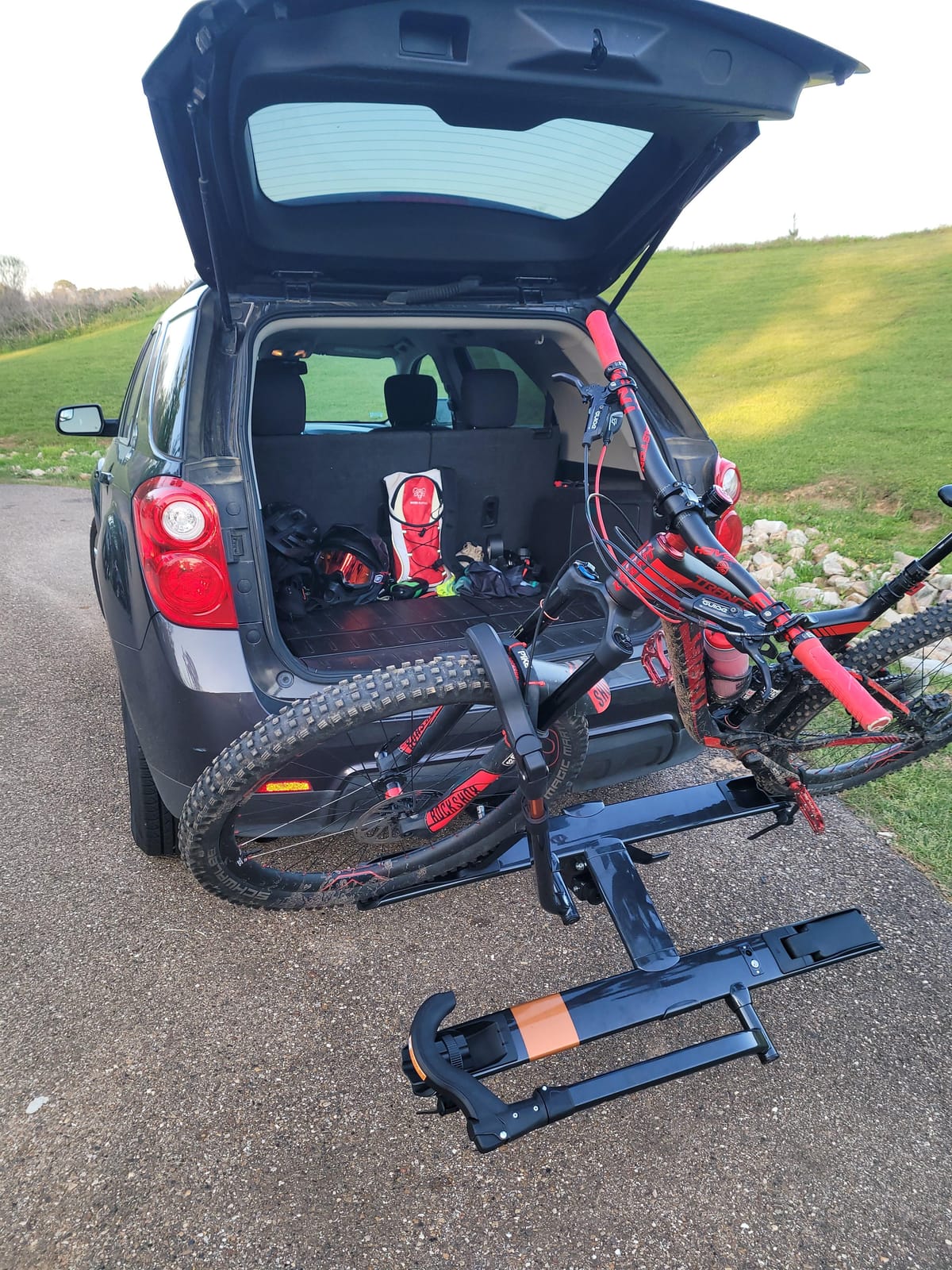
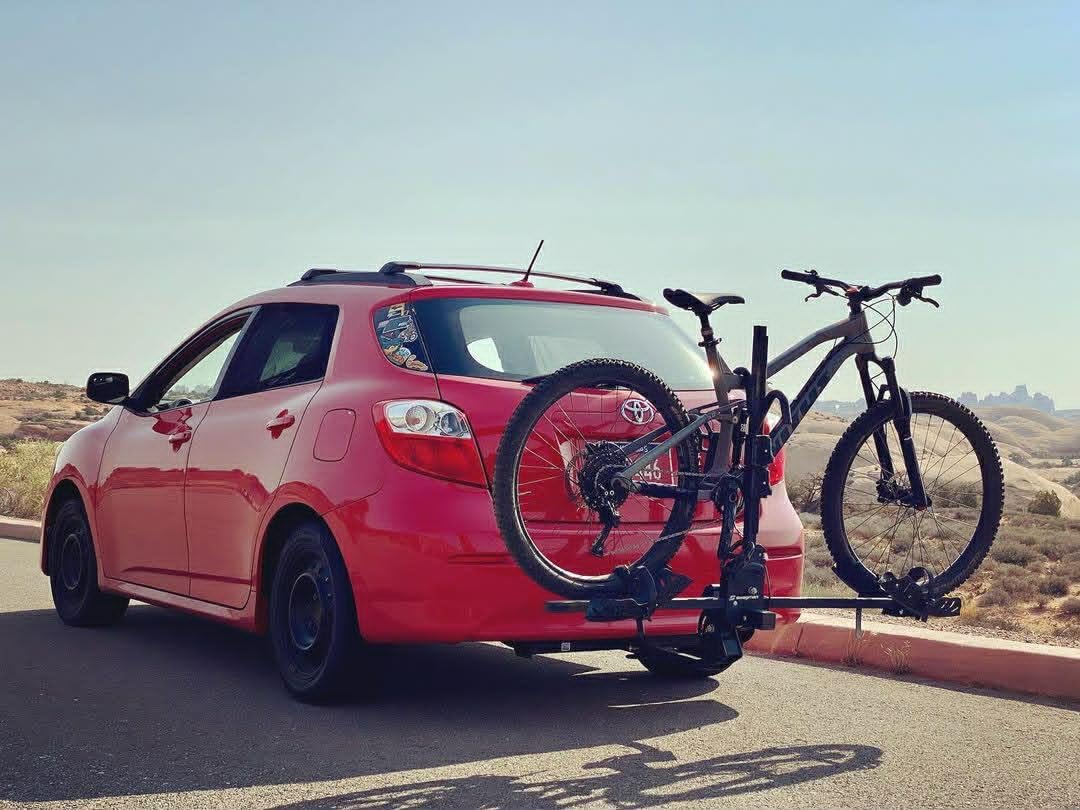
Frame contact: none. The Sherpa clamps the front tire with an adjustable ratchet arm and rests the rear wheel in a foldable cradle, so your top tube, down tube, and seat tube never touch a single part of the rack. That is the whole carbon safety argument in one sentence.
This was the most-reviewed rack in our group at more than 1700 ratings, and the near-unanimous five-star share tracks with what we found in the specs. Owners consistently call out the light aluminum build, one-handed loading, and the absence of paint marks after trips. Several reviewers describe switching to a tray rack after a hanging rack scuffed an earlier frame.
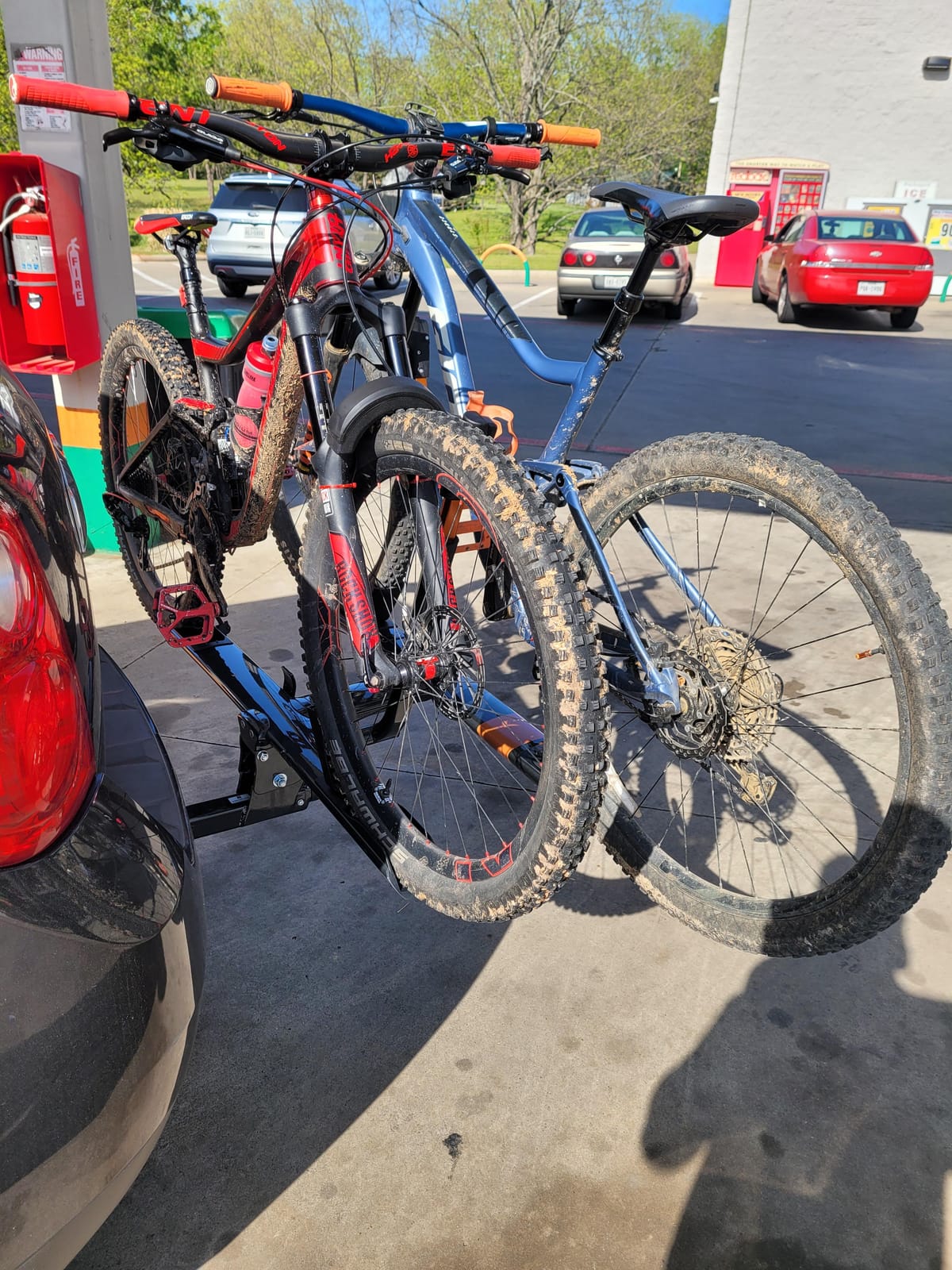
The foot-assisted pivot is the feature that converts this from a good rack into a daily-use rack. You tap the rack down with your shoe and reach the cargo area without unloading anything, then tap it back up. On a lighter rack that matters less, but on a full 2-bike load it saves a genuine argument with a loaded trunk.
Numbers to know: aluminum frame, 32 pounds listed weight, 40 lbs per bike, two bikes with 14 inch spacing, wheelbases up to 47 inches, wheels from 20 to 29 inches, and tires up to 3 inches. The 1.25 inch receiver fit is listed here, and 2 inch variants of the same model exist separately.
Will a long road bike fit without touching the frame?
The 47 inch wheelbase ceiling covers nearly every road bike, including large frames, but check your measurement if you ride an XL geometry. The ratchet arm grips the tire rather than the fork crown, so a long head tube does not create a contact point.
Wheels between 20 and 24 inches require the optional wheel adapter. If you also carry a kid’s bike or a small-wheeled folding bike, budget for that extra part or choose a rack that covers the full range.
What is the catch with the Sherpa?
Two bikes is the limit in this configuration, and 40 lbs per bike is modest next to racks rated at 60. If you plan to haul a heavy e-bike alongside your carbon road bike, the capacity shortfall matters more than the weight of the rack itself.
2. Swagman Quad 2+2 – Best Value for Families Carrying Four Bikes
- Removable outer section converts 2-bike to 4-bike use
- 45 lb capacity per bike handles a wide range of bikes
- Padded locking ratchet hooks hold bikes firmly
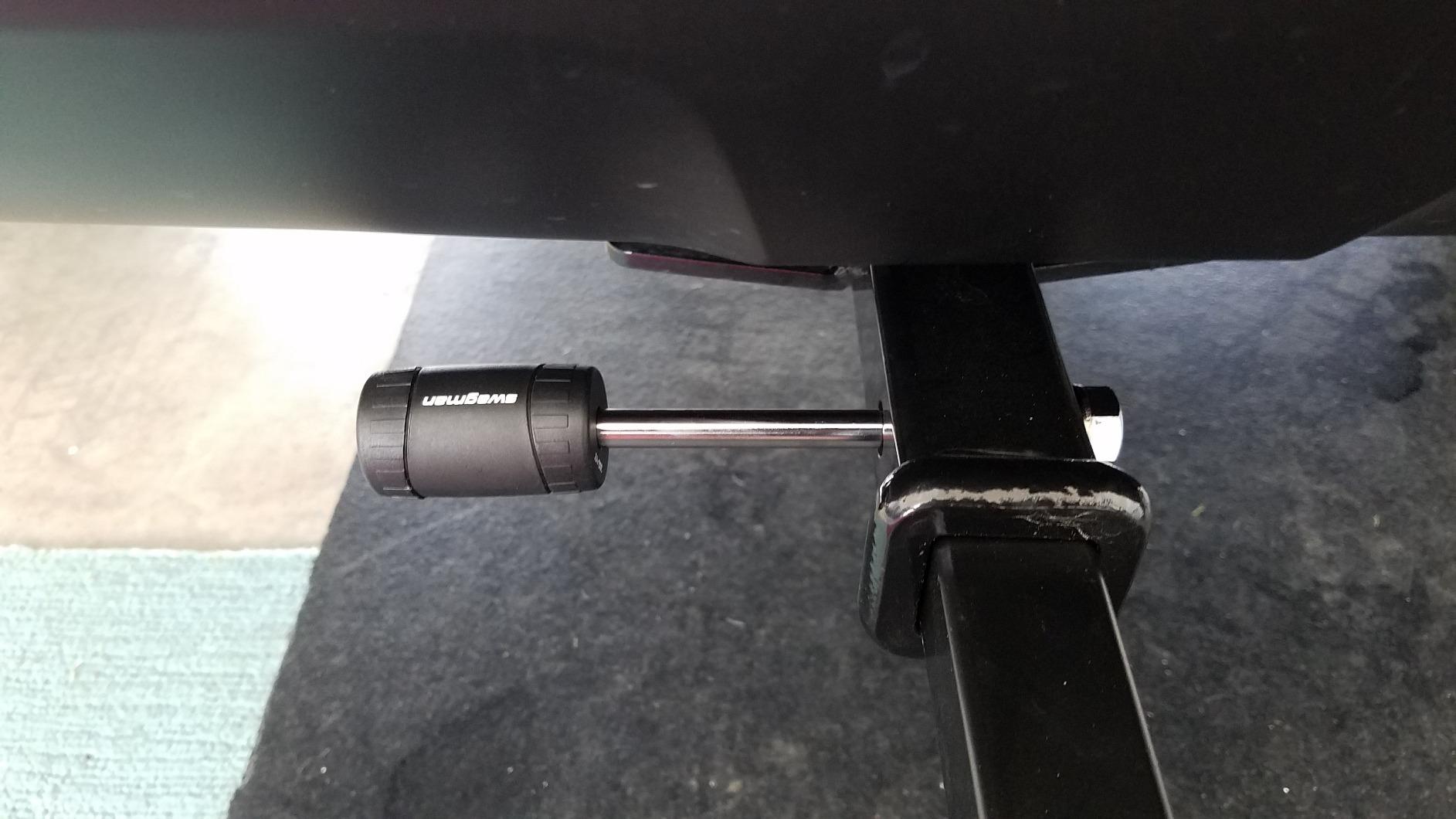
- Locking hitch pin doubles as an anti-rattle device
- Folds flat by pulling a single pin
- Heavy at 81 pounds so removal takes two people
- Not compatible with 1.25 inch receivers
- Steel construction adds weight next to aluminum racks
Frame contact: none. The Quad carries each bike on individual wheel trays with padded locking ratchet hooks on the front tires, which is the same carbon-safe architecture as the Kuat and Thule racks above it.
The reason this rack earns a place is range rather than refinement. Sliding wheel trays accept 20 to 29 inch wheels, wheelbases from 20 to 50 inches, and tires up to 3 inches, so a 56 cm carbon road bike, a mountain bike, and a kids’ bike can share one carrier. The 20 to 50 inch wheelbase window is the widest here, and that is exactly where long road bikes fail on shorter racks.
Owners frequently single out the locking hitch pin, which stops the rack rattling inside the receiver as well as locking it. A rack that quiets down at speed is easier on the bikes and easier on the ears, and the folded profile keeps the rack tucked close to the vehicle on days you are not carrying anything.
Two things to plan around. It is 81 pounds of steel, so lifting it on and off the hitch is a two-person job, and it requires a 2 inch receiver with no adapter path. Measure your receiver before you commit.
How do four bikes fit without knocking together?
Offset the bikes in an alternating pattern. Handlebar, saddle, and pedal interference between neighbouring bikes is the usual complaint on any full four-bike load, and staggering the load keeps frames from touching on rough roads.
The ratchet hooks are padded, so even in a tight arrangement the contact points are rubber against tire, not metal against paint.
Is the extra capacity worth the extra weight?
If you carry two bikes most of the time and only need four for holidays, remove the outer section and run it as a 2-bike rack. You keep the ratchet hooks and tray design and drop roughly half the weight.
3. Kuat NV 2.0 1.25 inch – Top Rated for E-Bikes and Heavy Rides
- Highest rated rack in the group
- 60 lb per tray handles heavy e-bikes
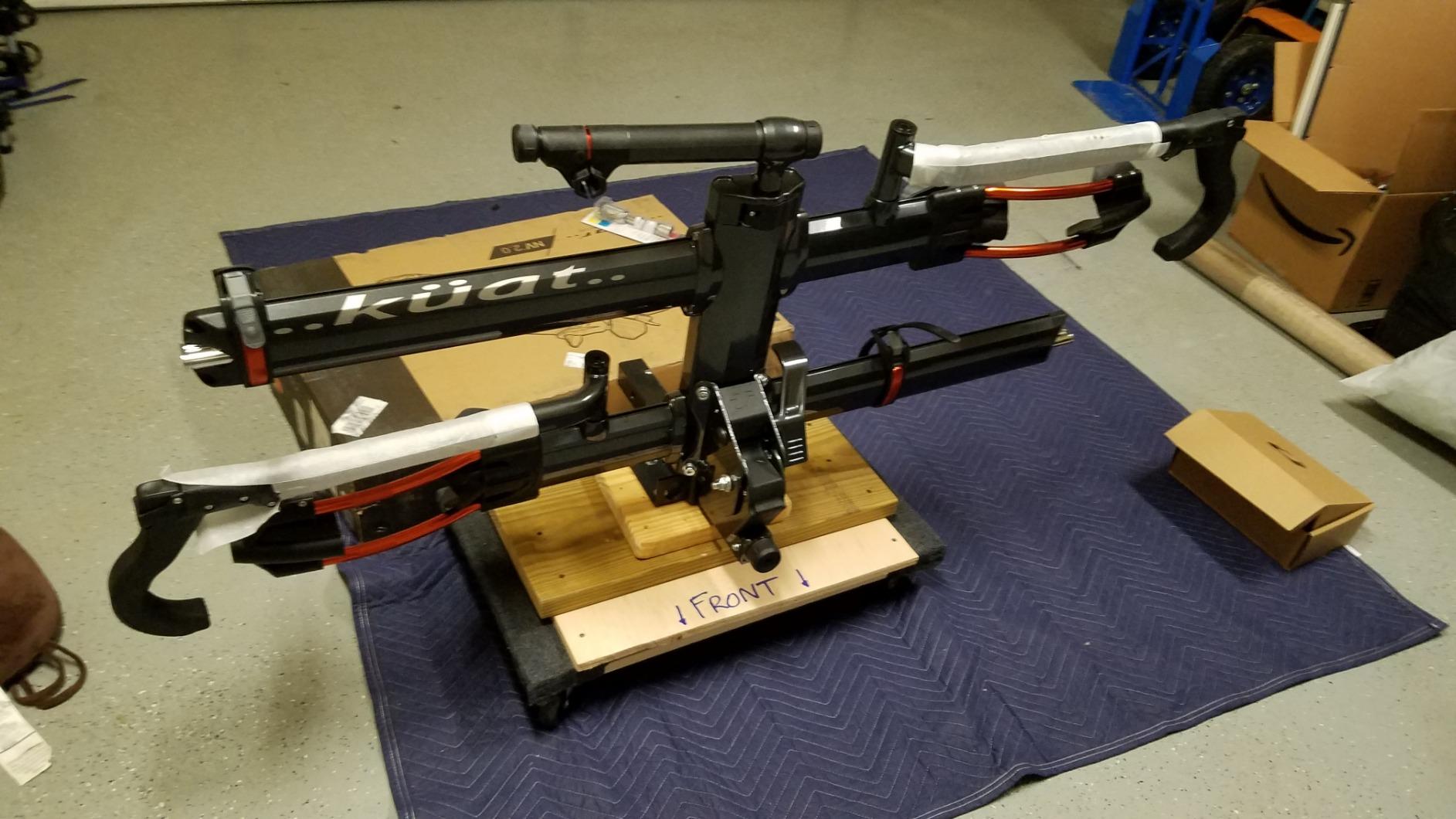
- Integrated Trail Doc repair stand folds out roadside
- Foot and hand pivot tilts with bikes loaded
- Owners report no sway at highway speed
- Very heavy
- a two-person job to install and tilt
- Partly blocks the backup camera
- Add-on kits are receiver-size specific
Frame contact: none. The NV is a tray rack with a front wheel clamp and rear cradles, and one owner we found reports that a previous hanging rack damaged their carbon frame while this one produced no rubbing at all. That is the pattern the whole category is built around.
At 4.8 stars across more than 1200 ratings, this is the highest-rated rack in the group and the one reviewers describe as overbuilt relative to cheaper alternatives. The 60 lb per tray rating is the useful headline for carbon owners, since plenty of modern road and gravel bikes with big bottles, bags, and discs sit well above 40 lbs.
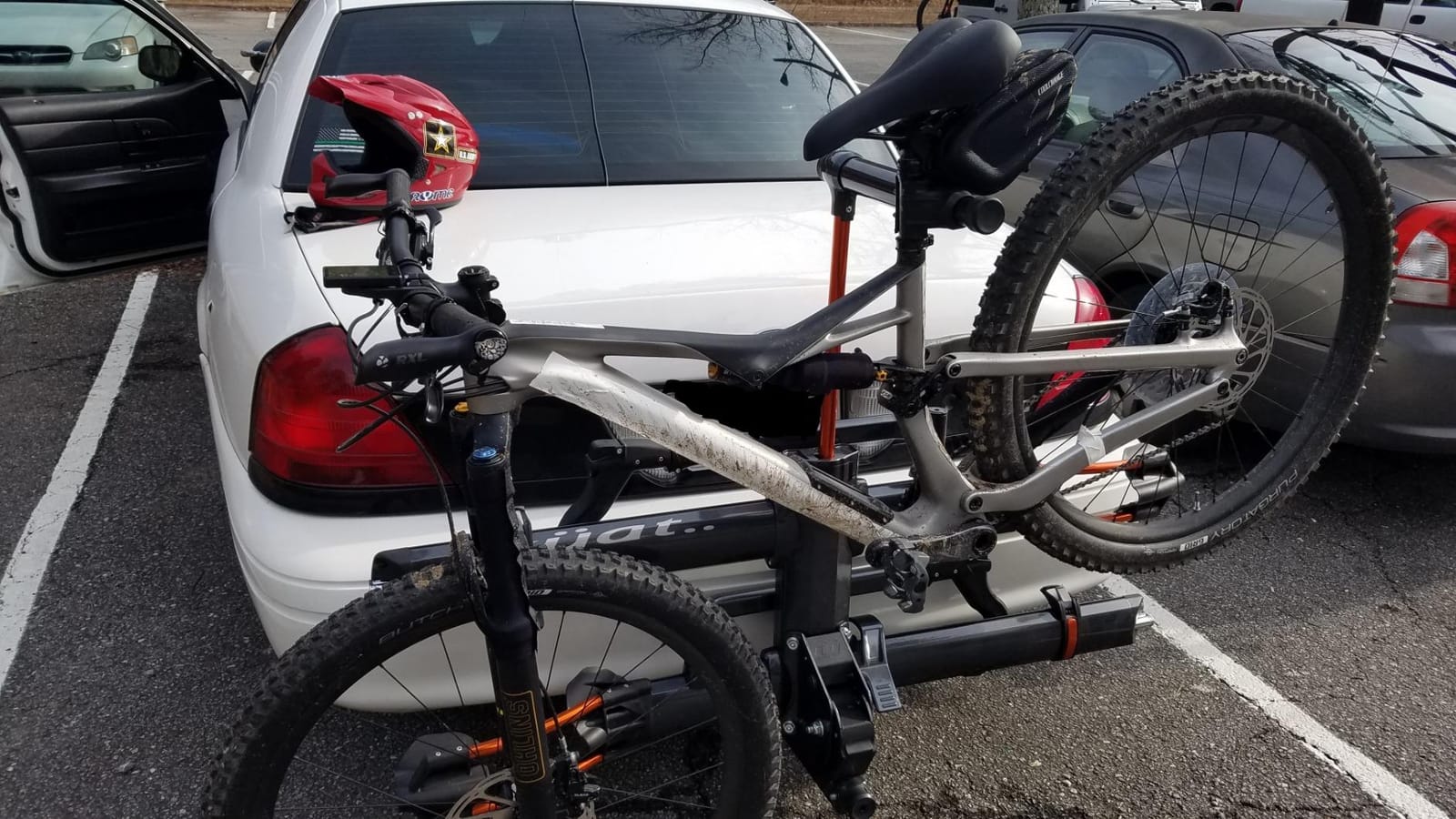
The Trail Doc repair stand is the detail nobody expects to care about and then uses constantly. It folds out of the tray and holds the bike at working height, so a roadside chain adjustment, brake bleed, or tubeless plug does not happen in a parking lot next to a car. Fat tire kit included, and the adjustable front cradle takes varied wheelbases without letting the front wheel wander.
Both the foot and hand pivot let you tilt the loaded rack down for rear access or fold it up when it is empty, which is genuinely useful on a carbon bike because you are not unloading it to reach the hatch.
Is it worth the weight for a carbon road bike?
Only if you also carry an e-bike or haul two bikes. For a single lightweight carbon road bike, the Sherpa’s lighter build is the better daily tool and this rack is overqualified.
Budget for the install. Owners consistently describe lifting it onto the hitch, and tilting it down with bikes loaded, as a two-person job.
What does a 1.25 inch receiver limit?
You lose nothing in per-bike capacity, since both receiver sizes carry the same 60 lb per tray. You do lose interchangeability: the add-on kits and accessories are receiver-size specific, so parts for one version do not fit the other.
4. Thule T2 Pro XT XTR – Best for Wide Tires and Future Expansion
- Thule names carbon frames as an intended use
- Handles tires up to 5 inches without adapters
- 12.5 inch tray spacing with side-to-side adjustment
- HitchSwitch lever tilts the rack with bikes loaded
- AutoAttach tool-free installation
- 6 percent one-star rating
- the highest share here
- Heavy at 52 pounds
- 4-bike add-on works only with a 2 inch receiver
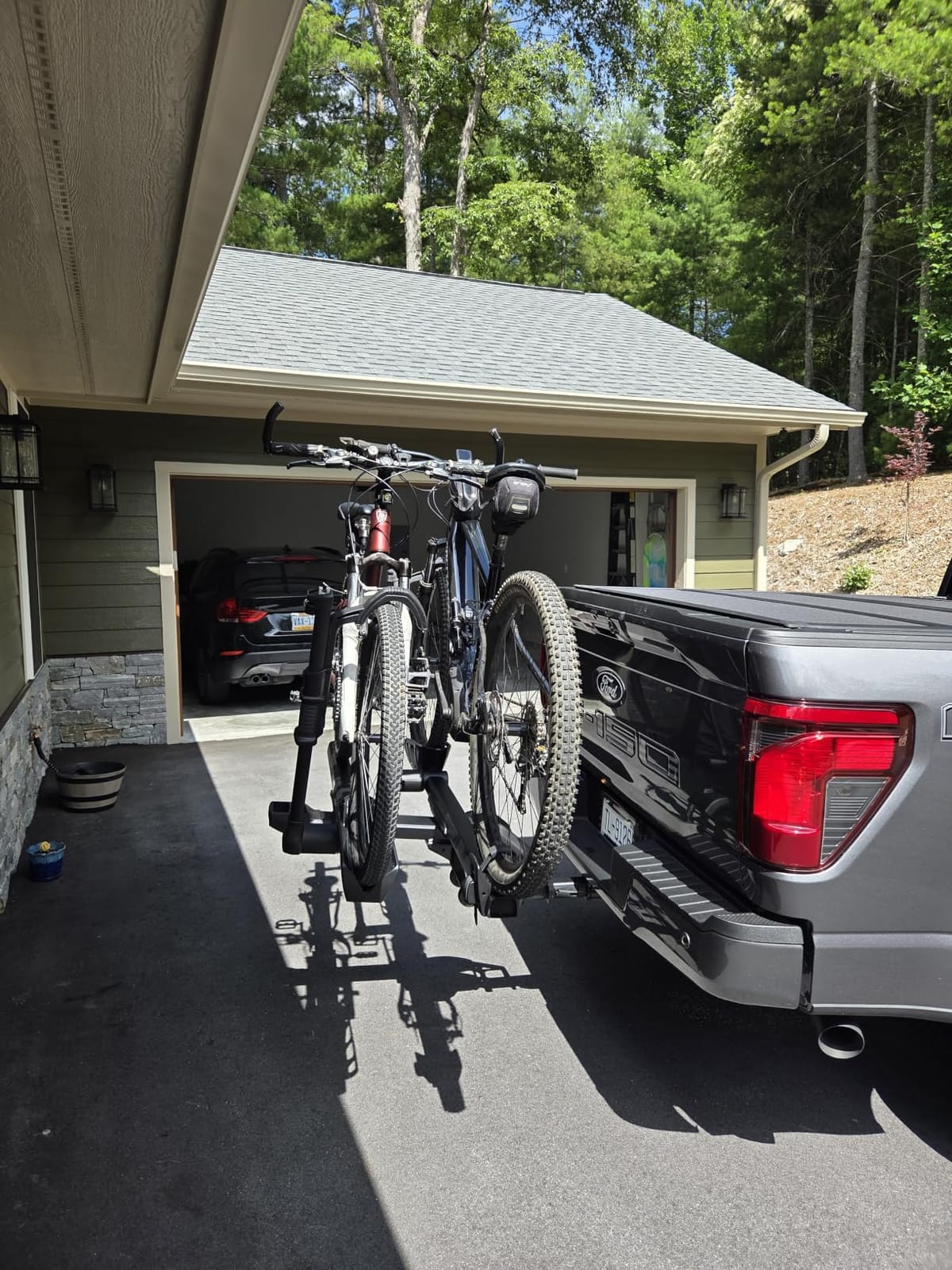
Frame contact: none. Thule designs this one around zero frame contact and names carbon frames in the intended use, so you are not inferring safety from marketing silence. Bikes sit on wheel trays while a front clamp holds the tire.
The distinguishing spec is tire width. It accepts tires up to 5 inches without adapters, which covers wide gravel, plus, fat, and downhill rubber, and 60 lb per bike covers most of those machines. For a carbon owner who also owns a carbon mountain bike, that combination is rare in a compact two-bike footprint.
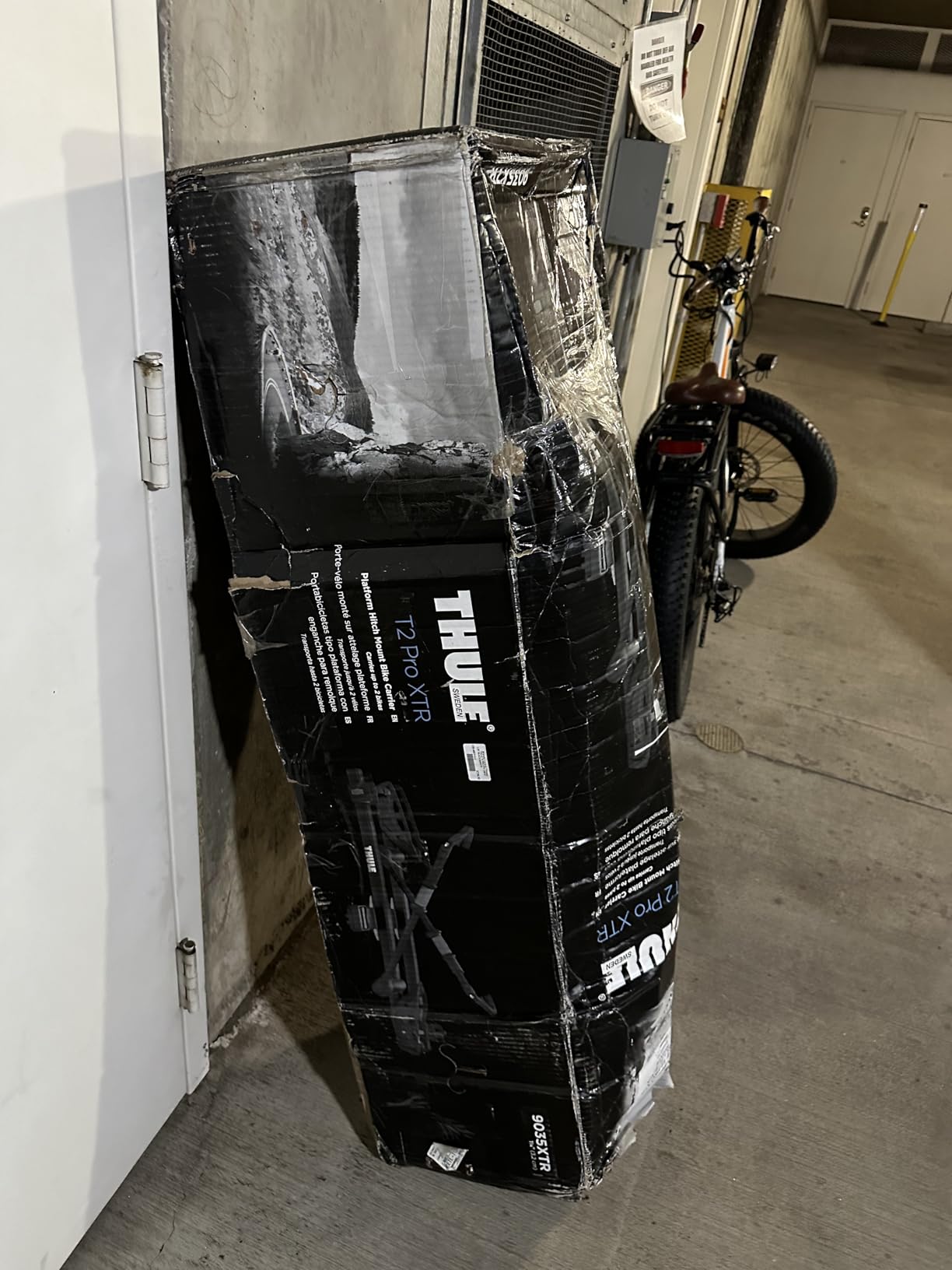
Twelve and a half inches of spacing between the bikes, adjustable side to side, is the feature reviewers praise most after the zero-contact design. On a longer wheelbase road bike with a tall seatpost, that adjustment is the difference between a clean load and two bikes sharing a handlebar. The integrated cable locks and the locking knob on the receiver cover both the bikes and the rack itself.
AutoAttach means no tools for installation and removal, and integrated wheels let you roll the rack around when it is off the vehicle, which matters at 52 pounds.
Can I add a third and fourth bike later?
Yes, with the Thule T2 Pro XT add-on, but only on the 2 inch receiver version. This 1.25 inch listing cannot be expanded, so plan your capacity before you buy rather than after.
The add-on also changes how you load. Four bikes on one hitch carrier needs a plan for offsetting frames so they do not touch each other.
Why does this one carry more one-star reviews?
Most of that group traces to fit and expansion limits rather than the rack itself. Owners are frustrated that parts and add-ons are receiver-specific, and some discovered vehicle compatibility questions only after delivery.
Check the compatibility guidance for your vehicle before you commit, and confirm the receiver size on the vehicle as well as the rack.
5. Hollywood Racks Destination 4 – Best for Four Bikes Without a Heavy Lift
Hollywood Racks Destination 4 Hitch Bike Rack, Carries Up to 4 Bikes, Black
- Carries four bikes at only 42 pounds
- Individual wheel trays make loading fast
- Padded frame holders rotate 360 degrees
- One person can install and fold it
- Long-term owners report thousands of miles without wobble
- Cannot open the trunk while bikes are loaded
- 35 lb per bike is the lowest rating here
- Included hitch lock is a weak deterrent
- Barely fits tires wider than 2.8 inches
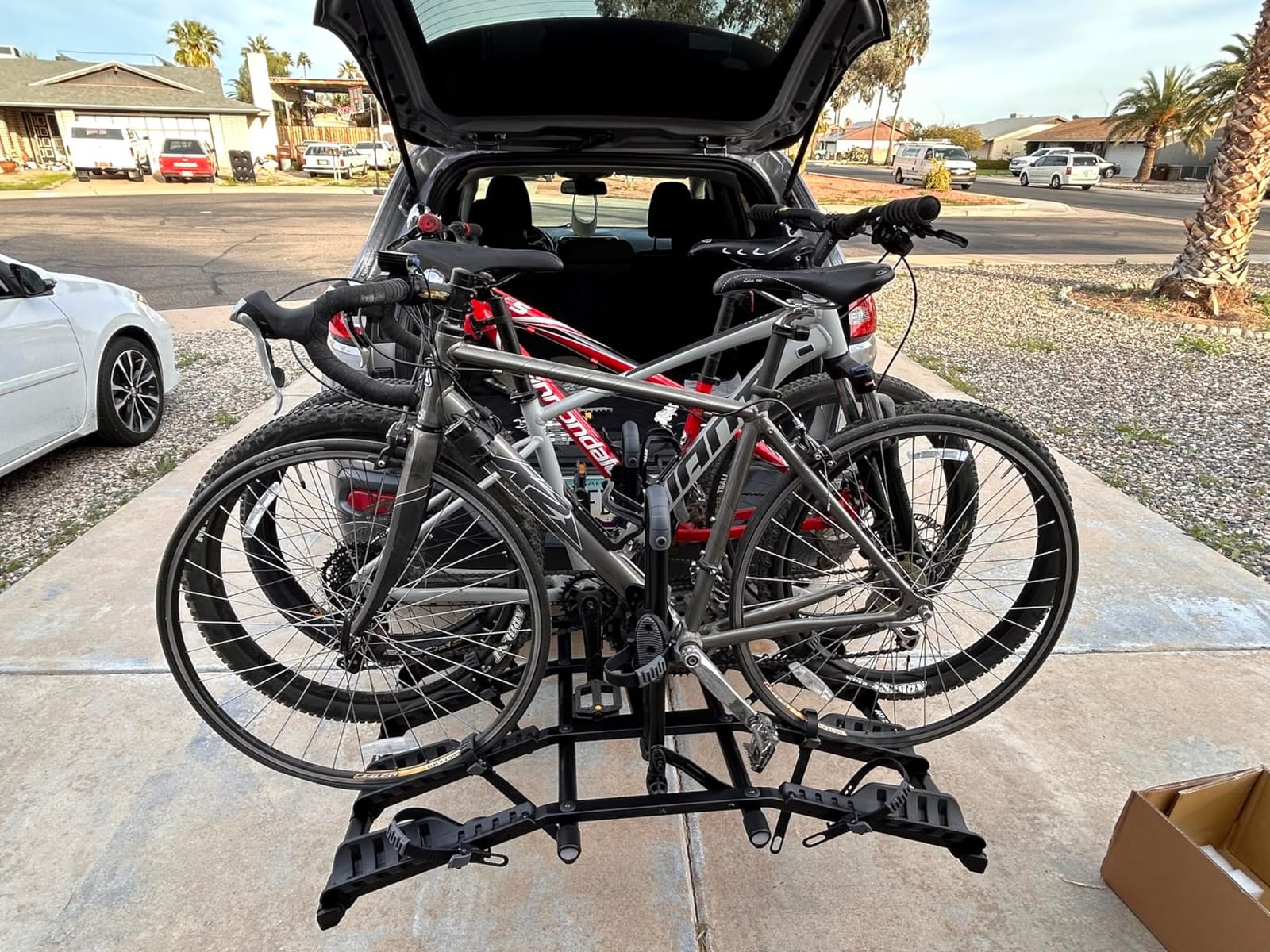
Frame contact: the bikes are supported by individual wheel trays, so there is no clamp pressing into the frame. The padded holders on this rack are stabilizers that rotate 360 degrees, and they are the one place a loaded bike can rest against something padded rather than a bare metal tube.
At 42 pounds for a four-bike carrier, this is the weight outlier in the group. Most four-bike racks land between 80 and 100 pounds, which means one person can install it, fold it, and move it around a garage. Owners report loading three mixed bikes in three to four minutes once the tray positions are dialled in.
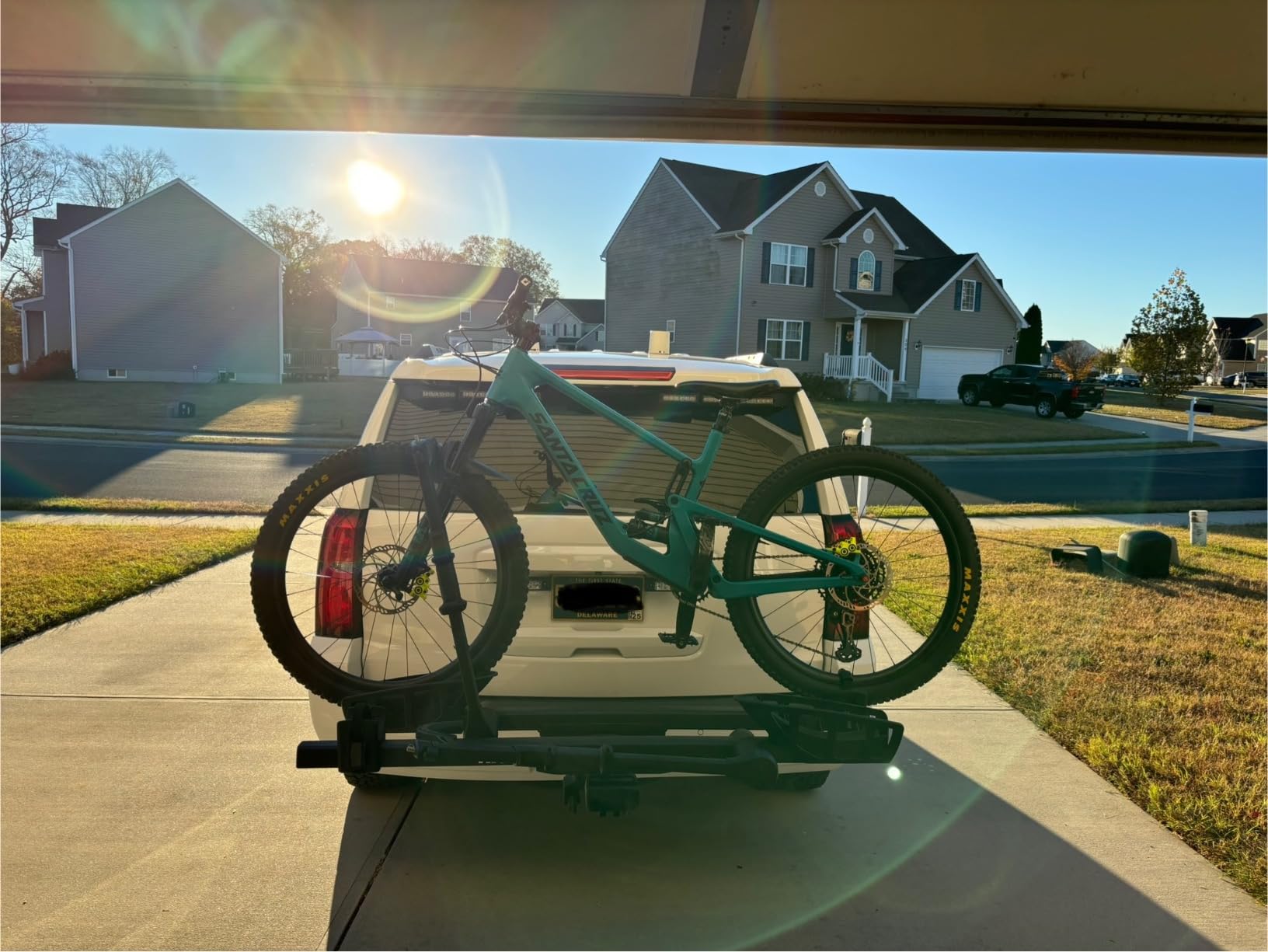
Durability reports are strong for the price band. Long-term owners describe season after season of trips with no wobble or rattling, and the fold-up design keeps the footprint small when the bikes come off. The locking threaded hitch pin and ratchet straps are included.
Two compromises. There is no tilt, so you cannot open the hatch with bikes loaded, and the 35 lb per bike limit is the lowest here, which rules out most modern e-bikes.
Can a delicate carbon frame ride in the padded holders?
Yes, with the understanding that the padding is a stabilizer rather than the primary support. The weight of the bike sits in the wheel trays, and the rotating padded arms are there to keep the frame from swinging side to side on rough roads.
Keep an eye on clearance when all four bikes are loaded. Handlebars and pedals have to be offset, and that is where frames find each other.
What do owners complain about most?
Assembly hardware is the recurring theme. The included wrench is the wrong size and strips easily, and the instructions are thin on photos, so plan to use real tools. Several owners also add their own chain because the included hitch lock feels light.
6. Yakima HoldUp 2-Bike – Best Adjustability for Mixed Bikes
Yakima HoldUp 2-Bike Platform Hitch Mount Rack, Fits 2 in. Receivers
- Individually adjustable trays stop two bikes from rubbing
- StrongArm tilt reaches the trunk with bikes loaded
- 60 lb per bike or 120 lb total
- Includes HitchLock
- locking cable
- and SKS locks
- Frames stay clean because there is no clamp contact
- Heavy
- lifting the assembled rack is a real effort
- Threaded hitch pin makes mounting slow
- Some owners report rust forming inside the arm pivots
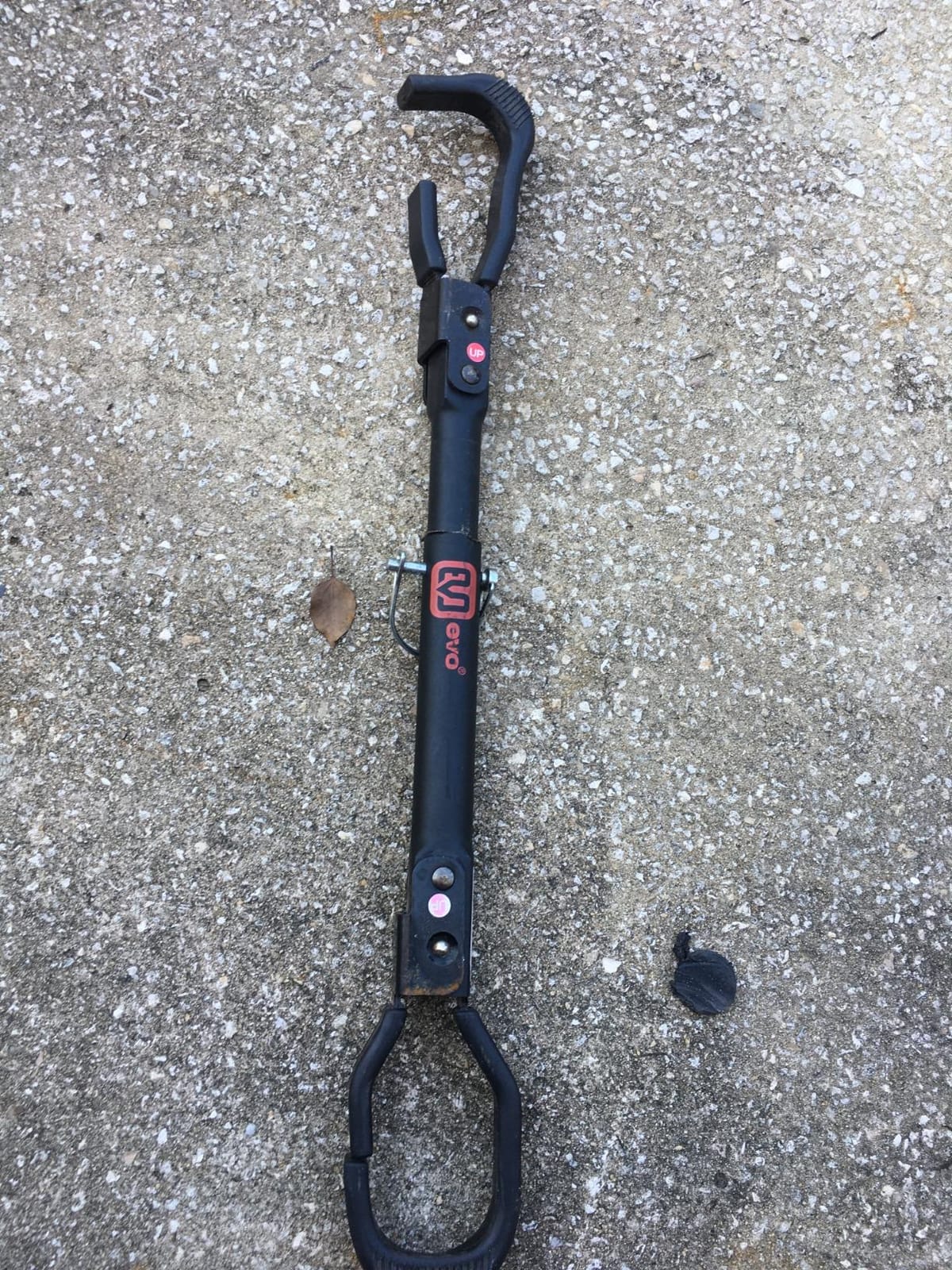
Frame contact: minimal by design. The HoldUp holds the front wheel in a hook and secures the rear with a strap, which is the same wheel-only principle as the tray racks, just in a more compact steel package. The frame itself hangs free between the two contact points.
The standout feature, and the one owners comparing it head to head with the Kuat NV mention most, is side-to-side tray adjustment. Each tray slides independently, so you can shift one bike forward and the other back to stop handlebars, saddles, and pedals from interfering. On a load that mixes a carbon road bike with a mountain bike, that solves the collision problem better than any fixed spacing.
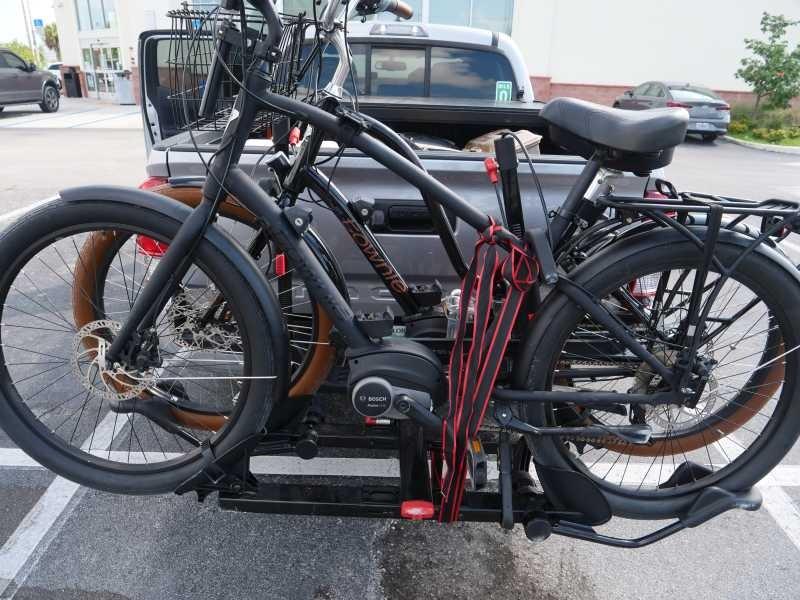
Security is well covered. The rack ships with a HitchLock, a locking cable, and SKS locks that key alongside other Yakima systems, and the StrongArm tilts the loaded rack back so you can reach the hatch without unloading, then folds it up compactly when the rack is empty. Owners frequently note that bikes come off with no paint marks.
The weak point is installation friction. The threaded hitch pin takes several turns and effectively requires a ratchet wrench, and there is no depth indicator on the receiver bracket, so solo mounting is fiddly the first time.
Does the front wheel hook ever reach the fork crown?
On a normal wheelbase, no. The hook grabs the tire ahead of the fork, and the rear strap takes the other end of the load, so nothing presses on the top tube or the carbon fork.
Check the fit before you drive away. A badly seated bike that leans against a hook is the one scenario where this architecture can rub.
Is it a good match for a carbon mountain bike?
With 60 lb per bike it covers most carbon trail and enduro builds, and the telescoping arms adjust for different wheel sizes. Owners in wet climates report rust developing inside the arm pivots, so rinse the rack after salted or muddy trips.
7. RockyMounts Monorail – Best Lightweight Option for Two Bikes
RockyMounts Monorail 2-Bike Platform Hitch Rack, No Frame Contact Front Wheel Mount Bike Carrier for Cars, SUVs & Trucks, Fits Road, Mountain, Fat Tire & E-Bikes, Black
- Secures the bike by the front wheel with no frame contact
- 60 lb per bike covers fat-tire e-bikes
- Steel and aluminum mix keeps weight to 39 pounds
- Quiet once the hitch pin is properly tightened
- Lifetime warranty
- Not compatible with fender-equipped bicycles
- Included locks and security loop feel flimsy
- Front wheel hook must sit close to the fork
- Threaded hitch bolt slows refitting
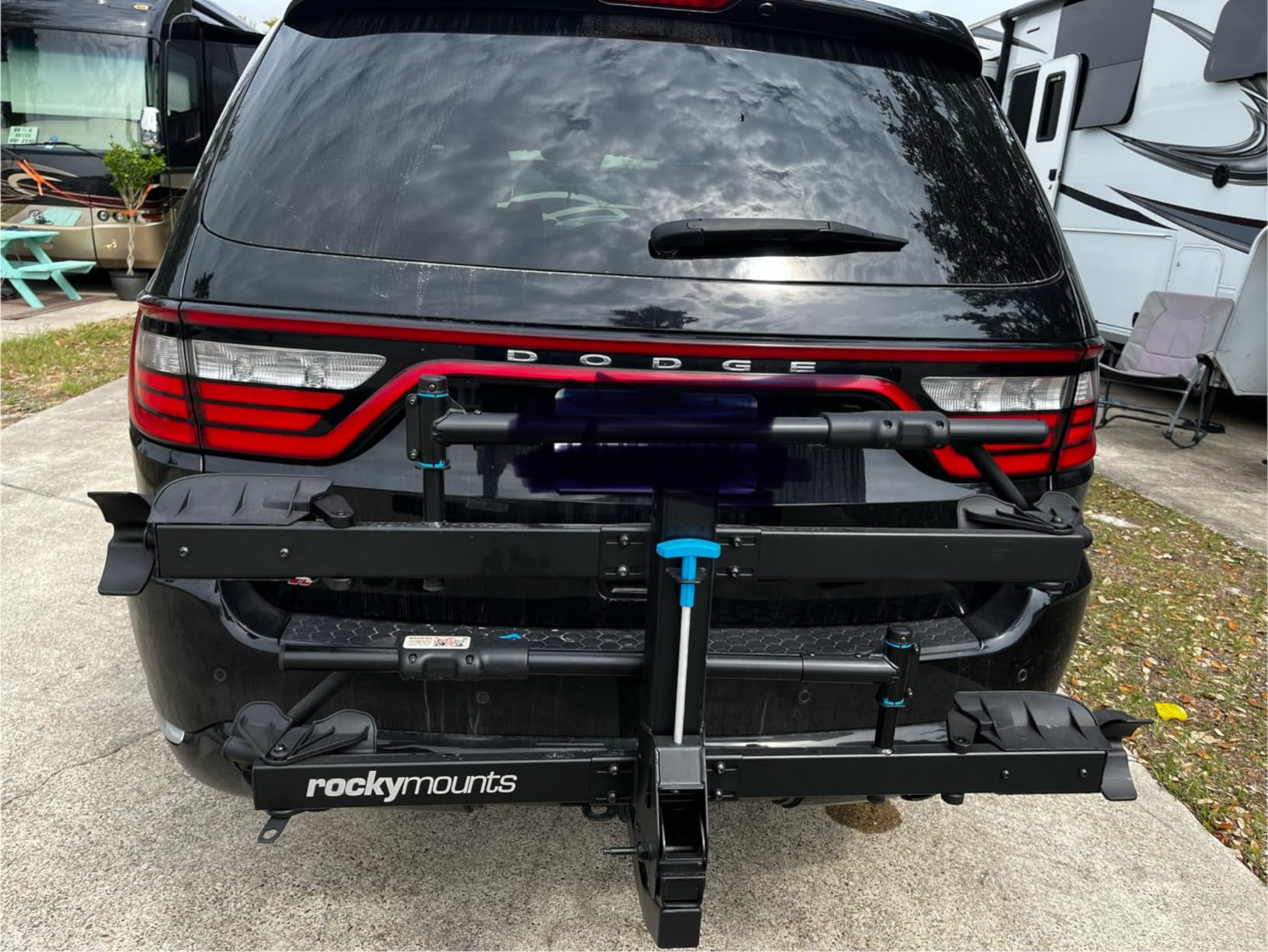
Frame contact: none. The Monorail is a single-rail platform design that secures the bicycle by the front wheel and rests the rear in a tray. For a carbon bike that is the cleanest possible arrangement, and the manufacturer states it directly rather than burying it in the fine print.
Thirty-nine pounds for a 60 lb per bike rack is a good balance, and the rear tilt arm gives you pickup bed and hatch access without disassembly. This is the one to pick if you remove the rack frequently, carry two bikes, and want the smallest job in the group.
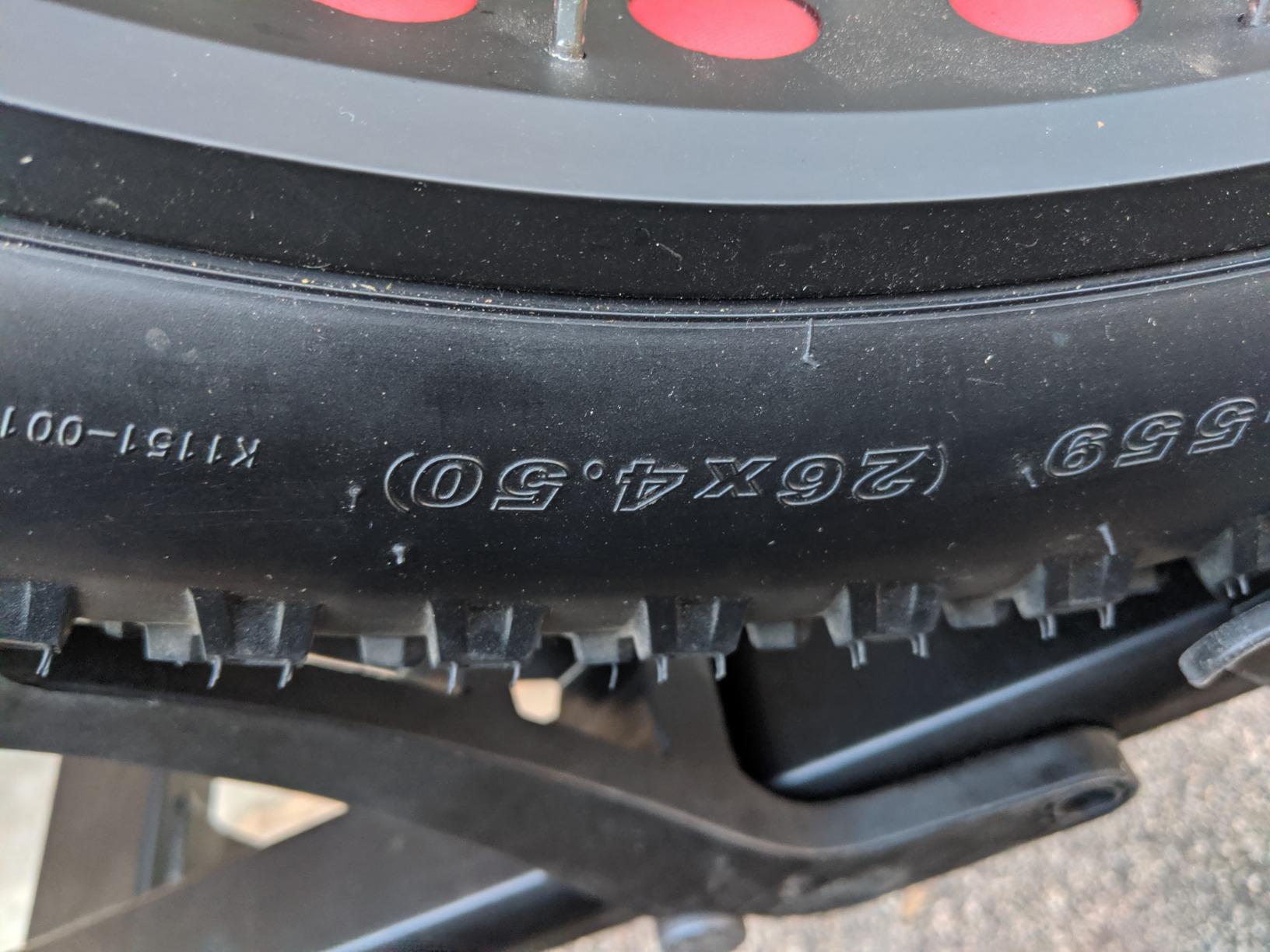
Owners call it solid, quiet, and good value against the premium brands, with assembly in roughly 20 to 40 minutes. It carries a smaller review base than the others here, which is worth knowing when you weigh owner feedback against the 4.6 rating.
There is one hard exclusion. The rack is not for bikes with fenders, which rules out many commuter setups. There is also a positioning detail that catches people out: the front wheel hook has to sit close to the fork, or it can work loose on rough roads and scratch the bike.
Why does the wheel hook position matter so much?
The hook grips the front tire, and the closer it sits to the fork the shorter the unsupported span of wheel. Set too far out, the wheel can flex under road vibration and shift against the hook.
Owners of rim-brake bikes also suggest a little extra cushioning from the hold-down bar, since the brake calipers and rim are less tolerant of a hard stop than a disc rotor.
Is it worth choosing over the bigger brands?
If you carry two bikes under 60 lbs, need a tilt, and value a lifetime warranty, yes. You give up some accessory interchangeability and the included security hardware is thin.
8. Swagman XTC4 – Best for Mixed Fleets on a 2 Inch Hitch
Swagman XTC4 Hitch Mount Bike Rack – Platform Carrier for 4 Bikes, Ratcheting Hook System, Fold-Up Storage Design, 2″ Receivers
- Sliding ratchet hook system gives a snug
- height-adjustable fit
- Handles any mix of frame shapes and sizes
- Quick-release tire hoops make loading fast
- Center arm folds down for rear access
- Hook rubber is durable and does not scratch bikes
- Heavy steel build that is hard for one person to lift
- Included lock is too short for a full four-bike load
- Frame protectors can rub paint if contact points are uncovered
- Blocks the license plate and tail lights
Frame contact: none from the mounting hardware. Bikes sit in wheel trays and the ratchet hooks grip the tires. The one caution is cosmetic rather than structural: if you leave the rubber frame protectors bare, a loaded bike can rub paint at those points, so cover contact areas on a carbon frame.
The ratcheting hook system is what reviewers praise most. Instead of screw-down arms that fight you every time you reposition a bike, the hooks slide and ratchet, so you can dial in a fit for four completely different frames without starting over. Women’s frames, low step-throughs, and odd geometries that defeat conventional racks all load here.
It carries four bikes on Class 3, 2 inch receivers, with the center arm folding down for rear cargo access and the whole unit angling up for ground clearance. The 35 lb per bike limit is the same as the Hollywood Racks Destination, so treat this as a road bike and kids’ bike carrier rather than an e-bike carrier.
At 4.2 stars this is the lowest-rated rack in the group, and the negatives cluster around quality rather than safety: stripped bolts, chipped powder coating on some units, and a support response owners describe as slow.
Will four different bikes fit without scuffing each other?
They will fit, but not without planning. With four adult bikes loaded there is very little clearance, so pedals and saddles have to be offset or lowered in an alternating pattern.
Frame the load so the tallest bike is nearest the vehicle. That keeps the handlebars of the outer bikes from sweeping into the ones behind them.
What should I improve before the first trip?
Buy a separate lock. The included cable is too short to wrap four bikes and the hitch pin together, and the rack needs a Swagman-specific threaded pin rather than a standard third-party lock.
Check the frame protectors and cover the contact points with tape or a sleeve if you are loading a carbon bike into a full four-bike arrangement.
Racks to Avoid With a Carbon Frame
A hanging rack, sometimes called a strap rack, is the most common mistake. The frame rests in the arms of the rack and a strap is pulled over the top tube, so a concentrated load sits on the carbon layup for the entire drive. Padding helps with paint but does not remove the load path, and it shifts under vibration.
Roof racks with frame clamps, the style most roof racks default to, are the same problem at a different height. The clamp grips the top tube or seat tube directly, and owners of frames with aero profiles report the clamp or the crossbar adapter rubbing where there is no flat surface to sit on. If a roof rack is your only option, choose a fork-mount or wheel-mount model instead.
Trunk racks come in both architectures. The hanging variants contact the top tube, and several attach to the frame at all, which makes them the least predictable choice for an expensive bike. Platform trunk racks that hold the wheels are fine in principle, but they put the bike behind the car where it is exposed to exhaust, road spray, and impact.
Two more that get overlooked. A seatpost-mounted rear rack puts its load straight into the seatpost, and carbon seatposts and dropper posts can crack under that kind of leverage. P-clip racks clamp the seat tube directly, and the forum advice that circulates is consistent: hand-tighten them, never use a wrench, and add rubber or a sleeve between the clip and the frame.
The rule that keeps coming up across cycling forums is simple enough to memorise: if the rack attaches to the wheels or dropouts instead of the frame, it is safe. Everything on this list follows that rule.
How to Load and Secure a Carbon Bike Without Damage
Load the rear wheel first. Set the bike into the rear tray, then roll it back until the tire is seated in the cradle. Loading the rear first keeps the front wheel from swinging into something on the way in.
Seat the front wheel in the clamp or hook. Push the tire against the arm until the ratchet engages, and close the arm fully. The load should pass through the tire and the hook, not through the fork crown.
Fit the rear strap snugly. Snug, not over-tightened. If you can twist the frame a few degrees at the strap, the tension is right.
Check the wheel position on racks with a front hook. The hook should sit close to the fork, with minimal unsupported wheel between hook and hub.
Recheck after five miles. Stop, look at every clamp, and confirm nothing has shifted. Then recheck whenever you change speed or add a stop to the trip.
Position bikes so frames cannot reach each other. Offset handlebars, pedals, and saddles in an alternating pattern, and put the tallest bike nearest the vehicle.
Photograph your bike before loading it. If a claim is ever disputed after a trip, dated images of the frame with no marks on it are the strongest evidence you can have.
Carbon Frame Inspection After a Long Trip
Run your fingers along the top tube, down tube, seat tube, and chainstays in good light. You are looking for a scuff, a dull spot where gloss has been abraded, or a shallow dent. Cosmetic scuffing stays on the surface; a dent that catches a fingernail is a different matter entirely.
Look along the underside of the chainstays and around the seat cluster, since those are the areas a strap or hook can reach. Check the fork crown and the area behind the head tube for any sign of a clamp impression.
Then have a shop look at it. A torque check at the stem, seatpost, and bottle cage bolts is cheap and catches a lot of small issues before they become real ones. If a frame was involved in a collision, replace it rather than repairing it.
How We Evaluated for Carbon Safety
Frame contact was the first filter, and it is binary. Anything that clamps, cradles, or straps the frame went into the avoid list regardless of price or rating. Every rack here holds the bike by its wheels only.
From there we weighted the things that actually cause damage or stress on carbon ownership: wheelbase coverage for long road bikes, tire width limits, per-bike weight ratings against real bike weights, receiver fit and adapter availability, and how much the frame can move at highway speed.
We also read owner reviews for the failure patterns. Wobble, paint marks, racks that cannot hold an XL frame, and hardware that strips during assembly all showed up repeatedly. We left out price as a ranking factor entirely, since it moves.
Frequently Asked Questions
Can you put a carbon frame bike on a bike rack?
Yes, provided you use a wheel-mounted platform rack. These trays support the front and rear wheels and clamp the tires, so the frame is never loaded. Hanging racks, roof racks with frame clamps, and hanging trunk racks all rest weight on the top tube or seat tube, which is the arrangement most riders and mechanics consider unsafe for carbon.
How do I transport a carbon frame bike?
Use a hitch, roof, or trunk platform rack that grips both wheels, load the rear wheel into its tray first, then seat and ratchet the front wheel clamp. Tighten the rear strap snugly rather than hard, confirm the front hook sits close to the fork, and stop to recheck the clamps after five miles. A wheel-mounted rack removes frame contact entirely, so the carbon layup carries no load at all.
Are hanging bike racks safe for carbon bikes?
No. A hanging or strap rack rests the frame in its arms and pulls a strap over the top tube, concentrating a load on the carbon layup for the whole drive. Foam or tape padding reduces paint marks but does not remove the load path, and padding shifts under vibration. A top tube adapter helps on some designs but does not change the underlying mechanism.
How fragile are carbon fiber frames?
Carbon frames carry very little load in compression, which is why a concentrated clamp point is a concern. A dent that catches a fingernail, a crack near a clamp mark, or a dull abraded patch are signs to have the frame inspected by a shop. Cosmetic scuffs that wipe away and do not catch a nail are surface marks rather than structural damage.
Which bike rack is the most anti-theft?
Look for a rack that locks the bikes to itself and the rack to the receiver, since a lock only helps if it secures both. Several racks here include a locking hitch pin, an integrated cable lock, and hardware that keys with a matching lock system. For overnight stops, treat the built-in hardware as a deterrent and carry your own lock.
How do I know which hitch receiver size I have?
Measure the opening of the receiver on your vehicle. A 1.25 inch receiver is the narrower class commonly found on SUVs, minivans, and some sedans, while 2 inch receivers appear on trucks, larger SUVs, and motorhomes. Check the class sticker on the receiver itself, and confirm the rack listing matches your measurement before you buy, because adapters do not exist for every model.
Bottom Line
Every rack on this list holds your bike by its wheels and never touches the frame, which is the only architecture worth considering for a carbon frame. Our pick for the best bike racks for carbon frames is the Kuat Sherpa 2.0 Compact: it is the lightest thing here, the most reviewed, and the easiest to live with day to day.
Go heavier on capacity if you haul e-bikes, and go wider if you carry four bikes. Either way, measure your hitch receiver, load the rear wheel first, and recheck the clamps after five miles.