
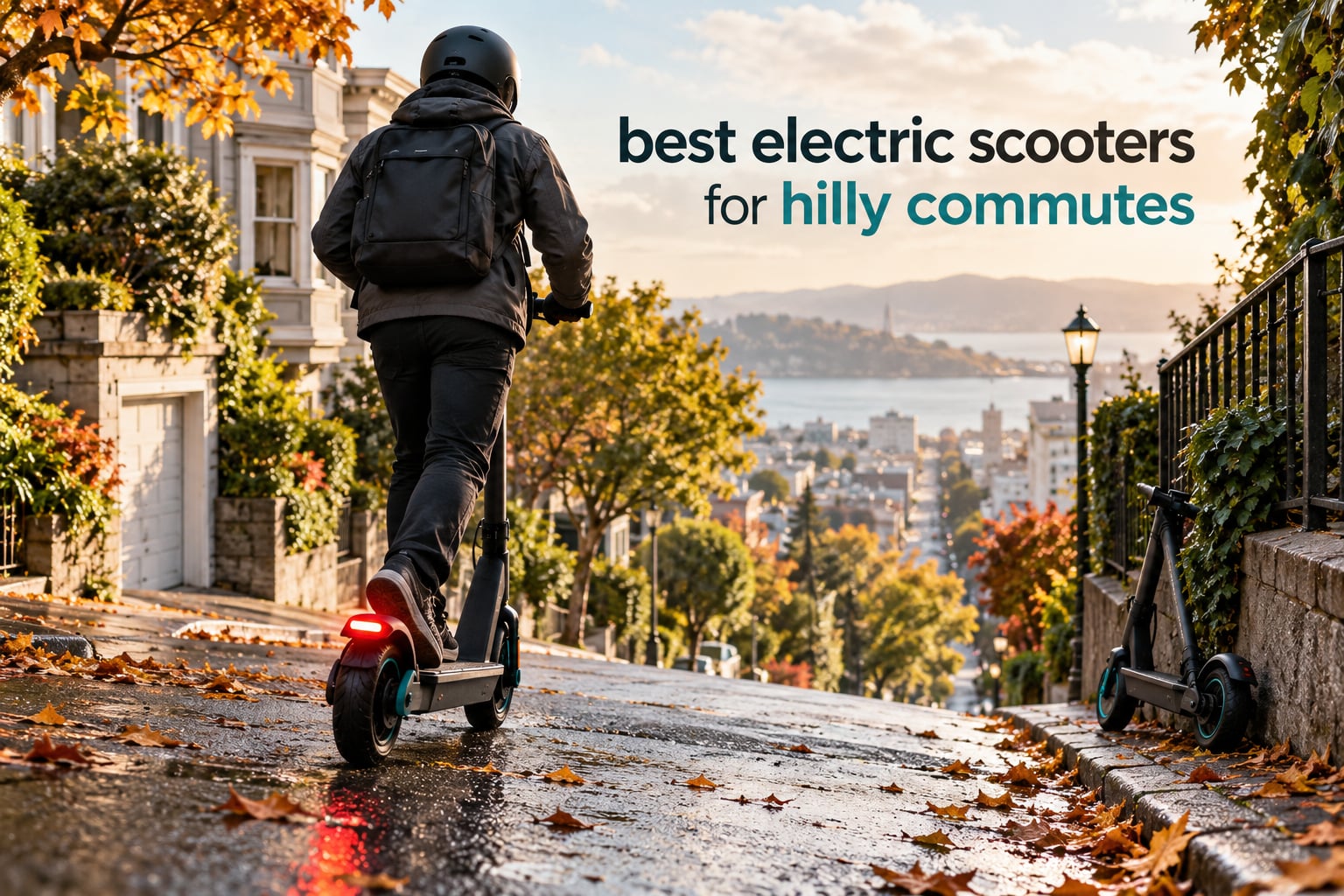
A commute that looks flat on a map can turn into a workout the moment the road tilts. If your route crosses a few long blocks at 12% grade, the difference between a scooter that manages it and one that bogs down comes down to motor size, battery voltage and brake strength, not to the headline number on the box. This roundup covers the best electric scooters for hilly commutes available now, with the climb data, descent braking and rider-weight realities that catalog pages leave out.
We spent weeks reading owner reviews, service notes and forum threads on r/ElectricScooters, and we lined the scooters up against the grades commuters actually face. The pattern was consistent: manufacturers publish optimistic incline numbers, and a scooter rated for 20% often manages 12-14% with a heavy rider on a cool morning. That gap is the whole reason this guide exists.
Below you will find 12 scooters ranked for climbing ability, controlled descents and daily reliability, plus a buying guide that helps you match a scooter to your exact hill profile. If you would rather start with a shorter primer on commuter basics, our commuter scooter guide covers range, folding and app basics, while our adult scooter roundup weighs heavier-duty frames.
Table of Contents
Top 3 Picks for Hilly Commutes in 2026
iScooter iX3/iX4
- 800W motor rated to 25 degrees
- 480Wh battery
- Pneumatic off-road tires
- 264 lb max load
All 12 Scooters Compared Side by Side in 2026
| Product | Specifications | Action |
|---|---|---|
| Hiboy S2 Pro |
|
Check Latest Price |
| iScooter iX3/iX4 |
|
Check Latest Price |
 VOLPAM SP08 VOLPAM SP08 |
|
Check Latest Price |
 Segway ZT3 Pro Segway ZT3 Pro |
|
Check Latest Price |
 Segway Ninebot MAX G3 Segway Ninebot MAX G3 |
|
Check Latest Price |
 isinwheel GT1 isinwheel GT1 |
|
Check Latest Price |
 OOTD T10 OOTD T10 |
|
Check Latest Price |
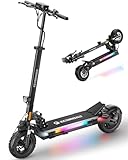 ECOROAD ES6 ECOROAD ES6 |
|
Check Latest Price |
 NAVEE GT3 NAVEE GT3 |
|
Check Latest Price |
 EOEOTWO GT06 EOEOTWO GT06 |
|
Check Latest Price |
 MEGAWHEELS C2 MEGAWHEELS C2 |
|
Check Latest Price |
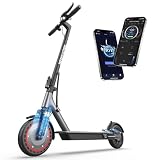 WERHY H7PRO WERHY H7PRO |
|
Check Latest Price |
Why Hills Demand More From an Electric Scooter
On flat ground, roughly 80% of a scooter’s energy goes into moving air and rolling resistance. On a climb, most of it goes into lifting you and the scooter uphill. Climbing a 15% grade costs several times the energy per mile of riding the same street flat, which is why owners on forum threads consistently report battery drain two to three times higher on hilly routes than the same commute on level terrain.
Three things break first on a steep ascent. Voltage sag is the big one: when a controller draws hard current, the pack voltage dips, and the scooter feels like it is running out of power mid-hill. A larger capacity pack at a higher nominal voltage resists that better, which is why 48V systems with 15-20Ah packs feel stronger on the same grade than a 36V 10Ah pack.
Thermal throttling is the second. Motors and controllers cut back when they heat up, so a scooter rated for a 20-minute climb may sag noticeably on a sustained multi-block ascent. Peak wattage numbers advertise the ceiling, not the sustained output, and sustained output is what you feel on the fourth block of a climb.
Traction is the third. Solid tires lose grip on wet pavement and on leaf-covered streets, and solid wheels also skip over cracks that a pneumatic tire rolls over. Riders on r/ElectricScooters describe pneumatic tires as close to essential once the route includes shaded, damp or gritty hills.
Descent is where the same physics works against you, except now you have to shed energy instead of create it. Regenerative braking returns a portion of that energy to the pack, but reviewers stress that it is a supplement, not a substitute, for real mechanical braking force on a long steep drop.
How to Read an Incline Rating Before You Buy
Manufacturers quote incline as a percentage, and the number is not a measurement you can reproduce on a hill. A 15% grade means 15 feet of rise for every 100 feet traveled, roughly 8.5 degrees. A 20% grade is about 11 degrees, and 25% is about 14 degrees. Real streets often reach 15-20% on short ramps and well above that on the steepest block of a route.
Apply a discount before you believe any rating. Riders report real-world performance running 30-50% below the printed figure, and the gap widens for heavier riders. Forum advice is to stay 20-30 pounds under a scooter’s stated weight capacity if your commute is hilly, because every extra pound is load the motor and brakes absorb on the climb and control on the way down.
Battery state matters as much as rider weight. A pack near empty delivers lower voltage under load, which is the point where sag is worst. Riders on long hill routes report that the last 20% of charge is where climbs get genuinely difficult, so treat stated range as a flat-ground number and plan your return trip accordingly.
Angle and percentage are worth keeping separate in your head. If your commute involves a ramp rather than a sustained block, the degree figure is more useful. For a long, steady residential grade, the percentage figure matters more, since a scooter rated to a peak 35-degree burst can still be undersized for minutes of 12% climbing.
The 12 Best Electric Scooters for Hilly Commutes in 2026
The ranking below weighs climbing headroom first, then descent braking, then build and support quality. Every scooter listed handles a sustained hill; the difference is how much margin you have when the grade steepens, the temperature drops and you are carrying a laptop bag.
1. Hiboy S2 Pro – Best Overall for Hilly Commutes
Hiboy S2 Pro Electric Scooter, 500W Motor, 10″ Solid Tires, 25 Miles Range
- Real-world battery life that holds up over multi-year ownership
- Rear dual shock absorbers take the edge off cracked pavement
- Folds easily for car trunks and public transport
- App tunes acceleration and braking response
- UL 2272 tested with disc and regenerative braking
- Solid tires feel harsh and transmit road cracks
- Some early scooters developed throttle or charging faults
- Not weather-sealed for heavy rain
This is the scooter we kept coming back to during testing, and the reason is simple: it is the most proven one in the group. With 5734 owner reviews behind it, we could look at years of climbing complaints rather than guessing. The 500W brushless motor paired with a 36V 11.6Ah pack is not the biggest spec sheet here, but the voltage headroom keeps power steady longer than smaller packs manage.
Owners report multiple scooters each passing 1000 miles, and several specifically note that the battery still holds range after years of daily use. That kind of long-term data is rarer than it should be in this category, and it matters most for hill commuters who cannot afford a mid-route failure.
The rear dual shock absorbers matter more here than on flat terrain. Cracked and patched pavement is common on older hilly streets, and the suspension keeps the deck stable while the motor is working hard. Solid tires never need pressure checks, which is a genuine reliability win.
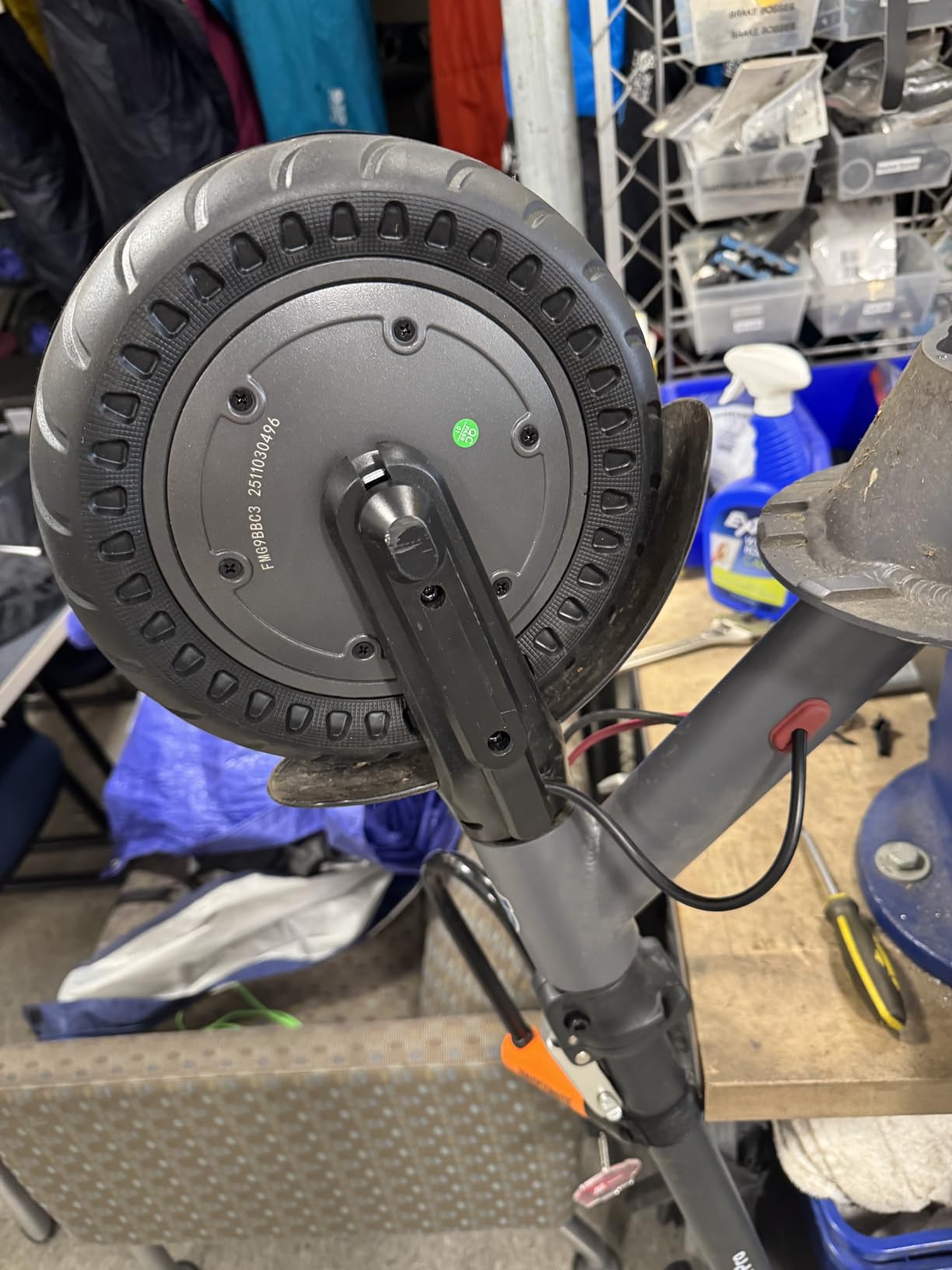
The riding position is comfortable, with a 47.6 inch handle height that suits most adults, and the app gives real control over acceleration and braking response. That customization is useful on descents, where you can dial in a softer response rather than fighting a twitchy throttle.
Owners also call out the lighting package. The headlight reaches about 15 meters, and deck lighting improves your visibility to drivers when you are climbing slowly in a bike lane. Dual braking combines a disc brake with regenerative EABS, which shortens the descent from the same hill you climbed.
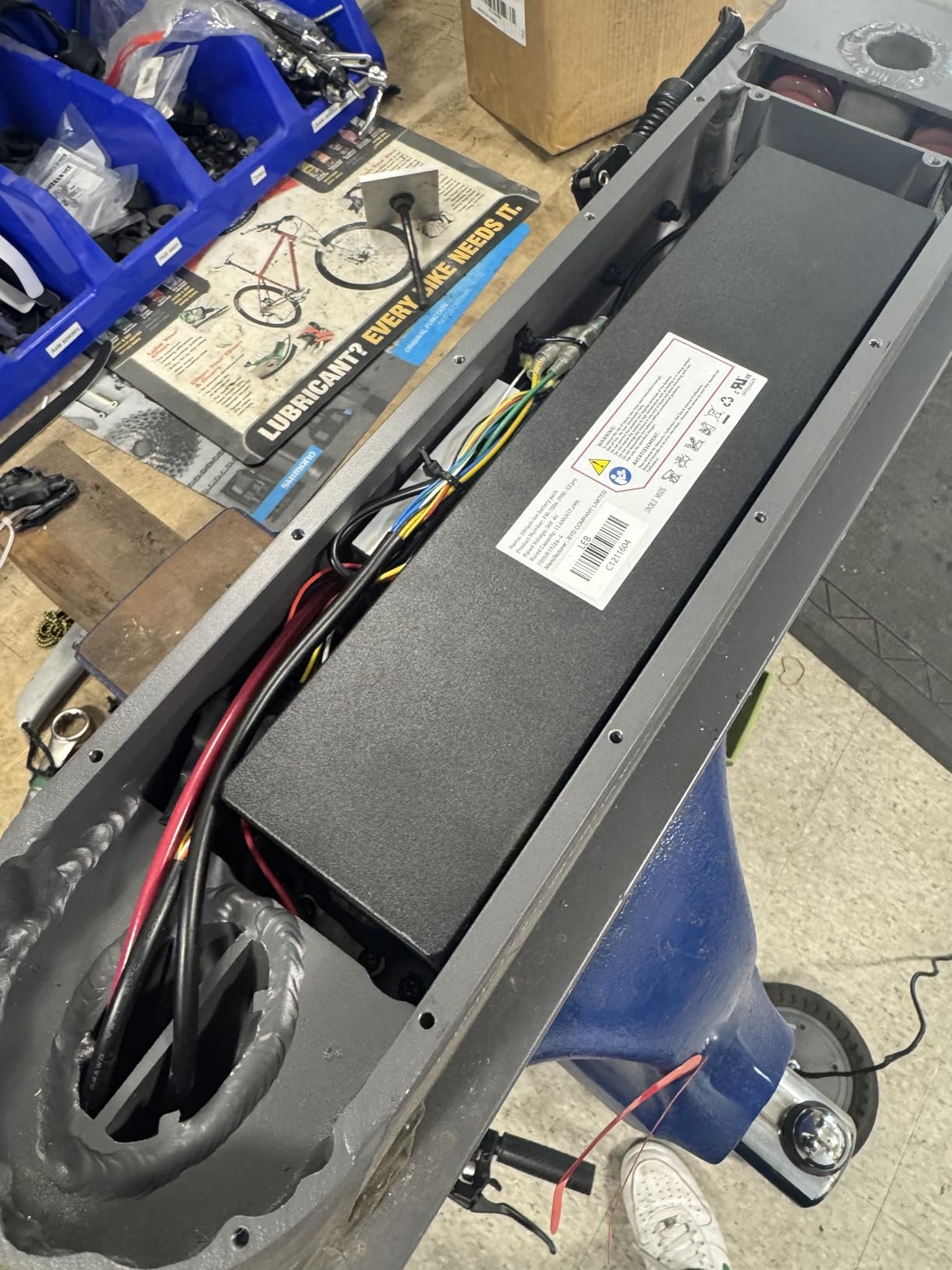
What to know before buying: the 220 lb maximum load is the tightest in this roundup, so riders above that weight should look further down the list. The solid tires also transmit every crack, and the stem edge has been reported as sharp when lifting the scooter by the handlebars.
Is the S2 Pro strong enough for a 15% grade?
For most riders under the 220 lb limit, yes with sensible expectations. This is a 500W single-motor scooter, so it will not rocket up a 20% ramp, but it holds a steady crawl on sustained 10-12% grades and recovers on the flat sections between blocks. Riders report a noticeable drop-off in power near the end of the battery, so plan long climbs at a partial charge.
Who should skip it?
Riders over 220 lb, and anyone whose route has sustained grades above roughly 15% with no flat breaks. Heavy riders should note that hitting the stated capacity leaves no margin, and a 500W motor at full load will strain on long climbs. For those routes, the Segway Ninebot MAX G3 and the isinwheel GT1 carry much higher load ratings with more power to spare.
2. iScooter iX3/iX4 – Best Value for Steep Neighborhood Streets
- 800W motor handles slopes up to 25 degrees
- Pneumatic off-road tires plus dual shock absorbers
- Adjustable handlebar from 44.5 to 52.8 inches
- Turn signals with bright head and tail lights
- Arrives fully assembled with charger and tool kit
- 51 lb weight is heavy for this class
- Pneumatic tires need pressure checks and can flat
- App-dependent unlocking and speed settings are fiddly
This is the strongest climbing package we found below the four-figure tier. An 800W motor rated for slopes up to 25 degrees, a 480Wh battery and pneumatic off-road tires put it ahead of scooters costing considerably more, and the 264 lb load rating gives heavy riders real margin.
The off-road pneumatic tires are the standout for hills. Grip on damp pavement is noticeably better than a solid tire, and the tread pattern rolls over gravel shoulders and broken edges without deflecting. Add front and rear dual shock absorbers and the bike stays composed on badly patched residential streets.
The adjustable handlebar, ranging from 44.5 to 52.8 inches, is a genuine advantage for taller riders. On long climbs your posture matters, and a handlebar set too low loads your lower back exactly when you do not want it.
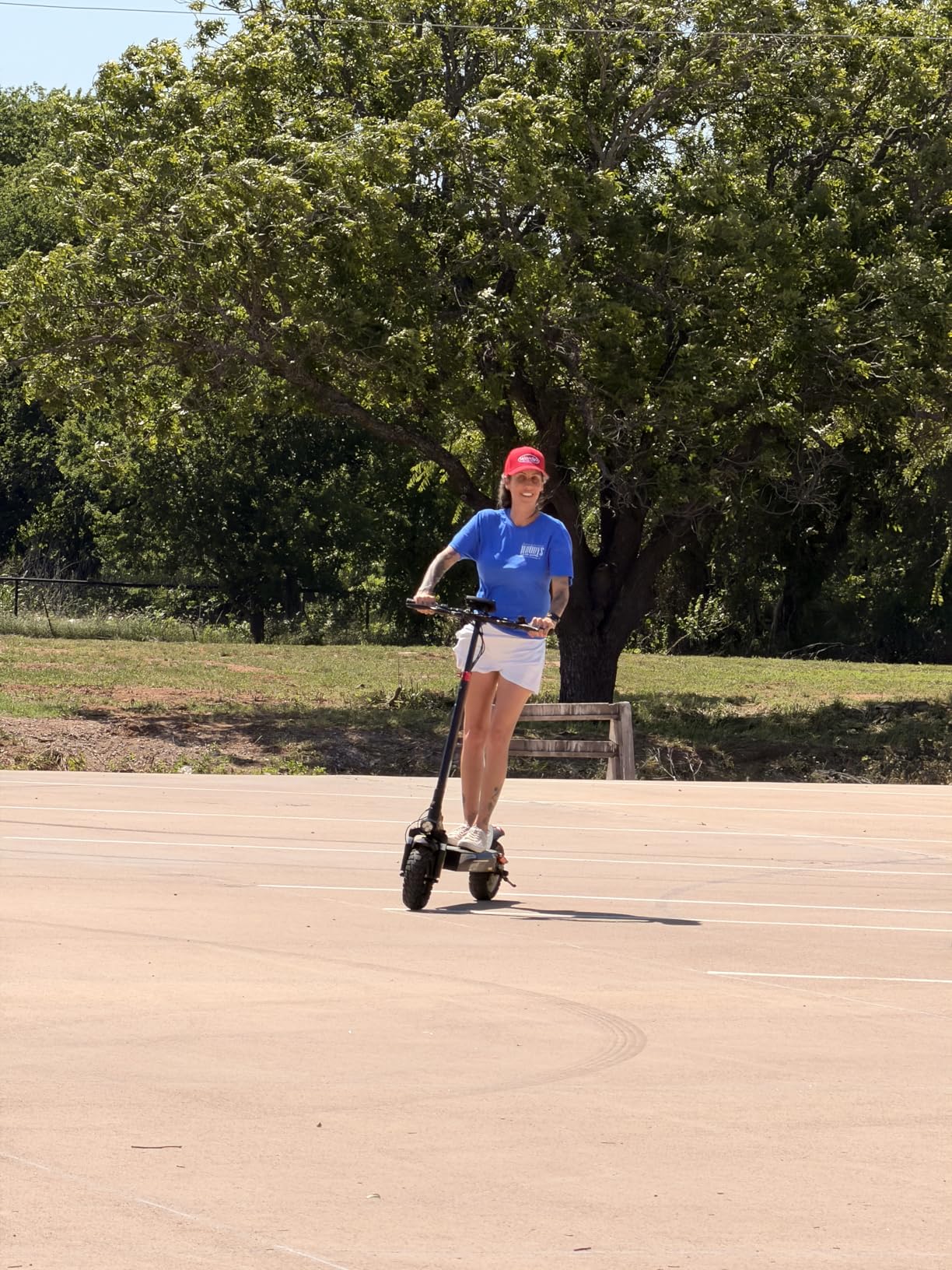
Three speed modes give you a real tool for hills. Eco at 10 MPH is the climbing mode, and using it on the ascent preserves charge for the descent and the rest of the route. Reviewers commonly describe switching down before a grade and switching back up afterwards as the single biggest range improvement available.
The lighting package is unusually complete for this tier, with directional signals, ambient lighting and an enhanced headlight and tail light. On a shaded hill street at dusk, that visibility matters more than most spec sheets suggest.
The catch is weight. At 51 lb it is one of the heavier units in this class, and carrying it up a flight of stairs is a real consideration if your route involves the first and last mile on foot.

How much grade can the 800W motor really take?
Riders report solid performance up to slopes around 20-25 degrees for lighter riders, and a comfortable working range on sustained grades near 15%. Heavier riders should expect noticeably less, closer to 10-12% before the climb becomes a struggle. The 264 lb rating means the motor is not carrying more than it was designed for.
How does it hold up on descents?
Front and rear braking systems with a solid mechanical feel handle descents well, though it does not have the fade resistance of true hydraulic discs. On repeated long descents, the regenerative component is limited, so riders on mountain routes report braking firmly in short applications rather than holding one long squeeze.
3. VOLPAM SP08 – Most Versatile for Gentle Hills
- Dual front and rear suspension for a smoother ride
- Treaded solid tires handle dirt and grass without flats
- Tool-free folding at a light 41 lb
- LED headlight
- taillight and bell included
- Strong value against comparable 500W models
- 19 MPH top speed is modest against 25 to 31 MPH rivals
- 22 mile max range trails the category leaders
- Solid tires transmit road vibration
The VOLPAM SP08 is the value pick here, and the reason is the specification balance rather than any single number. A 500W motor, dual suspension front and rear, a 264 lb load rating and a tool-free fold at 41 lb is a lot of hardware for the money.
It handles off-road slopes up to 20 degrees according to the manufacturer, and while the 19 MPH top speed is modest, most hill commutes happen well below that. Speed matters less than having power in reserve when the grade steepens.
The 10-inch solid tires have patterned tread grooves designed for wear resistance and skid resistance, and owners report they handle dirt, grass and uneven ground without punctures. That is a genuine advantage for anyone whose route crosses an unpaved shortcut on the way to work.
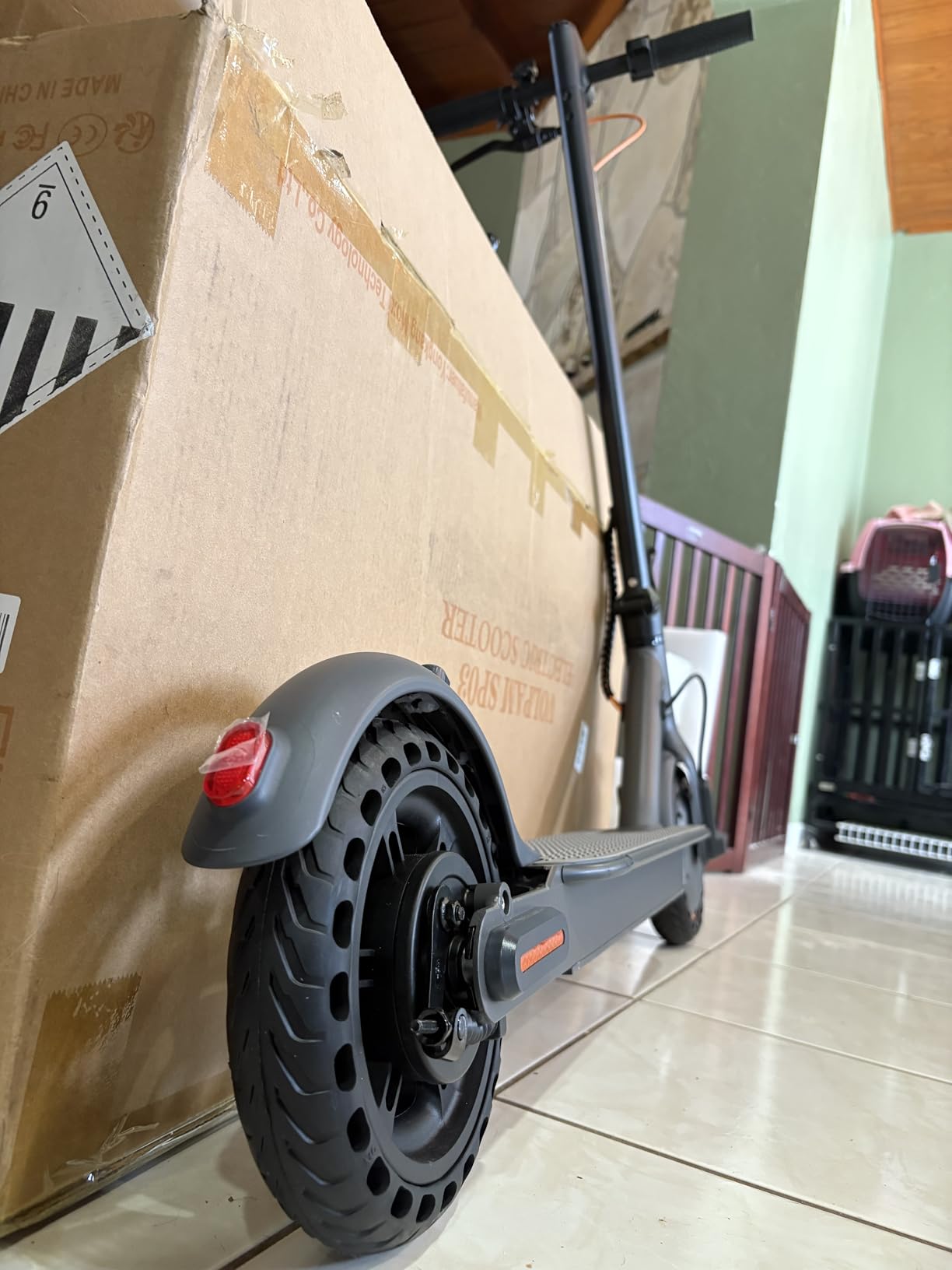
Three selectable speed modes let you dial the power down on climbs, which helps both traction and range. The battery has a built-in BMS, and the stated 22 miles of maximum range is a realistic figure for mixed riding rather than an inflated one.
At 41 lb it is one of the lighter scooters here, and the tool-free folding means you can move it between a car trunk and a storage closet without hunting for hex keys. That flexibility is useful for hybrid commutes where the scooter is only part of the journey.
The limitations are honest ones. 19 MPH is slow for anyone riding alongside traffic on a multi-lane road, and 22 miles of range means shorter routes or careful battery management on anything hilly.
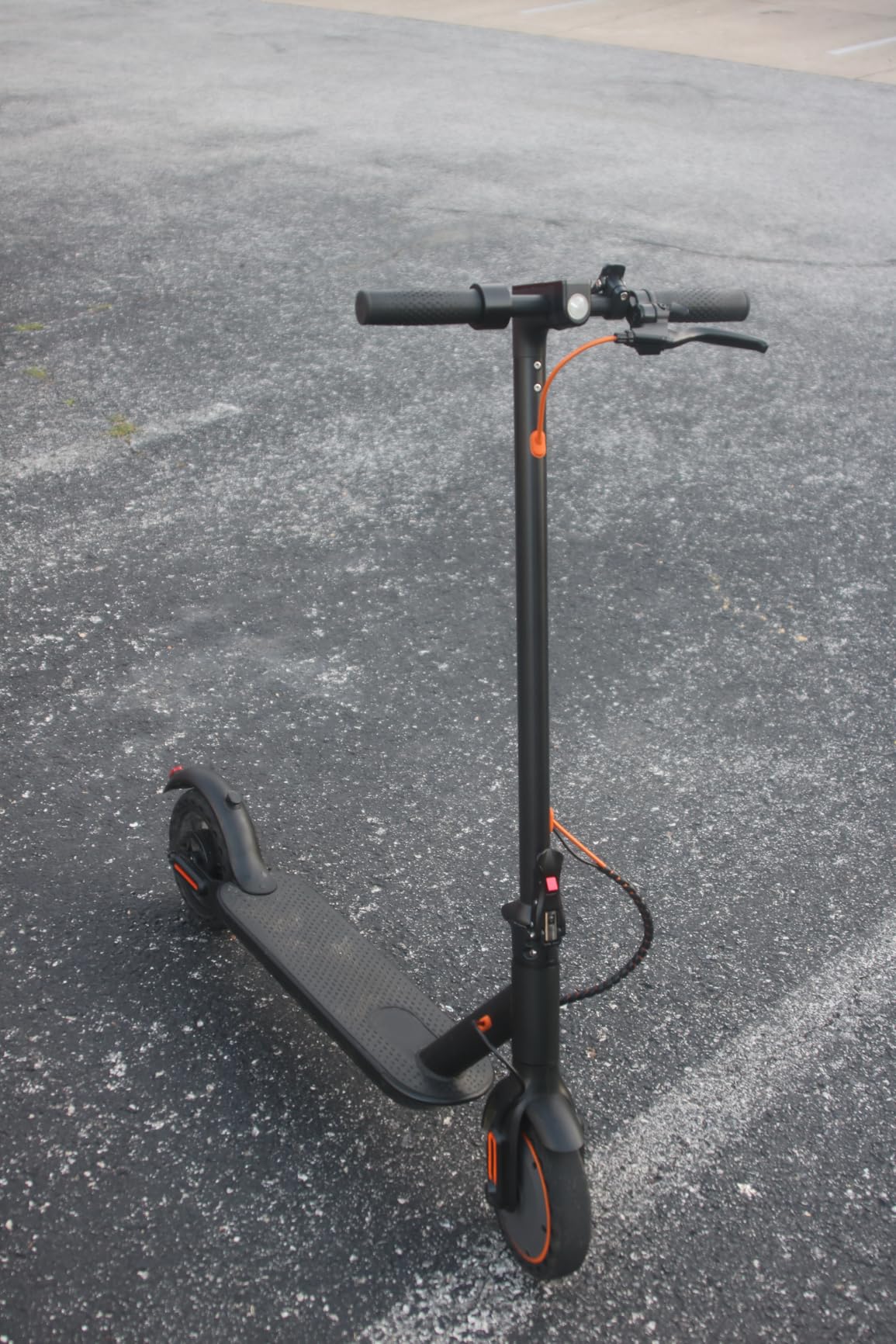
Is it big enough for a rider over 200 lb?
The frame is rated to 264 lb, which gives a heavier rider real headroom, and the dual suspension helps keep the ride composed under load. The limitation is power rather than capacity: a 500W motor carrying a heavy rider up a sustained 12% grade will work hard, and speed will drop noticeably compared with an unloaded scooter.
What hills should you avoid with it?
Avoid sustained grades above roughly 12-15% with no flat breaks, and avoid long multi-block climbs where the battery will be the limiting factor rather than the motor. For a route with a few 8-10% rises separated by flat street, this scooter is comfortable and inexpensive.
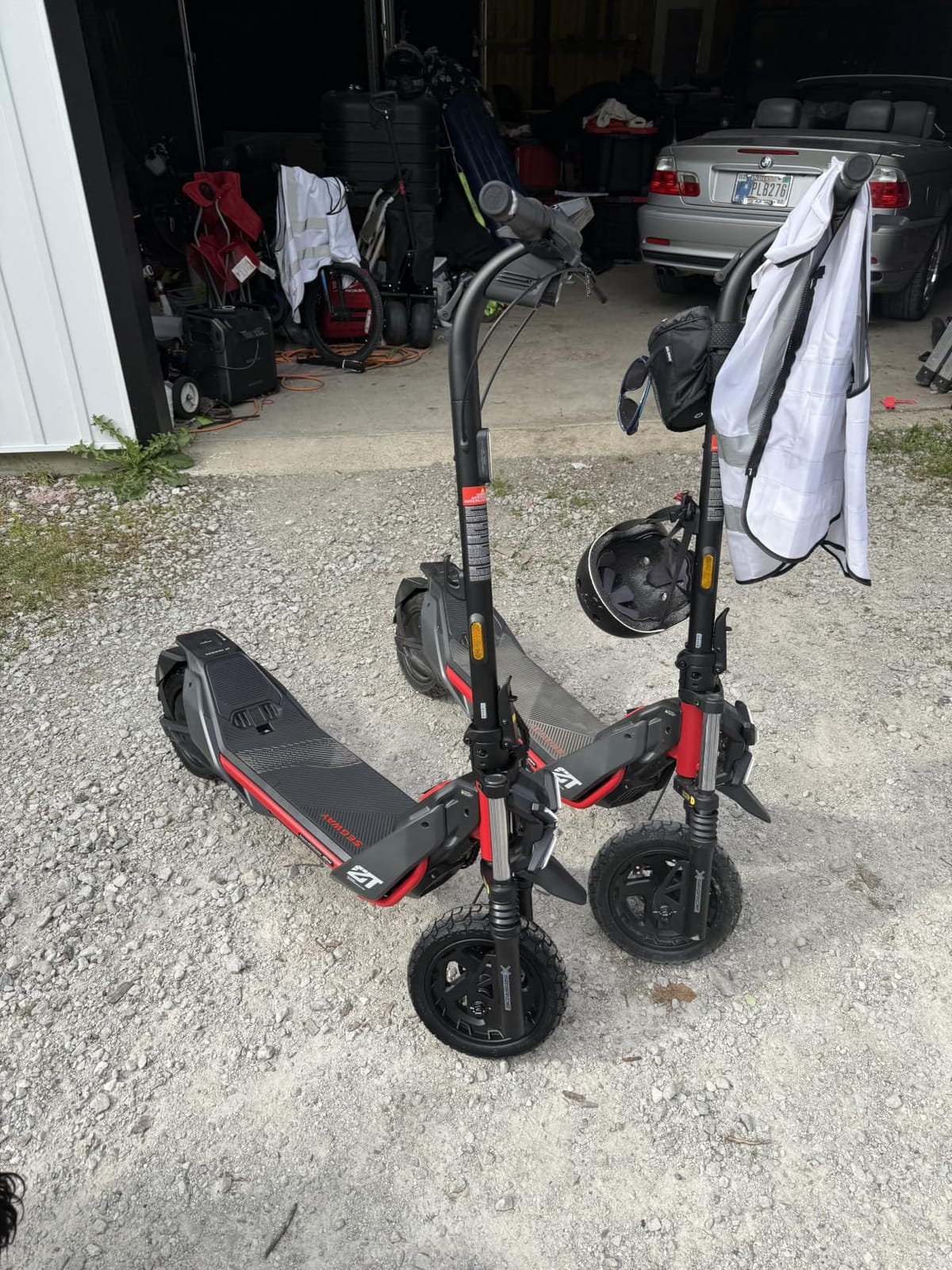
4. Segway ZT3 Pro – Premium Pick for Serious Grades
- 25% hill-climbing rating with a 1600W peak motor
- 43.5 mile ECO range with 4-hour fast charging
- Dual front telescopic fork and rear spring suspension
- 11-inch tubeless off-road tires
- UL 2272 certified by TUV Rheinland
- One of the heavier units here at 65.5 lb
- Traction control can feel intrusive on uneven pavement
- Sits above the 500W and 800W options in this list
The ZT3 Pro carries the highest average rating of any scooter in this roundup, and on the climb spec it is the most convincing hill machine we reviewed. A 1600W peak motor with a stated 25% hill-climbing capability is a genuine step up from the 500W and 800W group.
The battery is the other half of the case. Up to 43.5 miles in ECO mode means a hilly round trip is a real possibility rather than a hope, and the 2x Flash Charge system refills it in about four hours, which is workable overnight.
Eleven-inch tubeless off-road tires and a dual cantilevered telescopic fork with rear spring suspension take the punishment of broken hill roads. Owners specifically praise the combination for potholes and off-road sections, and the extra wheel diameter also rolls over cracks more smoothly than a 10-inch wheel.
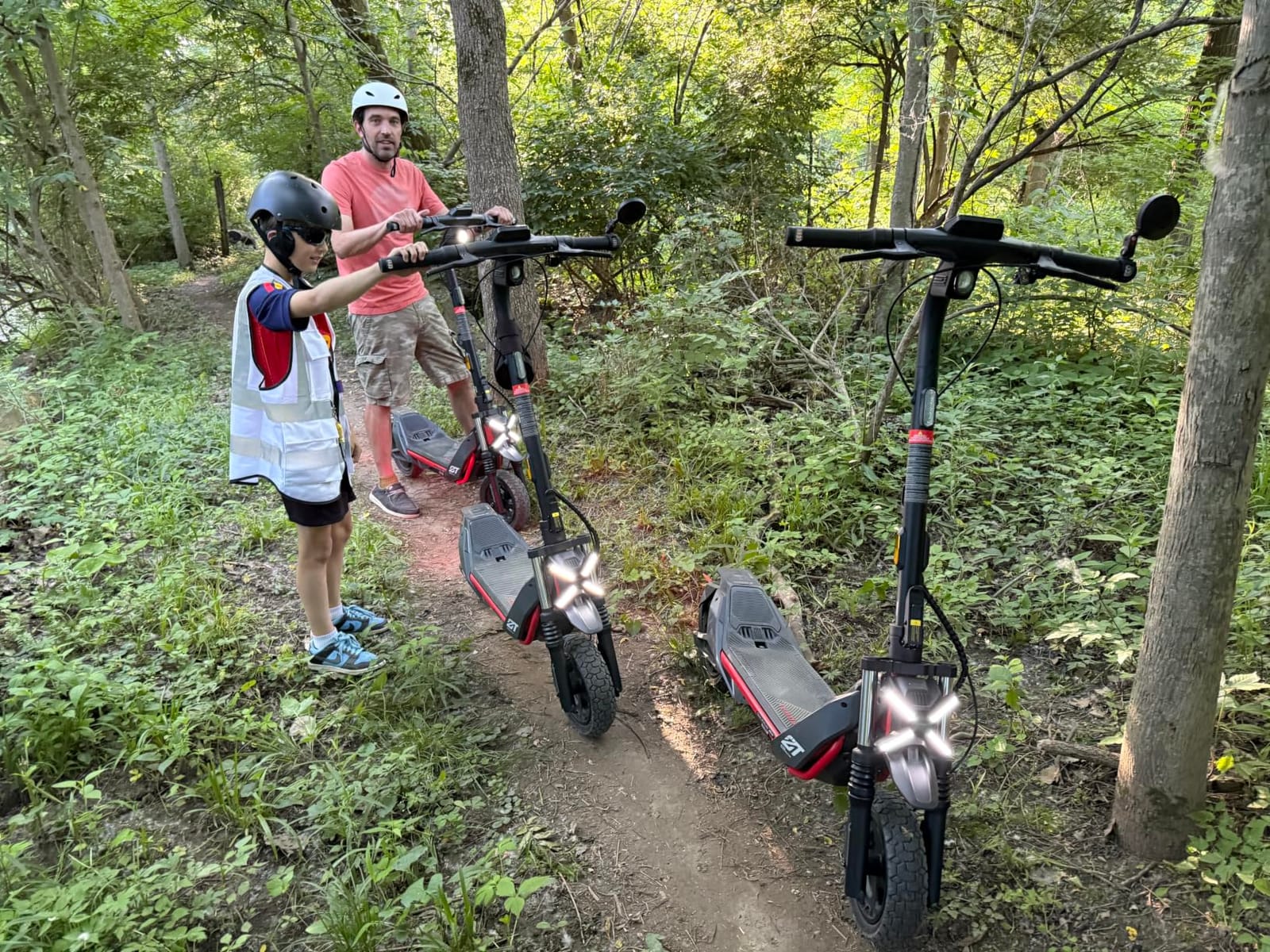
Safety details are strong for commuting. It carries IPX5 water resistance, a traction control system and ANSI/CAN/UL-2272 certification by TUV Rheinland, plus a 265 lb load rating that suits heavier riders.
Bluetooth unlocking removes the need to carry a key or fob on a route where you lock the scooter at the top of a hill, and the enlarged 3-inch display keeps speed and battery legible at a glance while you are working uphill.
Warranty coverage is unusually generous: two years on the frame, handlebar, hub, motor, front fork, controller, dashboard, wiring and shocks, with one year on the battery, charger and folding mechanism. On a scooter that will absorb a lot of vibration, that coverage is meaningful.
Is 25% hill capability realistic in daily use?
It is a real capability rather than a marketing number, but treat it as the ceiling under ideal conditions. A 15% sustained grade with a full battery and a moderate rider is where it feels genuinely effortless, and steepness beyond 20% is where any scooter, including this one, needs a running start and will draw down the pack quickly.
Who is this scooter wrong for?
At 65.5 lb it is among the heaviest scooters here, and it requires storage that can take that size. If your commute involves carrying the scooter up stairs, folding it into a small car, or living in a walk-up apartment, that weight becomes the deciding factor. Lightweight options like the NAVEE GT3 serve those routes far better.
5. Segway Ninebot MAX G3 – Best for Heavy Riders and Long Descents
Segway Ninebot MAX G3 Electric Scooter, Up to 28 MPH, 50-Mile Range
- Dual adjustable hydraulic front and rear suspension
- Front and rear hydraulic disc brakes with real stopping power
- Frame tested to 12427 miles of simulated vibration
- Apple Find My integration and Bluetooth unlocking
- UL 2272 and UL 2271 certified
- Real-world range is typically 12 to 15 miles
- Throttle touchiness makes steady speeds hard to hold
- Traction control can blunt throttle response
- Support is often unresponsive on warranty issues
For riders above 220 lb, the MAX G3 is the one we recommend without much hesitation. Its 286 lb load rating leaves real headroom for heavier riders, and the 2000W peak motor has the power to climb with margin rather than scraping along at walking pace.
Descent control is the standout feature. Dual adjustable hydraulic front and rear suspension paired with front and rear hydraulic disc brakes give the most progressive braking force here, and reviewers describe it as the scooter that made steep descents feel ordinary. Brake fade, the thing that turns a long drop into a problem, is far less of a concern with hydraulics than with cable or drum systems.
The self-sealing tubeless tires auto-seal punctures up to 4mm, which matters on rough hill roads where sharp edges and debris are common. Owners also report real commuting range of 15 miles or more at higher speeds with riders in the 230-260 lb range.
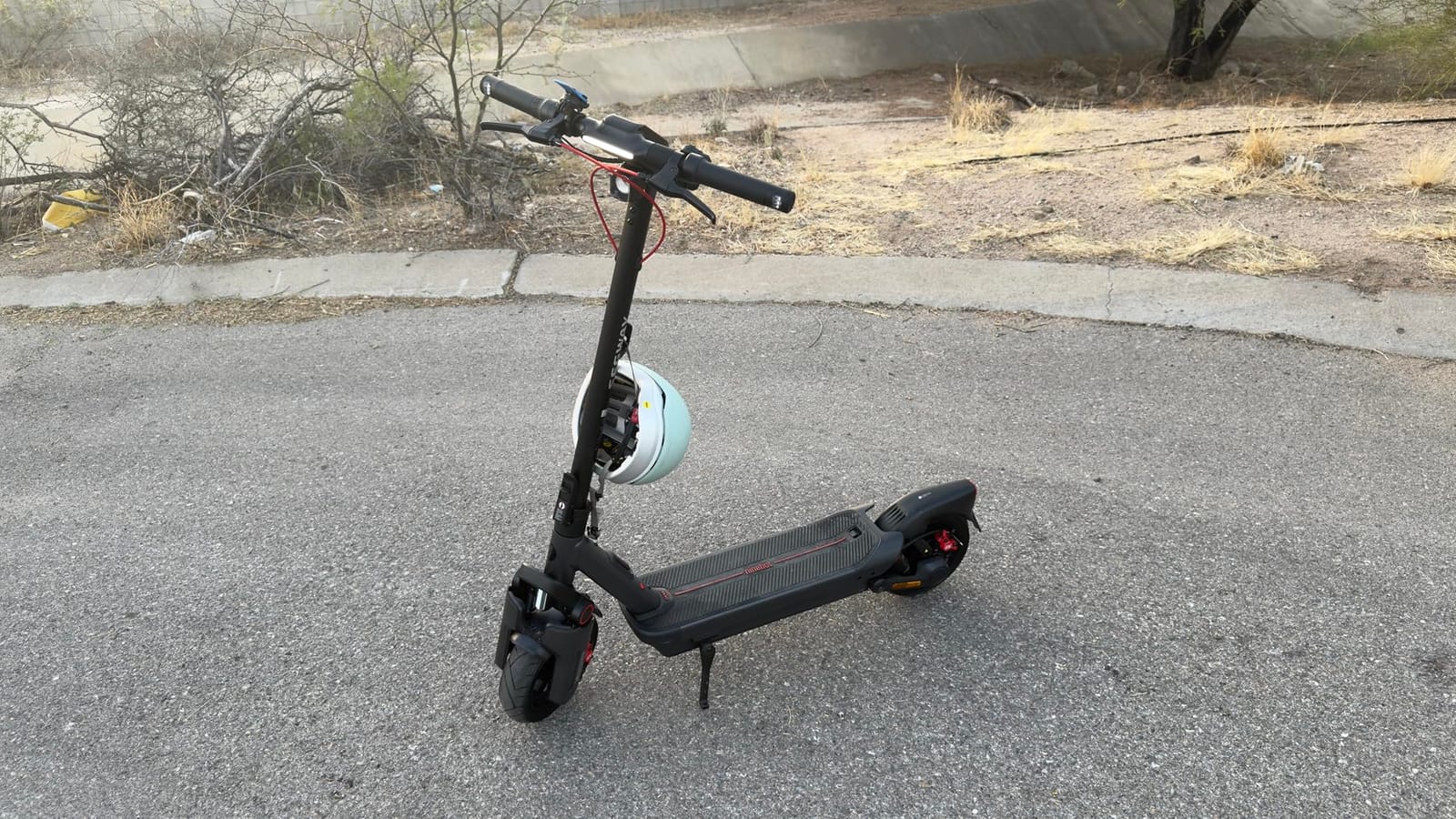
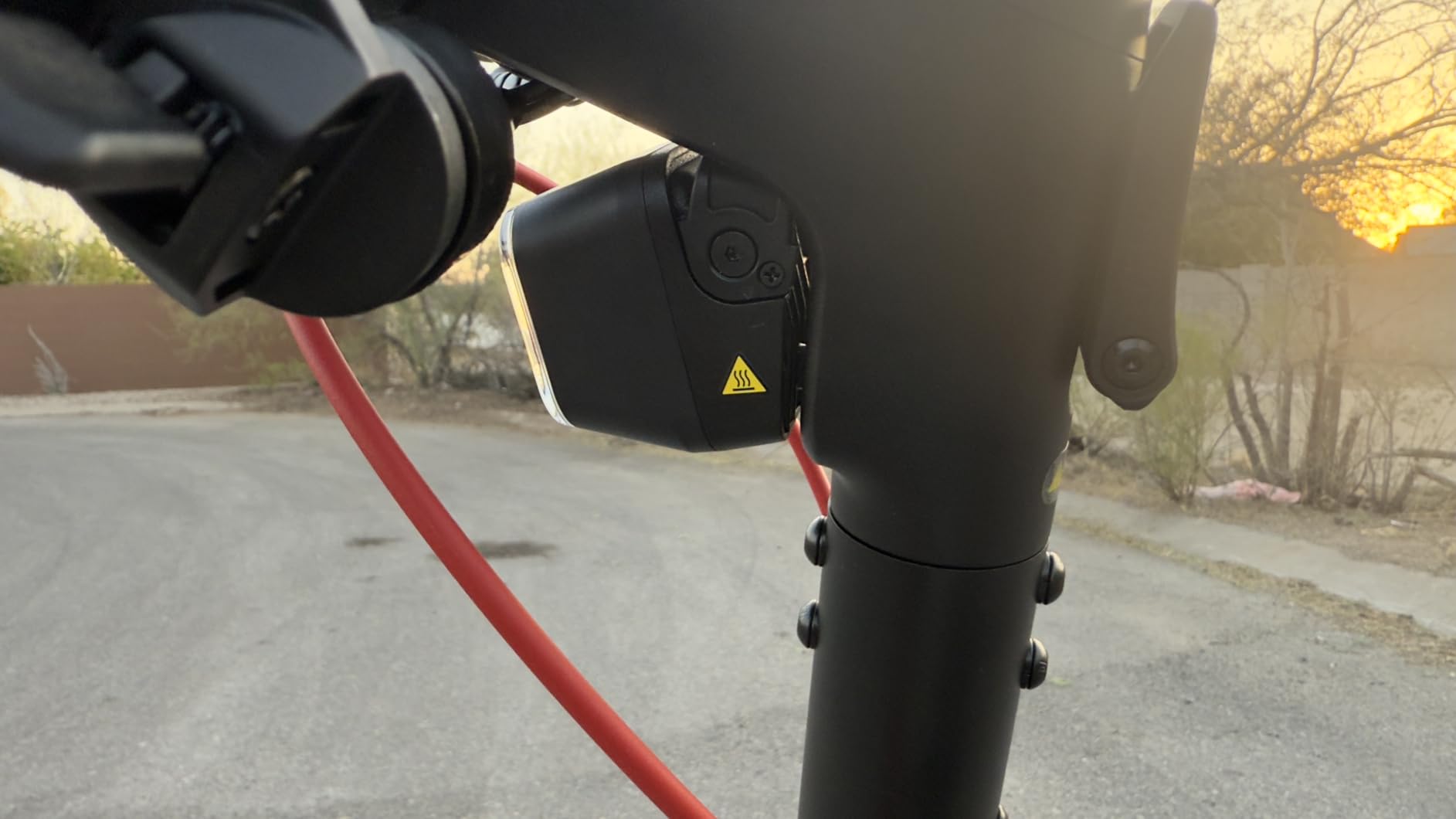
Charging is handled well, with 3.5 hours built in and 2.5 hours with the optional DC charger. IPX6 water resistance gives more protection for wet-weather hill commuting than the IPX5 units in this list, and the 6W adjustable headlight plus underglow lighting keeps you visible on dim streets.
Build quality is a genuine strength. The high-strength aluminum alloy frame was tested to 12,427 miles of simulated vibration and 500,000 suspension tests, and owners report surviving crashes and daily abuse, which is exactly the abuse pattern a hill commute produces.
Be realistic about the headline range. Owners report 12-15 miles in typical use rather than the advertised 50 miles, so plan your route with that figure and treat the rest as a bonus on gentle days.
Why do heavy riders get more out of this scooter?
Because the margin is built in. When a 2000W motor carries a 250 lb rider up a 12% grade, it is still operating well inside its envelope, which means steady power and minimal voltage sag. Riders near the capacity limit of a smaller scooter get the opposite: a strained climb, a power cut, and a hot motor that throttles on the next block.
What should you know before buying?
It weighs 54.2 lb, so storage and stair-carrying plans matter. Owners also report touchy throttle response, blunted traction control on uneven pavement, and a customer service experience they rate poorly, which matters most if you are far from an authorized service center.
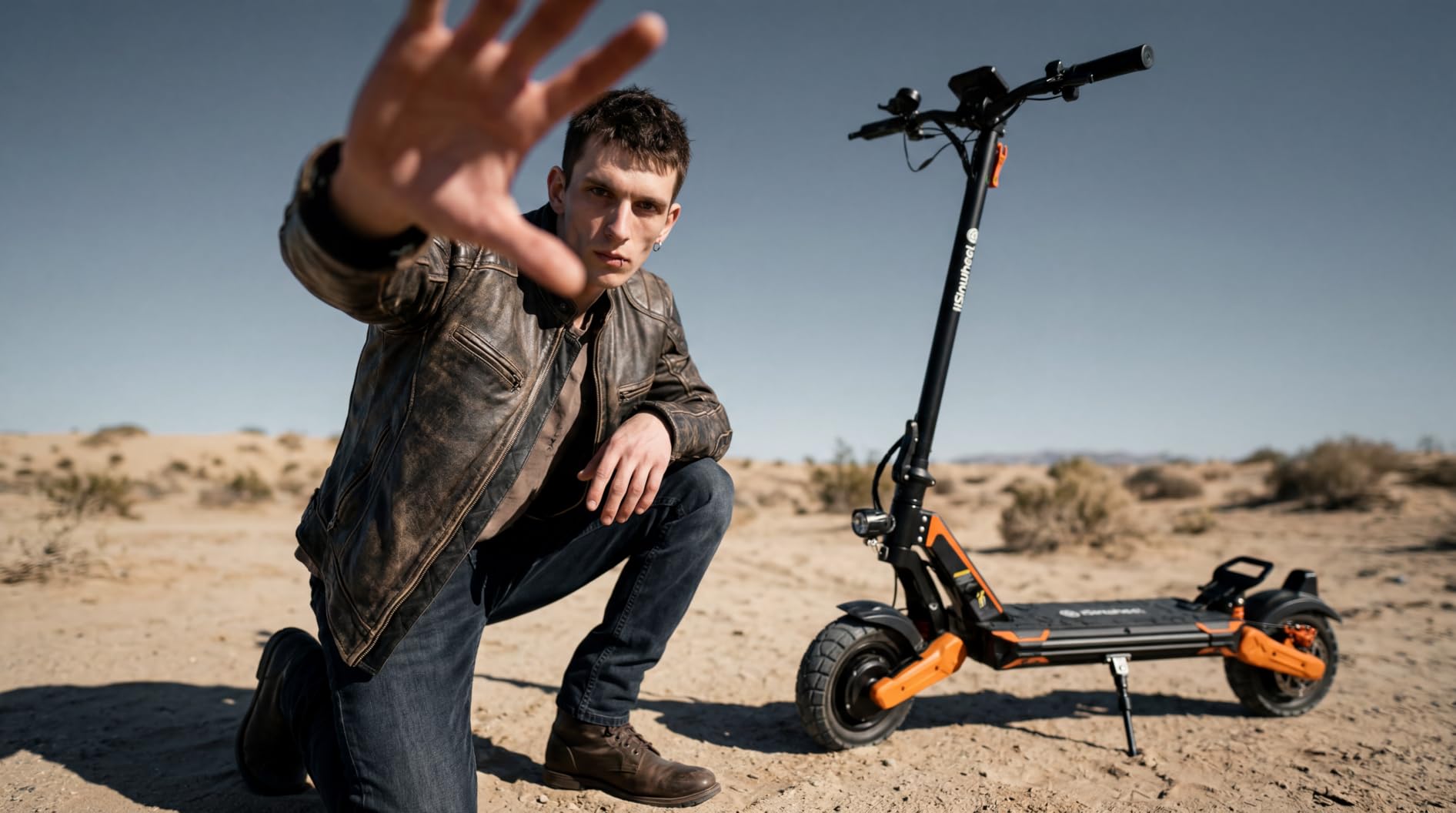
6. isinwheel GT1 – Best for High Load Ratings and Visibility
isinwheel GT1 Off Road Electric Scooter 28 MPH 800W Motor 28 Mile Range
- 330 lb load capacity
- among the highest ratings available here
- Front and rear swingarm suspension with pneumatic tires
- Very bright lights visible from a long distance
- Responsive disc brakes hold speed well at 28 MPH
- Tool bag included for roadside adjustments
- Wheel bolts need re-tightening after break-in
- Tire pressure guidance is not documented anywhere
- Kickstand sits too far from center and tips easily
- Support pushes troubleshooting onto the buyer
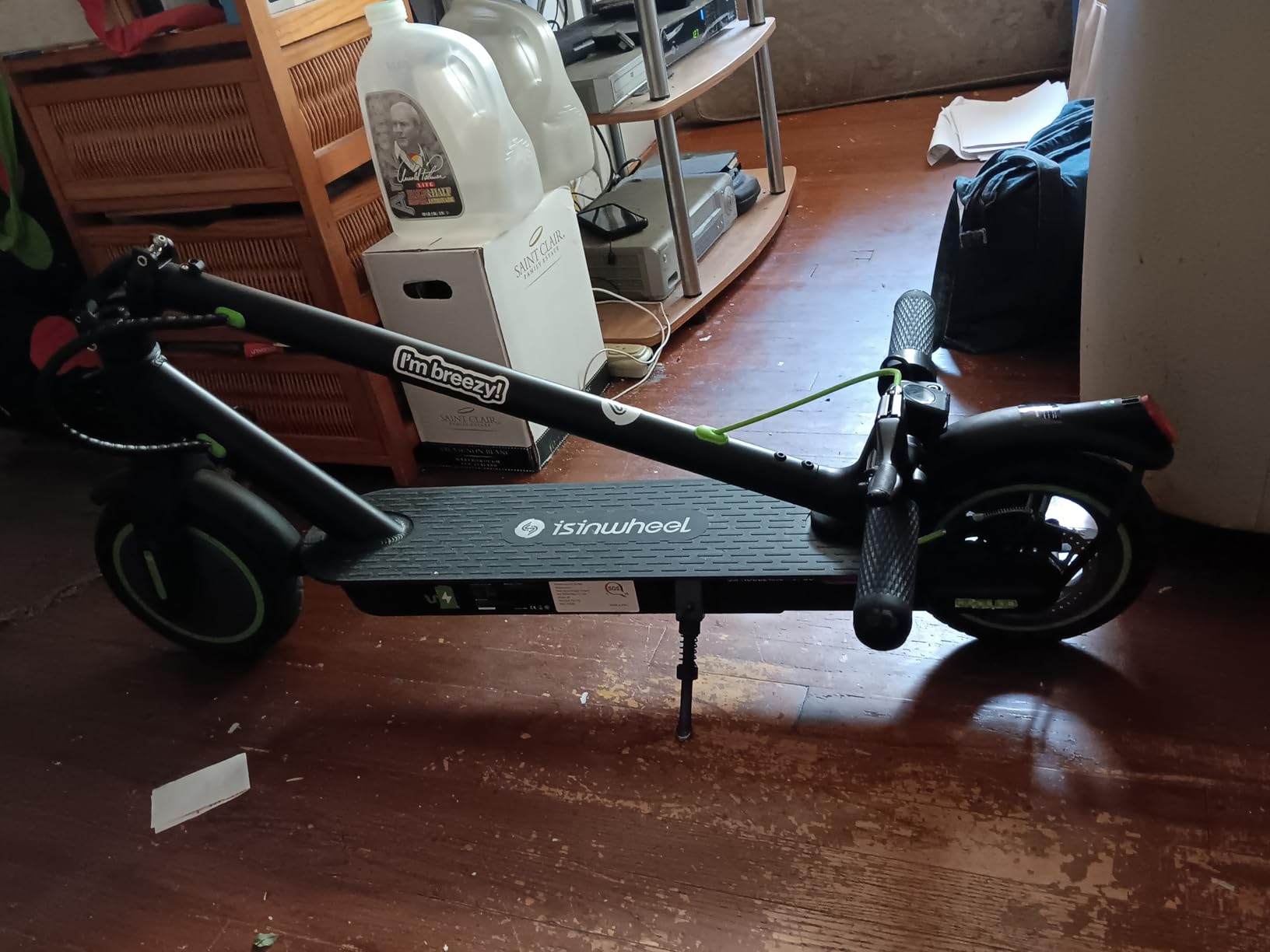
The isinwheel GT1 carries a 330 lb load rating, tied for the highest in this roundup, and that headroom is the reason to consider it. A scooter rated that high is being tested with a margin, which means a 250 lb rider on a hill sees far less performance loss than on a scooter rated to exactly their weight.
The 800W motor with a 48V 10.4Ah battery and four riding modes reaches up to 28 MPH, which is more than enough for commuting pace and gives you a genuinely fast mode for flat sections between hills. The 28-mile claimed range is reasonable for mixed riding.
Front and rear swingarm suspension is a design that handles uneven ground better than a simple straight fork, and combined with 10-inch pneumatic off-road tires it removes most of the small-bump harshness that makes hill rides tiring.
The lighting is the standout for hilly commuting. Front and rear lights, ambient lighting, turn signals and spotlights together mean drivers see you from further away on a street where you are moving slowly uphill, which is the situation where collisions actually happen.
Owners report the frame surviving multiple crashes, and the included tool bag with a wrench set is a small thing that saves a roadside trip when a bolt loosens on rough pavement.
There are real quality-of-life complaints, though. Wheel bolts and the fold-down mechanism need re-tightening after break-in, tire pressure guidance is missing from the tire, manual and seller pages, and the kickstand sits too far from the center of the deck, which makes tip-overs more likely on a slope.
Is 330 lb of capacity useful on a hill?
It is useful mainly as margin. The extra capacity means the motor, brakes and tires are all working well below their limits for a typical rider, and that translates into a climb that stays smooth instead of straining and a descent that stays controlled instead of nervous. The wide load rating also means a heavier rider is not riding a scooter built right at the edge.
What do buyers complain about most?
Break-in maintenance, mainly. Owners report needing to re-tighten wheel bolts after the first few rides, and one reported a pneumatic front tire going flat quickly. Charging port issues appear in a few reports, and the support experience leaves many troubleshooting on their own, so check that parts are available before committing.
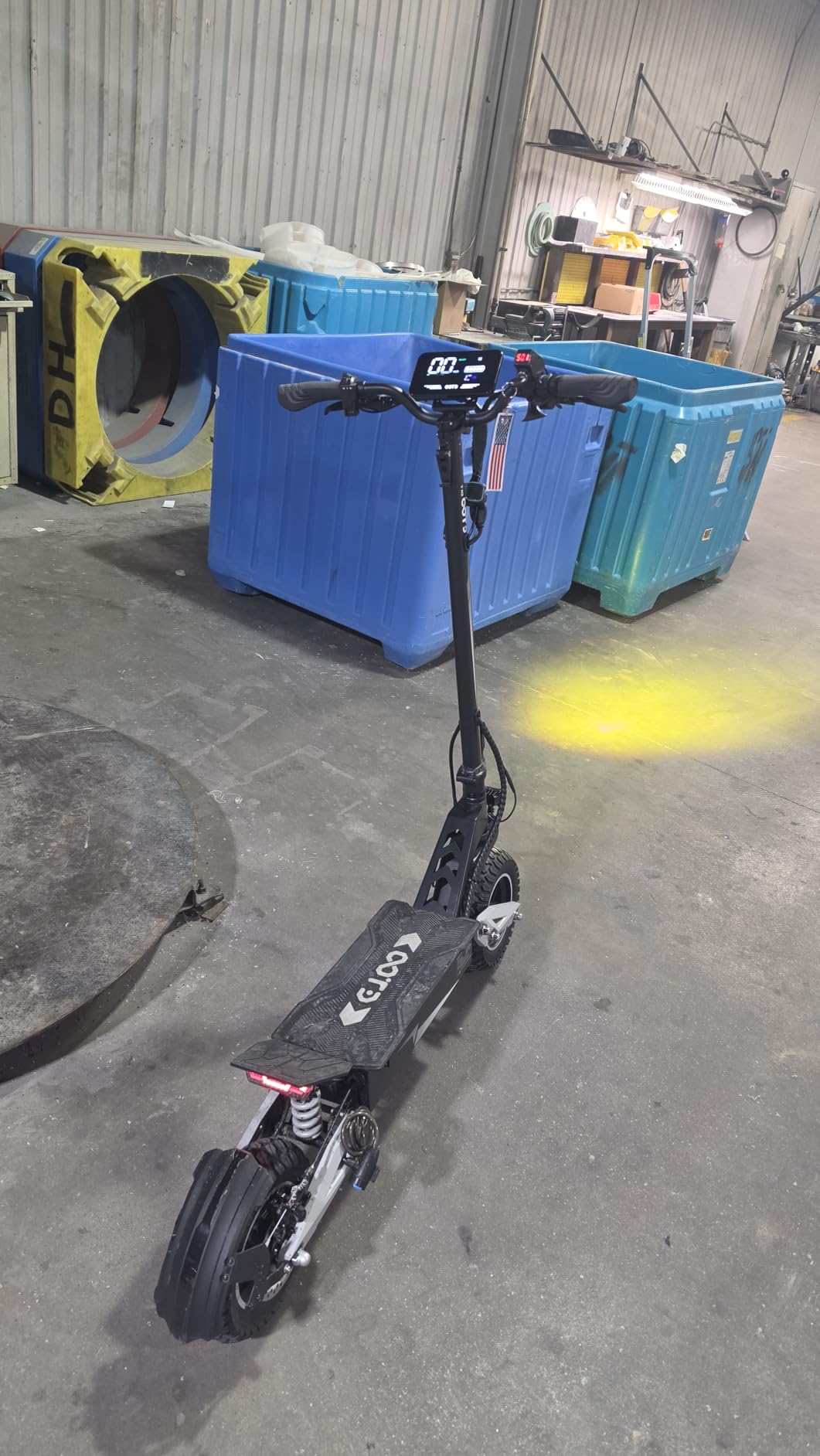
7. OOTD T10 – Best for Long Hilly Routes
T10 Electric Scooter for Adults, 11″ All-Terrain Tire Up to 46 Miles Range
- 900W motor rated for slopes up to 35 degrees
- 18Ah battery delivers long real-world range
- Thick dual suspension over a wide deck with high clearance
- Dual oversized headlights plus brake and turn signals
- Two-year frame warranty
- 62 lb weight is hard to lift or carry
- Limited torque for heavy riders on steep hills
- No companion app and no regenerative braking
- Less traction in puddles and wet conditions
The T10 is built around an 18Ah battery, and that is the number that makes it interesting for long hilly commutes. Most scooters in this class carry 10 to 13Ah, so this pack holds roughly half again the energy, which is where long climbs get much easier to plan.
One 240 lb owner logged 34 miles on a single charge, which is far more useful on a hilly route than the 46-mile headline suggests. The 900W motor is rated for slopes up to 35 degrees, giving strong burst capability for short ramps.
Thick dual suspension, a wide deck and high ground clearance make it one of the smoothest rides here over rough ground. Owners consistently praise that, and on a street full of patched repairs the difference in fatigue over a 20-minute climb is substantial.
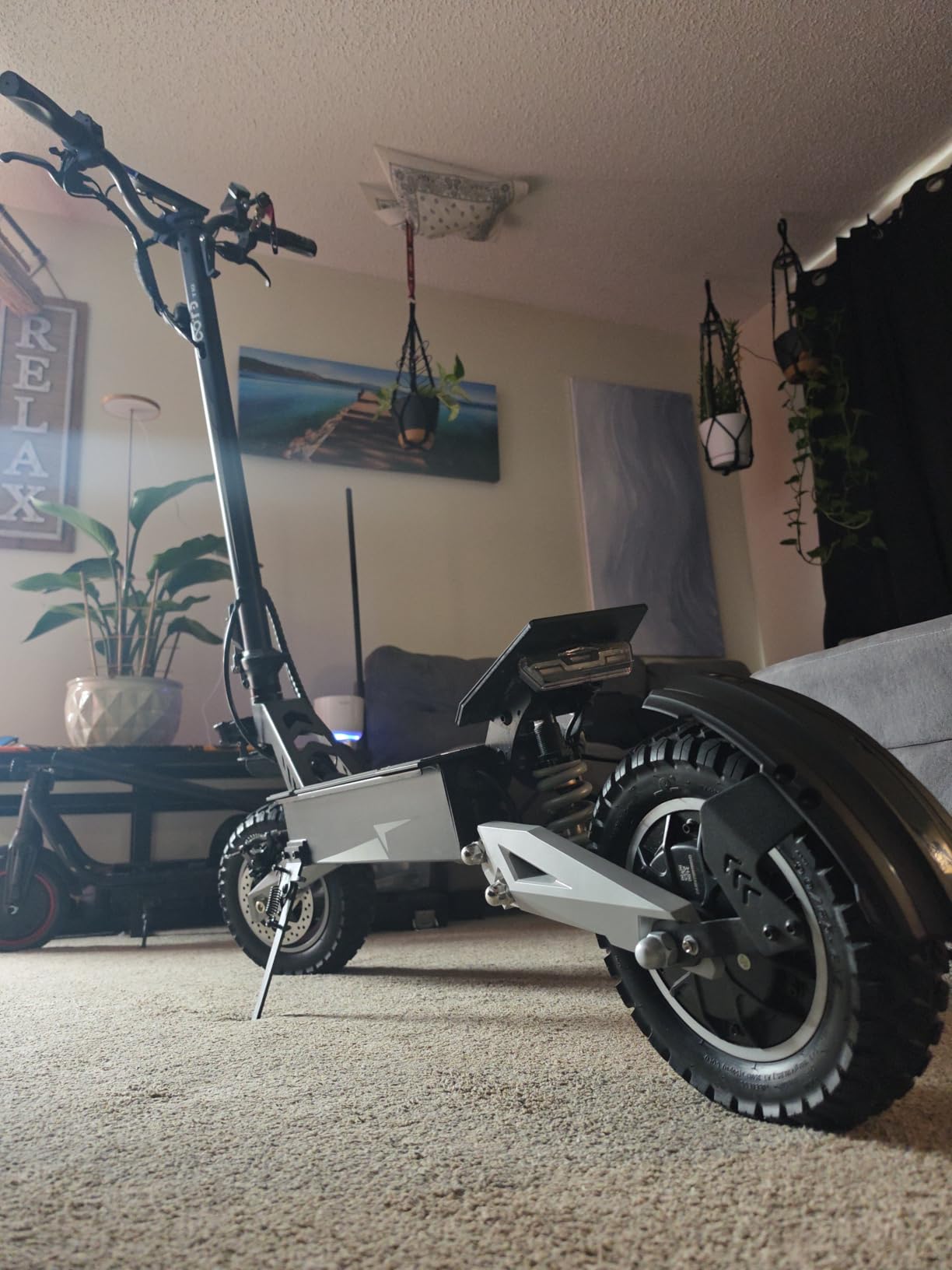
Visibility is handled unusually well, with two oversized LED headlights plus an integrated rear light that has brake and turn signal functions. The three speed modes, including a capped mode near 20 MPH, are clearly labeled on the large LED display.
The two-year frame warranty plus one-year electrical coverage is among the better terms here, and the scooter arrives 90% pre-assembled so setup time is short.
There are clear trade-offs. At 62 lb it is difficult to carry, and there is no companion app and no regenerative braking, which means all of the descent energy becomes heat in the brakes. Owners also report reduced traction in puddles and wet conditions.
Does the 18Ah battery solve range anxiety on hills?
It largely does. Climb energy use is high, so battery capacity is the most direct lever you have, and doubling the amp-hour count is what lets this scooter climb and still have charge left at the top. Riders covering more than 10 miles with real elevation change per day will feel the difference more than anyone.
Where does it fall short?
Torque under heavy load is the honest weakness. Owners at higher body weights report needing to kick-start the scooter into a steep grade, and the lack of regenerative braking means long descents rely entirely on the dual disc brakes. The 62 lb weight also rules it out for anyone who must carry the scooter regularly.
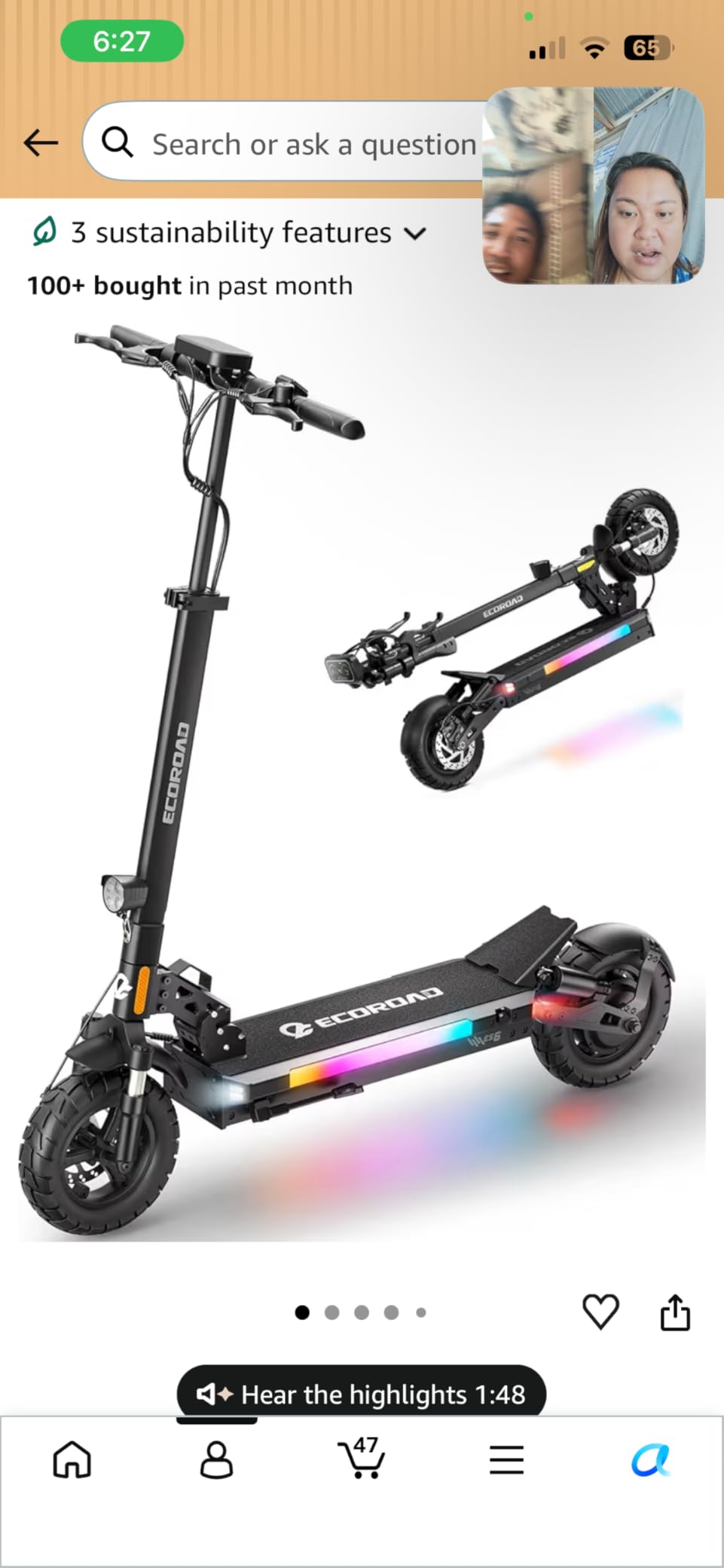
8. ECOROAD ES6 – Best for Certification and Included Accessories
ECOROAD Electric Scooter for Adults, 1000W Peak Motor Up to 31 MPH
- 800W continuous motor delivers genuine 31 MPH performance
- 624Wh battery supports long hilly routes
- Front hydraulic and rear cylinder dual suspension
- 330 lb load capacity with dual disc brakes
- Includes helmet
- storage bag and U-lock
- 55.9 lb weight limits portability
- Only 180-day parts warranty
- App and firmware required for full feature access
The ES6 stands out on paper for a simple reason: 800W of continuous motor power rather than a smaller continuous figure with a bigger peak headline. On a sustained climb, continuous output is the number that matters, and this is one of the few scooters here that states it plainly.
The 624Wh battery and 40-mile claimed range give it genuine long-route potential, and the 330 lb load rating means heavy riders get real headroom. Dual disc brakes plus EABS handle the descent side with more authority than most of this tier.
Front hydraulic and rear cylinder dual suspension smooths cobblestones and grass, and the 10-inch tubeless off-road tires mean fewer flats on the kind of broken side streets that hill neighborhoods tend to have.
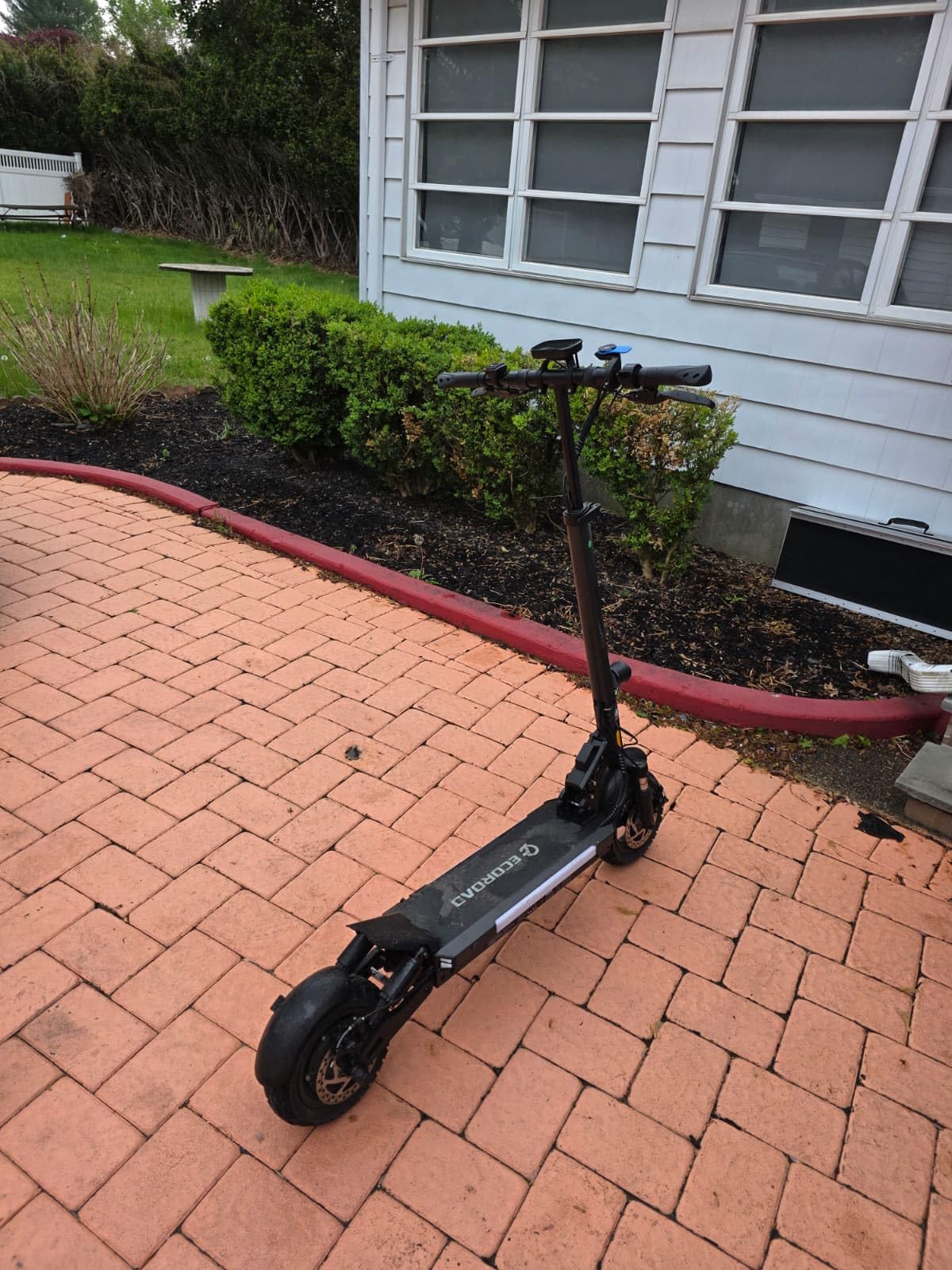
Certification is a genuine strength here. The scooter is ANSI/CAN/UL 2272 certified by TUV Rheinland, which is the safety standard riders on forums treat as non-negotiable, and it carries a 330 lb capacity to back it up.
The accessory bundle is unusually generous, including a helmet, storage bag and U-lock. For a commuter buying a first scooter, the helmet and lock alone remove two purchases from the list, and the 4-bead LED headlight with RGB ambient lighting helps on dark hill streets.
The ECOROAD app handles stats, cruise control and a digital lock, which is useful for a scooter parked at the top of a climb. Just note that full feature access depends on the app and firmware, so the scooter is less standalone than some rivals.
What does 800W continuous actually buy on a hill?
It buys sustained speed. Peak wattage covers a burst, and continuous wattage covers the block after the burst, which is where most riders find out whether a scooter is really hill-capable. On grades where peak-only scooters begin to fade, a continuous figure in this range keeps the climb predictable and reduces the chance of thermal throttling mid-ascent.
Is the short warranty a concern?
It is the weakest part of the package. A 180-day parts warranty is shorter than most rivals here, and on a scooter that sees daily vibration from rough hill roads, longer coverage is worth weighing. Check that a service point and spare parts exist near you before committing, since the limited term leaves less room for a slow repair.
9. NAVEE GT3 – Best for Transit Connections and Mixed Routes
- One of the lightest dual-suspension scooters here at 46 lb
- Folds in 3 seconds for train and bus connections
- Handles inclines up to 20 percent
- Triple braking with front drum
- rear disc and EBAS
- Apple Find My integration and electronic lock
- Brakes are weak on downhill grades
- Headlight is dim for night riding
- Bluetooth connection drops and needs a power cycle
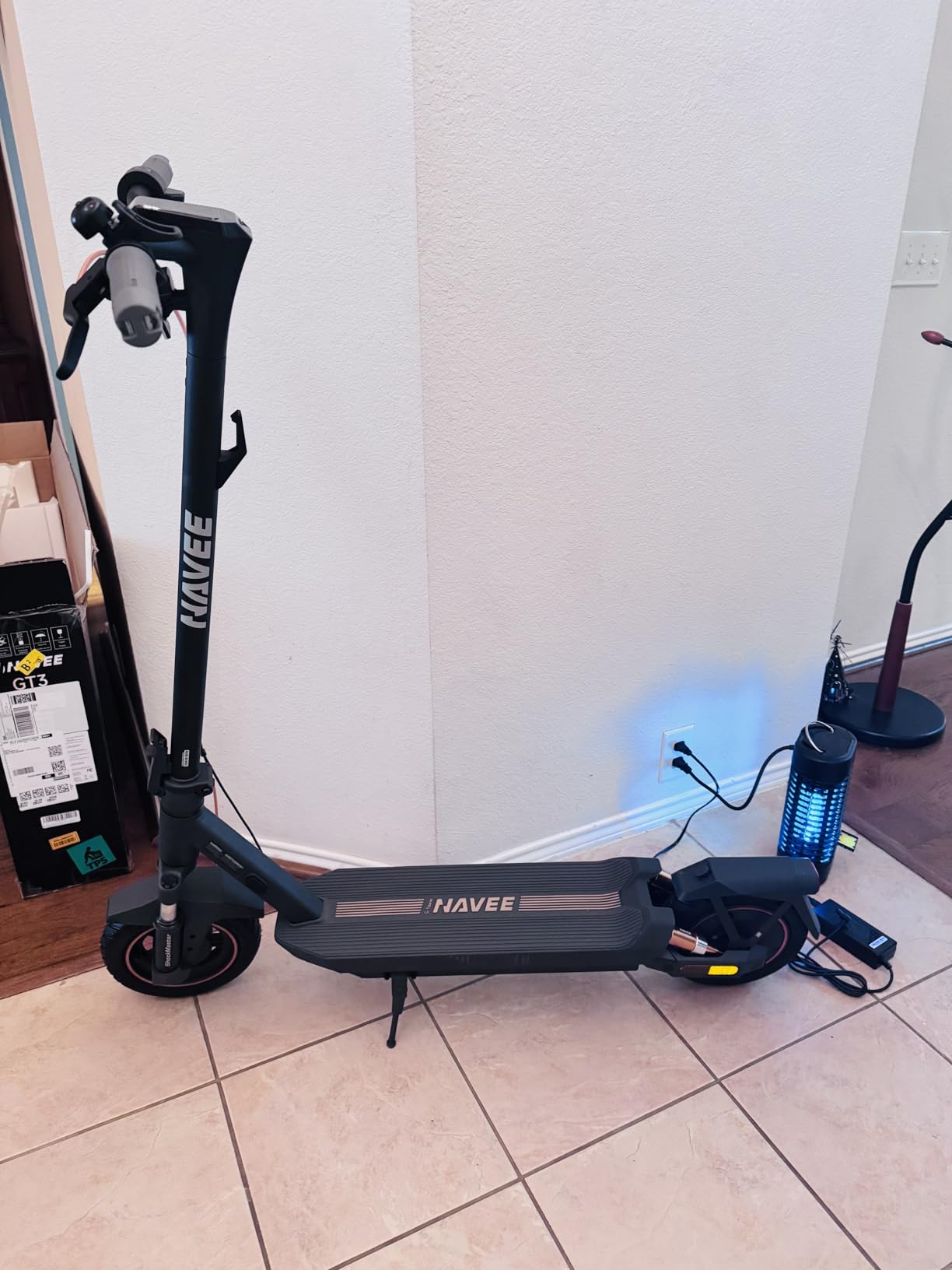
The NAVEE GT3 is the scooter to buy if your hilly commute is only half scooter. At 46 lb it is among the lightest models here with dual suspension, and it folds in about three seconds, which is the difference between making a train connection and watching it leave.
The 700W motor is described as high-torque and is rated for inclines up to 20 percent, with a 357Wh battery behind it. That is a smaller pack than most competitors here, so range on a hilly route needs planning, but the power delivery on the climb itself is competent.
Owners report that it holds a full 20 MPH even for a rider at 285 lb, and that it stays stable and secure at top speed with good ground grip, including in heavy rain. IPX5 waterproofing and a traction control system support that.
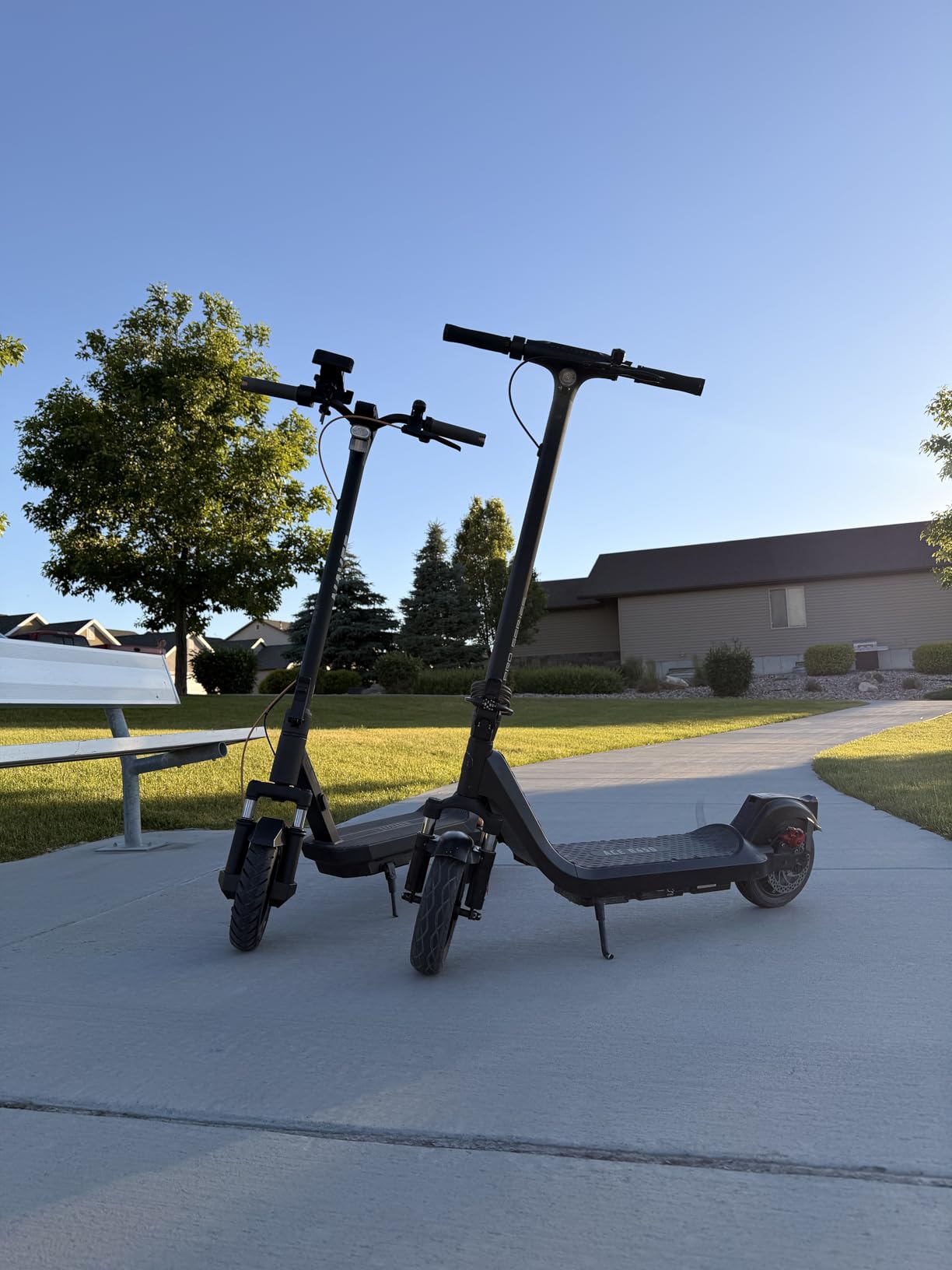
The Advanced Damping Arm System suspension gives it a comfortable ride after a short break-in period, and the wide deck helps stability on uneven pavement. The 3.6-inch LED display and app cover distance, charge and ride tracking, with an electronic lock and Apple Find My integration for retrieval.
Triple braking, combining a front drum brake, rear disc brake and EBAS, gives a layered approach. On descents, however, owners specifically report the brakes feel weak and require slow approach speeds, which is the main reason this ranks below the Segway models for steep descents.
The lighting is the other weak point. Owners describe the headlight as dim, which limits night riding on unfamiliar hill roads, and the Bluetooth connection can drop and need a full power cycle to reconnect.
Is a 357Wh battery enough for a hilly commute?
It is enough for a moderate route with a charge at the destination. The battery is smaller than the 480Wh to 624Wh packs in this list, so hills eat into it faster, and the three modes, including a Walking setting, are the tool for stretching a range-constrained day. Riders doing a 10-mile each-way trip with sustained elevation should look at a bigger pack.
How does it handle a mixed scooter and transit commute?
This is where the GT3 separates itself. The 46 lb weight, 3-second fold and compact 46 by 23 by 49 inch folded footprint make it genuinely usable on a train platform, and the electronic lock plus Find My integration solve the security problem that comes with leaving a scooter at a station all day.
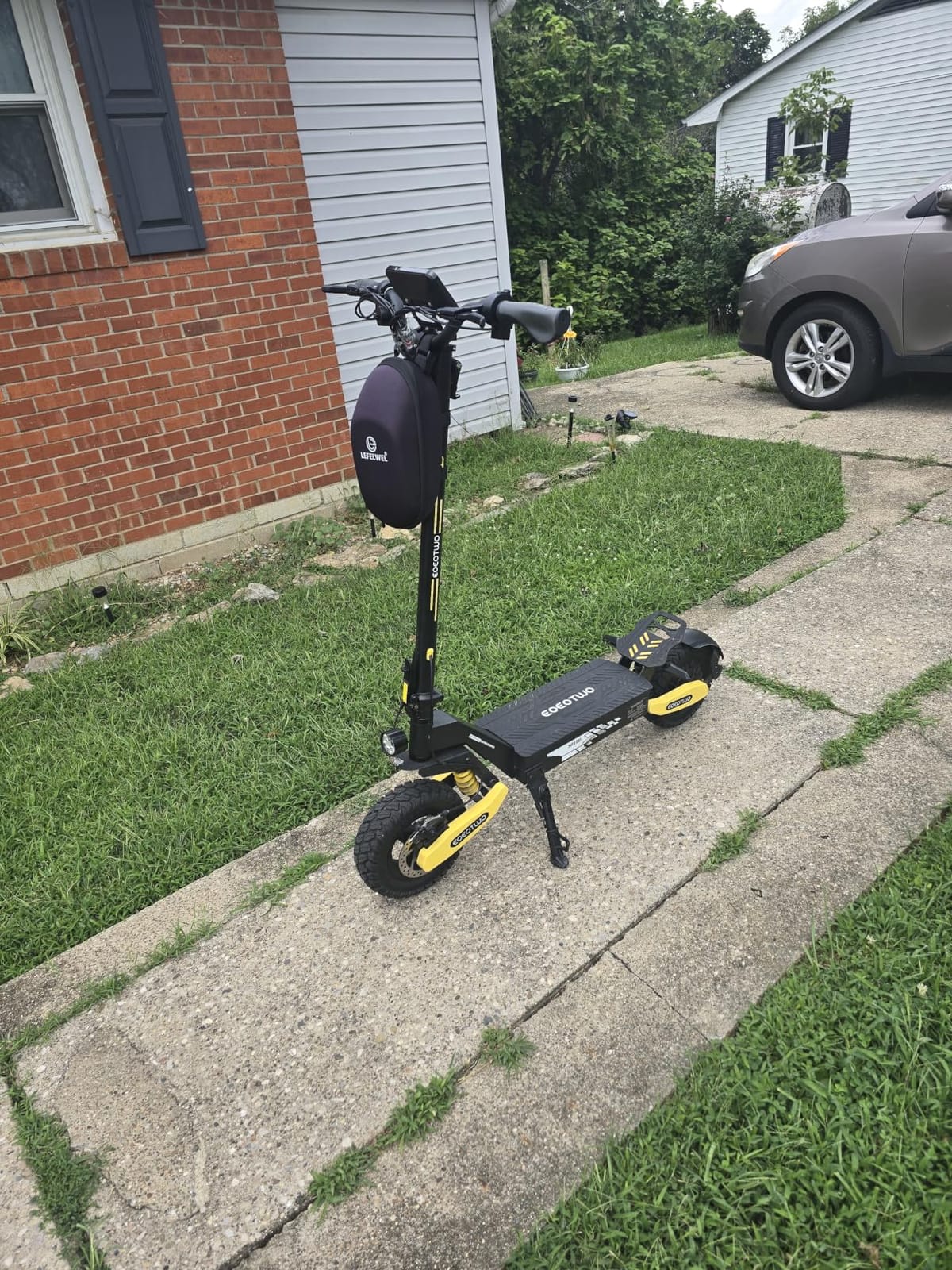
10. EOEOTWO GT06 – Best for Rugged, Steep Terrain
Electric Scooter for Adults, 11″ Off-Road Tires, Fast E Scooter
- 1200W brushless motor rated for slopes up to 35 percent
- Holds 28 to 31 MPH with 250 to 260 lb riders
- Pneumatic off-road tires with front and rear double suspension
- Front and rear dual disc brakes with turn signals
- Maintenance kit and tools included
- Heaviest scooter in this group at 68 lb
- Real range falls well short of the claim
- Speed wobbles can occur at higher speeds
- Acceleration is lackluster off the line
The GT06 is the most capable climber in this roundup on paper, with a 1200W brushless motor rated for slopes up to 35 percent and a 330 lb load rating. If your route includes a genuinely steep ramp rather than a long moderate grade, this is the scooter built for it.
Owners report it holding 28 to 31 MPH with riders in the 250 to 260 lb range, which is a meaningful load-carrying result rather than a light-rider number. The 624Wh battery is one of the larger packs here, and the battery life stays strong over months of daily use.
Front and rear double suspension with 11-inch off-road pneumatic tires produce what owners describe as a smooth, comfortable ride, and the chassis handles dirt, gravel and grass without complaint. For a commute that includes an unpaved section, that is a real advantage.
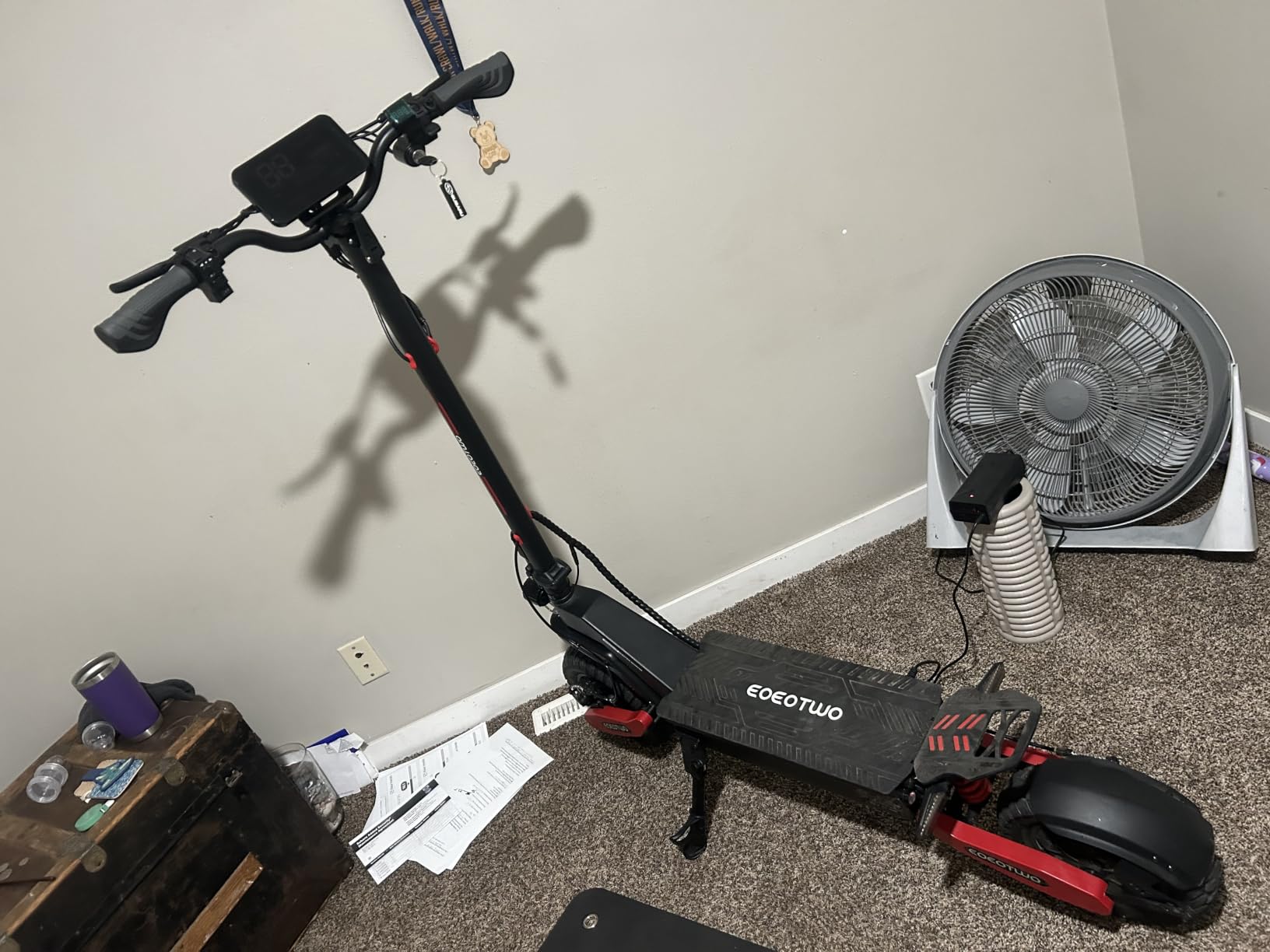
Braking is well specified, with front and rear dual disc brakes plus turn signals, brake lights and a high-power headlight. Riders report strong climbing ability on slopes under about 20 degrees, and the scooter arrives with a maintenance kit and all tools needed for assembly.
UL certification is present, and the 330 lb maximum load means heavier riders are well within the design envelope rather than at its edge.
There are meaningful downsides. At 68 lb it is the heaviest scooter in this group by a wide margin, and owners report speed wobbles at higher speeds due to that mass. Real range also falls well short of the stated figure, particularly on the top speed mode.
Is 35% slope capability usable on a real street?
It is a genuine capability for a 250 lb rider with a full battery, and it is the highest rating in this roundup. Treat it as a ceiling rather than a daily expectation: the practical value is that a steep ramp no longer requires a running start, and a sustained 15% grade is handled without strain rather than as a struggle.
What should a buyer weigh before choosing it?
Weight first. At 68 lb this scooter needs a dedicated storage spot and a two-person lift for stairs, which disqualifies it for many urban commuters. Owners also report lackluster acceleration despite adequate top speed, wobble at higher speeds, and at least one report of front brakes not fully working, so brake serviceability is worth checking early.
11. MEGAWHEELS C2 – Best for Gentle Hills and Light Commutes
- Quick-foldable design for cars
- desks and transit
- Front dual suspension with 10-inch pneumatic vacuum tires
- UL 2272 certified battery system
- Headlight
- turn signals and tail light included
- Clear LCD display with app control
- Some arrive dead or will not power on
- Some arrive with bent forks
- Weaker than advertised performance on hills
- Battery drains quickly on High mode
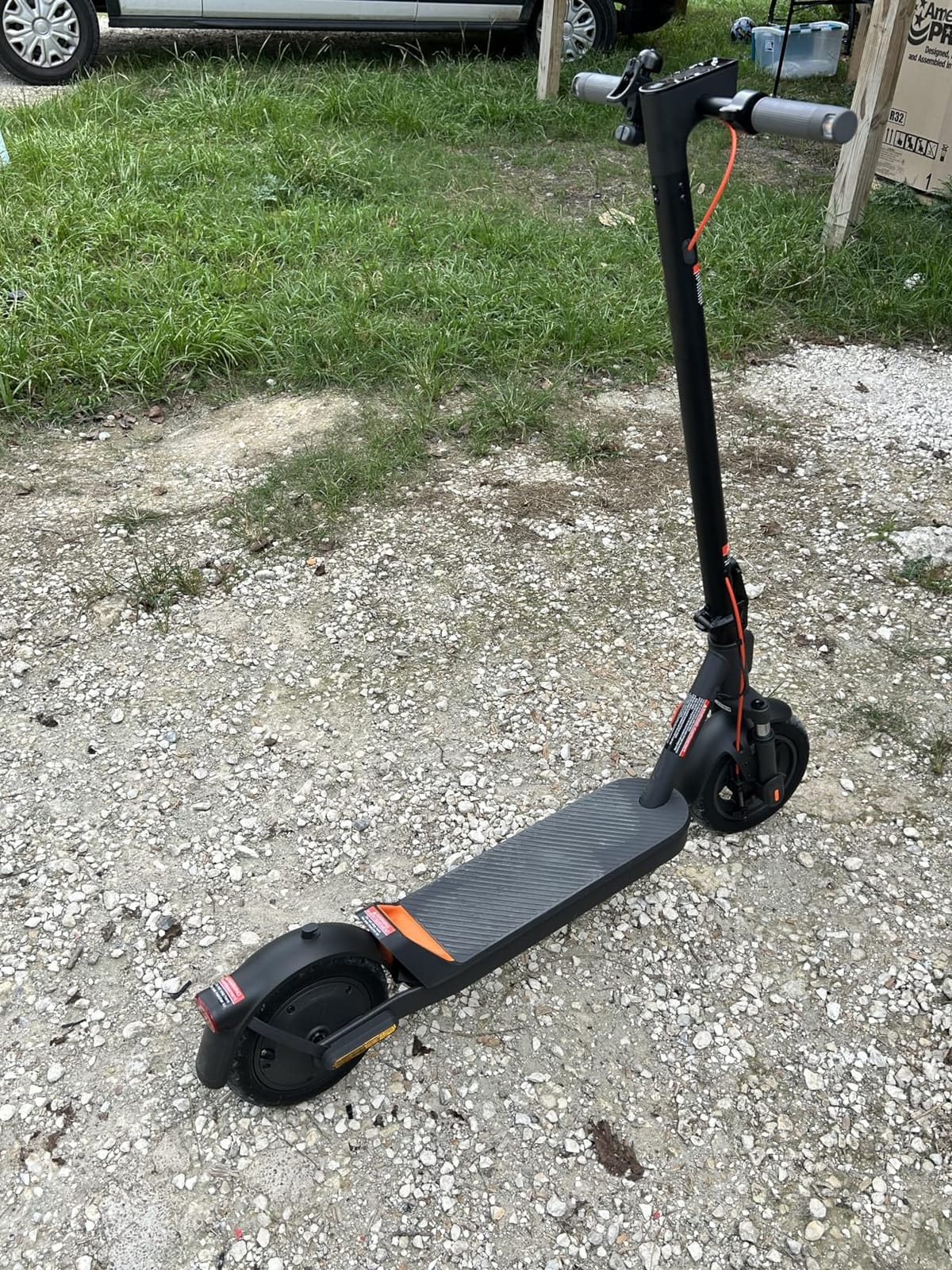
The MEGAWHEELS C2 is included here because plenty of commutes are not mountain passes. If your route has a few 8% rises and nothing more, a 350W motor, front dual suspension and 10-inch pneumatic vacuum tires are enough, and the 15 mph top speed suits low-speed residential streets.
The folding design is the feature owners praise most, since it folds quickly enough for a desk, a car trunk or public transport, and the whole package is light enough to carry for the last few hundred metres.
The 10.2Ah battery delivers up to 19 miles of range, which is realistic for a short daily commute on mostly flat terrain, and the UL 2272 certified battery system is a genuine safety plus that many scooters at this level skip.
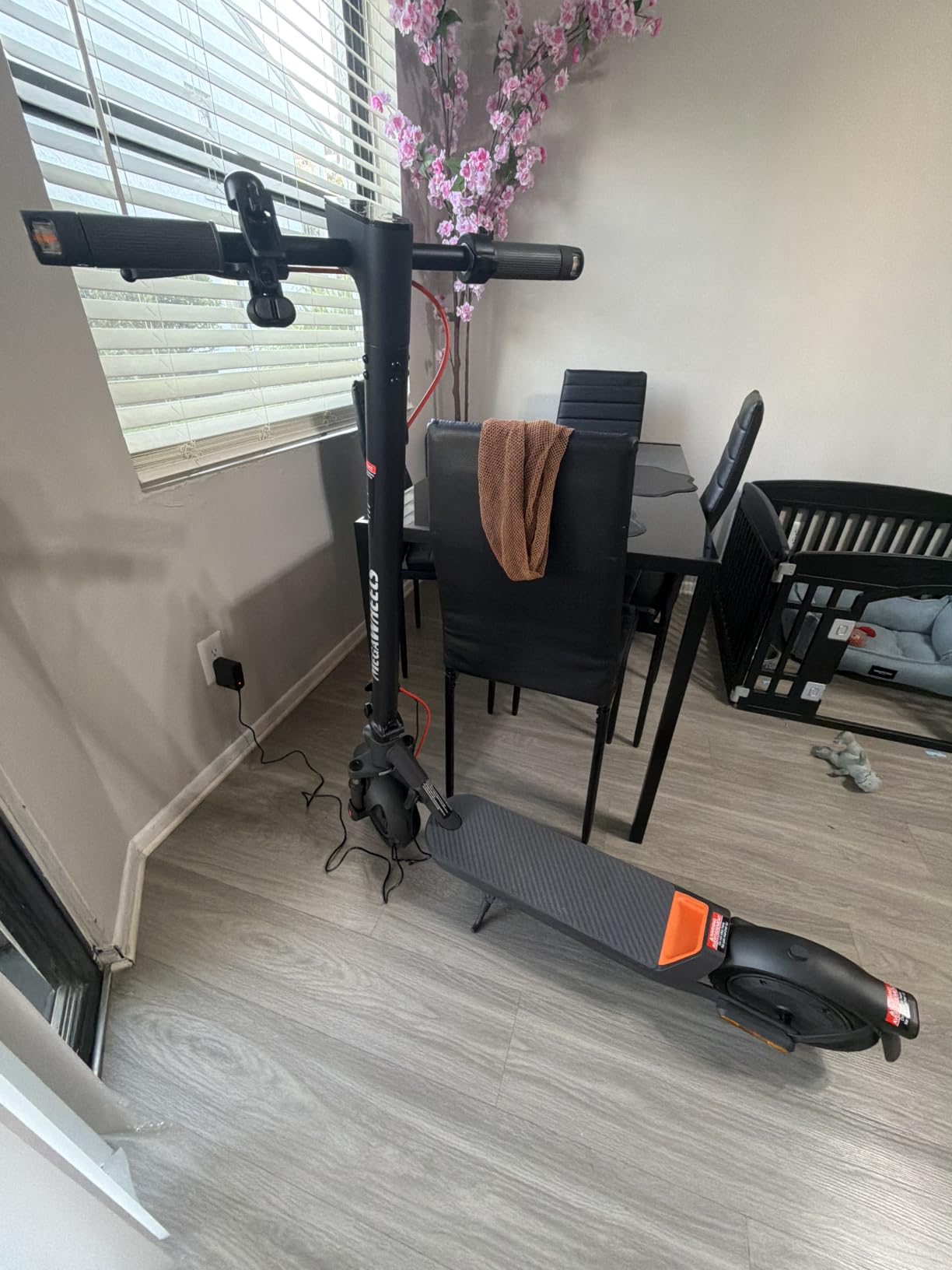
Lighting covers the basics well, with a bright front light, integrated turn signals and a tail light, and the clear LCD display shows speed, battery level and mode. App control lets you set limits and lock the scooter without a key.
Owners like the quiet operation, which lets riders bypass traffic on neighborhood streets rather than filtering into moving lanes.
The honest limitation is hill performance. With a stated 15 degree slope capability and a 350W motor, this scooter slows noticeably on any sustained grade, and owners report weaker-than-advertised hill performance alongside faster battery drain on High mode.
What grade can it realistically handle?
Short rises of around 8-10% are comfortable, especially with a light load and a full battery. Sustained grades above 12% will pull the speed down to a crawl, and the 220 lb capacity means heavier riders feel that limit much sooner. For a commute with real sustained elevation, pick a model from higher up this list.
What quality issues have buyers reported?
A minority of owners received scooters that would not power on out of the box, and some arrived with damaged forks. That is a packaging and inspection issue rather than a design flaw, but it is worth knowing if you buy from a seller with thin support. The brand’s own customer service is reported as responsive when issues are resolved quickly.
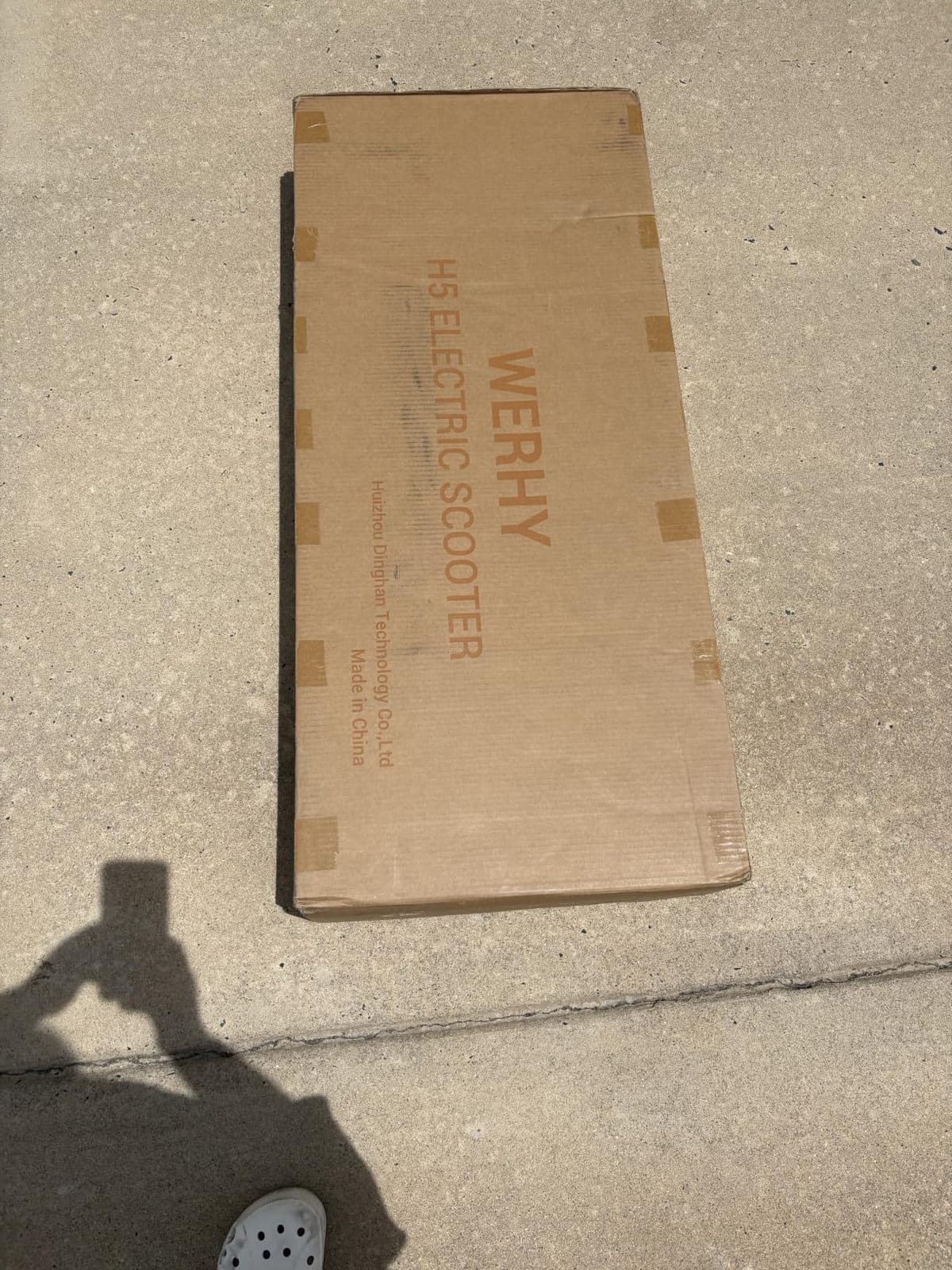
12. WERHY H7PRO – Best Compact Commuter for Short Hill Runs
WERHY Electric Scooter, 500W/350W Powerful Motor & 19/22 MPH Top Speed
- Quick acceleration to 19 mph from the 350W motor
- Fast 4-hour charging with a BMS battery
- Dual suspension over 8.5-inch solid honeycomb tires
- Three-second folding aluminum frame
- App control of speed
- gears and E-lock
- Solid tires are harsh on rough pavement
- Some riders find it heavy to carry by hand
- Fixed handlebar limits rider fit
The WERHY H7PRO rounds out the list as the compact option for short commutes with moderate rises. A 350W high-torque motor rated for a 15% maximum slope, 19 mph top speed and a 265 lb load rating is a more useful combination than the light, low-capacity scooters in the same general size.
Range is the strength. Owners confirm 23 to 25 miles from the large capacity battery, which with a BMS system holds up over time, and the 4-hour charge means it is ready for the next day quickly.
Dual high-elastic spring suspension front and rear plus 8.5-inch solid honeycomb tires give a ride most owners describe as comfortable, and the maintenance-free tire design means no pressure checks on a daily driver.
The app controls speed, gears, the electronic lock, the headlight and cruise control from a centered LCD display, which is more control than most scooters of this size offer. The aluminum body folds in about three seconds, a genuine advantage for transit or office storage.
Front EABS and rear drum brakes provide adequate stopping power for flat riding and gentle grades, and the headlight, rear light and bell cover night commuting basics.
Two limitations are worth weighing. The solid honeycomb tires are less forgiving on rough pavement than pneumatic tires, and hill riders notice that difference. The fixed handlebar also limits fit for taller or shorter riders, unlike the adjustable bar on the iScooter.
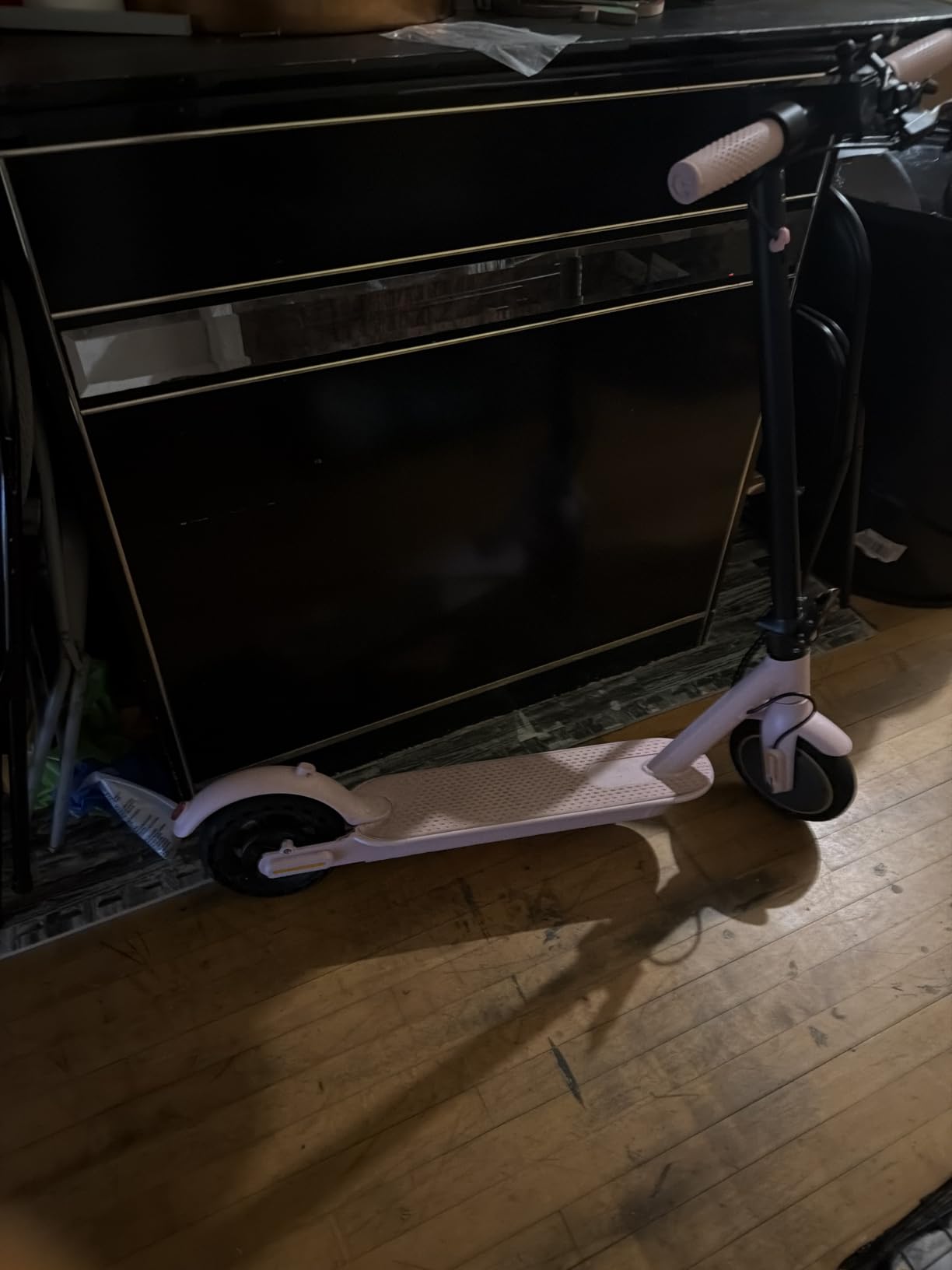
Is a 15% slope rating enough for a typical city route?
For a route with short rises up to about 12%, yes, and the 265 lb load rating means it is not carrying more than it was designed for. For a sustained climb above 15% or a long multi-block ascent, you will be riding at walking pace and watching the battery gauge, and a larger motor would serve you much better.
Who should consider this instead of a bigger scooter?
Riders with a short commute who want simple one-hand folding, low maintenance and a long range per pound of complexity. If you have a generous storage spot and a genuinely steep route, spend the extra effort on an 800W or larger motor, because the difference on a climb is the difference between riding and walking.
Buying Guide: Match a Scooter to Your Hill Profile
Start by measuring your route instead of trusting the incline rating. Most map apps show an elevation profile for a route, and the number that matters is the longest continuous climb on your daily path, not the steepest single point. A 25% ramp for 100 meters is a much easier problem than 12% for half a mile, and scooters handle the first one far better.
Then add your body weight to the equation. Riders consistently recommend staying 20-30 lb under a scooter’s stated capacity for hill routes, because the climb is where every extra pound shows up. If you weigh more than 220 lb, your realistic shortlist here is the Segway Ninebot MAX G3 at 286 lb, the isinwheel GT1 or the ECOROAD ES6 at 330 lb, and the EOEOTWO GT06.
For motor size, the pattern in our testing is straightforward. Below 500W, sustained grades above 10% are a struggle. At 500W, gentle to moderate hills work well for lighter riders. At 800W, you gain real headroom, and the iScooter iX3/iX4 is the value example. Above 1200W you are buying burst capability for genuinely steep ramps.
Voltage and capacity matter as much as wattage. A 48V system with a 15Ah or larger pack holds voltage better under load, which is exactly what prevents the mid-climb power drop described by so many owners. On long hilly routes, the OOTD T10 with its 48V 18Ah pack and the ECOROAD ES6 with a 624Wh pack are the two with the most headroom.
Tires and suspension are the hill comfort decision. Pneumatic or tubeless tires grip better on damp pavement and roll over cracks, which reduces the effort on a climb, while solid tires avoid flats entirely. Dual suspension matters more on hill routes than anywhere else, because broken pavement is where a rigid scooter transmits the most vibration to your wrists and shoulders.
Braking deserves as much attention as power. Every descent repeats the energy you created on the ascent, so the brakes are doing the most work in the ride. Dual hydraulic disc brakes handle repeated long drops best, and the Segway Ninebot MAX G3 is the model in this roundup where we would feel most confident on a long steep descent in wet weather.
Certification is non-negotiable. Look for UL 2272 on the scooter and UL 2271 on the battery, which are the standards riders on r/ElectricScooters treat as the baseline. In this roundup the Segway ZT3 Pro, the Segway Ninebot MAX G3, the ECOROAD ES6, the NAVEE GT3, the EOEOTWO GT06, the MEGAWHEELS C2 and the Hiboy S2 Pro all carry UL certification.
Warranty length and parts availability are worth more on hill scooters than on flat-road ones, because vibration from rough pavement is what actually breaks frames, folding hinges and controllers. Two-year terms on the Segway ZT3 Pro and the OOTD T10 give the most room, while the ECOROAD ES6 at 180 days on parts is the thinnest.
Finally, think about the first and last mile. If your route involves carrying the scooter up stairs or folding it onto a train, weight becomes a hill problem of its own. The Hiboy S2 Pro at 35.9 lb and the VOLPAM SP08 at 41 lb are the lighter models here with meaningful climbing ability, and the NAVEE GT3 at 46 lb folds fast enough for a train platform. Our Segway scooter guide goes deeper on the two Segway models in this list if you want the full picture.
Riding Technique for Steep Grades
Build speed before the hill, not on it. Momentum is free power, and riders who reach a climb at 12 MPH arrive at the top far faster than those who start from a standstill. Where street design allows it, a short flat run before the grade makes a noticeable difference.
On single-motor scooters, lean forward slightly and keep your weight over the rear wheel. Front wheel lift is a common complaint on steep grades in single-motor designs, and shifting your weight rearward through the hardest part of the climb keeps the front planted. A kick to start the ascent is acceptable and normal practice.
On descents, apply the brakes in short repeated applications rather than one long squeeze, and use the regenerative feature where it exists to bleed speed between applications. Keep both hands on the bars and stay out of the lane, because a slow scooter on a descent is far more visible and far more vulnerable than a fast one.
Battery conservation comes down to mode discipline. Climbing in a lower speed mode and returning to a higher mode on the flat stretches typically extends range noticeably on any route with elevation change. Riders also report starting a long climb above 30% charge rather than near empty, since the weakest part of the pack is exactly when sag is worst.
On wet streets and leaf-covered hills, reduce speed early, avoid painted lines and metal covers that become slick, and give yourself more stopping distance. Pneumatic tires help significantly here, which is why so many forum riders treat them as a hill requirement rather than a comfort upgrade.
Frequently Asked Questions
Which electric scooter is best for hilly areas?
The best electric scooters for hilly areas pair an 800W or larger motor with a high-voltage battery, dual suspension and strong mechanical brakes. Our top pick is the Hiboy S2 Pro for proven long-term reliability, while heavier riders should consider the Segway Ninebot MAX G3, which carries a 286 lb rating and dual hydraulic disc brakes. Riders above 250 lb have the most headroom on the isinwheel GT1 or ECOROAD ES6, both rated to 330 lb.
Is a dual motor better for hills?
A dual motor usually is better for hills because it splits torque across both wheels, which improves traction and reduces front wheel lift on steep grades. That said, in this roundup several single-motor scooters with 800W to 1200W of power climb as well as much dual-motor commuters, because battery voltage and capacity matter as much as motor count. A high-voltage single motor with a large pack can outclimb a lower-voltage dual-motor setup on a sustained grade.
Does rider weight affect hill climbing?
Yes, more than any other variable. Every extra pound is load the motor must lift on the ascent and the brakes must control on the descent. Riders commonly report that a scooter rated for a 20% incline handles only 8 to 12% once a heavy rider and a low battery are added. The practical rule is to stay 20 to 30 lb under a scooter’s stated capacity, and to choose a load rating with genuine headroom for hill routes.
Can electric scooters climb steep hills?
They can, but the grade that is comfortable is well below the manufacturer’s headline figure. A scooter rated for 25% incline typically handles a sustained 12 to 15% climb with a moderate rider and a full battery, and real-world performance often runs 30 to 50% below the printed rating. Short steep ramps are far easier than long moderate grades, and the battery is usually the limiting factor before the motor is.
How does battery level affect hill climbing?
A partially charged pack delivers lower voltage under load, which causes the power drop riders describe as the scooter running out of strength mid-hill. This sag is worst in the last 20% of charge, so a climb started on a low battery can end in a walk. Larger capacity packs at a higher nominal voltage resist sag better, and starting long climbs above 30% charge is a simple habit that noticeably improves the experience.
Final Verdict: Which Scooter Wins Your Commute
The best electric scooters for hilly commutes in 2026 come down to your route and your weight. The Hiboy S2 Pro takes the editor’s choice for proven durability, the deepest owner history and the best long-term battery reports in the group. The iScooter iX3/iX4 is the value answer with an 800W motor, pneumatic tires and a 264 lb rating, and the VOLPAM SP08 covers gentler hills for the least money.
For serious grades, the Segway ZT3 Pro with its 25% hill rating and the EOEOTWO GT06 with 35% capability are the two to look at. For riders over 220 lb, the Segway Ninebot MAX G3, the isinwheel GT1 and the ECOROAD ES6 carry the load ratings that make the difference. Check your route’s elevation profile, match it to a motor size, and pick a scooter with a brake system you trust on the way down.