
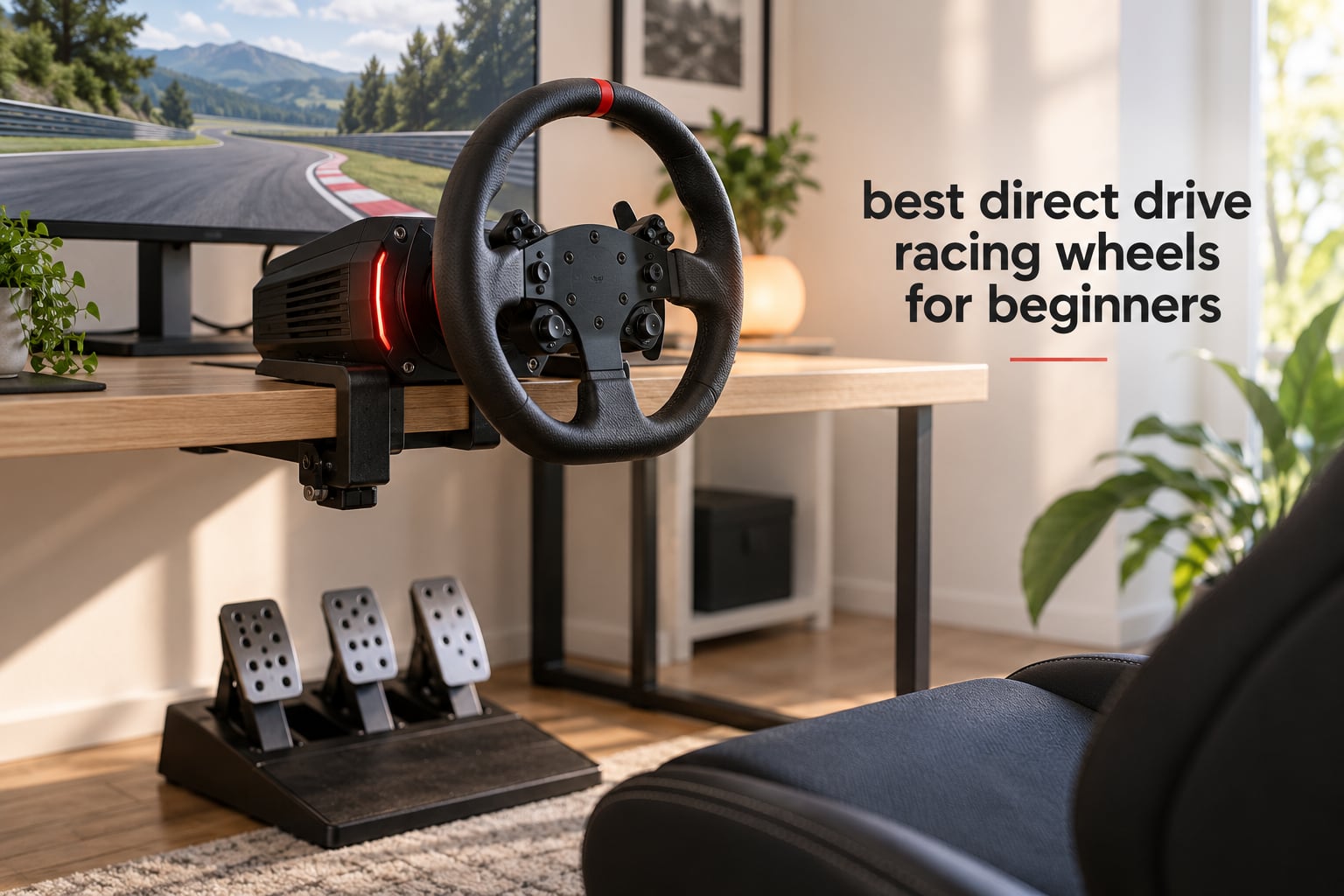
The short answer: the MOZA R5 Bundle is the best direct drive racing wheel for beginners in 2026. It pairs a 5.5 Nm servo base with a 280mm rim, steel pedals and a desk clamp in one box, so nothing else has to be bought before your first session.
Most newcomers arrive from a belt-driven wheel such as the Logitech G920 or the Thrustmaster T300 RS. Those wheels top out around 4-6 Nm, and owners on r/simracing routinely describe the jump to direct drive as transformative because the feedback detail arrives without the lag that a belt or cog set introduces.
Direct drive means the force feedback motor is bolted straight to the steering shaft with no belt and no gear wheels in between. The game sends forces to the base up to 1000 times per second and the base pushes back on the shaft at exactly the strength the physics engine calculated, so you feel kerbs, tyre slip, weight transfer and engine vibration as the car actually moves underneath you.
Table of Contents
Top 3 Best Direct Drive Racing Wheels for Beginners in 2026

MOZA R5 Bundle
- 5.5 Nm direct drive servo
- 280mm ES rim with 22 buttons
- SR-P Lite steel pedals included
- CNC steel desk clamp included
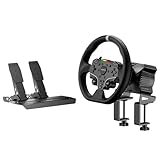
MOZA R3 Bundle
- 3.9 Nm servo with low torque ripple
- Compact base for small desks
- Steel Hall sensor pedals
- Angle-adjustable steel clamp
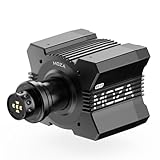
MOZA R9 V3
- 9 Nm direct drive servo
- NexGen 4.0 feedback algorithm
- Smart temperature control
- Wireless and wired connection
The R5 Bundle takes the top slot because 476 owners have bought it and the feedback matches what beginners actually need. The R3 Bundle scores highest on rating and costs less, and the R9 V3 is the obvious destination if you want to move up without changing ecosystems.
Best Direct Drive Racing Wheels for Beginners in October
| Product | Specifications | Action |
|---|---|---|
| MOZA R5 Bundle |
|
Check Latest Price |
| MOZA R3 Bundle |
|
Check Latest Price |
| MOZA R9 V3 |
|
Check Latest Price |
 Fanatec CSL DD QR2 Fanatec CSL DD QR2 |
|
Check Latest Price |
 Thrustmaster T598 Thrustmaster T598 |
|
Check Latest Price |
 PXN V10 Pro PXN V10 Pro |
|
Check Latest Price |
1. MOZA R5 Bundle Review – The Complete First Direct Drive Setup
MOZA R5 Bundle Racing Wheel, Direct Drive Base, Pedals Simulator Kit for PC
- Detailed smooth feedback for 5.5 Nm
- Metal construction with a solid CNC desk clamp
- Metal magnetic shift paddles
- Four-bolt setup and quick Pit House install
- Basic two-pedal set with no clutch or load cells
- Pedal base tilts backward unless weighted
- Shallow clamp on wide framed desks
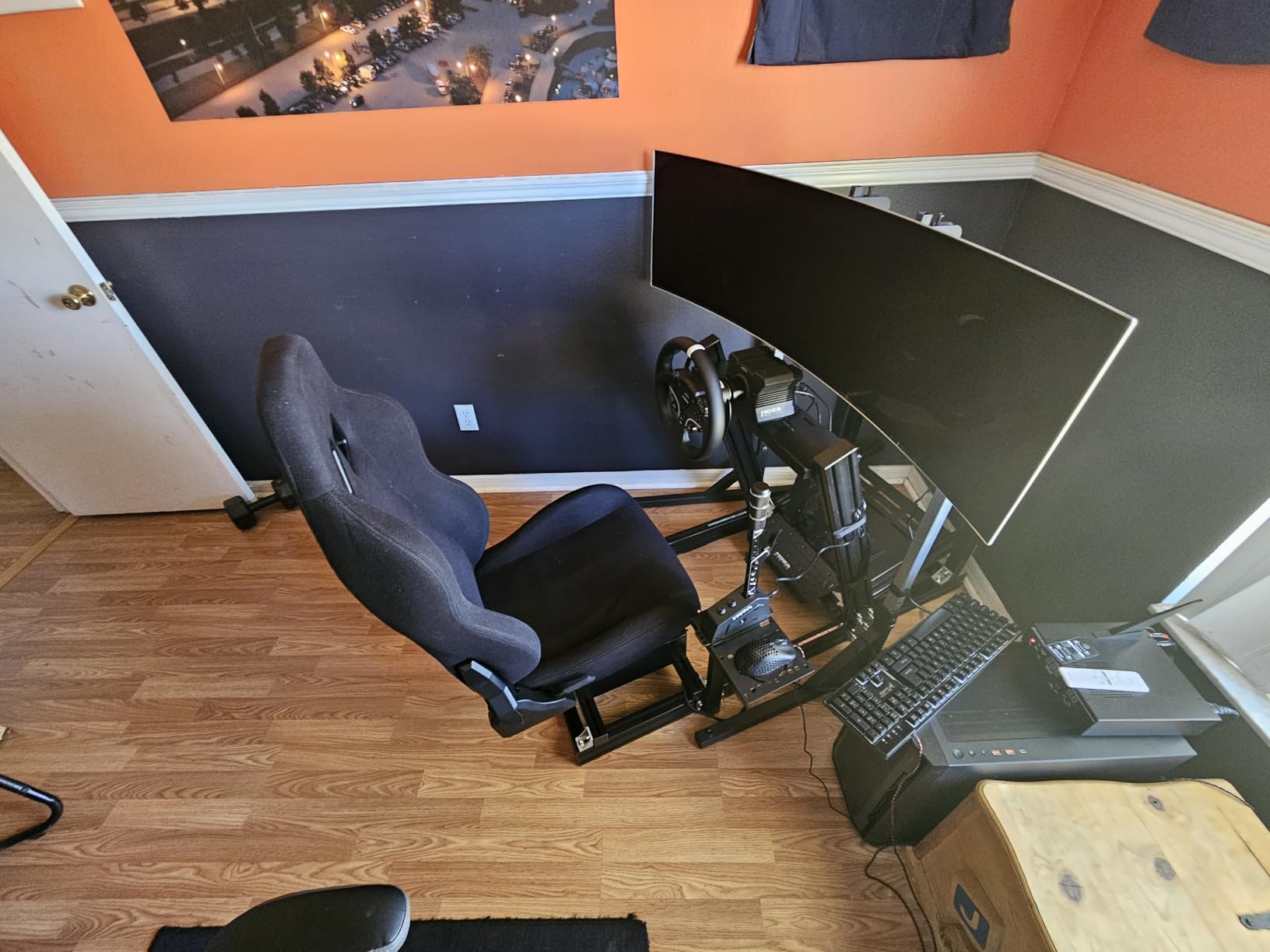
The R5 Bundle is the wheel we hand to a friend who has never touched a sim rig. The box contains everything: a 5.5 Nm direct drive base, the 280mm ES steering wheel, the SR-P Lite pedals and a CNC steel desk clamp. Setup is four bolts through the clamp, a USB cable to the PC and Pit House installing in the background.
Force feedback is the part that matters most. At 5.5 Nm the R5 delivers a smooth, detailed pull with no belt hiss and no cog rattle, and owners consistently describe it as a night-and-day step up from gear-driven and belt-driven sets. For a first direct drive wheel that is exactly the amount of force you want, because you can turn the overall strength down in software without losing the detail that makes direct drive worth buying.
The build is metal rather than plastic. The base, the quick release and the desk clamp all feel like they will survive being moved between setups, and the 280mm ES rim carries 22 buttons plus metal magnetic shift paddles, which is more input hardware than most beginners ever use.
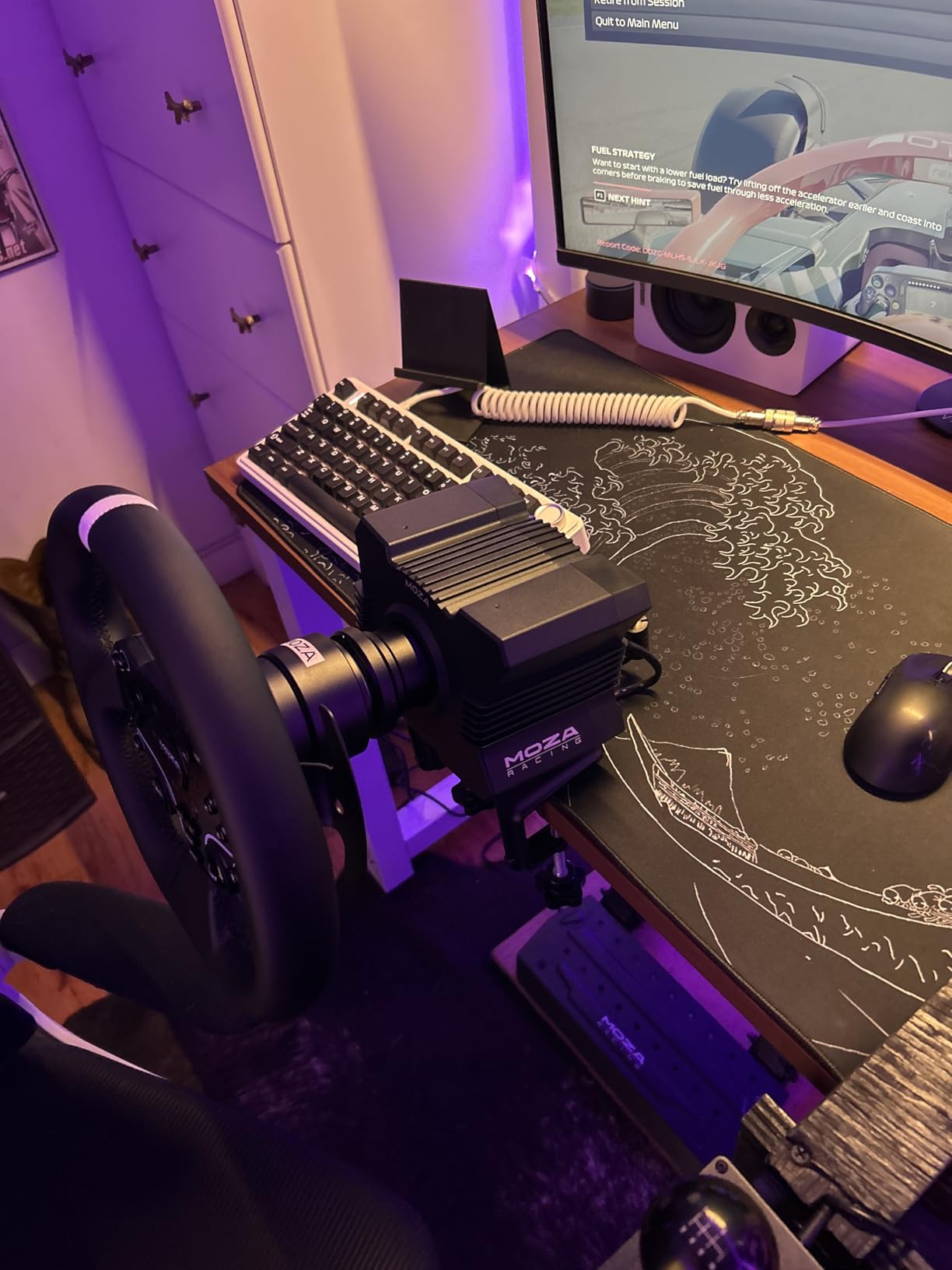
Two things put a brake on the recommendation, and both are about the pedals rather than the wheel. The SR-P Lite set is a two-pedal unit with no clutch and no load cell, and community threads describe budget bundle pedals as the component most likely to be replaced within a year. A brake stiffener kit is the usual first upgrade owners fit.
The second issue is mounting. The pedal base plate tilts backward unless it is weighted or bolted down, and the included clamp is shallow enough that it will not grip a wide metal desk frame. If your desk has a thick crossbar, budget for a proper mounting solution from the start. The wheel itself will not shift position at 5.5 Nm, but the pedals will creep across the floor.
Who the MOZA R5 Bundle suits
This is the pick for someone who wants to buy once and drive the same afternoon. Everything a beginner needs is in the box, the torque sits in the sweet spot for a first direct drive experience, and the 5.5 Nm output is strong enough that you will not immediately feel the urge to jump to a heavier base after a few laps.
Who should skip the MOZA R5 Bundle
Skip it if you drive on PS5 or Xbox. This bundle is built for PC, and while MOZA makes console-compatible bases separately, this configuration is not one of them. Console buyers should read the platform section below before spending anything.
Skip it if you already own decent pedals. The SR-P Lite set is the weakest part of the package, and buying the bundle means owning pedals you may replace within months. If you own load cell pedals already, a wheel base alone is the smarter purchase.
2. MOZA R3 Bundle Review – The Smallest Footprint and the Lowest Entry Cost
- Lowest cost complete direct drive bundle
- Very low torque ripple for instant response
- Compact base fits a small desk
- Steel pedals with adjustable curves
- PC only in this bundle configuration
- No clutch pedal included
- Less torque than the R5 bundle
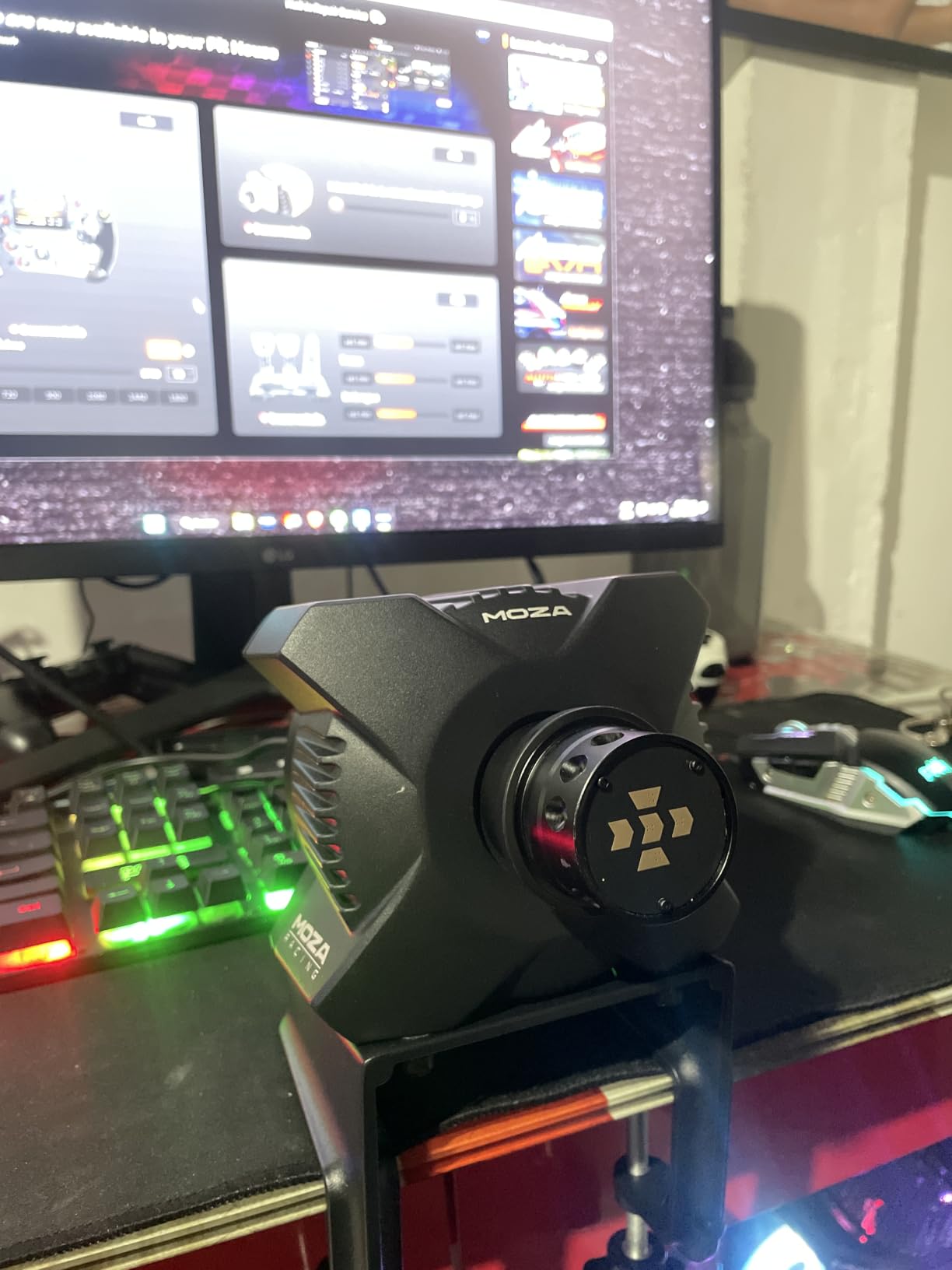
The R3 Bundle answers a different question from the R5. It asks: how small and how cheap can a complete direct drive setup be before it stops feeling like a real wheel. The answer is a 3.9 Nm servo base measuring 11.81 x 7.87 x 3.94 inches, which is the smallest footprint in this roundup and the reason it wins on desks.
Torque ripple is the spec that explains the 4.7 rating across 381 reviews. Low ripple means the feedback arrives smoothly instead of stepping, so the 3.9 Nm feels like a clean, immediate response rather than a weak one. Owners who came from belt-driven sets describe the transition as miles better than they expected from a base this small.
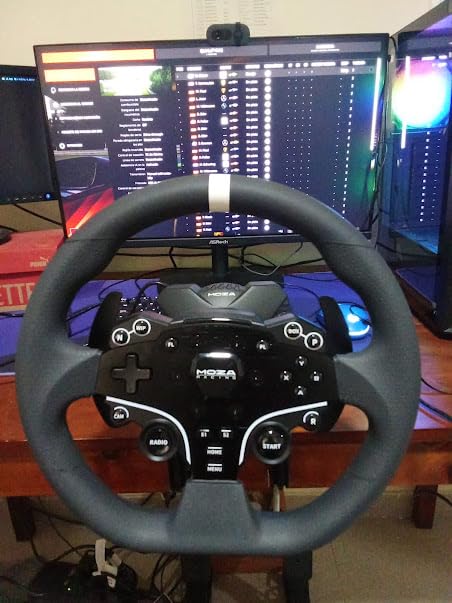
The ES Lite rim is an 11-inch round wheel with an aluminum alloy rim, PU grips and 22 buttons, held by a racing-grade quick release that accepts rim swaps later. That quick release matters more than it looks: it is the reason R3 owners can move up within the MOZA ecosystem instead of starting over.
The limitation that gets repeated most is platform support. This bundle is PC only, and it does not cover Xbox or PlayStation. If your racing happens on a console, the R3 Bundle is the wrong box even though it is otherwise excellent.
Second, there is no clutch pedal. The SR-P Lite pedals are steel with Hall sensors and adjustable spacing and output curves, which is a better pedal than most budget bundles ship, but they are still a two-pedal set. Manual transmission cars will feel incomplete.
Who the MOZA R3 Bundle suits
This suits apartment and small-desk setups more than any other product here. If your workspace is a compact desk rather than a dedicated rig, the compact base footprint is the deciding factor, and there is no other complete direct drive bundle in this guide that fits the same space.
It also suits buyers who are certain they will upgrade. Several R3 owners describe the base as a stepping stone toward a stronger MOZA base later, which makes sense given the shared quick release standard. Buying the R3 Bundle now and a stronger base next year costs less than buying a premium bundle today and never needing it.
Who should skip the MOZA R3 Bundle
Skip it if 3.9 Nm will feel too soft for you, particularly if you plan to drive rally or open-wheel cars where heavy effects are part of the experience. The R5 Bundle gives you 1.6 Nm more headroom for a modest step up.
Skip it if you drive on a console or if your car has a manual gearbox and you care about the clutch pedal. Both are hard limits of this bundle, not things that software can fix.
3. MOZA R9 V3 Review – Nine Newton Metres Without a Full Cockpit
MOZA R9 V3 Direct Drive Sim Racing Wheelbase 9Nm Force Feedback Servo Base
- Smooth detailed feedback well beyond entry level
- Premium aluminum build quality
- Desktop friendly with proper clamps
- PC and Xbox platform support
- Bare base only so rim and pedals cost extra
- Higher torque needs a solid desk or mount
The R9 V3 is the base most beginners should look at once they understand what torque feels like. Nine Newton metres is roughly 70 percent more than the R5 Bundle, and owners describe the difference as a clear step up in how much of the car’s weight transfer you can feel through the rim.
The chassis is aviation-grade aluminum alloy rather than the plastic-and-metal mix used on entry bases, and the motor runs with intelligent temperature control that monitors both motor and electronics. That cooling matters at 9 Nm, because sustained heavy effects generate heat and thermal throttling is where cheaper bases fall over during a long race.
Feedback tuning runs through the NexGen 4.0 algorithm inside Pit House, with the usual cloud app for adjusting settings from a phone. Reviewers single out the number of adjustment options as generous, though they also warn that Pit House needs a filter applied out of the box or the default feel can come across as robotic.
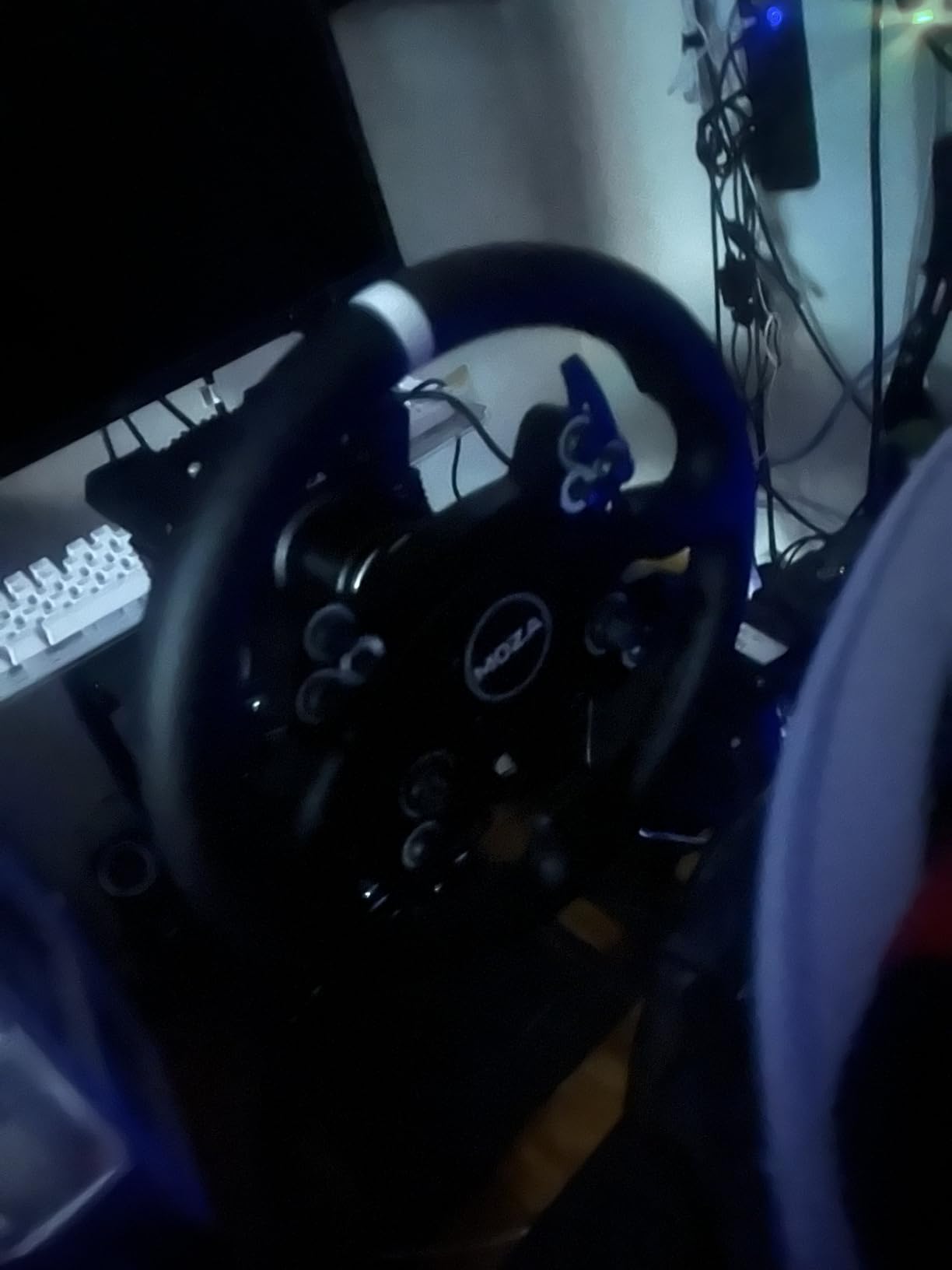
The catch is straightforward: this is a wheel base only. No rim, no pedals, no clamp. Buyers need to budget for all three separately, which pushes the real total well past what the base listing suggests. For a first-time buyer with nothing at all, that is a harder way to start.
The second catch is physical. Nine Newton metres will move a base that sits on a light desk. Reviewers who mounted the R9 V3 with proper clamps report it staying put on an ordinary desk, but that assumes the desk is solid and the clamp is rated for the load. A weak desk and a cheap clamp together is the recipe for the base walking across the room mid-corner.
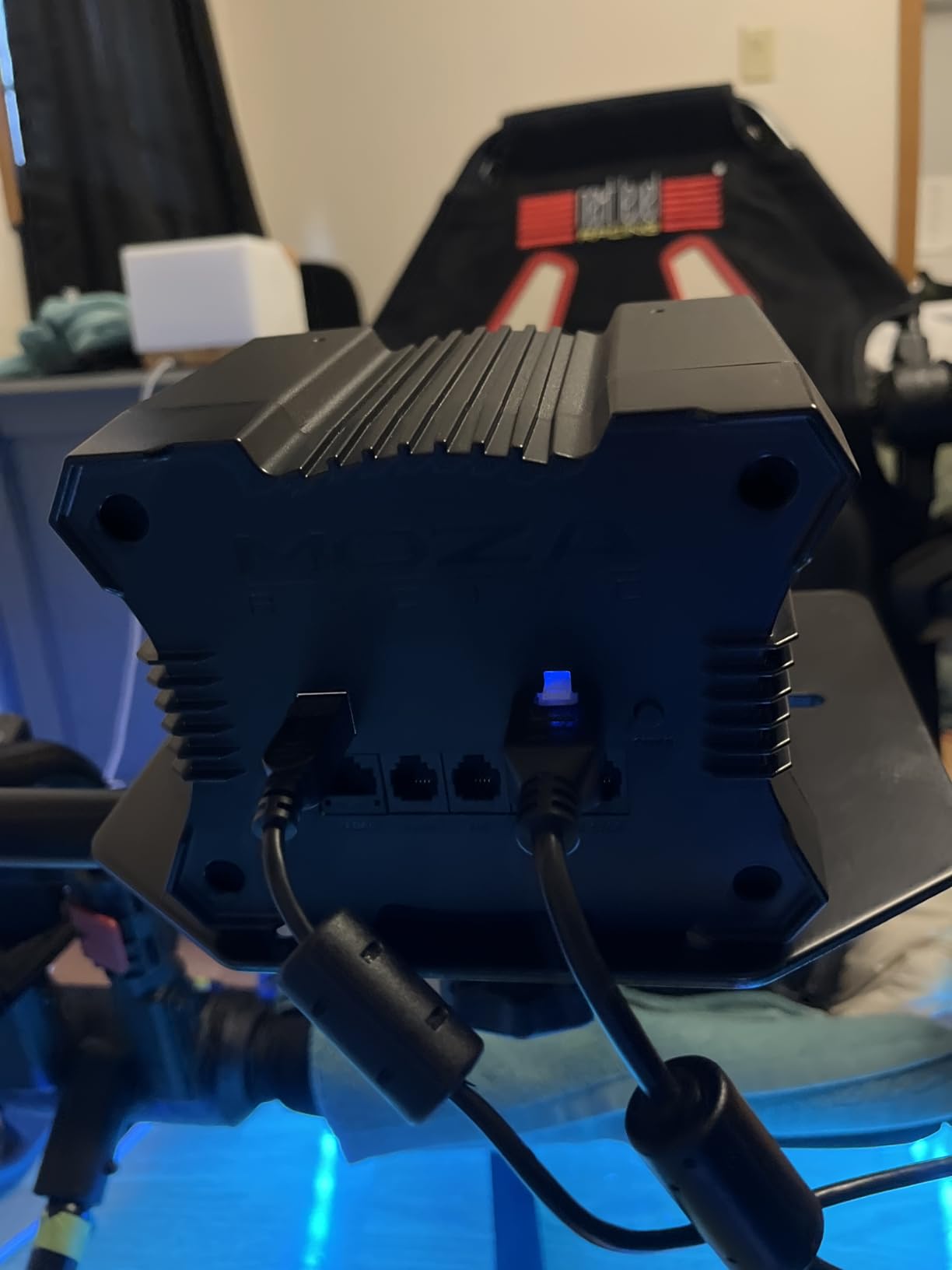
Who the MOZA R9 V3 suits
This suits a specific and fairly large group: people who already own a rim and pedals from an entry base and want the stronger motor without changing ecosystem. Because MOZA quick releases are shared across the range, moving from an R3 or R5 setup to the R9 V3 means swapping the base and keeping everything else.
It also suits anyone who plans to stay on PC and wants console-capable hardware later. The listed compatibility covers PC, Windows and Xbox Series X, though console use still requires a wheel with the appropriate license rather than just the base.
Who should skip the MOZA R9 V3
Skip it as a first purchase. Nine Newton metres is more than most beginners can comfortably hold at full strength for a whole session, and the extra cost of a rim and pedals turns it into the most expensive way into sim racing.
Skip it if you have a lightweight folding desk or a narrow clamp setup. The torque is fine, but the mounting has to be fine too. If your desk cannot take a proper mount, put that money toward a rig first and buy the base afterwards.
4. Fanatec CSL DD QR2 Review – Five Newton Metres Inside the Fanatec Ecosystem
FANATEC Sim Racing CSL DD QR2 Wheel Base – 5 Nm Direct Drive Base, Dynamic Force Feedback, QR2 Motorsport-Derived Quick-Release System – PC
- Smooth linear and consistent feedback
- Solid aluminum build with passive cooling
- Default tuning menu suits first-timers
- Three-year manufacturer warranty
- Plastic QR2 connector reported to loosen over time
- Reaching 8 Nm needs the boost kit and metal QR2
- Modest output for the outlay
The CSL DD QR2 is the Fanatec route into direct drive, and the appeal is the ecosystem rather than the motor. Fanatec builds a deep range of rims, hubs and pedals that attach to the QR standard, so buying the base first and adding hardware later is a normal way to assemble a setup rather than a compromise.
At 5 Nm the base produces smooth, linear and consistent feedback, which is the right shape for learning. Force feedback arrives without the stepped ripple that spoils cheaper budget wheels, and the passively cooled aluminum housing means the motor sheds heat without a fan adding noise to your session.
The tuning menu is split into a Standard menu aimed at first-time direct drive users and an Advanced menu for when you want more. Having both is a real beginner advantage, since you can stay in the simple menu for your first months and only dig deeper when you know what you are changing.
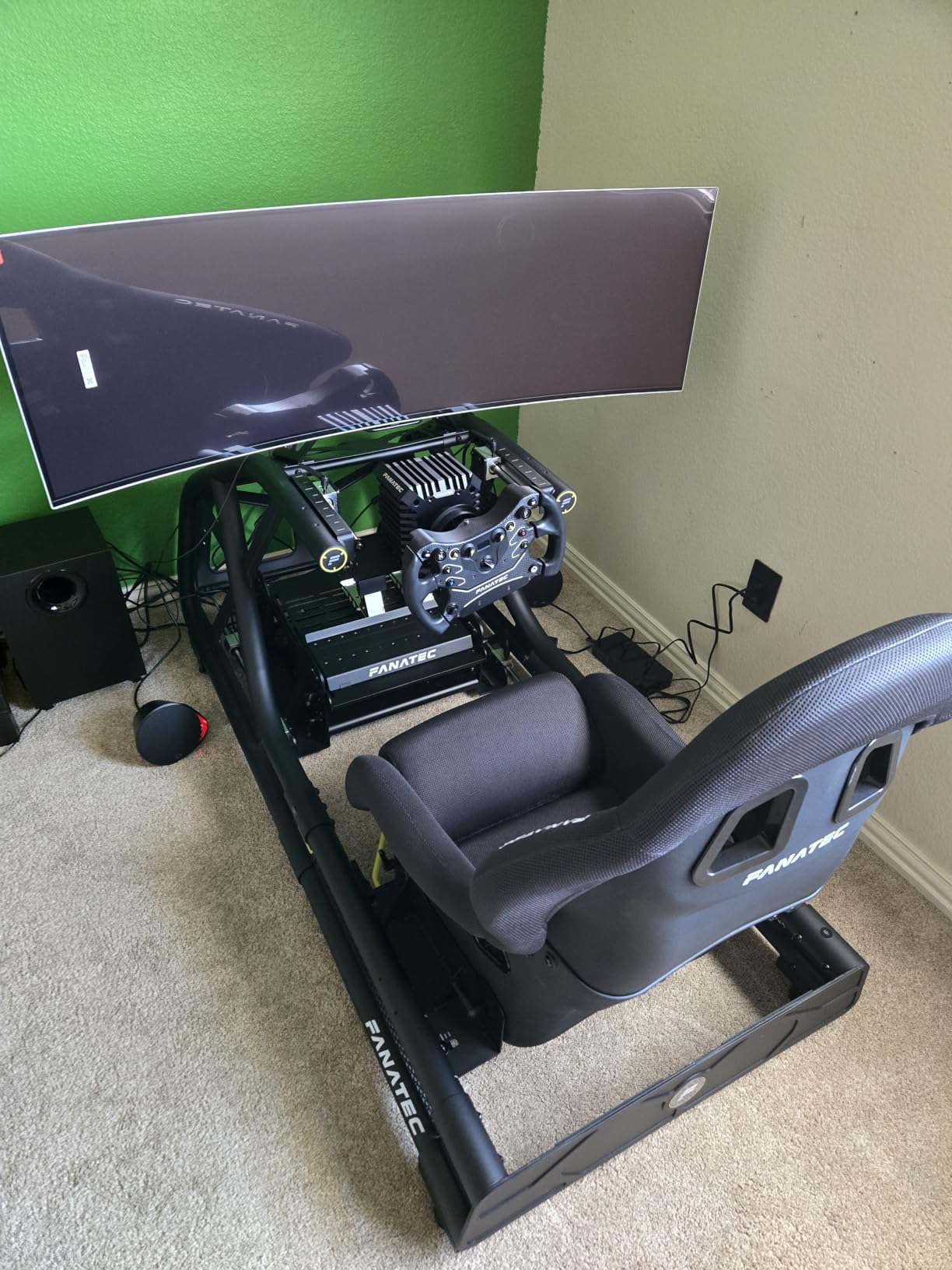
The recurring complaint is the QR2 connector. Multiple owners describe the plastic connector loosening over time, especially at higher torque settings, which produces a plastic-on-plastic sensation at the rim and can lead to the wheel losing recognition from the base. The metal QR2 upgrade is the documented fix, and it is worth doing early.
A second theme in reviews is that 5 Nm of output does not fully justify what you spend here, especially when several competitors deliver comparable torque with longer ownership histories. With a 3.9 rating across 21 reviews, this is the least settled product in the roundup, and a few buyers report hardware failing shortly after purchase.
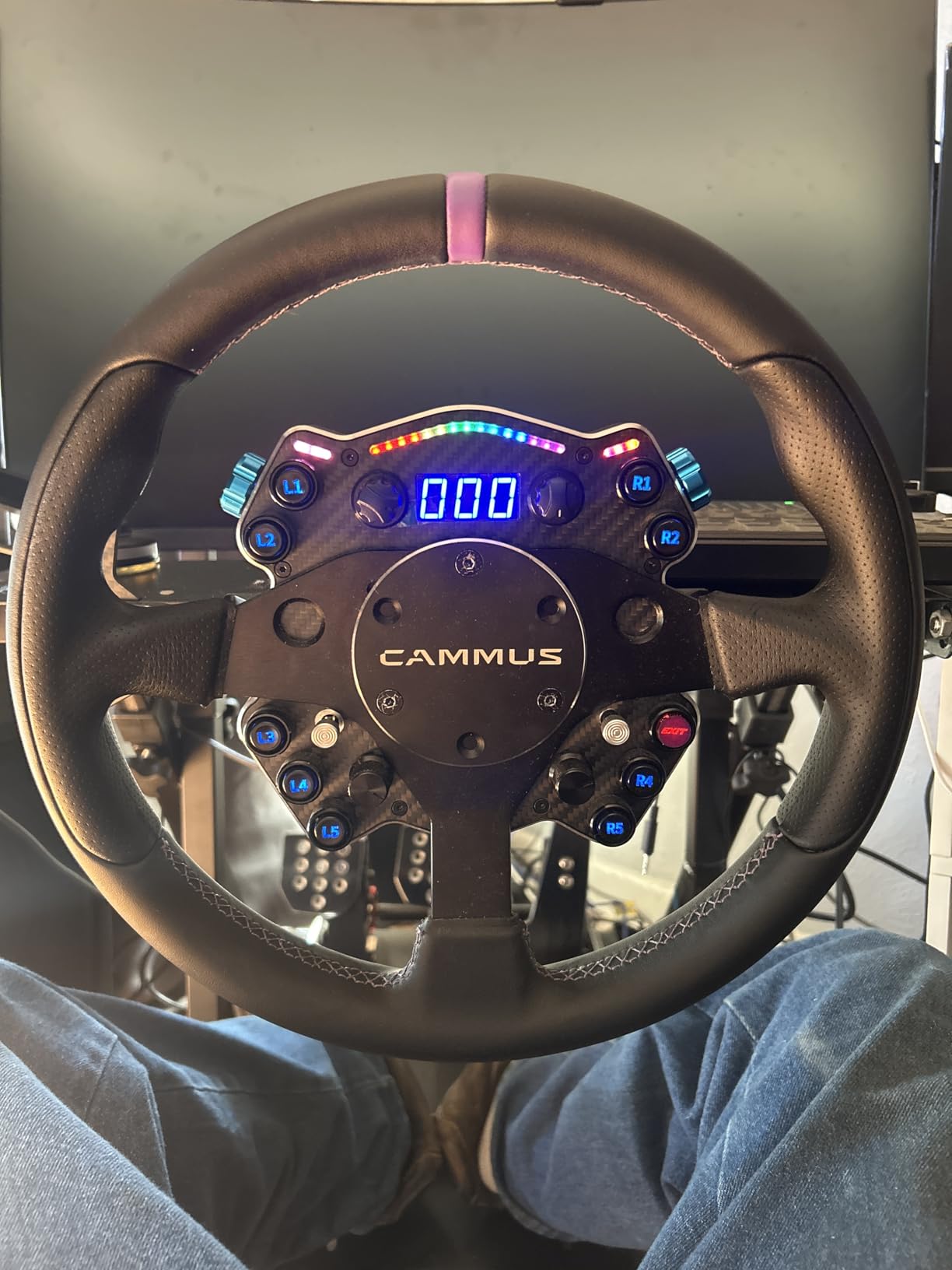
Who the CSL DD QR2 suits
This suits buyers who have decided Fanatec is their ecosystem. The QR standard, the SDK support for major racing titles and the depth of rim and pedal options make the base sensible if your next two purchases will also be Fanatec hardware.
It also suits beginners who want a hardware guarantee. The three-year manufacturer warranty is the longest in this roundup, which matters more than usual for a base with a known connector issue, because it gives you time to get the metal QR2 fitted and sorted.
Who should skip the CSL DD QR2
Skip it if you want an all-in-one box. This is a base only, so budget for a rim, pedals and a mount before your first session, exactly as you would with the R9 V3.
Skip it if you are sensitive to build detail at the rim joint. The connector complaints are consistent enough that we would not pair it with an expensive carbon rim as a first setup. Pair it with a Fanatec rim designed for QR2 and the problem largely disappears.
5. Thrustmaster T598 Review – The Only Native PlayStation 5 Option Here
- Detachable rim with magnetic paddle shifters
- Integrated race dash shows telemetry and tuning
- Plug-and-play with no complex menus
- Works on PS5 PS4 and PC
- Lowest average rating in this group
- 5 Nm feels modest next to rivals in the same class
- Two-pedal set with no clutch
- One-year warranty
The T598 is the only product in this roundup with native PlayStation 5 support, and for a console racer that single fact decides most of the shortlist. Gran Turismo players and anyone else racing on a PS5 without a PC nearby should look here first.
The wheel uses a 5 Nm constant torque axial direct drive motor, which delivers the same sustained pull rather than a spike that fades. The rim is 11.8 inches, detachable and fitted with magnetic paddle shifters, so it slots into the wider Thrustmaster ecosystem and can be swapped for another Thrustmaster rim later.
The integrated race dash is the feature nobody else in this guide offers. It displays in-game telemetry and lets you adjust force feedback strength from the wheel itself rather than opening software, which removes the single biggest setup obstacle for a console beginner.
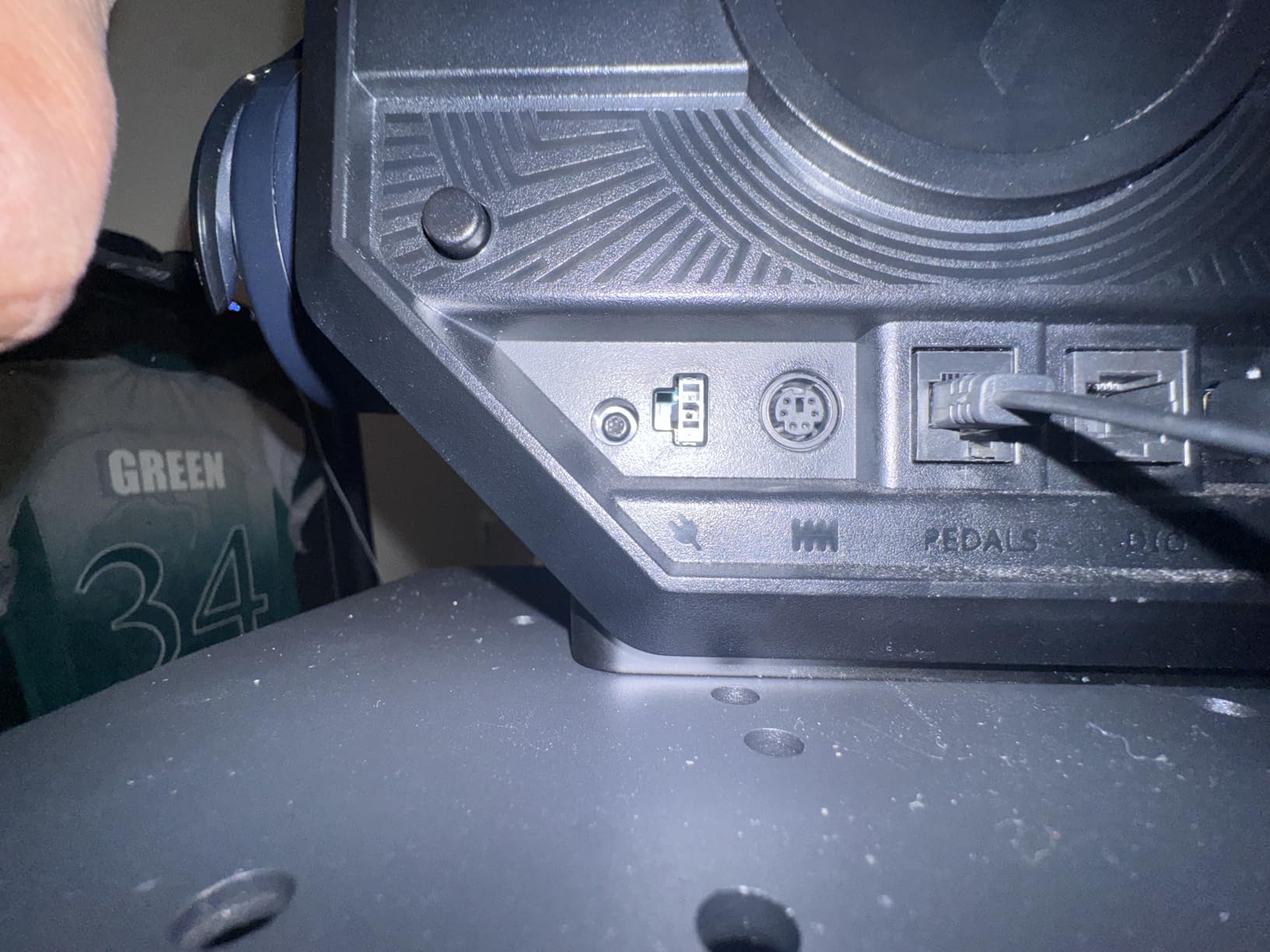
The reception is mixed. At 3.7 across 162 reviews this is the lowest rated product here, with 56 percent five-star but a notable 20 percent one-star share. Most of the criticism lands on value: 5 Nm of direct drive torque for this outlay feels thin when comparable MOZA packages include pedals and a clamp.
The Raceling LTE pedals are a two-pedal set with no clutch, which makes the package less complete than bundles that include three pedals. The one-year warranty is also the shortest in the roundup, which is a poor match for hardware that will be handled and re-mounted often.
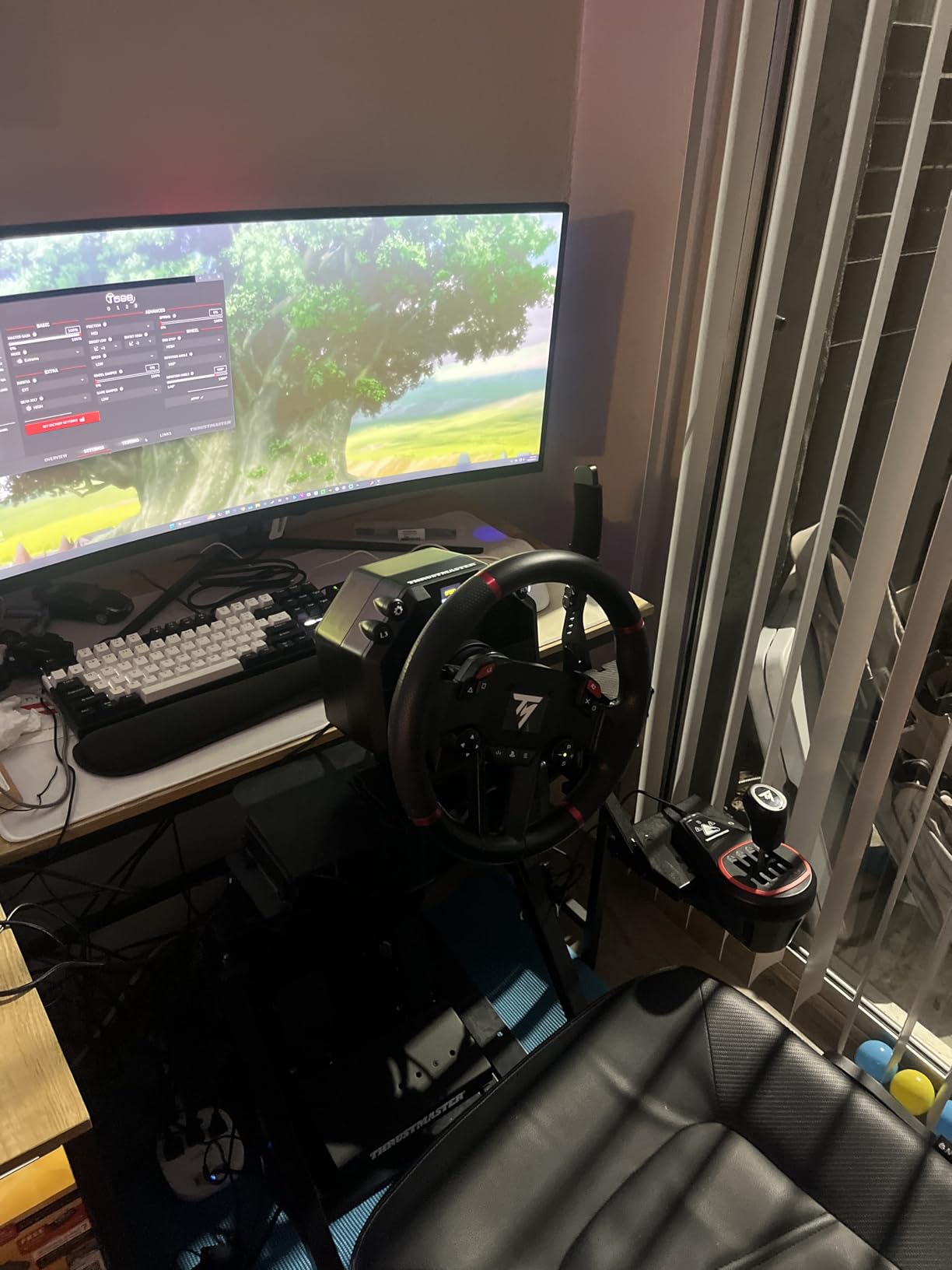
Who the T598 suits
This suits PlayStation 5 and PS4 owners who want a complete box with wheel and pedals, who do not want to fiddle with tuning software, and who like seeing telemetry on the wheel rather than on a second monitor. The race dash is a genuine advantage for console players.
It also suits Thrustmaster loyalists. Anyone who already owns a Thrustmaster rim or pedal set can use that hardware here, which keeps the ecosystem cost down for a first direct drive purchase.
Who should skip the T598
Skip it if you are on PC and can choose freely. On PC you have more torque options, longer ownership histories and better bundles for the same money, so the T598’s main advantage disappears.
Skip it if strong force feedback is the reason you are upgrading. Five Nm from a constant torque motor is usable but modest, and at this rating and warranty length we would rather put first-time buyers into a package with fewer unresolved complaints.
6. PXN V10 Pro Review – The Cheapest Way Into Direct Drive With Three Pedals
- Lowest outlay of any direct drive wheel here
- Smooth steering with no catching
- Three-pedal Hall effect set included
- Broad console and PC support
- 3.2 Nm is the lowest output in the group
- Plasticky pedals that some find firm
- No shifter included
- Heavy and needs desk space
The V10 Pro exists to answer one question: can you get real direct drive feedback without spending much. At 3.2 Nm peak and 2.8 Nm constant, it is the weakest motor in this roundup, and the steering still arrives smoothly with no catching or jerking across the full range of motion.
What makes it interesting for a first purchase is the hardware around that motor. You get a 270mm microfiber leather wrapped rim on a quick release, four paddle shifters including analog clutch paddles, and a three-pedal Hall effect set with adjustable height and faceplate angle. Most direct drive bundles at this level ship two pedals or none at all.
Platform coverage is unusually broad for a budget product. It lists PC, PS4, Xbox One, Xbox Series S and Xbox Series X support, which means it is one of the few wheels here that works across both console families.
Who the V10 Pro suits
This suits a beginner on the tightest budget who still wants a clutch pedal, a leather rim and console flexibility out of the box. If you cannot stretch to the MOZA bundles, this is the most complete direct drive package at the bottom of the range.
It also suits players moving up from gear-driven PXN models or from a Logitech belt wheel. Owners who already own PXN hardware report it as a genuine step up rather than a sideways move.
Who should skip the PXN V10 Pro
Skip it if you want to feel the road. Three-point-two Newton metres is enough to learn the basics but not enough to communicate fine grip limits, and several buyers note that the next step up in the range is the better long-term purchase.
Skip it if you play manual racing. The clutch paddles are on the wheel, but there is no clutch pedal included and no shifter in the box, so you will be buying both. The pedals themselves are also the plasticky part of the package, with several users reporting they feel firm rather than comfortable.
What Is a Direct Drive Racing Wheel?
A direct drive racing wheel mounts its force feedback motor directly to the steering wheel shaft, with no belts and no gear wheels in between. Forces a game generates reach your hands instantly and undistorted, one to one with what the physics engine calculated.
The motor spins the steering shaft directly through a quick release hub. The game sends force feedback effects to the base up to 1000 times per second, and the base pushes back at matching strength, so you feel kerb strikes, tyre slip, weight transfer and engine vibration as the car moves underneath you.
Belt-driven and gear-driven wheels lose detail to the belt or the cog wheels and top out in the 2-6 Nm range. Direct drive removes that loss entirely, which is why the jump from a belt wheel is felt immediately rather than gradually.
Direct Drive vs Belt Drive vs Gear Drive
Both belt and gear wheels put a physical transmission between the motor and the rim. The belt stretches and slips under load, and gear cogs introduce backlash and step the torque into discrete pulses. Both effects eat the fine detail that tells you where the grip limit is.
Direct drive also tends to be quieter, because there is no belt hiss and no cog chatter under the rim. On top of that, direct drive platforms are where modern features live. Load cell pedals, screen-equipped rims, telemetry and USB passthrough are all developed for this category first.
The trade-off is cost and complexity. A belt wheel such as the Logitech G920 costs less, needs no mounting hardware and works on every console without thinking about licenses. Direct drive costs more, needs a clamp or a rig, and requires you to think about platform support before you buy.
How Much Torque Do Beginners Actually Need?
Most beginners should start between 5 and 8 Nm. That range gives you genuine detail without requiring strength you do not have yet, and every wheel in this roundup falls inside or just below it except the R9 V3.
3-4 Nm – Enough to feel kerbs and engine vibration, but not enough to communicate weight transfer precisely. Fine for a first taste of direct drive on a tight budget.
5-6 Nm – The beginner sweet spot. The R5 Bundle, the CSL DD QR2 and the T598 all sit here, and they need no more than a decent desk clamp.
9 Nm – A clear step up that reveals much more of the car’s weight movement. The R9 V3 shows it can stay on a desk with proper clamps, but you need those clamps and a strong desk.
12 Nm and above – More than most beginners can use. Strong arms can hold it, but most first-time buyers end up running it at a fraction of rated strength anyway.
One warning that appears on iRacing and Assetto Corsa Competizione forums repeatedly: the torque printed on the box is peak torque, not what you should run in game. Start at 60 to 80 percent of rated strength, raise it slowly over your first weeks, and use per-car setup files rather than one global setting.
Which Platform Are You On? PC, PS5 or Xbox
Buy for your platform first, then for torque. The security chip that decides whether a wheel works on PS5 or Xbox lives in the steering wheel, not in the base, so an Xbox-capable base on its own does not make you console ready without a licensed wheel attached.
PC gives you the widest choice. Every product in this roundup works on PC, every rim from every brand is available, and load cell pedals plus telemetry are all options. For a beginner on PC we would start with the R5 Bundle or the R3 Bundle depending on desk size.
PS5 is the narrowest. The Thrustmaster T598 is the only native PlayStation option here, and its detachable rim plus race dash is a solid console package. If you want a Fanatec or MOZA base you will need to confirm the wheel you attach carries console support.
Xbox works through licensed wheels rather than licensed bases. The R9 V3 lists Xbox Series X compatibility and the PXN V10 Pro covers Xbox One plus Series S and X, but the base alone will not sign in to a console without an approved wheel. Verify the specific wheel before buying anything for an Xbox.
What Else You Need Besides the Wheel
A complete starter setup has four cost centres, and beginners usually forget two of them. Budget for the wheel, the pedals, a mount and a shifter before you click anything.
Wheel base or bundle – A bundle such as the R5 or R3 package covers base, rim and pedals in one line. A base-only product such as the R9 V3 or the CSL DD QR2 needs a rim and pedals added.
Pedals – Two-pedal sets are the norm in bundles. Three pedals with a clutch matter for manual cars, and load cell pedals are the single upgrade most likely to improve your lap times.
Mount – A desk clamp or a wheel stand. Torque above about 6 Nm makes a proper mount close to mandatory, and the clamps included with MOZA bundles are shallow enough that wide metal desk frames may need something else.
Shifter or handbrake – Optional for your first sessions. Add one when you start driving manual gearbox cars or rally.
On the PC side, 16GB of RAM is enough for sim racing. Your wheel is rarely the bottleneck; a solid CPU for the physics, a monitor and a proper mount matter far more for how the wheel feels.
What To Avoid Buying as a Beginner in 2026
Three mistakes account for most disappointing first purchases. Avoiding them costs nothing.
Do not buy 12 Nm or more as your first wheel. Strong torque on a weak mount is how bases end up on the floor and how new drivers conclude that sim racing is not for them. Start at 5 to 8 Nm and a proper clamp.
Do not buy a base on its own and forget the rim. Wheel bases ship without a steering wheel in most cases. Budget base plus rim plus pedals plus mount, not base alone.
Do not trust default force feedback settings. Out-of-the-box profiles on several brands can feel harsh or robotic. Apply a filter, lower the overall strength to 60 to 80 percent and use per-car setup files from your first session.
A fourth, softer one: do not buy a pedal set you will replace. Bundle pedals are functional, but if you know you will want load cell brakes within a year, buy them properly from the start rather than twice.
Frequently Asked Questions
What is the best direct drive wheel for beginners?
The MOZA R5 Bundle is the best direct drive wheel for beginners. Its 5.5 Nm servo base, 280mm rim, steel pedals and desk clamp all ship in one box, so you can drive the same day you open it. The MOZA R3 Bundle is the alternative if desk space is tight.
Is a direct drive wheel better than a belt drive wheel?
Yes, for feedback quality. Belt and gear wheels lose detail to the belt or cog wheels and top out around 2-6 Nm, so grip limits and suspension movement are hard to read. Direct drive delivers that detail at full strength. A belt wheel still makes sense if your budget is small or you need a console wheel that works without thinking about licenses.
How much torque do I need for sim racing as a beginner?
Between 5 and 8 Nm. That range gives real detail without needing strength you have not built yet, and it works with a standard desk clamp. Nine Nm is a good upgrade target once you know you can hold it. Twelve Nm and above is more than most first-time buyers will ever use at full strength.
Is 9 Nm enough for sim racing?
Nine Newton metres is plenty for sim racing and is considered the value sweet spot once you are past the entry tier. The MOZA R9 V3 shows it can stay on an ordinary desk with proper clamps. You still should not run it at full strength as a beginner, so start at 60 to 80 percent and raise it gradually.
Do direct drive wheels work on PS5 and Xbox?
Only if the steering wheel carries the right license, because the security chip sits in the wheel rather than the base. The Thrustmaster T598 is the only native PlayStation 5 option in this roundup. For Xbox, the base alone will not sign in, so check that the specific wheel you plan to attach supports your console.
Do I need load cell pedals immediately?
No. The two-pedal Hall sensor sets in the MOZA bundles and the three-pedal set with the PXN V10 Pro are fine for your first months. Load cell brakes are the upgrade most likely to improve your braking consistency, so buy them when you feel limited by the brake rather than on day one.
Conclusion: Which Direct Drive Racing Wheel Should You Buy First
Buy the MOZA R5 Bundle if you want one box that works, one brand that scales and 5.5 Nm of torque that suits a first direct drive experience. It is the best direct drive racing wheel for beginners in 2026 because nothing important is missing from the box and the ownership history is the longest in this group.
Buy the MOZA R3 Bundle instead if desk space is the constraint, and the MOZA R9 V3 if you already own a rim and pedals and want to upgrade the motor alone. Console players on PS5 should look at the Thrustmaster T598, and the tightest budget with a clutch pedal in mind points to the PXN V10 Pro.