
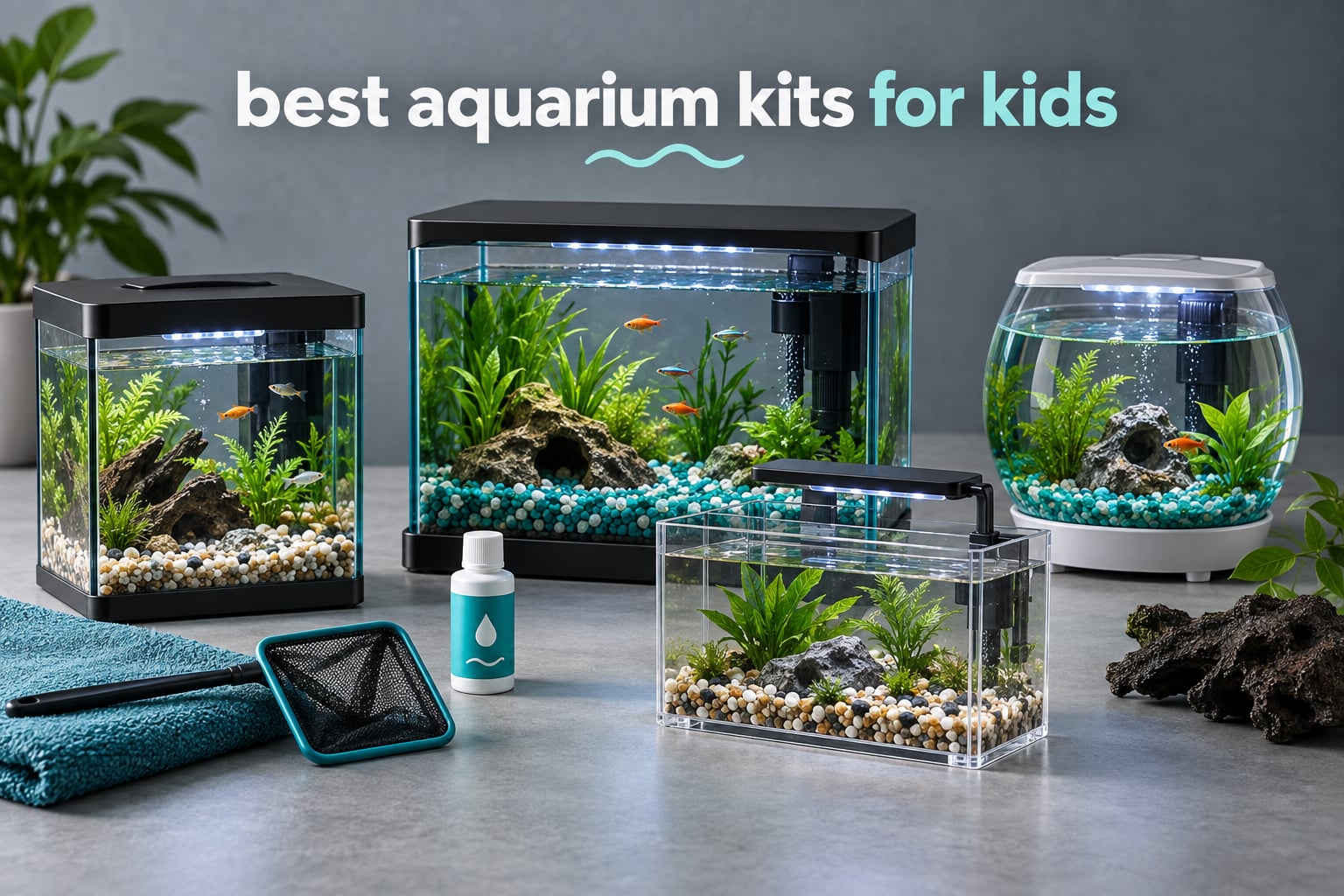
The best aquarium kits for kids are not the ones with the most accessories in the box. They are the ones a child can actually help look after without the water going bad in a week, and that comes down to three things: enough volume to keep water quality stable, a filter rated for that volume, and a fitted lid.
Get those three right and a tank survives a missed feeding and a distracted summer. Get them wrong and the fish die in the first month.
I have spent the last several months working through kits in the 1-gallon to 20-gallon range, reading the reviews closely and watching how each one behaves in a home rather than a showroom. The list below covers the full spread: tiny desktop tanks that fit a nightstand, mid-size all-in-ones that a school-age child can help with, and one large kit that a family can grow into over a couple of years.
One honest note before the picks. A reef2reef member named Idech put it plainly when describing a child’s tank: “only buy if you’re willing to do all the work yourself.” That matches what we hear from parents and from other experienced hobbyists.
The child can feed, observe, wipe the glass and pick the gravel color. An adult ends up doing the water tests, the water changes and the filter service, and buying the tank with that expectation is what makes the whole experience go well.
If you want the short version, the Marineland Portrait Glass LED 5-Gallon is our top pick for a reason: it has the largest review base of any kit here, a hidden filter that a child cannot fish around, and enough volume to hold either a betta or a small community group. The Aqueon 10-Gallon Starter Kit is the one to buy if you want the child to grow into it rather than outgrow it.
If you already own a freshwater setup, our guide to aquarium kits for freshwater fish covers adult setups in more depth. For younger children, a fish tank often arrives alongside building and STEM toys, and our picks on the best robotics kits for kids and best telling time learning kits for kids follow the same rule we use here: pick the thing a child can use unsupervised, and save the fancier version for later.
Table of Contents
Top 3 Best Aquarium Kits for Kids in 2026
These three cover the three most common situations: a first tank for a child roughly five to eight years old, a tank meant to last several years, and a small display tank for a bedroom desk.
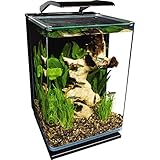
Marineland Portrait Glass LED 5-Gallon
- Hidden 3-stage filtration
- Daylight and moonlight LED modes
- Clear glass canopy
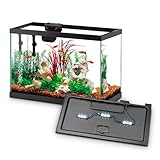
Aqueon 10-Gallon Starter Kit
- Heater thermometer net and conditioner included
- SmartClean filtration
- Glass tank

NICREW 2.5-Gallon Nano Nature
- High-clarity glass
- Pre-glued leveling mat included
- Begins with a lid
All 10 Kits at a Glance
The table below lists every kit in this roundup with its capacity and what makes it worth a look. A fitted lid appears in the notes because it is the single most overlooked safety feature for a child’s room.
| Product | Specifications | Action |
|---|---|---|
| Marineland Portrait Glass LED 5-Gallon |
|
Check Latest Price |
 Tetra Starter 1 Gallon Hexagon Tetra Starter 1 Gallon Hexagon |
|
Check Latest Price |
 Tetra ColorFusion 3 Gallon Tetra ColorFusion 3 Gallon |
|
Check Latest Price |
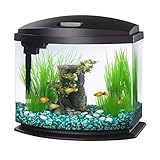 Aqueon MiniBow 5 Gallon Aqueon MiniBow 5 Gallon |
|
Check Latest Price |
 Koller Products 5 Gallon Kit Koller Products 5 Gallon Kit |
|
Check Latest Price |
 Tetra LED Half Moon 1.1 Gallon Tetra LED Half Moon 1.1 Gallon |
|
Check Latest Price |
| Aqueon 10 Gallon Starter Kit |
|
Check Latest Price |
 Koller AquaView 360 6 Gallon Koller AquaView 360 6 Gallon |
|
Check Latest Price |
 GloFish 20 Gallon Kit GloFish 20 Gallon Kit |
|
Check Latest Price |
| NICREW 2.5 Gallon Nano Nature |
|
Check Latest Price |
1. Marineland Portrait Glass LED 5-Gallon Kit – Best Overall for a First Tank
Marineland Portrait Glass LED Aquarium Kit, 5 Gallons, Hidden Filtration,Black
- Largest review base in this roundup at over 10000 ratings
- Hidden filter keeps equipment out of a child's reach
- Dual daylight and moonlight LED modes
- Clear glass canopy gives a wide view
- Hinged light and sliding canopy are fiddly to open
- Glass needs careful moving at 16 pounds
- No heater in the box so add one
This is the kit I recommend most often, and the reason is the review history rather than the feature list. At over 10000 ratings with 71 percent of buyers giving five stars, it is by a wide margin the most proven tank on this page. We have not found a single widespread failure pattern that would worry a parent.
The design choices are the ones that matter in a child’s room. The 3-stage filtration is hidden behind the rear panel, which means there is no pipe or intake for a curious seven-year-old to poke at, and the rounded corners plus clear glass canopy give an unusually wide view of a small tank. The daylight and moonlight modes let you run a soft blue glow at night instead of a bright lamp in a dark bedroom.
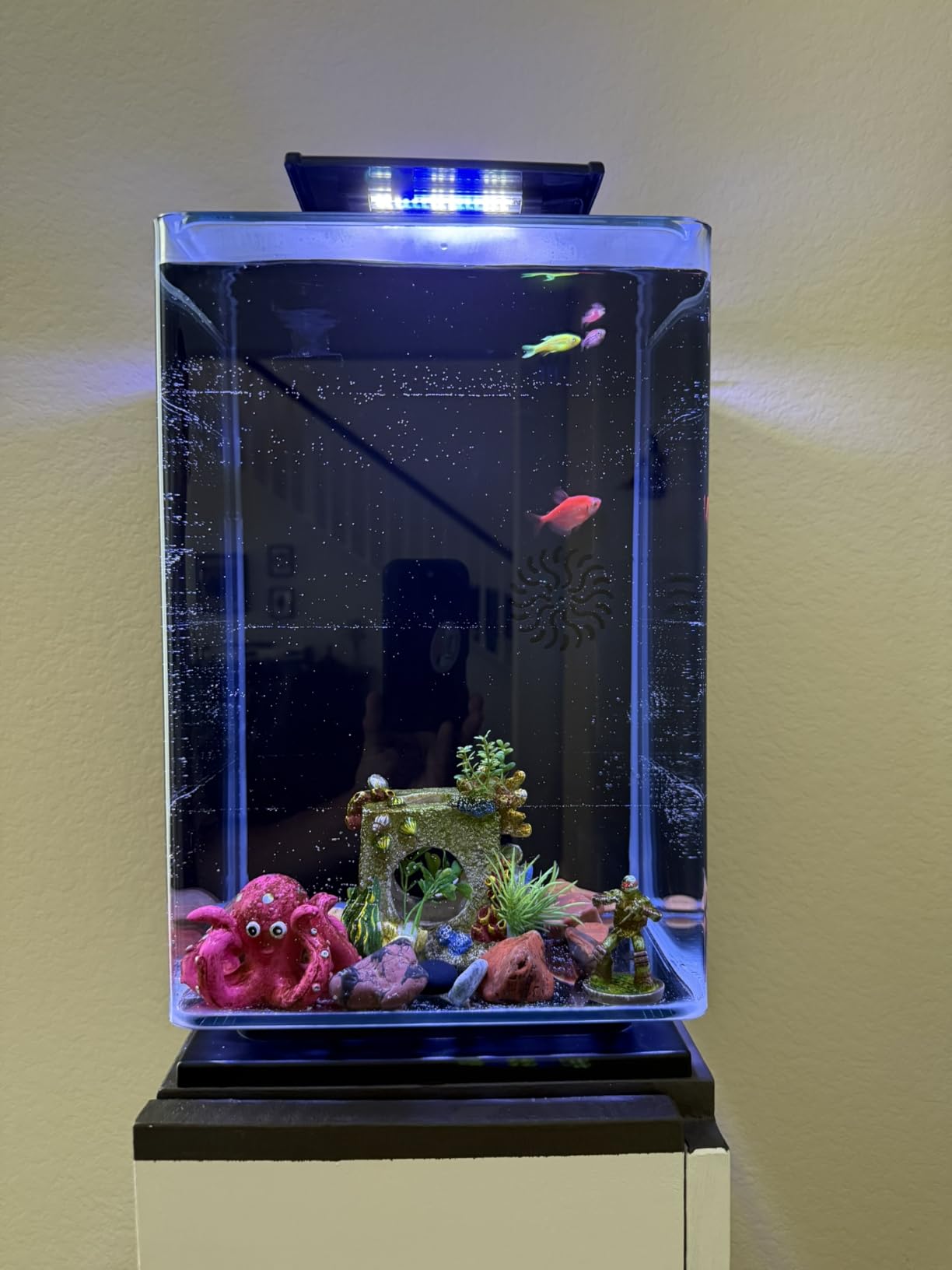
Two things to plan for. The tank is glass and weighs 16 pounds, so it goes on a stand rated for it and stays there.
The hinged LED light and sliding glass canopy are the fiddliest part of the whole design and need a steady hand when you open the top. Add a preset heater, a bottle of water conditioner and a gravel substrate to the order, because the box covers the tank, canopy, light and filter.
Replacement filter media is the ongoing cost. It takes Rite-Size Z cartridges, which are widely available and inexpensive, and cartridge changes are part of the monthly rhythm rather than an emergency purchase.
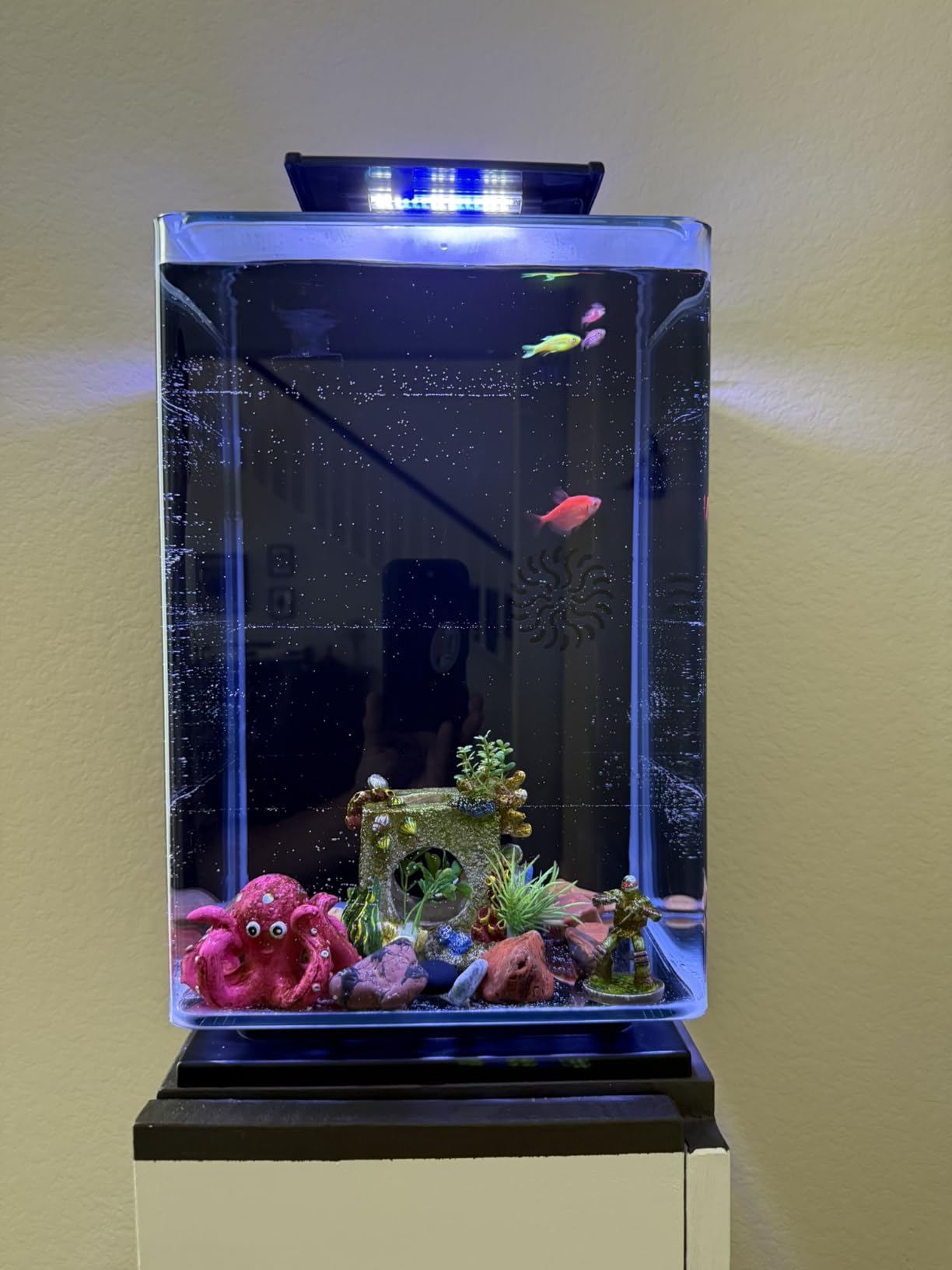
Why this one suits a first-time fish keeper
At 5 gallons the volume is big enough that ammonia from a missed feeding gets processed before it becomes dangerous, which is the main failure mode in tanks under 3 gallons. It also holds a small community group rather than a single fish, so a child who gets bored with one betta can add a couple of companions later without an upgrade.
The hidden filter is the quiet hero. Because nothing is exposed at the front or sides, a child cannot lift a piece of equipment out to look at it, and there is no gap where a small fish could get drawn into an open intake.
Where it falls short for a family
It is a glass tank, and a forum member named Jedi1199 raised the concern that matters for a child’s room: “Make sure you get a solid tight fitting lid.. Kids that age climb well, they may jump out!!” A hinged canopy is not the same as a screwed-down lid, so a restless child needs supervision at the top of the tank.
It is also a display aquarium first. There is no heater, no substrate and no decor in the box, so the first purchase is never the last one. Budget for a heater, conditioner, gravel and a couple of low-demand plants before the fish arrive.
2. Tetra Starter 1 Gallon Kit – Best Small Tank Under a Budget
- Compact hexagon shape fits a desk or nightstand
- Color cycling LED disc is genuinely engaging for children
- Feeding hole means the lid rarely comes off
- Fitted canopy keeps fish from jumping out
- Air pump cannot run bubbler and filter at full strength together
- Instructions are widely reported as unclear
- Thin plastic needs two hands when full
This is the impulse-buy end of the list and it does one thing well: it is a complete, working display tank for a betta or a couple of snails on a small shelf. Reviewers consistently treat it as a single-fish display rather than an aquarium in the normal sense, and that framing is honest.
The hexagon shape is compact at 7.75 by 6.75 by 8.25 inches, and the clear canopy has a feeding hole so daily care does not involve lifting anything. The bubbling disc cycles through a rainbow of LED colors, which is the feature children actually point at, and the internal Whisper filter runs quietly on the low setting.
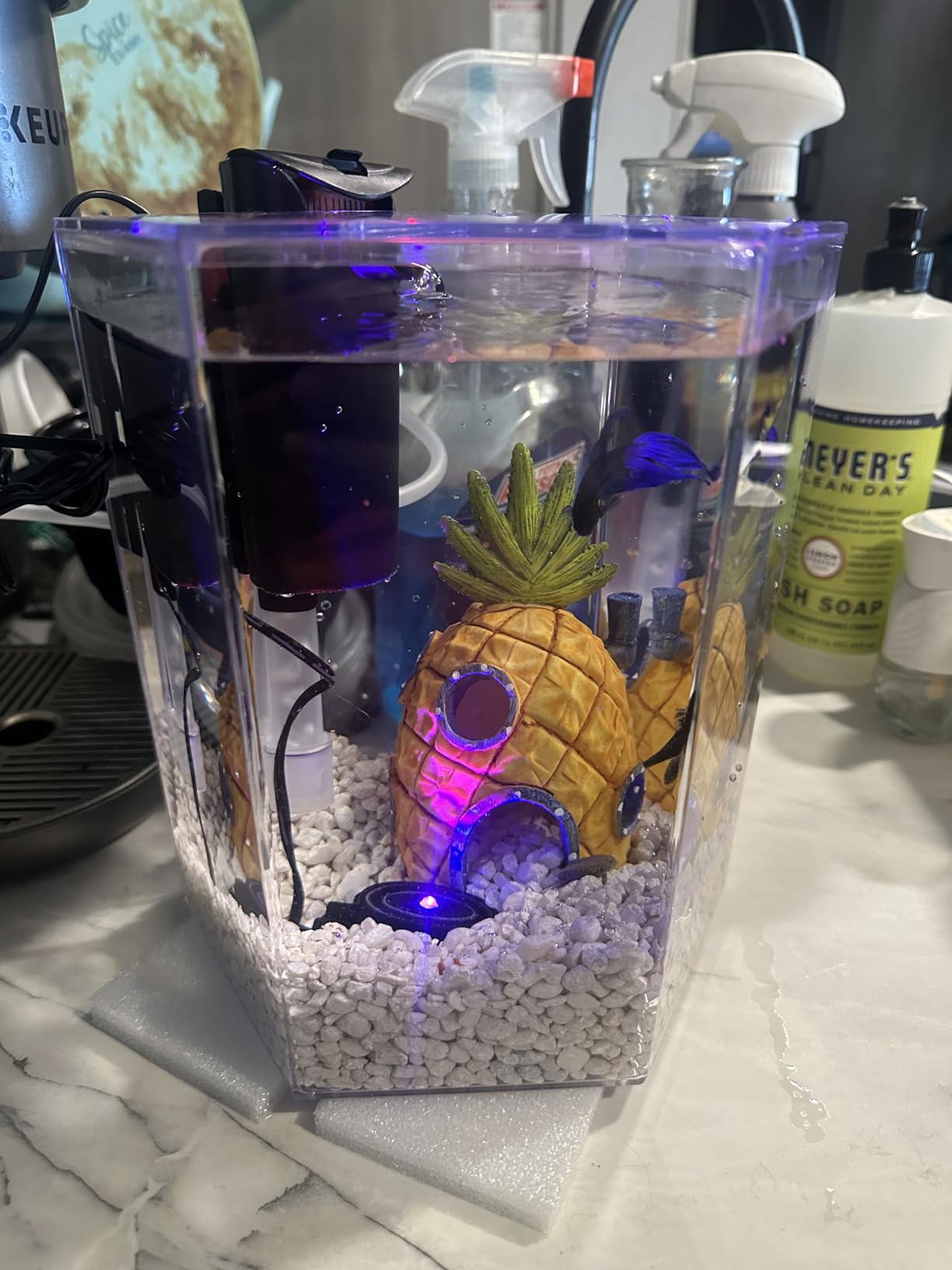
The honest limitation is the air pump. A single pump drives both the bubbler and the filter, and buyers report it cannot deliver full strength to both at once. Reviewers also consistently flag the instructions as vague or missing, the plastic as thin enough that the tank flexes when full, and the bubbles as too strong with no adjustment.
Because the filter and its tubing take up a meaningful share of a 1-gallon tank, treat this as a display aquarium. One betta and some snails is a realistic load, and anything more turns water quality into a daily problem.
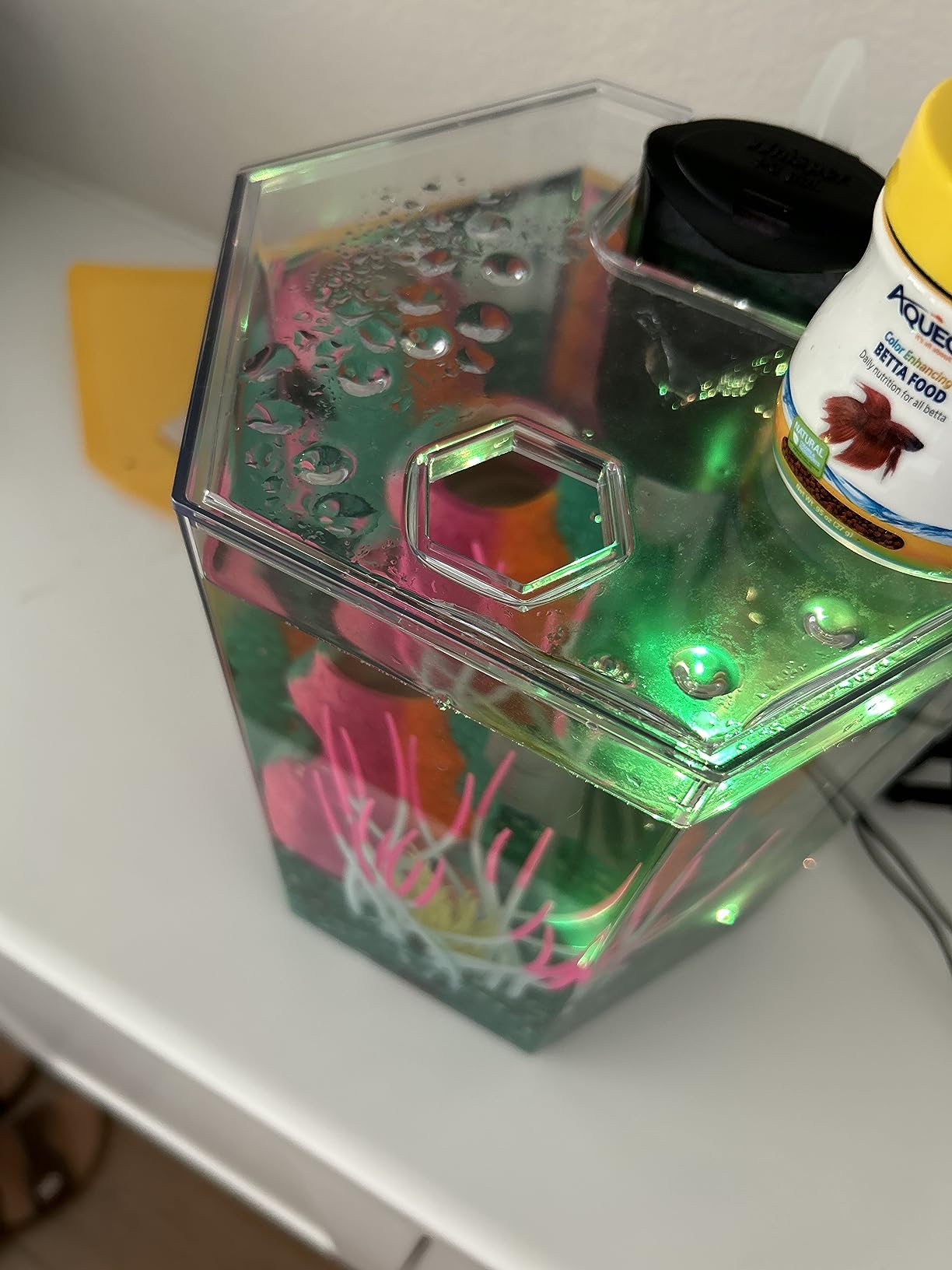
Best for a child who wants a fish they can name
A single betta in a small tank is a very different experience from a community aquarium, and for a five- or six-year-old it is often the better one. There is one animal with a name, a daily routine that takes thirty seconds, and no risk of the child adding too many fish on an impulse.
Keep the tank away from an edge and on a surface the child cannot lean against. At 1 pound empty it is light enough to move, and that is a benefit in a small room where the tank will probably be relocated more than once.
Where the 1-gallon limit becomes a problem
Water chemistry changes fast in a tank this small. Ammonia from uneaten food can spike overnight, and a temperature drop in a room that cools at night is felt harder in a gallon than in ten. Regular partial water changes are not optional here, which means daily attention from an adult.
There is no substrate, heater or decor in the box, and the lid is a canopy rather than a clamped lid. Add a heater before adding a tropical fish, and treat the first few weeks as a teaching period for whoever is doing the water changes.
3. Tetra ColorFusion 3 Gallon Kit – Best Color-Changing Light
Tetra ColorFusion Starter 3 Gallon Fish Tank Kit for Small Freshwater Fish
- Half moon curve gives a wide panoramic view
- Colored LED glow projects onto the ceiling
- Adjustable knobs balance bubbler and filter output
- Lightweight build has held up for many owners
- No on off switch so lights unplug manually
- Lid falls in unless aligned precisely
- Tank can bow when full and needs weighted gravel
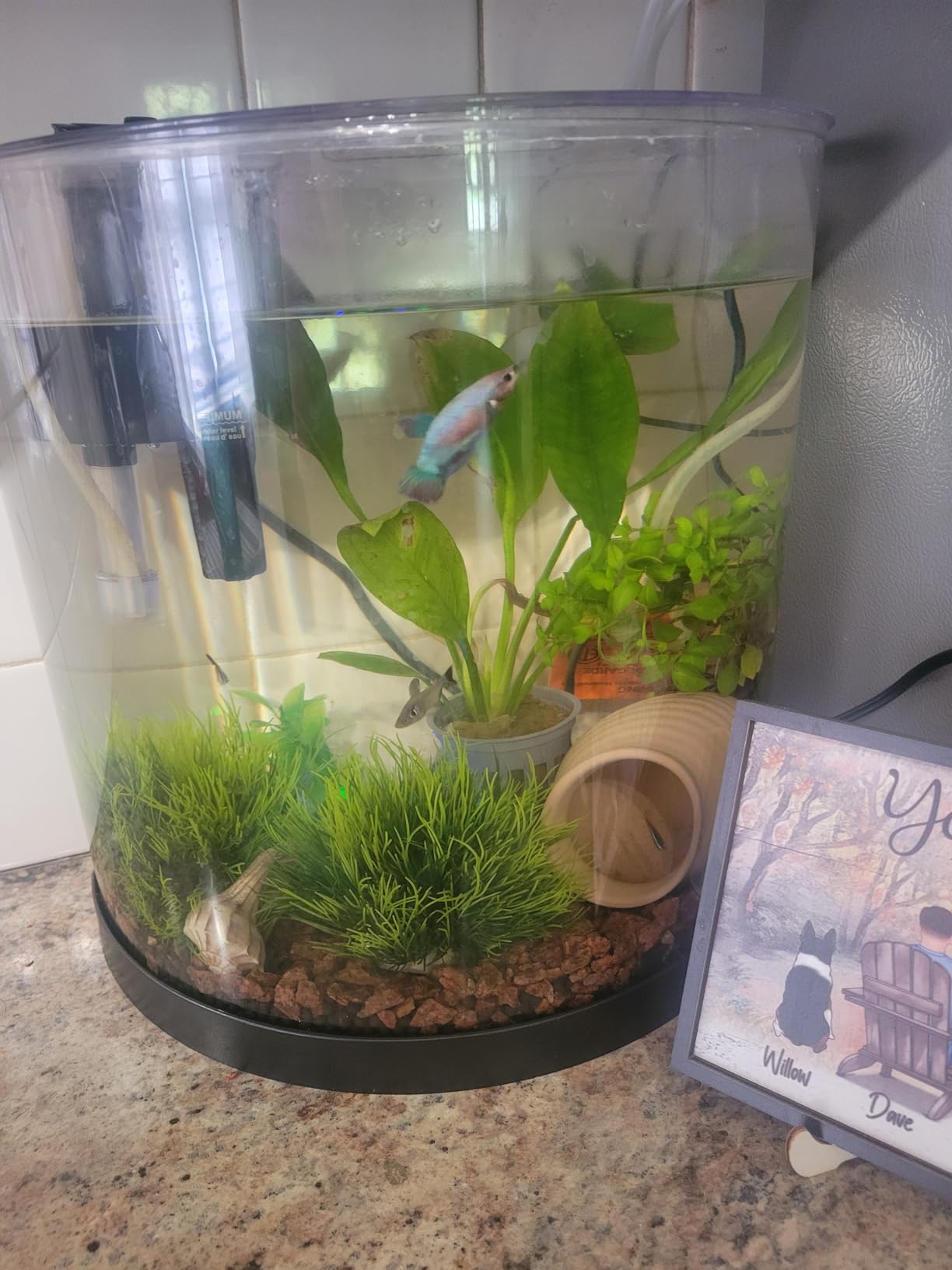
The half-moon profile is the reason to buy this one. The curved front gives roughly 180 degrees of viewing, which in a 3-gallon tank makes a betta or a pair of shrimp look larger and more present than they would in a square tank of the same volume. It also ranks in the top tier of the Aquarium Starter Kits category, which tells you how often it gets bought.
Unlike the 1-gallon kit, this one has adjustable knobs for the bubbler and the filter, so an adult can dial the air back once the tank is established. The clear canopy projects the colored LED glow onto the ceiling, and that is genuinely the feature that keeps a child coming back to look at it.
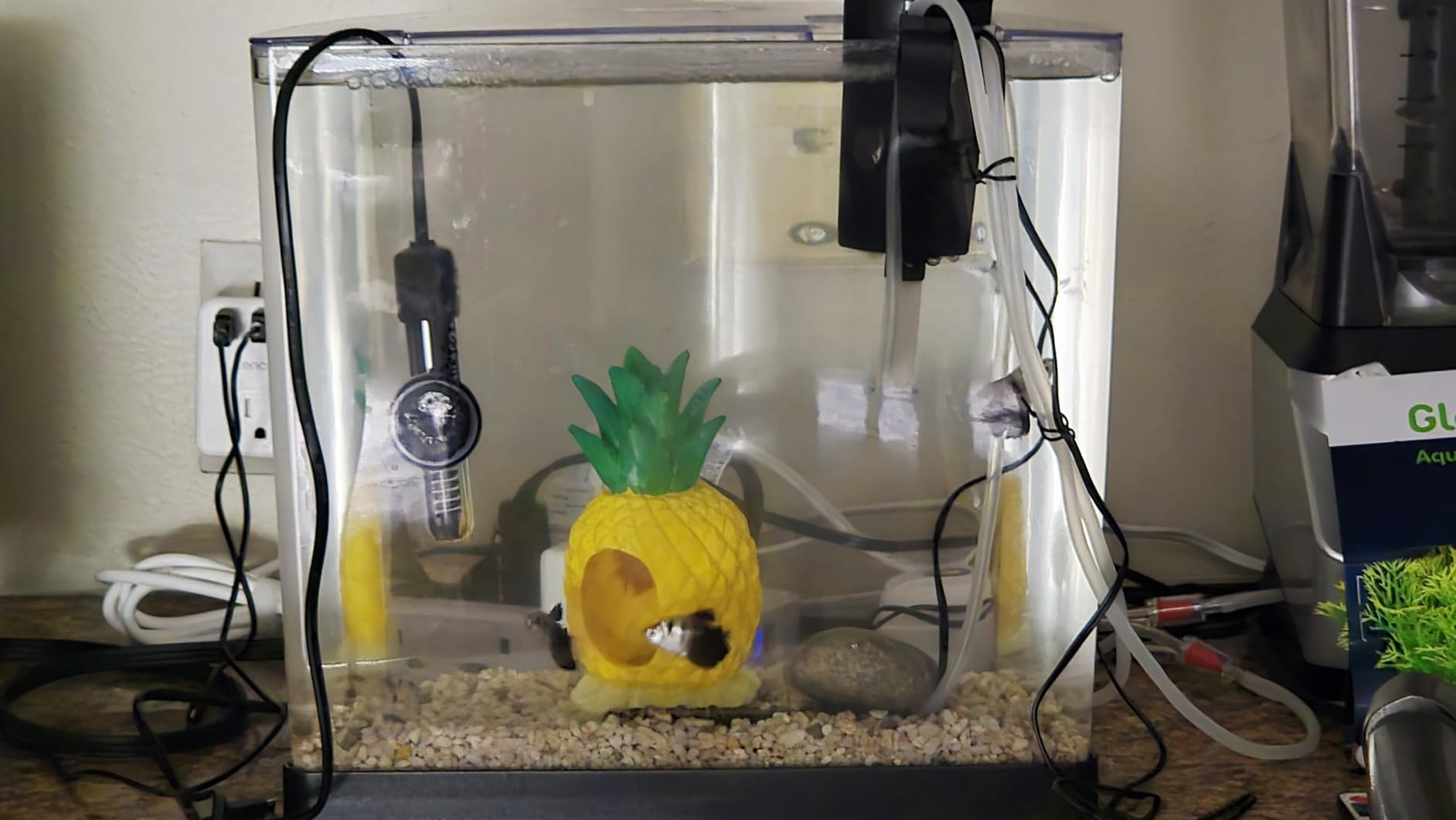
Three recurring complaints are worth knowing before you order. There is no on/off switch, so lights and air are unplugged by hand every night. The lid has to be aligned precisely or it drops into the water. And the acrylic body can bow when full, which reviewers solve by using heavy gravel that also weighs the bubbler and light down.
A few buyers report tanks arriving cracked and one reporting a filter that would not run at all. That is worth a quick inspection on arrival, since a 1-pound plastic tank is easy to check in a few seconds.
Why 3 gallons is a step up from 1 gallon
Three gallons gives you enough water to dilute a mistake. If a child feeds twice instead of once, the ammonia spike is smaller and the biological filter has more volume of water to work through, which is the difference between an inconvenience and a fish loss.
It also holds a slightly wider range of inhabitants. Shrimp, snails and a betta all do well, and there is room for a couple of low-demand plants to make it look like something other than a fish bowl.
Where the fiddly parts get in the way
The manual unplugging of the light and air pump is the biggest daily annoyance. Get into the habit of switching everything off at the same time each night, or pick up a small timer, because a tank left bubbling in a bedroom is audible.
Bowing under a full load is a real concern for a child who wants to keep adding stuff to the bottom. Heavy gravel is the practical fix, and it also stops the light and bubbler from shifting.
4. Aqueon MiniBow 5-Gallon Kit – Best for Quick Water Changes
- Integrated drain tube makes water changes fast
- Quiet flow suits bettas and long finned fish
- LED hood has a proper on off switch
- Acrylic will not shatter like glass
- Acrylic scratches easily during cleaning
- Filter cartridges can need replacing in under two weeks
- Filter intake slits can catch betta fins
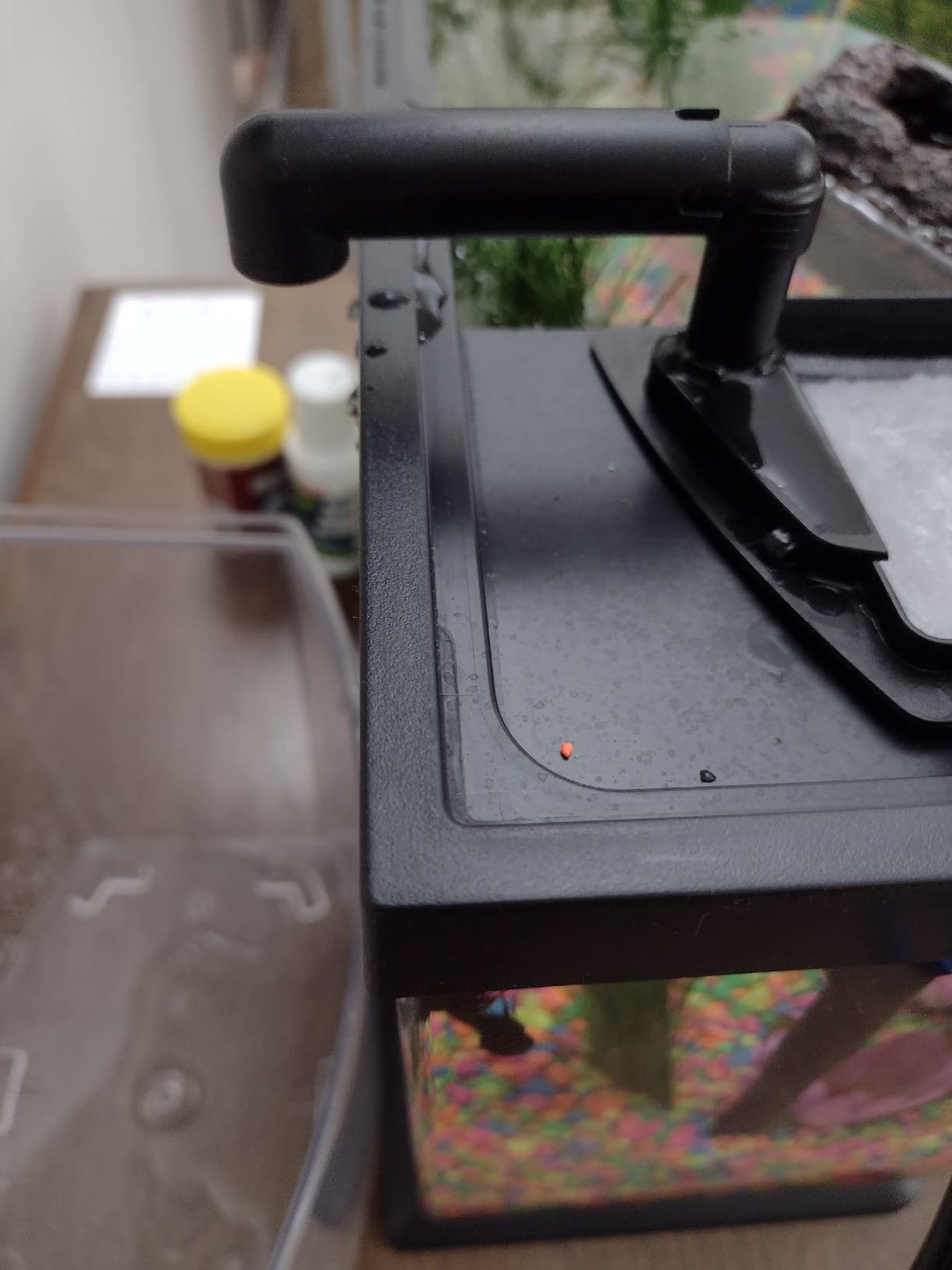
This is the kit we would pick if an adult is going to be doing the maintenance, because the SmartClean filter cuts the water change down to under two minutes. The integrated drain tube reaches the bottom of the tank and pulls water straight out. When the water change is that fast, it actually gets done on schedule.
The box is unusually complete for a 5-gallon kit. It ships with the tank, low-profile LED hood, elevated base, filter, water conditioner and food samples, so the first shopping trip is a heater and a bag of gravel. Assembly is designed for speed with illustrated color instructions, which matters when one adult is setting this up while a child watches.
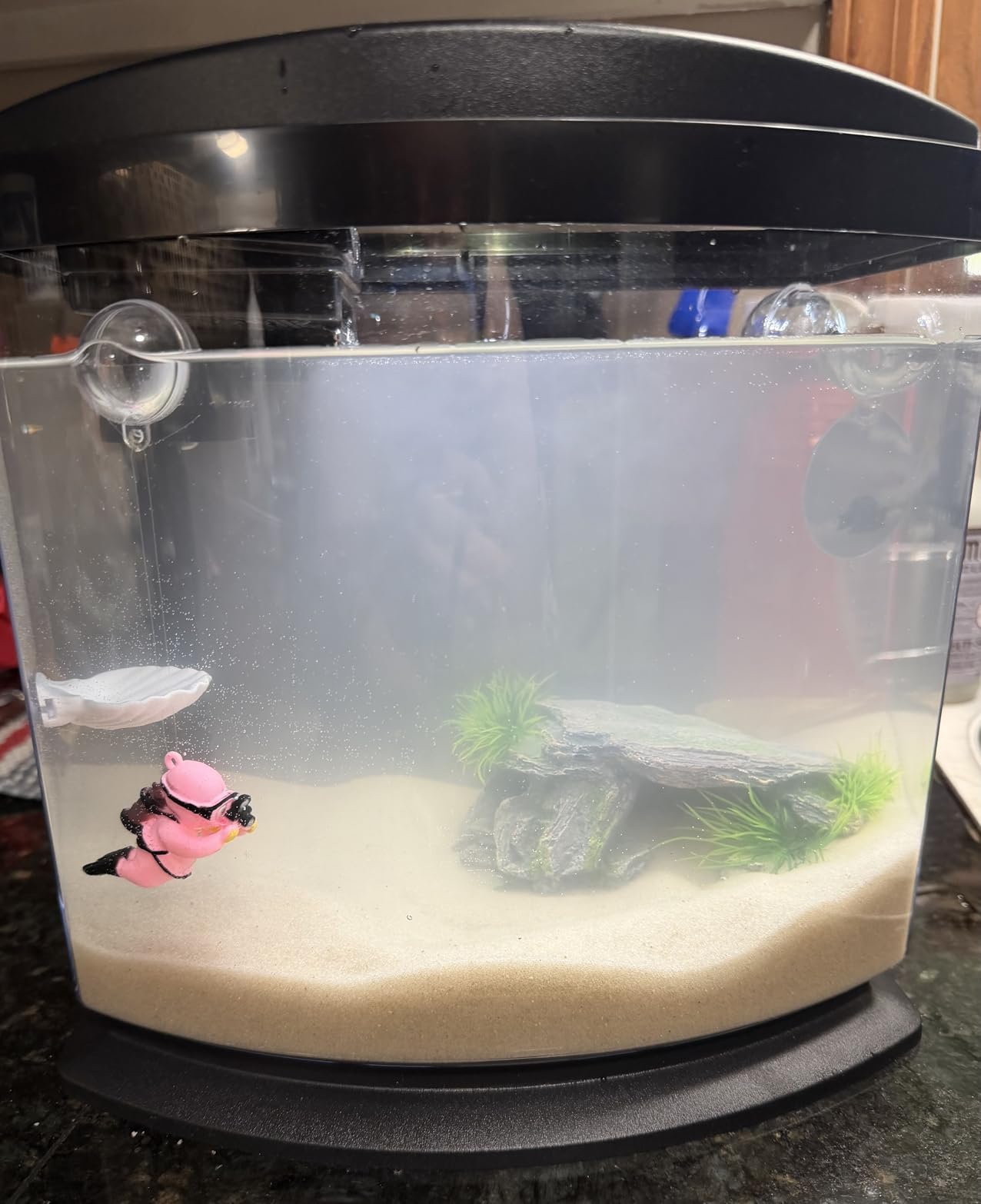
Reviewers like the quiet flow and consider it suitable for bettas and long-finned fish, which is not true of every small tank here. The domed hood light has a real on/off switch, a small quality-of-life detail that the cheaper kits skip entirely.
The recurring negatives are worth planning around. Acrylic scratches easily, so use a soft sponge and no abrasive cleaner, and the included cartridges can need replacing in under two weeks.
The lid light brightness cannot be adjusted and the black lid blocks aftermarket lighting upgrades. Most importantly, the filter intake has wide slits that can catch or injure betta fins, so a pre-filter sponge is the first thing to add.
Where the SmartClean design pays off
Every freshwater tank needs regular partial water changes, and that is the chore families abandon first. A drain tube built into the filter removes the siphon, the bucket juggling and the gravel vacuum, which turns a twenty-minute job into a quick top-up and refill.
The elevated base also solves a practical problem. It lifts the tank to a comfortable working height, which means a shorter adult does not have to kneel on the floor for every change.
Where the running costs add up
Filter cartridges are the line item. The replacement media costs more than generic media, owners report short service life, and cartridges are sold in packs, so set up a monthly reminder rather than waiting for the flow to drop.
Also note the rear lid opening is wide enough for a betta to jump out of, and a striped-pattern lid is not included with the tank. If you plan on a jumper, add a clamp or a piece of mesh across the gap.
5. Koller Products 5-Gallon Kit – Best for Young Children
Koller Products 5-Gallon Aquarium Kit with LED Lighting and Power Filter, Ideal for a Variety of Tropical Fish
- One piece body removes the silicone seal leak risk
- Impact resistant plastic is safer than glass in a playroom
- 30 LED light has four color modes and a timer
- 45 GPH filtration suits a 5-gallon setup
- Plastic surface scratches and clouds with age
- Filter cartridges need recurring replacement
- Tank is a tall rectangle rather than a display shape
This kit is marketed at exactly this use case. The listing frames ownership as a way to teach a child about responsibility, and the design follows through on the safety side: a one-piece impact-resistant plastic body with no silicone seams, described by the maker as leak-proof by design.
That construction matters more than most spec sheets admit. A forum parent on reef2reef reported his children cracked a glass tank within about a year and it went in the garbage. A plastic tank that takes a knock is a far better bet in a bedroom where a football occasionally comes through the door.
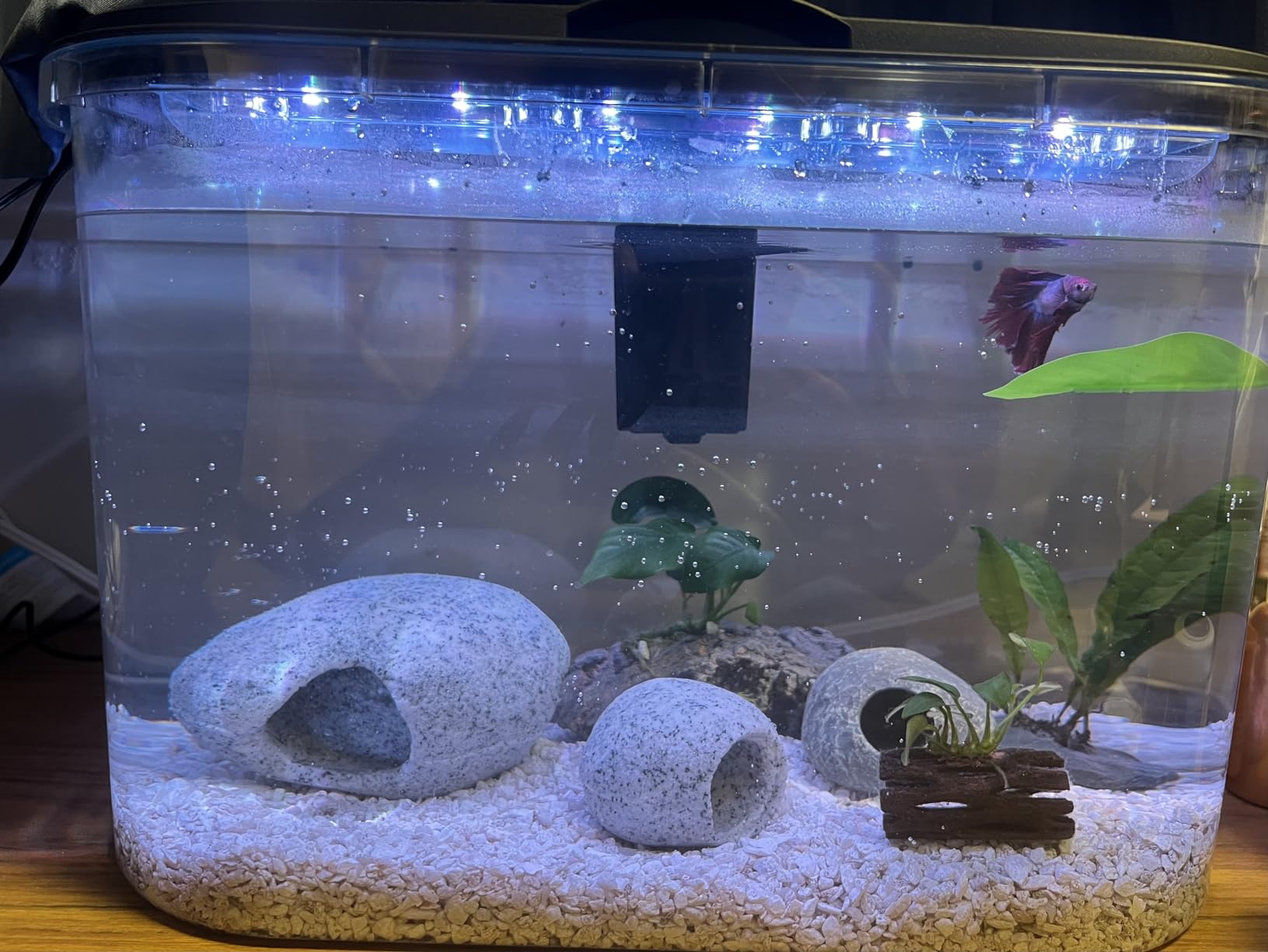
The lighting is the other reason parents like it. Thirty LEDs with white, warm, blue and mixed modes, plus a built-in 2, 4 or 8 hour timer with a memory function, so the light comes on at the same time every day without anyone touching a switch. That is a real advantage over the manual-unplug kits.
The internal filter is rated at 45 gallons per hour, which is a genuinely useful flow rate for a 5-gallon tank, and it uses standard Koller S cartridges so replacements are easy to find. The two downsides are consistent across reviews: the plastic surface scratches and eventually clouds, and cartridge replacement never stops.
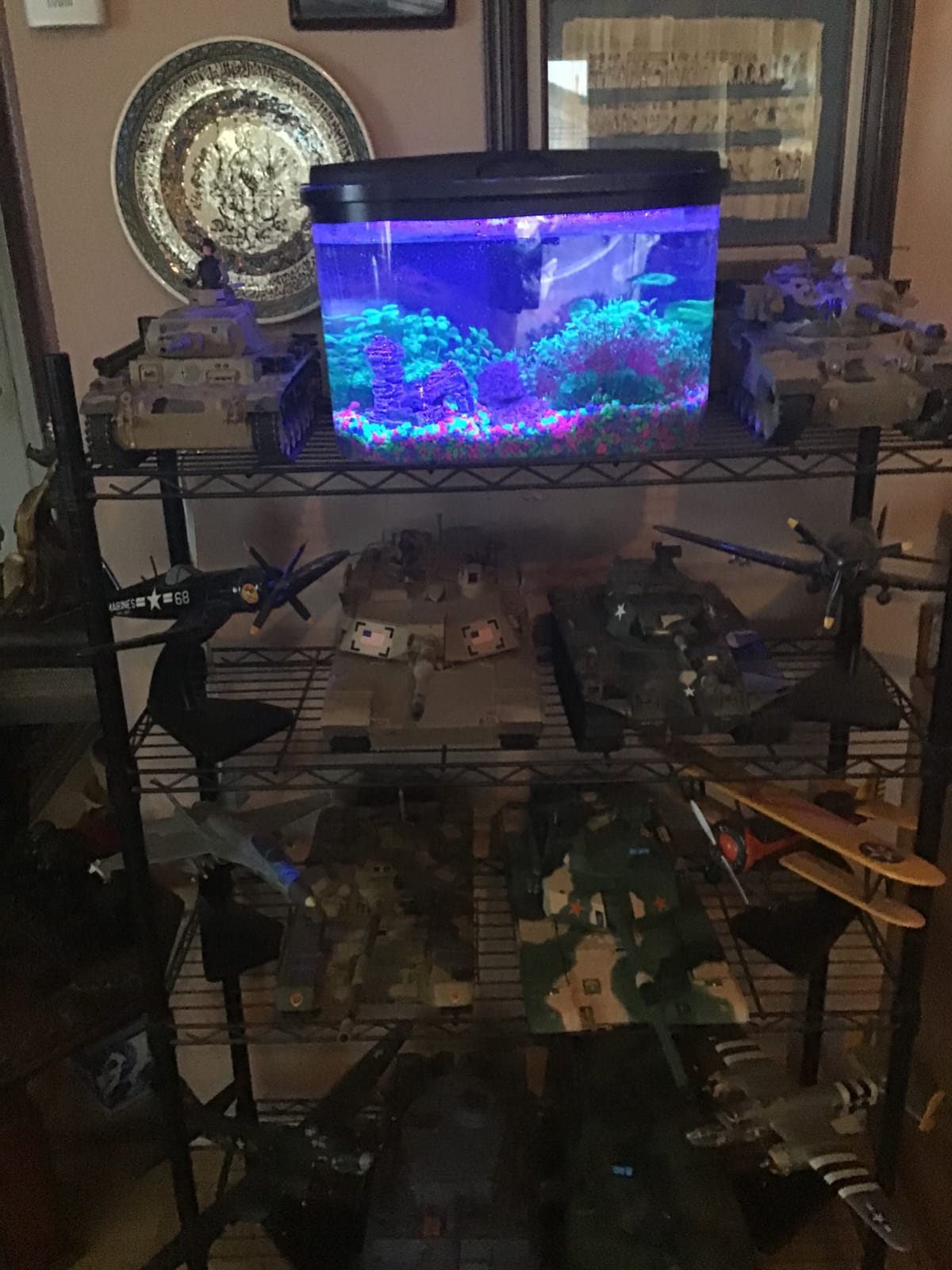
Why a plastic tank is the right call for a young child
Breakage is the most likely way a child’s first tank ends. Plastic removes silicone-seam failure and shatters, which means the realistic worst case is a dented panel rather than a flooded floor and a dead fish.
The clarity is the surprise for most parents. Reviewers repeatedly say the plastic is clear enough that people assume it is glass, so the visual reward that motivates a child is not sacrificed for the safety gain.
Where the trade-offs show up
Scratches are unavoidable. Cleaning with anything abrasive turns a clear panel into a frosted one over a year or two, so the rule for the whole household is a soft sponge and a dedicated cloth.
At 4.8 pounds and a tall rectangular shape, this tank wants a proper stand and a level surface. It is also a 5-gallon tank with no heater, substrate or decor in the box, so the first-time buyer still has a list.
6. Tetra LED Half Moon 1.1-Gallon Kit – Best for a Cordless Desk Setup
Tetra LED Half Moon 1.1 Gallon Fish Tank Kit for Betta Fish
- Cordless battery lighting frees the tank from outlet placement
- Light can sit above or below the tank
- Easy to clean and light enough to move
- Curved front has no seams across the view
- No filter or heater in the box so water changes are frequent
- Power cord for the light sold separately
- 1.1 gallons is too small for long term fishkeeping
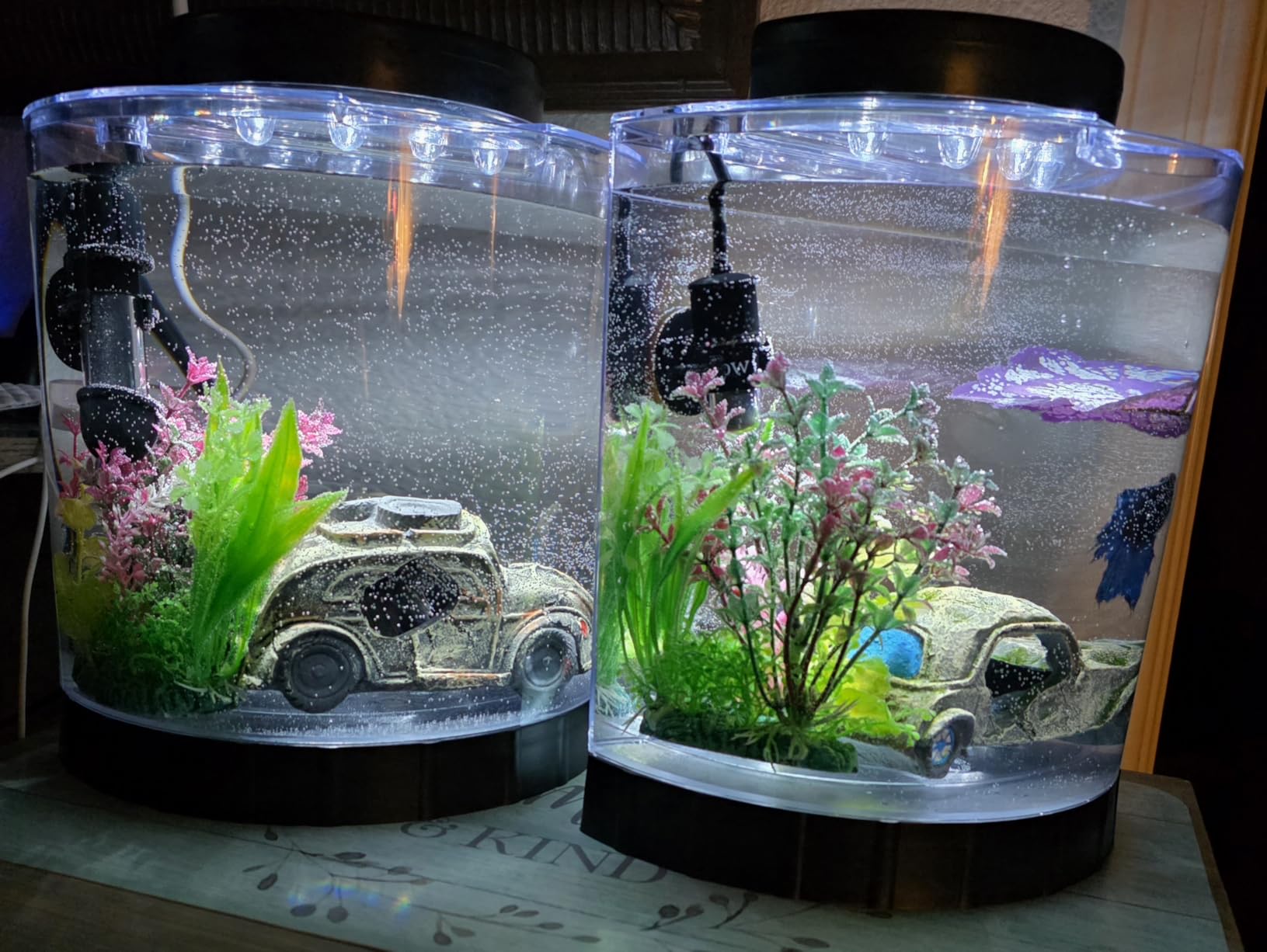
This one solves a specific problem: where to put the tank when there is no outlet near the desk. The LED runs on three AA batteries, and the maker notes an optional USB or power cord as an alternative, though the cord is not included. The light is movable and can sit above or below the tank.
Reviewers mostly use it as a decorative desktop betta tank, a hospital or quarantine vessel, or a display piece. At 1.32 pounds it is light enough for a child to carry to a sink for a water change, and the curved half-moon front has no silicone seam breaking the sightline.
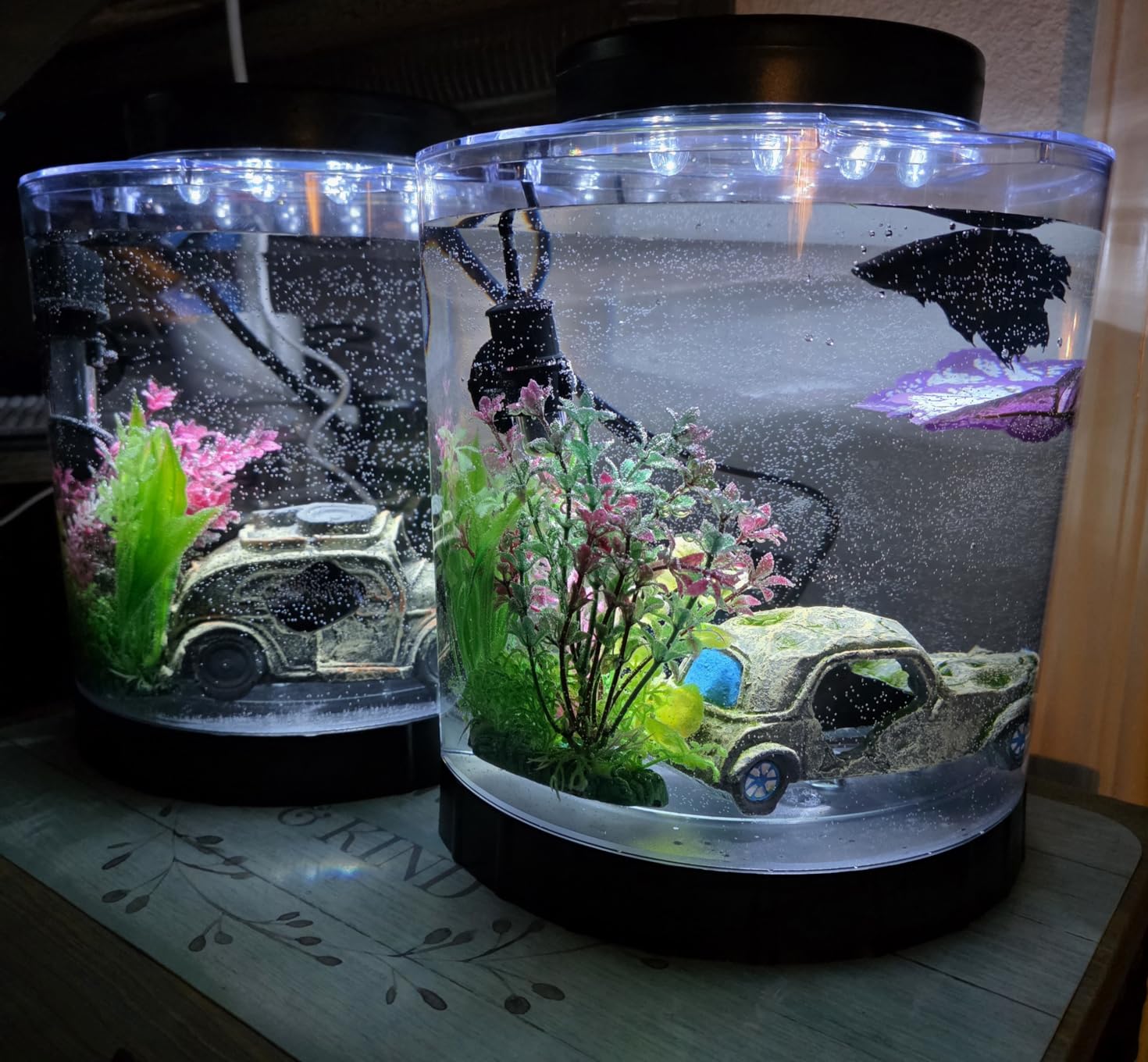
Be clear-eyed about what is missing: no filter and no heater. That means frequent partial water changes, and a separate heater purchase before any tropical fish goes in. The feeding hole in the canopy simplifies daily care, and the rear cord pass-through keeps the light tidy.
Other recurring notes: the plastic scratches easily and can arrive with cracks, the LED loses brightness over time, and the feeding hole is large enough for a betta to jump out of. This is a display tank, not a habitat.
When a display-only tank makes sense
If the goal is a fish the child can look at rather than a system to manage, this design works. One betta, a couple of snails, a battery light and a small weekly water change is a routine that fits a child’s attention span and an adult’s schedule.
It is also a reasonable quarantine or hospital tank to keep alongside a larger setup, which is how a lot of owners end up using it.
Why 1.1 gallons is the ceiling here
Water changes in a tank this small are close to daily, and with no filter the biological cycle never truly establishes. That is the honest limit, and it is why we would not start a child here unless an adult commits to the maintenance.
Add the heater, budget for a small test kit, and expect to change a meaningful slice of the water most days in the first month. Anything beyond that and you are working harder than a 5-gallon kit would ask of you.
7. Aqueon 10-Gallon Starter Kit – Best for Growing Into It
- Only kit here that includes a heater thermometer net food and conditioner
- Nothing to assemble so it is set up in minutes
- True 10 gallon glass volume with well sealed seams
- Removable filter is easy to rinse clean
- Filter intake is powerful enough to suck in small fish
- Flow can be too strong for bettas
- Sticker style thermometer is unreliable
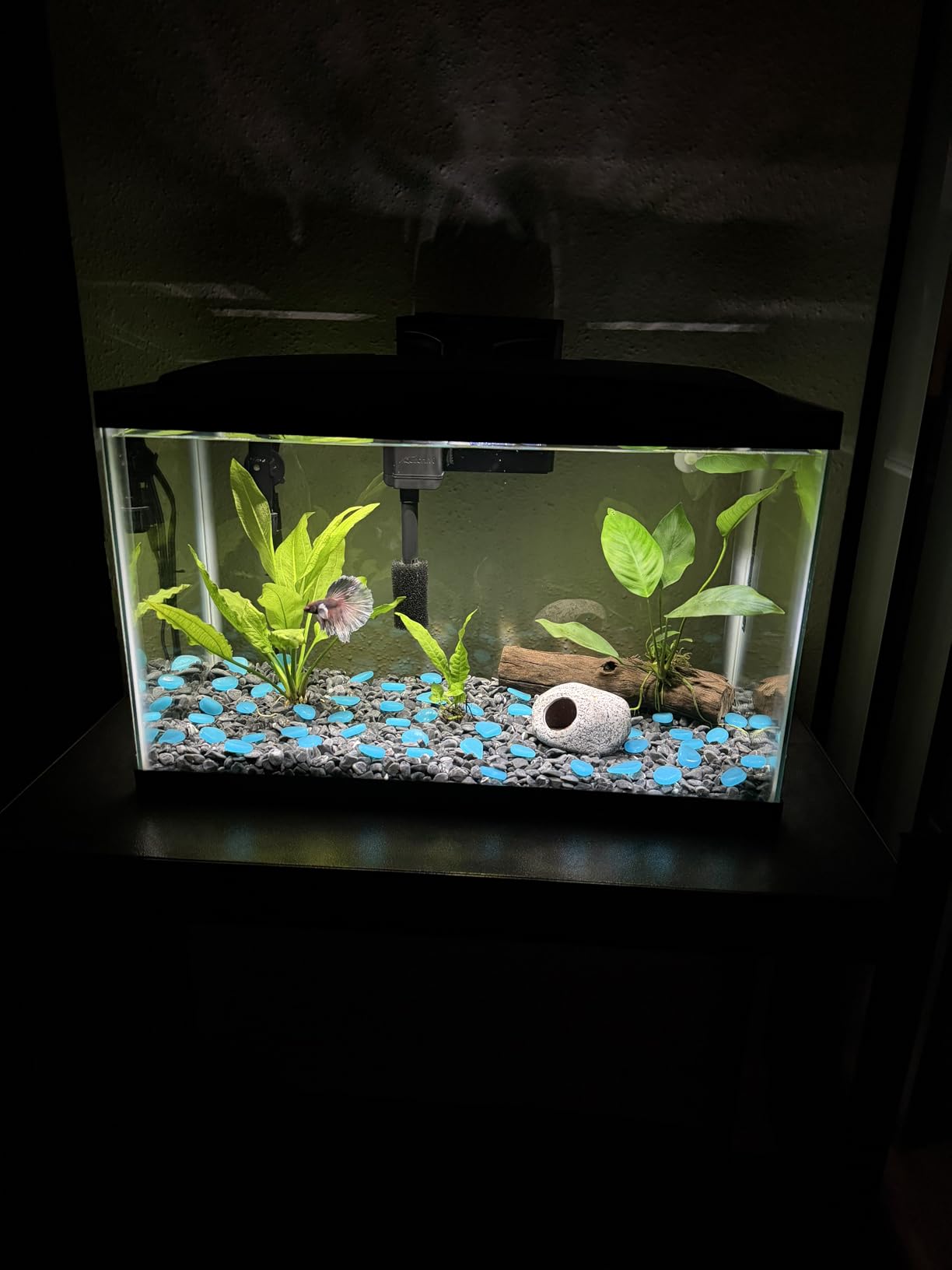
This is the most complete kit in the roundup, and completeness is what separates it. The box contains the 10-gallon glass aquarium, a low-profile hood with cool white LED lighting and a feeding door, the SmartClean internal power filter with an EcoRenew cartridge, a preset 50 watt heater, a thermometer, a fish net, fish food and a water conditioner.
Every one of those is an item most first-time buyers forget. The commonest surprise in this hobby is that a so-called starter kit contains only filter parts, and this one sidesteps that entirely. Nothing needs assembling, so a tank can be filled and running the same afternoon.
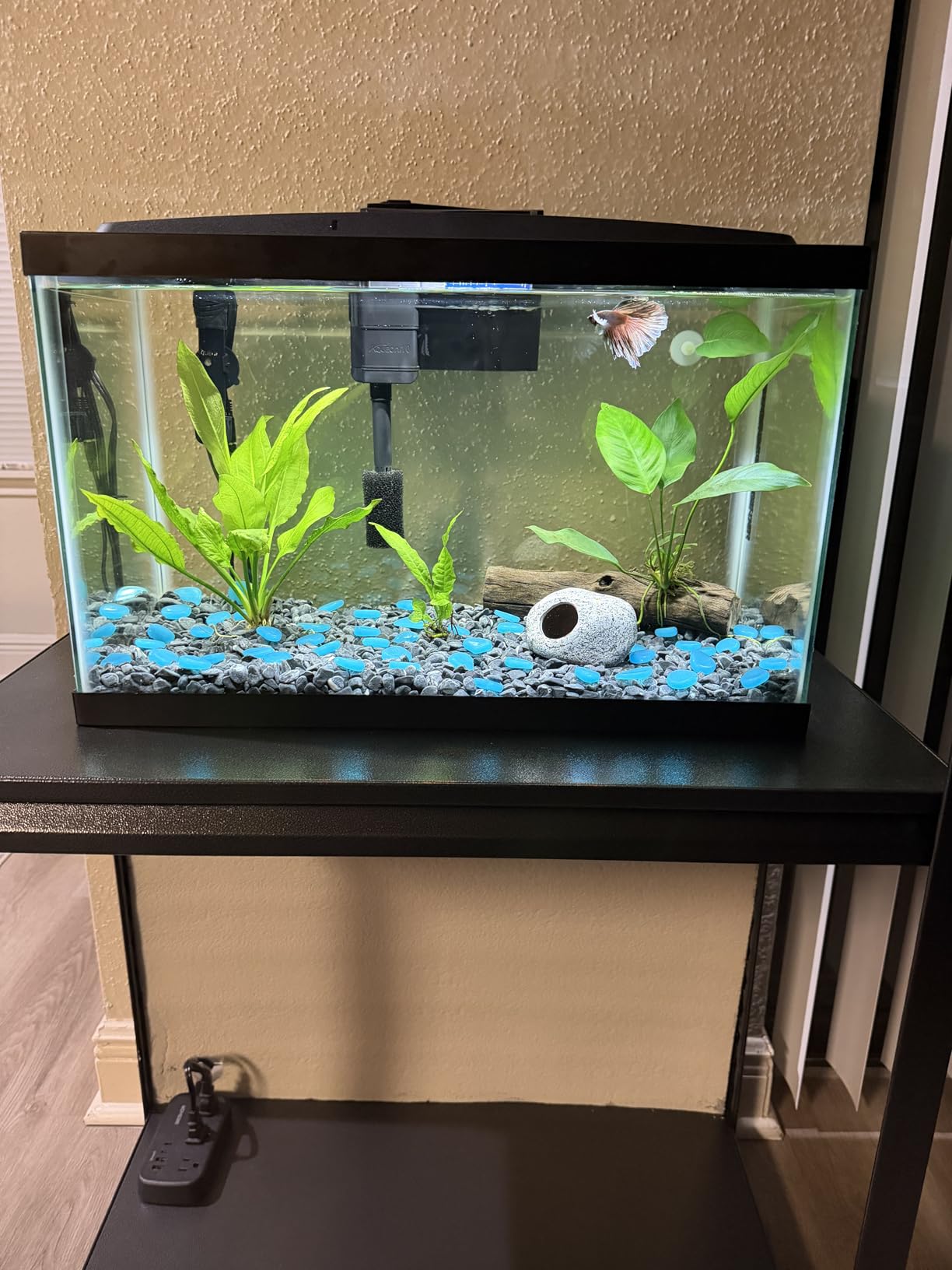
At 10 gallons with a hood and a filter, the water is far more stable than a desktop kit, and it holds a small community group rather than a single animal. That is the argument experienced hobbyists on reef2reef made when recommending 20 gallons to a parent: pick the size that lets a child add more fish as their interests grow, rather than replacing the whole tank in a year.
The cautions are specific. The filter intake is powerful and can pull in small fish, so add a pre-filter sponge, and flow can be too strong for bettas unless the outlet is diffused.
The LED is also brighter than some buyers want, and the sticker-style thermometer stops working, so replace it with a real one. The heater’s suction cups do not hold well, and it is preset at 78 degrees rather than adjustable.
Why 10 gallons is the sweet spot for a family tank
Water volume is the single biggest factor in whether a child’s tank survives a month of imperfect care. Ten gallons dilutes mistakes the way a 1-gallon tank cannot, and it holds enough fish that a child who outgrows one species has somewhere to go.
The glass construction is worth noting too. At 17.35 pounds it is not a tank for a high shelf, but glass does not scratch, and scratch-free panels are what make a tank still look good after a year of daily cleaning.
Where the extras fall short
The included thermometer is the weak link. A sticker-style strip on the glass is not a reliable temperature reading, and a wrong reading in a tank with a heater running is a real problem, so replace it in the first week.
Filter cartridges also need frequent replacement, which raises the running cost above a plastic-tank kit. Budget for a monthly cartridge and a bottle of conditioner, and treat both as part of the cost of the hobby rather than an exception.
8. Koller AquaView 360 6-Gallon Kit – Best for a 360 Degree View
Koller Products Plastic 6-Gallon AquaView 360 Aquarium Kit for Tropical Fish, Betta Fish with LED Lighting and Power Filter Clear, 4-Piece Set
- Curved cylinder gives a magnified 360 degree view
- Compact footprint uses vertical space
- Seven LED colors plus a lighting timer
- Shape suits bettas shrimp and snails
- Filter intake has no guard and has sucked in fish
- Included LED is too dim to support growing plants
- Filter cartridge reliability is a recurring complaint
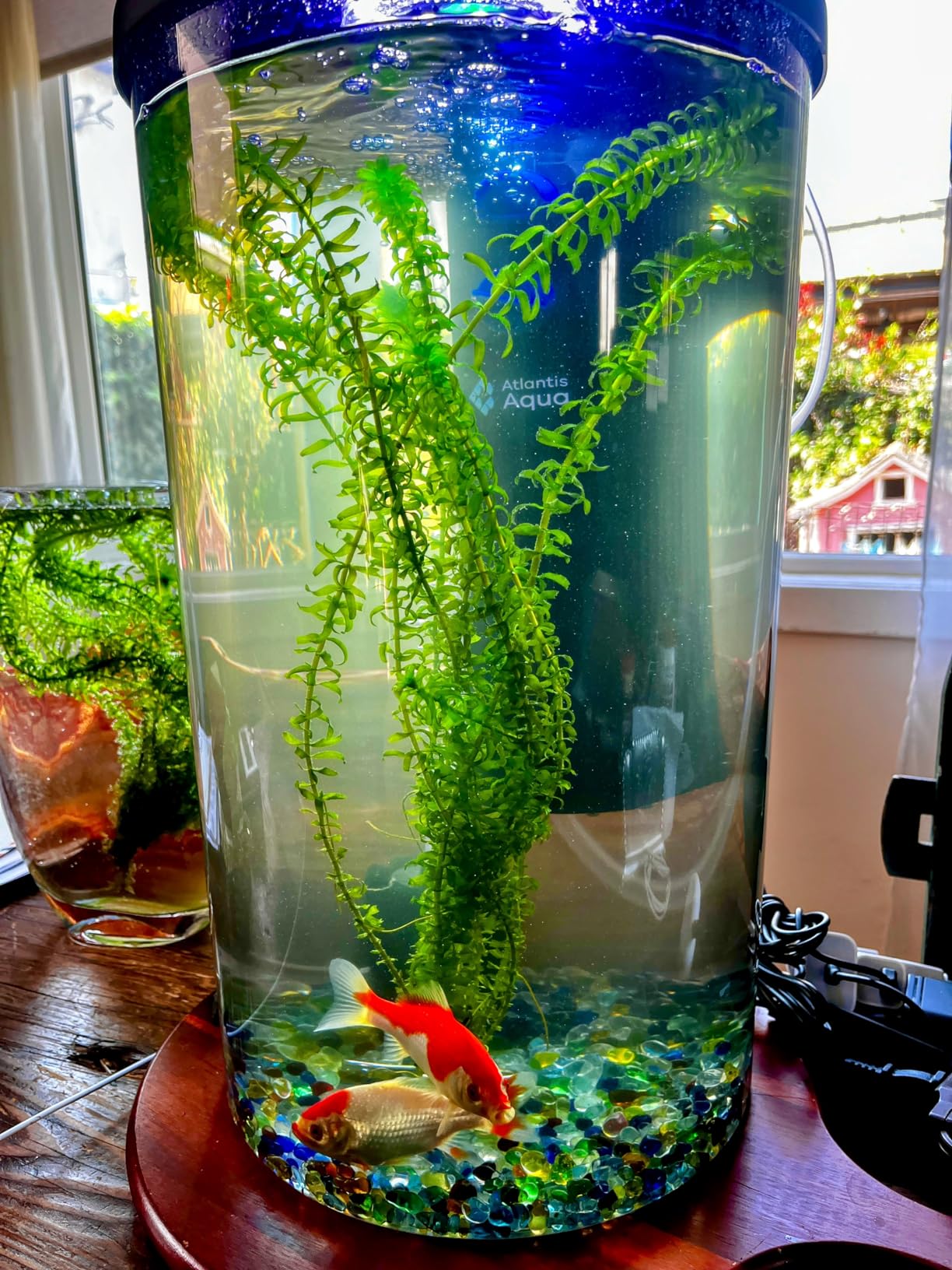
The AquaView 360 looks like nothing else in this roundup. A cylindrical tank with curved impact-resistant plastic gives a 360-degree view that magnifies the fish, and the shape uses vertical space instead of desk space.
The lighting adds seven color selections, from daylight white through blue, green, amber, aqua, purple and red, with a timer settable to 4 hours, 8 hours or continuous. For a child, changing the color of the tank is close to free entertainment and costs nothing to maintain.
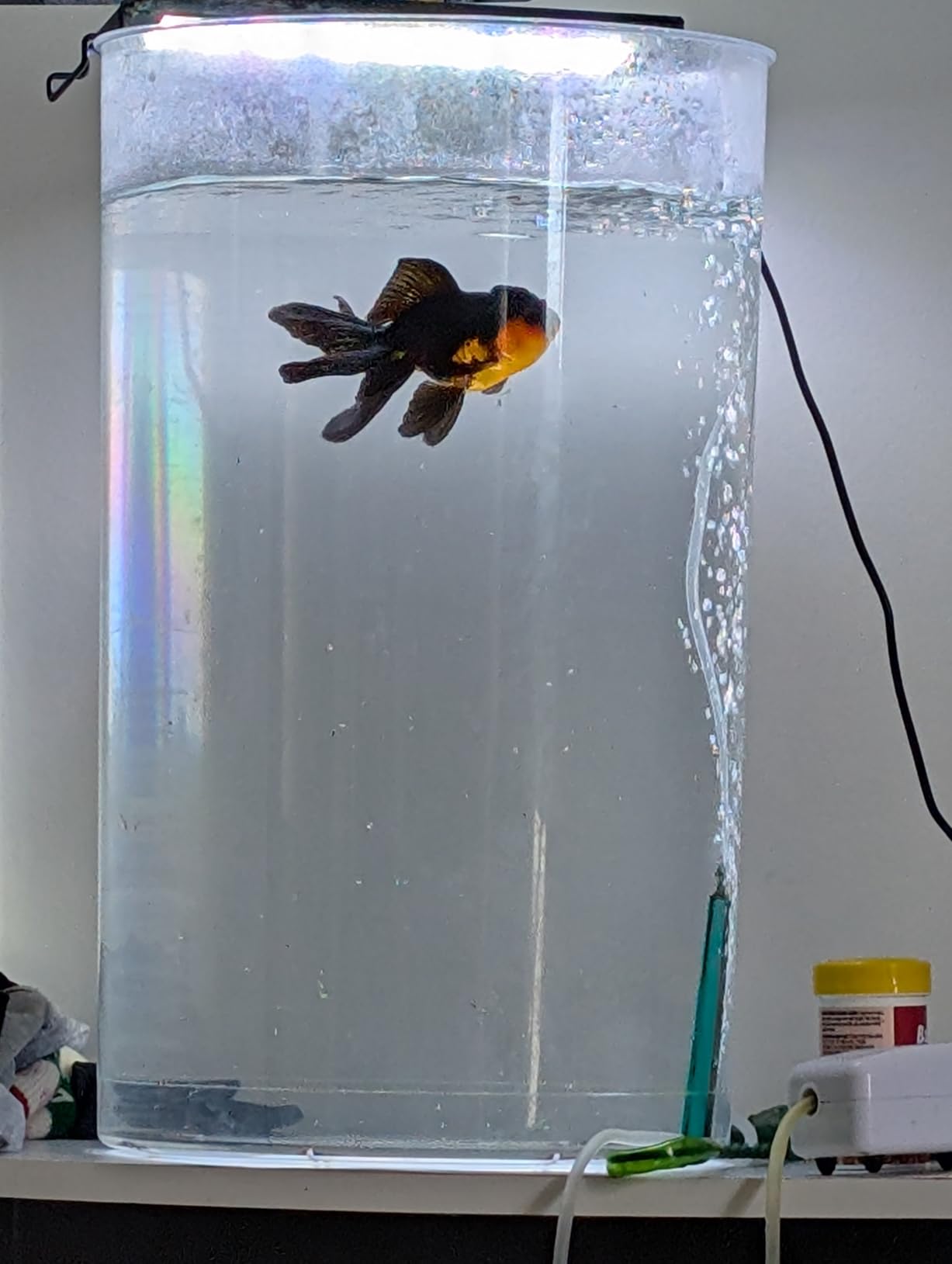
Two issues are serious enough to plan around. The filter intake has no guard, and one reviewer states plainly that it sucked in a fish and killed it. The included LED is also too dim to support growing plants, so treat this as a display tank rather than a planted one unless you replace the light.
Beyond that, the cartridge media performs poorly according to a number of owners, some of whom report better results running two filters. The pump cord can wear out from repeated flexing, and brand support has been reported as unresponsive when a filter fails, so keep a spare on hand.
Why the shape works for a child’s room
A round tank is interesting from every side of the room, which matters in a bedroom where a child will approach it from the bed rather than sitting in front of it. The magnification effect also makes a small number of fish feel substantial.
The tall, narrow proportions suit bettas, shrimp and snails particularly well, since these animals prefer more vertical swimming space than a wide shallow tank gives them.
Where the missing guard becomes a risk
An unguarded intake is the deal breaker here, and the fix is cheap: a pre-filter sponge or a small piece of mesh over the intake. Do that on day one rather than after a fish is lost.
At 2.5 pounds the tank is easy to move, and the plastic will not shatter, but expect to replace the light if you want live plants, and expect cartridge changes to be a recurring line item.
9. GloFish 20-Gallon Aquarium Kit – Best for a Glow Effect
GloFish 20 Gallon Aquarium Kit with LED Lights, Decor Heater and Filter
- Blue LED and fluorescent decor create a full neon display
- Glass is built in the USA and scratch resistant
- Heater and filter are both in the box
- Decor bundle means it is styled out of the box
- Weighs 34 pounds and needs a serious stand
- Glass carries a cracking risk in transit
- Gravel and fish are not included
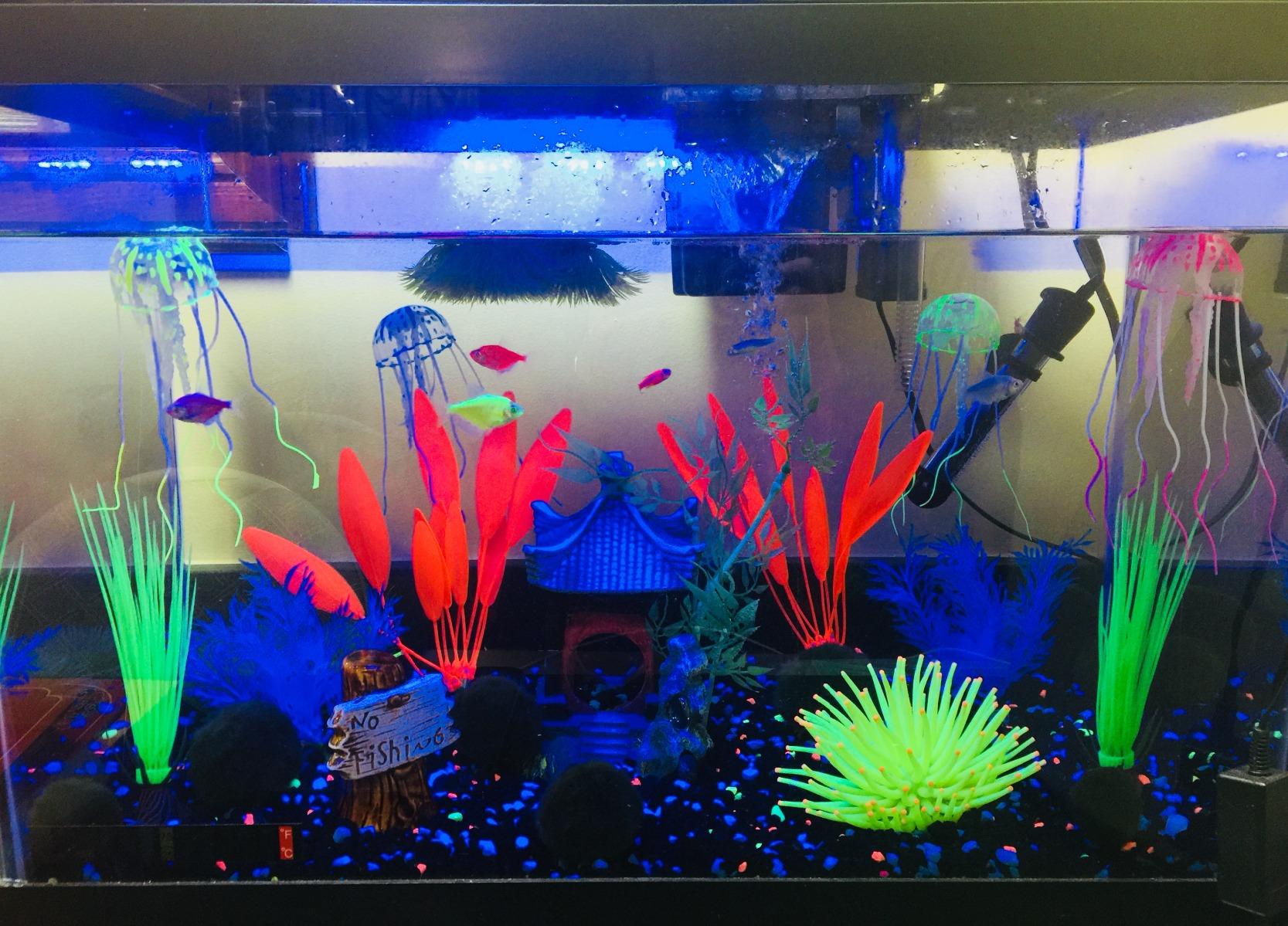
This is the kit in the roundup we would choose purely for how it looks, and for a child who wants a glowing aquarium in a dark bedroom it delivers. The blue LED hood works with a 13-inch GloFish LED light stick, and the decor bundle includes three GloFish plants and a yellow anemone that fluoresce under the blue light. The whole room ends up lit by the tank.
It is also one of the few large kits that bundles both a heater and a filter. The Tetra Mini UL heater and a Tetra Whisper 20 filter are in the box, which for a 20-gallon tank is a real saving on the setup list. The glass is built in the USA and described as scratch resistant, which matters on a tank this size.
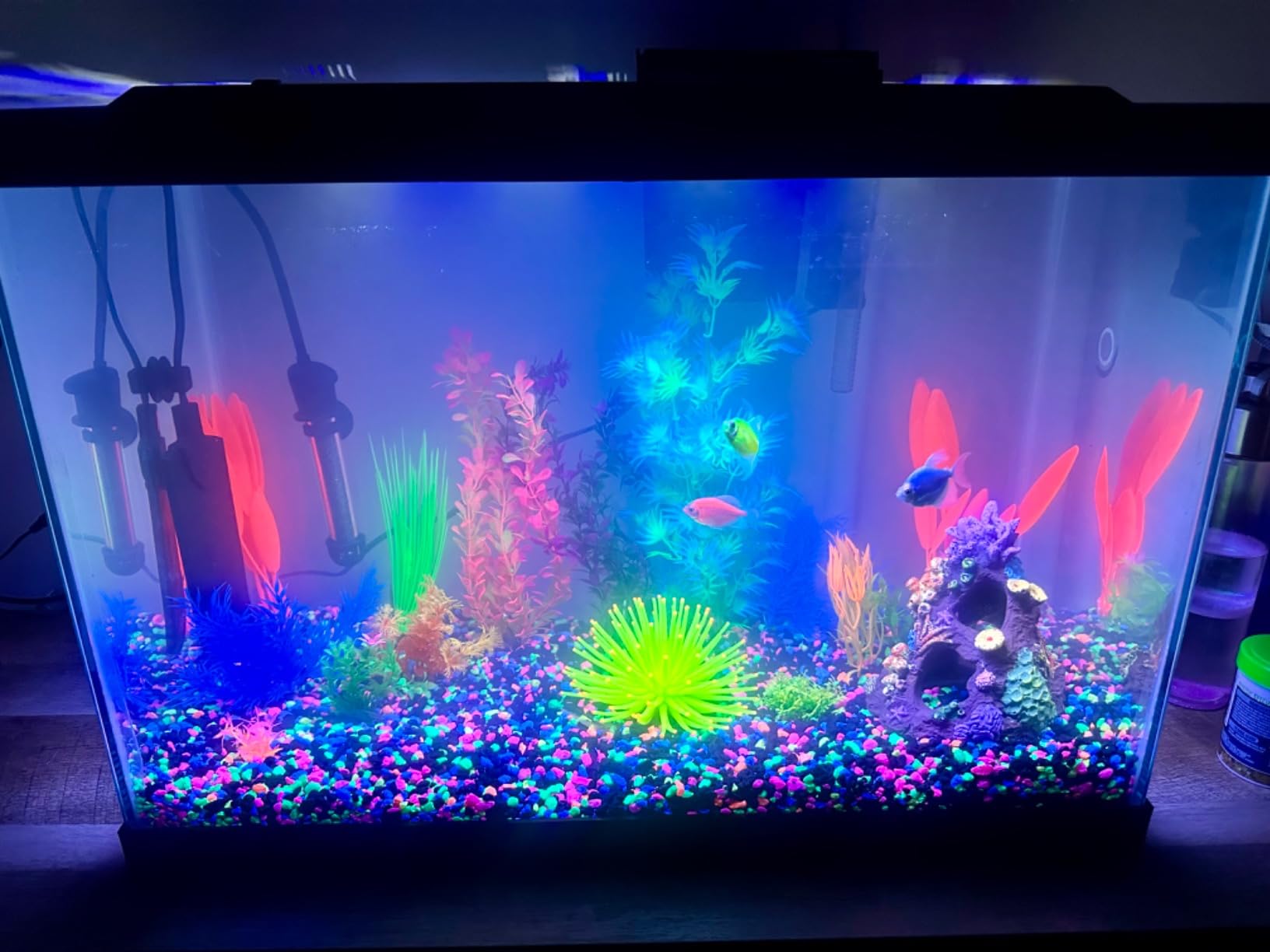
It is 34.32 pounds and 24.2 by 12.4 by 16.7 inches, so this is not a first tank in any practical sense unless you have the stand and floor space for it. A reef2reef member named Idech put the general view plainly when discussing a child’s tank: only buy one if you are prepared to do all the work yourself, and that scales with volume.
Fish and gravel are sold separately, so the tank arrives bare. At 20 gallons it needs a real community tank plan rather than a pair of fish, and a filter rated for that load. The glass also carries a cracking risk in transit, so inspect the seams before filling it.
Who this kit actually suits
A family with a 20-gallon stand, a clear spot in a dim room, and a child old enough to understand that a bigger tank means more work. Under those conditions the glow effect is the reason to buy it, and having the heater and filter included removes the two most common omissions.
The decorative angle also helps with the interest problem. A 20-gallon tank with a handful of species stays visually interesting for longer than a desktop kit, and a child who is watching fluorescent fish move is a child who is not feeding them a third time.
Where the commitment bites
Weight and volume are the real constraints. Moving the tank requires two people and a plan, and a leak at the stand is far worse at 20 gallons than at 5. A forum parent described having to move his child’s fish into his own tank after the child’s tank leaked a year or two later, and that is a bigger job at this size.
Do not buy this as a starter tank for a five-year-old. Buy it as a second tank for a family that already has a working setup and the equipment to run it.
10. NICREW 2.5-Gallon Nano Nature Aquarium Kit – Best for a Small Glass Display
NICREW 2.5 Gallon Nano Nature Aquarium Kit Betta Fish Tank, Complete, Black
- Highest rated kit in this roundup with a 4.5 average
- 79 percent of buyers give five stars
- High clarity glass does not scratch or cloud
- Leveling mat and lid are pre glued and ready
- 2.5 gallons holds one betta or a small shrimp group only
- Heater is not included and tropical fish need one
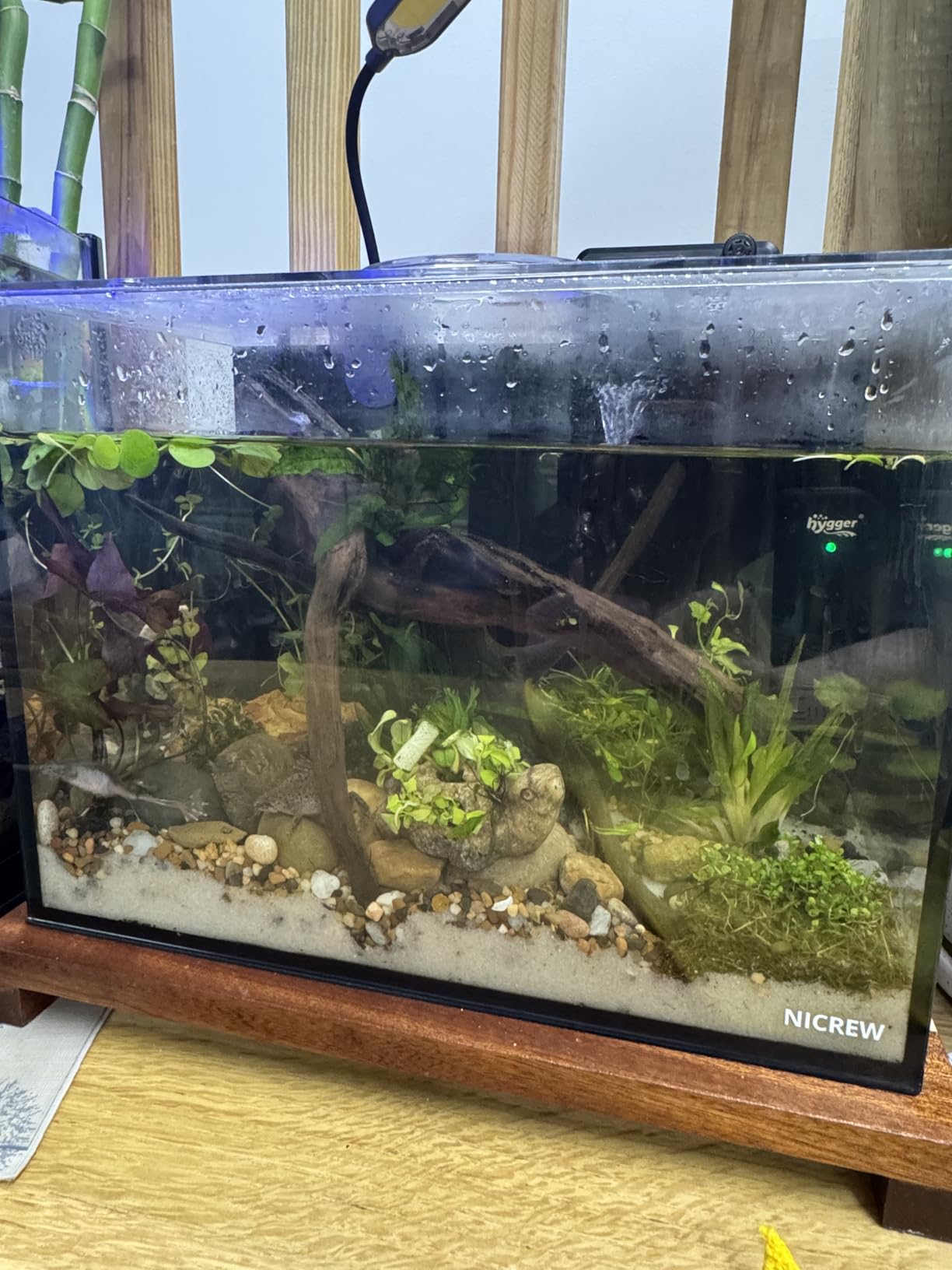
On ratings alone this is the strongest kit here, with a 4.5 average and 79 percent of buyers giving five stars, the best distribution of the ten. The tank is 2.5 gallons of high-clarity glass with 91.2 percent light transmittance, which is why planted aquascapes and shrimp displays look sharper in this tank than in the acrylic kits at the same size.
It is also simple to start. The tank ships with a lid and a pre-glued leveling mat, ready out of the box, and a step-by-step setup guide written for people who have never kept fish. At 11.81 by 6.3 by 8.66 inches it fits a countertop without taking over it.
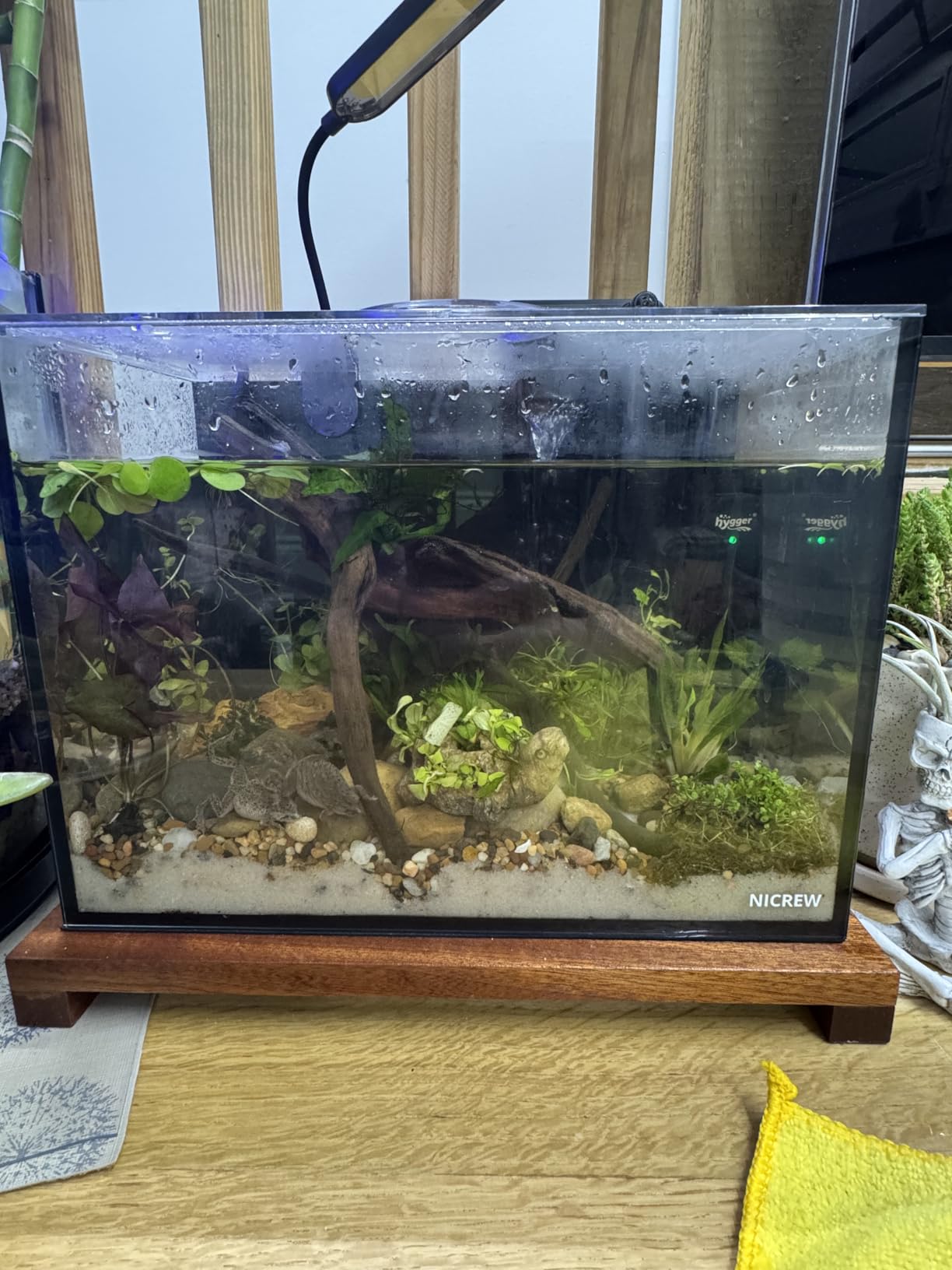
Glass construction is the quiet advantage over most kits in this roundup. Acrylic scratches and clouds with age, and reviewers on other kits here describe exactly that. A glass nano tank keeps its clarity in a child’s room, where a soft sponge is sometimes the only thing used to clean it.
The two limits are straightforward. At 2.5 gallons the realistic inhabitants are one betta or a small group of shrimp, and a heater is not part of the kit, so tropical fish need a separate purchase. At 14.28 pounds the tank is heavy for its size, so plan where it will sit before filling it.
Why glass beats plastic in a small display tank
Clarity is not a luxury in a nano tank. With only 2.5 gallons there is little water to soften a scratched surface, and the visual difference between clear glass and frosted acrylic is obvious within a few months of daily cleaning.
The pre-glued leveling mat solves the most common nano tank complaint, which is a tank sitting crooked and stressing the seams. It goes down once and stays.
Where the small volume decides for you
Two and a half gallons is a single-animal tank, and no amount of careful care changes that. A shrimp colony, a betta, or a betta with a couple of snails is the realistic list.
Because the rating is high and the price point sits above most plastic nano kits, this is a good choice for a child who will keep the tank for years rather than a month, and a poor choice for a present that needs to survive a long box sitting in a closet. If it goes unused for a year, a plastic kit is the more forgiving choice.
How to Choose an Aquarium Kit a Child Can Actually Care For
Size is the first decision and it is the one hardest to reverse. A tank cannot be upgraded in place, and a child who starts at 1 gallon will hit the water quality ceiling within weeks. The practical rule for families is to buy the largest tank the child’s room and your schedule can support, then add very few fish at first.
Here is how the sizes compare for a child’s first tank:
1 to 1.1 gallons suits a display tank for one betta or snails. Water changes are close to daily and the cycle never fully establishes, so an adult must be involved every day.
2.5 to 3 gallons is the first size that holds stable water. It works for a shrimp colony or a single betta with room for plants, and it is a reasonable first step for a child aged four to seven with adult help.
5 gallons is the sweet spot for a school-age child. It holds a betta or a small community group, dilutes mistakes, and is small enough that an adult can move it alone.
6 to 10 gallons is the grow-into-it range. It holds a real community tank, and a child can add species as their knowledge grows without replacing the tank.
20 gallons is a genuine commitment. It needs a dedicated stand, a stronger filter and a fish plan, and it is better as a second tank than a first one.
Material is the second decision. Glass looks better and scratches less, but it cracks and it is heavy. Acrylic and plastic flex rather than shatter, which is why we lean toward them for a young child’s room, and why the reef2reef parent we heard from lost a glass tank to his kids within about a year. The trade is optical clarity and a longer working life against impact resistance and low weight.
The fitted lid is the third, and it is the one most listings bury. Jedi1199’s warning about climbing children and jumping fish applies to every tank on this page. Check whether the lid is a true clamped lid or a canopy that sits in a groove, and assume a jumping species until you have addressed it.
Filtration is the fourth. An internal power filter rated at 45 gallons per hour handles a 5-gallon tank comfortably, which is the case for both Koller kits here. What matters more than the flow rating is whether the filter cartridge is easy to source and whether the media tray slides out for cleaning, because the adult doing maintenance will care far more about that than the child does.
Lighting is the fifth. A timer changes more than the mood. The Koller 5-Gallon and the AquaView 360 both include a built-in timer, which means a consistent photoperiod without anyone remembering, and consistent lighting is what keeps algae in check.
The heater is the sixth and the most commonly forgotten. Only the Aqueon 10-Gallon and the GloFish 20-Gallon bundle a heater. Everything else that houses tropical fish needs a separate preset heater, and a tank of bettas, tetras or guppies kept at room temperature is a tank in trouble.
Noise is the seventh. Anything air-pump driven, which includes the Tetra kits here, adds a hum that matters if the tank is a few feet from a bed. Filter-driven kits are quieter, and the Marineland’s hidden filter adds no air pump hum at all.
Finally, the kit inclusion reality check. A product labeled a starter kit often means a tank, a light and some filter parts. Only the Aqueon MiniBow and the Aqueon 10-Gallon include water conditioner and food, and only the 10-Gallon includes a heater, net and thermometer. Assume you are buying a heater, a bottle of conditioner, gravel, a few low-demand plants and a test kit on top of any kit that does not list them.
Setup and Cycling in the First 90 Days
The nitrogen cycle is the reason most new aquarists lose their first fish. In plain language, fish waste and uneaten food produce ammonia, which is toxic. Beneficial bacteria in the filter then convert ammonia into nitrite, and then into nitrate, which is much less harmful. That colony takes three to six weeks to establish in a new tank, and fish added on day one are swimming in a toxic tank with no defence.
Here is how we would stage the first three months.
Day 1 to day 3. Set the tank up on a level surface, rinse the substrate if it is gravel, fill with dechlorinated water, and run the filter and heater without any fish. Add live bacteria if you have them. This is the week to teach a child that the interesting part is starting a tank, not adding fish to it.
Week 1 to week 4. Test ammonia and nitrite every couple of days. Both should read zero or near-zero. If either reads high, do not add fish, and do not try to fix it with water changes alone, because the bacteria colony is the fix. Keep testing until the readings stay at zero across a full week.
Week 4 to week 6. Add the first fish, one small group, and watch for signs of stress such as clamping fins or hiding in the corner. Keep the lights on a timer and feed once a day, sparingly.
Week 6 to week 12. Settle into a weekly partial water change, roughly a quarter to a third of the volume, and add fish slowly, a few at a time, with two weeks between additions. This is the point where a child can take over feeding and glass cleaning, which is how experienced hobbyists on reef2reef suggested phasing it in: show lots of interest at first, teach the routine, and let the child accept it when they are ready.
Which Fish to Add First and Which to Avoid
Hardy fish survive imperfect care, and for a child’s tank that matters more than color. A top comment on an r/Aquariums thread recommended corydoras catfish specifically for children because you see them more and they are active and visible from the front, and the same comment suggested 20 to 40 gallons as the easiest size. In the sizes we cover here, corydoras suit 10 gallons and up.
For a 5-gallon tank, platies, mollies, zebra danios and a small group of neon tetras are all forgiving. A single betta works in anything from 2.5 gallons up, provided the flow is gentle. Nerite and mystery snails do useful work cleaning algae off the glass and give a child something to watch that is not a fish.
Skip goldfish. They grow far larger than a small tank allows, they produce a lot of waste, and the idea that they make ideal first pets is one of the most persistent myths in the hobby. Also avoid oscars, most cichlids and pufferfish, all of which outgrow a child’s tank quickly and are not forgiving about water quality.
Overfeeding is the number one killer in a small tank, and it is entirely a human problem. A child feeds whenever they pass the tank. One reef2reef poster described his as a tank his kids sometimes throw fish food at. The fixes are mechanical: a floating feeding ring that keeps food in one spot, pre-portioned daily amounts in a small container so nobody shakes flakes over the tank, and one feeding a day. Uneaten food decomposes and produces the ammonia that kills the fish, and that is the most common way a child’s first tank ends.
Kits We Would Skip and When to Hand Off the Care
Some kits in this category have ratings low enough that we would steer a parent away from them. A JumblPets starter fish aquarium kit sits at 1.4 stars from 7 ratings. The Penn-Plax SpongeBob aquarium kits sit at 2.0 and 2.1 stars, one of them from 38 ratings, and the Robo Alive light-up aquarium set sits at 2.5 stars. Ratings that low on small sample sizes are not always fair, but a themed novelty kit at that level of consistency is a poor bet when a proven tank is a similar purchase.
There is a counterargument for themed tanks, and it is a reasonable one. A reef2reef member recommended a cheap GloFish tank precisely because the fish are extremely hardy and survive accidental overfeeding, and because a glowing tank works as a nightlight. A tank a child is excited about gets watched more, and watching is half of the hobby.
Then there is the month-two problem, which no competitor addresses. A reef2reef member put it plainly: his kids were not actually interested in the fish, and he described the tank as one in his kids’ room that they sometimes throw fish food at. The same forum thread described a glass tank cracked by children within about a year, and a hobby that did not survive contact with a real child.
What actually helps is slowing the handoff down. Do not give a child full responsibility in week one. Teach the cycle, the feeding amount and the water change, let them take over feeding and glass cleaning, and keep the water tests adult-only for as long as it takes. If interest fades, rehome the fish properly rather than abandoning them, and keep the tank as a planted display or give it to a school or a shelter. A tank that has to live through a divorce, a move or a teenager is one you should buy smaller and cheaper.
Frequently Asked Questions
What is the best starter aquarium for kids?
The Marineland Portrait Glass LED 5-Gallon is our top pick, because at 5 gallons it holds stable water, hides its 3-stage filter out of reach, and has the deepest review history of any kit we tested. Add a preset heater, water conditioner and gravel, since none of those are in the box.
What are the best aquarium kits for beginners?
The Marineland Portrait Glass LED 5-Gallon for the all-around pick, the Aqueon 10-Gallon Starter Kit for the most complete box with a heater and accessories included, and the Koller Products 5-Gallon for a leak-proof plastic body. All three pair a tank with a filter, a light and enough volume to forgive small mistakes.
What size fish tank is best for kids?
5 gallons is the sweet spot for a school-age child. It holds a betta or a small community group, dilutes the ammonia from a missed feeding, and stays light enough for one adult to move. Tanks under 2 gallons need near-daily water changes, and 10 gallons is the better choice if the child will grow into more fish.
What is the best starter fish for a child?
Corydoras catfish are a strong pick for children because they are visible from the front and constantly active. In a 5-gallon tank, platies, mollies, zebra danios and neon tetras are all forgiving. A single betta works in anything from 2.5 gallons up, provided the filter flow is gentle and the lid is fitted.
How long does it take to cycle a fish tank?
Budget three to six weeks. Test ammonia and nitrite every few days, and do not add fish until both read zero consistently for a full week. Adding a bottled bacteria culture can shorten it, but it rarely produces an instant cycle. Fish added in the first two weeks are the most common reason a new aquarium fails.
Do kids really take care of fish tanks?
Partly, and the adults finish the job. Experienced hobbyists consistently advise showing lots of interest at first, teaching the routine, and letting the child take over feeding and glass cleaning only once they have accepted it. Water testing, water changes and filter service usually stay with an adult for the life of the tank.
The Bottom Line on the Best Aquarium Kits for Kids
The best aquarium kits for kids are the ones that forgive a child being a child. That means 5 gallons or more, a filter that is either hidden or easy to service, a lid that holds a jumping fish, and a family prepared to do the water changes. On that basis, the Marineland Portrait Glass LED 5-Gallon is the pick, with the Aqueon 10-Gallon Starter Kit as the option to grow into and the Koller Products 5-Gallon as the safest body for a younger child.
Whichever you choose, cycle the tank before the fish arrive, feed once a day, and expect the adult to run the maintenance. A child who learns that a living thing needs consistent care has learned something that a lot of screen time cannot teach, and the tank keeps teaching it long after the novelty fades.