
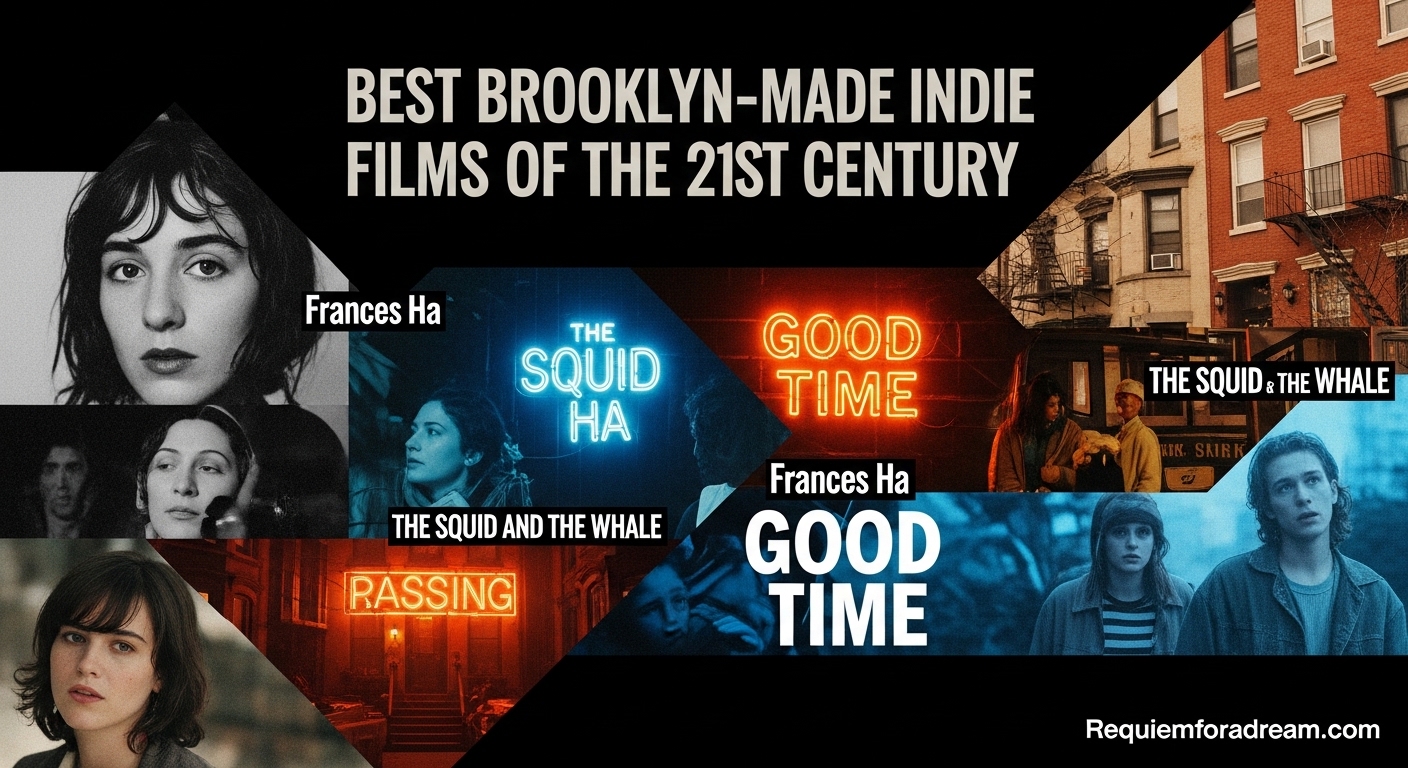
There’s something electric about watching a film that captures the Brooklyn I actually know. Not the postcard version of brownstones and hipster coffee shops, but the real thing: the Coney Island boardwalk in winter, the quiet streets of Park Slope at dusk, the layered rhythms of Bed-Stuy summer evenings. Brooklyn-made indie films have been documenting this borough’s soul for over two decades now, and I’ve spent the last few months watching them all again to figure out which ones truly deserve your time.
When we talk about Brooklyn-made indie films, we’re looking at movies that were shot primarily in Brooklyn neighborhoods, made outside the major studio system, and directed by filmmakers who actually understand what makes this borough tick. These aren’t Hollywood productions that happen to have a few Brooklyn exterior shots. These are independent films where the borough itself becomes a character, where the location informs everything from the pacing to the dialogue to the emotional texture.
My criteria for this list was straightforward but strict. Each film needed to be shot substantially in Brooklyn, made by independent production companies (typically budgets under $20 million), released between 2000 and 2026, and directed by filmmakers with genuine Brooklyn connections or deep understanding of the borough’s culture. I also prioritized films that say something meaningful about the specific neighborhoods they depict. Our site’s namesake, Darren Aronofsky’s Requiem for a Dream, immediately comes to mind as the perfect example of Brooklyn location becoming narrative soul.
The result is a collection of ten essential films that span the full breadth of Brooklyn’s indie cinema renaissance. From the brutal beauty of Coney Island in Darren Aronofsky’s breakthrough to the post-graduate drift of Greta Gerwig in Frances Ha, these movies capture something that Manhattan-centric Hollywood films rarely even attempt: the lived-in, layered reality of Brooklyn life.
Table of Contents
Quick Picks: Top 3 Brooklyn Indies at a Glance
Before we dive into the full chronological journey, here are my three absolute must-watch Brooklyn indie films if you only have time for the essentials.
Requiem for a Dream (2000) – Darren Aronofsky’s devastating addiction drama remains the most visually innovative Brooklyn film ever made. Shot in and around Coney Island, it’s a technical masterpiece that uses the boardwalk’s faded glory as a backdrop for four interwoven stories of chemical dependency. Ellen Burstyn’s performance as Sara Goldfarb, the Brighton Beach widow desperate to fit into her red dress, stands as one of the greatest in cinema history.
Frances Ha (2013) – Noah Baumbach and Greta Gerwig’s black-and-white portrait of a 27-year-old dancer navigating post-college limbo perfectly captures that specific Brooklyn feeling of being talented but not quite successful yet. Gerwig’s Frances floats between apartments, neighborhoods, and temporary jobs while the film documents a very specific 2013 Brooklyn moment. The sprint down Varick Street set to David Bowie’s “Modern Love” might be the most joyful sequence in 21st-century indie cinema.
Anora (2024) – Sean Baker’s Palme d’Or winner brings Brooklyn indie filmmaking into the 2020s with this Brighton Beach-set story of a stripper who impulsively marries the son of a Russian oligarch. Mikey Madison’s title performance anchors a film that understands the complex cultural layers of Brooklyn’s Russian-American communities. The Coney Island locations serve as both playground and battleground in what becomes one of the most unexpectedly moving films of the decade.
Brooklyn Indie Films of the 2000s
The early 2000s established the template for what Brooklyn indie cinema could accomplish. Digital technology was making production cheaper, but filmmakers still needed real locations and authentic stories. These three films proved that Brooklyn could provide both.
1. Requiem for a Dream (2000) – The Coney Island Nightmare
Darren Aronofsky’s second feature announced the arrival of a major American filmmaker and proved that Brooklyn’s most marginalized locations could anchor serious cinema. The film follows four characters through the seasons of addiction: Harry Goldfarb (Jared Leto) and his girlfriend Marion (Jennifer Connelly) chasing heroin dreams, Harry’s friend Tyrone (Marlon Wayans) navigating the racial politics of the drug trade, and Harry’s mother Sara (Ellen Burstyn) descending into prescription amphetamine psychosis.
What makes Requiem essential to Brooklyn cinema is how Aronofsky treats Coney Island not as backdrop but as emotional architecture. Sara’s apartment in Brighton Beach becomes a claustrophobic prison of delusion. The boardwalk’s faded grandeur mirrors the characters’ deteriorating mental states. The amusement park’s lights blur into the narcotic haze. Aronofsky, who grew up in Brooklyn and knew these neighborhoods intimately, understood that location could be thematic.
Technically, the film remains astonishing. Matthew Libatique’s cinematography employs every trick in the indie playbook: time-lapse photography, split screens, extreme close-ups, body-mounted cameras for subjective drug sequences. The “ass to ass” sequence, where Marion degrades herself for heroin money, still carries the power to make viewers physically uncomfortable decades later. Clint Mansell’s electronic score, performed by the Kronos Quartet, has become iconic in its own right.
Critically, Burstyn received a Best Actress Oscar nomination, one of the rare instances of a Brooklyn indie breaking through to Academy recognition. The film cemented Aronofsky’s reputation and proved that A24-style independent cinema (though this predated A24’s founding) could achieve both artistic and commercial success. It’s a film I revisit every few years, and it never loses its capacity to devastate.
2. 25th Hour (2002) – Spike Lee’s Post-9/11 Brooklyn Elegy
Spike Lee has probably done more than any filmmaker to document Brooklyn on screen, from Do the Right Thing’s Bed-Stuy summer to Crooklyn’s nostalgic 1970s. But 25th Hour represents something different: a film about the entire borough’s psychology in the immediate aftermath of September 11th. Based on David Benioff’s novel, it follows Monty Brogan (Edward Norton) through his final 24 hours of freedom before a seven-year prison sentence for drug dealing.
The film is structured as a goodbye tour through Monty’s life: his apartment in what appears to be the East Village, his father’s bar in a working-class Brooklyn neighborhood, the various clubs and restaurants where he conducted business, and finally, the rural upstate prison that awaits him. Lee shoots these locations with a mourning eye. The Manhattan skyline, visible from Brooklyn vantage points throughout the film, carries the absence of the Twin Towers like an open wound.
The famous “fuck you” montage, where Monty stares into a mirror and unleashes a profane rant against every New York stereotype imaginable, serves as the film’s emotional climax. But it’s the quieter moments that stick with me: Philip Seymour Hoffman as Monty’s anxious teacher friend, Barry Pepper as the Wall Street trader who never left Brooklyn behind, Rosario Dawson as the girlfriend Monty can’t trust himself to believe.
Brian Cox delivers the film’s knockout punch as Monty’s father, a retired firefighter whose final monologue imagines an alternate future where Monty escapes and starts over. The speech is operatic in its emotional scope, and Cox’s Irish-American delivery feels authentically Brooklyn in a way that few film monologues achieve. 25th Hour deserves more recognition as both a post-9/11 document and as one of Lee’s most restrained, mature works.
3. The Squid and the Whale (2005) – Park Slope Divorce Drama
Noah Baumbach made his reputation with Kicking and Screaming in 1995, but The Squid and the Whale announced him as a major voice in American independent cinema. Shot primarily in Park Slope and loosely based on Baumbach’s own parents’ divorce, the film follows two brothers (played by Jesse Eisenberg and Owen Kline) navigating the collapse of their intellectual parents’ marriage in 1980s Brooklyn.
Jeff Daniels plays Bernard Berkman, a once-promising novelist now teaching creative writing while his career stalls. Laura Linney is Joan, his wife, whose own writing career is suddenly taking off. The title refers to a diorama at the American Museum of Natural History that becomes a metaphor for the marriage: the giant squid and sperm whale locked in eternal combat, neither able to win or escape.
What Baumbach captures about Park Slope is specific and accurate: the brownstone intellectualism, the competitive literary culture, the way children of educated parents absorb adult anxieties through osmosis. Eisenberg’s Walt parrots his father’s pretentious opinions (claiming “Hey You” is a genuinely great Pink Floyd song because his father says so) while secretly crumbling under the pressure. Kline’s younger Frank develops a disturbing habit of drinking beer and smearing his semen on library books.
The film’s 81-minute running time feels exactly right. Baumbach never overexplains, never softens the characters’ flaws, never reaches for redemption that would feel unearned. The Park Slope locations, shot with a muted color palette by Robert Yeoman, feel lived-in rather than picturesque. This is the Brooklyn of actual childhood memory, not romanticized brownstone fantasy. It remains one of the most honest films about divorce ever made, and one of the best about Brooklyn’s literary class.
Brooklyn Indie Films of the 2010s
The 2010s saw Brooklyn indie cinema diversify and expand. The mumblecore movement, which began in the mid-2000s, found its Brooklyn expression in films about young creatives struggling to make rent and find meaning. Female filmmakers began claiming the territory with fresh perspectives. And the borough itself was changing, gentrifying, becoming something different than it had been in the previous decade.
4. Tiny Furniture (2010) – The Mumblecore Brooklyn Breakthrough
Lena Dunham’s Tiny Furniture announced the arrival of a major comedic voice and became the signature film of Brooklyn’s post-mumblecore moment. Shot in actual apartments in Tribeca and Brooklyn, the film stars Dunham as Aura, a recent college graduate who returns to her artist mother’s loft to figure out her next move.
What made Tiny Furniture revolutionary was its disregard for likability. Aura makes bad decisions constantly: she sleeps with the wrong guy, she quits jobs impulsively, she treats her best friend poorly, she mooches off her successful mother while resenting that success. Dunham never asks us to root for Aura in the traditional sense. Instead, she invites us to recognize ourselves in Aura’s aimlessness, her sense that everyone else has figured out something she missed.
The film’s Brooklyn locations feel accidental and real in the way that actual post-college life feels accidental. Aura doesn’t live in a cool neighborhood. She doesn’t have a charmingly decorated apartment. She has a room in her mother’s place and a job as a restaurant hostess that she loses almost immediately. The love interests, played by Alex Karpovsky and David Call, represent different varieties of Brooklyn creative-class disappointment: the YouTube “Nietzschean” and the chef who might be a pathological liar.
Tiny Furniture won Best Narrative Feature at South by Southwest and established Dunham’s template for the kind of raw, self-deprecating comedy that would make Girls a cultural phenomenon two years later. But the film holds up better than its reputation might suggest. As a document of a specific 2010 Brooklyn moment, before the borough’s transformation accelerated, it captures something authentic about young adulthood that transcends its era.
5. Margaret (2011) – Kenneth Lonergan’s NYC Trauma Epic
Kenneth Lonergan’s Margaret is technically set primarily in Manhattan, but its heart belongs to Brooklyn’s creative and emotional landscape. The film follows Lisa Cohen (Anna Paquin), a privileged Upper West Side teenager who witnesses, and partially causes, a fatal bus accident. What unfolds over the film’s three-hour running time is a meditation on guilt, performance, and the impossibility of true connection in post-9/11 New York.
The Brooklyn connections here are both literal and thematic. Lonergan, who grew up in the city, understands how the boroughs interconnect, how a Manhattan teenager might have a father in Brooklyn, how the city’s trauma circulates across neighborhood boundaries. The film’s protracted legal and emotional aftermath involves characters from across the city, and the production itself was notoriously troubled, with Lonergan fighting for final cut over years of post-production.
Anna Paquin’s performance is astonishing in its rawness. Lisa is not a likable protagonist; she’s entitled, dramatic, manipulative, and genuinely suffering. The film’s extended classroom debates about 9/11, terrorism, and American foreign policy feel uncomfortably real in their awkward intensity. The supporting cast is absurdly stacked: Matt Damon as a teacher Lisa fixates on, Mark Ruffalo as the bus driver, J. Smith-Cameron as Lisa’s actress mother, Jean Reno as the mother’s suitor, and Allison Janney in a devastating single scene as the accident victim.
Margaret was barely released in 2011, then gained its reputation through a 2012 extended cut that runs 186 minutes. This longer version, available on Blu-ray, is the definitive one. It’s a difficult film, demanding, occasionally infuriating, but also genuinely profound in its understanding of how people fail to communicate across class, age, and experience. For Brooklyn audiences, it captures the emotional geography of a city where tragedy and privilege exist in uncomfortable proximity.
6. Frances Ha (2013) – The Definitive Brooklyn Post-Grad Portrait
Noah Baumbach returned to Brooklyn with Frances Ha, co-written with and starring Greta Gerwig as a 27-year-old apprentice dancer struggling to hold onto her dreams, her best friendship, and her apartment. Shot in luminous black-and-white by Sam Levy, the film documents a specific Brooklyn moment: post-mumblecore, pre-full gentrification, when you could still sort of afford to be a creative person in the borough.
Frances Halladay is one of the great characters in American indie cinema. Gerwig’s performance, all gangly limbs and determined optimism, makes Frances’s failures endearing rather than depressing. She loses her apartment when her best friend Sophie (Mickey Sumner) moves out to live with a boyfriend in Tribeca. She botches a potential relationship with Lev (Adam Driver) through sheer social awkwardness. She takes a disastrous weekend trip to Paris on a credit card she can’t afford. Through it all, she maintains a desperate, almost heroic commitment to her own potential.
The film’s Brooklyn locations are essential to its mood. Frances lives in multiple apartments throughout the film, each one a step down in quality but still somehow in the borough. Her dance company’s studio, the restaurants where she works as a server, the VFW hall where she choreographs a Christmas show, the rooftops where she drinks with friends: these locations form a map of creative-class Brooklyn that felt recognizable and specific in 2013.
The famous running sequence, where Frances sprints down Varick Street to David Bowie’s “Modern Love,” captures the film’s essential joy. Even when Frances is failing, she’s moving forward. The ending, which finds her finally getting her own place (the “Ha” of the title refers to her address being cut off on a letter), suggests that the struggle itself might be the point. It’s a film about learning to want what you can actually have, and it remains Baumbach’s warmest, most emotionally generous work.
7. Appropriate Behavior (2014) – Brooklyn Comedy with an Iranian-American Lens
Desiree Akhavan’s debut feature brings a fresh perspective to Brooklyn indie cinema as a bisexual Iranian-American woman navigating the aftermath of a breakup with her girlfriend while trying to hide her sexuality from her traditional Persian family. The film feels like a bridge between mumblecore’s casual naturalism and something more formally adventurous, with flashback structure and fantasy sequences interrupting the present-tense narrative.
Akhavan stars as Shirin, a Brooklyn twenty-something bouncing between temp jobs, casual hookups with men, and lingering attachment to her ex-girlfriend Maxine (Rebecca Henderson). The film’s comedy comes from Shirin’s inability to be fully honest with anyone: she performs a version of herself for her family, another for her hipster Brooklyn friends, and a third for the various people she sleeps with. Only with Maxine did she feel genuinely seen, and that relationship has ended.
The Brooklyn settings feel contemporary and specific. Shirin lives in a shared apartment, works in an educational film production company with absurd subject matter, and navigates the borough’s dating scene with a combination of desperation and irony. Akhavan’s direction is confident and visually playful, using shifting aspect ratios and fantasy interruptions to literalize Shirin’s psychological state.
What makes Appropriate Behavior significant is how it expands the definition of what a Brooklyn indie protagonist can look like and what stories the borough can tell. The Persian family sequences, set in New Jersey but emotionally connected to Shirin’s Brooklyn life, add layers of cultural specificity that were rare in indie cinema at the time. Akhavan would go on to create The Bisexual for Channel 4 and The Miseducation of Cameron Post, but her debut remains a sharp, funny, and genuinely moving achievement.
Brooklyn Indie Films of the 2020s
Brooklyn indie cinema continues to evolve in the 2020s, with new voices finding fresh angles on familiar locations. These two films represent the current state of the form: technically accomplished, emotionally complex, and deeply rooted in specific Brooklyn communities.
8. Anora (2024) – Sean Baker’s Brighton Beach Masterpiece
Sean Baker has spent his career documenting the margins of American cities, from the transgender sex workers of Tangerine to the motel kids of The Florida Project. With Anora, he brings that empathetic gaze to Brooklyn’s Russian-American community, creating one of the decade’s most unexpected and moving films. Mikey Madison stars as Ani, a stripper in Brighton Beach who impulsively marries Ivan (Mark Eydelshteyn), the son of a Russian oligarch, only to find his powerful family descending on Brooklyn to annul the union.
The film’s first half plays like a raucous comedy: Ani and Ivan’s Vegas elopement, their return to Brighton Beach for a honeymoon of clubbing and excess, the gradual revelation that Ivan’s family will not accept this marriage. Baker shoots the Brighton Beach locations with documentary realism, capturing the specific textures of the Russian-American community that many viewers might never have experienced. The strip clubs, the Russian restaurants, the luxury apartments paid for with overseas money: these locations feel researched and real.
Then the film pivots into something darker and more profound. When Ivan’s parents send fixers to Brooklyn to force an annulment, Ani refuses to cooperate, and the film becomes a tense negotiation of power, class, and language. The sequences where Ani is held essentially hostage in the mansion, communicating through broken English and Google Translate with the Armenian fixer Toros (Karren Karagulian), build to a devastating final act.
Madison’s performance won her the Palme d’Or at Cannes and positioned her as a major talent. But it’s the film’s final shot that elevates Anora to greatness: a silent, intimate moment between Ani and Igor (Yura Borisov), one of the fixers, that recontextualizes everything we’ve seen. Baker understands that the most powerful cinema happens in faces, in the spaces between dialogue, in the moments when characters realize they have more in common than their circumstances suggest. It’s the best Brooklyn indie film since Frances Ha, and it announces a new golden age for the borough’s cinema.
9. Love, Brooklyn (2025) – André Holland’s Directorial Debut
Love, Brooklyn represents the newest wave of Brooklyn indie filmmaking: established actors stepping behind the camera to tell stories about their home communities. André Holland, best known for his performances in Moonlight and The Knick, directs and stars in this story of a Black author navigating the borough’s changing landscape while dealing with personal loss and professional uncertainty.
The film follows a writer, played by Holland, who returns to Brooklyn after a family tragedy and finds himself caught between old connections and new developments. The supporting cast includes Nicole Beharie, Deirdre O’Connell, and other reliable character actors who ground the story in recognizable human behavior. Holland’s direction emphasizes dialogue and performance, letting scenes breathe in ways that suggest theater training.
What makes Love, Brooklyn significant is its attention to the current Brooklyn moment: the tensions between longtime residents and newcomers, the economic pressures on creative professionals, the way the borough’s Black communities are experiencing gentrification differently than other groups. The film doesn’t preach or simplify these dynamics; it lets them exist in the background of character relationships, in the choices people make about where to live and who to spend time with.
As a 2026 release, Love, Brooklyn represents the ongoing vitality of Brooklyn indie production. The film premiered at the Sundance Film Festival and received distribution through a specialty division, continuing the pattern that has sustained Brooklyn cinema for two decades. Holland’s perspective as both an actor and director brings fresh energy to familiar territory, suggesting that Brooklyn’s story is far from fully told.
Honorable Mentions
Several other Brooklyn indie films from the 21st century deserve recognition even if they didn’t make my top tier. Sophie Brooks’ The Boy Downstairs (2017) is a charming romantic comedy about a woman who discovers her ex-boyfriend lives downstairs from her new Brooklyn apartment. Zosia Mamet stars with Matthew Shear, and the film captures the borough’s dating culture with wit and specificity.
Other notable entries include Listen Up Philip (2014), Alex Ross Perry’s abrasive portrait of a narcissistic novelist played by Jason Schwartzman; The Mend (2014), John Magary’s chaotic family comedy; and Person to Person (2017), Dustin Guy Defa’s ensemble piece following various Brooklyn characters through a single day. Each of these expands our understanding of what Brooklyn indie cinema can accomplish, even if they don’t reach the heights of the main selections.
Brooklyn Neighborhoods on Screen: A Cinematic Guide
One of the pleasures of watching Brooklyn indie films is seeing how different directors interpret the same locations. Each neighborhood carries its own cinematic history and emotional associations.
Park Slope: Brownstone Intellectualism
The Squid and the Whale remains the definitive Park Slope film, capturing the neighborhood’s concentration of writers, academics, and divorced parents sharing custody of gifted children. Noah Baumbach understood that the Slope’s beautiful brownstones create a particular kind of anxiety: the pressure to be culturally sophisticated, to raise children who read The New Yorker, to maintain the appearance of creative success even when the reality is more complicated. Other films have shot in Park Slope, but none have captured its specific class and cultural dynamics so precisely.
Coney Island and Brighton Beach: Margins and Dreams
Darren Aronofsky and Sean Baker have both found profound cinematic material in Brooklyn’s southern coast. Requiem for a Dream used Coney Island’s faded amusement park as a metaphor for addiction’s false promises: the lights, the sounds, the temporary highs that leave you crashed on the beach. Anora found a different truth in Brighton Beach’s Russian-American community, showing how ethnic enclaves maintain their culture while existing within the larger city. Both films understand that these neighborhoods represent Brooklyn’s working-class soul, the places where new immigrants and longtime residents coexist in uneasy proximity.
Bedford-Stuyvesant: Spike Lee’s Brooklyn
While my focus is on 21st-century films, Spike Lee’s 1980s and 1990s Bed-Stuy classics (Do the Right Thing, Crooklyn) cast a long shadow over Brooklyn cinema. In the 2000s, 25th Hour continues Lee’s engagement with the neighborhood even as his characters move through other parts of the borough. The Bed-Stuy of these films is changing rapidly due to gentrification, but the essential dynamics that Lee documented, community, conflict, cultural preservation, remain relevant to understanding Brooklyn on screen.
Williamsburg and Bushwick: The Artist Frontier
Many of the 2010s indie films, particularly in the mumblecore tradition, found their locations in Williamsburg and Bushwick as these neighborhoods transformed from working-class enclaves to artist colonies to fully gentrified destinations. Tiny Furniture and Frances Ha both capture moments in this transition, when young creatives could still afford to live in these areas while working marginal jobs. The current Brooklyn indie scene has largely been priced out of Williamsburg, but the neighborhood’s recent cinematic history remains worth exploring in films from this era.
Brooklyn Heights and DUMBO: Historic Backdrops
While fewer indie films center on these more affluent neighborhoods, they occasionally appear as locations that signal established wealth or historical connection. The Brooklyn Heights promenade, with its view of Lower Manhattan, offers a specific visual that filmmakers use to establish New York setting. DUMBO’s cobblestone streets and converted warehouses have appeared in various productions, though the area’s increasing luxury development has made it less central to independent productions focused on struggling artists.
Where to Watch Brooklyn Indie Films 2026
Finding these films has become easier than ever thanks to streaming platforms and specialty distributors. Here’s where you can track down the essential Brooklyn indies from this list.
Most of these films are available through major streaming services, though availability changes frequently. Requiem for a Dream currently streams on several platforms with subscription or rental options. Frances Ha is available through Criterion Channel, the essential service for serious film fans, and also rotates through Amazon Prime and other services. Anora, being a recent release, is available through digital rental and purchase platforms.
For the true Brooklyn indie experience, nothing beats seeing these films in actual Brooklyn venues. BAM Rose Cinemas in Fort Greene programs regular retrospectives and independent releases, often with director Q&As. Nitehawk Cinema in Williamsburg combines food service with film programming, creating an elevated viewing experience. Rooftop Films hosts outdoor screenings throughout the summer at various Brooklyn locations, maintaining the DIY spirit that launched many of these filmmakers.
Physical media remains important for films like Margaret, where the extended cut is essential viewing. Criterion has released excellent editions of several Brooklyn indies, including Frances Ha and The Squid and the Whale. For serious fans, building a collection of these releases ensures access to the definitive versions of each film.
Frequently Asked Questions About Brooklyn Indie Films
What movies are set in Brooklyn?
Brooklyn has been the setting for numerous iconic films including Requiem for a Dream (2000, Coney Island), The Squid and the Whale (2005, Park Slope), Frances Ha (2013, various Brooklyn neighborhoods), Anora (2024, Brighton Beach and Coney Island), Spike Lee’s 25th Hour (2002), and Do the Right Thing (1989, Bedford-Stuyvesant). Other notable Brooklyn-set films include Moonstruck (1987, Brooklyn Heights), Crooklyn (1994, Bed-Stuy), Tiny Furniture (2010), and Appropriate Behavior (2014).
What is the biggest indie film of all time?
Measured by box office performance, My Big Fat Greek Wedding (2002) is often cited as the most financially successful independent film, earning over $368 million worldwide on a $5 million budget. However, films like The Blair Witch Project (1999) and Paranormal Activity (2007) achieved even higher returns relative to their tiny production costs. In terms of cultural impact, Pulp Fiction (1994) and Clerks (1994) revolutionized independent cinema distribution and proved that indie films could achieve mainstream success.
What is considered the best film of the 21st century?
Critical consensus varies, but films frequently cited as the best of the 21st century include There Will Be Blood (2007), In the Mood for Love (2000), Mulholland Drive (2001), The Tree of Life (2011), and Spirited Away (2001). IndieWire’s 2024 poll of critics named The Assassin (2015) as the best film of the century so far. For Brooklyn-made indies specifically, Frances Ha and Requiem for a Dream regularly appear on best-of-century lists focused on American independent cinema.
What is mumblecore cinema?
Mumblecore is an American independent film movement that emerged in the mid-2000s, characterized by low budgets, focus on interpersonal relationships among young adults, naturalistic dialogue often improvised or loosely scripted, and non-professional or semi-professional actors. Key directors include Andrew Bujalski, Joe Swanberg, and the Duplass brothers. Brooklyn became a major location for mumblecore films, with Tiny Furniture (2010) and Frances Ha (2013) representing the movement’s evolution into more polished production while maintaining its focus on post-graduate anxiety and creative-class relationships.
Where can I watch Brooklyn independent films?
Brooklyn indie films are available on streaming platforms including Criterion Channel, Amazon Prime Video, Netflix, and Hulu, though specific titles rotate availability. For the theatrical experience, visit Brooklyn venues like BAM Rose Cinemas in Fort Greene, Nitehawk Cinema in Williamsburg, or Rooftop Films for outdoor screenings. Specialty distributors like A24, Searchlight Pictures, and IFC Films often handle Brooklyn indie releases. Physical media from the Criterion Collection offers the best quality for films like Frances Ha and The Squid and the Whale.
Who are the most important Brooklyn indie filmmakers?
Spike Lee remains the most significant Brooklyn filmmaker, documenting the borough from Do the Right Thing (1989) through 25th Hour (2002) and beyond. Darren Aronofsky established his reputation with Requiem for a Dream (2000), set in Coney Island. Noah Baumbach has made multiple Brooklyn films including The Squid and the Whale (2005) and Frances Ha (2013). Other important voices include Greta Gerwig (co-writer of Frances Ha), Lena Dunham (Tiny Furniture), Desiree Akhavan (Appropriate Behavior), and Sean Baker (Anora).
Conclusion
Brooklyn-made indie films offer something that Manhattan-centric Hollywood productions rarely achieve: a genuine sense of place that informs every frame. From the decaying grandeur of Coney Island in Requiem for a Dream to the brownstone intellectualism of Park Slope in The Squid and the Whale, these films understand that Brooklyn isn’t just a backdrop but a living character with its own rhythms and contradictions.
I’ve watched all of these films multiple times, and what strikes me most is how they document the borough’s transformation over two decades. The 2000s films show a Brooklyn before gentrification accelerated, where Coney Island was already fading but artist neighborhoods were still affordable. The 2010s capture the mumblecore moment, post-college creatives struggling to make rent while pursuing dreams. The 2020s films, particularly Anora and Love, Brooklyn, acknowledge the borough’s new reality while finding fresh stories in its enduring communities.
The best Brooklyn indie films remind us that cinema at its most powerful connects us to specific human experiences in specific places. Whether you’re a lifelong Brooklyn resident or someone who’s never visited, these films invite you into living rooms, coffee shops, boardwalks, and bedrooms that feel authentically inhabited. They prove that independent cinema, with its limited budgets and location shooting, can achieve a documentary-like truth about how people actually live.
If you’re new to Brooklyn indie cinema, start with Frances Ha for its warmth and humor, then move to Requiem for a Dream when you’re ready for something more challenging. Add Anora to see where the form is heading in 2026, and fill in the gaps with the other films on this list. Each one offers a different window into a borough that continues to inspire some of American cinema’s most vital independent voices. The Brooklyn indie film tradition is alive, evolving, and essential viewing for anyone who cares about where American cinema is heading.