
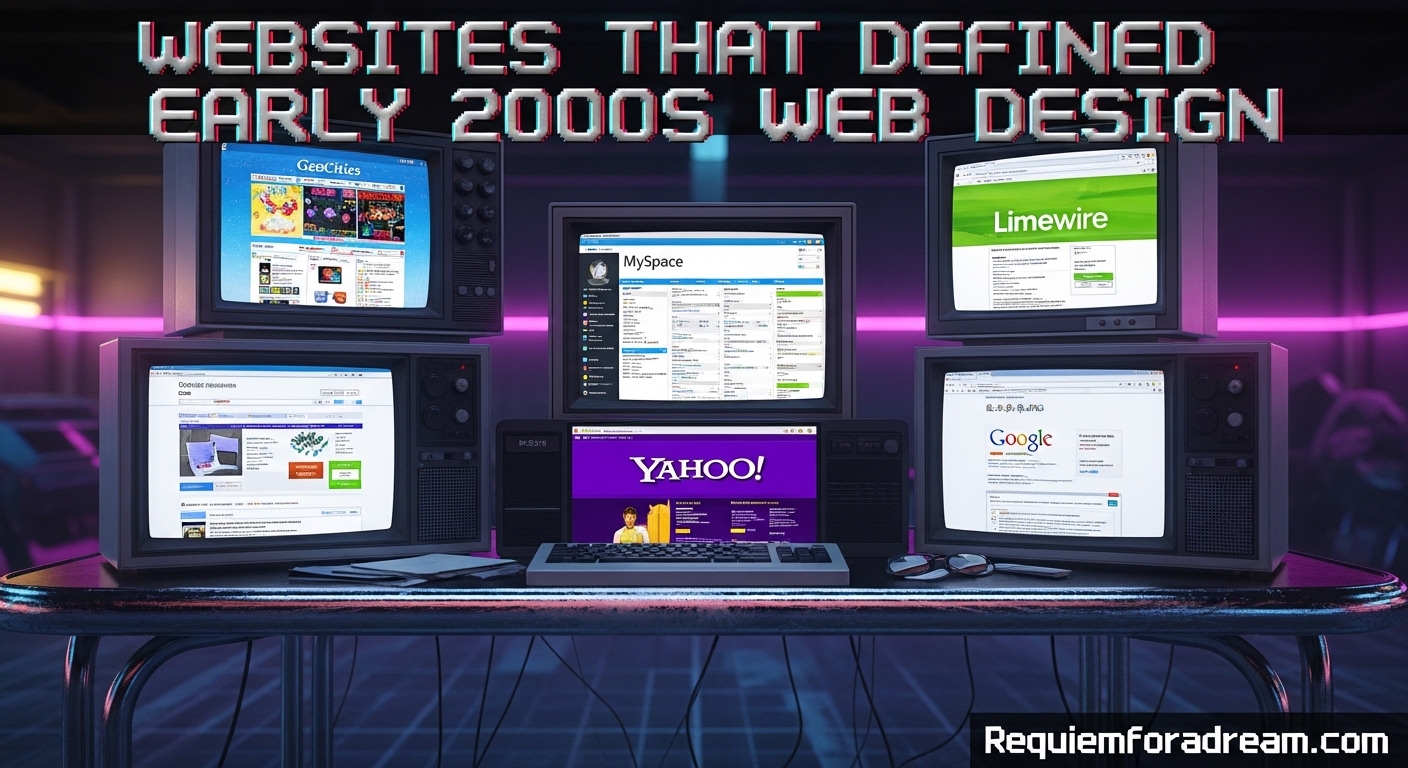
The sound of a 56k modem connecting still echoes in my memory like an old song. That screeching handshake was the soundtrack to a digital frontier that felt wild, creative, and entirely ours. Early 2000s web design wasn’t just about aesthetics. It was about pushing boundaries with limited tools, expressing personality through animated GIFs and tiled backgrounds, and building communities in places that now exist only in screenshots and memories.
Back then, websites weren’t the polished, algorithm-driven experiences we know today. They were messy, loud, and deeply personal. You could tell a lot about someone from their MySpace song choice or their GeoCities neighborhood affiliation. Early 2000s web design was the visual language of a generation discovering that the internet could be more than just information. It could be expression.
In this article, I am taking you on a journey through 12 websites that didn’t just exist during that era. They defined it. From social platforms that taught us HTML to gaming sites that dominated school computer labs, these destinations shaped how we experienced the web during its most creatively chaotic period.
Table of Contents
What Made Early 2000s Web Design Unique
Before diving into the specific websites, it helps to understand what made this era visually distinct. The design choices weren’t arbitrary. They were driven by hard technical constraints and a culture of experimentation that valued personality over polish.
The Technical Reality
Most of us connected through 56k modems with speeds that would make streaming a single TikTok video impossible today. Page load times mattered, but so did making an impression before the connection timed out. Designers worked within 800×600 screen resolutions, limited color palettes, and bandwidth restrictions that forced creativity. Every kilobyte counted, yet somehow we crammed auto-playing music, animated GIFs, and elaborate backgrounds onto single pages.
Visual Signatures of the Era
Certain design elements became instant shorthand for the millennium web aesthetic. Tiled background images repeated endlessly behind text. The marquee tag made words scroll across screens like news tickers. Hit counters at the bottom of pages displayed visitor numbers with primitive pride. Comic Sans appeared everywhere despite typographic protests. Glitter graphics and beveled buttons added depth to flat layouts. The blink tag annoyed everyone yet persisted. These weren’t bugs. They were features of a visual language we all understood.
Interactive Experiments
Macromedia Flash changed everything. Suddenly websites could host animations, games, and entire cartoons without needing television budgets. Guestbooks let visitors leave public messages before comments sections existed. Web rings connected related sites in circular navigation chains. Cursor trails followed mouse movements across screens like digital sparklers. These interactive elements made websites feel alive in ways that static HTML never could.
12 Websites That Defined Early 2000s Web Design
The following websites each contributed something essential to how we remember this era. Some are gone completely. Others transformed beyond recognition. A few stubbornly persist, digital time capsules waiting for curious explorers.
1. MySpace – The Social Network That Taught Us to Code
MySpace wasn’t just the biggest social network before Facebook. It was a design school for an entire generation. Tom, everyone’s first friend, welcomed millions to a platform where customization wasn’t just allowed. It was expected.
The genius of MySpace lay in its openness. Users could paste HTML and CSS directly into their profiles, leading to an explosion of creativity that ranged from beautiful to terrifying. Background music auto-played without asking permission. Top 8 friend rankings created drama and social hierarchies. Profile layouts became personal statements, and learning basic coding became a necessity for self-expression.
As one Reddit user in the web design community remembered, “I learned HTML through customizing MySpace profiles. It was trial and error, breaking things and fixing them until your page looked just right.” That educational side effect helped launch countless tech careers.
MySpace declined rapidly after Facebook opened to general users in 2006. News Corporation’s acquisition in 2005 led to changes that alienated the creative community. Today, MySpace exists primarily as a music platform for artists, having lost most user content from the golden era during a server migration gone wrong.
2. GeoCities – Neighborhoods in Cyberspace
Before social media profiles, there were personal homepages. And before personal homepages became easy, there was GeoCities. Launched in 1994 and reaching peak popularity around 2000, GeoCities organized websites into themed neighborhoods like Area51 for science fiction or Hollywood for entertainment.
The concept was simple but powerful. Anyone could build a website for free, organized by interest rather than social graph. Your neighbor in Area51 might be a teenager in Tokyo or a retiree in Texas, united by shared fascination with UFOs. This neighborhood structure created genuine community in ways that modern platforms struggle to replicate.
GeoCities pages were often chaotic masterpieces. Under construction GIFs warned visitors that sites remained perpetually unfinished. MIDI music files provided soundtracks. Animated cursors followed mouse movements. These weren’t design flaws. They were personality markers in a world before algorithmic feeds homogenized everything.
Yahoo purchased GeoCities in 1999 for $3.57 billion. A decade later, Yahoo announced closure. Despite preservation efforts, millions of pages disappeared in 2009. Some survive through the Internet Archive and tribute projects like NeoCities, which recreates the spirit if not the substance of the original.
3. Newgrounds – The Creative Crucible
Newgrounds began in 1995 as a fan site for a game called Neo Geo but evolved into something far more significant. By the early 2000s, it had become the premier destination for Flash animations and games, launching careers that would define internet entertainment.
The site’s impact on early 2000s web design cannot be overstated. It proved that browser-based content could rival professional productions for attention and quality. Creators like Egoraptor, Edmund McMillen, and the eventual founders of major gaming studios uploaded their early work here. The Portal system let users rate submissions, creating a meritocracy of creativity that discovered talent algorithmically before YouTube existed.
Newgrounds survived the death of Flash through the Ruffle emulator project and continues operating today. Unlike many peers, it adapted rather than disappeared. The site maintains its edgy, independent spirit while modernizing its technical foundation. For web design historians, it represents both the creative potential and technical fragility of the Flash era.
4. Neopets – Where Virtual Pets Built Real Communities
Launched in 1999, Neopets hit peak popularity during the early 2000s as millions of children and teenagers adopted virtual pets that required feeding, training, and virtual currency to survive. The site combined gaming, social networking, and primitive e-commerce into an addictive package that dominated school computer labs.
Neopets mattered for web design because it demonstrated how persistent online worlds could create genuine emotional investment. Users didn’t just visit. They inhabited. The economy of Neopoints, the customization of Neohomes, and the trading of rare items created social dynamics that felt real because they were. First friendships formed over guild memberships and item trades.
The visual design was colorful, cartoonish, and deliberately approachable. Every page loaded with the weight of multiple images on dial-up connections, yet kids waited patiently because the reward felt worth it. That patience, now largely lost to instant streaming culture, defined the era’s relationship with technology.
Neopets still exists today, though diminished from its peak. Multiple ownership changes and a shift toward mobile compatibility altered the experience. Original Neopets often starved when owners left for college or simply forgot passwords, digital ghosts haunting abandoned accounts.
5. Miniclip – The Secret of School Computer Labs
Every generation has the games they weren’t supposed to play during school hours. For early 2000s students, Miniclip was that distraction. Founded in 2001, the site offered hundreds of browser games that loaded quickly and played simply, perfect for sneaking sessions between classes.
Miniclip’s design prioritized accessibility above all else. Games loaded in seconds even on slow connections. Controls were simple. Titles like Raft Wars, 8 Ball Pool, and Commando became universal experiences for students worldwide. The site’s minimal visual design let the games speak for themselves.
The cultural impact extended beyond entertainment. Miniclip proved that serious gaming didn’t require expensive consoles or downloads. Browser-based experiences could compete for attention spans and loyalty. This realization shaped how an entire generation thought about digital entertainment, preparing them for the mobile gaming revolution that would follow.
Remarkably, Miniclip continues operating today, having successfully transitioned to mobile while maintaining its browser presence. The company has been downloaded over 4 billion times across its mobile titles. Unlike most early 2000s websites, Miniclip evolved rather than expired.
6. Yahoo – The Web Before Google
Before Google became synonymous with search, Yahoo ruled the internet. Founded in 1994 as Jerry and David’s Guide to the World Wide Web, Yahoo became the portal through which millions experienced the early internet. Its directory structure organized the chaotic web into browseable categories.
Yahoo’s design epitomized the portal concept. News, email, finance, games, and search all existed within one ecosystem. The homepage was dense with links, options, and information. Unlike Google’s later minimalism, Yahoo embraced complexity. It assumed users wanted everything in one place, and for years, they did.
The visual evolution of Yahoo tracks the broader trends of early 2000s web design. Purple became the brand’s signature color. Advertisements appeared in increasingly prominent positions. The company acquired competitors like GeoCities and Broadcast.com, attempting to consolidate the scattered internet under one umbrella.
Google’s rise gradually eroded Yahoo’s search dominance, while specialized services chipped away at other verticals. Yahoo still exists today, though as a shadow of its former self. Verizon acquired the core business, then sold it to Apollo Global Management. The directory that once organized the web closed in 2014, ending an era.
7. Ask Jeeves – Search with Personality
In an era when search engines competed on features rather than just results, Ask Jeeves stood out by giving the internet a butler. Launched in 1996, the site encouraged natural language queries. Users could ask questions in complete sentences rather than typing keyword fragments.
The butler mascot, rendered in dignified illustration, welcomed visitors to a search experience that felt personal rather than mechanical. Jeeves appeared in various costumes depending on the query, adding Easter egg delight to functional searches. This anthropomorphization of technology made the intimidating internet feel friendlier.
Ask Jeeves also pioneered certain search features that became standard elsewhere. The ability to ask follow-up questions, the categorization of results by type, and early attempts at direct answers all appeared here before competitors. The site never surpassed Yahoo or Google in market share, but it carved out a distinctive niche.
The butler was retired in 2006 as the company rebranded simply as Ask.com. Today, the site operates primarily as a question and answer platform with search capabilities. Jeeves himself makes occasional cameo appearances, nostalgia fuel for those who remember asking him questions decades ago.
8. Xanga – Blogging Before It Was Blogging
Xanga launched in 1999 as a site for sharing book and music reviews but evolved into something more significant. By the early 2000s, it had become a blogging platform that introduced millions to the concept of publishing their thoughts online.
The site’s significance for web design history lies in its customization options. Like MySpace after it, Xanga let users modify their layouts through HTML and CSS. Subscriptions created early follower dynamics. Comments enabled conversation. The concept of a blogroll, linking to other sites you read, created networked communities of writers.
Xanga represented the transition from personal homepages to personal publishing. GeoCities let you build a digital space. Xanga let you fill that space with ongoing narrative. The design aesthetic was cleaner than GeoCities but still allowed for personality through themes, fonts, and embedded media.
The platform declined as MySpace and then Facebook captured social attention. Xanga’s relaunch attempt in 2013, funded by user donations, failed to restore its former prominence. The site closed its original incarnation in 2014, taking with it millions of posts that documented teenage thoughts from the era.
9. eBay – The Auction Excitement
While other sites focused on social connection or entertainment, eBay brought the thrill of auctions to everyday internet users. Founded in 1995, eBay became the dominant online marketplace during the early 2000s, proving that e-commerce could work at scale.
eBay’s design reflected its auction heritage. Listings displayed time remaining in prominent countdown format. Bid histories showed competitive drama unfolding. Seller ratings created reputation systems that enabled trust between strangers. The visual chaos of thousands of simultaneous auctions felt exciting rather than overwhelming.
The site influenced web design by demonstrating that transactional interfaces could be engaging. Shopping didn’t need to be sterile. The bright colors, animated gavel icons, and constantly updating listings created urgency and excitement. User-generated content, in the form of listings and feedback, drove the experience.
Unlike most early 2000s websites, eBay remains highly relevant today. The auction format has been supplemented by Buy It Now options, but the core experience persists. The company has survived because it solved a real problem, connecting buyers with sellers in ways that physical marketplaces couldn’t match.
10. AltaVista – The Search Giant Before Google
Launched in 1995, AltaVista was once the Google of its era. DEC Research created it partly to demonstrate the power of their hardware, but it became the most popular search engine on the web, processing millions of queries daily at its peak.
AltaVista pioneered search features that seem obvious today. It was the first searchable, full-text database of web pages. It offered advanced search operators. Its Babel Fish translation service let users translate text and web pages between languages, named after the translating creature from The Hitchhiker’s Guide to the Galaxy.
The visual design was functional rather than flashy. Results appeared quickly, crucial in the dial-up era. The simple white background and blue links set conventions that Google would later adopt and own. AltaVista proved that search could be the primary entry point to the internet, though it couldn’t maintain that position.
Yahoo acquired AltaVista in 2003 and eventually shut it down in 2013. The brand that once defined web search now exists only in memories and internet history archives. Its fate serves as reminder that technical superiority doesn’t guarantee survival in the rapidly evolving web ecosystem.
11. Homestar Runner – Flash Cartoon Mastery
The Brothers Chaps created Homestar Runner in 2000 as a children’s book concept, but it became something far more influential as a Flash-based cartoon website. The simple premise, following the misadventures of a dim-witted athlete and his aggressive frenemy Strong Bad, attracted millions of visitors.
Homestar Runner mattered for web design because it showed what Flash could achieve in skilled hands. The cartoons were genuinely funny, with writing that appealed to adults as much as children. Strong Bad Emails, where the character answered real viewer messages, became the site’s most popular feature and ran for over 200 episodes.
The visual design was intentionally crude, resembling construction paper cutouts. This aesthetic choice masked sophisticated animation and sound design. Games accompanying the cartoons were simple but addictive. The site updated regularly, creating appointment viewing habits before podcasts or YouTube series formalized the concept.
The site stopped regular updates in 2009 as the Brothers Chaps pursued other projects, though occasional new content still appears. The Flash content has been converted to YouTube videos to survive the platform’s deprecation. Homestar Runner remains a touchstone for early 2000s web culture, cited frequently in nostalgia discussions.
12. Movie Marketing Websites – Hollywood’s Digital Frontier
Among the most fascinating examples of early 2000s web design were movie promotional sites. Studios experimenting with digital marketing created destinations that pushed technical boundaries while capturing film aesthetics. The original Space Jam website, launched in 1996 and preserved online, became legendary for its period-perfect design.
These sites embraced the era’s design excess rather than fighting it. The Matrix website featured cryptic green text and rabbit hole navigation. Warner Bros created elaborate Flash experiences for major releases. Each site became an extension of the movie’s world, letting fans explore before and after theater visits.
What made these sites significant was their budget. While personal homepages struggled with hosting costs, movie studios invested in professional design that still embraced early 2000s aesthetics. They proved that the style could be polished rather than amateur, intentional rather than limited by skill.
Many promotional websites from this era are lost, victims of expired domains and abandoned hosting. Some, like Space Jam’s, remain online as unintentional museums. These sites connect directly to the focus here at Requiem for a Dream, showing how early web design shaped how we first experienced film marketing in the digital age.
FAQ: Early 2000s Web Design and Forgotten Websites
What websites were used in the early 2000s?
The early 2000s featured websites like MySpace for social networking, GeoCities for personal homepages, Yahoo and AltaVista for search, Neopets and Newgrounds for entertainment, and Xanga for blogging. These sites defined how millions first experienced the internet, offering customization and community that modern platforms have largely abandoned.
What was the most popular website in 2000?
Yahoo was the most popular website in 2000, serving as the primary portal through which millions accessed the internet. Its directory structure and comprehensive services made it the starting point for most web sessions before Google eventually surpassed it later in the decade.
What is the name of the early 2000s Internet design?
Early 2000s web design is often called the millennium web style, Y2K aesthetic, or the Web 2.0 transition period. Key visual elements included tiled backgrounds, animated GIFs, hit counters, Comic Sans fonts, Flash animations, and marquee scrolling text. The style reflected technical limitations and cultural optimism about the internet’s potential.
What are some websites that no longer exist?
GeoCities closed in 2009, taking millions of personal homepages offline. AltaVista shut down in 2013 after Yahoo acquisition. Xanga closed its original platform in 2014. Ask Jeeves rebranded without its butler mascot. Many movie promotional websites expired with their films. Some content survives through the Internet Archive, but much has been permanently lost.
The Legacy of Early 2000s Web Design
The websites of the early 2000s didn’t just entertain us. They taught us. Millions learned HTML through necessity, customizing profiles and homepages until they looked right. That accidental education created a generation comfortable with code, prepared for the digital careers that would follow.
The visual language of the era is experiencing revival. NeoCities recreates the hosting spirit for modern creators. Brutalist web design embraces the chaos that corporate minimalism rejected. TikTok and Instagram filters recreate Y2K aesthetics for audiences too young to remember the original. The era’s design sensibilities persist, transformed but recognizable.
Yet something remains lost. The wild west creativity of a web without algorithmic feeds, where discovery happened through webrings and random exploration rather than recommendation engines, feels increasingly distant. The early 2000s represented a moment when the internet was still being invented, and anyone could contribute to its shape.
Conclusion: Remembering the Websites That Shaped an Era
The best websites that defined early 2000s web design shared common traits. They valued personal expression over professional polish. They built community through shared interests rather than social graphs. They worked within technical limitations that forced creative solutions. And they made the internet feel like a place of possibility rather than just utility.
From MySpace’s customizable chaos to GeoCities’ neighborhood communities, from Newgrounds’ creative meritocracy to Neopets’ virtual economies, these destinations shaped how an entire generation thought about digital life. Some survive in transformed states. Others exist only in screenshots and memories. All contributed to the web we have today.
Here at Requiem for a Dream, we document cultural moments that shaped how we experience media. The early 2000s web was itself a form of media, one we both consumed and created. If these memories stirred your own nostalgia, share your stories. The web may have changed, but our memories of what it once was remain vivid and worth preserving.