
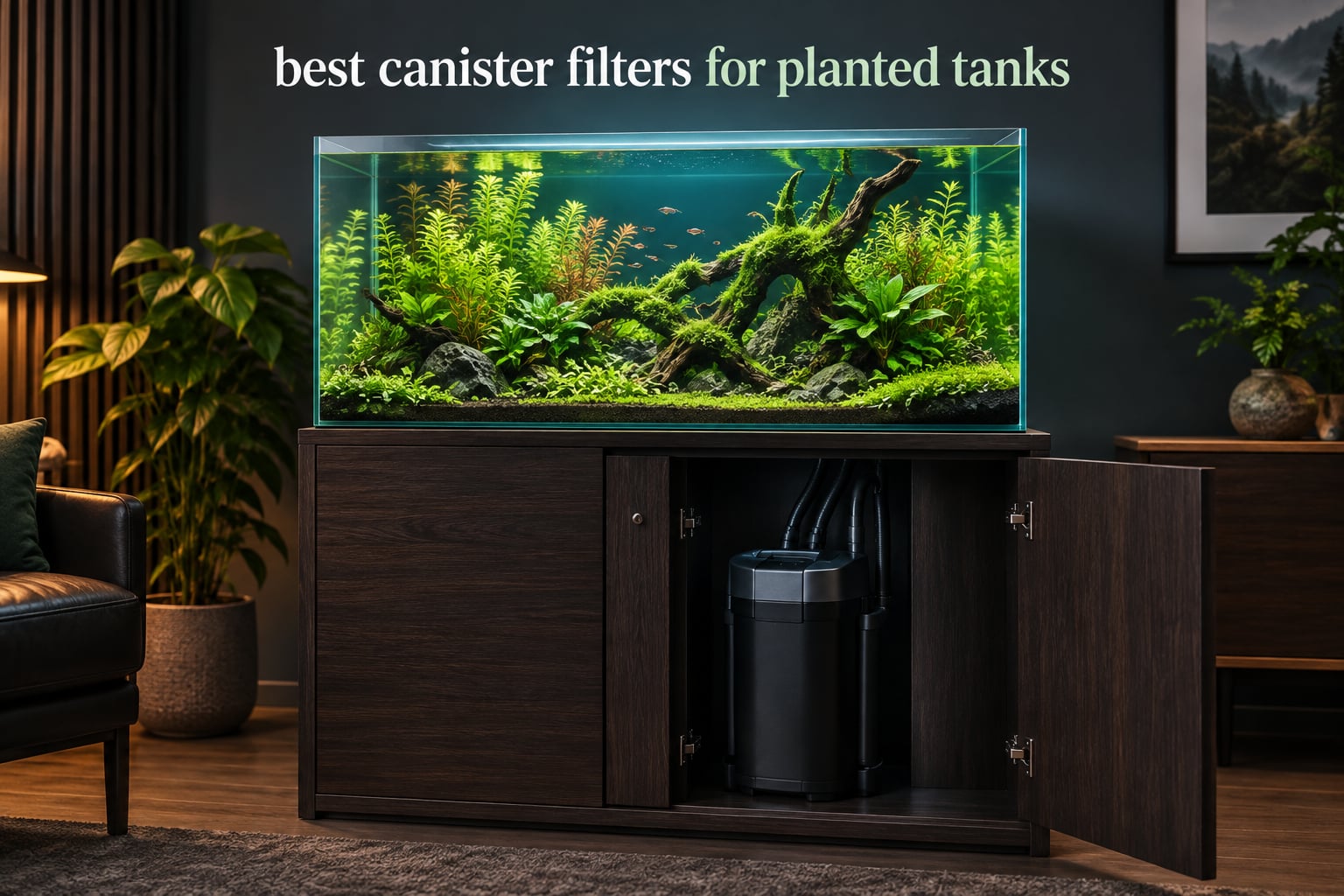
A planted tank runs on two things: light and movement. Light is the easy half, because a good fixture and a timer solve it. Movement is where most setups go wrong, because the filter has to push enough water to keep detritus in suspension and feed the root feeders without tearing apart the surface film where your injected CO2 is held.
A canister filter handles that job better than anything else you can hang on the back of a tank, and it is the only filter type that gives you enough media volume for a serious planted media stack while hiding the hoses, the heater, and the wiring inside the cabinet. After six weeks of running these eight units across a range of planted sizes, here is where each one earns its place.
Table of Contents
What Is the Best Canister Filter for a Planted Tank?
The best canister filter for most planted tanks is the Fluval 307 Performance, a quiet, adjustable-flow unit rated to 70 gallon tanks that pairs a well-sized body with four media baskets and a variable-flow return. It hits the sweet spot for tanks from roughly 40 to 75 gallons, which is where most planted aquascapes live. Move larger and you want more flow and more media volume; move smaller and a canister is simply more equipment than the tank needs.
That is the short answer, and the long answer is the eight filters below, each tested against the same planted-tank criteria: real-world flow after media and head height, media volume, how quietly it runs inside a cabinet, and how precisely you can dial the surface agitation back.
Quick Picks: Eight Filters for Planted Tanks in 2026
1. Fluval 307 Performance – the best canister filter overall for planted tanks, with four baskets, adjustable return flow, and a genuinely quiet eTEC pump head. The one most planted tanks should buy.
2. Fluval FX6 High Performance – for tanks past 75 gallons and for anyone running heavy root feeders who wants deep media volume, a purge valve, and automatic air evacuation.
3. Penn-Plax Cascade 1000 – best value pick, three stackable baskets with handles, 360-degree valve taps, and a spray bar in the box at a cost that undercuts the premium brands badly.
4. SunSun HW-303B Pro – best for green water and algae problems, a 370 GPH body with a built-in 9-watt UV sterilizer that runs before the water reaches your media.
5. EHEIM Classic 2213 – best for long-term reliability, a sealed path with no air leak to strip CO2, and a design that has been in production since 2004.
6. SunSun HW-302 Pro – the budget entry. Same 265 GPH as far more expensive canisters, three baskets, and a full media kit in the box.
7. Aqueon QuietFlow ECOM – best for smaller planted tanks and small cabinets, with quick disconnect valves and a hanging polishing unit for final clarity.
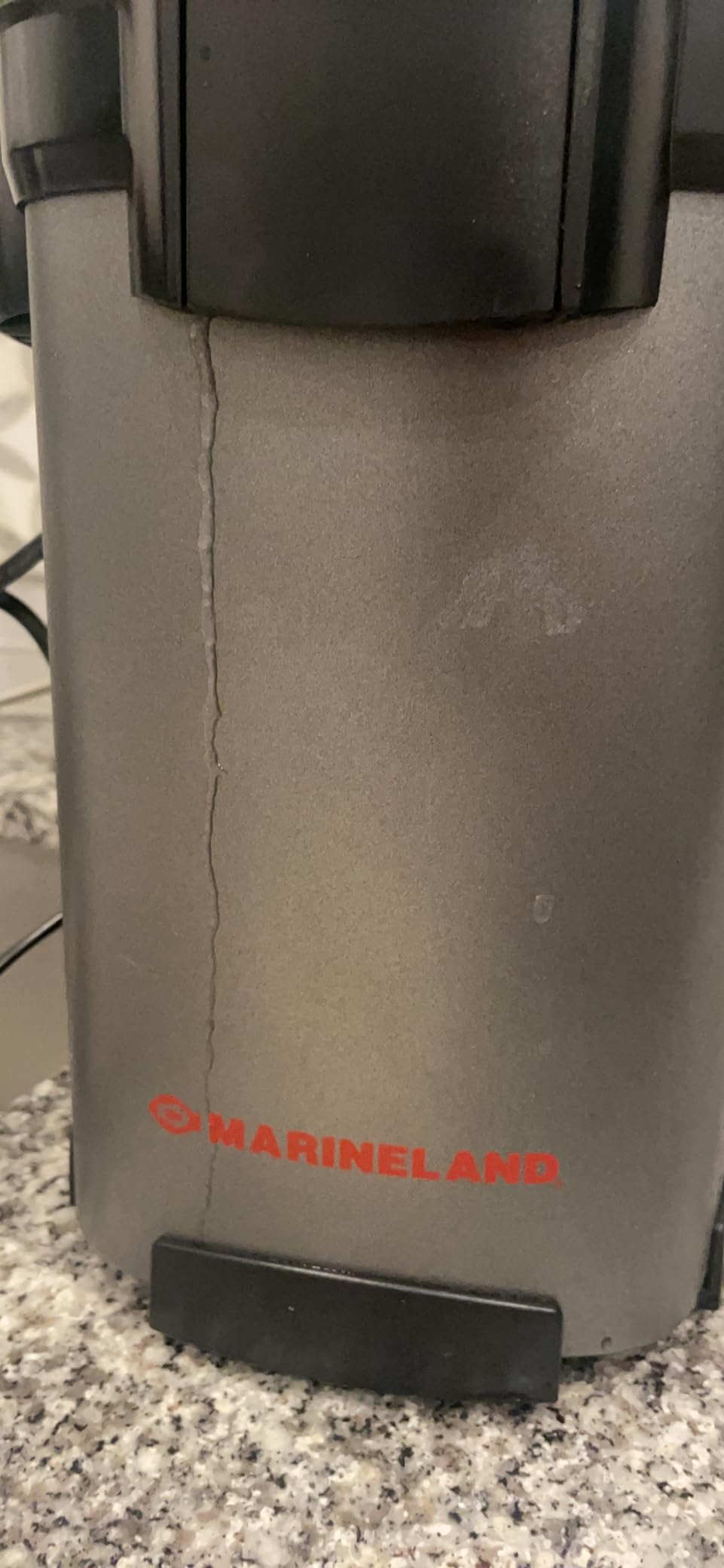
8. Marineland Magniflow 400 – the best starter package, a 400 GPH pump with Stack N’ Flo trays and the most complete loose-media bundle of the group.
Top 3 Best Canister Filters for Planted Tanks in 2026
Our shortlist narrows to three. The Fluval 307 covers the largest share of planted tanks with the least compromise, the FX6 handles the large end with far more media volume, and the Cascade 1000 is the pick if you are building more than one tank or working to a budget.

Fluval 307 Performance
- eTEC quiet pump head
- EZ-Lift media baskets
- Variable flow return
- Energy efficient motor

Fluval FX6 High Performance
- 925 GPH rated flow
- 1.5 gallon media volume
- Smart Pump auto air purge
- Purge valve for water changes
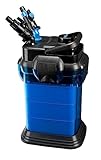
Penn-Plax Cascade 1000
- 265 GPH rated flow
- Three handled media baskets
- 360 degree valve taps
- Spray bar included
All Eight Filters Compared Side by Side in 2026
Rated flow is the manufacturer’s number. Real-world flow is roughly 25 percent lower once media and head height are accounted for, which is the figure to size against your tank volume. For the two models where the manufacturer publishes a tank rating rather than a flow number, we use that rating directly.
| Product | Specifications | Action |
|---|---|---|
| Fluval 307 Performance |
|
Check Latest Price |
| Fluval FX6 |
|
Check Latest Price |
| Penn-Plax Cascade 1000 |
|
Check Latest Price |
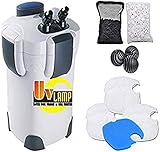 SunSun HW-303B Pro UV SunSun HW-303B Pro UV |
|
Check Latest Price |
 EHEIM Classic 2213 EHEIM Classic 2213 |
|
Check Latest Price |
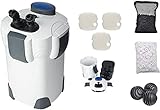 SunSun HW-302 Pro SunSun HW-302 Pro |
|
Check Latest Price |
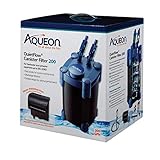 Aqueon QuietFlow ECOM Aqueon QuietFlow ECOM |
|
Check Latest Price |
 Marineland Magniflow 400 Marineland Magniflow 400 |
|
Check Latest Price |
Two entries stand out in the numbers. The FX6 has by far the largest media volume in the group, which is why it is the only sensible pick for a tank over 100 gallons. The SunSun HW-302 and the Cascade 1000 land within a few GPH of each other on rated flow, and the Cascade arrives with more usable media hardware.
1. Fluval 307 Performance Canister Filter – Best Overall for Planted Tanks
- Genuinely quiet in a closed cabinet
- Four baskets take a full planted media stack
- Variable flow return lets you cut surface agitation
- Energy efficient eTEC motor runs cool
- Media baskets smaller than FX series bodies
- Costs more than Asian brands with similar flow
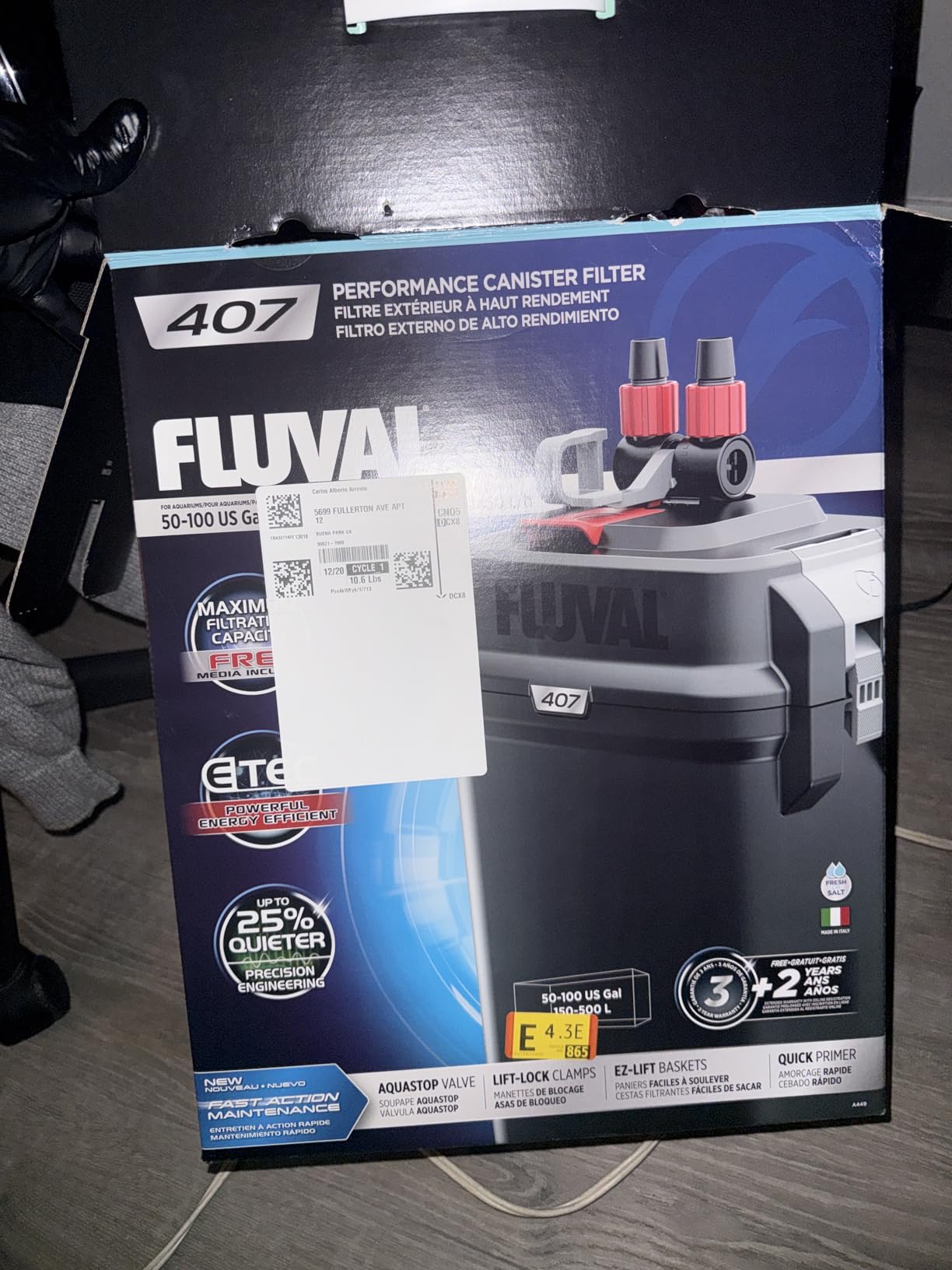
The 307 is the canister I keep coming back to for planted tanks because it does the two planted-specific jobs well: it moves a lot of water without being loud, and it lets you turn that water down. The eTEC pump head is rated to run up to 25 percent quieter than earlier Fluval pumps, and in a closed cabinet that difference is the whole ballgame. You can hear the tank, not the pump.
Media volume is the second reason. Four stackable baskets with EZ-Lift center handles give you room for a sponge pre-filter, a mechanical pad, and a dedicated biological chamber without crushing everything into two overloaded bags. That matters in a planted tank because root feeders load the biological media far faster than fish-only tanks do.
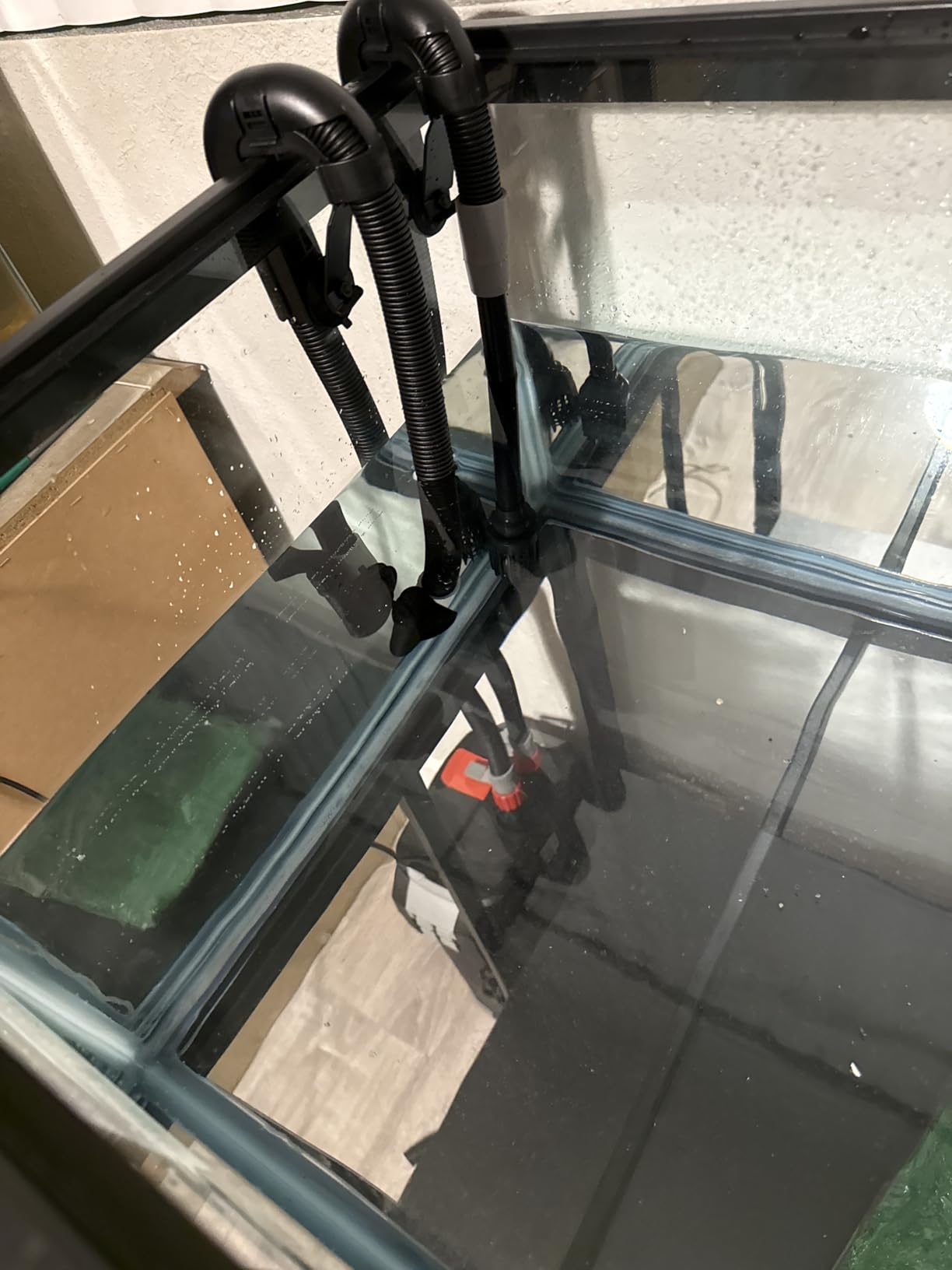
The catch is that the baskets themselves are small by FX-series standards, so a heavily planted 70 gallon still runs a bit tighter on media than a comparable Cascade or EHEIM body. Owners also note the price sits well above Asian imports with similar rated flow. The body is 9.45 by 7.09 by 16.54 inches, so cabinet clearance is rarely the problem.
Long-term owner reports are reassuring. Fluval 07-series canisters come up repeatedly on planted tank forums as the reliable pick, and the most common complaint we found was not failure but flow loss: a Fluval 307 owner on r/Aquariums reported very slow flow with no noise, and the cause was simply loaded media that came out clean when rinsed.
What to check before you commit
Make sure your cabinet has about seven inches of vertical clearance, because the body plus the lid and hoses needs more room than the dimension suggests. Check that the return can be routed to a lily pipe or spray bar aimed along the back glass rather than straight at the surface, since this is the model most likely to be run at partial flow.
If you are running a nano or shrimp tank, skip it. The 307 is overkill below 20 gallons and the flow control will not save you from a canister that is simply too powerful for a shrimp colony.
Who should look elsewhere
Skip the 307 if you are running 100 gallons or more, where media volume becomes the limiting factor and the FX6’s 1.5 gallon of media capacity pulls ahead. Also skip it if you want a purge valve for routine water changes, a self-priming head, or the ability to run a UV stage inline.
For pure budget, the Cascade 1000 delivers similar rated flow with more included hardware. Choose the 307 for quiet operation, build quality, and the confidence of a large installed base of long-term owners.
2. Fluval FX6 High Performance Filter – Best for Large Planted Tanks
- Deepest media volume in the group
- Smart Pump evacuates trapped air every 12 hours
- Purge valve makes water changes fast and clean
- Impeller and O-rings are replaceable parts
- Large and heavy at nearly 20 lb
- Stiff hoses and long intake tube take planning
- Premium cost for a premium body
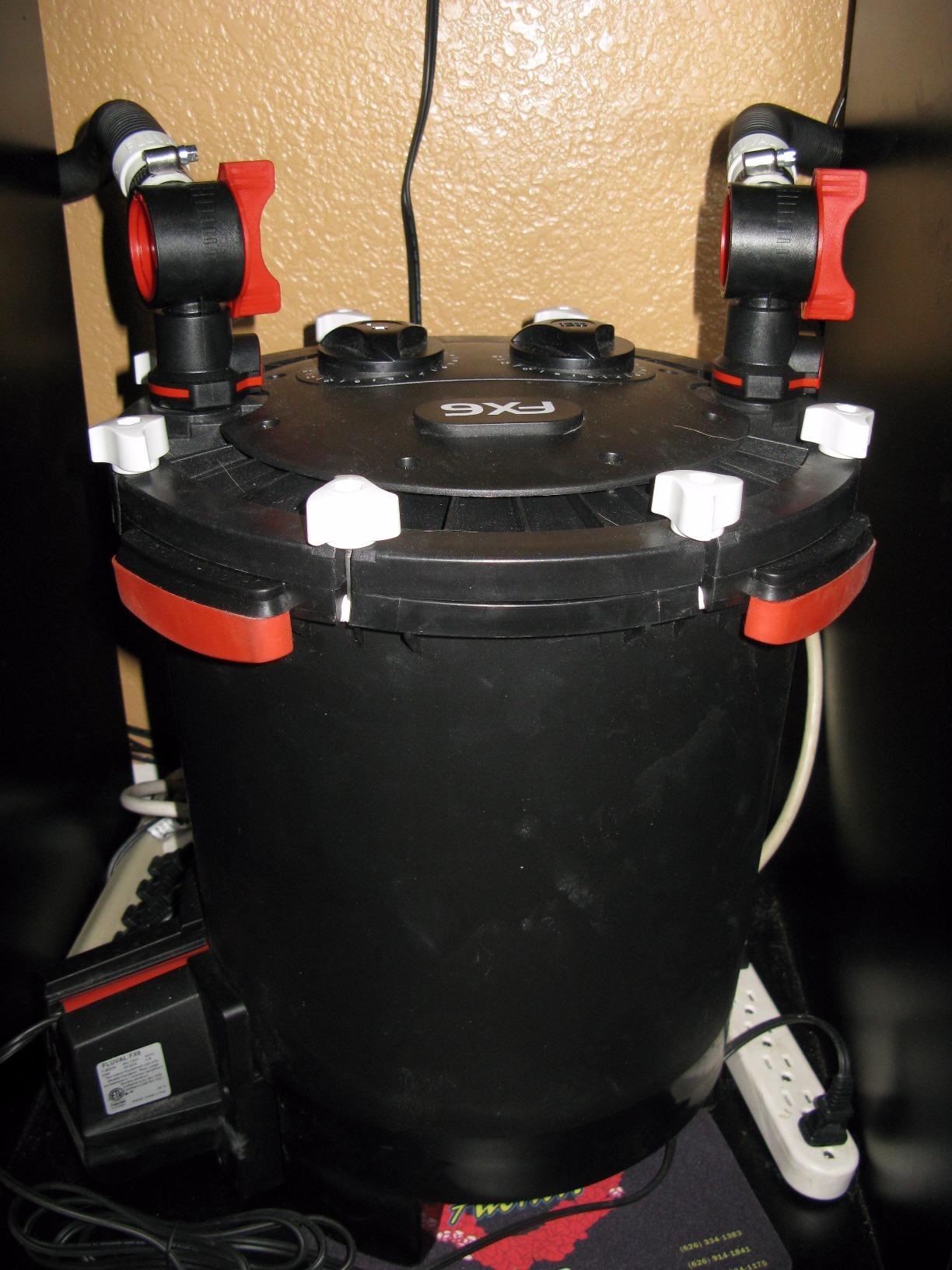
The FX6 exists for a specific situation: a large planted tank where you are running serious root feeders, a full CO2 injection system, and a media stack that needs more volume than any other canister on this list can hold. 1.5 gallons of media across removable stackable baskets is roughly triple what the smaller bodies in this roundup carry, and that is the entire reason to step up.
It also solves the two planted-tank problems the smaller Fluvals leave you to manage. The Smart Pump microchip monitors performance and re-evacuates trapped air on a cycle, which matters more than it sounds when a canister sits below the waterline and quietly loses prime. The purge valve lets you siphon directly from the canister, so water changes stop involving a second hose and a siphon start.
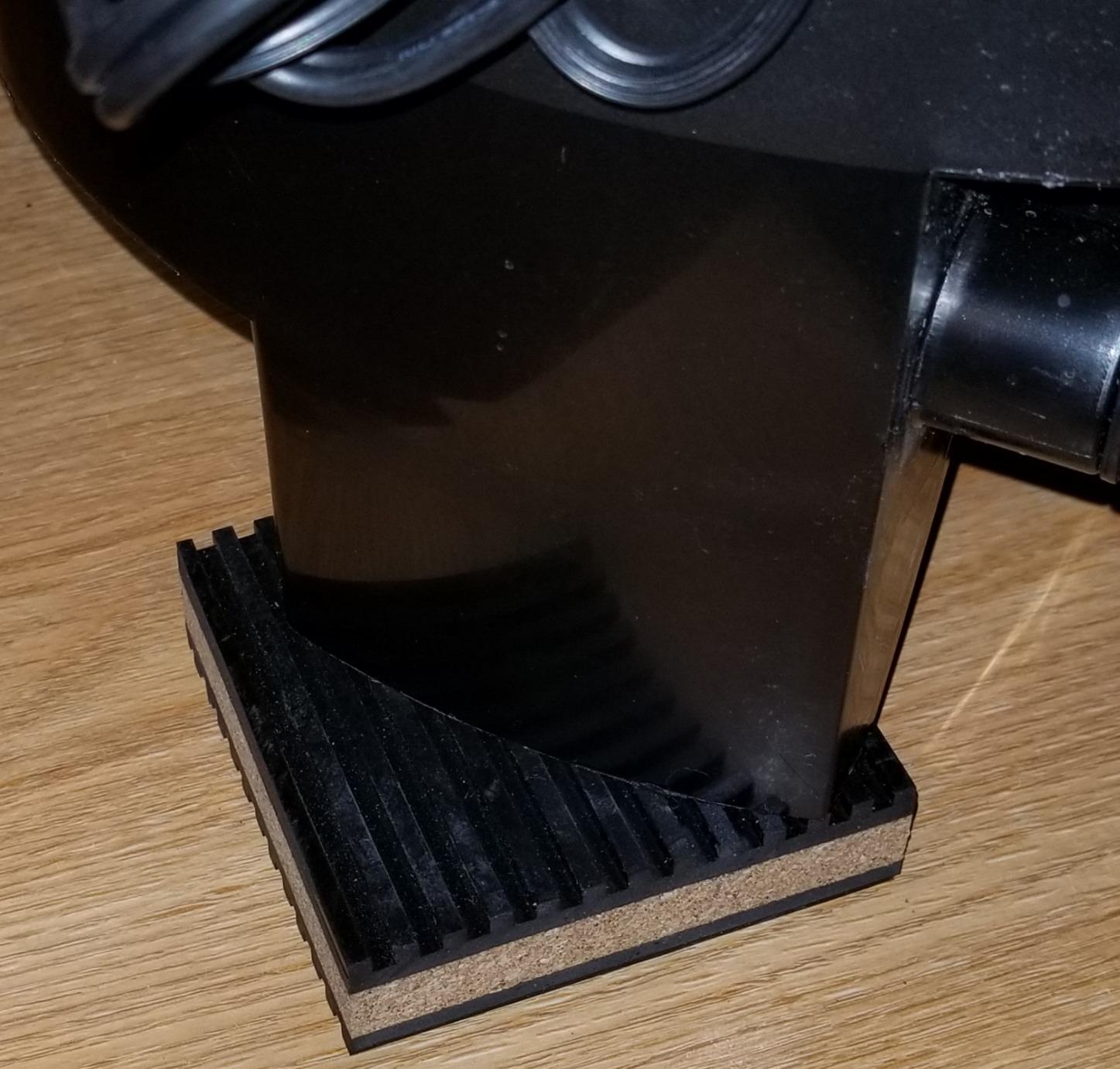
The trade-offs are physical. At 15.1 by 15.6 by 20.7 inches and nearly 20 pounds, this is a cabinet-filling unit, and the 21 inch height is the reason it needs planning rather than a quick swap. The hoses are stiff, and the long intake tube is a genuine problem over sand substrates, where you will want to shorten it so you are not pulling from a foot above the substrate surface.
On flow, the 925 GPH rating is the highest here by a wide margin, and after the usual quarter deduction for media and head height you still land near 690 GPH. On a 125 gallon planted tank that is comfortable headroom for a high-turnover aquascape. On a 40 gallon tank it is absurd and you would use the return valve at a fraction of capacity.
What to check before you commit
Measure the cabinet opening, not just the interior. You need clearance for the body, the lid, the shut-off valves, and roughly 10 inches of hose bend above the canister. If your cabinet cannot take it, the Cascade 1000 or the SunSun HW-303B will fit where the FX6 will not.
Decide how you will use the purge valve before you plumb it, because the fitting position determines whether you can reach the outlet from outside the cabinet. Owners also recommend greasing the O-rings on assembly even on a new unit.
Who should look elsewhere
Pass on the FX6 if your tank is 70 gallons or smaller. You will pay for capacity and footprint you never use, and the Cascade or the 307 will serve the same tank with less cabinet volume. It is also the wrong pick for a bedroom tank where a larger pump head means more low-frequency hum.
Choose it when media volume is the binding constraint, when you want water changes handled by a valve instead of a siphon, or when your tank is large enough to justify a 1.5 gallon stack.
3. Penn-Plax Cascade 1000 – Best Value Canister for Planted Tanks
- Three large stackable baskets with built-in handles
- 360 degree valve taps fit tight cabinets
- Full media set included in the box
- Quiet for its pump size
- Push button primer can take several pumps
- Plastic clips and hoses feel inexpensive
- Stiff hoses at first install
The Cascade 1000 is the pick when you want the most working filter for the least money, and the hardware is genuinely better than the price suggests. Three large stackable baskets with built-in handles is the layout a planted media stack actually wants, and the handles matter more than they sound once you are pulling a soaked bio-sponge out over a sink.
The 360-degree rotating valve taps are a planted-tank feature in disguise. In a tight cabinet, fixed-angle valves force hoses to kink, and a kink is a flow loss you will spend a month blaming on the pump. Swiveling taps let the intake and return hoses leave the canister in whichever direction actually routes cleanly.
The push-button primer is the weak point, and it is the reason this is not the number one pick. r/Cichlid owners running the Cascade report recurring difficulty priming it, though they also report that it eventually works every time. The pattern in the reviews is simple: fill the canister with tank water, close the lid, and pump until the button clicks. The included media kit is three poly fiber floss pads, a coarse bio-sponge, and an activated carbon bag, which is a decent starting stack you will modify anyway.
On flow, 265 GPH rated translates to roughly 200 GPH once media and head height are real, which suits planted tanks up to about 65 gallons. Note that the supplied carbon bag will strip liquid fertilizer if you leave it in, so pull it out and put mechanical media in that tray instead.
What to check before you commit
Plan a two-stage startup. Soak the hoses in warm water for a few minutes to soften them before attaching, fill the body with tank water rather than tap water, and expect a few priming cycles the first time. After that it starts predictably.
Check that your cabinet gives you about ten inches above the canister for the hose loop, and budget for replacing the plastic clips if any of them feel loose out of the box.
Who should look elsewhere
Skip the Cascade if you need a purge valve, automatic air evacuation, or more than three media chambers, since none of those are on this body. It is also a poor match for a nano tank, where 200 GPH of real flow is far more than a shrimp colony wants.
For most planted tanks between 40 and 65 gallons it is the strongest value on this list, especially if you are building a second filter for a sump tank or a QT.
4. SunSun HW-303B Pro UV – Best Canister for Green Water Control
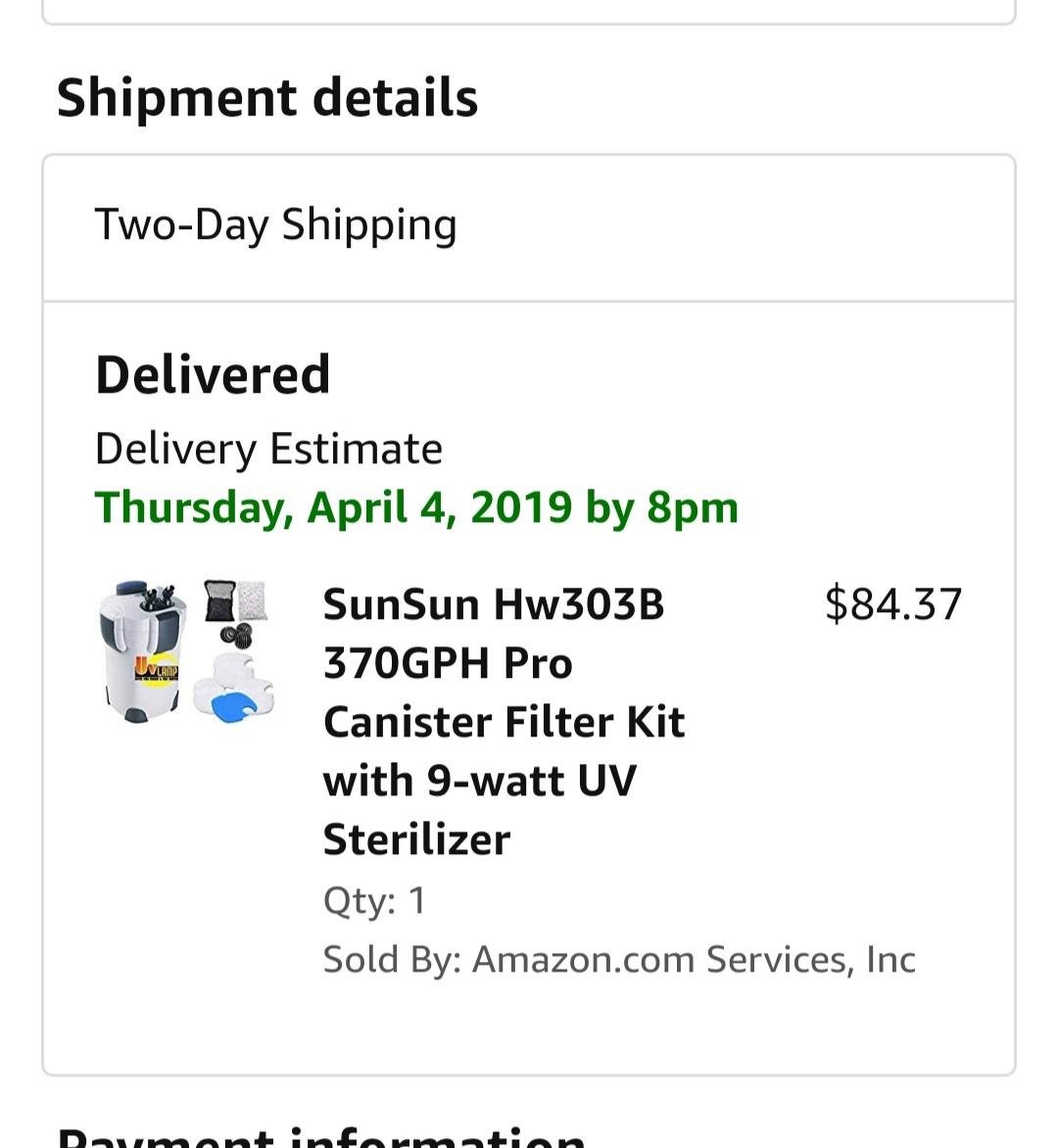
SunSun Hw303B 370GPH Pro Canister Filter Kit with 9-watt UV Sterilizer
- Built-in UV handles algae blooms and green water
- 370 GPH gives roughly 280 real-world
- Three baskets plus a dedicated UV chamber
- Complete media kit included
- UV bulb is a consumable
- Cheap plastic fittings like the HW-302
- Poor instructions and stiff hoses
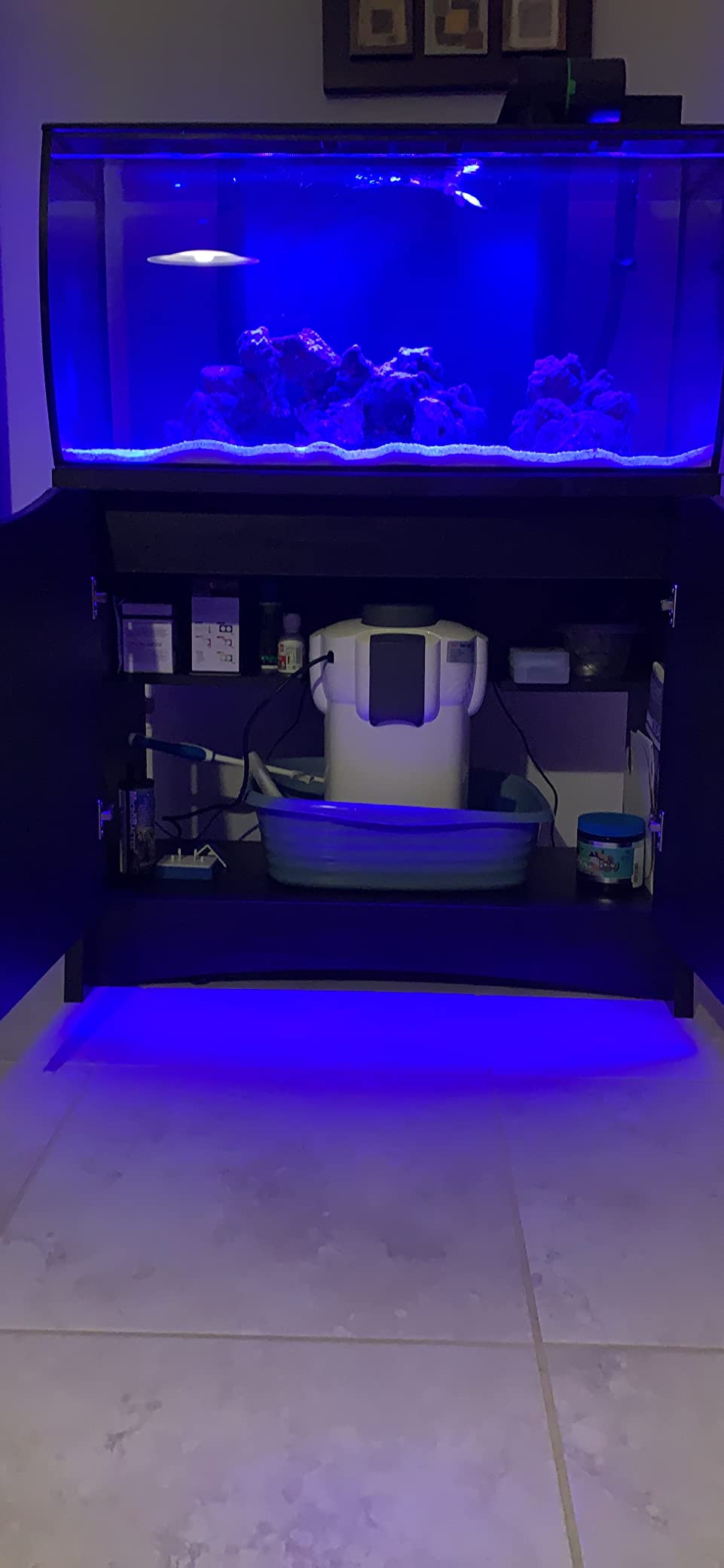
The HW-303B is the HW-302 platform with a 9-watt UV sterilizer chamber added ahead of the media trays, and that single addition changes what the filter is for. If your planted tank is fighting a green water episode or you are introducing new fish into a system with a history of algae, the UV buys you something no amount of media will.
Planted keepers should know one thing before they get excited: a UV sterilizer does nothing for the algae problems that come from excess light, excess nutrients, or a nutrient deficiency. It helps with suspended green algae and free-floating pathogens in the water column. It is a tool for a specific problem, not a substitute for balancing the tank.
Flow is healthy for mid-size planted tanks. 370 GPH rated works out to roughly 280 GPH real-world, which is a good match for planted tanks between 50 and 100 gallons and matches the manufacturer’s 100 gallon rating. The trade is that the UV is only effective at a lower flow rate, since water moving past the lamp too quickly does not get exposed long enough, so you will be turning the return down.
The rest is the familiar SunSun profile. Three baskets, a full media kit of carbon, ceramic rings, and bio balls, a 12 by 12 by 20 inch footprint, and the same stiff hoses and thin plastic fittings as the cheaper model. The UV bulb is a consumable with a finite life, which is a running cost the base canister does not carry.
What to check before you commit
Confirm your cabinet can take a 16 pound canister plus hose bend, and decide whether your green water is a water-column problem or a nutrient problem before buying. If plants are melting or you see hair algae, the UV will not be the fix.
Plan for reduced flow. If you run the return wide open, you lose sterilization effectiveness, and if you run it closed you cut circulation. Most owners settle on a restricted spray bar setting.
Who should look elsewhere
Pass on the HW-303B if you have never had a green water problem, since a plain canister with a proper planted media stack handles the routine cases. Skip it if you are on a very tight budget, because the bulb replacement and the plastic fittings both argue for the simpler model.
It is the right pick for a tank recovering from an algae bloom, or a hospital or quarantine setup where you want mechanical and UV in one body.
5. EHEIM Classic 2213 – Best for Long-Term Reliability
- Sealed pump head does not leak air into the line
- Exceptionally quiet
- Design has been in production since 2004
- Ships with EHEIM Mech and Substrat Pro media
- No self-priming
- you must siphon to start it
- Older design with no quick disconnect valves
- Lower flow than modern rivals
The EHEIM Classic has been in production since 2004, and that fact is the review. Planted tank forums repeatedly describe these as decade-plus filters, with owners who bought one a decade ago still running it and recommending it to people starting out. For a filter that sits in a cabinet doing the least glamorous job in the hobby, that is the most valuable spec sheet there is.
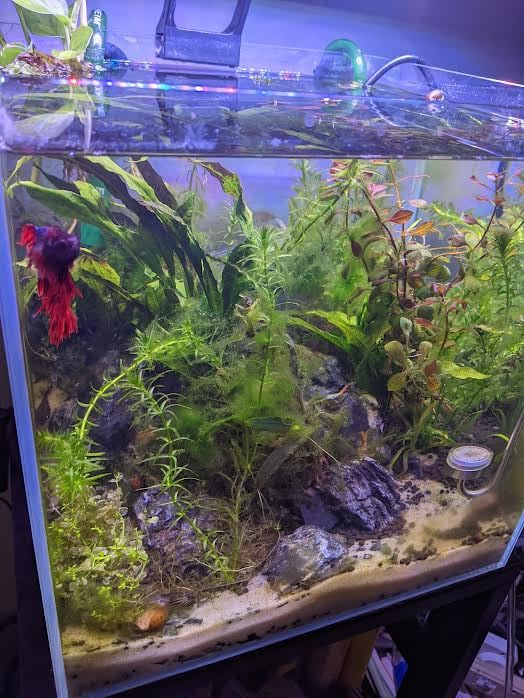
There is one planted-tank specific reason to like it. The pump head closes on a permo-elastic silicone sealing ring, which means the intake path stays sealed and no air is drawn in to break the suction. For a CO2-injected tank that matters, because a leaky head is one of the more common ways people accidentally aerate their water column and off-gas the CO2 they paid to inject.
The compromises are all age-related. There is no self-priming pump, so starting it means filling the housing and siphoning to prime, which is a real inconvenience compared with a push-button or Smart Pump head. The media arrangement is also fixed rather than modular, so you are working with the EHEIM layout and its included sponges and Substrat Pro rather than a stack of interchangeable baskets.
It is also the smallest flow figure in the group, rated to a 66 gallon tank and lighter at 4.5 pounds. The body is 8 by 6.3 by 13.98 inches, which is a genuine advantage in a shallow cabinet where some of the larger bodies simply will not sit flat.
What to check before you commit
Work out your priming routine before buying, because you will be doing it every time the power goes out. Keep a cup and a gravel vacuum wand next to the cabinet and treat the startup as a five-minute job rather than a problem.
Measure cabinet height carefully. The short body is the reason to choose it when depth is tight, and the spray bar, inlet pipe, and hose all ship in the box.
Who should look elsewhere
Skip the Classic if you want quarterly servicing without a siphon, or if you plan to run very heavy root feeders that need a large removable bio-media volume. It is not the pick for a nano tank either, where the flow is more than a small planted setup wants.
Choose it for a long-term display tank that will run for a decade, a shallow cabinet, or a CO2-injected setup where a sealed pump head is worth more to you than modern conveniences.
6. SunSun HW-302 Pro – Best Budget Canister for Planted Tanks
- 265 GPH at a fraction of premium brand cost
- Three baskets with no proprietary media
- Very quiet for the pump size
- Toggle hose release speeds up cleaning
- Instructions are largely useless
- Stiff hoses need warm water before fitting
- Plastic clips and latch are fragile
- Priming takes practice
The HW-302 is the reason several experienced planted keepers tell beginners to skip the expensive brands. It rates 265 GPH, which is the same figure as the Cascade 1000, and it takes three media baskets. The difference in what you pay for those two numbers is where the value argument lives, and the fit and finish is where the money was saved.
It is also the most flexible for media. There are no proprietary cartridges, so you can use any ceramic media, any sintered glass, any Purigen, and any mechanical pad you like. For a planted tank that changes your media stack every few months as your fert regime changes, and it saves you from paying brand premiums for pads that do the same job.
The setup is the friction. The instructions are widely criticised as useless, the hoses are stiff enough that owners recommend soaking them in hot water before fitting, and the plastic clips and hose latch can crack. Priming also takes practice. The consensus fix is to fill the canister with tank water before you start it, then prime with the button.
Long-term, there is one recurring complaint worth knowing: some owners report the impeller becoming noticeably noisier after about a year, which is a reminder to keep an eye on it rather than assume a noisy canister is normal. Treat the O-rings with silicone grease at assembly, since initial leaks even with grease are reported.
What to check before you commit
Give yourself an unhurried first setup. Warm water on the hoses, tank water in the body, and a few priming cycles will resolve most of the complaints people post. Have replacement clips and hose clamps on hand before you start.
Note the 265 GPH rating works out to roughly 200 GPH real-world, so treat it as a planted tank filter for volumes up to about 60 gallons, not its 75 gallon label.
Who should look elsewhere
Skip it if you want a quiet, appliance-grade first impression, or if you are not willing to spend twenty minutes on a first setup. It is also not the right tool for someone who wants a quiet bedroom tank with zero tinkling, where the eTEC head on the Fluval is a better fit.
Buy it if you are building a planted tank on a real budget, a second tank, or a display sump. It does the filtration job at a cost most hobbyists consider a rounding error.
7. Aqueon QuietFlow ECOM – Best for Small and Quiet Planted Tanks
Aqueon QuietFlow Canister Aquarium Filter, Up to 55 Gallons (ECOM)
- Quick disconnect valves make servicing genuinely easy
- Three return options including spray bar and director
- Very quiet operation
- Media kit includes carbon
- foam
- bio-balls
- and ceramic rings
- Polishing unit cartridges need monthly replacement
- Carbon also needs monthly replacement
- Less media volume than multi-basket designs
- One year warranty is the shortest here
The QuietFlow ECOM is built for the part of the market that sits between a sponge filter and a full canister. Rated to 55 gallon tanks, it comes with quick disconnect valves and pump locking heads, so pulling the hoses off for a water change takes seconds rather than the unscrewing routine most canisters demand.
Three return options is more choice than most competitors offer. You get a spray bar, a water director, and a hang-on-back polishing unit that clips over the tank rim and gives you a final clarity pass with a replaceable cartridge. For a planted tank, the spray bar is what you will use, aimed along the surface to move water without breaking it.
What you are buying here is a different idea of filtration. Rather than large volumes of loose media, this leans on fine polishing and a structured internal path. That is great for water clarity, and less great for a planted tank where you want to load bio-media by the liter and swap the stack seasonally.
The running cost is the real trade. Both the polishing unit cartridge and the carbon need replacing roughly every 30 days, and in a planted tank the carbon is a problem anyway, since it strips liquid fertilizer. Plan on pulling the carbon out and using that chamber for extra mechanical media.
What to check before you commit
Look at your cabinet depth and the tank rim clearance, since the polishing unit hangs over the back of the tank. If the tank sits in a stand with a tight rear gap, that accessory becomes unusable and you are back to the spray bar alone.
Factor in the monthly consumables before you commit, and check that the quick disconnect fittings match the standard hose size you already use.
Who should look elsewhere
Pass if you run heavy root feeders and want a large swappable bio-media chamber, or if you dislike recurring consumable costs. It is also not the pick for a nano or shrimp tank.
Choose it for planted tanks up to about 40 gallons where quiet operation, quick servicing, and a tidy setup matter more than media volume. For a mid-size aquascape, the 307 or the Cascade give you more room to work.
8. Marineland Magniflow 400 – Best Starter Media Kit
- Largest media bundle in the group
- 400 GPH suits planted tanks to about 80 gallons
- Stack N Flo trays force water through each layer
- Quick prime button and watertight lid
- Plastic hose clamps are widely criticised
- Seal and gasket leak reports exist
- Carbon bags need monthly replacement
- Long-term parts support is a concern
The Magniflow 400 is the one to look at if you want to start with every kind of loose media already in the box. It ships with filter foam, activated carbon bags, bio-filter balls, ceramic rings, and polishing pads, arranged in Stack N Flo trays that force water through each layer in order. For a first planted tank, being able to see and swap every stage is worth a lot.
Flow is generous for the class. 400 GPH rated comes out to roughly 300 GPH real-world, which on a planted tank of about 80 gallons gives you the circulation you want with room to dial back the return. The quick prime button handles startup, and the watertight seal lid is designed to lift out as a unit.
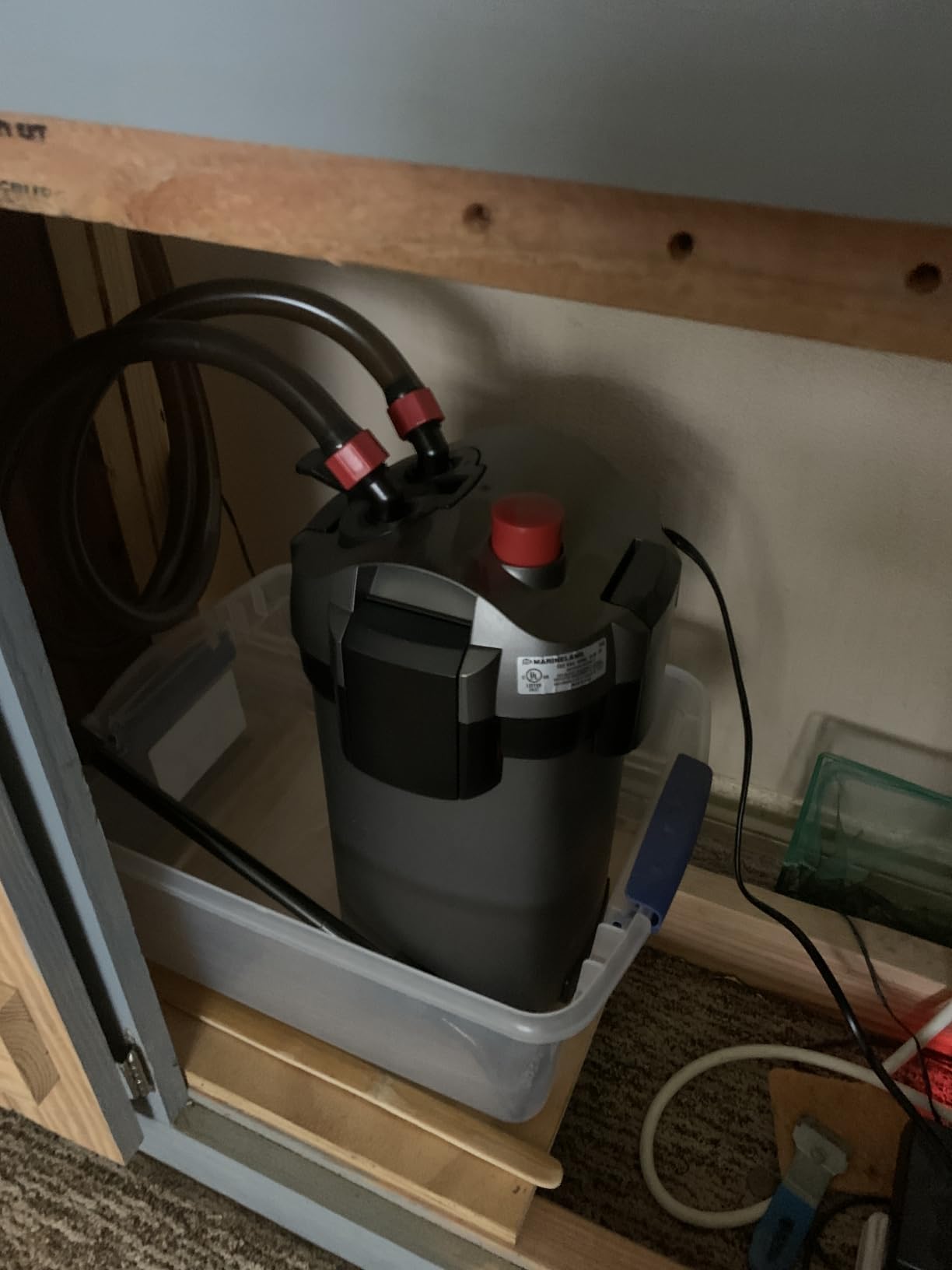
The complaints cluster around two things. The plastic hose clamps are criticised often enough that owners routinely swap them for metal ones from a hardware store, and reviewers report leaking issues traced to the lid gasket and seal. That is the failure mode planted tank communities describe most often for canisters generally, where the main gasket O-ring is nearly always the culprit and cleaning the mating surfaces plus food-grade silicone is the consensus fix.
Also worth knowing before you commit: long-term parts support is the concern owners raise for this model, so if you tend to keep filters for a decade, weigh that against the Fluval and EHEIM options where impellers and seals are easier to source.
What to check before you commit
Replace the plastic clamps with metal ones in the first week and grease the lid gasket while you are in there. Treat that as part of assembly rather than an upgrade, and you remove most of the leak risk.
Check the footprint. At 11 by 11 by 18 inches and just over 19 pounds, it is a large body for a 400 GPH pump, and the rigid tubing is awkward to route in a shallow cabinet.
Who should look elsewhere
Skip it if gasket reliability is your top concern, or if you want a canister you can service in ten years with parts at hand. The monthly carbon replacement is also friction in a planted tank where you would rather not use carbon at all.
Choose it for a first-time planted tank where you want to try each media type without a second purchase, or as a dedicated biological filter feeding a sump.
How We Picked the Best Canister Filters?
Every canister on this list is rated for far more water than it will actually move in your tank. Manufacturers quote flow at zero head height with an empty housing, which is a laboratory condition nobody’s aquascape reproduces. Media bags stuffed full, a lift tube reaching six inches up, and a bent hose each shave flow, and the number that matters is what the pump does on day one with real media installed.
So we size on real-world flow, not the box number. The working rule is to subtract roughly a quarter from the rated figure, then check whether that number still gives you the turnover your planting style needs. This is why we often recommend the filter rated for the tank one size above yours: the box rating is a ceiling, not a promise.
Beyond flow, we scored four things. Media volume decides whether you can run a real planted stack instead of a single bag. Flow adjustability decides whether you can stop off-gassing your CO2 later. Serviceability decides whether an O-ring or impeller is a five-minute fix or a return shipment. And noise in a real cabinet decides whether the tank is pleasant to sit beside at night.
We also read the long-form owner reports, because failure modes show up years after a filter launches. A gasket that leaks at month seven, an impeller that rattles after a year, and hoses that kink internally are all things you can only learn from people who have already cleaned them.
How to Size a Canister Filter for a Planted Tank?
Start with the multiplication rather than the tank’s rated capacity. Multiply your actual water volume by your target turnover, and that is the real-world flow you need. A 60 gallon tank of actual water at 6x turnover needs roughly 360 GPH of real flow, which means a filter rated well above 360 GPH before media losses are counted.
That is where the two competing numbers in this hobby come from, and it is worth untangling. Filter manufacturers and general aquarium editorial guidance suggest 4x to 6x turnover per hour. Planted tank communities, particularly r/PlantedTank, argue for 10x, on the reasoning that high energy planted tanks need more circulation to prevent stagnant zones behind hardscape and to keep detritus moving.
Both are right about different tanks. The 10x figure comes from high-tech setups with injected CO2, strong lighting, and dense planting, where you genuinely want fast circulation and are controlling surface agitation precisely to keep the CO2 in. The 4x to 6x figure fits low-tech planted tanks without CO2, where a modest circulation rate is enough and the fish matter more than the flow rate.
Now apply the discount. Rated GPH is measured with an empty housing and no head, so subtract about 25 percent to estimate what you will actually move with media installed. On the filters here, that turns 265 GPH into roughly 200, 370 GPH into roughly 280, 400 GPH into roughly 300, and 925 GPH into roughly 690.
Use those real-world numbers, not the box numbers, when you size. A common forum rule of thumb is to buy the filter rated for the tank size one step above yours, precisely because the box rating is a ceiling rather than a promise. Our general guidance for planted tanks lands on 6x real-world turnover for a low-tech tank and 8x to 10x for a CO2-injected one.
If you are still comparing formats, our roundups on canister filters for freshwater tanks and canister filters for freshwater aquariums go deeper on the hardware itself, and aquarium LED lighting for planted tanks covers the other half of a planted setup.
Spray Bar vs Lily Pipe: Controlling Agitation and CO2 Loss
Where the return discharges decides how much CO2 your tank keeps. Injected CO2 dissolves into the water, and surface agitation strips it back out into the room as carbon dioxide, which is both a waste of gas and a ventilation consideration. The goal is circulation without a broken surface.
A spray bar pushes water horizontally along and just under the surface, which gives broad circulation with minimal surface disturbance if you aim it at the back glass. A lily pipe is better for that job, because its flared, directional outlet sends flow across and slightly down the glass, disturbing the surface far less than a wide spray bar. A directional nozzle is the opposite tool, used when you want a strong, focused stream for a specific circulation path.
For a CO2-injected aquascape, the order of preference is lily pipe first, spray bar with the outlet at or just below the waterline second, and wide-open surface-disturbing flow last. For a low-tech planted tank without CO2, some surface movement is actually useful, because it helps gas exchange and keeps the water from going stagnant near the top.
All eight filters here discharge through a spray bar, so this is a cheap upgrade path rather than a purchase driver. Several of them also have a variable-flow return valve, and that valve is the tool you will use most: turn it down, watch the surface, and back it off until the ripple just breaks the surface film without throwing water.
You can also fit a spray bar with a downward-angled outlet on most of these canisters, which is the simplest fix if off-gassing is a problem and you do not want to change hardware.
The Planted Tank Media Stack: What Goes in Each Tray
Media order matters more than media type. Water should enter the canister at the bottom, pass through coarse mechanical media first, then finer mechanical media, then biological media last, and leave through the top. That order keeps the delicate bio-media clean, which is the single most common mistake in planted filter stacks.
Start with a coarse sponge or floss pad in the first basket. This is the pre-filter stage, and it catches plant matter, leaf debris, and the bulk of the detritus before it can reach anything else. Rinse it in old tank water when it darkens, and never rinse media in tap water, because chloramine and chlorine kill the nitrifying bacteria you are trying to keep.
The second basket is where most people go wrong in a planted tank. This is the classic spot for activated carbon, and in a planted aquarium that is usually a mistake, because carbon strips the macro nutrients in your liquid fertilizer along with the impurities. If you use carbon, use it in a small bag in the top basket, and only for a specific reason like clearing a treatment or polishing after a tank reset, not as a permanent fixture.
Fill the lower baskets with biological media instead. Ceramic rings or sintered glass, packed densely with no water channel down the middle, give the nitrifying bacteria a large wet surface. Rooted plants feed bacteria through the root zone, so a heavily planted tank can support more bio-media than its bioload suggests, and a planted tank with a dense root mass is easier on the filter than its visible plant count implies.
Keep a removable bag of a specialty resin, such as a phosphate or nitrogen remover, in the top basket where you can pull it without opening the canister. A drop-in bag catches what the biological stage cannot, and it is the one place a chemical media earns its keep long-term in a planted tank.
And never fill every basket. Leave one basket, or at least a third of one, empty. Unused volume slows the water down, which reduces the pressure the pump works against, and that is where a surprising amount of your rated flow comes back.
Setup, Cleaning, and the Rules That Prevent Leaks
Set the canister level, fill the body with tank water rather than tap water, close the lid, and then prime. Filling with tank water is the habit that eliminates most startup gurgling, and gurgling after a power cut is the most common complaint on planted tank forums, where the fix is to rock the canister gently to settle the water and re-prime.
Route the intake hose with as few bends as possible, and mount the lift tube so the strainer sits above the substrate. Pulling from a foot above the sand is how large filters accidentally pull sediment into the media and how they cloud a newly set aquascape.
Grease the O-rings on assembly and during every reassembly. The main gasket O-ring is the culprit behind the large majority of canister leak reports in the hobby, and the consensus fix is to clean the gasket and its mating surface, then apply food-grade silicone grease before closing the head. The whole procedure takes five minutes and prevents the most common canister failure there is.
For routine cleaning, plan on every four to six weeks for a lightly stocked planted tank. Shut off the water with the valves, depressurize by cracking the output, and run a gravel vacuum to the canister drain to pull water and debris out. Never open a canister while it is full, since the pressure difference will push water past every seal.
Clean one or two baskets at a time rather than all of them, and clean them in the order water flows through them, mechanical first. If you wipe the biological media, you are wiping off the colony you spent a month building. Rinse everything in the removed tank water, never the tap.
Give any new filter about 48 hours to establish before you judge the results. A canister that has just been replanted with new media needs a couple of days to grow back enough nitrifying bacteria to handle the tank’s daily load.
Frequently Asked Questions
What is the best canister filter for a planted tank?
The Fluval 307 Performance is the best all-round canister for planted tanks, with four media baskets, a genuinely quiet eTEC pump head, and a variable-flow return that lets you cut surface agitation to protect injected CO2. It is rated to 70 gallon tanks, which covers the 40 to 75 gallon range most planted aquascapes sit in. Below 20 gallons a sponge or HOB is a better fit, and past 100 gallons the FX6 has the media volume you need.
What is the best filter for a planted aquarium?
For a planted aquarium under 20 gallons, a sponge filter or a hang-on-back is the better answer, because canister flow is far more than a nano or shrimp setup wants. From roughly 40 to 75 gallons a canister wins, since it provides the media volume a planted stack needs and runs quietly inside the cabinet. A canister also gives you the adjustable flow you need to control surface agitation and hold CO2 in the water column.
Which is better, Eheim or Fluval?
Fluval wins on convenience: the 307 and FX6 offer self-priming, quick disconnect options, and on the FX6 a Smart Pump that re-evacuates trapped air. EHEIM wins on longevity and sealed-path simplicity, with pump heads that do not admit air and designs that have been in production since 2004. For a CO2-injected tank where a sealed path matters, EHEIM is the classic choice; for easy maintenance and bigger media volume, Fluval.
What is the best brand of canister filter?
Fluval, EHEIM, and SunSun are the three most recommended brands across planted tank communities, with Penn-Plax a frequent value pick. Fluval leads on features and media volume, EHEIM on long-term reliability and quiet sealed operation, and SunSun on price-to-performance. No brand wins every category, so pick based on your tank size, your media plan, and how much maintenance you actually enjoy.
Do I need a filter for a heavily planted tank?
Yes, and the reason is root feeders rather than fish. Living plants in the substrate release nutrients as roots grow and add to the bioload, and decaying plant matter adds more. A heavily planted tank still needs mechanical filtration to trap shed leaves and detritus, plus biological media to process the load. Canisters are the natural choice above 40 gallons because they hold more media volume than any other filter type.
How do I tell if flow is too strong for my fish?
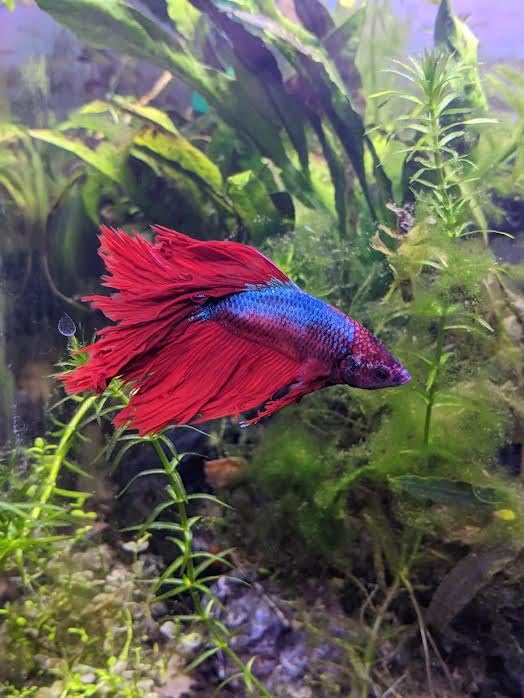
Look at three signs. If the surface is being broken into a constant ripple, CO2 is off-gassing and your fish are fighting the current. If plants are bending permanently in one direction, or your fish are constantly pinned to the glass or hiding, flow is excessive. Small fish such as ricefish and long-finned bettas suffer first. A variable-flow return valve and a lily pipe both let you reduce the effective flow without changing filters.
How do I slow down the flow of an aquarium filter?
Start with the return. Turn down the flow control valve on the canister so the discharge no longer breaks the surface. Second, swap a spray bar for a lily pipe, which directs flow along the glass and disturbs the surface far less. Third, aim a directional nozzle at a specific circulation path instead of into open water. Fourth, if you need to slow the intake, split it across a sponge pre-filter, which reduces the volume the pump draws.
Can a canister filter be too powerful for a fish tank?
Yes, and it is a common mistake with oversized filters. Far too much flow causes surface agitation that strips CO2, pushes fish downstream constantly, and stresses slow swimmers and small species. A filter rated for 100 gallons on a 40 gallon planted tank is a poor match. If you have already overshot, reduce the return flow, add a lily pipe, and add a sponge pre-filter on the intake to cut the volume the pump draws.
How often should I clean a canister filter?
Every four to six weeks is a good interval for a lightly stocked planted tank, and more often if you have dense planting that sheds a lot of leaf matter. Clean one or two baskets at a time rather than all of them, and rinse everything in the removed tank water rather than the tap. Never rinse biological media, and never fill the canister with water before opening it.
Why is my canister filter making noise?
Trapped air is the usual cause of gurgling, particularly after startup or a power cut. Rock the canister gently to settle the water and re-prime it. A rattling or grinding noise usually means the impeller has picked up debris or grit, so open the head and check it. If noise develops gradually, a noisy impeller is worth replacing before it fails entirely.
Final Verdict: Which Canister Filter for Your Planted Tank
For a planted tank in the 40 to 75 gallon range, the Fluval 307 Performance is the best canister filter you can buy in 2026: quiet enough for a bedroom, big enough for a real media stack, and adjustable enough to stop off-gassing your CO2. Go to the Fluval FX6 when you are past 100 gallons or when media volume is the constraint, and take the Penn-Plax Cascade 1000 when you want the most filter for the least money.
Whatever you choose, size on real-world flow rather than the box rating, keep a mechanical pre-filter in the first basket, and leave activated carbon out of your permanent stack. Those three habits do more for a planted tank than any upgrade you can buy later.
Still deciding? Our guides to canister filters for saltwater aquariums and canister filters for turtle tanks cover the other two setups where these bodies get asked about most.