
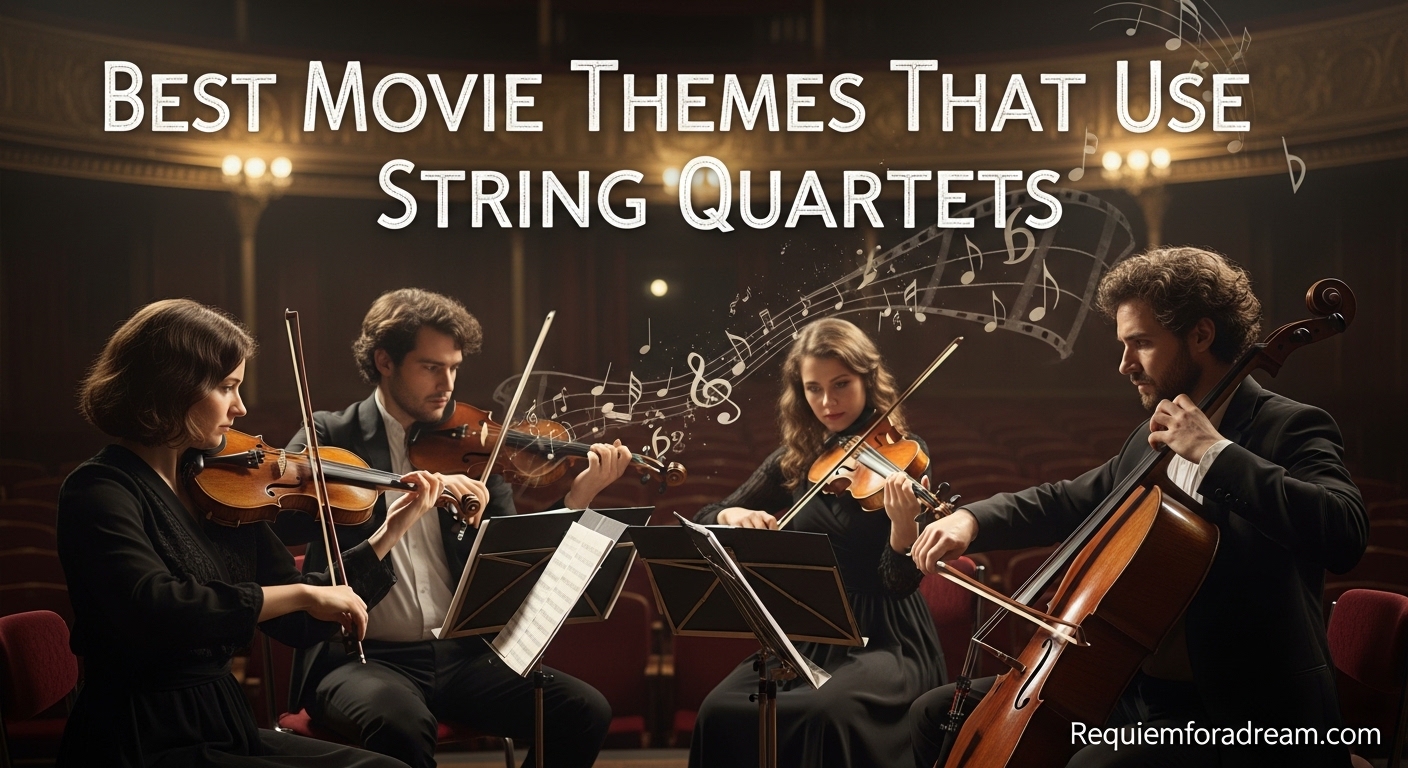
There is something almost magical about the way four stringed instruments can transform a simple movie scene into an unforgettable emotional experience. The best movie themes that use string quartets have this uncanny ability to crawl under your skin and stay there, lingering in your mind long after the credits roll. I have spent years collecting film soundtracks, and I keep coming back to these intimate chamber pieces that somehow say more with four instruments than full orchestras often manage.
The string quartet format – two violins, one viola, and one cello – creates a unique sonic space that filmmakers have exploited for decades. Unlike massive orchestral swells that can overwhelm a scene, quartet music breathes with the characters. It sits in the room with them. This is why so many directors reach for quartet textures when they need genuine emotional honesty rather than grand spectacle.
In this guide, I have gathered ten of the most compelling examples of movie themes featuring string quartets. Some are original compositions written specifically for the films. Others are clever arrangements that reimagine famous scores through a chamber music lens. Together, they demonstrate why this centuries-old ensemble format remains one of cinema’s most powerful storytelling tools in 2026.
Table of Contents
What Is a String Quartet in Film Music?
A string quartet consists of four musicians playing two violins, a viola, and a cello. This configuration has been the backbone of chamber music since the 18th century, but film composers have adapted it for cinematic purposes in fascinating ways.
In film scoring, the quartet offers several technical advantages. The small size allows for extremely tight ensemble playing where every note matters. Composers can write intricate contrapuntal lines that would get lost in a larger orchestra. The range spans from the cello’s deep resonance to the violin’s piercing high register, all produced by instruments that blend naturally because they share the same physical construction.
What makes quartets special for film is their scalability. Four musicians can play so softly that you barely notice them, creating an atmospheric bed beneath dialogue. Then, without warning, they can generate tremendous intensity through tremolo bowing or unified melodic lines. This dynamic flexibility makes them perfect for psychological dramas, horror films, and intimate character studies.
10 Best Movie Themes That Use String Quartets
1. Lux Aeterna (Requiem for a Dream) – Clint Mansell
When Darren Aronofsky needed music that could match his film’s unrelenting intensity, he turned to composer Clint Mansell and the Kronos Quartet. What emerged was “Lux Aeterna,” a piece that has since become synonymous with cinematic dread and has been referenced, remixed, and parodied countless times since the film’s release.
The composition works because it strips away everything unnecessary. A simple descending string line repeats over pulsating rhythms, building layer upon layer until the tension becomes almost unbearable. The Kronos Quartet brings a raw, aggressive edge to their playing that no synthetic string library could replicate. You can hear the physical effort in every bow stroke.
What many listeners don’t realize is how technically demanding this piece is for the performers. The constant tremolo bowing requires tremendous stamina, particularly for the violinists who maintain that shimmering intensity throughout. It is exhausting music played by musicians who sound on the verge of breaking, which perfectly mirrors the film’s themes of addiction and collapse.
Since Requiem for a Dream, “Lux Aeterna” has appeared in countless trailers and commercials, often in re-recorded forms. The original Kronos Quartet version remains definitive, capturing a specific moment in time when four acoustic instruments created something that sounds almost electronic in its precision and power.
2. The Heart Asks Pleasure First (The Piano) – Michael Nyman
Jane Campion’s 1993 film The Piano features one of the most distinctive string quartet sounds in cinema history. Michael Nyman composed a score that draws heavily on Baroque patterns and minimalist repetition, creating music that feels both ancient and modern simultaneously.
The central theme, “The Heart Asks Pleasure First,” exemplifies Nyman’s approach. A simple harmonic progression cycles underneath a soaring violin melody that seems to search endlessly for resolution. The quartet format allows each voice to maintain independence while contributing to the whole, much like the film’s protagonist who must navigate complex emotional territory.
Nyman wrote these pieces specifically for his own ensemble, the Michael Nyman Band, which featured strings alongside other instruments. However, the core quartet textures shine through, particularly in moments when the stripped-down string sound carries scenes of intense emotional revelation.
The success of this soundtrack proved that minimalist approaches could work beautifully in period dramas. Rather than using lush Romantic orchestration to signal “prestige cinema,” Nyman’s repetitive structures create a hypnotic quality that draws viewers deeper into the characters’ interior lives.
3. String Quartets (Mishima) – Philip Glass
Paul Schrader’s 1985 film Mishima: A Life in Four Chapters features one of the most sophisticated uses of pre-existing chamber music in cinema. Philip Glass had already composed three string quartets before the film was made, and Schrader wove them throughout the narrative to create an intricate musical architecture.
Glass’s quartets rely on his signature arpeggiated figures passed between instruments in hypnotic cycles. The effect is meditative rather than dramatic, which suits the film’s contemplative examination of Yukio Mishima’s life and work. Rather than manipulating emotions with obvious cues, the music creates a space for reflection.
The recording featured the Kronos Quartet, who had developed a close working relationship with Glass over multiple projects. Their interpretation emphasizes the precision of Glass’s rhythmic patterns while allowing just enough human variation to keep the repetitions from becoming mechanical.
What makes this score significant is how it demonstrated that existing concert music could function as effective film music without compromise. Schrader didn’t ask Glass to simplify or sentimentalize his compositions. The quartets remain challenging, complex works that happen to accompany images with remarkable synergy.
4. Main Theme (Schindler’s List) – John Williams
John Williams composed one of his most beloved themes for Steven Spielberg’s Schindler’s List, featuring violinist Itzhak Perlman in the original recording. While the film score was orchestrated for larger forces, the main theme has become a staple of string quartet repertoire for events and performances.
The melody’s simplicity is its genius. Based on Jewish folk influences and modal scales, it speaks directly to the heart without pretension. In quartet arrangements, the first violin typically carries Perlman’s soaring line while the other voices provide harmonic support that never competes for attention.
I have heard countless wedding ceremonies and memorial services use this theme specifically because the quartet version maintains the emotional weight while remaining intimate enough for small spaces. It demonstrates how great film music can transcend its original context to become part of the broader musical vocabulary.
The theme’s popularity among string quartets has also introduced many listeners to chamber music who might never attend a formal classical concert. It serves as a gateway, proving that the quartet format can handle deeply emotional material without losing its essential character.
5. Halloween Theme – John Carpenter (Vitamin String Quartet cover)
John Carpenter’s original Halloween theme is one of the most recognizable pieces of horror film music ever written. The Vitamin String Quartet’s classical reinterpretation transforms this synthesizer-driven nightmare into something equally chilling but entirely acoustic.
The genius of the arrangement lies in how it adapts electronic sounds to string techniques. The iconic repeating piano figure translates perfectly to pizzicato violin, while the droning bass synth becomes sustained cello notes. What was cold and mechanical becomes organic and breathing, somehow making it even more disturbing.
Vitamin String Quartet has built an empire on these kinds of unexpected transformations. Their version of the Halloween theme appears on multiple compilations and has introduced younger audiences to both string quartet music and classic horror cinema simultaneously.
The arrangement works because it respects the original’s minimalist DNA. Carpenter understood that horror often works best with less, and the quartet version honors that philosophy. Four instruments are enough to create genuine dread when deployed with intelligence and restraint.
6. Game of Thrones Theme – Ramin Djawadi (Vitamin String Quartet cover)
Ramin Djawadi’s theme for HBO’s Game of Thrones was already monumental in its original orchestration. The Vitamin String Quartet’s cover proves that even epic television music can thrive in an intimate chamber setting.
The arrangement cleverly distributes the theme’s various components across the quartet. The iconic cello line from the original becomes the foundation, while violins handle the medieval-sounding countermelodies. The pounding percussion that drives the original is suggested through aggressive bowing and rhythmic emphasis rather than literal translation.
This cover became particularly popular during the show’s peak cultural saturation, offering fans a way to experience familiar music in fresh contexts. Wedding ceremonies, corporate events, and casual listening all found uses for this interpretation.
The success demonstrates how quartet arrangements can serve different emotional purposes than the originals. Where the full orchestral version signals spectacle and power, the quartet version feels personal and human-scaled. Both are valid; both serve different moments.
7. Adagio in G Minor (Platoon/Flashdance) – Albinoni/Giazotto
The Adagio in G Minor, attributed to Tomaso Albinoni (though likely composed by Remo Giazotto in the 20th century), has appeared in multiple films including Platoon and Flashdance. This Baroque masterpiece has become a favorite of string quartets worldwide.
The piece builds from a simple ground bass into an increasingly elaborate emotional statement. Its structure – slow, deliberate, and achingly beautiful – makes it perfect for film moments requiring profound sentiment without words. Oliver Stone used it brilliantly in Platoon during scenes of devastation and reflection.
For string quartets, the Adagio offers technical challenges that reward skilled players. The sustained tone required throughout tests ensemble intonation and bow control. The gradual dynamic build requires perfect coordination to achieve the piece’s full impact.
The popularity of this piece in both concert halls and film contexts shows how certain compositions transcend their origins. Whether performed by a Baroque ensemble or a modern quartet, the Adagio speaks to something universal in human experience.
8. Eternal Sunshine of the Spotless Mind – Jon Brion
Michel Gondry’s Eternal Sunshine of the Spotless Mind features a Jon Brion score that subtly incorporates quartet textures throughout its dreamy, fragmented narrative. Rather than relying on obvious melodies, Brion creates an atmosphere of memory and loss through layered string sounds.
The quartet appears in various configurations, sometimes alone and sometimes blended with other instruments. Brion’s production style – loose, experimental, and emotionally direct – suits the film’s themes perfectly. The music sounds like it is being remembered rather than performed.
This approach represents a different use of quartet resources than the more famous examples on this list. Instead of showcasing technical virtuosity, Brion uses the strings for color and texture, creating an indie-film sensibility that has influenced countless composers since.
The soundtrack has developed a cult following among musicians who appreciate its unconventional construction. It proves that string quartets need not always play traditional classical repertoire or blockbuster themes to find meaningful film work.
9. Inception: Time – Hans Zimmer (String Quartet Arrangement)
Hans Zimmer’s “Time” from Inception represents some of his most sophisticated film writing, building from simple piano figures into a massive orchestral catharsis. String quartet arrangements of this piece have become increasingly popular, demonstrating the adaptability of Zimmer’s compositional architecture.
The arrangement challenge here is significant. Zimmer’s original relies heavily on brass, percussion, and electronic elements alongside strings. A pure quartet version must reimagine these sounds using only bowed instruments, often through extended techniques like col legno (striking strings with the wood of the bow) or aggressive ponticello bowing near the bridge.
When performed well, the quartet version strips away the blockbuster bombast to reveal the emotional skeleton beneath. The gradual layering that Zimmer builds over six minutes must be achieved through increasingly dense counterpoint and rhythmic subdivision.
This arrangement shows how modern blockbuster scores, often criticized for their sameness and volume, can yield beautiful chamber music when approached creatively. The quartet format demands solutions that full orchestras never need to consider.
10. Westworld: Motion Picture Soundtrack – Radiohead (Vitamin String Quartet cover)
HBO’s Westworld gained attention for its use of anachronistic music, placing contemporary songs in a futuristic Western setting. The Vitamin String Quartet provided many of these covers, translating Radiohead, The Rolling Stones, and Soundgarden into pseudo-period-appropriate string textures.
Their version of Radiohead’s “Motion Picture Soundtrack” is particularly effective. The original song already featured haunting Mellotron and harp sounds that translate naturally to string quartet. The VSQ arrangement emphasizes the melancholy at the song’s core while adding the precision that only trained classical musicians can provide.
The cover serves double duty in the series, both as source music within the narrative and as commentary on the show’s themes of artificiality and authenticity. Hearing modern rock classics rendered through 19th-century instrumentation creates exactly the uncanny effect the showrunners wanted.
This approach has influenced other series, including Bridgerton, which similarly uses string covers of pop songs to create period atmosphere with contemporary appeal. The Vitamin String Quartet essentially created a subgenre that has proven remarkably durable.
Why String Quartets Work So Well in Film
The Intimacy Factor
Four musicians create a fundamentally different acoustic experience than forty. In a string quartet, you can often sense the individual players breathing together, adjusting to each other in real time. This human quality transfers directly to the screen, making scenes feel more authentic and grounded.
Film composers have long understood that smaller ensembles encourage viewers to lean in rather than sit back. When the music doesn’t fill every available frequency, space opens up for other elements to register. Dialogue becomes clearer. Sound design details emerge. The quartet creates a partnership with the other audio components rather than dominating them.
Dynamic Range and Flexibility
A string quartet can move from near-silence to substantial volume faster than most larger ensembles. This responsiveness makes quartets perfect for following the emotional contours of film scenes that shift rapidly between states.
Technical capabilities like pizzicato (plucking strings), col legno, sul ponticello, and various vibrato speeds give composers enormous coloristic variety. A skilled quartet can suggest everything from guitar strumming to electronic beats using only traditional instruments and techniques.
The range of four strings also matches human hearing particularly well. The cello covers bass frequencies that ground the harmony, while violins reach frequencies that cut through without piercing. The viola fills the crucial middle register where much of the harmonic information lives.
Genre Versatility
Horror films love string quartets because the instruments can generate genuine unease through simple means. Dissonant harmonies played close together create acoustic beating that physically disturbs listeners. Unpredictable rhythmic patterns played by four coordinated musicians generate tension through precision rather than chaos.
Romantic dramas benefit from the quartet’s ability to sustain long, singing lines that mimic the human voice. Composers can write melodies that breathe and sigh like characters in love or despair. The ensemble can swell and diminish like emotional states fluctuating.
Indie and arthouse cinema appreciates the quartet’s economic and practical advantages. Recording four musicians costs less than hiring orchestras. The smaller footprint allows for location recording that would be impossible with larger forces. And the sonic transparency fits the aesthetic preferences of many independent filmmakers.
Notable String Quartets in Popular Music
Several performing ensembles have become particularly associated with film music over the years. Understanding these groups helps explain how certain sounds have entered popular culture.
The Kronos Quartet has been the most significant force in bringing contemporary and film music to string quartet audiences. Since founding in 1973, they have recorded music by Glass, Reich, Mansell, and countless film composers. Their aggressive, precise style defines what many listeners think of as “modern” quartet playing.
Vitamin String Quartet took a different approach, building a massive catalog of pop and rock covers played in classical style. Their versions of movie themes, alternative hits, and chart-toppers have appeared in films, television shows, and advertisements. They proved that the quartet format could handle any musical material with the right arrangements.
The Brodsky Quartet has maintained a more traditional classical profile while occasionally engaging with popular material. Their work with pop artists like Bjork and Elvis Costello demonstrated how flexible the quartet concept could be when approached with open minds.
These ensembles have trained audiences to expect string quartets outside concert halls. Wedding ceremonies, corporate events, and private parties regularly hire quartets to play film music precisely because these groups made the repertoire familiar and accessible.
Frequently Asked Questions
What are some famous string quartets?
The most famous string quartets in film music include the Kronos Quartet, known for their work on Requiem for a Dream and Philip Glass scores, and the Vitamin String Quartet, famous for their covers of pop songs and movie themes. Other notable ensembles include the Brodsky Quartet and the Alban Berg Quartett.
What is the movie about the string quartet?
A Late Quartet (2012) is a film specifically about a string quartet, starring Philip Seymour Hoffman and Christopher Walken. It explores the interpersonal dynamics of a professional quartet facing crises. Other films featuring quartets include Immortal Beloved, Hilary and Jackie, and the documentary The Beethoven Project.
What movie was Adagio for Strings used in?
Samuel Barber’s Adagio for Strings has appeared in multiple films, most notably Platoon (1986) directed by Oliver Stone. It has also been used in The Elephant Man, Amelie, and Sweeney Todd. The piece has become synonymous with cinematic grief and reflection.
What is the most popular string quartet music?
The most popular string quartet music spans classical repertoire like Beethoven’s late quartets and contemporary film scores. In popular culture, Vitamin String Quartet’s covers of songs like Bittersweet Symphony and their movie theme arrangements have gained massive streaming numbers. Classical favorites include Dvorak’s American Quartet and Ravel’s String Quartet in F.
Conclusion
The best movie themes that use string quartets prove that emotional power in cinema has nothing to do with budget size or orchestral weight. Four committed musicians playing together in a room can create sounds that resonate as deeply as any hundred-piece ensemble. From the harrowing intensity of Lux Aeterna to the Baroque grace of the Adagio in G Minor, these themes demonstrate the quartet’s unique capacity for intimacy and expression.
As streaming platforms and independent filmmaking continue democratizing cinema in 2026, I expect we’ll hear even more creative uses of this versatile format. The string quartet has served composers for nearly three centuries, and these movie themes suggest it has plenty more stories to tell.