
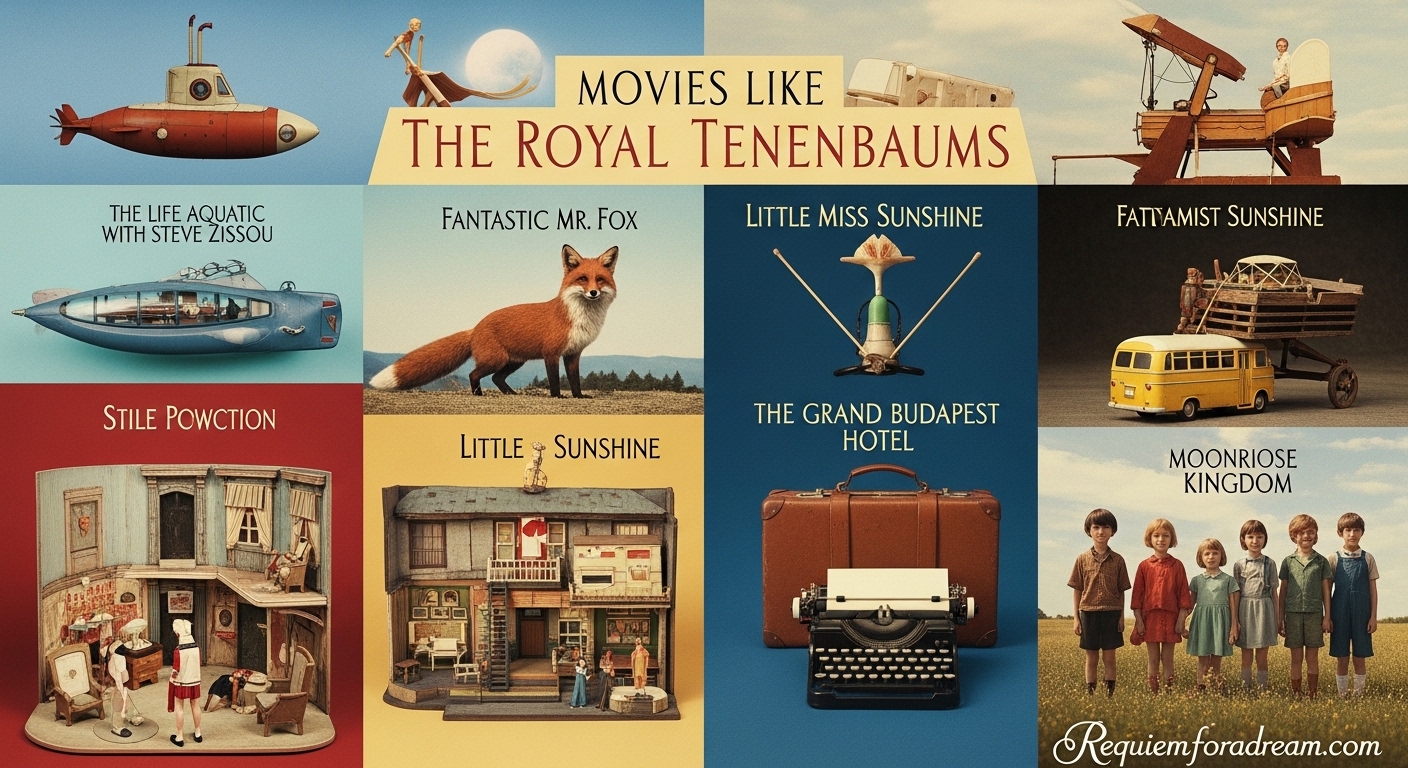
Few films capture that specific blend of visual whimsy and emotional melancholy quite like The Royal Tenenbaums. Wes Anderson’s 2001 masterpiece introduced millions to a cinematic language that feels simultaneously storybook-perfect and deeply human. The symmetrical framing, the pastel color palettes, the deadpan delivery of heartbreaking dialogue—it all created a template that film lovers have been chasing ever since.
If you are searching for movies like The Royal Tenenbaums, you are probably looking for more than just quirky aesthetics. You want films that balance dark comedy with genuine emotion. You want dysfunctional families that somehow feel relatable. You want child prodigies, eccentric characters, and visual storytelling that treats every frame like a painting.
I have spent years curating watchlists for fellow Anderson devotees. This guide combines essential Wes Anderson films you might have missed with alternative directors who capture that same magic. We will explore where to stream each film, why it connects to The Royal Tenenbaums, and which ones deserve your attention first 2026.
Table of Contents
What Makes The Royal Tenenbaums So Special
Before diving into recommendations, let us break down exactly what defines this film’s unique appeal. Understanding these elements helps explain why certain movies made this list while others did not.
The Visual Aesthetic
Wes Anderson treats his sets like elaborate dollhouses. Every room in the Tenenbaum house tells a story through its clutter. The wardrobe choices—from Margot’s fur coat to Chas’s tracksuits—communicate character without a single line of dialogue.
The film’s symmetrical framing became so iconic that it now defines an entire approach to cinematography. Colors are carefully curated: warm yellows, deep reds, and that signature faded pink. Even the typeface (Futura Bold) becomes part of the visual signature.
Thematic Elements
The Royal Tenenbaums explores family dysfunction through a lens of genius and failure. The three Tenenbaum children were prodigies who peaked early. Their father Royal abandoned them, then forces his way back into their lives through deception.
Themes of reconciliation, forbidden love, and the burden of expectations run throughout. The film treats mental illness, addiction, and depression with surprising directness for a comedy. Yet it never loses its sense of humor or its underlying hope.
Tonal Balance
Perhaps most importantly, The Royal Tenenbaums balances deadpan humor with genuine emotional stakes. A scene can make you laugh at a character’s absurdity while simultaneously breaking your heart with their pain. The film respects its characters even when mocking their eccentricities.
This tonal tightrope walk is what separates true Anderson-style films from mere imitators. The movies on this list all understand that balance.
Essential Wes Anderson Films
If you loved The Royal Tenenbaums, these Wes Anderson films should be your next stops. They represent the director’s evolution while maintaining the elements you already love.
Rushmore (1998) – Where the Style Began
Before The Royal Tenenbaums, there was Rushmore. This 1998 film established many elements that would define Anderson’s career: the precocious protagonist, the Bill Murray collaboration, the soundtrack filled with British Invasion tracks, and the precise visual compositions.
Jason Schwartzman plays Max Fischer, a fifteen-year-old scholarship student at the prestigious Rushmore Academy. Max runs every extracurricular club while barely passing his classes. He falls in love with an elementary school teacher and befriends a depressed industrialist played by Bill Murray. The relationship between Max and Murray’s character mirrors the father-son dynamics that would become central to The Royal Tenenbaums.
Where to watch: Currently available on Paramount+ and for rental on major platforms.
The Life Aquatic with Steve Zissou (2004) – Family Under the Sea
Bill Murray takes the lead in this colorful adventure about an oceanographer hunting the shark that killed his partner. The film expands Anderson’s visual palette with stop-motion sea creatures and a yellow submarine aesthetic that feels like a children’s book come to life.
Family dysfunction remains central. Steve Zissou discovers he has a son he never knew existed, played by Owen Wilson. Their developing relationship anchors the film’s emotional core. The father-son tension, the deadpan delivery of emotional revelations, and the ensemble cast of eccentric characters all connect directly to The Royal Tenenbaums.
Where to watch: Available on Hulu and for digital rental.
The Darjeeling Limited (2007) – Brothers on a Train
Three estranged brothers reunite for a spiritual journey across India by train. Peter (Adrien Brody), Jack (Jason Schwartzman), and Francis (Owen Wilson) have not spoken since their father’s funeral. Francis has planned their itinerary in meticulous detail, revealing his controlling nature while hiding his own injuries from a recent accident.
The sibling dynamics will feel immediately familiar to fans of the Tenenbaum children. Each brother carries resentment, grief, and secrets. The train setting forces them into close quarters, amplifying tensions while offering opportunities for reconciliation. The film’s vibrant colors and cultural aesthetics expand Anderson’s visual vocabulary while maintaining his emotional precision.
Where to watch: Available on Disney+ and for digital rental.
Fantastic Mr. Fox (2009) – Stop-Motion Whimsy
Anderson adapted Roald Dahl’s novel into a stop-motion masterpiece that perfectly translates his live-action style into animation. George Clooney voices Mr. Fox, a reformed chicken thief who cannot resist one last heist. His actions endanger his family and spark war with three cruel farmers.
The film’s color palette and production design feel directly descended from The Royal Tenenbaums. The family dynamics—Mr. Fox’s relationship with his son Ash, his wife’s patience wearing thin—explore similar themes of fathers trying to connect with children who feel misunderstood. The dry humor and deadpan delivery translate perfectly to the animated medium.
Where to watch: Available on Disney+ and Max.
Moonrise Kingdom (2012) – Young Love and Child Prodigies
Set in 1965 on a fictional New England island, Moonrise Kingdom follows two twelve-year-old misfits who run away together. Sam is an orphan and skilled Khaki Scout. Suzy lives in a lighthouse with her dysfunctional family, carries binoculars everywhere, and reads young adult fantasy novels.
The child prodigy element connects directly to the Tenenbaum siblings. Both children are precocious, misunderstood, and desperately seeking connection. The film’s storybook aesthetic—complete with on-screen chapter titles and practical effects—feels like The Royal Tenenbaums translated through a younger lens. Bruce Willis, Edward Norton, and Frances McDormand round out an ensemble cast that balances the children’s romance with adult complications.
Where to watch: Available on Max and for digital rental.
The Grand Budapest Hotel (2014) – Visual Perfection
Many critics consider this Wes Anderson’s masterpiece. Ralph Fiennes plays Monsieur Gustave, the perfectionist concierge of a famous European hotel between the wars. When a wealthy guest dies and leaves him a valuable painting, Gustave becomes entangled in murder, prison breaks, and a fascist regime’s rise.
The film’s visual density surpasses even The Royal Tenenbaums. Every frame contains layers of detail, from the hotel’s pink facade to the intricate pastries. The nested narrative structure—told as a story within a story within a story—adds emotional distance that paradoxically increases the film’s melancholy impact. Themes of loyalty, friendship, and a disappearing world echo the nostalgia that permeates The Royal Tenenbaums.
Where to watch: Available on Hulu and Max.
Non-Wes Anderson Films That Capture the Magic
Sometimes you need films that match the vibe without being direct copies. These alternatives offer similar aesthetics, themes, or tonal balances while bringing their own directorial voices to the equation.
Little Miss Sunshine (2006) – The Closest Match
If any non-Anderson film matches The Royal Tenenbaums beat for beat, it is Little Miss Sunshine. This indie sensation follows a dysfunctional family road-tripping to a children’s beauty pageant. The Hoover family includes a suicidal uncle, a silent son, a grandfather snorting heroin, a father obsessed with winning, and Olive—the little girl who just wants to dance.
The parallels are striking. Both films feature child prodigies who may not be as exceptional as their families believe. Both explore parental pressure and sibling resentment. Both balance dark comedy with genuine heartbreak and end on notes of tentative hope. The yellow Volkswagen bus becomes as iconic as the Tenenbaum house. Greg Kinnear, Toni Collette, Steve Carell, and Alan Arkin form an ensemble that rivals Anderson’s regular troupe.
Where to watch: Available on Hulu and for digital rental.
Amélie (2001) – Visual Whimsy from France
Jean-Pierre Jeunet’s romantic comedy became an international phenomenon for good reason. Audrey Tautou plays Amélie, a shy waitress in Paris who decides to improve the lives of those around her through small, secret acts of kindness. Her own isolation and romantic hesitations form the film’s emotional core.
The visual connection to Anderson’s work is immediate. Jeunet uses saturated colors, elaborate practical effects, and detailed production design to create a fairy-tale version of Paris. Amélie’s apartment and the café where she works feel as carefully curated as any Anderson set. The voiceover narration, the eccentric supporting characters, and the balance of humor and melancholy all align with what The Royal Tenenbaums fans love.
Where to watch: Available on AMC+ and for digital rental.
Jojo Rabbit (2019) – Taika Waititi’s Whimsical Darkness
Taika Waititi won the Academy Award for Best Adapted Screenplay for this bold dramedy about a ten-year-old Hitler Youth member whose imaginary friend is Adolf Hitler (played by Waititi himself). Roman Griffin Davis plays Jojo, a fervent Nazi supporter who discovers his mother is hiding a Jewish girl in their attic.
The film’s tonal audacity recalls The Royal Tenenbaums at its most daring. Waititi makes you laugh at absurdity while never letting you forget the real horrors of fascism. The symmetrical framing, saturated colors, and deadpan delivery echo Anderson’s style while remaining distinctly Waititi’s voice. Scarlett Johansson gives an Oscar-winning performance as Jojo’s secretly rebellious mother, and the film’s emotional climax hits with genuine power.
Where to watch: Available on FX Now and for digital rental.
Knives Out (2019) – Dysfunction with a Mystery
Rian Johnson modernizes the whodunit with this sharp comedy-mystery about the wealthy Thrombey family. When patriarch Harlan (Christopher Plummer) dies mysteriously, detective Benoit Blanc (Daniel Craig) must navigate a nest of entitled heirs, each with motives and secrets.
The family dysfunction parallels are immediate. The Thrombeys are wealthy, self-absorbed, and constantly at each other’s throats. Marta, Harlan’s nurse played by Ana de Armas, becomes the audience surrogate navigating their eccentricities. The ensemble cast—including Jamie Lee Curtis, Michael Shannon, Toni Collette, and Chris Evans—delivers the same caliber of performance as Anderson’s regulars. The film balances laughs with genuine stakes, creating a mystery that satisfies while delivering social commentary.
Where to watch: Available on Netflix and for digital rental.
Frances Ha (2012) – Noah Baumbach’s Black-and-White Quirk
Noah Baumbach co-wrote The Royal Tenenbaums with Wes Anderson, and his solo work explores similar thematic territory through a different visual lens. Greta Gerwig co-wrote and stars as Frances, a twenty-seven-year-old dancer in New York struggling to keep her apartment, her friendship with Sophie, and her dreams alive.
Shot in black-and-white by cinematographer Sam Levy, the film captures a specific moment in young adulthood when everything feels possible and terrifying simultaneously. Frances’s eccentricities, her awkward social interactions, and her refusal to compromise her artistic dreams recall Margot Tenenbaum’s determined individuality. The film is more grounded than Anderson’s work but shares the same affection for flawed protagonists.
Where to watch: Available on Max and for digital rental.
Everything Everywhere All at Once (2022) – Controlled Chaos
The Daniels’ multiverse adventure became the surprise hit of 2022, winning seven Academy Awards including Best Picture. Michelle Yeoh plays Evelyn, a laundromat owner being audited by the IRS while her marriage crumbles and her daughter grows distant. Then she discovers she must connect with parallel universe versions of herself to save existence itself.
The family dysfunction at the film’s core connects directly to The Royal Tenenbaums. Evelyn’s relationship with her daughter Joy mirrors Royal’s attempts to reconnect with his children. The absurdist humor, the visual inventiveness, and the genuine emotional payoff all align with what Anderson fans seek. The film goes places Anderson never would—hot dog fingers, everything bagel black holes—but the heart underneath is the same.
Where to watch: Available on Showtime and for digital rental.
Harold and Maude (1971) – The Spiritual Predecessor
Before Wes Anderson, Hal Ashby created this cult classic about death-obsessed young Harold who falls in love with seventy-nine-year-old Maude. Their May-December romance unfolds through funerals, fake suicides, and eventually, genuine connection.
Cat Stevens’ folk soundtrack, the counterculture sensibility, and the matter-of-fact treatment of death all influenced Anderson’s later work. Harold’s elaborate fake suicides—staging hangings, drownings, and swordfights—have the same deadpan absurdity as Richie Tenenbaum’s suicide attempt. Ruth Gordon’s Maude is as eccentric and fully realized as any Anderson matriarch. The film’s cult status endures because it balances dark themes with genuine warmth.
Where to watch: Available on the Criterion Channel and for digital rental.
Where to Start Your Viewing Journey
With thirteen films to choose from, you might wonder which deserve your immediate attention. Here is my recommended approach based on what specifically drew you to The Royal Tenenbaums.
If You Loved the Family Dysfunction
Start with Little Miss Sunshine. It matches the Tenenbaums’ family dynamics more closely than any other film on this list. Then move to The Darjeeling Limited for sibling-specific tensions, followed by Knives Out for wealthy-family dysfunction with a mystery twist.
If You Loved the Visual Style
Begin with The Grand Budapest Hotel as Wes Anderson’s most visually dense film. Follow with Amélie for similar color palettes from a different director. Moonrise Kingdom offers the most storybook-perfect aesthetic in Anderson’s filmography.
If You Loved the Dark Comedy with Heart
Start with Jojo Rabbit for tonal audacity that actually works. Everything Everywhere All at Once delivers bigger emotional punches than you might expect. The Life Aquatic balances absurdity with genuine father-son reconciliation.
If You Are New to Wes Anderson
Watch chronologically: Rushmore, The Royal Tenenbaums, The Life Aquatic, The Darjeeling Limited, Fantastic Mr. Fox, Moonrise Kingdom, The Grand Budapest Hotel. This lets you watch Anderson’s visual style evolve while his thematic concerns remain consistent.
Frequently Asked Questions
What is considered Wes Anderson’s best movie?
While opinions vary, many critics and fans consider The Grand Budapest Hotel to be Wes Anderson’s masterpiece. It earned him his first Academy Award nominations for Best Director and Best Original Screenplay, and won for Best Production Design, Best Costume Design, Best Makeup, and Best Original Score. The film represents the peak of his visual style and storytelling. However, The Royal Tenenbaums and Rushmore are also frequently cited as his best work depending on personal taste.
Why did Gene Hackman not like Wes Anderson?
Gene Hackman reportedly had a difficult relationship with Wes Anderson during the filming of The Royal Tenenbaums. Hackman was not Anderson’s first choice for the role of Royal and was somewhat reluctantly cast. During production, Hackman was reportedly difficult on set, clashing with Anderson’s precise directing style. However, Hackman’s performance is widely regarded as one of his finest, and he brought a raw energy to the character that anchors the film emotionally.
What movies have the same visual style as The Royal Tenenbaums?
For Wes Anderson’s exact visual style, watch his other films: The Grand Budapest Hotel, Moonrise Kingdom, and The Darjeeling Limited. For similar aesthetics by other directors, try Amélie by Jean-Pierre Jeunet for whimsical color palettes, Jojo Rabbit by Taika Waititi for symmetrical framing, or Submarine by Richard Ayoade for indie quirkiness. The 1971 classic Harold and Maude is also considered a spiritual predecessor to Anderson’s visual approach.
Are there any recent movies like The Royal Tenenbaums?
Yes, several recent films capture similar vibes. Everything Everywhere All at Once (2022) shares the dysfunctional family themes and absurdist humor. Jojo Rabbit (2019) matches the whimsical tone with serious subject matter. The Fabelmans (2022) explores family dysfunction through a filmmaker’s lens. Asteroid City (2023) is Wes Anderson’s latest film and maintains his signature style. For something newer, look for The Wonderful Story of Henry Sugar (2023), a short film also by Anderson.
What should I watch if I have seen all Wes Anderson movies?
If you have exhausted Wes Anderson’s filmography, explore films by Noah Baumbach (The Meyerowitz Stories, Frances Ha), Taika Waititi (Jojo Rabbit, Hunt for the Wilderpeople), and Jean-Pierre Jeunet (Amélie, Micmacs). Richard Linklater’s films like Slacker and Dazed and Confused offer similar indie sensibilities. Todd Solondz’s Happiness and Welcome to the Dollhouse provide darker alternatives. For family dysfunction themes, try Little Miss Sunshine, The Squid and the Whale, or This Is Where I Leave You.
Conclusion: Your Next Great Watch Awaits
The thirteen films on this list represent the best options for fans of movies like The Royal Tenenbaums. Whether you choose to dive deeper into Wes Anderson’s filmography or explore the alternatives from directors like Taika Waititi, Jean-Pierre Jeunet, and Noah Baumbach, you will find films that balance visual artistry with emotional truth.
Start with Little Miss Sunshine or The Grand Budapest Hotel if you want the safest bets. Branch into Everything Everywhere All at Once or Jojo Rabbit if you want something more recent. And do not overlook Harold and Maude if you want to understand where this entire aesthetic tradition began.
Each of these films understands what makes The Royal Tenenbaums special: the belief that even the most dysfunctional families contain genuine love, that eccentricity should be celebrated rather than corrected, and that cinema can be both visually stunning and emotionally resonant. Your next favorite film is waiting on this list 2026.