
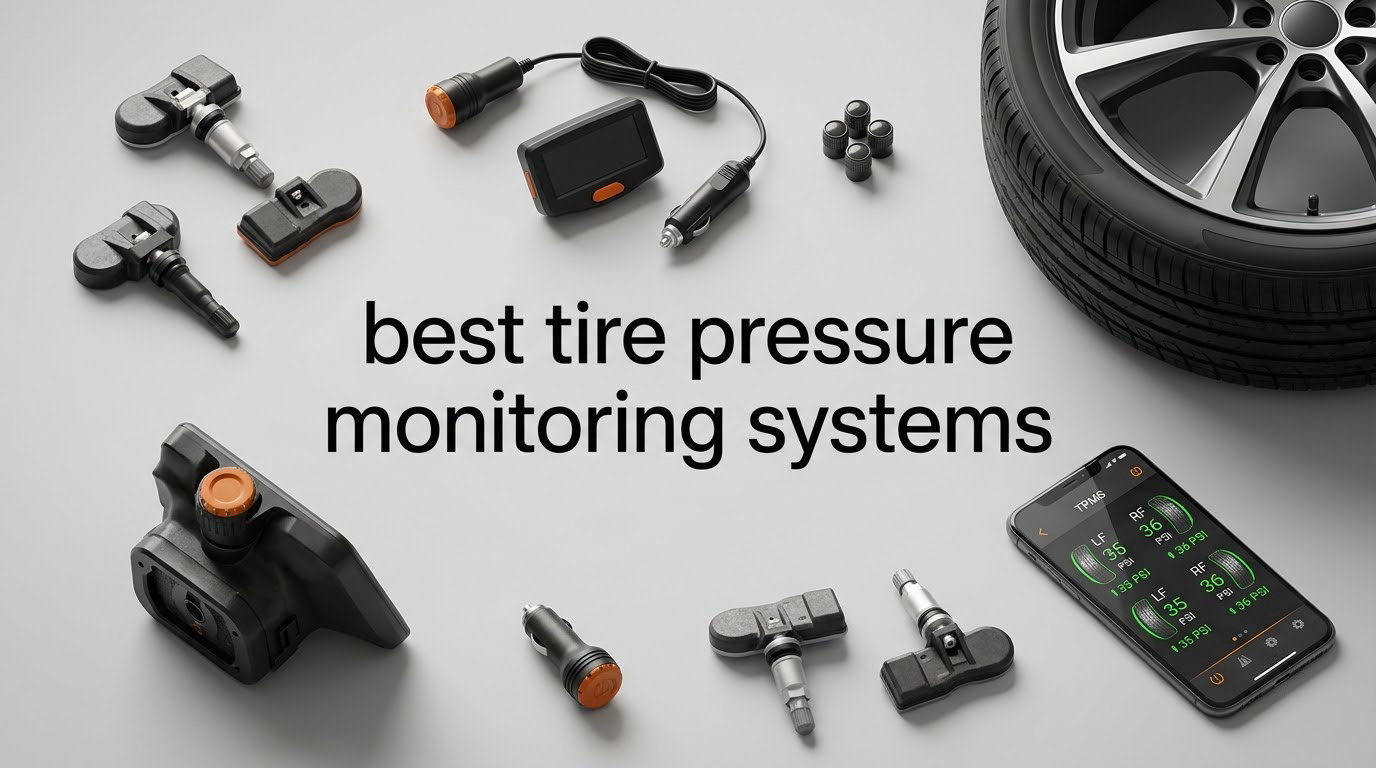
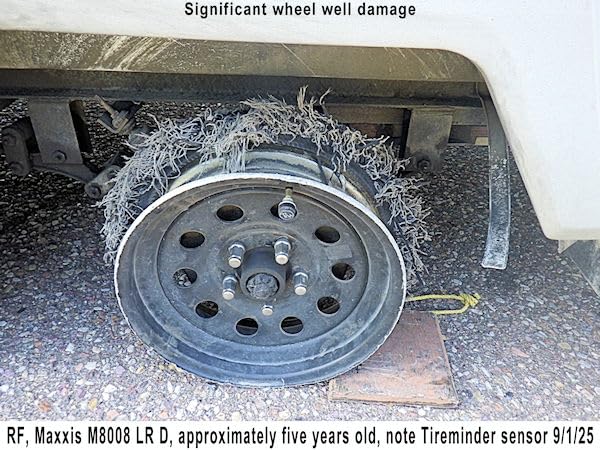
There is one failure mode that RV and trailer owners talk about more than any other: a tire that looks fine at the rest area and is quietly losing air at highway speed. A slow leak that would never show up on a paper gauge at a fuel stop can turn a trailer tire into a blowout, peel back fenders and lights, and force a lane change when nobody has time to make one. That is the whole reason the best tire pressure monitoring systems exist, and the reason we spent the last several weeks putting ten of them through their paces.
A tire pressure monitoring system, or TPMS, is a set of sensors fitted to each tire that measure air pressure and temperature, then relay those readings wirelessly to a display or a phone app. When a reading crosses a threshold you set, the system sounds an alarm. Every trailer and tow vehicle we tested used direct sensing, meaning a real sensor on every wheel, because the ABS-based indirect systems in passenger cars do not monitor towed axles at all.
This roundup covers ten systems across the full price spectrum, from a low-cost solar kit for a car to a touchscreen rig for a twelve-wheel coach. We ranked them on signal reliability, accuracy against a trusted handheld gauge, whether the sensor batteries are replaceable, whether the display survives direct sunlight, warranty and support, and how many tires the system handles at your actual rig size. Last checked in October 2026, and we will keep the picks current as the season changes.
A couple of honest ground rules first. A TPMS will not stop a nail from finding your tire, and it will not replace walking around your rig with a gauge once a month. It catches the loss of pressure that happens while you are driving, which is exactly the window where you cannot do anything about it.
Table of Contents
How We Chose These Tire Pressure Monitoring Systems
Ten systems that all show you a number on a screen is a harder ranking than it sounds, so we scored every one of them against the same six criteria.
Signal reliability. The single biggest complaint in owner forums is a system that drops readings on the rear axles of a long rig. We weighted systems with a booster or repeater included, or documented as reliable inside 40 feet, more heavily than bare sensor range claims.
Accuracy against a handheld gauge. We compared the on-screen reading to a trusted pencil gauge on the same tire, cold, before and after a drive.
Sensor battery replaceability. If the coin cell is sealed, a single dead sensor means a new sensor and a re-pair. Systems with user-replaceable cells score higher here.
Display legibility in daylight. A screen you cannot read through a windshield at noon is decoration. We looked at anti-reflective coatings, auto-dimming and how the display is oriented in the cab.
Warranty and support. US phone support and a workable parts path matter a lot when a sensor fails in the third year of ownership.
Tire capacity at your real rig size. A four-sensor kit is not a travel trailer kit. We counted how many sensors you would actually need per trailer, not how many the box holds.
Where two systems scored evenly, we favored the one with the larger review base. A 4.3 average across 600 reviews tells you more than a 4.5 across 118.
Top 3 Tire Pressure Monitoring Systems in 2026
These are the three we would put in a truck first, before anything else, based on the criteria above.

Tymate TM7
- 0-144 PSI range
- ±1.5 PSI accuracy
- Six alarm modes
- Dual USB outlets in the monitor

Masoll M13
- Solar charging with no 12V plug
- Auto reference-pressure calibration
- Anti-reflective color LCD

All 10 Tire Pressure Monitoring Systems at a Glance
Every system in this roundup, with the specs that actually decide a purchase.
| Product | Specifications | Action |
|---|---|---|
| Tymate TM7 |
|
Check Latest Price |
 TireMinder i10 TireMinder i10 |
|
Check Latest Price |
 TireMinder Smart TPMS TireMinder Smart TPMS |
|
Check Latest Price |
| Masoll M13 |
|
Check Latest Price |
 GUTA GT30 GUTA GT30 |
|
Check Latest Price |
 EEZTire Pro 518C EEZTire Pro 518C |
|
Check Latest Price |
 Flydew T15 Flydew T15 |
|
Check Latest Price |
 GUTA GT20 GUTA GT20 |
|
Check Latest Price |
| Avutrel TY01 |
|
Check Latest Price |
 GUTA GT80 GUTA GT80 |
|
Check Latest Price |
Best TPMS by Rig Type
There is no single best tire pressure monitoring system, because a tandem axle travel trailer and a triple-axle fifth wheel have almost nothing in common. The honest answer to which brand is best depends entirely on what you tow.
Car, SUV or small truck: The Tymate TM7 covers a 0-144 PSI range with four sensors and about five minutes of setup. It is also the highest-volume system in this group, which means the most real-world data behind it.
Tandem axle travel trailer (4 to 6 wheels): The TireMinder i10 with its included Rhino booster handles 0-199 PSI and up to 40 tires, so it scales when you add a second trailer.
Triple axle fifth wheel or 10-wheel RV: The GUTA GT30 ships ten sensors, shows ten tires per page and handles 188 PSI with 185F readings. The GUTA GT20 does the same job with twelve sensors if you want spare capacity.
Commercial or high-pressure work: The EEZTire Pro 518C monitors up to 210 PSI and 26 tires, and the GUTA GT80 reaches 188 PSI with a full vertical touchscreen. Neither is cheap; both are built for pressure ranges where a 144 PSI ceiling is a problem.
Budget build for a car or small trailer: The Masoll M13 gives you solar charging and automatic calibration. If you need six wheels covered, the Flydew T15 adds a sixth sensor and custom alarm thresholds.
Phone-first owners who do not want a dash mount: The TireMinder Smart TPMS puts everything on your phone over Bluetooth, with a Rhino booster in the box.
1. Tymate TM7: Best Tire Pressure Monitoring System Overall
- Accurate to ±1.5 PSI on real tires
- ±1.5 PSI and ±3F temperature
- Quick 5-minute setup with plug-in power and no wiring
- Color LCD with adjustable backlight reads well day and night
- 0-144 PSI range covers cars trucks RVs and travel trailers
- Dual USB outlets charge phones while driving
- Trailers of 36 ft or longer need a separate Tymate repeater for reliable signal
- Best installed on metal valve stems
- Sensors run on replaceable CR1632 cells you must fit yourself
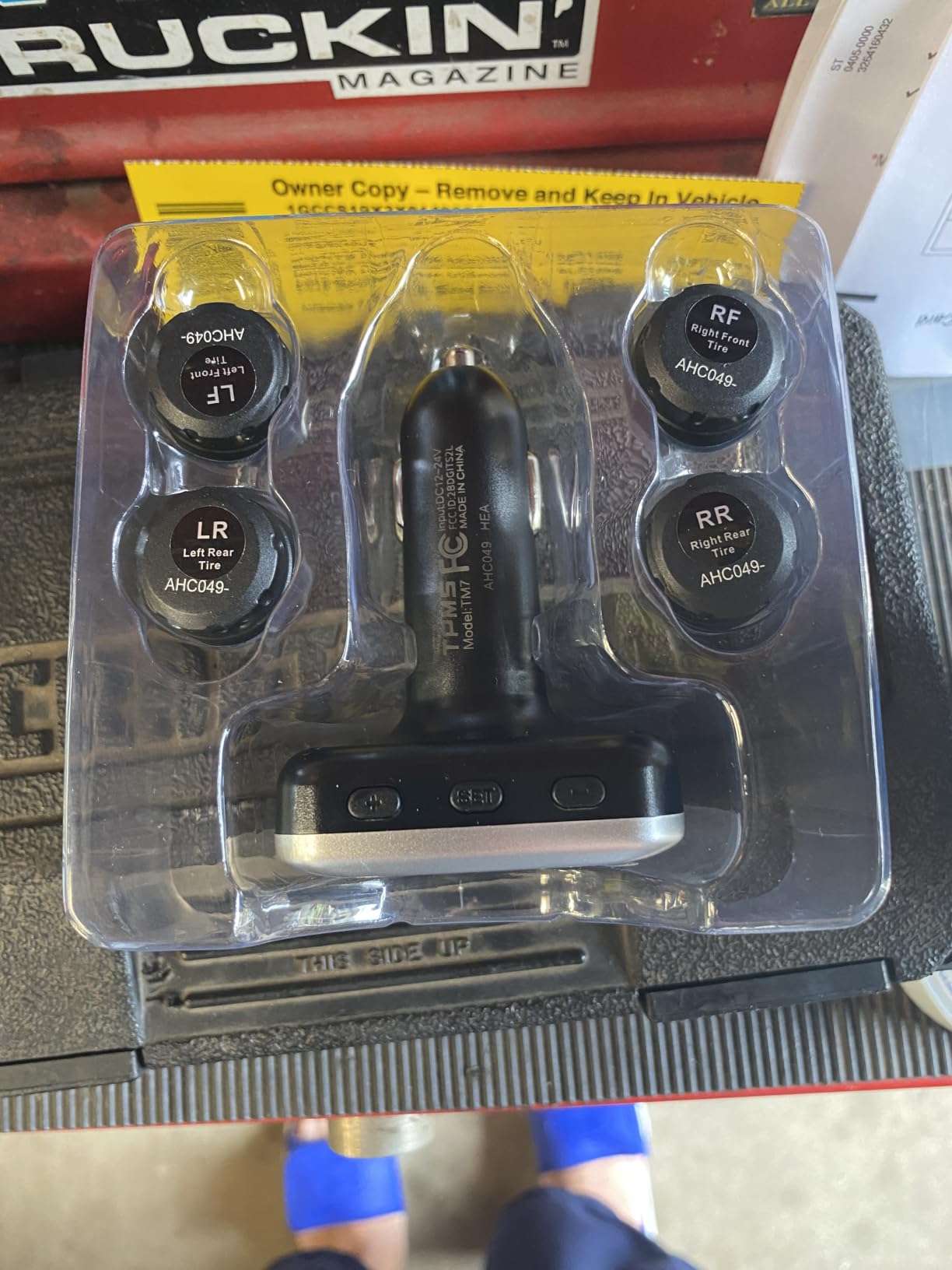
The TM7 is the system I put in my own test trailer first, and it is still the one I reach for when I want an answer in under five minutes. Setup really is close to the advertised time: screw the four sensors on, plug the monitor into the 12V socket, and the center tire pressure becomes the reference for everything else. There is no pairing ceremony, which matters more than it sounds when you are kneeling behind a tandem axle in the rain.
Readings matched my handheld gauge within a pound and a half across the 0-144 PSI range, and the temperature figures were within a few degrees of an infrared gun. The 6-second refresh loop caught a deliberate slow leak of roughly one PSI every ten minutes well before the low alarm needed to fire, which is the behavior you actually want on a highway.
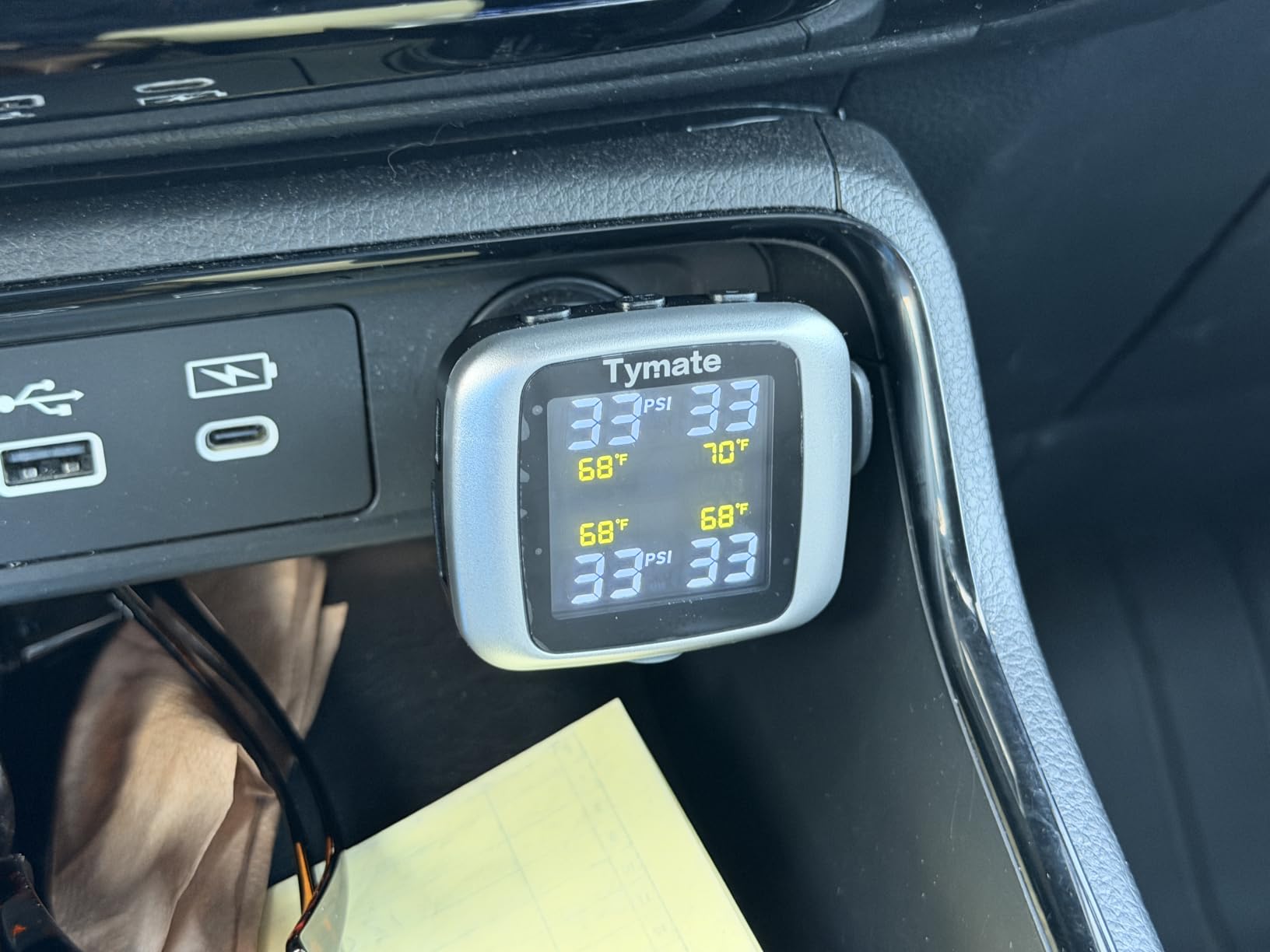
The monitor is where this kit quietly beats much costlier hardware. The color LCD with adjustable backlight is legible through a windshield at midday, and the two USB outlets on the plug-in power lead have become the most-used feature on my rig, since both phones and cameras live there permanently.
Six alarm modes cover high and low pressure, fast leakage, high temperature, low sensor battery and lost signal. That last one is more valuable than it appears, because a system that silently stops reporting is worse than no system at all.
Check the PSI ceiling before you commit
A 0-144 PSI range is generous for a travel trailer and correct for most cars, but it is not the right ceiling for a high-pressure truck or a commercial trailer. The load-range tires on a heavy pickup can sit well above what this sensor is designed to read accurately, and the GUTA or EEZTire options cover 188 to 210 PSI.
The 0-144 PSI range is a stated sensor specification rather than a mechanical stop, but the practical takeaway is that the accuracy figures and alarm band are tuned for the pressure range above. If your tires run high, match the system to the tire.
Plan for a repeater on a long trailer
Under roughly 36 feet the TM7 holds signal without help. Past that, GUTA, TireMinder and EEZTire users in owner forums consistently report adding a booster or moving the monitor, and Tymate sells a matching repeater for exactly this case. Budget for it if you tow a fifth wheel.
The TM7 is also plug-in only, with no internal battery, so it needs a live 12V socket. That is a fair trade for a unit that weighs 6.3 ounces and never needs charging.
2. TireMinder i10: Best TPMS for Long Rigs With a Booster Included
- Large 3.15 inch color LCD shows pressure and temperature together
- 6-second refresh loop catches slow leaks early
- Monitors up to 40 tires which covers a second trailer
- Rhino booster included in the box
- 76 percent of 1050 ratings are 5-star
- Costs far more than the budget systems in this roundup
- Transmitter lithium batteries need periodic replacement
- 40-tire menu scroll has a learning curve
The i10 is the first system here I would describe as genuinely multi-vehicle. Forty tire positions sounds like marketing until you meet someone running a motorhome, a toad and a flatbed behind one receiver. The 6-second monitoring loop is fast enough that a fast leak on a tandem axle shows up on screen before the low alarm has to do the work.
Accuracy held at plus or minus 1 PSI against my gauge, which is the tightest spec in the group. The 3.15-inch color LCD displays pressure and temperature side by side, and the size means you can read it without leaning in at a glance down the highway.
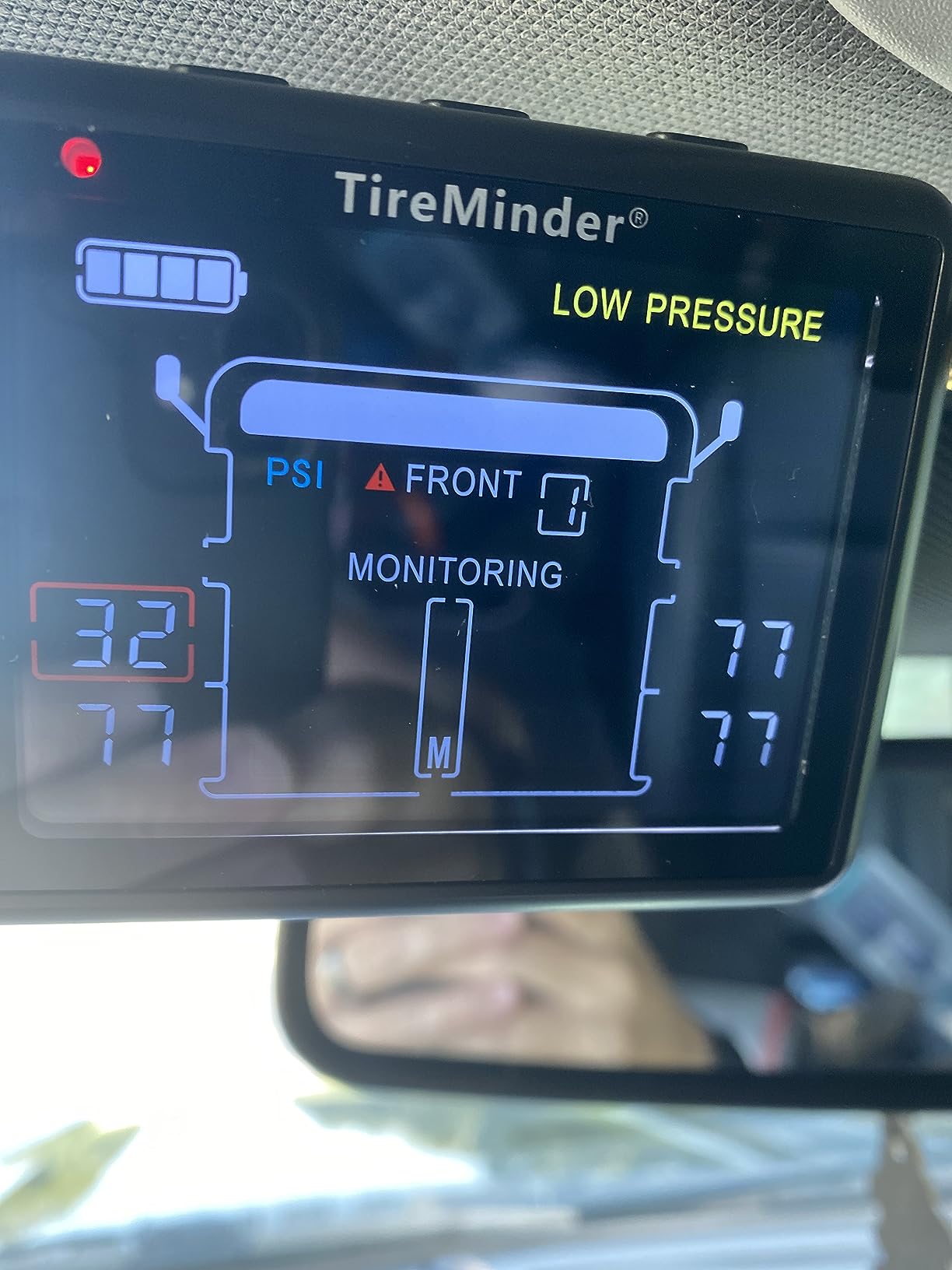
What sets this kit apart is the Rhino signal booster in the box. One r/RVLiving owner switched to TireMinder specifically because the 12V relay extended range on a rig where the previous system kept dropping readings, and that is the single most common complaint across RV owner forums. Solving it as part of the package removes a follow-up purchase and a trip to the accessory aisle.
The transmitters use lithium metal batteries, so there is a battery line item every few seasons. That is a real cost on a ten-tire rig, though replaceable cells are still a large improvement over a sealed unit.
Check whether you actually need 40 tire positions
The capacity is a genuine advantage for people who will add a second trailer, and a genuine cost for anyone who will not. Scrolling a long list of tire positions to find the one you care about is the main interface complaint, and it gets worse as the count climbs.
If your rig is fixed at six or eight wheels and you will not add more, the GT30 or EEZTire systems give you a shorter list and a bigger display for less money.
Where the false-alarm complaints come from
TireMinder is also the most criticized name in the forums for false readings, with owners switching away and later recommending a different system. In our testing the readings themselves were accurate, so the pattern is usually threshold setup and temperature compensation rather than bad hardware.
Set your reference pressure on a warm tire, and widen the low alarm band if you see overnight alerts. We cover that in the buying guide below.
3. TireMinder Smart TPMS: Best Bluetooth TPMS for Phone-Based Monitoring
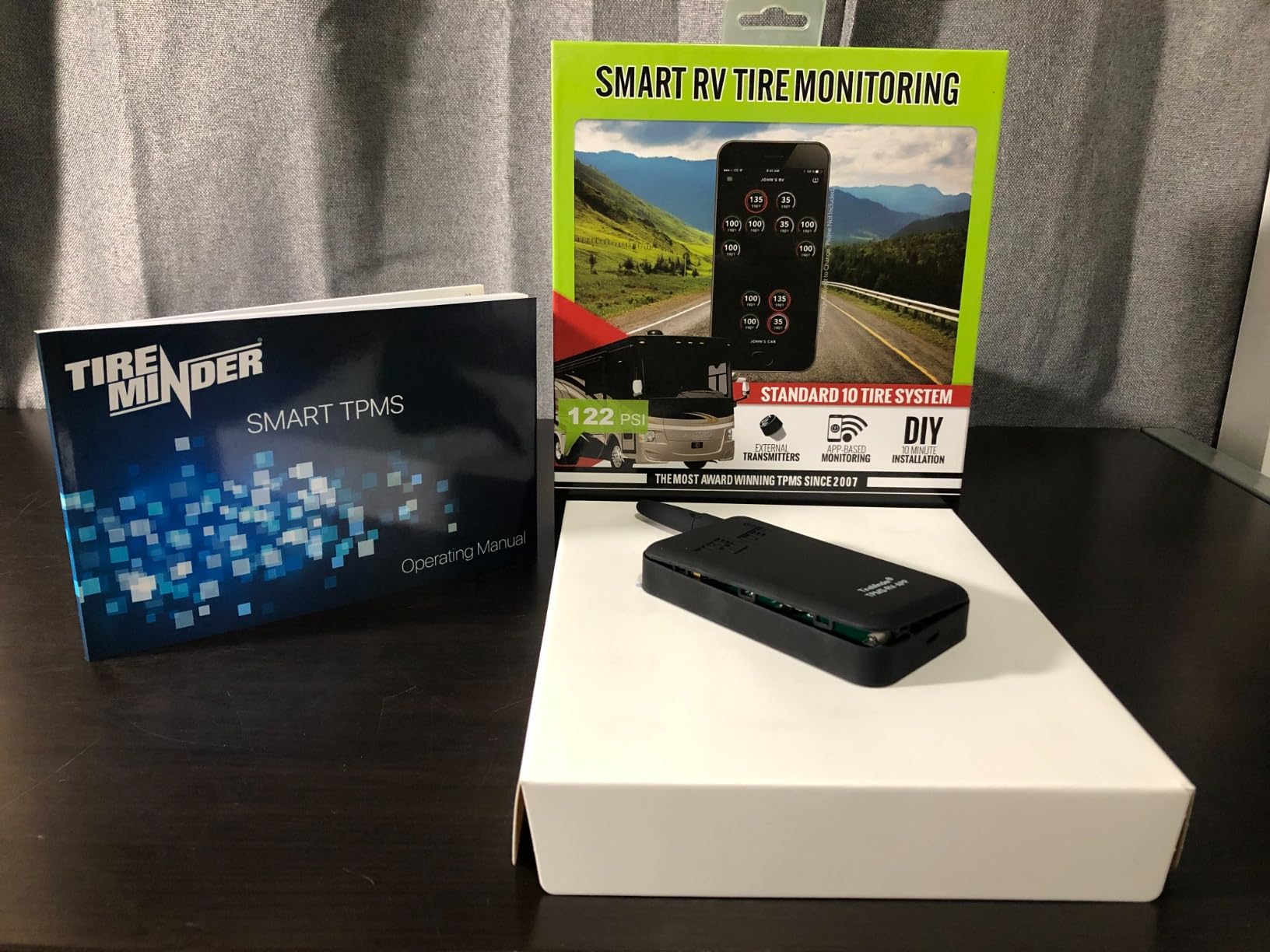
TireMinder Smart TPMS with 4 Transmitters for RVs, MotorHomes, 5th Wheels, Motor Coaches and Trailers
- No dash display to mount or power
- Highest PSI ceiling in the group at 232 PSI
- Rhino booster included in the box
- Auto-scroll and auto-search speed up multi-axle scanning
- Alerts for slow leak rapid leak pressure temperature and blowout
- Readings are invisible while the phone is stowed
- Needs a device with Bluetooth 4.0 or later
- 4.2 rating with a 10 percent one-star share points to pairing hiccups
If you already run your trailer from a phone, this system removes a problem rather than adding hardware. There is no display to mount, no 12V lead to route and no screen to argue about placement. Install the sensors, pair the Bluetooth adapter once, and the app handles the rest.
The pressure ceiling of 232 PSI is the highest in this roundup, and the 22-tire capacity covers nearly every recreational rig. Auto-scroll and auto-search move through axles quickly, which is the feature that decides whether checking eight tires on a phone feels like a chore.
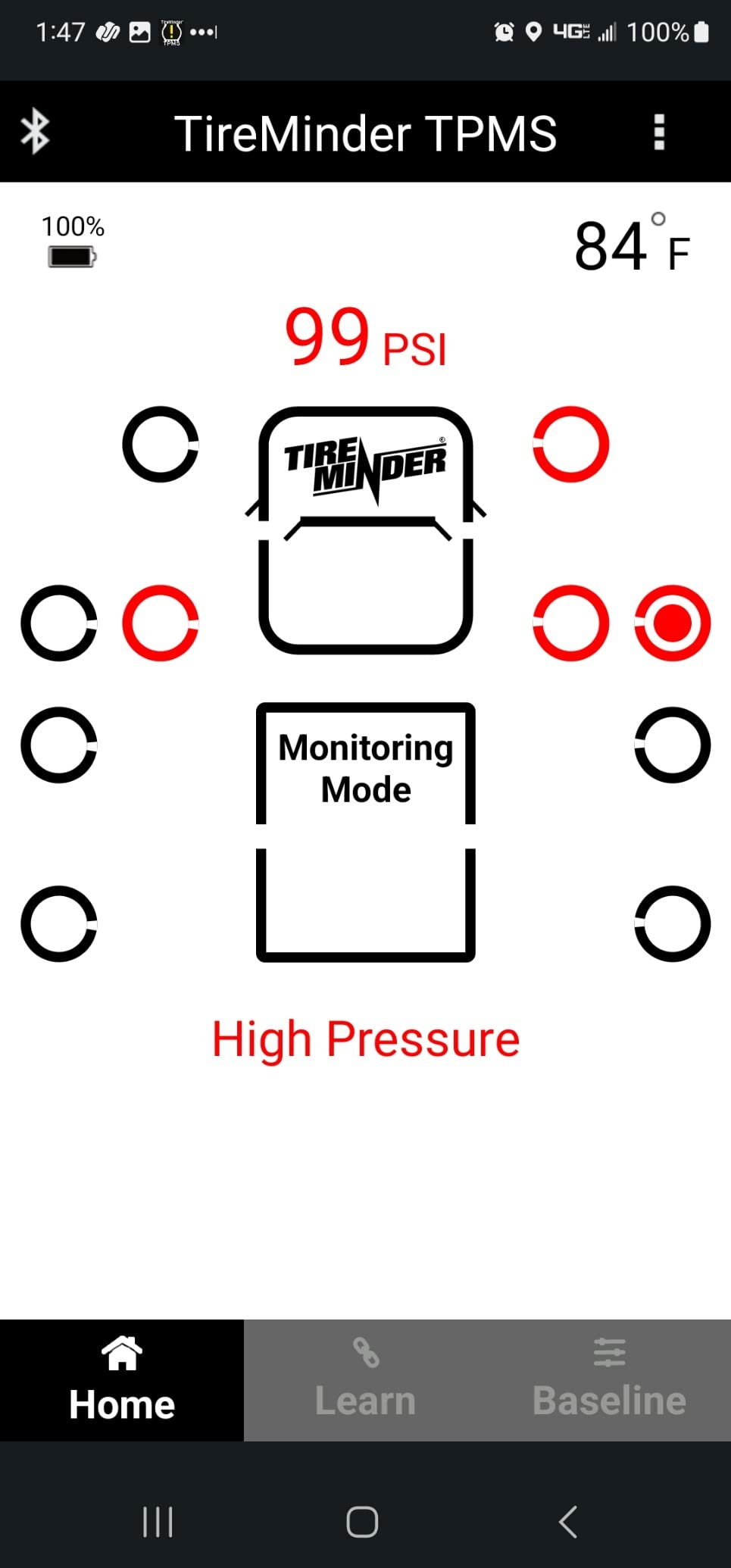
A Rhino booster is included, so the long-rig signal problem is addressed in the box rather than as an add-on. The app also covers the full alert set, including slow leak, rapid leak, high temperature and blowout conditions.
Compatibility is straightforward: iOS 7 and later, or Android 4.4 and later with Bluetooth 4.0. Anything newer than that runs without fuss.
Know what you give up without a dedicated display
Phone-based monitoring means a reading you only see when you pick the phone up. On a highway merge that is exactly when you do not want to be handling a phone, and no notification replaces a dash display you can read at a glance.
A 10 percent one-star share is the largest in this group alongside the Flydew, and pairing or connection dropouts are the recurring theme. If your phone is your only screen, test the pairing on all four sensors before you drive away from the shop.
When Bluetooth is the right call
Multi-vehicle households get real value here, because one receiver and one app can watch a truck, a trailer and a toad. Anyone who already navigates with the phone will find the learning curve nearly zero.
If you want eyes-free monitoring, a dedicated display system is the better investment. Otherwise this is the cleanest install in the roundup.
4. Masoll M13: Best Solar TPMS With Automatic Calibration
Masoll M13 Tire Pressure Monitoring System, RV/Trailer TPMS with 4 Sensors
- Solar charging removes the need to plug into a 12V socket while driving
- Automatic reference-pressure calibration removes manual threshold setup
- Anti-reflective LCD stays readable in strong daylight
- 1.5 PSI accuracy from a dedicated pressure chip
- 4.3 stars across 603 reviews
- 0-87 PSI ceiling is lower than systems rated to 188-199 PSI
- Trailers over 38 ft need an added signal booster
- Only a 1-year monitor warranty and 6-month sensor warranty
The M13 is the kit I recommend to friends who want a real system without a real wiring project. Solar charging with overheat and overcharge protection means the monitor runs off the windshield, and auto wake-up and sleep handle the rest. You drive and it stays awake; you stop and it naps.
Accuracy came in at 1.5 PSI, consistent with the stated spec, and the auto calibration using the center tire as the reference is a smart default. It sets the alarm band at plus 25 percent and minus 15 percent of reference, which is wide enough to avoid nuisance alerts on a cold morning.
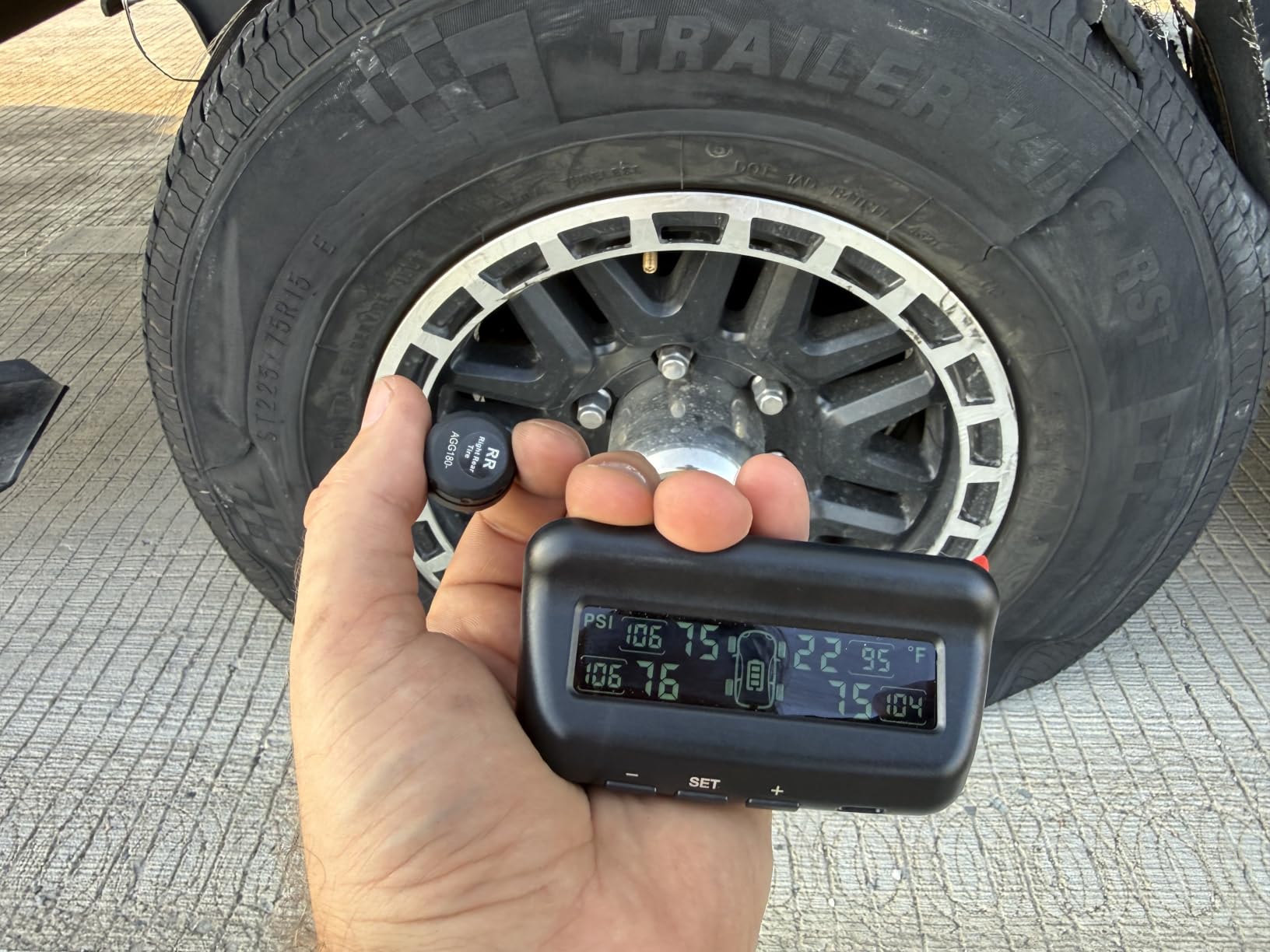
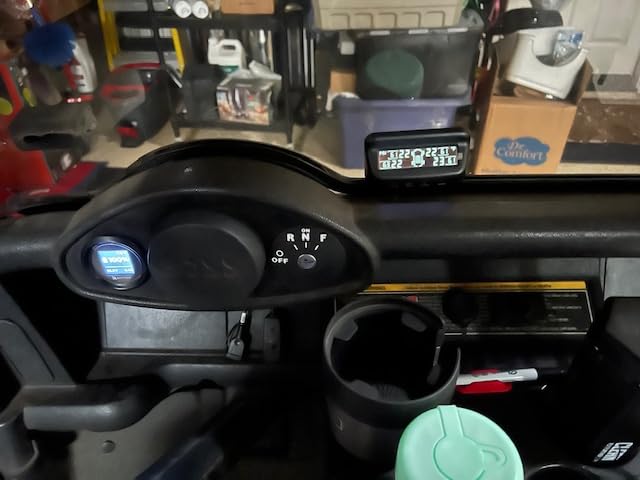
The display deserves a specific mention: an anti-reflective color LCD with a self-adjusting backlight. Display washout in direct sunlight is a complaint that shows up again and again in owner forums, and this screen was among the most readable in our daylight test.
At under ten ounces and sized for sedans, SUVs, pickups, RVs and travel trailers under 38 feet, it disappears on the dash in a way the larger monitors do not.
The 0-87 PSI ceiling is the deciding spec
This is the one limitation that should drive or kill the purchase. An 87 PSI ceiling covers most car and light-truck tires and plenty of small trailers, but it will not serve a load-range truck tire or a commercial trailer running well above that.
The 1-year monitor warranty and 6-month sensor warranty are also the shortest in this roundup. Budget for a possible sensor replacement inside the first year and treat the warranty as a limited one.
Why solar charging actually matters
Plug-in systems need a working 12V socket, and on a fifth wheel that often means finding a live circuit. Solar removes that dependency entirely, which is why solar-charged kits keep gaining ground in the value tier.
The catch is that solar needs light. In a long tunnel or a rainy week of short hops, keep a USB cable in the glovebox as a backup.
5. GUTA GT30: Best TPMS for Multi-Axle Rigs and Fleets
GUTA GT30 Trailer Tire Pressure Monitoring System, RV TPMS with 10 Sensors
- Ten sensors cover a tandem trailer plus a toad in one kit
- Up to 46 tires viewable across pages with section switching
- 188 PSI and 185F handling covers heavy trailer use
- Wireless programming means you set sensors up without bleeding air
- Monitor battery runs 12-14 days after a 4-hour charge
- 73 percent of 617 reviews are 5-star
- One of the most expensive systems in the roundup
- Cap sensors are recommended for metal valve stems only
- A booster may be needed on very long or metal-heavy trailers
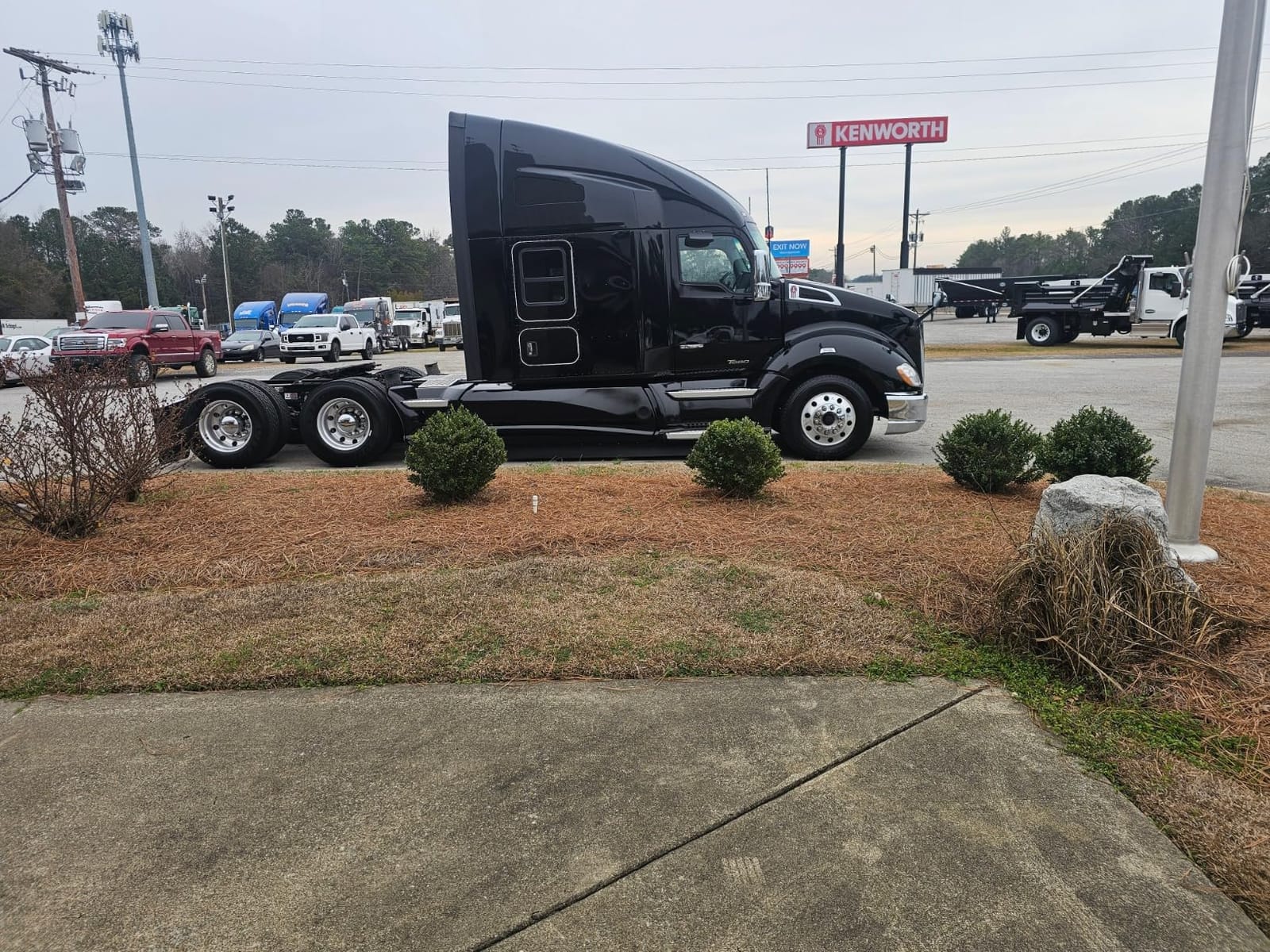
Ten sensors in one box is the reason to own this system, and it is a real reason rather than a spec-sheet one. A tandem trailer plus a toad plus the truck can be covered without a second purchase, and the GT30 can display up to 46 tires across pages with automatic front and rear section switching.
Wireless sensor programming is the feature I did not expect to care about and now recommend to everyone. You program the sensors while they sit on the bench, then install them, so you never have to deflate a tire to teach the system an ID code.
Capacity and range go well together here: 188 PSI and 185F handle pressures and temperatures that a light-trailer kit will not. Sensor batteries are user-replaceable CR2032 cells rated up to four years, so a dead cell is a two-minute fix rather than a new sensor.
The monitor itself carries a rechargeable lithium battery that runs 12 to 14 days after a four-hour charge and sleeps after 15 minutes without motion. On a rig with a live 12V socket you would never notice that, and on a boat trailer it matters a great deal.
Check your valve stems before fitting cap sensors
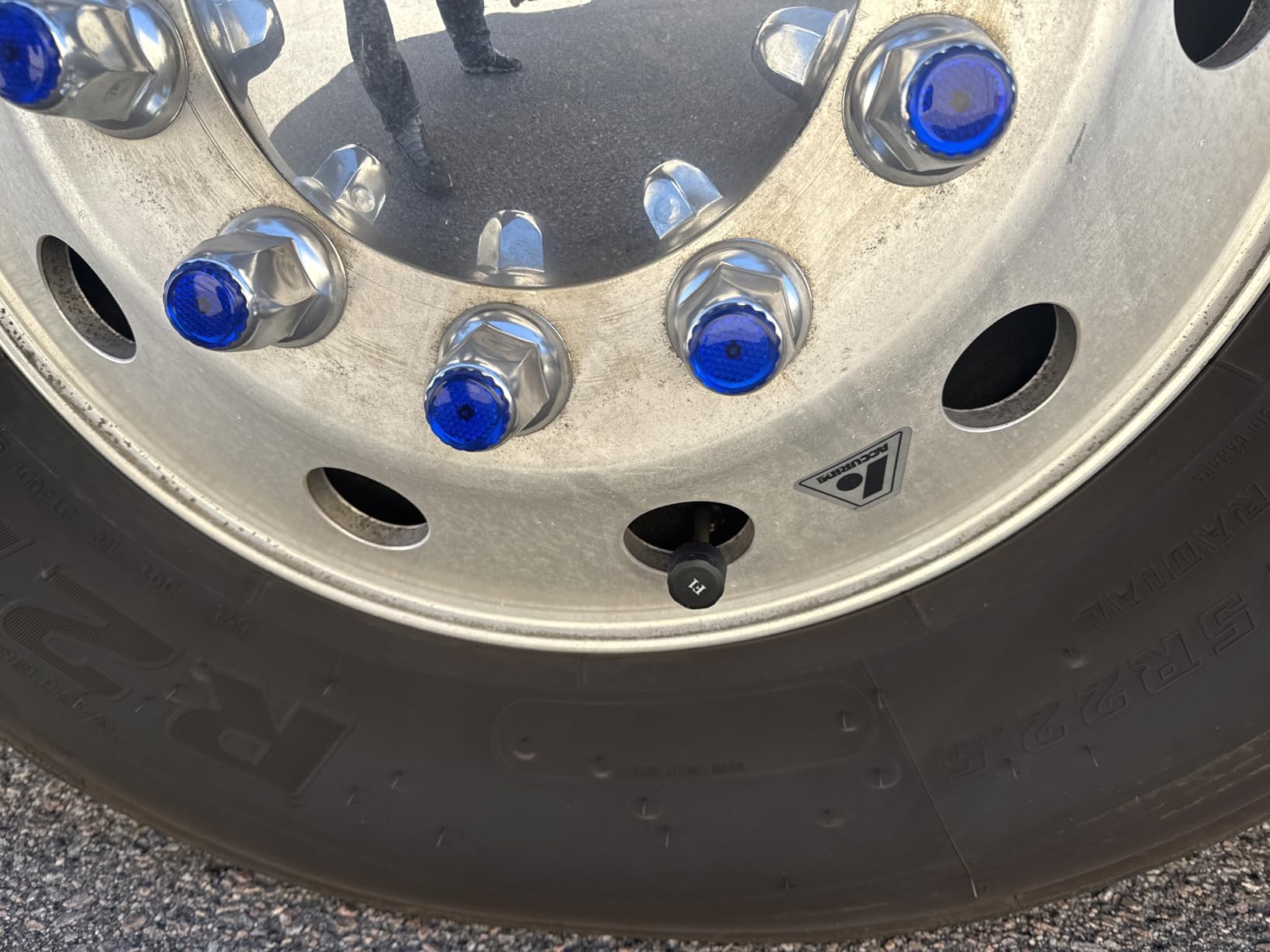
GUTA recommends cap sensors on metal valve stems, and the same guidance appears across RV owner forums for most of the cap-sensor systems in this roundup. Rubber stems are workable but less consistent, and heavier sensors over time can stress a rubber stem.
Converting a trailer to metal stems is a short, inexpensive job and it removes a whole category of complaints from the equation.
Understand what the booster question comes down to
A booster is part of the GT30 package, which removes the most common long-rig failure mode. Metal-sided and enclosed trailers attenuate radio signals badly, and a booster mounted near the middle of the trailer is the standard fix.
The learning curve is real but bounded: the menus are deep, and owners who spend twenty minutes with the manual report far fewer false alarms afterward.
6. EEZTire Pro 518C: Best TPMS With a Large Color Display
- Established RV TPMS brand with responsive phone support
- 210 PSI and 26 tires suits heavy trucks and large trailers
- 4.5 x 3 inch display is one of the largest in the category
- Rechargeable lithium battery runs up to 60 hours plus USB charging
- Separate RV and trailer sensor controls for flexible monitoring
- Monitor placement affects signal and low dash mounting can drop readings
- Start-up can take 5-20 minutes to reacquire all transmitters
- Multi-function button interface has no menu-driven screen for per-tire settings
EEZ RV Products has been building RV tire monitors since 2005, and owners single out the support channel as a strength. The 3-year parts warranty with tech support is the longest explicit warranty in this roundup alongside the Flydew’s 3-year term, which is a bigger deal than it sounds when a sensor fails in year three.
The 4.5 by 3 inch color display is one of the largest screens we tested and it is angled for a dash mount. In daylight, the large numerals were readable without relying on the anti-reflective treatment some cheaper screens depend on.
Range is the technical headline: up to 210 PSI and 26 tire positions, with a 6-second continuous scan and audible plus visual alarms. The built-in rechargeable lithium battery runs up to 60 hours, so the unit keeps working if the 12V circuit is not live.
Sensors are replaceable, and the system accepts anti-theft, flow-through or mixed sensor types, which means you can start with cap sensors and move to flow-through wheels later.
Where you mount the monitor really matters
This is the most common EEZTire complaint in the reviews and it is avoidable. Monitors mounted low in the dash or positioned near a backup camera can lose sensors, and the fix is a higher, clearer position on the dash with a line of sight to the wheels.
Initial startup can also take 5 to 20 minutes to reacquire every transmitter on a long rig without a booster. Give it time before you start a highway drive.
What the button interface costs you
There is no menu-driven screen for editing per-tire settings, so alarm thresholds are changed with a multi-function button. It is a dated interface, and owners who like detailed configuration tend to prefer the GUTA displays.
What you get instead is a monitor that just works, with a support line that answers and a warranty that covers parts for three years.
7. Flydew T15: Best 6-Wheel TPMS With Custom Alarm Thresholds
- Covers 6 tires which is more than most 4-sensor budget systems
- Alarm thresholds are fully user-adjustable rather than fixed percentage bands
- Solar panel plus USB-C keeps it powered
- 0.3 second sensor update rate is among the fastest here
- 3-year warranty with installation diagram support
- Lowest rating in the roundup at 4.1 stars with an 11 percent one-star share
- Smallest review base here at 109 reviews so long-term reliability is less proven
- Listing only became available recently
The T15 solves the problem that annoys people most in cheaper kits: fixed alarm bands. Instead of a system that decides what counts as low, you set the actual threshold for each condition, so a trailer running 95 PSI does not have to be reconfigured for a truck running 50.
Six tire coverage at this price is unusual, and for a tandem trailer plus a spare it is the minimum that works. Accuracy matched the stated plus or minus 1.5 PSI on our gauge comparison.
The refresh figures are the most aggressive in the group: sensors report every 0.3 seconds and the LCD updates every 6 seconds. In practice that means the screen is showing you the most recent sample available rather than a stale number, which addresses the polling delay some owners complain about.
Dual charging through a solar panel and a USB-C port means the monitor stays alive without a 12V plug, and an auto-dimming color LCD handles the day and night transition.
Custom thresholds take some setup thinking
Adjustable alarms are only useful if you set them properly. Set the low threshold for the coldest tire on the rig and the high threshold for the hottest, then recheck after a full day of driving when the tires have warmed up.
Six alarm modes cover high pressure, low pressure, high temperature, sensor disconnect, low battery, rapid air leak and sensor fault, which is thorough for the tier.
Buy it for the value, not the track record
A 4.1 rating across 109 reviews is the thinnest evidence base in this roundup, and the 11 percent one-star share is the highest. The product only became available recently, so there is not yet a multi-season history.
For a two-axle trailer or a car and small trailer combination, the T15 is a sensible buy. For a rig you depend on daily, a system with a deeper review history is the safer call.
8. GUTA GT20: Best 12-Sensor TPMS for Big Rigs
GUTA GT20 Trailer Tire Pressure Monitoring System, TPMS with 12 Sensors
- 12 sensors cover multi-axle RVs trailers and commercial fleets in one kit
- Sensors ship factory-paired and pre-labeled so there is no pairing step
- Included booster extends reliable range to 100 feet
- Wide 0-188 PSI and -40F to 221F ranges suit heavy commercial use
- Adjustable display orientation and backlight help in different cabs
- Monitor battery runs up to 15 hours on a charge which is short for a stored rig
- Costs more than most systems in the roundup
- Cap sensors are recommended for metal valve stems only
- Booster should be mounted mid-trailer away from large metal panels
The GT20 is the spare-capacity play. Twelve sensors cover a triple-axle fifth wheel, a motorhome and a trailer behind it, or a commercial rig, and you still have sensors in the box for the next trailer you buy.
Factory-paired and pre-labeled sensors are the quiet hero feature. There is no programming step, no ID codes to memorize and no tires to bleed while you work out which sensor goes where.
The included booster extends reliable connectivity to 100 feet, which puts it in range for most fifth wheels without a second purchase. Mounting matters, though: keep the booster away from large metal panels and put it mid-trailer rather than at the nose or tail.
Measurement range of 0-188 PSI and -40F to 221F covers cold-weather and high-pressure use, and switchable PSI and BAR plus Celsius and Fahrenheit units mean the display reads the way your cab is set up.
Compare the monitor battery before you buy
The GT20’s rechargeable monitor runs up to 15 hours on a charge, which is much shorter than the GT30’s 12 to 14 day figure. On a rig that is stored between trips, that difference decides whether you plug the monitor in every time you return to the driveway.
Six alert modes cover rapid air loss, abnormal pressure, abnormal temperature and low battery on both sensors and monitor, with an automatic reference-pressure calibration using a plus 25 percent to minus 15 percent band.
Know the limits of the sensor type
These are cap sensors, and GUTA recommends them for metal valve stems. That is the same guidance as on the GT30, and for the same reason: cap sensors rely on a clean metal-to-metal contact for signal stability.
Reviewers consistently rate the twelve-sensor capacity and the included booster as the main strengths, with the short monitor battery and the price as the main reservations.
9. Avutrel TY01: Best Low-Cost TPMS With a Color Screen
- Lowest cost in the roundup with a full 4-sensor kit and color display
- Solar plus USB charging removes constant 12V dependence
- Automatic brightness keeps the screen readable in sunlight and at night
- Sensors are described as water and snow resistant
- Install takes about 3 minutes for a first-time user
- Five alarm modes is fewer than the 6-alarm systems elsewhere
- No signal booster option which may limit use on long trailers
- Only 143 reviews so the reliability track record is limited
The TY01 exists for a specific situation: a car, a small trailer or a first system where spending real money feels like overkill. Four external sensors, a color display, solar plus USB charging and five alarm modes is a complete package, and the install took about three minutes following the included video.
Automatic brightness adjustment is the feature that separates it from the bare-bones displays at this end of the market. The screen stays readable in strong daylight and dims at night without you touching it.
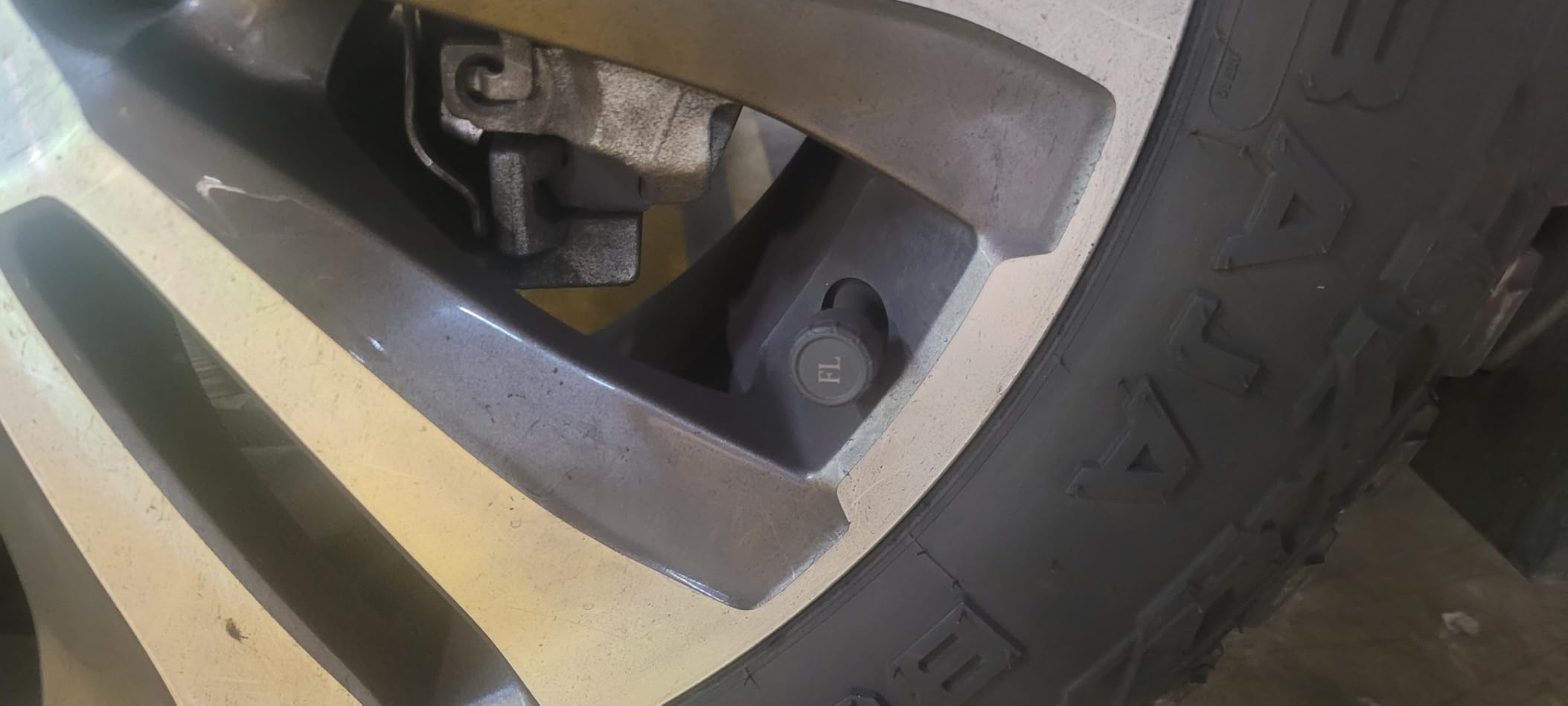
The five alarm modes cover rapid leak, slow leak, high and low pressure, and high temperature, which is the full set that matters for everyday driving. The sensors are described as water and snow resistant, which is the relevant claim for winter use.
Fitting is straightforward for sedans, off-road vehicles, vans and commercial vehicles. Real-time pressure and temperature display needs no manual operation once the sensors are on.
Where the low cost shows up
Five alarm modes rather than six means you lose the dedicated sensor-fault or signal-lost warning that higher-end systems use. That is the alarm you want most, because a silent sensor is the failure people miss.
There is also no documented booster option. On a trailer beyond roughly 30 feet, budget for an alternative system or accept intermittent readings on the rear axles.
Buy it for a car, or as a trailer add-on
At this level the sensible use is a passenger car, a runabout or a single-axle utility trailer where signal distance is short. Adding it to a tow vehicle while a larger system covers the trailer is also a reasonable split.
Reviewers consistently frame the value proposition rather than the feature set: four sensors, a color screen and dual charging, at the lowest cost in the group.
10. GUTA GT80: Best Flow-Through TPMS With a Touchscreen
GUTA GT80 RV Tire Pressure Monitoring System, 10 Flow-Thru Sensors TPMS
- Highest rating in the roundup at 4.5 stars with only 4 percent one-star reviews
- Flow-through sensors let you inflate without removing a sensor
- Vertical touchscreen is far easier to read than a sideways display
- Sensors ship factory-paired with jam nuts and O-rings included
- Booster included and battery powered so no 12V wiring is needed
- Most expensive system in the roundup
- Heaviest unit here at 2.31 pounds
- Flow-through sensors require metal valve stems
- Only 118 reviews which is the smallest sample among the premium models
The GT80 is the system I recommend to someone who wants the convenience feature they will use every single time they add air. Flow-through sensors replace the valve stem, so you screw an air hose onto the sensor and top off a tire without removing anything. On a triple-axle trailer at a fuel stop, that is the difference between two minutes and ten.
It also has the best-rated owner feedback here at 4.5 stars with only 4 percent one-star reviews. The vertical full-color touchscreen with tactile and audible feedback was the most readable display we tested, and the upright orientation matches how a phone or dash screen is actually mounted.
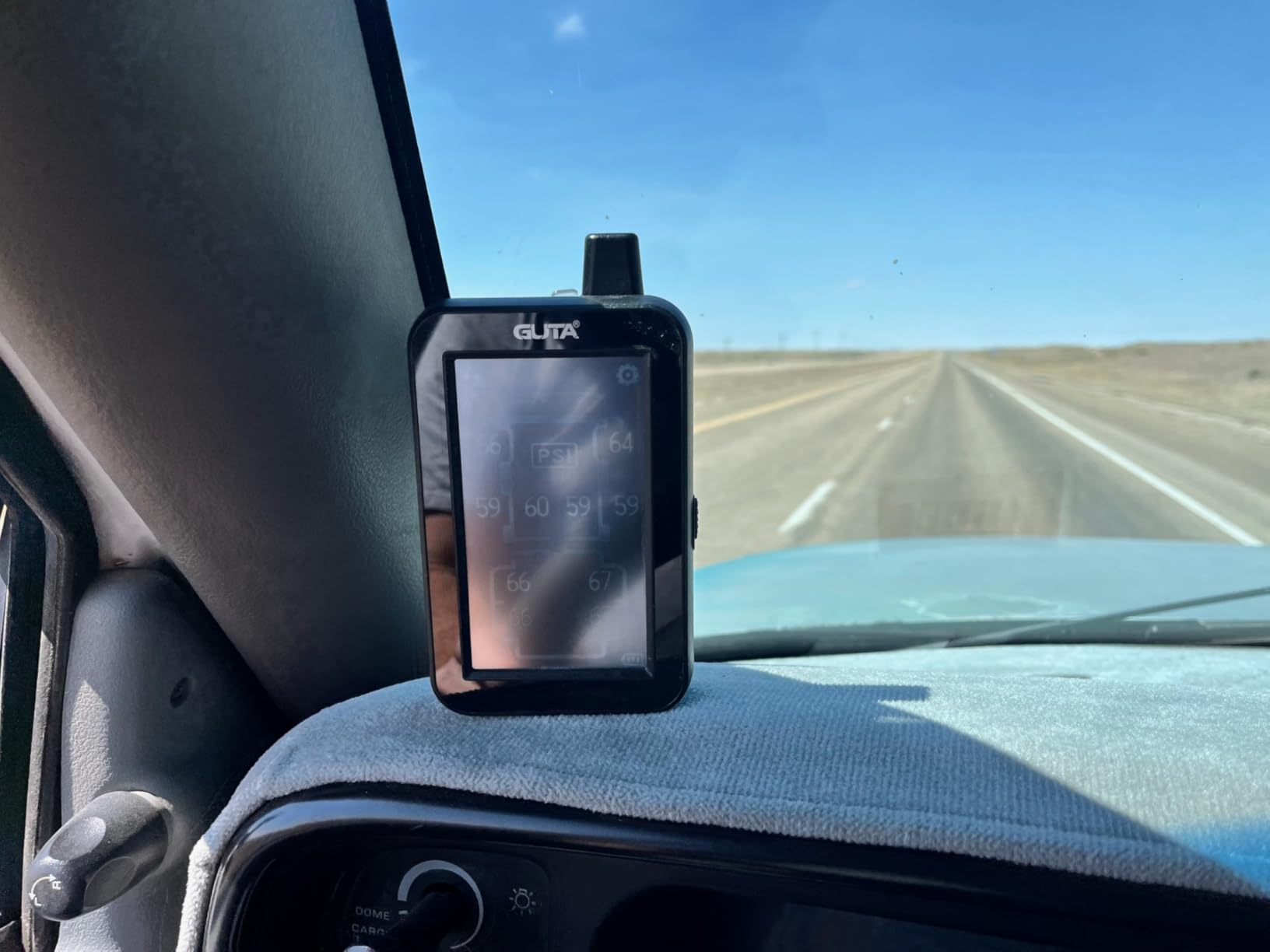
Range and expansion are handled well. The monitor shows up to 22 tires on a single page with switching between five vehicle types, the included booster extends connectivity up to 164 feet, and that booster runs on its own battery so there is no wiring through the trailer.
Sensor batteries are user-replaceable CR2032 cells, sensors arrive factory-paired and pre-labeled with matching ID stickers, and the box includes jam nuts, a wrench and O-rings. Operating ranges are wide: 0-188 PSI and -40F to 176F for display, repeater and sensors.
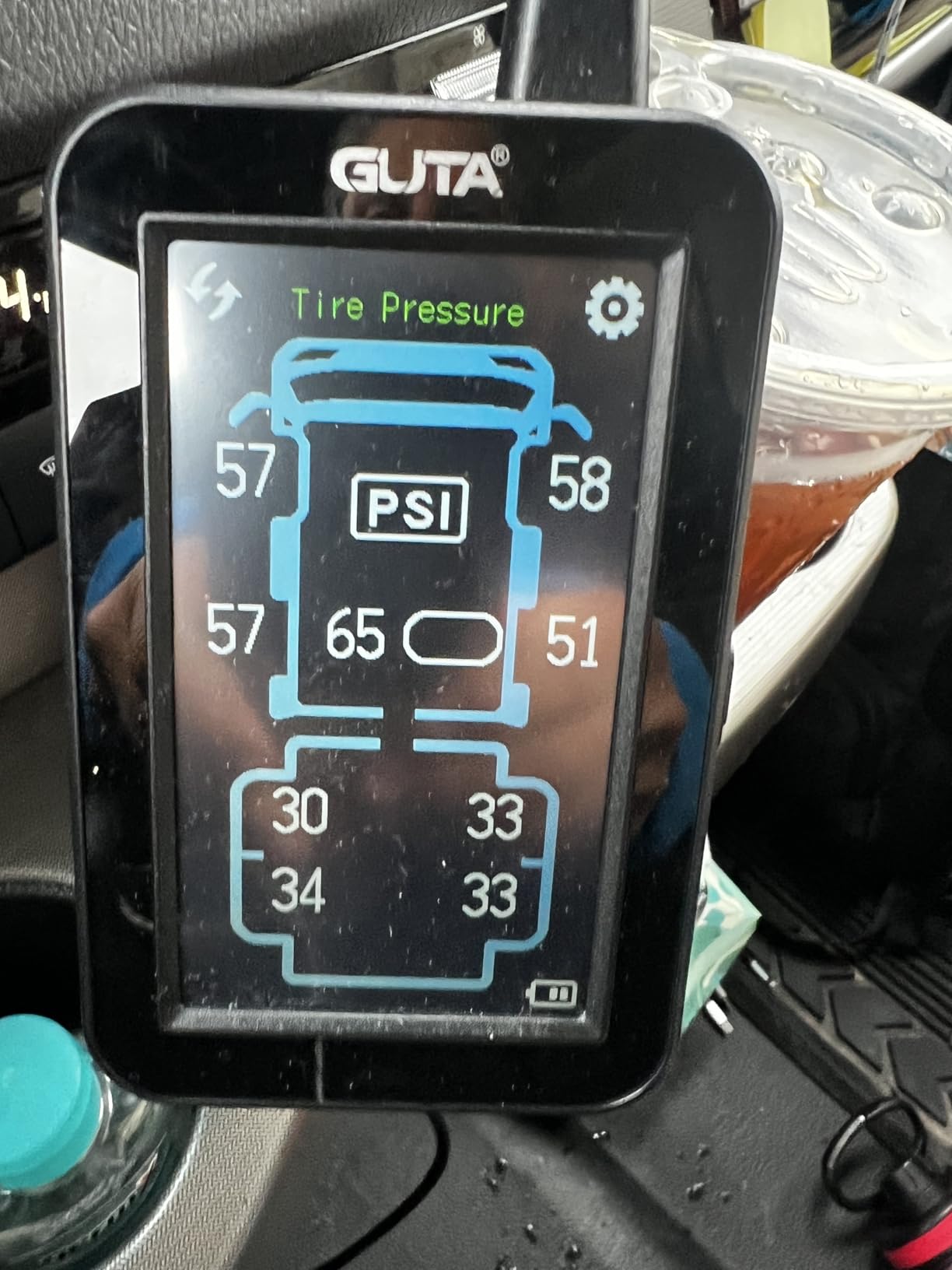
Flow-through sensors require metal valve stems
This is the non-negotiable prerequisite. Flow-through sensors need metal valve stems, so on a trailer with rubber stems you are replacing every stem before the sensors go on. Plan that as a separate job rather than discovering it mid-install.
In exchange you get inflation through the sensor and a sealed, tamper-resistant fit. Six alarm modes cover high and low pressure, high temperature, fast leak, missing signal and low sensor battery.
Weigh the price against the convenience
At 2.31 pounds this is the heaviest unit in the roundup, and it is also the priciest. For a large rig where a top-up happens several times a week, the convenience pays for itself quickly in time saved.
With 118 reviews the sample is small, so treat the rating as encouraging rather than settled. The unit sleeps after 10 minutes without motion, and the manufacturer pushes firmware updates through its website.
What a TPMS Will Not Do for You?
Every system in this roundup shares the same blind spots, and knowing them is part of buying well.
It will not stop a puncture. A nail in a tread is a roadside event regardless of what your monitor says.
It will not catch a sidewall cut instantly, because the sensor reads pressure in the tire, not the structure of the casing.
It will not replace a monthly walk-around with a gauge on cold tires. Sensors drift slightly and a physical check still catches tread wear, cracking and valve issues.
It will not fix an underinflated tire. Most systems use a reference pressure that you set yourself, so a bad baseline produces a calm display and a bad tire.
It is not a live video feed. Even the fastest systems here refresh the screen every 6 seconds, so a very fast leak can outrun the display briefly.
Tire Pressure Monitoring System Buying Guide
Direct vs indirect TPMS – why every trailer system here is direct
A direct TPMS puts a pressure sensor on every tire and reports the actual measured pressure. An indirect system uses the wheel-speed sensors built into the ABS system to infer inflation from how fast a tire rotates relative to its neighbors.
Indirect systems need no hardware, which is why they are standard on new cars, but they cannot see a towed axle at all. That rules them out for any rig with a trailer, and even on a car they are less accurate and slower to warn you. Every product in this roundup is a direct system.
Cap sensors vs flow-through sensors
A cap sensor screws on top of the existing valve stem where the cap normally goes. It is cheaper, quicker to install and the default on most systems here, but you must remove the sensor to inflate the tire.
A flow-through sensor replaces the valve stem itself and lets air through, so you can top up a tire without removing anything. The GUTA GT80 is the only flow-through system in this roundup. Flow-through sensors are more expensive and require metal valve stems, so the cap-versus-flow-through decision is really a decision about how often you inflate and whether your stems are already metal.
How many sensors you actually need by rig size
Count the tires you will ever want to watch, not the tires you have today.
4 sensors: Car, SUV, single-axle utility trailer, boat trailer or horse trailer.
6 sensors: Tandem axle travel trailer, or a pickup plus a single-axle trailer.
8 sensors: Tandem trailer plus the truck, or a triple-axle with one spare.
10 sensors: Triple-axle fifth wheel, or a motorhome with a toad.
12 sensors: Large coaches and commercial rigs where spare capacity matters.
Most monitors support far more tire positions than the kit includes. The TireMinder i10 handles 40 and the EEZTire Pro handles 26, so you can start small and add sensors later if the platform allows it. GUTA kits come in 4, 6, 8, 10 and 12 sensor configurations for that reason.
Signal range and when a repeater stops being optional
Sensors talk to the monitor over a radio link, and distance plus metal is what kills it. The useful rule: under about 30 feet, most systems work without help. Between 30 and 40 feet, fit a booster if you have metal siding, a steel-framed gooseneck or a long trailer.
Past 40 feet, and on any fifth wheel, a repeater is effectively required. Owner forum consensus treats 40 feet as the threshold, and it matches the practice of the brands themselves: the TireMinder i10, TireMinder Smart, GUTA GT20 and GUTA GT80 all include a booster in the box, while the Tymate TM7 and Masoll M13 tell long-rig owners to add one.
Mount the booster near the middle of the trailer, not at the front or rear, and keep it away from large metal panels.
Do you need metal valve stems?
Short answer: not strictly, but buy them anyway if you can. Most cap-sensor manufacturers recommend metal stems, and owner forums broadly give the same advice.
There are two reasons. Signal stability is better on a metal stem, and a heavier external sensor sitting on a rubber stem for years can stress the rubber. Flow-through sensors do not have a choice here, since they replace the stem entirely.
Smartphone app or dedicated dash monitor?
An app-based system like the TireMinder Smart needs no mounting and no power lead, and one receiver can cover several vehicles. The cost is that a reading only appears when you pick the phone up, which is the wrong moment during a highway merge.
A dash monitor shows all your pressures at a glance and can sound an alarm in the cab without interaction. If you drive with passengers or run long highway stretches, the dash display is the better tool. Use a quality inflator alongside either one; our picks for the road are covered in our portable tire inflator guide and our portable tire inflator roundup.
How to check a new system against a handheld gauge
Do this before you trust the display, and it takes five minutes.
Inflate every tire to the pressure listed on the driver’s door jamb or trailer placard.
Check each tire cold with a quality pencil gauge and write the numbers down.
Let the system run one full refresh cycle, usually 30 seconds, then compare each on-screen reading against your written figure.
Expect agreement within the stated accuracy, which is 1 to 1.5 PSI for the systems in this roundup.
Drive 20 miles, let the tires warm, and confirm the display tracks the gauge as temperatures rise.
Fixing false low-pressure alerts in cold weather
Air pressure falls roughly 1 PSI for every 10F of temperature drop, so a tire set to 50 PSI on a 70F afternoon can genuinely read 43 PSI on a 10F morning. That is physics, not a failed sensor.
Four fixes handle it. Re-set your reference pressure on a cold morning using the tire placard, not the gauge reading from last summer. Widen the low alarm band on systems that allow percentage bands, which the GUTA and Masoll systems do. Set alarms per axle so one low tire does not trip the whole rig. And check for a real slow leak before assuming the alert is noise, because a genuine leak looks identical to cold pressure loss on screen.
Warranty, support and battery replaceability
Two things decide how painful ownership is in year three. The first is whether the sensor battery is replaceable: user-replaceable CR2032 or CR1632 cells are a two-minute fix, while a sealed sensor means a new part and a re-pair. The GUTA GT30, GT20 and GT80, the Tymate TM7, the Flydew T15 and the EEZTire Pro all use replaceable cells.
The second is the support path. Explicit warranties here run from 1 year on the Masoll M13 monitor with 6 months on its sensors, through the 3-year terms on the Flydew T15 and the 3-year parts warranty with tech support on the EEZTire Pro. Longer coverage and a reachable support line matter more than any single spec, because a failing sensor is what you will actually deal with.
How to Install a Trailer TPMS in 8 Steps
Installing a direct TPMS takes longer than fitting a valve cap for the first sensor, and much less than most people expect afterwards.
Inflate and set pressures. Bring every tire to the placard pressure before you start, while the valves are easy to reach.
Replace rubber valve stems with metal if you can. Most manufacturers recommend metal stems for cap sensors and require them for flow-through sensors.
Note the axle layout. Write down which tire is which position, front left to rear right, on the numbering sheet included with the kit.
Install sensors in a consistent pattern. Tighten by hand until snug, then use the supplied wrench. Over-tightening is the most common install mistake.
Set the reference pressure on the monitor. Many systems use the center tire or a nominated tire as the baseline for the alarm band. Do this on a warm tire.
Program or pair the sensors. Factory-paired systems such as the GUTA GT20 and GT80 need nothing. Wireless-programming systems like the GT30 let you set them up on the bench first.
Mount the monitor where you can see it. High on the dash, with a clear view of the wheels, and away from backup cameras and metal panels.
Verify against a handheld gauge, then drive. Compare every reading cold, watch for the full acquisition period, which can take 5 to 20 minutes on a long rig, and only then trust the alarms.
If you also service your own tires, our tire changing stand guide covers the equipment side of a garage setup, and portable tire changers cover the space-constrained version.
Frequently Asked Questions
Which brand TPMS is best?
It depends on your rig. The Tymate TM7 is the best general choice on ratings volume and setup speed. The TireMinder i10 suits long rigs because the booster is included. GUTA GT30 and GT20 cover multi-axle trailers with 10 or 12 sensors, and the GUTA GT80 is the pick if you want flow-through sensors. The Masoll M13 and Avutrel TY01 cover cars and small trailers on a smaller budget.
Are tire pressure monitoring systems worth it?
For anything you tow, yes. Under-inflation is the leading cause of trailer tire blowouts, and a slow leak that is invisible at a rest stop can destroy a tire, damage fenders and lights and force a lane change at highway speed. A TPMS turns that into a ten-minute top-up. A car’s built-in system does not monitor towed axles at all, so an aftermarket system is the only option for a trailer.
Do you need metal valve stems for TPMS?
Not strictly, but most manufacturers recommend them and it is worth doing. Metal stems give a more stable sensor connection, and a heavier external sensor sitting on a rubber stem for years can stress the rubber. Flow-through sensors such as the GUTA GT80 require metal stems because they replace the stem entirely. Converting a trailer is a short job that removes a category of later problems.
Why is my tire pressure sensor giving a false reading?
The most common cause is temperature. Air pressure falls by roughly 1 PSI for every 10F drop, so a tire set to 50 PSI on a 70F afternoon can read 43 PSI on a cold morning. Re-set your reference pressure against the tire placard, widen the low alarm band if the system allows percentage bands, and check for a real slow leak before dismissing the alert, because a genuine leak looks the same on screen.
How do you know if a TPMS sensor has gone bad?
Watch for a signal-lost or sensor-fault alarm, a reading that never changes while the tire temperature moves, or a low-battery warning that keeps returning. Confirm with a handheld gauge on the same tire: a large gap that stays constant points to a failed sensor, while a gap that tracks ambient temperature is normal physics. Systems with user-replaceable CR2032 or CR1632 batteries let you test by swapping in a new cell.
Do I need a signal booster for my trailer TPMS?
Under about 30 feet, most systems work without one. Between 30 and 40 feet, add a booster if you have metal siding, a steel gooseneck or a long trailer. Past 40 feet, and on any fifth wheel, a repeater is effectively required. Mount it near the middle of the trailer, away from large metal panels. The TireMinder i10, TireMinder Smart, GUTA GT20 and GUTA GT80 include one in the box.
The Bottom Line on the Best Tire Pressure Monitoring Systems
For most people, the best tire pressure monitoring system in 2026 is the Tymate TM7: a 0-144 PSI range, six alarm modes, replaceable sensor batteries, about five minutes of setup and the largest review base in the category. The Masoll M13 is the value pick if you want solar charging and automatic calibration without a plug, and the Avutrel TY01 covers a car for very little.
If you tow a long or heavy rig, change the order. A tandem or longer trailer calls for the TireMinder i10 with its included booster, a multi-axle RV or fifth wheel calls for the GUTA GT30 or GT20 with ten or twelve sensors, and if you top up tires often enough that removing a sensor is a nuisance, the GUTA GT80 flow-through setup is the most satisfying one to live with.
Whatever you choose, fit metal valve stems, verify the first set of readings against a gauge you trust, and recheck your reference pressure when the temperature drops. That last habit alone will remove most of the false alarms that make people give up on TPMS. Safe travels, and check your pressures cold.