
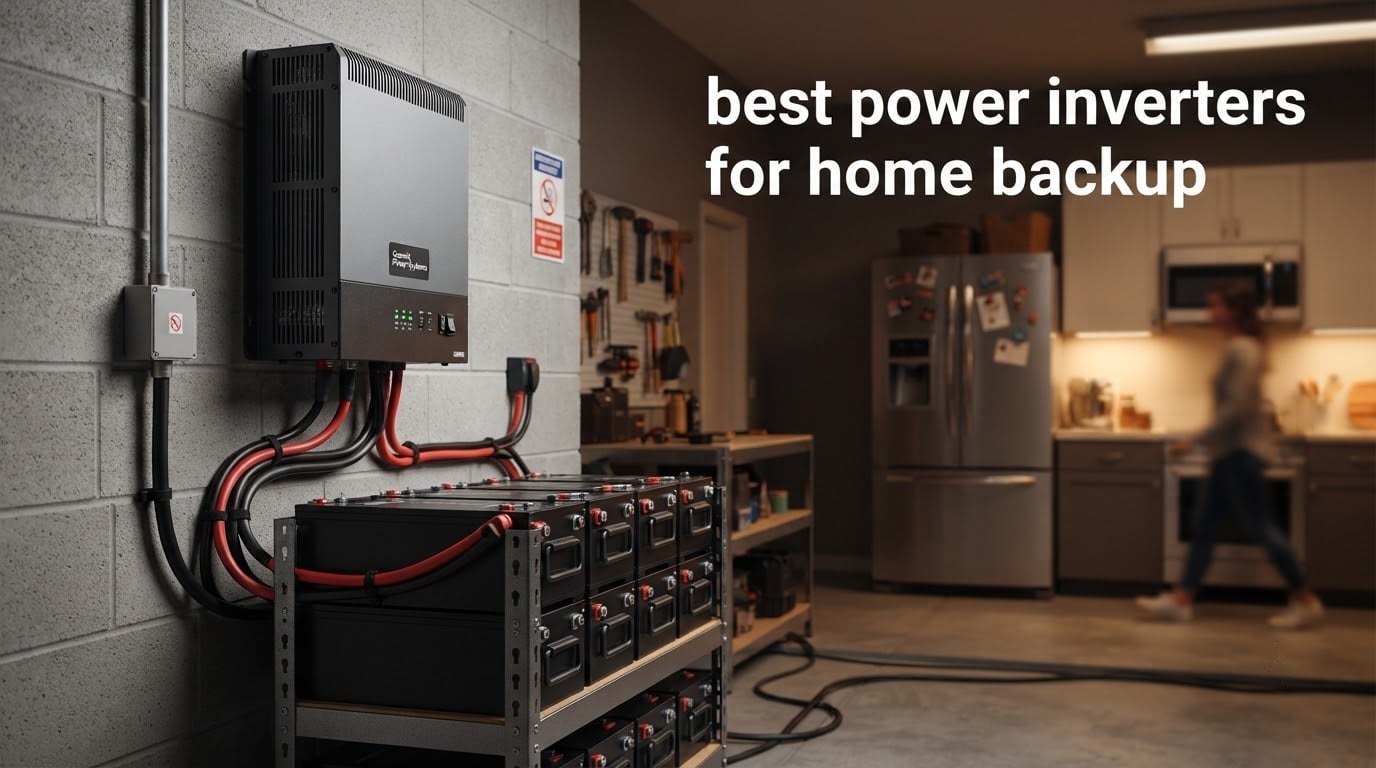
The best power inverter for home backup depends on one thing first: what you actually need to keep running. Most buyers fall into one of three camps, and the right unit for an internet router and NAS is nothing like the right unit for a refrigerator, well pump and medical device during a four-day outage.
Here is the short version. Electronics-only backup needs 1000-1500W of clean output and little else. Critical-loads backup — fridge, internet, lighting, a CPAP machine — needs 2000-3000W with a transfer switch so nothing reboots when the grid drops. Whole-home backup with a central air conditioner, electric water heater or dryer needs a 120/240V split-phase system in the 8000W class, and that is a different category of purchase entirely.
We compared ten pure sine wave and hybrid inverters across continuous and surge output, DC input voltage, waveform type, transfer switching, charge control, idle draw, port selection and warranty length. Every unit below is written for one of those three scenarios rather than a generic score. This guide was updated in October 2026, and we updated it again after the newest hybrid units landed.
If you are still deciding between a battery-backed inverter and a self-contained power station, our guide to the best portable power stations for home backup covers the plug-and-play route. The inverter route is cheaper per watt and far more flexible once you start adding circuits.
Table of Contents
Top 3 Best Power Inverter Picks for Home Backup in 2026

Renogy PUH 3000W
- 3000W continuous
- 6000W surge
- Built-in grid transfer switch
- Bluetooth and wired remote
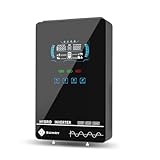
SUMRY HGX 4000W Hybrid
- 4000W continuous at 24V DC
- 140A built-in MPPT charge controller
- Runs loads without a battery

The Renogy PUH wins the top slot because it is the only unit in this group that switches your circuits automatically and has been proven over thousands of buyer reports. The SUMRY HGX takes the solar slot with the highest average rating we saw. The Giandel solves the shore-power GFCI problem that keeps tripping RV and boat owners.
All 10 Home Backup Inverters Side by Side in 2026
| Product | Specifications | Action |
|---|---|---|
| Renogy PUH 3000W |
|
Check Latest Price |
| SUMRY HGX 4000W Hybrid |
|
Check Latest Price |
| Giandel 4000W GFCI |
|
Check Latest Price |
 BELTTT 2000W BELTTT 2000W |
|
Check Latest Price |
 LANDERPOW 3000W 24V LANDERPOW 3000W 24V |
|
Check Latest Price |
 JARXIOKE 5000W JARXIOKE 5000W |
|
Check Latest Price |
 ZETAWALE 4000W ZETAWALE 4000W |
|
Check Latest Price |
 ROARBATT 4000W ROARBATT 4000W |
|
Check Latest Price |
 VEVOR 3000W VEVOR 3000W |
|
Check Latest Price |
 Cantonape 3000W Cantonape 3000W |
|
Check Latest Price |
1. Renogy PUH 3000W — Best Overall Home Backup Inverter with Automatic Transfer Switching
- Built-in on-grid transfer switch for seamless switching
- Bluetooth app plus wired remote for monitoring
- Over 92% conversion efficiency with under 18W no-load draw
- Quiet running below 51dB
- Cooling fans with full voltage
- current and short-circuit protection
- Only one AC outlet on the unit
- A one-year manufacturer warranty
- About 10 percent of reviews are one-star
This is the inverter we kept coming back to. The PUH is a 3000W continuous, 6000W surge pure sine wave unit running off a 12V battery bank, and the reason it sits at the top is the transfer switch built into the chassis. When the grid fails, it hands your load over to the bank without you touching a switch.
Output is clean enough for a NAS, a router and a laptop, and the surge rating covers a refrigerator compressor without drama. Conversion efficiency runs above 92 percent, and no-load consumption stays under 18 watts, which matters if the bank sits plugged in for weeks between outages.
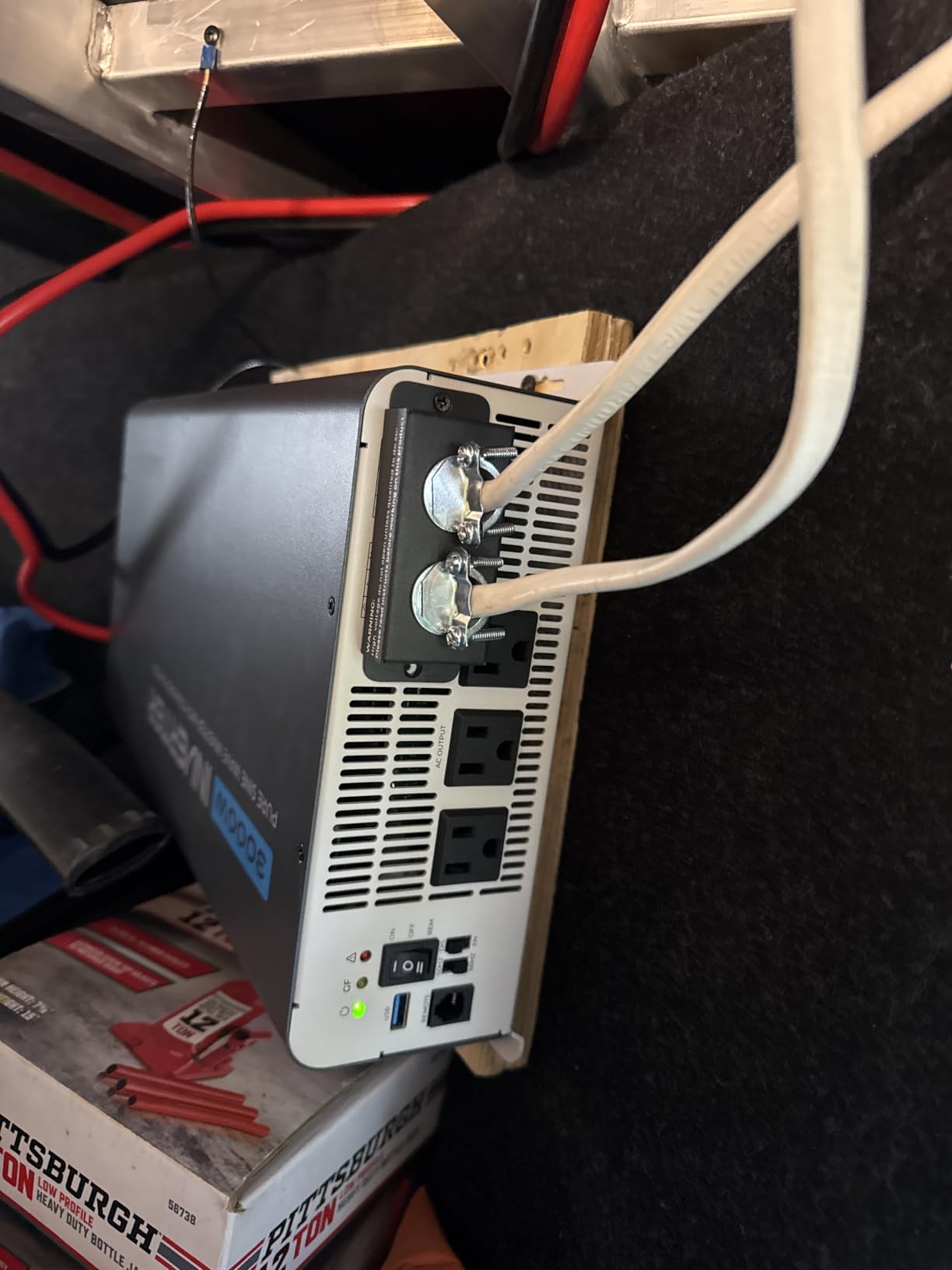
At 14.8 pounds and 19.2 by 10.4 by 3.8 inches, it is bigger than most 3000W units, which is the price of the transfer switch and the fan cooling. Mounting space is worth checking before you commit, especially on a garage wall.
The monitoring is genuinely useful. A Bluetooth app plus a wired remote means you can read output load and battery state from inside the house instead of walking out to a dark garage at midnight. This is the unit to buy if you work from home and cannot afford a five-minute reboot every time a breaker trips.
Who the Renogy PUH suits
It suits homeowners who want a partial-home critical loads panel fed automatically. Fridge, internet, lighting, a home office and a CPAP machine all sit comfortably inside 3000W continuous, and the transfer switch handles the switchover without anyone hunting for a flashlight.
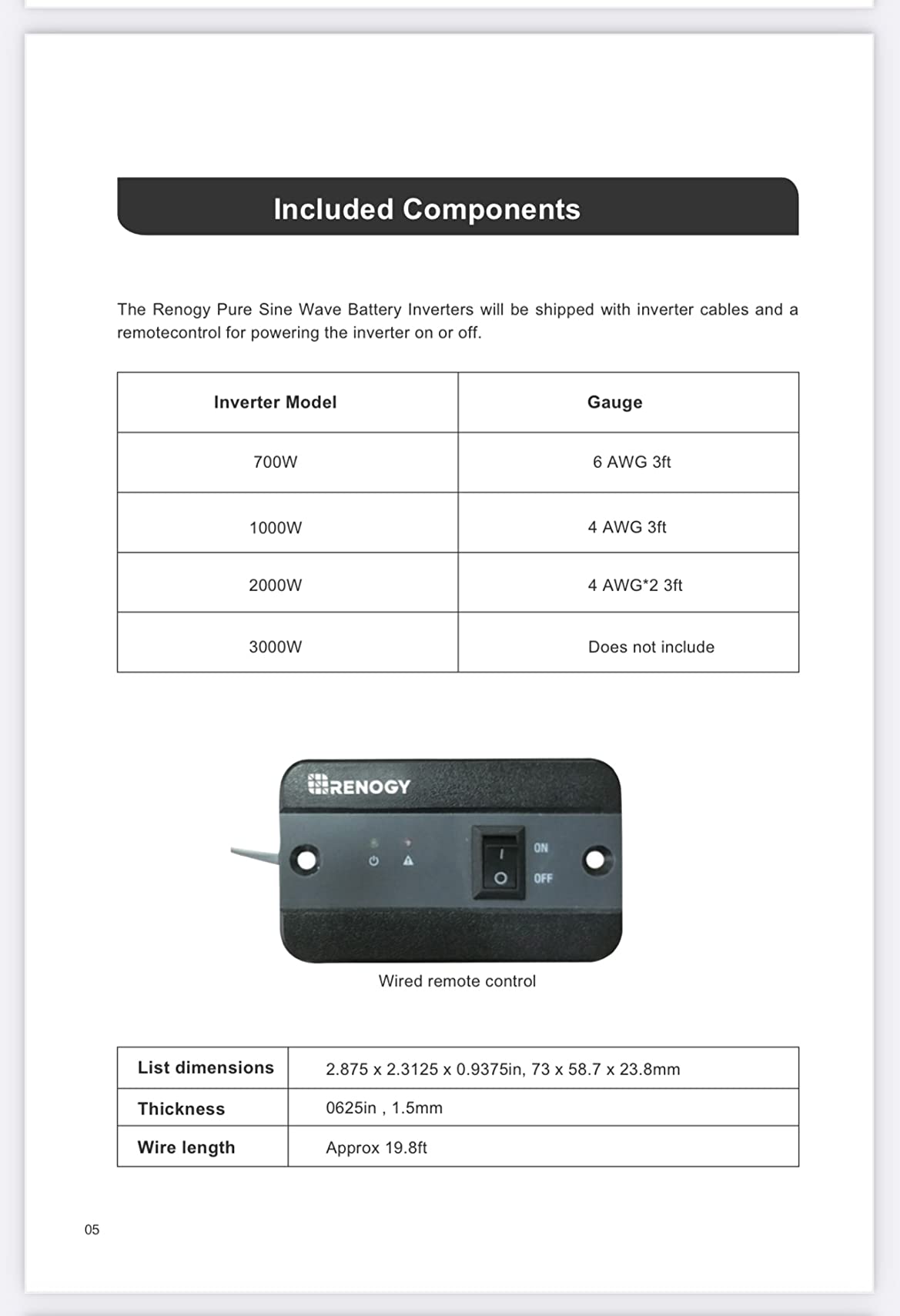
It also suits anyone running a modest solar array who wants monitoring without a separate charge controller. Renogy built in a wired remote with an LED screen plus app control, and the protection suite covers low and high voltage, low and high current and short circuit.
Who should skip the Renogy PUH
Skip it if your plan includes a window air conditioner or a pump. Owners report protection cutouts on demanding loads, and with a single AC outlet on the unit you will be running an extension chain for anything beyond two devices.
The one-year manufacturer warranty is the shortest useful window in this group. If you intend to keep the bank installed year-round, treat that as a reason to look at a longer warranty instead.
2. SUMRY HGX-4KW 4000W Hybrid Inverter — Best for Solar-Charged Off-Grid Backup
- Built-in 140A MPPT controller with up to 5600W PV at 350VDC
- Up to 98 percent conversion efficiency
- Runs loads from PV without a battery when input exceeds 120V
- Configurable solar
- battery and utility priority
- 6.25 inch touchscreen LCD under tempered glass
- Louder cooling fans than premium MPPT solar inverters
- Single-phase 120V only with no 240V split-phase support
- Limited troubleshooting documentation and a digital-only manual
The HGX-4KW is the highest-rated unit we put through this comparison, sitting at 4.7 across 437 reports with an 89 percent five-star share. What earns that rating is the charge controller: a 140A MPPT built into the same box as the inverter, rated up to 5600W of PV at 350VDC.
That combination is what most solar users actually want. One box takes DC from the panels, converts it for the house, and replenishes the bank. You can even run loads straight from the PV input without a battery attached once the array exceeds 120V.
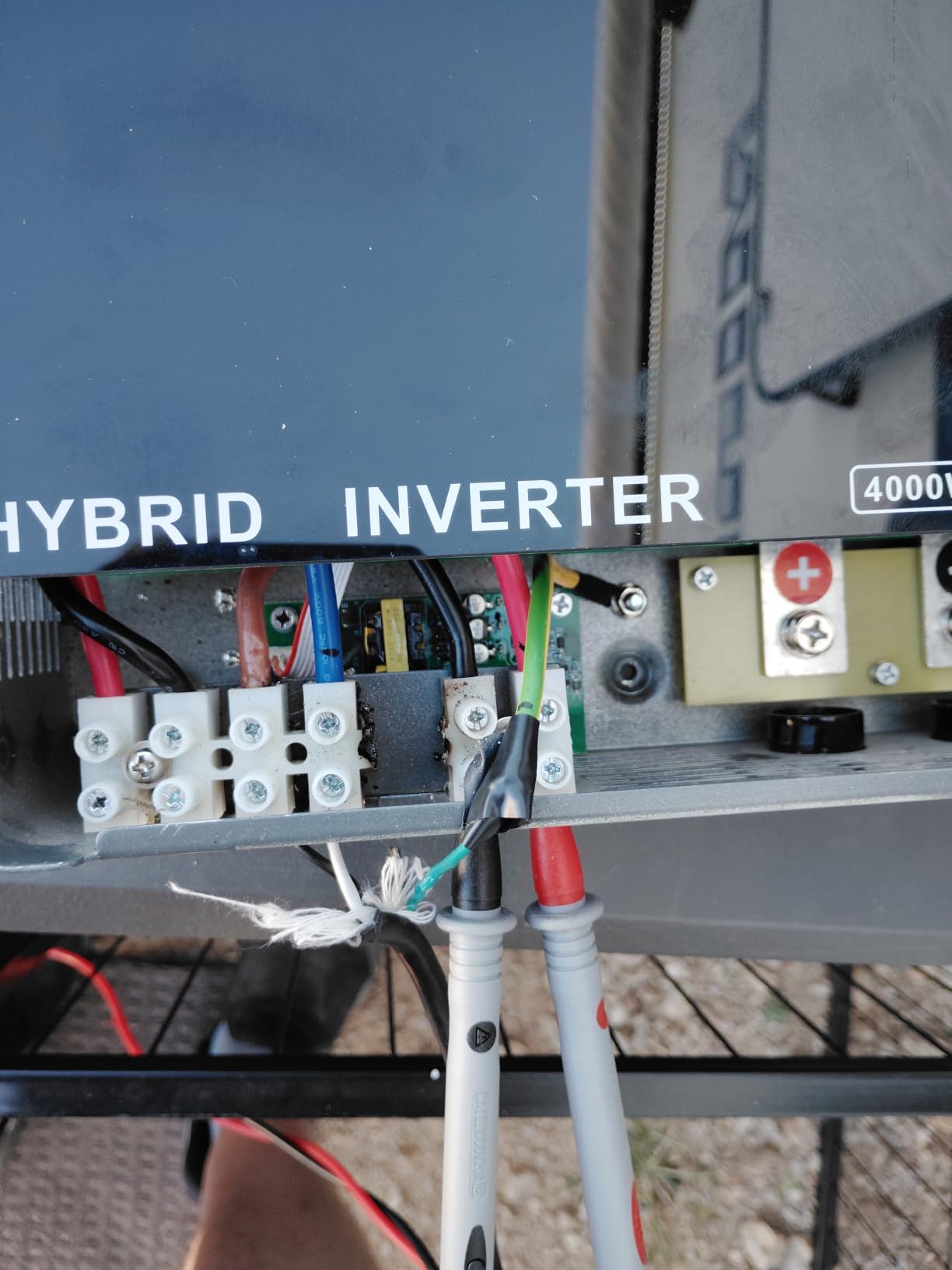
The battery compatibility list is broad — AGM, gel, lead-acid, lithium-ion and LiFePO4 all work, and you set charging priority for solar, battery or utility. At 24V it also draws far less current through your cables than a 12V unit of the same output.
The 6.25 inch touchscreen under tempered glass is unusually large for this class and readable at arm’s length, which matters when you are changing modes in the dark.
Who the SUMRY HGX suits
It suits off-grid cabins, farm builds, workshops and anyone whose solar array should recharge the same bank that carries the house through an outage. The configurable output priority means solar can carry the load first with the battery as reserve, or the reverse when you want maximum storage kept.
At 4000W rated and 8000W peak it also handles a decent partial-home list on its own, and 24V operation keeps cable runs under control in a long building.
Who should skip the SUMRY HGX
Skip it for whole-home 240V loads. This is single-phase 120V only, so a central air conditioner, electric water heater or clothes dryer simply cannot connect to it.
Its three cooling fans are louder than those in premium MPPT solar inverters, and if you plan to install in a bedroom-adjacent space or an occupied office, that trade-off deserves a test listen first. Documentation is also thin, so plan on learning settings from forums.
3. Giandel 4000W GFCI — Best for RV, Boat and Wet-Location Installs
- UL listed 20A GFCI outlets with ground fault protection
- Battery type selectable for LiFePO4
- lead acid and ternary lithium
- Resetable low-voltage cutoff adjustable from 9.5V to 11.5V
- Two remotes including a 30ft wired and a 20m wireless
- 18-month warranty with responsive support
- Several owners report thermal shutdown above roughly 90F ambient
- Surge-sensitive loads such as EV mobile chargers can trip the breaker
- Hardwire romex is no longer a 3-wire direct-connect option
The Giandel solves a specific problem that shows up constantly on RV forums: bonding plug trips when a shore power GFCI-protected load meets a plain inverter outlet. Its 20A outlets are UL listed GFCI receptacles, so window air units and other protected appliances stop cutting out mid-run.
Underneath that is a 2025 patented 4000W design with 7000W of surge held for two seconds, running on a 12V bank at 60 Hz. Conversion is clean pure sine wave, which is what makes it usable for a boat cabin or an RV with a sensitive electronics run.
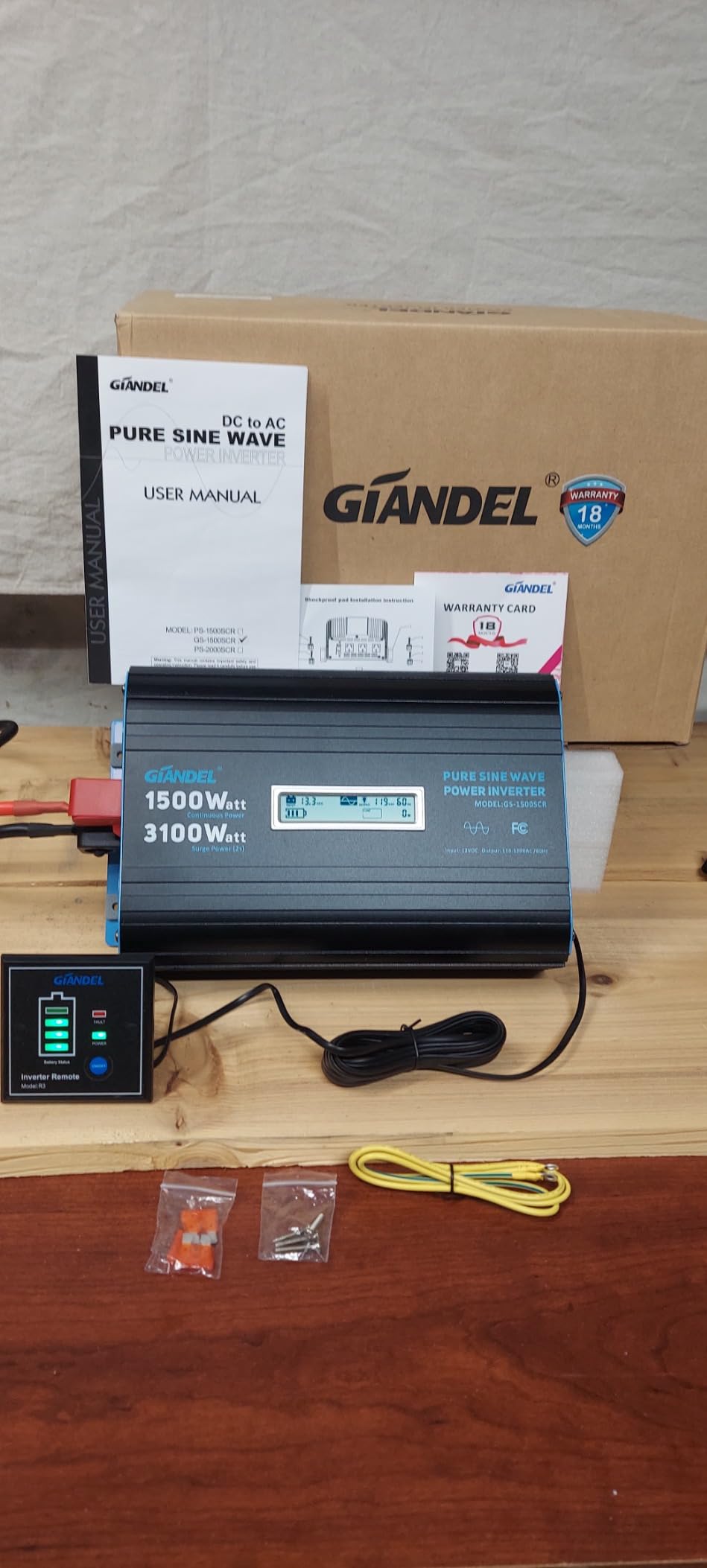
The battery type selector is a real convenience. You can pick LiFePO4, lead acid or ternary lithium profiles, and the resetable low-voltage cutoff is adjustable from 9.5V to 11.5V, so one inverter covers chemistries with very different resting voltages.
Two remotes ship in the box: a 30 foot wired controller and a 20 meter wireless backup. The large LCD sits behind the faceplate with the wiring done in behind it rather than through the case.
Who the Giandel 4000W suits
It suits RV, camper, boat and mobile workshop owners where a GFCI-protected appliance is on the list. It also suits lithium users who want a matching charge profile rather than a generic lead-acid setting.
For a home, the 18-month warranty and adjustable voltage window give it an edge over the one-year units at similar output, and the surge headroom is generous for pumps and compressors.
Who should skip the Giandel 4000W
If your install runs hot, look elsewhere. Several owners report thermal shutdown and breaker trips above roughly 90F ambient, and a garage in the Gulf states hits that regularly. Ventilation planning matters here more than it does for most units.
Surge-sensitive loads also draw complaints — EV mobile chargers in particular have been reported as tripping the breaker. And if you plan to feed the inverter with romex as a 3-wire direct connection, that path is no longer offered.
4. BELTTT 2000W — Best Value Pure Sine Wave Inverter for Electronics Backup
BELTTT 2000W Pure Sine Wave Inverter 12V DC to 120V AC, 4000W Surge
- Over 93 percent conversion efficiency with low no-load losses
- Dual AC sockets plus a 20A outlet
- 5V 2.1A USB and hardwire port
- 23ft remote controller and six 45A fuses included
- Bright LCD showing input and output voltage
- battery and load status
- 2000W continuous is a modest ceiling for whole-home loads
- Only a one-year warranty
The BELTTT is the value pick for anyone whose outage list is electronics plus a small appliance set. It runs 2000W continuous with 4000W of surge, converts at over 93 percent efficiency, and carries both UL and ETL listing — a combination few units at this level bother with.
The accessory bundle is the quiet story here. Two 2AWG three foot battery cables, six 45A fuses, a 23 foot remote controller and a thimble spanner all come in the box, which removes the two things DIY buyers most often buy separately.
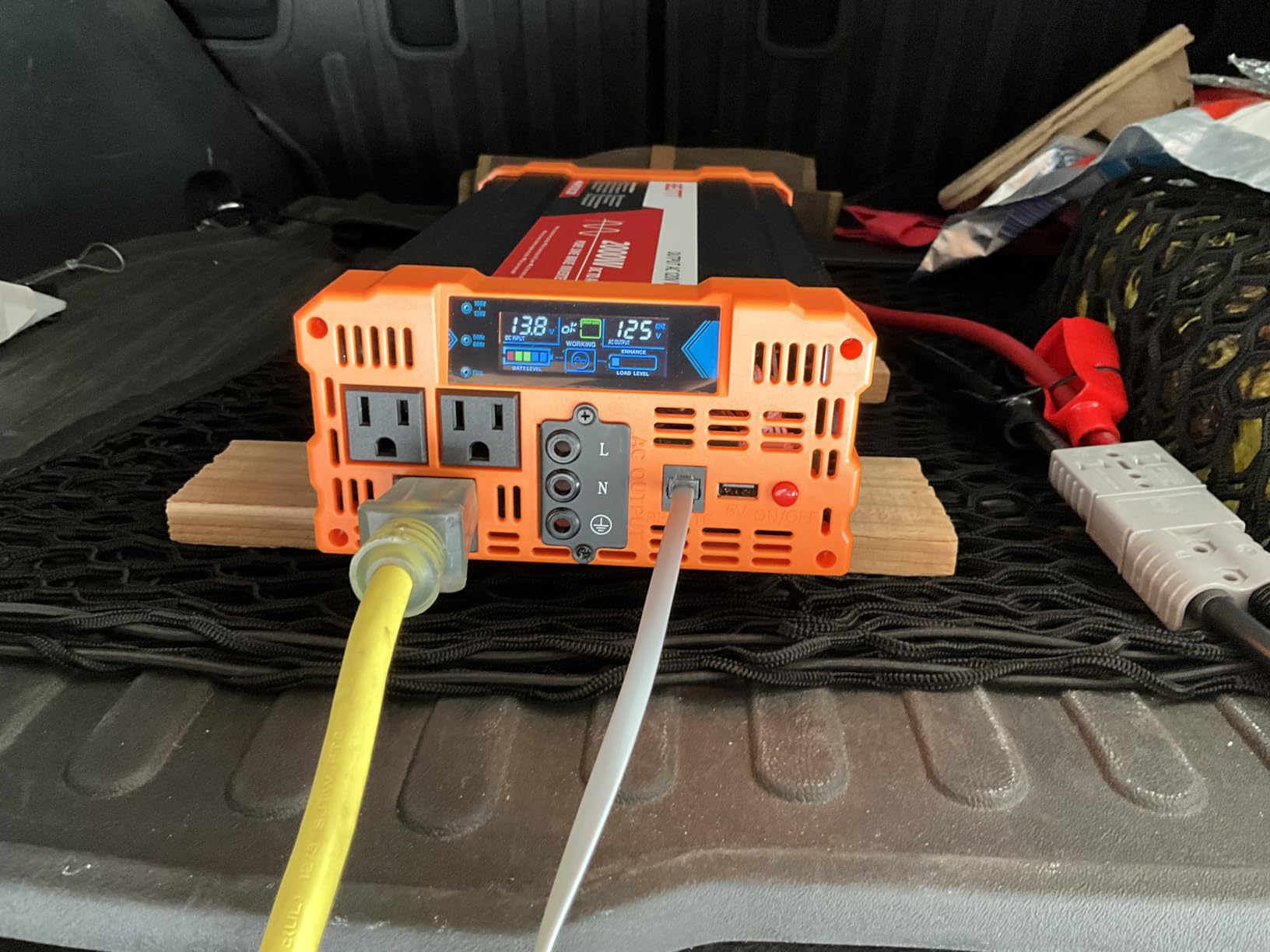
Output selection is generous for the class: dual AC sockets, a dedicated 20A outlet, a 5V 2.1A USB port and a hardwire port for running the inverter permanently into a panel. That hardwire port is what separates this from a travel inverter.
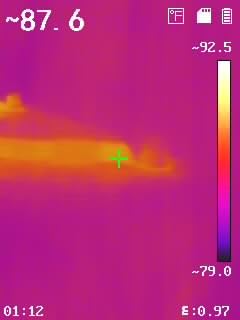
The high-brightness LCD with adjustable output voltage tells you input voltage, output voltage, battery state and load without walking over to it. At 7.7 pounds and 14.8 by 7.7 by 3.9 inches it is also one of the more compact units here.
Who the BELTTT 2000W suits
It suits home offices, network racks and anyone backing up a router, modem, NAS and monitor. A 2000W ceiling with 4000W of surge will also start and run a small refrigerator or a CPAP machine with plenty of margin.
It suits first-time installers too, because the included fuses and cables mean you are not sizing your own copper before you have learned the unit’s appetite.
Who should skip the BELTTT 2000W
Skip it if you want to run more than one substantial appliance at once. Two thousand watts continuous goes quickly once a fridge, a coffee maker and a couple of rooms of lighting are running together.
The one-year warranty is the other limit. For a unit you might hardwire into a garage, a longer warranty is worth shopping for.
5. LANDERPOW 3000W 24V — Best Warranty Coverage and Best 24V Efficiency
- 24V architecture draws far less current than a 12V unit at the same output
- 3 AC outlets plus a hardwire terminal
- 30W USB-C and 5V 3.1A USB
- Two 1AWG thickened copper battery cables included
- Three-year coverage with one-year replacement and two-year support
- Requires a 24V battery bank
- which adds cost and complexity for typical home installs
- Lowest continuous wattage relative to case size in this group
Most first-time home installers buy a 12V unit because it is the default. The LANDERPOW is the counter-argument: running at 24V means roughly half the current for the same 3000W of output, which translates into smaller cables, less heat in the wiring and fewer voltage drop problems over a long run.
Surge is 6000W and efficiency is above 91 percent. Output is pure sine wave, so inductive and capacitive loads behave, which is what you need if a pump or a fan motor is on the list.
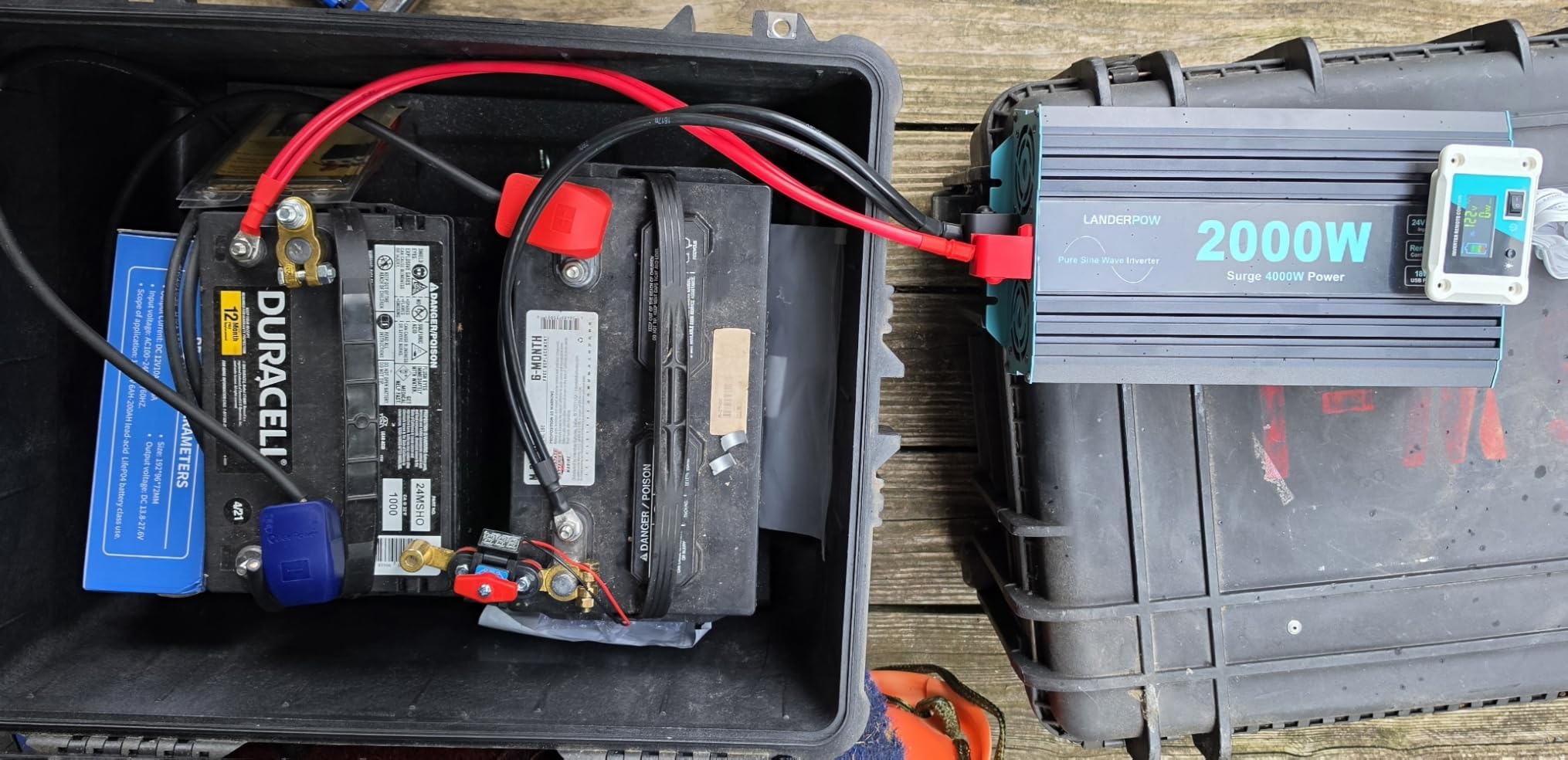
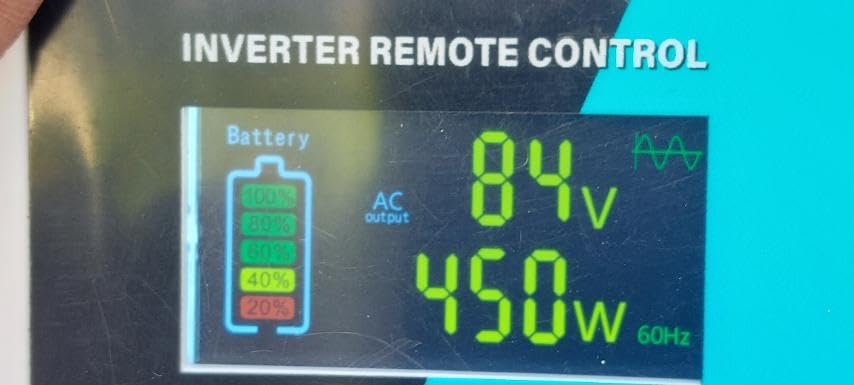
The port selection is generous — three AC outlets, a hardwired terminal, a 30W USB-C port and a 5V 3.1A USB. The 15 foot wired LED remote is long enough to keep the inverter in a compartment and the display in your hand.
The warranty is the standout. Three years of total coverage, split as one year replacement plus two years of support, and the manufacturer states spare part availability for three years. Nothing else in this group commits to that.
Who the LANDERPOW 3000W suits
It suits anyone already running 24V — RV coaches, work trucks, boats and small off-grid builds where 24V is standard. It also suits long cable runs where 12V voltage drop would eat your usable capacity.
The included 1AWG thickened copper cables are a genuine saving. Thin or copper-clad cables are the most common complaint across budget inverter reviews, and this one avoids the problem from the box.
Who should skip the LANDERPOW 3000W
Skip it if you are starting from an empty garage with a couple of deep-cycle lead-acid batteries. Building a 24V bank means either buying 24V batteries or pairing two 12V units in series, and many beginners get that pairing step wrong.
The 3 year warranty does not make up for a physically small unit relative to its competitors in this group, so check the footprint before ordering.
6. JARXIOKE 5000W — Best High-Wattage Inverter for Large Household Loads
- 5000W continuous with 10000W peak for large household loads
- Over 90 percent conversion efficiency with low no-load loss
- Four AC outlets plus Type-C and dual USB charging
- Remote on and off control within 100 meters
- Soft start with an isolated input and output design
- No published dimensions or weight in the listing specs
- Generic brand with limited traceable company information
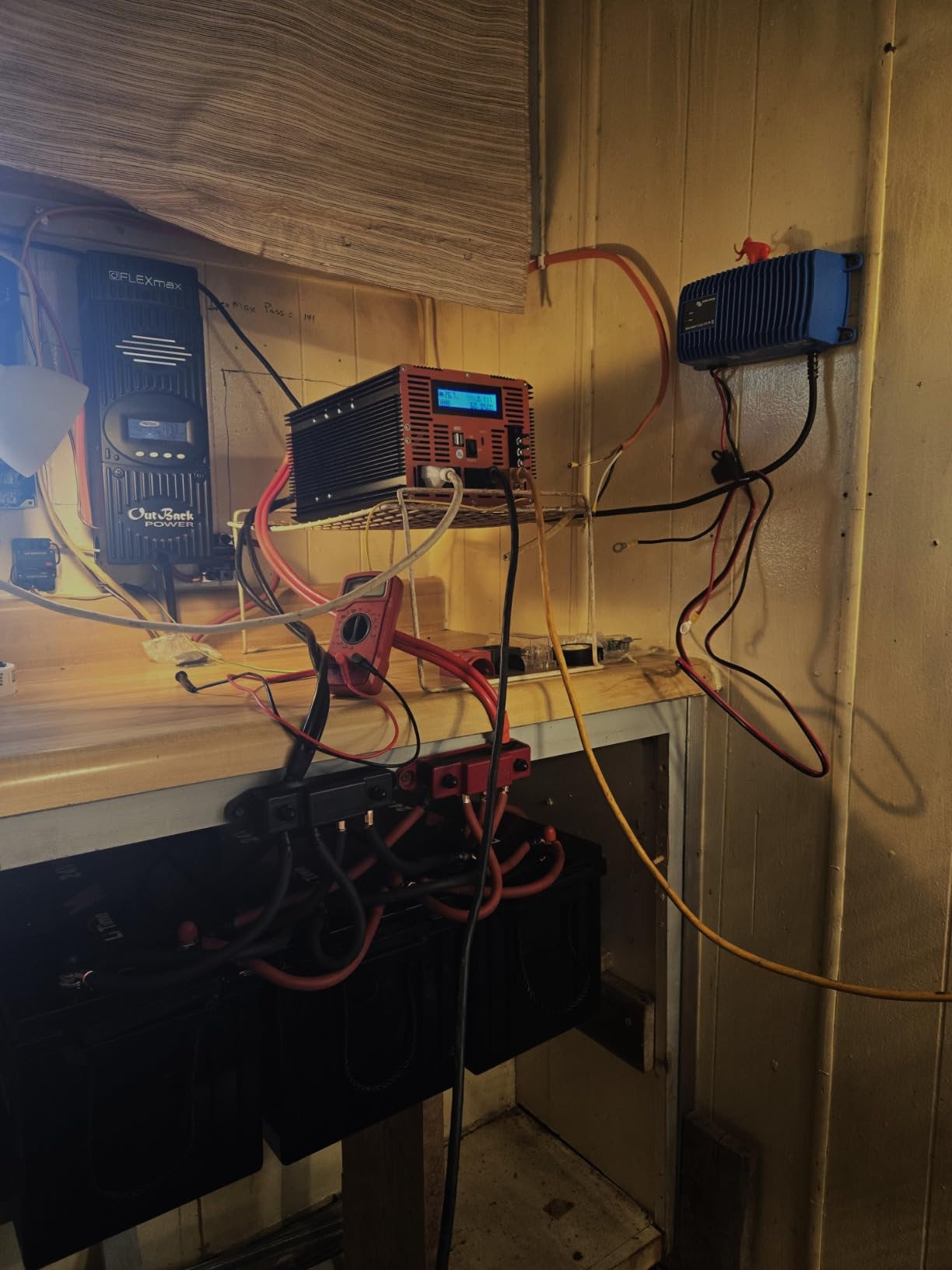
This is the largest continuous output in the group at 5000W, with 10000W of peak behind it. Owners running off-grid and RV systems use it where several heavy loads need to start together — a compressor, a pump and lighting in the same outage.
Conversion efficiency clears 90 percent and no-load losses are low. The chassis uses an isolated input and output design with a soft start ramp, which reduces inrush on the battery side and helps motors spin up rather than slam.
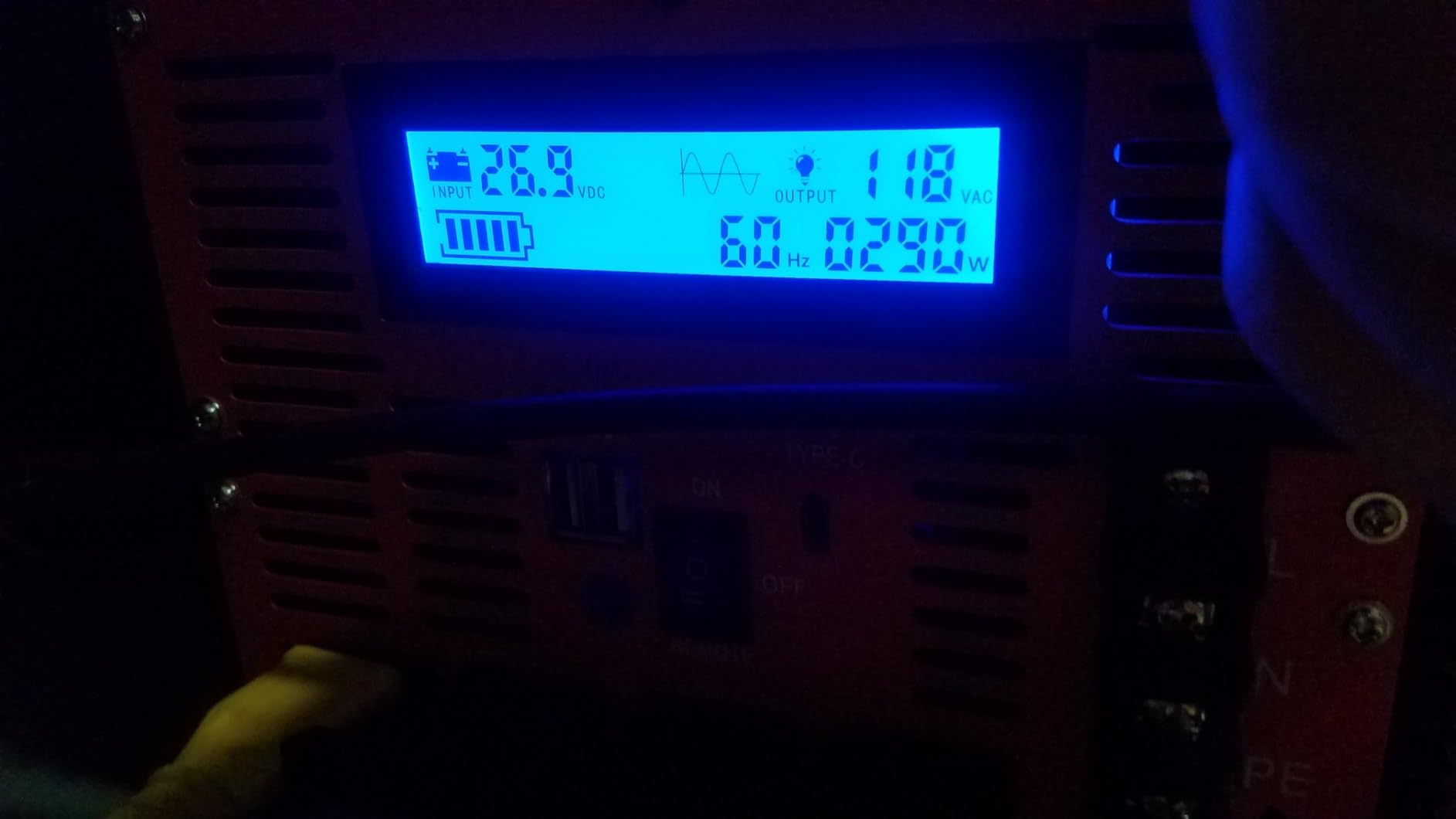
Four AC outlets plus a Type-C port and two USB ports mean more devices connect without a strip. A remote reaches 100 meters, so the unit can live in a cabinet while you control it from another room.
Protection covers overvoltage, low voltage, overload, short circuit, overheat and reverse polarity, with an audible alarm and indicator light on the case.
Who the JARXIOKE 5000W suits
It suits households whose outage list is heavier than a small fridge and a router. Five thousand watts continuous covers a refrigerator, a freezer, lighting, internet and a window air unit in the mix without constant load management.
It also suits RV and off-grid users who value four AC outlets on the face of the unit, which reduces extension cord spaghetti around a parked vehicle.
Who should skip the JARXIOKE 5000W
Documentation is the honest drawback. The listing publishes no dimensions and no weight, so you cannot confirm it fits the space you have. It also carries limited traceable company information, which matters if you ever need a warranty replacement.
Buying 5000W continuous means drawing over 400A from a 12V bank. Plan your cable gauge and fusing for that number before you commit to the unit.
7. ZETAWALE 4000W — Best for Motor and Compressor Starting Under Instrumented Test
4000W Pure Sine Wave Inverter 12V DC to 120V AC Converter with LCD Remote
- Oscilloscope-tested output holds a clean 118-120V sine at 3800W
- 14.76ft wired remote readable in daylight and at night
- Compatible with lithium
- AGM
- deep-cycle and lead-acid 12V batteries
- Heavy-duty AC terminal blocks alongside four outlets
- Included DC battery cables are too thin
- so plan an upgrade to 2/0 or 4/0 AWG
- Two-speed fan is notably loud with no variable-speed control
- Battery percentage readout is not calibrated for LiFePO4
- Hardwire AC output terminal is awkward to access when mounted
What separates this unit is the quality of its published testing. Buyers with oscilloscopes measured a clean 118 to 120V sine wave while pulling 3800W, and one bench test compared the waveform favorably against Honda EU2000, EU2200 and EU3000 generators running on gasoline.
For a household that cares about voltage stability — a home office with a server, audio equipment, a router stack — that kind of instrumented verification is worth more than an extra outlet.
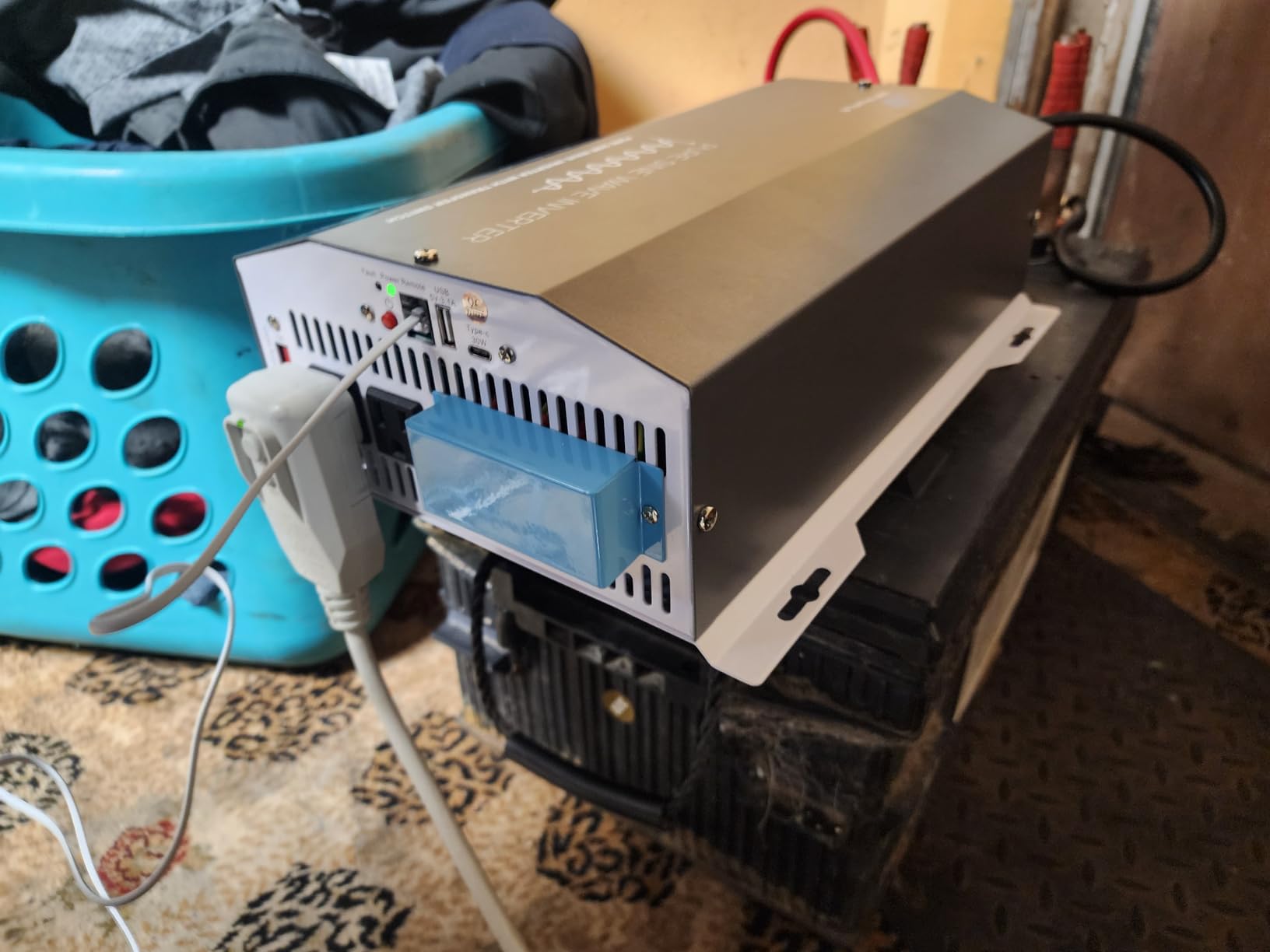
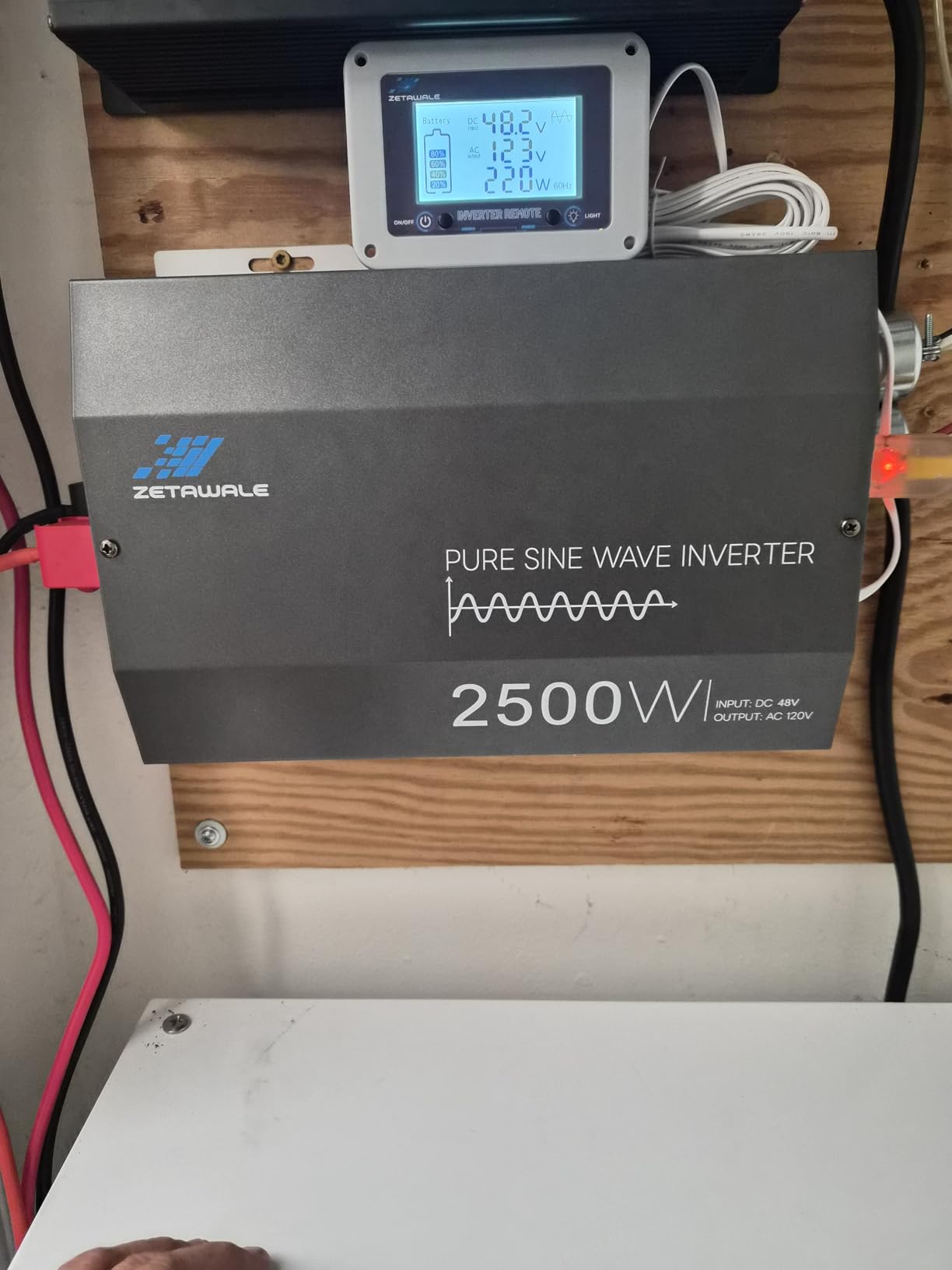
Output is 4000W continuous with 8000W of peak, four AC outlets, a USB port, Type-C fast charging and heavy-duty AC terminal blocks for a hardwired run. The 14.76 foot wired remote reports battery voltage, AC output voltage and load wattage.
Dual intelligent cooling fans manage heat, and the unit is compatible with lithium, AGM, deep-cycle and lead-acid 12V batteries, so an existing bank will usually work.
Who the ZETAWALE 4000W suits
It suits anyone whose outage list is dominated by motors and compressors — a refrigerator, a freezer, a sump pump, a small well pump. Four thousand watts continuous with 8000W of surge has the headroom to start them.
It suits owners who plan to hardwire the inverter into a panel, since the terminal blocks give a cleaner connection than a household outlet.
Who should skip the ZETAWALE 4000W
Do not use the included DC cables. Buyers consistently report them as too thin and upgrade to 2/0 or 4/0 AWG, which is the correct call at these currents. Budget for that separately.
The two-speed fan is loud with no variable-speed control, and if your install sits near living space this will be the first thing you notice. RF interference affecting Wi-Fi and phones has also been reported, and the LiFePO4 battery percentage readout is not calibrated for lithium.
8. ROARBATT 4000W — Most Versatile for Large Compressor Loads
4000W Pure Sine Wave Power Inverter 12V DC to 120V AC, 8000W Peak for RV
- 4000W continuous with 8000W peak that starts a 2HP air compressor
- Soft start ramps loads in and reduces inrush
- 0.6A no-load draw helps preserve battery life in standby
- Six outputs including 4 AC outlets
- an AC terminal block and two USB ports
- High self-consumption at light loads
- with one tester measuring roughly 43 percent waste running a freezer
- Remote switch is bulky and the cables are only 80cm
- Cooling fans are loud and cable terminal posts stack awkwardly
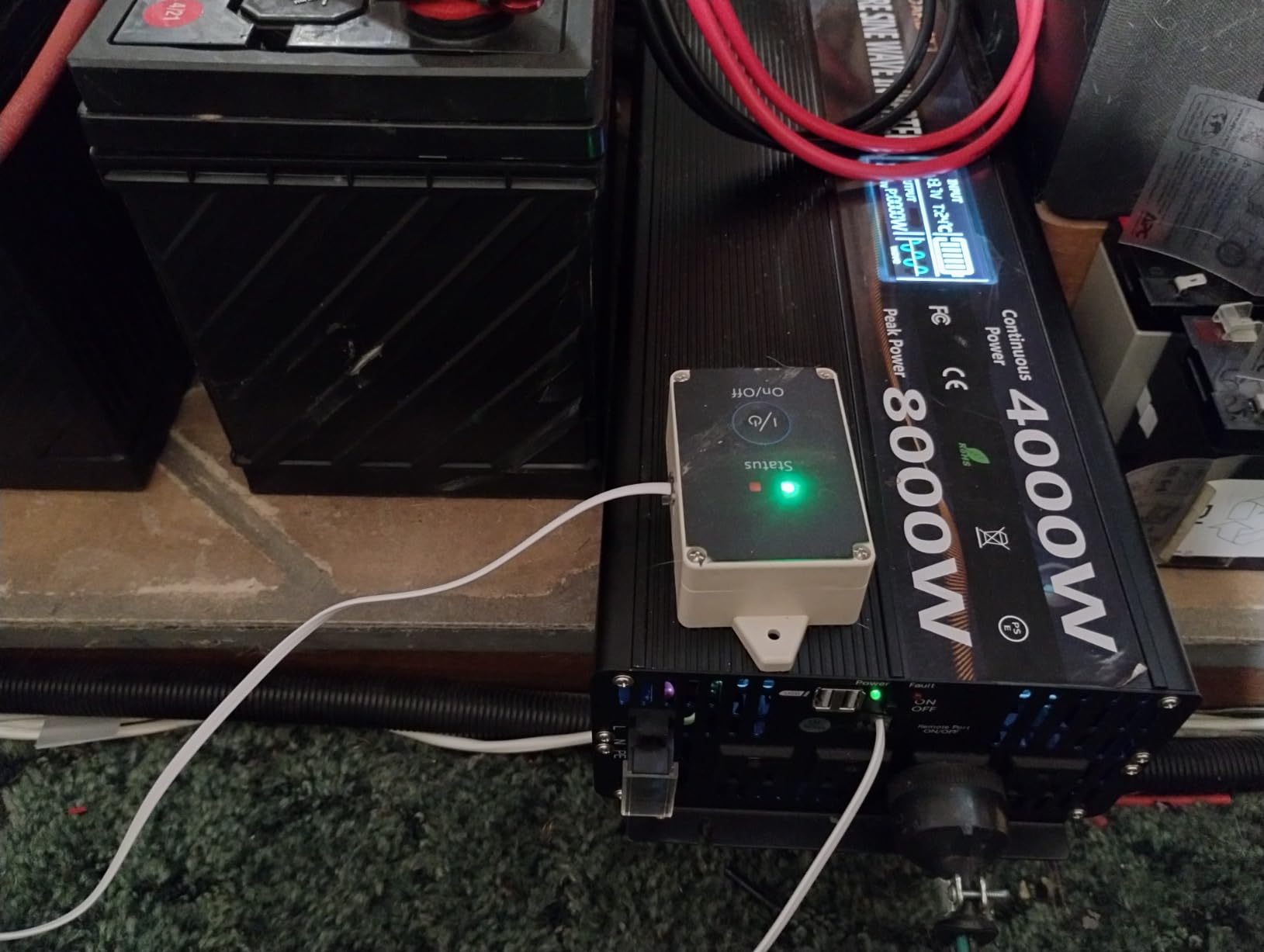
The ROARBATT is the entry point into 4000W class output. It carries UL listing, runs 4000W continuous with 8000W of peak, and owners report starting a 2HP air compressor off it — a load that punishes anything smaller.
Soft start ramps the load in gradually rather than slamming it on, which reduces inrush and the sparking that comes with it. The manufacturer guidance is to keep total load within 80 percent of rated power, or 3200W, for continuous operation and longevity.
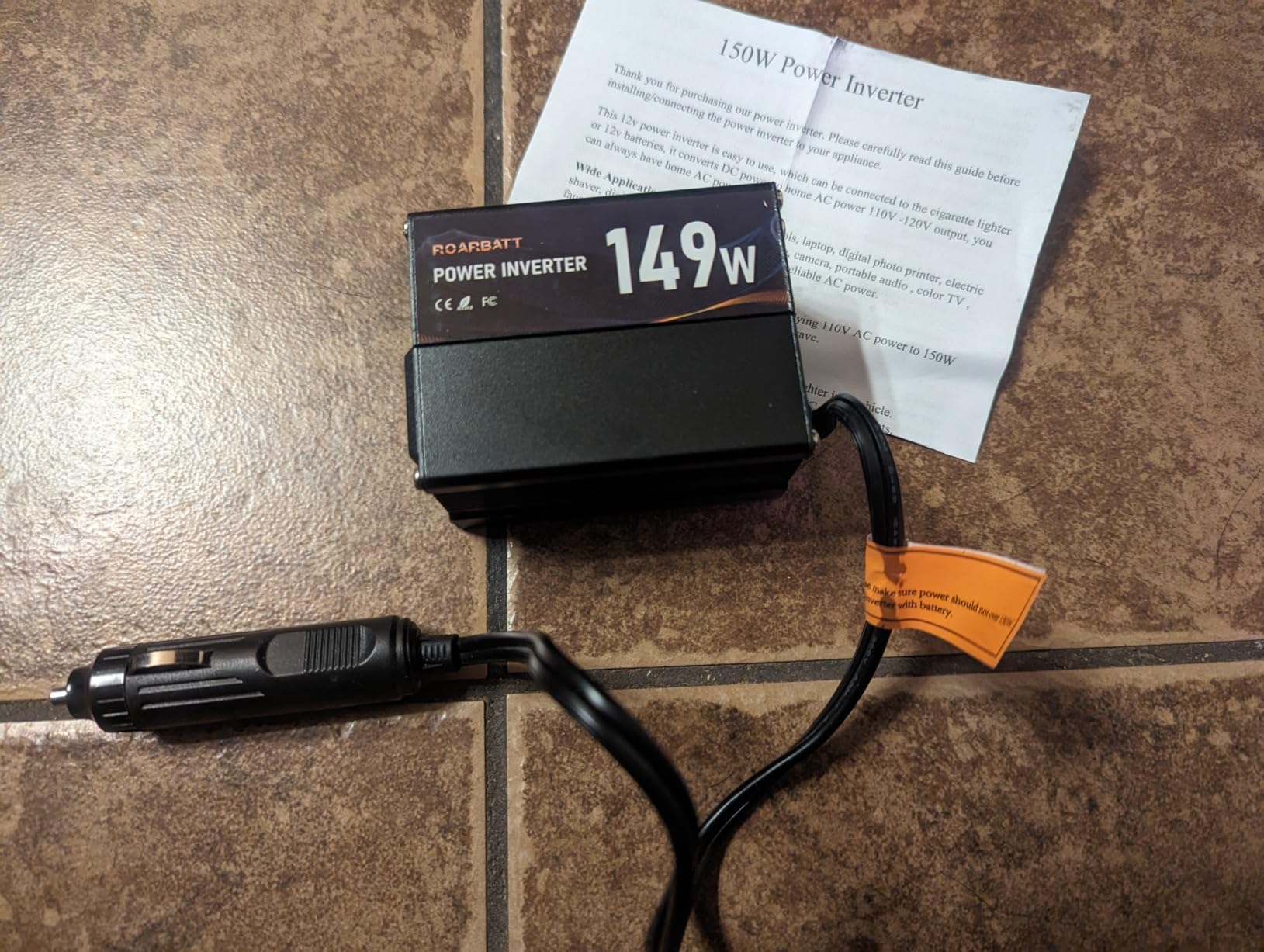
Output is unusually broad for this price: four AC outlets, an AC terminal block and two USB ports at 5V 3.4A. The 4.5 meter wired remote gives you load and battery data from inside.
Owners report running two portable air units at once off a 300Ah battery, and the housing is a rugged aluminum build with a 4.5 meter wired remote for long cable runs.
Who the ROARBATT 4000W suits
It suits buyers who need real compressor capacity at the entry price point. A workshop, a garage or a home that depends on a freezer during a long outage is a good fit for 4000W with 8000W of surge.
The 0.6A no-load draw is genuinely useful if the unit stays connected year-round, since that figure translates to far less standby loss than units drawing several watts at idle.
Who should skip the ROARBATT 4000W
Read the standby measurements before you buy. One tester measured roughly 43 percent waste while running a freezer — meaning the inverter was burning significant power relative to a light load, and a bank left connected overnight will lose real capacity.
The remote is bulky, the supplied cables are only 80cm, the fans are loud, and the terminal posts are stacked awkwardly. Buyers also report warranty support that is difficult to reach. If the freeze is a medical necessity, buy the warranty elsewhere.
9. VEVOR 3000W — Best for Truck, Boat and Multi-Device Charging
VEVOR Pure Sine Wave Inverter 3000 Watts 12V DC to 120V AC Power Inverter
- Five simultaneous outputs including 2 AC
- 2 USB and a 30W Type-C port
- Wireless remote with 100 meter on and off range plus an in-unit LCD
- Temperature-controlled silent fan that starts above 40C
- Includes 100 percent pure copper cables
- Full-load efficiency of 88 percent is the lowest in this group
- Only 71 percent five-star share with 8 percent three-star ratings
- Heaviest 3000W unit at 11.5 pounds
The VEVOR is built around outputs rather than raw wattage. Two AC outlets, two USB ports delivering 18W combined and one 30W Type-C port give you five simultaneous connections, and a wireless remote reaches 100 meters for on and off control.
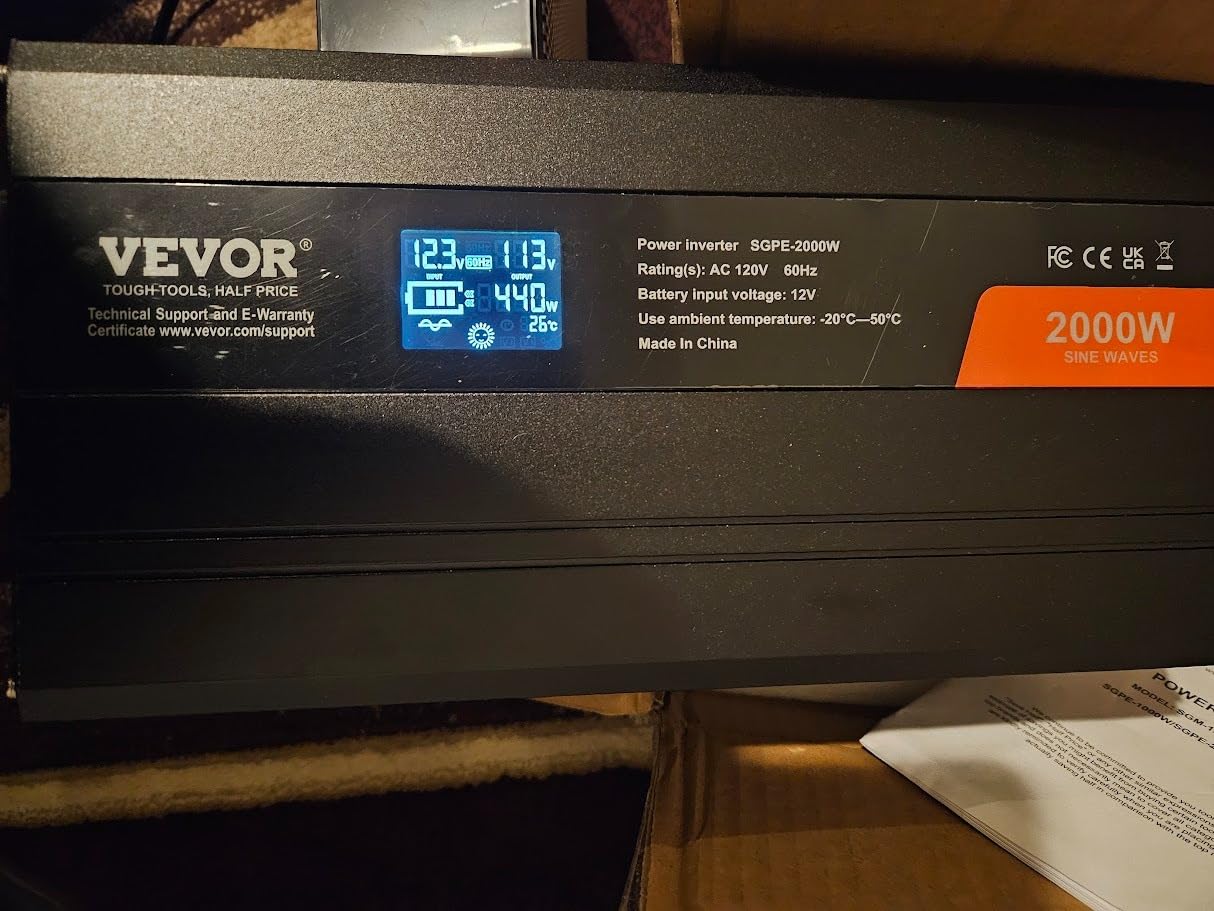
Output is 3000W continuous with 6000W of peak in pure sine wave, with CE and FCC certification and six protection layers. The temperature-controlled fan stays off until the unit passes 40C, which keeps it silent in normal use.
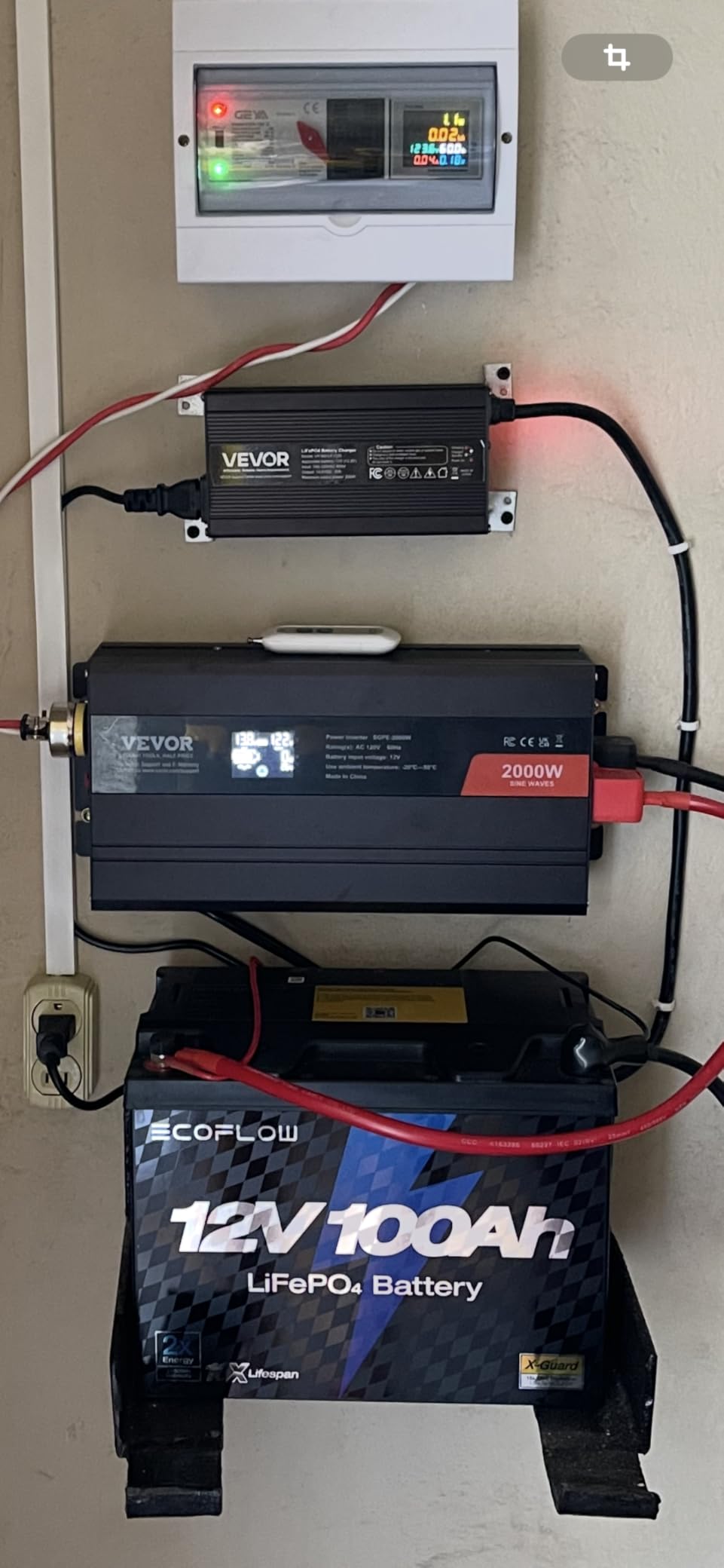
It ships with 100 percent pure copper cables, which puts it ahead of most budget units where thin or copper-clad wiring is the norm. The in-unit LCD gives real-time status for battery and load, and at 11.5 pounds and 16.3 by 6.5 by 3.2 inches it is the heaviest 3000W unit here, so plan mounting rather than expecting a pocket-sized box.
Who the VEVOR 3000W suits
It suits truck, boat and van-life owners whose load list is mostly phones, laptops, cameras and small appliances. Five simultaneous outputs means you can leave the AC outlets for real equipment and keep charging on USB and Type-C.
The silent fan below 40C and the copper cabling both point to a unit built for mobile use rather than a fixed install.
Who should skip the VEVOR 3000W
If efficiency matters to your runtime maths, skip it. Full-load efficiency of 88 percent is the lowest figure in this comparison, and on a small bank that difference eats usable hours.
The 4.3 rating with 462 reports comes with the weakest five-star share here at 71 percent, and 8 percent of ratings sit at three stars. The weight is the other practical issue — 11.5 pounds for 3000W is more than you would want to lift into a truck bed repeatedly.
10. Cantonape 3000W — Best Modified Sine Wave Inverter for Simple Loads
Cantonape 3000W Power Inverter 12V to 110V/120V DC to AC with LCD Display
- Large 3000W rating at the entry price point in this group
- Four AC outlets plus four USB ports for many simultaneous devices
- LCD shows voltage
- battery capacity
- load and six fault codes
- Remote controller included with responsive customer support
- Modified sine wave output is unsuitable for sensitive electronics
- Fans run frequently under load and are audible
- Some owners report random error shutdowns well below the 3000W rating
- Remote ships without a battery
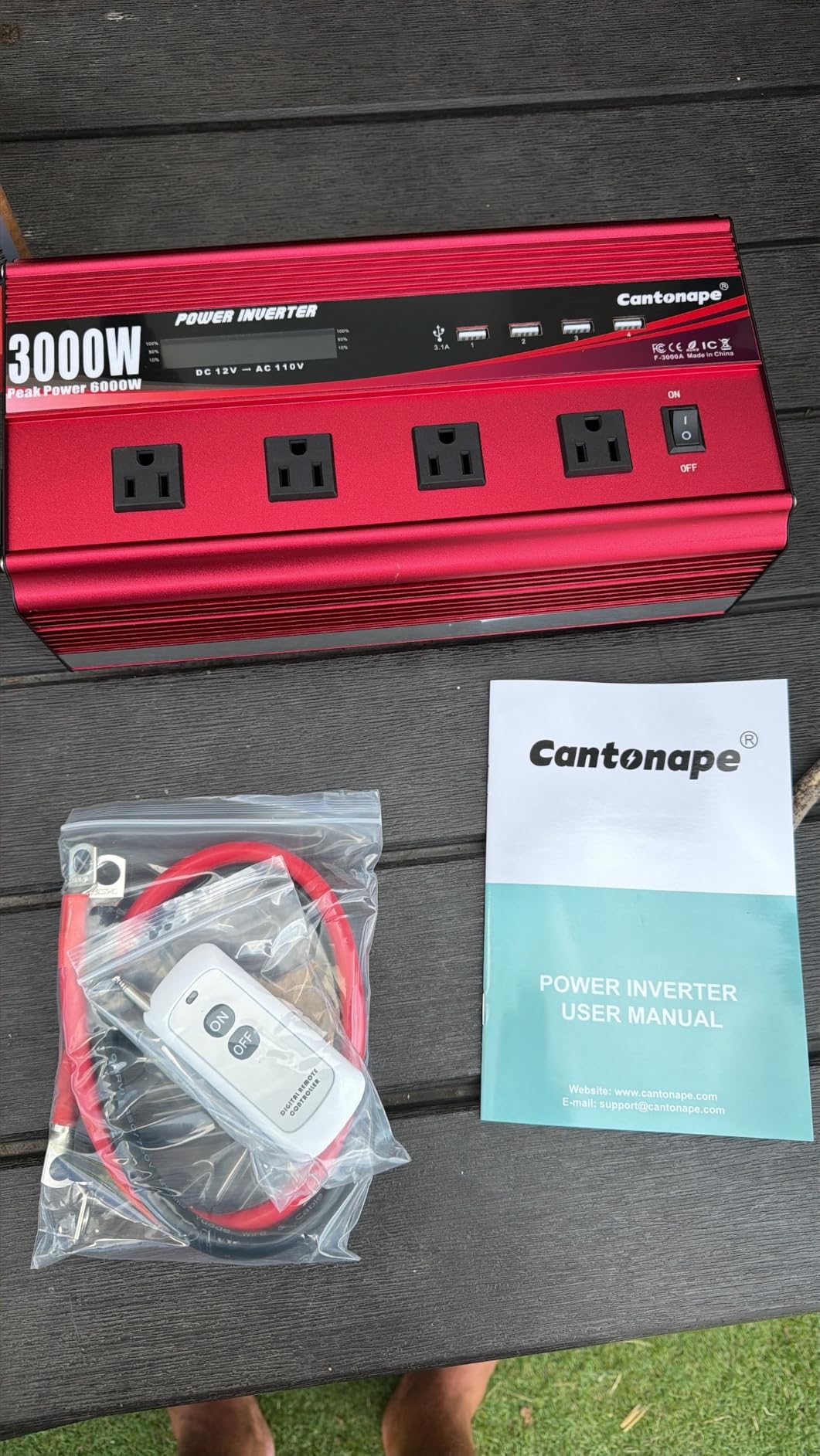
We include this unit because a modified sine wave inverter still has a legitimate place. For resistive loads and simple inductive loads — power tools, a work light, a space heater — the stepped waveform does no harm, and 3000W continuous with 6000W of surge is real capacity.
The output selection is the strongest argument for it. Four AC outlets and four USB ports, with an LCD that reports voltage, battery capacity, load percentage and six fault codes from E-1 through E-6.
Protection covers six circuits including reverse polarity and repeated-fault shutdown, and a remote controller is included for on and off control. At 2.6 kg it is the lightest 3000W unit here by a wide margin.
Available variants run from 2000W through 5000W in the same chassis, so the family grows with your load list rather than forcing a repurchase.
Who the Cantonape 3000W suits
It suits workshop and garage users running power tools, lights and heaters during an outage, where clean waveform quality is irrelevant and outlet count matters.
It suits buyers who want the largest number of connection points for the money, since four AC plus four USB beats most pure sine units in this comparison on that measure alone.
Who should skip the Cantonape 3000W
Skip it for anything sensitive. Modified sine wave output causes buzzing in audio equipment, humming in some microwaves, extra heat in small motors and unpredictable behaviour in CPAP machines and medical devices. If your list includes a refrigerator with a compressor, this is the wrong waveform.
Fans run frequently under load and are audible, some owners report random error shutdowns well below the 3000W rating, and the remote ships without a battery. Read it as a tools-and-lights inverter, not a home backup unit.
How to Choose a Home Backup Inverter in 2026?
Choose by scenario, not by wattage alone. The three that matter are electronics-only backup under 1500W, partial-home critical loads at 2000-3000W, and whole-home split-phase systems at 8000W or above. Buying a 5000W inverter when you need 800W wastes money; buying a 120V unit when you need to run a clothes dryer costs you twice, because you will replace it.
Pure sine wave vs modified sine wave
A pure sine wave inverter matches the grid waveform, so sensitive electronics run as they should. A modified sine wave unit steps the waveform, which is cheaper and fine for resistive loads but causes heat, noise and erratic behaviour in motors, compressors and microelectronics.
For home backup with a refrigerator, a router, a laptop or any medical device, pure sine wave is not a premium feature. It is the minimum. Only the Cantonape in this roundup is modified sine wave.
How to size an inverter for your home
Sum the running watts of everything you want on at once, then add 25 to 30 percent headroom for motor starting current. A worked example: a refrigerator compressor draws roughly 150W running with a surge in the 400W range, a router and modem about 25W, LED lighting 60W, a laptop 65W and a CPAP machine 40W. That totals roughly 340W running, so you add headroom and land near 450W.
In practice that means a 1000W to 1500W inverter covers that list with margin. Add a freezer, a well pump and lighting for a whole floor and you move to 3000W. Forum consensus on diysolarforum and iRV2 threads is to size the bank for one to two hours at maximum load, which is a useful starting point for capacity rather than inverter size.
Oversizing the inverter is the most common free improvement. Forum veterans repeatedly advise that an inverter at 50 percent load runs cooler, lasts longer and starts motors more reliably than the same inverter at 90 percent load.
Continuous watts vs surge watts
Continuous output is what the inverter holds indefinitely. Surge is a short burst — usually 10 to 30 seconds — for starting motors. Fridges, freezers, water heaters, sump pumps, well pumps and power tools all demand surge current far above their running draw.
Never size to the surge number. A unit rated 6000W peak and 3000W continuous protects a compressor on startup but will trip on a load above 3000W.
Battery bank: 12V vs 24V vs 48V and how much capacity
Voltage class changes how much current your cables must carry. A 3000W load from a 12V bank pulls 250A. The same 3000W from a 48V bank pulls 62A, which is why whole-home systems move to 48V. The classic DIY mistake, and the most expensive one, is pairing a 12V inverter with a 24V bank.
For capacity, use runtime in hours = battery kWh multiplied by 0.85 usable, divided by load watts. A 5kWh bank driving a 500W load gives roughly 8 to 9 hours. LiFePO4 can typically be discharged to 80 percent, while lead-acid is usually held near 50 percent for cycle life, so the same bank gives you very different hours.
Runtime is a function of bank size, not inverter wattage. A larger battery extends the outage; a larger inverter only raises the ceiling on what you can run at once.
Automatic transfer switch and backfeed safety
A transfer switch moves your loads between grid and battery, and backfeed — feeding the grid from your battery — is a serious hazard that utility workers face as a line hazard. The Renogy PUH has one built in. Every other unit here needs an external transfer switch or an approved interlock kit.
Plugging a backup inverter into a regular wall outlet and closing the main breaker back up is the exact scenario these kits exist to prevent. If you are hardwiring anything into a panel, that work is electrician territory in most jurisdictions.
Idle draw and the battery vampire load
Idle draw is what the inverter consumes with no load attached, and it runs all day whenever the unit is switched on. Anything under about 20W is treated as genuinely good by experienced owners. Indicator LEDs and low-voltage alarms are the usual culprits when a bank drains to flat while sitting unused for weeks.
The ROARBATT’s 0.6A no-load figure works out to a few watts, which is the low end here. The Renogy PUH sits under 18W. Check whether your unit can be switched fully off when the grid is up, because that eliminates the question entirely.
Which loads to prioritise on a critical loads panel
Back up in this order. Medical equipment first — CPAP, oxygen concentrators, medication refrigeration. Then a refrigerator or freezer. Then internet and networking, followed by lighting and a handful of outlets for a medical fridge. Sump pumps and well pumps come next if your property needs them. Heat and cooling go last, if at all.
Our picks for those batteries, and for larger banks built around the inverters above, are covered in our whole home backup battery guide.
What Not to Plug Into a Backup Inverter
Some loads belong on the grid only, regardless of inverter size. Central air, electric water heaters, electric ranges and dryers draw far too much current for any inverter in this roundup unless you are running a split-phase system sized for them. Laser printers and heated hair dryers trip protection circuits and waste capacity.
The real hazard is motor-based appliances on a modified sine wave unit, and any medical device that must run continuously without interruption. Check wattage on the label, add 25 to 30 percent headroom, and never run a load above the inverter’s continuous rating to see what happens.
One more practical warning. Do not use the thin DC cables that ship with budget units. Many buyers in this category replace them with 2/0 or 4/0 AWG pure copper before drawing real current, and on a 5000W inverter the difference is the gap between a working system and a fire risk. Fuse both battery leads close to the bank.
Frequently Asked Questions
What is the best backup inverter for a home?
The best backup inverter for a home depends on what you are powering. For electronics and internet gear, a 1000-1500W pure sine wave unit with a battery bank is enough. For a refrigerator, lighting, internet and a CPAP machine, choose 2000-3000W with a built-in transfer switch. For central air, a water heater or a dryer, you need a 120/240V split-phase system in the 8000W class.
What size inverter would I need to run my house?
Add up the running watts of everything you want on simultaneously, then add 25 to 30 percent headroom for motor starting surge. A typical essentials list — refrigerator compressor, router, modem, LED lighting, laptop, CPAP — totals roughly 340W running, which points to a 1000-1500W inverter. Whole-home loads including central air or an electric water heater require 120/240V split phase at 8000W or above.
What should you not plug into an inverter?
Do not plug central air, electric water heaters, electric ranges, clothes dryers, laser printers or hair dryers into a home backup inverter. These draw far beyond the continuous rating of any portable unit and will trip protection circuits. Hair dryers and laser printers are also wasteful loads. Never exceed the inverter’s continuous rating, and never run medical equipment on a modified sine wave output.
Which brand of power inverter is best?
It depends on the tier and the scenario. Renogy covers partial-home critical loads with its built-in transfer switch. SUMRY and similar hybrid brands suit solar-charged off-grid systems with integrated MPPT. Giandel is a strong choice for RV and boat installs needing GFCI outlets. LANDERPOW stands out for warranty coverage and 24V efficiency. Victron and Schneider are the durability benchmark when longevity matters more than upfront cost.
What size battery bank for a 3000W inverter?
For short outages, size the bank for one to two hours at maximum load, which is the common rule of thumb on DIY solar forums. Using runtime in hours equals battery kWh multiplied by 0.85 usable divided by load watts, a 3000W inverter on a 5kWh bank gives roughly 1.4 hours at full load, and far longer on a light circuit. Match bank voltage to inverter voltage: 12V inverter to a 12V bank, never 12V to 24V.
How long will a 100Ah battery run a 3000W inverter?
A single 100Ah battery holds about 1.2kWh, and after inverter losses roughly 1kWh is usable. At a full 3000W draw that is about 20 minutes, which shows why a 3000W inverter needs a much larger bank. On a realistic 300W household load the same battery gives roughly three hours. LiFePO4 releases about 80 percent of capacity, while lead-acid is usually held near 50 percent for cycle life.
Do I need a transfer switch for a portable inverter?
Yes, unless the inverter has one built in. A transfer switch moves your loads between grid and battery so there is no backfeed path to the grid, which protects line workers and prevents damage. Some units, including the Renogy PUH here, include an on-grid transfer switch internally. Every other inverter needs an external transfer switch or an approved interlock kit before you hardwire it into a panel.
The Verdict on the Best Power Inverters for Home Backup in 2026
The Renogy PUH 3000W is the best power inverter for home backup overall, because it is the only unit here that switches your circuits automatically while delivering 3000W of clean pure sine wave output and monitoring through an app. It carries the largest body of buyer feedback in the group at 4715 reports.
Go solar with the SUMRY HGX-4KW, whose 140A MPPT controller turns one box into inverter and charge controller. Buy the Giandel 4000W if GFCI outlets matter in an RV or boat. Step down to the BELTTT 2000W for electronics-only backup, and pick the LANDERPOW when a three-year warranty is worth the 24V bank.
Sizing your bank before you size anything else. An oversized inverter on a small bank gives you twenty minutes of outage, while a matched pair gives you all night.
Before you commit, compare battery options in our guide to 2000Wh power stations for home backup, and if your load list is really a truck-and-tools list rather than a house list, our car power inverter reviews cover the lighter end of the market.