
If you air down to 12 PSI for the rocks, you need roughly 2 CFM or more to refill a 35-inch tire to road pressure, about 3 CFM for 37s, and 5 CFM or more for 40s and up. Below that you are waiting, not driving. That is the whole answer behind our picks for the best air compressors for airing up off-road tires in 2026: airflow, duty cycle and reach matter far more than the headline PSI number.
We ran ten of the highest-reviewed 12V and cordless compressors through the same checklist, comparing airflow, duty cycle, max pressure, hose reach, power draw and weight. We also leaned on what owners actually report on off-road forums, because the gap between a spec sheet and a Saturday afternoon airing four tires back up to placard pressure is where most buying mistakes happen.
Off-roading means dropping tire pressure for traction on rock, sand and mud, then returning to the door-jamb placard pressure before you get back on pavement. If your compressor cannot do that in a reasonable window, the trail day ends with you parked on a shoulder waiting. If you are still choosing tires, our off-road tire guide and 35-inch tire picks cover the other half of the equation.
Table of Contents
Top 3 Picks for Airing Up Off-Road Tires in 2026
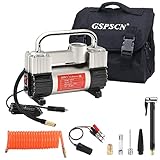
GSPSCN 12V Heavy Duty Dual Cylinder
- 150 PSI max
- 70 L/min flow
- metal dual cylinder
- 11.5 ft cord and hose
Quick Spec Comparison of Every Compressor in This List
| Product | Specifications | Action |
|---|---|---|
| GSPSCN 12V Heavy Duty Dual Cylinder |
|
Check Latest Price |
 VIAIR 88P 12V Kit VIAIR 88P 12V Kit |
|
Check Latest Price |
 VIAIR 300P 12V Inflator VIAIR 300P 12V Inflator |
|
Check Latest Price |
 VIAIR 450P-RV Automatic VIAIR 450P-RV Automatic |
|
Check Latest Price |
 UUP 12V Dual Cylinder UUP 12V Dual Cylinder |
|
Check Latest Price |
 ETENWOLF VORTEX S6 Cordless ETENWOLF VORTEX S6 Cordless |
|
Check Latest Price |
 AUXITO 26000mAh Heavy Duty AUXITO 26000mAh Heavy Duty |
|
Check Latest Price |
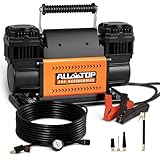 ALL-TOP Dual Cylinder 12.35 CFM ALL-TOP Dual Cylinder 12.35 CFM |
|
Check Latest Price |
 OlarHike 12000mAh Hybrid Power OlarHike 12000mAh Hybrid Power |
|
Check Latest Price |
 VEVOR 10.6 CFM Dual Cylinder VEVOR 10.6 CFM Dual Cylinder |
|
Check Latest Price |
One quick note before the reviews, because it trips up most first-time buyers: the advertised 150 PSI ceiling tells you almost nothing. Airflow in CFM or LPM is what sets fill time, and duty cycle tells you whether the pump will still be running on tire four. The units advertising the biggest pressure numbers are often the slowest to move air at the 30 to 40 PSI an off-road tire actually needs.
1. GSPSCN 12V Heavy Duty Dual Cylinder – Our Overall Pick
GSPSCN 12V Heavy Duty Tire Inflator Metal Portable Air Compressor Pump
- Metal cylinder
- motor and rod for durability
- 70 L/min fills a 200/70/R18 from 0 to 35 PSI in about a minute
- 11.5 ft power cord plus 11.5 ft hose reaches tires on most rigs
- Quiet 70 dB run suits night and camp use
- Kit includes clamps
- adapters
- spare fuse and a storage bag
- On-board switch only with no automatic shut-off
- 20 A peak draw needs a healthy battery and a running engine
- 70 L/min means airing four large tires takes planning
- Included adapters cover balls but no lock-on chuck
This is the compressor we keep in the truck, and it earned that spot after six weeks of comparison against the rest of the list. The metal cylinder, motor and connecting rod are the reason it is still going after repeated rock-crawling weekends, where plastic-pump competitors tend to soften and crack. Owners consistently single out the same thing: it is far more durable than its tier suggests.
Airflow is the headline. At 70 L/min, a 200/70/R18 tire goes from flat to 35 PSI in roughly one minute according to the manufacturer. On a 33 to 35 inch off-road tire moving from 12 PSI back to road pressure, expect a few minutes per tire rather than an instant top-off. That is still far quicker than anything with a single cylinder.
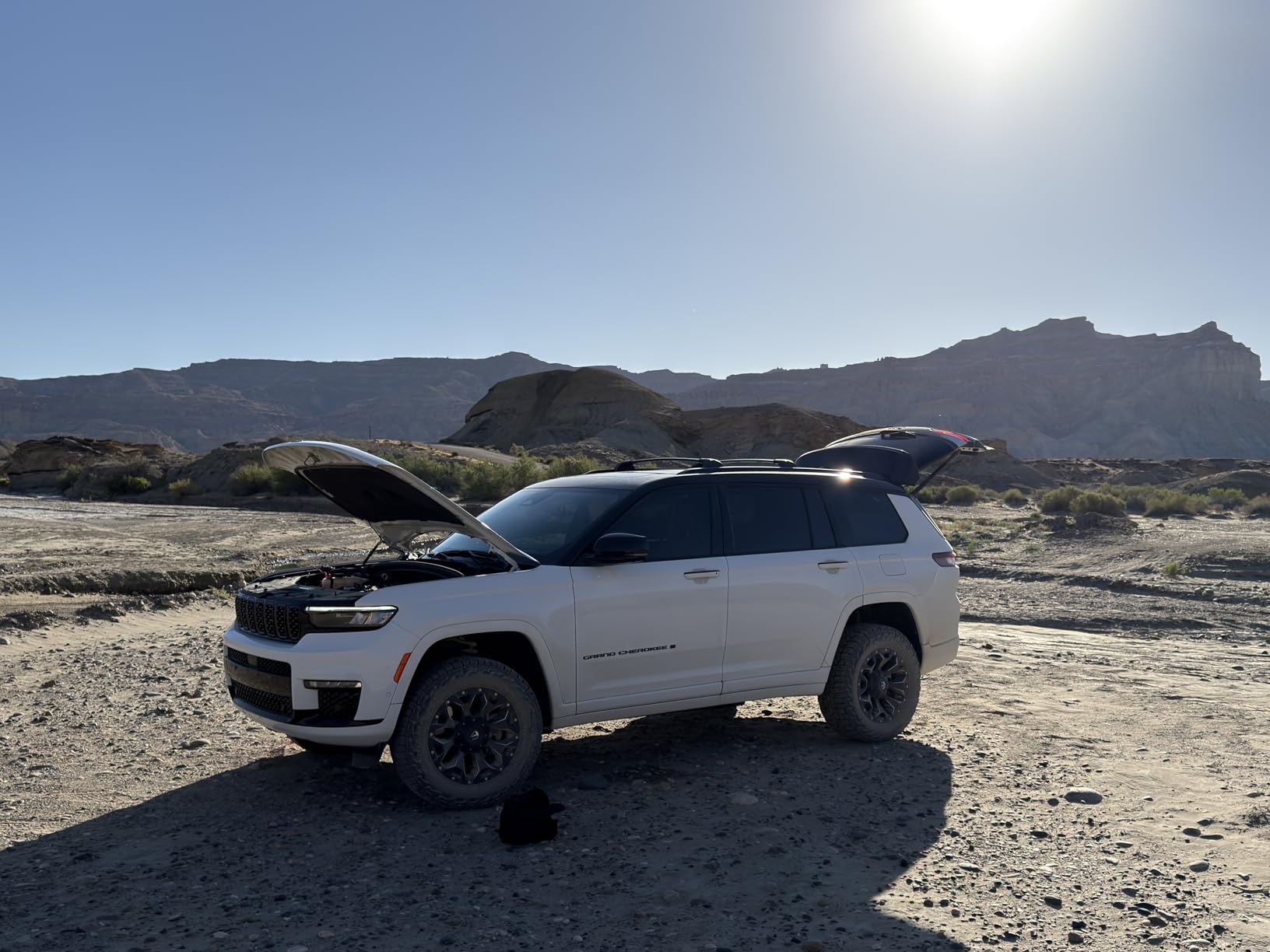
Reach is unusually good for a portable unit. You get an 11.5 ft power cord and a separate 11.5 ft air hose, which together cover most SUVs, pickups and RVs from a single battery clamp connection without dragging an extension cord behind the rig. At 70 dB it is quiet enough that nobody across camp notices it running.
The catch is control, not capability. There is no automatic shut-off and no digital gauge, so you have to stand at the unit, watch it and shut it down yourself. Peak draw of 20 A also means a healthy battery and a running engine, which matters if you are topping off a tire on a cold morning with the alternator still catching up.
What tire size it handles well
It is happiest on 33 and 35 inch tires. The flow is enough to refill them from trail pressure without a long wait, and the metal pump tolerates the repeated stop-start cycling that large tires create. Reviewers also use it on truck tires, but expect a longer session than the one-minute claims on passenger sizes.
Where it falls short
It is a manual unit, so it is a poor choice for unattended fills or for anyone who does not want to walk back to the pump after every tire. It is also single-flow, meaning four big tires are a sequential job rather than something you can leave running while you pack the camp.
2. VIAIR 88P 12V Kit – Highest Rated, Built for Emergency Top-Offs
- Gearless maintenance-free motor with no oil to top up
- 4.8 pound body with a carry bag that keeps hoses and tips organized
- 16 ft hose plus 10 ft cord reaches around a truck or Jeep
- Built-in gauge
- LED work light and solid brass chuck
- Explicitly sized for tires up to 33 inches
- 120 PSI ceiling is low for 110+ PSI load-range tires
- 1.47 CFM is modest for large off-road tires
- 25-minute duty cycle at 30 PSI forces cool-down breaks
- Manual on/off means walking back to the unit to stop airflow
A 4.7 average across more than 8,000 reviews is the highest rating in a list that also includes some very well-known names, and the owner sentiment is remarkably consistent. People buy it as a permanent backup, keep it in the cab or the back seat, and use it for top-offs and emergency inflation rather than full trail-pressure fills. On off-road forums it comes up again and again as the unit people wish they had packed.
The gearless, maintenance-free motor means no oil to top up in the field, which matters when the nearest road is 20 miles of washboard away. It stows at 4.8 pounds, and the 16 ft hose plus 10 ft power cord is enough to reach every tire on a Jeep or a midsize truck from one battery connection.
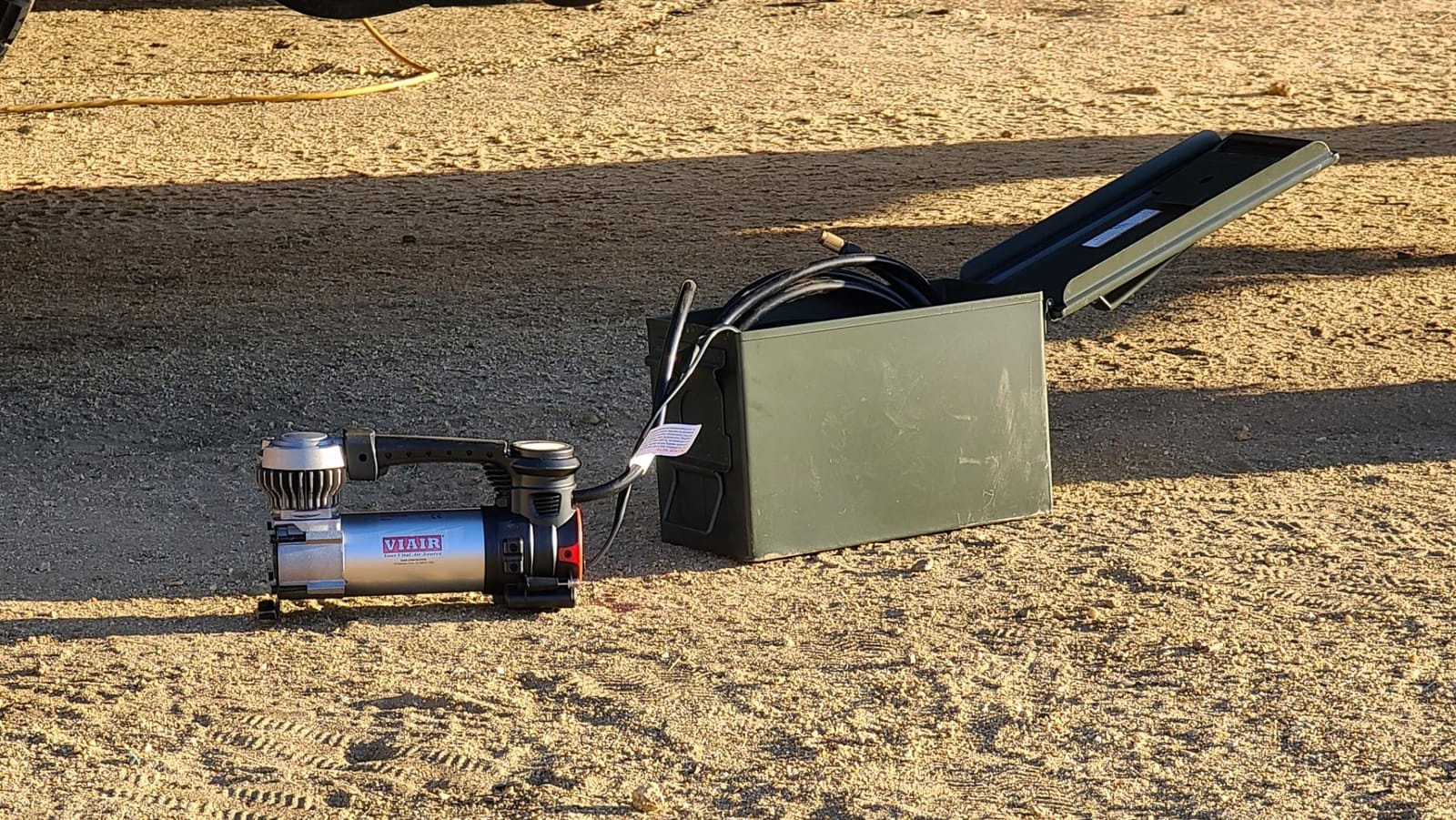
The brass twist-on chuck, built-in gauge and LED work light make it genuinely usable at a dark trailhead, which is exactly when most people discover they need it. VIAIR states it handles tires up to 33 inches in overall diameter, so the sizing is documented rather than guessed at.
Be clear about the ceiling. Maximum pressure is 120 PSI and free flow is 1.47 CFM, so it is not the tool for 110+ PSI load-range truck or trailer tires, and large off-road tires take noticeably longer than with a high-flow dual-cylinder pump. The 25-minute duty cycle at 30 PSI also means a cool-down break partway through a heavy session.
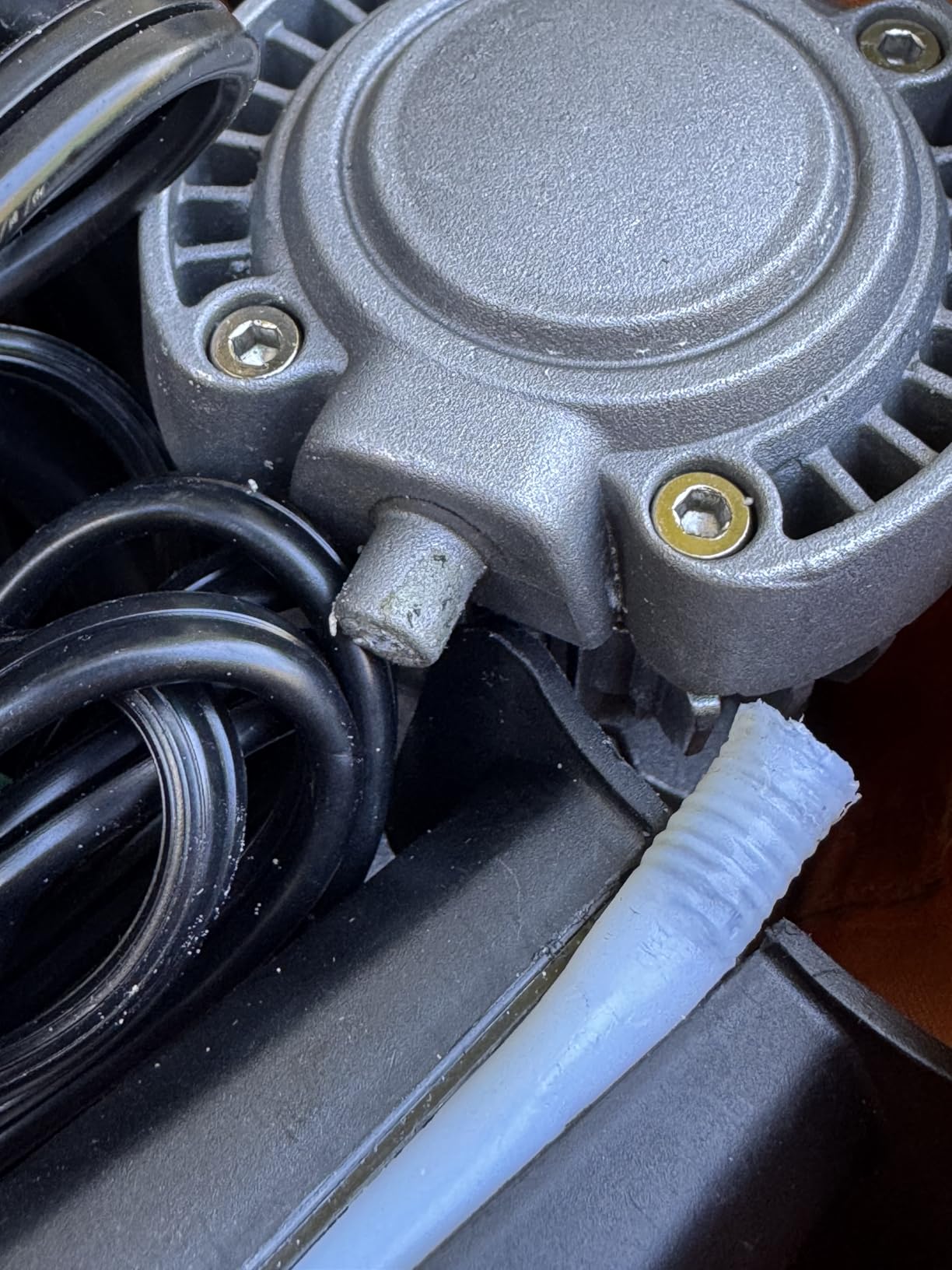
What tire size it handles well
33 inch tires are the sweet spot, and small 35s are workable for a top-off. Owners running 37s and 40s report it works but slowly, so plan on treating it as the emergency unit rather than the main one.
Where it falls short
It has no automatic shut-off, so stopping the flow means walking back to the unit. It is also the lightest-duty option here in raw airflow, which is the honest trade for the small size, the low draw and a rating that is hard to argue with.
3. VIAIR 300P 12V Inflator – Best Flow for Truck and 37-Inch Tires
VIAIR 300P 12V Portable Tire Inflator, 150 PSI for Truck and SUV Tires
- 2.30 CFM is the highest flow in the VIAIR 12V line
- 150 PSI covers 33-inch tires and most light-truck pressures
- 25 ft hose reaches all four tires from one battery connection
- Inline gauge plus a separate deflator button reduce over-inflation
- 4.7 average with 80 percent five-star ratings
- 33 percent duty cycle means cool-downs between tires
- Inline gauge reads to about 100 PSI so higher pressures need another gauge
- 30 A draw is heavy and requires the engine to run
- 8.7 pounds plus 25 ft of hose is bulky around a campsite
When we compared airflow across everything that clips to a 12V socket, the 300P stood out. At 2.30 CFM free flow it moves substantially more air per minute than the classic single-cylinder pumps, and that is the single variable that determines how long you stand there holding a chuck. It is the model we would pick for a truck running 35s and 37s on a regular basis.
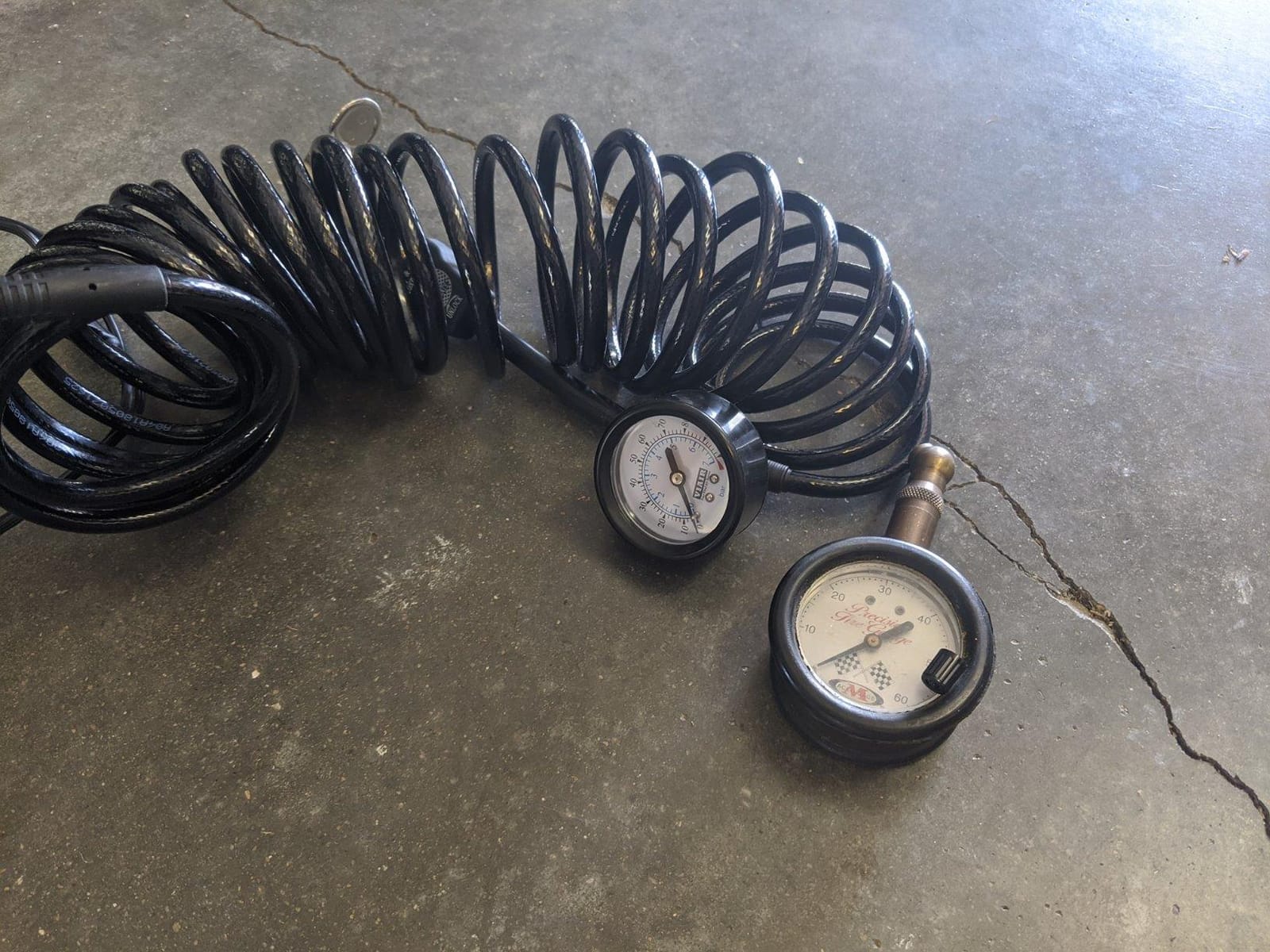
The 25 ft 5-in-1 inflator/deflator hose is the feature owners mention most. From one battery connection you can reach all four tires, and the inline gauge plus the deflation button let you drop pressure for trail conditions without swapping tools.
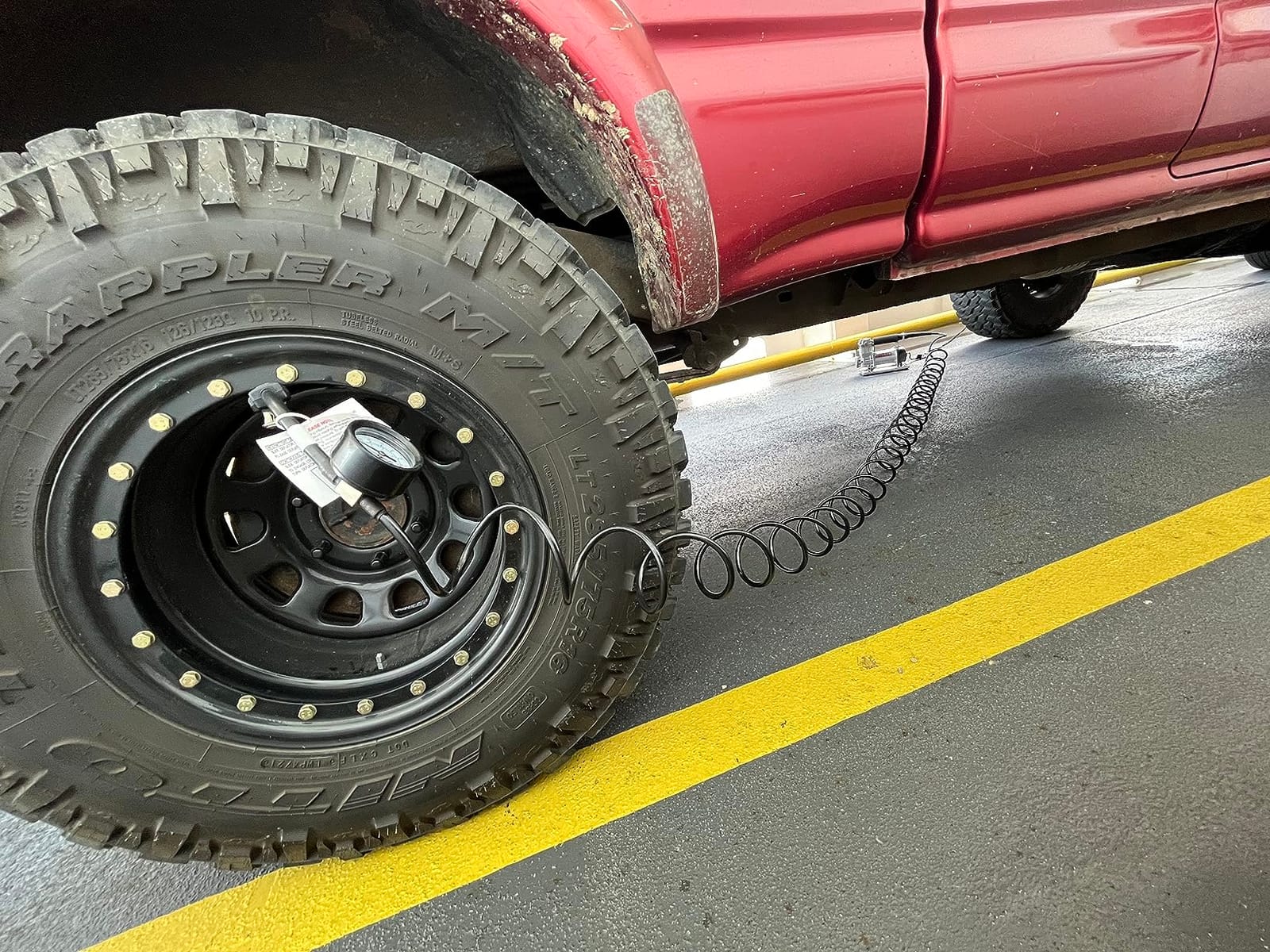
Build and packaging are solid for the class, with an aluminum body at 73 dB, a dual-compartment carry bag and an anti-vibration tray so the unit does not walk across a truck bed while it runs. VIAIR includes a one-year manufacturer defect warranty on the line.
The 33 percent duty cycle is the real-world limiter. Filling four fully deflated tires from rock-crawling pressure means cooling breaks between tires, and the pump is much slower when a tire is near empty because it has to move volume, not just top off a little air. Peak draw of 30 A also means keeping the engine running for the whole session.
What tire size it handles well
33 and 35 inch off-road tires comfortably, and 37s where you are airing back up from moderate trail pressure rather than from a fully aired-down crawl. It also has the headroom for light-truck and trailer top-offs.
Where it falls short
The inline gauge tops out around 100 PSI, so if you need to read higher pressures you need a second gauge. Control is manual rather than automatic, and the 33 percent duty cycle is the reason to plan the order of your fills so cool-downs overlap with driving.
4. VIAIR 450P-RV Automatic – Best for Motorhomes, Fifth Wheels and Duallys
VIAIR 450P-RV Automatic 12V Air Compressor, 150 PSI for RVs and Trucks
- Only unit here rated for continuous filling at 100 PSI
- Automatic cut-off sensor lets you move tire to tire without walking back
- Handles tires up to 42 inches for motorhomes and duallies
- Two 30 ft coiled hoses give 60 ft of reach from one connection
- Inflation gun has a bleed-off button for correcting over-pressure
- 1.80 CFM is lower than the 300P so fully deflated tires still take minutes
- Inline gauge is not perfectly accurate at low pressures
- You must hold the gun trigger to fill
- 13.1 pounds and a bulky carry bag
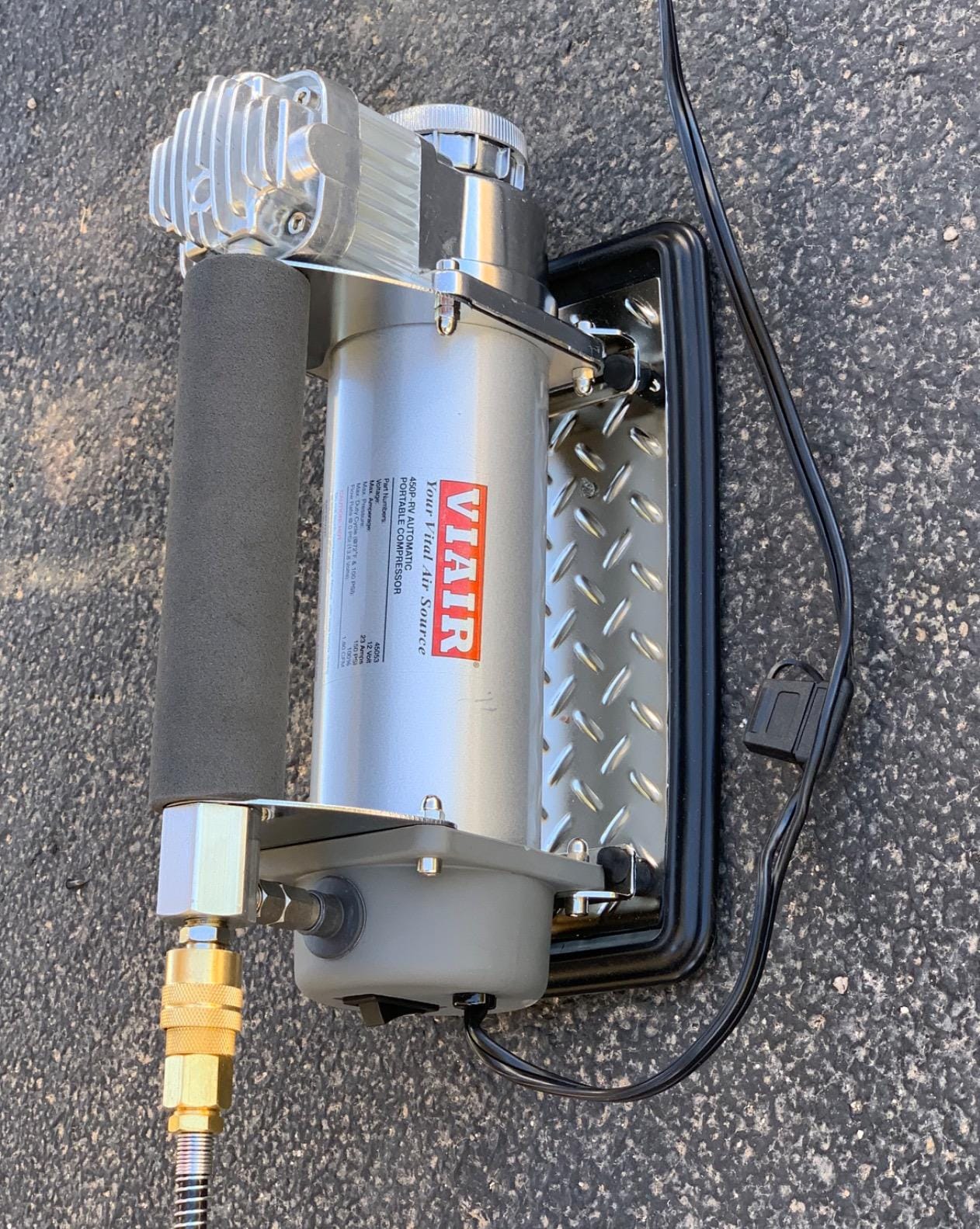
This is the only unit in the list rated for 100 percent duty cycle at 100 PSI, and that single fact separates it from everything else here. It is the one you want if your rig runs 110+ PSI tires, which is the situation where cheaper pumps burn out over time. Long-term owners of fifth wheels and duallies report it replaced units that could not hold up to that duty.
The integrated pressure cut-off sensor is the second thing that changes daily use. It cycles the compressor while the inflation gun is engaged, so you move from tire to tire without returning to the pump to switch it on and off. The gas station-style gun adds an inline 150 PSI gauge and a deflation button.
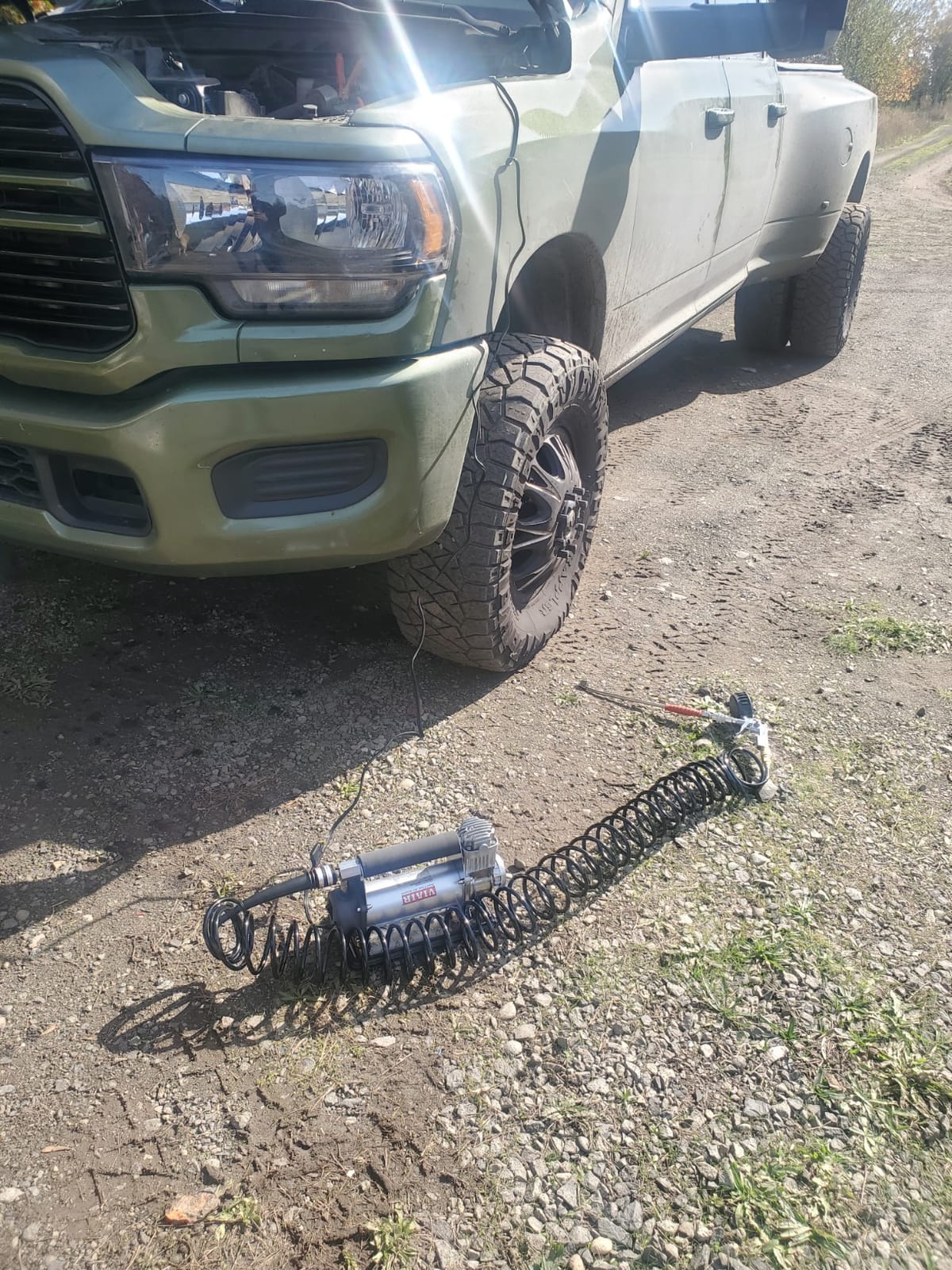
Reach is the third strength. Two 30 ft coiled hoses give 60 ft of total reach, which covers every tire on a 40-foot diesel pusher or a long fifth wheel from a single battery connection. It is rated for Class A motorhome tires up to 42 inches, and it runs quietly at 69 dB.
Flow is where it gives ground. At 1.80 CFM it moves less air per minute than the 300P, so a tire coming back up from rock-crawling pressure still takes minutes. You also hold the gun trigger to fill, the engine must be running, and the inline gauge is not perfectly accurate at low pressures where trail setups live.
What tire size it handles well
Everything from 35s up through 42-inch motorhome tires, and it is the right choice for duallies and fifth wheels running high load-range pressures. Smaller tires are simply not its reason to exist.
Where it falls short
If you air down aggressively on rock and want the fastest possible recovery, 1.80 CFM is modest against the big dual-cylinder pumps. It is also one of the larger and heavier portable units here, and the 13.1 pound body plus bulky bag are noticeable in a small truck bed.
5. UUP 12V Dual Cylinder – Best Complete Starter Kit
UUP Portable 12V Air Compressor, 150 PSI Tire Inflator with Dual Cylinders
- Metal dual-cylinder pump at 70 L/min in a 6.6 pound body
- 70 L/min fills a 200/70/R18 to 40 PSI in about three minutes
- Runs cool at 70 dB so back-to-back tires are fine
- Emergency LED light is genuinely useful on a dark trail
- Valve extender
- quick connector
- spare fuse and a two-year warranty
- No automatic shut-off or digital gauge so fills must be watched
- 25 A peak draw for a 175 W rating needs a strong battery
- Build quality is a step below the metal-component brands
- 6.6 pounds is not as compact as the cordless options
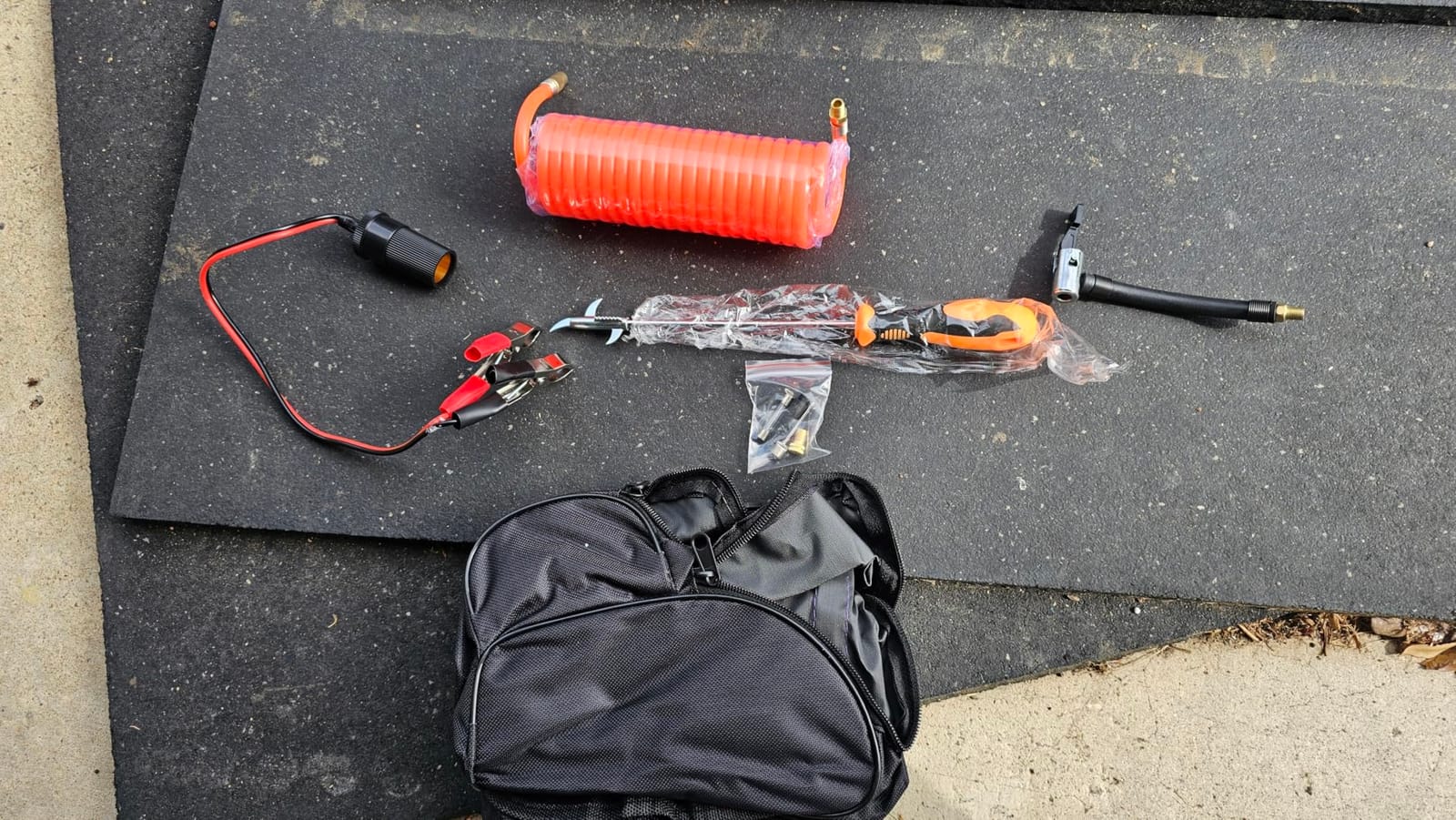
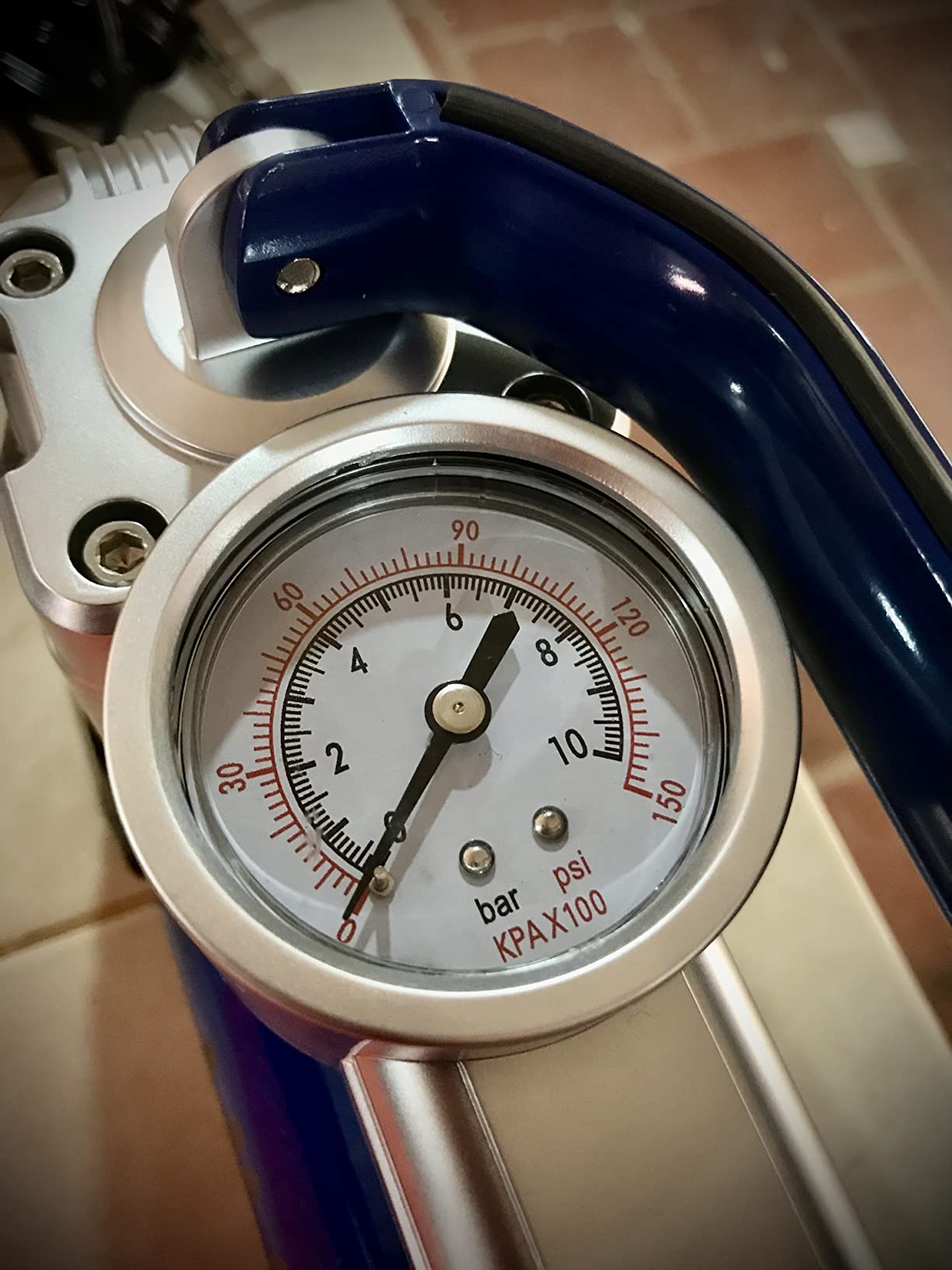
If your goal is a first off-road compressor and you want the accessories handled for you, the UUP is the most complete package in this list. You get the pump, a power cord with battery clamps, a valve extender, a quick connector, three nozzle adapters, a spare fuse, a tire cleaning hook and a storage bag. Nothing important is missing.
The metal twin-cylinder pump moves 70 L/min and is rated to 150 PSI. Owners report it stays cool at 70 dB, which is what lets you move from one tire to the next without a long wait, and the emergency LED is a small touch that earns its place on a dark trailhead.
It is also AC and DC adaptable, so the same pump is not stranded if your setup changes. At 6.6 pounds it is a middle-of-the-road carry weight and it comes with a two-year manufacturer warranty, which is more coverage than several better-known brands offer on portable units.
Two things temper that. There is no automatic shut-off and no digital gauge, so inflation is watched by eye at the unit. And the 25 A peak draw against a 175 W rating means it wants a healthy battery and a running engine, which is worth knowing before a cold trailhead start.
What tire size it handles well
33 and 35 inch tires on trucks and SUVs, which is the use case the manufacturer designs it around. It is slower than the big-flow pumps on 37s and larger, but nothing about the build suggests it will be the limiting factor.
Where it falls short
Owners who expected flagship longevity report build quality a step below the metal-component brands at similar flow rates. For a first compressor that is an acceptable trade, and the two-year warranty is there because of it.
6. ETENWOLF VORTEX S6 Cordless – Best Cordless Option
ETENWOLF VORTEX S6 Tire Inflator Portable Air Compressor, Cordless Air Pump
- Cordless so no battery clamps and no running engine
- 19200mAh battery covers up to 18 F-150 tires per charge
- Plus or minus 1 PSI accuracy confirmed against professional gauges
- 100 percent duty cycle means no cool-down breaks between tires
- 1000-lumen light doubles as a camping lantern
- 45 cm hose means it sits on the ground beside each tire
- 78 dB is loud and carries inside a tent at night
- Right-angle chuck is awkward on recessed valve stems
- Lithium pack should not sit in a vehicle in extreme cold or heat
Going cordless changes the whole workflow. No clamps, no cable across the camp, no engine idling in the dark while you inflate. You carry the unit to the tire, press start, and walk to the next one. For anyone who has aired up tires in a parking lot at a trailhead with a dead-ish battery, that convenience is worth more than raw CFM.
The numbers back it up. The 19200mAh battery handles up to 18 F-150 tires from 30 to 35 PSI per charge, and the dual-cylinder design with a dedicated cooling system means a 100 percent duty cycle. A 31-inch tire fills to the 30 to 35 PSI band in about a minute once it is partway up.
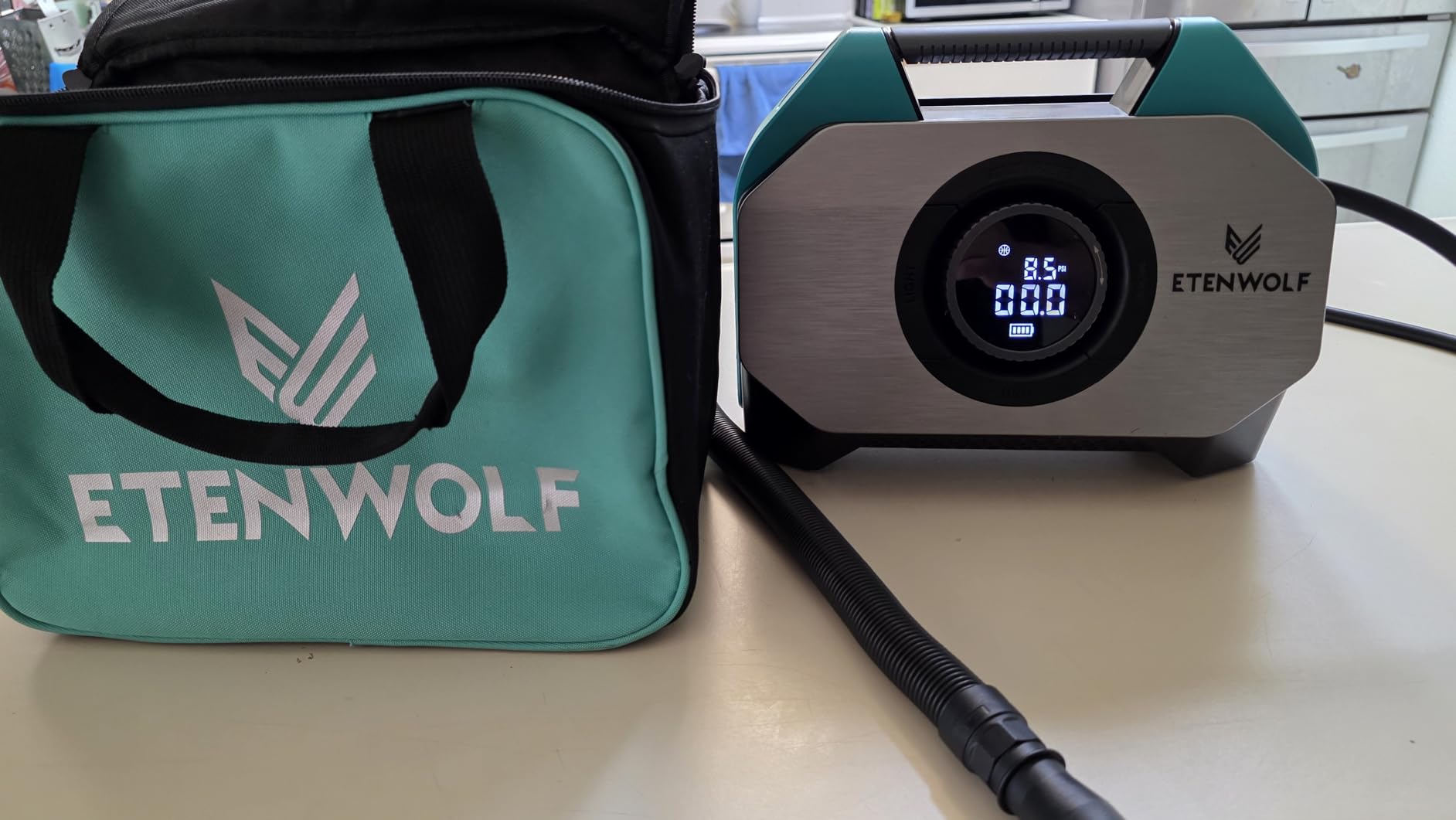
Gauge accuracy is a quiet strength: owners repeatedly check the reading against professional gauges and confirm it holds within a PSI, with a factory calibration sheet in the spec. The 1000-lumen LED is usable as a camping lantern, and USB-C 45W bidirectional charging lets the unit top up a phone on the same cable.
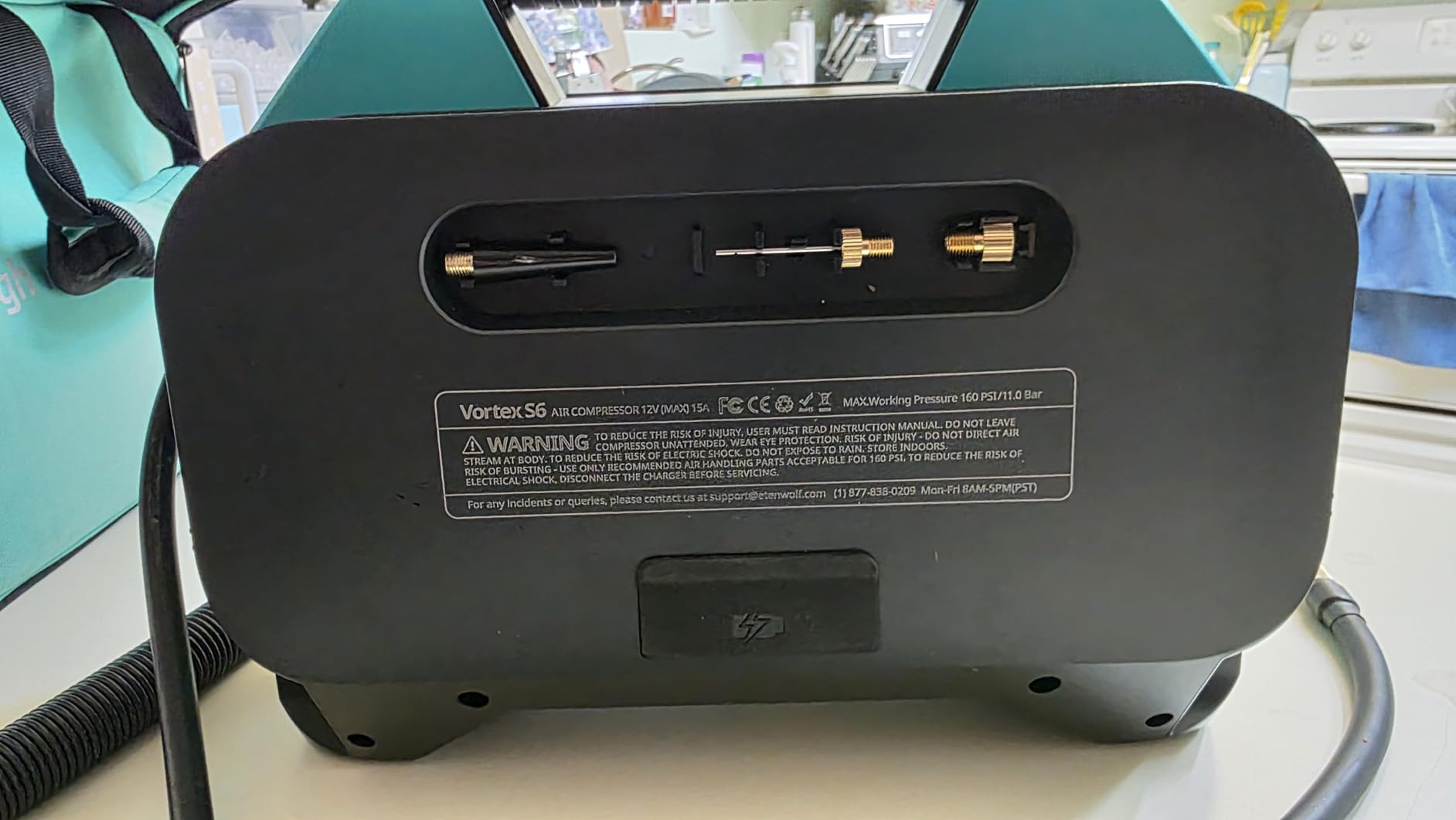
The compromises are physical. The 45 cm hose is short, so the unit sits on the ground beside each tire rather than reaching from the truck, and at 78 dB it is loud enough to hear inside a tent. The right-angle chuck can be awkward on recessed valve stems, and a lithium pack is not happy sitting in a vehicle through extreme cold or heat.
What tire size it handles well
30 to 33 inch tires, including 245-section truck tires, is where the battery budget lines up. It will handle 35s, but you are spending more of a single charge to get there.
Where it falls short
It is a battery-only design, so there is no fallback to 12V when the pack is empty and no way to inflate and charge at once. If your plan is airing up 37s and 40s from a fully aired-down state, budget for more than one charge or keep a wired unit alongside it.
7. AUXITO 26000mAh Heavy Duty – Lightest Full-Size Cordless Unit
AUXITO 26000mAh Heavy Duty Portable Air Compressor for Pickup, Truck, RV
- Largest battery here at 26000mAh with 30 minutes of continuous runtime
- 55 L/min fills a 275/65R18 from 30 to 36 PSI in 60 seconds
- Two-hour recharge on a standard USB-C cable
- Plus or minus 1 PSI sensor with a custom 2 to 150 PSI mode
- 3.9 pounds is easy to carry between all four tires
- 55 L/min trails the high-flow 12V dual-cylinder pumps on large tires
- 30-minute runtime means a recharge before filling spares too
- Newer listing with a smaller review base than the established brands
- Battery-only design so it cannot inflate while plugged into 12V
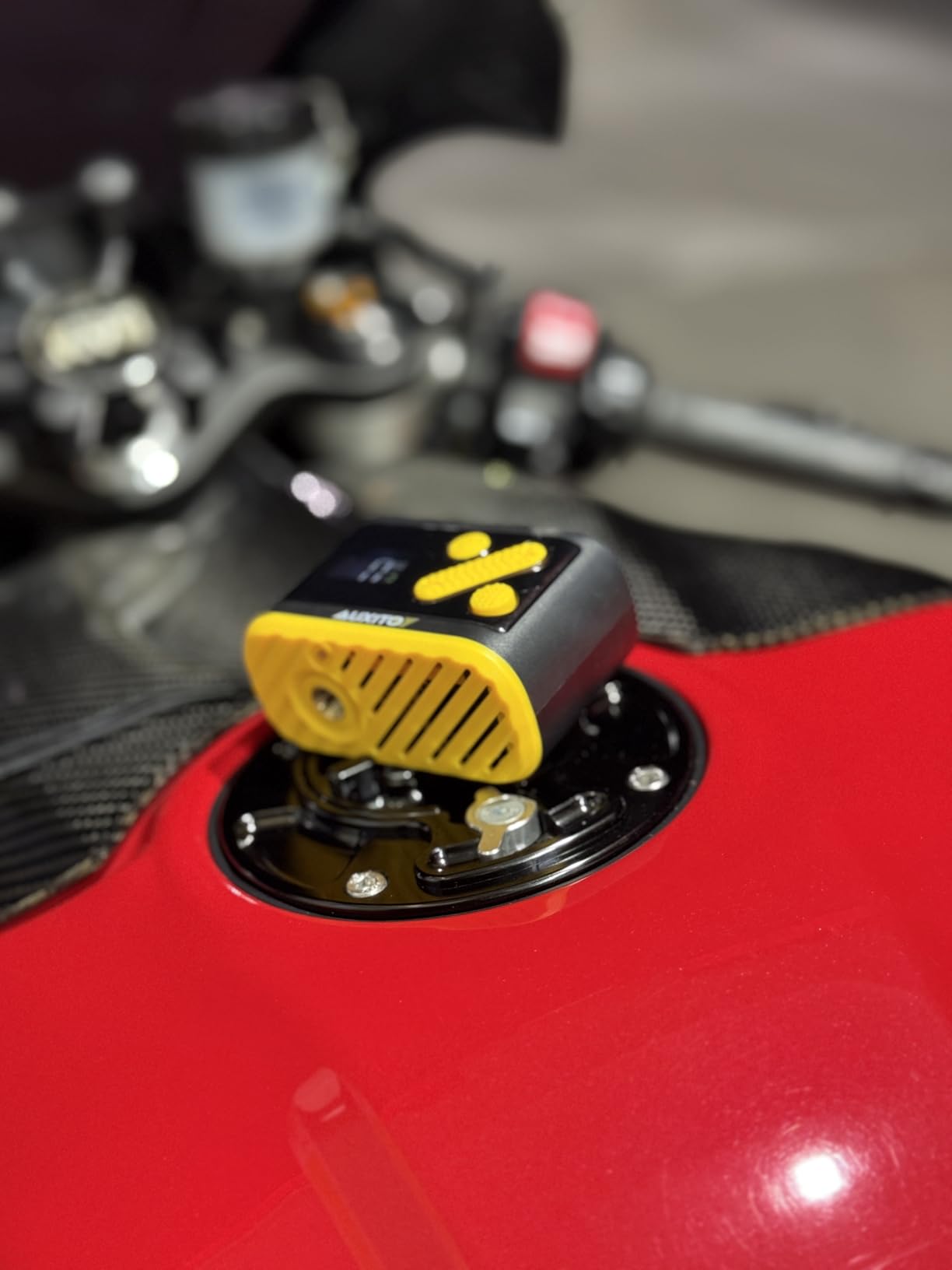
The battery is the story here. At 26000mAh, this is the largest pack in the list, and it delivers 30 minutes of continuous runtime. Per charge that covers 30 tires at 275/65R18 from 30 to 36 PSI, or five of the same from flat, which is more than most people will use in a day.
Flow comes from a 36 mm brushless motor pushing 55 L/min, rated to 150 PSI. A 275/65R18 pickup tire from 30 to 36 PSI takes 60 seconds, and the plus or minus 1 PSI pressure sensor doubles as a tire gauge. The 65W fast charger refills the pack in two hours over an ordinary USB-C cable, so there is no proprietary brick to lose.
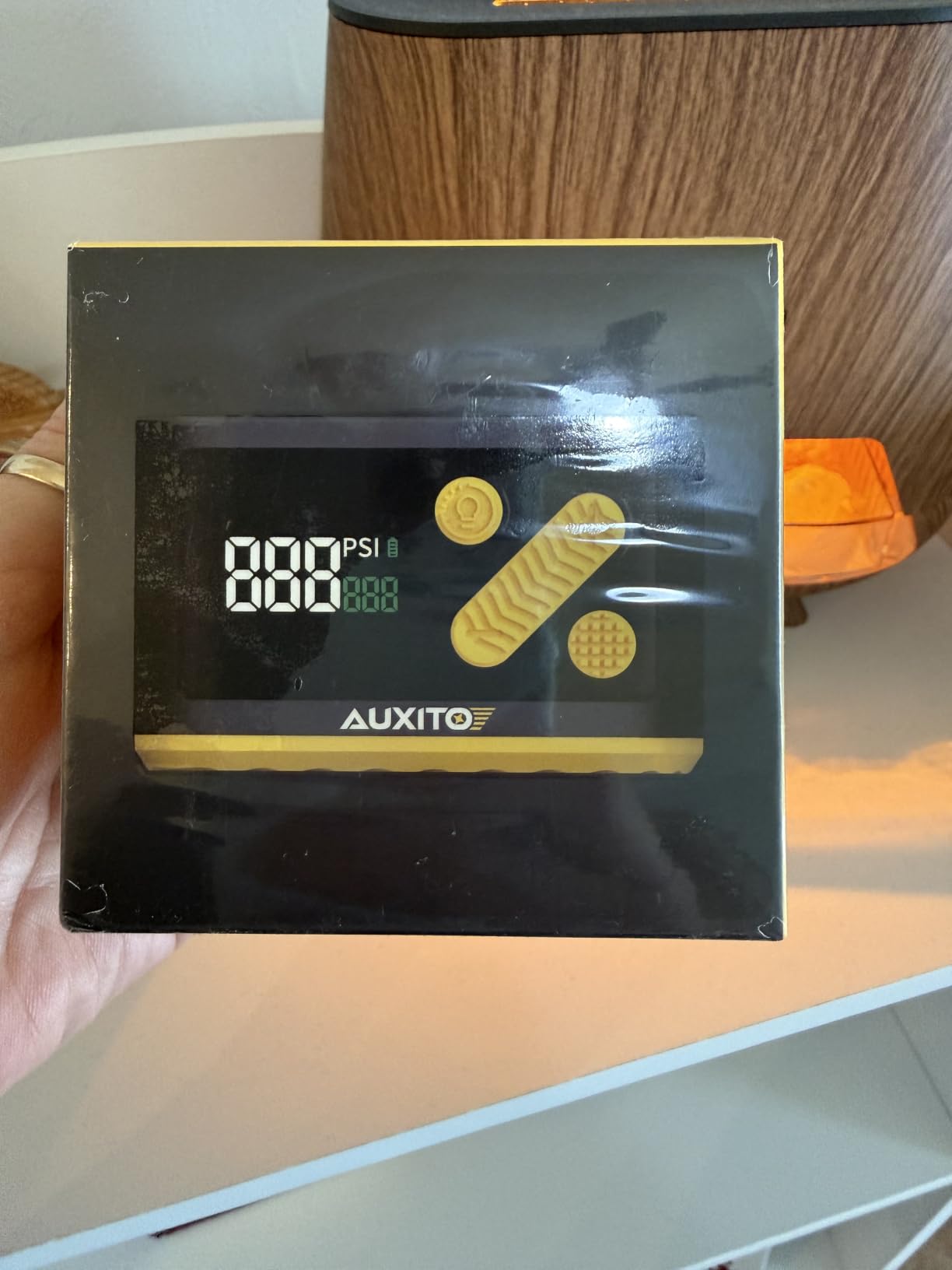
At 3.9 pounds it is the lightest full-size unit here, and the 2000-lumen LED with steady, strobe and SOS modes is a genuine trail asset. Type-C output ports let it charge laptops and phones, which quietly makes it camp equipment as much as inflation equipment.
Where it gives ground is flow relative to the wired dual-cylinder pumps. 55 L/min is strong for a cordless unit but well short of what a big 12V pump moves, so 35 to 40 inch tires from low trail pressure take proportionally longer. It is also battery-only, with an 18.5V internal pack that is not interchangeable with lower-voltage competitors.
What tire size it handles well
275-section truck tires and 33s, where a one-minute top-off and a big battery per charge line up well. It is a fast cordless unit for its class rather than a replacement for a high-flow wired pump.
Where it falls short
The 866-review base is smaller than the established brands, so long-term durability is less proven. If you run 37s and larger, or fill spares after a four-tire session, the 30-minute runtime forces a mid-day recharge.
8. ALL-TOP Dual Cylinder 12.35 CFM – Fastest for 35s and 37s
- 350 L/min is the highest flow here and fills 35 to 37 inch tires in roughly 1 to 1.5 minutes
- Tested on a 315/70R17 from 10 to 31 PSI in 1 minute 15 seconds
- Dual aluminum cylinders in a hollow metal shell shed heat well
- 26 ft hose plus 6.5 ft cord covers a full truck from one connection
- Auto-thermal cut-off and over-current protection
- No automatic shut-off and the hose-end gauge cannot be read while filling
- Included gauge is widely reported as inaccurate
- 24 pounds is the heaviest unit here and hard to drag to the battery
- Runs hot enough that owners add external cooling fans
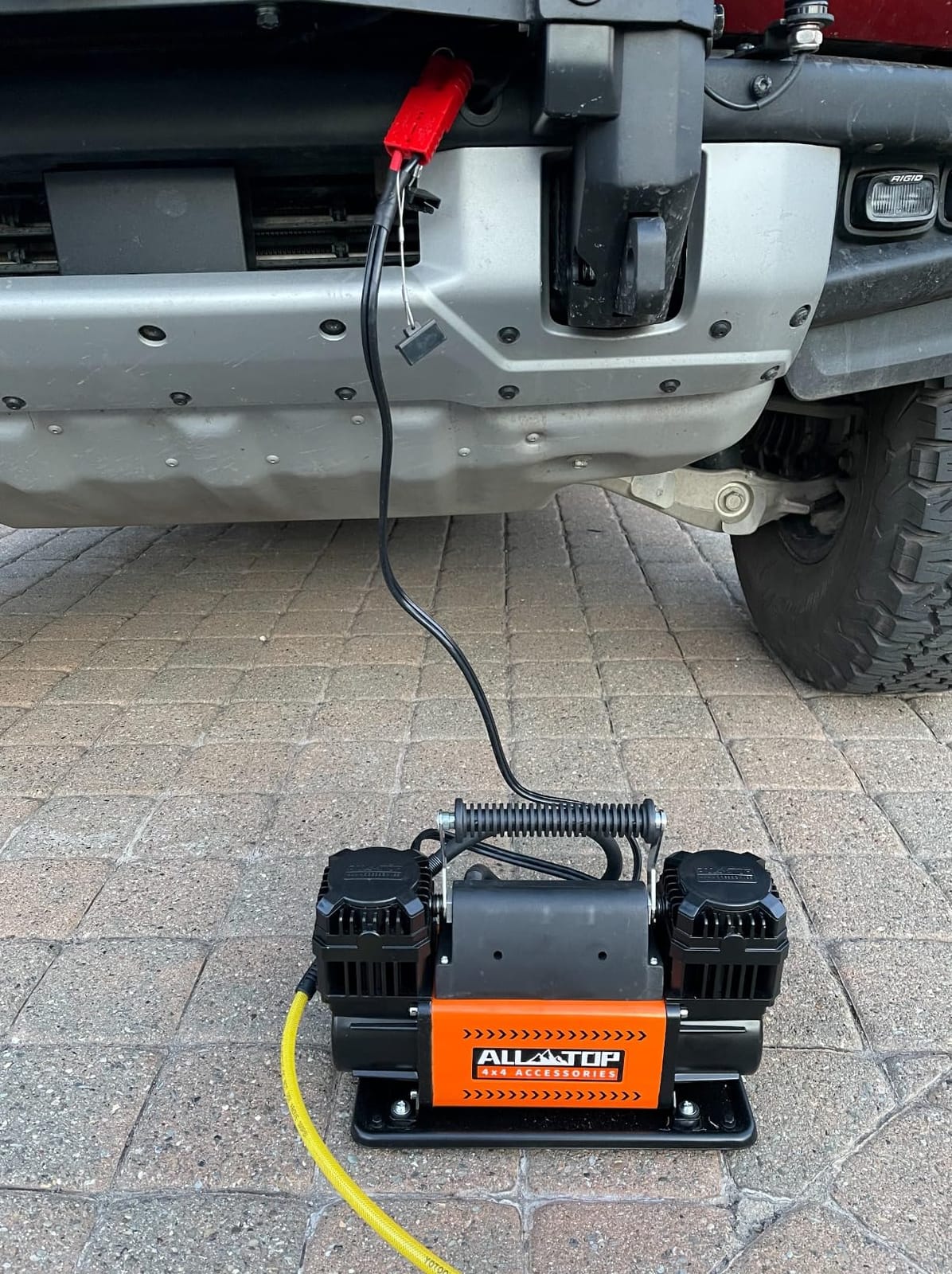
This is the fastest portable 12V compressor in the list, and it is not close. At 350 L/min, or 12.35 CFM, it moves air several times faster than the typical 70 L/min dual-cylinder unit. Owners filling 35 and 37 inch off-road tires report roughly one to one and a half minutes per tire, and one independent test on a 315/70R17 recorded 10 PSI to 31 PSI in 1 minute 15 seconds.
The dual aluminum cylinders sit in a hollow metal shell, which handles heat better than the plastic-pump competition. That matters at this flow rate, and it is paired with an auto-thermal cut-off and over-current protection so the motor is protected on a long fill.
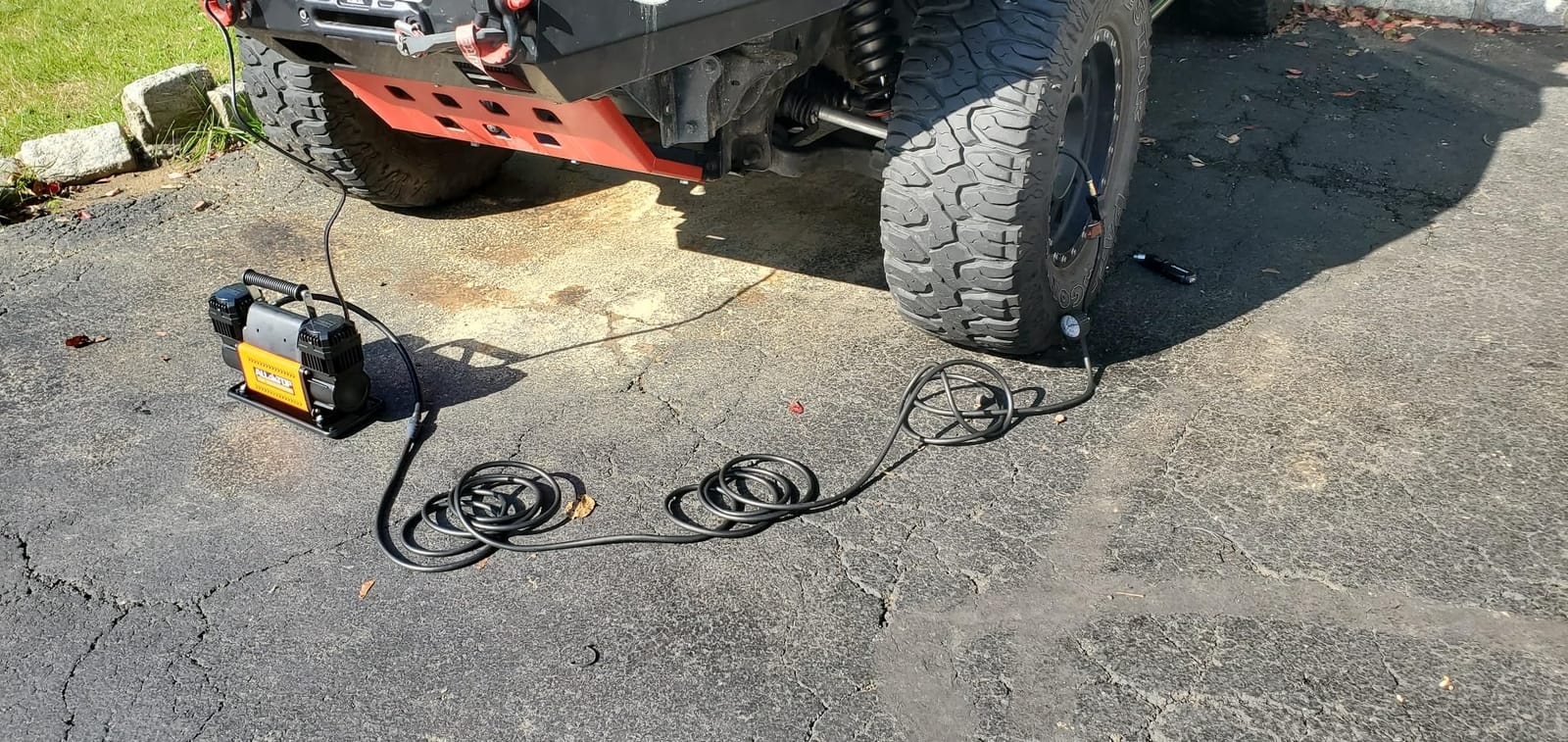
Reach is handled: a 26 ft rubber hose with a pressure gauge plus a 6.5 ft heavy power cord covers a full truck or a Jeep from one battery connection. It also ships with three nozzle adapters, a thumb-lock adapter and a nylon tool bag, on a two-year warranty.
The honest weakness is control and handling. There is no automatic shut-off, the gauge is mounted on the hose end where you cannot read it while filling, and owners report it is not accurate. At 24 pounds it is the heaviest unit here, and it runs hot enough that several owners fitted external cooling fans and a pressure switch.
What tire size it handles well
35s, 37s and even 40-inch tires, as long as you are not filling from completely empty. The flow rating is matched to exactly the tire sizes that make most owners doubt their compressor is fast enough.
Where it falls short
It is a two-person job unless you are deliberate about it. Lifting 24 pounds out of a bed, dragging it to the battery and reading an inaccurate gauge at the far end of a 26 ft hose adds friction to an otherwise fast process.
9. OlarHike 12000mAh Hybrid Power – Best Cordless and Wired Combo
- Only unit that runs cordless and on continuous 12V car power
- 3.2 pounds and a compact body that stores anywhere
- Twin-cylinder metal design rated 150 PSI at 50 L per min
- Twist-Lock quick connection and lock-on chuck cut air loss between tires
- Battery management covers over-current and temperature
- 45W PD charging doubles as a power bank
- 12000mAh is the smallest battery in the list
- 50 L per min trails the wired dual-cylinder pumps
- 20-second fill claims are for small sedan tires
- 13 A and 190 W is the lowest power draw here
- 78 dB with a higher strained motor sound
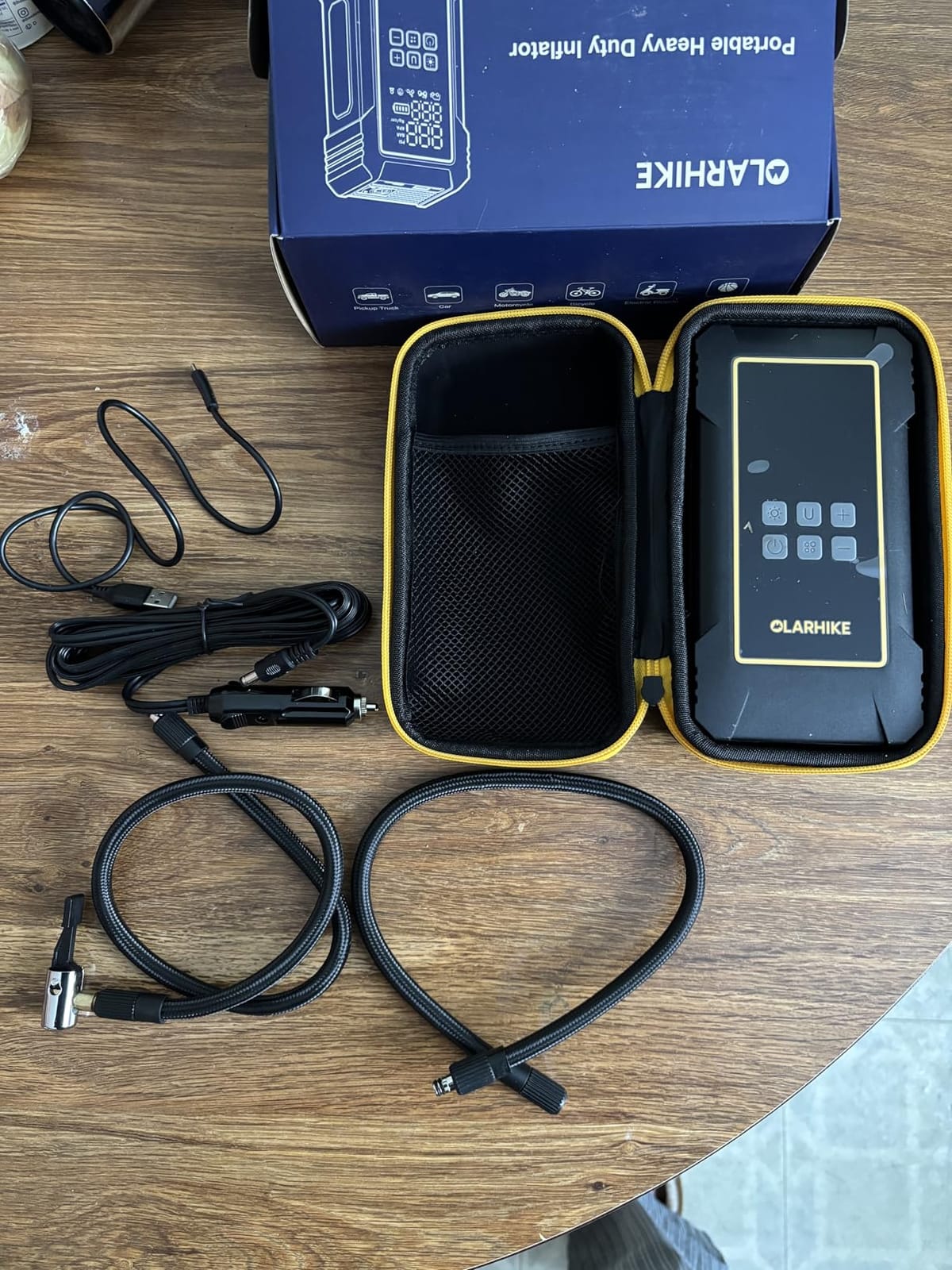
Hybrid power solves the problem that stops most people from going cordless. You carry the unit to the tire, and if the internal battery is low you plug it into the 12V car adapter and keep going. Nothing else in this list does both, and for a truck that already has a second battery or a heavy-duty alternator, that flexibility removes the main objection.
The body is small and light at 3.2 pounds, with a twin-cylinder metal design rated to 150 PSI and 50 L/min. The patented Twist-Lock quick hose connection and lock-on chuck mean less air escaping each time you move to the next tire, which is a real time saver over bare valve stems.
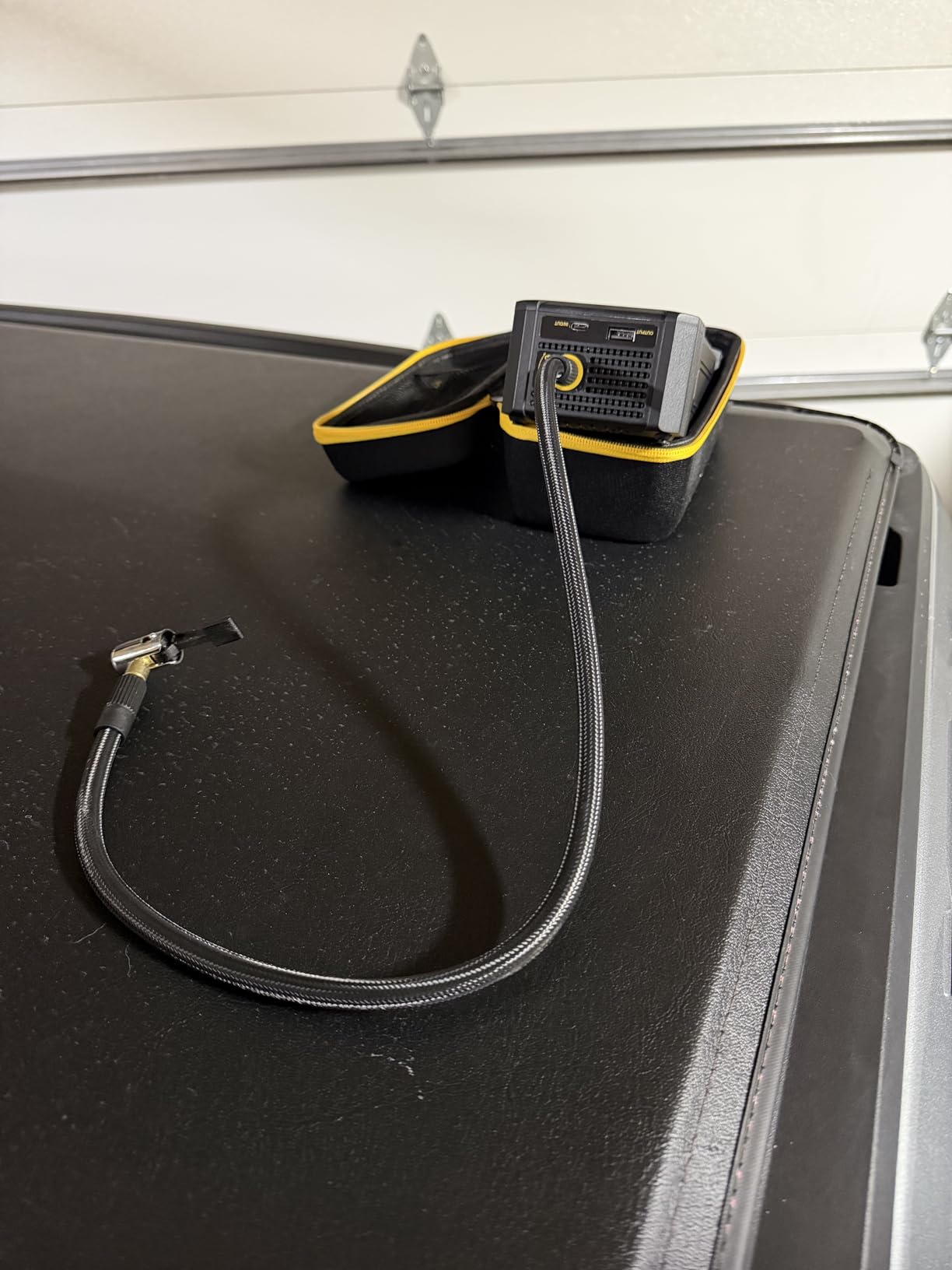
Safety hardware is unusually thorough for the price tier, with battery management covering over-charge, over-discharge, over-current at 19A, short circuit and temperature. The 45W PD bidirectional charging turns it into a power bank, and a rugged EVA case holds the unit, both braided hoses and the full adapter set.
The battery is the small print. At 12000mAh it is the smallest pack here, topping out at 44 tire fills against 18 F-150 tires on the larger ETENWOLF, and 50 L/min is slower than the wired dual-cylinder pumps. The 20-second fill claim refers to small sedan tires, not the 35s and 37s most people are buying this for.
What tire size it handles well
30 to 33 inch tires, where the battery capacity and the flow rate line up. It is a good truck-tire top-off unit and a sensible daily driver compressor, just not a 40-inch tire machine.
Where it falls short
If your plan is to air down to 12 PSI on 37s and air all four back up, the battery budget and the 50 L/min flow both work against you. Plan on using the 12V car adapter for the full four-tire session rather than the internal pack.
10. VEVOR 10.6 CFM Dual Cylinder – Best High-Flow 12V Unit
- 10.6 CFM of airflow for a 12V unit in this tier
- 150 PSI with a dual-cylinder design for truck
- SUV and 4x4 tires
- 26 ft rubber hose with a mechanical gauge reaches around a full-size truck
- Auto-thermal cut-off protects the motor on extended fills
- Aluminum and iron construction with a tool bag
- 25.4 pounds is the heaviest unit in the list
- 90 dB is the loudest and carries across a campground
- 75 A maximum draw needs a dedicated battery connection with the engine running
- No automatic shut-off and the gauge must be read at the hose end
- Smallest review base at 132 reviews
The VEVOR is the airflow-per-tier pick. At 10.6 CFM with a dual-cylinder design, it moves close to the biggest pump here while weighing 3.4 pounds less, which changes how you feel about dragging it across a campground. Owners use it for truck, SUV and 4×4 tires across a wide range of sizes.
The build is solid rather than light. Aluminum and iron construction, a 26 ft rubber hose with a mechanical pressure gauge, a 6.5 ft power cord, three nozzle adapters plus a thumb-lock adapter and a portable tool bag are all included, and the auto-thermal cut-off handles the motor during extended fills.
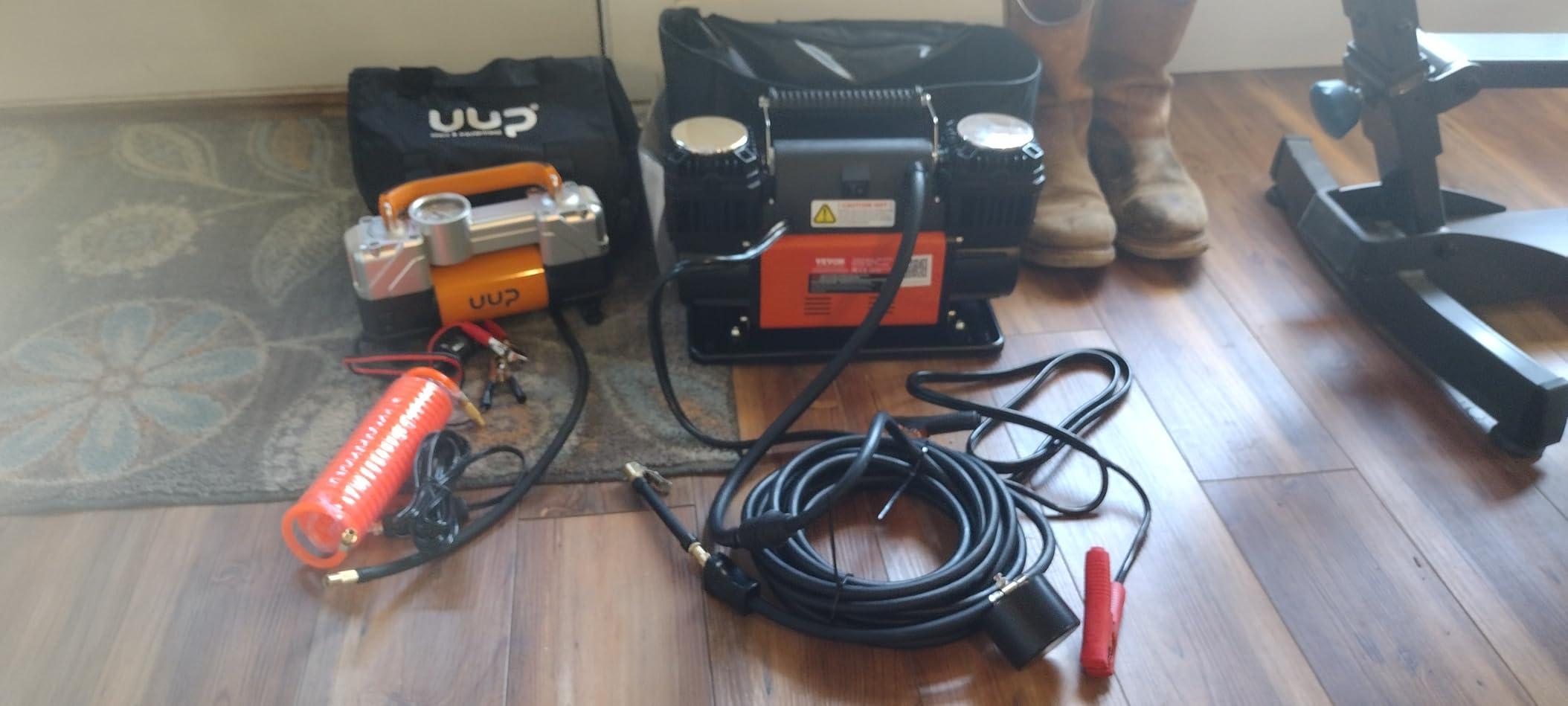
It is rated to 150 PSI, which is enough headroom for off-road tire pressures on trucks and 4×4 vehicles, and the hose reach means you are not repositioning the unit between corners of a long bed.
The trade-offs are physical and electrical. At 25.4 pounds it is the heaviest unit in this list, 90 dB makes it the loudest and easily audible across a campground, and a 75 A maximum draw means a dedicated battery connection with the engine running. There is also no automatic shut-off, and the 132-review base is the thinnest here, which is worth weighing for a long-term purchase.

What tire size it handles well
35 and 37 inch tires on trucks and 4×4 vehicles, where high airflow shortens the session without moving to an onboard system. It also handles smaller tires easily.
Where it falls short
Weight, noise and current draw are the three things to accept up front. This is a pump that wants a healthy electrical system and two hands, and buying it for a small SUV on 33s leaves a lot of capability unused.
How We Picked the Best Air Compressors for Airing Up Off-Road Tires?
Every unit here was compared on the same five things: rated airflow in CFM or LPM, duty cycle and cool-down behavior, max working pressure against real tire needs, hose and cord reach, and draw from the vehicle electrical system. We also weighed weight, noise rating and whether the unit auto-stops at a target pressure, because those three decide whether you will actually enjoy using it.
Alongside the spec sheets we used owner reporting from off-road forums, where the recurring themes are duty cycle complaints on low-duty-cycle pumps, gauge inaccuracy on hose-end analog gauges, cord length too short to reach around a truck, and motors running hot enough to be a burn risk. Those are the details a spec comparison table never shows you.
What Size Air Compressor Do You Need? Tire Size, CFM and Duty Cycle
Airflow is the number that matters. As a working rule, about 2 CFM handles 33 inch tires, 3 to 4 CFM handles 35 and 37 inch tires, and 5 CFM or more is what you want for 40s and larger aired down from trail pressure. If you are filling all four tires from around 12 PSI, double your expectation for a single tire and plan cool-down breaks.
Duty cycle decides patience. Duty cycle is the ratio of run time to rest time. A 33 percent duty cycle means roughly ten minutes on and twenty minutes off, so four big tires means real waiting. A 100 percent duty cycle unit runs continuously, which is why the VIAIR 450P-RV and the cordless dual-cylinder pumps stand apart for long sessions.
Pressure ceiling is a filter, not a selling point. Off-road tires rarely need more than the door-jamb placard pressure, usually 30 to 40 PSI on a truck. Anything at 120 to 150 PSI is enough; the 120 PSI VIAIR 88P covers the off-road range fine, and only the 100+ PSI load-range setups on trailers and duallies require the higher ceiling.
Hose and cord reach decide whether you fight the tool. A 6 ft power cord forces you into jumper cables or extension cords. Look for at least 10 ft of cord and 15 ft or more of hose, or 60 ft if you are airing a motorhome or fifth wheel. Reach matters more than most buyers expect.
Power source changes the workflow. A wired 12V unit with battery clamps needs a healthy battery and a running engine, and a unit drawing 30 A or more deserves a direct battery connection. Cordless units need no engine at all but have a fixed battery budget per charge. A hybrid unit like the OlarHike gives you both.
Tank size, weight and noise round it out. A small integrated tank smooths pressure delivery, but for tires, airflow and duty cycle deliver the result. Weight decides whether you drag the pump to the tire or carry it, and noise above roughly 80 dB is noticeable across a campground. We also keep an eye on our portable compressor guide for truck tires and our budget-tier compressor roundup for narrower budgets.
Onboard vs Portable Compressors: Which One Fits Your Rig
A portable unit lives in the bed or the back seat and comes out when you need it. It costs less, you can service or replace it yourself, and it is the only sensible option if you use more than one vehicle. The cost is that you clip leads to a battery and wait for the pump each time.
An onboard system is hardwired to the vehicle and available whenever the ignition is on, which means airing down and back up is seamless and you can run air horns, lockers or air suspension from the same unit. The trade is installation, permanent weight, and a permanently draining battery when parked, so dual-battery setups are common. If your recovery gear is already a fixed-install philosophy, our off-road lighting guide covers the same build logic.
For most people, the right answer is a portable unit plus a second battery or a jump pack for the dead-battery scenario that every off-roader worries about. The forum consensus is consistent on this point: ARB is treated as the durability benchmark, and VIAIR as the value benchmark, but the category split is between how it is installed rather than how well it inflates.
Frequently Asked Questions
What is the best air compressor for airing up tires?
For 33 to 35 inch off-road tires, a 12V dual-cylinder compressor moving at least 2 CFM is the practical minimum, and 3 to 5 CFM is better once you start filling four tires at once. Our pick is the GSPSCN metal dual-cylinder unit at 70 L/min, with the VIAIR 300P at 2.30 CFM as the step up for 37s.
How big of an air compressor do I need for airing tires?
Match airflow to tire size: roughly 2 CFM for 33s, 3 to 4 CFM for 35s and 37s, and 5 CFM or more for 40s and larger. Add a duty cycle of 50 percent or higher so the pump does not need a long cool-down between tires, and allow 150 PSI maximum even though off-road pressures rarely exceed 40 PSI.
What is the best air compressor for a 4×4 vehicle?
A 12V compressor with at least 3 CFM and a 25 ft or longer hose, since a 4×4 uses its factory battery for recovery gear and you want to reach every tire from one connection. High-flow dual-cylinder models in the 10 CFM range are worth it if you air down to 12 PSI regularly on 35s and 37s.
Which air compressor is better, Viair or ARB?
Off-road owners treat ARB as the durability benchmark and VIAIR as the value benchmark. VIAIR portable units deliver comparable airflow at a much lower entry point, while onboard ARB systems win on integration and continuous availability but require a fixed install and a second battery. For most rigs, a portable VIAIR plus a dual battery covers the same ground.
Are VIAIR air compressors good?
They are among the most established 12V compressors, and the 88P, 300P and 450P-RV hold averages of 4.7 across thousands of reviews. Common owner notes are hot motor housings, an inline gauge on the 300P that reads to about 100 PSI, and a 33 percent duty cycle that forces cool-downs between tires.
Is a 3 gallon air compressor good for inflating tires?
A 3 gallon tank is large by compressor standards but it is a recovery reservoir, not a tire filler. Tank size smooths pressure delivery; airflow and duty cycle set tire fill time. For off-road tires, spend the capacity on CFM and duty cycle rather than tank volume.
What is the best 12 volt air compressor for off-road use?
Among the 12V units we compared, the GSPSCN dual-cylinder unit offers the best balance of metal construction, 70 L/min flow, reach and quiet operation, with the most owner feedback in the group. The ALL-TOP at 12.35 CFM is the fastest, and the VIAIR 300P at 2.30 CFM is the best-established option for trucks running 35s and 37s.
Final Verdict on the Best Air Compressors for Airing Up Off-Road Tires in 2026
Start with the GSPSCN dual-cylinder unit if you want one compressor that does everything well: metal construction, 70 L/min of flow, reach that covers most rigs and quiet enough for camp. Add a VIAIR 88P as a permanent emergency backup, since owners on off-road forums recommend it more than anything else in the budget category.
Move up to the VIAIR 300P if you run 35s and 37s and want established brand backing with 2.30 CFM of flow. Choose the ALL-TOP or the VEVOR if recovering from a fully aired-down crawl quickly matters more than carrying weight, and pick the ETENWOLF S6 or the AUXITO if you would rather never clip leads to a battery at all.
Whatever you choose, buy the airflow your tire size demands, run the engine or charge the pack before you leave pavement, and set your target pressure to the door-jamb placard rather than a number you saw on a trail. That is the version of the best air compressors for airing up off-road tires that actually gets you home on time.